45 Star American Parade Flag | Personal Keepsake of Louis Harry Wager Jr. | Commemorating Theodore Roosevelt’s Presidential Visit to Kansas City | Circa 1903
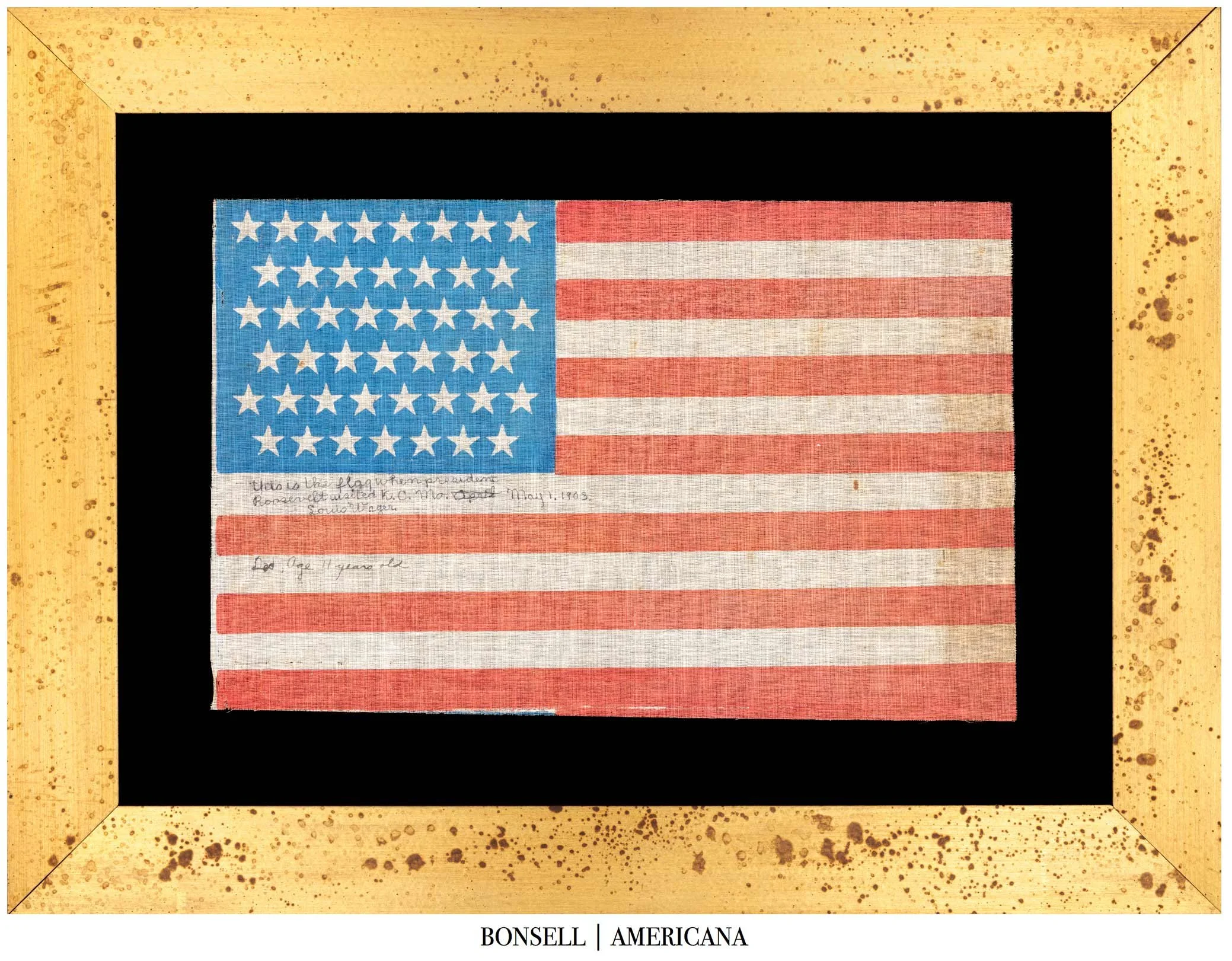
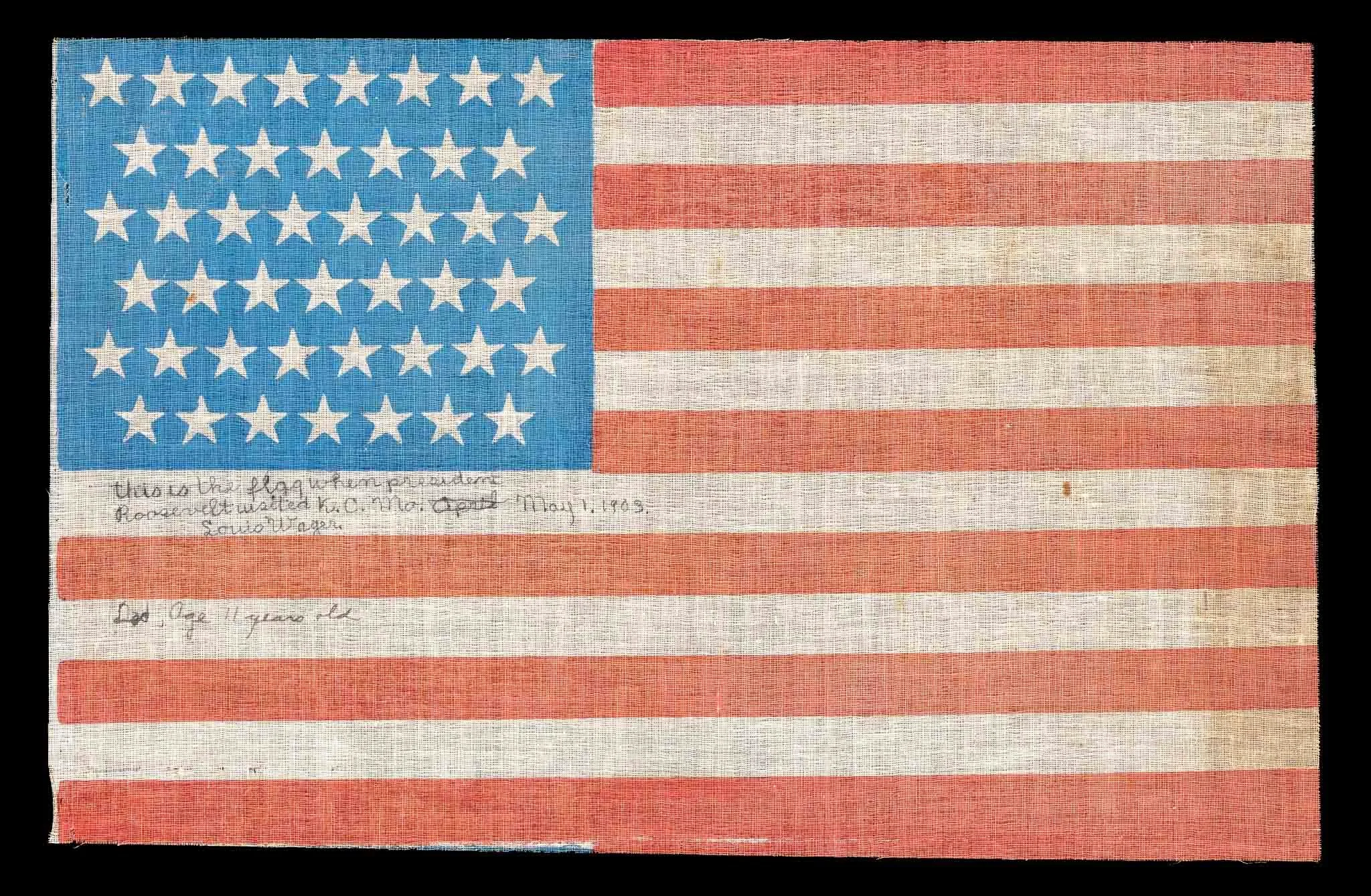
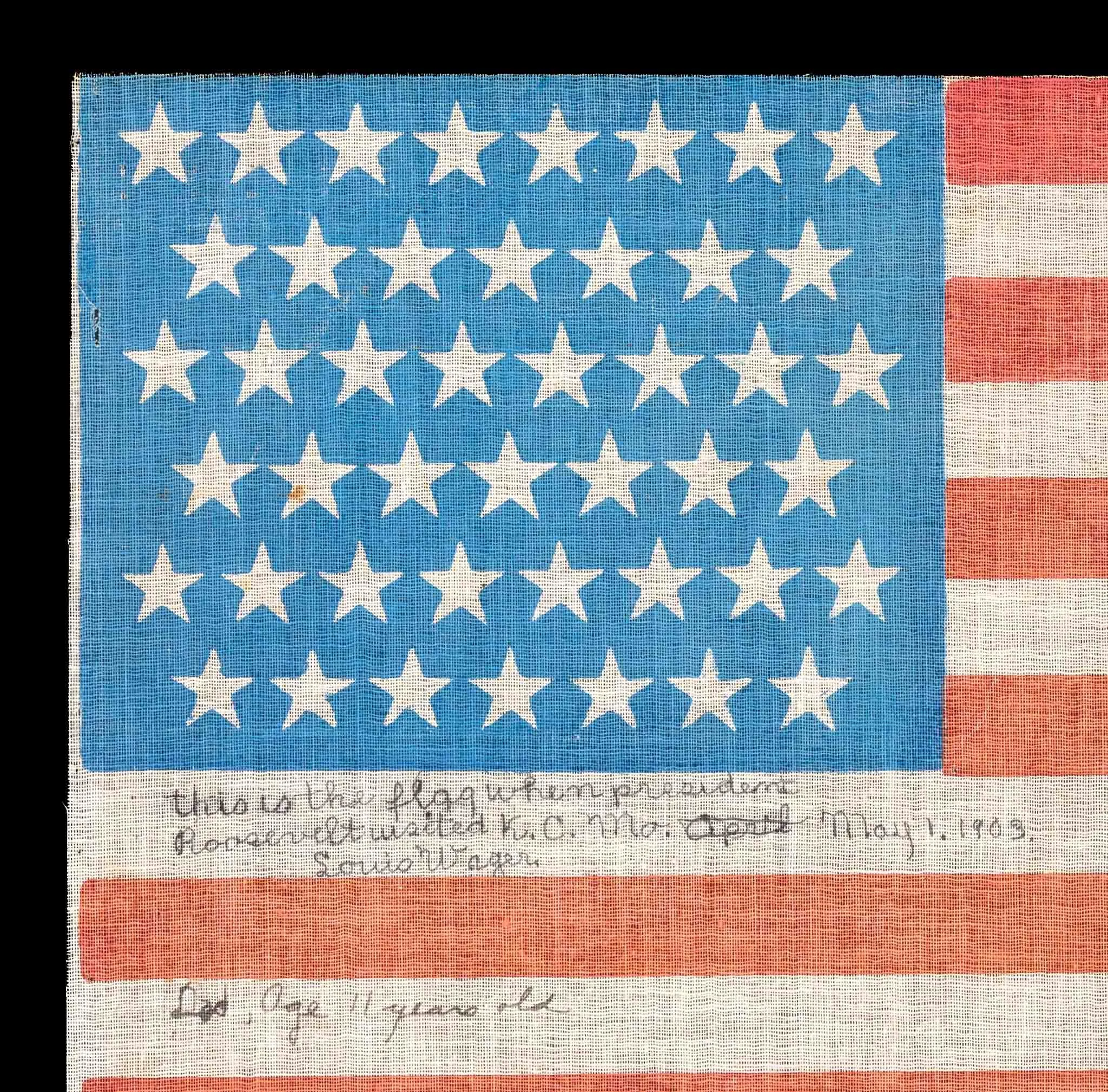
45 Star American Parade Flag | Personal Keepsake of Louis Harry Wager Jr. | Commemorating Theodore Roosevelt’s Presidential Visit to Kansas City | Circa 1903
Frame Size (H x L): 19 ¼” x 25 ¾”
Flag Size (H x L): 11” x 17”
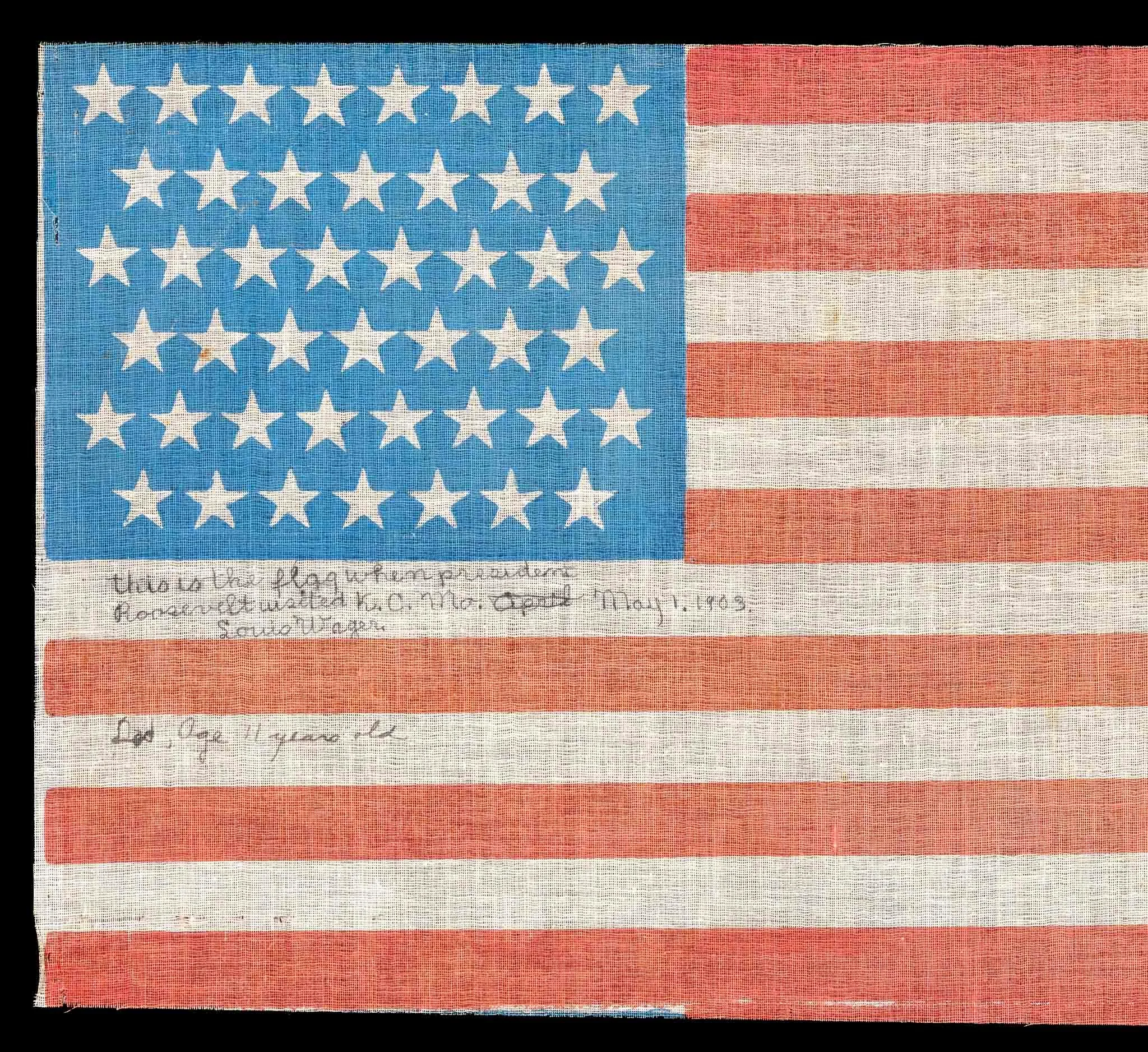
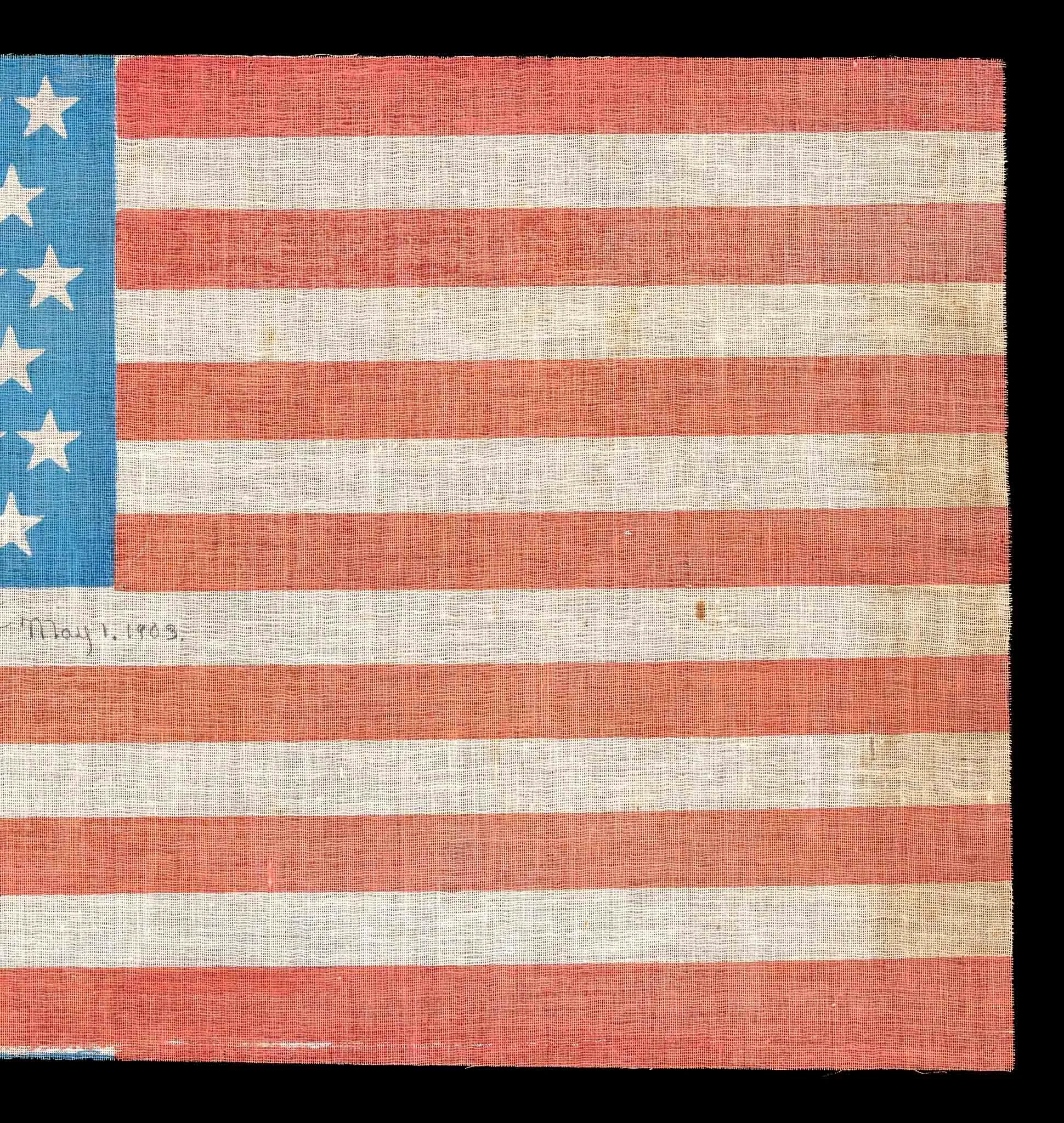
Offered is an exceptional 45-star American parade flag commemorating President Theodore Roosevelt’s visit to Kansas City, Missouri, on May 1, 1903. Printed on glazed cotton, the flag features a particularly attractive cornflower blue canton with 45 white, five-pointed stars arranged in an 8-7-8-7-8-7 configuration. The stars are evenly distributed across the canton in six straight, staggered rows, with each star oriented with a single point upward.
The 45-star flag became official on July 4, 1896, following Utah’s admission to the Union as the 45th state on January 4 of that year. It remained official through July 3, 1908, when it was succeeded by the 46-star flag following the admission of Oklahoma. The 45-star flag served as the national colors during the Spanish-American War, the assassination of President William McKinley, and the majority of Theodore Roosevelt’s presidency.
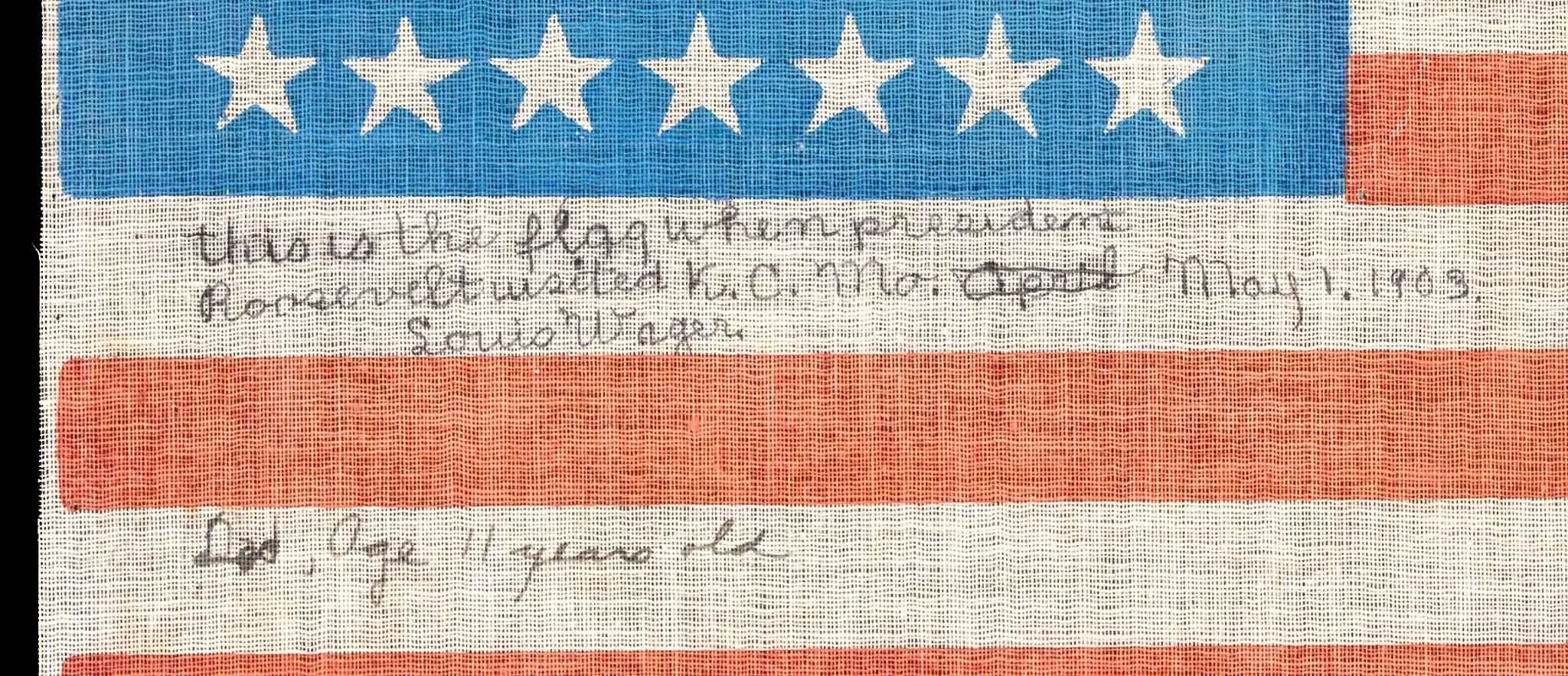
Of particular significance are the handwritten inscriptions appearing across two of the flag’s white stripes. The principal inscription, executed in pen, reads:
“This is the flag when President Roosevelt visited K.C. Mo. May 1, 1903. Louis Wager.”
Interestingly, the month of April appears to have been initially recorded and subsequently struck through in favor of May. A supplemental inscription on a lower white stripe reads:
“Dad, Age 11 years old.”
The handwriting of the supplemental inscription appears noticeably different from that of the principal inscription, exhibiting a more fluid and slanted style of penmanship. While the precise meaning of the reference to “Dad” is uncertain, it is possible that Wager attended the presidential procession with his father and was referencing his presence at the event. Perhaps more likely, given the apparent differences in handwriting, the supplemental inscription was added by one of Wager’s children at a later date, identifying the flag as a keepsake from their father’s childhood. Such an interpretation would suggest that the flag was preserved within the Wager family as an object of personal significance.
Regardless of the precise interpretation of the supplemental inscription, extensive historical and genealogical research has corroborated the circumstances described in the principal inscription, as well as the probable identity and age of the young boy who owned the flag.
PRESIDENT THEODORE ROOSEVELT’S VISIT TO KANSAS CITY
On April 1, 1903, President Theodore Roosevelt embarked on an extensive tour of the United States that would occupy more than two months of his presidency. Traveling primarily by railroad, Roosevelt visited communities throughout the Midwest, Great Plains, Mountain West and Pacific Coast, delivering numerous speeches and participating in public receptions along the way. The tour provided Americans across a considerable portion of the country with a rare opportunity to see a sitting president in person.
Roosevelt had assumed the presidency in September 1901 following the assassination of President William McKinley. At just 42 years of age upon taking office, he was the youngest individual to become president in American history. His energetic personality, military reputation stemming from the Spanish-American War, and increasingly prominent domestic reform agenda made him one of the most recognizable figures in American public life.
On April 30, 1903, Roosevelt participated in the dedication ceremonies for the Louisiana Purchase Exposition in St. Louis, Missouri. The exposition, which would formally open to the public the following year, commemorated the centennial of the Louisiana Purchase. Roosevelt continued westward, arriving in Kansas City on the morning of May 1, 1903.
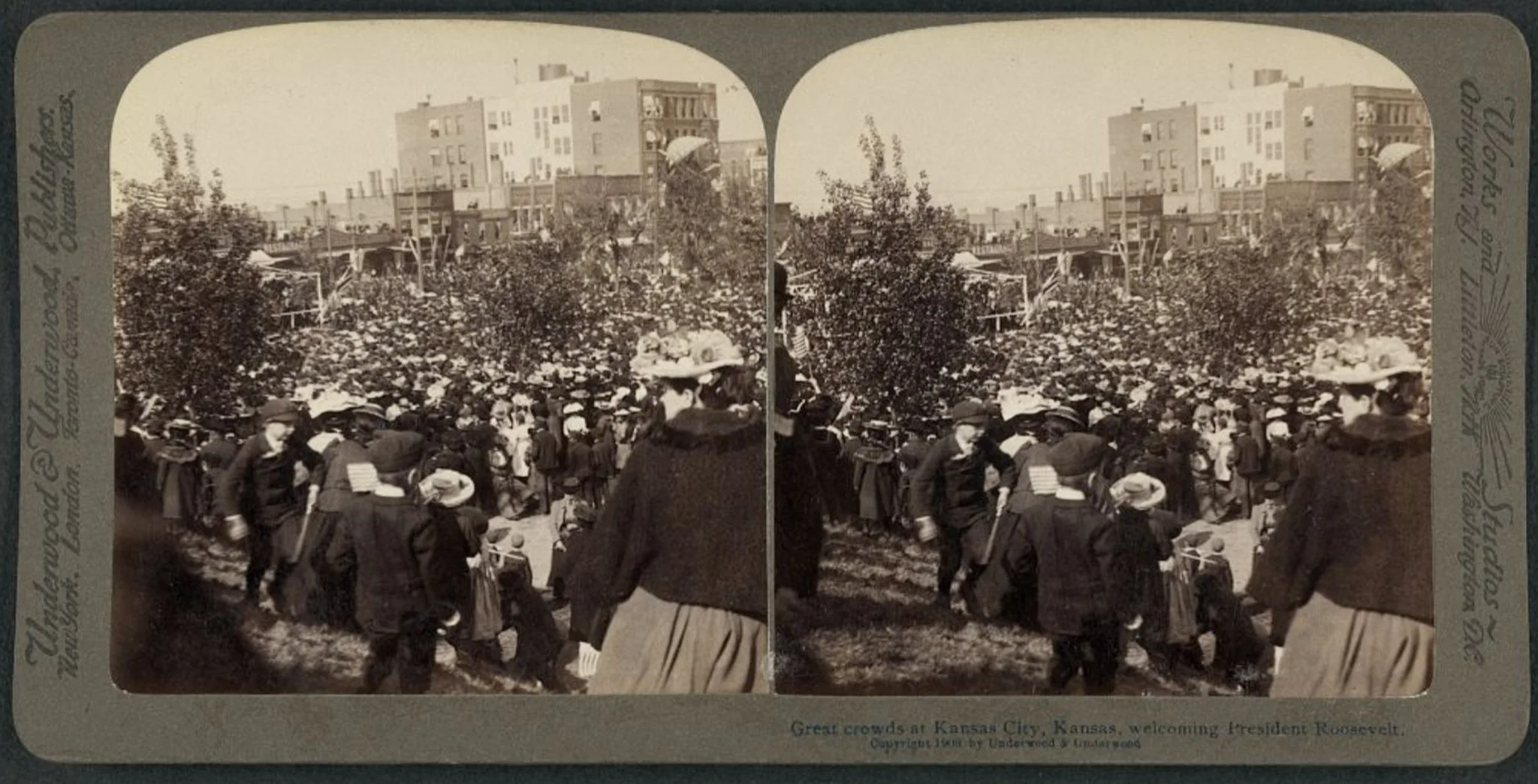
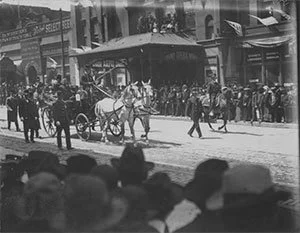
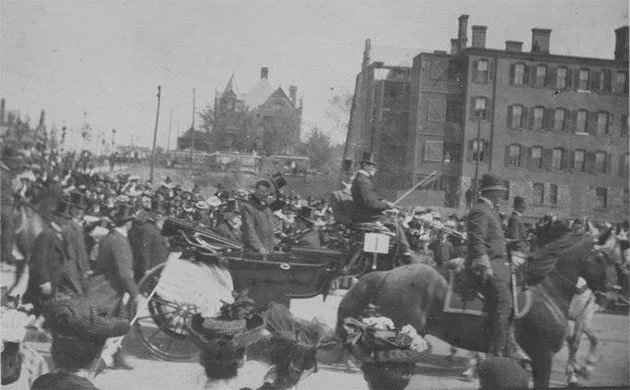
Kansas City organized an elaborate reception for the president, including a procession through the city, a public address at Convention Hall and a luncheon hosted by the Commercial Club at the Baltimore Hotel. Thousands of spectators gathered along the presidential procession, with buildings and streets decorated in patriotic colors.
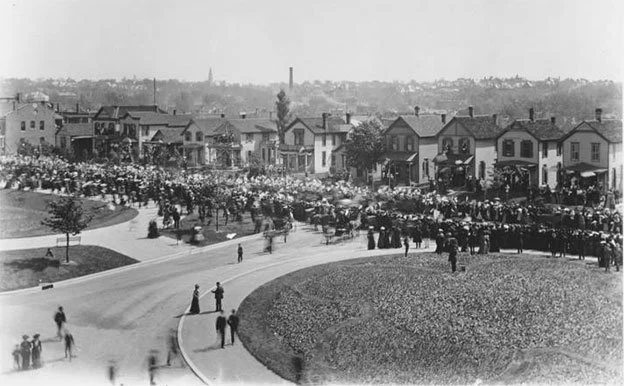
Of particular relevance to the flag offered here was the organized participation of Kansas City’s schoolchildren. Contemporary newspaper accounts describe more than 20,000 children assembling along the Paseo, one of the city’s principal boulevards, to greet the president. Children sang patriotic songs, cheered and waved small American flags as Roosevelt passed.
Several original photographs of the presidential procession survive, documenting the crowds that assembled throughout Kansas City on that day. Roosevelt subsequently visited Kansas City, Kansas, before continuing westward to Topeka.
LOUIS HARRY WAGER JR. (1892–1957)
Through historical and genealogical research, the flag’s original owner has been identified as Louis Harry Wager Jr., who was born in Leavenworth, Kansas, on March 14, 1892. Wager had celebrated his 11th birthday less than two months before Roosevelt’s visit to Kansas City, matching the age recorded on the flag.
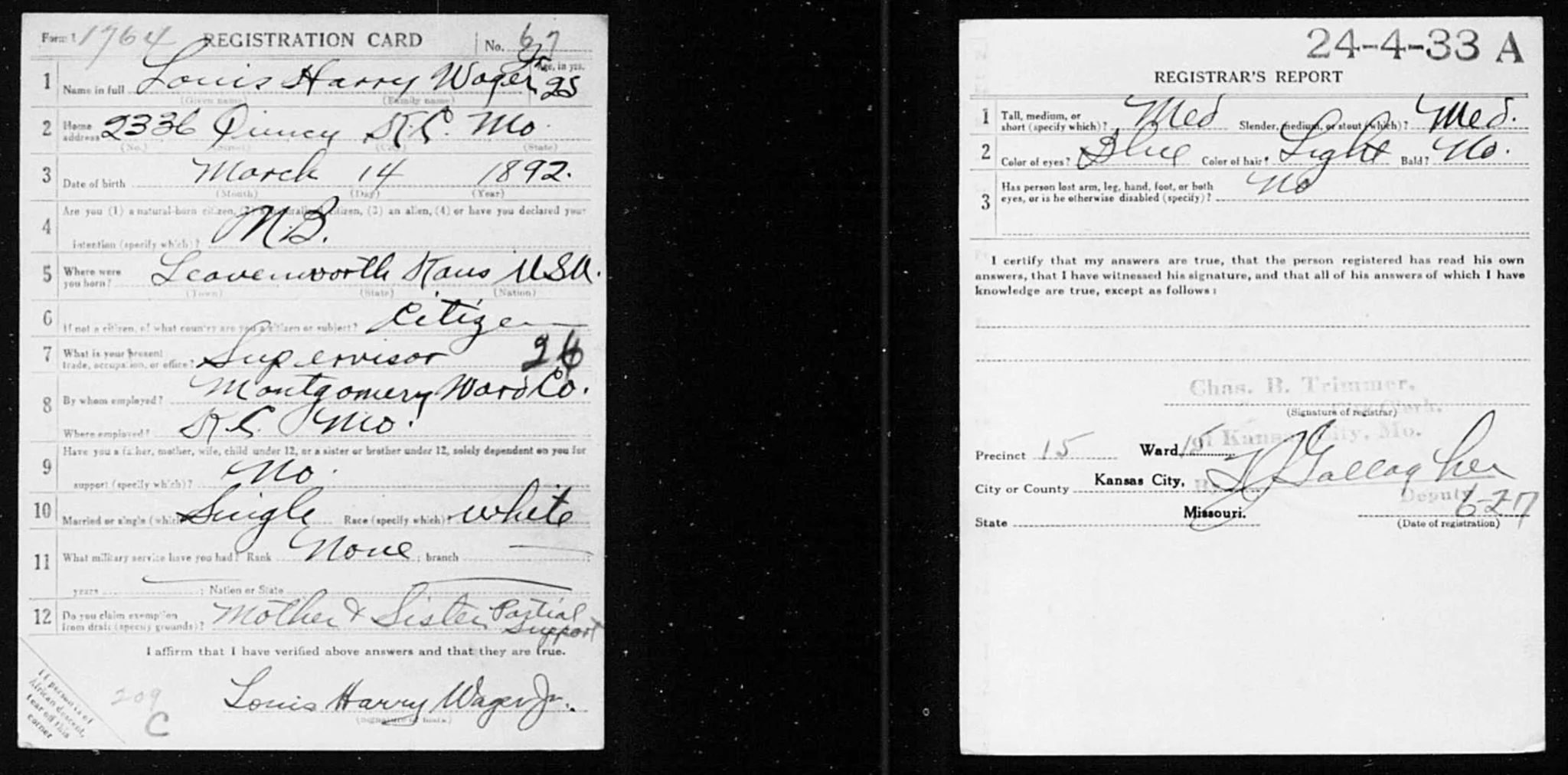
Wager spent much of his adult life in Kansas City, Missouri. His surviving World War I draft registration card, completed in June 1917, records his residence as 2336 Quincy Street and identifies him as a supervisor employed by Montgomery Ward & Co., one of the nation’s leading retailers.
At the time of his registration, Wager was unmarried and 25 years of age. He reported having no previous military service and requested exemption from the draft on the grounds that he contributed to the financial support of his mother and sister. Available historical evidence suggests that Wager remained a civilian throughout World War I.
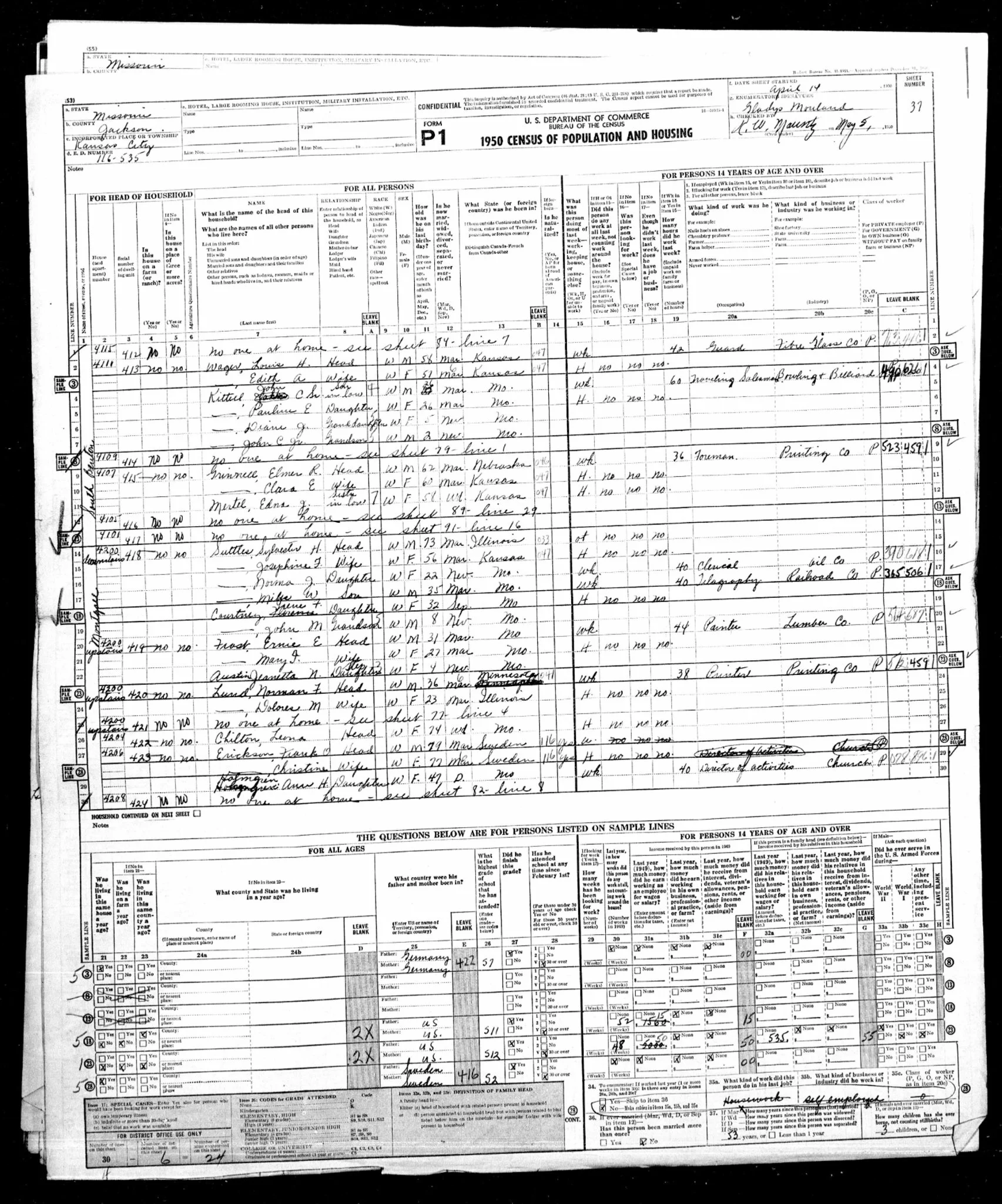
Wager subsequently married Edith Albertina Miller, with whom he had at least two daughters, Patricia and Pauline, both reportedly born in 1924. The 1950 United States Federal Census records Wager, then 58 years of age, residing in Kansas City with his wife, daughter Pauline, son-in-law and two grandchildren. By that time, he was employed as a guard for a fiberglass company.
Wager died on April 20, 1957, at the age of 65, and was buried in Lansing, Kansas, near his birthplace.
Among the surviving historical documents associated with Wager is his original World War I draft registration card, which bears his handwritten signature. The document provides an interesting point of comparison with the handwriting appearing on the flag.
SIGNIFICANCE
While printed 45-star American parade flags survive in relatively substantial numbers, comparatively few can be associated with a specific historical event, and fewer still bear the name and age of an identifiable individual who apparently participated in that event.
The handwritten inscriptions distinguish this example from commercially overprinted flags manufactured specifically to commemorate presidential campaigns, visits and other patriotic occasions. Rather than bearing a standardized commemorative message, the flag features a personal record of the event and the identity of its young owner, together with what may be a subsequent annotation by a member of his family.
The convergence of Wager’s name, age, geographic associations and the precise date of Roosevelt’s visit, together with contemporary accounts documenting the participation of thousands of schoolchildren carrying American flags, provides unusually strong historical context for the flag.
An attractive example of a turn-of-the-century 45-star American parade flag in its own right, its principal significance lies in its association with President Theodore Roosevelt, a documented presidential reception, and the identifiable 11-year-old boy who appears to have preserved it as a reminder of May 1, 1903.
Conservation Process: This flag was hand sewn to cotton fabric, and both were hand sewn to a mounting board. To prevent the black dye in the cotton fabric from seeping into the flag, it was first washed in a standard wash and then in a dye setting wash. The flag is positioned behind Optium Museum Acrylic.
Frame: The flag is housed in a wide, sloped molding with an aged gold surface, intentionally distressed to evoke the appearance of early gilded frames.
Condition Report: The flag is in very good condition for its age, exhibiting minor fading, scattered areas of foxing and discoloration, and a few small holes and abrasions, primarily along the hoist and lower edge. Minor fraying is present along the perimeter. Both handwritten inscriptions remain clearly legible, and the flag retains its attractive cornflower blue canton and strong overall color.
Collectability Level: The Great – Perfect for Rising Collectors
Date of Origin: 1903
Number of Stars: 45
Associated State: Utah