

Frame Size (H x L): 28.5” x 33.5”
Broadside Size (H x L): 19.25” x 24”
Offered is a World War I agricultural recruitment broadside produced for use in Illinois under the auspices of the U.S. Boys’ Working Reserve. Printed in red and blue inks on cream machine-made paper, the poster urges farmers to “Take a Boy Now to Help You Farm,” presenting agricultural labor as a direct contribution to the national war effort.
Issued during America’s involvement in the First World War (1917–1918), the broadside responds to labor shortages caused by military enlistment and wartime industrial expansion. The text states that “20,000 Illinois boys (between 16 and 21) have volunteered in the U.S. Boys’ Working Reserve to help Illinois farmers produce the food to win the war,” explicitly linking agricultural production with national victory. While military enlistment posters are more commonly encountered, this material reflects the parallel mobilization taking place on the American home front.
HISTORICAL CONTEXT
The U.S. Boys’ Working Reserve was organized in 1917 under the United States Department of Labor to mobilize teenage boys for essential wartime labor. As adult farm workers entered military service or relocated to industrial employment, agricultural output faced measurable strain. State programs recruited, screened, trained, and placed high school-aged boys in agricultural positions.
Illinois played a meaningful role in this effort. The broadside describes participants as “carefully picked young men — able-bodied and eager for hard work — intelligent, of good character — trained to learn and to obey.” It further notes that many received “SPECIAL EDUCATION FOR FARM WORK,” including instruction in handling horses and farm machinery. The language reflects Progressive Era emphasis on discipline, character, and organized civic participation.
The text asserts that Federal and State governments “GUARANTEE THESE YOUNG MEN,” an assurance intended to address farmers’ concerns regarding reliability and preparedness. The statement that each boy would be “worth his keep from the first day” frames the program in practical economic terms alongside its patriotic purpose.
The broadside bears the printed names of Samuel Insull, Chairman of the Illinois State Council of Defense, and Burridge D. Butler, Federal State Director of the U.S. Boys’ Working Reserve for Illinois. The printer’s imprint at the lower margin reads “Ryan & Hart Co., Printers, Chicago,” placing the production firmly within Illinois’ wartime administrative structure.
DESIGN, PRINTING, AND PHYSICAL CHARACTERISTICS
The headline “TAKE A BOY NOW” appears in large red block letters across the upper field, with supporting text printed in blue to establish clear visual hierarchy. At left center, a shield device encloses a portrait of a neatly dressed young man in suit and tie rather than work clothing. The imagery presents the recruit as disciplined, educated, and dependable. The shield motif reinforces themes of duty and service, aligning agricultural labor with national defense.
The layout is structured and direct, framed by double red and blue rule borders that organize the text into defined blocks. The concluding directive, “ASK THE MAN IN CHARGE HERE,” indicates intended display in a public or administrative setting where local coordination of placements occurred.
The broadside was printed by letterpress on paper, with red and blue inks applied in separate passes. Registration is clean and typographic impressions remain sharp. It is a single-sheet printed broadside featuring a bold typographic header, a shield-form portrait vignette, and structured text contained within rule borders. The lower margin carries the printer’s imprint of Ryan & Hart Co., Chicago. Visible fold lines are consistent with original folded distribution for mailing or shipment to county offices and agricultural agencies.
This U.S. Boys’ Working Reserve broadside documents the organized mobilization of agricultural labor on the American home front during World War I, combining state-level administration, disciplined wartime messaging, and strong graphic structure in a format intended for public display.
Frame: The broadside is housed in a wide, sloped molding with an aged gold surface, intentionally distressed to evoke the appearance of early gilded frames.
Condition: The broadside has been professionally conserved by a paper conservator and presents well overall. Visible horizontal and vertical fold lines remain from original distribution, with minor residual creasing and slight separation previously present at fold intersections. There is light, even toning consistent with age, along with scattered minor edge wear and small imperfections that remain visible upon close inspection. The printed surface remains strong, with red and blue inks retaining good saturation and clarity.
Collectability Level: The Great – Perfect for Rising Collectors
Date of Origin: 1917-1918
Frame Size (H x L): 30” x 22.5”
Broadside Size (H x L): 21” x 13”
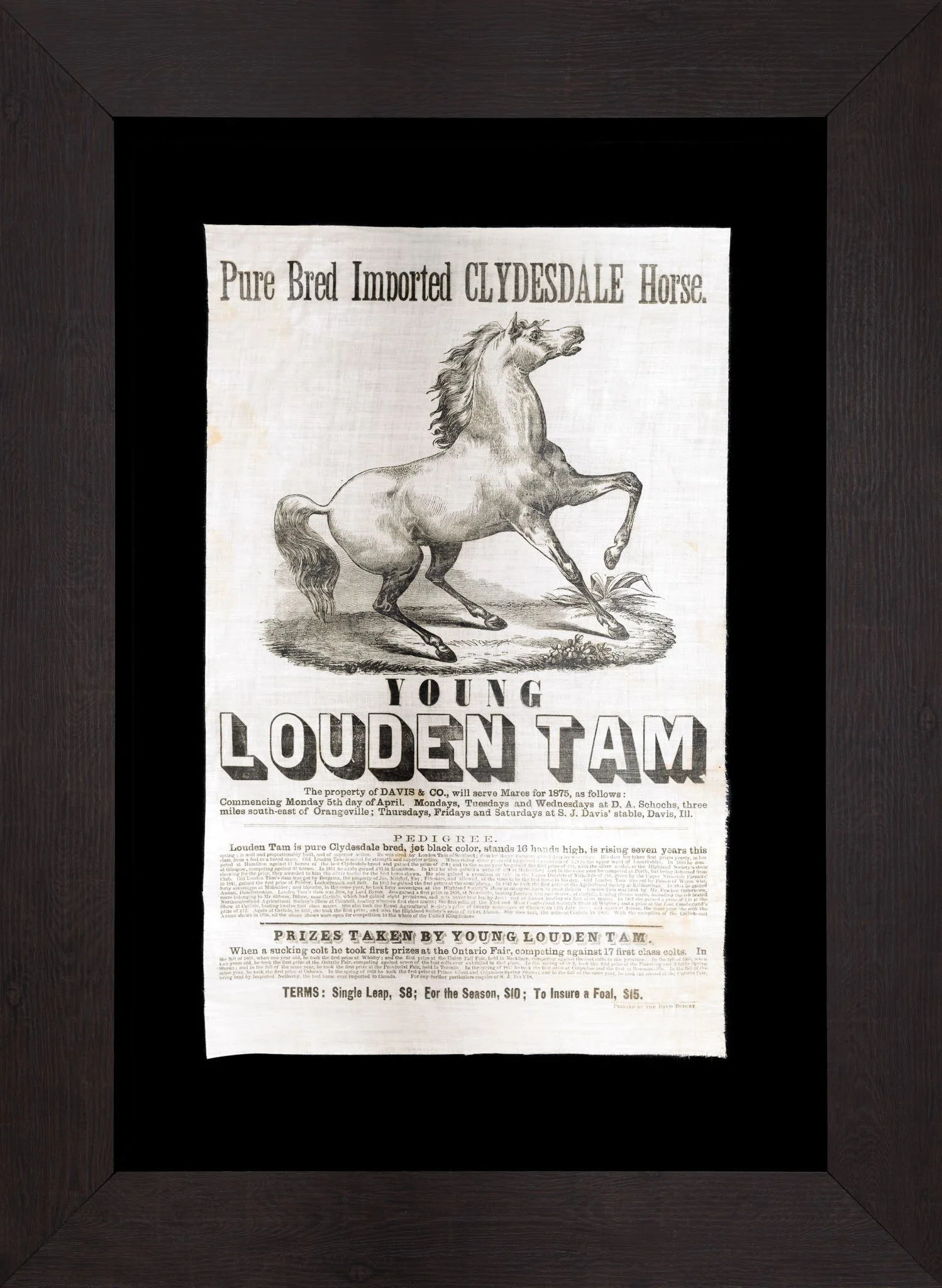
Offered is a rare nineteenth-century American livestock advertising broadside, promoting the breeding services of the purebred imported Clydesdale stallion Young Louden Tam. Printed on glazed cotton and issued for the 1875 breeding season, the broadside was produced for use in northern Illinois, with service locations listed near Orangeville and at S. J. Davis’s stable in Davis, Illinois. It reflects a period when draft-horse breeding was central to agricultural productivity and regional commerce in the Midwest.
Broadsides of this type were created for temporary public display in livery stables, feed stores, fairgrounds, and other agricultural centers. They announced a stallion’s availability, outlined pedigree and terms, and circulated locally during a single breeding season before being replaced. As a result, examples that remain today—particularly those produced on textile substrates rather than paper—are uncommon.
Young Louden Tam is described as a jet-black Clydesdale stallion, standing 16 hands high and rising seven years of age in 1875, an age regarded as ideal for breeding. He is identified as the son of Louden Tam of Scotland, with extended pedigree text noting show prizes and premiums earned abroad. In the decades following the Civil War, Illinois farmers actively sought imported British draft stock to improve strength, size, and consistency in working horses. Clydesdales were especially valued for their combination of power and sound movement, qualities well suited to the demands of Midwestern farming and freight work.
The terms of service reflect the structured and increasingly professional nature of horse breeding at the time. Fees ranged from $8 for a single leap to $15 to insure a foal, amounts that represented a serious investment for farmers. The listed schedule and multiple service locations illustrate how stallions were moved between communities to reach a wider clientele. In Illinois, where mixed grain farming, hauling, and land improvement all depended on animal power, access to a proven imported stallion carried both economic and practical importance.
This broadside is printed on glazed cotton, a durable textile sometimes used for agricultural advertising intended for repeated handling and display. The surface treatment provided greater resilience than paper and helps explain the survival of examples such as this. The central image is a wood engraving of the stallion, paired with bold, utilitarian typography designed for clear visibility in public settings. The overall layout prioritizes clarity and information, combining image, pedigree, schedule, and terms in a direct commercial format.
Taken as a whole, this broadside offers a clear window into nineteenth-century horse breeding in Illinois, where imported bloodlines, regional circulation of stallions, and printed advertising worked together to support an agricultural economy still fundamentally dependent on draft power. It stands as a well-preserved document of that system, valued both for its historical content and for its survival on an uncommon textile medium.
Conservation Process: The broadside was hand sewn to a cotton fabric backing, which was then hand sewn to a mounting board. To prevent dye migration from the black cotton, the fabric was pre-washed and treated with a dye-setting wash prior to mounting. The broadside is displayed behind Optium Museum Acrylic.
Frame: The frame features a wide, flat-profile wood molding finished in dark walnut. Its clean lines and subdued grain provide a strong, understated presentation. The profile offers visual weight without distraction.
Condition: The surface shows light, uneven discoloration, most noticeable in the lighter areas of the field, consistent with age and historical use. These tonal variations do not obscure the printed text or imagery and are typical of glazed cotton advertising from the period. Overall presentation remains clear and well preserved for a nineteenth-century working textile.
Collectability Level: The Great – Perfect for Rising Collectors
Date of Origin: 1875
Frame Size (H x L): 21.5” x 41.5”
Pennant Size (H x L): 10.25” x 27.5” with
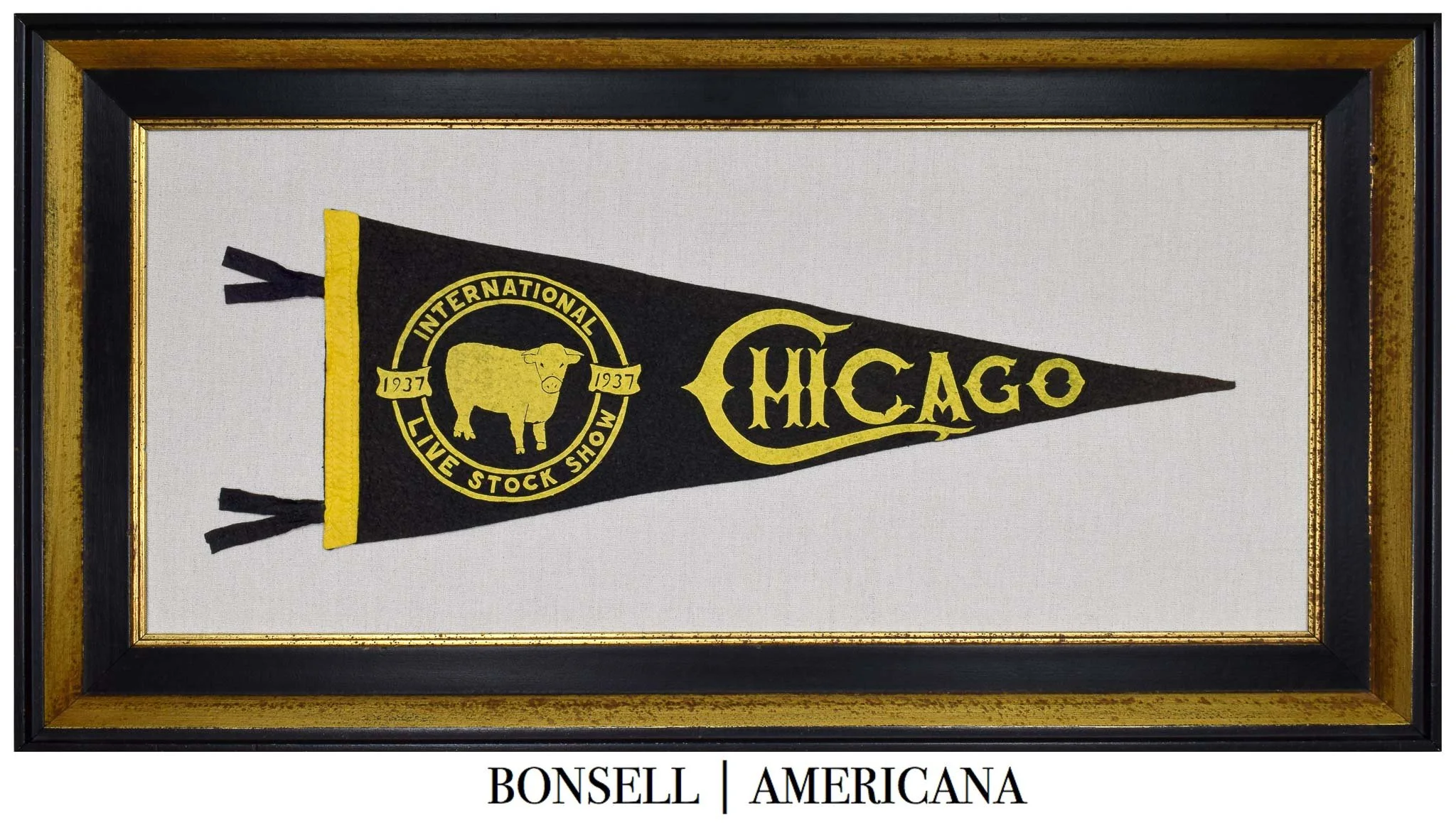
Offered is an antique pennant, from 1937, commemorating the International Live Stock Show held in Chicago. It features a bold yellow and black design with an illustration of a steer at the center, encircled by the text "International Live Stock Show." The year 1937 is prominently displayed on a banner beneath the steer, while the word "Chicago" is elegantly scripted along the length of the pennant.
The International Live Stock Show, inaugurated in 1900, was one of the premier livestock exhibitions in the United States, held annually in Chicago. This event was a key gathering for breeders, farmers, and agricultural enthusiasts from around the world. Hosted at the Chicago Stock Yards, the show became a significant platform for showcasing the best livestock, including cattle, swine, sheep, and horses. Participants competed for prestigious awards, which were highly coveted within the agricultural community.
The show not only highlighted the quality and breeding standards of livestock but also served as an educational forum. It provided opportunities for attendees to learn about the latest advancements in agricultural practices, breeding techniques, and animal husbandry. The exhibition featured various events, including judging competitions, parades, and demonstrations, which drew large crowds and fostered a sense of community among those involved in the agricultural industry.
During its peak, the International Live Stock Show played a crucial role in promoting agricultural innovation and excellence. It encouraged the exchange of knowledge and best practices among breeders and farmers, contributing to the advancement of livestock breeding and management. The show's influence extended beyond the United States, attracting international participants and spectators, thereby cementing Chicago's reputation as a central hub for agricultural development.
The 1937 show, represented by this pennant, was one of the many successful iterations of the event, continuing the tradition of excellence and competition.
Conservation Process: This pennant was hand sewn to cotton fabric, and both were hand sewn to a mounting board. To prevent the black dye in the cotton fabric from seeping into the pennant, it was first washed in a standard wash and then in a dye setting wash. The pennant is positioned behind Optium Museum Acrylic.
Frame: Italian, crafted with a black and gold finish.
Condition Report: Excellent condition, with vibrant colors and minimal signs of wear.
Collectability Level: The Good – Perfect for Beginning Collectors and Gifts
Date of Origin: 1937

Frame Size (H x L): 47.5” x 40”
Pennant Size (H x L): 35.5” x 28”
Offered is a set of sheepskin chaps tied to the historic CS Cattle Company of Cimarron, New Mexico, a remarkable example of early ranching gear. Likely dating to the late 1800s or early 1900s, they reflect the craftsmanship and functionality essential to ranch life during that era. Stamped with “CS Cattle Company Cimarron, New Mexico” and marked with the handwritten note “by Drover Jesus B.,” these chaps provide a tangible connection to the ranch’s history and their maker or user. Their design showcases rugged practicality, built to withstand the demands of daily ranch work.
Constructed from leather and sheepskin, the chaps feature a dual-layered belt system with brass hardware for a secure fit. Two front pockets offered practical storage for small tools or essentials, while decorative tassels along the seams reinforced durability and added aesthetic appeal. These details highlight the balance of utility and artistry typical of handmade gear from this period.
Whether from the late 19th or early 20th century, these chaps embody the resourcefulness and craftsmanship of ranching culture. Their sturdy materials, detailed construction, and clear provenance make them an exceptional artifact of ranching history, shedding light on the working conditions and ingenuity of ranchers in northeastern New Mexico.
The combination of sheepskin and a leather belt system, along with tassel reinforcements, aligns with a transitional period when ranching gear began evolving. This predates the widespread popularity of woolies in the early 20th century. The dual-layer belt with brass hardware and functional front pockets reflects the personalized, handmade craftsmanship typical before mass production. The “CS Cattle Company” stamp ties the chaps to the ranch established in 1873, and the handwritten note “by Drover Jesus B.” adds a personal touch, further suggesting their origin during the ranch’s early operations.
CHAP HISTORY
The term "chaps," derived from the Spanish word chaparreras, originated in the 16th and 17th centuries with Mexican vaqueros who used them as protective leg coverings in brushy or rugged environments. Early chaps, often crafted from thick leather, were tied to a belt or saddle and served to shield riders from thorny vegetation, harsh weather, and the wear and tear of horseback riding. As cattle herding spread across North America in the 19th century, chaps became essential gear for cowboys and ranchers.
By the 1800s, chaps evolved into various styles suited to specific needs. Shotgun chaps, with their straight-leg design, were practical for general work, while batwing chaps offered greater freedom of movement. Woolies, made from sheepskin or angora, gained popularity in colder climates for their warmth. Regardless of style, chaps were indispensable for protecting riders’ legs and clothing, symbolizing the resilience and ingenuity of ranching life.
CS CATTLE COMPANY
Established in 1873 by brothers Frank and Charles Springer, the CS Cattle Company is a historic working ranch in northeastern New Mexico, spanning 130,000 acres of plains, foothills, and mountain terrain. Originally part of the Maxwell Land Grant, the ranch carries a legacy of over 150 years of cattle ranching, horse breeding, and hunting under the stewardship of the Springer and Davis families.
Frank Springer, an Iowa-born lawyer, laid the foundation for the ranch in 1873 when he purchased his first 1,000 acres near the Sangre de Cristo Mountains. His brother Charles joined him in 1878, contributing the initials "CS" that define the ranch's brand. Over time, the ranch expanded, blending cattle ranching traditions with innovative practices, such as a horse breeding program that began in the 1880s and continues today.
Management of the ranch transitioned through generations, with Les Davis, Frank Springer’s grandson, taking leadership in 1947. Under his stewardship, the ranch diversified, enhancing its cattle operations and gaining recognition for its contributions to the American Quarter Horse breed. Horses bred at the CS were celebrated as cavalry mounts, polo ponies, and ranch horses.
Today, the CS Cattle Company remains a family-run enterprise, preserving its traditions while embracing modern practices. Its activities include cattle production, horse breeding, and guided hunting, utilizing its expansive terrain. The ranch endures as a symbol of resilience and innovation, embodying the spirit of the American West.
Conservation Process: The chaps were hand sewn to cotton fabric, and both were hand sewn to a mounting board. To prevent the black dye in the cotton fabric from seeping into the chaps, they were first washed in a standard wash and then in a dye setting wash. The chaps are positioned behind Optium Museum Acrylic.
Frame: The frame is a modern, rustic design crafted from textured brown wood. Its natural finish and visible grain patterns give it an authentic, handcrafted appearance, complementing the historic nature of the sheepskin chaps.
Condition Report: The sheepskin chaps show significant wear, with noticeable losses in the front, likely due to both extensive use and the passage of time. Stains and discoloration are present, further attesting to their heavy use in a working ranch environment. Despite these signs of wear, the condition adds a layer of authenticity and character, reflecting their history and the rugged demands of ranch life.
Collectability Level: The Extraordinary – Museum Quality Offerings
Date of Origin: 1873-1910

Frame Size (H x L): 21” x 38”
Pennant Size (H x L): 12” x 29”
Offered is an antique pennant, made for the International Live Stock Show, held in Chicago. It is red and features overprints of a prize winning bull, hog, lamb, and horse. The horse is haltered and held by a woman, who is also holding a championship trophy.
INTERNATIONAL LIVE STOCK SHOW
The International Live Stock Show, also known as the Chicago International, was a major agricultural exhibition held annually, from 1900 until 1976. The show was one of the largest and most prestigious events of its kind. It featured a variety of livestock competitions, including judging of cattle, hogs, sheep, and horses, as well as exhibits of agricultural machinery, animal feed, and other related products.
Over the years, the International Live Stock Show grew in size and scope, attracting exhibitors and spectators from across the United States and around the world. In the early 20th century, the event became a key platform for promoting American agricultural exports to Europe and other global markets.
Despite its success, the International Live Stock Show faced challenges in the postwar era. Changes in the livestock industry, including the growth of large farms and the consolidation of meatpacking companies, led to declining interest in traditional livestock shows. In addition, rising urbanization and changing consumer preferences reduced the appeal of rural-themed events like the Chicago International.
Ultimately, in 1976, the International Live Stock Show was discontinued due to declining attendance and financial difficulties. Today, the legacy of the show lives on in the Union Stockyards Gate, a landmark entrance to the former stockyards site that has been preserved as a symbol of Chicago's agricultural heritage.
INTERNATIONAL AMPHITHEATRE
The bottom of the pennant offered herein includes an image of the International Amphitheatre, a multi-purpose indoor arena, opened in 1934. The arena was designed by Abraham Epstein and hosted a variety of events, including concerts; sports competitions; political conventions; trade shows; and of course, the International Live Stock Show. The International Amphitheatre hosted legendary musicians, such as Elvis and the Beatles, and several presidential nominating conventions. However, due to facilities eventually becoming outdated and the decline of the livestock industry in the surrounding neighborhood, the International Amphitheatre eventually closed and was demolished in 1999.
ADVERTISING FLAG COMPANY
This pennant was made by the Advertising Flag Company (i.e., as indicated by the reference thereto under the champion bull). It was founded in 1936 in Chicago, Illinois by Frank F. Smith, and quickly became known for its production of high-quality flags, banners, and promotional products. Later, the company expanded its offerings to include custom-designed products and supplied flags and banners for major events. In the 1960s, the Advertising Flag Company introduced new technology and production techniques, allowing for more complex designs and faster production times. The company's legacy as a pioneer in the flag and banner industry continues to be felt today, with a wide range of products still available for customers worldwide.
Conservation Process: This pennant was hand sewn to cotton fabric, and both were hand sewn to a mounting board. To prevent the black dye in the cotton fabric from seeping into the pennant, it was first washed in a standard wash and then in a dye setting wash. The pennant is positioned behind Optium Museum Acrylic.
Frame: This pennant is in a reclaimed wood frame.
Condition Report: There is some toning of the hoist strip. But overall, the pennant is in excellent condition.
Collectability Level: The Good – Perfect for Beginning Collectors and Gifts
Date of Origin: 1940-1960
Sign Size (H x L): 22.25” x 61.5” x 1”
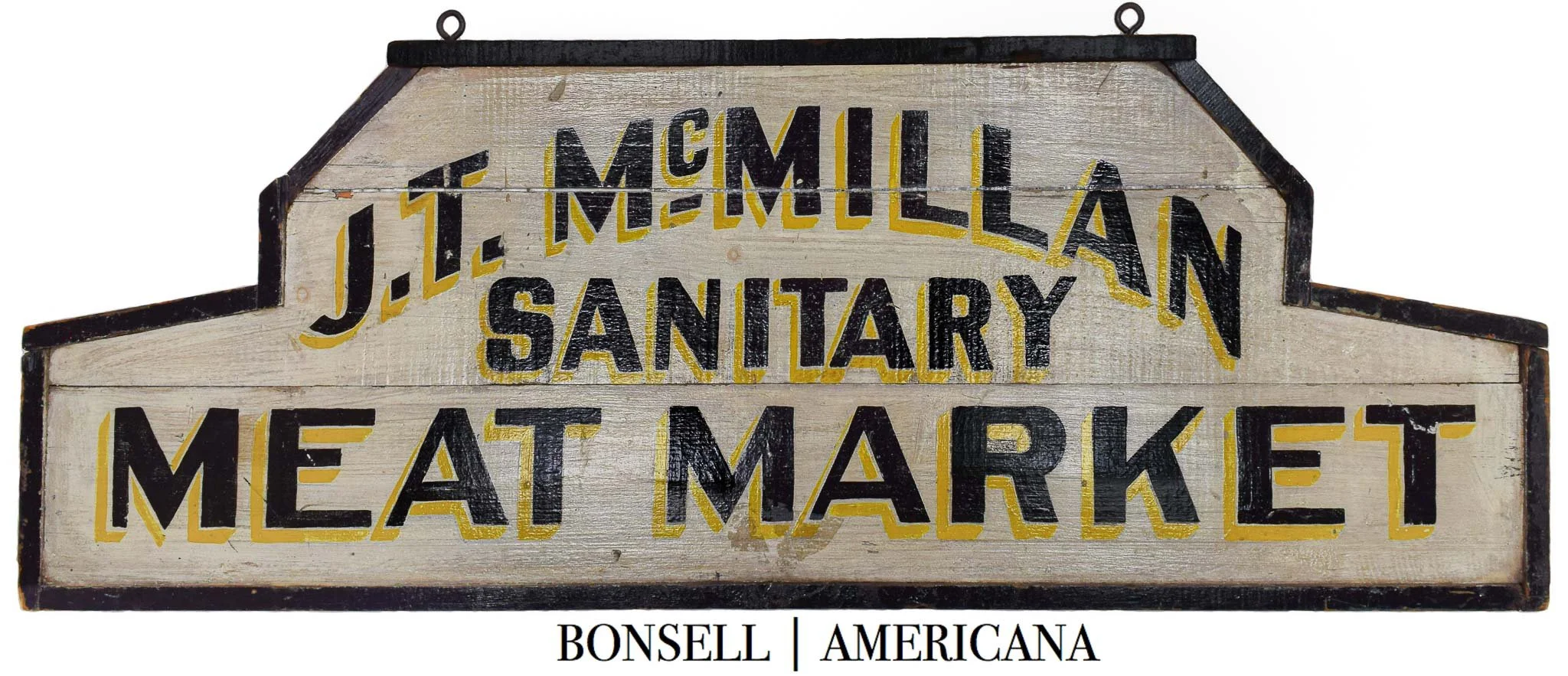
Offered is a distinctive early 20th-century antique trade sign for the "J.T. McMillan Sanitary Meat Market". The sign’s charming historical character is defined by its bold, black lettering accented with a yellow silhouette, which stands out against the oyster-white background, ensuring high visibility and a classic, eye-catching appeal. The sign possesses a commanding presence, ideal for a feature display.
The story of J.T. McMillan and his son, J.T. McMillan Jr., stands as a testament to ingenuity, enterprise, and the spirit of innovation that transformed the meat packing industry in the United States. Their legacy is not only a narrative of a family business but also a chapter in the broader history of American commerce and labor relations.
James T. McMillan, born in Belfast, Ireland in 1839, embarked on a journey to the United States with a vision of prosperity and opportunity. Settling in St. Paul, Minnesota, McMillan leveraged his tenacity and business acumen to establish a meatpacking venture that would grow to become a hallmark of quality and efficiency. In 1871, he laid the foundation of what was to become the J.T. McMillan Company, a name that would resonate with trust and quality in the meat industry.
McMillan's approach to meat packing was revolutionary. At a time when the industry was characterized by fragmented operations and unsanitary conditions, the J.T. McMillan Company pioneered methods of refrigeration and mechanization that would set new standards. His commitment to quality was reflected in the company’s products, which soon became synonymous with wholesomeness and were sought after across the region.
J.T. McMillan was not only an industrialist; he was a community pillar in St. Paul. His contributions to the local economy and the well-being of its residents were profound. He provided employment, stability, and growth in a period of rapid industrialization, often leading the charge in adopting practices that would benefit both his company and the community.
Following in his father’s footsteps, J.T. McMillan Jr. continued to expand and innovate within the meat packing industry. Under his guidance, the company adapted to the changing times, embracing new technologies and expanding their reach to new markets. It was during this era that the company faced the tumultuous challenges of labor unrest, indicative of the growing pains of an industrial nation. In 1920, the Butcher Workmen's strike at the packing plant called attention to the need for fair labor practices and equitable wages. The strike, which included both male and female workers, resulted in a significant step towards improved conditions and was a pivotal moment in labor history.
The McMillan meat packing enterprise was more than a business; it was a microcosm of the American dream, embodying the transformation of a nation through the lens of industry. The senior McMillan's immigrant success story and the junior McMillan's navigation through the complexities of early 20th-century labor relations provide a narrative rich with themes of ambition, struggle, adaptation, and progress.
Today, the remnants of the J.T. McMillan Company serve as a reminder of the indelible impact that the McMillan’s had on the American meat packing industry and the labor movement. Theirs is a story that underscores the multifaceted nature of progress, highlighting both the industrial prowess and the human elements that drive the evolution of commerce and community.
Condition Report: Crafted from pine, the sign showcases the authentic patina of age, including wear commensurate with its use. Its condition tells a story; while the sign displays well, it shows evidence of several restorative attempts, such as nailing and applied moldings, which add to its authenticity and charm.
Collectability Level: The Great – Perfect for Rising Collectors
Date of Origin: 1900-1930
Weathervane Size: 28” in length, 20” in height, and 5” in width
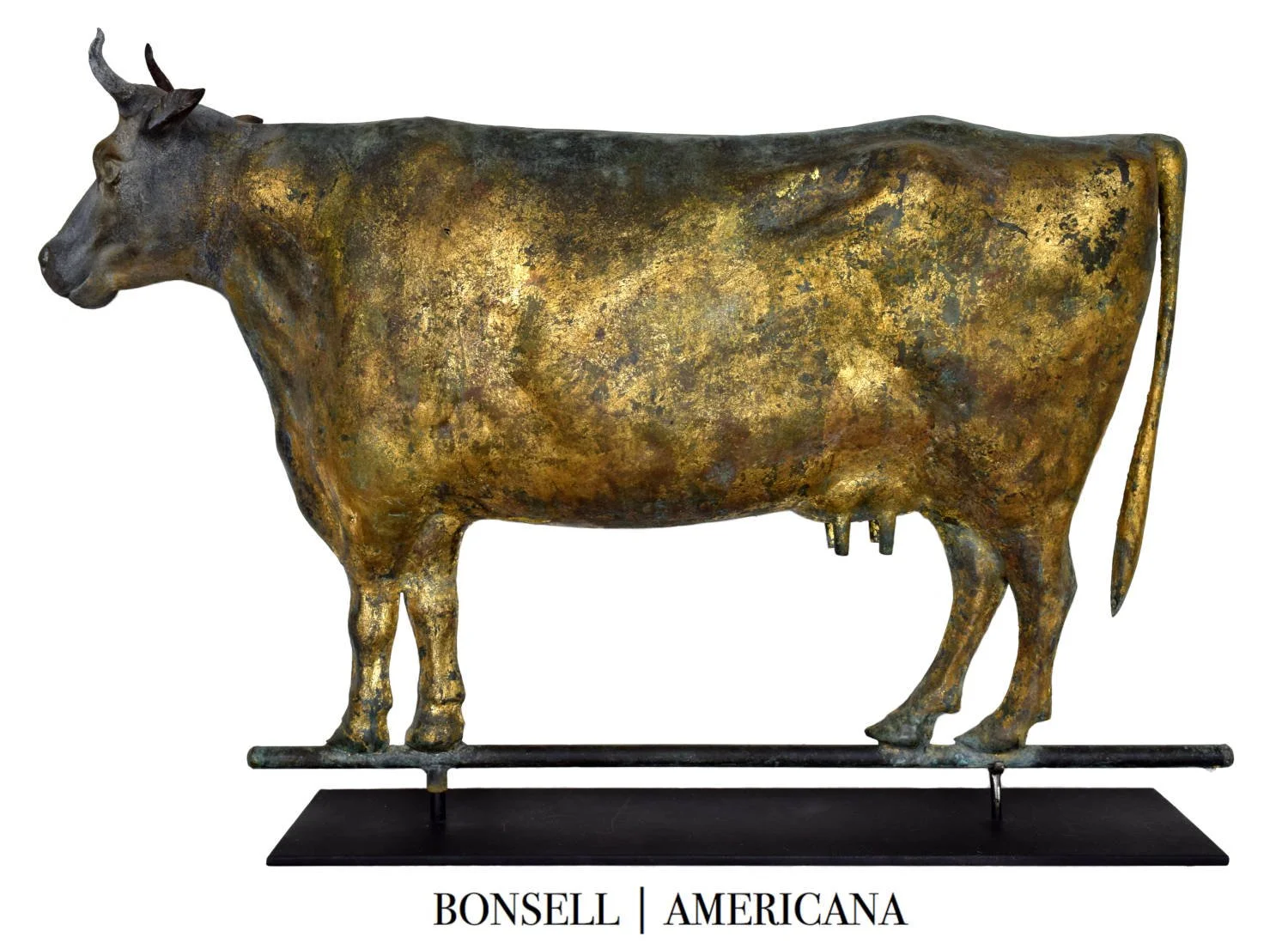
Offered is superb Jersey cow weathervane. The 19th century in America witnessed a burgeoning interest in weathervanes, both as functional tools and as decorative architectural elements. Cow weathervanes, often perched atop barns and farmhouses, meld functionality with symbolism, serving as a reflection of the agricultural roots of a property. These weathervanes not only indicate the direction of the wind but also often signify a farm's focus on cattle production. Beyond their practical utility, the cow design speaks to the cultural and economic importance of cattle in many rural communities. Whether chosen for its direct relevance to the farm's livelihood, as a nod to regional traditions, or simply for the aesthetic appeal of the bovine silhouette against the sky, cow weathervanes remain a cherished emblem of pastoral life and heritage.
The weathervane offered herein dates to approximately 1880 and is attributed to L.W. Cushing & Sons. While several manufacturers dotted the American landscape, few commanded the reverence and legacy associated with L.W. Cushing & Sons of Waltham, Massachusetts.
Established in the mid-19th century, L.W. Cushing & Sons emerged in a period rife with technological advancement and a growing appreciation for artisanship. As America was evolving, so too were its buildings and the decorative elements that adorned them. Weathervanes, with their blend of utility and aesthetics, naturally found favor among homeowners, public building custodians, and farmers alike. Situated within this backdrop, the company positioned itself as a paragon of quality and artistic integrity.
Central to L.W. Cushing & Sons' reputation was its unwavering commitment to craftsmanship. Crafted primarily from copper, their weathervanes often bore a gilded finish of gold leaf, making them shimmer and gleam under the sun's rays. This meticulous attention to detail not only ensured longevity but also conferred upon each piece a distinctive brilliance that set them apart. In the case of the weathervane offered herein, its surface includes a blue-green verdigris patina, bright and reflective gold leaf, and yellow gilder’s size (i.e., a type of yellow paint applied prior to the gold leaf that is revealed as aging occurs). Such a surface is considered the most appealing amongst the possibilities associated with copper weathervanes.
Referring back to L.W. Cushing & Sons, it was not just the quality of materials or finish that distinguished its weathervanes; it was their design ingenuity. From galloping horses and proud roosters to gracefully arcing arrows and stately ships, each weathervane bore testament to the dynamism of the era. Their designs captured the very essence of the subjects they portrayed, intertwining realism with a sense of motion, making them not just functional tools but pieces of art.
Yet, as with many tales of craftsmanship and artistry, the narrative of L.W. Cushing & Sons has its twilight. With the dawn of the 20th century, industrialization began reshaping the American manufacturing landscape. The once-celebrated weathervane, a symbol of a bygone era, found itself overshadowed by modern architectural sensibilities. The demand dwindled, and eventually, the journey of L.W. Cushing & Sons came to an end.
However, history has a way of revisiting and reviving its treasures. The present era, with its renewed interest in traditional American crafts, has resurrected the legacy of L.W. Cushing & Sons. Collectors and enthusiasts now view their weathervanes not just as wind indicators but as exceptional artifacts of Americana.
The legacy of L.W. Cushing & Sons serves as a poignant reminder of America's rich decorative arts history. While they may no longer navigate the winds as they once did, their weathervanes continue to guide us through a historical journey, echoing tales of artistry, innovation, and timeless elegance.
Collectability Level: The Best – Perfect for Advanced Collectors
Date of Origin: Approximately 1880
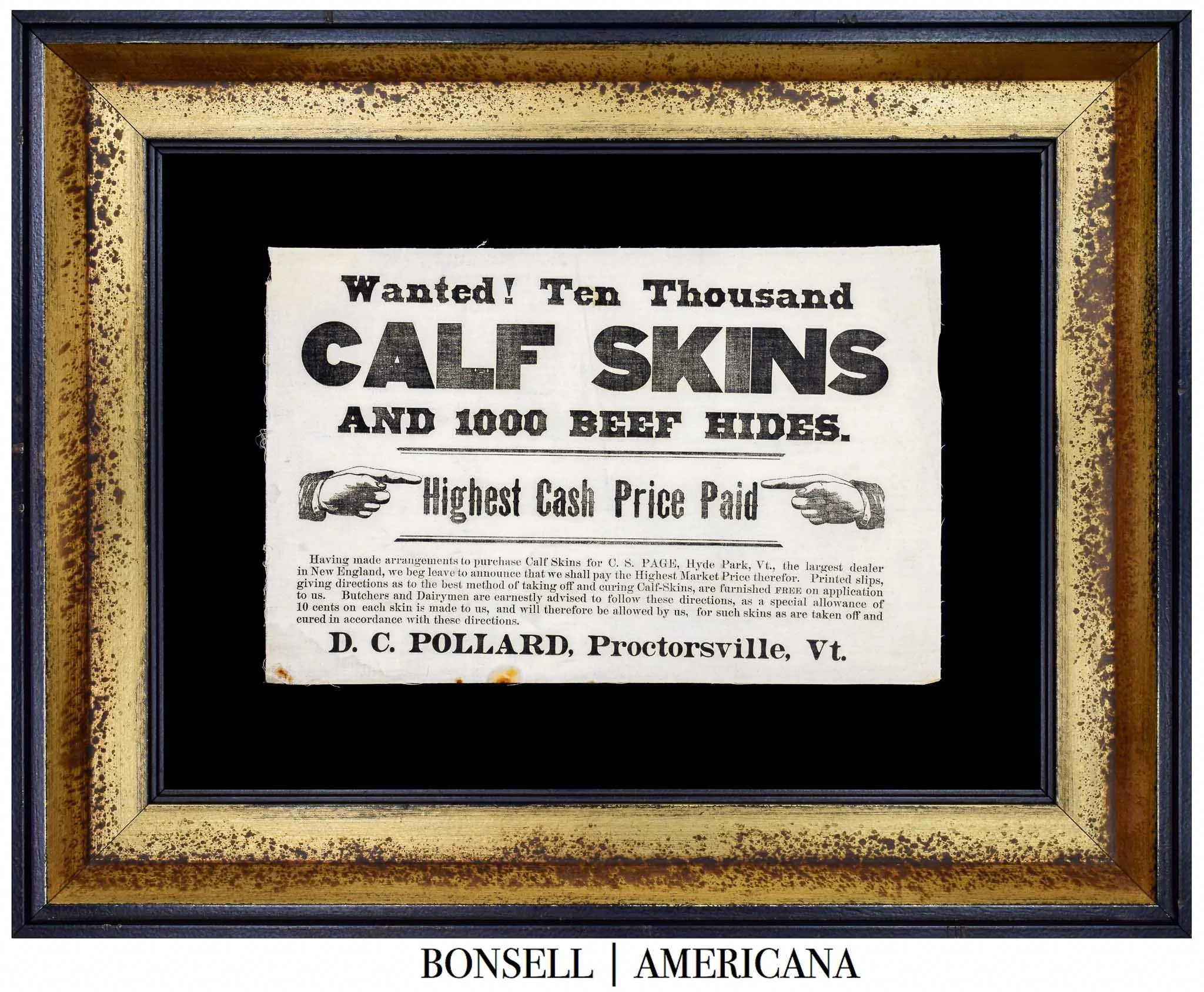
Frame Size (H x L): 22” x 28”
Broadside Size (H x L): 11” x 17”
Offered is a textile broadside with the following folksy overprint:
Wanted! Ten Thousand
CALF SKINS
AND 1000 BEEF HIDES
Highest Cash Price Paid
Having made arrangements to purchase Calf Skins for C.S. PAGE, Hyde Park, “V.t., the largest dealer in New England, we beg leave to announce that we shall pay the Highest Market Price therefor. Printed slips, giving direction as to the best method of taking off and curing Calf-Skins, are furnished FREE on application to us. Butchers and Dairymen are earnestly advised to follow these directions, as a special allowance of 10 cents on each skin is made to us, and will therefore be allowed by us, for such skins as are taken off and cured in accordance with these directions.
D.C. POLLARD, Proctorsville, Vt.
It is the only example that we have encountered. C.S. PAGE is a reference to Carroll Smalley Page, a Vermont based businessman and politician.
As a businessman, he specialized in buying and selling raw animal hides, which he would then process into leather. Page was known for his pioneering advertising and marketing techniques, which eventually helped him to become the world’s largest calfskin dealer.
As a politician, he served as the treasurer of Lamoille County from 1866 through 1872, as a member of the Vermont House of Representatives from 1869 through 1872, as a member of the Vermont Senate from 1874 through 1876, and as a probate judge in Lamoille County from 1880 through 1891. In September of 1890, he was elected as the Governor of Vermont. He served just a single term—a term length aligned with what was referred to as the Republican Party’s “Mountain Rule”—from October to 1890 through October of 1892.
Conservation Process: This broadside was hand sewn to cotton fabric, and both were hand sewn to a mounting board. To prevent the black dye in the cotton fabric from seeping into the broadside, it was first washed in a standard wash and then in a dye setting wash. The broadside is positioned behind Optium Museum Acrylic.
Frame: This broadside is in our Large Distressed Gold Frame.
Condition: This broadside has a few small stains near its lower left corner. Overall, it is in fine condition and attractive.
Collectability Level: The Great – Perfect for Rising Collectors
Date of Origin: 1875-1880
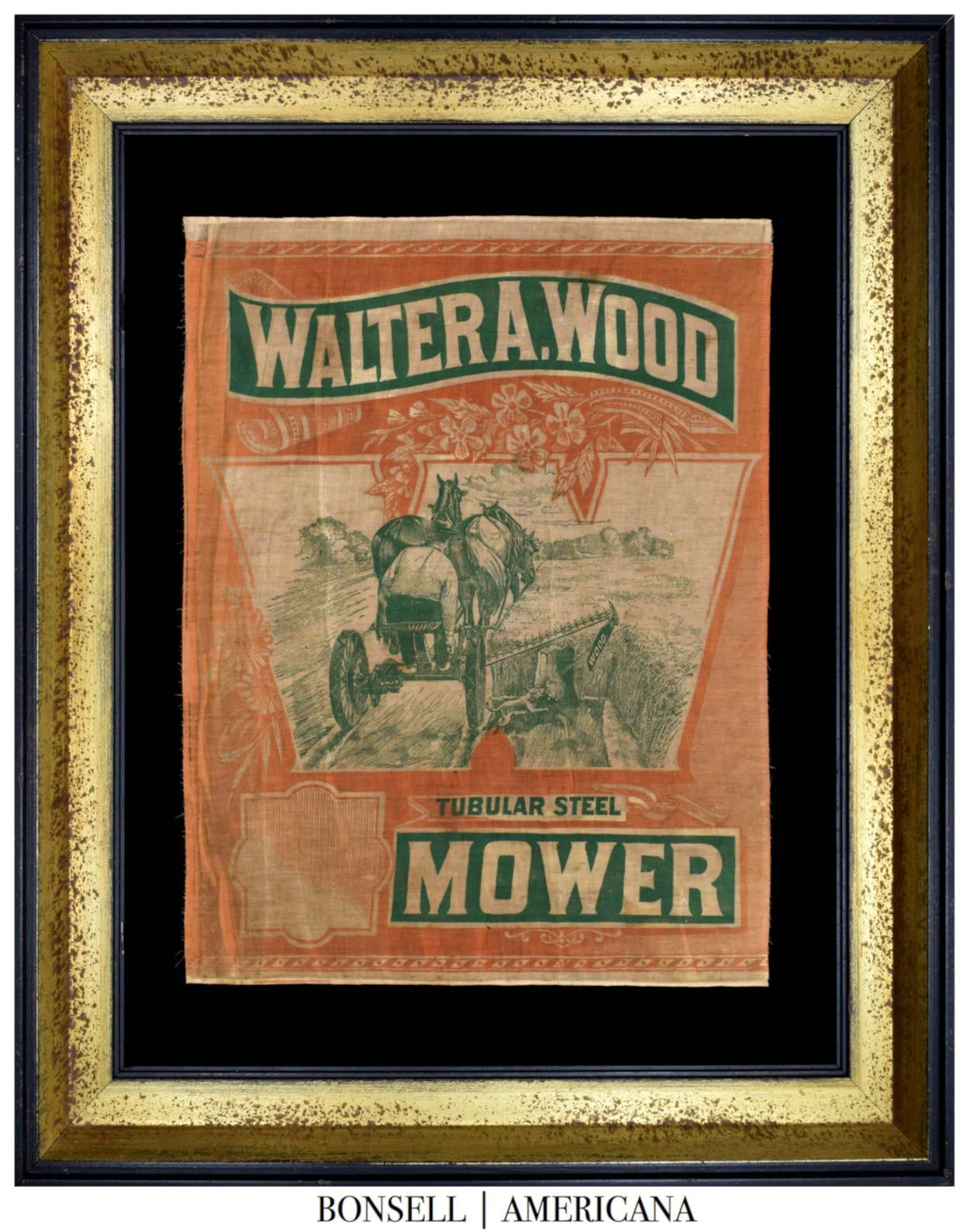
Frame Size (H x L): 35.5” x 29.5”
Banner Size (H x L): 25” x 18”
Offered is a cotton broadside. Broadside advertisements from the 19th century have a unique allure, reflecting not only the aesthetic and design sensibilities of the time, but also the groundbreaking innovations they aimed to promote. A remarkable specimen of such a broadside showcases the "Walter A. Wood Tubular Steel Mower".
Central to the broadside, a farmer can be observed maneuvering the mower across a field. Unlike traditional mowers of its time, this machine's construction primarily utilized steel, ensuring enhanced durability and performance. The mower's design was revolutionary. Its lightweight nature, attributed to its steel construction, optimized its efficiency.
Also central to the broadside, a team of horses guides the mower forward. The farmer is seen raising the cutting mechanism thereof to avoid a collision with a nearby tree stump. This action is likely deliberate, underscoring the mower's advanced design and functionality. Adjacent to the stump, a dog barks at a small varmint emerging from the stump, adding a touch of liveliness to the scene. This portrayal seamlessly marries the notions of agrarian diligence with technological ingenuity, emphasizing the mower's adaptability and precision in diverse terrains.
WALTER A. WOOD AND HIS COMPANY
Born on October 23, 1815, Walter Abbott Wood's life was a testament to hard work, ingenuity, and persistent innovation. Originating from Mason, New Hampshire, Wood's early life was marked by a mechanical aptitude which he honed over the years. His relocation to Rensselaerville, New York, in 1816, and later to Hoosick Falls in 1835, set the stage for his outstanding contributions in the agricultural machinery sector.
Under Wood's leadership, the Walter A. Wood Company saw a meteoric rise, transitioning from humble origins to becoming one of the world's foremost manufacturers of mowing and reaping machines. Beginning with the manufacturing of iron mould-board plows in partnership with John White, the company's quest for innovation led to the creation of the iconic Walter A. Wood Mower and Reaper.
The company's growth was exponential. By 1865, they produced over 8,000 machines, a leap from a mere two in 1852. Their relentless pursuit of perfection earned them over 1,200 different awards and recognitions globally, including commendations from Napoleon III and Emperor Franz Joseph.
The Walter A. Wood broadside serves as a window into the past, offering glimpses of a time when innovations in agriculture were reshaping the world. Behind its vibrant colors lies the legacy of a man whose vision transformed farming practices, a company that pioneered change, and a machine that stood as a beacon of innovation.
Conservation Process: This banner was hand sewn to cotton fabric, and both were hand sewn to a mounting board. To prevent the black dye in the cotton fabric from seeping into the banner, it was first washed in a standard wash and then in a dye setting wash. The banner is positioned behind a UV resistant acrylic and spaced apart therefrom using spacers.
Frame: This banner is in our Large Distressed Gold Frame.
Condition Report: There is some toning and a few small, minor stains. In other respects, this banner is in excellent condition, age appropriate, and visually striking.
Collectability Level: The Best – Perfect for Advanced Collectors
Date of Origin: 1890
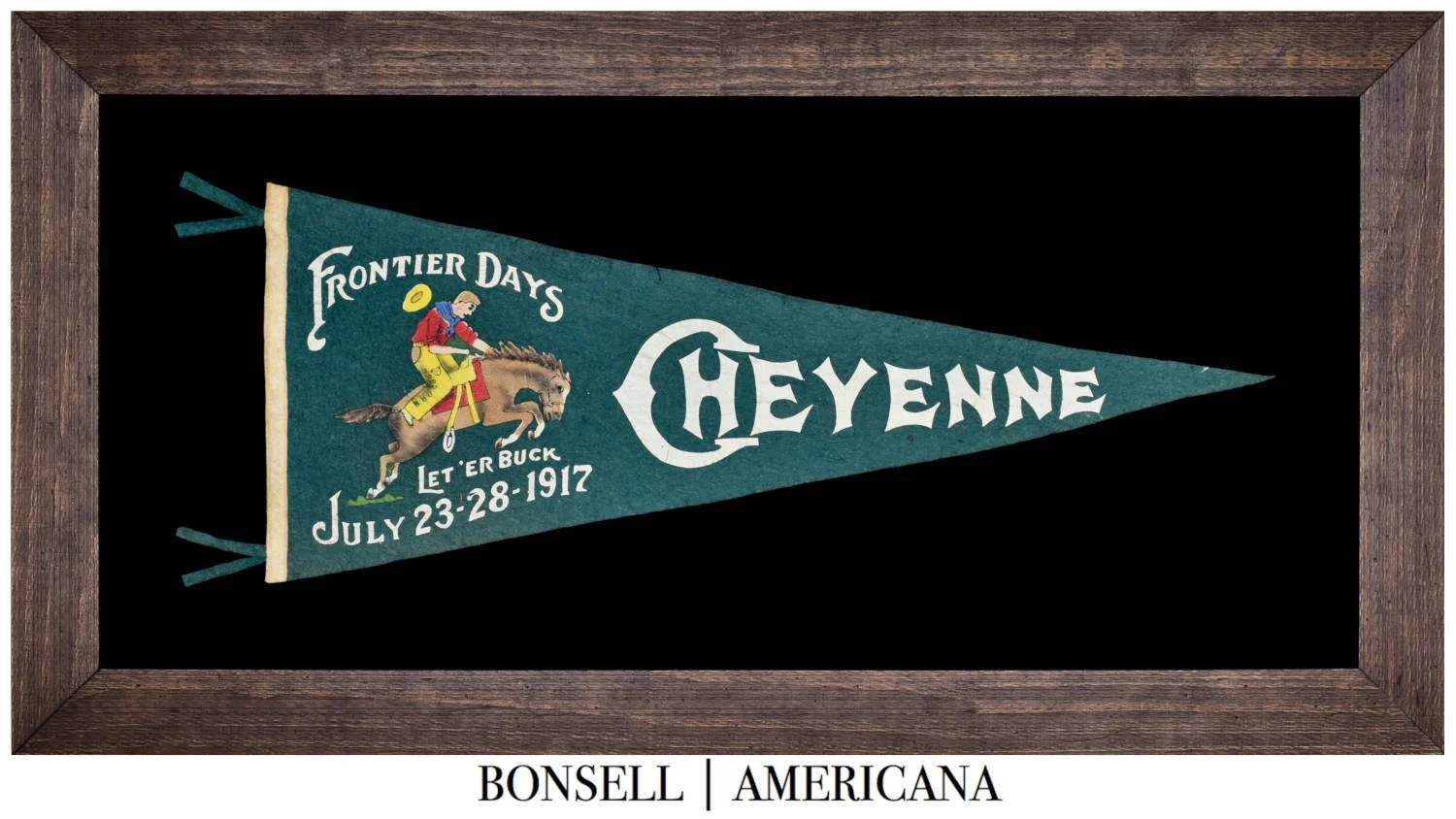
Frame Size (H x L): 21” x 40.5”
Pennant Size (H x L): 11” x 28” with 2.5” ties
Offered is an antique pennant, made for the Cheyenne Frontier Days. It features a cowboy atop a bucking bronco, as well as the following overprint:
FRONTIER DAYS
CHEYENNE
LET’ER BUCK
JULY 23-28-1917
The Cheyenne Frontier Days stands as an emblem of the enduring spirit of the American West. Founded in 1897, this event is more than a mere celebration; it encapsulates the essence of western heritage, becoming an enduring tradition that tells the story of a time gone by.
The origins of the Cheyenne Frontier Days can be traced back to the late 19th century when a group of visionary individuals from Cheyenne sought to commemorate the Old West's unique culture and traditions. Their goal was to create an event that would not only entertain but also educate attendees about the way of life, skills, and challenges of the frontier days. As a result, in 1897, the first "Frontier Day" was held, showcasing rodeo events, parades, and other western-themed festivities.
Over time, this annual event grew in scale and stature. Rodeo events expanded to include bull riding, steer wrestling, and barrel racing, among others, drawing participants from all over the country and later from around the world. The rodeo quickly became a central attraction, and the Cheyenne Frontier Days soon earned the title of the "World's Largest Outdoor Rodeo."
The Cheyenne Frontier Days offers more than just thrilling rodeo events. It serves as a living testament to the history of the West. The accompanying "Old Frontier Town" offers a step back in time, where attendees can experience firsthand the life of pioneers, gold prospectors, and cowboys. Craftsmen demonstrate traditional skills, such as blacksmithing and leatherworking, while Native American dancers and storytellers share their rich heritage and traditions.
This event has also always been a hub for music and entertainment. Over the years, it has seen performances from some of the biggest names in country music, further establishing its reputation as a major cultural event.
Beyond culture and entertainment, the Cheyenne Frontier Days holds substantial economic significance for Wyoming. Each year, the event draws a considerable number of tourists, boosting local businesses and contributing significantly to the state's economy. Hotels, restaurants, shops, and other local establishments benefit from the influx of visitors.
Socially, the event fosters a sense of community. Locals volunteer in various capacities, from organizing events to managing logistics. These collaborative efforts strengthen community bonds and promote a sense of pride and ownership in preserving and presenting their shared heritage.
The Cheyenne Frontier Days stands as a beacon of America's western heritage. It reminds us of the grit, determination, and adventurous spirit of those who lived during the frontier days. More than a century after its inception, it remains a symbol of the past, a celebration of the present, and a beacon for the future. It not only pays homage to the traditions and tales of the Old West but also provides an essential bridge connecting generations, ensuring that the stories, skills, and values of the frontier live on in the hearts and minds of all who attend.
Conservation Process: The pennant was hand sewn to cotton fabric, and both were hand sewn to a mounting board. To prevent the black dye in the cotton fabric from seeping into the pennant, it was first washed in a standard wash and then in a dye setting wash. The pennant is positioned behind Optium Museum Acrylic.
Frame: This pennant is in a reclaimed wood frame.
Condition Report: There are a few very small holes and tears. There is some toning along the hoist stripe. But generally, this pennant is in excellent condition and very attractive.
Collectability Level: The Good – Perfect for Beginning Collectors and Gifts
Date of Origin: 1917
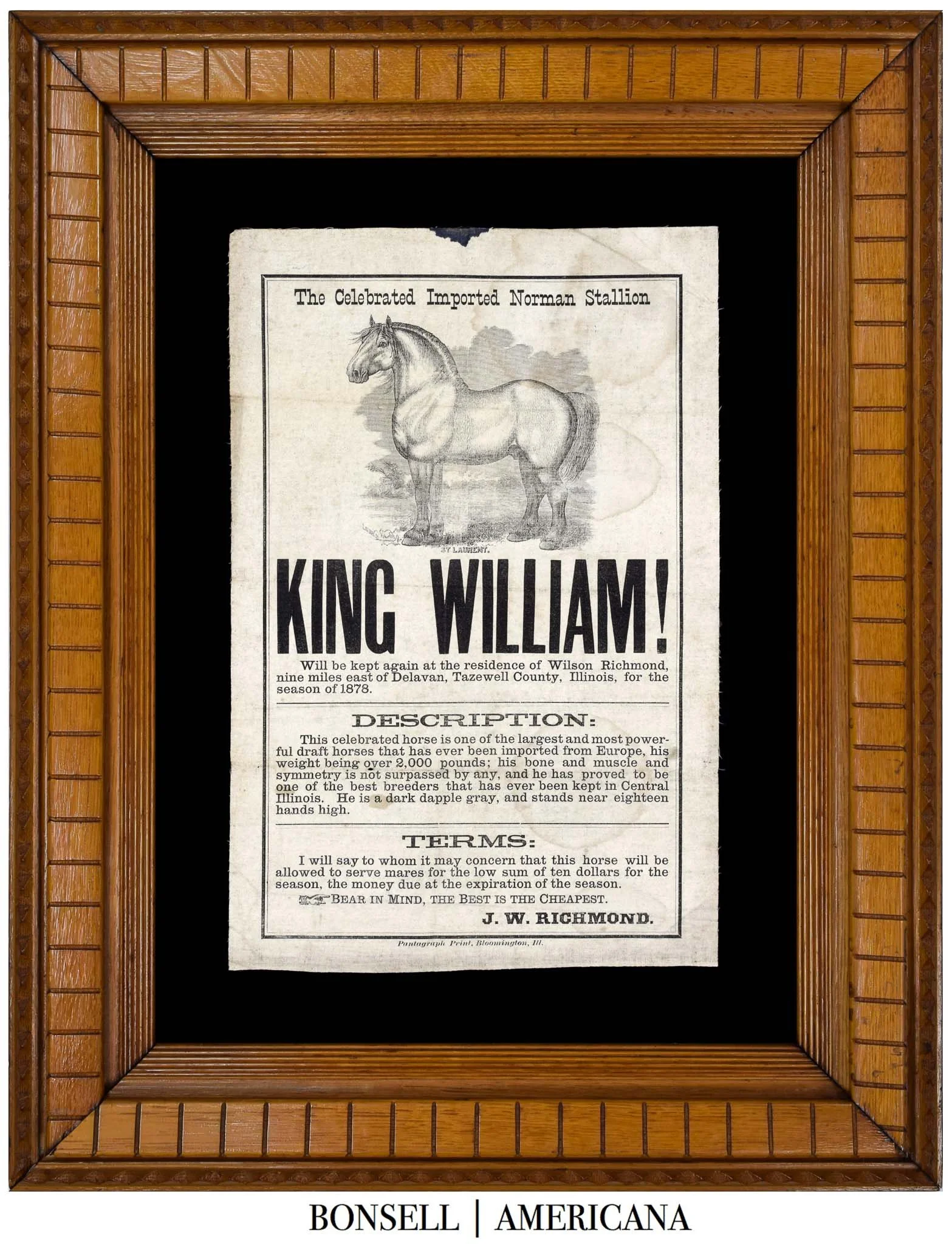
Frame Size (H x L): 28.5” x 22.5”
Broadside Size (H x L): 18” x 12”
Offered is a striking broadside, dating to 1878, advertising the celebrated imported Norman Stallion, King Williams, owned by J. Wilson Richmond of Tazewell County, Illinois. It is one of the best broadsides that we have ever encountered and quite unusual, in part because of its outstanding subject matter and in part because it is printed on cotton. The broadside features a portrait King Williams and states the following:
The Celebrated Imported Norman Stallion.
KING WILLIAM!
Will be kept again at the residence of Wilson Richmond, nine miles east of Delavan, Tazewell County, Illinois for the season of 1878.
DESCRIPTION:
This celebrated horse is one of the largest and most powerful draft horses that has ever been imported from Europe, his weight being over 2,000 pounds; his bone and muscle and symmetry is not surpassed by any, and he has proved to be one of the best breeders that has ever been kept in Central Illinois. He is a dark dapple gray, and stands near eighteen hands high.
TERMS:
I will say to whom it may concern that this horse will be allowed to serve mares for the low sum of ten dollars for the season, the money due at the expiration of the season.
BEAR IN MIND, THE BEST IS THE CHEAPEST.
J.W. RICHMOND.
Pantagraph Print, Bloomington, Ill.
Pantagraph Print, most recently referred to as Pantagraph Printing and Stationery, was founded in 1860 and located at 217 W. Jefferson Street in Bloomington, Illinois. It closed in December of 2020.
J.W. Richmond’s remarkable biography, as recorded in 1900 in the Biographical Record of Champaign County, Illinois, is as follows:
J.W. RICHMOND, of Fisher, Champaign county, needs no introduction to the people of this section of the state, as he has been actively engaged in farming and stock raising here for many years, and has made an enviable reputation as a keen financier and business man. The history of a successful man is always of interest to the public, and the hosts of friends of Mr. Richmond will be especially desirous of tracing his career and noting some of the features of his character as shown by the masterly way in which he overcame difficulties and wrought his own prosperity unaided by others.
To one knowing the patriotic spirit of Mr. Richmond it is no surprise to learn that he comes of the grand old Revolutionary stock, and that his great grand-father, Colonel Frank Richmond, was one of those heroes who laid life and fortune and all personal aims and ambitions upon the altar of his country, resolved to sacrifice everything, if necessary, for the triumph of the principles of justice and liberty in which be believed. The gallant colonel, who owned goodly estates in Virginia, his native state, won his title by long and meritorious service in Washington’s army, and not until victory had lighted upon our banners did he sheath his sword. Quite as patriotic service was performed by him in his voluntary contribution of more than one thousand head of horses and cattle to the struggling young government. When peace had been proclaimed he returned to his quiet life as a country gentleman, and passed his last days upon his old plantation, secure in his dear bought liberty. Tradition says that the city of Richmond, Virginia, was named in honor of the Richmond who first settled in the state of Virginia, the family being very prominent at the time.
Joseph, son of Colonel Richmond, was born at the old Virginia home, and having been reared in the principle that country has the first claim upon a loyal citizen it is not strange that he, too, took up the old musket which his father had carried in the Revolution, and went forth to meet the same foe in the war of 1812. Later he went to the new state of Ohio, and settled upon a tract of land in Muskingum county. He married there, and his son, Wilson, father of our subject, was born on the old homestead cleared in the midst of the forest, the date of the event being September 9, 1815. In 1830 the family removed to Illinois, where the father had been granted some land in consideration of the services rendered in the second war with Great Britain. This property was located in Tazewell county, and here, on the prairies, swept by the keen winter winds from the great northwest, the pioneers found that they had many difficulties to meet, which had not been included in their experience hitherto. In 1831, the winter of the “big snow,” as the early settlers termed it, the husband and father perished with the cold while returning home from a trip to Mackinaw, then the county seat. Thus the care of the family devolved largely upon Wilson Richmond, who was the eldest of the seven surviving children. He nobly aided his mother in the task of rearing the younger brothers and sisters, and when he felt free to establish a home for himself he wedded Mary Judy, daughter of John Judy, both natives of Ohio. Mr. Judy was a veteran of the war of 1812, and was one of the first settlers of Tazewell county. It is a pleasure to record that success blessed nearly every undertaking of Wilson Richmond, and that by honest toil and well directed energy he became wealthy and extremely influential in Tazewell county, where he is yet living, hale and happy, despite his eighty-five years. During the Civil War he was extensively engaged in the raising of sheep, annually selling from fifteen hundred to two thousand fleeces, and, as cotton could not be cultivated in the south to any extent for several years, his product him handsome income. Gradually buying real estate, he at length was the possessor of about fifteen hundred acres of fine farm land.
J.W. Richmond, whose birth occurred on his father’s farm in Tazewll county, February 26, 1845, early acquired familiarity with agriculture in all its departments, and from the time that he was fifteen years of age until he left home, in 1845, he superintended his father’s large homestead. At intervals he invested in land upon his own account, and owned in the neighborhood of eighteen hundred acres of fine farm property when he came to Champaign county as a permanent resident, at the time of his marriage. He has improved several farms since then and at the present time is the proprietor of about three thousand acres of land, most of this being located within the boundaries in the best districts of Iowa, Indiana, Nebraska, and Kansas.
More than a quarter of a century ago, J.W. Richmond determined to devote some attention to the matter of raising and dealing in high grade horses and cattle. In 1874 he made his first trip to Europe, and brought back some fine Percheron horses. Later he imported coach and Shire horses in large numbers and, altogether, has made five journeys to the old world, traveling through England, Germany, France, Belgium and Holland. He owns some famous blue grass pasture land along the Sangamon river, and for many years has made a business of feeding cattle for the market, selling from one hundred to one hundred and seventy head of stock each year.
Sixteen years ago Mr. Richmond and Nora Havenhill were married in New York. She was born in Monroe, Kendall county, Illinois, and is a daughter of Hiram Havenhill, a pioneer of Tazewell county, and late a resident of Kendall county, this state. Four children bless the home of our subject and wife, namely: Wilson, Lelia, Cummings, and Arthur Dean.
Since becoming a citizen of Fisher, Mr. Richmond has made five additions to the town, and in numerous substantial ways has increased the prosperity of the place. He is a stanch Republican, but in no sense the word is a politician, and has resolutely declined to hold office. In the Masonic fraternity he stands high, and has attained the Knight Templar degree, being identified with the Urbana Commandery.
Conservation Process: This broadside was hand sewn to cotton fabric, and both were hand sewn to a mounting board. To prevent the black dye in the cotton fabric from seeping into the broadside, it was first washed in a standard wash and then in a dye setting wash. The broadside is positioned behind Optium Museum Acrylic.
Frame: The broadside is in a fine oak frame that dates to approximately 1885.
Condition: As shown in the images, there are light stains across the surface of the broadside. There is an ink stain along the top edge. The ink stain is likely associated with the printing of the broadside (i.e., a printing error). Overall, it is striking and attractive.
Collectability Level: The Best – Perfect for Advanced Collectors
Date of Origin: 1878
Frame Size (H x L): 33.5” x 24.75”
Overalls Size (H x L): 12” x 23”
Offered is a pair of antique children’s denim overalls produced under the “Look Out” brand and constructed of Cone “Deeptone” denim, dating to approximately the 1930s–1940s. The surviving cloth label on the bib pocket reads “LOOK OUT – Made of Cone Deeptone Denim,” identifying both the brand name and the textile source. Cone Mills of Greensboro, North Carolina, was the most influential American manufacturer of denim during the twentieth century, supplying fabric to many of the country’s best-known workwear companies. Garments bearing references to Cone denim reflect the widespread reliance on this durable indigo cloth in the manufacture of utilitarian clothing intended for both labor and everyday wear.
The overall style reflects classic early twentieth-century American workwear construction, scaled for children. The garment features a traditional bib front with shoulder straps secured by metal hook fasteners, a configuration commonly used on bib overalls prior to the widespread adoption of later adjustable clasp systems. The bib includes a central pocket with a flap closure and button, beneath which the “Look Out” label is sewn. Two additional front pockets appear at the waist, with reinforcement stitching at points of stress. The legs are cut wide in the manner typical of period work garments, allowing freedom of movement for active wear.
Children’s overalls of this type were widely worn throughout the United States during the early twentieth century. They served both practical and economical purposes, providing a durable outer garment that protected clothing beneath while allowing children to participate in farm work, chores, and play. Denim overalls became a particularly common sight in rural communities and small towns, where sturdy garments were essential and clothing was expected to withstand heavy use. The association between overalls and childhood in America during the 1930s and 1940s is well documented in photographs, advertisements, and mail-order catalogs from the period.
The use of Cone “Deeptone” denim reflects the emphasis placed on durability and colorfastness in workwear fabrics of the era. Cone Mills developed several branded denim lines to promote the quality of its indigo-dyed cloth, and the “Deeptone” designation referred to the deep coloration achieved through repeated indigo dyeing of the warp yarns. This process produced denim that aged attractively with wear, gradually developing lighter areas and soft contrasts where the fabric was repeatedly flexed or abraded.
Surviving examples such as this illustrate the durable clothing commonly worn by American children during the first half of the twentieth century and reflect the widespread use of Cone Mills denim in garments intended for everyday wear.
Conservation Process: The overalls were hand sewn to cotton fabric, and both were hand sewn to a mounting board. To prevent the black dye in the cotton fabric from seeping into the overalls, the cotton was first washed in a standard wash and then in a dye setting wash. The overalls are positioned behind Optium Museum Acrylic.
Frame: The frame has a relatively flat profile with a matte black finish. The surface shows intentional distressing with subtle texture and light variation in the finish, giving it a restrained, aged appearance.
Condition Report: The overalls show honest wear consistent with age and use, including areas of fading, light fraying, and minor scattered wear to the denim. The metal hardware shows oxidation and age, while the fabric exhibits attractive, natural distressing throughout. Overall, the garment presents very well, with the kind of authentic wear that collectors appreciate in early denim workwear.
Collectability Level: The Good – Perfect for Beginners and Gifts
Date of Origin: 1930-1949