
Price: Call 618-553-2291, or email info@bonsellamericana.com
Frame Size (H x L): 22” x 42”
Pennant Size (H x L): 11” x 30”
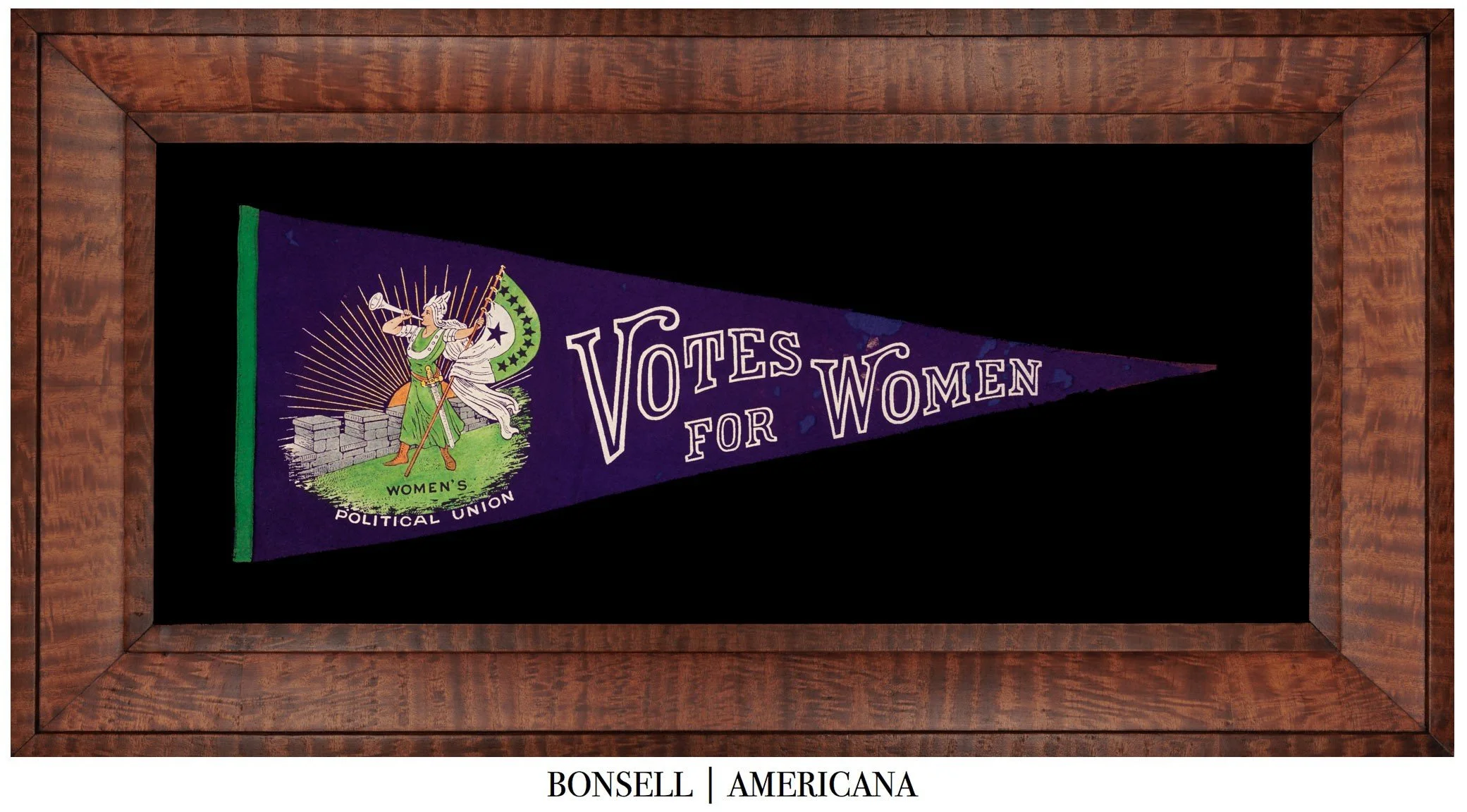
Offered is a women’s suffrage pennant produced for the Women’s Political Union of New York, and one of the more visually accomplished pieces of American suffrage material from the years immediately preceding passage of the Nineteenth Amendment. Printed on a rich purple felt ground, the pennant combines the words “VOTES FOR WOMEN” with an elaborate allegorical figure, radiating lines, stars, and the name “WOMEN’S POLITICAL UNION.” The combination of purple, green, white, and gold distinguishes it from the comparatively simple lettering and limited palettes found on many surviving suffrage pennants.
The central image is generally known as the “Bugler Girl” or “Clarion Girl,” an important suffrage emblem whose origins lie in the British movement for women’s voting rights. The figure was created by British artist and suffragist Caroline Watts and depicts an armored female herald sounding a bugle while advancing forward. The imagery was direct and purposeful: the clarion call announces the movement, while the advancing woman represents determination and progress. Behind her are radiating lines and a crescent-like arrangement of stars, creating one of the more elaborate graphic compositions found on suffrage material of the period.
Harriot Stanton Blatch adopted the imagery for use by the Women’s Political Union in the United States. Blatch was the daughter of Elizabeth Cady Stanton, one of the foundational figures of the American women’s rights movement, but became an important suffrage leader in her own right. After spending many years in England, where she became familiar with the increasingly active British suffrage campaign, Blatch returned to the United States and helped introduce some of its organizational methods and visual language to the American movement.
In 1907, Blatch founded the Equality League of Self-Supporting Women in New York. The organization was intended in part to broaden the constituency of the suffrage movement by bringing working women into organized political activity. In 1910, the group became the Women’s Political Union, or WPU. Blatch favored highly visible public campaigning, including open-air meetings, parades, banners, pennants, and other forms of political advertising intended to move the suffrage question beyond meeting halls and into the streets.
The present pennant is a strong example of that strategy. Its message could hardly be more direct. “VOTES FOR WOMEN” occupies most of the field in large decorative lettering, while the more elaborate image at the hoist gives the viewer something immediately recognizable to associate with the cause. At a time when political organizations increasingly understood the value of visual identity, the WPU produced material intended not simply to communicate a position, but to attract attention and remain memorable.
Its purple, green, and white coloration also reflects the transatlantic history of the design. Those colors had strong associations with the British women’s suffrage movement and differ markedly from the yellow and black more frequently encountered on American suffrage material. Blatch’s use of the British-derived imagery and palette makes the pennant particularly useful as evidence of the exchange of ideas, tactics, and graphic language between the British and American movements.
The pennant belongs to a recognizable WPU design represented in institutional collections. An example held by the Onondaga Historical Association has been reproduced by the New York State Museum in educational material devoted to the women’s suffrage movement and dated circa 1915. Another example is in the collection of the Museum of the City of New York and has been published by The Magazine Antiques, where it was dated circa 1917. These surviving examples help place the design firmly within the active campaigning years of the Women’s Political Union and document its place within the material culture of the suffrage movement.
Dating examples of this type with absolute precision can be difficult. The Women’s Political Union name came into use in 1910, while the organization’s activities increasingly overlapped with the broader national suffrage campaign during the middle of the decade. Blatch eventually aligned the WPU with Alice Paul’s Congressional Union, and the Women’s Political Union ceased operating as a distinct organization during this period. Taken together with the dating of surviving institutional examples, a circa 1910–1917 date range is appropriate for the present pennant.
One particularly interesting aspect of this example is its later history of use. When acquired, the pennant had been incorporated into a pillow, paired with another example of the same suffrage pennant with stuffing placed between the two. Political textiles of this type were often ephemeral objects, intended for rallies, marches, meetings, and public display rather than long-term preservation. Converting the pennants into a household object may have contributed to their survival long after the campaign for which they were originally produced.
The reverse of the pennant offered here adds another unusual element to its history. On the opposite side is printing for Hartford, Connecticut. The combination strongly suggests that the textile had a meaningful connection with Hartford. While the precise circumstances cannot presently be established, the Hartford association is worth noting, particularly because Connecticut itself had an active suffrage movement during this period and Hartford served as one of the state’s principal political and civic centers.
Among surviving women’s suffrage pennants, this design is notable for the amount of visual information it incorporates. Many suffrage textiles rely almost entirely upon wording or simple color symbolism. Here, the Women’s Political Union combined an unmistakable political slogan with sophisticated illustration, striking color, patriotic symbolism, and one of the movement’s recognizable allegorical figures.
Conservation Process: This pennant was hand sewn to cotton fabric, and both were hand sewn to a mounting board. To prevent the black dye in the cotton fabric from seeping into the pennant, it was first washed in a standard wash and then in a dye setting wash. The pennant is positioned behind Optium Museum Acrylic.
Frame: The pennant is housed in an exceptional antique tiger maple frame of substantial scale and unusually strong figure. The frame is constructed in two primary sections, with the outer molding wrapping around the stepped inner elements to create a layered, architectural profile; the richness of the maple and quality of construction make this one of the best frames we have handled.
Condition Report: The pennant presents well overall, with strong surviving color and graphics. There is visible discoloration at the pointed end, along with several holes and areas of loss throughout the felt; these have been discreetly backed with purple fabric so the missing areas blend closely with the original ground when viewed in person. The losses remain visible on close inspection, but the backing substantially reduces their visual impact and allows the design to read clearly.
Collectability Level: The Best – Perfect for Advanced Collectors
Date of Origin: 1910-1917

Price: Call 618-553-2291, or email info@bonsellamericana.com
Frame Size (H x L): 34 ½” x 46”
Flag Size (H x L): 23” x 34 ½”
Offered is a remarkable 38-star antique American flag, printed on coarse, glazed cotton and dating to the period surrounding the nation’s Centennial. The flag is distinguished by an especially unusual star configuration that combines a circular medallion with a secondary five-pointed star—often called a Great Star or Grand Luminary—formed from individual stars within the larger arrangement.
At first glance, the configuration can be difficult to discern. A ring of stars establishes the dominant circular form, while additional stars within the circle are positioned to create the outline of a large five-pointed star. Several of the stars at the tips of this secondary formation intersect with the surrounding wreath, allowing the two patterns to function together rather than as separate devices. A single star occupies the center. The result is an unusually sophisticated design in which the 38 stars form multiple patterns simultaneously.
The Grand Luminary was among the most visually ambitious star arrangements employed on 19th-century American flags. Rather than arranging the stars in simple rows, the maker used the stars themselves to construct a much larger star, transforming the canton into an overtly patriotic graphic. Great Star patterns appeared periodically throughout the 19th century, particularly on flags produced for celebrations, political events, and other occasions where visual impact was important. Combining such a device with a medallion configuration, as was done here, produced an especially elaborate result.
Also noteworthy are the stars positioned outside the principal medallion. Rather than the four corner stars frequently encountered on medallion-pattern flags, this example incorporates only two such stars. The remaining space contributes to the asymmetrical and almost hand-composed character of the canton and further distinguishes the design from more conventional 38-star arrangements.
The flag may initially appear to be displayed “backwards,” because the canton occupies the upper right when viewed from this side. This is, however, the intended face of the textile. The flag was printed in this orientation rather than simply being shown from its reverse.
Such construction is an important reminder that the conventions governing the display of the American flag were far less rigid during the 19th century than they would become in the 20th. Modern viewers are accustomed to standardized rules governing the position of the canton, particularly when a flag is displayed vertically or against a wall. Makers of early American flags operated in a period when such details were not yet governed by a comprehensive national code. Surviving examples consequently exhibit considerable variation in orientation, proportions, star arrangement, and construction. What today might initially appear incorrect was not necessarily regarded that way when the flag was made.
The 38-star flag is closely associated with one of the most important patriotic periods of the 19th century. Colorado entered the Union as the 38th state on August 1, 1876—just weeks after the United States celebrated the 100th anniversary of the Declaration of Independence. Colorado's admission during the Centennial year subsequently earned it the enduring nickname “The Centennial State.”
Under the Flag Act of 1818, a newly admitted state's star was formally added to the national flag on the Fourth of July following admission. Colorado's star therefore officially entered the flag on July 4, 1877, and the 38-star flag remained the official national flag until July 4, 1890.
Commercial practice did not always wait for the statutory date. Flag makers routinely anticipated statehood, particularly when admission appeared imminent, and 38-star flags were produced during 1876 in anticipation of Colorado joining the Union. This coincided with an extraordinary demand for patriotic material generated by the Centennial celebration.
The Centennial International Exhibition opened in Philadelphia in May 1876 and became the largest public celebration of the nation's first century. Flags, banners, bunting, shields, and other patriotic textiles appeared throughout the exhibition grounds and across the country as Americans commemorated the anniversary. It was an environment particularly conducive to inventive flag making. Makers were not confined to orderly rows of stars and instead produced medallions, wreaths, Great Stars, double wreaths, and other decorative configurations that transformed the canton into a design element in its own right.
For this reason, some of the most graphically interesting American flags date to the Centennial era. The 38-star count sits directly at the intersection of the nation's 100th anniversary and its continuing westward expansion. Colorado's admission provided flag makers with an opportunity to combine a new star count with the heightened patriotism of 1876, and many responded with arrangements far more imaginative than those that became customary in later decades.
The present example embodies that spirit particularly well. Its inset Grand Luminary is not immediately obvious, rewarding closer examination before the larger five-pointed star emerges from the surrounding medallion. The irregularity of the printing, the unusually complex canton, and the unconventional orientation all speak to an era when American flag design retained a remarkable degree of individual expression.
The result is a particularly compelling Colorado-statehood flag: not simply a 38-star example, but one whose composition reflects the experimentation and patriotic exuberance that characterized American flag making during the Centennial period.
Conservation Process: This flag was hand sewn to cotton fabric, and both were hand sewn to a mounting board. To prevent the black dye in the cotton fabric from seeping into the flag, it was first washed in a standard wash and then in a dye setting wash. The flag is positioned behind Optium Museum Acrylic.
Frame: The flag is housed in a substantial, wide-profile frame with a matte charcoal finish and subtle linear graining across the face.
Condition Report: The flag exhibits substantial but visually appealing age and use, including overall fading, oxidation, scattered staining, and areas of pigment loss throughout both the stripes and canton. There are several small holes, edge losses, and minor tears, with more pronounced wear along the hoist and upper fly end. Despite this, the flag remains remarkably complete, and the star configuration is still clearly legible.
Collectability Level: The Best – Perfect for Advanced Collectors
Date of Origin: 1876-1890
Number of Stars: 38
Associated War: The Indian Wars (1860-1890)
Associated State: Colorado
Price: Call 618-553-2291, or email info@bonsellamericana.com
Frame Size (H x L): 26” x 34 ½”
Flag Size (H x L): 14 ¾” x 23”
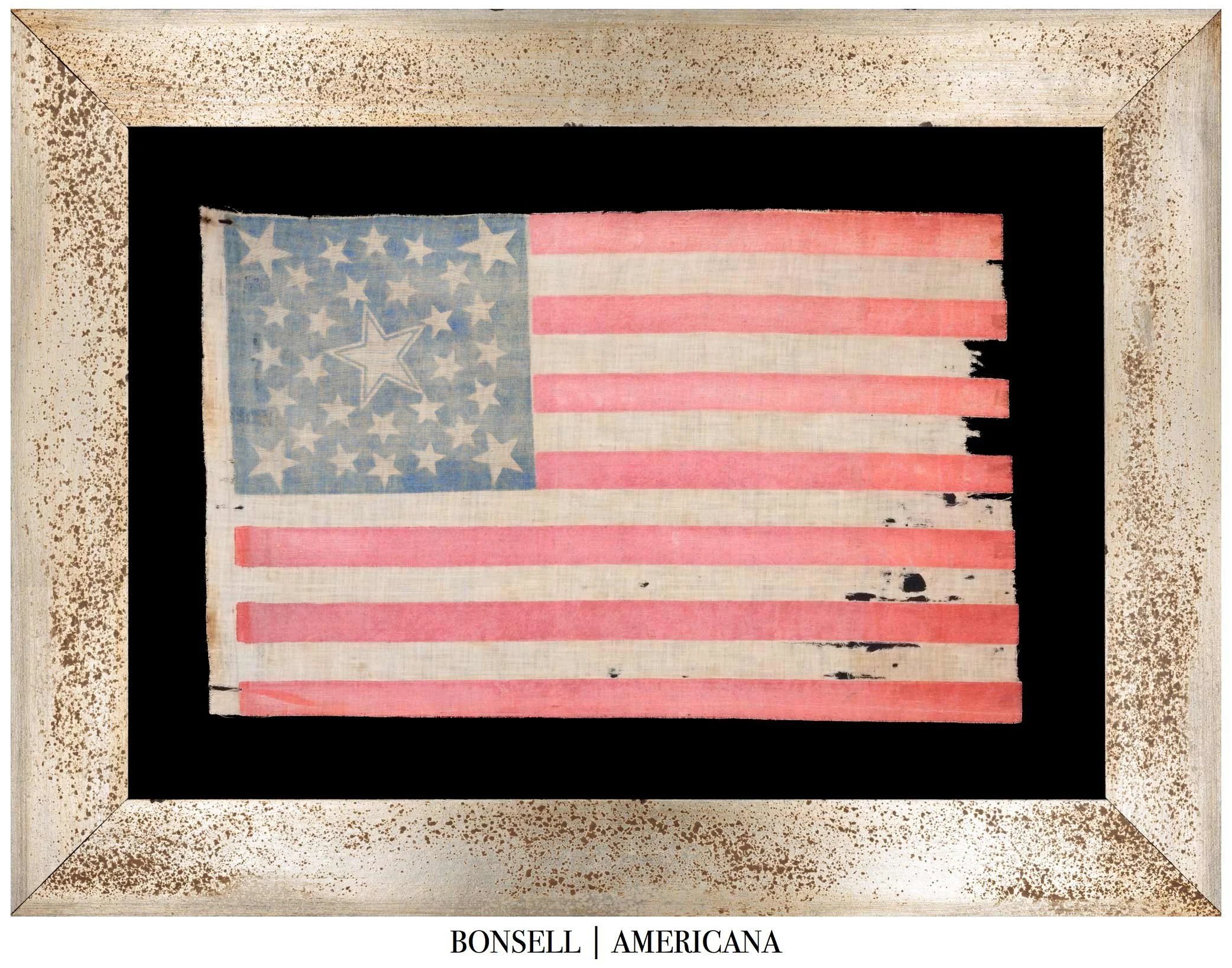
Offered is an exceptional 30-star antique American flag, printed on cotton and dating to one of the earliest periods of commercially printed American flags. The canton features an elaborate medallion configuration centered by a large, haloed star, making this a particularly striking example of an already exceedingly scarce star count.
The 30-star flag represents the admission of Wisconsin as the 30th state. Wisconsin entered the Union on May 29, 1848, and under the Flag Act of 1818 its star was officially added to the American flag on July 4 of that year. The 30-star flag remained official until July 3, 1851, when California's admission resulted in the 31-star flag.
Flags dating to the years before the Civil War survive in comparatively small numbers, particularly those intended for public, political, or celebratory use. The American flag had not yet assumed the near-universal place in civic and domestic life that it would acquire during and after the Civil War. Even within the military, the familiar Stars and Stripes was adopted gradually. Army regulations of 1834 prescribed a Stars and Stripes national color for artillery, while infantry was not authorized to carry the Stars and Stripes as its national color until 1841.
This flag therefore belongs to a formative period in the development of the American flag as a widely recognized national emblem. Its printed construction is especially noteworthy. Printed parade flags became increasingly important as inexpensive flags could be produced for political rallies, public celebrations, parades, and other civic events, but examples from the 1840s remain exceptionally early. This flag dates only about a decade after the 26-star period of 1837–1845 and well before the enormous expansion in flag production brought about by the Civil War.
The star configuration is among the most compelling features of the flag. Rather than employing simple horizontal or vertical rows, the maker arranged the stars in an elaborate medallion. A large star occupies the center of the canton, surrounded by concentric arrangements of smaller stars, with additional stars positioned toward the corners. The resulting design is both highly graphic and distinctly representative of the freedom enjoyed by 19th-century flag makers.
There was no federally prescribed arrangement of the stars during this period. The Flag Act of 1818 established that the flag would contain one star for each state, with additional stars added on the Fourth of July following a state's admission, but it did not dictate how those stars were to be arranged. Makers were therefore free to employ circles, medallions, Great Stars, staggered rows, and numerous other patterns. The federal government did not standardize the arrangement and proportions of the national flag until 1912, during the administration of President William Howard Taft.
At the center of this example is an unusually large, canted star surrounded by a narrow outlined or "haloed" border. This type of device is sometimes described by collectors as a center star and should be distinguished from a Great Star, in which numerous smaller stars are themselves arranged to form the outline of one large star. Here, the center star is an individual printed element around which the remainder of the constellation is organized.
The oversized center star is traditionally interpreted on flags of this type as representing the newest state—in this case Wisconsin. Whether every maker consciously intended that symbolism cannot be established, but the placement would have been particularly appropriate in 1848, when Wisconsin's admission was the event that brought the national constellation to 30 stars.
The halo surrounding the center star is another notable feature. Similar haloed center-star devices appear on a small group of printed American flags from the middle decades of the 19th century and are immediately recognizable for their distinctive appearance. The identity of the printer remains unknown, but similarities in printing style and canton design among surviving examples suggest that related flags may have originated with the same maker or closely associated manufacturers. On this example, the pale outline around the large star creates a strong focal point within an already complex medallion.
The historical moment represented by the flag is equally important. The 30-star period encompassed the presidential election of 1848, held only months after Wisconsin entered the Union. Whig nominee Zachary Taylor, a celebrated general of the Mexican-American War, faced Democratic nominee Lewis Cass and former President Martin Van Buren, who ran as the candidate of the newly organized Free Soil Party. Taylor won the election, propelled in large part by his national reputation as a military hero.
Taylor's supporters organized political clubs, rallies, and public gatherings around the image of "Old Rough and Ready," while the Free Soil campaign made the expansion of slavery into the western territories a central national political issue. The election took place as the country confronted the enormous territorial gains resulting from the Mexican-American War and the increasingly contentious question of whether slavery would expand westward.
A small printed flag such as this would have been well suited to the political and public gatherings of the period. Without specific provenance it is impossible to assign this particular example to the Taylor campaign, but its 1848–1851 date, portable format, and printed cotton construction place it squarely within the type of flag used at political rallies, parades, patriotic celebrations, and other public events during the era.
Taylor's presidency proved remarkably brief. He died on July 9, 1850, roughly 16 months after taking office, and was succeeded by Vice President Millard Fillmore. His administration coincided with rapidly increasing sectional conflict surrounding slavery and the territories acquired from Mexico, placing the 30-star period immediately before the political crises of the 1850s that eventually culminated in the Civil War.
The survival of any printed American flag from this period is notable. The combination present here—a 30-star count, pre-Civil War manufacture, elaborate medallion configuration, oversized haloed center star, and early printed cotton construction—places this example among the more visually distinctive forms produced during the formative years of the American flag. It represents Wisconsin's entry into the Union, the presidential politics of 1848, and an era when flag makers were still free to interpret the national constellation with extraordinary creativity.
Conservation Process: This flag was hand sewn to cotton fabric, and both were hand sewn to a mounting board. To prevent the black dye in the cotton fabric from seeping into the flag, it was first washed in a standard wash and then in a dye setting wash. The flag is positioned behind Optium Museum Acrylic.
Frame: The flag is housed in a wide, contemporary frame with a softly sloped profile and an aged silver finish. The surface is deliberately distressed, with warm brown and muted gold undertones showing through the silver, giving the frame an understated, timeworn appearance that complements the flag without competing with it.
Condition Report: The flag is in good condition for its age, with strong overall presentation and attractive, softly faded color. There is scattered fabric loss and fraying, concentrated primarily along the fly end and in several areas of the lower white stripes, along with minor staining and small scattered losses elsewhere. Despite these condition issues, the canton and distinctive haloed medallion configuration remain well preserved and highly legible.
Collectability Level: The Best – Perfect for Advanced Collectors
Date of Origin: 1848-1851
Number of Stars: 30
Associated State: Wisconsin
Price: Call 618-553-2291, or email info@bonsellamericana.com
Frame Size (H x L): 40” x 105”
Flag Size (H x L): 24 ½” x 88 ½”
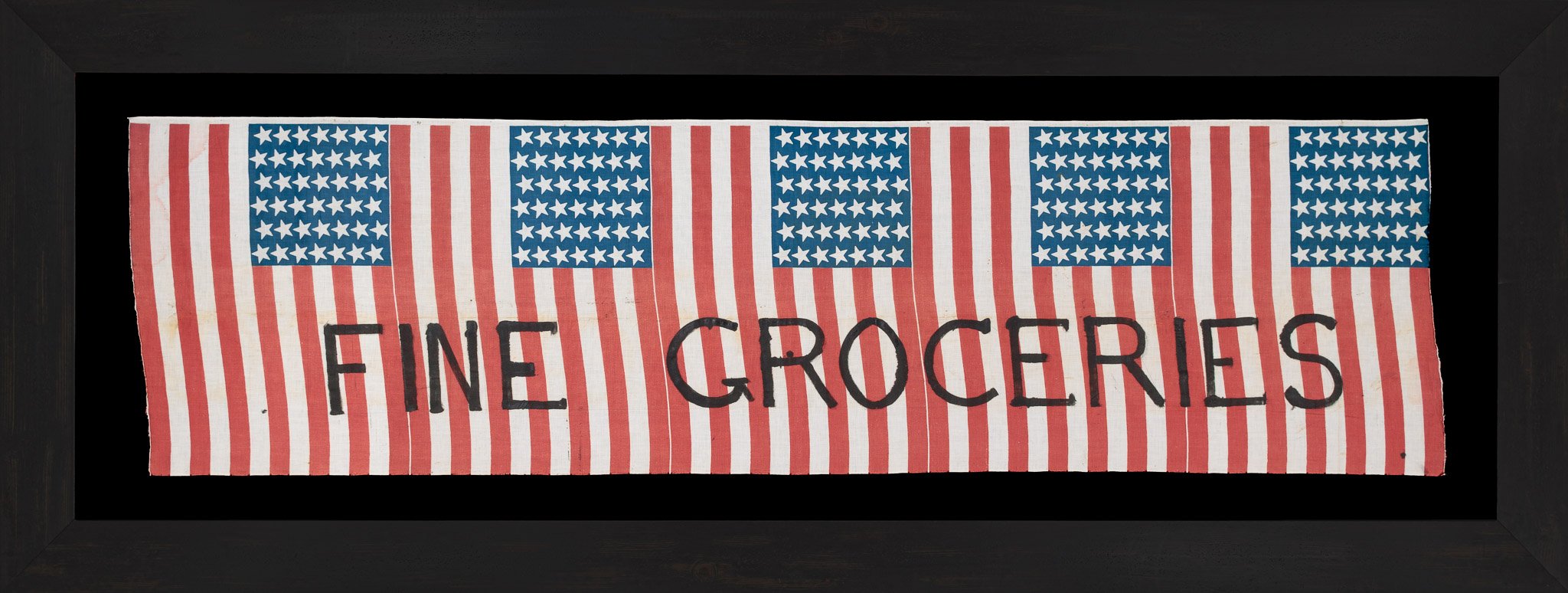
Offered is an unusual late 19th century advertising banner constructed from five connected 42-star American parade flags, printed on cotton and boldly hand-painted with the words “FINE GROCERIES.” The piece is notable on several levels: the flags themselves represent one of the more interesting unofficial star counts of the period, they remain joined in a continuous strip of five, and the group was later adapted for commercial use.
Each of the five flags contains 42 white stars on a blue canton. The stars are arranged in six vertical columns of seven, with alternating columns positioned at slightly different heights to create a subtle wave-like configuration. All of the stars are oriented with two points upward rather than the more familiar single point. There is no known significance to this orientation. During the 19th century, star arrangement and orientation were largely left to the discretion of flag makers, and the present configuration appears to have been simply a distinctive design choice.
The 42-star count corresponds to a particularly interesting moment in American expansion. North Dakota and South Dakota entered the Union on November 2nd, 1889, followed by Montana on November 8th and Washington on November 11th. Washington therefore became the 42nd state.
Flag manufacturers often responded to statehood more quickly than federal law did. Under the Flag Act of 1818, stars representing newly admitted states were formally added to the national flag on the following July 4th. In practice, commercial flag makers frequently introduced new star counts immediately after states were admitted, both to reflect the actual number of states and to keep pace with competing manufacturers.
That practice explains the appearance of the 42-star flag. Following Washington’s admission in November 1889, manufacturers began producing flags with 42 stars even though the official national flag still contained 38. Even though the 42-star count was expected to become official on July 4th, 1890, it never did.
Idaho was admitted as the 43rd state on July 3rd, 1890, just one day before the anticipated 42-star flag would have taken effect. Wyoming followed on July 10th as the 44th state. As a result, 42 stars never constituted an official United States flag count. Surviving 42-star flags therefore represent the relatively brief interval between Washington’s admission and Idaho’s entry into the Union, when manufacturers were anticipating the next official flag.
The present banner is especially interesting because the five flags were never separated. Small printed parade flags of this type were commonly manufactured in multiples on continuous lengths of cloth. Individual flags could then be cut apart for sale, distribution, or use at political rallies, patriotic celebrations, and other public events. Here, five examples remain joined together, preserving the manner in which they were originally printed rather than the individual format in which these flags are usually encountered.
The repeating design gives the banner a strong visual rhythm. Five blue cantons appear in sequence across the upper portion, while the red and white stripes continue below. The survival of this many connected examples also provides a useful illustration of how inexpensive printed parade flags were manufactured and distributed in the late 19th century.
At some point, the connected strip was repurposed as a commercial sign. Across the center, in large black letters, someone painted: FINE GROCERIES
Fine pencil guidelines remain visible around portions of the lettering, showing that the inscription was carefully laid out before the paint was applied. The irregularities in the letter forms and the surviving pencil marks make clear that the wording was applied by hand rather than mechanically printed.
The phrase itself points toward the banner’s likely use. “Fine Groceries” was a familiar period description used by grocers, general merchants, and food dealers to advertise better-quality provisions and specialty goods. Although the specific business associated with the banner is unknown, it was presumably displayed in a grocery store, market, general store, or similar commercial setting.
Its reuse in this fashion is an important part of the object’s history. Rather than being separated into individual flags, the strip was retained intact and turned into functional advertising. The existing patriotic imagery provided a highly visible background, while the painted inscription allowed the merchant to adapt an already decorative textile for practical use.
American flags and other patriotic devices were widely incorporated into commercial displays during the late 19th and early 20th centuries. Bunting, shields, eagles, and national colors appeared in shop windows, storefronts, exhibitions, and advertising displays. This banner belongs to that broader tradition while retaining a particularly direct connection to the flag trade itself.
The date at which the lettering was added cannot be established with certainty. The flags themselves were produced in connection with the 42-state period beginning in late 1889 and extending into 1890. The advertising inscription may have been applied at approximately the same time, although it is also possible that an unused strip remained in stock and was adapted somewhat later. Without documentation linking the banner to a specific business, a narrower date for its commercial use would be speculative.
Taken as a whole, the piece brings together two distinct areas of late 19th century material culture. The flags document the rapid changes in the national star count during the admission of the western states, while the painted inscription reflects the practical reuse of patriotic textiles in everyday American commerce.
The survival of five connected 42-star flags is unusual in itself. Their conversion into a hand-painted “FINE GROCERIES” banner makes the piece considerably more distinctive. It functions simultaneously as a statehood-era flag textile and as a surviving example of vernacular commercial signage, with strong relevance to collectors of American flags, advertising, store displays, and food-related material culture.
Conservation Process: The banner was hand sewn to cotton fabric, and both were hand sewn to a mounting board. To prevent the black dye in the cotton fabric from seeping into the banner, it was first washed in a standard wash and then in a dye setting wash. The banner is positioned behind Optium Museum Acrylic.
Frame: The banner is housed in a substantial flat-profile wooden frame with a distressed black finish and subtle natural undertones visible along the surface and edges. The wide, restrained molding gives the piece a strong architectural presence while remaining visually secondary to the textile.
Condition Report: The banner remains in very good overall condition, with strong red and blue coloration and the painted lettering remaining bold and legible. There is scattered light soiling, minor staining, and small marks consistent with age and use, along with slight irregularity and wear at the outer edges.
Collectability Level: The Best – Perfect for Advanced Collectors
Date of Origin: 1889-1890
Number of Stars: 42
Associated State: Washington
Frame Size (H x L): 29” x 38.75”
Flag Size (H x L): 16” x 22.5”
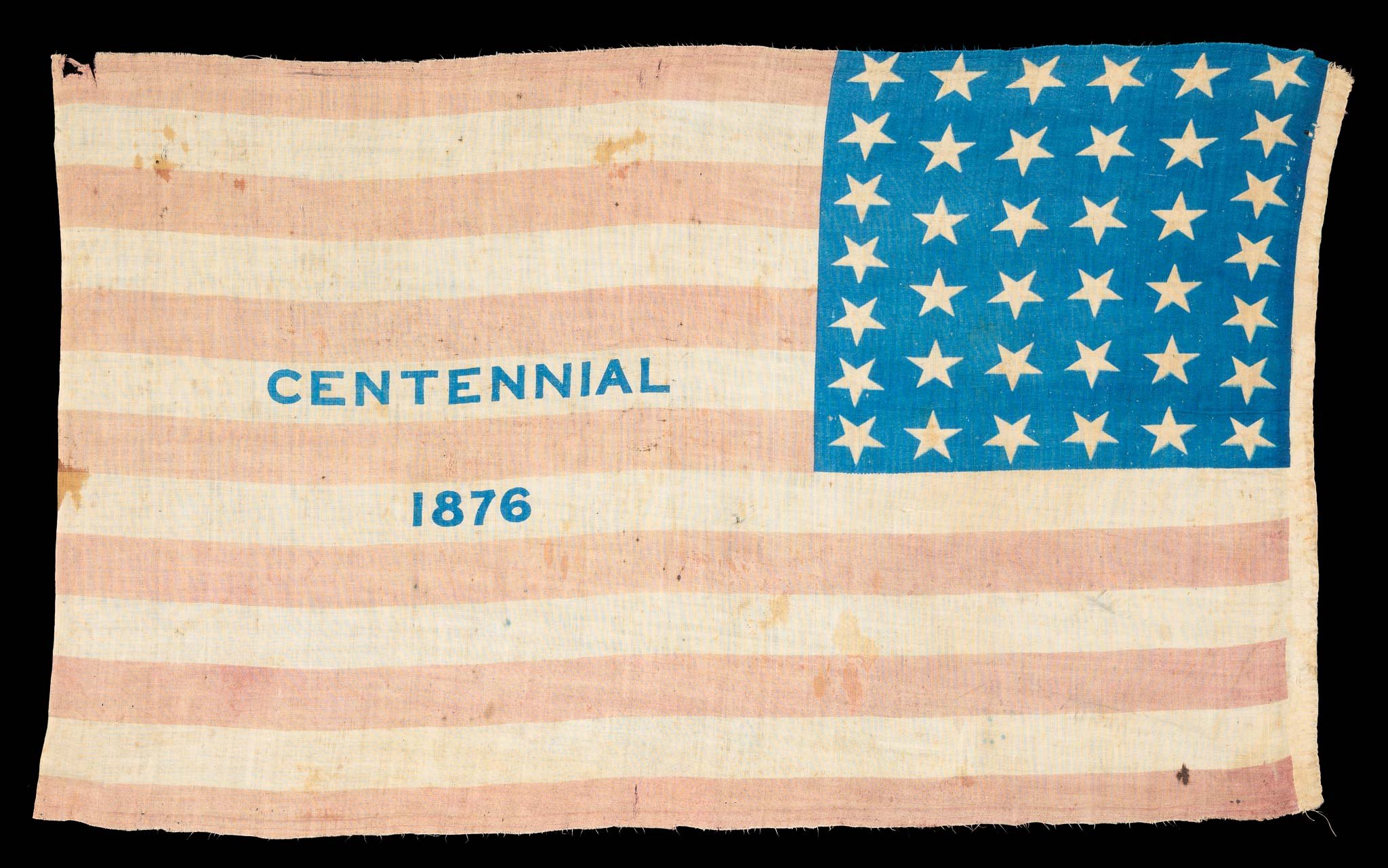
Offered is a 38-star antique American parade flag, printed on cotton and bearing the patriotic overprint CENTENNIAL | 1876. Made during the nation’s centennial year, the flag combines two important events of 1876: the celebration of the 100th anniversary of American independence and the admission of Colorado as the 38th state.
The centennial prompted an extraordinary display of patriotic material culture throughout the United States. Cities and towns hosted parades, ceremonies, exhibitions, and public gatherings, while homes, businesses, and civic buildings were decorated with flags and other red, white, and blue textiles. At the center of these celebrations was the Centennial International Exhibition in Philadelphia, held from May through November 1876 and recognized as the first official world’s fair in the United States. The exposition attracted millions of visitors and provided a national stage for American industry, technology, art, and culture.
This particular pattern appears to have a strong association with Philadelphia and the Centennial Exhibition. Surviving examples are scarce, with approximately twenty presently known in collections and the marketplace, and examples have frequently surfaced in Philadelphia and the surrounding region. More compellingly, a documented example bears the period inscription “Philadelphia, Sept 1876, G.N.M.”, providing direct evidence that flags of this pattern were present in the city during the exposition.
The canton contains 38 stars arranged in six vertical columns. The first and last columns contain seven stars each, while the four interior columns contain six. Their orientation alternates in an unusual fashion: the stars in the first, third, fourth, and sixth columns point downward, while those in the second and fifth columns point upward. The resulting arrangement is distinctive and readily identifiable among surviving Centennial-era parade flags.
Of particular interest, the blue used for the canton closely corresponds to that of the CENTENNIAL | 1876 inscription. This suggests that the inscription was incorporated into the original printing process rather than applied as a later secondary overprint. Many 19th-century parade flags were produced as standard patriotic flags and subsequently customized with campaign slogans, commercial advertising, commemorative text, or organizational information, often in black or another contrasting ink. Here, the coordinated printing strongly indicates that the flag was conceived specifically as a Centennial commemorative textile.
The flag was also printed in what collectors commonly describe as a reverse-mount orientation, with the canton positioned at upper right when the flag is viewed as shown. Although modern display convention calls for the canton to appear at upper left when a flag is presented horizontally, 19th-century manufacturers were considerably less standardized in this respect. Reverse-oriented parade flags are encountered with some regularity among early printed examples and reflect the broad variety of formats produced for decorative and commemorative use.
An example of this same flag is documented as item 437 in Threads of History: Americana Recorded on Cloth, 1775 to the Present, by Herbert Ridgeway Collins, then curator of political history at the Smithsonian Institution. The landmark reference illustrates more than 1,500 examples of American political and patriotic textiles, many drawn from the collection of Boleslaw and Marie-Louise Mastai. Another example appears in J. Richard Pierce’s The Stars and Stripes: Fabric of the American Spirit. The Pierce example carries the aforementioned inscription “Philadelphia, Sept 1876, G.N.M.”, providing important period documentation for the pattern and supporting its association with Philadelphia’s Centennial celebrations.
The presence of 38 stars is especially appropriate to the year. Colorado was admitted to the Union on August 1, 1876, earning its enduring nickname, the “Centennial State.” Under federal convention, the additional star formally became part of the national flag on July 4, 1877. Consequently, the official American flag throughout the Centennial Exhibition still contained 37 stars. Flag makers, however, routinely anticipated the admission of new states, and 38-star flags were produced and displayed well before their official date. Alongside 13-star flags recalling the original colonies, 38-star examples became particularly fitting symbols of the Centennial year: one looking back to the nation’s founding and the other acknowledging its newest state.
The 38-star flag remained the official national flag from July 4, 1877 until July 3, 1890. It served during the administrations of Rutherford B. Hayes, James A. Garfield, Chester A. Arthur, Grover Cleveland, and Benjamin Harrison. On July 4, 1890, it was succeeded by the 43-star flag following the admission of North Dakota, South Dakota, Montana, Washington, and Idaho.
This example is notable for its CENTENNIAL | 1876 inscription, unusual star arrangement, and documented connection to other known examples associated with Philadelphia. These features place it among a small group of identifiable parade flags produced in direct response to the nation’s 1876 centennial celebrations.
Conservation Process: This flag was hand sewn to cotton fabric, and both were hand sewn to a mounting board. To prevent the black dye in the cotton fabric from seeping into the flag, it was first washed in a standard wash and then in a dye setting wash. The flag is positioned behind Optium Museum Acrylic.
Frame: The flag is housed in a substantial circa-1830s figured birch frame, with pronounced flaming grain and a warm period finish. The frame incorporates a narrow ripple-molded outer edge and a modern inner gilt fillet, creating a restrained but elegant presentation. It retains an exceptional degree of original character and surface.
Condition Report: Overall good condition for its age, with moderate fading to the red stripes, scattered staining and light soiling, and minor areas of discoloration throughout. There is some fraying and small losses along the edges, including a more noticeable loss at the upper-left corner, along with minor wear near the fly end. The blue canton and CENTENNIAL | 1876 overprint remain strong and clearly legible.
Collectability Level: The Best – Perfect for Advanced Collectors
Date of Origin: 1876
Number of Stars: 38
Associated War: The Indian Wars (1860-1890)
Associated State: Colorado
Price: Call 618-553-2291, or email info@bonsellamericana.com
Frame Size (H x L): 12” x 14”
Flag Size (H x L): 5.5” x 8”
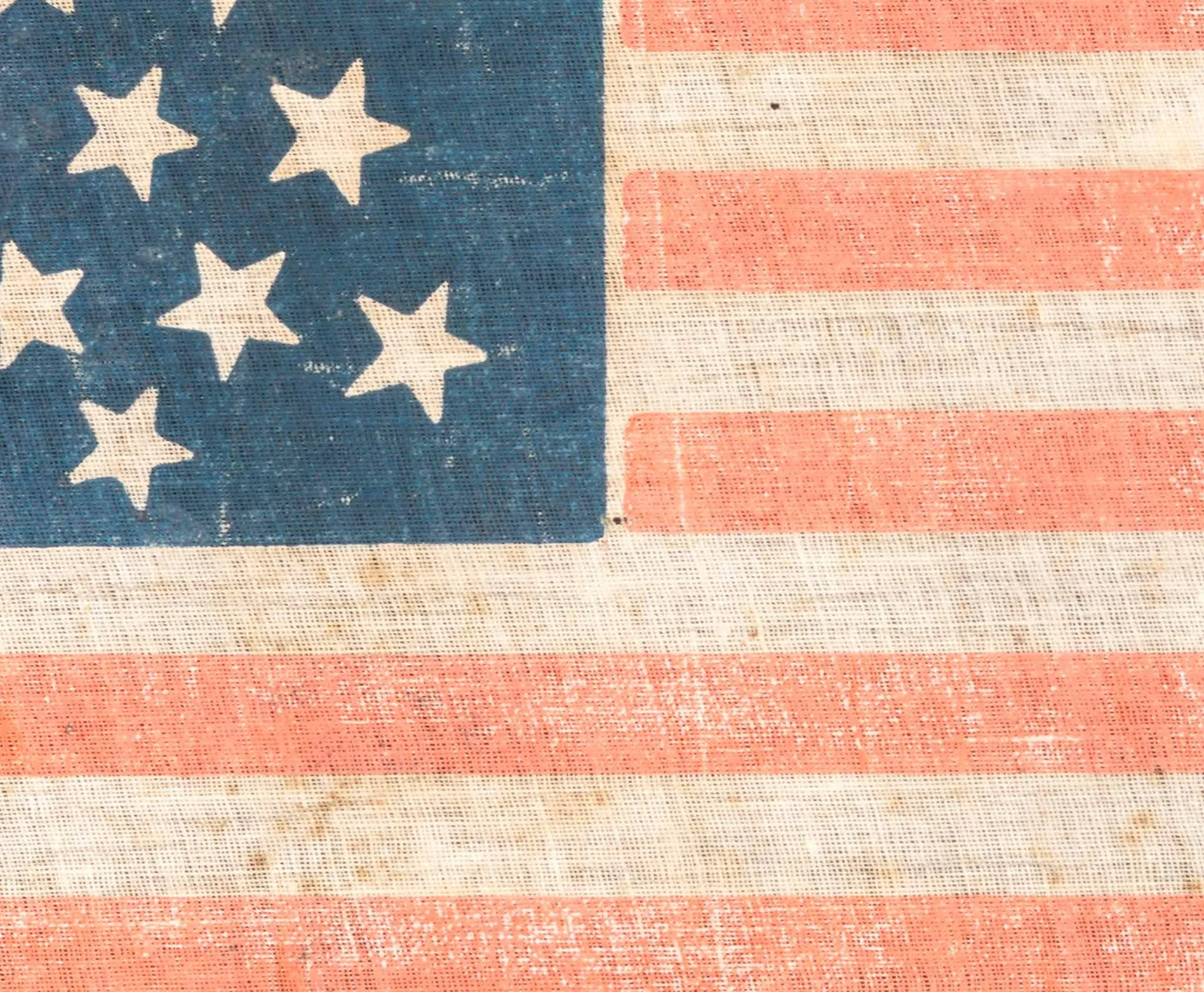
Offered is a 13-star antique American parade flag, printed on glazed cotton, and exhibiting one of the rarest star configurations found on any 19th-century printed American flag. The 13 stars are arranged to form a large, six-pointed version of the “Great Star” or “Great Luminary” pattern, in which a larger star is created from a constellation of smaller stars.
Great Star flags are highly prized among collectors, but this six-pointed interpretation is far more unusual than the five-pointed versions more commonly encountered in American flag design. The result is both graphic and mysterious: a bold, star-shaped device that immediately distinguishes this flag from nearly all other 13-star parade flags.
Printed parade flags exhibiting this pattern are extremely rare and are known in what we refer to as small, medium, and large varieties. The example offered here is the medium version, measuring approximately 5.5" x 8". Within this scarce family, the medium variety is limited to just four or five known examples, one of which includes a “Lincoln & Hamlin” overprint from Abraham Lincoln’s 1860 presidential campaign.
The flag dates to approximately 1848–1865. The beginning of this date range is based on the early use of printed parade flags in presidential campaigning by 1848, while the latter date corresponds with the conclusion of the Civil War. The rarity of this six-pointed star configuration, together with the flag’s coarse glazed cotton, early printing method, dyes, and the existence of the related Lincoln & Hamlin campaign example, strongly supports a date from the Civil War era or earlier.
The reason for arranging the stars in this six-pointed form is unknown, though two principal explanations are plausible.
As a first theory, the six-pointed star may reference the constellation of stars above the eagle on the Great Seal of the United States. The Great Seal, adopted in 1782, was created to authenticate official documents of the federal government and became one of the nation’s most important symbols. Francis Hopkinson played a key role in designing the Great Seal and has also often been credited as a designer of the United States flag, in contrast to the more familiar but historically debated Betsy Ross tradition. Although original sketches for the stars on the Great Seal were more loosely arranged, the engraver of the original die selected a six-pointed star form, likely influenced by European heraldic convention.
As a second, alternative theory, the configuration may be visually related to the Star of David, also known as the Shield of David. Modern viewers naturally recognize the six-pointed form in that context. The symbol itself dates back centuries and was used historically in decorative, ancestral, and religious contexts, though its widespread adoption as a primary emblem of Jewish identity developed more fully over time. By the 19th century, its use among European Jewish communities had increased, making the association possible within the period of this flag’s manufacture.
That said, the Star of David interpretation should be treated as a possibility rather than a certainty. The six-pointed form may instead have been selected because it was a balanced, visually logical, and highly effective way to arrange 13 stars into one larger star-shaped device. Whatever the maker’s intention, the result is among the most distinctive star patterns known in early American printed flags.
The flag is printed on glazed cotton, a material commonly associated with early parade flags. These small printed flags were inexpensive, portable, and intended for temporary display at political rallies, patriotic events, civic gatherings, and public celebrations. Their survival is often precarious because they were not generally made as permanent objects. The coarse weave, irregular printing, and softened red and blue pigments give this example the surface and character collectors associate with early printed cotton flags.
Prior to the Civil War, private use of the American flag was comparatively limited. Most early parade flags made for the civilian market appear to have been used in political rallies, campaign events, and other public gatherings. The known Lincoln & Hamlin example in this same general style is therefore especially important. It suggests that flags of this pattern were likely produced for political display, even when surviving examples do not bear printed campaign text.
While we may never know whether this flag was intended to reference the Great Seal, the Star of David, another historical source, or simply the most elegant arrangement of 13 stars into a six-pointed device, its importance is clear. It belongs to one of the rarest families of 13-star printed parade flags known to survive. Small in scale but powerful in design, it is an exceptional example for collectors of early American flags, political textiles, and rare patriotic printed cottons.
The original use of the 13-star flag dates to June 14, 1777, when the Continental Congress adopted the first official flag resolution. The resolution stated: “Resolved, that the flag of the United States be made of thirteen stripes, alternate red and white, that the union be thirteen stars, white on a blue field, representing a new constellation.” Thirteen-star flags were official from 1777 until 1795, but they have remained in use throughout American history.
The 13-star count was later used for a wide variety of patriotic, military, political, and commemorative purposes. Small U.S. Navy boats used 13-star flags as ensigns from 1795 until 1916, in part because fewer stars were easier to distinguish at a distance on small flags. Commercial flag-makers mirrored this practice, and some private vessels also flew 13-star flags during the same general period.
Thirteen-star flags were also flown in connection with major patriotic events, including observances following George Washington’s death in 1799, celebrations of the nation’s 50th anniversary in 1824, and public commemorations surrounding General Lafayette’s return to the United States in 1824–1825. Lafayette’s tour inspired celebrations in New York, Boston, Philadelphia, and many other communities throughout the country.
The 13-star flag also carried special meaning during the Mexican War and the Civil War. Both conflicts inspired renewed patriotic display, and during the Civil War especially, the flag became a powerful public symbol of Union, liberty, and national preservation. In that context, the 13-star count deliberately recalled the original colonies and the founding struggle for American independence.
Thirteen-star flags were again widely displayed during the Centennial celebrations of 1876, most notably at the Centennial International Exhibition in Philadelphia. By that time, the 13-star flag had become both a historic emblem and a flexible patriotic device, capable of referring to the Revolution, the Founding generation, national unity, and American endurance.
This example is especially compelling because it combines that historic 13-star symbolism with one of the rarest and most visually arresting star patterns known in early printed American flags. Its small scale, coarse glazed cotton, early printing, and six-pointed Great Star configuration make it a remarkable survivor from the formative period of American political and patriotic display.
Conservation Process: The flag was hand sewn to cotton fabric, and both were hand sewn to a mounting board. To prevent the black dye in the cotton fabric from seeping into the flag, it was first washed in a standard wash and then in a dye setting wash. The flag is positioned behind Optium Museum Acrylic.
Frame: A handsome 19th-century American frame with a rich, dark, hand-finished surface exhibiting pronounced craquelure throughout, indicative of age and original finish. The textured, slightly irregular surface and warm tonality provide a strong visual counterpoint to the textile, enhancing its period presence without distraction.
Condition Report: Condition is very good for an early printed parade flag of this type, with expected oxidation, minor staining, surface soiling, and scattered pigment loss throughout. There is fraying along the perimeter, especially at the fly end and along the top and bottom edges, with small areas of thread separation and fabric loss. A small horizontal tear is present near the fly end. The printed colors remain attractive, with a pleasingly faded red and strong blue canton, and the overall presentation is excellent.
Collectability Level: The Best – Perfect for Advanced Collectors
Date of Origin: 1848-1865
Number of Stars: 13
Associated War: The Civil War (1861-1865)
Associated State: Original 13 Colonies
Frame Size (H x L): 35" x 42”
Flag Size (H x L): 24” x 31”
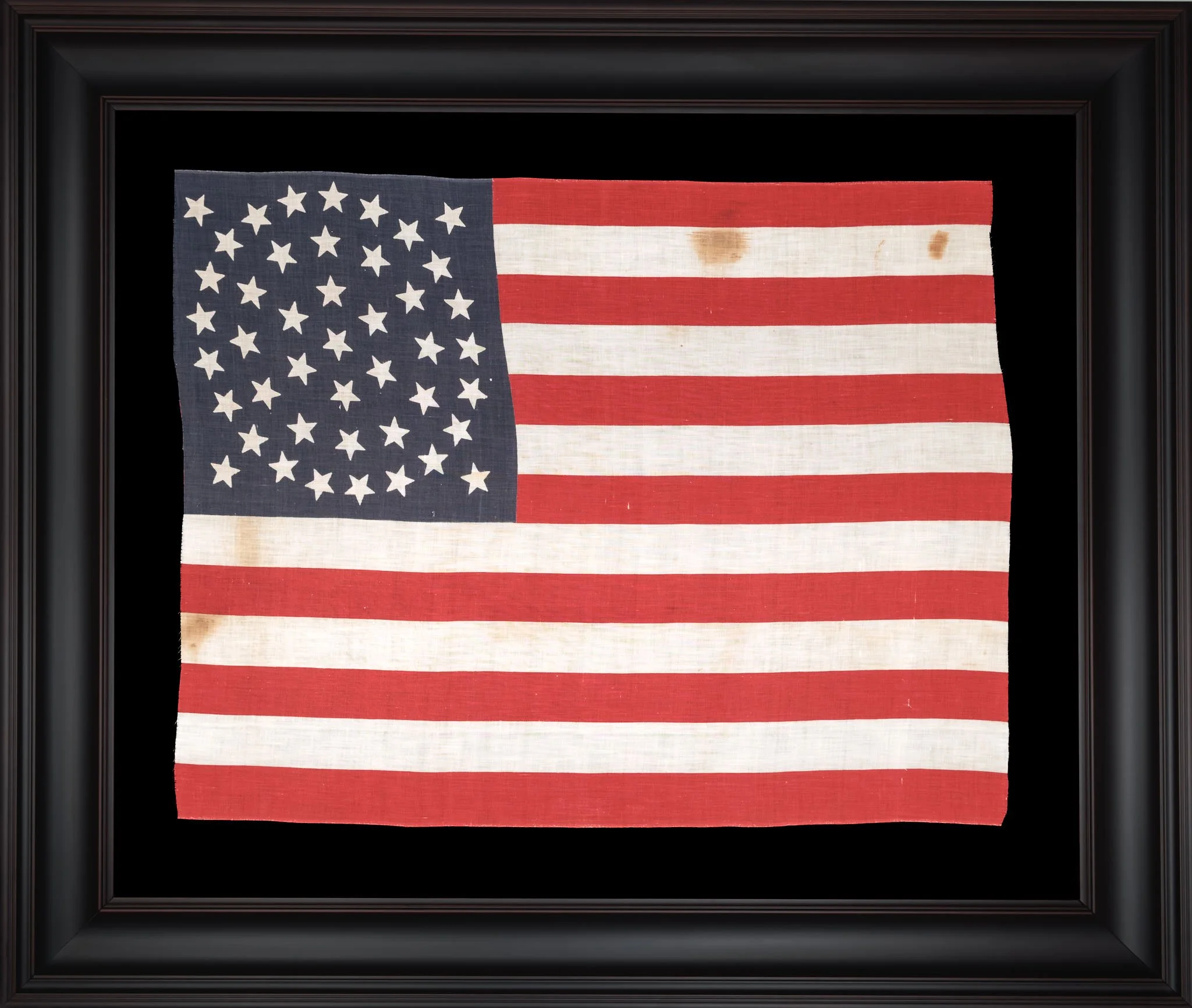
Offered is a forty-four star flag made of cotton. The stars on this flag are arranged in a medallion pattern, one of the most beautiful and desirable patterns in the hobby. This particular medallion has a center star that is surrounded by three concentric rings of stars. The three rings are then surrounded by four flanking corner stars.
Medallion pattern flags date to at least as early as the twenty-six star flag, and at least as late as the forty-eight star flag. The majority of medallion pattern flags, however, date to between 1861 and 1876. During this period, many flag makers would include a center star, surround it with one or more wreaths of stars, and then surround the wreaths with flanking stars (i.e., corner stars). Beginning in the 1890s, the beautiful medallion patterns became less common, and linear arrangements became the norm. Why this occurred is unclear, as flag makers had the freedom to place the stars however they liked until 1912, when President Taft issued Executive Order 1556 establishing the arrangement of the stars into rectilinear rows.
The forty-four star flag represents the inclusion of Wyoming to the Union. Wyoming was admitted on July 10th, 1890, and this flag became official on July 4th, 1891. Presidents Benjamin Harrison and Grover Cleveland served under this flag.
In 1889, Congress considered adding the Dakota Territory as a single state. What happened, however, was that the Dakota Territory was split it into two states: North Dakota and South Dakota, and they were both admitted on November 2nd, 1889. Soon thereafter, on November 8th, 1889, Montana was admitted as the forty-first state, and on November 11th, 1889, Washington was admitted as the forty-second. When Congress went on break, flag makers began producing anticipatory forty-two star flags for the following July 4th, 1890.
To the surprise of many, on July 3rd, 1890—just one day before the forty-two star flag was going to be official—Congress admitted Idaho as the forty-third state. As a result, the forty-two star flag never became official, but the forty-three star did. Just a few days later, on July 10th, 1890, Congress admitted Wyoming as the forty-fourth state. As a result of this rapid succession of state admissions, flag makers made large quantities of unofficial forty-two star flags and official forty-four star flags, but hardly any forty-three star flags (despite it being an official star count).
The forty-four star flag is relatively rare when compared to, for example, the forty-five star flag, as a result of it being used after the Centennial, but before the Spanish American War. The forty-four star flag was the official flag for five years up until July 4th, 1896, the time at which the forty-five star flag became official and began to represent the inclusion of Utah in the Union.
Conservation Process: This flag was hand sewn to cotton fabric, and both were hand sewn to a mounting board. To prevent the black dye in the cotton fabric from seeping into the flag, it was first washed in a standard wash and then in a dye setting wash. The flag is positioned behind Optium Museum Acrylic.
Frame: Housed in a wide, black-painted molded frame with a deep cove profile and stepped inner and outer edges. Subtle reddish-brown undertones in the grooves give the frame warmth and an antique-style character while maintaining a clean, formal presentation.
Condition Report: The flag presents well overall, with strong color and a legible medallion star pattern. There is age-appropriate toning and surface soiling throughout, most visible in the white stripes, along with several scattered brown stains, including examples near the upper fly, upper center, and lower hoist.
Collectability Level: The Best – Perfect for Advanced Collectors
Date of Origin: 1890-1896
Number of Stars: 44
Associated War: The Indian Wars (1860-1890)
Associated State: Wyoming
Frame Size (H x L): 32” x 37.75”
Broadside Size (H x L): 21” x 26.75”
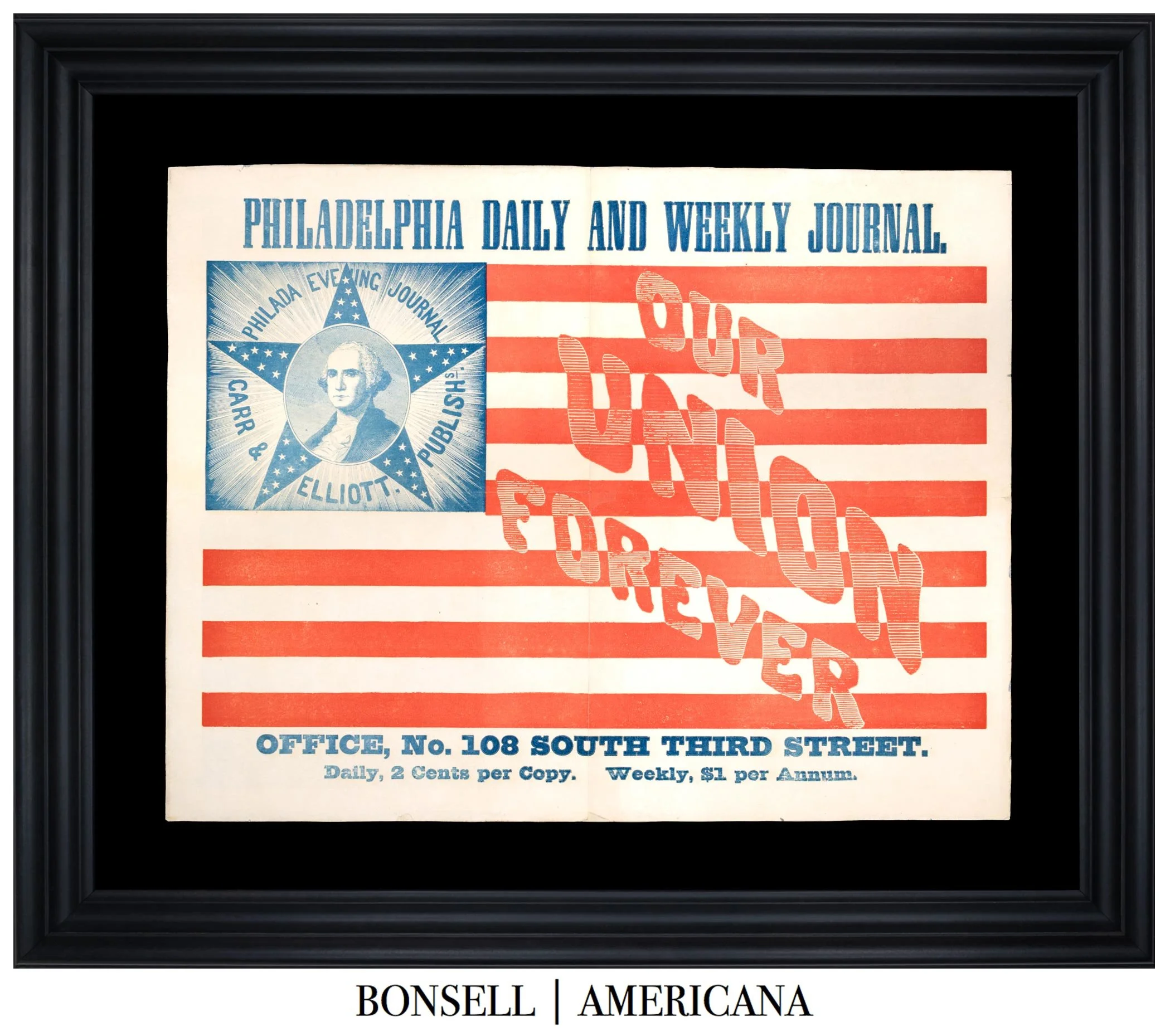
Offered is a Civil War–period advertising broadside for the Philadelphia Daily and Weekly Journal, printed in red and blue and designed in the form of an American flag. Produced in Philadelphia, Pennsylvania, circa 1861–1862, the sheet promotes the newspaper published by Carr & Elliott, whose office was located at No. 108 South Third Street. Combining patriotic imagery with commercial promotion, the broadside reflects the powerful role newspapers played in shaping public sentiment during the opening years of the American Civil War.
The broadside is printed on a single sheet and arranged as a stylized American flag. Across the upper portion appears the title “PHILADELPHIA DAILY AND WEEKLY JOURNAL.” Beneath this heading the design transitions into the striped field of the flag, printed in bold red bands. Running diagonally across the stripes in large block lettering is the emphatic slogan “OUR UNION FOREVER.” At the bottom of the sheet appears the imprint identifying the newspaper’s location and subscription terms: “OFFICE, No. 108 SOUTH THIRD STREET.” The cost of the publication is also clearly stated: “Daily, 2 Cents per Copy. Weekly, $1 per Annum.” These details underscore the dual purpose of the sheet as both patriotic display and newspaper advertisement.
The canton occupies the upper left portion of the design and contains one of the most visually compelling elements of the broadside. Within the blue field appears a portrait of George Washington, framed within the outline of a large star. Washington’s likeness is rendered in a circular medallion at the center of the device, surrounded by radiating lines that draw attention to the image. Around the portrait appears the text “PHILADA EVENING JOURNAL” and “CARR & ELLIOTT PUBLISHES,” directly associating the revered figure of the nation’s founding with the newspaper being advertised. The use of Washington in this context is deliberate and symbolic. During the Civil War, Washington’s image served as a reminder of the founding of the United States and of the struggle to preserve the Union he helped create.
Within the large star that frames the portrait are 34 smaller stars, representing the official 34-star count of the United States flag. The 34-star flag corresponds to the admission of Kansas as the 34th state on January 29, 1861. This star count became the official national flag on July 4, 1861 and remained in effect until July 3, 1863. In this design, the smaller stars are arranged within the outline of the larger star, which functions as a decorative framing device rather than an additional star in the count. The arrangement creates a visually striking canton while preserving the historically accurate star count associated with the early war period.
The newspaper promoted by the broadside was published by Carr & Elliott, a Philadelphia partnership active during the early years of the Civil War. Their paper, the Philadelphia Evening Journal, was part of a vibrant and competitive newspaper culture in the city. Philadelphia was one of the most important publishing centers in the United States during the nineteenth century, and its newspapers played a central role in shaping public opinion. Papers such as the Philadelphia Evening Journal provided daily coverage of the war while simultaneously promoting strong Unionist sentiment among readers.
The address listed on the broadside—108 South Third Street—places the newspaper within the historic commercial district of Philadelphia, only a short distance from Independence Hall and other landmarks associated with the founding of the United States. During the mid-nineteenth century this area was home to numerous printers, publishers, and booksellers. The location situates Carr & Elliott within the long-standing printing and publishing tradition of the city.
The slogan “OUR UNION FOREVER” is one of the most significant elements of the design. Appearing boldly across the stripes of the flag, the phrase encapsulates the central political and emotional message of the Union cause during the American Civil War. In the months following the outbreak of hostilities in 1861, Northern printers, publishers, and artists produced a wide range of patriotic imagery emphasizing the preservation of the United States. Slogans invoking the permanence of the Union were especially common, serving both as expressions of loyalty and as tools for rallying public support for the war effort. By integrating this phrase directly into the flag design, the broadside transforms the newspaper advertisement into a statement of national unity and resolve.
The visual strategy employed here reflects a broader pattern in Civil War graphic culture. Printers frequently combined patriotic imagery with commercial or informational content, creating designs that were both decorative and persuasive. In this example, the American flag serves as the organizing structure for the entire composition, while the slogan, portrait, and newspaper information are integrated seamlessly into the design. The result is a piece that would have functioned effectively both as an advertisement and as a patriotic display suitable for posting in a public space.
Institutional records place the broadside within the broader category of Civil War printed ephemera. An example is documented in the collection of the Library Company of Philadelphia, one of the nation’s most important repositories for early American printing and Civil War graphics. The recorded example was originally preserved in a Civil War scrapbook compiled by John A. McAllister, whose extensive collection of wartime prints and ephemera forms an important historical archive of the period.
Broadsides of this type occupy an important place in the history of American printing. Unlike bound publications, broadsides were typically produced for immediate display or distribution and were often discarded once their immediate purpose had passed. Surviving examples therefore provide valuable insight into the visual and political culture of their time. This example is especially notable for its strong graphic design, its integration of patriotic symbolism with newspaper advertising, and its clear association with the early years of the Civil War.
Taken together, the elements of the design—the American flag format, the 34-star canton, the portrait of Washington, and the bold proclamation “OUR UNION FOREVER”—create a powerful visual statement reflecting the atmosphere of the Union states during the opening phase of the Civil War. At the same time, the inclusion of the newspaper’s name, address, and subscription terms reminds us that this striking patriotic image also served a practical purpose: promoting the circulation of a Philadelphia newspaper during one of the most consequential periods in American history.
Frame: The frame is a deep-profile moulding with a simple, classical profile, finished in a dark cocoa-brown tone.
Condition: The broadside has been professionally conserved by a paper conservator and presents well overall. The sheet shows a vertical center fold, with additional light handling creases consistent with age and original distribution. There is minor scattered toning and a few small areas of edge wear, along with subtle surface irregularities typical of nineteenth-century paper broadsides. Overall, the colors remain strong and the piece displays attractively.
Collectability Level: The Best – Perfect for Advanced Collectors
Date of Origin: 1861-1862
Price: Call 618-553-2291, or email info@bonsellamericana.com
Frame Size (H x L): 20.5” x 26.5”
Flag Size (H x L): 11.5” x 17.5”
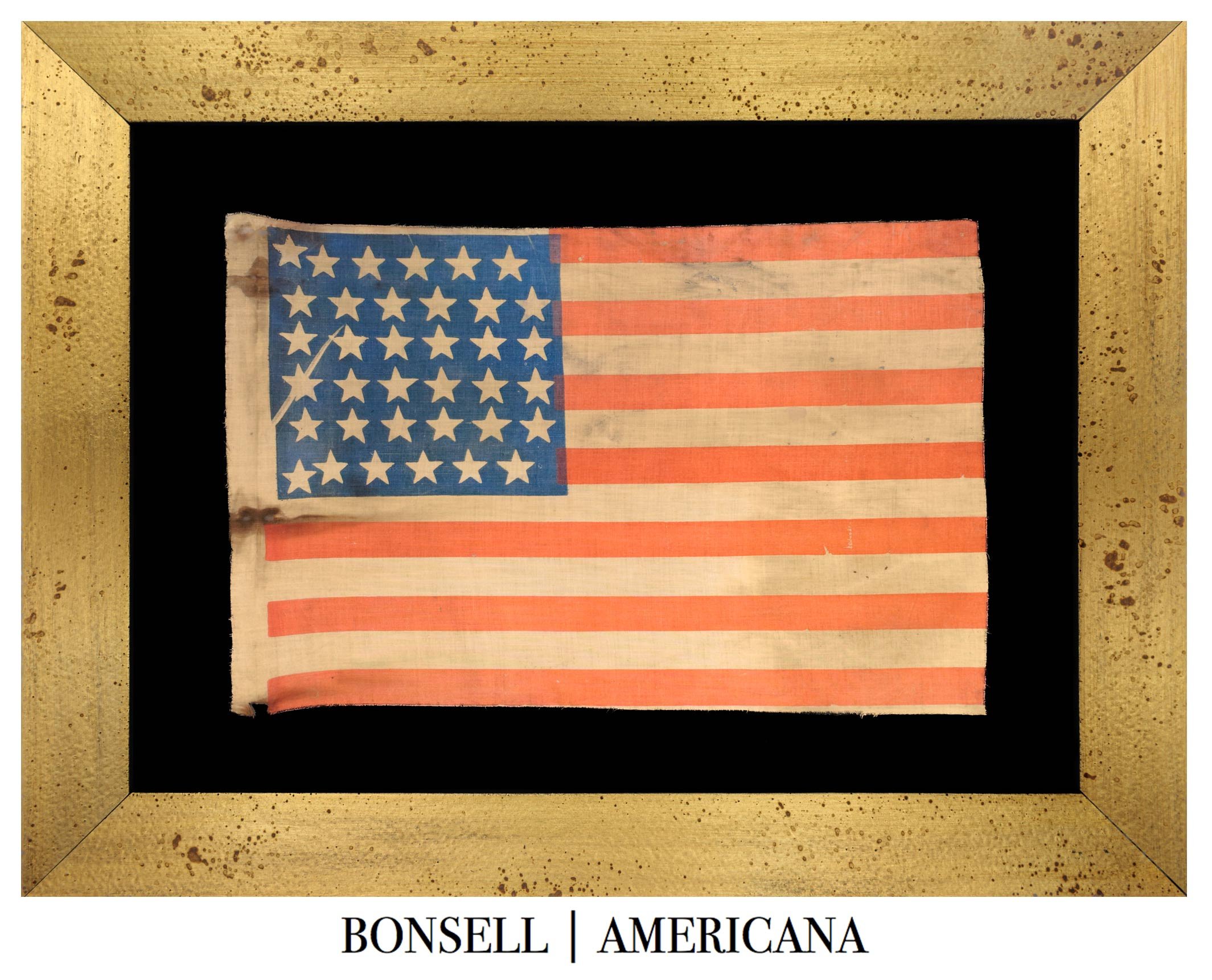
Offered is a scarce and historically resonant 36-star American parade flag, dating to the final years of the Civil War and the opening phase of Reconstruction, circa 1864–1867. Printed on cotton for public display, this flag reflects both the urgency of wartime patriotism and the latitude that 19th-century Americans exercised in interpreting and reshaping national symbols.
The canton bears a linear arrangement of stars framing three sides, creating a pronounced open-sided form that can reasonably be read as a visual reference to the Union itself. During the Civil War, the concept of Union was not merely political but existential, and visual shorthand for unity appears across a wide range of patriotic objects—from banners and badges to textiles and printed ephemera. Flags such as this one demonstrate how star placement, rather than being strictly ornamental, could be used to convey allegiance and resolve at a glance.
This configuration also places the flag within a small but documented family of beehive-related star patterns. When rotated ninety degrees, the linear stacking of stars closely resembles a beehive arrangement, aligning it conceptually with known 38-star and 42-star beehive flags produced later in the 19th century. In those examples, the beehive form is more explicit, but the underlying visual logic—organized, collective structure built from individual units—is consistent. The beehive was a long-established symbol in American civic and fraternal culture, representing industry, cooperation, and collective strength, themes that carried particular relevance during the war and the nation’s subsequent rebuilding.
From a manufacturing perspective, the flag illustrates the adaptive practices of mid-19th-century commercial flag-makers. Small parade flags were typically block-printed, using carved wooden forms designed for repeated use. As new states were admitted to the Union in quick succession, it was common for makers to modify existing blocks rather than commission entirely new carvings. In this case, the layout strongly suggests derivation from a 34-star pattern, with two stars added at the upper and lower corners of the hoist end to bring the count to thirty-six. The resulting design balances expediency with intentionality, combining practical production decisions with visually meaningful outcomes.
Several technical characteristics further distinguish the flag. The white ground appears to have been printed with white pigment prior to the application of color, a step that would have brightened the fabric and improved color adhesion. Additionally, the flag was printed on both sides, an uncommon feature among parade flags, which were more often printed on one side only, relying on pigment bleed-through to create a usable reverse. This added effort suggests an intent to produce a more visually finished object for display.
The thirty-six stars commemorate the admission of Nevada to the Union on October 31, 1864. Nevada’s statehood was driven by wartime necessity as much as geography. Its rapid admission was designed to reinforce support for President Abraham Lincoln during the 1864 election and to strengthen Republican influence in Congress. Equally significant were Nevada’s vast silver deposits, which were viewed as essential to sustaining Union finances during the war and addressing the immense fiscal demands that followed.
Although Nevada entered the Union in 1864, the 36-star flag did not become official until July 4, 1865, in accordance with federal flag protocol that delayed star additions until the first Independence Day following a state’s admission. As a result, the 36-star flag flew during the immediate postwar moment, when the nation was grappling with reunification, demobilization, and the early stages of Reconstruction. It remained the official flag of the United States until July 3, 1867, when it was superseded by the 37-star flag following Nebraska’s statehood. During this brief but consequential period, the 36-star flag served as a national emblem of a Union preserved at extraordinary cost.
In total, this flag stands as a rare convergence of symbolic design, adaptive manufacture, and historical timing. Its distinctive star arrangement, relationship to known beehive-pattern flags, and close association with the Civil War and its aftermath distinguish it as an intellectually engaging and historically significant example of American patriotic textiles.
Conservation Process: The flag was hand sewn to cotton fabric, and both were hand sewn to a mounting board. To prevent the black dye in the cotton fabric from seeping into the flag, it was first washed in a standard wash and then in a dye setting wash. The flag is positioned behind Optium Museum Acrylic.
Frame: The flag is housed in a wide, sloped molding with an aged gold surface, intentionally distressed to evoke the appearance of early gilded frames. The profile is substantial without being heavy, providing visual weight that complements the period character of the flag while maintaining a clean, restrained presentation.
Condition Report: The flag presents in sound, stable condition for its age, with expected wear consistent with mid-19th-century parade flags. There is moderate staining and discoloration along the hoist end, accompanied by scattered areas of minor pigment loss and surface abrasion throughout, most notably within the canton and along the stripes. The fabric remains intact overall, with light fraying at the edges and no major structural losses, allowing the flag to display well while retaining clear evidence of period use and age.
Collectability Level: The Best – Perfect for Advanced Collectors
Date of Origin: 1864-1867
Number of Stars: 36
Associated War: Civil War (1861-1865)
Associated State: Nevada
Price: Call 618-553-2291, or email info@bonsellamericana.com
Frame Size (H x L): 40.75” x 46.75”
Flag Size (H x L): 29” x 46.75”
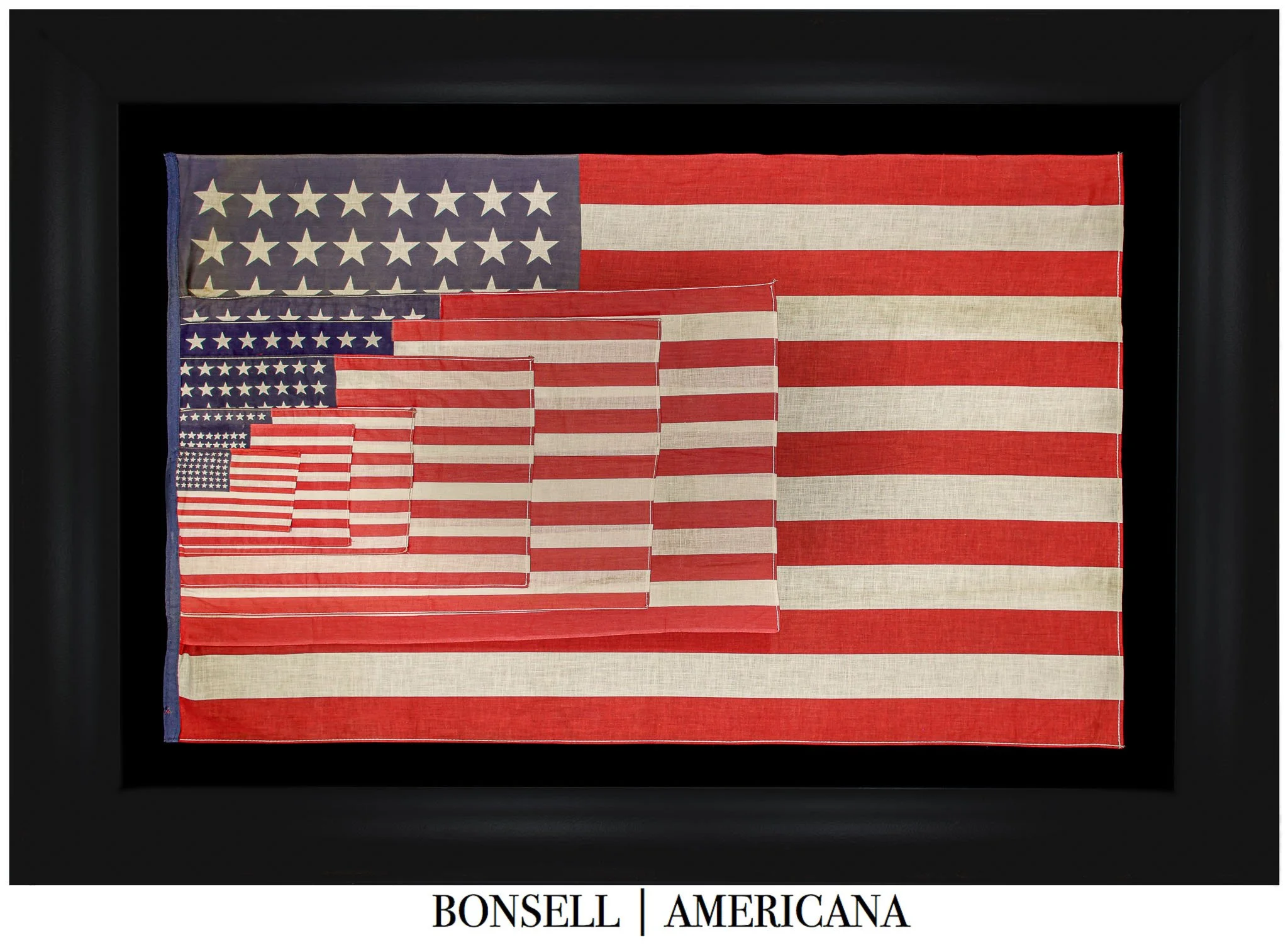
Offered is an exceptional 48-star antique American flag salesman sample, dating to the period between 1912 and circa 1930. Salesman samples such as this were produced in limited numbers during the late 19th and early 20th centuries, serving as compact, portable representations of a manufacturer’s full-size offerings. Traveling salesmen relied on these reduced examples to present styles, construction, and materials to retailers, while shopkeepers, in turn, used them to demonstrate available products to prospective customers without the need to unfurl full-scale flags. Because they were utilitarian tools rather than objects intended for public display, survival rates are extraordinarily low.
This remarkable example is composed of seven individual cotton flags, carefully stacked and joined in descending size, with the largest flag forming the base and progressively smaller flags layered atop it. The resulting visual effect is both graphic and sophisticated, offering a clear demonstration of scale, proportion, and workmanship while simultaneously functioning as a striking work of American folk art. Its appearance bears a notable resemblance to Jasper Johns’ 1958 painting Three Flags, in which a large, medium, and small American flag are similarly superimposed. Johns’ work—acquired by the Whitney Museum of American Art in 1980 for $1 million—has become one of the most celebrated images in postwar American art. While this flag salesman sample predates Johns’ painting by several decades, the compositional parallel underscores the enduring visual power of the layered flag motif in American culture.
Flag salesman samples are among the rarest forms of American patriotic textiles. Fewer than a dozen are known to exist across all star counts, and 48-star examples are represented by only a small handful of documented specimens. These appear in two distinct formats: one in which the individual flags are smaller and joined by a white cotton header, and another—such as the present example—in which the flags are larger and joined by a blue cotton header. A notable example of the latter format once resided in the esteemed Richard Pierce collection. Beyond the 48-star format, only one 38-star sample and one 45-star sample are presently known, bringing the total number of documented flag salesman samples to approximately seven.
Collectors value flag salesman samples not only for their extreme scarcity, but also for their dual role as historical artifacts and visually compelling objects. Unlike standard parade or garrison flags, these pieces document the commercial side of American flag production, providing insight into how manufacturers marketed their wares and how retailers engaged customers. The stacked, graduated presentation transforms a practical sales aid into an object of considerable aesthetic presence, one that bridges the worlds of folk art, design history, and national symbolism. In the case of 48-star examples, this appeal is further enhanced by the flag’s long official lifespan and its association with some of the most transformative decades in American history.
Until 1912, American flag makers enjoyed broad freedom in arranging the stars within the canton, resulting in a wide variety of whimsical and folk-influenced patterns. Early 48-star flags often display staggered or offset star arrangements. This changed in June of 1912, when President William Howard Taft issued Executive Order No. 1556, mandating a standardized rectilinear configuration for the 48-star flag, arranged in six horizontal rows of eight stars each. The sampler offered here exhibits this precise rectilinear pattern, strongly indicating production in or after 1912. Based on construction methods and materials, it is reasonable to conclude that it predates the widespread changes in flag manufacture that occurred around 1930.
The 48-star flag commemorates the admission of New Mexico and Arizona as the 47th and 48th states, on January 6 and February 14, 1912, respectively. The design officially became the national flag on July 4, 1912, and remained so for an extraordinary forty-seven years—the longest official tenure of any American flag. It flew during the administrations of Presidents Taft, Wilson, Harding, Coolidge, Hoover, Roosevelt, Truman, and Eisenhower, and during some of the most consequential events in the nation’s history, including World War I, World War II, and the Korean War.
The 48-star flag was ultimately replaced on July 4, 1959, following the admission of Alaska to the Union and the adoption of the 49-star flag. Today, 48-star flags are widely regarded as emblematic of early-20th-century America, and salesman samples such as this stand among the most coveted and intellectually rich forms of American patriotic textiles.
Conservation Process: This flag was hand sewn to cotton fabric, and both were hand sewn to a mounting board. To prevent the black dye in the cotton fabric from seeping into the flag, it was first washed in a standard wash and then in a dye setting wash. The flag is positioned behind Optium Museum Acrylic.
Frame: The flag is presented in a deep, black-painted frame with a softly scooped profile and a lightly weathered surface that reveals subtle undertones of warm brown beneath the finish. The design is both substantial and refined, with a gently burnished texture that complements the age and character of the flag. Its depth allows the textile to be recessed slightly, giving the presentation a shadowbox effect that enhances contrast and visual presence.
Condition Report: Overall, the flag presents very well, with strong, vibrant coloration and excellent graphic impact in the stacked format. There is expected age and handling wear, including light soiling and soft creasing from prior folding/display. Close inspection reveals minor fraying and small edge wear—most noticeably at a few corners and along the hoist binding—along with a few tiny pinprick holes consistent with age and use.
Collectability Level: The Best – Perfect for Advanced Collectors
Date of Origin: 1912-1930
Number of Stars: 48
Associated War: WWI
Associated State: Arizona

Price: Call 618-553-2291, or email info@bonsellamericana.com
Frame Size (H x L): 12.5” x 19.5”
Flag Size (H x L): 7” x 12”
Offered is a 46-star flag printed on silk, displaying a vibrant blue canton and deep red stripes. The stars are arranged in an 8-7-8-8-7-8 lineal configuration. Those in the first, third, fourth, and sixth rows tilt slightly to the 11:00 position, while those in the second and fifth rows tilt toward 1:00, creating the subtle movement often seen in printed silk parade flags.
The flag features an overprint across the lower white stripes. An overprint is text applied directly to the surface of an existing flag—either the canton or stripes—and appears most frequently on cotton, silk, or paper parade flags produced between roughly 1860 and the early 1900s. Overprints were used for political campaigns, fraternal organizations, civic events, commercial promotions, and historical anniversaries. The text on this example, printed across the bottom three white stripes, reads:
ONE HUNDREDTH ANNIVERSARY CELEBRATION OF THE
BIRTHDAY OF ABRAHAM LINCOLN, FEBRUARY 12, 1909
LINCOLN PARK CHAPTER, No. 177, R.A.M.
The text marks the centennial of Abraham Lincoln’s birth. Born February 12, 1809, in Hardin County, Kentucky, Lincoln spent his early years on Sinking Spring Farm and Knob Creek. His father, Thomas Lincoln—a carpenter and farmer—faced repeated land-title disputes, a common challenge in early Kentucky. These difficulties, along with clearer property laws in the Indiana Territory, led the family to relocate there in 1814. It was in Indiana that Lincoln’s formative years unfolded, shaped by manual labor, limited schooling, and exposure to frontier legal and social conditions.
By 1909, Lincoln had long been established as a central figure in American history, and the centennial of his birth was widely observed. States formed official commissions; cities organized parades, exhibitions, school programs, and public addresses; and numerous organizations produced commemorative items such as medals, badges, banners, and printed textiles. These efforts reflected the period’s interest in national memory and civic instruction.
The issuing body identified on this flag—the Lincoln Park Chapter No. 177 of the Royal Arch Masons—participated in Chicago’s local centennial activities. Royal Arch Masonry, part of the broader Masonic tradition, emphasized moral instruction, civic engagement, and charitable work. Fraternal organizations played a significant role in public life in the early 20th century, often sponsoring patriotic events and distributing commemorative materials. Overprinting a 46-star flag for the Lincoln Centennial was consistent with national practice, in which existing patriotic forms were adapted to mark historical anniversaries.
The 46-star count represents the admission of Oklahoma to the Union. Oklahoma became a state on November 16, 1907, and the 46-star flag became official on July 4, 1908, following the federal rule that new stars appear on Independence Day after admission. The region’s path to statehood was complex. Indian Territory had been established as a destination for tribes removed from the Southeast, including the Cherokee, Chickasaw, Choctaw, Creek, and Seminole. Under the Dawes Act and related legislation, tribal lands were allotted to individuals, and large “surplus” tracts were opened to non-Native settlement. The Indian Appropriations Act of 1889 authorized the first major opening of these lands and led to the Oklahoma Land Rush. Those who entered early came to be known as “Sooners,” a term later associated with the state.
Population growth, rail expansion, and federal policy ultimately led to the consolidation of Oklahoma Territory and Indian Territory into a single state. Although the 46-star flag became official in 1908, manufacturers prepared for statehood in advance, producing 46-star designs prior to formal adoption—a widespread practice in the flag trade.
The 46-star flag flew during the presidencies of Theodore Roosevelt and William Howard Taft. Its period of official use was short, ending on July 4, 1912, when the 48-star flag superseded it after the admission of New Mexico and Arizona. The brief lifespan of the 46-star flag, combined with transitional national conditions at the time, contributes to its relative scarcity among parade flags of the period.
Overprinted 46-star parade flags are rarer still. Overprinting required an additional production step, was commonly done for a single event or organization, and these flags were typically used in outdoor processions where loss and damage were common. When paired with a specific Lincoln Centennial reference and a clear issuing chapter, the result is a well-documented and desirable example. Few 46-star parade flags survive with fraternal overprints of this type, and fewer still in the level of condition seen here.
Another example of this particular flag is highlighted in Richard Pierce’s collection and featured in a full page photo on page 56 of his book, the Stars and Stripes: Fabric of the American Spirit. Pierce has been collecting American parade flags since 1991, and has one of the leading collections thereof.
Conservation Process: This flag was hand sewn to cotton fabric, and both were hand sewn to a mounting board. To prevent the black dye in the cotton fabric from seeping into the flag, it was first washed in a standard wash and then in a dye setting wash. The flag is positioned behind Optium Museum Acrylic.
Frame: The flag is housed in an antique ripple-molded frame dating to the mid-19th century. The surface exhibits a dark, burnished finish with characteristic undulating contours that catch light and emphasize the period workmanship.
Condition Report: The flag survives in outstanding condition, with strong, saturated colors and exceptionally well-preserved silk. The overprint remains crisp and clear, and the fabric shows only minimal, age-appropriate handling. Overall, it is an unusually fine example when compared to most surviving 46-star parade flags of this period.
Collectability Level: The Best – Perfect for Advanced Collectors
Date of Origin: 1909
Number of Stars: 46
Associated State: Oklahoma
Price: Call 618-553-2291, or email info@bonsellamericana.com
Frame Size (H x L): 24.75” x 33”
Flag Size (H x L): 14” x 22.5”
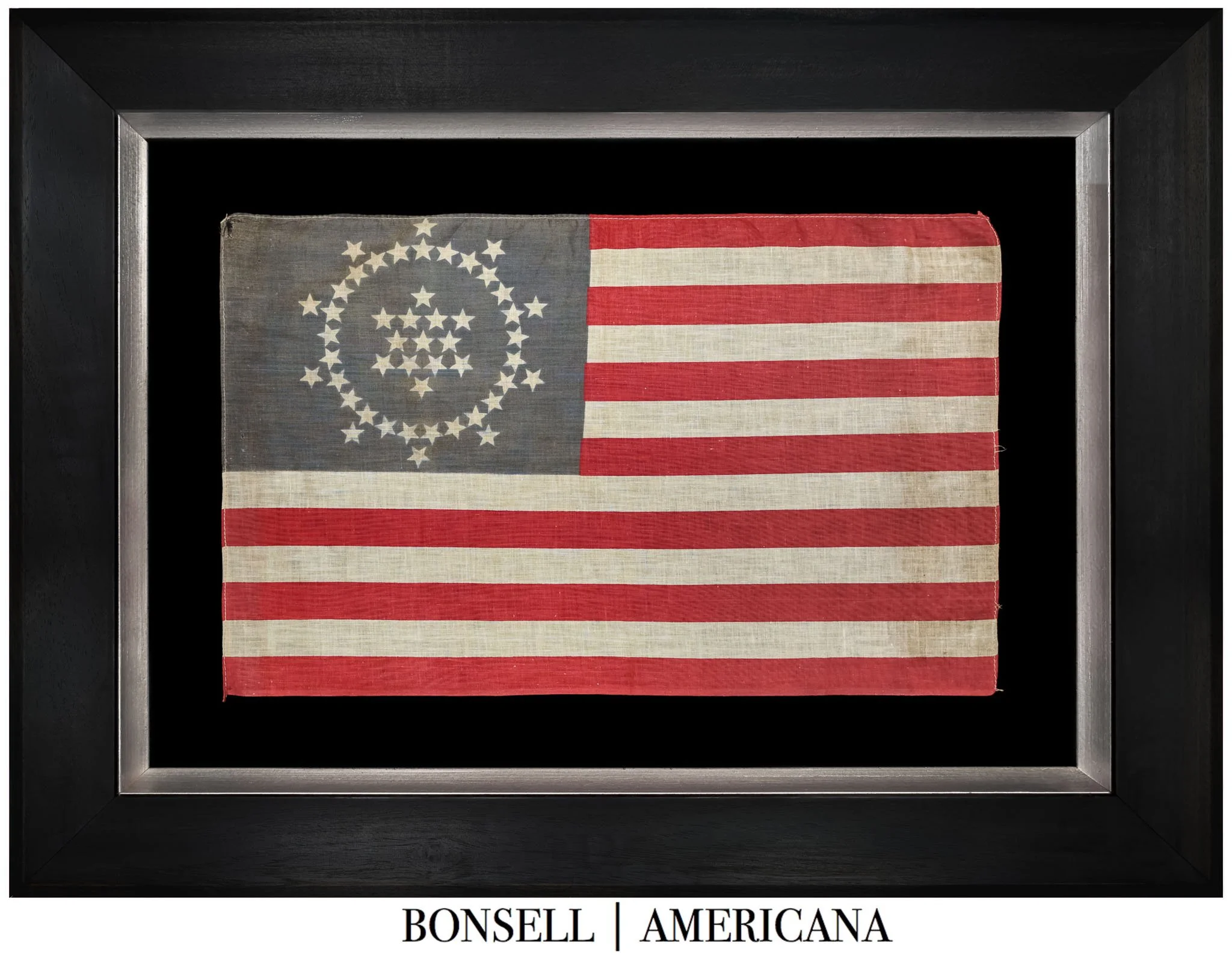
Offered is an exceptional and historically meaningful printed cotton flag featuring the celebrated Whipple pattern, produced between 1909 and 1912. This rare early 20th-century design represents one of the most ambitious alternative star configurations proposed just before the federal government standardized the forty-eight-star flag in 1912.
From the earliest years of the Republic, American flag makers enjoyed considerable freedom in arranging the stars. Although the First Flag Act of 1777 established the basic elements of the flag, no law specified how the stars should be configured. The result was more than a century of extraordinary variety—sunbursts, wreaths, great stars, medallions, and countless regional or maker-specific arrangements—each reflecting artistic preference, patriotic symbolism, or contemporary sentiment.
This long period of experimentation came to an end as the nation approached the admission of New Mexico and Arizona in 1912. To settle the matter, President William Howard Taft issued Executive Order 1556, which established a fixed pattern of six rows of eight stars and formalized the proportions of the U.S. flag. With a single directive, the era of creative unofficial star configurations drew to a close.
Among the most compelling designs proposed during the run-up to this change was the Whipple Peace Flag, created by author and historian Wayne Whipple of Philadelphia. Whipple sought a design that honored both the origins and the growth of the Union. At its center is a large Great Star composed of thirteen stars for the original colonies. Surrounding this are two rings: an inner ring of twenty-five stars representing states admitted between 1776 and 1876, and an outer ring of ten stars for those added afterward. The wide spacing of the outer ring was intentional, allowing room for future expansion. Whipple viewed the design as a symbol of unity, continuity, and national optimism, and he promoted it widely; it even drew the interest of President Taft.
Whipple’s proposal did not emerge in isolation. By the early 20th century, newspapers regularly published speculative star patterns, and patriotic organizations debated which arrangements best embodied the expanding nation. Whipple—already known nationally as a historian and author of patriotic literature—became one of the most visible advocates for a symbolic, historically grounded design. He published pamphlets, contributed articles, and delivered public lectures explaining the layered meaning behind his concentric rings of stars.
His design gained additional momentum in 1910 and 1911, when the federal government explored how a future standardized flag might be constructed. Whipple submitted his model to the War Department and to the White House, where numerous proposals were reviewed. Period newspapers reported that President Taft personally examined Whipple’s design and appreciated its symbolism. For a brief but notable period, the Whipple configuration appeared in editorials and patriotic publications as a serious contender for the official U.S. flag. Its eventual rejection—in favor of a simpler, more industrially efficient grid—captures the tension of the era, as the United States shifted from expressive, artisanal variations to a standardized national emblem aligned with modern manufacturing.
This example is printed on a lightweight, plain-weave cotton with clearly defined warp and weft yarns, typical of commercially produced parade flags of the early 20th century. The flagmaker finished the hoist, fly, and top edges with machine stitching. In contrast, the bottom edge was left unstitched because it is the original woven selvage of the fabric, which is naturally stable and does not fray. Together, these construction details reflect the practical, straightforward methods used for printed cotton flags intended for patriotic use in the years immediately preceding the adoption of the standardized forty-eight-star design. As both a patriotic artifact and an alternative vision for the national flag, this Whipple-pattern example stands as a compelling piece of pre–World War I Americana.
Conservation Process: This flag was hand sewn to cotton fabric, and both were hand sewn to a mounting board. To prevent the black dye in the cotton fabric from seeping into the flag, it was first washed in a standard wash and then in a dye setting wash. The flag is positioned behind Optium Museum Acrylic.
Frame: The flag is presented in a striking two-part custom frame composed of a wide, matte black outer moulding paired with a contrasting inner liner in a soft metallic tone. The combination creates depth and visual separation, allowing the flag to sit prominently.
Condition Report: The flag remains in attractive overall condition, with strong color in the red stripes and good clarity in the Whipple star configuration. Light discoloration appears along portions of the fly edge, likely the result of long-term storage in a rolled state, where the outermost layers were more exposed to ambient conditions. Of the minor fabric breaks present, the most notable is a small tear at the upper hoist corner; its placement suggests it may relate to early tacking—whether to a staff, a wall, or another display surface is uncertain.
Collectability Level: The Best – Perfect for Advanced Collectors
Date of Origin: 1909-1912
Number of Stars: 48
Associated State: Arizona
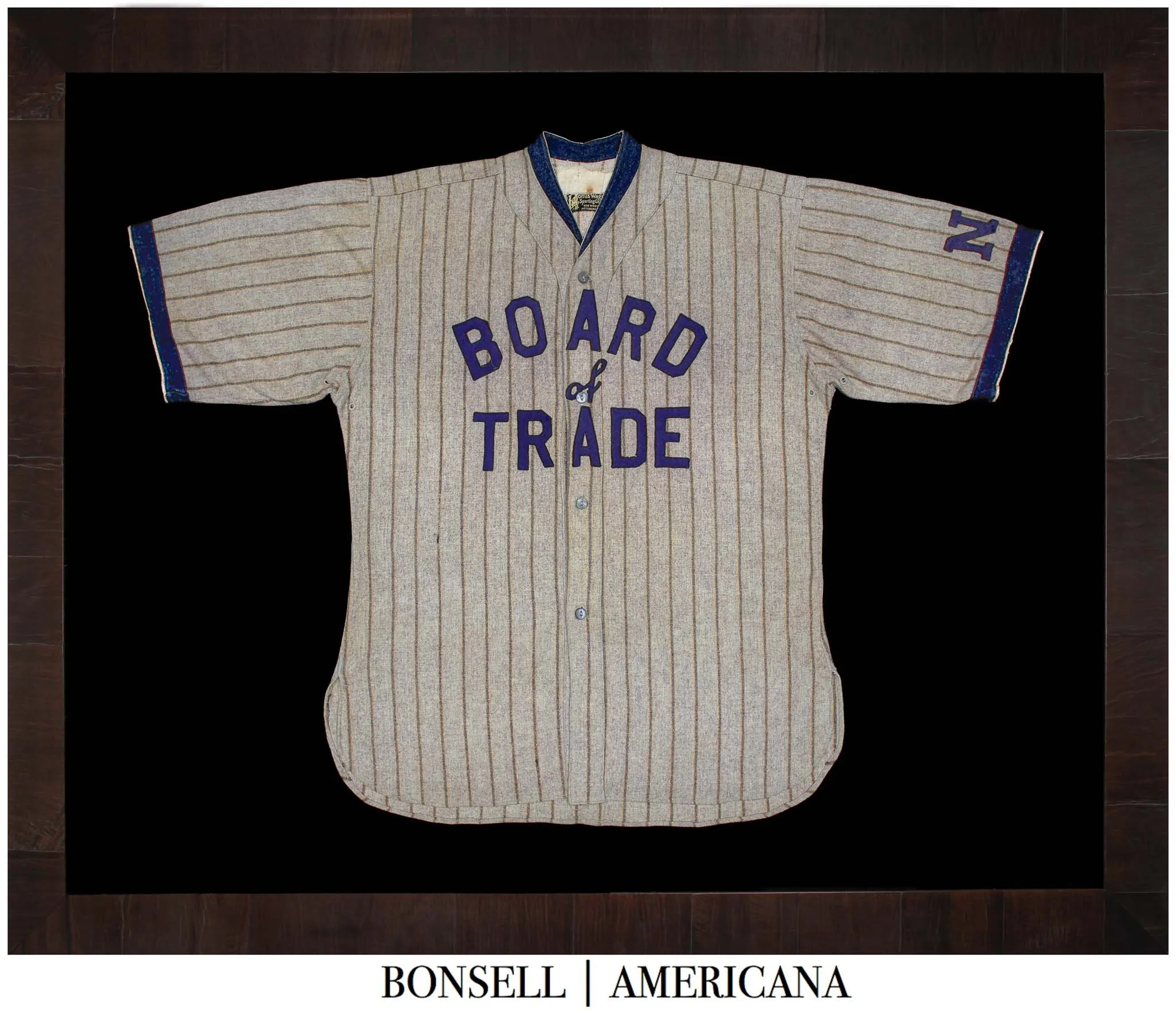
Frame Size (H x L): 45” x 55.5”
Jersey Size (H x L): 33.5” x 44”
Offered is an early baseball jersey with “BOARD OF TRADE” spelled across the chest in dark navy wool felt letters arranged in an arc. The jersey is made of gray pinstriped flannel with narrow tan stripes, typical of uniforms from the 1930s and 1940s. It has a full button front, short tail, and blue trim along the collar and sleeve cuffs. Ventilation eyelets are set under each arm, and inside the collar is a woven label that reads “Honus Wagner Sporting Goods / 438 Wood Street / Pittsburgh.” Stitching, seams, and materials are consistent with the factory-made flannel uniforms of that period.
The left sleeve shows an “NS” monogram, which may refer to either North Side or North Shore—both of which would have been relevant to the Chicago Board of Trade (“CBOT”). Many CBOT members lived along Chicago’s North Shore suburbs—Evanston, Wilmette, and Winnetka among them—and it’s plausible that this jersey represented a Board of Trade club or team drawn from that community. The style and construction are consistent with factory-issued industrial-league uniforms of the late-Depression era.
Company and industrial baseball teams were an important part of American work and social life during the early to mid-1900s. Businesses, trade groups, and civic organizations often formed their own teams to play in local leagues. The reference to the Board of Trade almost certainly points to the Chicago Board of Trade, which had an active presence in those circles. Employees and members fielded teams that competed in business leagues around the city, and it was not uncommon for the CBOT to sponsor or affiliate with regional teams in surrounding communities such as the North Shore, where many of its members resided.
Among all boards of trade across the country, Chicago’s stood apart. Founded in 1848, the CBOT became America’s leading commodities exchange and one of the city’s defining institutions. By the 1930s, its trading floor was a symbol of Chicago’s economic strength and resilience during the Great Depression, with thousands of brokers, clerks, and laborers moving grain and livestock futures that kept the Midwest’s economy in motion. Athletic teams like this one offered both recreation and a way to strengthen camaraderie in a high-pressure environment. Baseball, in particular, became an outlet for workplace pride and a reflection of the city’s blue-collar energy.
That same spirit extended northward into the lakefront suburbs, where baseball held a prominent place in civic and recreational life. During the 1930s and 1940s, the North Shore hosted a network of amateur and semi-professional leagues—many sponsored by local businesses, civic clubs, and Chicago institutions whose employees lived outside the city. Games were played on public diamonds and school fields in Evanston, Wilmette, Winnetka, and Highland Park, often drawing crowds from the surrounding neighborhoods. Teams from the Board of Trade, the stockyards, and local manufacturers regularly traveled the North Shore circuit. These were competitive, well-organized games, blending business rivalry with the sense of community that small-town baseball brought to the region. For many white-collar Chicagoans, suiting up on a summer evening to play along the lakefront was as much a social tradition as it was a sport.
The Honus Wagner Sporting Goods Company, whose tag appears in the collar, adds another layer of significance. Founded in Pittsburgh by Hall of Fame shortstop Johannes Peter “Honus” Wagner shortly after his playing career ended, the firm produced uniforms, bats, and gloves from roughly 1919 through the early 1950s. Wagner was one of the most respected figures in baseball history—a cornerstone of the early Pittsburgh Pirates and an inaugural inductee into the National Baseball Hall of Fame in 1936. Known as “The Flying Dutchman,” he was admired not only for his remarkable skill but also for his integrity and sportsmanship, traits that made his name an ideal brand for quality athletic goods.
Wagner’s reputation gave the company immediate credibility among ballplayers, and his business drew steady demand from amateur, semi-professional, and industrial-league teams across the Midwest and Great Lakes regions. His involvement was more than nominal—he reportedly visited the shop and remained engaged in its operations well into his later years. The label inside this jersey, featuring the 438 Wood Street, Pittsburgh address, corresponds to the company’s mid-1930s to 1940s production period, and its woven script design matches other verified examples from that timeframe. When paired with the jersey’s flannel weight, pinstripe pattern, and reinforced underarms, these characteristics align squarely with a mid-to-late 1930s manufacture.
Taken together, the evidence points to a jersey made for a Chicago Board of Trade baseball team, likely one connected to the city’s North Shore. It stands as a rare surviving piece from the era when America’s corporate and civic institutions proudly fielded baseball clubs as part of daily life. The subject matter itself has wide appeal—connecting fans of the game, students of Chicago history, collectors of financial-market memorabilia, and anyone drawn to the intersection of American commerce and sport. Few objects capture that blend of competition, community, and identity as directly as a uniform worn by traders stepping off the exchange floor to play ball.
Conservation Process: The jersey was hand sewn to cotton fabric, and both were hand sewn to a mounting board. To prevent the black dye in the cotton fabric from seeping into the jersey, it was first washed in a standard wash and then in a dye setting wash. The jersey is positioned behind Optium Museum Acrylic.
Frame: The frame has a clean, substantial profile finished in a dark brown veneer called Cigar Leaf. Its surface has a soft, natural sheen that gives the impression of hand-rubbed wood rather than a heavy gloss. The overall look is simple but refined, with enough depth and warmth to complement the antique jersey.
Condition Report: The jersey shows moderate wear consistent with its age. The flannel fabric remains strong with a few light stains from use. The felt lettering is well preserved with only minor fraying at the edges, and the buttons and Honus Wagner tag remain intact and original.
Collectability Level: The Best – Perfect for Advanced Collectors
Date of Origin: 1935-1940
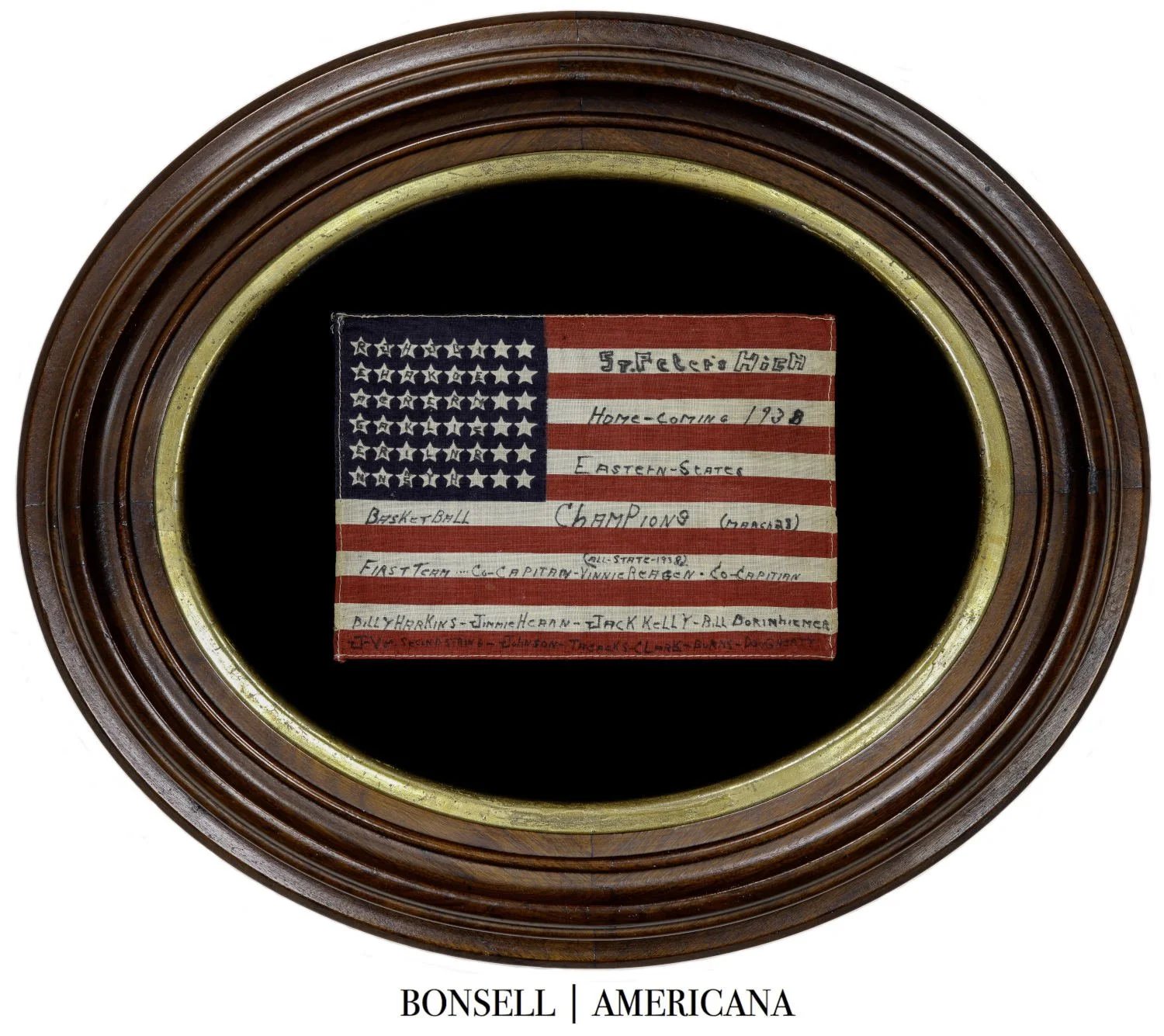
Frame Size (H x L): 16.5” x 19.5”
Flag Size (H x L): 6” x 8.5”
Offered is a rare and personal example of an overprinted American flag, used to commemorate the 1938–1939 basketball season at St. Peter’s High School in New Brunswick, New Jersey. Printed on cotton, the flag features 48 stars and 13 stripes, in keeping with national standards at the time. Onto this standard design, names and inscriptions were added by hand in ink, turning the flag into a localized artifact tied to a specific team.
The overprint marks the school’s basketball team winning the Eastern States Invitational Tournament Championship. Regional tournaments like the Eastern States Invitational brought together top teams from across the Northeast.
The inscriptions list the starting lineup: Co-Captain Vinnie Reagen (named All-State in 1938), Co-Captain Billy Harkins, Jimmie Hearn, Jack Kelly, and Bill Borinheimer. Second-string players are also named: Johnson, Tacacks, Clark, Burns, and Dougherty. Five of the starters’ names are written vertically on the stars in the canton, further integrating player recognition into the flag’s design. The flag is dated March 28, 1938, and references “Home-Coming,” suggesting use in a celebratory event, such as a parade or school gathering.
This flag was featured in the 2011–2012 exhibition The Stars and Stripes: Fabric of the American Spirit at the Morven Museum & Garden in Princeton, New Jersey. The exhibition presented highlights from The Pierce Collection of American Parade Flags, one of the most respected collections of patriotic textiles in the country. The show examined how Americans have used the flag to commemorate political, civic, and personal milestones. This example stood out for its use as a tool of local recognition, blending national symbolism with school achievement.
The flag also reflects the broader history of American flag design. Prior to 1912, flag makers were free to arrange the stars in any pattern. Early 48-star flags often featured staggered or offset arrangements. That changed with Executive Order 1556, issued by President William Howard Taft in 1912, which standardized the layout to a rectilinear pattern of six rows of eight stars (8-8-8-8-8-8). The flag offered here follows that design. Based on materials and construction.
The 48-star flag became official on July 4, 1912, following the admissions of New Mexico (January 6, 1912) and Arizona (February 14, 1912) as the 47th and 48th states. It remained in use for forty-seven years—longer than any other official U.S. flag design—until July 4, 1959, when Alaska's statehood introduced the 49-star version. It flew during the administrations of Presidents Taft through Eisenhower, and during World War I, World War II, and the Korean War.
Conservation Process: This flag was hand sewn to cotton fabric, and both were hand sewn to a mounting board. To prevent the black dye in the cotton fabric from seeping into the flag, it was first washed in a standard wash and then in a dye setting wash. The flag is positioned behind Optium Museum Acrylic.
Frame: The flag is housed in an antique walnut frame, likely dating between 1860 and 1890. The frame features a plain walnut molding with an inner gilt liner.
Condition Report: The flag is in excellent condition. There is some light soiling and toning. The ink inscriptions remain clearly legible throughout.
Collectability Level: The Best – Perfect for Advanced Collectors
Date of Origin: 1938
Number of Stars: 48
Associated War: WWI
Associated State: Arizona
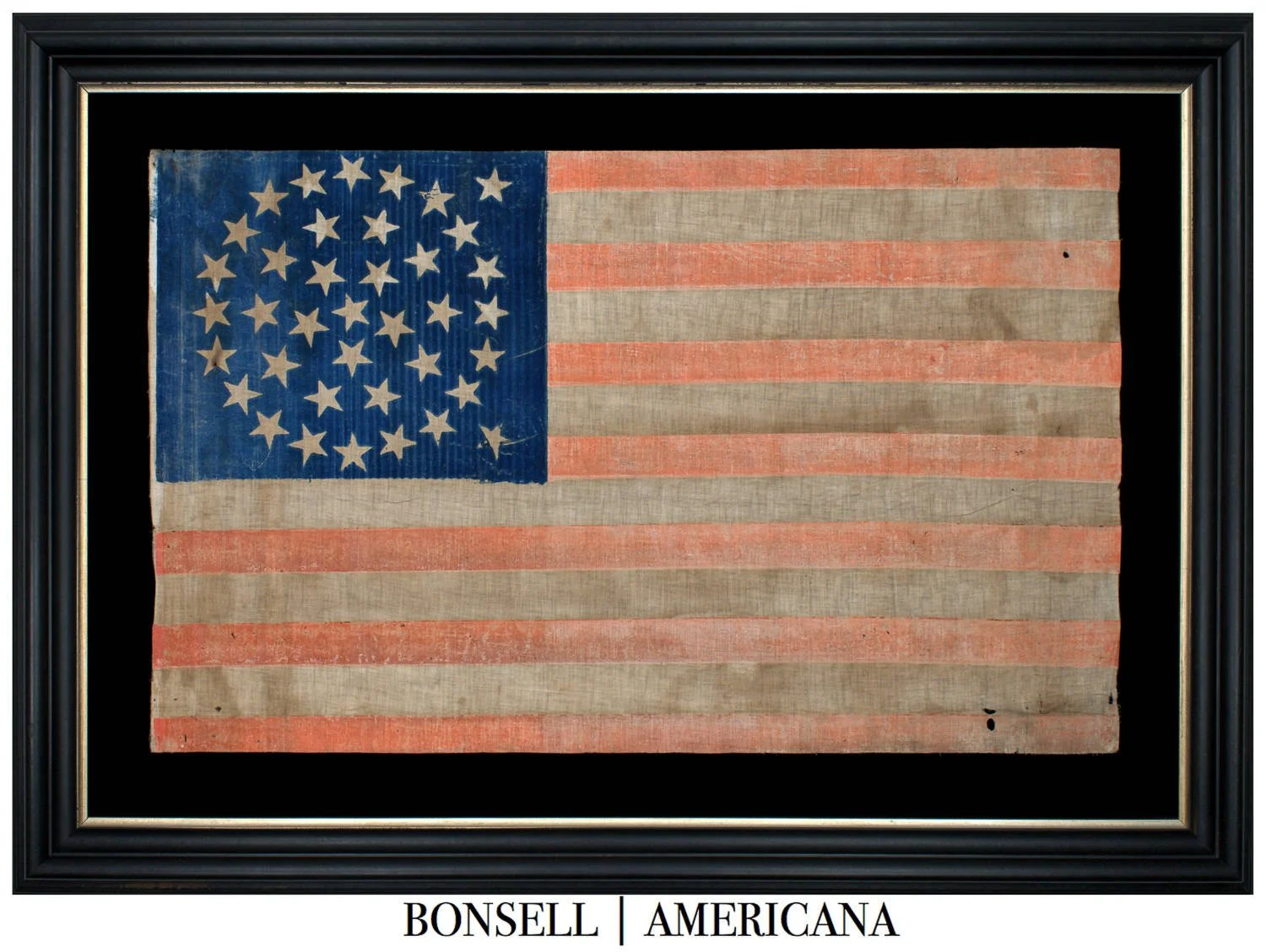
Price: Call 618-553-2291, or email info@bonsellamericana.com
Frame Size (H x L): 32.5” x 46”
Flag Size (H x L): 22” x 35.5”
Offered here is a large‐scale, thirty-eight star United States flag, printed on coarse cotton and showcasing an offset medallion star pattern. This design features a central star encircled by three concentric rings of stars—a five star inner ring, a ten star middle ring, and a twenty star outer ring—along with two offset stars positioned to the right. Medallion patterns like this were particularly popular in the nineteenth century, reflecting the creativity of private flag manufacturers who often added artistic flourishes to their designs.
The medallion pattern itself holds historical significance, embodying both patriotic symbolism and aesthetic appeal. Such patterns were favored during periods of heightened national pride, as their symmetrical and eye-catching designs emphasized the unity of the states. While the U.S. government did not standardize star arrangements until the early twentieth century, medallion patterns were commonly seen in the flags of the Civil War and post-Civil War eras, making them enduring symbols of an expanding and optimistic nation.
The thirty‐eight stars on this flag represent Colorado’s admission to the Union on August 1st, 1876. Known as the “Centennial State,” Colorado earned its nickname for achieving statehood just twenty‐eight days after the nation’s centennial celebrations. Colorado’s journey to statehood began with the establishment of the Colorado Territory in 1861, spurred by the Pike’s Peak Gold Rush, which brought a wave of settlers to the region. Early statehood efforts faced setbacks, including a veto by President Andrew Johnson in the 1860s, but a renewed push in the mid-1870s culminated in Colorado’s official entry as the thirty-eighth state following Congress’s passage of an enabling act.
Although the thirty‐eight star flag did not become official until July 4th, 1877, flag makers frequently produced “anticipatory flags” ahead of such changes. These flags played a prominent role during the centennial celebrations of 1876, alongside revival designs featuring thirteen stars to commemorate the original colonies. The Centennial year was a watershed moment for the United States, fostering a renewed sense of patriotism and unity after the divisions of the Civil War. Communities across the nation adorned homes, businesses, and public spaces with red, white, and blue decorations, and flags became the centerpiece of this outpouring of national pride.
The Centennial International Exposition in Philadelphia was the highlight of these celebrations, attracting nearly ten million visitors between May and November of 1876. This world’s fair showcased American ingenuity on a grand scale, with notable exhibits including the Corliss Steam Engine and Alexander Graham Bell’s telephone, which would go on to revolutionize communication.
The thirty‐eight star flag officially served from July 4th, 1877, to July 4th, 1890, during which it flew over the administrations of Presidents Rutherford B. Hayes, James A. Garfield, Chester A. Arthur, Grover Cleveland, and Benjamin Harrison. This flag represented a nation growing both geographically and industrially. Colorado’s statehood symbolized the United States’ expansion westward, driven by mining booms, railroad construction, and the development of new settlements.
In 1890, the addition of five new states—North Dakota, South Dakota, Montana, Washington, and Idaho—necessitated a redesign, and the forty‐three star flag replaced the thirty‐eight star version. Despite its relatively short tenure, the thirty‐eight star flag remains a prized artifact, celebrated for its vibrant medallion designs and its connection to the Centennial year—a defining moment in American history when the nation reflected on its first century and welcomed Colorado as a symbol of progress and unity.
Conservation Process: This flag was hand sewn to cotton fabric, and both were hand sewn to a mounting board. To prevent the black dye in the cotton fabric from seeping into the flag, it was first washed in a standard wash and then in a dye setting wash. The flag is positioned behind Optium Museum Acrylic.
Frame: This offering is in our X-Large Distressed Black and Silver Frame.
Condition Report: The flag is in overall good antique condition for its age. The colors remain visible, though the red and blue areas exhibit fading consistent with time and exposure. There are some small holes, fraying along the edges, and light staining, but these issues do not significantly detract from its historical integrity or presentation. If anything, they add to it.
Collectability Level: The Best – Perfect for Advanced Collectors
Date of Origin: 1876-1889
Number of Stars: 38
Associated War: The Indian Wars (1860-1890)
Associated State: Colorado
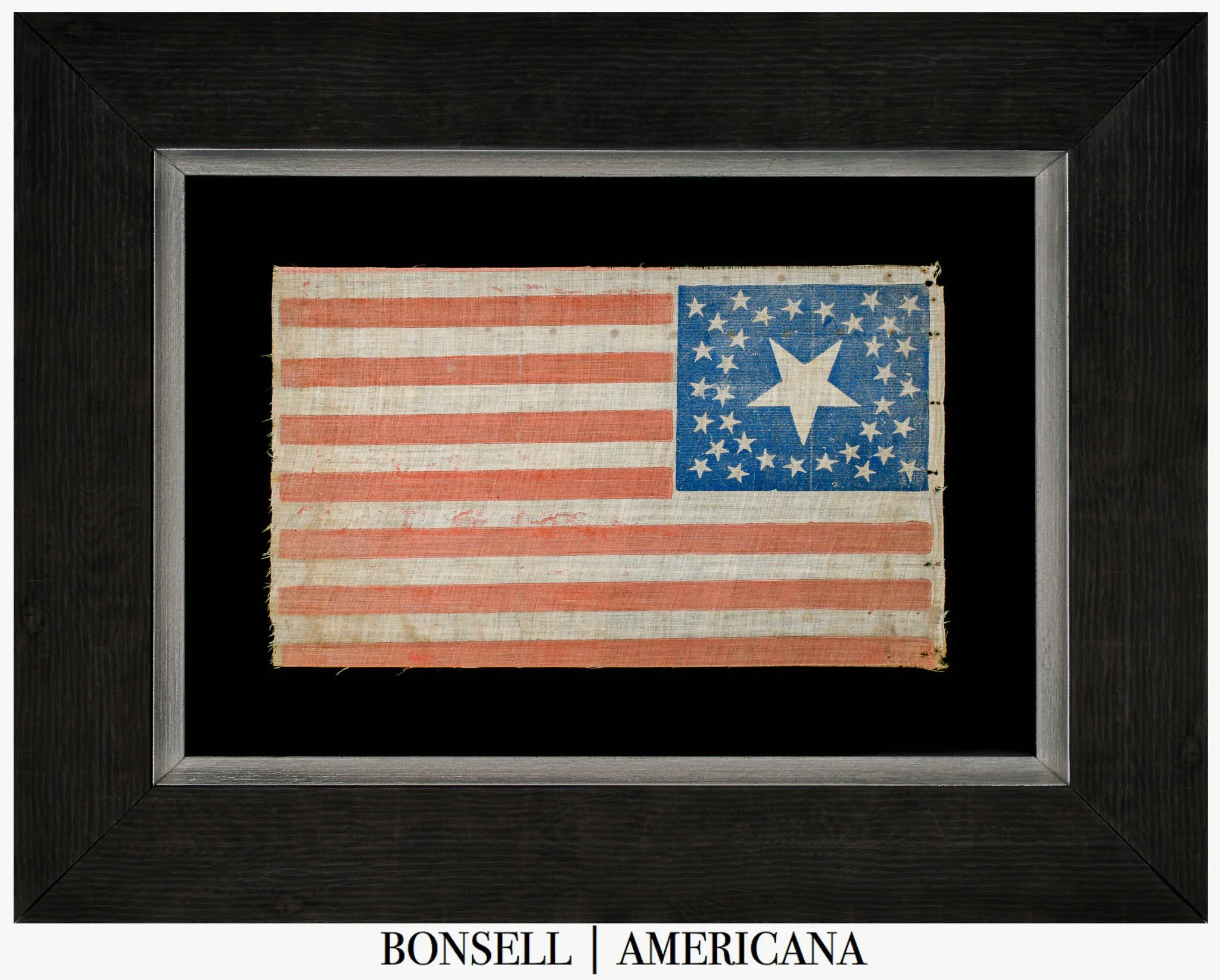
Frame Size (H x L): 18.5” x 24”
Flag Size (H x L): 8.5” x 14”
Offered is a thirty-six star antique flag, printed on coarse glazed cotton and bearing one of the most unusual and distinctive star configurations known in 19th-century American flags. The design features a massive central star set in the middle of the canton. Encircling it is a wreath of seventeen stars, followed by a larger parenthesis of fourteen stars—seven to the left and seven to the right. Four additional stars, one in each corner of the canton, frame the entire composition. Together, these elements form a clear and deliberate arrangement that is highly structured and visually balanced.
The use of a parenthesis formation in a star pattern is exceptionally rare. While 19th-century flag makers employed a wide range of designs—including medallions, wreaths, great stars, and snowflakes—very few surviving examples include a true left-right arc that resembles a bracketed enclosure. In the few that do, the arcs are typically subtle and easily lost within a field of other stars. In contrast, the parenthesis on this flag is plainly visible and integral to the design. We are aware of only three examples of this exact configuration, and no other known pattern presents the parenthesis in this prominent a way.
The massive center star is a form sometimes referred to as a “center star,” a feature occasionally used to represent the newest state admitted to the Union. In this case, that state is Nevada. Center stars are usually only modestly larger than surrounding stars. Here, however, the center star is dramatically oversized and dominates the canton. It is also inverted, with one point facing downward. The reasons for this orientation are unclear. In many cases, 19th-century makers did not follow a standard orientation and may not have viewed any one direction as “up.”
The remaining stars are irregular in shape and size. The stripes have faded to a salmon or orange hue, which aligns with the use of madder or cochineal dyes—commonly used between 1850 and 1880—and known to fade in this way over time.
This flag includes an extra white stripe along the top, an unusual but not symbolic feature. It likely results from how the flag was cut from a larger bolt of glazed cotton that included multiple printed flags. Depending on the cut, individual examples could include one or more additional stripes. In this case, the extra stripe adds visual interest.
This is the third known example of this flag type. One is held in the Pierce Collection of American Parade Flags and is published on page 18 of The Stars and Stripes: Fabric of the American Spirit. A second example previously passed through our hands.
Thirty-six star flags represent the admission of Nevada to the Union. Although Nevada became a state on October 31, 1864, the thirty-six star flag became official on July 4, 1865. That date came shortly after the end of the Civil War, and the flag is often associated with Union victory and the early years of Reconstruction. The thirty-six star flag remained official until July 4, 1867, when the thirty-seven star flag was adopted to include Nebraska.
Nevada’s admission was driven by both political and economic motives. It occurred just eight days before President Lincoln’s re-election, bolstering Republican electoral strength. Economically, Nevada’s silver mining industry was seen as important to financing the Union’s war debt. The state’s borders were later expanded in 1866 and again in 1867, adding land from the Utah and Arizona territories.
This flag stands out for its oversized center star, visible parenthesis arrangement, and added stripe—features that place it among the most distinctive and scarce known designs from the Civil War era.
Conservation Process: This flag was hand sewn to cotton fabric, and both were hand sewn to a mounting board. To prevent the black dye in the cotton fabric from seeping into the flag, it was first washed in a standard wash and then in a dye setting wash. The flag is positioned behind Optium Museum Acrylic.
Frame: The flag is presented in a custom two-part frame. The outer frame is a dark wood with a subtle grain texture, while the inner liner is a metallic silver, offering a clean contrast that highlights the colors and form of the flag.
Condition Report: The flag is in sound condition, with moderate wear consistent with age and use. Toning and soiling are present throughout, and there is some minor fraying along the edges. The colors have faded, particularly the red stripes, which now appear as a muted orange—typical of madder-based dyes used during the period. A line of old nail holes runs vertically along the right edge, evidence of the flag’s original attachment to a wooden staff.
Collectability Level: The Best – Perfect for Advanced Collectors
Date of Origin: 1864-1867
Number of Stars: 36
Associated War: Civil War (1861-1865)
Associated State: Nevada
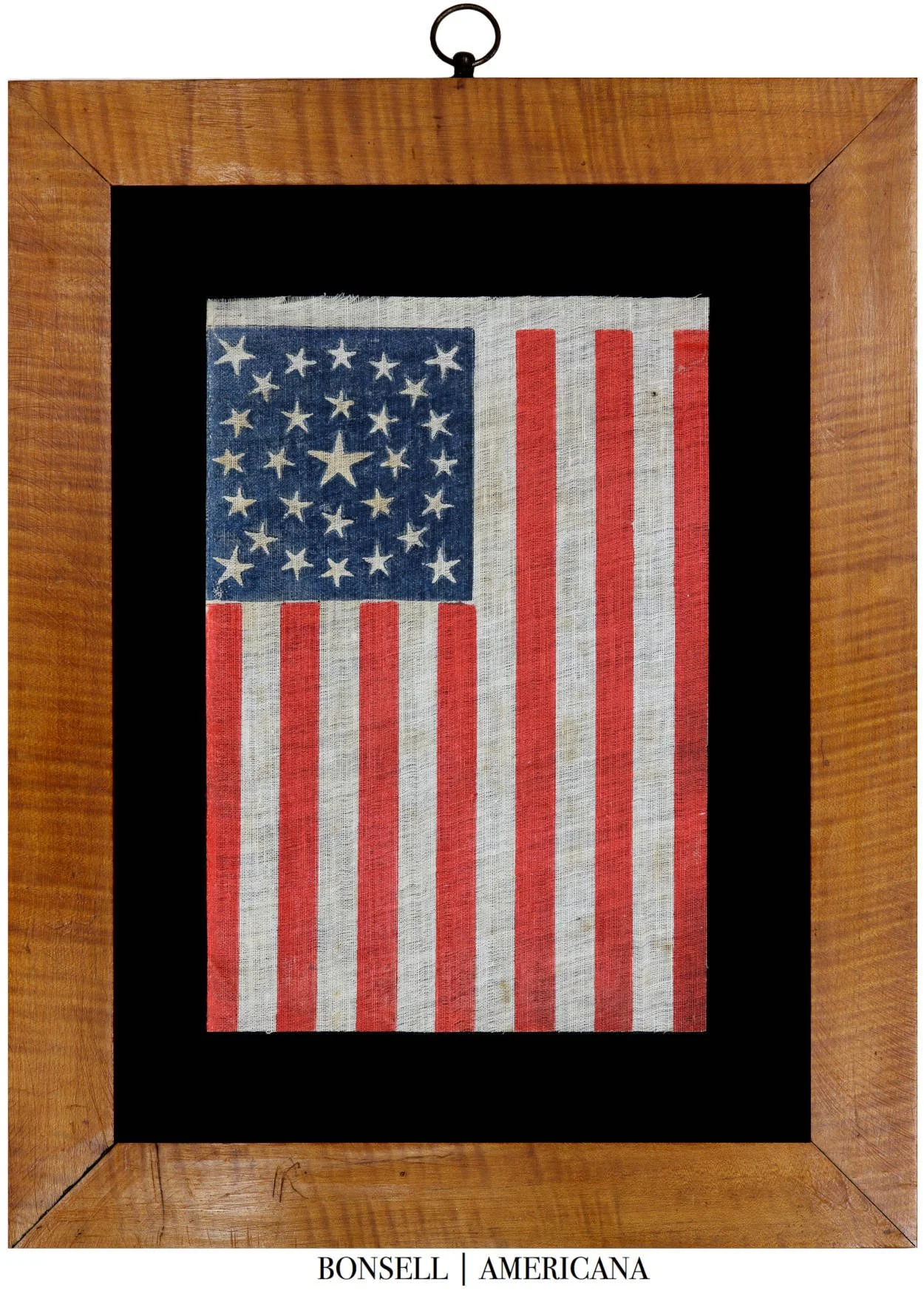
Frame Size (H x L): 16” x 12.5”
Flag Size (H x L): 10” x 6.75”
Offered is a 29-star American flag printed on glazed cotton, with its stars arranged in a striking and highly desirable medallion configuration. At the center of the canton is a large star, known as a “center star,” symbolizing the most recently admitted state to the Union—Iowa. This central star is surrounded by two concentric rings of smaller stars, with four additional flanking stars placed in each corner of the canton, creating a bold and balanced aesthetic.
The stars themselves are notably pointy and whimsical in design, tightly packed within the canton in a way that is both charming and visually distinctive. Though the specific maker is unknown, these stars match a recognizable style attributed to a small group of flags believed to originate from the same workshop. Flags from this group have been documented in only six known star counts: 7, 13, 15, 29, 33, and 35. Each of these counts carried symbolic meaning—celebrating early secession, the original thirteen colonies, Kentucky’s centennial, or the most recent state admissions to the Union. Among this group, the 29-star variant is the earliest and among the rarest.
This flag is mounted vertically, which repositions the canton to the upper left, in accordance with modern U.S. flag display customs. If it were mounted horizontally, the canton would appear in the upper right—a configuration known as a reverse (or backwards) mount. While that orientation conflicts with today’s flag code, such standards did not exist in the 19th century, and reverse displays were both common and acceptable. In some cases, flags were printed on only one side (e.g., the one offered herein) or appeared more vibrant on the reverse, making backwards mounting both practical and historically appropriate to collectors.
The 29-star flag commemorates Iowa’s admission to the Union on December 28, 1846. Iowa’s path to statehood began decades earlier, when the land was acquired as part of the Louisiana Purchase in 1803. For years, it remained sparsely populated by settlers and occupied largely by Native American tribes.
In the 1830s, following a series of treaties and the Black Hawk War of 1832, the U.S. government opened the territory to white settlement. Iowa became an official U.S. territory in 1838, carved from the Wisconsin Territory, and experienced rapid population growth due to its fertile land and strategic location along the Mississippi River.
As its population expanded, Iowa petitioned for statehood in the 1840s. Congress initially rejected Iowa’s proposed constitution due to boundary disputes, but a revised constitution was approved in 1846. On December 28 of that year, President James K. Polk signed the act admitting Iowa as the 29th state.
The admission marked a continued westward expansion of the Union and helped establish Iowa as a key agricultural state in the growing republic.
This flag officially became representative of the United States on July 4, 1847, and retained that status for just one year—until July 4, 1848, when a 30th star was added for Wisconsin. Due to this extremely brief period of official use, 29-star flags were produced in very limited numbers.
Compounding their rarity is the broader historical context: flags made before the Civil War (1861–1865) are exceptionally scarce. During this era, flag use was far more restrained. Americans did not commonly display flags for patriotic reasons, and military use was also limited. U.S. Army artillery units weren’t authorized to carry the national flag until 1834, and infantry regiments not until 1841. As a result, flags made before the outbreak of the Civil War account for roughly only 1% of 19th-century U.S. flags that survive today.
This example, with its early date, rare star count, and medallion design, represents an important artifact from the antebellum period. Flags from this era are difficult to find, and 29-star examples are especially scarce due to their short period of official use. This flag offers historical value both as a physical object and as a reflection of the nation's growth during the mid-19th century.
Conservation Process: This flag was hand sewn to cotton fabric, and both were hand sewn to a mounting board. To prevent the black dye in the cotton fabric from seeping into the flag, it was first washed in a standard wash and then in a dye setting wash. The flag is positioned behind Optium Museum Acrylic.
Frame: This offering is in an attractive tiger maple frame. Tiger maple frames are cherished for their striking, wavy grain patterns that shimmer with a unique iridescence, reminiscent of a tiger's coat.
Condition Report: The flag remains in remarkably clean and well-preserved condition. There is some discoloration, along with a few tiny holes, but these are minimal and do not detract from the flag’s overall appearance. Compared to others from the era, this example ranks among the very best in terms of condition.
Collectability Level: The Best – Perfect for Advanced Collectors
Date of Origin: 1846-1848
Number of Stars: 29
Associated State: Iowa
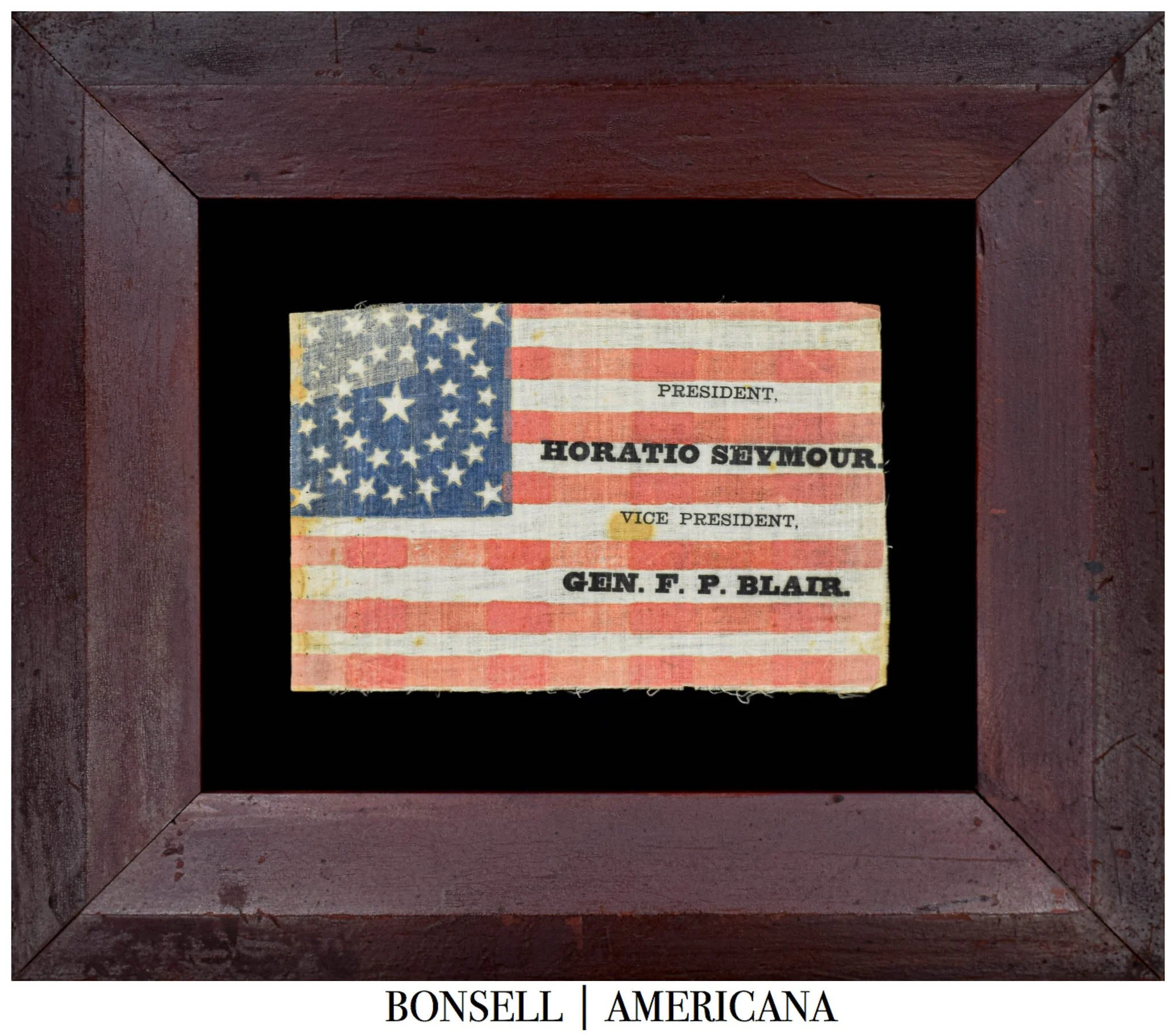
Frame Size (H x L): 13” x 15.5”
Flag Size (H x L): 5” x 8”
Offered is a thirty-six star flag with the following outstanding overprint:
PRESIDENT,
HORATIO SEYMOUR.
VICE PRESIDENT,
GEN. F. P. BLAIR
The overprint is in reference to Democrats Horatio Seymour and Francis Preston Blair, who—in the 1868 presidential election—ran against Republicans Ulysses S. Grant and Schuyler Colfax.
Seymour and Blair won just 80 electoral votes and 47.34% of the popular vote, while Grant and Colfax won 214 electoral votes and 52.66% of the popular vote. The contrast in the electoral votes was expected, but the proximity of the popular vote was surprising—particularly given that newly enfranchised freedmen voted almost exclusively for Grant and Colfax, and further given that many Southern whites, who would have voted almost exclusively for Seymour and Blair, had been temporarily disenfranchised at the time of the election (i.e., those in Texas, Mississippi, and Virginia, the states that had not yet been restored to the Union). The leading explanation for the proximity of the popular vote is that whites—both Northern and Southern—must have voted for Seymour and Blair more often than had been anticipated.
This flag is exceptional for at least the following reasons:
First, campaign flags are the most desirable of all flags. The first campaign flags were made in 1840 and were associated with the William Henry Harrison campaign. In 1890, a bill was introduced that attempted to prevent the desecration of the flag by printing, painting, or advertising for public display or private gain. The bill failed. In 1895, a similar bill was introduced, but likewise failed. Finally, in 1905, a bill passed outlawing the use of marks and portraits on the flag, coat of arms, and other insignia of the United States. With this background in mind, campaign flags are especially difficult to acquire, because they were only made between 1840 and 1905. And in reality, most examples that surface are from a narrower time frame between 1860 and 1890.
Second, the subject flag is particularly rare, even for a campaign flag. It is the only example that we have encountered, and it went undocumented in the Threads of History, written by Herbert Ridgeway Collins, former curator of the Division of Political History at the Smithsonian Institution. Escaping documentation therein was difficult, being that Collins corresponded with 1000’s of collectors, museums, and universities, in his attempt to catalog every political textile. In total, he documented 1500 examples, dating from 1775 to 1979, yet this flag—and all Seymour-Blair flags, but for one—went under his radar, almost certainly as a function of their rarity.
And third, its stars are arranged in a wonderful medallion pattern. The large star in the middle is referred to as a “center star.” The center star represents the newest state added to the Union (e.g., Nevada in the case of this thirty-six star flag). Surrounding the center star is a pair of concentric rings of stars, and surrounding the rings are four flanking stars positioned in the corners of the canton.
CONSTRUCTION
The flag offered herein is printed on coarse glazed cotton. The stripes and overprint were block stamped. The canton is a dusty blue and the stripes are essentially orange. The orange is a result of the use of either madder or cochineal to create the red dye. Such dye was commonly used to make flags between 1850 and 1880. The First Flag Act of 1777 specified the flag’s general colors, but it did not specify the exact shades thereof. For this reason, some flags—like this one—have unusual colors, per the modern eye. The exact shades were not officially specified until 1934.
The overprints are in black across the white stripes and notably a portion of the “HORATIO” overprint appears to overlap one of the red stripes. This suggests that the red stripes were applied, perhaps along with the blue canton, and the campaign overprints were applied sometime thereafter, maybe even years later. In some instances, surplus flags would lie dormant awaiting the next campaign season, patriotic burst, or overprint request.
STAR COUNT
Flags made for the 1868 campaign have surfaced with thirty-four, thirty-six, and thirty-seven stars (and perhaps others). In 1868, the official star count was thirty-seven. As such, this is the most logical count for an 1868 campaign flag. The lower star counts of thirty-four and thirty-six can be explained via the following theories:
First, these lower star counts may have been leftovers associated with the burst of parade flags produced during the Civil War. In a time of frugality—and 1868 would have been such a time given its proximity with respect to the Civil War, not to mention the rugged nature of the 19th century generally—a maker would sell whatever he had, and a buyer would purchase whatever was available.
Second, these lower star counts may have been made with older printing blocks. Cutting blocks was an arduous task. Thus, makers sometimes used older blocks in later years, both to save the time and minimize the effort associated with making new blocks.
And third, there was a general randomness with respect to star counts in 19th century flags, more so with flags dating to 1870 and earlier, and less so with flags dating to 1870 and later. Neither makers nor buyers were particularly disciplined with respect to star counts, perhaps in part because the star count changed so frequently in the 19th century, and perhaps in part because early flags were crude in every respect, the star count being no different.
The subject flag has thirty-six stars, likely because of one of these three theories. Under the first theory, this flag may have been made in 1864 or 1865, and then left in storage until it was overprinted in 1868 and distributed. Under the second and third theories, this flag may have been made in 1868. As viewed from these outer bounds, the underlying flag would date to between 1864 and 1868.
In any event, the overprint would have been applied in 1868, following the nominations of Seymour and Blair (i.e., after the flag was taken from storage or immediately after the flag was printed, depending on the circumstances).
THIRTY-SIX STAR FLAGS
The thirty-six star flag represents the inclusion of Nevada to the Union. Nevada was admitted on October 31st, 1864, and this flag became official on July 4th, 1865. Nevada was originally part of the Utah Territory beginning in 1850, became its own territory in 1861, and became its own state in 1864.
The timing of Nevada's inclusion was politically and economically based. For political reasons, Nevada was admitted to the Union just eight days prior to President Lincoln's re-election bid against General George McClellan. Such timing was meant to benefit Lincoln and his fellow Republicans. For economic reasons, Nevada was included as part of the Union to help it pay off the country’s war debts. Economically, Nevada was particularly attractive at the time, because of its significant silver mining industry. Nevada expanded its borders in 1866 when the western Utah Territory was added to its eastern side, and further expanded in 1867 when a portion Pah-Ute County in the Arizona Territory was added to its southern side.
The thirty-six star flag was the official flag for the last six months of the Civil War, and it was used by the military during that time. It was also the official flag during a portion of the Reconstruction era. Ultimately, the thirty-six star flag was official until July 4th, 1867, the time at which the thirty-seven star flag became official and began to represent the inclusion of Nebraska in the Union.
Conservation Process: This flag was hand sewn to cotton fabric, and both were hand sewn to a mounting board. To prevent the black dye in the cotton fabric from seeping into the flag, it was first washed in a standard wash and then in a dye setting wash. The flag is positioned behind Optium Museum Acrylic.
Frame: This offering is in a mahogany veneer frame. It has a brown and red finish and dates to the 1840s.
Condition Report: There is discoloration in the upper-left quadrant of the canton. There are vertical stripes of fading, the first two of which are under the canton, and the other three of which are to the right of the canton. The stripes of fading may be original to the flag (i.e., manufacturing related). They are more noticeable in the photos than in person. There are a few small stains across the surface of the flag with the most noticeable one being over a portion of “VICE.” Given the age and rarity of the subject flag, it is highly desirable despite these issues.
Collectability Level: The Best – Perfect for Advanced Collectors
Date of Origin: 1864-1868
Number of Stars: 36
Associated State: Nevada
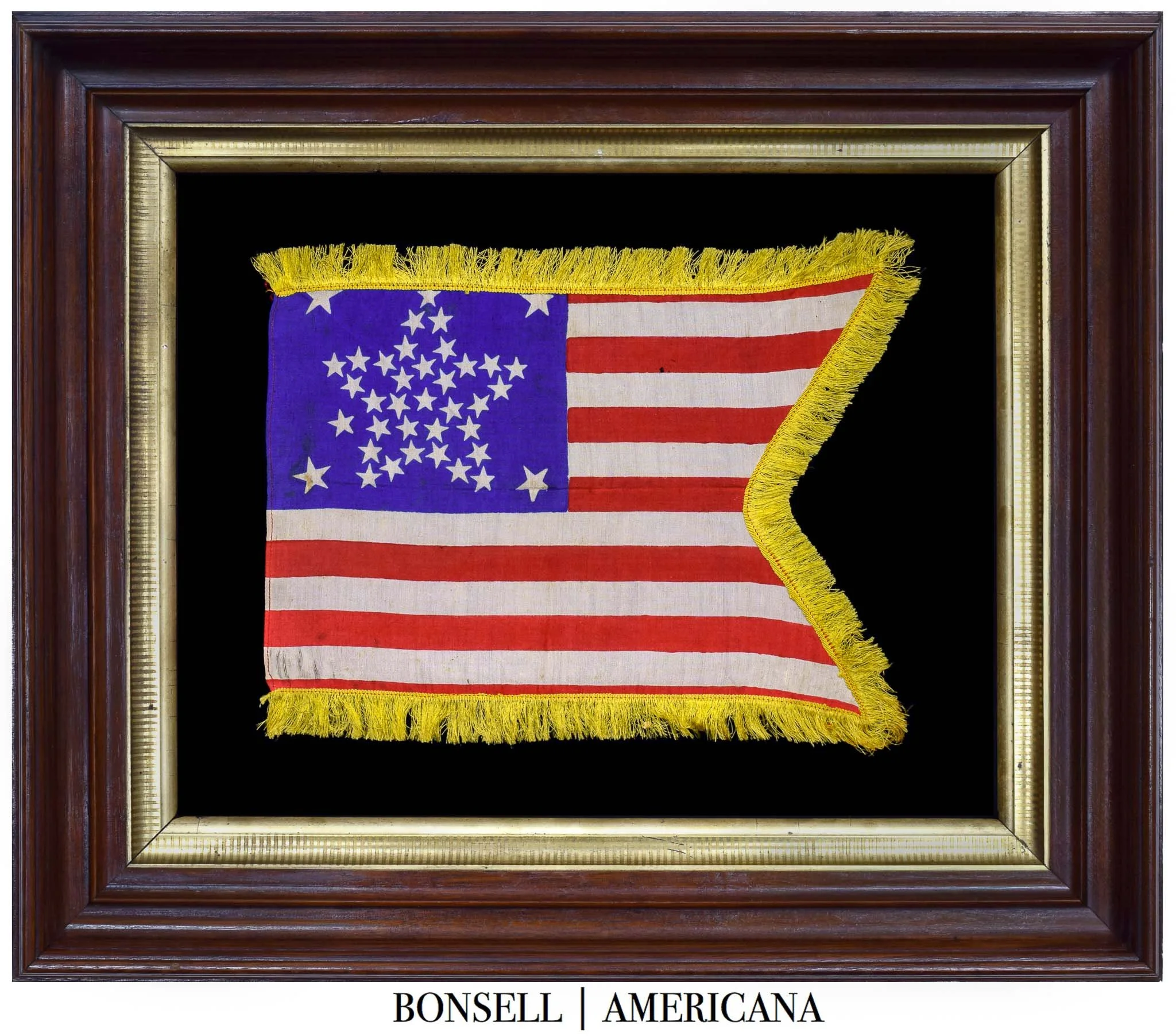
Price: Call 618-553-2291, or email info@bonsellamericana.com
Frame Size (H x L): 17” x 20”
Flag Size (H x L): 8.5” x 11.5”
Offered is a thirty-eight star parade flag. It is printed on silk, and a gold fringe is handsewn thereto. its stars are arranged in a "Great Star" pattern—a configuration that is as rare as it is interesting. This particular Great Star includes twenty-five stars in its outline, eight stars inside of the outline, one star surrounding the outline, and four corner flanking stars. The flanking stars are canted and larger than the others.
US Naval Captain Samuel Reid is credited with designing the Great Star pattern in 1818. Captain Reid was an officer in the US Navy and commanded the privateer General Armstrong during the War of 1812. Andrew Jackson credited Captain Reid's heroism in delaying the British Squadron in the Battle of Fayal, and aiding in General Jackson's defense of New Orleans. Captain Reid and his crew were greeted as heroes.
The Second Flag Act, passed in 1794, stated that the flag would have fifteen stars and fifteen stripes, in response to Vermont and Kentucky being added to the Union. Knowing that this approach would not be sustainable, with Captain Reid's help, Congress passed the Flag Act of 1818, specifying that the flag should only have thirteen stripes, but should have a star for each state admitted to the Union. It further specified that the addition of each star should be on the Fourth of July following its respective state's admission.
Captain Reid played a significant role in the Flag Act of 1818. He recommended a basic design of thirteen horizontal alternating stripes in honor of the thirteen colonies and a star in honor of each state. He further recommended several potential star patterns, including twenty stars in the shape of a larger star for general use. Reid suggested this pattern to make the flag consistent and easily identifiable, particularly at long distances and at sea. His star pattern recommendation was not ultimately included in the Act, nor was any star pattern, but Captain Reid is universally credited with designing the Great Star pattern. Its use peaked in the 1840s, but it was also used during the Civil War and occasionally during Centennial Celebrations. Its last known commercial use was on a thirty-eight star flag.
Perhaps the most interesting feature of this flag is its profile, in that it includes a V-shaped swallowtail. Its swallowtail was inspired by those of U.S. cavalry guidons (i.e., small flags used by cavalry units to mark the flanks). Of the antique flags that enter the market, perhaps one-in-a-thousand include a swallowtail shape at the fly end, making this flag particularly unique, desirable, and visually dramatic.
The thirty-eight star flag represents the inclusion of Colorado to the Union. Colorado was admitted on August 1st, 1876 and this flag became official on July 4th, 1877. Presidents Hayes, Garfield, Arthur, Cleveland, and Harrison all served under this flag. Colorado became known as the “Centennial State,” a result of becoming official just twenty-eight days after the centennial. The official star count for US flags in 1876 was the thirty-seven star flag. However, it was common for flag makers to produce anticipatory flags in advance of their official date, making the thirty-eight star flag—and for historical reasons, the thirteen star flag—the most common flags flown during the centennial celebrations of 1876.
The nation’s centennial in 1876 inspired patriotism across the county and reunited its citizens. Cities of all sizes hosted parades and celebrations, and buildings and homes were canvased in red, white, and blue with flags being the primary symbol of national pride. The most notable celebration was the Centennial International Exposition in Philadelphia. In just six months, the Exhibition hosted nearly 10 million visitors, and included many extraordinary exhibits, including the introduction of the Corliss Steam Engine and Alexander Graham Bell’s telephone.
The thirty-eight star flag was official until July 4th, 1890, the time at which the forty-three star flag became official and began to represent the inclusion of North Dakota, South Dakota, Montana, Washington, and Idaho to the Union.
Conservation Process: This flag was hand sewn to cotton fabric, and both were hand sewn to a mounting board. To prevent the black dye in the cotton fabric from seeping into the flag, it was first washed in a standard wash and then in a dye setting wash. The flag is positioned behind Optium Museum Acrylic.
Frame: This flag is in a multitiered frame with an outer walnut layer and an inner gilded layer. It dates to between 1860 and 1890.
Condition Report: There is some staining. The most notable stain is in the bottom-left corner of the canton. There are a few small holes. The fringe is tattered in places, but only slightly.
Collectability Level: The Best – Perfect for Advanced Collectors
Date of Origin: 1876-1889
Number of Stars: 38
Associated War: The Indian Wars (1860-1890)
Associated State: Colorado
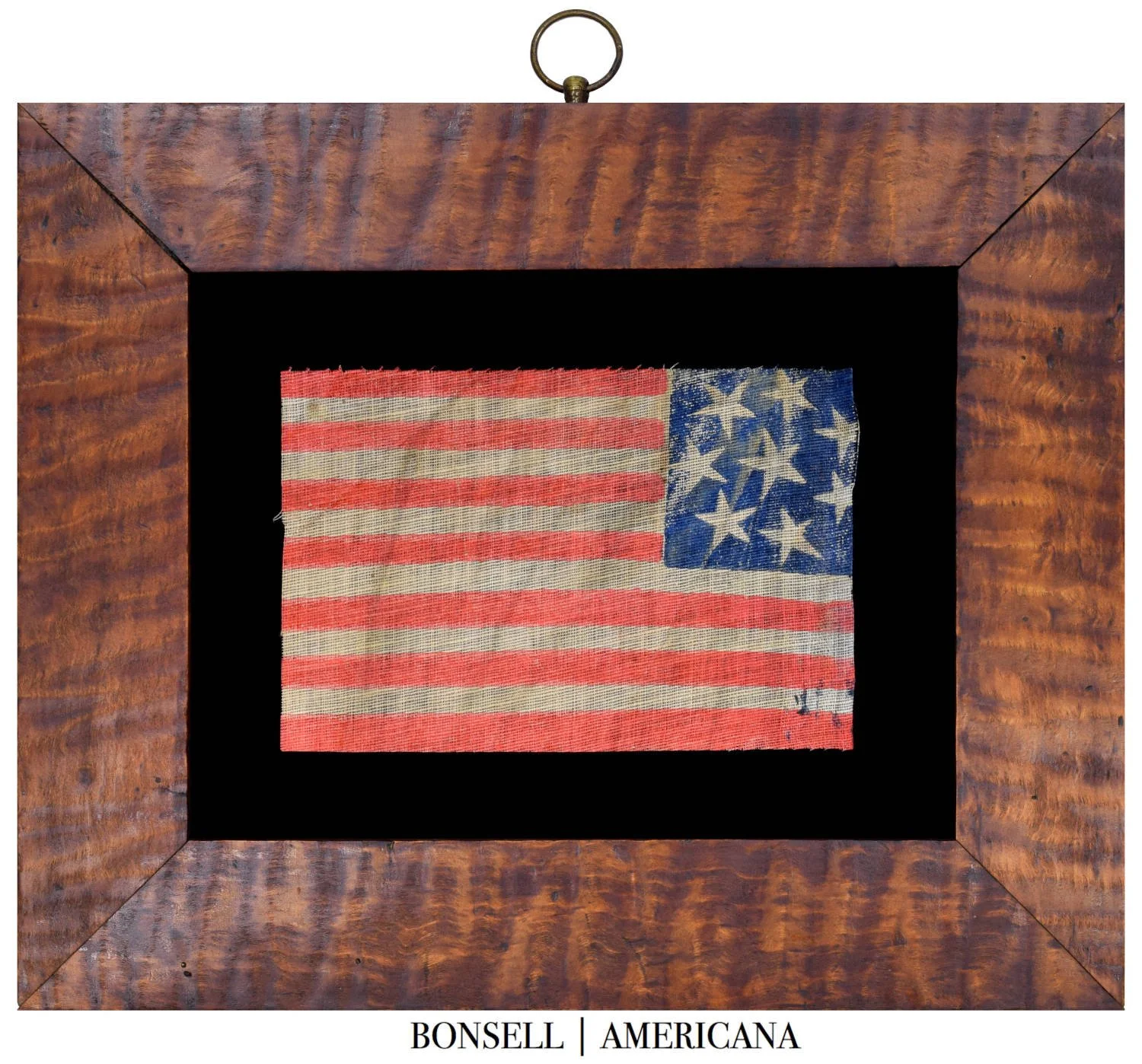
Price: Call 618-553-2291, or email info@bonsellamericana.com
Frame Size (H x L): 9” x 10.5”
Flag Size (H x L): 4” x 5.75”
Offered is a rare eight-star parade flag made in celebration of Virginia's secession from the Union. It is printed on glazed cotton and includes stripes that lean towards orange. The star pattern includes a canted center star, and it is surrounded by a ring of randomly canted stars of the same size. All of the stars are poorly and whimsically printed, as is often the case on flags dating to the Civil War.
Seven-star flags were made with Southern sympathies and commemorated the first wave of states that seceded from the Union, starting in February of 1861. The first wave included Louisiana, Georgia, Alabama, Florida, Mississippi, South Carolina, and Texas. Later, in April of 1861, Virginia seceded as the eighth state. Similar to the seven-star flags, this eight-star version commemorated the secession of the Southern states and, specifically, the historically important state of Virginia.
All known eight-star parade flags date to the Civil War, while some seven-star parade flags date to as late as 1890. Of the parade flags having fewer than thirteen-stars, the eight and nine-star versions are by far the rarest. Seven-star parade flags, for example, outnumber their eight-star counterparts by a ratio of 100-to-1.
This flag was manufactured in a reverse mount orientation. A reverse mount is one in which the canton of a US flag is positioned in the upper-right corner. Current flag ethics state that the canton should always be placed on upper-left, but such a requirement did not exist in the 19th century.
Conservation Process: This flag was hand sewn to cotton fabric, and both were hand sewn to a mounting board. To prevent the black dye in the cotton fabric from seeping into the flag, it was first washed in a standard wash and then in a dye setting wash. The flag is positioned behind Optium Museum Acrylic.
Frame: The frame is made of tiger maple and dates to approximately 1840. It is a highly desirable frame and outstanding in its appearance.
Condition Report: There is some staining and fading across the surface. There is a blue stain on the bottom white stripe, along and near the right edge. This stain appears to be a period stain, likely as a result of the printing process. A portion of the right edge is missing, perhaps because it was originally affixed to a staff via glue.
Collectability Level: The Best – Perfect for Advanced Collectors
Date of Origin: 1861
Number of Stars: 8
Associated War: The Civil War (1861-1865)
Associated State: Virginia

Frame Size (H x L): 36” x 20.75”
Pennant Size (H x L): 26” x 10”
Offered is an antique prohibition pennant in the classic elongated triangular form, tapering sharply to a point. The background is a muted purple. White lettering is arranged in a bold, visually balanced layout. Along the hoist edge, “VOTE YES” appears vertically in tall block letters, setting a strong tone.
Centered on the pennant is the rallying cry: “CALIFORNIA DRY.” “CALIFORNIA” is rendered in large capital letters, with “DRY” below it in a slightly smaller font. Notably, the “D” in “DRY” contains tally marks—five lines crossed diagonally—suggesting themes of voting and civic action. Below, “NOV 3” anchors the design in time.
At the pointed tip, “1914” runs horizontally, underlined with a stylized line that draws the eye to the end. The typography shifts subtly to fit the space, maintaining clarity while enhancing the urgency of its original message.
This pennant commemorates a pivotal moment in California’s history, set against the backdrop of the early 20th-century temperance movement. By 1914, national momentum for prohibition was surging, fueled by decades of grassroots advocacy from organizations like the Anti-Saloon League and the Woman’s Christian Temperance Union. These groups saw alcohol as a root cause of societal ills—crime, poverty, domestic violence, and moral decay—and worked tirelessly to bring about change.
The slogan “California Dry” was part of a statewide campaign urging voters to support a ban on the manufacture and sale of alcohol. The scheduled vote on November 3, 1914, marked California’s own reckoning with the growing national call for temperance.
Although California voters ultimately rejected the prohibition measure in 1914, the campaign was emblematic of a broader cultural shift that culminated just a few years later. By 1919, the 18th Amendment had been ratified, launching national Prohibition in 1920. But that national effort was built on years of local and state-level battles, battles like the one this pennant represents. In fact, many counties and municipalities in California had already gone “dry” prior to the statewide vote, adopting local ordinances in response to public pressure.
The 1914 campaign also reflected a deeper clash of values within California itself. Urban centers like San Francisco and Los Angeles—with their diverse immigrant populations and thriving nightlife—largely opposed prohibition. In contrast, rural and religious communities were more inclined to support it. The debate underscored broader societal tensions: progressivism vs. personal liberty, tradition vs. modernization, rural conservatism vs. urban dynamism.
The temperance movement in California was further complicated by the state’s unique cultural and demographic makeup. California was home to large immigrant communities—particularly from Italy, Germany, and China—many of whom brought longstanding cultural traditions involving alcohol, whether in winemaking, beer brewing, or social consumption. These communities viewed prohibition as an assault not only on personal freedom but on cultural identity itself. As a result, anti-prohibition forces in the state often framed their opposition in terms of civil rights, economic livelihood, and ethnic representation, further polarizing the electorate.
Despite the 1914 defeat, California would continue to play a nuanced role in the prohibition era. While the state never passed a sweeping statewide ban, numerous towns and counties enacted local prohibition laws, creating a patchwork of dry and wet jurisdictions. These localized efforts mirrored national trends, where enforcement varied widely and resistance was often spirited. California’s complex geography, extensive coastline, and border with Mexico also made it a hotbed for bootlegging and smuggling during national prohibition—an unintended consequence that revealed the limitations of enforcement and foreshadowed the law’s eventual repeal.
The slogan “Vote Yes California Dry” was more than a political message—it was a call for moral reform, social order, and a vision of a better society during a time of rapid change.
Today, this pennant stands as a artifact of grassroots activism and civic mobilization. It captures a moment when Americans were deeply engaged in questions about the role of government, personal responsibility, and the power of collective action. While national Prohibition would ultimately be repealed in 1933 with the 21st Amendment, the legacy of the movement—its fervor, its controversy, and its impact—echoes in the stories of campaigns like California’s 1914 vote.
Conservation Process: This pennant was hand sewn to cotton fabric, and both were hand sewn to a mounting board. To prevent the black dye in the cotton fabric from seeping into the pennant, the fabric was first washed in a standard wash and then in a dye setting wash. The pennant is positioned behind Optium Museum Acrylic.
Frame: Framed in a matte black wood frame with subtle grain texture, the presentation is both understated and elegant.
Condition Report: The pennant shows moderate fading consistent with age, but the lettering remains bold and legible. The felt is intact with no major flaws, making it a well-preserved example of early political ephemera.
Collectability Level: The Great – Perfect for Rising Collectors
Date of Origin: 1914
Weathervane Size: 28” in length, 20” in height, and 5” in width
Offered is superb Jersey cow weathervane. The 19th century in America witnessed a burgeoning interest in weathervanes, both as functional tools and as decorative architectural elements. Cow weathervanes, often perched atop barns and farmhouses, meld functionality with symbolism, serving as a reflection of the agricultural roots of a property. These weathervanes not only indicate the direction of the wind but also often signify a farm's focus on cattle production. Beyond their practical utility, the cow design speaks to the cultural and economic importance of cattle in many rural communities. Whether chosen for its direct relevance to the farm's livelihood, as a nod to regional traditions, or simply for the aesthetic appeal of the bovine silhouette against the sky, cow weathervanes remain a cherished emblem of pastoral life and heritage.
The weathervane offered herein dates to approximately 1880 and is attributed to L.W. Cushing & Sons. While several manufacturers dotted the American landscape, few commanded the reverence and legacy associated with L.W. Cushing & Sons of Waltham, Massachusetts.
Established in the mid-19th century, L.W. Cushing & Sons emerged in a period rife with technological advancement and a growing appreciation for artisanship. As America was evolving, so too were its buildings and the decorative elements that adorned them. Weathervanes, with their blend of utility and aesthetics, naturally found favor among homeowners, public building custodians, and farmers alike. Situated within this backdrop, the company positioned itself as a paragon of quality and artistic integrity.
Central to L.W. Cushing & Sons' reputation was its unwavering commitment to craftsmanship. Crafted primarily from copper, their weathervanes often bore a gilded finish of gold leaf, making them shimmer and gleam under the sun's rays. This meticulous attention to detail not only ensured longevity but also conferred upon each piece a distinctive brilliance that set them apart. In the case of the weathervane offered herein, its surface includes a blue-green verdigris patina, bright and reflective gold leaf, and yellow gilder’s size (i.e., a type of yellow paint applied prior to the gold leaf that is revealed as aging occurs). Such a surface is considered the most appealing amongst the possibilities associated with copper weathervanes.
Referring back to L.W. Cushing & Sons, it was not just the quality of materials or finish that distinguished its weathervanes; it was their design ingenuity. From galloping horses and proud roosters to gracefully arcing arrows and stately ships, each weathervane bore testament to the dynamism of the era. Their designs captured the very essence of the subjects they portrayed, intertwining realism with a sense of motion, making them not just functional tools but pieces of art.
Yet, as with many tales of craftsmanship and artistry, the narrative of L.W. Cushing & Sons has its twilight. With the dawn of the 20th century, industrialization began reshaping the American manufacturing landscape. The once-celebrated weathervane, a symbol of a bygone era, found itself overshadowed by modern architectural sensibilities. The demand dwindled, and eventually, the journey of L.W. Cushing & Sons came to an end.
However, history has a way of revisiting and reviving its treasures. The present era, with its renewed interest in traditional American crafts, has resurrected the legacy of L.W. Cushing & Sons. Collectors and enthusiasts now view their weathervanes not just as wind indicators but as exceptional artifacts of Americana.
The legacy of L.W. Cushing & Sons serves as a poignant reminder of America's rich decorative arts history. While they may no longer navigate the winds as they once did, their weathervanes continue to guide us through a historical journey, echoing tales of artistry, innovation, and timeless elegance.
Collectability Level: The Best – Perfect for Advanced Collectors
Date of Origin: Approximately 1880
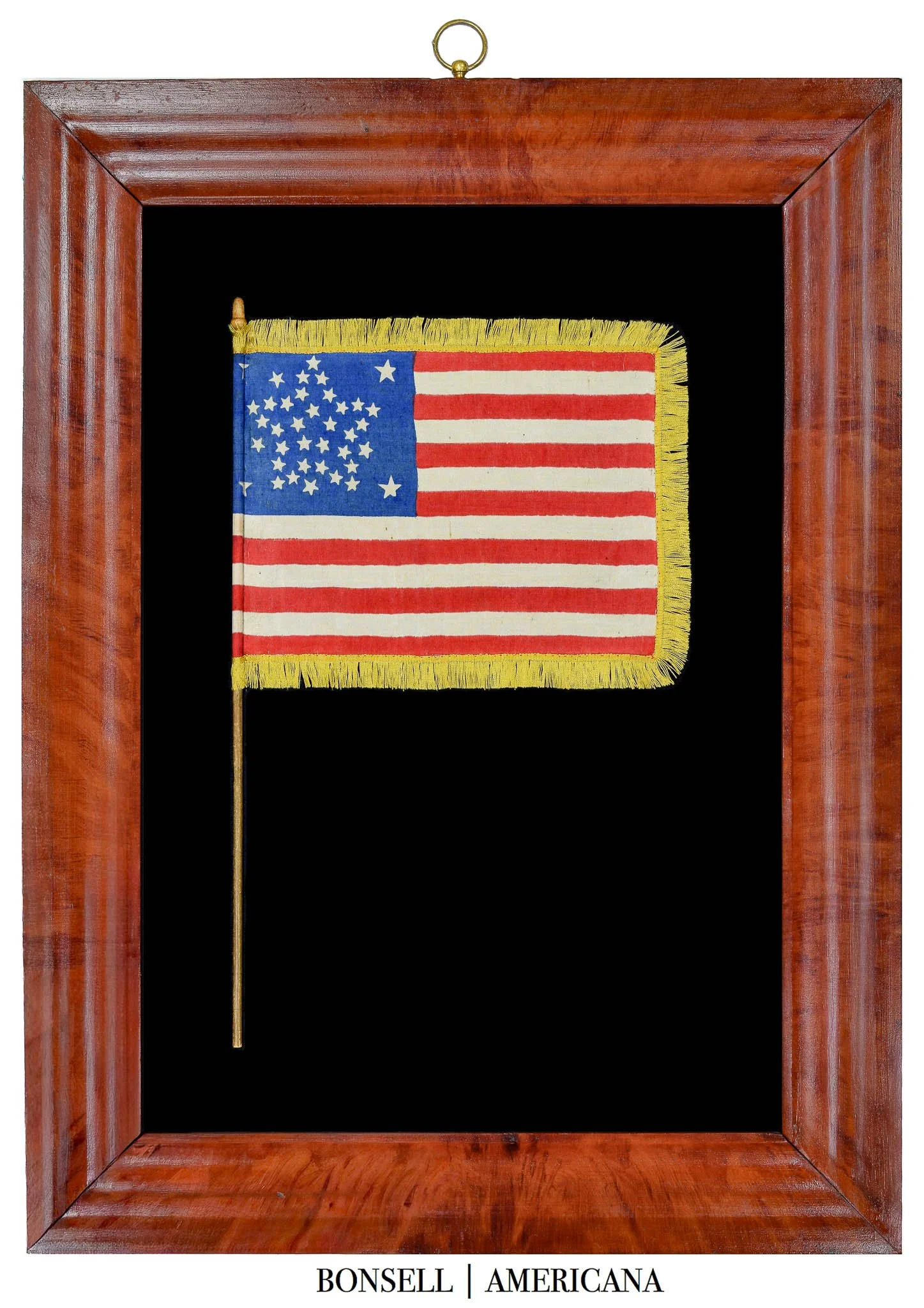
Price: Call 618-553-2291, or email info@bonsellamericana.com
Frame Size (H x L): 25” x 19”
Flag Size (H x L): 8” x 10” and Affixed to a 16” Staff
Offered is a thirty-eight star parade flag. It is printed on silk, and a gold fringe is handsewn thereto. its stars are arranged in a "Great Star" pattern—a configuration that is as rare as it is interesting. This particular Great Star includes twenty-five stars in its outline, five stars inside of the outline, four stars surrounding the outline, and four corner flanking stars. The flanking stars are canted and slightly larger than the others. The flag is still affixed to its staff.
US Naval Captain Samuel Reid is credited with designing the Great Star pattern in 1818. Captain Reid was an officer in the US Navy and commanded the privateer General Armstrong during the War of 1812. Andrew Jackson credited Captain Reid's heroism in delaying the British Squadron in the Battle of Fayal, and aiding in General Jackson's defense of New Orleans. Captain Reid and his crew were greeted as heroes.
The Second Flag Act, passed in 1794, stated that the flag would have fifteen stars and fifteen stripes, in response to Vermont and Kentucky being added to the Union. Knowing that this approach would not be sustainable, with Captain Reid's help, Congress passed the Flag Act of 1818, specifying that the flag should only have thirteen stripes, but should have a star for each state admitted to the Union. It further specified that the addition of each star should be on the Fourth of July following its respective state's admission.
Captain Reid played a significant role in the Flag Act of 1818. He recommended a basic design of thirteen horizontal alternating stripes in honor of the thirteen colonies and a star in honor of each state. He further recommended several potential star patterns, including twenty stars in the shape of a larger star for general use. Reid suggested this pattern to make the flag consistent and easily identifiable, particularly at long distances and at sea. His star pattern recommendation was not ultimately included in the Act, nor was any star pattern, but Captain Reid is universally credited with designing the Great Star pattern. Its use peaked in the 1840s, but it was also used during the Civil War and occasionally during Centennial Celebrations. Its last known commercial use was on a thirty-eight star flag.
The thirty-eight star flag represents the inclusion of Colorado to the Union. Colorado was admitted on August 1st, 1876 and this flag became official on July 4th, 1877. Presidents Hayes, Garfield, Arthur, Cleveland, and Harrison all served under this flag. Colorado became known as the “Centennial State,” a result of becoming official just twenty-eight days after the centennial. The official star count for US flags in 1876 was the thirty-seven star flag. However, it was common for flag makers to produce anticipatory flags in advance of their official date, making the thirty-eight star flag—and for historical reasons, the thirteen star flag—the most common flags flown during the centennial celebrations of 1876.
The nation’s centennial in 1876 inspired patriotism across the county and reunited its citizens. Cities of all sizes hosted parades and celebrations, and buildings and homes were canvased in red, white, and blue with flags being the primary symbol of national pride. The most notable celebration was the Centennial International Exposition in Philadelphia. In just six months, the Exhibition hosted nearly 10 million visitors, and included many extraordinary exhibits, including the introduction of the Corliss Steam Engine and Alexander Graham Bell’s telephone.
The thirty-eight star flag was official until July 4th, 1890, the time at which the forty-three star flag became official and began to represent the inclusion of North Dakota, South Dakota, Montana, Washington, and Idaho to the Union.
Conservation Process: This flag was professionally conserved. It is sewn to silk and positioned behind Conservation Clear Acrylic (standard) or behind Optium Museum Acrylic (per request).
Frame: This offering is in a masterfully executed hand-painted faux bois frame. It dates to between 1830 and 1840.
Condition Report: This flag exhibits some small tears, but they have been professionally stabilized and masked. It now presents nearly flawlessly.
Collectability Level: The Best – Perfect for Advanced Collectors
Date of Origin: 1876-1889
Number of Stars: 38
Associated War: The Indian Wars (1860-1890)
Associated State: Colorado
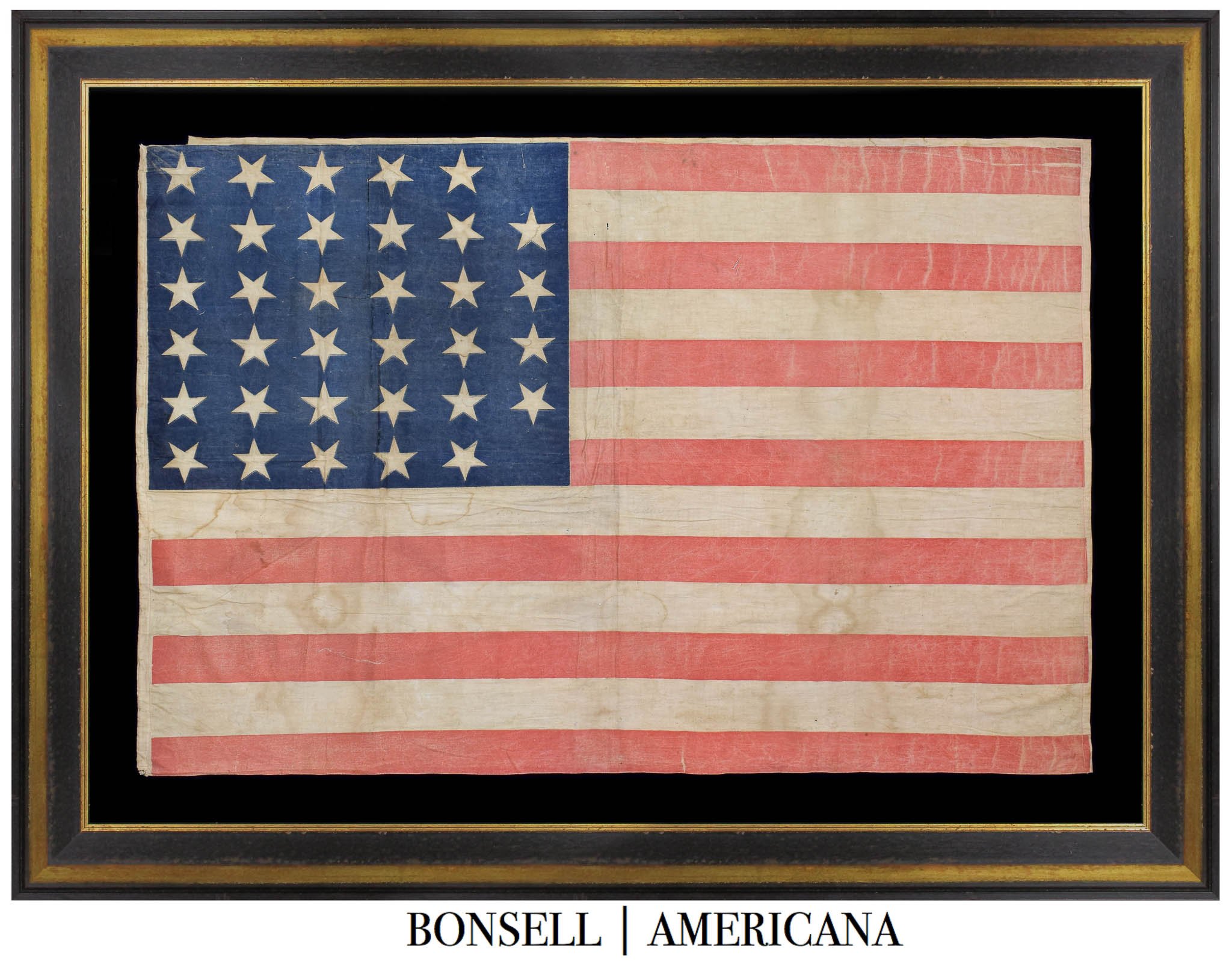
Price: Call 618-553-2291, or email info@bonsellamericana.com
Frame Size (H x L): 42.5” x 58”
Flag Size (H x L): 31.5” x 47”
Offered is a thirty-four star antique flag, printed on cotton. Its stars are arranged in a 5-6-6-6-6-5 pattern, with notches in the upper-right and lower-right corners. The stars are tumbling relative to one another, whether viewed via the columns or the rows.
The stripes are closer to orange than red. The orange is a result of the use of either madder or cochineal to create the red dye, and is common in flags dating between 1850 and 1880. The orange color of the “red” stripes is attractive and a desirable to collectors.
The thirty-four star flag represents the inclusion of Kansas to the Union. Kansas was admitted on January 29th, 1861, and this flag became official on July 4th, 1861. President Lincoln served, and the Civil War was fought, under this star count. Many thirty-four star flags predate the first shots of the Civil War in 1861, as flag makers began producing them upon the admission of the Kansas, instead of the time at which the flag was officially admitted to the Union later in the same year. The thirty-four star flag was official until July 4th 1863, the time at which the thirty-five star flag became official and began to represent the inclusion of West Virginia in the Union.
Thirty-four and thirty-five star flags were the official flags for the majority of the Civil War, and for this reason, both are extremely collectible. Flags associated with this time period (1861-1865) and earlier are among the rarest and most desirable of all US flags. Prior to the Civil War, Americans did not typically display flags for patriotic purposes. In fact, even the military did not regularly use the flag, as it was not until 1834 that the army field artillery was permitted to carry the traditional US flag, and not until 1841 that regiments carried it. Instead, most flags prior to the Civil War were used to mark ships, and were massive in scale so as to be seen from large distances.
The surge in small US flags for patriotic purposes began primarily with onset of the Civil War. This flag was made during this surge and is a rare survivor. In fact, this is the only example of this style of flag that we have encountered.
Conservation Process: This flag was hand sewn to cotton fabric, and both were hand sewn to a mounting board. To prevent the black dye in the cotton fabric from seeping into the flag, it was first washed in a standard wash and then in a dye setting wash. The flag is positioned behind Optium Museum Acrylic.
Frame: This offering is in our Large Distressed Black and Gold Frame.
Condition Report: There is oxidation and staining across the entirety of the flag. The most noticeable such issues are (1) below the canton and (2) in a vertical strip, positioned between the canton and the fly edge. There is a vertical tear through the canton. There are printing errors across several of the red stripes. The aforementioned issues are age appropriate and typical of the era.
Collectability Level: The Best – Perfect for Advanced Collectors
Date of Origin: 1861-1863
Number of Stars: 34
Associated War: The Civil War (1861-1865)
Associated State: Kansas
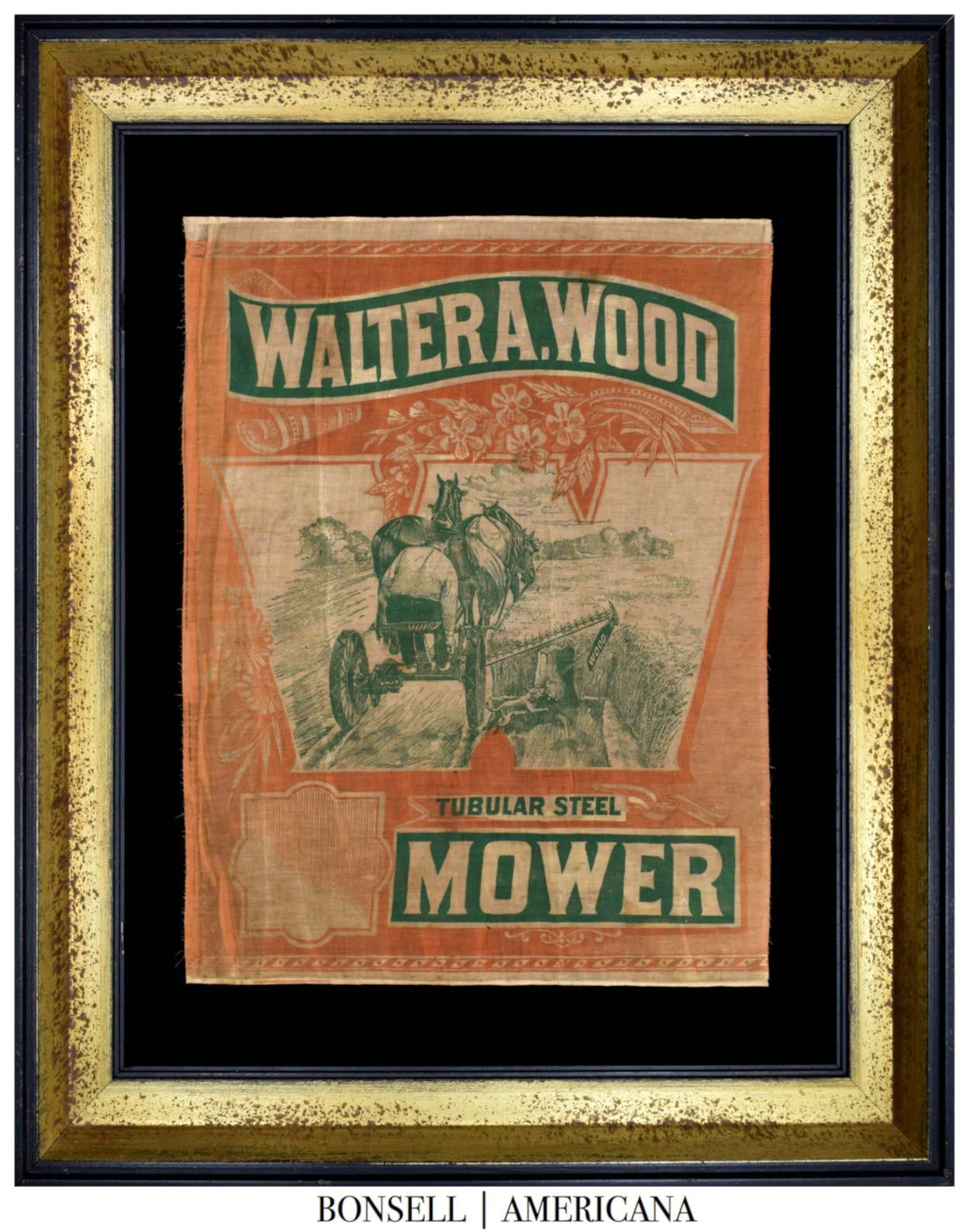
Frame Size (H x L): 35.5” x 29.5”
Banner Size (H x L): 25” x 18”
Offered is a cotton broadside. Broadside advertisements from the 19th century have a unique allure, reflecting not only the aesthetic and design sensibilities of the time, but also the groundbreaking innovations they aimed to promote. A remarkable specimen of such a broadside showcases the "Walter A. Wood Tubular Steel Mower".
Central to the broadside, a farmer can be observed maneuvering the mower across a field. Unlike traditional mowers of its time, this machine's construction primarily utilized steel, ensuring enhanced durability and performance. The mower's design was revolutionary. Its lightweight nature, attributed to its steel construction, optimized its efficiency.
Also central to the broadside, a team of horses guides the mower forward. The farmer is seen raising the cutting mechanism thereof to avoid a collision with a nearby tree stump. This action is likely deliberate, underscoring the mower's advanced design and functionality. Adjacent to the stump, a dog barks at a small varmint emerging from the stump, adding a touch of liveliness to the scene. This portrayal seamlessly marries the notions of agrarian diligence with technological ingenuity, emphasizing the mower's adaptability and precision in diverse terrains.
WALTER A. WOOD AND HIS COMPANY
Born on October 23, 1815, Walter Abbott Wood's life was a testament to hard work, ingenuity, and persistent innovation. Originating from Mason, New Hampshire, Wood's early life was marked by a mechanical aptitude which he honed over the years. His relocation to Rensselaerville, New York, in 1816, and later to Hoosick Falls in 1835, set the stage for his outstanding contributions in the agricultural machinery sector.
Under Wood's leadership, the Walter A. Wood Company saw a meteoric rise, transitioning from humble origins to becoming one of the world's foremost manufacturers of mowing and reaping machines. Beginning with the manufacturing of iron mould-board plows in partnership with John White, the company's quest for innovation led to the creation of the iconic Walter A. Wood Mower and Reaper.
The company's growth was exponential. By 1865, they produced over 8,000 machines, a leap from a mere two in 1852. Their relentless pursuit of perfection earned them over 1,200 different awards and recognitions globally, including commendations from Napoleon III and Emperor Franz Joseph.
The Walter A. Wood broadside serves as a window into the past, offering glimpses of a time when innovations in agriculture were reshaping the world. Behind its vibrant colors lies the legacy of a man whose vision transformed farming practices, a company that pioneered change, and a machine that stood as a beacon of innovation.
Conservation Process: This banner was hand sewn to cotton fabric, and both were hand sewn to a mounting board. To prevent the black dye in the cotton fabric from seeping into the banner, it was first washed in a standard wash and then in a dye setting wash. The banner is positioned behind a UV resistant acrylic and spaced apart therefrom using spacers.
Frame: This banner is in our Large Distressed Gold Frame.
Condition Report: There is some toning and a few small, minor stains. In other respects, this banner is in excellent condition, age appropriate, and visually striking.
Collectability Level: The Best – Perfect for Advanced Collectors
Date of Origin: 1890

Price: Call 618-553-2291, or email info@bonsellamericana.com
Frame Size (H x L): 30” x 39.5”
Flag Size (H x L): 19.5” x 28.5”
Offered is an extraordinary thirty-six star American flag, printed on coarse, glazed cotton. This striking example features a highly desirable medallion star pattern, a design that is both visually captivating and historically significant. At the heart of the canton lies a bold center star, encircled by two rings of stars, with additional flanking stars positioned in each corner—creating a stunning and meticulously balanced composition.
MEDALLION FLAGS: A REFLECTION OF AMERICAN PATRIOTISM AND ARTISTIC EXPRESSION
Medallion-patterned flags were a product of their time, appearing most frequently between 1861 and 1876. Unlike today’s standardized designs, nineteenth-century flag makers had the freedom to arrange the stars in any pattern they chose, resulting in highly creative and often elaborate designs. Among these, the medallion configuration was particularly prized, as it created a sense of order and symmetry while also making a bold visual statement.
Medallion flags were commonly used for patriotic displays, political rallies, and ceremonial occasions. They were typically printed on lightweight cotton or silk, making them more delicate than their wool bunting counterparts, which were more commonly used for military and naval applications. While many medallion-patterned flags were handmade or printed in small batches, their use declined by the late nineteenth century as industrialization led to mass production and increasing standardization. By the 1890s, most flag manufacturers had moved toward linear arrangements, a trend that was eventually codified in 1912 when President William Howard Taft issued Executive Order 1556, which mandated the arrangement of stars into rectilinear rows.
THE CENTER STAR: A SYMBOL OF GROWTH AND UNITY
One of the defining features of this flag is the large, canted center star—a hallmark of some of the most striking nineteenth-century flag designs. Unlike the Great Star pattern, in which a single large star is formed by smaller stars, the center star is a singular, prominent feature placed at the heart of the canton. Historically, the center star was often used to symbolize the most recently admitted state—in this case, Nevada.
Adding to the flag’s rarity, the center star is haloed, featuring a smaller, bold star enclosed within a faint outline. Haloed stars are highly collectible, as this unique design choice appears to have been the hallmark of a single, yet unidentified, manufacturer. This particular maker produced multiple haloed center star flags across different star counts, including examples with thirty, thirty-four, thirty-five, thirty-six, and forty-two stars.
THE DISTINCTIVE STRIPES
Another striking element of this flag is its orange-toned stripes. Instead of the deep crimson we associate with American flags today, the red stripes have taken on a distinctive orange hue. This variation is due to the natural dyes used during the period, primarily madder root and cochineal. Both dyes were commonly used between 1850 and 1880, and their hues could range from deep red to orange, depending on the concentration, mordant, and exposure to light over time. The warm patina of the stripes adds to the overall character of this piece, making it an even more compelling example of early American flag-making.
NEVADA’S PATH TO STATEHOOD
The thirty-six star flag represents the admission of Nevada into the Union on October 31st, 1864, in the midst of the Civil War. However, as was customary, the official adoption of the new star count took place the following July 4th, 1865. This flag was, therefore, the official banner of the United States for the last six months of the war and continued to be used throughout the early Reconstruction era.
Nevada’s road to statehood was both unique and deeply tied to national political and economic concerns. The region was originally part of the Utah Territory when it was established in 1850, but due to increasing tensions between Mormon settlers and non-Mormon mining communities, it was separated and designated as the Nevada Territory in 1861. However, despite its immense mineral wealth—particularly the Comstock Lode, one of the richest silver deposits in the world—Nevada had a small population and did not meet the typical requirements for statehood.
President Abraham Lincoln and congressional Republicans saw great strategic value in admitting Nevada as a state. Politically, Lincoln was seeking re-election in 1864 and needed additional electoral votes to secure victory against his Democratic opponent, General George McClellan. The addition of a Republican-leaning state to the Union would help bolster support for Lincoln’s administration and ensure continued backing for the war effort. Additionally, Nevada’s silver mining industry was crucial to the federal government, as the Civil War had placed enormous financial strain on the nation. The revenue from Nevada’s mines helped finance the Union’s war expenses, making the territory’s inclusion an economic necessity.
Statehood was fast-tracked, with Lincoln urging Nevada’s territorial leaders to draft a state constitution. In an unprecedented move, Nevada’s entire constitution was telegraphed to Washington, D.C., in October 1864, an act that was considered a remarkable technological feat at the time, as it was the longest telegraph transmission ever sent. Just days later, on October 31st, 1864, Lincoln signed the proclamation officially admitting Nevada as the thirty-sixth state.
Following its admission, Nevada’s borders expanded in 1866 when the western portion of Utah Territory was annexed to its eastern boundary. The following year, in 1867, another addition from Pah-Ute County, Arizona Territory, further extended the state’s southern region.
A FLAG THAT BRIDGES TWO ERAS
The thirty-six star flag is significant not only because of its association with the Civil War but also because it marks a transitional period in American history. It was the official flag at the close of the war, flown as Union forces achieved final victory over the Confederacy. It was also present during the beginning of Reconstruction, a complex and contentious era in which the nation grappled with reintegration and the rights of newly freed African Americans.
This flag remained the official U.S. flag until July 4th, 1867, when the thirty-seven star flag was introduced to commemorate Nebraska’s statehood. However, flags with thirty-six stars likely continued to be used well beyond their official tenure, as flag replacement was often slow, particularly in military and civilian contexts.
With its eye-catching medallion pattern, haloed center star, and unique orange-toned stripes, this flag stands out as an exceptional representation of American history. Whether displayed as a collector’s centerpiece, studied for its craftsmanship, or appreciated as a tangible connection to the Civil War and the Reconstruction era, this remarkable example encapsulates the artistry and patriotic fervor of the mid-nineteenth century.
Conservation Process: This flag was hand sewn to cotton fabric, and both were hand sewn to a mounting board. To prevent the black dye in the cotton fabric from seeping into the flag, it was first washed in a standard wash and then in a dye setting wash. The flag is positioned behind Optium Museum Acrylic.
Frame: The frame is a blend of contemporary and traditional styles, designed to bring the beauty of nature to any setting. Made in Italy and finished in an opaque black color, it adds a touch of elegance and sophistication to an office, home, or other environment.
Condition Report: This flag exhibits the expected wear and patina of a well-preserved mid-nineteenth-century textile. The cotton shows signs of age, with some staining and discoloration, particularly in the white stripes, which have developed a warm, aged tone. The canton retains strong coloration, though there is some fading and minor fraying along the edges. To enhance its presentation, cotton has been carefully placed behind certain portions of the flag to mask flaws and stabilize areas of wear.
Collectability Level: The Best – Perfect for Advanced Collectors
Date of Origin: 1864-1867
Number of Stars: 36
Associated War: Civil War (1861-1865)
Associated State: Nevada
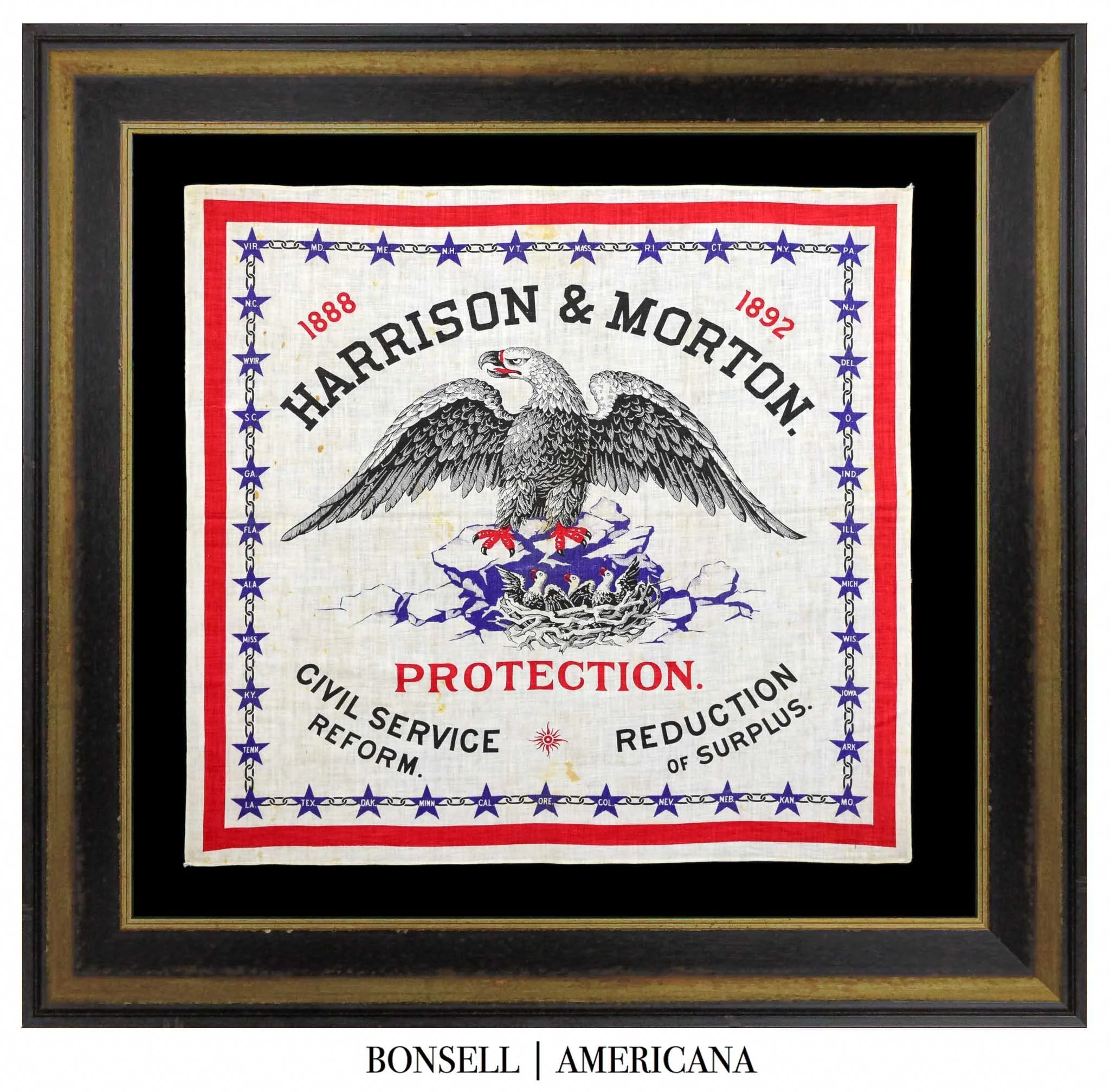
Price: Call 618-553-2291, or email info@bonsellamericana.com
Frame Size (H x L): 33.5” x 34.5”
Bandanna Size (H x L): 23.5” x 24.5”
Offered is a patriotic campaign bandanna for the Harrison and Morton campaign of 1888. It is made of cotton, and vividly features an eagle protecting its three babies. The babies are resting in a nest and positioned in front of a rock. Printed above the eagle is the verbiage “1888” and “1892” in red, and the verbiage “HARRISON & MORTON” in black. Printed below the eagle are the themes of the Harrison campaign, including the verbiage “PROTECTION” in red, and the verbiage “CIVIL SERVICE REFORM” and “REDUCTION OF SURPLUS” in black. Thirty-nine states, encased by blue stars, are printed along the borders of the bandanna. Of particular note, one of the states is “DAK,” as this bandanna was made before it was known that there would be both a North Dakota and a South Dakota, instead of just one overall state.
Campaign bandannas were initially produced beginning in the first quarter of the nineteenth century, and became a particularly popular campaign tool in the time period between 1850 and 1920. Campaign bandannas were worn, presented in store fronts, waved in parades, flown at political rallies, and hung from buggy whips.
An example of this Harrison and Morton bandanna is documented in the Threads of History. The referenced example is shown as item 581 and was held in a private collection. In addition, this bandanna is also featured on the cover, along with eleven other special textiles. The Threads of History was written by Herbert Ridgeway Collins, who was the curator of the Division of Political History at the Smithsonian Institute. His book is the best reference available for political textile collectors and includes over fifteen-hundred examples, dating from 1775 to 1979.
The imagery shown on this bandanna is similar to the imagery protected in design patent number 18,497. Rufus H. Rose of New York, New York was listed as the sole inventor, and his patent issued on July 31st, 1888. The illustration in the ‘497 patent is actually for Cleveland & Thurman, and interestingly this example is not included in the Threads of History. To our knowledge and that of others, the Cleveland & Thurman textile may not have been distributed.
Harrison was a moderate Republican, and elected the 23rd president in the election of 1888. Harrison ran against Grover Cleveland, the incumbent President and a Democrat. Harrison lost the popular vote, but won the electoral vote with 233 electoral votes to Cleveland's 168. Harrison signed into law the Sherman Antitrust Act in 1890, the first legislation prohibiting business combinations in restraint of trade. Despite this, many Americans viewed Harrison and the Republicans as being too closely aligned with the wealthy elite, and as wasteful. Upon Harrison's election, the treasury had a great surplus, but the "Billion-Dollar Congress" spent enormous sums on soldiers' pensions and business subsidies, erasing the surplus. By 1890, the Democrats recaptured the House of Representatives by a large majority, and in turn, Harrison had little influence on legislation. In the election of 1892, Harrison lost the electoral vote with 145 electoral votes to Cleveland's 277.
Conservation Process: This bandanna was hand sewn to cotton fabric, and both were hand sewn to a mounting board. To prevent the black dye in the cotton fabric from seeping into the bandanna, it was first washed in a standard wash and then in a dye setting wash. The bandanna is positioned behind Conservation Clear Acrylic (standard) or behind Optium Museum Acrylic (per request).
Frame: This offering is in our Large Distressed Black and Gold Frame.
Condition Report: This bandanna has some minor stains, most of which are light yellow in color. Despite this, it presents very well and is a statement piece.
Collectability Level: The Best – Perfect for Advanced Collectors
Date of Origin: 1888
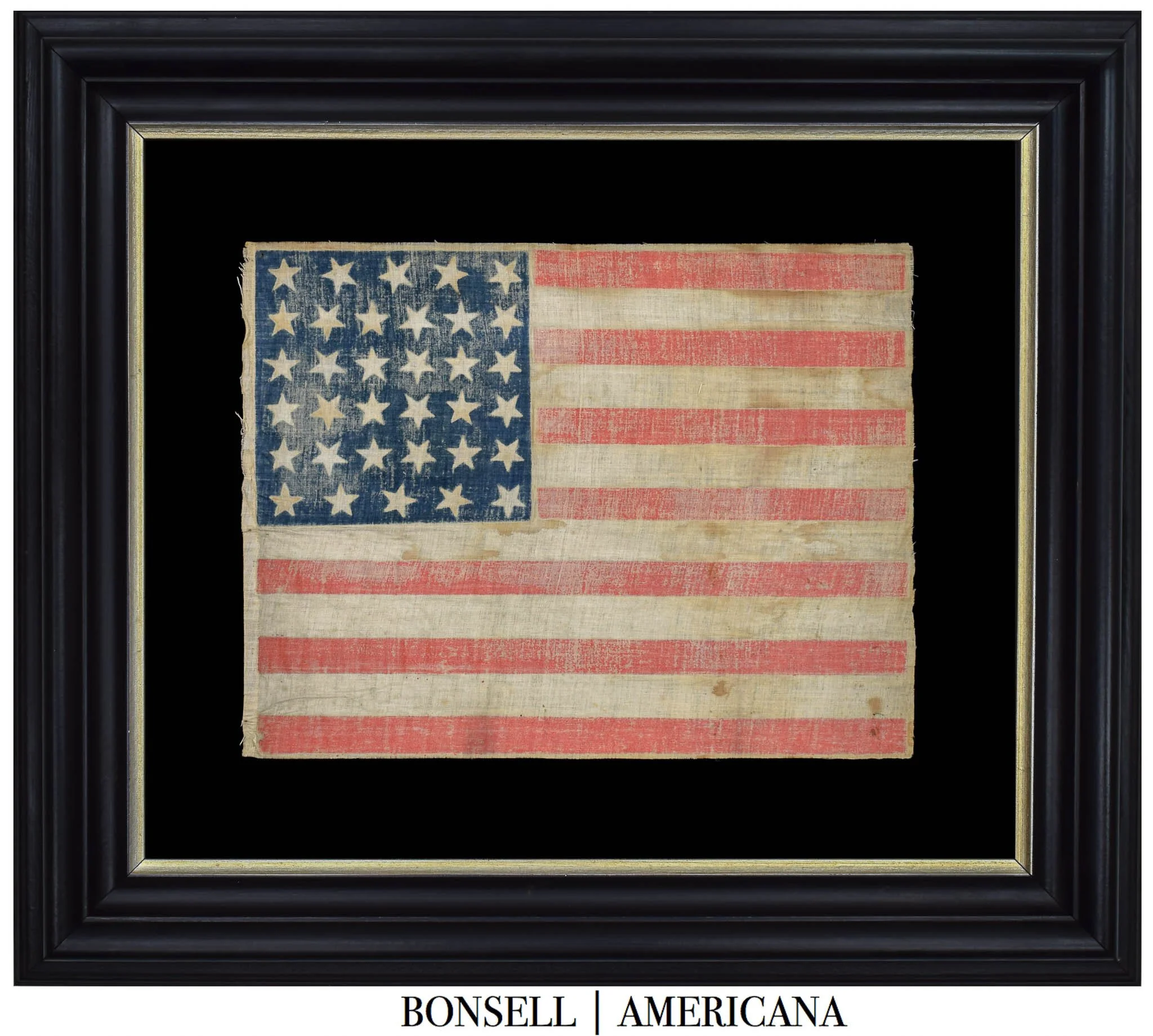
Price: Call 618-553-2291, or email info@bonsellamericana.com
Frame Size (H x L): 22” x 25.5”
Flag Size (H x L): 11” x 15”
Offered is a thirty-four star antique flag printed on glazed cotton. Its stars are arranged in a 5-6-6-6-6-5 pattern. The stars in the first and sixth rows are canted in various directions. In contrast, the stars in the other rows are tumbling relative to one another, creating a dancing effect between the stars as they appear to be partnering and dancing with one another. When the second through fifth rows are instead viewed as columns, the stars are pointing either consistently upwards or consistently downwards.
This flag is square in its proportions, instead of elongated. The First Flag Act of 1777 did not specify the dimensions or proportions of the American flag. And such freedom extended up until 1912, the time at which President Taft issued Executive Order 1556, establishing official proportions.
The stripes of this flag are closer to orange than red. Such a color is a result of the use of either madder or cochineal to create the red dye, and is common in flags dating between 1850 and 1880. The orange color of the “red” stripes is attractive and a desirable to collectors.
The thirty-four star flag represents the inclusion of Kansas to the Union. Kansas was admitted on January 29th, 1861, and this flag became official on July 4th, 1861. President Lincoln served, and the Civil War was fought, under this star count. Many thirty-four star flags predate the first shots of the Civil War in 1861, as flag makers began producing them upon the admission of the Kansas, instead of the time at which the flag was officially admitted to the Union later in the same year. The thirty-four star flag was official until July 4th 1863, the time at which the thirty-five star flag became official and began to represent the inclusion of West Virginia in the Union.
Thirty-four and thirty-five star flags were the official flags for the majority of the Civil War, and for this reason, both are extremely collectible. Flags associated with this time period (1861-1865) and earlier are among the rarest and most desirable of all US flags. Prior to the Civil War, Americans did not typically display flags for patriotic purposes. In fact, even the military did not regularly use the flag, as it was not until 1834 that the army field artillery was permitted to carry the traditional US flag, and not until 1841 that regiments carried it. Instead, most flags prior to the Civil War were used to mark ships, and were massive in scale so as to be seen from large distances.
The surge in small US flags for patriotic purposes began primarily with onset of the Civil War. This flag was made during this surge and is a rare survivor. In fact, this is the only example of this style of flag that we have encountered.
Conservation Process: This flag was hand sewn to cotton fabric, and both were hand sewn to a mounting board. To prevent the black dye in the cotton fabric from seeping into the flag, it was first washed in a standard wash and then in a dye setting wash. The flag is positioned behind Optium Museum Acrylic.
Frame: This offering is in a distressed black and silver frame.
Condition Report: This flag exhibits some staining and foxing. Its stripes and canton are faded. Despite these issues, this flag displays well and has the Civil War era appearance that our clients desire.
Collectability Level: The Best – Perfect for Advanced Collectors
Date of Origin: 1861-1863
Number of Stars: 34
Associated War: The Civil War (1861-1865)
Associated State: Kansas
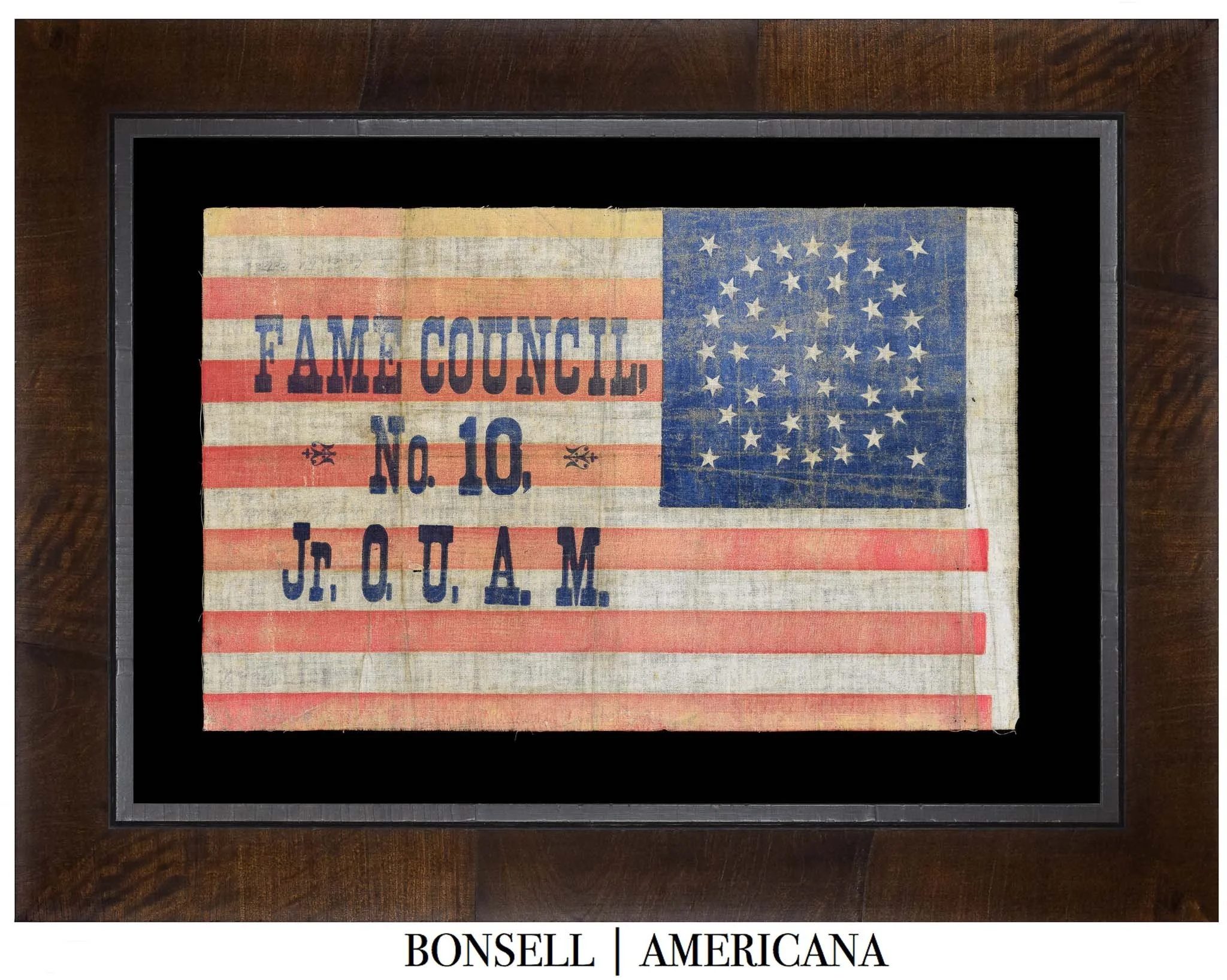
Frame Size (H x L): 20” x 25.5”
Flag Size (H x L): 11” x 17”
Offered is an extraordinary forty-star parade flag, dating to 1889 and recently found in an antique store intermingled with World War II posters. There are thought to be approximately forty to fifty flags of this star count, nearly all of which have stars arranged linearly. In contrast, the stars of this flag are arranged in a medallion. Its medallion includes a center star, an inner ring of five stars, a middle ring of ten stars, and an outer ring of twenty stars. Four flanking stars surround the outer ring. The stars are all the same size. Of the known forty-star flags, this specific flag is unique in our experience and likely the only remaining example.
Medallion pattern flags date to at least as early as the twenty-six star flag, and at least as late as the forty-eight star flag. The majority of medallion pattern flags, however, date to between 1861 and 1876. Beginning in the 1890s, medallion patterns became less common, and linear arrangements became the norm. Why this occurred is unclear, as flag makers had the freedom to place the stars however they liked until 1912.
In addition to this flag’s unusual pattern, it also includes the following unusual overprint:
FAME COUNCIL,
-No. 10,-
Jr. O.U.A.M.
“Jr. O.U.A.M.” is a reference to the Junior Order of United American Mechanics (“Jr. OUAM”). The Order of United American Mechanics (“OUAM”) was founded in 1845 in Philadelphia. The OUAM was focused on fighting increased labor pressures. The term “Mechanic” was a reference to building one’s self, rather than a reference to the occupation of the members. The Jr. OUAM began as a youth affiliation of the OUAM in 1853, but it seceded in 1885 to become its own organization and later absorbed its parent. Fame Council No. 10 was based in Roxborough, a neighborhood in Philadelphia, Pennsylvania.
J.H. Wilson Company manufactured this flag. It was located at 928 Arch Street in Philadelphia, and it made a variety of military and patriotic related items, including swords, belts, helmets, caps, drums, buttons, gloves, and banners.
J.H. Wilson Company describes flags of this general style as memorial flags of the best quality for decorating graves. They could be ordered with overprints, including custom overprints related to the Grand Army of the Republic (“GAR”). The custom overprints were available in two styles. The first style included custom overprint options in the canton, while the second style included custom overprint options across the stripes. The first and second styles were available in a smaller size of 9” by 15” and a larger size of 12” x 18”. The J.H. Wilson Company also provided the following information in its marketing brochure:
These flags are made of the best heavy muslin, printed in solid OIL COLORS, and are of the best quality and finish throughout.
We mount them on 36-inch solid sticks, which will not warp or break as is the case with the common “split” sticks usually furnished.
In order that the water-proof colors may have ample time to become thoroughly dry, we would request committees to place orders at once, and we will deliver flags when needed.
This flag is shown in a reverse mount orientation. A reverse mount is one in which the canton of a US flag is positioned in the upper-right corner. Current flag ethics state that the canton should always be placed in the upper-left, but such a requirement did not exist in the 19th century. Thus, flags like this one, were manufactured in a manner that appears backwards to today’s viewers.
In 1889, the Dakota Territory was split it into two states: North Dakota and South Dakota, and they were both admitted on November 2nd, 1889. Just six days later, on November 8th, 1889 Montana was admitted as the forty-first state (making the forty-star flag almost immediately obsolete). And then, just three days later, on November 11th, 1889, Washington was admitted as the forty-second states (making the forty-one star flag almost immediately obsolete). As a result of this rapid succession of state admissions, flag makers made large quantities of forty-two star flags, but hardly any forty or forty-one star flags. In fact, there are only a few known examples of printed forty-star flags in circulation, and thus they are very desirable to even the most advanced of collectors.
Conservation Process: This flag was hand sewn to cotton fabric, and both were hand sewn to a mounting board. To prevent the black dye in the cotton fabric from seeping into the flag, it was first washed in a standard wash and then in a dye setting wash. The flag is positioned behind Conservation Clear Acrylic (standard) or behind Optium Museum Acrylic (per request).
Frame: This offering is in special edition Medium Frame.
Condition Report: As shown in the images, this flag exhibits some slight fading and light toning, but generally is in excellent condition.
Collectability Level: The Best – Perfect for Advanced Collectors
Date of Origin: 1889
Number of Stars: 40
Associated War: Indian Wars (1860-1890)
Associated State: South Dakota
Price: Call 618-553-2291, or email info@bonsellamericana.com
Frame Size (H x L): 28” x 38”
Flag Size (H x L): 17” x 27”
Offered is an unusual 13-star American flag, dating to approximately 1910–1940, with its stars arranged in the widely recognized “Betsy Ross” pattern. The flag is particularly interesting for its unconventional construction, incorporating what appear to be materials repurposed from an earlier American flag, a separately attached blue canton, and 13 paper stars glued directly to the fabric. As homemade example, it may have originated as a school project, classroom display, or other patriotic exercise intended to commemorate the nation's founding.
The flag's 13 stars are arranged in a circular formation, representing the original 13 colonies. While this configuration is among the most recognizable in American flag history, antique examples are surprisingly uncommon. Most surviving 13-star flags feature either the traditional 3-2-3-2-3 arrangement or some variation of the medallion pattern. Flags displaying a simple circle of 13 stars constitute a much smaller portion of the surviving population.
The arrangement is closely associated with Betsy Ross, the Philadelphia upholsterer traditionally credited with making the first American flag. Although the historical foundation of that story is questionable, its influence on American patriotic imagery has been substantial. The circular pattern has become so closely associated with the nation's founding that it is frequently assumed to have been the original arrangement adopted in 1777, despite the absence of contemporary documentation establishing that fact.
CONSTRUCTION AND DATING
One of the most compelling aspects of this flag is the manner in which it was assembled. The red and white stripes appear to have been cut from an earlier American flag, rather than manufactured specifically for this example. The fabric is glazed cotton, with a relatively open weave and a red coloration consistent with many commercially produced flags of the early twentieth century. The red is notably a true red, rather than the orange-red frequently encountered on printed flags of the late nineteenth century, particularly those dating to the 38-star period.
Based on these characteristics, we believe the striped fabric likely originated from a flag manufactured sometime between approximately 1910 and 1940. A 48-star American flag, representing the period following Arizona's admission to the Union in 1912, is perhaps the most plausible source, although earlier 42-star to 46-star flags cannot be ruled out. Without the original canton, the precise star count of the source flag cannot be established.
The blue canton appears to be glazed cotton as well, although its surface is somewhat shinier and its weave noticeably tighter than that of the striped field. The canton was machine-sewn to the striped field, further supporting the conclusion that the flag was assembled from individual components.
Most unusual are the 13 stars, which are made of paper and adhered directly to the blue canton. Their individual shapes and placement have a distinctly handmade character. This method of construction would have been impractical for a flag intended to fly outdoors, where exposure to wind and moisture would quickly compromise the paper elements. It is instead consistent with an object intended for interior display, educational use, or some other commemorative purpose.
Taken together, these characteristics suggest a homemade flag, perhaps assembled by a student or teacher as part of a classroom lesson on American history. The use of an existing flag would have provided readily available red and white stripes, while the separately attached canton and paper stars allowed the maker to recreate the familiar Betsy Ross design. Although its original purpose is unknown, a schoolroom origin seems plausible given the prominence of the Betsy Ross story in American education during the early twentieth century.
We favor a date of approximately 1910–1940 for the completed flag, although the materials could have been reused some years after their original manufacture.
THE BETSY ROSS LEGEND
Betsy Ross is perhaps the most recognizable figure associated with the creation of the American flag. According to popular tradition, she was visited in Philadelphia in 1776 or 1777 by George Washington and a small committee seeking a flag for the newly independent nation. Ross purportedly agreed to manufacture the flag but suggested replacing the six-pointed stars in the proposed design with five-pointed stars, demonstrating how the latter could be produced with a single cut of folded paper.
Despite its enduring popularity, there is no surviving contemporary documentation establishing that Ross designed or made the first American flag. She was a working upholsterer and flagmaker during the Revolutionary era, but the specific claim that she created the first national flag rests on family testimony recorded many decades after the alleged event.
The story first gained significant public attention in 1870, when William Canby, Ross's grandson, presented an account of her involvement to the Historical Society of Pennsylvania. Canby relied on family recollections and affidavits rather than contemporary letters, contracts, or official records. His narrative was subsequently repeated in popular publications, including an 1873 account in Harper's New Monthly Magazine, helping establish the story in the American imagination.
By contrast, documentary evidence links Francis Hopkinson, a signer of the Declaration of Independence and member of the Continental Congress, to the design of the American flag. In 1780, Hopkinson sought compensation from Congress for designing what he described as the flag of the United States of America. Although his claim does not conclusively establish every detail of the earliest flag's appearance, it provides a contemporary documentary foundation lacking in the Betsy Ross account.
The historical uncertainty surrounding Ross did little to diminish the story's popularity. In the decades following the Civil War, Americans increasingly embraced patriotic narratives celebrating the Revolutionary generation. The Centennial of American independence in 1876 gave particular momentum to this movement, and the Ross story offered a memorable account connecting George Washington, the nation's first flag, and the contributions of an American woman.
By the late nineteenth and early twentieth centuries, the legend had become firmly established in classrooms, patriotic literature, and public commemorations. Ross's descendants Rachel Albright and Sarah Wilson contributed to its popularity by producing and selling handmade reproductions of the supposed original flag at Independence Hall in Philadelphia, principally during the period from approximately 1895 to 1913. Their examples were generally made of silk, with carefully embroidered stars, and are distinctly different from the flag offered here.
If made between 1910 and 1940, the present example would have originated during a period when the Betsy Ross narrative was deeply embedded in American popular culture. Its paper stars and repurposed fabric seem particularly appropriate for an educational or patriotic project, in which reproducing the familiar design may have mattered more than following conventional flagmaking practices.
13-STAR FLAGS GENERALLY
The first national flag was established by the Continental Congress on June 14, 1777. The resolution specified 13 alternating red and white stripes and 13 white stars on a blue field, representing a new constellation. Importantly, it did not prescribe a particular arrangement for the stars. Consequently, several configurations appeared on early American flags, and no surviving congressional directive establishes the familiar Betsy Ross circle as the original design.
Although the official number of stars increased as additional states entered the Union, 13-star flags continued to be manufactured and displayed for generations. They remained associated with the nation's founding and appeared in patriotic celebrations, military and maritime contexts, and commemorations of American independence. The 1876 Centennial was an especially important occasion for their revival, while later anniversary celebrations helped sustain their popularity well into the twentieth century.
Of the various 13-star arrangements, the Betsy Ross circle is among the most familiar to the public yet one of the less frequently encountered patterns on genuinely antique flags. Its prevalence in modern reproductions should not be confused with its relative scarcity among surviving historical examples.
The flag offered here is a particularly interesting survivor of that tradition. Its modest materials and unconventional construction distinguish it from professionally manufactured flags of the period, while its circular arrangement of paper stars speaks directly to the enduring influence of the Betsy Ross legend. Whether produced in a classroom, a private home, or for a patriotic celebration, it represents an early twentieth-century interpretation of one of America's best-known flag designs.
Conservation Process: The flag has been professionally conserved, mounted to silk, and is now protected behind Optium Museum Acrylic to ensure long-term preservation.
Frame: The frame is a dark-stained hardwood molding with a clean square profile and subtle variations in grain and tone that lend warmth and visual depth.
Condition Report: The flag is in good overall condition, with scattered discoloration and staining throughout, particularly along the hoist and portions of the white stripes. There is some fading and minor wear to the fabric, including small areas of fraying along the edges. Several of the paper stars exhibit staining, wear, and partial loss, most notably one near the bottom of the canton.
Collectability Level: The Best – Perfect for Advanced Collectors
Date of Origin: 1895-1913
Number of Stars: 13
Associated State: Original 13 Colonies