
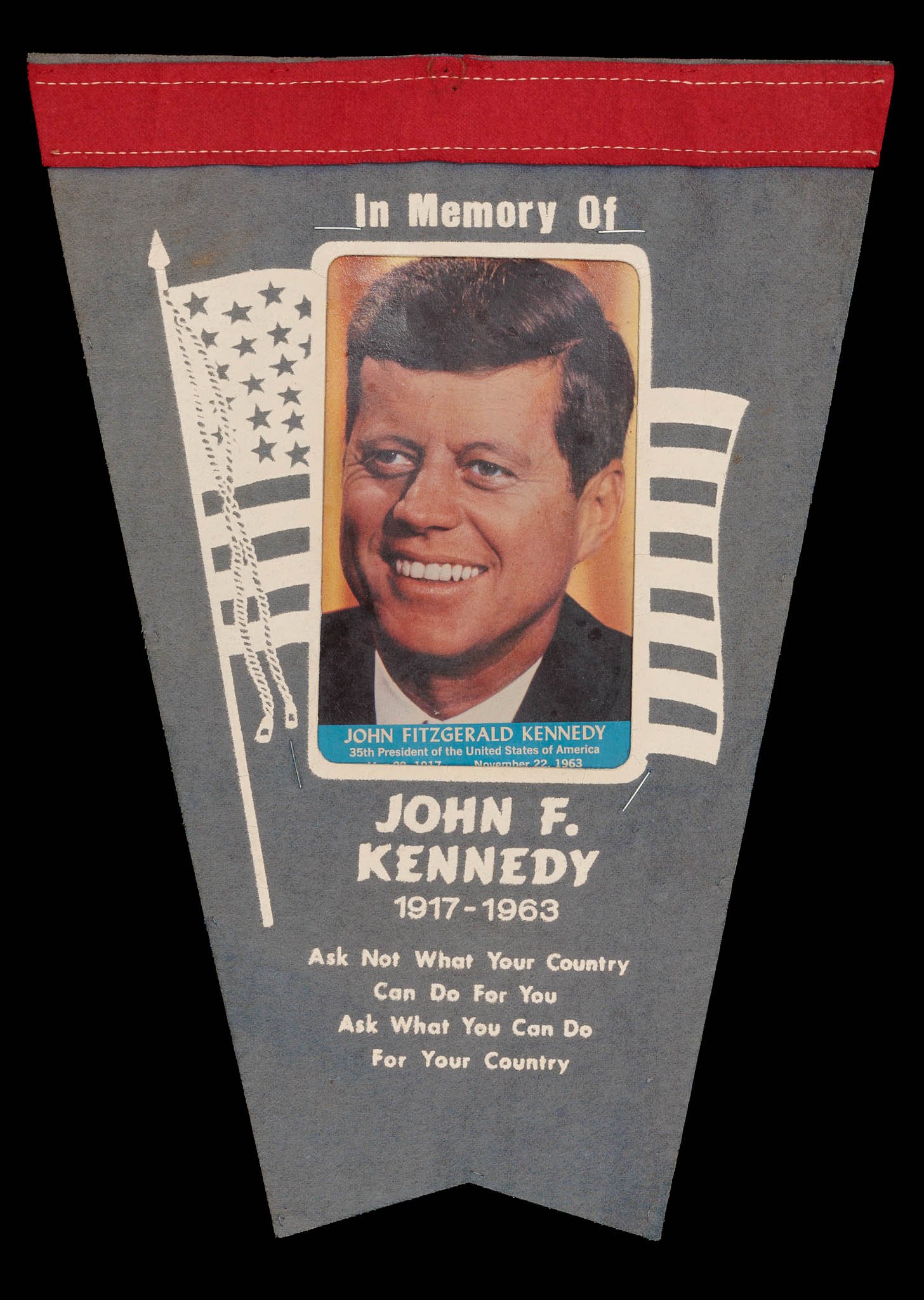
Frame Size (H x L): 20” x 17”
Pennant Size (H x L): 11.5” x 8.5”
Offered is a memorial pennant honoring John F. Kennedy, the 35th President of the United States, produced in the wake of his assassination in 1963. Made primarily of felt, the pennant combines a photographic portrait of Kennedy with patriotic imagery, memorial inscriptions, and words from his inaugural address. The result is an especially graphic example of the enormous body of commemorative material created following his death.
At center is a color portrait of Kennedy, smiling and facing slightly to the viewer's left. Behind the image is a stylized American flag, while the words “In Memory Of” appear prominently above. Below, the pennant identifies “John F. Kennedy, 1917–1963,” followed by the familiar words associated with his presidency: “Ask Not What Your Country Can Do For You / Ask What You Can Do For Your Country.” The red binding across the top provides a strong contrast to the otherwise gray, black, white, and muted-color composition.
The quotation is drawn from Kennedy's inaugural address of January 20, 1961. Near the conclusion of the speech, Kennedy called upon Americans to participate actively in the life of the nation and framed public service as an obligation of citizenship. The passage quickly became one of the most recognizable statements of his presidency, making its inclusion on a memorial object particularly appropriate.
Kennedy entered the White House at age 43 following the closely contested 1960 election and served from January 1961 until his assassination in Dallas, Texas, on November 22, 1963. His administration coincided with an especially consequential period of the Cold War and included the Bay of Pigs invasion, the Cuban Missile Crisis, the creation of the Peace Corps, growing federal involvement in the civil rights struggle, and an expanded national commitment to space exploration. In March 1961, Kennedy established the Peace Corps by executive order, and in May of that year he called for the United States to land a man on the Moon before the decade's end.
Kennedy’s assassination prompted a broad national outpouring of grief and a wide range of memorial objects, including photographs, buttons, banners, and pennants such as this.
This example combines several elements closely associated with Kennedy’s memory: a youthful photographic portrait, patriotic American flag imagery, and the well-known quotation from his inaugural address. Together, they make the pennant a distinctive piece of period presidential memorabilia and a reflection of how Kennedy was commemorated following his death in 1963.
Conservation Process: This pennant was hand sewn to cotton fabric, and both were hand sewn to a mounting board. To prevent the black dye in the cotton fabric from seeping into the pennant, the fabric was first washed in a standard wash and then in a dye setting wash. The pennant is positioned behind Optium Museum Acrylic.
Frame: The pennant is housed in a black frame with deeply stepped molding and a narrow silver-toned inner liner.
Condition Report: The pennant is in very good overall condition, with light surface soiling, minor discoloration, and small areas of wear consistent with age and use. The felt remains well preserved, with strong graphics and lettering, while the applied photographic portrait shows light edge wear and is secured with visible staples. The red top binding remains intact, with only minor waviness and wear.
Collectability Level: The Good – Perfect for Beginning Collectors and Gifts
Date of Origin: 1963
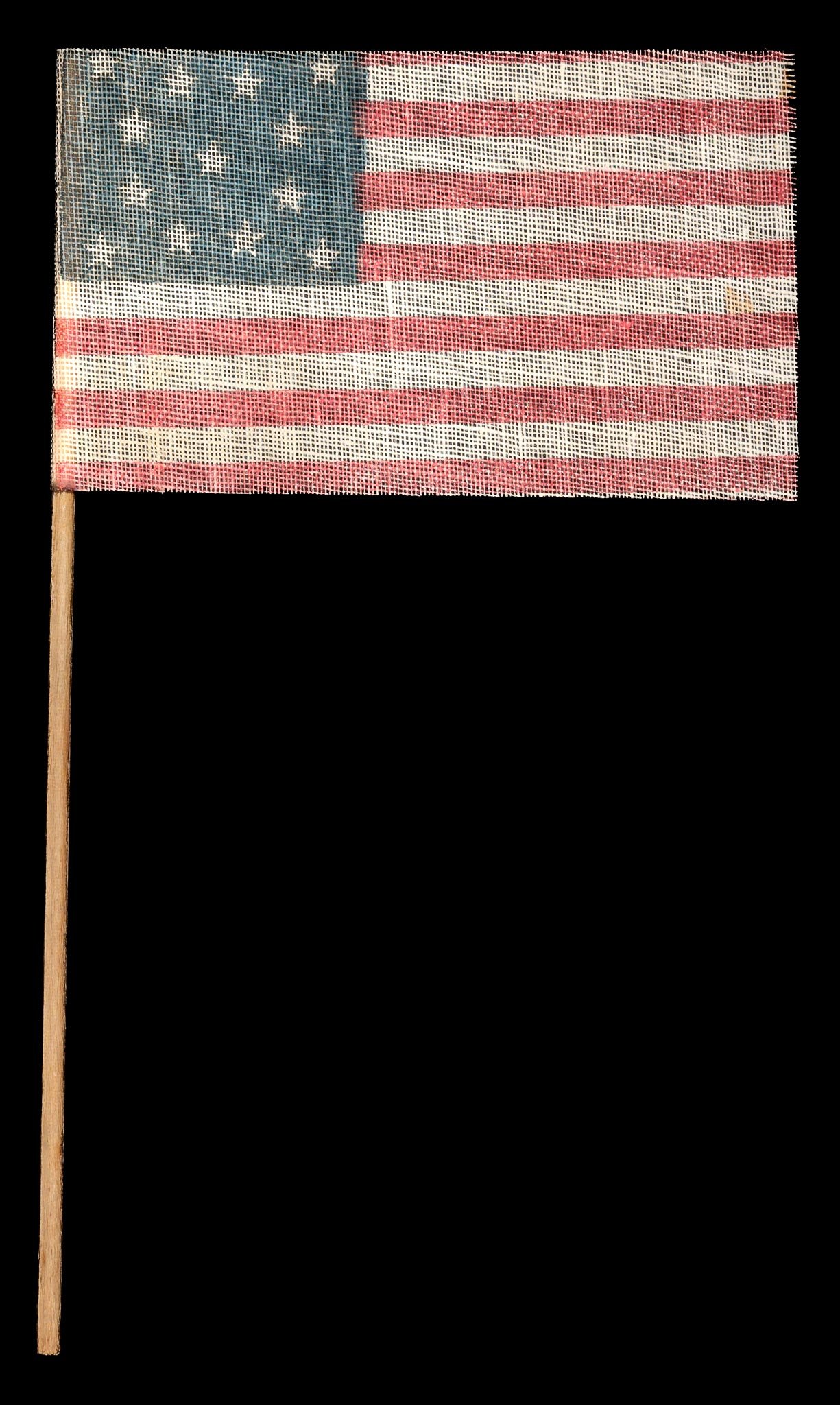
Frame Size (H x L): 13.5” x 10.5”
Flag Size (H x L): 2.5” x 4 and Affixed to a 7” Staff
Offered is a 13-star American parade flag, made for the patriotic celebrations surrounding the United States Centennial of 1876. Printed on plain weave cotton and mounted to its original wooden staff, the flag is characteristic of the small hand-waving flags carried in parades, political gatherings, public ceremonies, and other patriotic events during the latter nineteenth century.
The Centennial represented an extraordinary moment in American history. Just eleven years after the conclusion of the Civil War, the nation celebrated the 100th anniversary of the Declaration of Independence amid an enormous revival of patriotic imagery. Cities and towns throughout the country organized parades, speeches, military demonstrations, fireworks, and public gatherings, while homes, businesses, and civic buildings were decorated extensively in red, white, and blue. American flags—particularly small parade flags such as this example—were among the most visible symbols of the celebration.
The centerpiece of the Centennial year was the Centennial International Exhibition in Philadelphia, the first official world's fair held in the United States. Open from May through November 1876, the exhibition attracted nearly ten million visitors and showcased American industry, technology, art, agriculture, and manufacturing to an international audience. Among its celebrated attractions were the enormous Corliss steam engine that powered much of Machinery Hall and Alexander Graham Bell's recently developed telephone, which was famously demonstrated before exhibition judges.
Although the official flag of the United States during most of the Centennial year contained 37 stars, flag makers were rarely constrained by official star counts. Colorado was admitted to the Union on August 1, 1876, becoming the 38th state and earning its enduring nickname, the “Centennial State.” Anticipating Colorado's admission, manufacturers produced large numbers of 38-star flags before that count formally became official on July 4, 1877.
Alongside the 37- and 38-star flags, however, 13-star flags enjoyed renewed popularity during the Centennial because of their direct association with the nation's founding. Rather than representing the contemporary number of states, the 13 stars recalled the 13 original colonies and the American Revolution. For a country celebrating its first hundred years, the symbolism was especially appropriate, and manufacturers produced 13-star flags in numerous arrangements and sizes for Centennial displays and festivities.
The origins of the 13-star American flag extend to June 14, 1777, when the Continental Congress adopted the first national flag resolution:
“Resolved, That the flag of the thirteen United States be thirteen stripes, alternate red and white; that the union be thirteen stars, white in a blue field, representing a new constellation.”
The precise arrangement of those 13 stars was not specified, resulting in an extraordinary variety of patterns during the early national period. Thirteen remained the official number of stars until Vermont and Kentucky entered the Union and the 15-star flag was adopted in 1795.
Importantly, the 13-star configuration did not disappear as additional states joined the nation. It continued to be employed for practical, naval, commemorative, and patriotic purposes throughout the nineteenth century. Its visual connection to the Revolution made it especially attractive whenever Americans sought to evoke the country's founding generation. Thirteen-star flags consequently appeared during periods of heightened patriotism, including the Mexican War, the Civil War, and celebrations honoring Revolutionary War history.
The return of the Marquis de Lafayette to the United States in 1824 provides an early example of this revival of Revolutionary symbolism. Lafayette, the celebrated French officer who had fought alongside the Americans during the Revolution, was welcomed during an extensive national tour with elaborate parades, banquets, speeches, and public ceremonies. Similar appeals to the imagery of the founding era became increasingly common as the nineteenth century progressed.
That tradition reached its greatest expression with the Centennial in 1876. Few flags could have conveyed the meaning of the occasion more directly than a flag bearing 13 stars: a visual reference to the original states displayed exactly one hundred years after American independence.
Small parade flags from the Centennial period are particularly evocative artifacts because they were intended to be held and waved rather than simply displayed from buildings. Their modest scale, lightweight construction, and wooden staffs allowed thousands of participants and spectators to carry the national colors personally through the parades and celebrations that defined America's 100th anniversary.
This example survives as a wonderful artifact of that period—a miniature American flag whose 13 stars deliberately look backward to the nation's founding while celebrating its first century.
Conservation Process: This flag was hand sewn to cotton fabric, and both were hand sewn to a mounting board. To prevent the black dye in the cotton fabric from seeping into the flag, it was first washed in a standard wash and then in a dye setting wash. The flag is positioned behind Optium Museum Acrylic.
Frame: The flag is presented in an antique marquetry frame with richly figured wood veneers arranged in geometric bands. The layered construction, warm patina, and dark inner molding provide an especially handsome period presentation for the flag.
Condition Report: The flag is in very good condition for its age, retaining strong red and blue coloration with attractive overall fading and toning. There is minor fraying and thread loss along the outer edges, along with scattered small stains and areas of discoloration consistent with age and use.
Collectability Level: The Good – Perfect for Beginning Collectors and Gifts
Date of Origin: 1876
Number of Stars: 13
Associated War: The Indian Wars (1860-1890)
Associated State: Original 13 Colonies
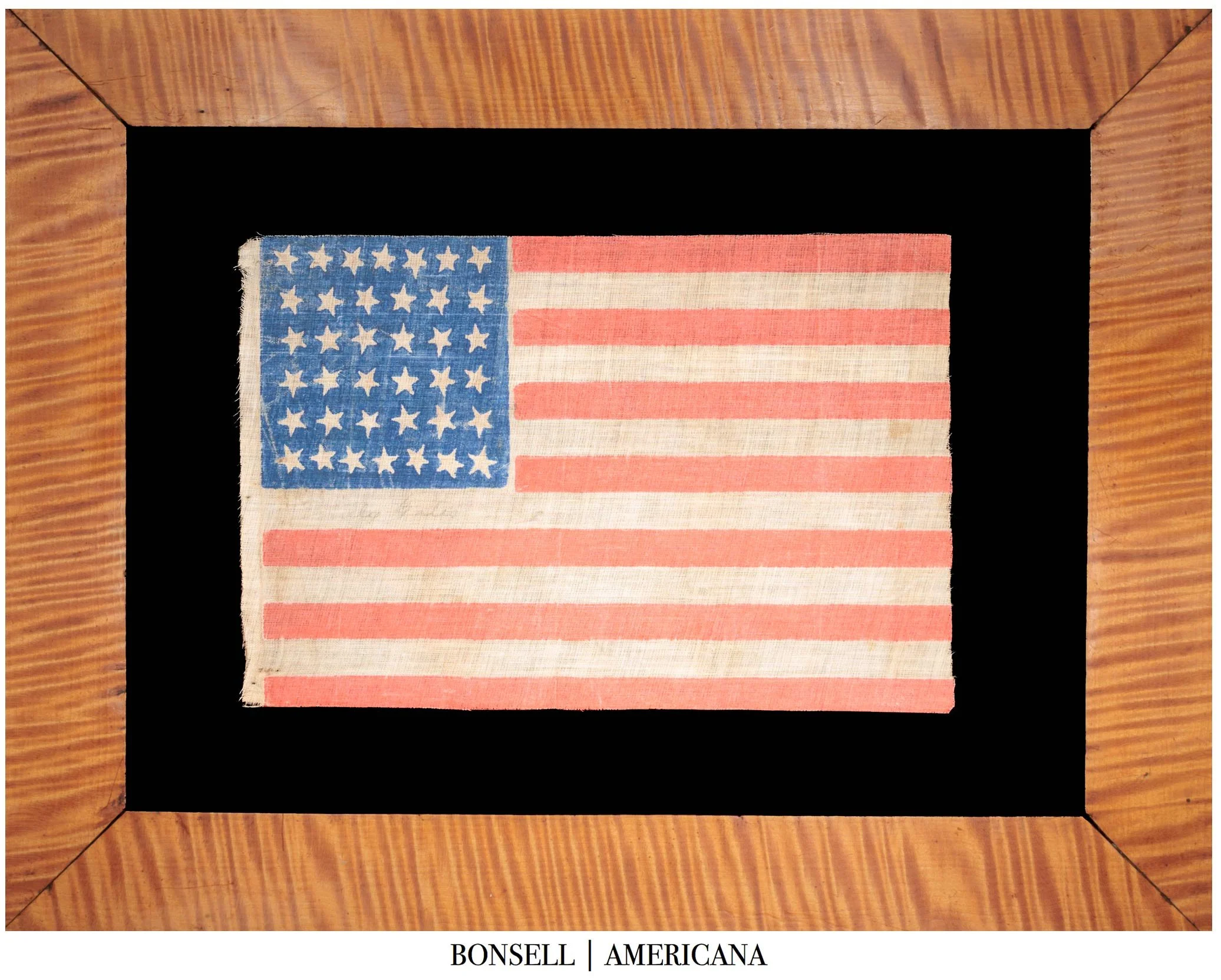
Frame Size (H x L): 13” x 17”
Flag Size (H x L): 6.75” x 10”
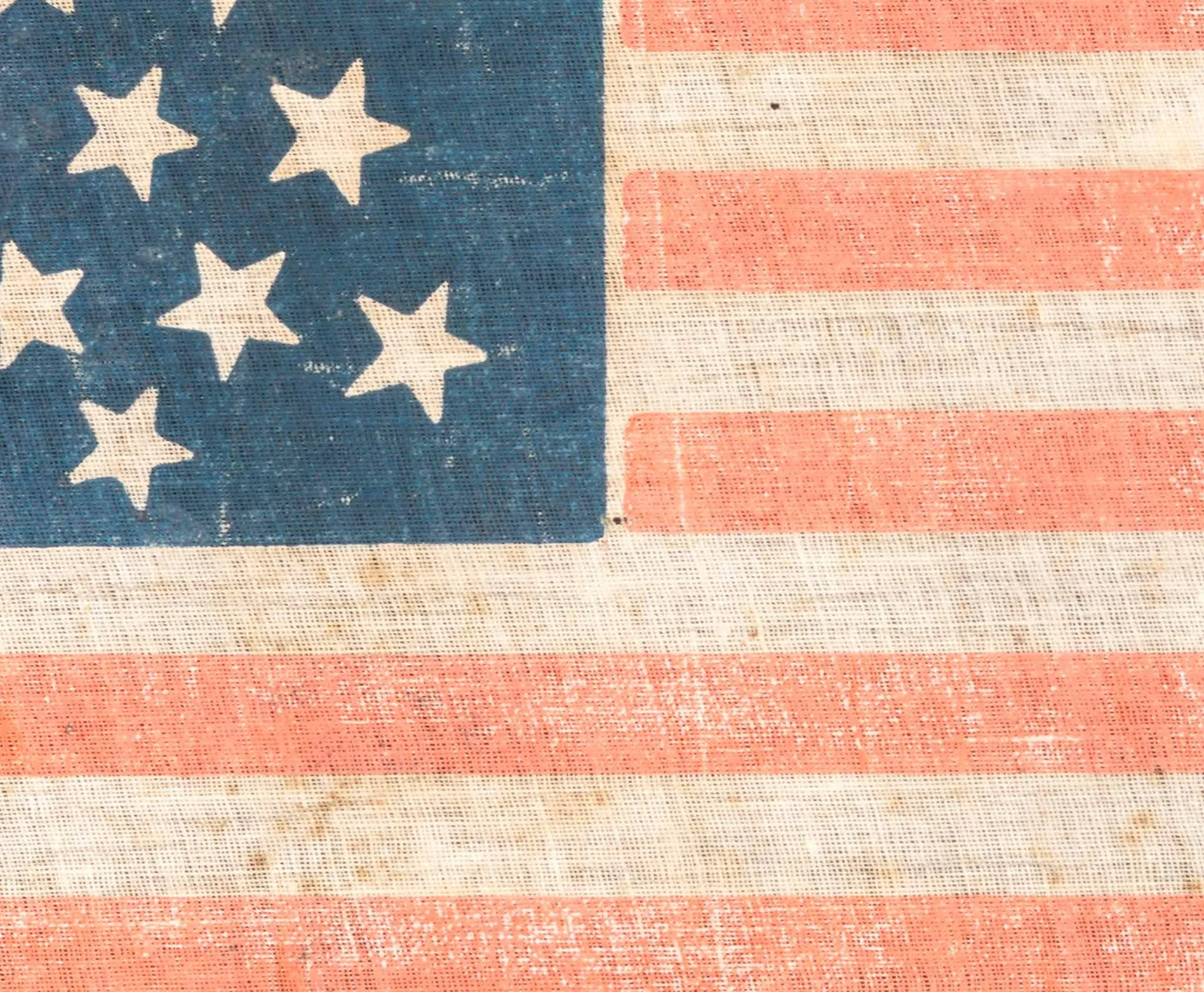
Offered is a 38-star American parade flag, printed on glazed cotton and dating to the period following Colorado’s admission to the Union. The canton displays a 7-6-6-6-6-7 star configuration, with the stars arranged in generally linear rows and oriented in slightly varying directions. The stripes retain a warm orange-red tone, contrasting with the blue canton and giving the flag the characteristic appearance of a 19th-century printed parade flag.
Of particular interest is a period pencil inscription that appears to read “Emily Gates,” written in cursive. Personal inscriptions are occasionally encountered on 19th-century flags and can take the form of names, dates, locations, messages, or other notations. Small parade flags were commonly carried at political rallies, civic parades, veterans’ gatherings, holiday celebrations, and similar events, and inscriptions sometimes served simply to identify the owner.
While the identity of Emily Gates has not been established, the inscription provides evidence of individual ownership or use. This is a meaningful distinction, as the majority of surviving parade flags remain anonymous. The inscription therefore adds a personal element to an otherwise commercially produced patriotic textile.
The 38 stars represent Colorado’s admission to the Union on August 1st, 1876. Colorado became the 38th state just 28 days after the nation’s centennial and consequently became known as the “Centennial State.” The 38-star flag officially became the national standard on July 4th, 1877, in accordance with the established practice of adding new stars on the Independence Day following a state’s admission.
The 38-star flag remained official until July 3rd, 1890. Its period of use coincided with significant national growth, including continued western expansion, railroad development, industrialization, and the post-Reconstruction period. Because Colorado entered the Union during the Centennial year, 38-star flags are also closely associated with the broad wave of patriotic material produced during and immediately after the celebrations of 1876.
The timing of Colorado statehood is important when considering surviving 38-star flags. Flag makers were already producing large quantities of patriotic textiles for the Centennial, and some manufacturers incorporated 38 stars in anticipation of Colorado’s admission or immediately afterward. Other examples were produced throughout the official 1877–1890 period. As a result, the star count can appear on flags made both for Centennial-related use and for later patriotic events.
This example is printed on glazed cotton, a material commonly used for parade flags during the period. Unlike large sewn flags intended for sustained outdoor use, printed parade flags were inexpensive, portable, and suitable for distribution in quantity. They were used at political events, military reunions, civic ceremonies, and public celebrations. Their relatively lightweight construction also meant that many were discarded or damaged, contributing to the scarcity of well-preserved examples today.
The printed surface exhibits the irregularities associated with period production, including slight variation in color saturation and star orientation. The red stripes have mellowed toward a warm orange-red, while the blue canton remains clearly defined. These characteristics are consistent with the pigments, printing methods, and materials used in late-19th-century parade flags.
The combination of a desirable 38-star count, glazed-cotton construction, attractive period coloration, and the handwritten “Emily Gates” inscription makes this a particularly strong example of a late-19th-century American parade flag. The inscription is especially noteworthy, providing a direct indication of personal ownership or use and adding a level of historical context not present on most comparable examples.
Conservation Process: This flag was hand sewn to cotton fabric, and both were hand sewn to a mounting board. To prevent the black dye in the cotton fabric from seeping into the flag, it was first washed in a standard wash and then in a dye setting wash. The flag is positioned behind Optium Museum Acrylic.
Frame: The flag is in an attractive tiger maple frame. Tiger maple frames are cherished for their striking, wavy grain patterns that shimmer with a unique iridescence, reminiscent of a tiger's coat.
Condition Report: The flag is in very good overall condition for its age, with strong, legible colors and no significant losses. There is minor fraying along the perimeter, particularly at the hoist, along with scattered light soiling, staining, and areas of wear consistent with age and use.
Collectability Level: The Great – Perfect for Rising Collectors
Date of Origin: 1876-1890
Number of Stars: 38
Associated War: The Indian Wars (1860-1890)
Associated State: Colorado
Price: Call 618-553-2291, or email info@bonsellamericana.com
Frame Size (H x L): 12” x 14”
Flag Size (H x L): 5.5” x 8”
Offered is a 13-star antique American parade flag, printed on glazed cotton, and exhibiting one of the rarest star configurations found on any 19th-century printed American flag. The 13 stars are arranged to form a large, six-pointed version of the “Great Star” or “Great Luminary” pattern, in which a larger star is created from a constellation of smaller stars.
Great Star flags are highly prized among collectors, but this six-pointed interpretation is far more unusual than the five-pointed versions more commonly encountered in American flag design. The result is both graphic and mysterious: a bold, star-shaped device that immediately distinguishes this flag from nearly all other 13-star parade flags.
Printed parade flags exhibiting this pattern are extremely rare and are known in what we refer to as small, medium, and large varieties. The example offered here is the medium version, measuring approximately 5.5" x 8". Within this scarce family, the medium variety is limited to just four or five known examples, one of which includes a “Lincoln & Hamlin” overprint from Abraham Lincoln’s 1860 presidential campaign.
The flag dates to approximately 1848–1865. The beginning of this date range is based on the early use of printed parade flags in presidential campaigning by 1848, while the latter date corresponds with the conclusion of the Civil War. The rarity of this six-pointed star configuration, together with the flag’s coarse glazed cotton, early printing method, dyes, and the existence of the related Lincoln & Hamlin campaign example, strongly supports a date from the Civil War era or earlier.
The reason for arranging the stars in this six-pointed form is unknown, though two principal explanations are plausible.
As a first theory, the six-pointed star may reference the constellation of stars above the eagle on the Great Seal of the United States. The Great Seal, adopted in 1782, was created to authenticate official documents of the federal government and became one of the nation’s most important symbols. Francis Hopkinson played a key role in designing the Great Seal and has also often been credited as a designer of the United States flag, in contrast to the more familiar but historically debated Betsy Ross tradition. Although original sketches for the stars on the Great Seal were more loosely arranged, the engraver of the original die selected a six-pointed star form, likely influenced by European heraldic convention.
As a second, alternative theory, the configuration may be visually related to the Star of David, also known as the Shield of David. Modern viewers naturally recognize the six-pointed form in that context. The symbol itself dates back centuries and was used historically in decorative, ancestral, and religious contexts, though its widespread adoption as a primary emblem of Jewish identity developed more fully over time. By the 19th century, its use among European Jewish communities had increased, making the association possible within the period of this flag’s manufacture.
That said, the Star of David interpretation should be treated as a possibility rather than a certainty. The six-pointed form may instead have been selected because it was a balanced, visually logical, and highly effective way to arrange 13 stars into one larger star-shaped device. Whatever the maker’s intention, the result is among the most distinctive star patterns known in early American printed flags.
The flag is printed on glazed cotton, a material commonly associated with early parade flags. These small printed flags were inexpensive, portable, and intended for temporary display at political rallies, patriotic events, civic gatherings, and public celebrations. Their survival is often precarious because they were not generally made as permanent objects. The coarse weave, irregular printing, and softened red and blue pigments give this example the surface and character collectors associate with early printed cotton flags.
Prior to the Civil War, private use of the American flag was comparatively limited. Most early parade flags made for the civilian market appear to have been used in political rallies, campaign events, and other public gatherings. The known Lincoln & Hamlin example in this same general style is therefore especially important. It suggests that flags of this pattern were likely produced for political display, even when surviving examples do not bear printed campaign text.
While we may never know whether this flag was intended to reference the Great Seal, the Star of David, another historical source, or simply the most elegant arrangement of 13 stars into a six-pointed device, its importance is clear. It belongs to one of the rarest families of 13-star printed parade flags known to survive. Small in scale but powerful in design, it is an exceptional example for collectors of early American flags, political textiles, and rare patriotic printed cottons.
The original use of the 13-star flag dates to June 14, 1777, when the Continental Congress adopted the first official flag resolution. The resolution stated: “Resolved, that the flag of the United States be made of thirteen stripes, alternate red and white, that the union be thirteen stars, white on a blue field, representing a new constellation.” Thirteen-star flags were official from 1777 until 1795, but they have remained in use throughout American history.
The 13-star count was later used for a wide variety of patriotic, military, political, and commemorative purposes. Small U.S. Navy boats used 13-star flags as ensigns from 1795 until 1916, in part because fewer stars were easier to distinguish at a distance on small flags. Commercial flag-makers mirrored this practice, and some private vessels also flew 13-star flags during the same general period.
Thirteen-star flags were also flown in connection with major patriotic events, including observances following George Washington’s death in 1799, celebrations of the nation’s 50th anniversary in 1824, and public commemorations surrounding General Lafayette’s return to the United States in 1824–1825. Lafayette’s tour inspired celebrations in New York, Boston, Philadelphia, and many other communities throughout the country.
The 13-star flag also carried special meaning during the Mexican War and the Civil War. Both conflicts inspired renewed patriotic display, and during the Civil War especially, the flag became a powerful public symbol of Union, liberty, and national preservation. In that context, the 13-star count deliberately recalled the original colonies and the founding struggle for American independence.
Thirteen-star flags were again widely displayed during the Centennial celebrations of 1876, most notably at the Centennial International Exhibition in Philadelphia. By that time, the 13-star flag had become both a historic emblem and a flexible patriotic device, capable of referring to the Revolution, the Founding generation, national unity, and American endurance.
This example is especially compelling because it combines that historic 13-star symbolism with one of the rarest and most visually arresting star patterns known in early printed American flags. Its small scale, coarse glazed cotton, early printing, and six-pointed Great Star configuration make it a remarkable survivor from the formative period of American political and patriotic display.
Conservation Process: The flag was hand sewn to cotton fabric, and both were hand sewn to a mounting board. To prevent the black dye in the cotton fabric from seeping into the flag, it was first washed in a standard wash and then in a dye setting wash. The flag is positioned behind Optium Museum Acrylic.
Frame: A handsome 19th-century American frame with a rich, dark, hand-finished surface exhibiting pronounced craquelure throughout, indicative of age and original finish. The textured, slightly irregular surface and warm tonality provide a strong visual counterpoint to the textile, enhancing its period presence without distraction.
Condition Report: Condition is very good for an early printed parade flag of this type, with expected oxidation, minor staining, surface soiling, and scattered pigment loss throughout. There is fraying along the perimeter, especially at the fly end and along the top and bottom edges, with small areas of thread separation and fabric loss. A small horizontal tear is present near the fly end. The printed colors remain attractive, with a pleasingly faded red and strong blue canton, and the overall presentation is excellent.
Collectability Level: The Best – Perfect for Advanced Collectors
Date of Origin: 1848-1865
Number of Stars: 13
Associated War: The Civil War (1861-1865)
Associated State: Original 13 Colonies
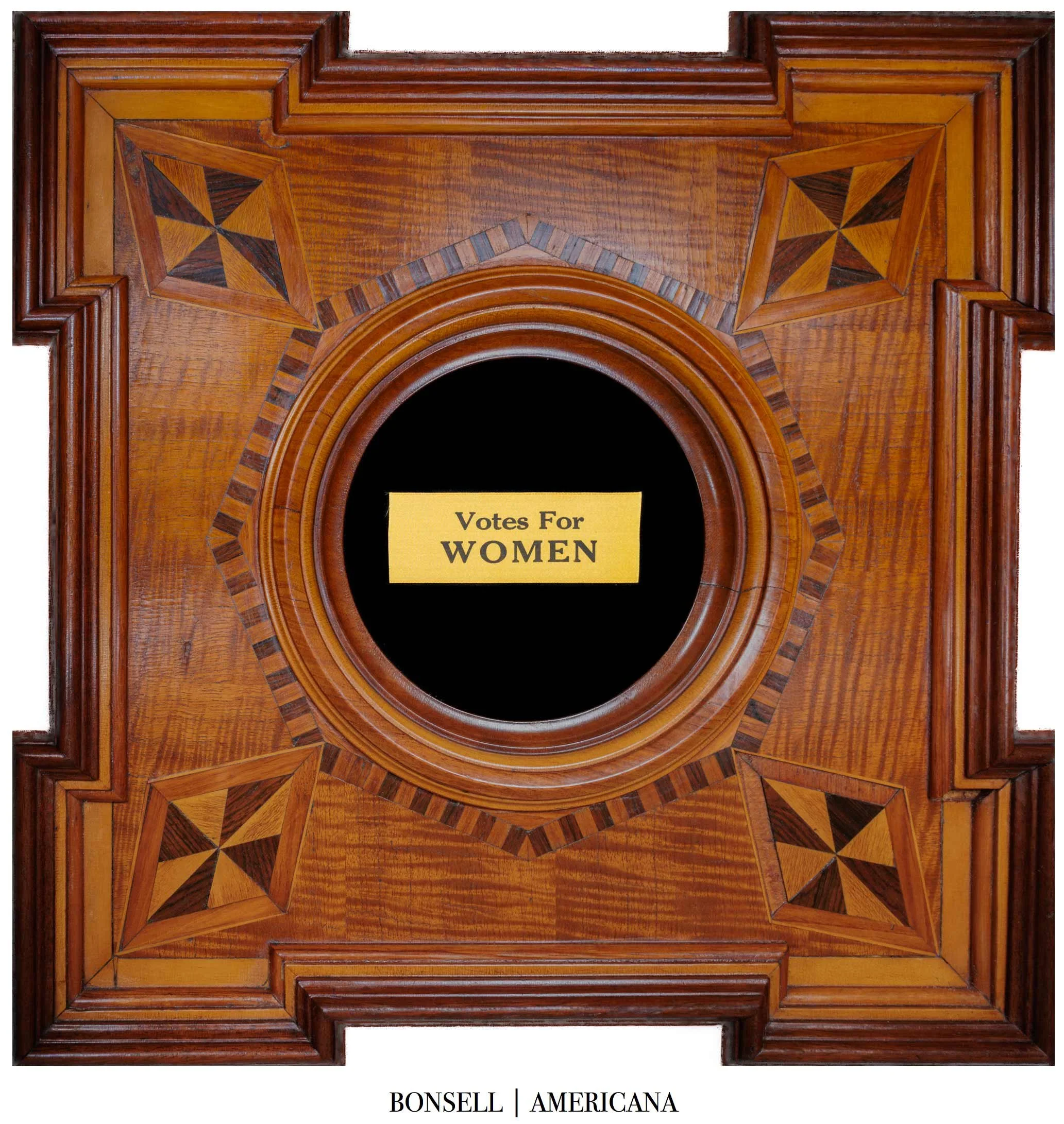
Frame Size (H x L): 17” x 17”
Textile Size (H x L): 1.5” x 3.5”
Offered is a rare “Votes for Women” ribbon. The field is yellow, and the verbiage is in all black caps. Yellow was the primary color in the women’s suffrage movement in the US, and was combined with various other colors, though in most instances was combined with black. In England, violet and green were the primary colors.
In 1848, Lucretia Mott and Elizabeth Cady Stanton organized the first women’s rights convention in Seneca Falls, New York. As a result of this meeting in Stanton’s hometown, the document containing a declaration for women’s suffrage, right to education, and right to employment was drafted. Over the next 50 years, numerous women’s conventions were hosted to bring strength to the movement in masses.
Though initially targeted as a state-by-state movement, it was ultimately recognized that only an amendment to the Constitution would grant all women the right to vote. Amendments were introduced in 1878 and 1914, both of which were defeated. By 1918, both political parties were committed to women’s suffrage, in part based on the major role women played in World War I. As such, in January of 1918 and June of 1919, an amendment was passed by two-thirds majorities in the House and Senate, respectively. On August 18th, 1920, Tennessee became the 36th state to ratify the amendment, giving the two-thirds of state legislators necessary to ratify the amendment. On August 26th, the Nineteenth Amendment became part of the Constitution, and read as follows:
The right of citizens of the United States to vote shall not be denied or abridged by the United States or by any State on account of sex. Congress shall have power to enforce this article by appropriate legislation.
Conservation Process: This ribbon was hand sewn to cotton fabric, and both were hand sewn to a mounting board. To prevent the black dye in the cotton fabric from seeping into the ribbon, it was first washed in a standard wash and then in a dye setting wash. The ribbon is positioned behind Optium Museum Acrylic.
Frame: The frame dates to approximately 1890. It is multi-tiered and made of mahogany, oak, and maple. It is a frame of the highest quality.
Condition Report: This ribbon is in excellent condition.
Collectability Level: The Good – Perfect for Beginning Collectors and Gifts
Date of Origin: 1913-1920
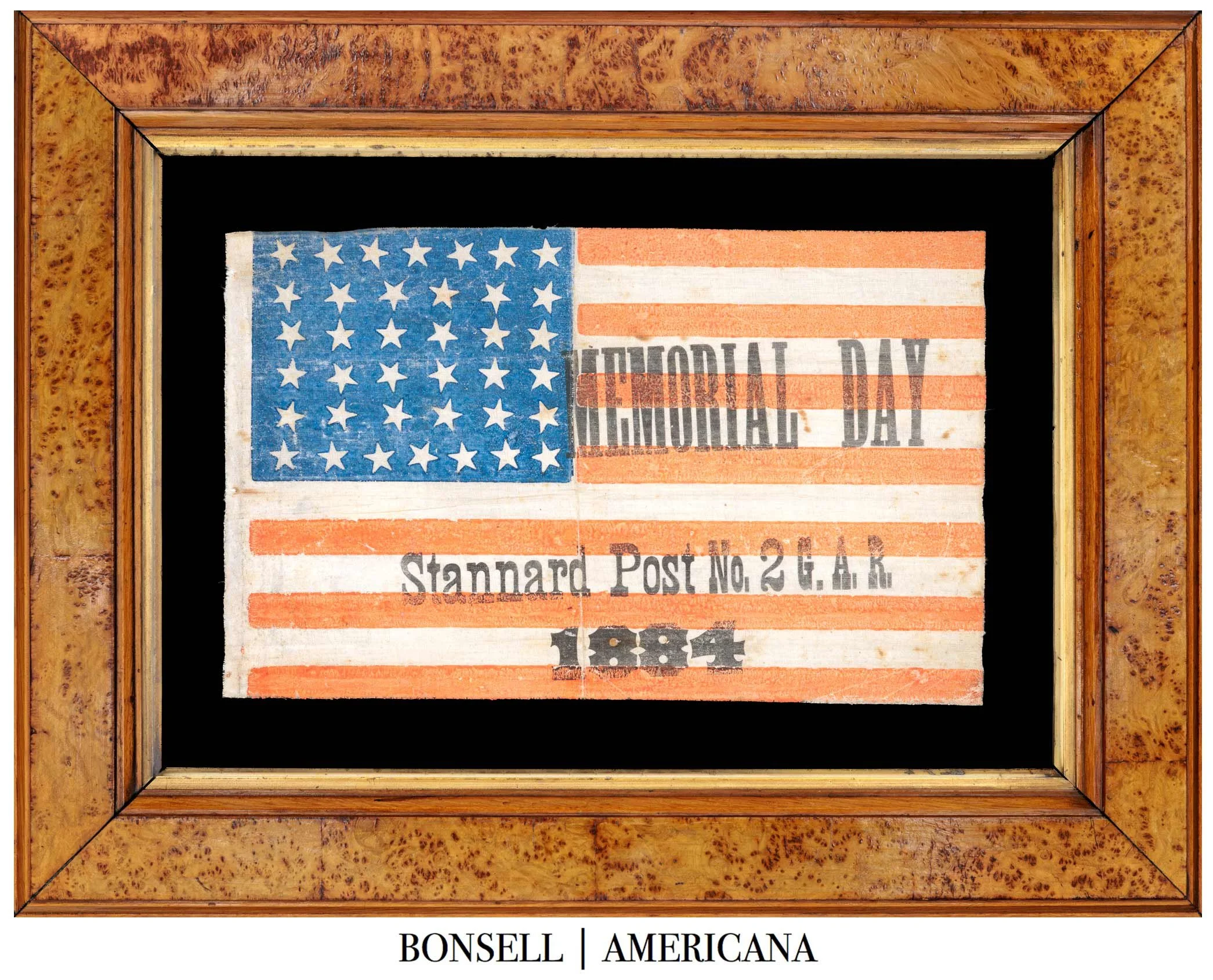
Frame Size (H x L): 16.75” x 22”
Flag Size (H x L): 9” x 14”
Offered is a 38-star American parade flag, printed on glazed cotton and overprinted for MEMORIAL DAY with a secondary, stamped overprint, referencing Stannard Post No. 2 of the Grand Army of the Republic (G.A.R.), dated 1884.
The canton displays a 7-6-6-6-6-7 star configuration, with stars arranged in generally linear rows and canted in varying directions, lending a lively, almost animated quality to the field. The stripes present in a particularly attractive orange-red tone, a result of period pigments and printing techniques, and provide strong visual contrast against the blue canton. Across the striped field appears the boldly applied, all-capital MEMORIAL DAY overprint, printed at a slight angle. The typography is somewhat crude, yet visually compelling, with additional text reading “Stannard Post No. 2 G.A.R.” and the date “1884,” offering the rare advantage of a clearly documented moment of use. This is the first example of this specific overprint and flag that we have encountered.
The presence of the MEMORIAL DAY overprint, combined with the identification of Stannard Post No. 2, firmly anchors this flag within the culture of Civil War remembrance. The Grand Army of the Republic, founded in 1866, was the leading fraternal organization of Union veterans, and its posts were deeply involved in the establishment and perpetuation of Memorial Day observances across the United States. These events were among the most important civic rituals of the late 19th century, involving parades, cemetery ceremonies, speeches, and the decoration of soldiers’ graves. Flags such as this were produced for precisely these occasions, often in limited quantities and for local use, which contributes to their rarity today.
Stannard Post No. 2 was located in Burlington, Vermont, and was named in honor of General George Jerrison Stannard, a Union officer best known for his leadership at the Battle of Gettysburg. The identification of a specific G.A.R. post is particularly desirable, as it ties the object to a defined community of veterans and a known geographic location. Unlike generic patriotic flags, this example was created for a specific group and event, elevating both its historical and interpretive value.
Of further interest is documentary evidence connecting the post to its membership. Period records, including the obituary of Leander W. Freeman, identify him as a member of Stannard Post No. 2. Freeman, an African American veteran who served in Company F of the 54th Massachusetts Colored Volunteers, represents an important and often underrepresented dimension of G.A.R. membership. His presence within the post underscores the degree to which African American veterans participated in these organizations and in Memorial Day observances, particularly in Northern communities. While it cannot be said that this flag was directly associated with Freeman himself, the documented connection between the post and one of its members adds a meaningful layer of human context and historical depth.
The 38 stars on this flag represent Colorado’s admission to the Union on August 1st, 1876. Known as the “Centennial State,” Colorado achieved statehood just 28 days after the nation’s 100th anniversary. Although the 38-star flag did not become official until July 4th, 1877, it remained in use through July 3rd, 1890, spanning a period of westward expansion, industrial growth, and national consolidation following the Civil War. By the date of this flag’s overprint—1884—the star count was fully official and widely produced, placing this example firmly within its proper historical context rather than among earlier anticipatory issues made for the Centennial.
The printing method and material further support an 1880s date. The use of glazed cotton, along with printed application of color, is consistent with parade flags of the period. The slightly irregular saturation of the pigments, especially in the stripes, contributes to the warm, almost burnished appearance that clients find particularly appealing. The overprint reflects the practical realities of such commemorative objects—standard flags customized for local events through secondary application.
Flags with specific Memorial Day overprints tied to named G.A.R. posts are rare, particularly those bearing a clear and early date. The combination of a desirable 38-star count, strong visual presentation, documented year of use, and direct association with a Grand Army post in Burlington makes this an especially compelling example. It stands not only as a patriotic object, but as a tangible artifact of post-war remembrance, community and identity.
Conservation Process: This flag was hand sewn to cotton fabric, and both were hand sewn to a mounting board. To prevent the black dye in the cotton fabric from seeping into the flag, it was first washed in a standard wash and then in a dye setting wash. The flag is positioned behind Optium Museum Acrylic.
Frame: The flag is housed in a handsome antique frame of birdseye maple, displaying dense, highly figured grain with warm, honeyed tones typical of 19th-century examples, likely dating to the mid- to late-1800s. A narrow gilded liner provides a refined inner border. The surface exhibits a naturally aged patina consistent with its period, enhancing its depth and character.
Condition Report: The flag shows moderate overall wear consistent with age and use, including scattered foxing, minor staining, and areas of pigment loss, particularly within the overprint and along the stripes. There is a vertical fold line through the center with associated light fabric breakdown, accompanied by minor fraying and edge wear along the perimeter. Despite these condition issues, the fabric remains stable, with strong visual presentation and legibility of both the star field and the MEMORIAL DAY overprint.
Collectability Level: The Great – Perfect for Rising Collectors
Date of Origin: 1884
Number of Stars: 38
Associated War: The Indian Wars (1860-1890)
Associated State: Colorado
Price: Call 618-553-2291, or email info@bonsellamericana.com
Frame Size (H x L): 13” x 16.5”
Flag Size (H x L): 6.5” x 10”
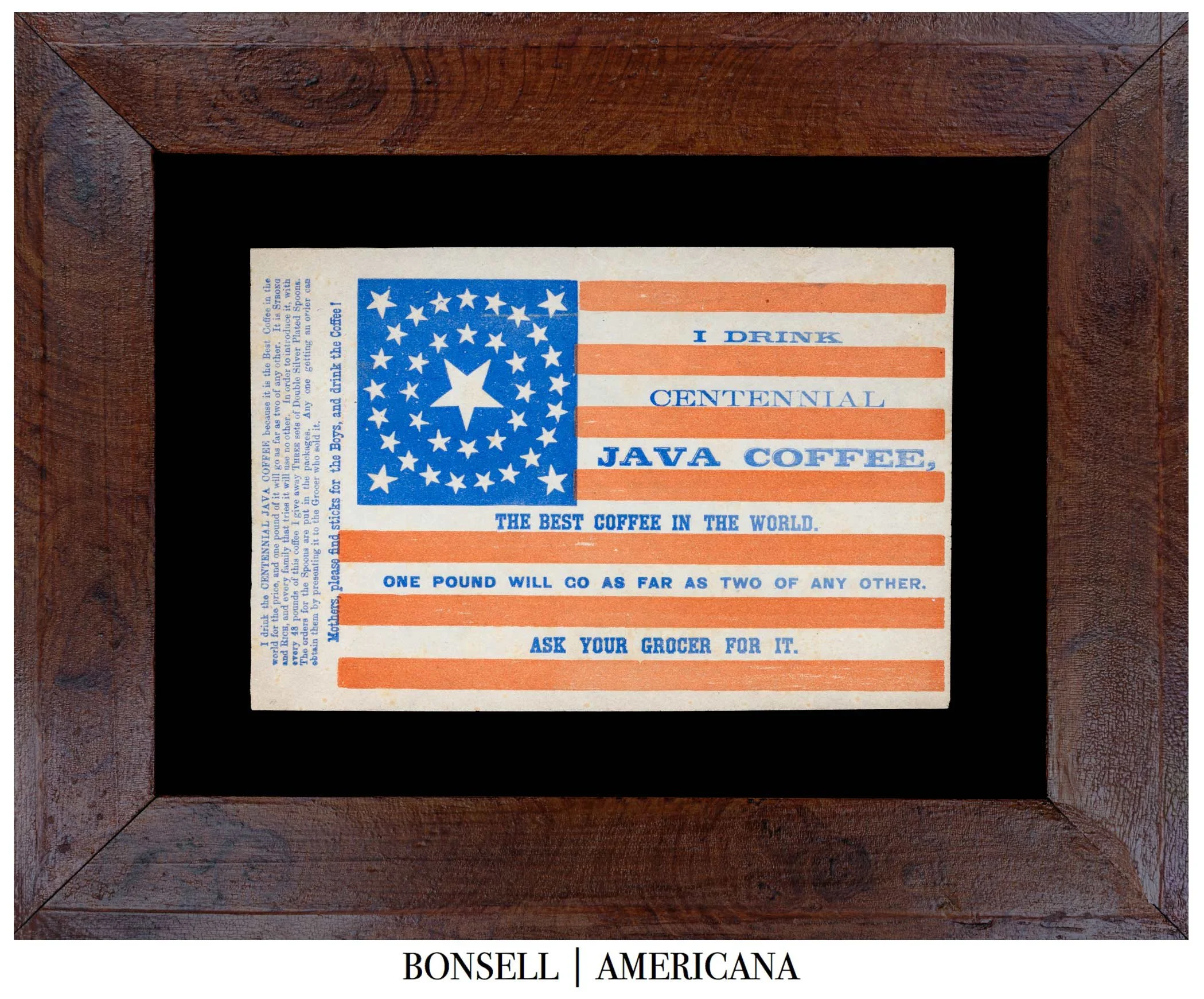
Offered is a rare and visually striking 38-star American flag trade flag, produced in the Centennial era and featuring an extensive advertising overprint for “CENTENNIAL JAVA COFFEE.” Printed on paper in an unusually large format measuring approximately 6.5 by 10 inches—roughly double the size of most surviving trade cards—this example occupies a compelling space between traditional advertising ephemera and a hand-held parade flag.
The canton displays a highly graphic and well-balanced medallion configuration, composed of a single, oversized center star surrounded by two concentric rings of smaller stars, with four additional flanking stars completing the count of thirty-eight. The inner ring contains 12 stars, while the outer ring presents 21, forming a bold and symmetrical arrangement that is both visually dynamic and carefully structured. The large center star serves as a strong focal point within the design and may be interpreted as an intentional visual emphasis on Colorado, the 38th state.
The overprint is exceptional in both scale and execution. Spanning the stripes in varying typefaces, it reads: “I DRINK CENTENNIAL JAVA COFFEE, THE BEST COFFEE IN THE WORLD. ONE POUND WILL GO AS FAR AS TWO OF ANY OTHER. ASK YOUR GROCER FOR IT.” The typography shifts from line to line, creating a layered and energetic visual rhythm that enhances the overall composition. Along the hoist, a vertical block of text further promotes the quality of the product, while an additional vertical instruction—directed to mothers—encourages the mounting of the flag on a stick for children to wave. This directive provides clear evidence that the piece was intended for active use as a hand-held display, rather than passive advertising alone.
The coloration is equally noteworthy. The red stripes, rendered in a distinctly orange-red tone, provide vivid contrast against the blue canton and contribute to the flag’s strong visual presence. Combined with the bold overprint and varied typography, the result is an unusually lively and engaging piece of printed Americana.
The broader context of this object is further enriched by period concerns surrounding the quality and purity of coffee. Late 19th-century reports on food adulteration reveal that a significant portion of commercially available ground coffee was diluted with roasted grains, legumes, and chicory. Within this environment, claims such as “ONE POUND WILL GO AS FAR AS TWO OF ANY OTHER” take on added meaning, functioning not merely as advertising rhetoric but as a direct appeal to consumers wary of inferior or adulterated products. Contemporary documentation even records “CENTENNIAL JAVA” among branded coffees in circulation, reinforcing the authenticity of the marketing language employed here.
The convergence of Centennial-era patriotism with commercial promotion is executed at an unusually high level in this 38-star example, both graphically and conceptually. Its large format, dynamic medallion star configuration, extensive overprint, and clear evidence of intended use as a parade flag combine to set it apart from more typical trade cards. Examples of this scale and visual impact are seldom encountered, and this is the first of this specific design that we have handled. Simply put, it ranks among the most compelling and visually engaging 19th-century American flag trade flags to surface.
The 38 stars on this flag represent Colorado’s admission to the Union on August 1st, 1876. Known as the “Centennial State,” Colorado earned its nickname for achieving statehood just 28 days after the nation’s centennial celebrations. Colorado’s journey to statehood began with the establishment of the Colorado Territory in 1861, spurred by the Pike’s Peak Gold Rush, which brought a wave of settlers to the region. Early statehood efforts faced setbacks, including a veto by President Andrew Johnson in the 1860s, but a renewed push in the mid-1870s culminated in Colorado’s official entry as the 38th state following Congress’s passage of an enabling act.
Although the 38-star flag did not become official until July 4th, 1877, flag makers frequently produced anticipatory examples ahead of such changes. These flags played a prominent role during the centennial celebrations of 1876, alongside revival designs featuring thirteen stars to commemorate the original colonies. The Centennial year was a watershed moment for the United States, fostering a renewed sense of patriotism and unity after the divisions of the Civil War. Communities across the nation adorned homes, businesses, and public spaces with red, white, and blue decorations, and flags became the centerpiece of this outpouring of national pride.
The Centennial International Exposition in Philadelphia was the highlight of these celebrations, attracting nearly ten million visitors between May and November of 1876. This world’s fair showcased American ingenuity on a grand scale, with notable exhibits including the Corliss Steam Engine and Alexander Graham Bell’s telephone, which would go on to revolutionize communication.
The 38-star flag officially served from July 4th, 1877, to July 4th, 1890, during which it flew over the administrations of Presidents Rutherford B. Hayes, James A. Garfield, Chester A. Arthur, Grover Cleveland, and Benjamin Harrison. This flag represented a nation growing both geographically and industrially. Colorado’s statehood symbolized the United States’ expansion westward, driven by mining booms, railroad construction, and the development of new settlements.
In 1890, the addition of five new states—North Dakota, South Dakota, Montana, Washington, and Idaho—necessitated a redesign, and the 43- star flag replaced the 38-star version. Despite its relatively short tenure, the 38-star flag remains a prized artifact, celebrated for its vibrant medallion designs and its connection to the Centennial year—a defining moment in American history when the nation reflected on its first century and welcomed Colorado as a symbol of progress and unity.
Frame: Housed in a beautiful American frame dating to circa 1840, crafted in hand-painted faux bois to simulate richly grained, knotty light mahogany. The surface displays exceptional graining with a warm, nuanced finish that complements the flag without overpowering it. The profile and early construction lend an appropriate sense of age and authenticity, enhancing the overall presentation.
Condition Report: The flag has been professionally conserved by a paper conservator, resulting in stable overall condition. There is moderate, even toning to the paper, accompanied by scattered foxing and minor surface soiling consistent with age. Evidence of prior handling is present in the form of minor edge wear, none of which detracts from the strong visual presentation. The printed imagery and overprint remain bold and highly legible throughout.
Collectability Level: The Extraordinary – Museum Quality Offerings
Date of Origin: 1860-1890
Associated War: The Indian Wars (1860-1890)
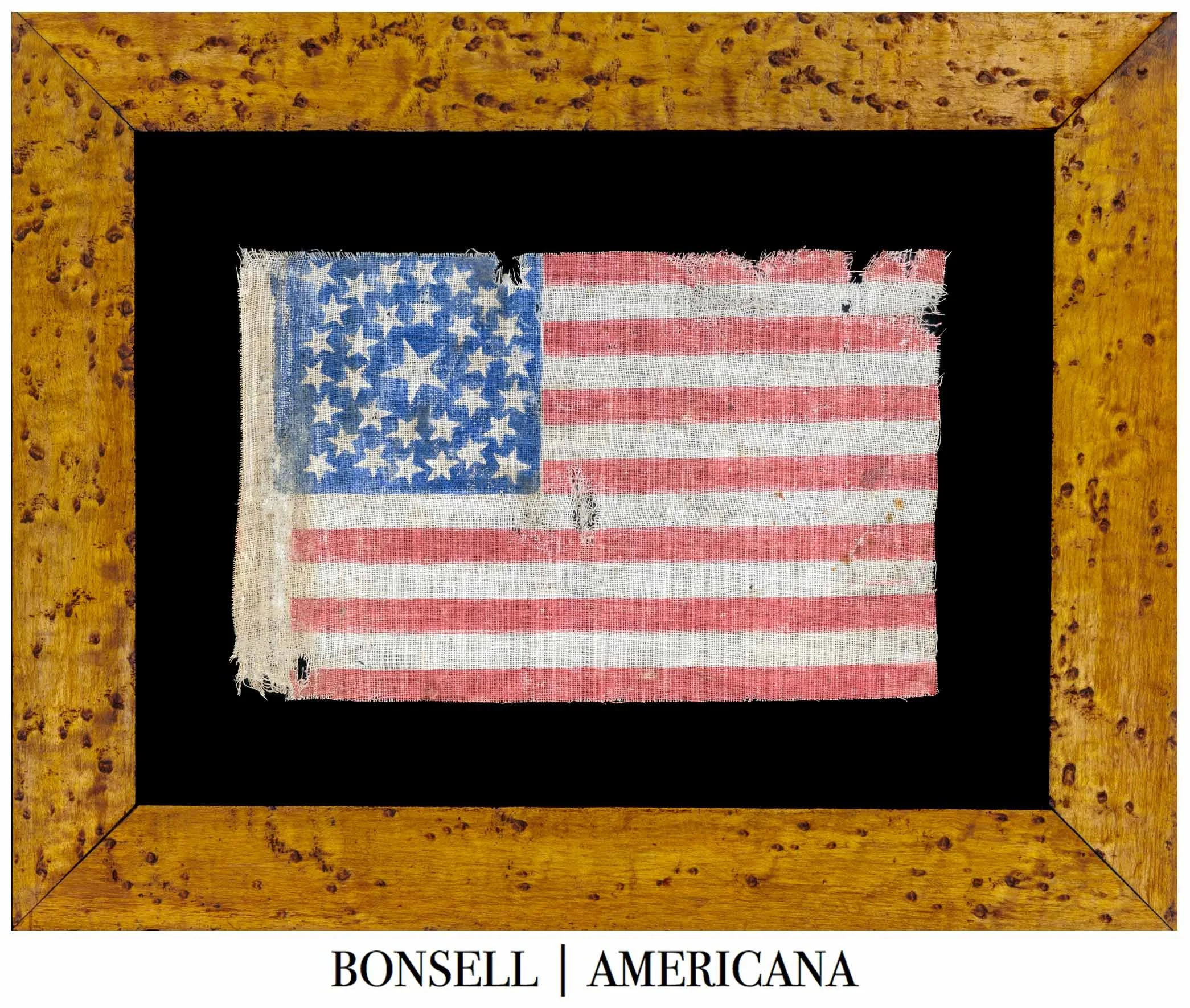
Frame Size (H x L): 12” x 15”
Flag Size (H x L): 6” x 9”
Offered is a 33-star American national flag, printed on glazed cotton and executed in a highly distinctive medallion-style star configuration. At the center of the canton is a single, oversized “center star,” canted to approximately the 11:00 position. This center star is widely understood to represent the most recently admitted state—Oregon in the case of the 33-star flag. Surrounding the center star are two concentric rings of smaller stars, with four additional stars positioned in the corners of the canton, completing the design.
The stars are notably pointy and irregular in form, lending the flag a distinctly folksy, hand-rendered appearance. They are tightly packed within the canton, a visual characteristic emblematic of a small and well-recognized family of mid-19th-century printed flags. Although the maker of this example remains unidentified, the star shapes, spacing, and overall layout are consistent across a limited group of flags known to have originated from the same workshop.
This workshop is documented to have produced flags in 6 different star counts, all sharing the same stylistic vocabulary: 7-star, 13-star, 15-star, 29-star, 33-star, and 35-star examples. Each star count corresponds to a specific historical or commemorative purpose. Flags with 7 stars acknowledged the first seven states to secede from the Union; 13-star flags referenced the original colonies; 15-star flags commemorated Kentucky’s centennial; and the 29-star, 33-star, and 35-star flags celebrated the admission of Iowa, Oregon, and West Virginia, respectively. The recurrence of this design across multiple star counts suggests a commercially oriented maker responding quickly to current events and prevailing public sentiment.
The 33-star flag represents the admission of Oregon, which became the 33rd state on February 14, 1859. In accordance with federal law, the star count was updated on the following Independence Day, making July 4, 1859, the official beginning of the 33-star flag’s period of use. It remained the official national flag until July 4, 1861, when the 34-star flag—reflecting the admission of Kansas—was formally adopted.
The historical timing of the 33-star flag is particularly significant. Its official period of use overlaps directly with the secession crisis and the opening months of the Civil War. At the time the 33-star flag became official, multiple Southern states had already left the Union, yet no stars were ever removed from the flag. As a result, the 33-star flag represents a Union that was legally intact but politically fractured—an important and meaningful distinction for collectors.
This association is underscored by a notable historical reference: a 33-star flag was flying at Fort Sumter when Confederate forces launched their attack in April of 1861. Because of this, the 33-star flag is among the earliest star counts directly tied to the Civil War and is often regarded as a visual symbol of the nation on the brink of armed conflict.
Although the 33-star flag was officially replaced in July of 1861, it continued to be used well into the Civil War. Wartime supply constraints meant that existing flags remained in service, and manufacturers did not immediately discard earlier printing blocks or designs. As a result, 33-star flags are documented in both pre-war and early-war contexts, adding to their historical depth and complexity.
From a broader collecting perspective, flags from the Civil War era are among the most sought-after of all antique American flags. Prior to the late 1850s, flags were not commonly displayed by civilians for patriotic purposes, and even military use was relatively limited. Earlier flags were typically produced for maritime identification and were often very large in scale. The mass production of smaller, affordable flags—intended for rallies, political events, and personal display—emerged with the election of Abraham Lincoln and accelerated rapidly with the onset of the Civil War. The 33-star flag sits squarely at the beginning of this transformation.
Taken as a whole, the 33-star flag occupies a uniquely compelling position in the history of American national flags. It represents the Union at a moment of profound tension—legally whole, yet politically fractured—while also marking the transition from large, utilitarian flags to smaller examples made expressly for public display and personal expression. Combined with its association with the opening chapter of the Civil War, its relatively brief official lifespan, and the bold medallion-style configuration seen here, the 33-star flag stands among the most historically resonant and visually distinctive star counts available to collectors today.
Conservation Process: This flag was hand sewn to cotton fabric, and both were hand sewn to a mounting board. To prevent the black dye in the cotton fabric from seeping into the flag, it was first washed in a standard wash and then in a dye setting wash. The flag is positioned behind Optium Museum Acrylic.
Frame: The flag is housed in a solid birdseye maple frame, chosen for its warm tone and distinctive figured grain. Its restrained profile provides a clean, complementary presentation without distracting from the flag itself.
Condition Report: The flag presents with expected wear consistent with age and use, including overall fabric softening, light surface soiling, and moderate fraying along the edges. There is a small area of fabric loss and a short vertical tear within the striped field, accompanied by scattered minor holes and thread loss elsewhere. Despite these condition issues, the flag remains stable, visually compelling, and well suited for display.
Collectability Level: The Great – Perfect for Rising Collectors
Date of Origin: 1859-1861
Number of Stars: 33
Associated War: Pre-Civil War
Associated State: Oregon
Frame Size (H x L): 9.5” x 13”
Flag Size (H x L): 4.5” x 7.5”
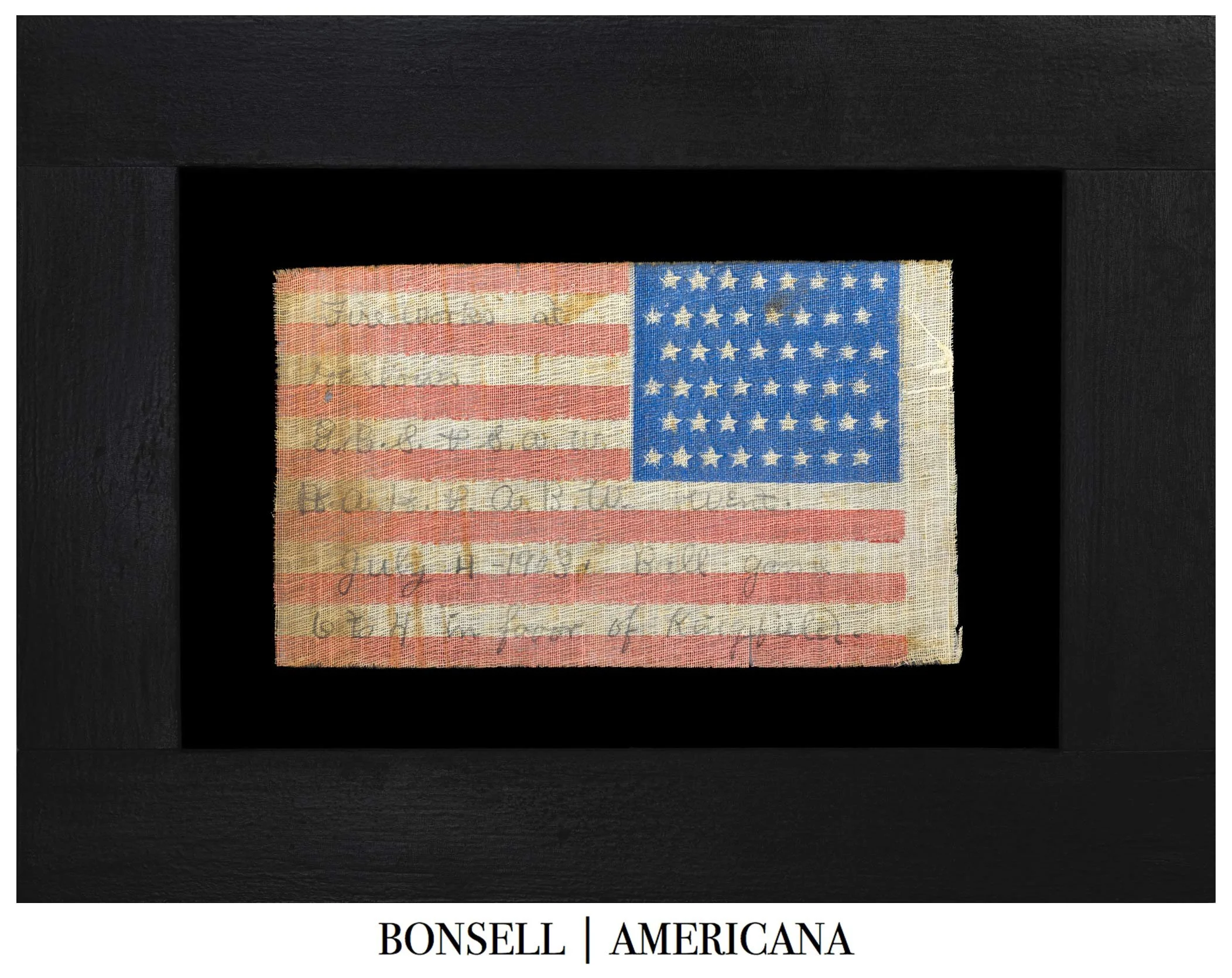
Offered is a 48-star American parade flag, printed on glazed cotton, notable for its early, non-regulated star arrangement and for the presence of handwritten inscriptions that record a specific Independence Day celebration. In addition to its patriotic function, this flag preserves contemporaneous written details relating to a local baseball game and Fourth of July festivities.
The handwritten inscriptions appear on both sides of the 48-star flag and are central to its significance. One side records the setting, participants, and date of the celebration, while the other reiterates the date and game details. Because portions of the writing are faint and partially obscured, the inscriptions are transcribed here verbatim so that the historical information is fully accessible.
The inscription on the side shown reads as follows:
Fireworks at
Harlows
G.B.S. & S.A.W.
H.A.H. & A.B.W. Went
July 4, 1903. Ball game
6 to 4 in favor of Kingfield.
The inscription on the other side reads as follows:
July 4, 1903.
H.A.H.
Ball game between Lexington &
Kingfield, 6 to 4 in favor of Kingfield.
Together, these inscriptions anchor the 48-star flag to a Fourth of July celebration in 1903 in western Maine. The named towns—Kingfield and Lexington—were neighboring rural communities, and holiday baseball games between such towns were a common feature of Independence Day observances at the turn of the twentieth century. These games were typically informal and locally organized, often accompanied by picnics and fireworks and held on private farms or open land rather than at formal municipal venues. The reference to “Harlows” is consistent with this practice and appears to denote a locally known family property used as the gathering site.
The recorded score—six to four in favor of Kingfield—suggests local pride and firsthand participation. A series of initials appears on both sides of the flag (G.B.S., S.A.W., H.A.H., and A.B.W.). While their specific identities remain unknown, such initials are typical of informal, personal inscriptions of the period and likely reference individuals present at, or involved in, the day’s events.
The 48-star count is anticipatory. This flag dates to 1903, nearly a decade before the 48-star flag became official on July 4, 1912, following the admission of New Mexico and Arizona earlier that year. In the late nineteenth and early twentieth centuries, American flag makers regularly anticipated future state admissions and produced flags reflecting projected star counts well in advance of official adoption. As a result, 48-star flags are known from the 1890s onward, long before the configuration was formally recognized.
Prior to June 24, 1912—when President Taft issued Executive Order 1556—there were no federal specifications governing star arrangement or flag proportions. Flag makers were free to arrange the stars within the canton as they saw fit, and proportions varied widely. Many early 48-star flags therefore display staggered or offset star patterns and elongated formats, characteristics present in this example and consistent with its early date of manufacture. Exact shades of red, white, and blue were likewise unregulated until 1934.
The 48-star flag holds a uniquely long and consequential place in American history. It became official on July 4, 1912, and remained the national flag for forty-seven years, until July 4, 1959, when Alaska prompted the adoption of the 49-star flag. During this extended period of use, the United States experienced many of the defining events of the twentieth century, including World War I, World War II, and the Korean War, all fought under the 48-star flag. Eight U.S. presidents served while it was the official national emblem, and for many Americans it became the flag most closely associated with the country’s emergence as a global power.
Seen in this light, the presence of a 48-star flag at a small-town Fourth of July celebration in 1903 feels notably forward-looking. Long before the star count became official—and decades before it would fly during some of the nation’s most consequential moments—this flag was already in use as part of everyday civic life, carried and written upon by ordinary Americans marking a summer holiday with baseball and fireworks.
Importantly, this is the exact 48-star flag illustrated and discussed in The Stars and Stripes: Fabric of the American Spirit by J. Richard Pierce. Pierce is widely regarded as one of the foremost private collectors and scholars of American parade flags, and his collection—formed over decades—has served as the basis for exhibitions and scholarship at major institutions. Inclusion in his work places this flag within a rigorously studied and well-documented corpus of American textiles.
The flag is also referenced in a published article in Antiques & The Arts and was publicly exhibited as part of The Stars and Stripes: Fabric of the American Spirit, including exhibitions at Hancock Shaker Village and Morven Museum & Garden. These references establish the flag as a documented and exhibited example.
Taken together, the anticipatory 48-star count, early production characteristics, precise date, named towns, recorded score, handwritten inscriptions, and published exhibition history place this flag within the broader context of American flag-making, early baseball culture, and Independence Day traditions at the turn of the twentieth century.
Conservation Process: This flag was hand sewn to cotton fabric, and both were hand sewn to a mounting board. To prevent the black dye in the cotton fabric from seeping into the flag, it was first washed in a standard wash and then in a dye setting wash. The flag is positioned behind Optium Museum Acrylic.
Frame: The flag is housed in an early frame with a dry black surface, dating to approximately the 1840s. The frame is constructed from four straight lengths of molding joined at the corners rather than mitred, a method associated with utilitarian framing practices of the period.
Condition Report: The flag presents with honest wear consistent with age and use. There is a small hole near the fly end, located beneath the handwritten reference to Harlows, as well as a small vertical tear between the letters “g” and “f” in “Kingfield.” Additional minor fading and surface wear are present throughout, but the flag remains stable, legible, and visually appealing, with the inscriptions and star field clearly intact.
Collectability Level: The Great – Perfect for Rising Collectors
Date of Origin: 1903
Number of Stars: 48
Associated War: WWI, WWII, and Korean War
Associated State: Arizona
Frame Size (H x L): 14.5” x 18.5”
Flag Size (H x L): 8.75” x 10.5”
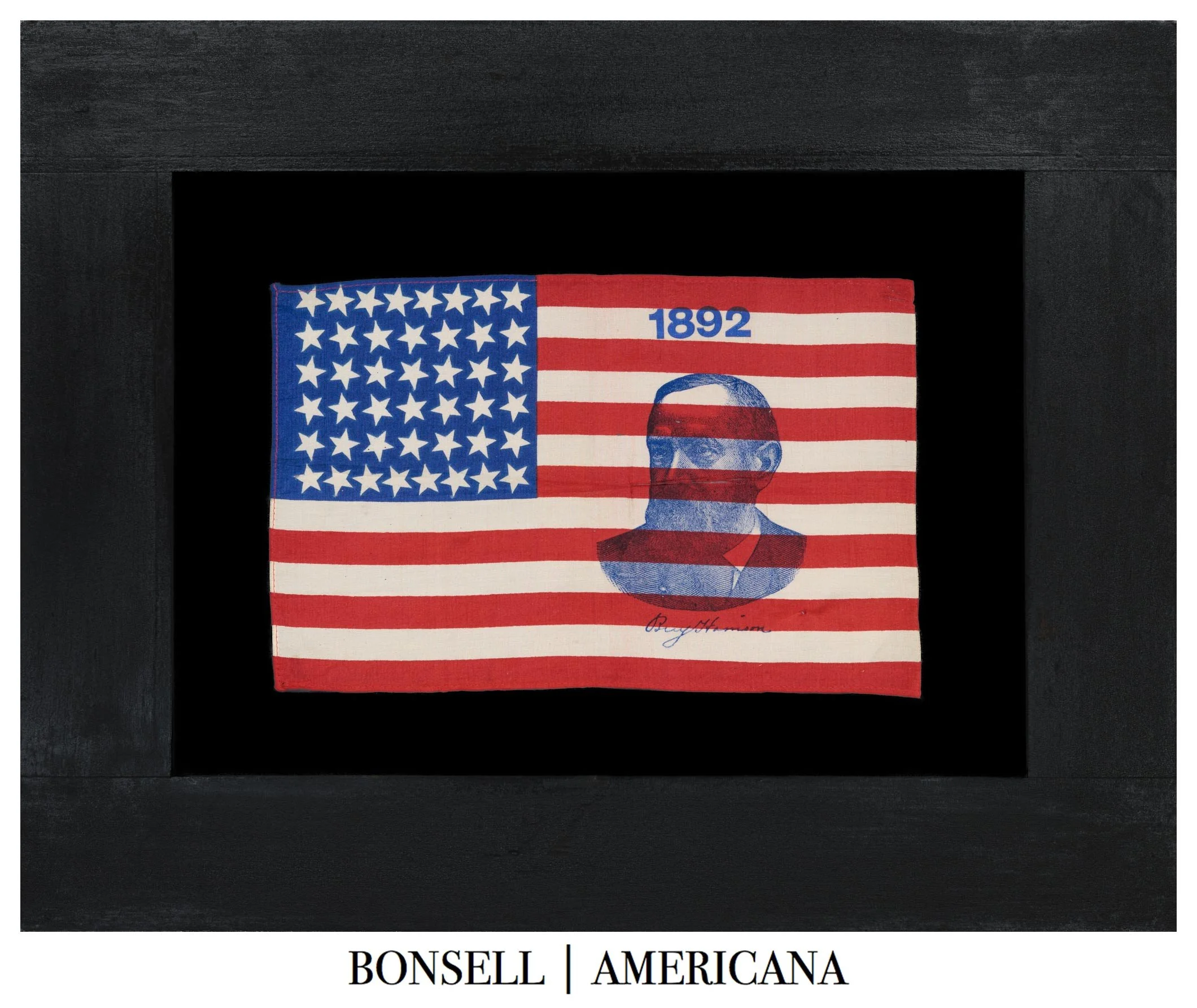
Offered is a 44-star American silk parade flag produced for the presidential election of 1892 and overprinted with a portrait of Republican candidate Benjamin Harrison, along with a facsimile of his signature and the campaign year, “1892.”
Printed on silk and intended for parade or public display, this flag represents a documented form of late-19th-century political ephemera that integrates national symbolism, portrait imagery, and campaign identification within a single textile. The canton contains forty-four white stars arranged in regular rows on a blue field, corresponding to the official star count following Wyoming’s admission to the Union in 1890. Harrison’s portrait is printed directly across the striped field, visually linking the candidate to the national flag in a manner consistent with campaign display practices of the period.
The portrait used on this flag is derived from a painted likeness by Eastman Johnson, executed circa 1889 and associated with the National Portrait Gallery. Johnson was a prominent American artist of the 19th century, and the use of his painted portrait as the basis for campaign imagery reflects a common practice of adapting established presidential likenesses for political ephemera. The source of the portrait confirms that the image was not a generic engraving but one grounded in an officially recognized representation of the candidate.
This Harrison portrait flag is documented in authoritative reference works on American political textiles and is represented in major institutional collections. An example of this flag is held by the Smithsonian Institution, within its Division of Political History. Additional examples are documented in the Pierce Collection, one of the most significant private collections of American parade flags and political cloth. The appearance of this flag in both institutional and private reference contexts establishes it as a recognized campaign type rather than an isolated or undocumented variant.
The underlying 44-star silk flag used for this Harrison example was manufactured as a standardized base and later adapted through overprinting. The same base flag was also used for the 1892 Democratic campaign of Grover Cleveland, substituting Cleveland’s portrait and signature while retaining the identical star field and stripe layout. Outside of politics, this flag format appears with other period overprints, including a commemorative example marking the one-hundredth performance of actor John Drew, as well as a salesman’s sample intended to demonstrate advertising possibilities on parade flags. These related examples illustrate the commercial practices of late-19th-century flag makers, who produced high-quality patriotic textiles that could be customized for different clients and purposes.
A notable feature of the Harrison and Cleveland campaign flags is the method of overprinting. Unlike most political parade flags of the era, which were typically overprinted in black ink after the base flag was produced, the portrait and text on this flag were printed in blue ink matching that of the canton. This approach results in a unified visual treatment and distinguishes this group of flags from more common black-overprinted campaign examples.
The election of 1892 provides relevant historical context for this flag. It marked a rematch between incumbent president Benjamin Harrison and former president Grover Cleveland, following Cleveland’s defeat in 1888. The campaign centered on economic policy and tariffs, and Cleveland’s victory made him the only president in U.S. history to serve two non-consecutive terms. Campaign materials from this election reflect a period in which political messaging increasingly relied on mass-produced visual objects intended for public display.
Silk parade flags from the 19th century survive in limited numbers due to the inherent fragility of the material and their intended use. This example remains a clear and legible representation of a documented 1892 campaign design, supported by reference literature and institutional comparators. Its silk construction, identifiable portrait source, and established place within a known family of related flags make it a representative example of American political textiles from the late 19th century.
Conservation Process: The flag was hand sewn to cotton fabric, and both were hand sewn to a mounting board. To prevent the black dye in the cotton fabric from seeping into the flag, it was first washed in a standard wash and then in a dye setting wash. The flag is positioned behind Optium Museum Acrylic.
Frame: The flag is housed in an early frame with a dry black surface, dating to approximately the 1840s. The frame is constructed from four straight lengths of molding joined at the corners rather than mitred, a method associated with utilitarian framing practices of the period.
Condition Report: The silk shows expected age-related wear, including a few small holes. There is a horizontal tear that begins just to the left of Harrison’s portrait at approximately nose level and extends toward the ear. Despite these condition issues, the textile remains stable, attractive, and visually cohesive.
Collectability Level: The Great – Perfect for Rising Collectors
Date of Origin: 1892
Number of Stars: 44
Associated State: Wyoming
Frame Size (H x L): 23” x 17”
Flag Size (H x L): 17” x 11”
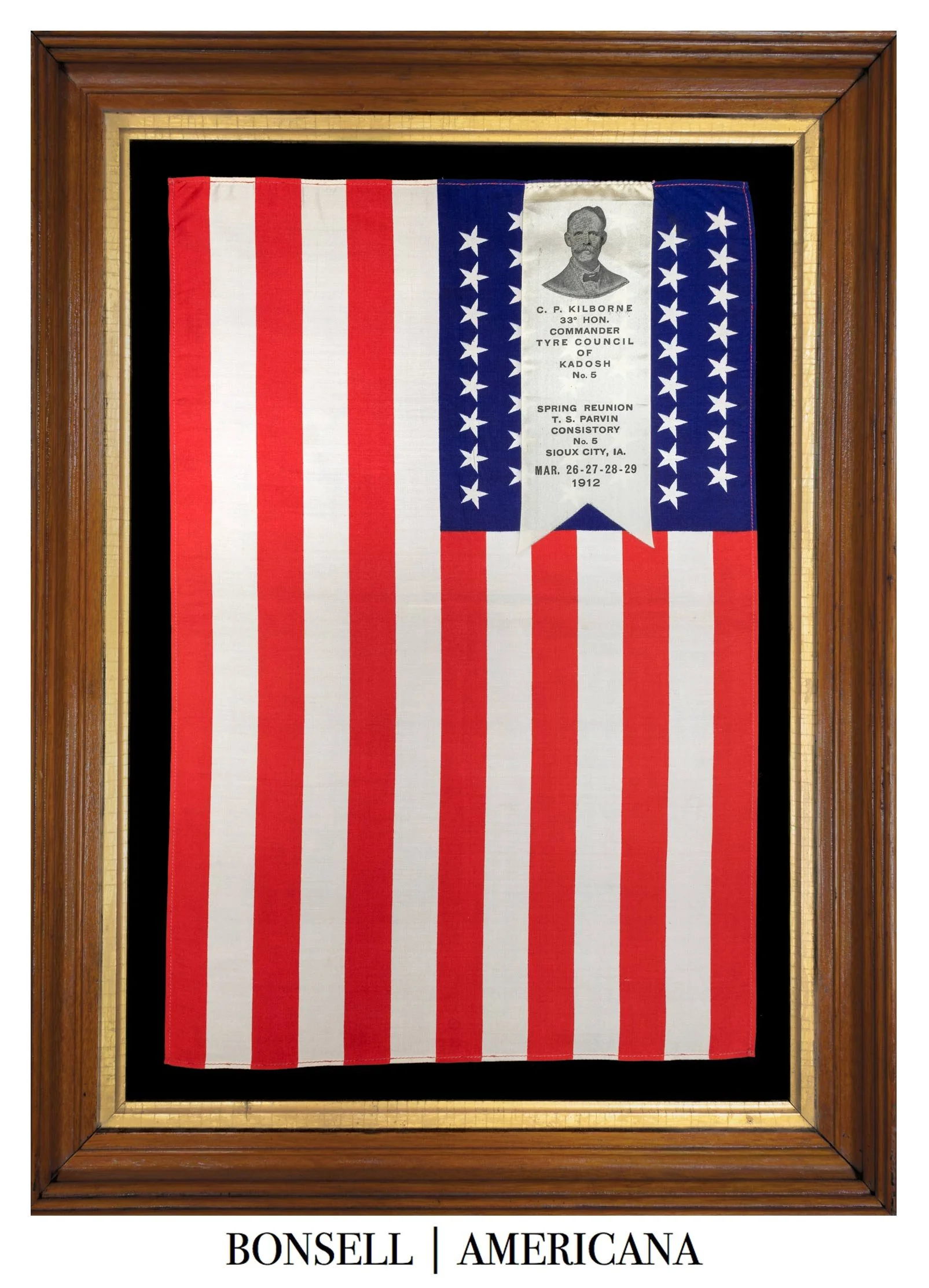
Offered is an unusual forty-eight star antique flag with a Freemason ribbon sewn thereto. Both are made of silk. This is one of the first flags that we have encountered with a ribbon, and the very first that we have encountered with a ribbon sewn across its canton. We consider this a great feature, as it looks very unusual and gives a solid provenance to the flag. The ribbon includes the following overprint:
C.P. KILBORNE
33⁰ HON.
COMMANDER
TYRE COUNCIL
OF
KADOSH
No. 5
SPRING REUNION
T.S. PARVIN
CONSISTORY
No. 5
SIOUX CITY, IA.
MAR. 26-27-28-29
1912
The forty-eight star flag represents the inclusion of New Mexico and Arizona to the Union. New Mexico was admitted on January 6th, 1912, and Arizona was admitted on February 14th, 1912. The forty-eight star flag became official on July 4th, 1912. Presidents Taft, Wilson, Harding, Coolidge, Hoover, Roosevelt, Truman, and Eisenhower all served under this flag. World Wars I and II, and the Korean War were all fought under it.
Until 1912, flag makers were free to arrange the stars on a flag’s canton in any manner they liked. For example, this flag has a staggered star pattern, in that the rows are laterally offset relative to one another. However, on June 24th, 1912, President Taft issued Executive Order 1556, specifying that the star arrangement on forty-eight star flags should be a rectilinear 8-8-8-8-8-8 pattern. It also specified the proportions of forty-eight star flags.
Because flag makers had a great deal of freedom in how they made flags prior to this Executive Order, many forty-eight star flags do not have a linear and horizontal arrangement, particularly those made in the late 19th century and into the teens (i.e., up to WWI). We note the 19th century, because many antique flags are anticipatory in nature. Flag makers would regularly anticipate how many states would be added, and when they would be added. By the late 1890s, flag makers began anticipating and offering a forty-eight star flag. To support this notion, many antique flags have been shown in early photographs dating to the 1890s, or include 1890s dates printed directly thereon.
The forty-eight star flag was official for forty-seven years up until July 4th, 1959, the time at which the forty-nine star flag became official and began to represent the inclusion of Alaska in the Union.
Conservation Process: This flag was hand sewn to cotton fabric, and both were hand sewn to a mounting board. To prevent the black dye in the cotton fabric from seeping into the flag, it was first washed in a standard wash and then in a dye setting wash. The flag is positioned behind Conservation Clear Acrylic (standard) or behind Optium Museum Acrylic (per request).
Frame: The antique frame dates to between 1900 and 1920.
Condition Report: The flag and ribbon are in fantastic condition and extremely vibrant.
Collectability Level: The Good – Perfect for Beginning Collectors and Gifts
Date of Origin: 1912
Number of Stars: 48
Associated State: Arizona

Frame Size (H x L): 20” x 16”
Flag Size (H x L): 4.5” x 6” and Affixed to a 10” Staff
Offered is a forty-five star parade flag with a fantastic overprint of the following:
SMOKER
GIVEN TO THE MEN OF THE
NORTH ATLANTIC SQUADRON
By the Citizens of Pensacola, Florida
APRIL 14, 1903
As shown in the attached photograph and newspaper article, the North Atlantic Squadron (later renamed the North Atlantic Fleet) docked in Pensacola, and a social event (i.e., a smoker) was held between the men of the Squadron and the citizens of Pensacola. Among those in attendance was Francis J. Higginson, who was an officer in the US Navy during the Civil War and the Spanish-American War. He was the last commander in chief of the North Atlantic Fleet.
Overprints on flags come in a variety of forms, and are most frequently encountered in flags dating to between 1860 and 1910. This overprinted flag is among the best that we have ever encountered, both for its form and rarity. In terms of form, it is a great because of its varying fonts and sizes, its centering over the entire width of the flag, and its subject matter. In terms of rarity, this is only version of this flag that we have ever encountered, and it is reasonable to assume that very few (if any) others have survived.
The stars appear to be arranged in an 8-7-8-7-8-7 pattern. The canton of the flag is a beautiful cornflower blue, and its stripes are a deep red. The First Flag Act of 1777 specified the number of stripes and the colors of the flag, but did not specify the exact shades of each color, which is why some flags—like this one—have unusual colors. The exact shades were not officially specified until 1934.
The forty-five star flag represents the inclusion of Utah to the Union. Utah was admitted on January 4th, 1896, and this flag became official on July 4th, 1896. Presidents Grover Cleveland, William McKinley, and Teddy Roosevelt served under this flag, and the Spanish-American War was fought under it.
In 1848 Utah became a territory of the United States, and in 1849 its constitution was established as the Mormon State of Deseret. The next year, the State of Deseret applied to become a state, but Congress rejected the application and changed its name to the Utah Territory, which included the entirety of Nevada and portions of Colorado and Wyoming (as a section of the Missouri Compromise). Despite its continued efforts to gain statehood, it remained a territory, partially as a result of the Mormon Church and Utah authorities being openly tolerant of polygamy. In 1890 Utah outlawed the practice, and in 1896 Utah finally became the forty-fifth state. The forty-five star flag was official for 12 years up until July 4th, 1908, when the forty-six star flag became official and began to represent the inclusion of Oklahoma in the Union.
Conservation Process: This flag was hand sewn to cotton fabric, and both were hand sewn to a mounting board. To prevent the black dye in the cotton fabric from seeping into the flag, it was first washed in a standard wash and then in a dye setting wash. The flag is positioned behind Conservation Clear Acrylic (standard) or behind Optium Museum Acrylic (per request).
Frame: The frame dates to between 1860 and 1890, and includes a gold liner and extensive decorating.
Condition Report: This flag has some minor staining and some fading. There is some minor fraying along the bottom of the flag. Many collectors prefer flags that show their use and age.
Collectability Level: The Great – Perfect for Rising Collectors
Date of Origin: 1903
Number of Stars: 45
Associated War: Spanish-American War (1898)
Associated State: Utah

Price: Call 618-553-2291, or email info@bonsellamericana.com
Frame Size (H x L): 12.5” x 19.5”
Flag Size (H x L): 7” x 12”
Offered is a 46-star flag printed on silk, displaying a vibrant blue canton and deep red stripes. The stars are arranged in an 8-7-8-8-7-8 lineal configuration. Those in the first, third, fourth, and sixth rows tilt slightly to the 11:00 position, while those in the second and fifth rows tilt toward 1:00, creating the subtle movement often seen in printed silk parade flags.
The flag features an overprint across the lower white stripes. An overprint is text applied directly to the surface of an existing flag—either the canton or stripes—and appears most frequently on cotton, silk, or paper parade flags produced between roughly 1860 and the early 1900s. Overprints were used for political campaigns, fraternal organizations, civic events, commercial promotions, and historical anniversaries. The text on this example, printed across the bottom three white stripes, reads:
ONE HUNDREDTH ANNIVERSARY CELEBRATION OF THE
BIRTHDAY OF ABRAHAM LINCOLN, FEBRUARY 12, 1909
LINCOLN PARK CHAPTER, No. 177, R.A.M.
The text marks the centennial of Abraham Lincoln’s birth. Born February 12, 1809, in Hardin County, Kentucky, Lincoln spent his early years on Sinking Spring Farm and Knob Creek. His father, Thomas Lincoln—a carpenter and farmer—faced repeated land-title disputes, a common challenge in early Kentucky. These difficulties, along with clearer property laws in the Indiana Territory, led the family to relocate there in 1814. It was in Indiana that Lincoln’s formative years unfolded, shaped by manual labor, limited schooling, and exposure to frontier legal and social conditions.
By 1909, Lincoln had long been established as a central figure in American history, and the centennial of his birth was widely observed. States formed official commissions; cities organized parades, exhibitions, school programs, and public addresses; and numerous organizations produced commemorative items such as medals, badges, banners, and printed textiles. These efforts reflected the period’s interest in national memory and civic instruction.
The issuing body identified on this flag—the Lincoln Park Chapter No. 177 of the Royal Arch Masons—participated in Chicago’s local centennial activities. Royal Arch Masonry, part of the broader Masonic tradition, emphasized moral instruction, civic engagement, and charitable work. Fraternal organizations played a significant role in public life in the early 20th century, often sponsoring patriotic events and distributing commemorative materials. Overprinting a 46-star flag for the Lincoln Centennial was consistent with national practice, in which existing patriotic forms were adapted to mark historical anniversaries.
The 46-star count represents the admission of Oklahoma to the Union. Oklahoma became a state on November 16, 1907, and the 46-star flag became official on July 4, 1908, following the federal rule that new stars appear on Independence Day after admission. The region’s path to statehood was complex. Indian Territory had been established as a destination for tribes removed from the Southeast, including the Cherokee, Chickasaw, Choctaw, Creek, and Seminole. Under the Dawes Act and related legislation, tribal lands were allotted to individuals, and large “surplus” tracts were opened to non-Native settlement. The Indian Appropriations Act of 1889 authorized the first major opening of these lands and led to the Oklahoma Land Rush. Those who entered early came to be known as “Sooners,” a term later associated with the state.
Population growth, rail expansion, and federal policy ultimately led to the consolidation of Oklahoma Territory and Indian Territory into a single state. Although the 46-star flag became official in 1908, manufacturers prepared for statehood in advance, producing 46-star designs prior to formal adoption—a widespread practice in the flag trade.
The 46-star flag flew during the presidencies of Theodore Roosevelt and William Howard Taft. Its period of official use was short, ending on July 4, 1912, when the 48-star flag superseded it after the admission of New Mexico and Arizona. The brief lifespan of the 46-star flag, combined with transitional national conditions at the time, contributes to its relative scarcity among parade flags of the period.
Overprinted 46-star parade flags are rarer still. Overprinting required an additional production step, was commonly done for a single event or organization, and these flags were typically used in outdoor processions where loss and damage were common. When paired with a specific Lincoln Centennial reference and a clear issuing chapter, the result is a well-documented and desirable example. Few 46-star parade flags survive with fraternal overprints of this type, and fewer still in the level of condition seen here.
Another example of this particular flag is highlighted in Richard Pierce’s collection and featured in a full page photo on page 56 of his book, the Stars and Stripes: Fabric of the American Spirit. Pierce has been collecting American parade flags since 1991, and has one of the leading collections thereof.
Conservation Process: This flag was hand sewn to cotton fabric, and both were hand sewn to a mounting board. To prevent the black dye in the cotton fabric from seeping into the flag, it was first washed in a standard wash and then in a dye setting wash. The flag is positioned behind Optium Museum Acrylic.
Frame: The flag is housed in an antique ripple-molded frame dating to the mid-19th century. The surface exhibits a dark, burnished finish with characteristic undulating contours that catch light and emphasize the period workmanship.
Condition Report: The flag survives in outstanding condition, with strong, saturated colors and exceptionally well-preserved silk. The overprint remains crisp and clear, and the fabric shows only minimal, age-appropriate handling. Overall, it is an unusually fine example when compared to most surviving 46-star parade flags of this period.
Collectability Level: The Best – Perfect for Advanced Collectors
Date of Origin: 1909
Number of Stars: 46
Associated State: Oklahoma
Price: Call 618-553-2291, or email info@bonsellamericana.com
Frame Size (H x L): 16.75” x 12.75”
Flag Size (H x L): 5.5” x 6.75” and Affixed to a 10.5” Staff
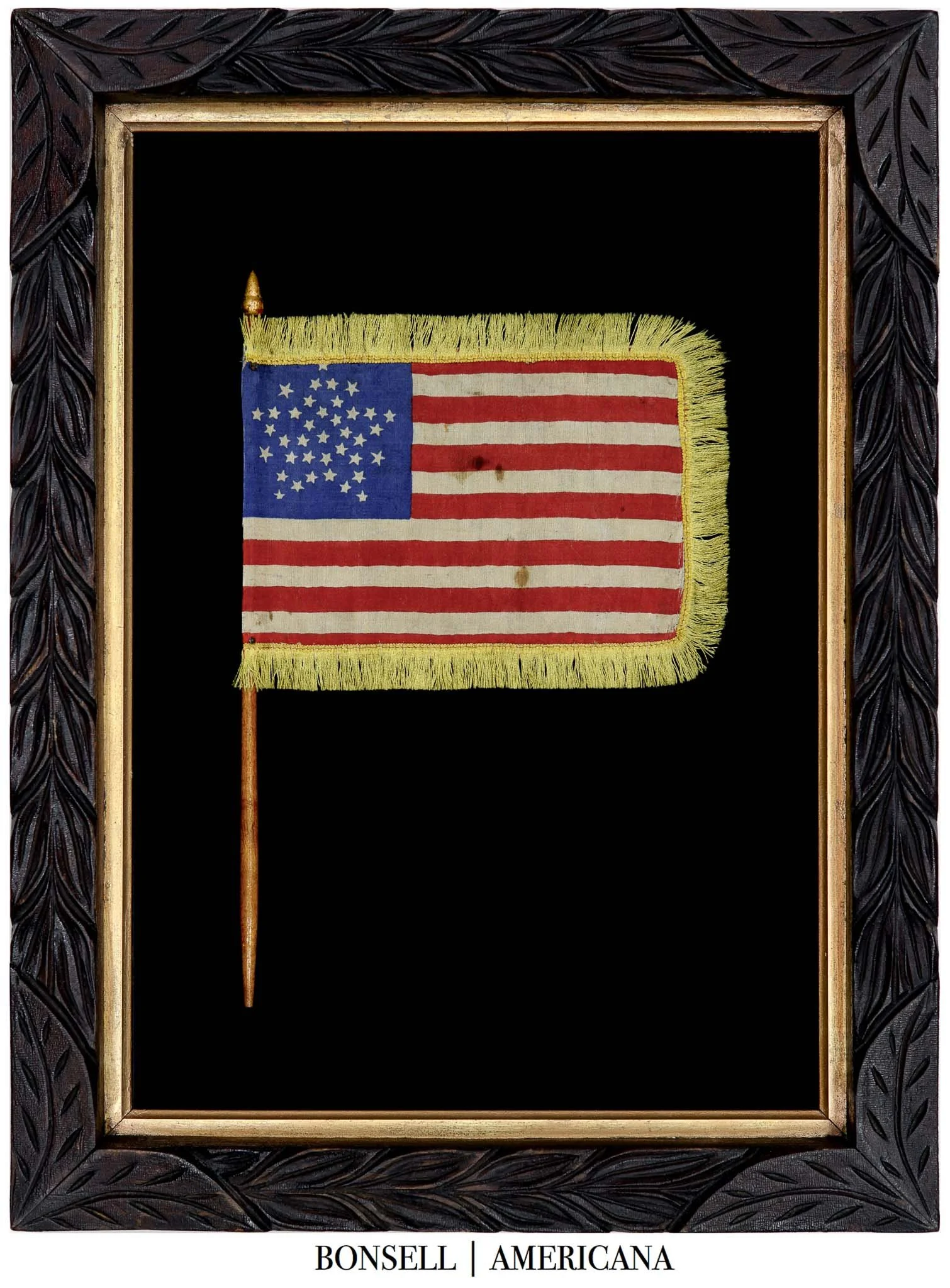
Offered is a 38-star American parade flag, printed on fine silk, bordered on three sides with gold fringe, and mounted to its original turned-wood staff with a smooth finish, gilt spear finial, and sharpened lower point. The stars are arranged in a Great Star—or Great Luminary—pattern, consisting of 34 stars forming the larger star and four flanking stars in the corners.
The flag’s construction and finish indicate use in a formal or ceremonial context. The printed silk, gold fringe, and carefully finished staff are consistent with patriotic and commemorative flags produced in Philadelphia and other major cities during the mid-nineteenth century.
THE FLAG
This small silk flag was printed with precise registration and even coloration, the stripes sharply defined and the canton evenly inked. The silk’s fine weave and sheen reflect a quality consistent with high-end commercial production. The flag remains attached to its original turned-wood staff by two small nails driven through the hoist—an attachment method typical of finer ceremonial flags, providing a secure but discreet means of fastening while preserving the textile’s presentation.
The gold fringe, sewn by hand along three sides, was reserved for interior and commemorative use. The smooth, turned staff with gilt finial and sharpened point suggests the flag was intended for formal display rather than outdoor procession. The combination of materials and finish places it among the more refined small-format silk parade flags of its period.
THE GREAT STAR PATTERN
The Great Star, or Great Luminary, pattern arranges smaller stars into the form of a single large five-pointed star, representing the idea that many states together form one nation. The design is credited to U.S. Naval Captain Samuel Chester Reid (1783–1861), a veteran of the War of 1812 and longtime harbor master of New York. Reid gained public recognition for his defense of the privateer General Armstrong at the Azores in 1814—an engagement that delayed the British fleet bound for New Orleans—and later became known for his expertise in maritime signals and his advocacy for a more standardized approach to American flag design.
In early 1818, as Congress debated how to revise the expanding and cumbersome fifteen-stripe flag created under the 1794 act, Reid corresponded with Representative Peter Wendover of New York and proposed a simplified system: thirteen stripes to honor the founding colonies and one star for each state, arranged in a coherent geometric form. Among several suggested layouts, Reid’s preferred design placed the smaller stars into the shape of a single large star—“a constellation within a constellation”—to convey unity and legibility at distance, particularly at sea.
Although the resulting Flag Act of 1818 adopted Reid’s principle of thirteen stripes and one star per state, it did not legislate any specific star pattern, leaving the arrangement to individual makers. The Great Star, however, quickly became one of the most admired and enduring designs of the nineteenth century. It appeared on printed parade flags, campaign banners, and naval ensigns, valued for its symmetry and balance.
By the time of the Civil War, the Great Star carried both historical and patriotic associations. It was viewed as a traditional pattern linking the modern Union to the ideals of the early Republic. Flag makers continued to employ it for ceremonial and commemorative use, particularly on fine silk parade flags and memorial banners. In this example, 34 stars form the large central figure, while four stars placed beyond the points complete the count of 38, producing a bold and symmetrical display consistent with the best mid-century printed examples.
ANTICIPATORY MANUFACTURE
The 38-star count corresponds to Colorado’s admission to the Union on August 1, 1876, though this star count did not become official until July 4, 1877. During the nineteenth century, flag makers frequently issued new designs before formal adoption, anticipating the next state to enter the Union.
This practice of pre-admission manufacture was both commercially practical and culturally symbolic. It allowed printers to offer “updated” flags immediately after statehood while reflecting public optimism about westward expansion. Comparable anticipatory flags exist for earlier admissions, including Kansas (1861) and Nevada (1864).
Colorado’s path to statehood began well before 1876, with petitions for admission introduced as early as 1864, during the Civil War. Congress debated its admission repeatedly over the following decade, and newspapers in eastern cities, including Philadelphia, reported on its prospects alongside those of Nebraska and Nevada. The anticipation of new western states encouraged flag makers to prepare designs reflecting expanded star counts.
By the mid-1860s, Philadelphia had become one of the nation’s foremost centers for patriotic manufacture. Firms such as Annin & Co., Horstmann Brothers, and numerous smaller print shops along Chestnut and Market Streets produced silk and cotton parade flags in a range of star configurations, often ahead of official adoption. These companies marketed their goods for parades, civic events, and military ceremonies, where flags bearing more than the current official number of stars were common symbols of national growth and optimism.
Within this commercial environment, a 38-star flag printed in the 1860s would not have been unusual. The practice of speculative printing—producing new star counts in expectation of future admissions—was routine. The combination of silk fabric, applied gold fringe, and finished wooden staff seen here reflects the upper tier of that market: a ceremonial-quality flag made for display rather than distribution. Such details are consistent with the craftsmanship of Philadelphia’s mid-century flag and military outfitters and with the city’s role as a major supplier of patriotic materials during and immediately after the Civil War.
CEREMONIAL AND MEMORIAL USE
Flags of this type were made for civic and commemorative display, not mass distribution. During the Civil War and Reconstruction periods, small silk flags with fringe were used to decorate interior spaces, honor guards, and funeral settings.
In the days following Lincoln’s assassination, cities across the Union displayed mourning drapery and American flags. In Philadelphia, the ceremonies of April 1865 made extensive use of flags and banners, both in the procession and in the interior of Independence Hall. Surviving period descriptions mention flags arranged around the casket and within the Assembly Room.
The materials and construction of this flag correspond closely to that setting. The quality of printing, the fringe, and the fine staff align with the decorative standards of funeral and memorial display rather than the rougher cotton handwavers distributed to the public.
PROVENANCE AND DOCUMENTATION
A typed and signed affidavit dated November 1, 1934, accompanies the flag. It was written by Louis Irving Reichner (1871–1942) of Philadelphia, a lawyer and genealogist. In the statement, Reichner records that his grandmother, Eliza J. Stephens, was present in Independence Hall during the removal of Lincoln’s remains on April 24, 1865, and that a soldier guarding the casket gave her one of the American flags placed around it.
The affidavit’s content and dates correspond exactly to the documented record of Lincoln’s funeral. A certified Philadelphia birth record, issued in 1918, confirms Reichner’s birth on July 14, 1871, to Louis Reichner, Jr. and Christiana (Stephens) Reichner, verifying his descent from Eliza J. Stephens.
Both the affidavit and birth certificate were found in Reichner’s personal Bushnell’s “Paperoid” expanding wallet, manufactured by the Alvah Bushnell Company of Philadelphia and gilt-stamped “L.I.R. / Life Ins.” The wallet retains its original paper envelope and maker’s printed insert.
Reichner’s obituary (1942) records a long and accomplished career. Born in Philadelphia in 1871, he attended the William Penn Charter School before earning degrees from Princeton University (M.A., 1897) and the University of Pennsylvania Law School. Following admission to the bar, he joined the Fidelity Trust Company in Philadelphia, where he worked in the trust and estate division before entering private practice. By 1910 he had become associated with the firm of Duane, Morris & Heckscher, one of the city’s oldest and most respected law offices, known for its corporate and banking clientele. In 1926 he accepted a position in New York as counsel for the National Properties Corporation, continuing to specialize in trust and real-estate matters.
During the First World War, Reichner served as a Captain in the U.S. Army Ordnance Department, responsible for procurement and supply logistics. He was promoted to Major in the Reserve Corps in 1919 and later to Lieutenant Colonel in 1929, remaining active in military reserve service into the 1930s.
Beyond his professional work, Reichner was deeply involved in civic and cultural organizations. He was a founding member and officer of the Princeton Club of Philadelphia, a long-time participant in the Orpheus Club, and a member of the Sons of the Revolution, the Society of the War of 1812, and the Genealogical Society of Pennsylvania. These affiliations reflect both his social standing and his enduring interest in American history and lineage. His involvement in genealogical and patriotic societies, coupled with his training as a lawyer, made him unusually well suited to document family history with care and precision—an aptitude reflected in the 1934 affidavit that accompanies this flag.
LINCOLN’S FUNERAL IN PHILADELPHIA
When the funeral train carrying Abraham Lincoln’s remains left Washington on April 21, 1865, it began a twelve-day journey to Springfield, Illinois. The Philadelphia stop was among the most elaborate and most attended of the entire route.
The train arrived at the Broad Street Station on Saturday, April 22. The casket was transferred to a hearse draped in black, drawn by eight gray horses, and escorted by city officials, soldiers, and members of the fire companies. The procession moved north on Broad Street and east along Chestnut toward Independence Hall. Contemporary reports describe a silent crowd and buildings covered in mourning cloth.
A correspondent for the New-York Daily Tribune (April 24, 1865) noted the depth and decorum of the city’s mourning: “The good taste of the citizens of Philadelphia was displayed in the mourning habiliments of their dwellings and places of business yesterday to-day, as well as during the entire week. Among the most prominent were the residences of Gens. Grant and Meade, which were covered with flags festooned with crape. Numerous military officers have their headquarters in Girard-st., and they are beautifully draped. The ladies appear with mourning badges on their left shoulders, and this custom had become so general that its non-observance is noticed.”
Inside the Assembly Room of Independence Hall, the coffin was placed on a raised platform. Soldiers stood guard as thousands filed past. The room was decorated with floral wreaths, patriotic emblems, and heavy black drapery.
A front-page engraving in the Philadelphia Inquirer (April 25, 1865), titled “President Lincoln’s Remains in Independence Hall,” depicts the scene. In the image, the bier stands in the center of the chamber beneath swags of bunting and banner-shaped hangings that fill the background. While discrete small hand-held flags are not identifiable, the décor includes flag-like folds and shield emblems that convey the patriotic symbolism described in contemporary accounts. The National Park Service, drawing from period descriptions, similarly notes that the Assembly Room was “adorned in mourning from floor to ceiling” as approximately 100,000 (or more) mourners filed past over twenty hours of visitation.
Public viewing began on the evening of April 22 and continued through Sunday, April 23. At dawn on Monday, April 24, the casket was closed and borne again to a hearse under escort of soldiers and firemen for transport to the depot. Although the departure took place before sunrise—around four o’clock in the morning—large crowds gathered once more along Chestnut and Broad Streets to pay their final respects. Contemporary accounts describe men, women, and children standing in silence as the hearse passed, church bells tolling in the distance, and flags lowered throughout the city. The train departed amid this quiet vigil, beginning the next stage of its journey to New York.
Reichner’s 1934 affidavit, written nearly seventy years later, aligns closely with these records: his grandmother’s presence on the day of removal, the guard stationed beside the casket, and the presence of American flags among the decorations. While no contemporary photograph of such flags survives, the affidavit’s details correspond precisely to the documented sequence of the Philadelphia ceremonies and to the known decorative traditions of that event.
SIGNIFICANCE
This flag and its documentation form a coherent and verifiable group. The flag itself is a fine example of small-format silk printing from the mid-nineteenth century, made with quality materials suited for ceremonial use. Its 38-star Great Star pattern reflects both patriotic symbolism and the practice of anticipatory manufacture.
The supporting documents—the affidavit, birth record, and personal wallet—create an unbroken chain of ownership from an eyewitness at Lincoln’s funeral to her grandson, who recorded and preserved the story. The group provides unusually complete provenance for an object of this nature and situates it clearly within the broader context of American mourning and civic commemoration in 1865.
Taken together, these materials represent a rare survival linking a known family witness to one of the most important public ceremonies in nineteenth-century American history.
Conservation Process: This flag was professionally conserved. It is sewn to silk and positioned behind Optium Museum Acrylic.
Frame: The frame is a circa 1900 hand-carved wood example with a dark-stained finish and excellent corner joints. It features a repeating leaf-and-stem motif and a gilt-painted inner liner that provides a simple, period-appropriate contrast. Solidly constructed and well-preserved, it is typical of quality American craftsmanship from the early 20th century.
Condition Report: The flag shows moderate signs of age and use consistent with its period. The silk remains intact with some scattered stains, light surface soiling, and minor splits visible under magnification. The colors are strong for its age, with the red slightly muted and the blue well preserved. The gold fringe and staff remain firmly attached and in stable condition.
Collectability Level: The Extraordinary – Museum Quality Offerings
Date of Origin: 1865
Number of Stars: 38
Associated War: The Civil War (1861-1865)
Associated State: Colorado
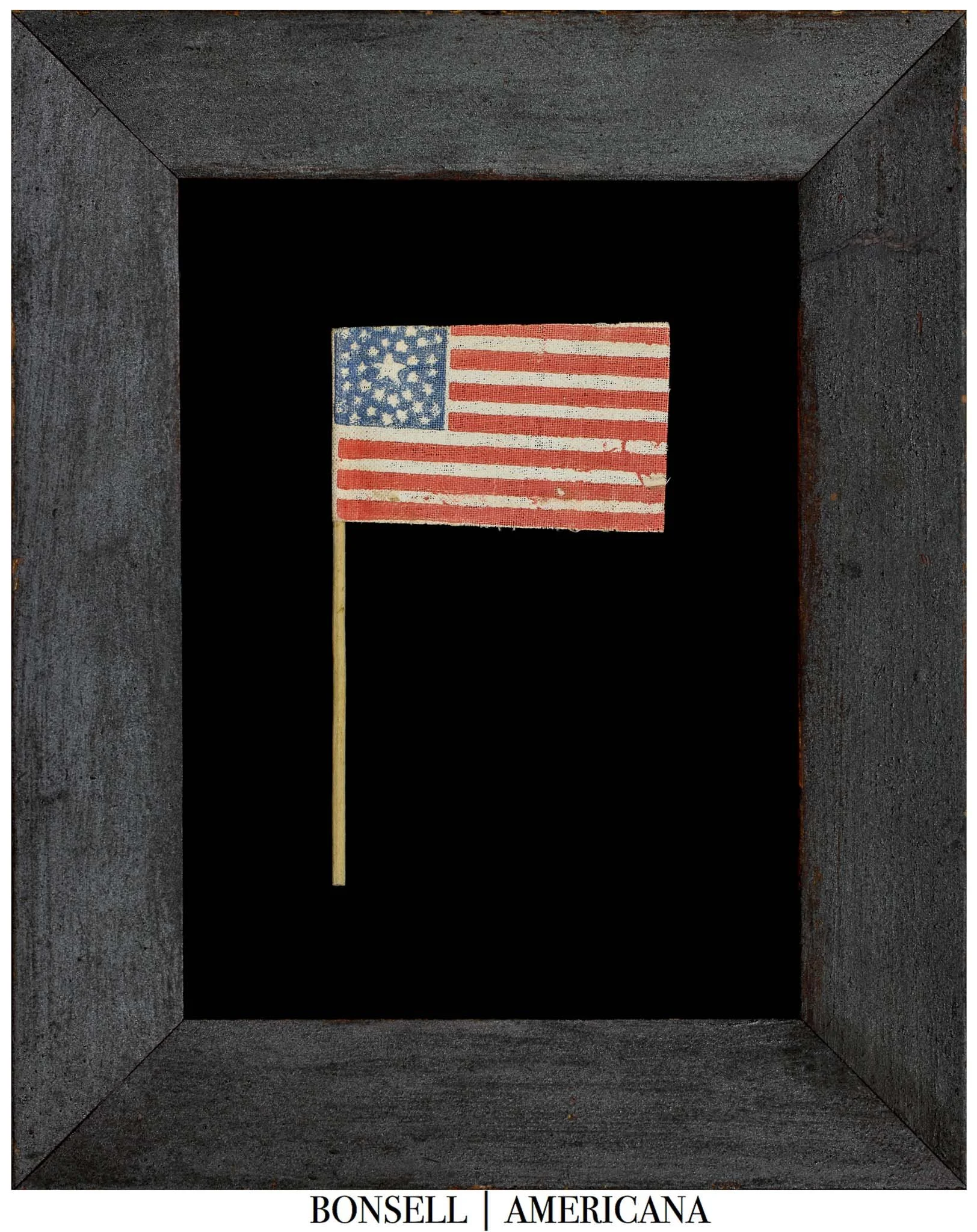
Frame Size (H x L): 12.25” x 10”
Flag Size (H x L): 2.5” x 3.5” and Affixed to a 6” Staff
Offered is a scarce and visually striking 36-star antique American parade flag, printed on coarse cotton and presented on its original wooden staff. Parade flags such as this were made for short-term patriotic display at parades, political rallies, celebrations, and inaugurations. Despite their ephemeral purpose, they remain among the most evocative and collectible forms of 19th-century Americana.
The stars on this flag are arranged in what is known as a medallion configuration—a visually arresting layout favored during the mid-19th century. At the center of the canton is a large star, encircled by two concentric rings: the inner ring features 10 stars, while the outer ring contains 17. Completing the design are corner stars flanking the medallion. While medallion patterns were especially popular between 1861 and 1876, they largely disappeared from production by 1890, replaced by more uniform rows and columns. Their ornate, almost celebratory feel sets them apart from the rigid star alignments of later eras.
This specific example bears 36 stars, representing the admission of Nevada into the Union. Though Nevada officially joined on October 31, 1864, the 36-star flag did not become official until July 4, 1865—just after the conclusion of the Civil War. Nevada’s statehood was strategically timed. Politically, it was intended to support President Abraham Lincoln’s 1864 re-election and to solidify Republican control during Reconstruction. Economically, the state’s immense silver reserves were seen as critical to financing the Union war effort and addressing postwar debt.
The 36-star flag served as the nation’s official flag for two years, from July 4, 1865, to July 3, 1867. During this time, it flew over a country grappling with the aftermath of the Civil War and beginning the long road toward Reconstruction. It was also used by the U.S. military during the final months of the war. The 37-star flag, recognizing Nebraska’s statehood, would succeed it on July 4, 1867.
Extremely close inspection of this example reveals important details about its manufacture. The flag is printed on a coarse, plain-weave cotton consistent with mid-19th-century domestic cloth. The pigments sit visibly atop the fibers, pooling around the yarn intersections in a manner characteristic of early block or stencil printing rather than later roller-printed methods. The blue displays the dark, slightly green-cast tone associated with Prussian blue, and the red carries the matte, mineral quality of iron-oxide pigments—both typical of inexpensive patriotic printing of the period. Uneven pressure during the print strike softens some stars and enhances others, creating subtle mis-registration that underscores its hand-guided, utilitarian origins.
Conservation Process: The flag was hand sewn to cotton fabric, and both were hand sewn to a mounting board. To prevent the black dye in the cotton fabric from seeping into the flag, it was first washed in a standard wash and then in a dye setting wash. The flag is positioned behind Optium Museum Acrylic.
Frame: The flag is housed in an early American, splined-miter frame dating to approximately 1830–1860, retaining its original lampblack or ‘dry black’ surface. The hand-cut joinery, early iron hanging hardware, and oxidized hardwood construction are all consistent with antebellum rural framing practices.
Condition Report: The flag survives in honest condition with scattered small losses and light surface wear typical of early printed parade flags on open-weave cotton. Most distinctive is the originally irregular top edge, where the trimming or print strike cuts partially into the canton and grazes the upper red stripe — a characteristic result of the rudimentary, hand-guided production methods used for these inexpensive flags. Despite its modest imperfections, it retains strong visual character and an appealing, untouched presentation.
Collectability Level: The Great – Perfect for Rising Collectors
Date of Origin: 1864-1867
Number of Stars: 36
Associated War: Civil War (1861-1865)
Associated State: Nevada
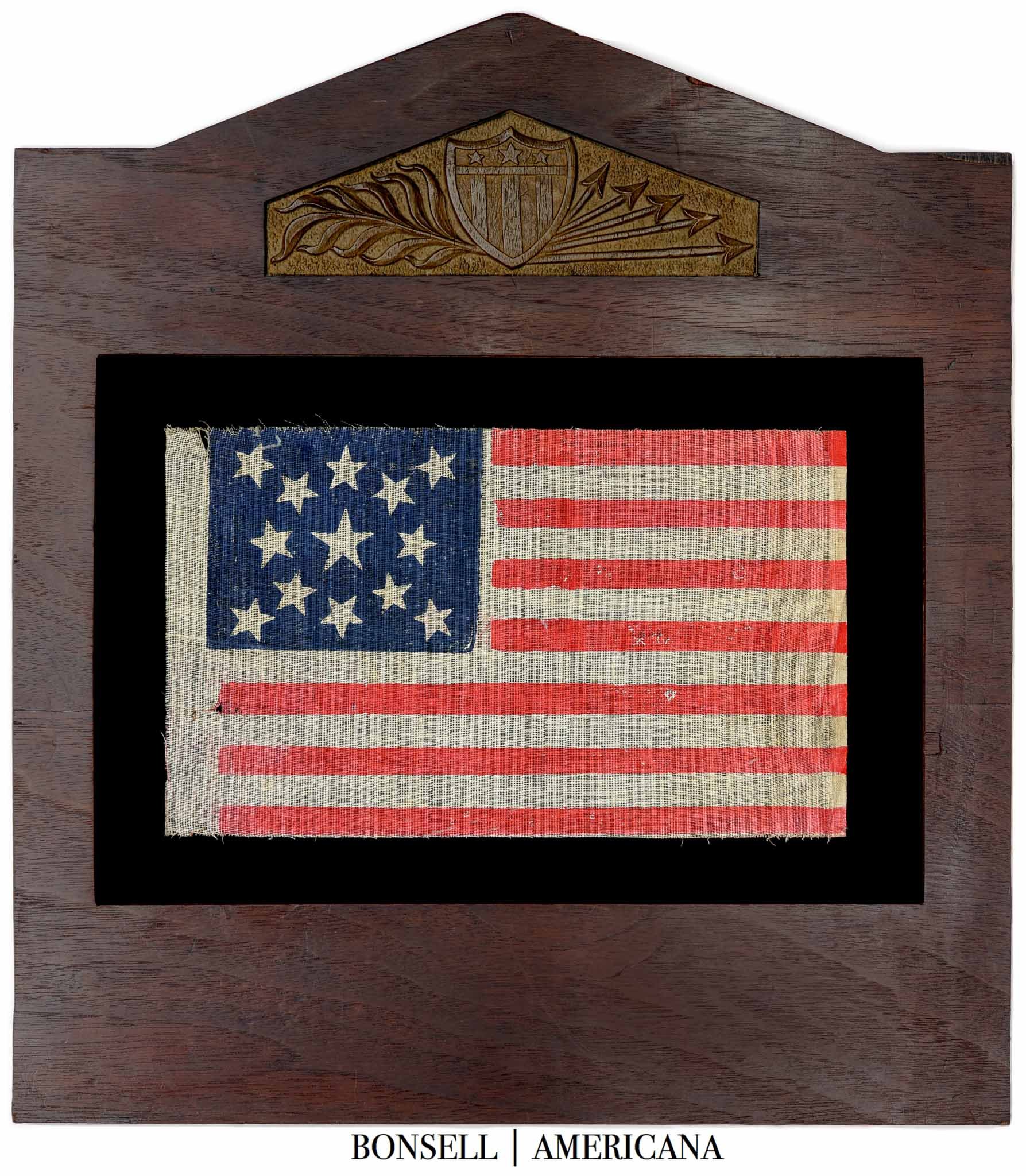
Frame Size (H x L): 15.25” x 14.5”
Flag Size (H x L): 6” x 9”
Offered is a 13-star American flag, printed on glazed cotton, that displays a bold and distinctly folk-like character. The canton features thirteen white stars arranged in a medallion pattern, with a large center star encircled by a ring of eight and complemented by one in each corner. The stars vary slightly in proportion and spacing, underscoring the hand-rendered quality of the design despite its printed manufacture. The stripes, rendered in alternating red and white, extend the full length of the flag, with areas of uneven inking and light wear. The glazed finish lends a subtle sheen, and the fabric presents a strong yet time-softened appearance typical of the period.
While the size of this flag may initially appear to be small, it is in fact an unusually large and rare size for the era. The most typical printed parade flags produced for the Centennial measured just 2" x 3", whereas the example offered here measures 6" x 9"—approximately three times larger than the common variety.
The nation’s Centennial in 1876 sparked widespread patriotism and served to reunite citizens in the decade following the Civil War. Communities across the country organized parades and public events, and homes and buildings were decorated with red, white, and blue. The largest celebration was the Centennial International Exposition in Philadelphia, which welcomed nearly ten million visitors over six months and introduced groundbreaking innovations such as the Corliss Steam Engine and Alexander Graham Bell’s telephone.
During the Centennial year, President Ulysses S. Grant signed the proclamation admitting Colorado as the 38th state. The official star count remained 37, but flag makers often produced 38-star flags in anticipation of Colorado’s addition. Thirteen-star flags also appeared widely, chosen for their historical connection to the nation’s origins. This echoed the original 1777 resolution of the Continental Congress, which specified a flag with thirteen stripes and thirteen stars to represent the new union.
Although officially replaced in 1795, 13-star flags remained in use for special occasions. They flew on small U.S. Navy boats until 1916, at George Washington’s death in 1799, and during the nation’s 50th anniversary in 1824, when they were displayed to honor General Lafayette’s return tour. They were also used during the Mexican War of 1846–48 and during the Civil War of 1861–65, both periods when patriotism encouraged the display of historical emblems. Their presence in the Centennial celebrations reinforced a direct link to the Revolutionary era and to the ideals on which the nation was founded. This 6" x 9" example reflects that tradition in both form and symbolism.
Conservation Process: The flag was hand sewn to cotton fabric, and both were hand sewn to a mounting board. To prevent the black dye in the cotton fabric from seeping into the flag, it was first washed in a standard wash and then in a dye setting wash. The flag is positioned behind Optium Museum Acrylic.
Frame: The flag is housed in a dark-stained wooden frame with a peaked crest, giving it an architectural form. At the top is a carved patriotic motif featuring a federal shield flanked by stylized rays and foliate elements, reinforcing its American theme. The frame shows some age and wear, consistent with an early 20th-century origin, and was chosen to complement the historic character of the flag while emphasizing its patriotic symbolism.
Condition Report: The flag shows moderate wear consistent with its age, including light fraying along the fly end and minor tears at the upper-left corner. The printed colors have softened over time, with scattered areas of fading and uneven inking visible in both the canton and the stripes. Overall, the flag remains strong and displays well, with condition that is very attractive for a Centennial-era printed example.
Collectability Level: The Great – Perfect for Rising Collectors
Date of Origin: 1876
Number of Stars: 13
Associated War: The Indian Wars (1860-1890)
Associated State: Original 13 Colonies
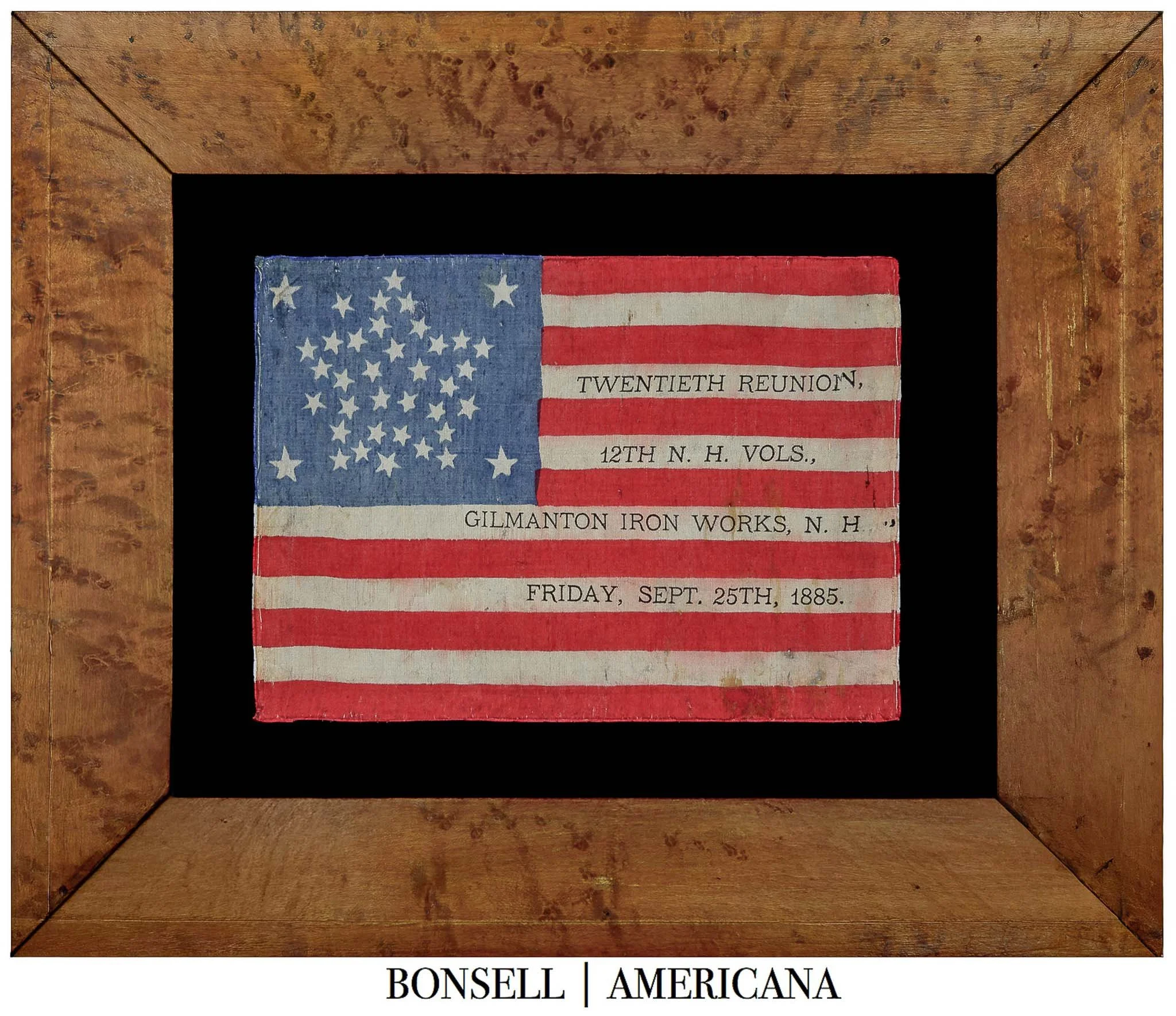
Frame Size (H x L): 14” x 17”
Flag Size (H x L): 6.5” x 9.25”
Offered is a remarkable 38-star printed silk parade flag commemorating the Twentieth Reunion of the 12th New Hampshire Volunteer Infantry, held at Gilmanton Iron Works, New Hampshire, on Friday, September 25th, 1885. It is overprinted with the following inscription:
TWENTIETH REUNION,
12TH N. H. VOLS.,
GILMANTON IRON WORKS, N. H.,
FRIDAY, SEPT. 25TH, 1885.
The “12TH N. H. VOLS.” refers to the 12th New Hampshire Infantry Regiment, a Union Army unit mustered in at Concord in September 1862 and mustered out in June 1865. The regiment saw heavy combat in several major engagements, including Fredericksburg, Chancellorsville, and Gettysburg. At Chancellorsville, it was the last unit under General Sickles’ command to withdraw from the field—suffering 69 killed and 250 wounded out of 580 men engaged. At Gettysburg, the 12th held ground north of the Klingel Farm under fierce attack by the Alabama Brigade, with 26 killed, 73 wounded, and 6 additional deaths from wounds among its 224 participants.
The reference to a “Twentieth Reunion” suggests the regiment began annual gatherings in 1866, immediately following the war. While most Civil War veteran flags feature overprints from the Grand Army of the Republic (GAR), this example is unusual in that it references a specific regimental reunion. Moreover, it predates the more commonly encountered GAR reunion flags, most of which date to the early 20th century.
The flag’s canton features a rare and desirable “Great Star” pattern—an arrangement where smaller stars form the outline of a larger five-pointed star. This example includes 25 stars forming the outer shape, 5 within its interior, 4 interstitial stars surrounding the main form, and 4 canted corner stars. The slight asymmetry and open gaps likely allowed space for a future star, symbolizing the evolving Union.
The Great Star configuration is credited to U.S. Navy Captain Samuel Chester Reid, who proposed the design in 1818 while advising Congress on flag standardization. Reid's ideas helped shape the Flag Act of 1818, which fixed the number of stripes at thirteen and mandated that a new star be added for each new state on the July 4th following its admission. While his favored star pattern was not codified in law, the Great Star design became popular for its visual impact, especially when flown at sea. Though it saw greatest use in the 1840s, it remained in occasional production through the Centennial era. The last known commercial use of the pattern appeared on 38-star flags.
A matching example to the flag offered here was discovered in its original shipping tube bearing a two-cent stamp and the printed return address:
From
R.W. MUSGROVE,
Book and Job Printer.
R.W. Musgrove, a Civil War veteran and editor of the Bristol Enterprise, is confirmed to have produced these flags. To attribute a 19th-century printed flag to a specific maker is exceedingly rare and adds significant historical value.
The 38-star count represents the admission of Colorado to the Union on August 1, 1876, with the flag becoming official on July 4, 1877. The 38-star flag remained official through 1889 and into mid-1890, covering the administrations of Presidents Hayes, Garfield, Arthur, Cleveland, and Harrison. Though the 37-star flag was official during the nation’s Centennial in 1876, both the 13-star and 38-star flags were widely used to commemorate the event, especially by manufacturers eager to anticipate Colorado’s statehood.
The Centennial celebrations of 1876 ignited a renewed national pride. Cities hosted parades, homes were decorated in patriotic colors, and flags became a central symbol of unity and identity. The most prominent celebration was the Centennial International Exposition in Philadelphia, which attracted nearly 10 million visitors and introduced marvels such as the Corliss Steam Engine and Alexander Graham Bell’s telephone.
This flag, dating to 1885, stands apart as an early and regimental-specific veteran reunion artifact—bearing direct connection to one of the war’s hard-fought Union regiments, with a star pattern rooted in early 19th-century naval heritage. It is a compelling piece of Civil War memory.
Conservation Process: This flag was professionally conserved. "It is mounted to silk backing and positioned behind Optium Museum Acrylic.
Frame: The flag is mounted in a birdseye maple frame, likely dating to the mid-to-late 19th century, with a distinctive swirling grain and warm amber tone.
Condition Report: The flag is in good overall condition, with solid color retention and a clearly legible overprint. The silk exhibits typical age-related wear, including light creasing, a few small splits, and scattered staining—most notably some faint gold-toned discoloration.
Collectability Level: The Extraordinary – Museum Quality Offerings
Date of Origin: 1885
Number of Stars: 38
Associated War: The Indian Wars (1860-1890)
Associated State: Colorado
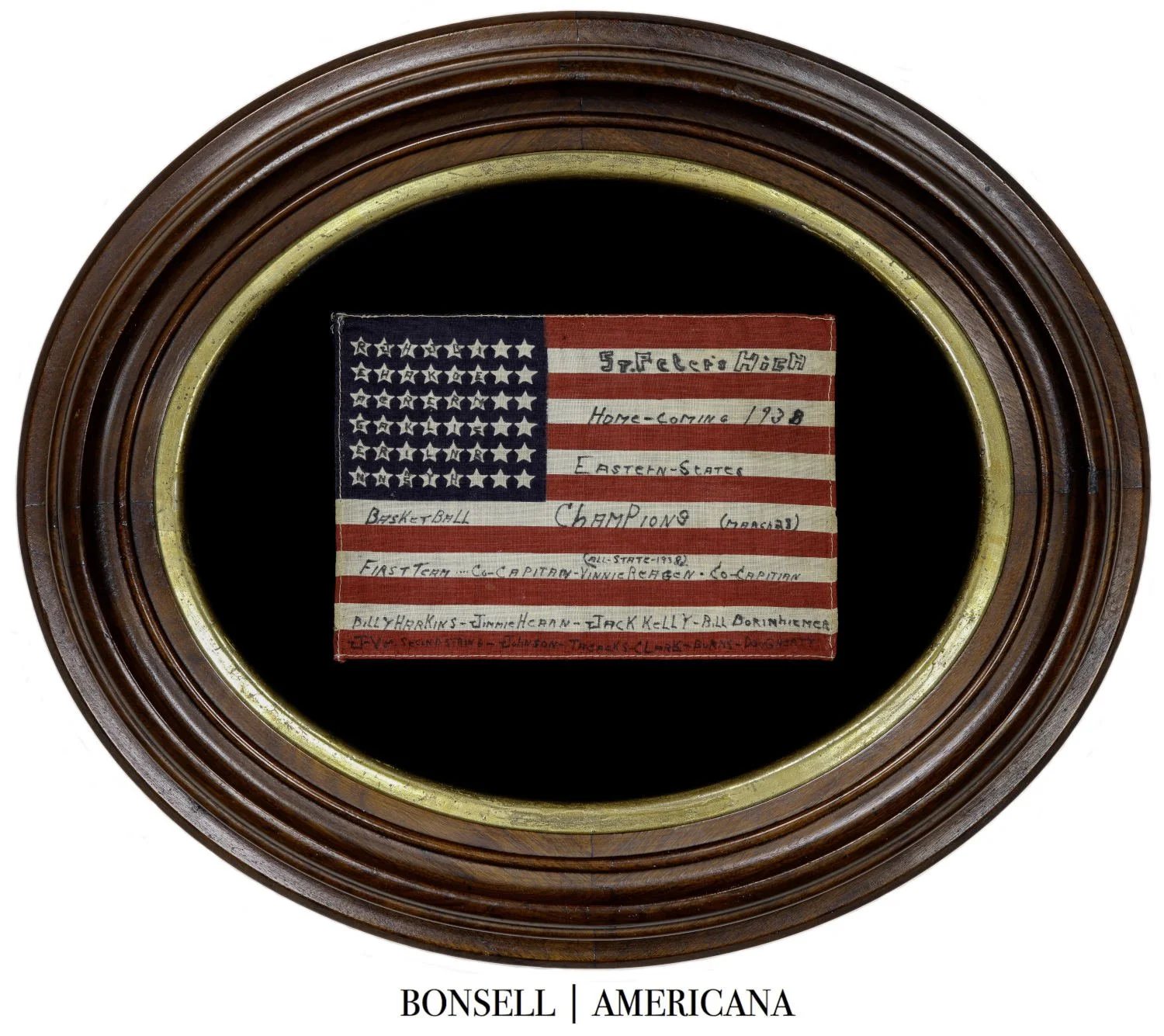
Frame Size (H x L): 16.5” x 19.5”
Flag Size (H x L): 6” x 8.5”
Offered is a rare and personal example of an overprinted American flag, used to commemorate the 1938–1939 basketball season at St. Peter’s High School in New Brunswick, New Jersey. Printed on cotton, the flag features 48 stars and 13 stripes, in keeping with national standards at the time. Onto this standard design, names and inscriptions were added by hand in ink, turning the flag into a localized artifact tied to a specific team.
The overprint marks the school’s basketball team winning the Eastern States Invitational Tournament Championship. Regional tournaments like the Eastern States Invitational brought together top teams from across the Northeast.
The inscriptions list the starting lineup: Co-Captain Vinnie Reagen (named All-State in 1938), Co-Captain Billy Harkins, Jimmie Hearn, Jack Kelly, and Bill Borinheimer. Second-string players are also named: Johnson, Tacacks, Clark, Burns, and Dougherty. Five of the starters’ names are written vertically on the stars in the canton, further integrating player recognition into the flag’s design. The flag is dated March 28, 1938, and references “Home-Coming,” suggesting use in a celebratory event, such as a parade or school gathering.
This flag was featured in the 2011–2012 exhibition The Stars and Stripes: Fabric of the American Spirit at the Morven Museum & Garden in Princeton, New Jersey. The exhibition presented highlights from The Pierce Collection of American Parade Flags, one of the most respected collections of patriotic textiles in the country. The show examined how Americans have used the flag to commemorate political, civic, and personal milestones. This example stood out for its use as a tool of local recognition, blending national symbolism with school achievement.
The flag also reflects the broader history of American flag design. Prior to 1912, flag makers were free to arrange the stars in any pattern. Early 48-star flags often featured staggered or offset arrangements. That changed with Executive Order 1556, issued by President William Howard Taft in 1912, which standardized the layout to a rectilinear pattern of six rows of eight stars (8-8-8-8-8-8). The flag offered here follows that design. Based on materials and construction.
The 48-star flag became official on July 4, 1912, following the admissions of New Mexico (January 6, 1912) and Arizona (February 14, 1912) as the 47th and 48th states. It remained in use for forty-seven years—longer than any other official U.S. flag design—until July 4, 1959, when Alaska's statehood introduced the 49-star version. It flew during the administrations of Presidents Taft through Eisenhower, and during World War I, World War II, and the Korean War.
Conservation Process: This flag was hand sewn to cotton fabric, and both were hand sewn to a mounting board. To prevent the black dye in the cotton fabric from seeping into the flag, it was first washed in a standard wash and then in a dye setting wash. The flag is positioned behind Optium Museum Acrylic.
Frame: The flag is housed in an antique walnut frame, likely dating between 1860 and 1890. The frame features a plain walnut molding with an inner gilt liner.
Condition Report: The flag is in excellent condition. There is some light soiling and toning. The ink inscriptions remain clearly legible throughout.
Collectability Level: The Best – Perfect for Advanced Collectors
Date of Origin: 1938
Number of Stars: 48
Associated War: WWI
Associated State: Arizona
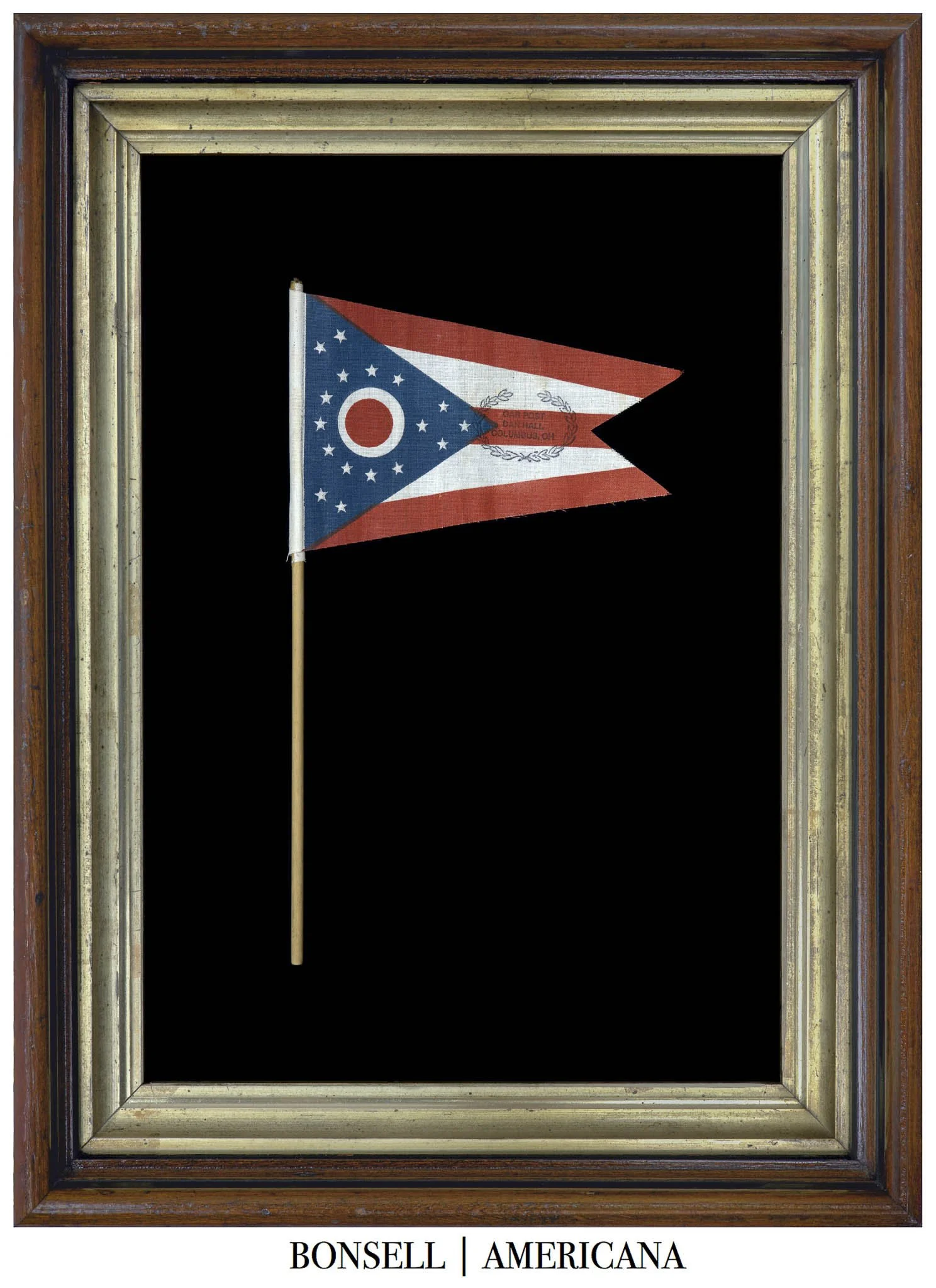
Frame Size (H x L): 17” x 13”
Flag Size (H x L): 4” x 6” on a 10” Staff
Offered is an Ohio state flag, dating to 1925. It is an exceptional artifact of historical significance, crafted to honor the life and legacy of Daniel M. Hall, a celebrated Civil War veteran and National Commander of the Grand Army of the Republic (“GAR”). Made from plain weave cotton, the flag reflects the practical materials commonly used for commemorative items of the period. The cotton is treated with a finish to make it more durable and water-resistant, mimicking the qualities of oilcloth.
Its distinctive swallowtail design, featuring vibrant red, white, and blue elements, mirrors the official Ohio state flag adopted in 1902, a design inspired by Civil War cavalry guidons. Mounted on its original wooden staff, this flag was intended for ceremonial use, serving as a reminder of Hall’s legacy.
What elevates this flag’s historical importance is its overprint, stamped in black ink on the striped field. Enclosed within a laurel wreath, the inscription reads, “GAR Post, Dan Hall, Columbus, OH,” directly tying the flag to the GAR and specifically commemorating Hall’s death in 1925, just before his 83rd birthday. Flags with overprints dedicated to specific individuals are rare, making this an especially coveted piece for collectors.
The GAR, founded in 1866, was one of the most influential veterans’ organizations in American history. Dedicated to uniting Union Civil War veterans, the GAR blended social fellowship with political advocacy. Members, often called “comrades,” donned their wartime uniforms to march in parades, participate in reunions, and advocate for veterans’ benefits such as pensions. The organization also played a central role in establishing Memorial Day as a national holiday. Structurally, the GAR mirrored the military, with local “posts” acting as chapters under the leadership of state and national commanders. By fostering a sense of brotherhood and preserving the memory of Union service, the GAR had a profound impact on postwar society and veterans’ rights.
Daniel M. Hall exemplified the dedication and leadership of the GAR’s membership. Born on October 20th, 1842, Hall served with distinction in the 2nd and 12th Ohio Cavalry regiments during the Civil War. After mustering out in 1865, he became deeply involved in veterans’ affairs, joining the Hamlin Post of the GAR in Columbus, Ohio, in 1883. Hall’s organizational skills and leadership propelled him to prominence, ultimately serving as the Commander of the Ohio Department and later as National Commander-in-Chief. His efforts focused on preserving the bonds of fellowship among veterans and honoring their sacrifices. Hall’s passing in 1925 marked the loss of a respected leader, memorialized through artifacts like this flag.
The Hamlin Post, based in Columbus, was among many GAR chapters that served as vital centers for veterans’ social and charitable activities. Posts like Hamlin provided support to veterans and their families, organized community events, and preserved the shared memory of Union service. Under Hall’s leadership, the Hamlin Post became an integral part of the GAR’s Ohio Department, further elevating its historical significance. The creation of this overprinted flag in Hall’s memory underscores the deep respect he commanded within the organization and the lasting impact of his contributions.
The Ohio state flag itself, adopted in 1902, is among the most distinctive in the United States. Designed by Cleveland architect John Eisenmann, it was created for the Pan-American Exposition in Buffalo, New York, in 1901. Its unusual swallowtail shape sets it apart, drawing inspiration from both Civil War-era cavalry guidons and maritime burgees. This shape, along with its bold and symbolic design, captures the spirit of Ohio’s heritage and geography. At its center is a red disc set within a white circular field, representing the letter “O” for Ohio and the buckeye, the state’s iconic symbol. Five alternating red and white stripes symbolize the state’s waterways and roads, while the blue triangular field, representing hills and valleys, features 17 stars: 13 for the original colonies and four more to signify Ohio’s admission as the 17th state.
This symbolic depth, paired with its unconventional design, ensures the Ohio flag’s enduring appeal. Over the decades, it has been a source of pride for the state and its citizens, appearing in civic ceremonies and historical commemorations alike. The flag’s resemblance to Civil War guidons serves as a reminder of Ohio’s significant contributions to the Union during the Civil War, while its design elements reflect the state’s natural and cultural heritage. Together, the Ohio flag and artifacts like this overprinted version serve as emblems of the state’s history and the lasting legacy of its citizens.
Conservation Process: This flag was hand sewn to cotton fabric, and both were hand sewn to a mounting board. To prevent the black dye in the cotton fabric from seeping into the flag, it was first washed in a standard wash and then in a dye setting wash. The flag is positioned behind Optium Museum Acrylic.
Frame: The frame is made of walnut and dates from 1860 to 1890. Its dark wood and simple craftsmanship reflect the style of the period.
Condition Report: The flag is in remarkably clean and well-preserved condition, with vibrant colors and minimal signs of wear. Only a few faint yellow stains are visible, adding subtle character while not detracting from its overall appearance.
Collectability Level: The Great – Perfect for Rising Collectors
Date of Origin: 1925
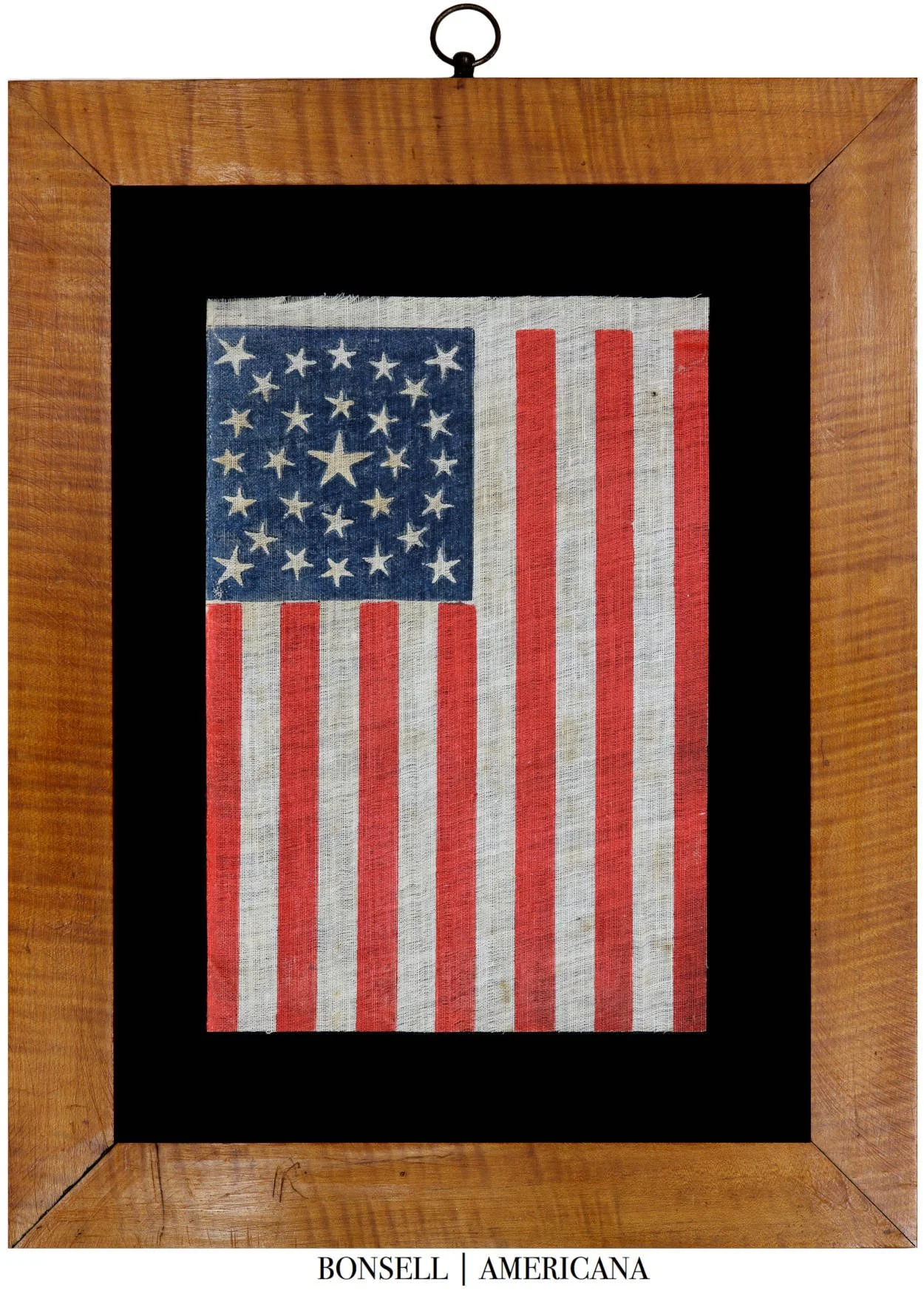
Frame Size (H x L): 16” x 12.5”
Flag Size (H x L): 10” x 6.75”
Offered is a 29-star American flag printed on glazed cotton, with its stars arranged in a striking and highly desirable medallion configuration. At the center of the canton is a large star, known as a “center star,” symbolizing the most recently admitted state to the Union—Iowa. This central star is surrounded by two concentric rings of smaller stars, with four additional flanking stars placed in each corner of the canton, creating a bold and balanced aesthetic.
The stars themselves are notably pointy and whimsical in design, tightly packed within the canton in a way that is both charming and visually distinctive. Though the specific maker is unknown, these stars match a recognizable style attributed to a small group of flags believed to originate from the same workshop. Flags from this group have been documented in only six known star counts: 7, 13, 15, 29, 33, and 35. Each of these counts carried symbolic meaning—celebrating early secession, the original thirteen colonies, Kentucky’s centennial, or the most recent state admissions to the Union. Among this group, the 29-star variant is the earliest and among the rarest.
This flag is mounted vertically, which repositions the canton to the upper left, in accordance with modern U.S. flag display customs. If it were mounted horizontally, the canton would appear in the upper right—a configuration known as a reverse (or backwards) mount. While that orientation conflicts with today’s flag code, such standards did not exist in the 19th century, and reverse displays were both common and acceptable. In some cases, flags were printed on only one side (e.g., the one offered herein) or appeared more vibrant on the reverse, making backwards mounting both practical and historically appropriate to collectors.
The 29-star flag commemorates Iowa’s admission to the Union on December 28, 1846. Iowa’s path to statehood began decades earlier, when the land was acquired as part of the Louisiana Purchase in 1803. For years, it remained sparsely populated by settlers and occupied largely by Native American tribes.
In the 1830s, following a series of treaties and the Black Hawk War of 1832, the U.S. government opened the territory to white settlement. Iowa became an official U.S. territory in 1838, carved from the Wisconsin Territory, and experienced rapid population growth due to its fertile land and strategic location along the Mississippi River.
As its population expanded, Iowa petitioned for statehood in the 1840s. Congress initially rejected Iowa’s proposed constitution due to boundary disputes, but a revised constitution was approved in 1846. On December 28 of that year, President James K. Polk signed the act admitting Iowa as the 29th state.
The admission marked a continued westward expansion of the Union and helped establish Iowa as a key agricultural state in the growing republic.
This flag officially became representative of the United States on July 4, 1847, and retained that status for just one year—until July 4, 1848, when a 30th star was added for Wisconsin. Due to this extremely brief period of official use, 29-star flags were produced in very limited numbers.
Compounding their rarity is the broader historical context: flags made before the Civil War (1861–1865) are exceptionally scarce. During this era, flag use was far more restrained. Americans did not commonly display flags for patriotic reasons, and military use was also limited. U.S. Army artillery units weren’t authorized to carry the national flag until 1834, and infantry regiments not until 1841. As a result, flags made before the outbreak of the Civil War account for roughly only 1% of 19th-century U.S. flags that survive today.
This example, with its early date, rare star count, and medallion design, represents an important artifact from the antebellum period. Flags from this era are difficult to find, and 29-star examples are especially scarce due to their short period of official use. This flag offers historical value both as a physical object and as a reflection of the nation's growth during the mid-19th century.
Conservation Process: This flag was hand sewn to cotton fabric, and both were hand sewn to a mounting board. To prevent the black dye in the cotton fabric from seeping into the flag, it was first washed in a standard wash and then in a dye setting wash. The flag is positioned behind Optium Museum Acrylic.
Frame: This offering is in an attractive tiger maple frame. Tiger maple frames are cherished for their striking, wavy grain patterns that shimmer with a unique iridescence, reminiscent of a tiger's coat.
Condition Report: The flag remains in remarkably clean and well-preserved condition. There is some discoloration, along with a few tiny holes, but these are minimal and do not detract from the flag’s overall appearance. Compared to others from the era, this example ranks among the very best in terms of condition.
Collectability Level: The Best – Perfect for Advanced Collectors
Date of Origin: 1846-1848
Number of Stars: 29
Associated State: Iowa
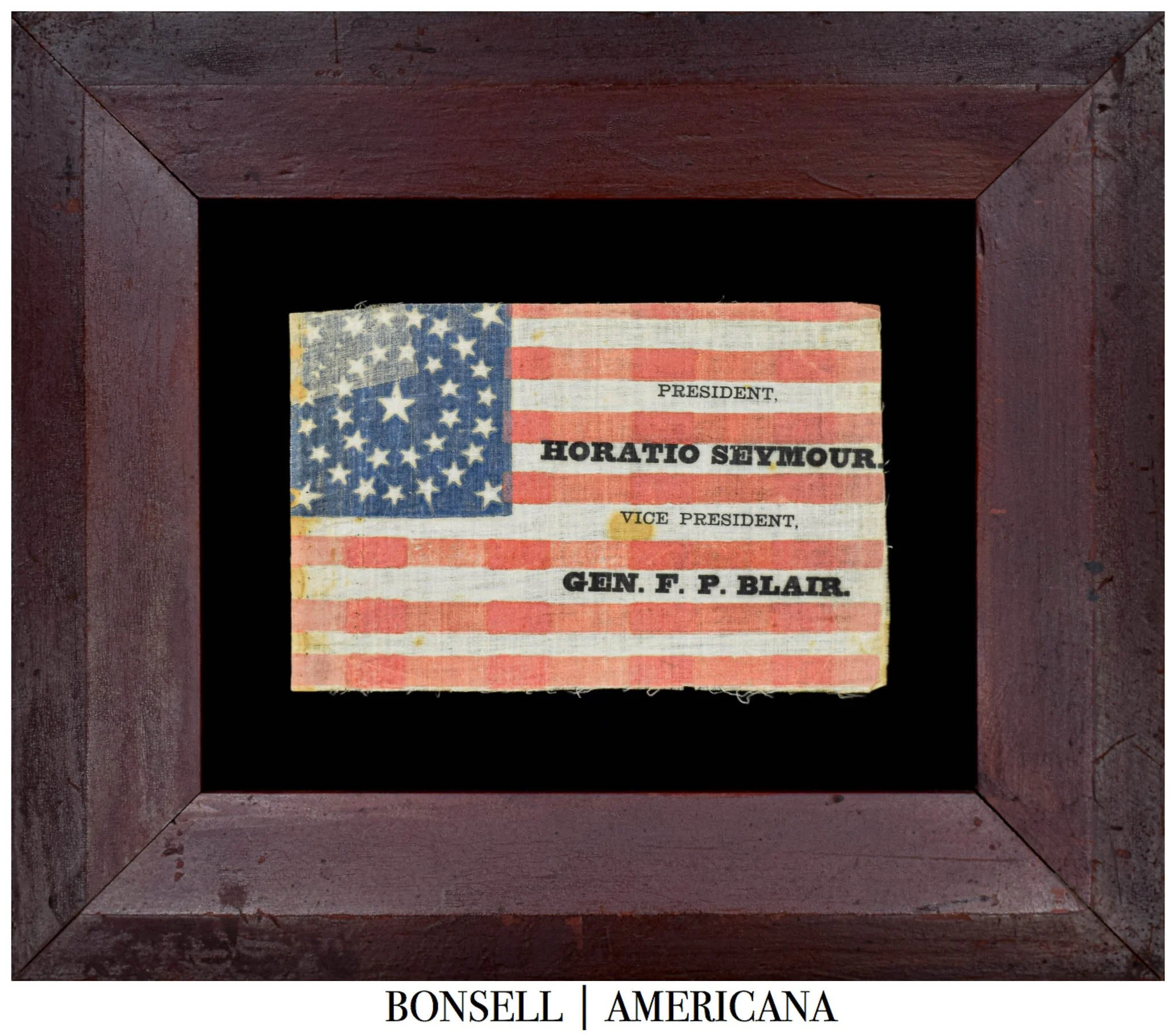
Frame Size (H x L): 13” x 15.5”
Flag Size (H x L): 5” x 8”
Offered is a thirty-six star flag with the following outstanding overprint:
PRESIDENT,
HORATIO SEYMOUR.
VICE PRESIDENT,
GEN. F. P. BLAIR
The overprint is in reference to Democrats Horatio Seymour and Francis Preston Blair, who—in the 1868 presidential election—ran against Republicans Ulysses S. Grant and Schuyler Colfax.
Seymour and Blair won just 80 electoral votes and 47.34% of the popular vote, while Grant and Colfax won 214 electoral votes and 52.66% of the popular vote. The contrast in the electoral votes was expected, but the proximity of the popular vote was surprising—particularly given that newly enfranchised freedmen voted almost exclusively for Grant and Colfax, and further given that many Southern whites, who would have voted almost exclusively for Seymour and Blair, had been temporarily disenfranchised at the time of the election (i.e., those in Texas, Mississippi, and Virginia, the states that had not yet been restored to the Union). The leading explanation for the proximity of the popular vote is that whites—both Northern and Southern—must have voted for Seymour and Blair more often than had been anticipated.
This flag is exceptional for at least the following reasons:
First, campaign flags are the most desirable of all flags. The first campaign flags were made in 1840 and were associated with the William Henry Harrison campaign. In 1890, a bill was introduced that attempted to prevent the desecration of the flag by printing, painting, or advertising for public display or private gain. The bill failed. In 1895, a similar bill was introduced, but likewise failed. Finally, in 1905, a bill passed outlawing the use of marks and portraits on the flag, coat of arms, and other insignia of the United States. With this background in mind, campaign flags are especially difficult to acquire, because they were only made between 1840 and 1905. And in reality, most examples that surface are from a narrower time frame between 1860 and 1890.
Second, the subject flag is particularly rare, even for a campaign flag. It is the only example that we have encountered, and it went undocumented in the Threads of History, written by Herbert Ridgeway Collins, former curator of the Division of Political History at the Smithsonian Institution. Escaping documentation therein was difficult, being that Collins corresponded with 1000’s of collectors, museums, and universities, in his attempt to catalog every political textile. In total, he documented 1500 examples, dating from 1775 to 1979, yet this flag—and all Seymour-Blair flags, but for one—went under his radar, almost certainly as a function of their rarity.
And third, its stars are arranged in a wonderful medallion pattern. The large star in the middle is referred to as a “center star.” The center star represents the newest state added to the Union (e.g., Nevada in the case of this thirty-six star flag). Surrounding the center star is a pair of concentric rings of stars, and surrounding the rings are four flanking stars positioned in the corners of the canton.
CONSTRUCTION
The flag offered herein is printed on coarse glazed cotton. The stripes and overprint were block stamped. The canton is a dusty blue and the stripes are essentially orange. The orange is a result of the use of either madder or cochineal to create the red dye. Such dye was commonly used to make flags between 1850 and 1880. The First Flag Act of 1777 specified the flag’s general colors, but it did not specify the exact shades thereof. For this reason, some flags—like this one—have unusual colors, per the modern eye. The exact shades were not officially specified until 1934.
The overprints are in black across the white stripes and notably a portion of the “HORATIO” overprint appears to overlap one of the red stripes. This suggests that the red stripes were applied, perhaps along with the blue canton, and the campaign overprints were applied sometime thereafter, maybe even years later. In some instances, surplus flags would lie dormant awaiting the next campaign season, patriotic burst, or overprint request.
STAR COUNT
Flags made for the 1868 campaign have surfaced with thirty-four, thirty-six, and thirty-seven stars (and perhaps others). In 1868, the official star count was thirty-seven. As such, this is the most logical count for an 1868 campaign flag. The lower star counts of thirty-four and thirty-six can be explained via the following theories:
First, these lower star counts may have been leftovers associated with the burst of parade flags produced during the Civil War. In a time of frugality—and 1868 would have been such a time given its proximity with respect to the Civil War, not to mention the rugged nature of the 19th century generally—a maker would sell whatever he had, and a buyer would purchase whatever was available.
Second, these lower star counts may have been made with older printing blocks. Cutting blocks was an arduous task. Thus, makers sometimes used older blocks in later years, both to save the time and minimize the effort associated with making new blocks.
And third, there was a general randomness with respect to star counts in 19th century flags, more so with flags dating to 1870 and earlier, and less so with flags dating to 1870 and later. Neither makers nor buyers were particularly disciplined with respect to star counts, perhaps in part because the star count changed so frequently in the 19th century, and perhaps in part because early flags were crude in every respect, the star count being no different.
The subject flag has thirty-six stars, likely because of one of these three theories. Under the first theory, this flag may have been made in 1864 or 1865, and then left in storage until it was overprinted in 1868 and distributed. Under the second and third theories, this flag may have been made in 1868. As viewed from these outer bounds, the underlying flag would date to between 1864 and 1868.
In any event, the overprint would have been applied in 1868, following the nominations of Seymour and Blair (i.e., after the flag was taken from storage or immediately after the flag was printed, depending on the circumstances).
THIRTY-SIX STAR FLAGS
The thirty-six star flag represents the inclusion of Nevada to the Union. Nevada was admitted on October 31st, 1864, and this flag became official on July 4th, 1865. Nevada was originally part of the Utah Territory beginning in 1850, became its own territory in 1861, and became its own state in 1864.
The timing of Nevada's inclusion was politically and economically based. For political reasons, Nevada was admitted to the Union just eight days prior to President Lincoln's re-election bid against General George McClellan. Such timing was meant to benefit Lincoln and his fellow Republicans. For economic reasons, Nevada was included as part of the Union to help it pay off the country’s war debts. Economically, Nevada was particularly attractive at the time, because of its significant silver mining industry. Nevada expanded its borders in 1866 when the western Utah Territory was added to its eastern side, and further expanded in 1867 when a portion Pah-Ute County in the Arizona Territory was added to its southern side.
The thirty-six star flag was the official flag for the last six months of the Civil War, and it was used by the military during that time. It was also the official flag during a portion of the Reconstruction era. Ultimately, the thirty-six star flag was official until July 4th, 1867, the time at which the thirty-seven star flag became official and began to represent the inclusion of Nebraska in the Union.
Conservation Process: This flag was hand sewn to cotton fabric, and both were hand sewn to a mounting board. To prevent the black dye in the cotton fabric from seeping into the flag, it was first washed in a standard wash and then in a dye setting wash. The flag is positioned behind Optium Museum Acrylic.
Frame: This offering is in a mahogany veneer frame. It has a brown and red finish and dates to the 1840s.
Condition Report: There is discoloration in the upper-left quadrant of the canton. There are vertical stripes of fading, the first two of which are under the canton, and the other three of which are to the right of the canton. The stripes of fading may be original to the flag (i.e., manufacturing related). They are more noticeable in the photos than in person. There are a few small stains across the surface of the flag with the most noticeable one being over a portion of “VICE.” Given the age and rarity of the subject flag, it is highly desirable despite these issues.
Collectability Level: The Best – Perfect for Advanced Collectors
Date of Origin: 1864-1868
Number of Stars: 36
Associated State: Nevada
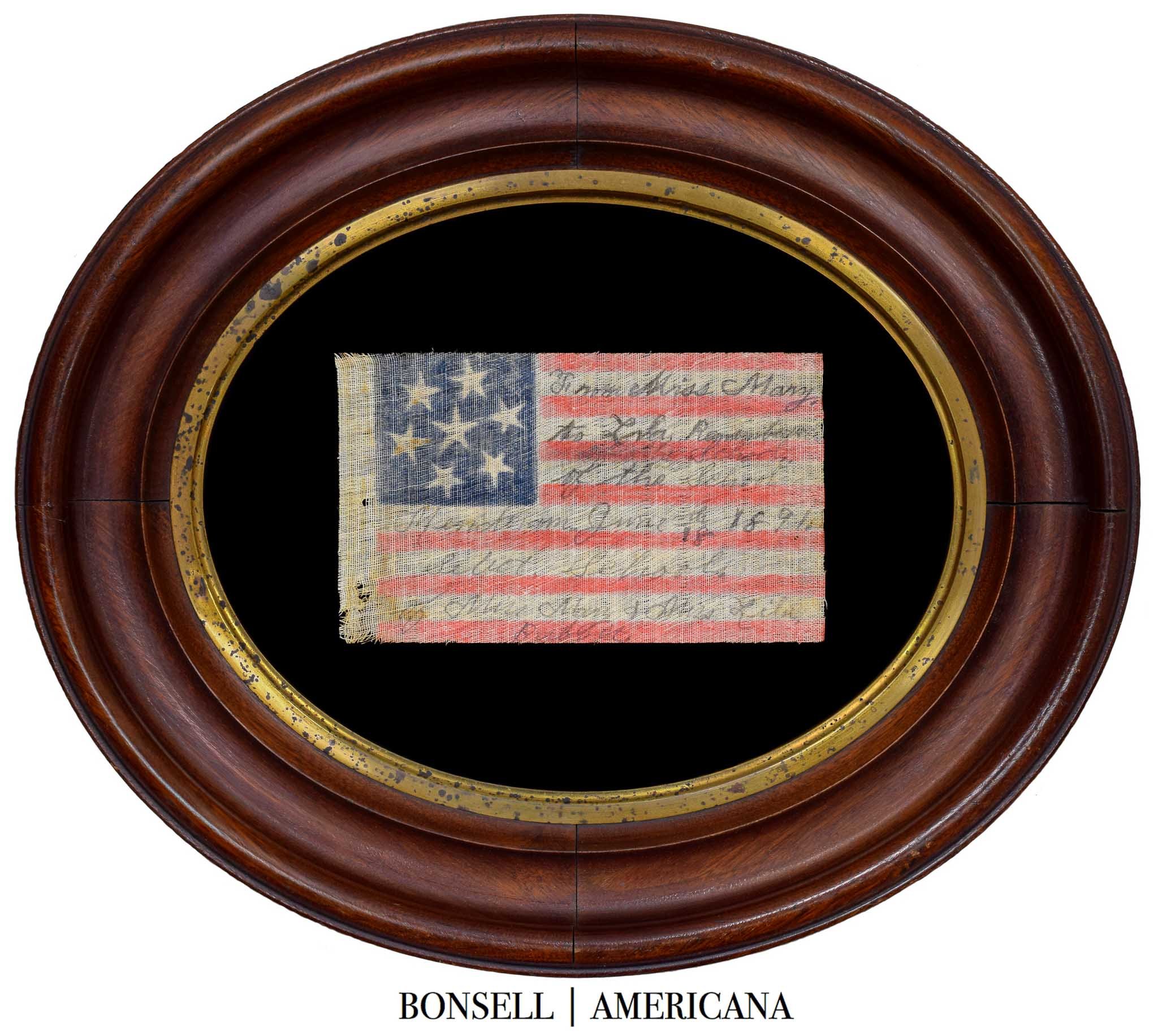
Frame Size (H x L): 11.5” x 13.5”
Flag Size (H x L): 3.5” x 6”
Offered is an exceptional parade flag with the following, handwritten overprint:
From Miss Mary,
Go Leila, Remembrance
of the School
Mendham. June 18th 1891.
Select School
of Miss Mary & Miss Leila
Babbitt
Mary and Leila Babbitt founded the Babbitt Select School in 1884, in Mendham, New Jersey. Mendham is nestled in the hills of Morris County. Unfortunately, beyond this, little seems to be known about the Babbitt’s or the school. But even so, this is a special flag, in that we know where it began its life and how it was used.
Seven-star flags surface in a smaller size and a larger size. The smaller sized flags are approximately two inches by three-and-a-half inches. In contrast, the larger sized flags are approximately three-and-a-half inches by five-and-a-half inches, and they are much rarer than the smaller sized flags. The flag offered herein is one of the larger sized flags.
Thirteen-star parade flags were commonly waved at centennial celebrations in 1876, which were held across the country and, most notably, in Philadelphia at the Centennial International Exhibition. The seven-star flag offered herein is similar, but instead made with southern sympathies to commemorate the first wave of states that seceded from the Union, beginning in 1861. The first wave included Louisiana, Georgia, Alabama, Florida, Mississippi, South Carolina, and Texas. A second wave included Arkansas, Tennessee, North Carolina, and Virginia, and it completed the final grouping of the Confederate States of America. Not only did Southerners (and Southern Sympathizers) wave seven-star parade flags, they also occasionally waved eight-star and nine-star versions, though with much less frequency. They, too, celebrated the initial wave of states seceding from the union.
New Jersey, though geographically situated in the North and typically aligned with the Union during the American Civil War, harbored a complex array of political and social sentiments during the era. While the state's industry and economy largely benefited from its ties to the North, many of its residents, particularly those in the agricultural southern regions, felt a cultural and economic affinity with the South. These sympathies were rooted in New Jersey's historical connections to the South, its agrarian interests, and the state's contentious stance on issues such as slavery and states' rights. The state even had a "Peace Democrat" or "Copperhead" faction, which opposed the Civil War and advocated for a negotiated peace with the Confederacy. While New Jersey did not secede and its troops fought valiantly for the Union, it's evident that the state's loyalties during this tumultuous period were more nuanced than a simple North-South dichotomy might suggest. Such complexities might explain why the flag offered herein traces to New Jersey, despite such flags (i.e., seven star flags) typically tracing back to the South.
Conservation Process: This flag was hand sewn to cotton fabric, and both were hand sewn to a mounting board. To prevent the black dye in the cotton fabric from seeping into the flag, it was first washed in a standard wash and then in a dye setting wash. The flag is positioned behind Optium Museum Acrylic.
Frame: This flag is in a multitiered frame with an outer walnut layer and an inner gilded layer. It dates to between 1860 and 1890.
Condition Report: There are stains across the surface. The red and blue portions have faded slightly. There is some damage to the vertical white strip. Overall, it is attractive and age appropriate.
Collectability Level: The Great – Perfect for Rising Collectors
Date of Origin: 1888
Number of Stars: 7
Associated State: The Confederate States

Frame Size (H x L): 13.25” x 17”
Flag Size (H x L): 7.5” x 10.5”
Offered is an American parade flag bearing an anticipatory 46-star count, printed on silk and overprinted to commemorate a specific civic and military event. The flag features a blue canton with white stars arranged in a lineal configuration, paired with red and white stripes. The stars display modest directional variation, a characteristic commonly encountered in printed parade flags of the late 19th century.
This example is overprinted with the following inscription:
Reception to the Fighting 20th, Topeka Kas., Nov. 2, 1899.
The text identifies the flag as having been produced for a public reception held in Topeka, Kansas, welcoming home the 20th Kansas Volunteer Infantry following its return from service in the Philippines. Contemporary Kansas records note that in November 1899 the regiment was formally received at the statehouse, confirming the civic nature and scale of the event referenced in the overprint.
The 20th Kansas Volunteer Infantry was among the volunteer regiments raised during the Spanish-American War and remained on duty beyond the formal conclusion of that conflict, serving during the Philippine-American War. Regiments that experienced extended or active service were often described in period sources as “fighting” units, a term used contemporaneously to distinguish them from units whose service was brief or limited to stateside duty. The language employed in the overprint reflects this period usage.
Although the 46-star flag did not become official until July 4, 1908, following Oklahoma’s admission to the Union in November 1907, flag manufacturers routinely produced designs in advance of anticipated state admissions. These anticipatory star-count flags were a recognized and accepted part of the American flag trade. Oklahoma’s statehood was widely expected well before its formal admission, and 46-star designs were prepared for patriotic use accordingly.
The overprint required a secondary printing step applied after the flag itself was produced, typically for a single event. Flags of this type were intended for short-term display during parades, receptions, and related public observances and were commonly subjected to outdoor use. Survival rates are low, particularly for examples with legible inscriptions tied to a specific regiment, place, and date.
This is the first parade flag we have encountered with this particular overprint. While it is not possible to state definitively that no others survive, examples of this exact type appear to be extremely limited in number. Whether unique or among only a few remaining, the flag represents a highly uncommon convergence of anticipatory manufacture and documented civic use.
Rather than serving as a generalized patriotic emblem, this flag documents a specific moment in Kansas and U.S. military history. Its star count reflects national expectation on the eve of statehood, while its overprint fixes it to a recorded homecoming reception honoring a returning regiment at the close of the 19th century.
Conservation Process: This flag was hand sewn to cotton fabric, and both were hand sewn to a mounting board. To prevent the black dye in the cotton fabric from seeping into the flag, it was first washed in a standard wash and then in a dye setting wash. The flag is positioned behind Optium Museum Acrylic.
Frame: The flag is housed in a period-painted wooden frame with reeded molding and applied star corner blocks, a style commonly produced in the early 20th century. The form and decorative elements are consistent with examples dating to circa 1900–1920, including the World War I era. The surface shows expected age and wear appropriate to its period.
Condition Report: The flag shows expected age-related wear consistent with use, including light soiling and scattered minor stains, most noticeable in the white stripes. Colors remain strong overall, and the fabric is stable, with the overprint clear and fully legible. There are no significant losses or structural issues that detract from display.
Collectability Level: The Great – Perfect for Rising Collectors
Date of Origin: 1899
Number of Stars: 46
Associated State: Oklahoma
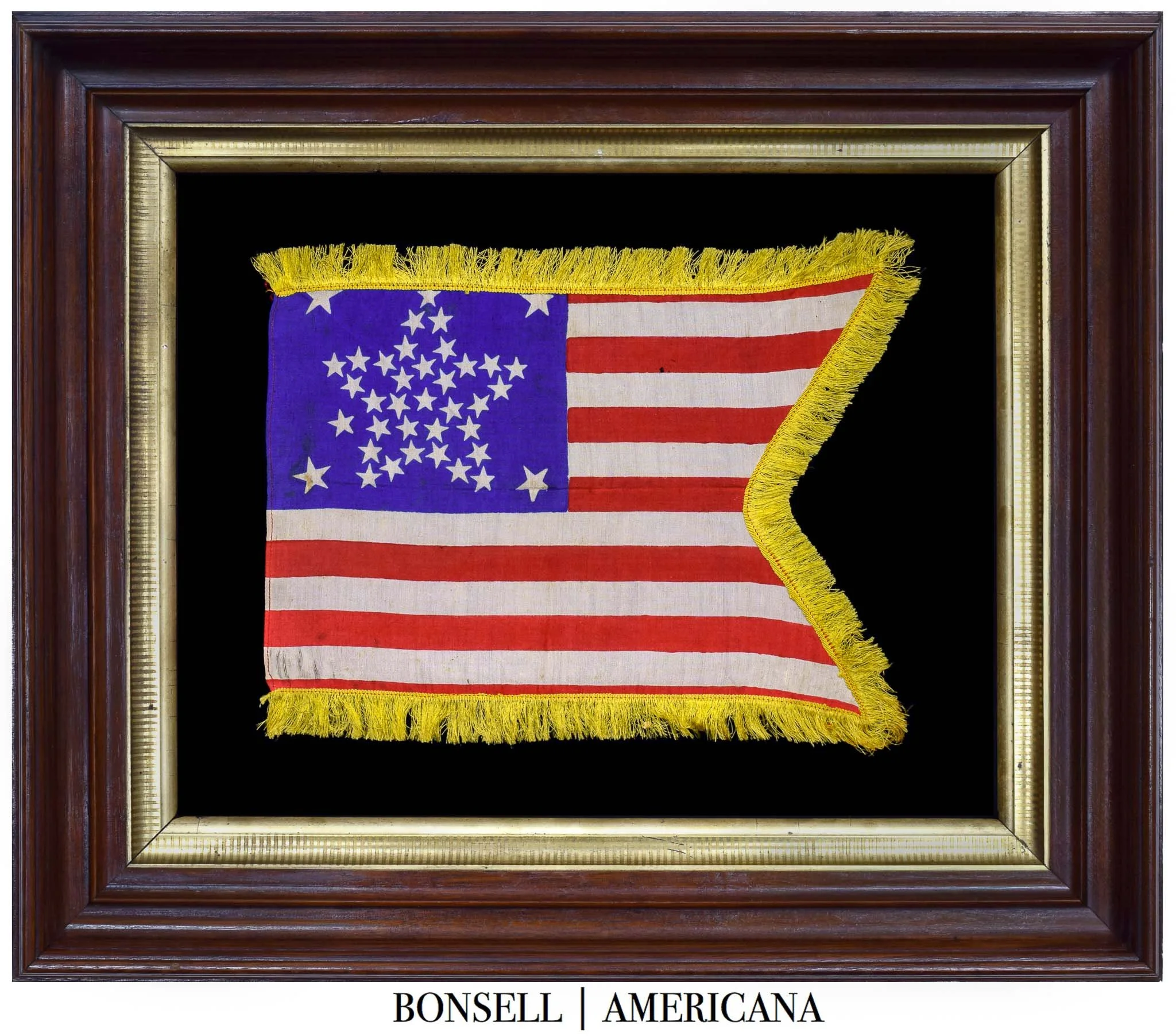
Price: Call 618-553-2291, or email info@bonsellamericana.com
Frame Size (H x L): 17” x 20”
Flag Size (H x L): 8.5” x 11.5”
Offered is a thirty-eight star parade flag. It is printed on silk, and a gold fringe is handsewn thereto. its stars are arranged in a "Great Star" pattern—a configuration that is as rare as it is interesting. This particular Great Star includes twenty-five stars in its outline, eight stars inside of the outline, one star surrounding the outline, and four corner flanking stars. The flanking stars are canted and larger than the others.
US Naval Captain Samuel Reid is credited with designing the Great Star pattern in 1818. Captain Reid was an officer in the US Navy and commanded the privateer General Armstrong during the War of 1812. Andrew Jackson credited Captain Reid's heroism in delaying the British Squadron in the Battle of Fayal, and aiding in General Jackson's defense of New Orleans. Captain Reid and his crew were greeted as heroes.
The Second Flag Act, passed in 1794, stated that the flag would have fifteen stars and fifteen stripes, in response to Vermont and Kentucky being added to the Union. Knowing that this approach would not be sustainable, with Captain Reid's help, Congress passed the Flag Act of 1818, specifying that the flag should only have thirteen stripes, but should have a star for each state admitted to the Union. It further specified that the addition of each star should be on the Fourth of July following its respective state's admission.
Captain Reid played a significant role in the Flag Act of 1818. He recommended a basic design of thirteen horizontal alternating stripes in honor of the thirteen colonies and a star in honor of each state. He further recommended several potential star patterns, including twenty stars in the shape of a larger star for general use. Reid suggested this pattern to make the flag consistent and easily identifiable, particularly at long distances and at sea. His star pattern recommendation was not ultimately included in the Act, nor was any star pattern, but Captain Reid is universally credited with designing the Great Star pattern. Its use peaked in the 1840s, but it was also used during the Civil War and occasionally during Centennial Celebrations. Its last known commercial use was on a thirty-eight star flag.
Perhaps the most interesting feature of this flag is its profile, in that it includes a V-shaped swallowtail. Its swallowtail was inspired by those of U.S. cavalry guidons (i.e., small flags used by cavalry units to mark the flanks). Of the antique flags that enter the market, perhaps one-in-a-thousand include a swallowtail shape at the fly end, making this flag particularly unique, desirable, and visually dramatic.
The thirty-eight star flag represents the inclusion of Colorado to the Union. Colorado was admitted on August 1st, 1876 and this flag became official on July 4th, 1877. Presidents Hayes, Garfield, Arthur, Cleveland, and Harrison all served under this flag. Colorado became known as the “Centennial State,” a result of becoming official just twenty-eight days after the centennial. The official star count for US flags in 1876 was the thirty-seven star flag. However, it was common for flag makers to produce anticipatory flags in advance of their official date, making the thirty-eight star flag—and for historical reasons, the thirteen star flag—the most common flags flown during the centennial celebrations of 1876.
The nation’s centennial in 1876 inspired patriotism across the county and reunited its citizens. Cities of all sizes hosted parades and celebrations, and buildings and homes were canvased in red, white, and blue with flags being the primary symbol of national pride. The most notable celebration was the Centennial International Exposition in Philadelphia. In just six months, the Exhibition hosted nearly 10 million visitors, and included many extraordinary exhibits, including the introduction of the Corliss Steam Engine and Alexander Graham Bell’s telephone.
The thirty-eight star flag was official until July 4th, 1890, the time at which the forty-three star flag became official and began to represent the inclusion of North Dakota, South Dakota, Montana, Washington, and Idaho to the Union.
Conservation Process: This flag was hand sewn to cotton fabric, and both were hand sewn to a mounting board. To prevent the black dye in the cotton fabric from seeping into the flag, it was first washed in a standard wash and then in a dye setting wash. The flag is positioned behind Optium Museum Acrylic.
Frame: This flag is in a multitiered frame with an outer walnut layer and an inner gilded layer. It dates to between 1860 and 1890.
Condition Report: There is some staining. The most notable stain is in the bottom-left corner of the canton. There are a few small holes. The fringe is tattered in places, but only slightly.
Collectability Level: The Best – Perfect for Advanced Collectors
Date of Origin: 1876-1889
Number of Stars: 38
Associated War: The Indian Wars (1860-1890)
Associated State: Colorado
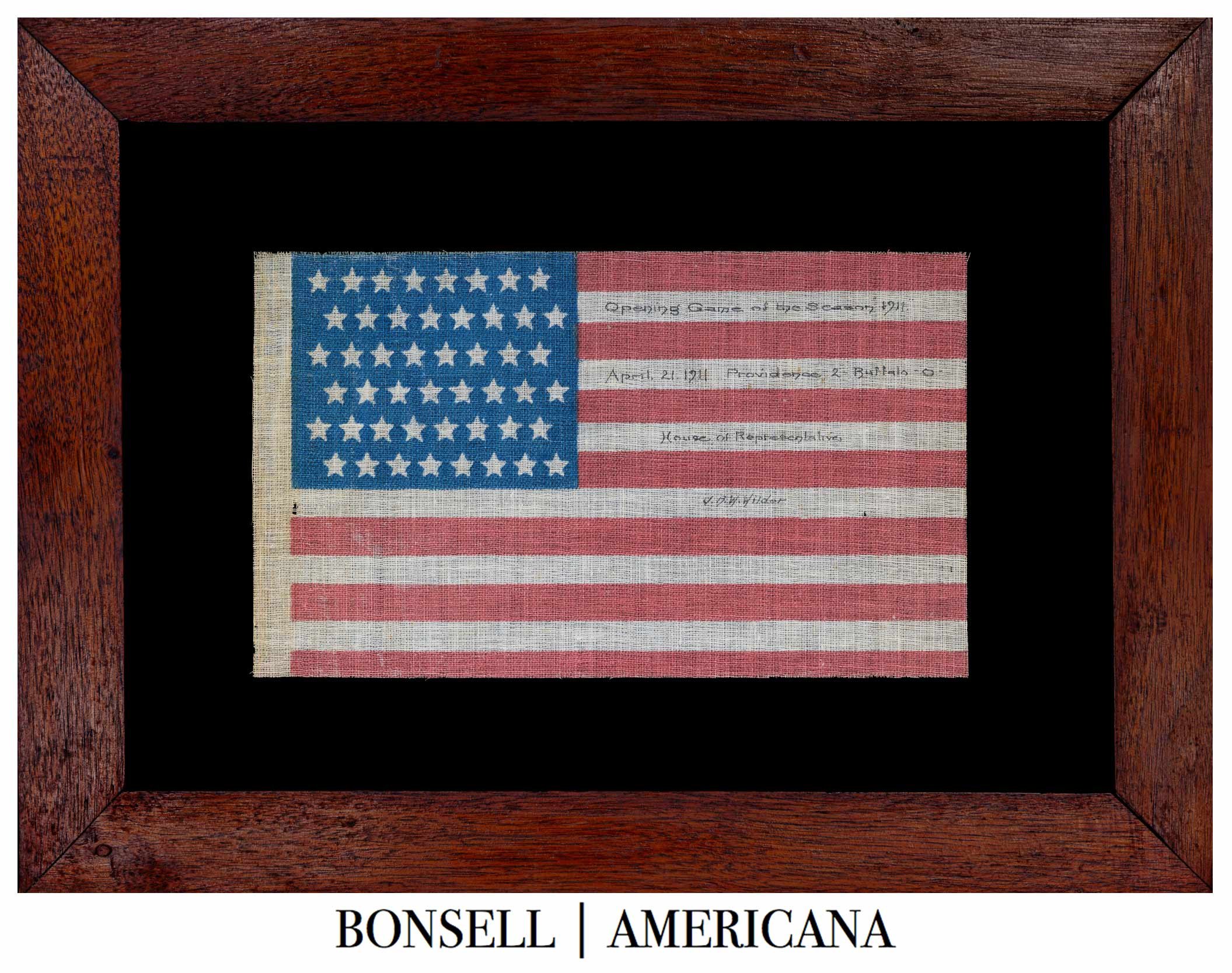
Frame Size (H x L): 12” x 16”
Flag Size (H x L): 6” x 9.75”
Offered is an early-20th-century American flag commemorating the Opening Game of the 1911 Eastern League season, contested between the Providence Grays and the Buffalo Bisons, played on April 21, 1911. The flag documents a specific civic and sporting event and reflects the intersection of professional baseball, state politics, and patriotic display in the early twentieth century.
The flag is printed on glazed cotton, a calendared textile finish that compresses the fibers and produces a slight surface sheen. This finish was commonly used for commemorative and ceremonial flags of the period because it allowed for sharper ink definition and improved durability. The underlying cotton weave remains visible, consistent with commercial flag production of the era. The stars are arranged in a staggered configuration, a layout frequently employed by early-twentieth-century flag makers. While star arrangements were not yet federally standardized, staggered patterns were widely favored for their visual balance and suitability for mechanical printing.
The flag bears a finely printed overprint reading, “Opening Game of the Season 1911,” followed by “April 21, 1911 | Providence 2 | Buffalo 0,” recording the final score of the contest. Beneath this appears the designation “House of Representatives,” followed, on a separate line, by the name “J. B. W. Wilder.” The inclusion of the final score establishes that the flag was produced after the game’s conclusion and functioned as a commemorative record of the event rather than a pre-game or in-stadium distribution. The overprint transforms the flag from a general patriotic textile into a document tied to a specific date, outcome, civic body, and individual.
The text is mechanically printed, but close inspection reveals minor variation among individual letterforms, indicating that the printing derived from a hand-lettered source. This method was common in small-batch commemorative textile production during the early twentieth century, in which lettering was first drawn by hand and then transferred mechanically using a stencil, plate, or roller. The result combines consistent ink application with subtle irregularities characteristic of hand-origin printing. The name and all text appear to be part of the original production and not later additions.
The two clubs represented were among the most established franchises in early twentieth-century minor-league baseball. The Providence Grays traced their origins to the nineteenth century and carried a name associated with Providence’s earlier major-league team of the 1880s, maintaining a strong local following and a reputation for competitive play within the Eastern League. The Buffalo Bisons, likewise, were one of the league’s cornerstone franchises, reflecting Buffalo’s status as a major industrial and transportation center. Both clubs occupied prominent roles within the Eastern League, which at the time was regarded as one of the strongest and most professionally organized minor leagues in the country, frequently serving as a proving ground for players and managers who would later advance to the major leagues.
The April 21, 1911 game marked the Opening Day of the Eastern League season. Contemporary newspaper coverage documents organized ceremonies surrounding the event, including parades, band performances, flag-raising, and the participation of state and municipal officials. In this period, Opening Day baseball games functioned as formal civic occasions as well as sporting contests, particularly in regional and minor-league cities where professional teams were closely tied to local identity and public life.
The name printed on the flag, Jacob B. Wilder, identifies a Rhode Island legislator representing Johnston who was active in state government during the 1910s. Legislative records confirm his service in the Rhode Island General Assembly, including later service in the State Senate. His association with the House of Representatives on this flag aligns with period practices, as legislators commonly served in both chambers over time. Attendance at prominent civic events such as Opening Day baseball games formed part of the public role of state officials, and the presence of Wilder’s name suggests that the flag was either presented to him or retained as a personal record of official participation.
The flag displays a 48-star canton, reflecting the impending admission of Arizona and New Mexico as states. Although the official 48-star flag did not become effective until July 4, 1912, manufacturers frequently anticipated changes in star count, particularly when statehood was imminent. This practice was common in commercial flag production during the late nineteenth and early twentieth centuries, resulting in early examples of new star counts appearing before their official adoption.
Flags with 48-stars occupy a significant place in American flag history. The 48-star design remained the official national flag from 1912 until 1959, making it the longest-used star count in U.S. history. It was the flag flown during World War I, World War II, and throughout the Great Depression. As a result, 48-star flags are closely associated with major national, political, and military developments of the first half of the twentieth century. Early or pre-official examples are of particular interest for their placement within the transitional period preceding federal standardization.
This flag is notable for the way it brings together several distinct aspects of early-twentieth-century American life within a single object. It combines a national flag produced during a transitional moment in federal standardization, a documented professional baseball Opening Day, and the recorded participation of a state legislator and legislative body. In our experience, it is uncommon to encounter a single artifact that so clearly and directly unites patriotic display, organized sport, and political presence. Such objects were not produced in large numbers and rarely survive with this level of specificity. As a result, the flag represents a particularly strong example of Americana, illustrating how baseball, civic ritual, and public office intersected in everyday American culture during the Progressive Era.
Conservation Process: This flag was hand sewn to cotton fabric, and both were hand sewn to a mounting board. To prevent the black dye in the cotton fabric from seeping into the flag, it was first washed in a standard wash and then in a dye setting wash. The flag is positioned behind Optium Museum Acrylic.
Frame: The flag is housed in an antique mahogany frame dating to the mid-19th century, with a flat profile and mitered corners typical of the period. The wood exhibits age-related wear and visible grain, consistent with long-term use, and the straightforward construction reflects utilitarian craftsmanship rather than later decorative styles.
Condition Report: The flag is housed in an antique mahogany frame dating to the mid-19th century, with a flat profile and mitered corners typical of the period. The wood exhibits age-related wear and visible grain, consistent with long-term use, and the straightforward construction reflects utilitarian craftsmanship rather than later decorative styles.
Collectability Level: The Great – Perfect for Rising Collectors
Date of Origin: 1911
Number of Stars: 48
Associated War: WWI
Associated State: Arizona
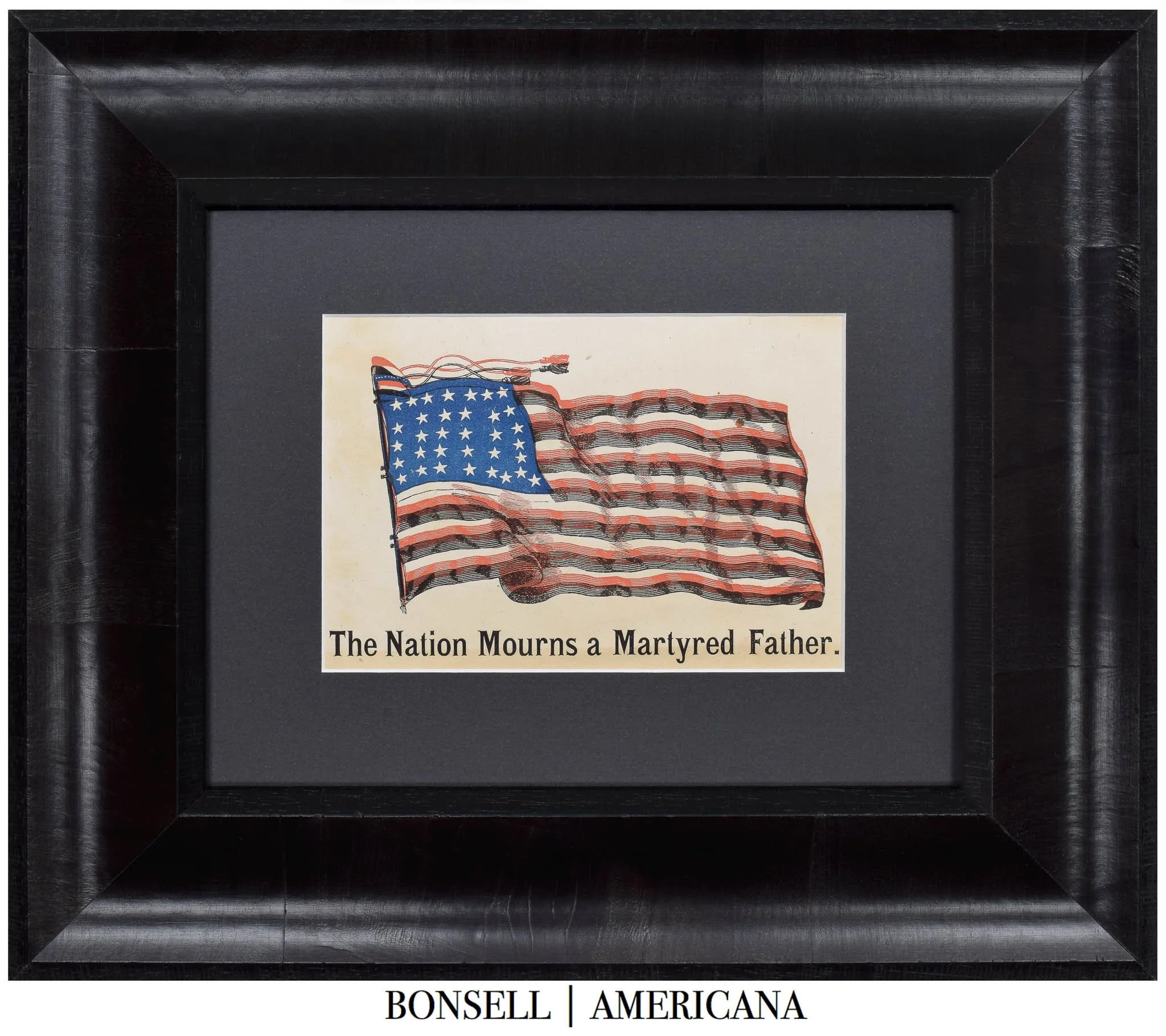
Frame Size (H x L): 12” x 14.25”
Flag Size (H x L): 4.25” x 6.25”
Offered is a paper broadside, featuring a flag and the following overprint: The Nation Mourns a Martyred Father. It was made to mourn the assassination of Abraham Lincoln and was likely handed out along his funeral route.
Flags printed on paper trade cards and broadsides tend to have unusual star patterns, and the flag offered herein aligns with this notion. It includes thirty-four stars that are neither arranged by column; nor by row; nor by concentric rings; nor by any logical manner, for that matter. Rather, the stars are arranged randomly, such that there is no distinct, recognizable pattern. The flag offered herein was made in 1865, even though thirty-four star flags were official only between 1861 and 1863. During the nineteenth century, makers sometimes used greater or fewer stars than the official number of stars, likely because it did not make a big difference to either the maker or the user, just as long as the number was relatively close to what was official.
More unique than the star pattern and count, however, is that the flag includes red, white, and black stripes—a feature that is unique, in our experience, to this broadside. It also includes red; white; and black tassels, flowing horizontally above the blue canton. Per Victorian-era tradition, black was used to show mourning and grief. Thus, following the assassination of Lincoln, everything from buildings, to homes, to outfits, and flags were draped in black (or made to include black, like in the case of the flag offered herein).
Paper mourning flags, made following Lincoln’s assassination, have survived in several different forms with several different overprints. For example, such flags featured in the Stars and Stripes, written by J. Richard Pierce, include the following overprints:
· GOD’S Illustrious Servant! FAITHFUL TO THE END.
· WE MOURN! OUR CHIEF HAS FALLEN.
· WE LOVE HIM—LIVING. WE REVERE HIM—DEAD
· THE NATION MOURNS A MARTYRED FATHER.
Lincoln mourning flags are as rare as these overprints are interesting, and they are a highly desirable subset of antique American flags. They also offer a comparatively affordable entry point into Lincoln related flags, as compared to Lincoln campaign flags, for example.
THE ASSASSINATION
On April 9th, 1865, Confederate General Robert E. Lee surrendered his army at Appomattox Court House, Virginia, ending the Civil War. It was assumed that the country would return to a peaceful state, and that such a return would be relatively swift and widespread. But just five days later, on April 14th, chaos erupted and sadness ensured yet again when John Wilkes Booth—a Confederate Sympathizer and famous actor—assassinated Lincoln at Ford’s Theater in Washington D.C.
Booth was born, in 1838, in Maryland, a state that allowed the slave trade, yet also a state that remained part of the Union. During the 1860s, he was one of America’s best known and most popular stage actors. He had leading roles from New Orleans to Chicago to Boston and many other cities therebetween. He was good looking, he was charming, and he was a heartthrob—so much so that he is thought to be the first actor to ever have his clothes torn off by adoring fans.
Booth hated abolitionists, whom he thought were destroying the country. He considered fighting for the Confederacy, but his mother talked him out of doing so. The guilt associated with staying on the sidelines was overwhelming to him, particularly as the defeat of the South was becoming more and more likely. The guilt was so debilitating that he and a group of associates—in a desperate attempt “to do something”—conspired to kidnap Lincoln, in Richmond, Virginia, the Capital of the Confederacy. They planned to kidnap Lincoln on March 20th, 1865, but their planned attack point never overlapped with his movements. Thus, their plan had been foiled.
Thereafter, Booth and his co-conspirators were growing increasingly desperate and becoming increasingly sinister, so much so that they pivoted their plan from kidnapping Lincoln to killing him. Booth saw an opening in which to assassinate Lincoln, after learning that Lincoln would attend Laura Keene’s performance of “Our American Cousin” at Ford’s Theatre. In coordination therewith, Booth’s associate, George Atzerodt, planned to kill Vice President Andrew Johnson at the Kirkwood Hotel, and Booth’s associates, Lewis Powell and David Herold, planned to kill Secretary of State William H. Seward at his home, the thinking being that killing Lincoln and his possible successors would throw the U.S. government into chaos. These two subplots were failures: Seward was only wounded, and Johnson was spared entirely as his would-be attacker lost his nerve.
Lincoln and Mary Todd Lincoln arrived late for the show, but even so, witnesses reported that Lincoln was happy, relaxed, and laughing throughout the production. They sat in a private box above the stage, along with Henry Rathbone, a young army officer, and Clara Harris, Rathbone’s fiancé and daughter of New York Senator Ira Harris.
At 10:15, Booth slipped into Lincoln’s private box and shot him in the head, using a .44-caliber derringer pistol and just a single shot therefrom. Rathbone rushed Booth. Booth countered by stabbing Rathbone in the shoulder. Booth then jumped out of the box and onto the stage. He broke his leg upon his landing and then shouted the Latin phrase “sic semper tyrannis,” which translates to “thus always to tyrants” in English, which translates to “I bring death to tyrants” in plain English. The audience initially thought that commotion was part of the production, but Mary Todd’s screams quickly suggested otherwise. Immediately thereafter, Booth left the theater and escaped by horseback. Despite this all happening in just seconds, many in the audience were still able to recognize the assassin as Booth, due to his widespread fame.
LINCOLN’S DEATH
After Lincoln was shot, Charles Leale, a young doctor who was in the audience, rushed to his side and found him slumped in his chair, unable to move, and struggling to breath. Soldiers carried Lincoln to a boardinghouse across from the theater and placed him into a bed. The surgeon general rushed to the boardinghouse, only to determine that Lincoln would die, likely sometime in the night.
Vice President Andrew Johnson, members of Lincoln’s cabinet, and several of Lincoln’s friends stood at his bedside. Mary Todd was in bed, in an adjoining room, overwhelmed with shock and grief, while Robert Todd, her eldest son, stood by her side in support. Lincoln died at 7:22 A.M. on April 15th. He was 56 years old.
BOOTH’S CAPTURE AND DEATH
On April 26th, Union soldiers found Booth and David Herold, an accomplice, in a Virginia barn. The soldiers set the barn on fire, the purpose being to flush them from the barn and to capture them. Indeed, Herold surrendered. But in contrast, Booth stayed in the barn and allegedly raised his gun to shoot at the surrounding soldiers. To counter, one of the soldiers shot Booth in his neck. Thereafter, the soldiers carried Booth from the barn. He died just three hours later, but not before gazing at his hands and uttering his last words, “useless, useless.”
MOURNING LINCOLN
The news of Lincoln’s death spread like wildfire and sent shockwaves through the nation. By the end of April 15th, flags were at half-mast, the country was shut down, and the jubilee associated with the War’s end was replaced with the mourning associated with Lincoln’s assassination. Also, by the end of April 15th, Lincoln’s body was back at the White House, specifically in the East Room thereof for several days of public viewing. On April 19th, there was a funeral service and, thereafter, his body was transported down Pennsylvania Avenue and placed in the Capitol Rotunda for further viewings and services.
On April 21st, the honor guard took Lincoln’s body to the train depot, and the train then departed from Washington D.C. with 10,000 people in attendance, including cabinet secretaries, Edwin Stanton, Gideon Welles, Hugh McCulloch, and John Palmer Usher; the Commanding General of the U.S. Army, Ulysses S. Grant; and the Quartermaster General, Montgomery C. Meigs. The last stop on the train route was Springfield, Illinois, Lincoln’s hometown. The trip thereto generally traced (in reverse) Lincoln’s route, from Springfield to Washington, in 1860, to attend fist first inauguration.
In total, citizens observed, honored, and mourned Lincoln along 1,654 miles of track and at stops in Washington D.C.; Baltimore, Maryland; Harrisburg, Pennsylvania; Philadelphia, Pennsylvania; New York City; Albany, New York; Buffalo, New York; Cleveland, Ohio; Columbus, Ohio; Indianapolis, Indiana; Michigan City, Indiana; Chicago, Illinois; Springfield, Illinois. Lincoln’s funeral train was the first commemoration of a president’s death via rail.
THIRTY-FOUR STAR FLAGS GENERALLY
The thirty-four star flag represents the inclusion of Kansas to the Union. Kansas was admitted on January 29th, 1861, and this flag became official on July 4th, 1861. President Lincoln served, and the Civil War was fought, under this star count. Many thirty-four star flags predate the first shots of the Civil War in 1861, as flag makers began producing them upon the admission of the Kansas, instead of the time at which the flag was officially admitted to the Union later in the same year. The thirty-four star flag was official until July 4th 1863, the time at which the thirty-five star flag became official and began to represent the inclusion of West Virginia in the Union.
Thirty-four and thirty-five star flags were the official flags for the majority of the Civil War, and for this reason, both are extremely collectible. Flags associated with this time period (1861-1865) and earlier are among the rarest and most desirable of all US flags. Prior to the Civil War, Americans did not typically display flags for patriotic purposes. In fact, even the military did not regularly use the flag, as it was not until 1834 that the army field artillery was permitted to carry the traditional US flag, and not until 1841 that regiments carried it. Instead, most flags prior to the Civil War were used to mark ships, and were massive in scale so as to be seen from large distances. The surge in small US flags for patriotic purposes began primarily with onset of the Civil War.
Conservation Process: The flag is mounted behind a mat and Optium Museum Acrylic.
Frame: The flag offered herein is in an outstanding, modern black frame.
Condition Report: There is some age-appropriate toning. Overall, the flag is in excellent condition.
Collectability Level: The Great – Perfect for Rising Collectors
Date of Origin: 1865
Number of Stars: 34
Associated War: The Civil War (1861-1865)
Associated State: Kansas
Price: Call 618-553-2291, or email info@bonsellamericana.com
Frame Size (H x L): 13” x 20”
Pennant Size (H x L): 4 ¾” x 11 ½”
Offered is a striking Texas Centennial pennant dating to 1936, printed on felt and featuring bold western imagery associated with the celebration of the 100th anniversary of Texas independence. The pennant is rendered in a warm red-orange field with a contrasting yellow hoist, while the graphics are printed primarily in white, yellow, and red.
The design is dominated by the words “TEXAS CENTENNIAL” in large white block lettering, immediately identifying the piece with the statewide centennial celebration. To the left is a dramatic image of a cowboy riding a bucking bronco, an especially appropriate motif for an event that leaned heavily into Texas history, ranching culture, and the mythology of the American West. Beneath the horse appears the printed phrase “BUCKING BRONCHO,” while a yellow five-pointed star carries the date “1936.” Together, the typography and imagery give the pennant the unmistakable visual character of 1930s exposition and souvenir material.
The Texas Centennial commemorated the 100th anniversary of Texas independence in 1836. Although events were held throughout the state, the centerpiece was the Texas Centennial Exposition in Dallas, which opened at Fair Park in June 1936. The exposition combined Texas history with an emphasis on modernization, industry, culture, and progress, drawing millions of visitors during its run.
The celebration was far larger than a single fair. Centennial projects and events took place throughout Texas, resulting in new museums, monuments, restored historic sites, and commemorative buildings. The effort was both historical and promotional, presenting Texas as a place with a distinctive past and an ambitious future.
Souvenir pennants such as this were especially well suited to large public celebrations of the era. Made inexpensively from felt, they could incorporate colorful printed graphics and be easily carried home by visitors. Their imagery often distilled an event into a handful of immediately recognizable symbols. Here, the cowboy, bucking horse, star, and oversized Texas lettering present an idealized vision of the state that would have been immediately recognizable to visitors in 1936.
More than simply a Texas souvenir, the pennant is a colorful surviving artifact from one of the state's largest commemorative events of the 20th century. Its strong period graphics, western imagery, and prominent Centennial lettering make it an especially appealing example of Texas exposition material from 1936.
Conservation Process: This pennant was hand sewn to cotton fabric, and both were hand sewn to a mounting board. To prevent the black dye in the cotton fabric from seeping into the pennant, it was first washed in a standard wash and then in a dye setting wash. The pennant is positioned behind Optium Museum Acrylic.
Frame: The pennant is housed in a wide, rustic wood frame with a dark brown finish that allows the natural grain to remain clearly visible.
Condition Report: The pennant is in good overall condition, with age-related fading, mottling, and scattered discoloration throughout the felt. The printed graphics and lettering remain strong and readily legible, with only minor surface wear and softening along the edges consistent with age.
Collectability Level: The Good – For Beginners and Gifts
Date of Origin: 1936