
Frame Size (H x L): 20” x 17”
Pennant Size (H x L): 11.5” x 8.5”
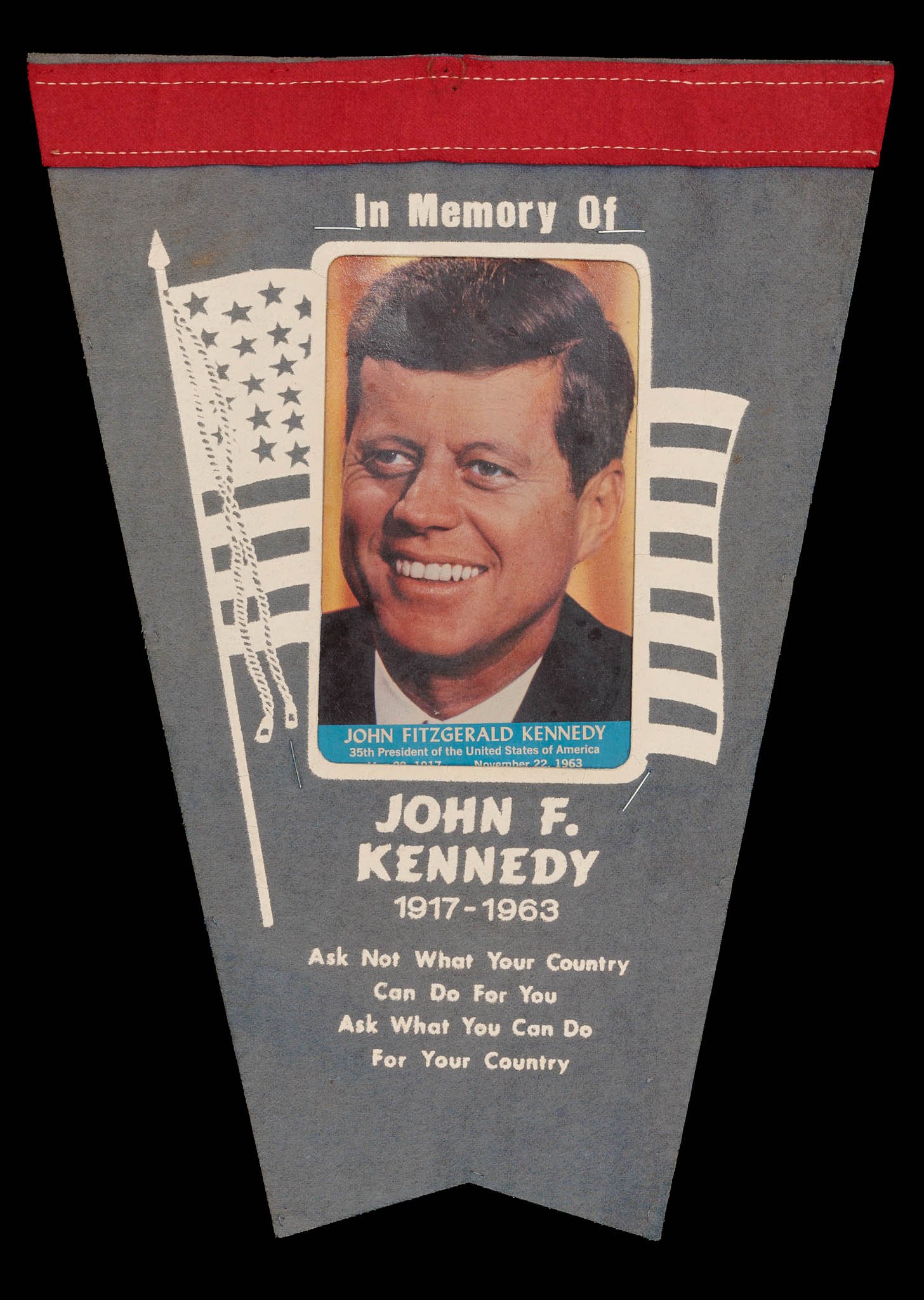
Offered is a memorial pennant honoring John F. Kennedy, the 35th President of the United States, produced in the wake of his assassination in 1963. Made primarily of felt, the pennant combines a photographic portrait of Kennedy with patriotic imagery, memorial inscriptions, and words from his inaugural address. The result is an especially graphic example of the enormous body of commemorative material created following his death.
At center is a color portrait of Kennedy, smiling and facing slightly to the viewer's left. Behind the image is a stylized American flag, while the words “In Memory Of” appear prominently above. Below, the pennant identifies “John F. Kennedy, 1917–1963,” followed by the familiar words associated with his presidency: “Ask Not What Your Country Can Do For You / Ask What You Can Do For Your Country.” The red binding across the top provides a strong contrast to the otherwise gray, black, white, and muted-color composition.
The quotation is drawn from Kennedy's inaugural address of January 20, 1961. Near the conclusion of the speech, Kennedy called upon Americans to participate actively in the life of the nation and framed public service as an obligation of citizenship. The passage quickly became one of the most recognizable statements of his presidency, making its inclusion on a memorial object particularly appropriate.
Kennedy entered the White House at age 43 following the closely contested 1960 election and served from January 1961 until his assassination in Dallas, Texas, on November 22, 1963. His administration coincided with an especially consequential period of the Cold War and included the Bay of Pigs invasion, the Cuban Missile Crisis, the creation of the Peace Corps, growing federal involvement in the civil rights struggle, and an expanded national commitment to space exploration. In March 1961, Kennedy established the Peace Corps by executive order, and in May of that year he called for the United States to land a man on the Moon before the decade's end.
Kennedy’s assassination prompted a broad national outpouring of grief and a wide range of memorial objects, including photographs, buttons, banners, and pennants such as this.
This example combines several elements closely associated with Kennedy’s memory: a youthful photographic portrait, patriotic American flag imagery, and the well-known quotation from his inaugural address. Together, they make the pennant a distinctive piece of period presidential memorabilia and a reflection of how Kennedy was commemorated following his death in 1963.
Conservation Process: This pennant was hand sewn to cotton fabric, and both were hand sewn to a mounting board. To prevent the black dye in the cotton fabric from seeping into the pennant, the fabric was first washed in a standard wash and then in a dye setting wash. The pennant is positioned behind Optium Museum Acrylic.
Frame: The pennant is housed in a black frame with deeply stepped molding and a narrow silver-toned inner liner.
Condition Report: The pennant is in very good overall condition, with light surface soiling, minor discoloration, and small areas of wear consistent with age and use. The felt remains well preserved, with strong graphics and lettering, while the applied photographic portrait shows light edge wear and is secured with visible staples. The red top binding remains intact, with only minor waviness and wear.
Collectability Level: The Good – Perfect for Beginning Collectors and Gifts
Date of Origin: 1963
Frame Size (H x L): 31.5” x 21.5”
Pennant Size (H x L): 6.25” x 10” and Affixed to an 18” Staff
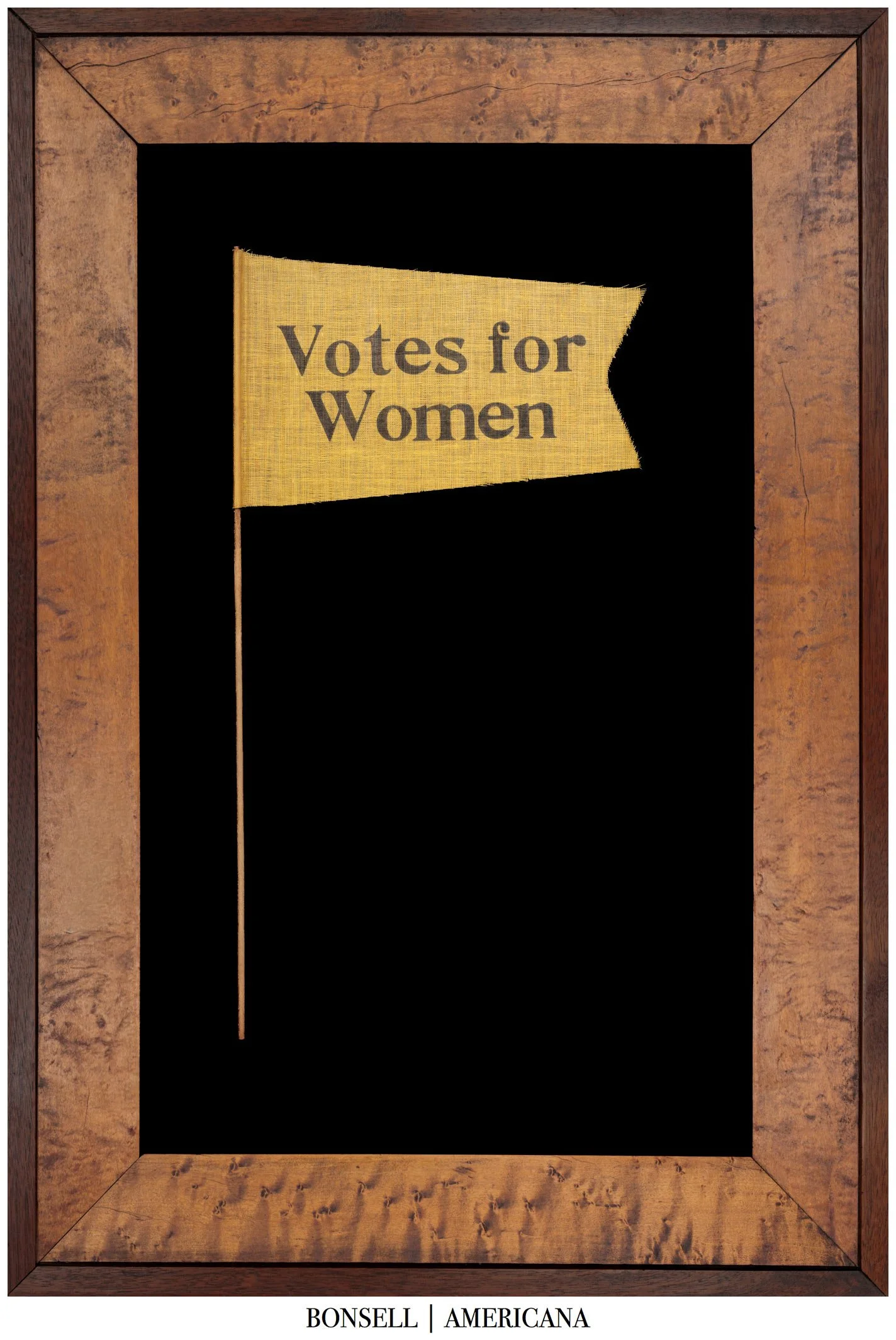
Offered is an American women’s suffrage pennant advocating “Votes for Women.” The pennant is made of cotton and constructed in a swallowtail form, a shape commonly used for political and reform-related textiles in the late-19th and early-20th centuries. The field is yellow, with the slogan printed in black across the surface. The pennant remains affixed to its original wooden staff.
Yellow was the primary color associated with the women’s suffrage movement in the United States and was widely adopted by suffrage organizations beginning in the late-19th century. It was frequently paired with black to create a bold, high-contrast design that could be read easily during marches, meetings, and public demonstrations. Pennants and related textiles were produced for active use and functioned as direct statements of political purpose.
The organized movement for women’s voting rights in the United States is generally traced to 1848, when Lucretia Mott and Elizabeth Cady Stanton convened the first women’s rights convention in Seneca Falls, New York. That meeting produced the Declaration of Sentiments, a document asserting women’s claims to political equality, education, and employment. Over the following decades, the movement expanded through conventions, lectures, and organized advocacy.
In 1906, Harriot Stanton Blatch—daughter of Elizabeth Cady Stanton—founded the Equality League of Self-Supporting Women, later renamed the Women’s Political Union. This organization focused on mobilizing working-class women and increasing the public visibility of the suffrage movement. In 1910, the group organized the first large-scale suffrage march in the United States, held in New York City. Textiles such as pennants and banners were used extensively during this period to convey clear, readable messages during marches and public gatherings.
Although early efforts focused on securing voting rights at the state level, it became increasingly clear that a constitutional amendment was necessary to guarantee suffrage nationwide. Proposed amendments were introduced in Congress in 1878 and again in 1914, but both attempts failed. Momentum shifted during and after World War I, when women’s contributions to the war effort helped secure bipartisan political support. In January 1918, the House of Representatives approved a suffrage amendment by the required two-thirds majority, followed by Senate approval in June 1919.
On August 18, 1920, Tennessee became the thirty-sixth state to ratify the amendment, providing the necessary three-quarters majority of states. Eight days later, on August 26, 1920, the Nineteenth Amendment was formally adopted into the Constitution, stating:
“The right of citizens of the United States to vote shall not be denied or abridged by the United States or by any State on account of sex. Congress shall have power to enforce this article by appropriate legislation.”
Surviving suffrage pennants are uncommon, particularly examples that retain their original staff and exhibit strong color and legibility. Pieces such as this were produced for use in marches, meetings, and public demonstrations and reflect the material culture of the American women’s suffrage movement.
Conservation Process: This pennant was hand sewn to cotton fabric, and both were hand sewn to a mounting board. To prevent the black dye in the cotton fabric from seeping into the pennant, it was first washed in a standard wash and then in a dye setting wash. The pennant is positioned behind Optium Museum Acrylic.
Frame: The pennant is housed in an impressive antique frame featuring a broad birdseye maple interior molding surrounded by a darker hardwood outer border, which appears more consistent with walnut than mahogany. The contrasting woods, veneered construction, and restrained mitered profile are characteristic of 19th-century American framing, and the frame likely dates to the mid-to-late 1800s.
Condition Report: The pennant remains in very good overall condition, with strong yellow coloration and clear, legible black lettering. There is expected fraying and minor loss along the outer edges, particularly at the swallowtail end, along with light surface wear consistent with age and use. The staff remains intact and is original to the pennant.
Collectability Level: The Great – Perfect for Rising Collectors
Date of Origin: 1910-1920
Price: Call 618-553-2291, or email info@bonsellamericana.com
Frame Size (H x L): 9” x 32 ½”
Textile Size (H x L): 1 ¼” x 25 ½”
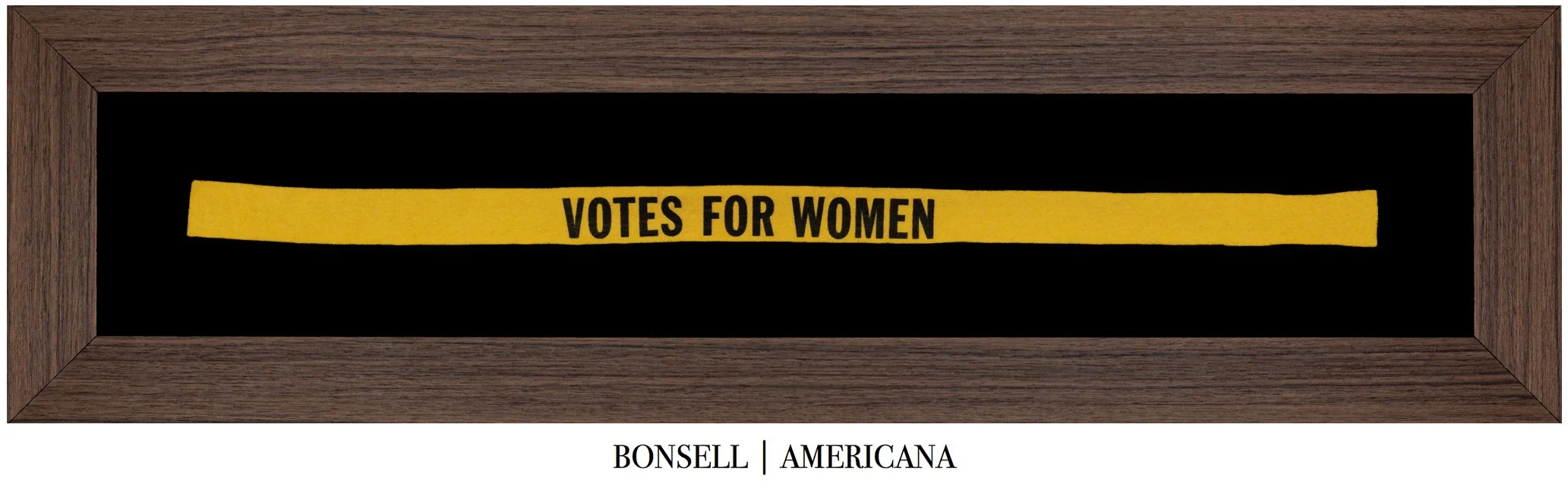
Offered is a rare “VOTES FOR WOMEN” suffrage armband, fashioned from yellow felt with bold black lettering. Bands of this form were worn around the arm and, in some instances, around a hat, providing supporters with a simple and highly visible way to identify themselves with the women’s suffrage movement. The direct slogan, strong contrast, and unmistakable yellow-and-black color scheme made pieces such as this particularly effective at rallies, conventions, parades, and other public demonstrations.
Yellow became one of the most recognizable colors associated with the American women’s suffrage movement. Its use can be traced to the campaign for suffrage in Kansas in 1867, where the sunflower—Kansas’s state flower—was adopted as a symbol by supporters. The color was later embraced by major national suffrage organizations and appeared extensively on banners, ribbons, sashes, pennants, buttons, and other campaign material. Yellow was frequently paired with black lettering, as seen here, producing a combination that was both visually striking and easily legible from a distance.
The organized American women’s rights movement is generally traced to the Seneca Falls Convention of 1848, organized principally by Elizabeth Cady Stanton and Lucretia Mott. The convention produced the Declaration of Sentiments, modeled in part on the Declaration of Independence, which outlined a broad series of grievances regarding the legal, political, educational, and economic status of women. Among its most consequential demands was the assertion that women should possess the right to vote.
Over the following decades, suffrage advocates organized conventions, petition drives, speaking tours, publications, marches, and political campaigns throughout the country. Progress initially came largely on a state-by-state basis, particularly in the West, where a number of states enfranchised women before a federal amendment was adopted. At the same time, national organizations increasingly focused their efforts on securing an amendment to the United States Constitution that would prohibit the denial of voting rights on the basis of sex.
A federal women’s suffrage amendment was first introduced in Congress in 1878. For decades it failed to receive sufficient support, despite the increasingly organized efforts of suffragists across the country. By the 1910s, however, the movement had gained substantial political momentum. Highly visible demonstrations, coordinated lobbying campaigns, and the prominent role played by women during World War I helped place suffrage at the center of national political debate.
The proposed amendment passed the House of Representatives on May 21, 1919, followed by the Senate on June 4. It was then submitted to the states for ratification. On August 18, 1920, Tennessee became the 36th state to ratify the amendment, providing the three-fourths majority then required. The 19th Amendment was formally certified on August 26, 1920, declaring:
“The right of citizens of the United States to vote shall not be denied or abridged by the United States or by any State on account of sex.”
Small wearable textiles such as this armband represent the public-facing side of the suffrage campaign. Unlike formal banners intended for organizational headquarters or large demonstrations, armbands and hatbands could be worn directly by individual supporters, effectively turning the wearer into a moving advertisement for the cause. Their relatively ephemeral nature also contributes to their scarcity today, as pieces made for active campaign use were far less likely to be preserved than medals, buttons, or printed ephemera.
With its bold “VOTES FOR WOMEN” message and classic yellow-and-black suffrage coloration, this is an excellent surviving example of the material culture produced during one of the most consequential political reform movements in American history.
Conservation Process: This armband was hand sewn to cotton fabric, and both were hand sewn to a mounting board. To prevent the black dye in the cotton fabric from seeping into the armband, it was first washed in a standard wash and then in a dye setting wash. The armband is positioned behind Optium Museum Acrylic.
Frame: The armband is presented in a flat-profile dark walnut frame with a clean, understated finish.
Condition Report: The armband remains in excellent condition, with exceptionally strong yellow coloration and crisp, bold black lettering. The felt is remarkably well preserved, showing only the slightest age-related surface variation and no significant staining, losses, or damage.
Collectability Level: The Great – Perfect for Rising Collectors
Date of Origin: 1910-1920
Price: Call 618-553-2291, or email info@bonsellamericana.com
Frame Size (H x L): 30.5” x 19”
Pennant Size (H x L): 17” x 8.25” with 4.75” ties
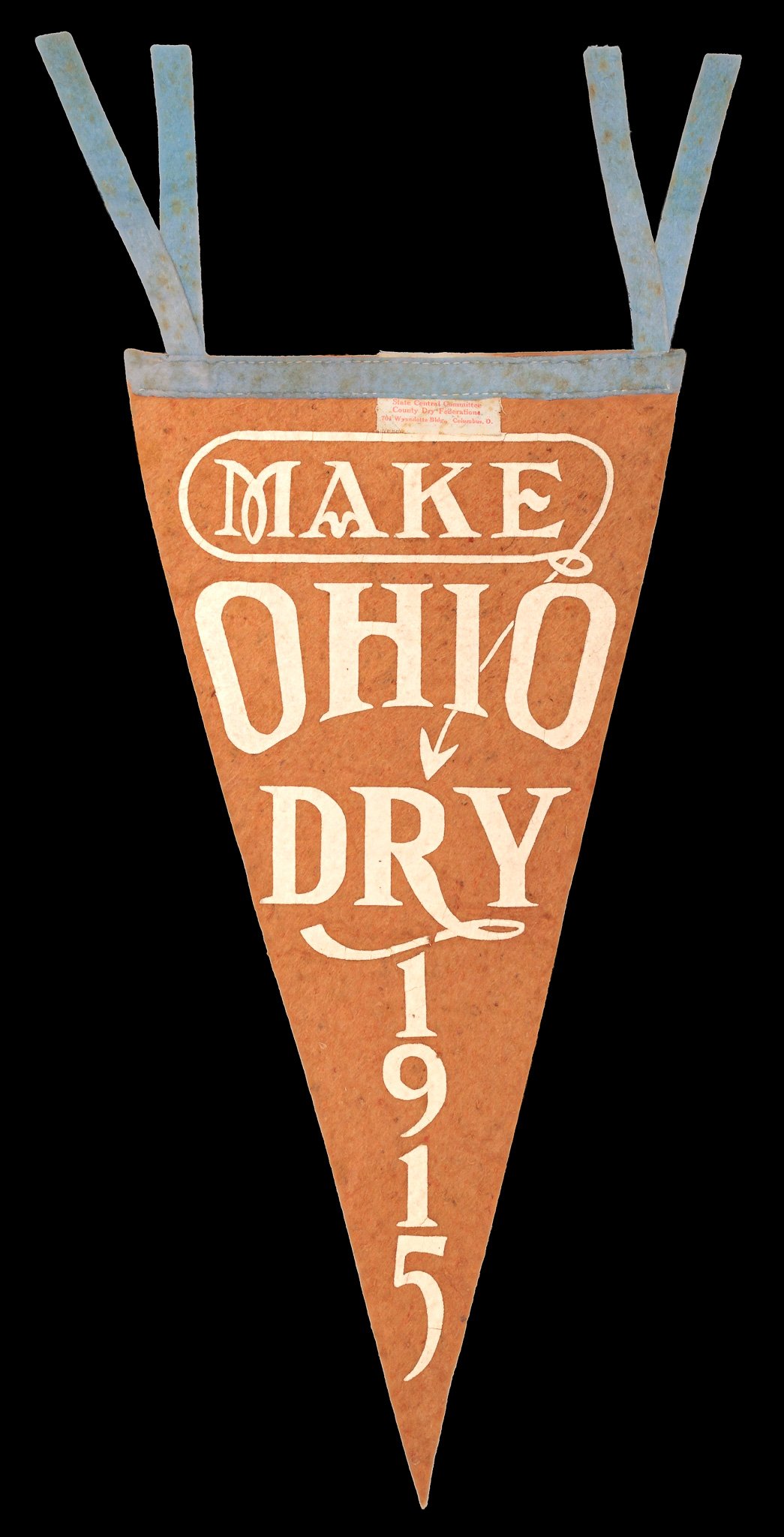
Offered is a rare political campaign pennant produced for Ohio's landmark 1915 statewide prohibition referendum, boldly printed "MAKE OHIO DRY 1915" in white lettering against an orange wool felt field. The pennant is of classic early twentieth-century construction, with a tapered felt body, stitched blue felt binding across the hoist, and matching blue felt ties designed for attachment to clothing, a vehicle, or display at rallies and public gatherings. Intended as a highly visible campaign accessory, it represents one of the more recognizable surviving slogans associated with Ohio's statewide prohibition movement.
The pennant survives with two original identifying labels, an unusual and important feature that documents both the organization responsible for the campaign and the Columbus firm that produced or supplied the piece. Sewn beneath the blue felt binding on the front is a printed label reading:
State Central Committee
County Dry Federations
701 Wyandotte Bldg.
Columbus, O.
Rather than identifying a commercial maker, this label attributes the pennant to the statewide committee representing Ohio's network of County Dry Federations. Contemporary records confirm that county dry federations operated throughout Ohio during this period, bringing together churches, temperance organizations, civic leaders, and local supporters in a coordinated effort to secure statewide prohibition. While the Ohio Anti-Saloon League remained the movement's best-known organization, period publications demonstrate that the statewide campaign functioned as a broad coalition of cooperating groups rather than a single organization acting alone. The committee headquartered in Columbus coordinated these county organizations during the statewide referendum campaign of 1915.
The Columbus address itself is noteworthy. The committee occupied offices in the Wyandotte Building, one of the city's most prominent commercial office buildings. Completed in 1898 and designed by Daniel Burnham & Company, the steel-frame structure was Columbus's first skyscraper and remained among the city's premier business addresses during the early twentieth century. Housing the campaign headquarters in the Wyandotte Building reflects the organized, professional character of the prohibition movement, which by 1915 had developed an extensive statewide administrative structure capable of coordinating thousands of local volunteers and supporters.
Equally important is the original label retained on the reverse, identifying:
Shipley & Company
Advertising Specialists
Columbus, Ohio
Contemporary Columbus city directories and period advertising establish Shipley & Company as one of the city's leading advertising specialty firms. The company supplied a remarkably broad range of custom promotional merchandise, including banners, badges, calendars, celluloid novelties, leather goods, metal souvenirs, and other advertising specialties produced for businesses, civic organizations, and political campaigns. Their own advertising promoted custom souvenirs among their principal offerings, making the firm a logical supplier for campaign material such as this pennant. The presence of both original labels provides an uncommon level of documentation, identifying not only the organization responsible for distributing the pennant but also the Columbus advertising firm that produced or supplied it.
The campaign represented by this pennant sought to unite a diverse cross-section of Ohio society. Contemporary publications identify ministers, businessmen, educators, farmers, labor representatives, members of the Woman's Christian Temperance Union, and other civic leaders among those directing the statewide effort. One such figure was Worthington Kautzman of Columbus, a prominent businessman and former Adjutant General of Ohio, whose name appears in contemporary campaign literature associated with the movement. Rather than functioning as a narrow political organization, the campaign emphasized cooperation among the various "dry" organizations operating throughout the state, a theme repeatedly stressed in contemporary publications.
The significance of this pennant extends beyond the unsuccessful referendum of 1915. Although Ohio voters rejected the proposed constitutional amendment that November, the campaign itself did not end. Instead, the statewide organization remained intact, retaining the familiar "Make Ohio Dry" slogan and continuing under campaign manager James A. White. Publications issued by the Ohio Dry Federation in 1917 demonstrate the direct continuation of the movement, describing the cooperation between county chairmen, the Ohio Dry Federation, and the Ohio Anti-Saloon League as they prepared a renewed statewide campaign. That effort proved successful. In November 1918, Ohio voters approved statewide prohibition legislation, making Ohio a dry state months before national prohibition took effect. The following January, Ohio became one of the states to ratify the Eighteenth Amendment to the United States Constitution, helping secure the national prohibition of intoxicating liquor, which went into effect on January 17, 1920.
As a result, this pennant represents more than a souvenir of a single political campaign. It is an artifact from the opening phase of the movement that ultimately transformed Ohio law and contributed directly to one of the most significant constitutional changes in American history. Political textiles documenting statewide reform campaigns are encountered far less frequently than those associated with presidential elections, and examples retaining original organizational and maker's labels are rarer still. Combining bold graphic appeal with exceptional historical documentation, this is an outstanding surviving example from Ohio's determined campaign to "Make Ohio Dry."
Conservation Process: This pennant was hand sewn to cotton fabric, and both were hand sewn to a mounting board. To prevent the black dye in the cotton fabric from seeping into the pennant, it was first washed in a standard wash and then in a dye setting wash. The pennant is positioned behind Optium Museum Acrylic.
Frame: The pennant has been presented in an Italian molding with a broad, flat profile and a satin black finish. Crisp, clean lines and gently beveled inner and outer edges lend the frame a refined, understated appearance that complements the textile without competing for attention.
Condition Report: There is modest, expected wear from age and use, accompanied by scattered soiling and oxidation throughout the felt, particularly along the blue binding and ties. Minor age-related crazing is present in the printed white lettering, with light surface wear elsewhere, while the original organizational label remains intact. Despite this honest wear, the pennant retains outstanding visual impact and displays exceptionally well.
Collectability Level: The Great – Perfect for Rising Collectors
Date of Origin: 1915
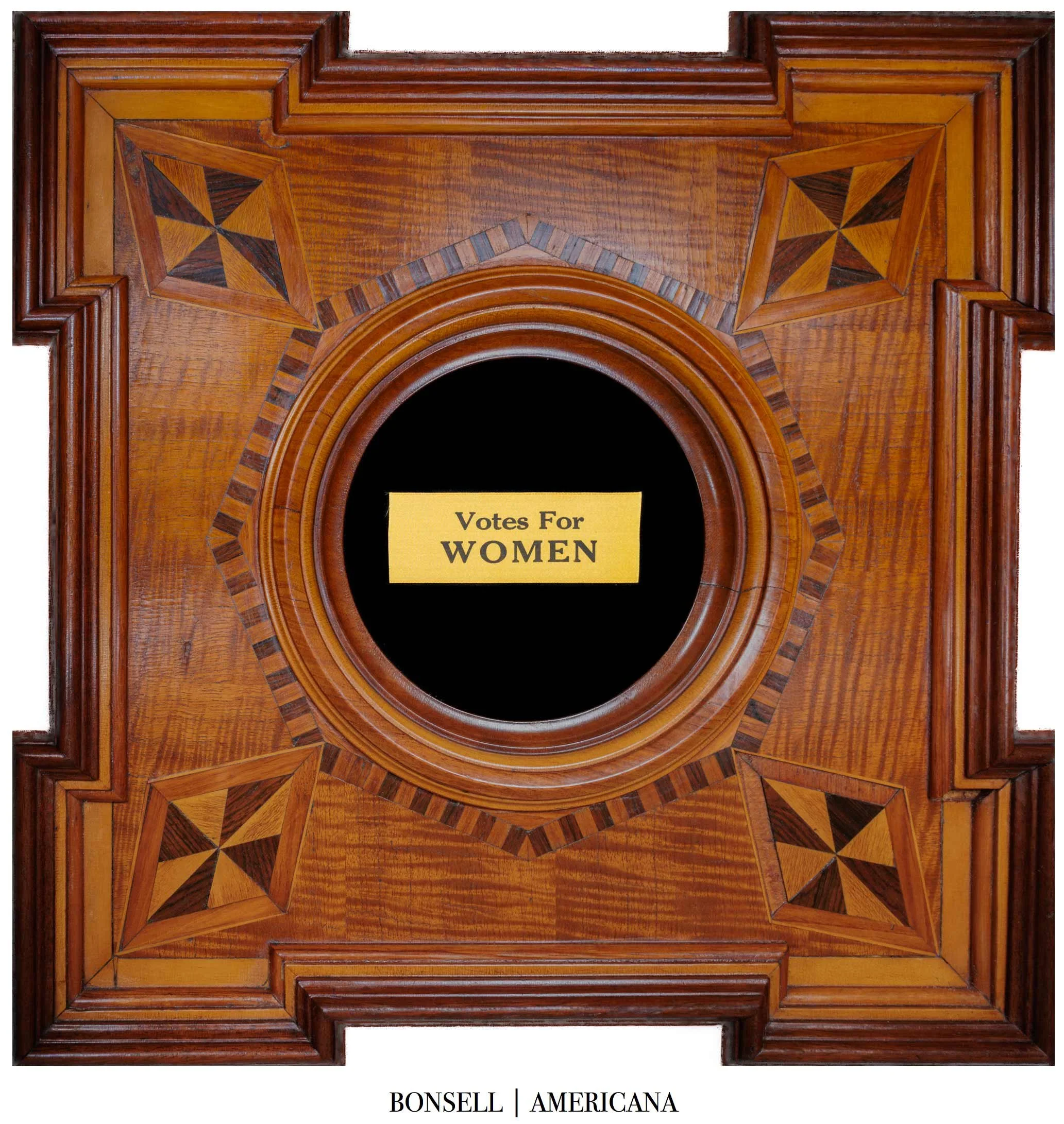
Frame Size (H x L): 17” x 17”
Textile Size (H x L): 1.5” x 3.5”
Offered is a rare “Votes for Women” ribbon. The field is yellow, and the verbiage is in all black caps. Yellow was the primary color in the women’s suffrage movement in the US, and was combined with various other colors, though in most instances was combined with black. In England, violet and green were the primary colors.
In 1848, Lucretia Mott and Elizabeth Cady Stanton organized the first women’s rights convention in Seneca Falls, New York. As a result of this meeting in Stanton’s hometown, the document containing a declaration for women’s suffrage, right to education, and right to employment was drafted. Over the next 50 years, numerous women’s conventions were hosted to bring strength to the movement in masses.
Though initially targeted as a state-by-state movement, it was ultimately recognized that only an amendment to the Constitution would grant all women the right to vote. Amendments were introduced in 1878 and 1914, both of which were defeated. By 1918, both political parties were committed to women’s suffrage, in part based on the major role women played in World War I. As such, in January of 1918 and June of 1919, an amendment was passed by two-thirds majorities in the House and Senate, respectively. On August 18th, 1920, Tennessee became the 36th state to ratify the amendment, giving the two-thirds of state legislators necessary to ratify the amendment. On August 26th, the Nineteenth Amendment became part of the Constitution, and read as follows:
The right of citizens of the United States to vote shall not be denied or abridged by the United States or by any State on account of sex. Congress shall have power to enforce this article by appropriate legislation.
Conservation Process: This ribbon was hand sewn to cotton fabric, and both were hand sewn to a mounting board. To prevent the black dye in the cotton fabric from seeping into the ribbon, it was first washed in a standard wash and then in a dye setting wash. The ribbon is positioned behind Optium Museum Acrylic.
Frame: The frame dates to approximately 1890. It is multi-tiered and made of mahogany, oak, and maple. It is a frame of the highest quality.
Condition Report: This ribbon is in excellent condition.
Collectability Level: The Good – Perfect for Beginning Collectors and Gifts
Date of Origin: 1913-1920
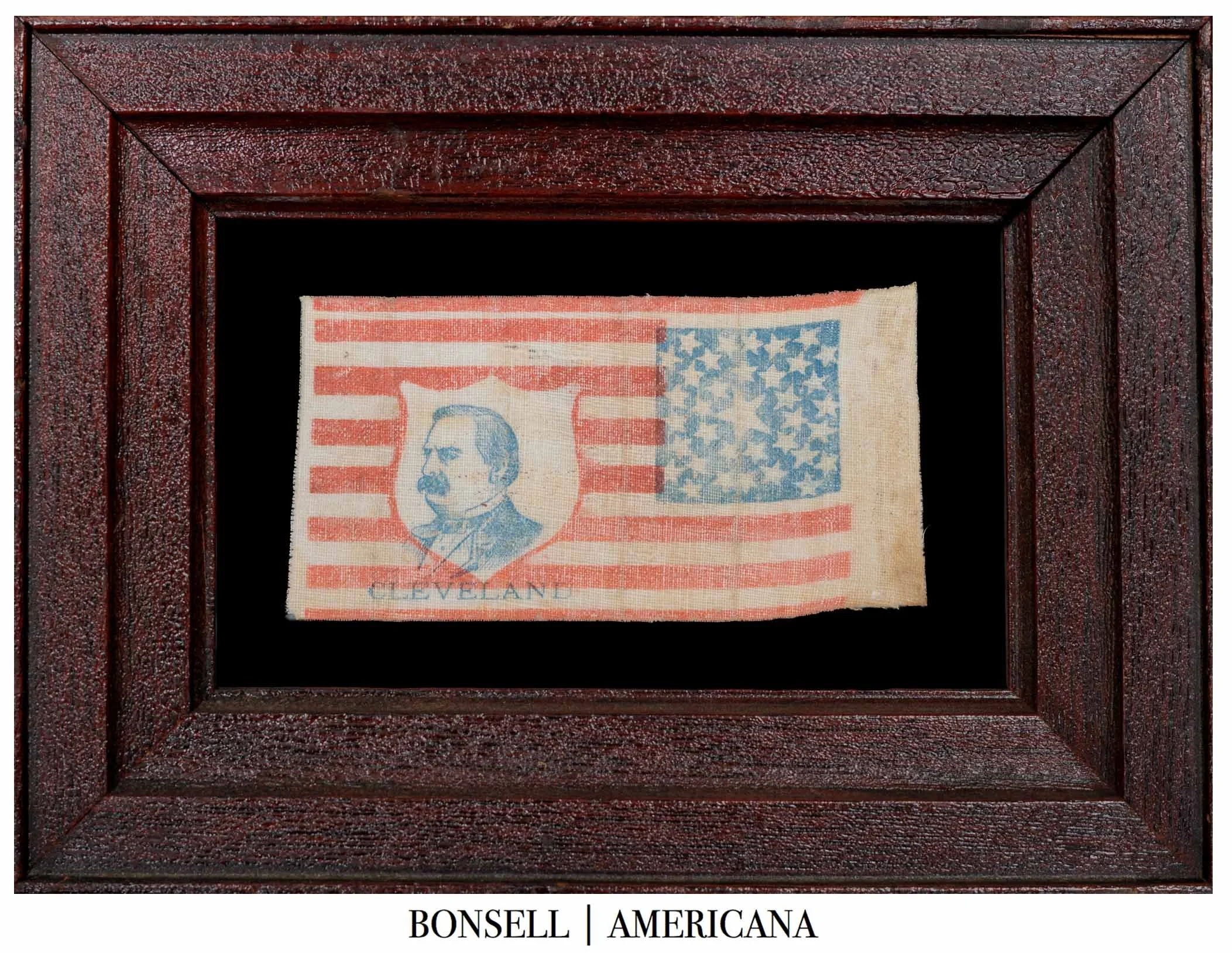
Frame Size (H x L): 6” x 8”
Flag Size (H x L): 2.25” x 4.25”
Offered is a miniature portrait campaign flag of Grover Cleveland, printed on coarse cotton and dating to the 1884 presidential election. The textile features Cleveland’s likeness rendered in blue within a shield, set against a field of red stripes and a blue canton populated by 36 stars. Beneath the portrait appears a bold, block-letter overprint reading “CLEVELAND,” executed in the same blue pigment. Small in scale yet visually assertive, the piece belongs to a scarce and highly collectible class of political textiles produced for campaign display and distribution.
The canton presents a medallion star configuration, a format rooted in mid-19th century design. A large central star—distinctively canted—anchors the composition, encircled by two rings of smaller stars, with additional stars completing the outer field. In total, the design incorporates 36 stars, corresponding to Nevada’s admission to the Union. While this count was official from July 4, 1865, to July 3, 1867, it was long obsolete by the time of Cleveland’s 1884 campaign, when the nation bore 38 states. The presence of a 36-star count here is therefore not literal, but instructive: it strongly suggests that the printing block employed for this flag originated earlier and was retained for later use. Rather than commissioning a new, updated design, printers appear to have repurposed an existing block, preserving both the earlier star count and the medallion format.
This retention of anachronistic imagery was not uncommon in inexpensive campaign ephemera. In this instance, it yields a visually compelling hybrid—late 19th-century political messaging expressed through a design vocabulary more typical of the Civil War era. The medallion configuration itself, with its celebratory and somewhat ornamental character, had largely fallen out of favor by circa 1890, replaced by rectilinear arrangements following the standardization of the flag in 1912. Its presence here adds both aesthetic distinction and historical depth.
Notably, the flag is presented in reverse orientation, with the canton appearing at the upper right rather than the upper left. This is not an error. During the 19th century, there was no official designation of a “front” or “back” to the American flag, nor a universally mandated canton position in printed parade flags and small textiles. As such, reverse-oriented examples like this are encountered and should be understood within the flexible conventions of the period.
The inclusion of a portrait within a shield is another point of distinction. While political textiles frequently incorporate candidate names or slogans, figural portraiture—especially integrated into a shield device—is less commonly encountered in flags of this scale. Cleveland’s likeness is crisply executed given the medium, with the shield serving both as a framing device and as a symbolic reference to national identity and civic virtue. The pairing of portrait and overprint reinforces the object’s intended function: immediate visual recognition in a crowded campaign environment.
From a production standpoint, the flag exhibits characteristics consistent with economical, large-quantity manufacture. The cotton is of a coarse, plain weave, and the pigments sit atop the fibers rather than penetrating them fully, indicative of block or stencil printing. Minor irregularities in saturation and registration are visible upon close inspection, lending the surface a slightly uneven but authentic quality. These features align with known examples of period campaign flags, which prioritized speed and cost-efficiency over refinement.
Historically, the flag relates to the fiercely contested 1884 presidential election between Grover Cleveland and James G. Blaine. Cleveland, the Democratic governor of New York, ran on a platform of reform and opposition to political corruption, while Blaine, the Republican nominee, carried the baggage of prior scandal. The campaign was marked by intense partisan rhetoric and remains one of the more colorful contests of the late 19th century. Objects such as this were produced to galvanize public support, serving as both promotional tools and personal tokens of political allegiance.
Examples of Cleveland campaign flags in this format are infrequently encountered, and those incorporating a medallion star field and portrait-on-shield design are particularly scarce. Campaign flags as a category occupy a special position within the field of American flag collecting, bridging political history and textile design. Their ephemeral nature—produced for short-term use and often discarded—has ensured that surviving examples are limited.
In sum, this is a compelling and visually distinctive example of late 19th-century political material culture: a Grover Cleveland campaign flag that combines an earlier star configuration, a dynamic medallion layout, and an uncommon portrait presentation within a single, compact textile.
Conservation Process: The flag was hand sewn to cotton fabric, and both were hand sewn to a mounting board. To prevent the black dye in the cotton fabric from seeping into the flag, it was first washed in a standard wash and then in a dye setting wash. The flag is positioned behind Optium Museum Acrylic.
Frame: A handsome 19th-century American frame with a rich, dark, hand-finished surface exhibiting pronounced craquelure throughout, indicative of age and original finish. The textured, slightly irregular surface and warm tonality provide a strong visual counterpoint to the textile, enhancing its period presence without distraction.
Condition Report: The flag shows expected wear consistent with its age and utilitarian purpose, including fraying along the edges, minor losses at the margins, and light soiling throughout. There is modest fading to the pigments and some unevenness in the print, inherent to its method of manufacture. Overall, the textile remains stable, with its imagery clear and highly legible.
Collectability Level: The Great – Perfect for Rising Collectors
Date of Origin: 1884
Number of Stars: 36
Associated War: The Indian Wars (1860-1890)
Associated State: Nevada
Price: Call 618-553-2291, or email info@bonsellamericana.com
Frame Size (H x L): 36” x 36”
Flag Size (H x L): 25” x 25”
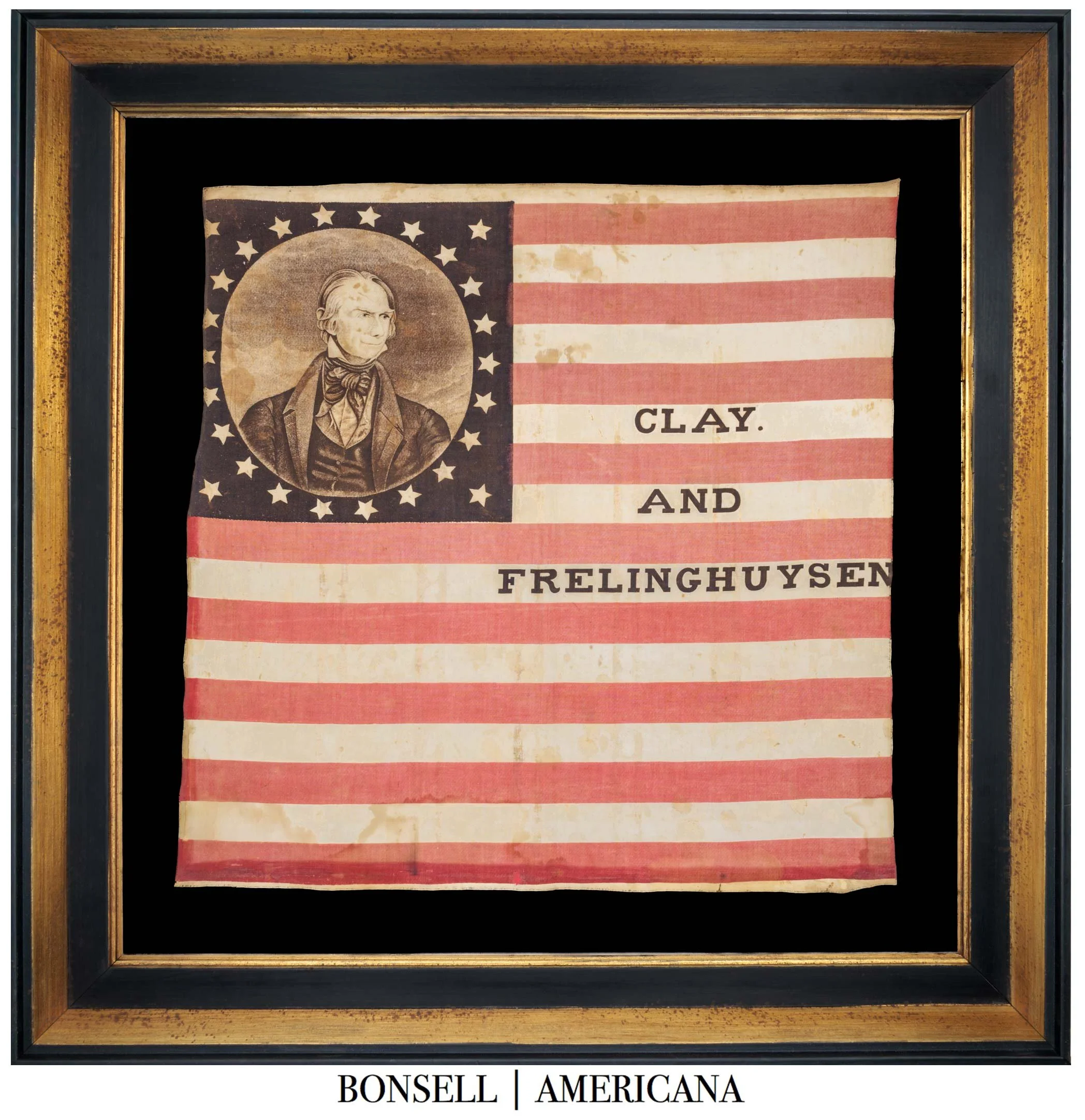
Offered is a rare and important printed cotton campaign flag, produced for the 1844 presidential election of Henry Clay and his running mate, Theodore Frelinghuysen. Executed in red, white, and blue on a single length of cotton, the design combines portraiture, national symbolism, and political messaging within a unified and highly deliberate composition. At the hoist, within a square canton, a circular medallion encloses a portrait of Clay, surrounded by a wreath of 26 stars. Extending across the striped field are the words “CLAY | AND | FRELINGHUYSEN.” The result is a cohesive graphic arrangement in which image and text are structurally integrated into the format of the American flag.
The canton functions as a formal portrait device, with Clay’s likeness rendered in a sepia-toned print derived from an engraved source and adapted for textile production. The surrounding stars form a continuous ring, both framing the portrait and reinforcing the national context of the campaign. The stripes are boldly rendered and evenly spaced, providing a strong horizontal counterbalance to the centralized portrait. The typography is clear and assertive, occupying three lines across the field in a manner that is both legible and visually balanced. Unlike later parade flags, where printed slogans are often secondary additions, the text here is integral to the design from inception.
The flag is printed on cotton, likely by means of block or early roller printing techniques. As is typical of mid-19th century textile production, minor irregularities in ink saturation and distribution are present, contributing to the hand-produced character of the piece. The pigments have mellowed over time in a manner consistent with early dyes, with the canton presenting as a deep, dark tone and the red stripes retaining strong visual presence.
The near-square proportions—approximately in keeping with known examples of the type—are a defining characteristic of early flags of this period. Unlike later, more standardized parade flags, which tend to adopt elongated rectangular formats, these earlier examples often reflect the proportions of military and presentation standards of the late 18th and early 19th centuries. The format enhances the visual impact of the design, allowing the portrait medallion and surrounding elements to occupy a central and commanding position.
The 1844 presidential campaign in which this flag was produced stands as a pivotal moment in American political history. Henry Clay, the Whig candidate, was one of the most influential statesmen of the first half of the 19th century, having served as Speaker of the House, U.S. Senator, and Secretary of State. A principal architect of what became known as the “American System,” Clay advocated for a program of economic development centered on protective tariffs, a national banking system, and federal support for internal improvements such as roads and canals. His running mate, Theodore Frelinghuysen of New Jersey, was a prominent lawyer, senator, and later president of Rutgers College, known for his moral reform positions and national visibility within the Whig Party.
Opposing Clay was Democrat James K. Polk, whose campaign emphasized territorial expansion, including the annexation of Texas and the acquisition of Oregon. While Clay’s platform reflected a vision of structured economic growth and national cohesion, Polk’s expansionist message ultimately resonated more strongly with voters, and he prevailed in the election. Textiles associated with the Clay campaign, including flags such as the present example, represent a sophisticated and early use of visual media in American political life, bridging the gap between printed campaign ephemera and later mass-produced patriotic objects.
Flags of this type occupy a narrow and important window in the evolution of American flag production. The 26-star count corresponds to the admission of Michigan as the 26th state on January 26th, 1837. Under the flag acts of the period, new stars were officially added on the following July 4th, making the 26-star flag the official national flag from July 4th, 1837 through July 3rd, 1845. This eight-year span encompasses some of the earliest known examples of printed American flags made for political purposes. While earlier campaign textiles exist, including banners from the 1840 campaign of William Henry Harrison, the Clay and Frelinghuysen examples of 1844 remain among the earliest surviving instances in which the American flag format was adapted so directly and effectively for political messaging.
The present design is documented in Herbert Ridgeway Collins’ Threads of History: Americana Recorded on Cloth, 1775 to the Present (Smithsonian Press, 1979), where it appears as example number 179. Collins classifies it as a “flag banner,” noting its cotton construction, near-square proportions, and the presence of the Clay portrait within a ring of 26 stars. The inclusion of this pattern in a foundational institutional reference underscores its importance within the canon of American textile history and provides a firm basis for identification and dating.
Additional institutional examples further support the significance of this design. An identical Clay and Frelinghuysen campaign flag is held within the collections of Rutgers University, directly connecting the object to Frelinghuysen’s later role as president of that institution. Such examples reinforce both the historical grounding of the type and its recognition within academic and museum contexts. Surviving flags of this variety are limited in number.
What distinguishes this flag, beyond its historical context, is the strength and clarity of its graphic presentation. The balance between image and typography is particularly successful, creating a composition that is both visually engaging and immediately understandable. The scale is also highly desirable—large enough to command attention in display, yet manageable within a framed presentation.
Campaign flags from the pre-Civil War era are widely regarded among collectors as some of the most compelling forms of American patriotic textile, combining rarity, historical importance, and strong visual design. Within this category, portrait examples such as the present flag are especially sought after, due to the added dimension of figural imagery and the direct association with prominent political figures.
Conservation Process: The flag was hand sewn to a cotton fabric backing, which was then hand sewn to a mounting board. To prevent dye migration from the black cotton, the fabric was pre-washed and treated with a dye-setting wash prior to mounting. The flag is displayed behind Optium Museum Acrylic.
Frame: This offering is in our Large Distressed Black and Gold Frame.
Condition Report: There is moderate to significant foxing and staining throughout, most evident in the striped field and along the lower portion, accompanied by areas of pigment loss and uneven toning consistent with age. The canton has darkened, and there is scattered discoloration within the portrait area, along with minor edge wear and small areas of fabric loss. Despite these characteristics, the imagery remains clear and the text fully legible, with strong overall visual presentation.
Collectability Level: The Extraordinary – Museum Quality Offerings
Date of Origin: 1844
Number of Stars: 26
Associated State: Michigan
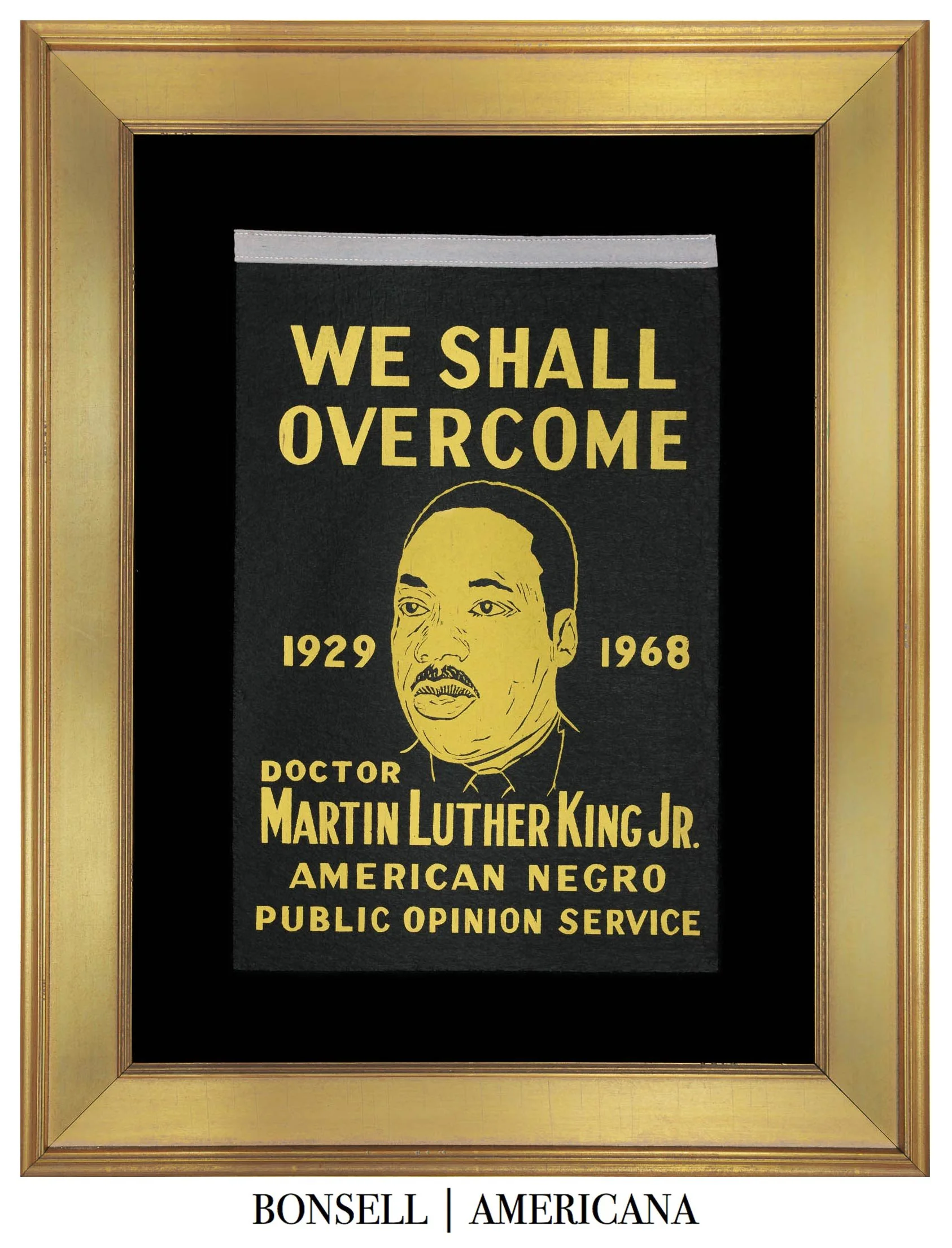
Frame Size (H x L): 28” x 22”
Banner Size (H x L): 18” x 12”
Offered is a Martin Luther King Jr. banner, dating to 1968. The verbiage “WE SHALL | OVERCOME” is printed at the top, and “DOCTOR | MARTIN LUTHER KING JR. | AMERICAN NEGRO | PUBLIC OPINION SERVICE” is printed at the bottom. In the middle of the banner is an image of Dr. King’s face, which is surrounded by 1929 on one side and 1968 on the other side. The verbiage of the overprinting, the image of Dr. King, and the colors combine to make for a fantastic piece.
Conservation Process: This banner was hand sewn to cotton fabric, and both were hand sewn to a mounting board. To prevent the black dye in the cotton fabric from seeping into the banner, it was first washed in a standard wash and then in a dye setting wash. The banner is positioned behind Conservation Clear Acrylic (standard) or behind Optium Museum Acrylic (per request).
Frame: This offering is in our Medium Gold with Flat Profile Frame.
Condition Report: This banner is in excellent condition and presents wonderfully.
Collectability Level: The Good – Perfect for Beginning Collectors and Gifts
Date of Origin: 1968
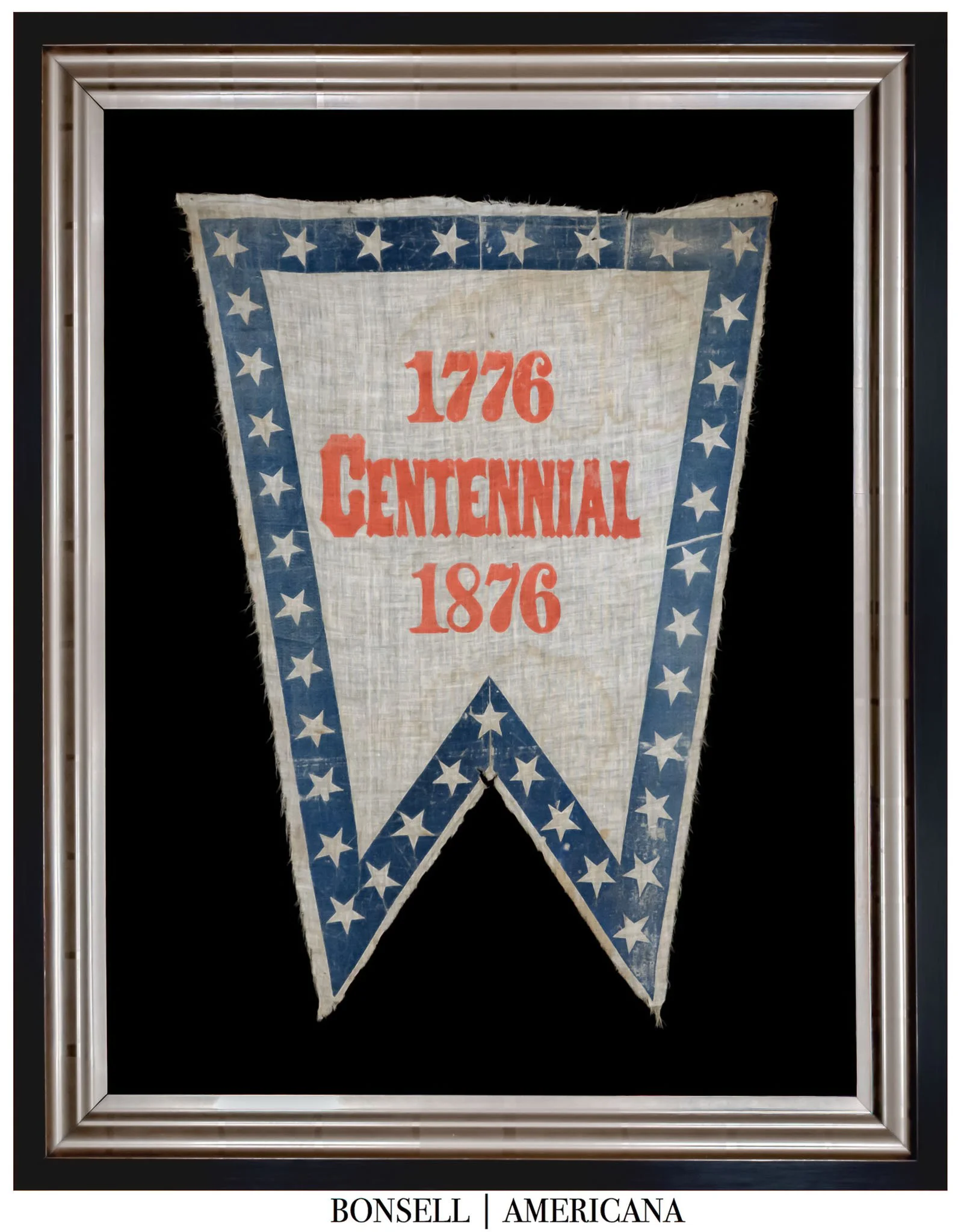
Frame Size (H x L): 33” x 26.75”
Flag Size (H x L): 23.5” x 17.5”
Offered is a patriotic banner made of glazed cotton, commemorating the centennial of the United States in 1876. It features a distinctive swallowtail design with a pointed bottom. The central portion of the banner is a white field, prominently displaying the bold red text "1776 CENTENNIAL 1876" in a stylized font. The lettering stands out against the background, emphasizing the historical significance of the piece.
Surrounding the central area is a wide blue border adorned with evenly spaced white five-pointed stars, reinforcing its American patriotic theme. In total, there are 37 stars, reflecting the official number of states in the Union from 1867 to 1877, following Nebraska’s admission as the 37th state. This star count aligns with the 1876 Centennial era, as the U.S. flag design remained unchanged until Colorado became the 38th state in August 1876.
This banner celebrates the United States' centennial, marking 100 years since the signing of the Declaration of Independence. Given its vibrant design and patriotic symbolism, it was almost certainly waved with pride at a centennial celebration or purchased as a keepsake during the nationwide festivities of 1876.
The banner was made by the American Flag Company, a well-documented producer of patriotic textiles during the 1876 Centennial celebrations. While the company was formally incorporated in New York in 1893, evidence from The Threads of History confirms that it was actively manufacturing banners, pennants, and flags in the 1870s, including designs nearly identical to this one. The American Flag Company played a significant role in producing high-quality patriotic memorabilia, supplying decorative textiles for centennial parades, expositions, and public celebrations. Given the banner’s distinctive swallowtail shape, color scheme, and typographic style—hallmarks of the company’s known centennial-era work—it is consistent with their production methods.
During the centennial, the demand for patriotic banners surged as Americans sought to commemorate the nation’s 100th anniversary with bold, symbolic decorations. The American Flag Company was at the forefront of this movement, manufacturing pieces that not only honored the past but also reflected the nation’s optimism for the future.
The United States Centennial in 1876 was a grand celebration marking the 100th anniversary of the nation’s independence, symbolizing a century of progress, resilience, and patriotism. This milestone came at a time of national reflection, as the country had recently emerged from the Civil War and was working toward reunification and industrial advancement. The centennial was a moment for Americans to honor the achievements of their young nation while looking forward to its future growth. Citizens across the country participated in parades, fireworks displays, and special ceremonies, reinforcing a sense of national pride and unity.
The most significant event of the centennial celebrations was the 1876 Centennial Exposition in Philadelphia, Pennsylvania. This world’s fair, held in Fairmount Park, was the first major international exhibition hosted by the United States. Spanning six months, from May to November, the exposition showcased the latest technological innovations, industrial advancements, and cultural exhibits from both the U.S. and other participating nations. More than 10 million visitors attended, including notable figures such as President Ulysses S. Grant and Emperor Dom Pedro II of Brazil. Among the most famous exhibits were Alexander Graham Bell’s telephone, the Corliss steam engine, and a massive arm and torch from the yet-to-be-completed Statue of Liberty.
Beyond the exposition, centennial celebrations took place in cities and towns across the nation. Patriotic symbols such as the Liberty Bell, bald eagle, and stars and stripes were widely displayed in decorations, banners, and commemorative items, reinforcing national identity. Newspapers and publications of the time encouraged citizens to reflect on the ideals of the Declaration of Independence, with many speeches focusing on themes of freedom, democracy, and innovation.
Additionally, centennial-themed art, music, and literature flourished, further cementing the event’s cultural significance. The centennial also served as a turning point in America’s transition from an agrarian society to an industrial power. The inventions and advancements displayed at the exposition underscored the rapid technological growth that would define the coming decades. It was a time when the nation embraced modernization while still paying homage to its revolutionary roots.
For many Americans, the centennial reinforced the belief that the United States had not only survived its first century but had emerged stronger and more capable of leading on the world stage. This banner, with its powerful iconography and exceptional craftsmanship, serves as a tangible reminder of that momentous occasion—an artifact that was likely held aloft in the excitement of a centennial parade or purchased as a cherished souvenir of the grandest celebration in the nation's history.
Conservation Process: This banner was hand sewn to cotton fabric, and both were hand sewn to a mounting board. To prevent the black dye in the cotton fabric from seeping into the banner, it was first washed in a standard wash and then in a dye setting wash. The banner is positioned behind Optium Museum Acrylic.
Frame: The frame features a black outer border with a silver-toned inner portion, creating a sophisticated contrast that draws attention to the banner’s patriotic design.
Condition Report: The banner is in well-preserved condition for its age, with some signs of wear consistent with its historical use. The fabric exhibits light fading, creasing, and minor fraying along the edges, particularly at the swallowtail points. There is some missing fabric along the top edge, more pronounced on the right side than the left, adding to its authentic, timeworn character. Despite these age-related imperfections, the colors remain vibrant, and the printed text and star pattern are still bold and legible, making it an excellent example of a centennial-era patriotic textile.
Collectability Level: The Good – Perfect for Beginners and Gifts
Date of Origin: 1876
Number of Stars: 37
Associated War: The Indian Wars (1860-1890)
Associated State: Colorado
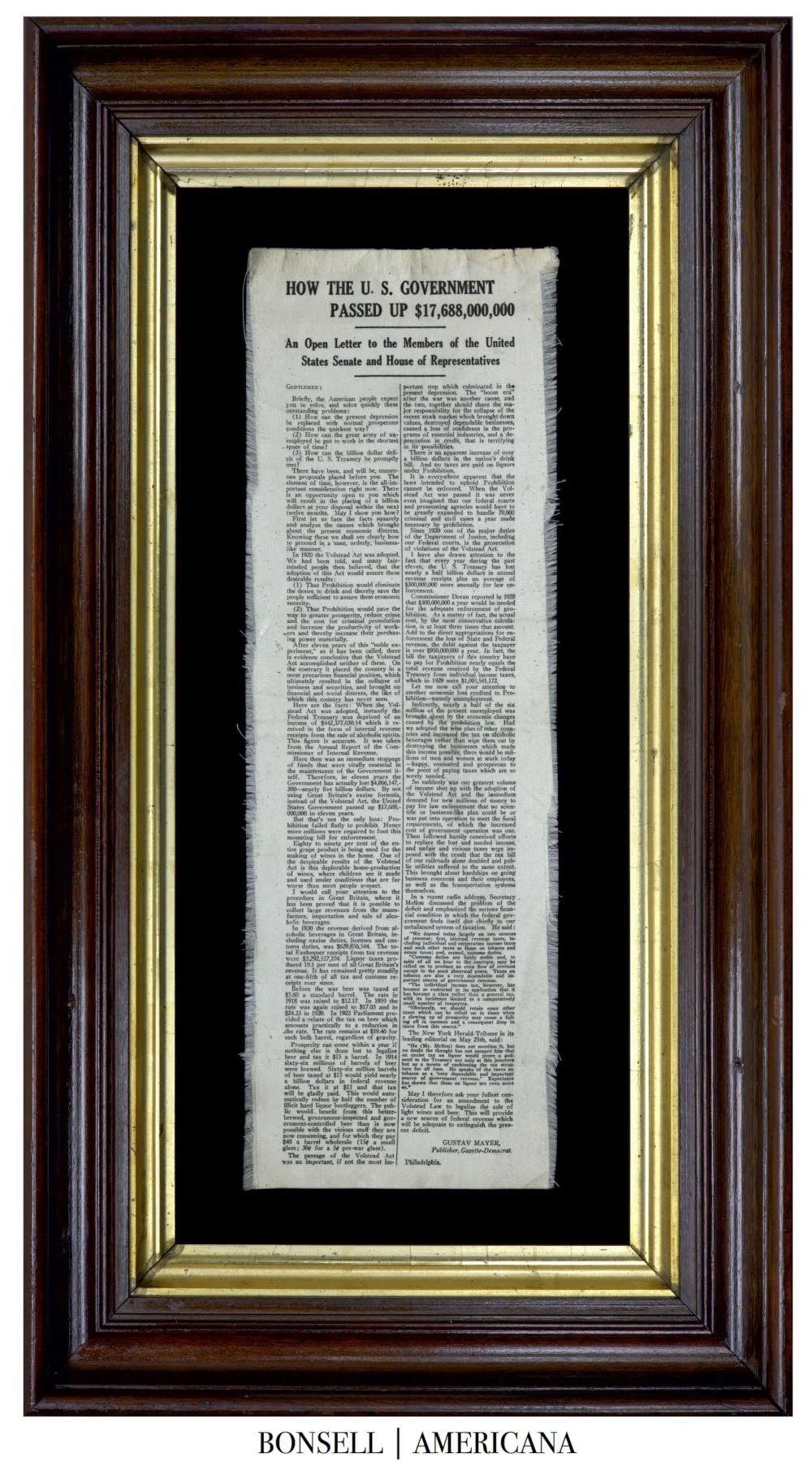
Frame Size (H x W): 17.75” x 6”
Broadside Size (H x W): 25.5” x 14”
Offered is a rare broadside titled "How the U.S. Government Passed Up $17,688,000,000," with the subtitle "An Open Letter to the Members of the United States Senate and House of Representatives" prominently printed in bold at the top. Featuring a two-column layout with densely packed text, it presents a detailed argument about the economic consequences of Prohibition, focusing on the loss of tax revenue from alcohol taxation. Printed on lightweight, plain-woven linen, the material adds both durability and a sense of significance to the document.
Crafted from the fibers of the flax plant, the plain-woven linen used for this broadside provides a smooth, durable, and slightly lustrous surface ideal for clear, detailed printing. Linen's lightweight nature made it practical for handling and transport while retaining its structural integrity. During the Prohibition era, linen’s prestige and resilience reflected the importance of its message, aligning with the cultural and historical demands of the period.
This broadside delivers an economic critique of Prohibition, highlighting the $17 billion in potential tax revenue forfeited due to the Volstead Act. Addressed to members of Congress, it frames Prohibition as both a moral failure and a financial catastrophe, urging lawmakers to reconsider the policy. By emphasizing the ban’s economic consequences, the piece shifts the debate from ideological concerns to pragmatic fiscal realities, making a strong case for repealing the legislation.
During Prohibition (1920–1933), alcohol was outlawed across the United States in an effort to curb societal issues such as crime and alcoholism. While initially seen as a moral victory, the policy's unintended consequences quickly became evident. Organized crime surged as illegal distilleries and bootleggers met the persistent demand for alcohol, while the federal government, heavily reliant on alcohol taxes, faced severe revenue shortfalls. This broadside criticizes these impacts, proposing that regulated alcohol production could restore public funding and weaken the black market.
The broadside also presents an alternative vision for alcohol regulation, advocating for government-controlled production and taxation to generate revenue and ensure safety. It argues that such regulation would benefit the economy and the public by replacing dangerous, unregulated liquor with inspected and affordable options. This pragmatic approach likely resonated with lawmakers and citizens alike, especially as the Great Depression deepened the need for economic reform.
This fabric broadside exemplifies the growing opposition to Prohibition in the late 1920s and early 1930s, reflecting grassroots pressure that contributed to the eventual repeal of the Volstead Act through the 21st Amendment in 1933. The choice to print on linen, rather than paper, underscores its intended durability and importance, ensuring the message's longevity. By grounding its argument in economic terms, this broadside serves as an artifact of the Prohibition era, reflecting the tensions and debates that shaped one of America’s most significant policy reversals.
Conservation Process: The broadside was hand sewn to cotton fabric, and both were hand sewn to a mounting board. To prevent the black dye in the cotton fabric from seeping into the broadside, it was first washed in a standard wash and then in a dye setting wash. The broadside is positioned behind Optium Museum Acrylic.
Frame: The frame is made of walnut and dates from 1860 to 1890. Its dark wood and simple craftsmanship reflect the style of the period.
Condition: The broadside is in excellent condition overall, with light staining that does not detract from its legibility or visual appeal. The fraying along the edges is consistent with the fabric's original lightweight linen construction and reflects its natural wear rather than damage.
Collectability Level: The Good – Perfect for Beginning Collectors and Gifts
Date of Origin: 1920-1933
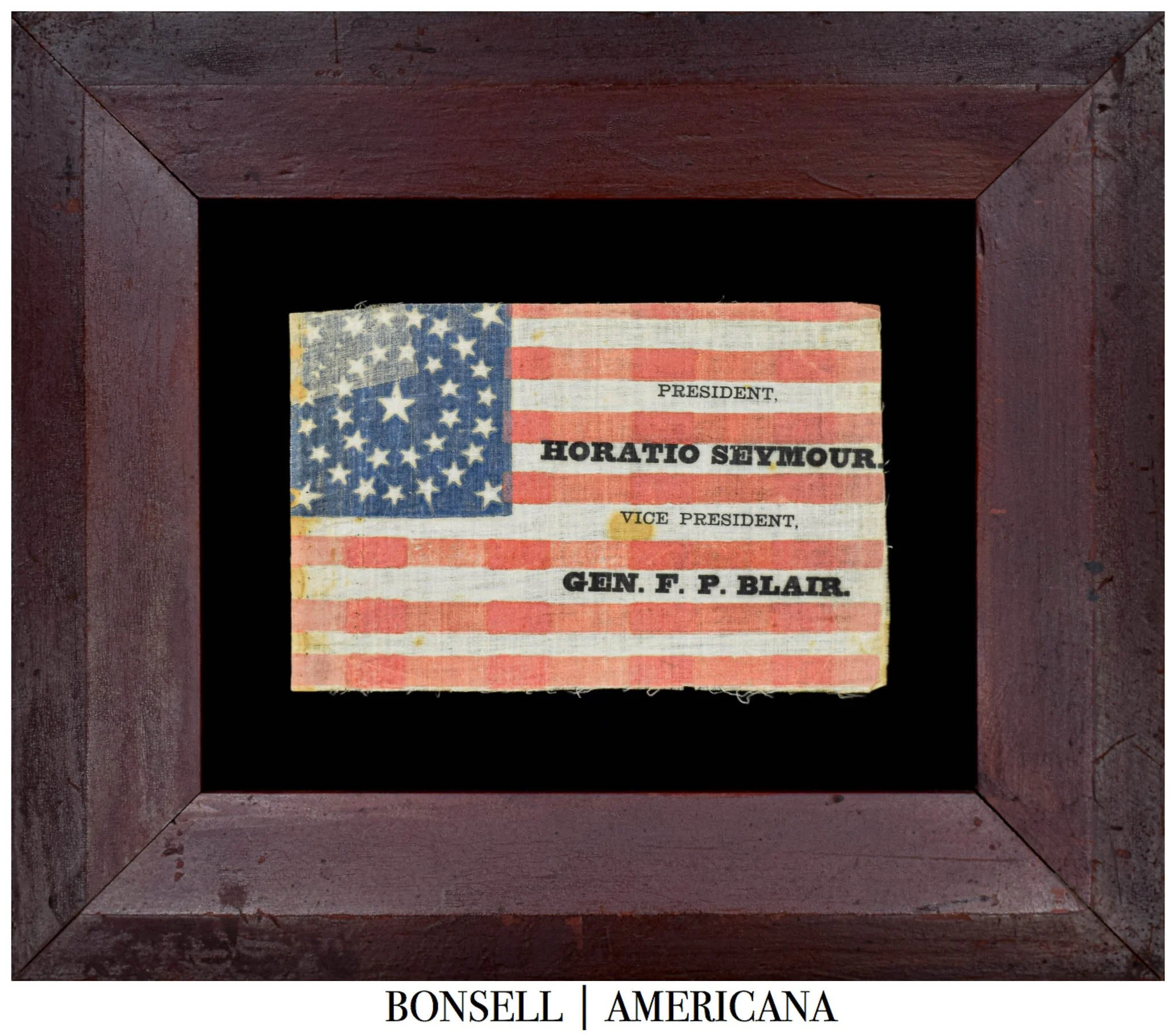
Frame Size (H x L): 13” x 15.5”
Flag Size (H x L): 5” x 8”
Offered is a thirty-six star flag with the following outstanding overprint:
PRESIDENT,
HORATIO SEYMOUR.
VICE PRESIDENT,
GEN. F. P. BLAIR
The overprint is in reference to Democrats Horatio Seymour and Francis Preston Blair, who—in the 1868 presidential election—ran against Republicans Ulysses S. Grant and Schuyler Colfax.
Seymour and Blair won just 80 electoral votes and 47.34% of the popular vote, while Grant and Colfax won 214 electoral votes and 52.66% of the popular vote. The contrast in the electoral votes was expected, but the proximity of the popular vote was surprising—particularly given that newly enfranchised freedmen voted almost exclusively for Grant and Colfax, and further given that many Southern whites, who would have voted almost exclusively for Seymour and Blair, had been temporarily disenfranchised at the time of the election (i.e., those in Texas, Mississippi, and Virginia, the states that had not yet been restored to the Union). The leading explanation for the proximity of the popular vote is that whites—both Northern and Southern—must have voted for Seymour and Blair more often than had been anticipated.
This flag is exceptional for at least the following reasons:
First, campaign flags are the most desirable of all flags. The first campaign flags were made in 1840 and were associated with the William Henry Harrison campaign. In 1890, a bill was introduced that attempted to prevent the desecration of the flag by printing, painting, or advertising for public display or private gain. The bill failed. In 1895, a similar bill was introduced, but likewise failed. Finally, in 1905, a bill passed outlawing the use of marks and portraits on the flag, coat of arms, and other insignia of the United States. With this background in mind, campaign flags are especially difficult to acquire, because they were only made between 1840 and 1905. And in reality, most examples that surface are from a narrower time frame between 1860 and 1890.
Second, the subject flag is particularly rare, even for a campaign flag. It is the only example that we have encountered, and it went undocumented in the Threads of History, written by Herbert Ridgeway Collins, former curator of the Division of Political History at the Smithsonian Institution. Escaping documentation therein was difficult, being that Collins corresponded with 1000’s of collectors, museums, and universities, in his attempt to catalog every political textile. In total, he documented 1500 examples, dating from 1775 to 1979, yet this flag—and all Seymour-Blair flags, but for one—went under his radar, almost certainly as a function of their rarity.
And third, its stars are arranged in a wonderful medallion pattern. The large star in the middle is referred to as a “center star.” The center star represents the newest state added to the Union (e.g., Nevada in the case of this thirty-six star flag). Surrounding the center star is a pair of concentric rings of stars, and surrounding the rings are four flanking stars positioned in the corners of the canton.
CONSTRUCTION
The flag offered herein is printed on coarse glazed cotton. The stripes and overprint were block stamped. The canton is a dusty blue and the stripes are essentially orange. The orange is a result of the use of either madder or cochineal to create the red dye. Such dye was commonly used to make flags between 1850 and 1880. The First Flag Act of 1777 specified the flag’s general colors, but it did not specify the exact shades thereof. For this reason, some flags—like this one—have unusual colors, per the modern eye. The exact shades were not officially specified until 1934.
The overprints are in black across the white stripes and notably a portion of the “HORATIO” overprint appears to overlap one of the red stripes. This suggests that the red stripes were applied, perhaps along with the blue canton, and the campaign overprints were applied sometime thereafter, maybe even years later. In some instances, surplus flags would lie dormant awaiting the next campaign season, patriotic burst, or overprint request.
STAR COUNT
Flags made for the 1868 campaign have surfaced with thirty-four, thirty-six, and thirty-seven stars (and perhaps others). In 1868, the official star count was thirty-seven. As such, this is the most logical count for an 1868 campaign flag. The lower star counts of thirty-four and thirty-six can be explained via the following theories:
First, these lower star counts may have been leftovers associated with the burst of parade flags produced during the Civil War. In a time of frugality—and 1868 would have been such a time given its proximity with respect to the Civil War, not to mention the rugged nature of the 19th century generally—a maker would sell whatever he had, and a buyer would purchase whatever was available.
Second, these lower star counts may have been made with older printing blocks. Cutting blocks was an arduous task. Thus, makers sometimes used older blocks in later years, both to save the time and minimize the effort associated with making new blocks.
And third, there was a general randomness with respect to star counts in 19th century flags, more so with flags dating to 1870 and earlier, and less so with flags dating to 1870 and later. Neither makers nor buyers were particularly disciplined with respect to star counts, perhaps in part because the star count changed so frequently in the 19th century, and perhaps in part because early flags were crude in every respect, the star count being no different.
The subject flag has thirty-six stars, likely because of one of these three theories. Under the first theory, this flag may have been made in 1864 or 1865, and then left in storage until it was overprinted in 1868 and distributed. Under the second and third theories, this flag may have been made in 1868. As viewed from these outer bounds, the underlying flag would date to between 1864 and 1868.
In any event, the overprint would have been applied in 1868, following the nominations of Seymour and Blair (i.e., after the flag was taken from storage or immediately after the flag was printed, depending on the circumstances).
THIRTY-SIX STAR FLAGS
The thirty-six star flag represents the inclusion of Nevada to the Union. Nevada was admitted on October 31st, 1864, and this flag became official on July 4th, 1865. Nevada was originally part of the Utah Territory beginning in 1850, became its own territory in 1861, and became its own state in 1864.
The timing of Nevada's inclusion was politically and economically based. For political reasons, Nevada was admitted to the Union just eight days prior to President Lincoln's re-election bid against General George McClellan. Such timing was meant to benefit Lincoln and his fellow Republicans. For economic reasons, Nevada was included as part of the Union to help it pay off the country’s war debts. Economically, Nevada was particularly attractive at the time, because of its significant silver mining industry. Nevada expanded its borders in 1866 when the western Utah Territory was added to its eastern side, and further expanded in 1867 when a portion Pah-Ute County in the Arizona Territory was added to its southern side.
The thirty-six star flag was the official flag for the last six months of the Civil War, and it was used by the military during that time. It was also the official flag during a portion of the Reconstruction era. Ultimately, the thirty-six star flag was official until July 4th, 1867, the time at which the thirty-seven star flag became official and began to represent the inclusion of Nebraska in the Union.
Conservation Process: This flag was hand sewn to cotton fabric, and both were hand sewn to a mounting board. To prevent the black dye in the cotton fabric from seeping into the flag, it was first washed in a standard wash and then in a dye setting wash. The flag is positioned behind Optium Museum Acrylic.
Frame: This offering is in a mahogany veneer frame. It has a brown and red finish and dates to the 1840s.
Condition Report: There is discoloration in the upper-left quadrant of the canton. There are vertical stripes of fading, the first two of which are under the canton, and the other three of which are to the right of the canton. The stripes of fading may be original to the flag (i.e., manufacturing related). They are more noticeable in the photos than in person. There are a few small stains across the surface of the flag with the most noticeable one being over a portion of “VICE.” Given the age and rarity of the subject flag, it is highly desirable despite these issues.
Collectability Level: The Best – Perfect for Advanced Collectors
Date of Origin: 1864-1868
Number of Stars: 36
Associated State: Nevada
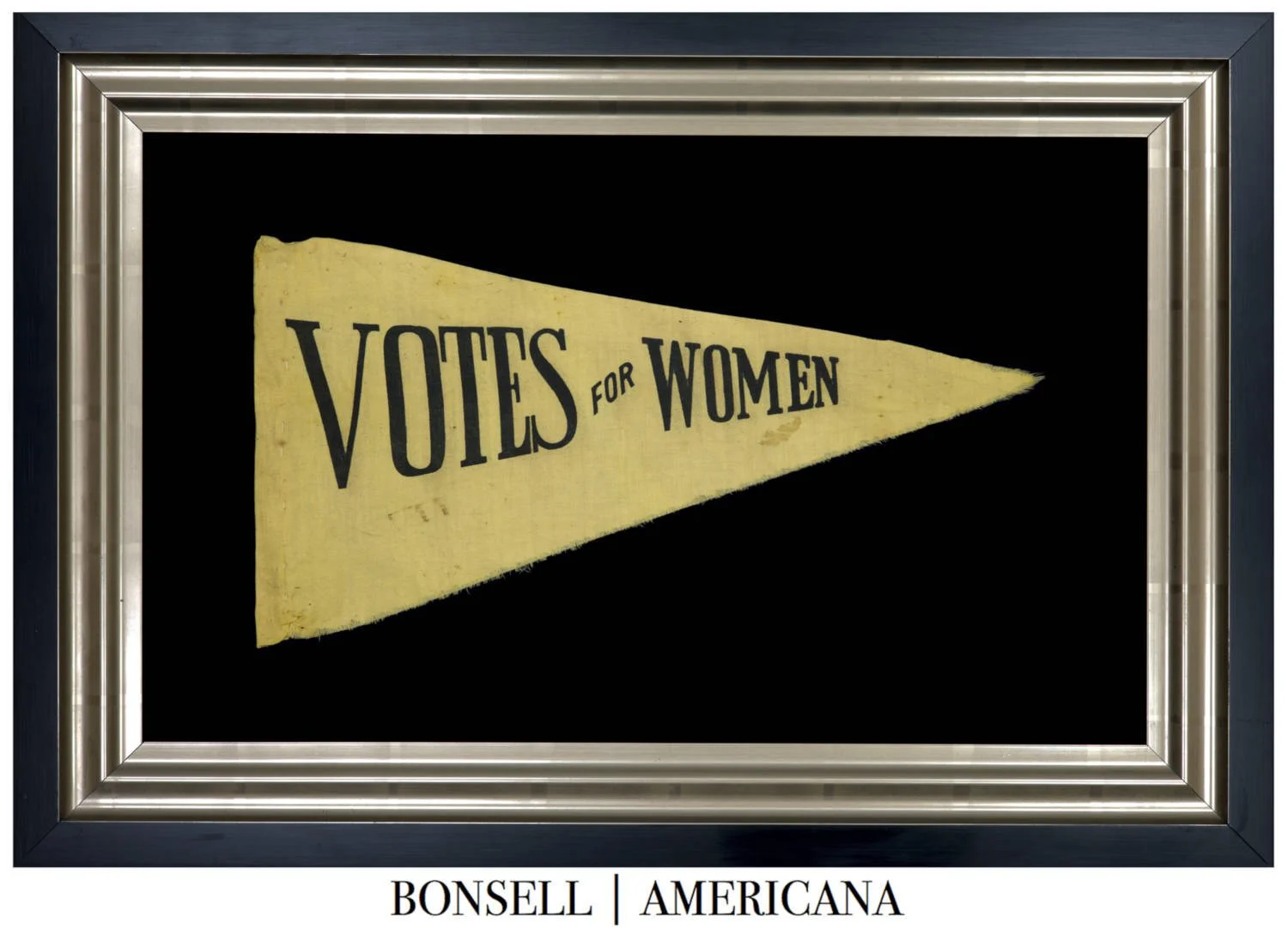
Price: Please call 618-553-2291, or email info@bonsellamericana.com
Frame Size (H x L): 18” x 26”
Pennant Size (H x L): 8.5” x 16.5”
Offered is a pennant made of cotton. It has a triangular shape with a yellow background, a common color used in the women’s suffrage movement. The text "VOTES FOR WOMEN" is boldly printed in black capital letters across the surface, emphasizing the message central to the early 20th century suffrage campaign.
The pennant is a symbolic artifact from the women’s suffrage movement, which was a pivotal social and political campaign of the late 19th and early 20th centuries. In the United States, the movement sought to secure women's right to vote and challenged the entrenched inequalities in political representation. The suffrage movement emerged in response to broader conversations about civil rights, as women activists argued that they, too, should be granted the same voting rights that men enjoyed. This effort reached its height in the early 20th century, as suffragists organized rallies, distributed literature, and used visual symbols like pennants to garner public support for their cause.
The use of pennants like this one became a powerful tool for protest, as they were easily portable, visually striking, and could be displayed in public spaces to attract attention to the suffrage cause. The yellow color was often associated with the suffragist movement in the U.S., particularly the National Woman’s Party, which was one of the most prominent organizations advocating for women’s voting rights. This vibrant hue, combined with slogans like "Votes for Women," helped unify supporters of the cause and provided a sense of solidarity in the fight for equality. The phrase “Votes for Women” became a rallying cry that encapsulated the demands of the movement.
The suffrage movement faced significant opposition from those who believed that granting women the right to vote would disrupt traditional gender roles and undermine social stability. Despite these challenges, activists like Susan B. Anthony, Elizabeth Cady Stanton, and later Alice Paul continued their advocacy, using peaceful protests, lobbying efforts, and visual campaigns to pressure politicians and influence public opinion. As the movement gained momentum, these symbols of suffrage, such as pennants, buttons, and banners, became increasingly visible across the country.
Ultimately, the persistence of the women’s suffrage movement led to the ratification of the 19th Amendment to the U.S. Constitution in 1920, which prohibited the federal government and states from denying citizens the right to vote based on sex. This monumental victory came after decades of tireless activism and was a turning point in the struggle for gender equality in America. The "Votes for Women" pennant, therefore, not only represents a specific moment in history but also serves as a lasting symbol of the determination and resilience of the suffragists who fought for political inclusion.
Conservation Process: This pennant was hand sewn to cotton fabric, and both were hand sewn to a mounting board. To prevent the black dye in the cotton fabric from seeping into the pennant, it was first washed in a standard wash and then in a dye setting wash. The pennant is positioned behind Optium Museum Acrylic.
Frame: The frame has a sleek, modern design with a black outer edge and an inner metallic silver border. It features multiple beveled layers, creating a visually striking contrast that enhances the presentation of the pennant.
Condition Report: The pennant is in generally good condition, showing some signs of aging with light discoloration and a few small stains. These minor imperfections are typical for an artifact of its age, and they add to its historical character.
Collectability Level: The Great – Perfect for Rising Collectors
Date of Origin: 1910-1920

Frame Size (H x L): 31.5” x 34”
Bandanna Size (H x L): 20.5” x 23”
Offered is a rare 1912 Teddy Roosevelt campaign bandanna. It is printed on red silk with beige and black designs of two of Teddy’s hats and three moose. The large moose, in the center, is surrounded by a red and white floral pattern, and the pattern is surrounded by a red border. The Progressive Party campaigned heavily with the use of flags and bandannas, yet this style is particularly hard to find.
Campaign bandannas were initially produced beginning in the first quarter of the nineteenth century, but became a particularly popular campaign tool in the time period between 1850 and 1920. They were worn, presented in store fronts, waved in parades, flown at political rallies, and hung from buggy whips.
An example of this bandanna is documented in the Threads of History, written by Herbert Ridgeway Collins (see item number 939). Mr. Collins was the curator of the Division of Political History at the Smithsonian Institute. His book is the best reference available for political textile collectors and includes over fifteen-hundred examples, dating from 1775 to 1979. In writing his book, Mr. Collins sent thousands of letters to collectors, museums, and universities, and requested their assistance in his quest to document every known political textile.
Theodore Roosevelt—a writer, soldier, naturalist, and statesmen—was the 26th president of the United States from 1901 until 1909. Roosevelt was elected as the governor of New York in 1898, and in this position, he was a reformer who was best known for removing corrupt officials and regulating corporations. Such actions irritated Republican leaders. And in response, they urged him to run as the vice presidential nominee with William McKinley in 1900, the thought being that Roosevelt's vice presidential role would be ceremonial in nature and sidetrack him from continuing to reform and regulate. In 1901, however, McKinley was assassinated, and Roosevelt became the youngest president in history.
Roosevelt was known for raising awareness of the nation's role in world politics, trust busting, regulating the railroads, and continuing to fight political corruption. Notably, in 1902, Roosevelt intervened in the anthracite coal strike upon threats to cut off heating fuel for homes, schools, and hospitals. He responded by stating that the army would run the mines, and by having Wall Street withhold credit to the coal companies and dump their stocks. His actions ended the strike and resulted in a pay increase for the miners. This was the first time that a President had publicly intervened in a labor dispute for the laborers, and he characterized his actions as working toward a "Square Deal" between capital and labor. This became Roosevelt's slogan in his 1904 election, in which he ran against democratic contender Alton Parker. Roosevelt overwhelmingly defeated him by 336 electoral votes to 140. He carried every region in the Union, minus the South.
In 1908, Roosevelt honored his promise not to run for a third term, and he persuaded William Taft to become his Republican successor. Taft defeated William Jennings Bryan for the presidency in 1908, and he defeated Roosevelt for the Republican nomination in 1912. Taft was a conservative republican, and Roosevelt was a progressive republican. Because of this difference and Roosevelt's frustration with not getting the Republican Party's nomination, he formed the Progressive Party, nicknamed the Bull Moose Party following a letter from Roosevelt declaring that he considered himself "as strong as a bull moose." Roosevelt argued for a "New Nationalism" in support of greater governmental regulation and promotion of social welfare, in hopes of attracting votes from the Democratic nominee, Woodrow Wilson. Despite Roosevelt's message and popularity, Wilson easily defeated him by 435 electoral votes to Roosevelt's 88. The Progressive Party elected very few candidates, and as a result, Roosevelt knew it was not a viable long-term party. He kept it alive, but only to the extent that he could use it as a bargaining chip for his return to the Republican Party.
Conservation Process: This bandanna was hand sewn to cotton fabric, and both were hand sewn to a mounting board. To prevent the black dye in the cotton fabric from seeping into the bandanna, it was first washed in a standard wash and then in a dye setting wash. The bandanna is positioned behind Optium Museum Acrylic.
Frame: This offering is in our X-Large Distressed Black and Silver Frame.
Condition Report: This bandanna has a few small holes. In other respects, it is in excellent condition.
Collectability Level: The Great – Perfect for Rising Collectors
Date of Origin: 1912
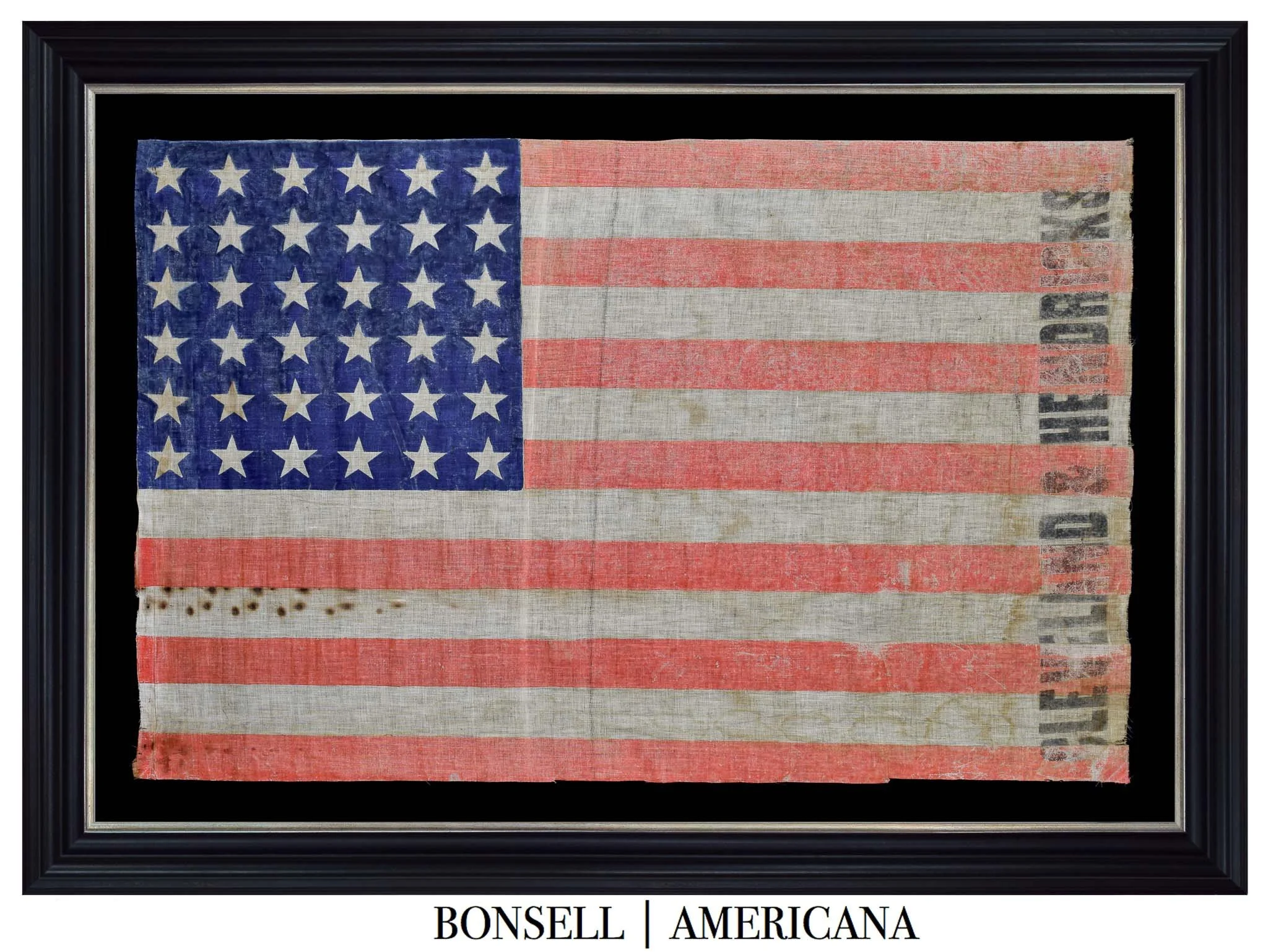
Frame Size (H x L): 38” x 53”
Flag Size (H x L): 27” x 42”
Offered is an antique flag, printed on glazed cotton, with a “CLEVELAND & HENDRICKS” campaign overprint. Cleveland was the presidential nominee for the Democratic Party in 1884. His vice-presidential running mate was Thomas A. Hendricks. They ran against James G. Blaine, who was the presidential nominee for the Republican Party, and John A. Logan, who the vice-presidential nominee. Cleveland and Hendricks defeated Blaine and Logan. The Cleveland ticket won 219 electoral votes and 48.9% of the popular vote, while the Blaine ticket won only 182 electoral votes and 48.3% of the popular vote.
STAR COUNT
In 1884, the official star count was thirty-eight. However, despite the flag being offered herein having so clearly been associated with the 1884 Cleveland and Hendricks campaign, it has just thirty-six stars. This “lower than expected star count” is the result of one of these possibilities:
As a first possibility, this flag may have been made during the Civil War or shortly thereafter; placed into storage, unsold; and then overprinted for the campaign of 1884. Under this possibility, this flag may have been made between 1864 and 1867, and then left in storage until it was overprinted and distributed in 1884.
As a second possibility, this flag may have been made with an outdated printing block. Cutting printing blocks was an arduous task. Thus, makers sometimes used older, outdated blocks in later years, in order to save time and avoid the effort associated with making new ones.
As a third possibility, this flag may have been made without much thought at all going into choosing the star count. During the 19th century, there was a general randomness with respect to star counts. Neither makers nor buyers were particularly disciplined with respect thereto, perhaps in part because the star count changed so frequently in the 19th century, and also perhaps in part because early flags were crude in every respect, the star count being no different. Under the second and third possibilities, this flag would have been made in 1884.
Ultimately, as viewed from the outer bounds of this trio of possibilities, the flag itself would have a “not earlier than date” of 1864 and a “not later than date” of 1884. And regardless of the age of the underlying flag, the overprint would have been applied thereto in 1884—basically, (1) after Cleveland and Hendricks were chosen as nominees, and (2) after the flag was taken from storage or immediately after the flag was printed, depending on the circumstances.
CONSTRUCTION
The stripes of this flag are closer to orange than red, and they are striking in their appearance. This unusual color is common in flags dating to between 1850 and 1880, because during this time period, makers often used either madder or cochineal to create the red dye. Over time, such dyes would oxidize and turn orange.
This flag is 27” x 42”, making is relatively large in scale compared to most printed campaign flags of the era. In turn, it makes a bigger statement and is more desirable than most of its peers, in this important respect.
THIRTY-SIX STAR FLAGS GENERALLY
The thirty-six star flag represents the inclusion of Nevada to the Union. Nevada was admitted on October 31st, 1864, and this flag became official on July 4th, 1865. Nevada was originally part of the Utah Territory beginning in 1850, became its own territory in 1861, and became its own state in 1864.
The timing of Nevada's inclusion was politically and economically based. For political reasons, Nevada was admitted to the Union just eight days prior to President Lincoln's re-election bid against General George McClellan. Such timing was meant to benefit Lincoln and his fellow Republicans. For economic reasons, Nevada was included as part of the Union to help it pay off the country’s war debts. Economically, Nevada was particularly attractive at the time, because of its significant silver mining industry. Nevada expanded its borders in 1866 when the western Utah Territory was added to its eastern side, and further expanded in 1867 when a portion Pah-Ute County in the Arizona Territory was added to its southern side.
The thirty-six star flag was the official flag for the last six months of the Civil War, and was used by the military during that time. It was also the official flag during a portion of the Reconstruction era. The thirty-six star flag was official until July 4th, 1867, the time at which the thirty-seven star flag became official and began to represent the inclusion of Nebraska in the Union.
Conservation Process: This flag was hand sewn to cotton fabric, and both were hand sewn to a mounting board. To prevent the black dye in the cotton fabric from seeping into the flag, it was first washed in a standard wash and then in a dye setting wash. The flag is positioned behind Optium Museum Acrylic.
Frame: This offering is in our X-Large Distressed Black and Silver Frame.
Condition Report: As shown in the photos, this flag has light stains throughout its surface. The darkest stains run along the white stripe that is the second one from the bottom. These stains may be rust marks from nails attaching the flag to a staff (i.e., perhaps when the flag was rolled around the staff and nails). The bottom third of the canton has been professionally restored. Prior thereto, this portion of the canton had faded much more than the others portions thereof. The “CLEVELAND & HENDRICKS” overprint is faded, more so over the red stripes than over the white stripes. Despite these issues, this flag is age appropriate, attractive, and impressive. It is a statement maker and head turner.
Collectability Level: The Great – Perfect for Rising Collectors
Date of Origin: 1864-1884
Number of Stars: 36
Associated Wars: The Civil War (1861-1865) and the Indian Wars (1860-1890)
Associated State: Nevada
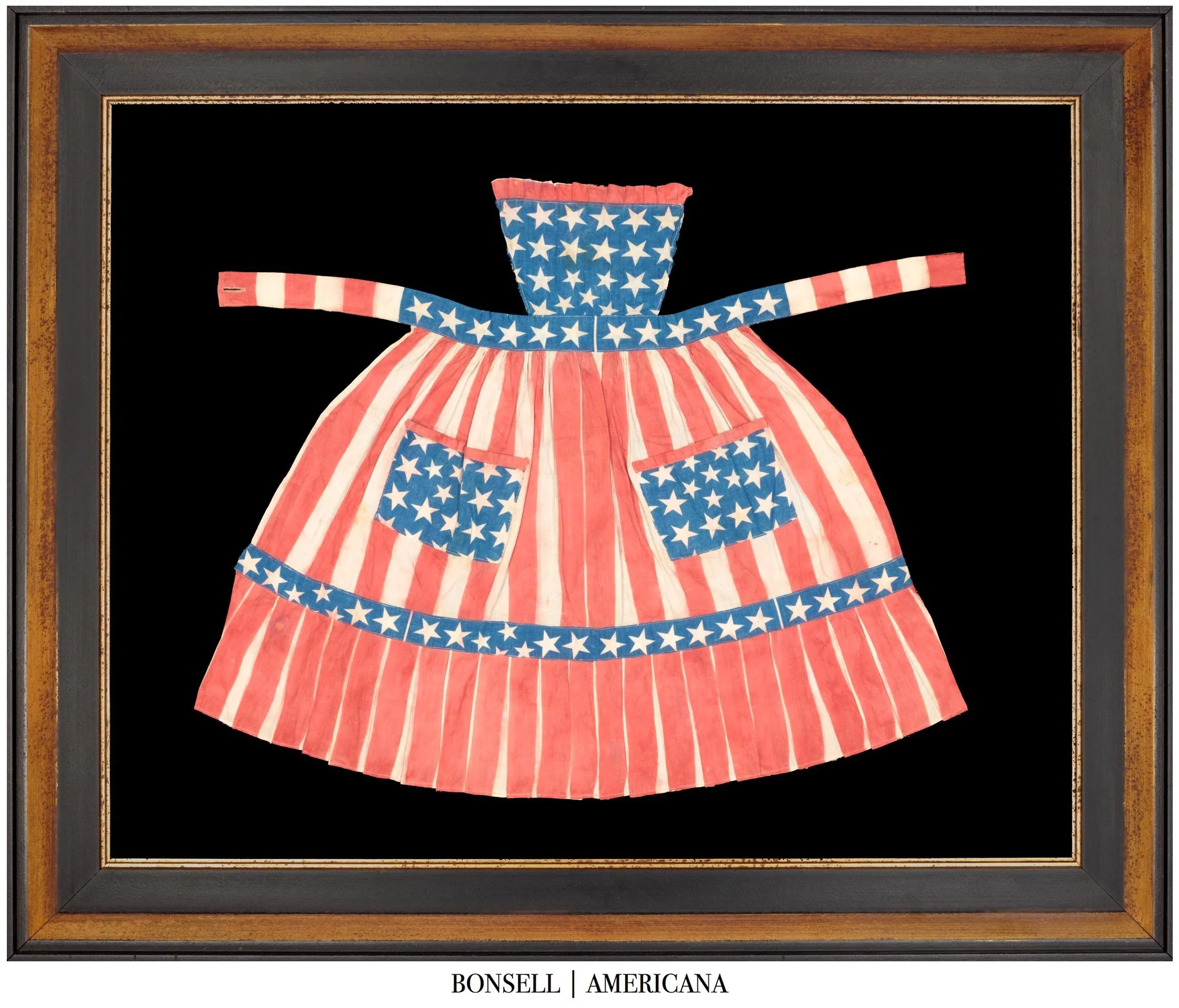
Frame Size (H x L): 31.5” x 38.5”
Dress Size (H x L): 20.5” x 27.5”
Offered is a patriotic dress made of thirty-eight star antique flags. In 1876, during the centennial celebrations of American Independence, women and girls would often wear patriotic dress. These dresses—vibrant in the red, white, and blue—often featured motifs of stars and stripes, mirroring the American flag. This choice of apparel was more than just a fashion statement; it symbolized a deep sense of national pride, allowing women and girls to actively participate in the commemoration of the country's hundredth anniversary. The styles of these dresses varied, some being simple with flag-colored sashes, while others were more elaborate, adorned with layers of ruffles and star-spangled designs. For many, dressing in such symbolic attire was a way to nurture a sense of national identity, and their presence in these colorful, emblematic outfits became a striking and memorable feature of the 1876 centennial celebrations.
In the case of the dress offered herein, it is made of thirty-eight star flags (an example of which is shown in the last image). The flags exhibit an extremely rare star pattern, in which there are larger stars arranged linearly and smaller stars arranged in a medallion, amongst the larger stars. More specifically, pattern includes six linearly arranged larger stars in each of the first, second, fifth, and sixth rows. And it includes four linearly arranged larger stars in each of the third and fourth rows. The stars in the first row are generally canted to the 11:00 position, while the stars in the second row are alternatively, generally canted to the 1:00 position. The stars in the other rows are canted haphazardly, which adds to this flag’s folksiness.
The most interesting feature of this star arrangement, however, is the medallion of six smaller stars. Printing on cotton typically employed wooden blocks, which were hand-cut so as to leave raised surfaces bearing the desired pattern. The block used in printing this flag was originally used for printing thirty-six star flags with a linear 6-6-6-6-6-6 pattern. For convenience, this block was then recut, so that the middle four stars could be removed and replaced with the six smaller stars. Flags printed with recut blocks are quite unusual and rare, and thus highly prized by collectors.
The thirty-eight star flag represents the inclusion of Colorado to the Union. Colorado was admitted on August 1st, 1876 and this flag became official on July 4th, 1877. Presidents Hayes, Garfield, Arthur, Cleveland, and Harrison all served under this flag. Colorado became known as the “Centennial State,” a result of becoming official just twenty-eight days after the centennial. The official star count for US flags in 1876 was the thirty-seven star flag. However, it was common for flag makers to produce anticipatory flags in advance of their official date, making the thirty-eight star flag—and for historical reasons, the thirteen star flag—the most common flags flown during the centennial celebrations of 1876.
The nation’s centennial in 1876 inspired patriotism across the county and reunited its citizens. Cities of all sizes hosted parades and celebrations, and buildings and homes were canvased in red, white, and blue with flags being the primary symbol of national pride. The most notable celebration was the Centennial International Exposition in Philadelphia. In just six months, the Exhibition hosted nearly 10 million visitors, and included many extraordinary exhibits, including the introduction of the Corliss Steam Engine and Alexander Graham Bell’s telephone.
The thirty-eight star flag was official until July 4th, 1890, the time at which the forty-three star flag became official and began to represent the inclusion of North Dakota, South Dakota, Montana, Washington, and Idaho to the Union.
Conservation Process: The dress was hand sewn to cotton fabric, and both were hand sewn to a mounting board. To prevent the black dye in the cotton fabric from seeping into the dress, it was first washed in a standard wash and then in a dye setting wash. The dress is positioned behind Optium Museum Acrylic.
Frame: The dress is showcased in our Large Distressed Gold Frame.
Condition Report: As shown in the photos, there is some staining, foxing, and bleeding of red into the white. Despite this, the dress presents wonderfully.
Collectability Level: The Great – Perfect for Rising Collectors
Date of Origin: 1876
Number of Stars: 38
Associated War: The Indian Wars (1860-1890)
Associated State: Colorado
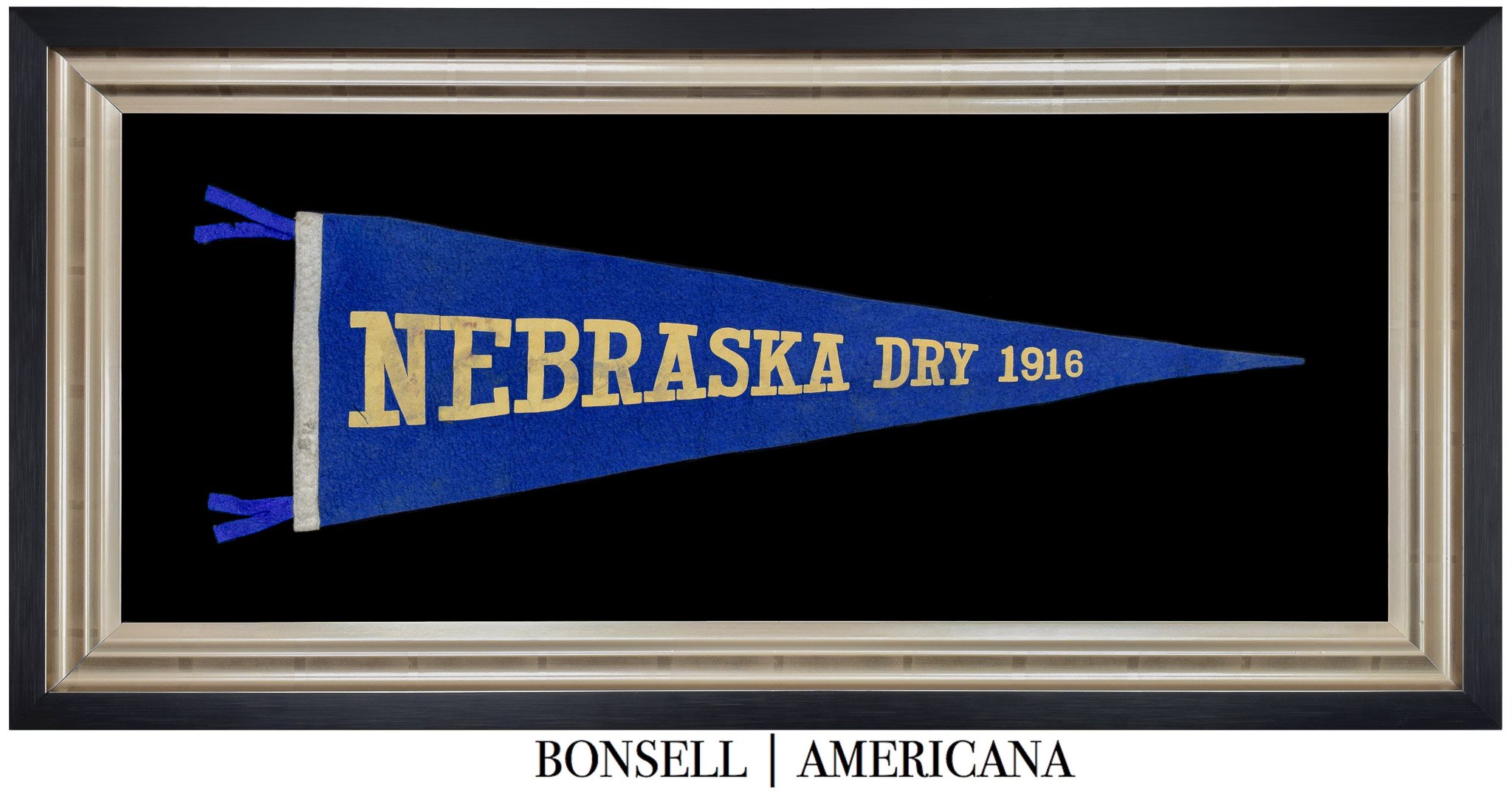
Frame Size (H x L): 18” x 36.5”
Pennant Size (H x L): 8” x 24.75” with 2” ties
Offered is an antique pennant with a “NEBRASKA DRY 1916” overprint. It is made of felt and includes a blue field with white lettering.
In the early 20th century, amid an intense national debate over the role of alcohol in society, many states began to consider prohibition measures. This "NEBRASKA DRY 1916" pennant offers a window into the fervor of the prohibition movement and its impact on the state of Nebraska.
The late 19th and early 20th centuries in America saw the rapid growth of the temperance movement, which advocated for the reduction or elimination of alcohol consumption. This movement was rooted in concerns about public morality, the social ills associated with drunkenness, and the influence of saloons in politics and community life. Organizations like the Woman's Christian Temperance Union (WCTU) and the Anti-Saloon League played central roles in pushing for prohibition at both the state and national levels.
By the time the pennant was created, Nebraska was no stranger to the debates surrounding alcohol. The state's engagement with prohibition began much earlier than 1916, with localized movements and laws restricting or banning the sale of alcohol. However, it was in 1916 that Nebraska's relationship with alcohol reached a significant turning point. That year, the state passed a prohibition amendment to its constitution. The subsequent law went into effect in 1917, making Nebraska one of the many states to embrace prohibition before the nationwide ban in 1920.
The "Nebraska Dry 1916" pennant would have been a potent symbol during this period. Its bold proclamation of "dry" signified Nebraska's stance against the sale and consumption of alcohol. Given its celebratory tone, the pennant was likely used to rally support during the campaign leading up to the vote or to commemorate the passage of the prohibition amendment.
This pennant, as a historical artifact, carries layers of meaning. On a basic level, it represents Nebraska's decision to go "dry" and the state's role in the broader national movement towards prohibition. The pennant serves as a testament to the intense social and political activism of the era, where grassroots movements could galvanize public opinion and effect legislative change.
However, beyond the immediate historical context, the pennant also embodies the broader cultural tensions of the early 20th century. The fight over prohibition was not just about alcohol; it was intertwined with debates over public morality, the role of women in public life (given their significant role in the temperance movement), and the struggle between rural and urban values in a rapidly changing America.
The pennant is a snapshot of a transformative era in Nebraska and American history. Through objects like this, we are reminded of the power of collective movements and the ways in which society's values evolve over time.
Conservation Process: The pennant was hand sewn to cotton fabric, and both were hand sewn to a mounting board. To prevent the black dye in the cotton fabric from seeping into the pennant, it was first washed in a standard wash and then in a dye setting wash. The pennant is positioned behind Optium Museum Acrylic.
Frame: The pennant is in a modern black and silver frame.
Condition Report: There is some staining, most notably over the white vertical strip and over the lettering. Overall, the pennant is age appropriate and attractive.
Collectability Level: The Great – Perfect for Rising Collectors
Date of Origin: 1916

Frame Size (H x L): 36” x 20.75”
Pennant Size (H x L): 26” x 10”
Offered is an antique prohibition pennant in the classic elongated triangular form, tapering sharply to a point. The background is a muted purple. White lettering is arranged in a bold, visually balanced layout. Along the hoist edge, “VOTE YES” appears vertically in tall block letters, setting a strong tone.
Centered on the pennant is the rallying cry: “CALIFORNIA DRY.” “CALIFORNIA” is rendered in large capital letters, with “DRY” below it in a slightly smaller font. Notably, the “D” in “DRY” contains tally marks—five lines crossed diagonally—suggesting themes of voting and civic action. Below, “NOV 3” anchors the design in time.
At the pointed tip, “1914” runs horizontally, underlined with a stylized line that draws the eye to the end. The typography shifts subtly to fit the space, maintaining clarity while enhancing the urgency of its original message.
This pennant commemorates a pivotal moment in California’s history, set against the backdrop of the early 20th-century temperance movement. By 1914, national momentum for prohibition was surging, fueled by decades of grassroots advocacy from organizations like the Anti-Saloon League and the Woman’s Christian Temperance Union. These groups saw alcohol as a root cause of societal ills—crime, poverty, domestic violence, and moral decay—and worked tirelessly to bring about change.
The slogan “California Dry” was part of a statewide campaign urging voters to support a ban on the manufacture and sale of alcohol. The scheduled vote on November 3, 1914, marked California’s own reckoning with the growing national call for temperance.
Although California voters ultimately rejected the prohibition measure in 1914, the campaign was emblematic of a broader cultural shift that culminated just a few years later. By 1919, the 18th Amendment had been ratified, launching national Prohibition in 1920. But that national effort was built on years of local and state-level battles, battles like the one this pennant represents. In fact, many counties and municipalities in California had already gone “dry” prior to the statewide vote, adopting local ordinances in response to public pressure.
The 1914 campaign also reflected a deeper clash of values within California itself. Urban centers like San Francisco and Los Angeles—with their diverse immigrant populations and thriving nightlife—largely opposed prohibition. In contrast, rural and religious communities were more inclined to support it. The debate underscored broader societal tensions: progressivism vs. personal liberty, tradition vs. modernization, rural conservatism vs. urban dynamism.
The temperance movement in California was further complicated by the state’s unique cultural and demographic makeup. California was home to large immigrant communities—particularly from Italy, Germany, and China—many of whom brought longstanding cultural traditions involving alcohol, whether in winemaking, beer brewing, or social consumption. These communities viewed prohibition as an assault not only on personal freedom but on cultural identity itself. As a result, anti-prohibition forces in the state often framed their opposition in terms of civil rights, economic livelihood, and ethnic representation, further polarizing the electorate.
Despite the 1914 defeat, California would continue to play a nuanced role in the prohibition era. While the state never passed a sweeping statewide ban, numerous towns and counties enacted local prohibition laws, creating a patchwork of dry and wet jurisdictions. These localized efforts mirrored national trends, where enforcement varied widely and resistance was often spirited. California’s complex geography, extensive coastline, and border with Mexico also made it a hotbed for bootlegging and smuggling during national prohibition—an unintended consequence that revealed the limitations of enforcement and foreshadowed the law’s eventual repeal.
The slogan “Vote Yes California Dry” was more than a political message—it was a call for moral reform, social order, and a vision of a better society during a time of rapid change.
Today, this pennant stands as a artifact of grassroots activism and civic mobilization. It captures a moment when Americans were deeply engaged in questions about the role of government, personal responsibility, and the power of collective action. While national Prohibition would ultimately be repealed in 1933 with the 21st Amendment, the legacy of the movement—its fervor, its controversy, and its impact—echoes in the stories of campaigns like California’s 1914 vote.
Conservation Process: This pennant was hand sewn to cotton fabric, and both were hand sewn to a mounting board. To prevent the black dye in the cotton fabric from seeping into the pennant, the fabric was first washed in a standard wash and then in a dye setting wash. The pennant is positioned behind Optium Museum Acrylic.
Frame: Framed in a matte black wood frame with subtle grain texture, the presentation is both understated and elegant.
Condition Report: The pennant shows moderate fading consistent with age, but the lettering remains bold and legible. The felt is intact with no major flaws, making it a well-preserved example of early political ephemera.
Collectability Level: The Great – Perfect for Rising Collectors
Date of Origin: 1914
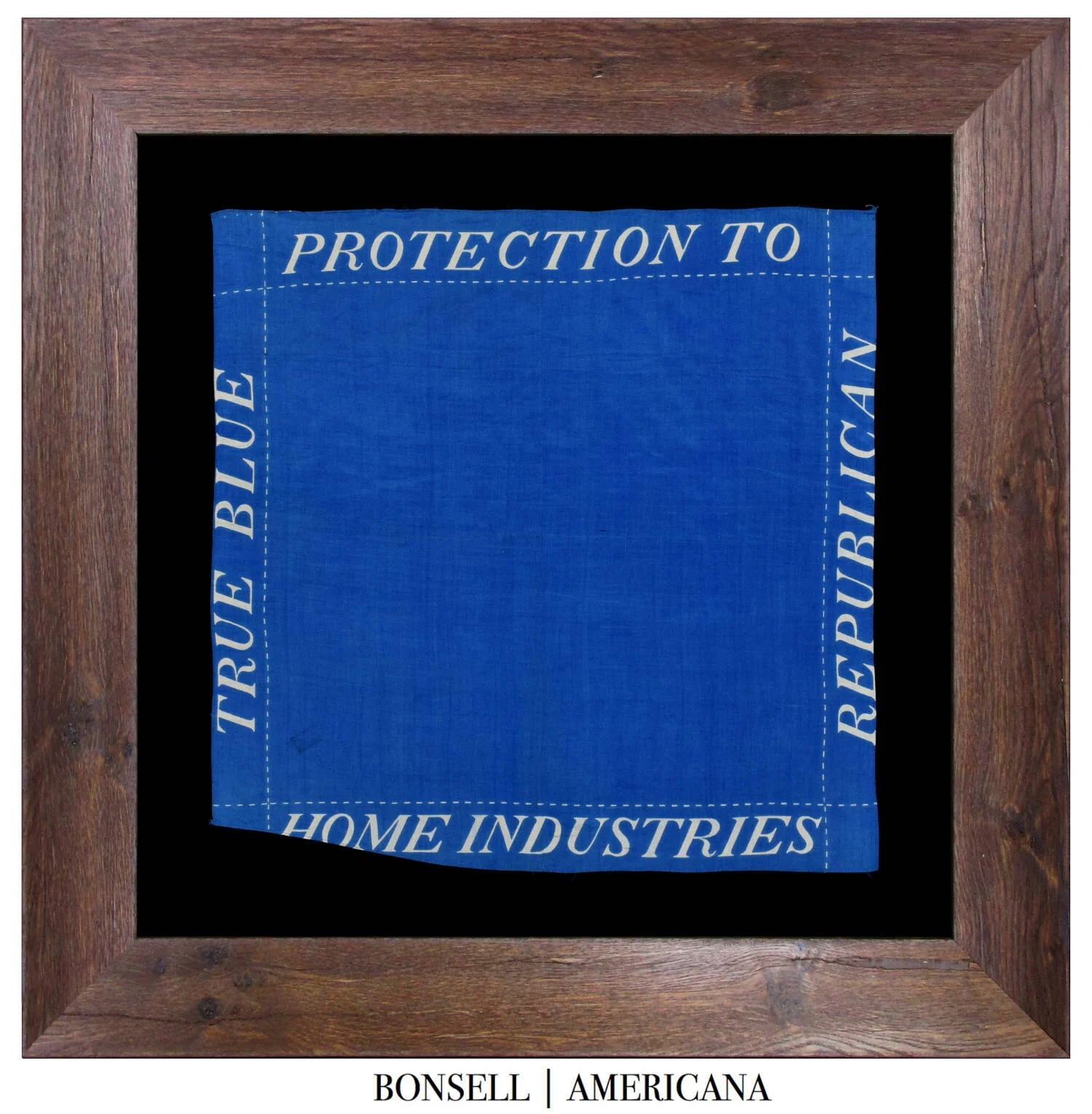
Frame Size (H x L): 32” x 31”
Kerchief Size (H x L): 21” x 20”
Offered is patriotic kerchief made for the Benjamin Harrison campaign. It is made of blue silk and features a pair of overprints. The first overprint states, “TRUE BLUE REPUBLICAN.” And the second overprint states, “PROTECTION TO HOME INDUSTRIES,” a slogan and theme of the Benjamin Harrison campaign in 1888. Campaign kerchiefs were initially produced beginning in the first quarter of the nineteenth century, but became a particularly popular campaign tool in the time period between 1850 and 1920. Campaign kerchiefs were worn, presented in store fronts, waved in parades, flown at political rallies, and hung from buggy whips.
An example of this kerchief is documented in the Threads of History, written by Herbert Ridgeway Collins (item number 582). The referenced example was held in the Ralph E. Becker Collection. Mr. Collins was the curator of the Division of Political History at the Smithsonian Institute. His book is the best reference available for political textile collectors and includes over fifteen-hundred examples, dating from 1775 to 1979.
Harrison was a moderate Republican and was elected as the 23rd president in the election of 1888. Harrison ran against Grover Cleveland, the incumbent President and a Democrat. Harrison lost the popular vote, but won the electoral vote with 233 electoral votes to Cleveland's 168. Harrison signed into law the Sherman Antitrust Act in 1890, the first legislation prohibiting business combinations in restraint of trade. Despite this, many Americans viewed Harrison and the Republicans as being too closely aligned with the wealthy elite, and as wasteful. Upon Harrison's election, the treasury had a great surplus, but the "Billion-Dollar Congress" spent enormous sums on soldiers' pensions and business subsidies, erasing the surplus. By 1890, the Democrats recaptured the House of Representatives by a large majority, and in turn, Harrison had little influence on legislation. In the election of 1892, Harrison lost the electoral vote with 145 electoral votes to Cleveland's 277.
Conservation Process: This kerchief was hand sewn to cotton fabric, and both were hand sewn to a mounting board. To prevent the black dye in the cotton fabric from seeping into the kerchief, it was first washed in a standard wash and then in a dye setting wash. The kerchief is positioned behind Conservation Clear Acrylic (standard) or behind Optium Museum Acrylic (per request).
Frame: This offering is in our Large Reclaimed Wood Frame. However, it can be reframed and would look great using any one of our Medium or Large Frames, which are shown in the final two images. The pricing associated with the different framing options may vary. Reframing of an offering may delay shipment by up to two weeks.
Condition Report: There are a few minor stains, a pair of which are roughly in the center of the kerchief and one of which is in the lower left corner. The blue has faded slightly but is still bright and natural in appearance. The lower left corner is sewn at an angle, such that a portion of the “O” is folded under and a slightly larger portion of the “H” is folded under. The angle of the sewing appears to be original to the kerchief, in contrast to a repair that may have been made at some time thereafter. Overall, the kerchief is age appropriate and looks great.
Collectability Level: The Great – Perfect for Rising Collectors
Date of Origin: 1888
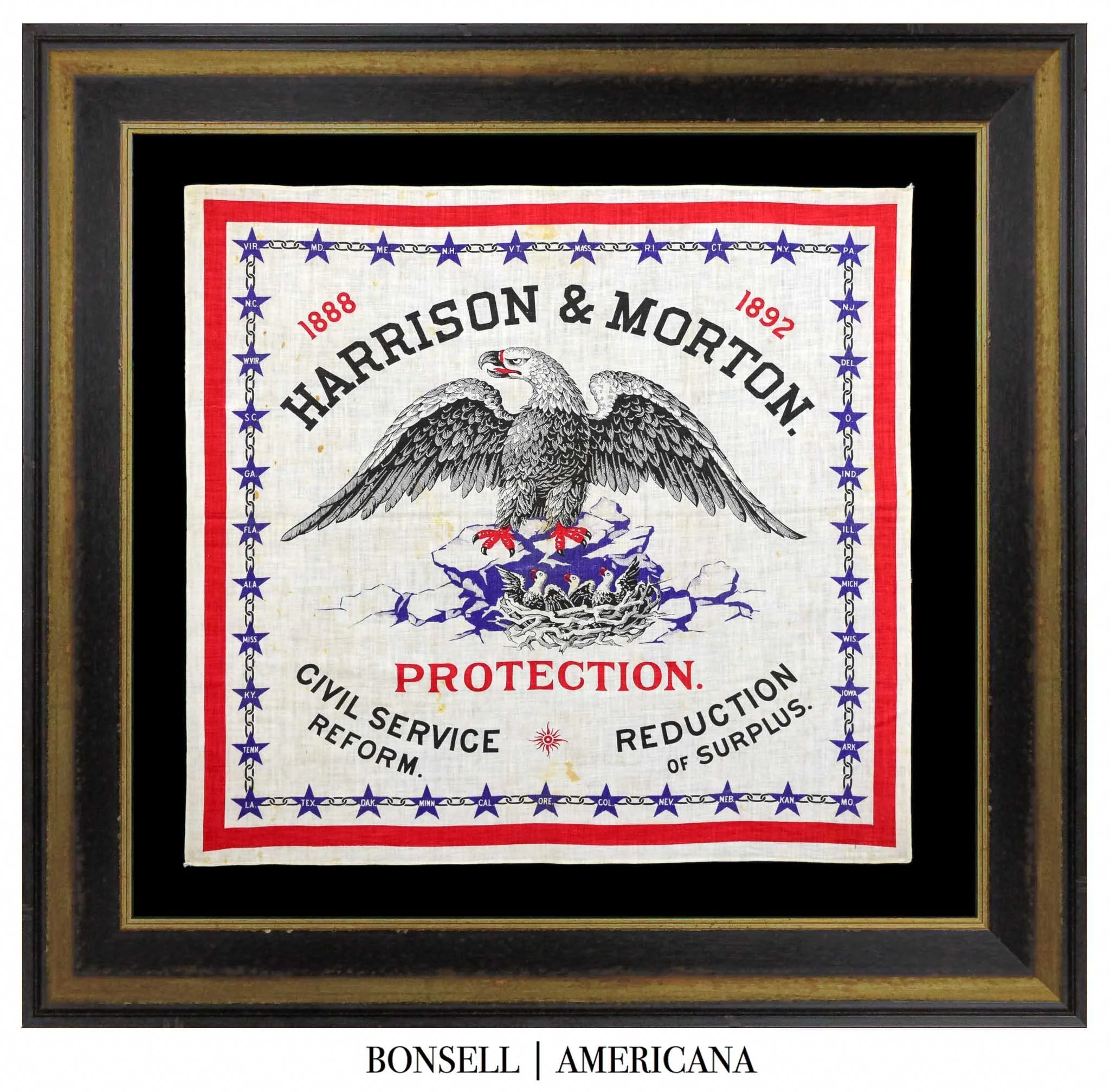
Price: Call 618-553-2291, or email info@bonsellamericana.com
Frame Size (H x L): 33.5” x 34.5”
Bandanna Size (H x L): 23.5” x 24.5”
Offered is a patriotic campaign bandanna for the Harrison and Morton campaign of 1888. It is made of cotton, and vividly features an eagle protecting its three babies. The babies are resting in a nest and positioned in front of a rock. Printed above the eagle is the verbiage “1888” and “1892” in red, and the verbiage “HARRISON & MORTON” in black. Printed below the eagle are the themes of the Harrison campaign, including the verbiage “PROTECTION” in red, and the verbiage “CIVIL SERVICE REFORM” and “REDUCTION OF SURPLUS” in black. Thirty-nine states, encased by blue stars, are printed along the borders of the bandanna. Of particular note, one of the states is “DAK,” as this bandanna was made before it was known that there would be both a North Dakota and a South Dakota, instead of just one overall state.
Campaign bandannas were initially produced beginning in the first quarter of the nineteenth century, and became a particularly popular campaign tool in the time period between 1850 and 1920. Campaign bandannas were worn, presented in store fronts, waved in parades, flown at political rallies, and hung from buggy whips.
An example of this Harrison and Morton bandanna is documented in the Threads of History. The referenced example is shown as item 581 and was held in a private collection. In addition, this bandanna is also featured on the cover, along with eleven other special textiles. The Threads of History was written by Herbert Ridgeway Collins, who was the curator of the Division of Political History at the Smithsonian Institute. His book is the best reference available for political textile collectors and includes over fifteen-hundred examples, dating from 1775 to 1979.
The imagery shown on this bandanna is similar to the imagery protected in design patent number 18,497. Rufus H. Rose of New York, New York was listed as the sole inventor, and his patent issued on July 31st, 1888. The illustration in the ‘497 patent is actually for Cleveland & Thurman, and interestingly this example is not included in the Threads of History. To our knowledge and that of others, the Cleveland & Thurman textile may not have been distributed.
Harrison was a moderate Republican, and elected the 23rd president in the election of 1888. Harrison ran against Grover Cleveland, the incumbent President and a Democrat. Harrison lost the popular vote, but won the electoral vote with 233 electoral votes to Cleveland's 168. Harrison signed into law the Sherman Antitrust Act in 1890, the first legislation prohibiting business combinations in restraint of trade. Despite this, many Americans viewed Harrison and the Republicans as being too closely aligned with the wealthy elite, and as wasteful. Upon Harrison's election, the treasury had a great surplus, but the "Billion-Dollar Congress" spent enormous sums on soldiers' pensions and business subsidies, erasing the surplus. By 1890, the Democrats recaptured the House of Representatives by a large majority, and in turn, Harrison had little influence on legislation. In the election of 1892, Harrison lost the electoral vote with 145 electoral votes to Cleveland's 277.
Conservation Process: This bandanna was hand sewn to cotton fabric, and both were hand sewn to a mounting board. To prevent the black dye in the cotton fabric from seeping into the bandanna, it was first washed in a standard wash and then in a dye setting wash. The bandanna is positioned behind Conservation Clear Acrylic (standard) or behind Optium Museum Acrylic (per request).
Frame: This offering is in our Large Distressed Black and Gold Frame.
Condition Report: This bandanna has some minor stains, most of which are light yellow in color. Despite this, it presents very well and is a statement piece.
Collectability Level: The Best – Perfect for Advanced Collectors
Date of Origin: 1888
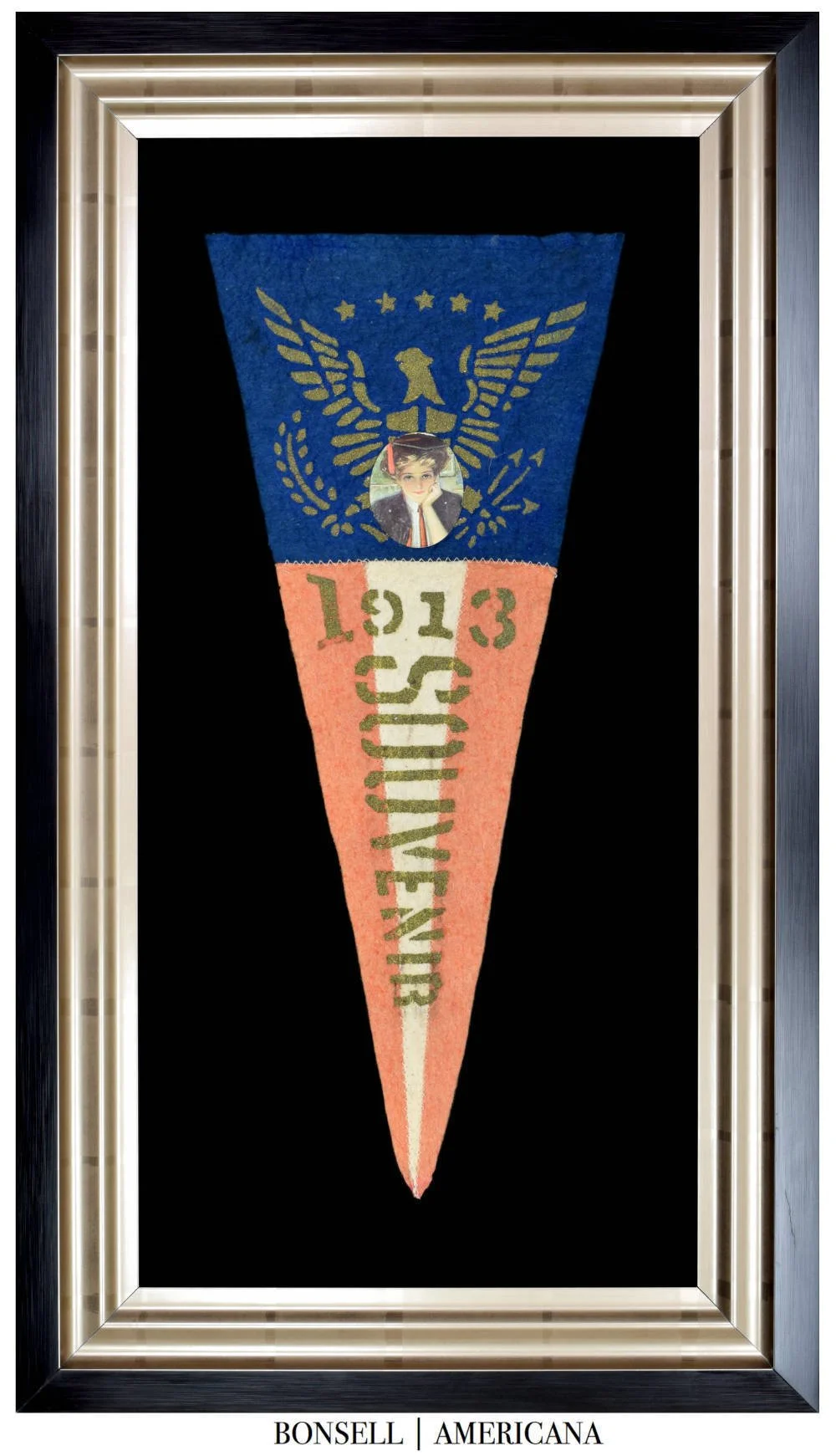
Frame Size (H x L): 29.75” x 17”
Pennant Size (H x L): 21” x 8.5”
Offered is a rare suffragette pennant made for the Woman Suffrage Procession, the first suffragette parade in Washington D.C., and the first large, organized march ever held therein for political purposes. This is the first such pennant that we have encountered. The Procession took place on March 3rd, 1913, a day before the inauguration of Woodrow Wilson. The purpose of the parade, as described in the official program, was to “march in a spirt of protest against the present political organization of society, from which women are excluded.” Or in slightly more technical terms, the ultimate purpose was to pass a constitutional amendment guaranteeing women the right to vote.
The National American Woman Suffrage Associated (“NAWSA”) spearheaded the Procession, and Alice Paul and Lucy Burns, chairs of the NAWSA’s Congressional Committee, choreographed it. Sitting atop a horse, Inez Milholland, a lawyer and activist, led over 5000 suffragettes up Pennsylvania Avenue. The parade included 20 floats; 9 bands; 4 mounted brigades; and various groups representing women at home, in school, and in the workplace. The Procession concluded at the Treasury Building, where an allegorical tableau was acted out in combination with the parade. The final act was a rally at the Memorial Continental Hall, featuring prominent speakers, including Anna Howard Shaw and Helen Keller.
PENNANT CONSTRUCTION
The field of the pennant includes a blue portion, a white portion, and two red portions. The blue portion includes an eagle and a sepia paper portrait of a suffragette, which is glued into place. The red and white portions include the year of the Procession, “1913”. They also include the verbiage “SOUVENIR”. The eagle, “1913”, and “SOUVENIR” are printed in metallic gold glitter.
This pennant is not documented in the Threads of History, written by Herbert Ridgeway Collins. Collins was the curator of the Division of Political History at the Smithsonian Institute. His book is the best reference available for political textile collectors and includes over 1500 examples, dating from 1775 to 1979. In writing his book, Mr. Collins sent thousands of letters to collectors, museums, and universities, and requested their assistance in documenting every political textile. Despite his efforts, this pennant is not documented therein, which points to its rarity.
We are not certain of who made this pennant. However, pennants exhibiting similar construction, style, and features were made by Rudolph Brothers, headquartered at 19 N. 5th Street in Philadelphia. They were "Jobbers of Toys & Novelties." Rudolph Brothers pennants often include oval portraits, metallic components, and dates—similar to the pennant offered herein. Rudolph Brothers also made various pennants for Wilson’s inauguration on March 4th, 1913. One such example is featured in the Threads of History as item 958.
THE SUFFRAGE MOVEMENT GENERALLY
In 1848, Lucretia Mott and Elizabeth Cady Stanton organized the first women’s rights convention in Seneca Falls, New York. As a result of this meeting in Stanton’s hometown, the document containing a declaration for women’s suffrage, right to education, and right to employment was drafted. Over the next 50 years, numerous women’s conventions were hosted to bring strength to the movement in masses. In 1906, the daughter of Elizabeth Cady Stanton, Harriot Stanton Blatch, founded the Equality League of Self-Supporting Women, which later became the Women’s Political Union. The Women’s Political Union organized working-class suffragists and, in 1910, organized the first large scale suffrage march in the United States (in New York City).
Though initially targeted as a state-by-state movement, it was ultimately recognized that only an amendment to the Constitution would grant all women the right to vote. Amendments were introduced in 1878 and 1914, both of which were defeated. By 1918, both political parties were committed to women’s suffrage, in part based on the major role women played in World War I. As such, in January of 1918 and June of 1919, an amendment was passed by two-thirds majorities in the House and Senate, respectively. On August 18th, 1920, Tennessee became the 36th state to ratify the amendment, giving the two-thirds of state legislators necessary to ratify the amendment. On August 26th, the Nineteenth Amendment became part of the Constitution, and stated the following:
The right of citizens of the United States to vote shall not be denied or abridged by the United States or by any State on account of sex. Congress shall have power to enforce this article by appropriate legislation.
Conservation Process: This pennant was hand sewn to cotton fabric, and both were hand sewn to a mounting board. To prevent the black dye in the cotton fabric from seeping into the pennant, it was first washed in a standard wash and then in a dye setting wash. The pennant is positioned behind Optium Museum Acrylic.
Frame: This pennant is in a black and silver frame.
Condition Report: There are some small stains and areas of discoloration in the blue portion. A portion of the “1” of “1913” is missing. This pennant is in excellent condition overall.
Collectability Level: The Great – Perfect for Rising Collectors
Date of Origin: 1913
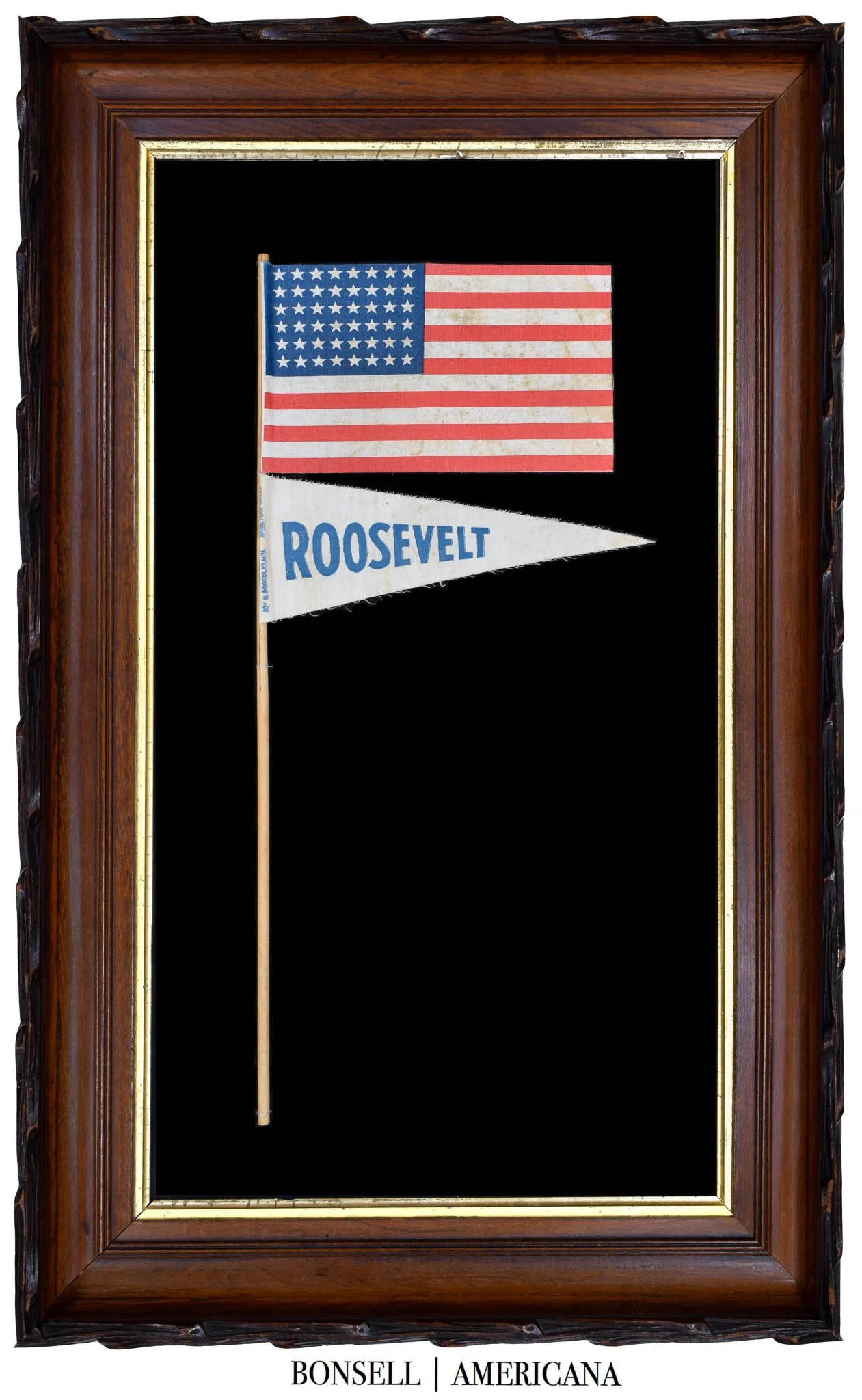
Frame Size (H x L): 35.25” x 22.25”
Flag Size (H x L): 6” x 9” and affixed to a 24” staff.
Pennant Size (H x L): 4” x 10.5” and affixed to the same 24” staff
Offered is a 48 star flag and Franklin D. Roosevelt (“FDR”) pennant, both of which are made of cotton and attached to the same wooden staff. The stars on the flag are arranged in a standard 8-8-8-8-8-8 format. The pennant is white. “ROOSEVELT” is printed horizontally across the field, and “ROY B. BOOKER, ATLANTA | AMER. FLAG CO. N.Y.” is printed vertically across the hoist edge. Both are printed in blue.
In 1890, a bill was introduced that attempted to prevent the desecration of the flag by printing, painting, or advertising for public display or private gain. The bill failed. Then, in 1895, a similar bill was introduced, but also failed. And finally, in 1905, a bill passed outlawing the use of marks and portraits on the flag, coat of arms, and other insignia of the United States. With this background in mind, Booker found something akin to a loophole so as to follow the law passed in 1905, yet still honor FDR. Such a combination is quite unique and visually interesting.
This item is not documented in the Threads of History, written by Herbert Ridgeway Collins, former curator of the Division of Political History at the Smithsonian Institution. Escaping documentation therein was difficult, being that Collins corresponded with 1000’s of collectors, museums, and universities, in his attempt to catalog every political textile. In total, he documented 1500 examples, dating from 1775 to 1979, yet this flag went under his radar, likely a function of its relative rarity and geographically limited distribution.
Booker made buttons for FDR’s Atlanta Homecoming Celebration in 1935. From this, we infer that he likely made this flag for the same reason. Booker’s company, now known as Booker Promotions, was founded in 1920, in Atlanta, and is still in operation. It offers promotional products, branding services, and marketing services.
FDR’S VISIT AND SPEECH
FDR was the presidential nominee for the Democratic Party in 1932, and he ran against Herbert Hoover, who was the nominee for the Republican Party. FDR defeated Hoover. FDR won 472 electoral votes and 57.4% of the popular vote, while Hoover won only 59 electoral votes and 39.7% of the popular vote. FDR went on to also win the elections of 1936, 1940, and 1944, making him the only president to serve more than two terms. He led the United States out of the Great Depression and also led it to victory during World War II.
FDR visited Atlanta on November 29th, 1935 and gave the following speech:
My Friends and Neighbors, I am happy to be in Georgia. I am proud of Georgia. Happy today especially because of this moving reception which my friends, the Senators and all of the Representatives in the Congress from this State, have tendered me, and to which you, the good people of this State, have responded with such warmth and hospitality. Happy because I meet again so many old friends and neighbors. Proud because I see signs on every hand that the overwhelming majority of the people of this State are keeping pace with the millions of others throughout the Nation who believe in progress, are willing to work for progress and are going to get progress. Proud because I see clear signs of a revival of material prosperity in country and in city, and especially because I sense a swelling prosperity of the spirit that spells a greater help and a deeper happiness for our fellow men.
Eleven years ago I came to live at Warm Springs for the first time. That was a period of great so-called prosperity. But I would not go back to the conditions of 1924, and I do not believe that you people would want to go back to those conditions either.
Of that year and of the five years that followed, I have a clear recollection which you can verify for yourselves. In that orgy of "prosperity" a wild speculation was building speculative profits for the speculators and preparing the way for you, the public, to be left "holding the bag." In that orgy of "prosperity," banks, individually and by chains, were closing their doors at the expense of the depositors. In that orgy of "prosperity" the farmers of the South had become involuntary speculators themselves, never certain when they planted their cotton whether it would bring twenty-five cents or fifteen cents or a nickel. In that orgy of "prosperity" the poorest vied with the richest in throwing their earnings and their savings into a cauldron of land and stock speculation. In that orgy of "prosperity" slum conditions went unheeded, better education was neglected, usurious interest charges mounted, child labor continued, starvation wages were too often the rule instead of the exception. Yes, in those days Mammon ruled America. That is why we are not going back to them.
Those are the years for us to remember in the future—those fool's paradise years before the crash came. Too much do we harp on the years that followed, when from 1929 to 1933 this whole Nation slipped spirally downward—ever downward—to the inevitable point when the mechanics of civilization came to a dead stop on March 3, 1933.
You and I need not rehearse the four years of disaster and gloom. We know the simple fact that at the end of those four years America acted before it was too late. America turned about, and by a supreme, well-nigh unanimous national effort, started on the upward path again.
You and I have reason to remember the past two and a half years that have gone by so quickly, reason to remember the fine spirit of the average American citizen which made my task vastly lighter. Memory is short, but yours is not too short to recollect those great meetings of the representatives of the farmers, regionally and in Washington, in the spring and summer of 1933, when they agreed overwhelmingly that unfairly low prices for farm crops could never be raised to, and maintained at, a reasonable level until and unless the Government of the United States acted to help them to reduce the tremendous carryovers and surpluses which threatened us and the whole world.
You and I can well remember the overwhelming demand that the national Government come to the rescue of the home owners and farm owners of the Nation who were losing the roofs over their heads through inflated valuations and exorbitant rates of interest.
You and I still recollect the need for and the successful attainment of a banking policy which not only opened the closed banks but guaranteed the deposits of the depositors of the Nation.
You and I have not forgotten the enthusiastic support that succeeded in ending the labor of children in mills and factories, in seeking a fairer wage level for those on starvation pay, and in giving to the workers hope for the right collectively to bargain with their employers. That success, I am glad to say, in large part still persists.
You and I will not forget the long struggle to put an end to the indiscriminate distribution of "fly-by-night" securities, and to provide fair regulation of the stock exchanges and of the great interstate public utility companies of our country.
You and I—yes, every individual and every family in the land —are being brought close to that supreme achievement of this great Congress, the Social Security law which, in days to come, will provide the aged against distressing want, will set up a national system of insurance for the unemployed, and will extend well-merited care to sick and crippled children.
You and I are enlisted today in a great crusade in every part of the land to cooperate with Nature and not to fight her, to cooperate to stop destructive floods, to prevent dust storms, to prevent the washing away of our precious soils, to grow trees, to give thousands of farm families a chance to live, and to seek to provide more and better food for the city dwellers of the Nation.
In this connection it is, I think, of interest to point out that national surveys which have been conducted in the past year or two prove that the average of the citizenship of the United States lives today on what the doctors would call a third-class diet. If the country lived on a second-class diet instead of a third-class diet, do you know what that would mean? It would mean we would need to put many more acres than we use today back into the production of foodstuffs for domestic consumption. If the Nation lived— as I wish it did—on a first-class diet, we would have to put more acres than we have ever cultivated into the production of an additional supply of things for Americans to eat.
That raises a question:
Why—to speak in broad terms in following up this particular illustration—why are we living on a third-class diet? Well, the best answer I know is this: The masses of the American people have not the purchasing power to eat more and better food.
I mentioned a few weeks ago that farm income in the United States has risen since 1932 a total of nearly three billion dollars. That is because wheat is selling at better than 90 cents instead of 32 cents; corn is selling at 50 cents instead of 12 cents; cotton is at 12 cents instead of 4 1/2 cents, and other crops are in proportion. I wonder what cotton would be selling at today if during these past three years we had continued to produce fifteen or sixteen or seventeen million bales each year, adding to our own surplus, adding to the world surplus, and driving the cotton farmers of the Southland into bankruptcy and starvation. What does this additional three billions of farmers' income mean to the country? What does it mean to the dwellers in the city? It has meant the rebirth of city business, the reopening of closed factories, the doubling of automobile production, the improvement of transportation and the giving of new employment to millions of Americans.
That brings us squarely face to face with the fact of the continued unemployment of many millions of people of whom approximately three and a half million are employables in need of relief. When some of the people of a great and wealthy country are suffering from starvation, I take it that no honest Government has a choice. Over three years ago, realizing in the beginning that we were not doing a perfect thing but that we were doing a necessary, saving and human thing, we appropriated money for direct relief. That was necessary, as you and I know, to ward off actual starvation. But, just as quickly as possible, we turned to the job of providing actual work for those in need.
I can realize that gentlemen in well-warmed and well-stocked clubs will discourse on the expenses of Government and the suffering that they are going through because their Government is 'spending money for work relief. I wish I could take some of these men out on the battle-line of human necessity, and show them the facts that we in the Government are facing. If these more fortunate Americans will come with me, I will not only show them the necessity for the expenditures of this Government, but I will show them, as well, the definite and beneficial results we have attained with the dollars we have spent. Some of these same gentlemen tell me that a dole would be more economical than work relief. That is true. But the men who tell me that have, unfortunately, too little contact with the true America to realize that in this business of relief we are dealing with properly self-respecting Americans to whom a mere dole outrages every instinct of individual independence. Most Americans want to give something for what they get. That something, which in this case is honest work, is the saving barrier between them and moral disintegration. I propose to build that barrier high and keep it high.
Let me talk some more about money.
Last April I stated to the Congress what I have held to consistently ever since—that it was the hope of the Administration that by some time in November of this year we would substantially end the dole, and offer in place of it employment to, by far, the greater part of the three and a half million employable persons we estimated were on relief rolls in the United States.
Week after week, from that time on, some individuals and some organizations and some groups, careless of the truth, regardless of scruple, have sought to make the American people believe that this program was a hopeless failure and that it could not possibly succeed.
Today is the twenty-ninth day of November. It gives me a certain satisfaction to be able to inform you, and through you the Nation, that on Wednesday, two days ago by actual figures, there were three million one hundred and twenty-five thousand persons at work on a great variety of useful projects in every State of the Union. The small remaining number have received orders to report to work on projects already under way or about to be started. That result, I believe you will agree with me, constitutes a substantial and successful national achievement.
Aside from the tremendous increase in morale through substituting work for a dole, there is the practical side of permanent material benefit. Within sight of us today, there stands a tribute to useful work under Government supervision—the first slum clearance and low-rent housing project. Here, at the request of the citizens of Atlanta, we have cleaned out nine square blocks of antiquated squalid dwellings, for years a detriment to this community. Today those hopeless old houses are gone and in their place we see the bright cheerful buildings of the Techwood Housing Project.
Within a very short time, people who never before could get a decent roof over their heads will live here in reasonable comfort amid healthful, worthwhile surroundings; others will find similar homes in Atlanta's second slum clearance project, the University Project; and still others will find similar opportunity in nearly all of the older, overcrowded cities of the United States.
I take it that it has been equally worthwhile to the Nation to give jobs to the unemployed in the construction of a vast network of highways, including thousands of miles of farm-to-market roads; in repairing great numbers of schools, and building hundreds of new schools in city and country; in helping cities to put in sewers and sewage disposal plants and water works; in constructing cold storage warehouses and county recreational buildings; in creating aviation fields; in giving a million boys a chance to go to C.C.C. camps and to work on forestry and soil erosion prevention; in controlling malaria; in pushing health projects; in putting white-collar workers into jobs of permanent usefulness to their communities, and, last but not least, in giving youth an opportunity for better education.
Into the ears of many of you has been dinned the cry that your Government is piling up an unconscionable and back-breaking debt. Let me tell you a simple story: In the spring of 1933, many of the great bankers of the United States flocked to Washington. They were there to get the help of their Government in 'saving their banks from insolvency. To them I pointed out, in all fairness, the simple fact that you could not make bread without flour, the simple fact that the Government would be compelled to go heavily into debt for a few years to come, in order to save banks and save insurance companies and mortgage companies, and railroads, and to take care of millions of people who were on the verge of starvation. Every one of these gentlemen expressed to me at that time the firm conviction that it was all well worth the price and that they heartily approved.
But I did not stop there. In order to get their further judgment, I asked them what they thought the maximum national debt of the United States Government could rise to without serious danger to the national credit. Their answers—remember this was in the spring of 1933—were that the country could safely stand a national debt of between fifty-five and seventy billion dollars. I told them that a rise in the national debt to any such figure was, in my judgment, wholly unnecessary, and that even if they, the bankers, were willing I could not and would not go along with them. I told them then that only a moderate increase in the debt for the next few years seemed likely and justified. That objective holds good today; but remember that at that time many bankers and big business men would have been willing to put the country far deeper into debt than I shall ever let it go.
And by way of parenthesis, if the bankers thought the country could stand a debt of fifty-five to seventy billion dollars in 1933, With values as they were then, I wonder what they would say the country could stand today, in the light of an enormous increase of values of property of all kinds all along the line since 1933.
Let us make one thing clear. Your Government says to you: "You cannot borrow your way out of debt; but you can invest your way into a sounder future."
As a matter of actual fact, the gross national debt under the last Administration rose from a little over seventeen billions to twenty-one billions. The day I came into office I found that the national Treasury contained only $158,000,000, or, at the rate of previously authorized expenditures under the last Administration, I found enough money in the Treasury to last less than a month. Since that time, March 4, 1933, the national debt has risen—of course it has risen, and you know why—from 21 billions to 29 1/2 billions; but it must also be remembered that today, included in this figure there is nearly 1 1/2 billions of working balance in the Treasury of the United States and nearly 4 1/2 billion dollars of recoverable assets which the Government is going to get back over a period of years, and as we get it back we are going to retire the national debt with it.
As things stand today, in the light of a definite and continuing economic improvement, we have passed the peak of appropriations; revenues without the imposition of new taxes are increasing, and we can look forward with assurance to a decreasing deficit. The credit of the Government is today higher than that of any other great Nation in the world. It is higher in spite of attacks on that credit made by those few individuals and organizations which seek to dictate to the Administration and to the Congress how to run the national Treasury and how to let the needy starve.
Back in that same spring of 1933, if you and I had made a national balance sheet—I mean a balance sheet based on what the individual people of the country owned and owed—we would have found that if we had added up the values of all of the property of every kind in the United States, the total of those values, which you and I would call assets, would have been greatly exceeded by the figure representing the total of all the debts owed by the people of the United States. In other words, in March, 1933, our national balance sheet, the wealth on the one side against the debts of the American public, showed that we were in the red. Today, two and a half years later, it is a fact that the total of all the debts in the United States is lower than it was then; and on the other side of the picture, you and I know that the values of property of all kinds—farms, houses, automobiles, securities and every other kind of property—have increased so greatly since 1933, that today we are once more in the black. We were insolvent then. Today we are solvent, and we are going to stay so.
In this fact, especially as we are gathered here today at a time of national Thanksgiving, all of us can rightly find a deep satisfaction. But recovery means something more than getting the country back into the black. You and I do not want just to go back to the past. We want to face the future in the belief that human beings can enjoy more of the good things of life, under better conditions, than human beings ever enjoyed in the past. American life has improved in these two years and a half, and if I have anything to do with it, it is going to improve more in the days to come. The word "progress" is a better word than "recovery," because progress means not only a sound business and a sound agriculture, sound from the material point of view, but it means, with equal importance, a sound improvement in American life as a result of continuing and forceful effort on the part of the people of our Nation and, through them, on the part of the Government of the Nation. I am certain, my friends, that that is your purpose. You have my assurance that it is mine. That is why I continue my confidence, my faith, everlasting faith, in the people of America.
THE 48 STAR FLAG
The 48 star flag represents the inclusion of New Mexico and Arizona to the Union. New Mexico was admitted on January 6th, 1912, and Arizona was admitted on February 14th, 1912. The 48 star flag became official on July 4th, 1912. Presidents Taft, Wilson, Harding, Coolidge, Hoover, Roosevelt, Truman, and Eisenhower all served under this flag. World Wars I and II and the Korean War were all fought under it. The 48 star flag was official for 47 years up until July 4th, 1959, the time at which the 49 star flag became official and began to represent the inclusion of Alaska in the Union.
Conservation Process: The flag and pennant were hand sewn to cotton fabric, and all three were hand sewn to a mounting board. To prevent the black dye in the cotton fabric from seeping into the flag and pennant, it was first washed in a standard wash and then in a dye setting wash. The flag and pennant are positioned behind Conservation Clear Acrylic (standard) or behind Optium Museum Acrylic (per request).
Frame: This offering is in an multitiered frame with an outer walnut layer and an inner gilded layer. It dates to between 1860 and 1890.
Condition Report: There is minor staining and foxing across both the flag and pennant. The overall condition is age appropriate, and the overall presentation is very attractive.
Collectability Level: The Great – Perfect for Rising Collectors
Date of Origin: 1935
Number of Stars: 48
Associated War: WWI, WWII, and Korean War
Associated State: Arizona
Price: Call 618-553-2291, or email info@bonsellamericana.com
Frame Size (H x L): 22” x 42”
Pennant Size (H x L): 11” x 30”
Offered is a women’s suffrage pennant produced for the Women’s Political Union of New York, and one of the more visually accomplished pieces of American suffrage material from the years immediately preceding passage of the Nineteenth Amendment. Printed on a rich purple felt ground, the pennant combines the words “VOTES FOR WOMEN” with an elaborate allegorical figure, radiating lines, stars, and the name “WOMEN’S POLITICAL UNION.” The combination of purple, green, white, and gold distinguishes it from the comparatively simple lettering and limited palettes found on many surviving suffrage pennants.
The central image is generally known as the “Bugler Girl” or “Clarion Girl,” an important suffrage emblem whose origins lie in the British movement for women’s voting rights. The figure was created by British artist and suffragist Caroline Watts and depicts an armored female herald sounding a bugle while advancing forward. The imagery was direct and purposeful: the clarion call announces the movement, while the advancing woman represents determination and progress. Behind her are radiating lines and a crescent-like arrangement of stars, creating one of the more elaborate graphic compositions found on suffrage material of the period.
Harriot Stanton Blatch adopted the imagery for use by the Women’s Political Union in the United States. Blatch was the daughter of Elizabeth Cady Stanton, one of the foundational figures of the American women’s rights movement, but became an important suffrage leader in her own right. After spending many years in England, where she became familiar with the increasingly active British suffrage campaign, Blatch returned to the United States and helped introduce some of its organizational methods and visual language to the American movement.
In 1907, Blatch founded the Equality League of Self-Supporting Women in New York. The organization was intended in part to broaden the constituency of the suffrage movement by bringing working women into organized political activity. In 1910, the group became the Women’s Political Union, or WPU. Blatch favored highly visible public campaigning, including open-air meetings, parades, banners, pennants, and other forms of political advertising intended to move the suffrage question beyond meeting halls and into the streets.
The present pennant is a strong example of that strategy. Its message could hardly be more direct. “VOTES FOR WOMEN” occupies most of the field in large decorative lettering, while the more elaborate image at the hoist gives the viewer something immediately recognizable to associate with the cause. At a time when political organizations increasingly understood the value of visual identity, the WPU produced material intended not simply to communicate a position, but to attract attention and remain memorable.
Its purple, green, and white coloration also reflects the transatlantic history of the design. Those colors had strong associations with the British women’s suffrage movement and differ markedly from the yellow and black more frequently encountered on American suffrage material. Blatch’s use of the British-derived imagery and palette makes the pennant particularly useful as evidence of the exchange of ideas, tactics, and graphic language between the British and American movements.
The pennant belongs to a recognizable WPU design represented in institutional collections. An example held by the Onondaga Historical Association has been reproduced by the New York State Museum in educational material devoted to the women’s suffrage movement and dated circa 1915. Another example is in the collection of the Museum of the City of New York and has been published by The Magazine Antiques, where it was dated circa 1917. These surviving examples help place the design firmly within the active campaigning years of the Women’s Political Union and document its place within the material culture of the suffrage movement.
Dating examples of this type with absolute precision can be difficult. The Women’s Political Union name came into use in 1910, while the organization’s activities increasingly overlapped with the broader national suffrage campaign during the middle of the decade. Blatch eventually aligned the WPU with Alice Paul’s Congressional Union, and the Women’s Political Union ceased operating as a distinct organization during this period. Taken together with the dating of surviving institutional examples, a circa 1910–1917 date range is appropriate for the present pennant.
One particularly interesting aspect of this example is its later history of use. When acquired, the pennant had been incorporated into a pillow, paired with another example of the same suffrage pennant with stuffing placed between the two. Political textiles of this type were often ephemeral objects, intended for rallies, marches, meetings, and public display rather than long-term preservation. Converting the pennants into a household object may have contributed to their survival long after the campaign for which they were originally produced.
The reverse of the pennant offered here adds another unusual element to its history. On the opposite side is printing for Hartford, Connecticut. The combination strongly suggests that the textile had a meaningful connection with Hartford. While the precise circumstances cannot presently be established, the Hartford association is worth noting, particularly because Connecticut itself had an active suffrage movement during this period and Hartford served as one of the state’s principal political and civic centers.
Among surviving women’s suffrage pennants, this design is notable for the amount of visual information it incorporates. Many suffrage textiles rely almost entirely upon wording or simple color symbolism. Here, the Women’s Political Union combined an unmistakable political slogan with sophisticated illustration, striking color, patriotic symbolism, and one of the movement’s recognizable allegorical figures.
Conservation Process: This pennant was hand sewn to cotton fabric, and both were hand sewn to a mounting board. To prevent the black dye in the cotton fabric from seeping into the pennant, it was first washed in a standard wash and then in a dye setting wash. The pennant is positioned behind Optium Museum Acrylic.
Frame: The pennant is housed in an exceptional antique tiger maple frame of substantial scale and unusually strong figure. The frame is constructed in two primary sections, with the outer molding wrapping around the stepped inner elements to create a layered, architectural profile; the richness of the maple and quality of construction make this one of the best frames we have handled.
Condition Report: The pennant presents well overall, with strong surviving color and graphics. There is visible discoloration at the pointed end, along with several holes and areas of loss throughout the felt; these have been discreetly backed with purple fabric so the missing areas blend closely with the original ground when viewed in person. The losses remain visible on close inspection, but the backing substantially reduces their visual impact and allows the design to read clearly.
Collectability Level: The Best – Perfect for Advanced Collectors
Date of Origin: 1910-1917