
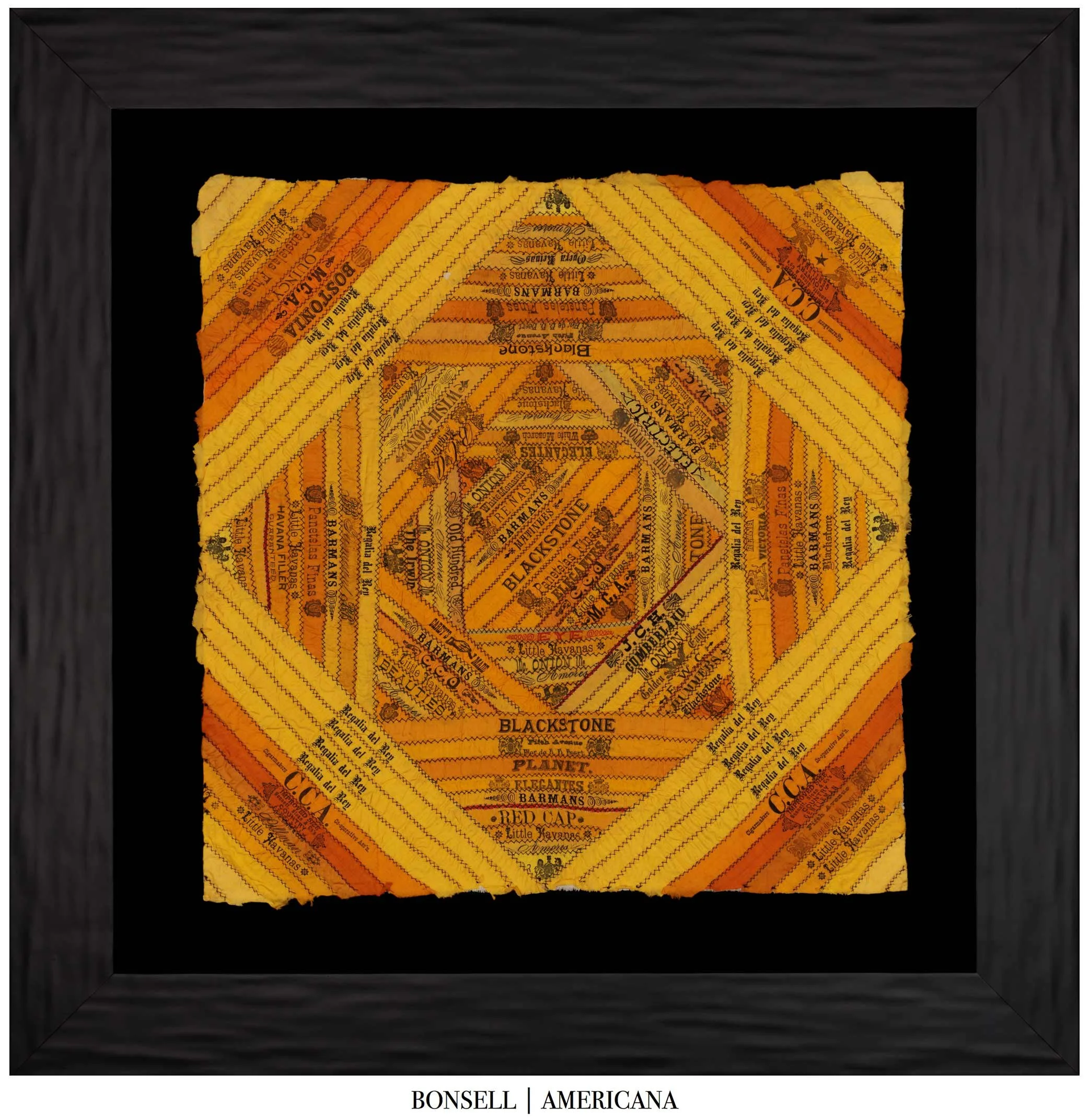
Frame Size (H x L): 34” x 34”
Quilt Size (H x L): 23” x 23”
Offered is a quilt made of silk cigar ribbons, dating to between 1880 and 1910.
In the nineteenth century, most men enjoyed a good cigar, so much so that nearly every household had at least one cigar smoker. At the time, it was considered a gentlemanly and leisurely activity. As Mark Twain often did, he famously quipped and captured the status of cigars with respect to himself and American men generally in saying, “If I cannot smoke in heaven, then I shall not go.” Even the most debonair in the United States and elsewhere were fond of cigars, such as King Edward VII, who announced to his acquaintances, in protest of Queen Victoria’s smoke free policy, “Gentlemen, you may smoke.”
In the United States, cigar smoking was at its peak in 1895, and at that time, there were thousands of cigar manufacturers, in a range of sizes, to meet the corresponding demand. In Cleveland, Ohio, for example, there were 330 cigar manufacturers at the peak (versus none today). On one end of the spectrum, some “manufacturers” were nothing more than a family rolling cigars in a New York apartment or a farmer rolling cigars in an Ohio barn. On the other end, some manufacturers were large, sophisticated organizations, such as those in Connecticut and Florida, the success of Connecticut’s manufacturers being based on the state’s outstanding soil composition, and the success of Florida’s manufacturers being based on the state’s easy access to Cuban suppliers.
Cigar manufacturers sold to distributors. In some cases, the manufacturer would package the cigars for the distributor—but with the end customer in mind—in a wooden box, or alternatively the manufacturer would wrap the cigars with a silk ribbon. In other cases, the manufacturer would package the cigars in mass quantities in a barrel or box, and then the distributor would package the cigars in the wooden box or wrap the cigars. Typically, when wrapped, cigars were sold in quantities of either 25 or 50. Early cigars were much smaller than today’s, almost to the point of being closer in size to a modern cigarette than a modern cigar.
Cigar ribbons were made of silk and each featured the respective manufacturer’s name, essentially being a combination of a packaging material, an advertisement, and a differentiator. A higher quality cigar had higher quality ribbon, while a lower quality cigar had a lower quality ribbon. Most ribbons had a field in a shade of yellow or orange, and most had an overprinting in black. The different shades of yellow and orange seemed to be a function of the different shades of ribbons available, or alternatively a function of the manufacturers wanting to distinguish themselves from the others. Despite a general focus on yellow and orange, some manufacturers used other colors, such as pink, blue, red, and green. Cigar ribbons were typically shy of an inch in width and between 12 and 15 inches in length.
Cigar ribbons—being essentially a form of packaging—were generally thrown away after their respective cigars were smoked. However, some smokers (or their wives) collected the ribbons for enjoyment or for use in a project, such as a table cover, a pillowcase, or a quilt. Such thriftiness was common in the nineteenth and early twentieth centuries, not to mention during the Great Depression and afterwards.
Cigar quilts surface in a variety of sizes. The quilt offered herein is on the smaller end of the spectrum and is desirable for collecting, framing, and displaying. Bigger quilts are sometimes as large is 5 feet by 5 feet. While such quilts are dramatic, they are difficult to display and, thus, often less desirable.
The ribbons of the quilt herein form a diamond in a level square, surrounded by a larger tipped square, surrounded by an even larger level square, and so on. The ribbons are from different manufacturers, including Blackstone, Red Cap, Little Havanas, and Elegantes, to name just a few examples. The maker placed the manufacturers and their respective colors, so as to make a thoughtful, attractive design.
By the 1910s, 20s, and 30s, demand for cigars began to waiver and factories began to shutter, mostly as a result of cigarettes becoming a serious competitor thereto and as a result of the Great Depression. Following this downfall, cigars were significantly less popular for decades, even to the point that manufacturers wondered whether the industry would survive in any form at all. However, beginning in the 1990s—with the introduction of Cigar Afficionado and an increasing interest in old gentlemanly pursuits—cigars made a comeback and are still very much a part of American culture, albeit on a much smaller scale as compared to the nineteenth and early twentieth centuries.
Conservation Process: This quilt was hand sewn to cotton fabric, and both were hand sewn to a mounting board. To prevent the black dye in the cotton fabric from seeping into the quilt, it was first washed in a standard wash and then in a dye setting wash. The quilt is positioned behind Conservation Clear Acrylic (standard) or behind Optium Museum Acrylic (per request).
Frame: The flag is housed in a substantial, wide-profile frame with a matte charcoal finish and subtle linear graining across the face.
Condition: Variations along the raw edges are period to the piece. This quilt is in excellent condition.
Collectability Level: The Good – Perfect for Beginning Collectors and Gifts
Date of Origin: 1880-1910
Price: Call 618-553-2291, or email info@bonsellamericana.com
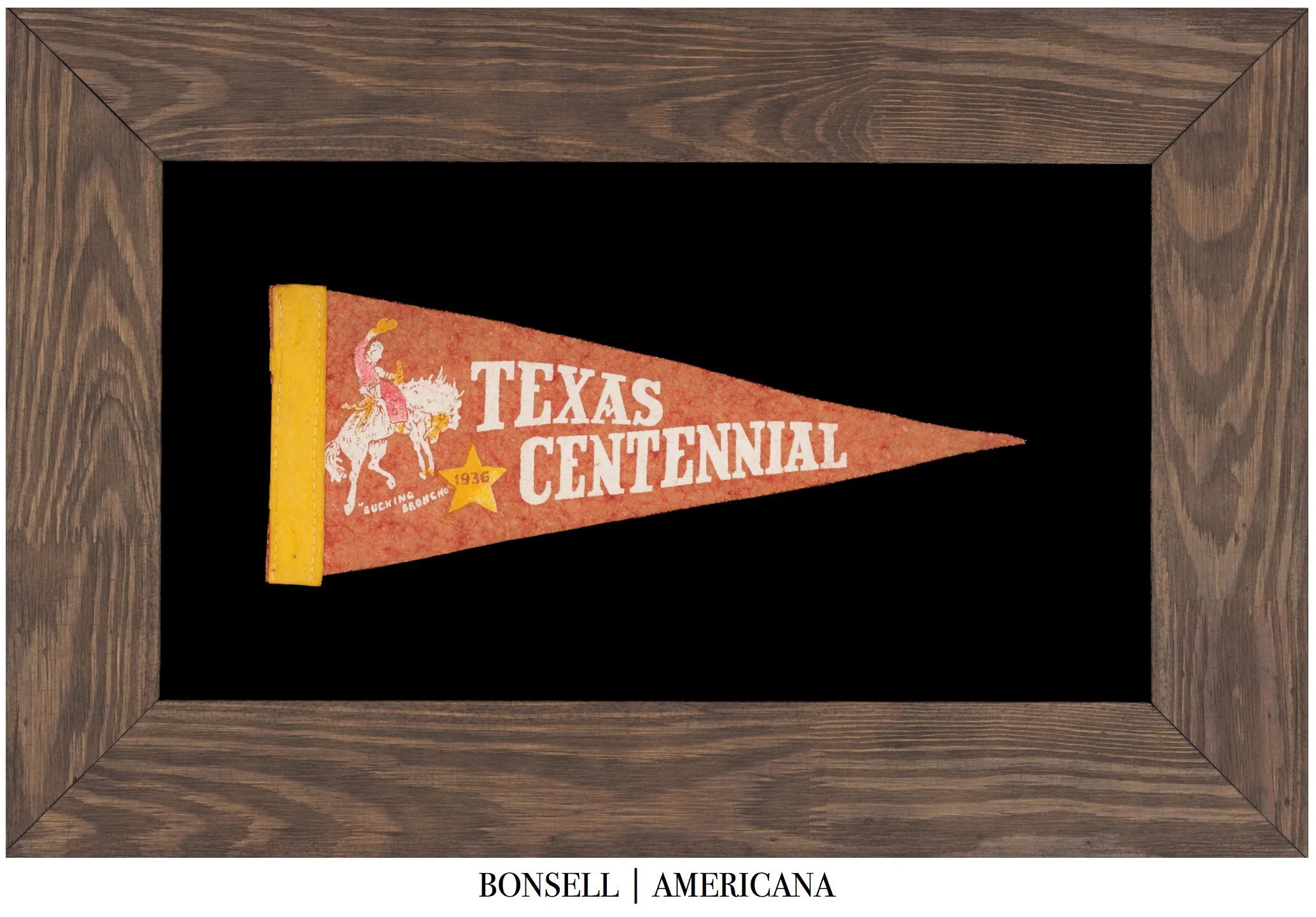
Frame Size (H x L): 13” x 20”
Pennant Size (H x L): 4 ¾” x 11 ½”
Offered is a striking Texas Centennial pennant dating to 1936, printed on felt and featuring bold western imagery associated with the celebration of the 100th anniversary of Texas independence. The pennant is rendered in a warm red-orange field with a contrasting yellow hoist, while the graphics are printed primarily in white, yellow, and red.
The design is dominated by the words “TEXAS CENTENNIAL” in large white block lettering, immediately identifying the piece with the statewide centennial celebration. To the left is a dramatic image of a cowboy riding a bucking bronco, an especially appropriate motif for an event that leaned heavily into Texas history, ranching culture, and the mythology of the American West. Beneath the horse appears the printed phrase “BUCKING BRONCHO,” while a yellow five-pointed star carries the date “1936.” Together, the typography and imagery give the pennant the unmistakable visual character of 1930s exposition and souvenir material.
The Texas Centennial commemorated the 100th anniversary of Texas independence in 1836. Although events were held throughout the state, the centerpiece was the Texas Centennial Exposition in Dallas, which opened at Fair Park in June 1936. The exposition combined Texas history with an emphasis on modernization, industry, culture, and progress, drawing millions of visitors during its run.
The celebration was far larger than a single fair. Centennial projects and events took place throughout Texas, resulting in new museums, monuments, restored historic sites, and commemorative buildings. The effort was both historical and promotional, presenting Texas as a place with a distinctive past and an ambitious future.
Souvenir pennants such as this were especially well suited to large public celebrations of the era. Made inexpensively from felt, they could incorporate colorful printed graphics and be easily carried home by visitors. Their imagery often distilled an event into a handful of immediately recognizable symbols. Here, the cowboy, bucking horse, star, and oversized Texas lettering present an idealized vision of the state that would have been immediately recognizable to visitors in 1936.
More than simply a Texas souvenir, the pennant is a colorful surviving artifact from one of the state's largest commemorative events of the 20th century. Its strong period graphics, western imagery, and prominent Centennial lettering make it an especially appealing example of Texas exposition material from 1936.
Conservation Process: This pennant was hand sewn to cotton fabric, and both were hand sewn to a mounting board. To prevent the black dye in the cotton fabric from seeping into the pennant, it was first washed in a standard wash and then in a dye setting wash. The pennant is positioned behind Optium Museum Acrylic.
Frame: The pennant is housed in a wide, rustic wood frame with a dark brown finish that allows the natural grain to remain clearly visible.
Condition Report: The pennant is in good overall condition, with age-related fading, mottling, and scattered discoloration throughout the felt. The printed graphics and lettering remain strong and readily legible, with only minor surface wear and softening along the edges consistent with age.
Collectability Level: The Good – For Beginners and Gifts
Date of Origin: 1936
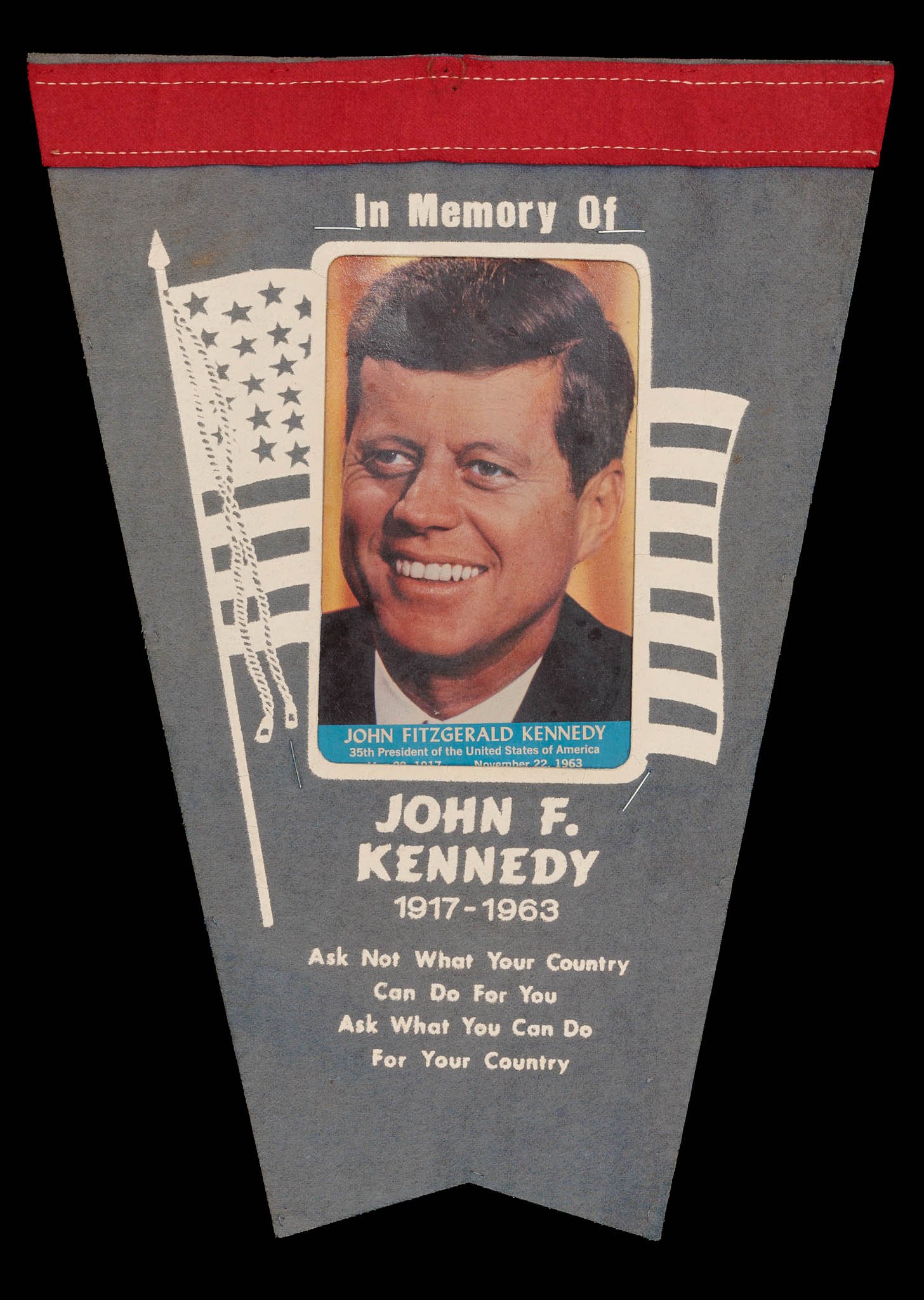
Frame Size (H x L): 20” x 17”
Pennant Size (H x L): 11.5” x 8.5”
Offered is a memorial pennant honoring John F. Kennedy, the 35th President of the United States, produced in the wake of his assassination in 1963. Made primarily of felt, the pennant combines a photographic portrait of Kennedy with patriotic imagery, memorial inscriptions, and words from his inaugural address. The result is an especially graphic example of the enormous body of commemorative material created following his death.
At center is a color portrait of Kennedy, smiling and facing slightly to the viewer's left. Behind the image is a stylized American flag, while the words “In Memory Of” appear prominently above. Below, the pennant identifies “John F. Kennedy, 1917–1963,” followed by the familiar words associated with his presidency: “Ask Not What Your Country Can Do For You / Ask What You Can Do For Your Country.” The red binding across the top provides a strong contrast to the otherwise gray, black, white, and muted-color composition.
The quotation is drawn from Kennedy's inaugural address of January 20, 1961. Near the conclusion of the speech, Kennedy called upon Americans to participate actively in the life of the nation and framed public service as an obligation of citizenship. The passage quickly became one of the most recognizable statements of his presidency, making its inclusion on a memorial object particularly appropriate.
Kennedy entered the White House at age 43 following the closely contested 1960 election and served from January 1961 until his assassination in Dallas, Texas, on November 22, 1963. His administration coincided with an especially consequential period of the Cold War and included the Bay of Pigs invasion, the Cuban Missile Crisis, the creation of the Peace Corps, growing federal involvement in the civil rights struggle, and an expanded national commitment to space exploration. In March 1961, Kennedy established the Peace Corps by executive order, and in May of that year he called for the United States to land a man on the Moon before the decade's end.
Kennedy’s assassination prompted a broad national outpouring of grief and a wide range of memorial objects, including photographs, buttons, banners, and pennants such as this.
This example combines several elements closely associated with Kennedy’s memory: a youthful photographic portrait, patriotic American flag imagery, and the well-known quotation from his inaugural address. Together, they make the pennant a distinctive piece of period presidential memorabilia and a reflection of how Kennedy was commemorated following his death in 1963.
Conservation Process: This pennant was hand sewn to cotton fabric, and both were hand sewn to a mounting board. To prevent the black dye in the cotton fabric from seeping into the pennant, the fabric was first washed in a standard wash and then in a dye setting wash. The pennant is positioned behind Optium Museum Acrylic.
Frame: The pennant is housed in a black frame with deeply stepped molding and a narrow silver-toned inner liner.
Condition Report: The pennant is in very good overall condition, with light surface soiling, minor discoloration, and small areas of wear consistent with age and use. The felt remains well preserved, with strong graphics and lettering, while the applied photographic portrait shows light edge wear and is secured with visible staples. The red top binding remains intact, with only minor waviness and wear.
Collectability Level: The Good – Perfect for Beginning Collectors and Gifts
Date of Origin: 1963
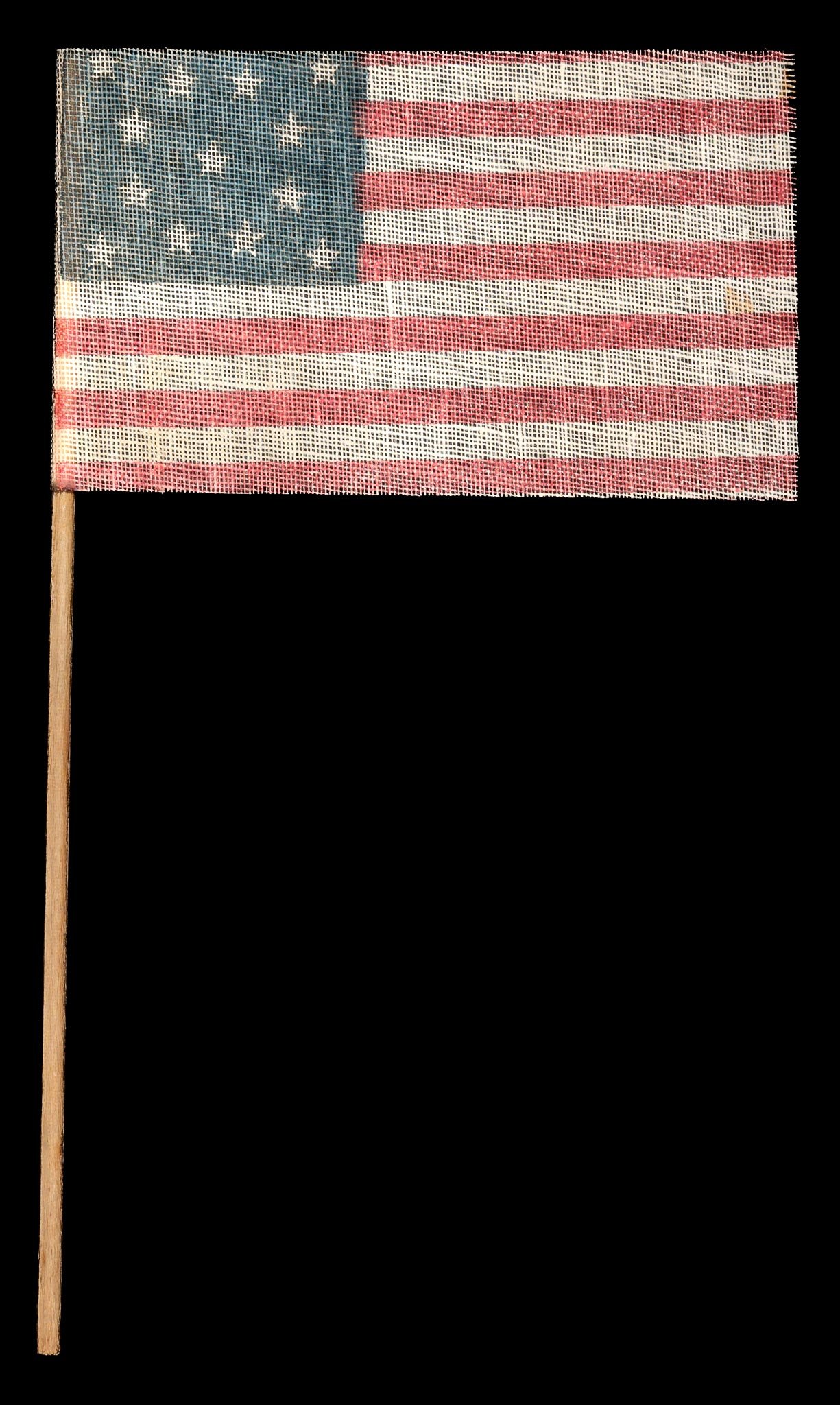
Frame Size (H x L): 13.5” x 10.5”
Flag Size (H x L): 2.5” x 4 and Affixed to a 7” Staff
Offered is a 13-star American parade flag, made for the patriotic celebrations surrounding the United States Centennial of 1876. Printed on plain weave cotton and mounted to its original wooden staff, the flag is characteristic of the small hand-waving flags carried in parades, political gatherings, public ceremonies, and other patriotic events during the latter nineteenth century.
The Centennial represented an extraordinary moment in American history. Just eleven years after the conclusion of the Civil War, the nation celebrated the 100th anniversary of the Declaration of Independence amid an enormous revival of patriotic imagery. Cities and towns throughout the country organized parades, speeches, military demonstrations, fireworks, and public gatherings, while homes, businesses, and civic buildings were decorated extensively in red, white, and blue. American flags—particularly small parade flags such as this example—were among the most visible symbols of the celebration.
The centerpiece of the Centennial year was the Centennial International Exhibition in Philadelphia, the first official world's fair held in the United States. Open from May through November 1876, the exhibition attracted nearly ten million visitors and showcased American industry, technology, art, agriculture, and manufacturing to an international audience. Among its celebrated attractions were the enormous Corliss steam engine that powered much of Machinery Hall and Alexander Graham Bell's recently developed telephone, which was famously demonstrated before exhibition judges.
Although the official flag of the United States during most of the Centennial year contained 37 stars, flag makers were rarely constrained by official star counts. Colorado was admitted to the Union on August 1, 1876, becoming the 38th state and earning its enduring nickname, the “Centennial State.” Anticipating Colorado's admission, manufacturers produced large numbers of 38-star flags before that count formally became official on July 4, 1877.
Alongside the 37- and 38-star flags, however, 13-star flags enjoyed renewed popularity during the Centennial because of their direct association with the nation's founding. Rather than representing the contemporary number of states, the 13 stars recalled the 13 original colonies and the American Revolution. For a country celebrating its first hundred years, the symbolism was especially appropriate, and manufacturers produced 13-star flags in numerous arrangements and sizes for Centennial displays and festivities.
The origins of the 13-star American flag extend to June 14, 1777, when the Continental Congress adopted the first national flag resolution:
“Resolved, That the flag of the thirteen United States be thirteen stripes, alternate red and white; that the union be thirteen stars, white in a blue field, representing a new constellation.”
The precise arrangement of those 13 stars was not specified, resulting in an extraordinary variety of patterns during the early national period. Thirteen remained the official number of stars until Vermont and Kentucky entered the Union and the 15-star flag was adopted in 1795.
Importantly, the 13-star configuration did not disappear as additional states joined the nation. It continued to be employed for practical, naval, commemorative, and patriotic purposes throughout the nineteenth century. Its visual connection to the Revolution made it especially attractive whenever Americans sought to evoke the country's founding generation. Thirteen-star flags consequently appeared during periods of heightened patriotism, including the Mexican War, the Civil War, and celebrations honoring Revolutionary War history.
The return of the Marquis de Lafayette to the United States in 1824 provides an early example of this revival of Revolutionary symbolism. Lafayette, the celebrated French officer who had fought alongside the Americans during the Revolution, was welcomed during an extensive national tour with elaborate parades, banquets, speeches, and public ceremonies. Similar appeals to the imagery of the founding era became increasingly common as the nineteenth century progressed.
That tradition reached its greatest expression with the Centennial in 1876. Few flags could have conveyed the meaning of the occasion more directly than a flag bearing 13 stars: a visual reference to the original states displayed exactly one hundred years after American independence.
Small parade flags from the Centennial period are particularly evocative artifacts because they were intended to be held and waved rather than simply displayed from buildings. Their modest scale, lightweight construction, and wooden staffs allowed thousands of participants and spectators to carry the national colors personally through the parades and celebrations that defined America's 100th anniversary.
This example survives as a wonderful artifact of that period—a miniature American flag whose 13 stars deliberately look backward to the nation's founding while celebrating its first century.
Conservation Process: This flag was hand sewn to cotton fabric, and both were hand sewn to a mounting board. To prevent the black dye in the cotton fabric from seeping into the flag, it was first washed in a standard wash and then in a dye setting wash. The flag is positioned behind Optium Museum Acrylic.
Frame: The flag is presented in an antique marquetry frame with richly figured wood veneers arranged in geometric bands. The layered construction, warm patina, and dark inner molding provide an especially handsome period presentation for the flag.
Condition Report: The flag is in very good condition for its age, retaining strong red and blue coloration with attractive overall fading and toning. There is minor fraying and thread loss along the outer edges, along with scattered small stains and areas of discoloration consistent with age and use.
Collectability Level: The Good – Perfect for Beginning Collectors and Gifts
Date of Origin: 1876
Number of Stars: 13
Associated War: The Indian Wars (1860-1890)
Associated State: Original 13 Colonies
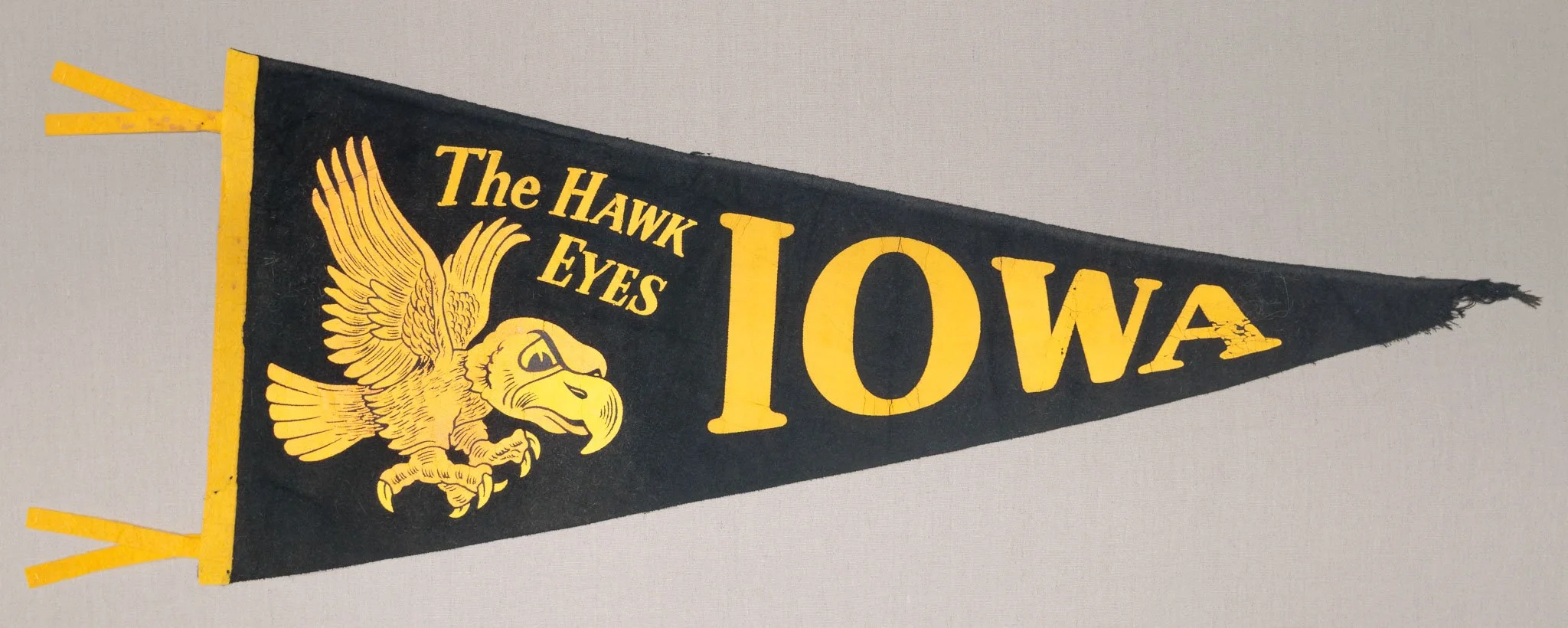
Frame Size (H x L): 22.5” x 43.5”
Pennant Size (H x L): 12” x 29.75” with 4” tassels.
Offered is a vintage University of Iowa felt pennant, dating to approximately 1950–1960. Rendered in Iowa’s familiar black and gold, the pennant features a large flying hawk beneath the phrase “The Hawk Eyes,” followed by an oversized “IOWA” extending nearly the full length of the field. Its animated imagery, bold typography, and elongated proportions make it a strong example of mid-20th-century collegiate souvenir design.
The pennant is constructed from black felt and finished along the hoist with a narrow yellow felt binding. Four yellow felt ties extend from the top and bottom, allowing the pennant to be secured to a wall, display rod, or other support. This tie-style construction was commonly used on collegiate and athletic pennants during the first half of the 20th century and remained popular into the postwar years. The long, sharply tapered body gives the piece a dramatic horizontal presence, while the yellow decoration stands out clearly against the black ground.
Near the hoist is a detailed illustration of a hawk in flight. The bird is shown with raised wings, spread tail feathers, extended talons, and an open beak. Fine black lines define the feathers, face, body, and claws within the yellow silhouette, giving the image more detail than is usually encountered on later collegiate pennants. A small varsity-style letter appears on the bird’s head, further linking the image to the University of Iowa and its athletic programs.
Above the bird appears the phrase “The Hawk Eyes,” divided into two lines and rendered in serif lettering. The two-word treatment is noteworthy. Although “Hawkeyes” had long been established as the nickname for Iowans and the university’s athletic teams, souvenir manufacturers sometimes altered familiar names for graphic effect. Here, the phrase may also have been intended as a playful reference to the watchful bird shown immediately below.
The remainder of the pennant is dominated by the word “IOWA.” The lettering decreases in scale as it follows the narrowing shape of the felt field toward the point. This arrangement allowed the manufacturer to make full use of the available space while preserving the pennant’s strongly tapered profile. The substantial serif lettering and slight irregularity of the composition are characteristic of collegiate graphics made before school logos and athletic identities became more rigidly standardized.
The University of Iowa’s association with the Hawkeye name dates well before the manufacture of this pennant. By the middle of the 20th century, hawk imagery had become an increasingly important part of the university’s visual identity. The cartoon mascot later known as Herky the Hawk originated in the late 1940s and helped transform the Hawkeye from a regional nickname into a recognizable athletic character.
The bird shown here appears to belong to that early period of mascot development. Rather than the upright, humanlike figure commonly associated with later versions of Herky, this pennant presents a largely naturalistic hawk with an exaggerated expression and collegiate insignia. This combination is consistent with the transitional mascot imagery of the postwar years, when manufacturers often created their own interpretations of school symbols.
The pennant’s construction and graphic treatment support a date of approximately 1950–1960. Its black felt body, separately applied yellow hoist and ties, detailed surface-printed illustration, traditional serif lettering, and early interpretation of the Iowa hawk all correspond with collegiate pennants made during the 1950s.
With its expressive flying hawk, unusual “The Hawk Eyes” wording, and especially bold presentation of the Iowa name, this pennant captures the spirited visual culture surrounding American college athletics during the postwar era.
Conservation Process: This pennant was hand sewn to cotton fabric, and both were hand sewn to a mounting board. To prevent the black dye in the cotton fabric from seeping into the pennant, it was first washed in a standard wash and then in a dye setting wash. The pennant is positioned behind Optium Museum Acrylic.
Frame: The pennant is presented in a substantial black frame with a classic reverse-scoop profile and satin finish. A narrow gilded inner edge adds definition and complements the pennant’s yellow graphics.
Condition Report: The pennant is in good overall condition for its age, with scattered cracking and minor loss to the yellow printed decoration, most noticeably within the final letters of “IOWA.” The pointed end shows fraying, thinning, and a small area of material loss, while the black felt field and yellow ties otherwise remain largely intact.
Collectability Level: The Extraordinary – Museum Quality Offerings
Date of Origin: 1950-1960
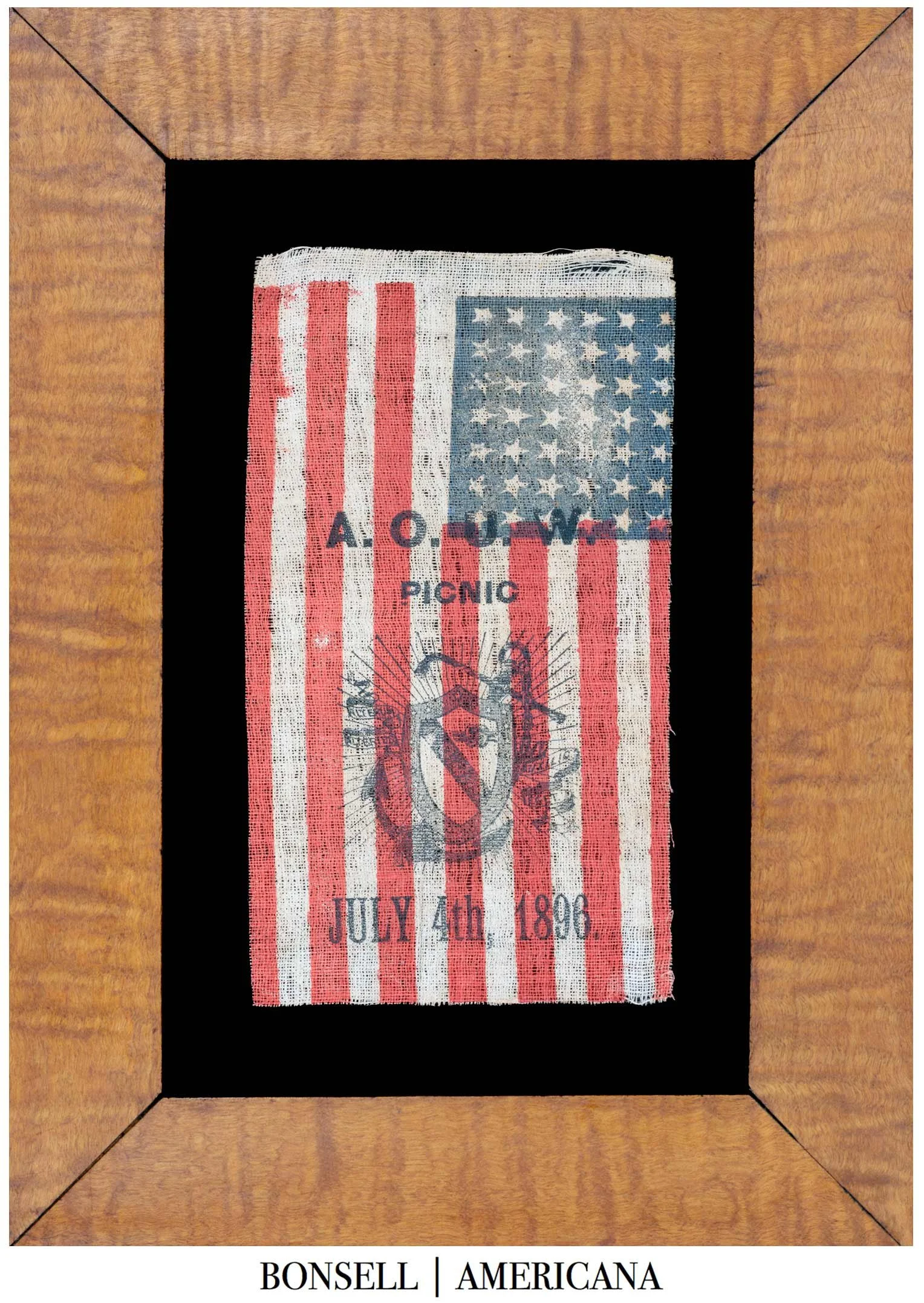
Frame Size (H x L): 10.25” x 7.5”
Flag Size (H x L): 6.5” x 3.5”
Offered is a vertically oriented and highly unusual 42-star American parade flag, printed on open-weave, plain weave cotton and bearing a commemorative overprint for an Ancient Order of United Workmen (A.O.U.W.) Fourth of July picnic held in 1896. The flag displays a distinctly folk quality, with 42 stars arranged in six linear rows of seven stars each. The stars vary noticeably in shape and placement, lending the design a charmingly irregular appearance despite its commercially printed construction.
Adding substantially to the appeal of the present example is the overprinted decoration occupying the center of the striped field. Printed in dark blue ink, the design advertises an “A.O.U.W. Picnic” held on July 4th, 1896. At center is the emblem of the Ancient Order of United Workmen, incorporating a shield, anchor, symbols of fraternity and labor, and radiating lines that emphasize the device in a manner reminiscent of a medal or civic badge. Encircling the emblem is the organization’s Latin motto, “alter alterius auxilio eget,” generally translated as “each needs the help of another.” The phrase succinctly expressed the society’s central principle of mutual aid and collective responsibility.
Founded in 1868 by John Jordan Upchurch, the Ancient Order of United Workmen emerged during a period when commercial life insurance remained beyond the reach of many working Americans. The organization combined social fellowship, civic engagement, and a system of mutual financial protection through which members contributed to a fund providing benefits to the families of deceased brethren. The concept proved enormously successful. By the final decades of the 19th century, the A.O.U.W. had become one of the largest fraternal organizations in the nation and served as a model for many later fraternal insurance societies.
Public gatherings formed an important component of lodge life. Picnics, parades, excursions, and Independence Day celebrations provided opportunities for members and their families to gather while simultaneously promoting the organization’s ideals within the broader community. Textiles such as the present example were produced specifically for such occasions and served as both patriotic decorations and commemorative souvenirs. Their survival rate was naturally low, owing to their lightweight construction and intended use during outdoor festivities.
The 42-star count reflects the admission of Washington as the 42nd state on November 11th, 1889. In accordance with the Flag Act of 1818, the 42-star flag became official on July 4th, 1890. Its official period was exceptionally brief, lasting just one year before the admissions of Idaho and Wyoming resulted in the 44-star flag on July 4th, 1891.
Interestingly, the overprint on the present example is dated July 4th, 1896, several years after the official period of the 42-star flag. While this might initially appear contradictory, such discrepancies are frequently encountered on 19th century parade flags and other commercially printed patriotic textiles. Manufacturers often continued to employ existing printing patterns long after a particular star count had passed from official use, especially on inexpensive souvenir, advertising, and commemorative flags. As a result, it is not unusual to encounter late 19th century examples bearing star counts that predate the event or occasion for which they were produced. In this case, the 1896 overprint provides the most reliable evidence for the date of its event-related production and use.
The combination of a 42-star count, folksy presentation, open-weave cotton construction, and dated fraternal overprint creates an object that exists at the intersection of American flag collecting, social history, and fraternal benefit society history.
Conservation Process: The flag was hand sewn to cotton fabric, and both were hand sewn to a mounting board. To prevent the black dye in the cotton fabric from seeping into the flag, it was first washed in a standard wash and then in a dye setting wash. The flag is positioned behind Optium Museum Acrylic.
Frame: The flag is in an attractive tiger maple frame. Tiger maple frames are cherished for their striking, wavy grain patterns that shimmer with a unique iridescence, reminiscent of a tiger's coat.
Condition Report: The flag presents with expected wear for its age and lightweight construction, including fraying and small losses along the edges. There is scattered soiling, fading, and surface abrasion throughout, with areas of ink and pigment loss, particularly in the canton.
Collectability Level: The Good – Perfect for Beginning Collectors and Gifts
Date of Origin: 1896
Number of Stars: 42
Associated State: Washington
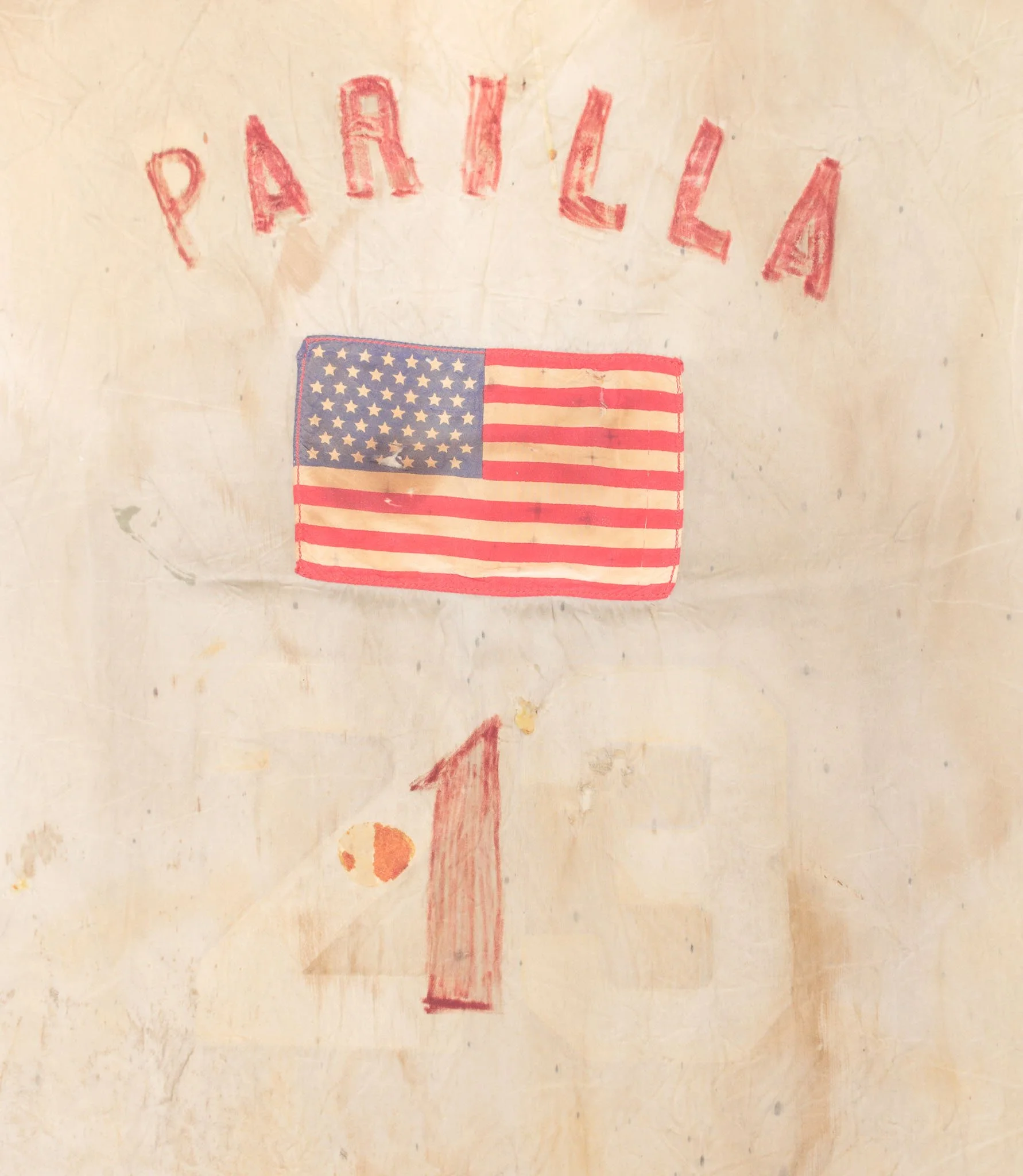
Frame Size (H x L): 34.5” x 31.5”
Jersey Size (H x L): 23.5” x 20.5”
Offered is a sleeveless motorcycle racing vest attributed to Richard “Dick” Gariepy of Barre, Massachusetts, a leading East Coast scrambles rider and the 1962 North American Scrambles Champion. Dating to circa 1962–1963, the vest is made from rayon and is marked with the Italian motorcycle name PARILLA, a large red numeral 1, and silk 49-star American flags sewn to both the front and back. The side shown here is the back of the garment.
The vest was intended to be worn over a long-sleeved shirt, sweater, or other riding apparel. Period photographs show Gariepy and other scrambles riders wearing this general type of sleeveless outer jersey over a contrasting long-sleeved layer. Such garments provided a practical surface for displaying a rider’s number, motorcycle marque, sponsor, or national identity while allowing the clothing underneath to be changed according to weather and track conditions.
The garment closes along the left side with a metal Talon zipper, allowing it to be pulled over other clothing without a center-front opening. Talon was one of the principal American zipper manufacturers of the period, and the metal fastener is consistent with an early-1960s date.
Across the upper back, the name PARILLA is painted by hand in large red letters. Beneath the flag is a similarly hand-painted red numeral 1.
A faint but legible 23 remains visible beneath and around the painted numeral. In person, the number appears as cleaner or less-damaged fabric. This suggests that applied numerals, perhaps adhesive-backed or heat-applied, once covered the textile and protected it from wear and discoloration. After the numerals were removed, their outline remained as a ghost image.
This corresponds with a documented Gariepy racing entry. In the program for the June 22, 1963 Laconia 90-Mile 250cc Road Race, Richard Gariepy of Barre was entered as No. 23 aboard a Parilla. The match among rider, motorcycle, and number is notable. It cannot be proven that the ghosted number on the vest relates specifically to that race, given motorcycle numbers often changed by event and class, but the association is logical. The later painted “1” indicates that the vest was likely renumbered for another competition.
The silk American flags sewn to the front and back each contain 49 stars arranged in seven rows of seven. The flags are machine sewn around their perimeters. The 49-star count has a narrow historical period. Alaska entered the Union on January 3, 1959, and the 49-star flag became official on July 4 of that year. Hawaii entered the Union later in 1959, and the 50-star flag became official on July 4, 1960. The 49-star flag was therefore official for only one year.
The flags do not necessarily date the completed vest to 1959–1960. Small 49-star flags remained available after the official change and could have been incorporated into a garment several years later. The stronger dating evidence is Gariepy’s documented Parilla activity in 1962 and 1963. The vest is therefore most reasonably dated to that period.
Richard Rice Gariepy became an accomplished New England motorcycle racer during the period when American scrambles competition was developing toward what is now generally called motocross. Scrambles combined dirt, natural terrain, elevation changes, and high-speed sections, requiring both speed and control. Gariepy also competed in TT events and road racing.
His most significant season came in 1962, when he raced a 250cc Parilla Wildcat. Period accounts credit him with victories at the Canadian National Championship Scramble, the AMA National TT Motorcycle Scramble Championship at Edgewood, Maryland, and the North-South Challenge. At Edgewood, he won both the 250cc expert-class championship and the overall lightweight-division championship in a field reported to include more than 100 lightweight riders. Together with his Canadian victory, the result established him as the North American Scrambles Champion.
Contemporary Parilla advertising used Gariepy’s championship success to promote the 250cc Wildcat. One advertisement announced “PARILLA WINS NATIONAL CHAMPIONSHIP” and identified him as the North American Scrambles Champion. Period photographs also show Gariepy wearing sleeveless outer racing garments of the same general type as the present vest.
Parilla was founded in Milan, Italy, by Giovanni Parrilla after World War II. The company became known for technically advanced lightweight motorcycles and achieved success in road races and scrambles competitions. The 250cc Wildcat was marketed as a serious lightweight competition motorcycle, and Gariepy’s 1962 victories became an important part of its American advertising.
Gariepy continued racing for decades. His obituary noted that he won back-to-back vintage motorcycle championships in 2011 and 2012 while in his seventies. The present vest dates from the early and most historically significant period of his career.
The combination of the hand-painted Parilla name, changing race numbers, Talon side zipper, paired silk 49-star flags, and Gariepy provenance places the vest within early-1960s American motorcycle competition and Parilla’s brief but successful racing presence in the United States.
Conservation Process: The jersey was hand sewn to cotton fabric, and both were hand sewn to a mounting board. To prevent the black dye in the cotton fabric from seeping into the jersey, it was first washed in a standard wash and then in a dye setting wash. The jersey is positioned behind Optium Museum Acrylic.
Frame: The frame is a deep-profile moulding with a simple, classical profile, finished in a dark cocoa-brown tone.
Condition Report: The vest exhibits extensive period wear, including overall soiling, discoloration, scattered staining, creasing, and surface abrasion. There are several small holes and losses, particularly near the center and lower portions, along with wear at the neckline, arm openings, seams, and zipper area. As the garment was used as a motorcycle racing jersey, at least some of this wear is likely associated with track use. The painted lettering and numeral remain legible, while the applied flags show minor soiling and localized wear.
Collectability Level: The Good – Perfect for Beginners and Gifts
Date of Origin: 1962-1963
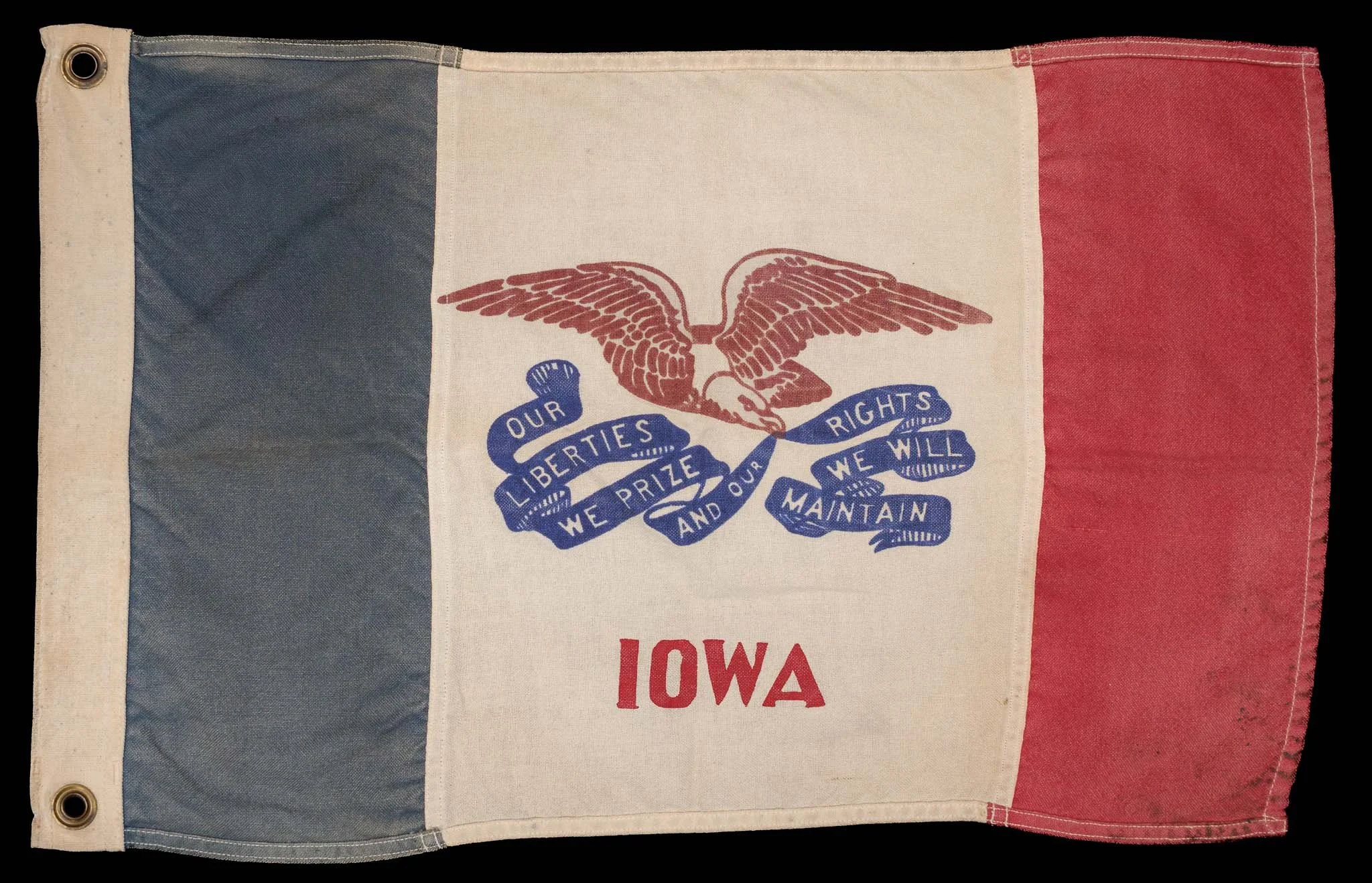
Frame Size (H x L): 22.75” x 31.25”
Flag Size (H x L): 15” x 23”
Offered is a vintage Iowa state flag, commercially made of cotton and dating to approximately 1940–1960. The flag presents Iowa’s familiar vertical tricolor of blue, white, and red, with the state’s eagle-and-ribbon device printed prominently upon the broad white center panel and the name “IOWA” printed below in red.
The body is assembled from three separate panels of plain-weave cotton, joined vertically by machine stitching. The white center panel is noticeably wider than the colored outer sections, providing ample space for the central device. The blue and red panels have mellowed considerably with age, particularly the blue, which has faded unevenly along areas exposed to light and use. Both colors remain easily legible, however, and the softer palette gives the flag an appealing, unmistakably vintage appearance.
The central imagery is printed directly onto the cotton. A red eagle appears with wings extended, carrying a flowing blue ribbon in its beak. The ribbon bears Iowa’s state motto: “Our liberties we prize and our rights we will maintain.” The individual words are distributed across the folds of the streamer in hand-rendered white lettering. Beneath the device, “IOWA” appears in large red slab-serif capitals.
The printing retains the slightly irregular quality associated with traditional textile production. Ink follows the weave of the cotton, with subtle variations in density and softly defined edges. The eagle is rendered in a subdued brick-red or reddish-brown, while the ribbon is printed in a rich blue. The imagery is bold enough to be recognized from a distance, yet retains considerable detail in the eagle’s feathers, talons, beak, and the many folds of the ribbon.
The flag is finished along the hoist with a substantial folded cotton heading. Two large brass grommets, one at each end, allowed the flag to be secured to a staff or halyard. The grommets are set through multiple layers of fabric and show an appropriately aged surface. Short, closely spaced machine stitches reinforce the heading near the grommets and at the points where the perimeter hems meet the hoist. These concentrated areas of stitching helped distribute the strain created when the flag was flown.
Construction throughout is by straight machine stitching. The panels are joined with neatly executed vertical seams, while the top and bottom edges are secured with narrow folded hems and parallel rows of stitching. Additional back-tacking or reinforcement appears at panel junctions and at the ends of sewing runs. The fly end is similarly folded and machine sewn. Although efficiently made, the flag reflects a period when even commercially produced state flags were commonly constructed from woven cotton rather than the synthetic fabrics that became increasingly prevalent later in the 20th century.
Iowa’s state flag was designed by Dixie Cornell Gebhardt of Knoxville, Iowa, a member of the Daughters of the American Revolution. Gebhardt initially developed the design during the First World War, when Iowa guardsmen serving along the Mexican border needed a state banner. The Iowa General Assembly formally adopted her design as the official state flag on March 29, 1921.
The arrangement was patterned after the vertical blue, white, and red tricolor of France, acknowledging the period during which the territory that became Iowa was under French control. In the symbolism described for the flag, blue represents loyalty, white purity, and red courage. The American eagle and the ribbon bearing the state motto place Iowa firmly within the United States while emphasizing the preservation of liberty and legal rights.
The present example was produced several decades after the design’s official adoption. Its woven cotton construction, separately sewn panels, heavy cotton hoist, brass grommets, direct textile printing, and straightforward lockstitch assembly are consistent with commercially manufactured flags of the middle decades of the 20th century. The materials and methods do not support an especially early date, but they are characteristic of a durable institutional or outdoor flag made before lightweight synthetic state flags became dominant.
Conservation Process: This flag was hand sewn to cotton fabric, and both were hand sewn to a mounting board. To prevent the black dye in the cotton fabric from seeping into the flag, it was first washed in a standard wash and then in a dye setting wash. The flag is positioned behind Optium Museum Acrylic.
Frame: The flag is presented in a substantial black-painted wood frame with a stepped, deeply molded profile and subtle gray inner lip.
Condition Report: The flag is in good vintage condition, with overall fading and mellowing of the blue, red, and natural cotton consistent with age and prior display. There is scattered soiling, minor staining, and localized wear, most notably along the lower portion of the red fly end, with light fraying and small edge losses. The printed eagle, motto, and “IOWA” remain strong and readily legible, while the hoist and both brass grommets remain intact.
Collectability Level: The Good – Perfect for Beginners and Gifts
Date of Origin: 1940-1960
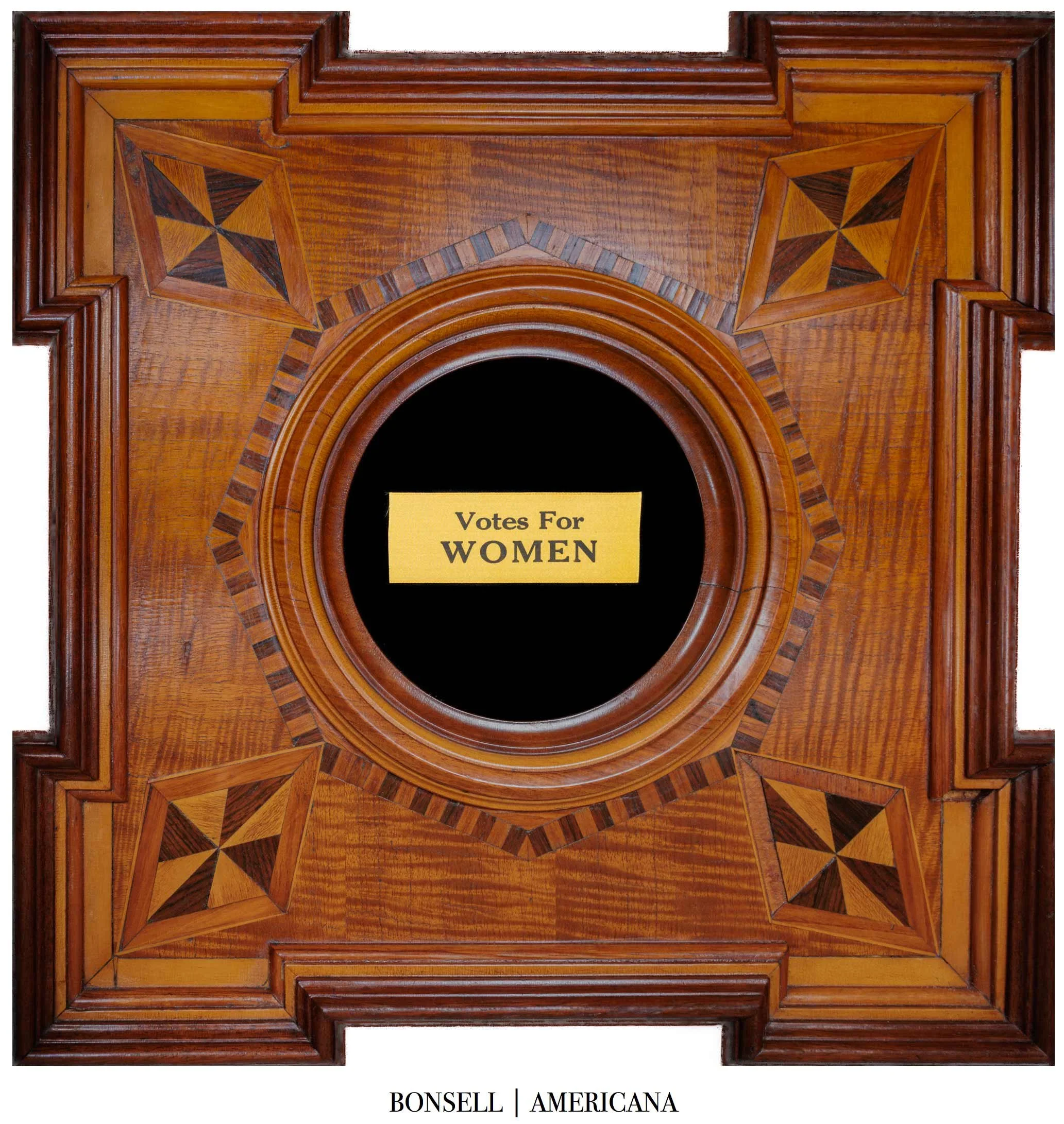
Frame Size (H x L): 17” x 17”
Textile Size (H x L): 1.5” x 3.5”
Offered is a rare “Votes for Women” ribbon. The field is yellow, and the verbiage is in all black caps. Yellow was the primary color in the women’s suffrage movement in the US, and was combined with various other colors, though in most instances was combined with black. In England, violet and green were the primary colors.
In 1848, Lucretia Mott and Elizabeth Cady Stanton organized the first women’s rights convention in Seneca Falls, New York. As a result of this meeting in Stanton’s hometown, the document containing a declaration for women’s suffrage, right to education, and right to employment was drafted. Over the next 50 years, numerous women’s conventions were hosted to bring strength to the movement in masses.
Though initially targeted as a state-by-state movement, it was ultimately recognized that only an amendment to the Constitution would grant all women the right to vote. Amendments were introduced in 1878 and 1914, both of which were defeated. By 1918, both political parties were committed to women’s suffrage, in part based on the major role women played in World War I. As such, in January of 1918 and June of 1919, an amendment was passed by two-thirds majorities in the House and Senate, respectively. On August 18th, 1920, Tennessee became the 36th state to ratify the amendment, giving the two-thirds of state legislators necessary to ratify the amendment. On August 26th, the Nineteenth Amendment became part of the Constitution, and read as follows:
The right of citizens of the United States to vote shall not be denied or abridged by the United States or by any State on account of sex. Congress shall have power to enforce this article by appropriate legislation.
Conservation Process: This ribbon was hand sewn to cotton fabric, and both were hand sewn to a mounting board. To prevent the black dye in the cotton fabric from seeping into the ribbon, it was first washed in a standard wash and then in a dye setting wash. The ribbon is positioned behind Optium Museum Acrylic.
Frame: The frame dates to approximately 1890. It is multi-tiered and made of mahogany, oak, and maple. It is a frame of the highest quality.
Condition Report: This ribbon is in excellent condition.
Collectability Level: The Good – Perfect for Beginning Collectors and Gifts
Date of Origin: 1913-1920
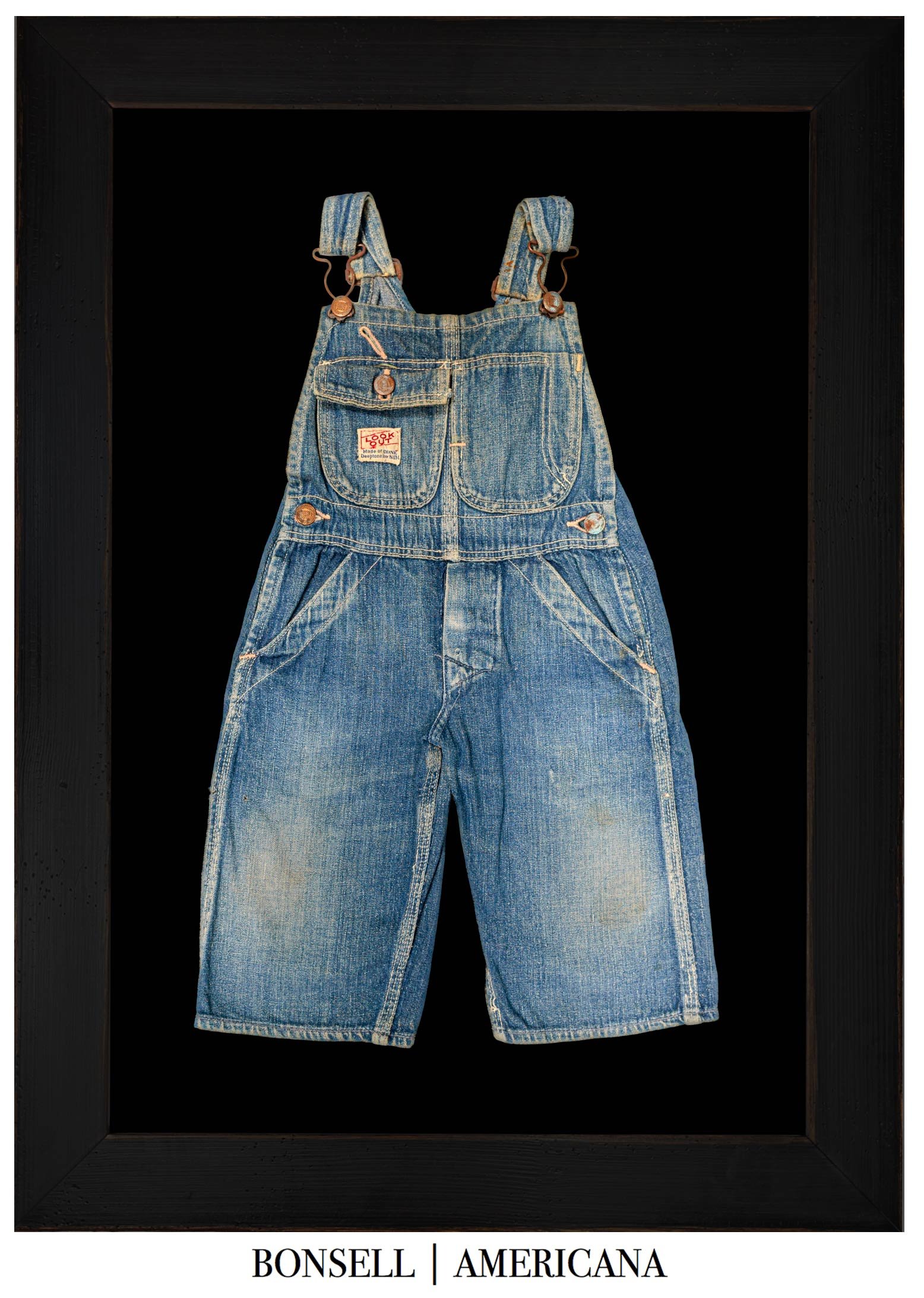
Frame Size (H x L): 33.5” x 24.75”
Overalls Size (H x L): 12” x 23”
Offered is a pair of antique children’s denim overalls produced under the “Look Out” brand and constructed of Cone “Deeptone” denim, dating to approximately the 1930s–1940s. The surviving cloth label on the bib pocket reads “LOOK OUT – Made of Cone Deeptone Denim,” identifying both the brand name and the textile source. Cone Mills of Greensboro, North Carolina, was the most influential American manufacturer of denim during the twentieth century, supplying fabric to many of the country’s best-known workwear companies. Garments bearing references to Cone denim reflect the widespread reliance on this durable indigo cloth in the manufacture of utilitarian clothing intended for both labor and everyday wear.
The overall style reflects classic early twentieth-century American workwear construction, scaled for children. The garment features a traditional bib front with shoulder straps secured by metal hook fasteners, a configuration commonly used on bib overalls prior to the widespread adoption of later adjustable clasp systems. The bib includes a central pocket with a flap closure and button, beneath which the “Look Out” label is sewn. Two additional front pockets appear at the waist, with reinforcement stitching at points of stress. The legs are cut wide in the manner typical of period work garments, allowing freedom of movement for active wear.
Children’s overalls of this type were widely worn throughout the United States during the early twentieth century. They served both practical and economical purposes, providing a durable outer garment that protected clothing beneath while allowing children to participate in farm work, chores, and play. Denim overalls became a particularly common sight in rural communities and small towns, where sturdy garments were essential and clothing was expected to withstand heavy use. The association between overalls and childhood in America during the 1930s and 1940s is well documented in photographs, advertisements, and mail-order catalogs from the period.
The use of Cone “Deeptone” denim reflects the emphasis placed on durability and colorfastness in workwear fabrics of the era. Cone Mills developed several branded denim lines to promote the quality of its indigo-dyed cloth, and the “Deeptone” designation referred to the deep coloration achieved through repeated indigo dyeing of the warp yarns. This process produced denim that aged attractively with wear, gradually developing lighter areas and soft contrasts where the fabric was repeatedly flexed or abraded.
Surviving examples such as this illustrate the durable clothing commonly worn by American children during the first half of the twentieth century and reflect the widespread use of Cone Mills denim in garments intended for everyday wear.
Conservation Process: The overalls were hand sewn to cotton fabric, and both were hand sewn to a mounting board. To prevent the black dye in the cotton fabric from seeping into the overalls, the cotton was first washed in a standard wash and then in a dye setting wash. The overalls are positioned behind Optium Museum Acrylic.
Frame: The frame has a relatively flat profile with a matte black finish. The surface shows intentional distressing with subtle texture and light variation in the finish, giving it a restrained, aged appearance.
Condition Report: The overalls show honest wear consistent with age and use, including areas of fading, light fraying, and minor scattered wear to the denim. The metal hardware shows oxidation and age, while the fabric exhibits attractive, natural distressing throughout. Overall, the garment presents very well, with the kind of authentic wear that collectors appreciate in early denim workwear.
Collectability Level: The Good – Perfect for Beginners and Gifts
Date of Origin: 1930-1949
Frame Size (H x L): 26” x 39.75”
Lithograph Size (H x L): 16” x 29.75”
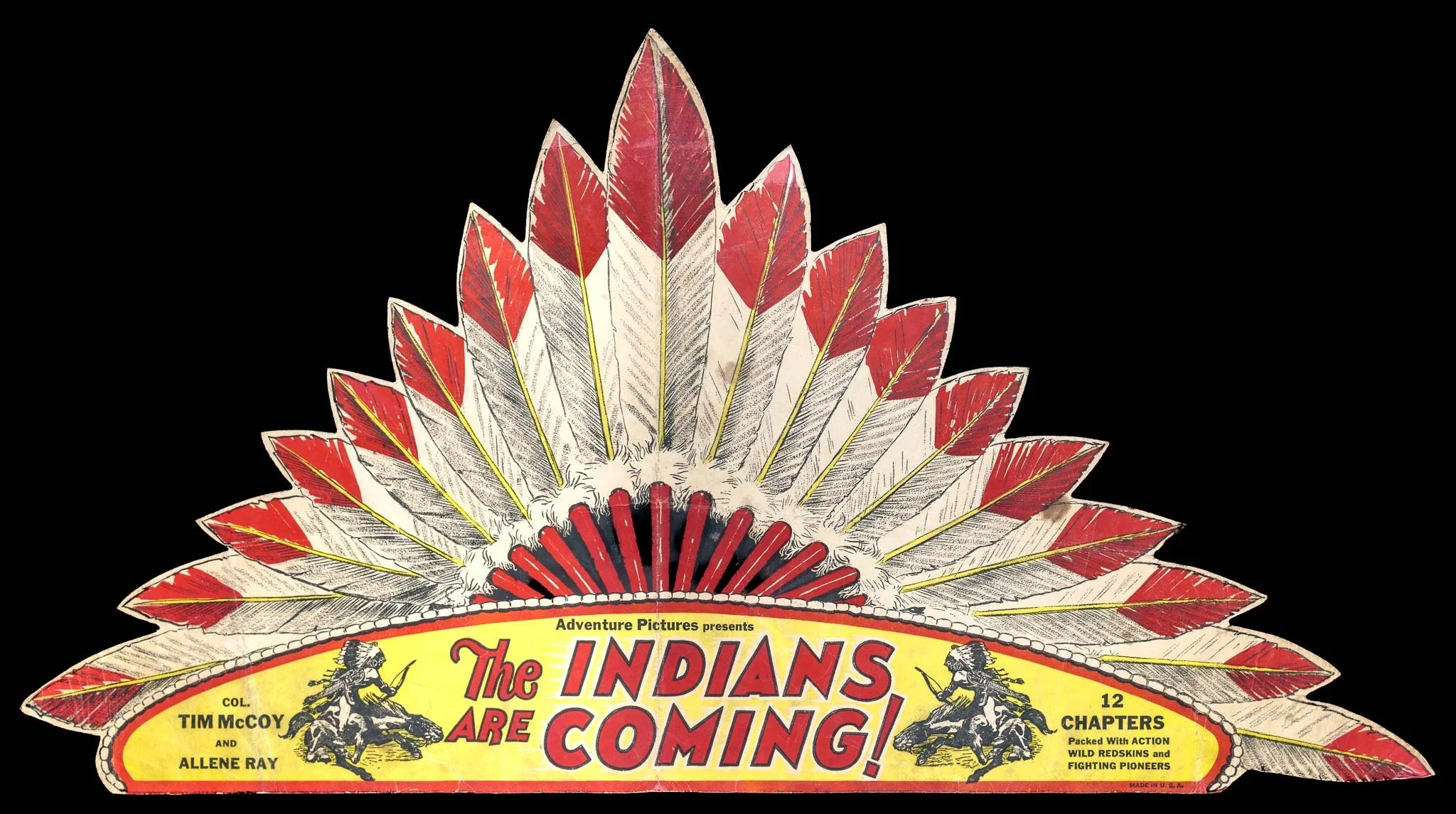
Offered is a die-cut, lithographed theatrical advertisement for the 1930 Western serial The Indians Are Coming, produced by Adventure Pictures and starring Col. Tim McCoy and Allene Ray. Intended for lobby or storefront display, the piece departs from the standard rectangular poster format and is cut in the silhouette of a feathered war bonnet, immediately identifying its Western theme to passing audiences. Strong color contrast, bold typography, and mounted warrior imagery were used to attract attention in a competitive theater setting.
Adventure Pictures was an independent American motion picture company active during the late silent and early sound era. By 1930, the serial format was an established commercial model. Instead of a single feature-length film, studios released productions in multiple short chapters, typically fifteen to twenty minutes in duration, issued weekly. Each chapter concluded with a cliffhanger, encouraging audiences to return. During the early years of the Great Depression, this structure helped stabilize attendance by promoting repeat visits. Independent companies such as Adventure Pictures relied heavily on Western and action-driven narratives, which were economical to produce and broadly marketable.
The Indians Are Coming was released in 1930 as a 12-chapter Western serial. Directed by Henry MacRae and filmed in California, it was distributed nationally through regional exchanges. The narrative centers on frontier conflict between settlers and Native American tribes, framed within the conventions of early twentieth-century Western cinema. The emphasis was action: horseback pursuit, ambush, siege, and rescue, structured in episodic progression. The title itself functioned as a marketing device, signaling danger and conflict rather than documentary history. The prominently printed “12 Chapters” designation advertised the serialized structure that formed the economic foundation of the production.
Colonel Tim McCoy (1891–1978) was an established Western film actor of the late silent and early sound period. Before entering films in the mid-1920s, he worked with Native American tribes and later served as a technical advisor in motion pictures involving Indigenous themes. His screen persona emphasized horsemanship and frontier authority. By 1930, he was a dependable lead capable of carrying multi-chapter productions such as this one. The honorary “Colonel” designation became part of his public identity and appeared consistently in promotional materials.
Allene Ray (1901–1979) was a serial and B-Western actress active during the same period. She frequently portrayed heroines placed in peril within episodic narratives, roles essential to sustaining suspense across weekly installments. Her billing alongside McCoy reflects the importance of recognizable co-stars in maintaining audience engagement throughout a serialized release.
The advertisement was printed on heavy stock paper using commercial color lithography. Multiple ink applications produce saturated reds, yellows, and blacks, with strong linework defining the feather shafts and mounted figures. The red feather tips and red title lettering reinforce themes of urgency and action, while the yellow ground ensures legibility from a distance. Black outlines unify the composition and provide clarity. The die-cut feathered crest gives the advertisement a dimensional presence distinct from a standard flat placard.
Flanking the title are mounted warrior figures, reinforcing themes of speed and confrontation. Horses functioned as visual shorthand in Western cinema, symbolizing mobility and frontier conflict. The war bonnet silhouette operates as a broad cultural signifier, designed for immediate recognition in popular advertising rather than ethnographic specificity. Such imagery was widely employed in early twentieth-century promotional material to evoke the mythologized American West.
The tagline, “Packed with Action – Wild Redskins and Fighting Pioneers,” reflects the marketing language common to 1930 Western promotion. Its phrasing emphasizes spectacle and simplifies frontier narratives into oppositional archetypes intended to heighten dramatic tension. From a historical standpoint, the language illustrates how early Western serials commercialized frontier themes for mass entertainment during the interwar period. The terminology belongs to the conventions of its time and underscores the action-driven tone expected of serial advertising.
Issued in 1930 at a transitional moment in American film history, this piece reflects the continued viability of the serial format during the industry’s shift to synchronized sound. Independent Western serials remained commercially important even as production technology evolved. Graphic lobby displays such as this were central to exhibition strategy, designed to attract attention and convert interest into ticket sales. As an object, it represents both a specific film production and the broader mechanics of serialized storytelling in early American cinema.
Frame: Housed in a new custom wood frame with a visible grain and black finish. The profile is flat and straightforward, providing a clean presentation. The dark tone creates strong contrast with the artwork.
Condition: The piece shows expected age-related wear, including scattered creasing, light surface wrinkles, and minor edge wear consistent with original theatrical use. Visible fold lines and small areas of paper separation along portions of the die-cut edges remain evident. The work has been stabilized by a professional paper conservator, with appropriate archival treatment undertaken to secure structural integrity while preserving original surface characteristics. Color remains strong and the printed graphics are clear overall.
Collectability Level: The Good – Perfect for Beginners and Gifts
Date of Origin: 1930

Frame Size (H x L): 6” x 8.5”
Flag Size (H x L): 3” x 5.5”
Offered is an eighteen-star advertising trade card in the form of a flag, dating to 1885.
THE OBVERSE
It is made of paper and its obverse includes the following overprint:
BUY THE
UNITED * STATES
PLAYING CARDS
MANUFACTURED BY THE RUSSELL & MORGAN PRINTING CO., CINCINNATI, O.
over
The Russel & Morgan Company was founded in 1867 by A.O. Russell and Robert J. Morgan, upon their purchase of the printing section of the Cincinnati Enquirer. In 1880, the Company purchased equipment to begin printing playing cards. By 1881, it was producing 1600 packs per day via a team of 20 employees. In 1894, the playing card business became so large that it was separated off into its own and called the United States Playing Card Company. It is still in existence today and is the largest playing card manufacturer in the world.
The canton of the flag includes a large center star and 17 stars bursting away from it. The inside of the center star includes “U.S.” printed in red. Typically, 18 stars is representative of Louisiana statehood. However, in the case of this flag, the count of 18 stars is likely just a function of what would fit in the canton as part of a starburst pattern.
The combination of the overprint across the stripes and the canton, the folksy subject matter, and the interesting star pattern makes for a tremendous combination of desirable features on a single flag.
THE REVERSE
The reverse of the trade card includes the following verbiage:
U.S. PLAYING CARDS.
PRICE LIST.
No. 9.—Oct. 1, 1885.
No. | Per Gross.
101. TIGERS…$7.50
Assorted Plaid, Star and Calico Backs.
155. TOURIST’S…13.50
Neat Set Pattern Backs.
188. CAPITOL…24.00
Enameled. Fancy Backs.
188.X CAPITOL…39.00
Gilt Edges. Enameled. Fancy Backs.
202. SPORTSMAN’S…36.00
Enameled, high finish. Assor’d Backs.
202.X SPORTSMAN’S…54.00
Gilt Edges. Enameled, high finish.
Assorted Backs.
303. ARMY AND NAVY…48.00
All Linen. Ass’d Fancy Backs. Double
Enam’d, highest finish. Cloth Boxes.
Superfine Poker Cards
404. CONGRESS…66.00
Finest Double Enameled. Gilt Backs.
Cloth Boxes
505. EXTRA ARMY AND NAVY…72.00
Gilt Edges. All Linen. Double Enam-
eled. Cloth Boxes.
606. EXTRA CONGRESS…90.00
Gilt Edges. Finest Double Enameled.
Cloth Boxes stamped in gold.
707. CABINET, FOR Progressive Euchre,…33.00
Double Enameled. Original Assorted
Backs. Cloth Boxes.
707.X CABINET, for Progr’ve Euchre…48.00
Gilt Edges. Cloth Boxes Stamped in
gold.
808. BICYCLE…18.00
White Enameled. Bicycle Backs.
Order by the above Numbers.
JAS. E. DAVIS & CO
DETROIT, MICH.
Conservation Process: This flag is positioned on a cotton rag board and behind Optium Museum Acrylic.
Frame: The antique frame has a crackled, painted surface. It dates to approximately 1880 and compliments the flag.
Condition Report: This flag is in excellent condition.
Collectability Level: The Good – Perfect for Beginning Collectors and Gifts
Date of Origin: 1885
Number of Stars: 18
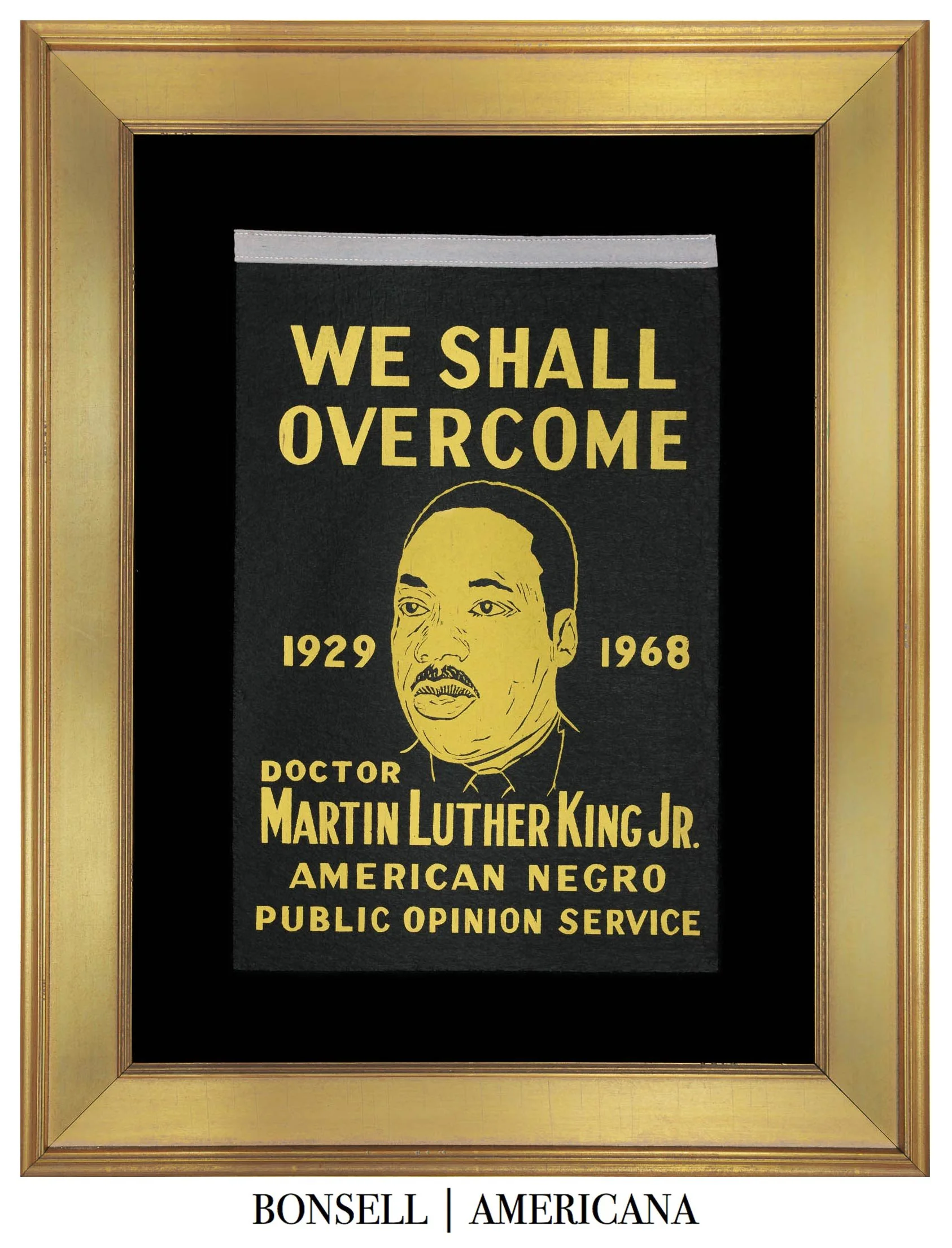
Frame Size (H x L): 28” x 22”
Banner Size (H x L): 18” x 12”
Offered is a Martin Luther King Jr. banner, dating to 1968. The verbiage “WE SHALL | OVERCOME” is printed at the top, and “DOCTOR | MARTIN LUTHER KING JR. | AMERICAN NEGRO | PUBLIC OPINION SERVICE” is printed at the bottom. In the middle of the banner is an image of Dr. King’s face, which is surrounded by 1929 on one side and 1968 on the other side. The verbiage of the overprinting, the image of Dr. King, and the colors combine to make for a fantastic piece.
Conservation Process: This banner was hand sewn to cotton fabric, and both were hand sewn to a mounting board. To prevent the black dye in the cotton fabric from seeping into the banner, it was first washed in a standard wash and then in a dye setting wash. The banner is positioned behind Conservation Clear Acrylic (standard) or behind Optium Museum Acrylic (per request).
Frame: This offering is in our Medium Gold with Flat Profile Frame.
Condition Report: This banner is in excellent condition and presents wonderfully.
Collectability Level: The Good – Perfect for Beginning Collectors and Gifts
Date of Origin: 1968
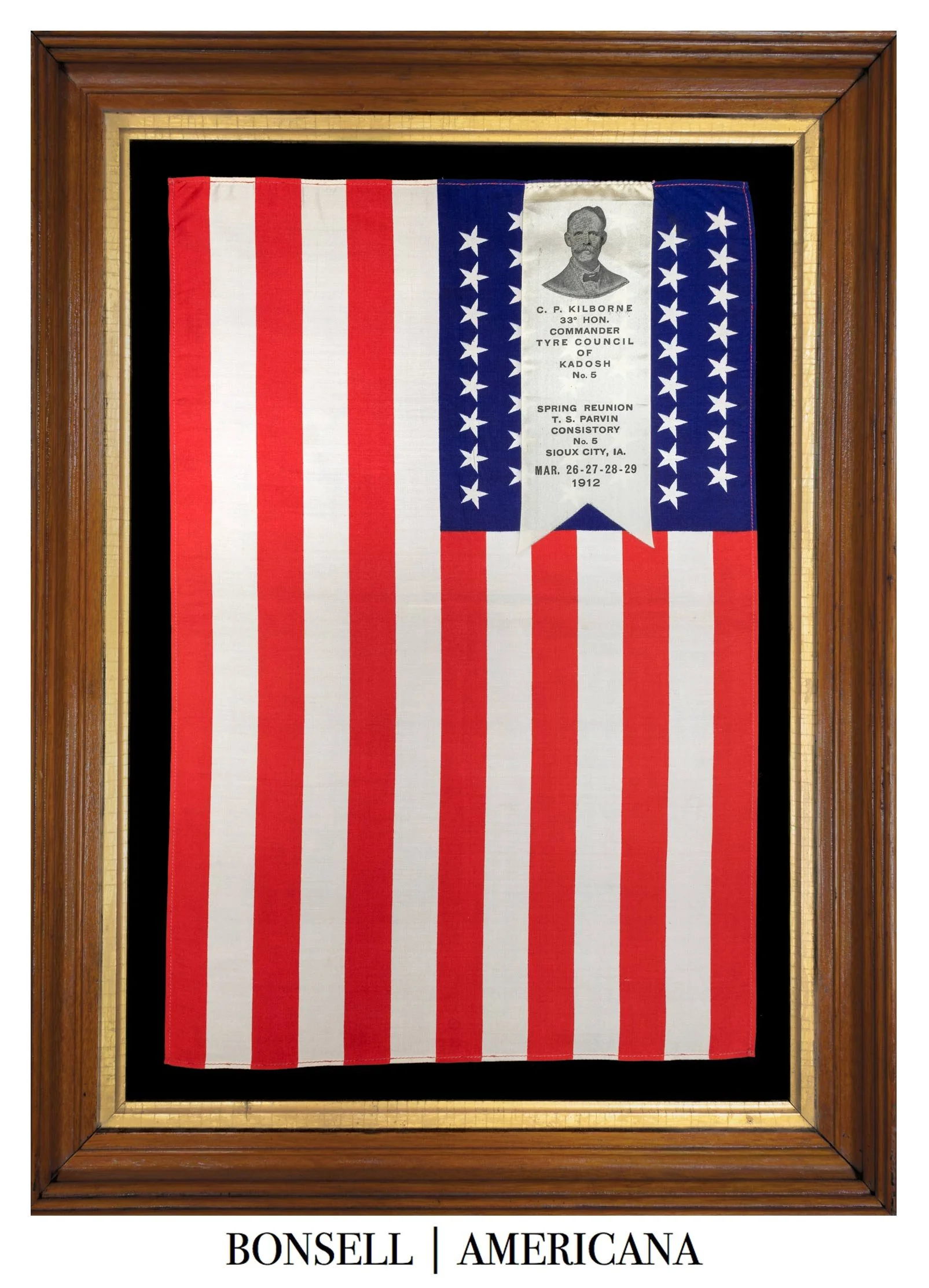
Frame Size (H x L): 23” x 17”
Flag Size (H x L): 17” x 11”
Offered is an unusual forty-eight star antique flag with a Freemason ribbon sewn thereto. Both are made of silk. This is one of the first flags that we have encountered with a ribbon, and the very first that we have encountered with a ribbon sewn across its canton. We consider this a great feature, as it looks very unusual and gives a solid provenance to the flag. The ribbon includes the following overprint:
C.P. KILBORNE
33⁰ HON.
COMMANDER
TYRE COUNCIL
OF
KADOSH
No. 5
SPRING REUNION
T.S. PARVIN
CONSISTORY
No. 5
SIOUX CITY, IA.
MAR. 26-27-28-29
1912
The forty-eight star flag represents the inclusion of New Mexico and Arizona to the Union. New Mexico was admitted on January 6th, 1912, and Arizona was admitted on February 14th, 1912. The forty-eight star flag became official on July 4th, 1912. Presidents Taft, Wilson, Harding, Coolidge, Hoover, Roosevelt, Truman, and Eisenhower all served under this flag. World Wars I and II, and the Korean War were all fought under it.
Until 1912, flag makers were free to arrange the stars on a flag’s canton in any manner they liked. For example, this flag has a staggered star pattern, in that the rows are laterally offset relative to one another. However, on June 24th, 1912, President Taft issued Executive Order 1556, specifying that the star arrangement on forty-eight star flags should be a rectilinear 8-8-8-8-8-8 pattern. It also specified the proportions of forty-eight star flags.
Because flag makers had a great deal of freedom in how they made flags prior to this Executive Order, many forty-eight star flags do not have a linear and horizontal arrangement, particularly those made in the late 19th century and into the teens (i.e., up to WWI). We note the 19th century, because many antique flags are anticipatory in nature. Flag makers would regularly anticipate how many states would be added, and when they would be added. By the late 1890s, flag makers began anticipating and offering a forty-eight star flag. To support this notion, many antique flags have been shown in early photographs dating to the 1890s, or include 1890s dates printed directly thereon.
The forty-eight star flag was official for forty-seven years up until July 4th, 1959, the time at which the forty-nine star flag became official and began to represent the inclusion of Alaska in the Union.
Conservation Process: This flag was hand sewn to cotton fabric, and both were hand sewn to a mounting board. To prevent the black dye in the cotton fabric from seeping into the flag, it was first washed in a standard wash and then in a dye setting wash. The flag is positioned behind Conservation Clear Acrylic (standard) or behind Optium Museum Acrylic (per request).
Frame: The antique frame dates to between 1900 and 1920.
Condition Report: The flag and ribbon are in fantastic condition and extremely vibrant.
Collectability Level: The Good – Perfect for Beginning Collectors and Gifts
Date of Origin: 1912
Number of Stars: 48
Associated State: Arizona
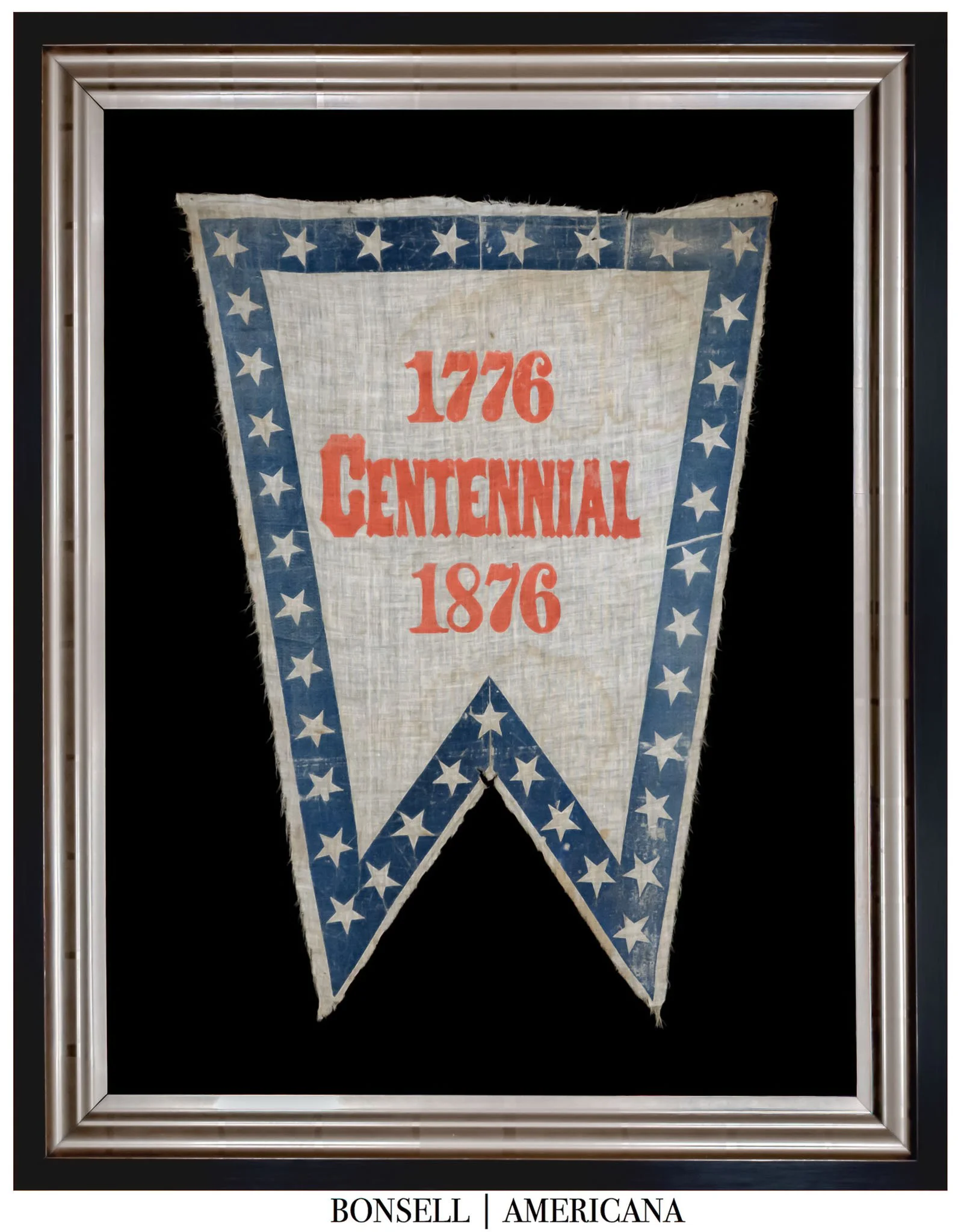
Frame Size (H x L): 33” x 26.75”
Flag Size (H x L): 23.5” x 17.5”
Offered is a patriotic banner made of glazed cotton, commemorating the centennial of the United States in 1876. It features a distinctive swallowtail design with a pointed bottom. The central portion of the banner is a white field, prominently displaying the bold red text "1776 CENTENNIAL 1876" in a stylized font. The lettering stands out against the background, emphasizing the historical significance of the piece.
Surrounding the central area is a wide blue border adorned with evenly spaced white five-pointed stars, reinforcing its American patriotic theme. In total, there are 37 stars, reflecting the official number of states in the Union from 1867 to 1877, following Nebraska’s admission as the 37th state. This star count aligns with the 1876 Centennial era, as the U.S. flag design remained unchanged until Colorado became the 38th state in August 1876.
This banner celebrates the United States' centennial, marking 100 years since the signing of the Declaration of Independence. Given its vibrant design and patriotic symbolism, it was almost certainly waved with pride at a centennial celebration or purchased as a keepsake during the nationwide festivities of 1876.
The banner was made by the American Flag Company, a well-documented producer of patriotic textiles during the 1876 Centennial celebrations. While the company was formally incorporated in New York in 1893, evidence from The Threads of History confirms that it was actively manufacturing banners, pennants, and flags in the 1870s, including designs nearly identical to this one. The American Flag Company played a significant role in producing high-quality patriotic memorabilia, supplying decorative textiles for centennial parades, expositions, and public celebrations. Given the banner’s distinctive swallowtail shape, color scheme, and typographic style—hallmarks of the company’s known centennial-era work—it is consistent with their production methods.
During the centennial, the demand for patriotic banners surged as Americans sought to commemorate the nation’s 100th anniversary with bold, symbolic decorations. The American Flag Company was at the forefront of this movement, manufacturing pieces that not only honored the past but also reflected the nation’s optimism for the future.
The United States Centennial in 1876 was a grand celebration marking the 100th anniversary of the nation’s independence, symbolizing a century of progress, resilience, and patriotism. This milestone came at a time of national reflection, as the country had recently emerged from the Civil War and was working toward reunification and industrial advancement. The centennial was a moment for Americans to honor the achievements of their young nation while looking forward to its future growth. Citizens across the country participated in parades, fireworks displays, and special ceremonies, reinforcing a sense of national pride and unity.
The most significant event of the centennial celebrations was the 1876 Centennial Exposition in Philadelphia, Pennsylvania. This world’s fair, held in Fairmount Park, was the first major international exhibition hosted by the United States. Spanning six months, from May to November, the exposition showcased the latest technological innovations, industrial advancements, and cultural exhibits from both the U.S. and other participating nations. More than 10 million visitors attended, including notable figures such as President Ulysses S. Grant and Emperor Dom Pedro II of Brazil. Among the most famous exhibits were Alexander Graham Bell’s telephone, the Corliss steam engine, and a massive arm and torch from the yet-to-be-completed Statue of Liberty.
Beyond the exposition, centennial celebrations took place in cities and towns across the nation. Patriotic symbols such as the Liberty Bell, bald eagle, and stars and stripes were widely displayed in decorations, banners, and commemorative items, reinforcing national identity. Newspapers and publications of the time encouraged citizens to reflect on the ideals of the Declaration of Independence, with many speeches focusing on themes of freedom, democracy, and innovation.
Additionally, centennial-themed art, music, and literature flourished, further cementing the event’s cultural significance. The centennial also served as a turning point in America’s transition from an agrarian society to an industrial power. The inventions and advancements displayed at the exposition underscored the rapid technological growth that would define the coming decades. It was a time when the nation embraced modernization while still paying homage to its revolutionary roots.
For many Americans, the centennial reinforced the belief that the United States had not only survived its first century but had emerged stronger and more capable of leading on the world stage. This banner, with its powerful iconography and exceptional craftsmanship, serves as a tangible reminder of that momentous occasion—an artifact that was likely held aloft in the excitement of a centennial parade or purchased as a cherished souvenir of the grandest celebration in the nation's history.
Conservation Process: This banner was hand sewn to cotton fabric, and both were hand sewn to a mounting board. To prevent the black dye in the cotton fabric from seeping into the banner, it was first washed in a standard wash and then in a dye setting wash. The banner is positioned behind Optium Museum Acrylic.
Frame: The frame features a black outer border with a silver-toned inner portion, creating a sophisticated contrast that draws attention to the banner’s patriotic design.
Condition Report: The banner is in well-preserved condition for its age, with some signs of wear consistent with its historical use. The fabric exhibits light fading, creasing, and minor fraying along the edges, particularly at the swallowtail points. There is some missing fabric along the top edge, more pronounced on the right side than the left, adding to its authentic, timeworn character. Despite these age-related imperfections, the colors remain vibrant, and the printed text and star pattern are still bold and legible, making it an excellent example of a centennial-era patriotic textile.
Collectability Level: The Good – Perfect for Beginners and Gifts
Date of Origin: 1876
Number of Stars: 37
Associated War: The Indian Wars (1860-1890)
Associated State: Colorado
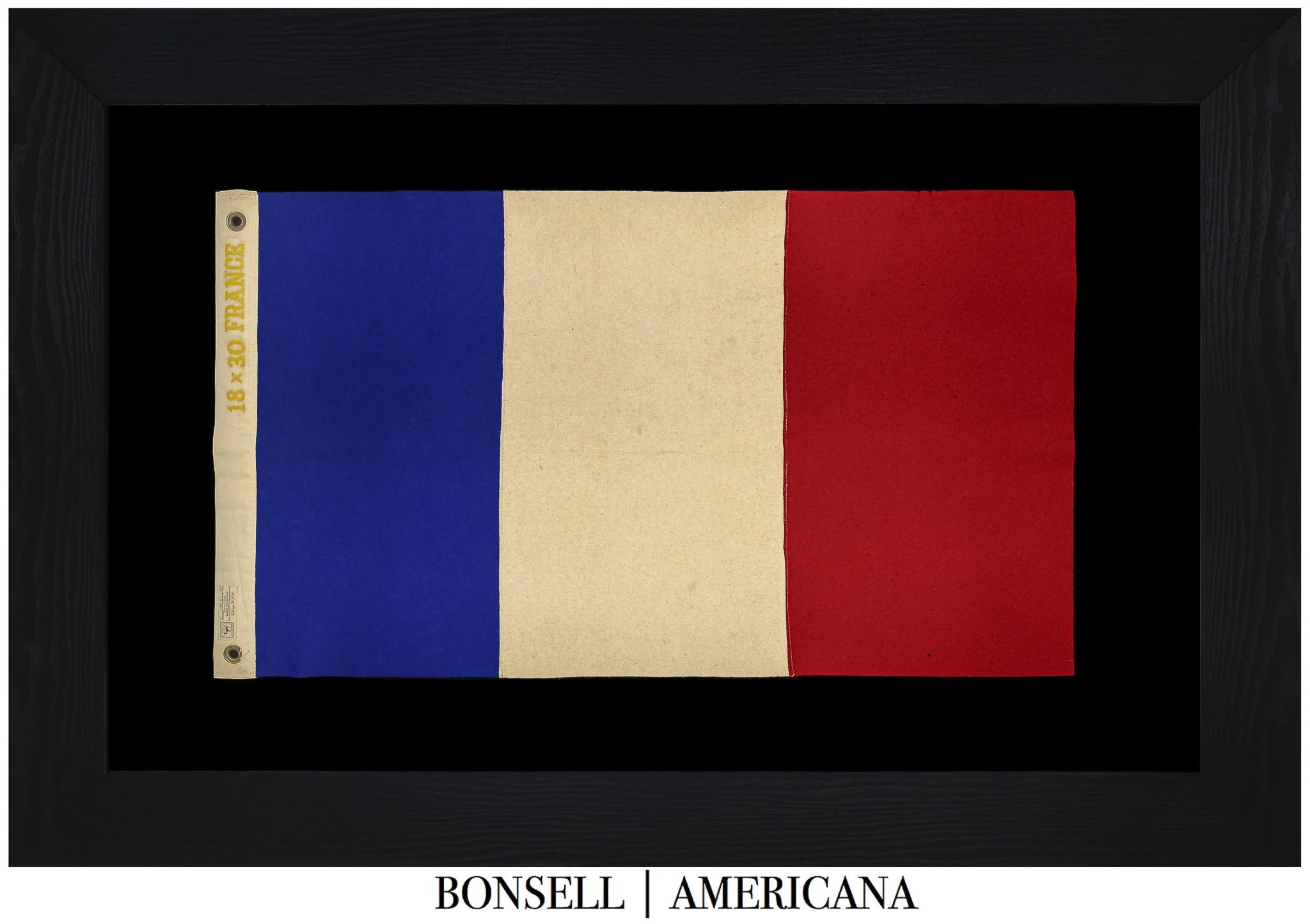
Frame Size (H x L): 28” x 40”
Flag Size (H x L): 17” x 28.75”
Offered is an early 20th-century French tricolor flag, executed in a bold and visually compelling format, with the blue, white, and red fields rendered in felt. The use of felt—rather than woven wool bunting—produces a soft surface texture and saturated coloration that differs markedly from standard maritime or government-issue examples, indicating a decorative or ceremonial purpose rather than long-term outdoor hoisting.
The hoist is constructed of sturdy cotton twill and fitted with brass grommets, with all elements machine sewn, consistent with professional American commercial manufacture of the period. The hoist bears stenciled dimensional and country identification reading “18 × 30 FRANCE,” indicating the flag’s approximate size in inches, a practical marking commonly used for institutional supply. Affixed alongside is a sewn maker’s label identifying Samuel Mortensen & Co., Chicago, U.S.A., described as manufacturers of Original College Goods and Fine Textile Advertising Specialties. Original labels of this nature are uncommon and provide direct, primary documentation of origin.
Samuel Mortensen & Co. is documented in university advertising by at least 1910 and appears as an active business in the 1912 Lakeside Annual Directory of the City of Chicago. The firm specialized in felt and textile goods produced for schools, colleges, and other formal institutions, including flags, banners, and pennants.
The French tricolor—blue, white, and red—has served as the national flag of France since the late 18th century, its origins rooted in the French Revolution. The colors combine those of Paris (blue and red) with white, long associated with the French monarchy, symbolizing national unity and the revolutionary ideals of liberty, equality, and fraternity. Officially adopted in 1794, the tricolor has endured through successive political regimes and remains one of the most recognizable national flags in the world.
By the late 19th and early 20th centuries, the French flag had assumed broader international significance, particularly within educational and institutional settings outside of France. In the United States, foreign national flags were frequently displayed in schools, universities, civic buildings, armories, and fraternal halls as tools for instruction, cultural awareness, and the visual expression of diplomatic relationships. This practice intensified during periods of increased global engagement, including the years surrounding World War I, when France held a central role as a major ally and symbol of republican governance.
Although French national flags were produced both domestically and abroad, this example reflects American manufacture intended for educational, civic, or patriotic display rather than official government issue. Based on the documented activity of the maker, the label format, felt construction, machine sewing, cotton twill hoist, and brass grommets, this flag can be confidently dated to the 1910s, extending conservatively into the early 1920s. The survival of the original maker’s label materially strengthens the historical context and distinguishes this example from otherwise similar but undocumented tricolors.
Conservation Process: This flag was hand sewn to cotton fabric, and both were hand sewn to a mounting board. To prevent the black dye in the cotton fabric from seeping into the flag, it was first washed in a standard wash and then in a dye setting wash. The flag is positioned behind Optium Museum Acrylic.
Frame: A square-profile molding with a deep, charcoal-toned surface that mimics the look of hand-grained wood. Subtle linear patterning adds quiet texture and depth, while the finish maintains a restrained sophistication suitable for both period and modern interiors.
Condition Report: Condition is very good overall, with the felt fields retaining strong color and a pleasing, even surface. The white center panel shows expected age toning with scattered, light soiling, while the red field exhibits a few tiny dark specks consistent with age. The cotton twill hoist shows minor wrinkling and light discoloration near the grommets, and the maker’s label remains intact and clearly legible.
Collectability Level: The Good – Perfect for Beginners and Gifts
Date of Origin: 1910-1925

Frame Size (H x L): 5” x 6.25”
Flag Size (H x L): 1.5” x 2”
Offered is a 13-star American flag ribbon dating to the period between approximately 1876 and 1910. Woven entirely of silk rather than printed, the flag’s stars and stripes are integrated directly into the weave, producing a luminous, ribbed texture that reflects the higher level of craftsmanship found in woven badge ribbons of the late 19th century. The canton bears thirteen white stars arranged in the 3-2-3-2-3 pattern—the configuration most frequently encountered on 19th-century examples and one that recalls the early federal symbolism of the nation’s formative years. These ribbons were made in various sizes and formats to adorn lapels, medals, and fraternal insignia, serving as subtle yet fashionable expressions of patriotism.
The 3-2-3-2-3 arrangement of stars emerged as one of the earliest and most enduring patterns for 13-star flags. Though the precise layout of the original 1777 flag was never specified, makers from the late 18th century onward experimented with multiple constellations. The staggered rows of the 3-2-3-2-3 pattern provided an appealing sense of symmetry and movement while remaining easily reproducible by hand or loom. By the mid-19th century, this configuration had become the de facto standard for small printed and woven flags representing the original thirteen colonies. Its visual balance and historical associations made it especially popular during periods of patriotic revival, including the Centennial of 1876 and later commemorative events.
The production of such ribbons coincided with a period of heightened national pride and commemoration that followed the Civil War. The Centennial of 1876 inspired an outpouring of decorative and utilitarian objects bearing early American motifs, and the 13-star flag emerged as a favored emblem of that movement. Its revival continued into the Spanish–American War era, when veterans’ organizations, political groups, and civic associations adopted historic symbols of the Revolution to evoke unity and national strength. Woven flag ribbons like this one were distributed at parades, reunions, and public celebrations, linking modern expressions of loyalty to the founding ideals of the Republic.
Although the 13-star flag was official only from 1777 to 1795, its enduring use in the late 19th and early 20th centuries reflects how deeply the design had become embedded in America’s visual language of heritage and patriotism.
Conservation Process: This flag was hand sewn to cotton fabric, and both were hand sewn to a mounting board. To prevent the black dye in the cotton fabric from seeping into the flag, it was first washed in a standard wash and then in a dye setting wash. The flag is positioned behind Optium Museum Acrylic.
Frame: The ribbon is presented in an oval solid hardwood frame fitted with a gilded metal liner. The frame is carved from a single block of wood and retains a warm, reddish-brown finish that contrasts nicely with the bright metallic inner molding.
Condition Report: The ribbon remains in excellent condition, with vibrant color and strong silk luster. The weave is tight and stable, with no tears, fraying, or areas of loss.
Collectability Level: The Good – Perfect for Beginning Collectors and Gifts
Date of Origin: 1876-1910
Number of Stars: 13
Associated War: The Civil War (1861-1865)
Associated State: Original 13 Colonies
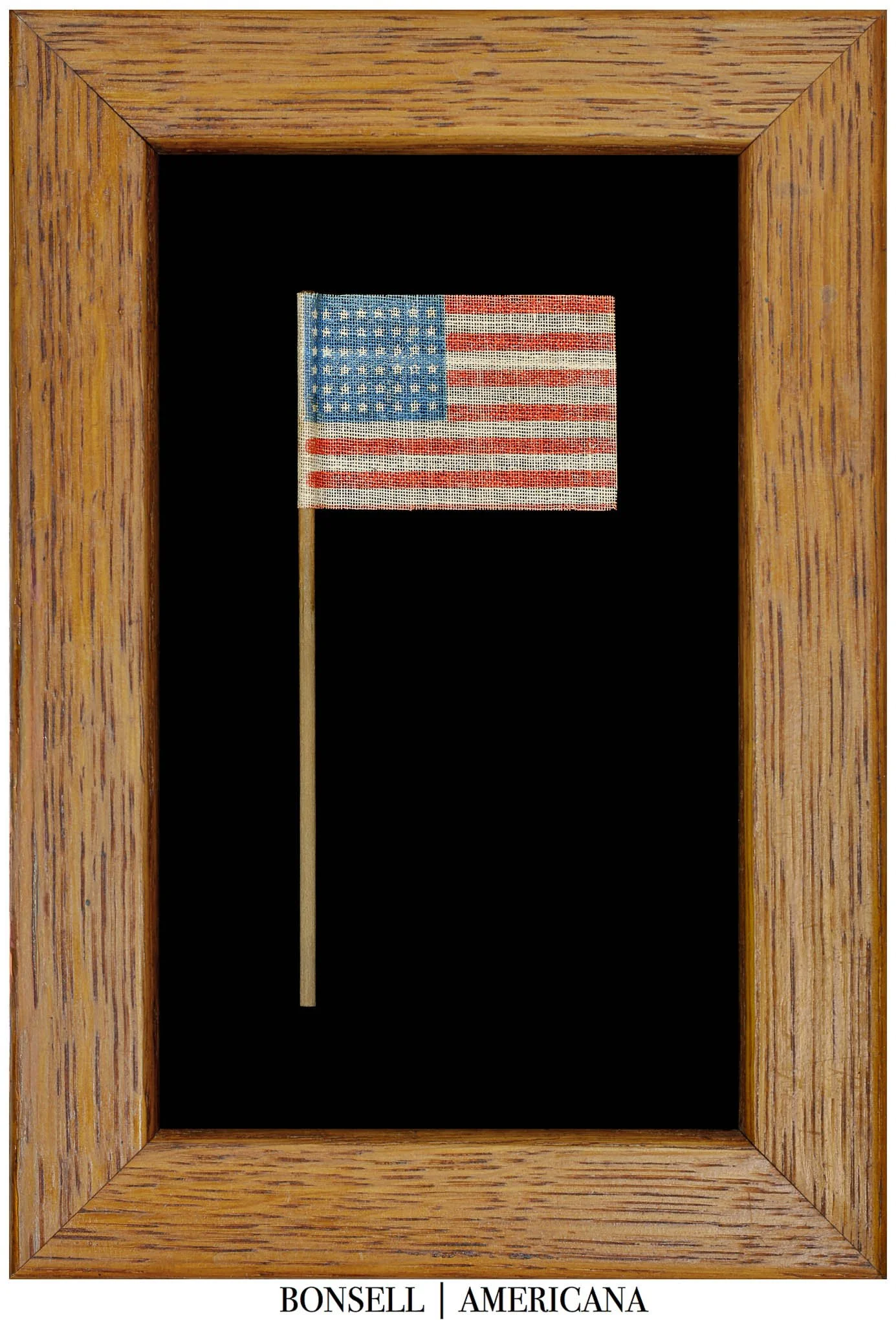
Frame Size (H x L): 10.75” x 7.25”
Flag Size (H x L): 2” x 3” and Affixed to a 6” Staff
Offered is a 48-star American national flag printed on glazed cotton and mounted on its original wooden staff. The fabric displays a distinctive open-weave texture visible between the printed elements and retains a faint surface sheen from the original glazing. This treatment, typical of parade flags from the early 20th century, stiffened the cloth, enhanced brightness, and provided limited resistance to moisture during outdoor use. The weave and finish are consistent with printed parade flags made between 1912 and 1930, when lightly glazed cotton was the preferred medium for economical yet visually striking patriotic display.
The stars are arranged in six straight horizontal rows of eight—known as the 8-8-8-8-8-8 configuration—adopted as the official layout following President William Howard Taft’s Executive Order of June 24, 1912. This rectilinear pattern replaced the varied and often irregular designs of earlier flags, marking the first formal standardization of the American flag’s star arrangement. The compact canton and irregular ink saturation seen here reflect early printing methods, likely achieved by roller or block press before the widespread use of rotary or screen processes.
The 48-star flag represents the admission of New Mexico (January 6, 1912) and Arizona (February 14, 1912) as the 47th and 48th states. Officially adopted on July 4th of that year, it remained the national banner for forty-seven years—longer than any design before it. During this period, the flag accompanied the United States through both World Wars, the Great Depression, and the Korean War, symbolizing a nation emerging as a global power. It was flown at countless milestones in American history—from the dedication of the Lincoln Memorial and the raising at Iwo Jima to the presidencies of Taft, Wilson, Harding, Coolidge, Hoover, Roosevelt, Truman, and Eisenhower. Its longevity and ubiquity make the 48-star flag one of the most recognizable and enduring designs in the evolution of the Stars and Stripes.
Small parade flags such as this were distributed at patriotic celebrations, political rallies, and community parades throughout the early decades of the 20th century. Their lightweight construction and bright printed colors made them inexpensive to produce yet expressive symbols of civic pride. Surviving examples are prized for their authenticity and connection to a formative era in America’s national identity.
Conservation Process: This flag was hand sewn to cotton fabric, and both were hand sewn to a mounting board. To prevent the black dye in the cotton fabric from seeping into the flag, it was first washed in a standard wash and then in a dye setting wash. The flag is positioned behind Optium Museum Acrylic.
Frame: The frame is made of solid oak with a warm golden finish and pronounced quarter-sawn grain. Its clean lines and straightforward joinery reflect early 20th-century craftsmanship and design sensibilities.
Condition Report: The flag remains in excellent condition with vibrant color and only mild, natural oxidation to the white cotton. Minor wear appears along the hoist where the fabric was wrapped around the original wooden staff, but there are no tears, losses, or repairs.
Collectability Level: The Good – Perfect for Beginning Collectors and Gifts
Date of Origin: 1912-1930
Number of Stars: 48
Associated War: WWI, WWII, and Korean War
Associated State: Arizona
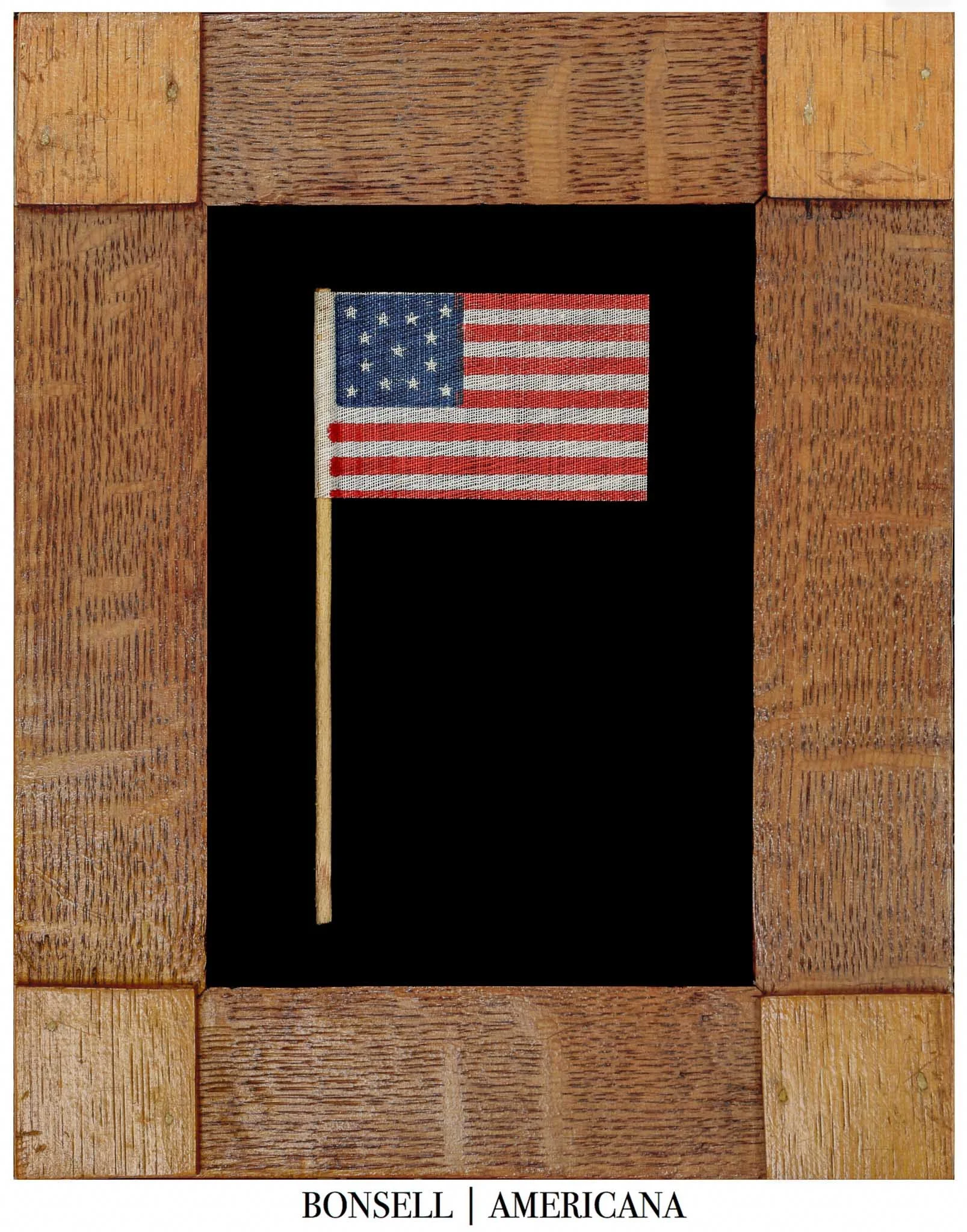
Frame Size (H x L): 10.75” x 8.5”
Flag Size (H x L): 2” x 3” and Affixed to a 6” Staff
Offered is a 13-star printed parade flag produced to commemorate the Centennial of American independence in 1876. A decade after the Civil War, the Centennial inspired an extraordinary outpouring of patriotism and national pride. Communities across the reunited states—large cities and small towns alike—organized parades, civic pageants, and decorative displays. Homes, schools, and public buildings were draped in red, white, and blue bunting, with the national flag serving as the central symbol of unity and renewal.
The most ambitious celebration was the Centennial International Exposition in Philadelphia, the first official World’s Fair held in the United States. Over six months, nearly ten million visitors attended, marveling at technological and cultural exhibits that defined America’s industrial ascendance. Among its landmark presentations were the debut of Alexander Graham Bell’s telephone and the Corliss Steam Engine—then the largest engine ever built.
At the time of the Exposition, the official star count of the United States flag was 37, reflecting the admission of Nebraska in 1867. Yet 1876 also marked the entry of Colorado as the 38th state, earning it the nickname “The Centennial State.” Flag makers, always eager to anticipate new additions, produced both 38-star flags and, for symbolic and historical reasons, 13-star flags—reviving the design of the original Revolutionary era as a nostalgic emblem of the nation’s birth. During the Centennial year, these 13-star flags were among the most popular decorative forms seen in parades, civic halls, and patriotic displays.
The use of the 13-star format dates to June 14, 1777, when the Continental Congress resolved: “That the flag of the United States be made of thirteen stripes, alternate red and white; that the union be thirteen stars, white on a blue field, representing a new constellation.” This pattern represented the original colonies and remained official until 1795, when two stars and two stripes were added for Vermont and Kentucky. Nonetheless, the 13-star configuration never disappeared.
It remained in continuous ceremonial use well into the nineteenth century. The U.S. Navy flew 13-star ensigns on small boats from 1795 through 1916 to maintain clear identification at sea. The design was hoisted at the death of George Washington in 1799, and again during the nation’s semicentennial in 1824, when General Lafayette toured the United States as a living link to the Revolution. Similar flags reappeared during subsequent patriotic moments—the Mexican War (1846–1848), the Civil War (1861–1865), and the Centennial celebrations of 1876—each time symbolizing a return to the founding ideals of the Republic.
By the time this example was produced, the 13-star flag had evolved from a functional design into a revered patriotic motif—an emblem not of a single moment, but of the enduring American story from independence through reconciliation and progress.
Conservation Process: The flag was hand sewn to cotton fabric, and both were hand sewn to a mounting board. To prevent the black dye in the cotton fabric from seeping into the flag, it was first washed in a standard wash and then in a dye setting wash. The flag is positioned behind Optium Museum Acrylic.
Frame: The flag is presented in a period-style cornerblock frame made of oak, modeled after late 19th-century designs. The frame itself likely dates to the mid-20th century and is joined at the miters with corrugated fasteners typical of that period.
Condition Report: The flag remains in excellent condition, with strong color retention and only light toning to the white areas. The glazed cotton is stable and well-preserved, showing no notable fraying or loss beyond a few small areas where the fabric was wrapped around the staff.
Collectability Level: The Good – Perfect for Beginning Collectors and Gifts
Date of Origin: 1876
Number of Stars: 13
Associated War: The Indian Wars (1860-1890)
Associated State: Original 13 Colonies
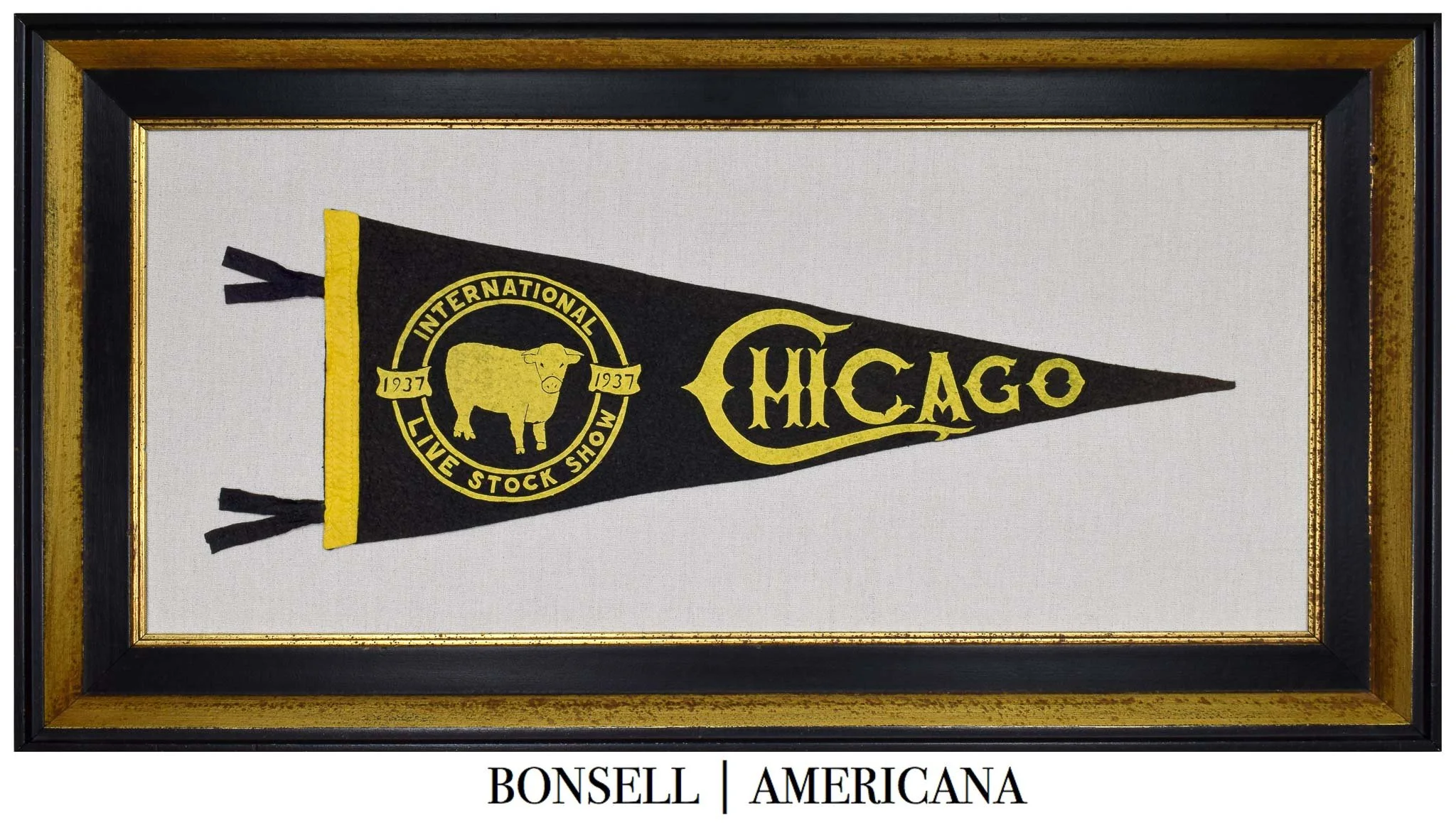
Frame Size (H x L): 21.5” x 41.5”
Pennant Size (H x L): 10.25” x 27.5” with
Offered is an antique pennant, from 1937, commemorating the International Live Stock Show held in Chicago. It features a bold yellow and black design with an illustration of a steer at the center, encircled by the text "International Live Stock Show." The year 1937 is prominently displayed on a banner beneath the steer, while the word "Chicago" is elegantly scripted along the length of the pennant.
The International Live Stock Show, inaugurated in 1900, was one of the premier livestock exhibitions in the United States, held annually in Chicago. This event was a key gathering for breeders, farmers, and agricultural enthusiasts from around the world. Hosted at the Chicago Stock Yards, the show became a significant platform for showcasing the best livestock, including cattle, swine, sheep, and horses. Participants competed for prestigious awards, which were highly coveted within the agricultural community.
The show not only highlighted the quality and breeding standards of livestock but also served as an educational forum. It provided opportunities for attendees to learn about the latest advancements in agricultural practices, breeding techniques, and animal husbandry. The exhibition featured various events, including judging competitions, parades, and demonstrations, which drew large crowds and fostered a sense of community among those involved in the agricultural industry.
During its peak, the International Live Stock Show played a crucial role in promoting agricultural innovation and excellence. It encouraged the exchange of knowledge and best practices among breeders and farmers, contributing to the advancement of livestock breeding and management. The show's influence extended beyond the United States, attracting international participants and spectators, thereby cementing Chicago's reputation as a central hub for agricultural development.
The 1937 show, represented by this pennant, was one of the many successful iterations of the event, continuing the tradition of excellence and competition.
Conservation Process: This pennant was hand sewn to cotton fabric, and both were hand sewn to a mounting board. To prevent the black dye in the cotton fabric from seeping into the pennant, it was first washed in a standard wash and then in a dye setting wash. The pennant is positioned behind Optium Museum Acrylic.
Frame: Italian, crafted with a black and gold finish.
Condition Report: Excellent condition, with vibrant colors and minimal signs of wear.
Collectability Level: The Good – Perfect for Beginning Collectors and Gifts
Date of Origin: 1937
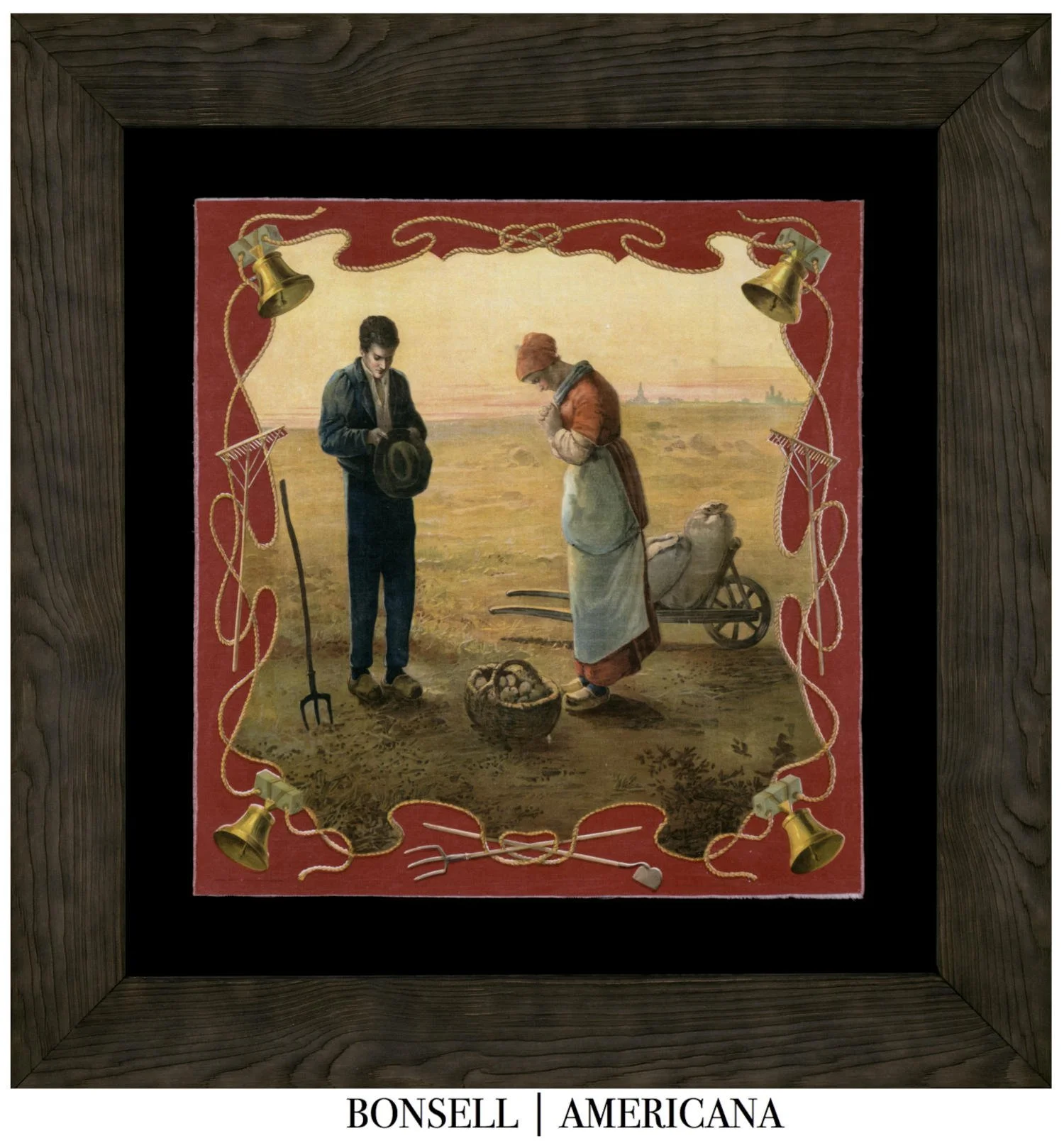
Frame Size (H x L): 34.5” x 33”
Textile Size (H x L): 22.5” x 21.5”
Offered is a printed cotton textile dating to 1900, featuring a reproduction of The Angelus, the well-known painting by French artist Jean-François Millet. Originally painted between 1857 and 1859, The Angelus depicts two peasants in a field at dusk, bowing their heads in prayer as the church bell tolls. The figures stand beside a wheelbarrow and a basket of potatoes, underscoring the theme of rural labor and humility. The image highlights the rhythms of agricultural life and the connection between work and devotion. The painting became one of the most widely reproduced religious and sentimental works of the 19th century.
This textile adaptation was published and copyrighted in 1900 by Campbell, Metzger & Jacobson, a decorative textile and lithography firm based at 446 Broadway in New York City. The company was active around the turn of the 20th century and specialized in printed pillow fronts, wall panels, and other home furnishings. Their products were distributed widely through upholstery suppliers and dry goods retailers. The copyright line, printed along the lower edge of the textile, reads: “Copyright 1900 by Campbell, Metzger & Jacobson.”
The scene is framed by a red printed border containing rope, brass bells, and agricultural tools such as pitchforks and rakes. These design elements complement the setting of the central image and reinforce its agrarian character. The printing technique is chromolithography, applied using multiple passes of oil-based ink to produce rich color and tonal variation. The textile was likely intended as a pillow front or decorative wall panel, suitable for use in homes that identified with themes of faith, farming, and hard work.
The base fabric is a 2/1 cotton twill, identified by its subtle diagonal rib pattern. This weave provided both durability and a smooth surface for detailed printing. Unlike the wool felts used in lower-cost tobacco premiums of the era, this cotton textile would have been marketed toward the upholstery and home furnishing trade, where clearer image reproduction and sewing ease were priorities.
Three supporting images are included to help document and contextualize the piece. The first is a period trade article describing Campbell, Metzger & Jacobson’s offerings, including lithographed pillow fronts. The second is an early 20th-century photograph of the firm's storefront at 446 Broadway. The third is a modern-day photograph of the same building, which still stands in lower Manhattan. These references help confirm the publisher’s identity and provide visual evidence of their business operations at the time this textile was produced.
This piece reflects the intersection of printed art, domestic decoration, and agricultural symbolism in the early 1900s. It connects a prominent European painting to the American market through chromolithographic textile printing. The result is a well-documented example of a decorative object rooted in both fine art and the values of rural labor.
Conservation Process: This textile was hand sewn to cotton fabric, and both were hand sewn to a mounting board. To prevent the black dye in the cotton fabric from seeping into the textile, it was first washed in a standard wash and then in a dye setting wash. The textile is positioned behind Optium Museum Acrylic.
Frame: The frame is constructed from dark-stained wood with a visible grain pattern and a wide, flat profile. It features a clean, modern design
Condition Report: The textile is in sound condition, with strong color retention and no major losses. Minor wear is visible at the edges, along with a few small surface marks consistent with age. The printed image remains clear and well-preserved.
Collectability Level: The Good – Perfect for Beginning Collectors and Gifts
Date of Origin: 1900
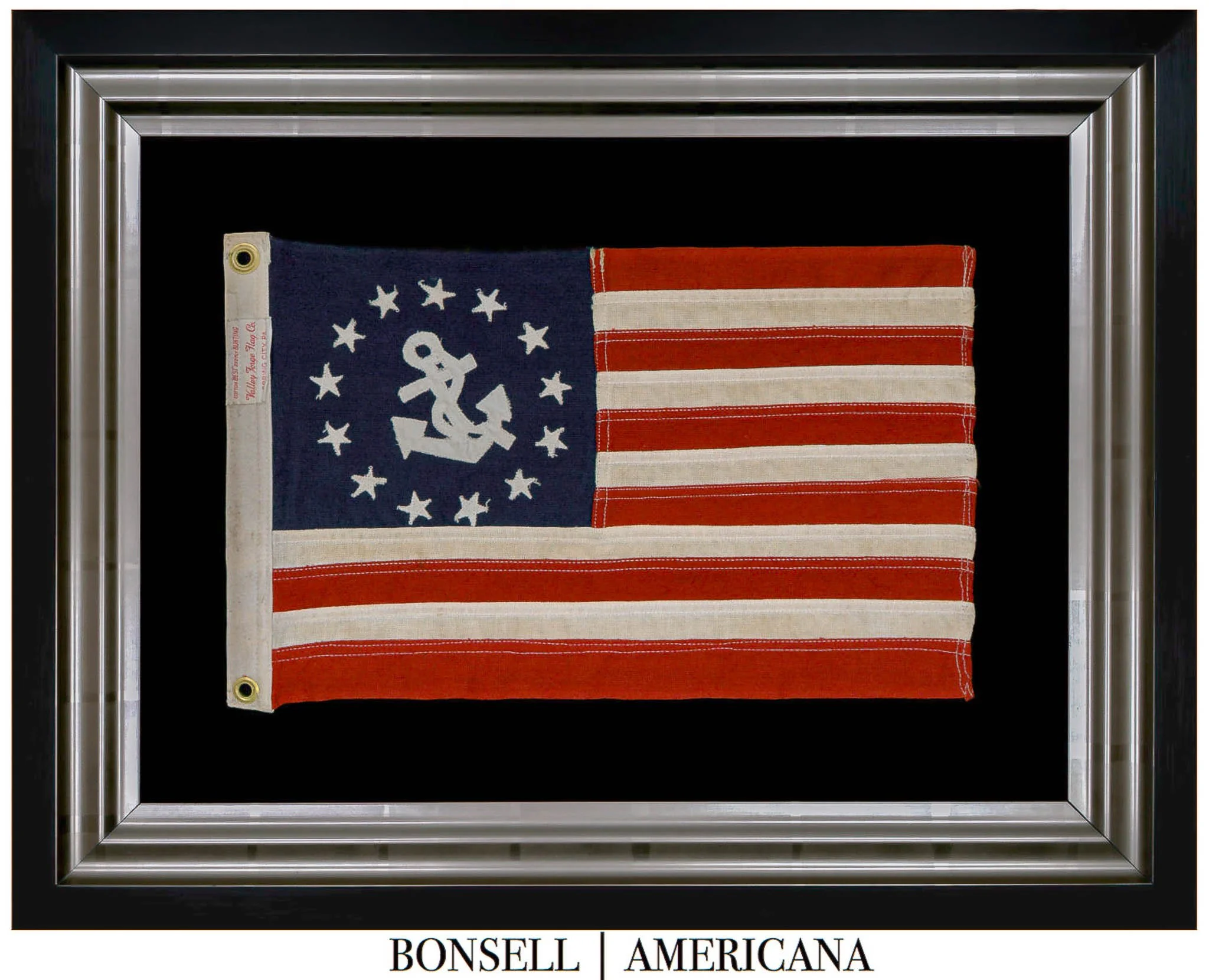
Frame Size (H x L): 19.5” x 25”
Flag Size (H x L): 23” x 35”
Offered is a mid-20th-century American yacht ensign, manufactured by the Valley Forge Flag Company of Spring City, Pennsylvania. These flags were traditionally flown in place of the standard U.S. national flag on private pleasure craft operating in U.S. waters. Distinctive in design, they feature a canted white anchor encircled by 13 white stars—representing the original 13 colonies—set within a blue canton. This emblem, unique to yacht ensigns, has long symbolized both American patriotism and nautical tradition.
The use of a dedicated U.S. yacht ensign arose in the 19th century, when customs officials frequently inspected all incoming vessels, including private yachts rarely involved in commerce. To address this, Congress passed legislation in 1848 authorizing a separate ensign for registered yachts. Vessels flying the yacht ensign were exempt from routine customs inspections, allowing owners uninterrupted leisure sailing while still maintaining official identification on the water.
While never intended to replace the national ensign, the yacht flag was typically flown from the masthead, with the national flag flown from the stern or gaff. Over time, however, many yachts flew the yacht ensign exclusively—an unofficial yet widespread practice driven by the flag’s aesthetic appeal and practicality. Though the law authorizing its use was repealed in 1980, the tradition endures, and the design remains a beloved emblem of American yachting culture.
CONSTRUCTION
This example was produced by the Valley Forge Flag Company, a prominent American maker active in flag production since 1918. A machine-sewn tag along the hoist reads:
“COTTON BEST 2X2 FLY BUNTING / Valley Forge Flag Co. / Spring City, PA.”
The tag’s wording, lack of zip code, and overall style—combined with the use of cotton bunting—indicate a date of manufacture between circa 1935 and 1955.
The flag is constructed from cotton bunting, which was widely used for ceremonial and recreational flags before synthetic materials became the standard in the 1960s. The red and white stripes are machine-pieced with straight seams, while the navy canton is appliquéd with a white anchor surrounded by 13 stars. All design elements in the canton are made from cotton and double-appliquéd to both sides using a zig-zag stitch.
A reinforced white twill hoist bears the manufacturer’s tag and is fitted with two metal grommets, likely nickel-plated brass—a corrosion-resistant alloy preferred for maritime use. The overall construction reflects the evolution of American flag-making in the postwar era: mass-produced, yet still rooted in traditional craftsmanship and patriotic symbolism.
THIRTEEN-STAR FLAGS GENERALLY
The 13-star flag originated with the Continental Congress’s resolution of June 14, 1777, establishing the first official national flag of the United States. While its official tenure lasted until 1795, the design remained symbolically powerful well into the 19th and 20th centuries.
From 1795 to 1916, the 13-star flag served as the standard ensign on small U.S. Navy boats. It was also flown during moments of national mourning and celebration, including George Washington’s death in 1799, the 50th anniversary of American independence, and General Lafayette’s 1824 return tour. Its Revolutionary War associations made it a fitting choice for commemorative and patriotic events throughout American history.
The design saw renewed prominence during the Mexican-American War and Civil War, when its ties to the founding era made it a potent symbol of national unity. By the centennial celebrations of 1876, the 13-star flag had become an enduring emblem of American resilience, often appearing at public events and historical commemorations.
Steeped in symbolic meaning and patriotic heritage, the 13-star flag continues to serve as a visual reminder of the nation’s founding ideals—unity, independence, and perseverance.
Conservation Process: This flag was hand sewn to cotton fabric, and both were hand sewn to a mounting board. To prevent the black dye in the cotton fabric from seeping into the flag, it was first washed in a standard wash and then in a dye setting wash. The flag is positioned behind Optium Museum Acrylic.
Frame: The flag is housed in a modern, shadowbox-style frame featuring a bold, stepped profile. The frame has a black outer edge with a metallic silver inner liner, providing a clean, high-contrast presentation that complements the flag.
Condition Report: The flag is in sound condition, with strong color retention in both the stripes and the canton. There is minor toning and light soiling, primarily along the hoist and edges. The fabric remains stable, with no significant fraying or loss.
Collectability Level: The Good – Perfect for Beginning Collectors and Gifts
Date of Origin: 1935-1955
Number of Stars: 13
Associated War: World War II (1941-1945)
Associated State: Original 13 Colonies
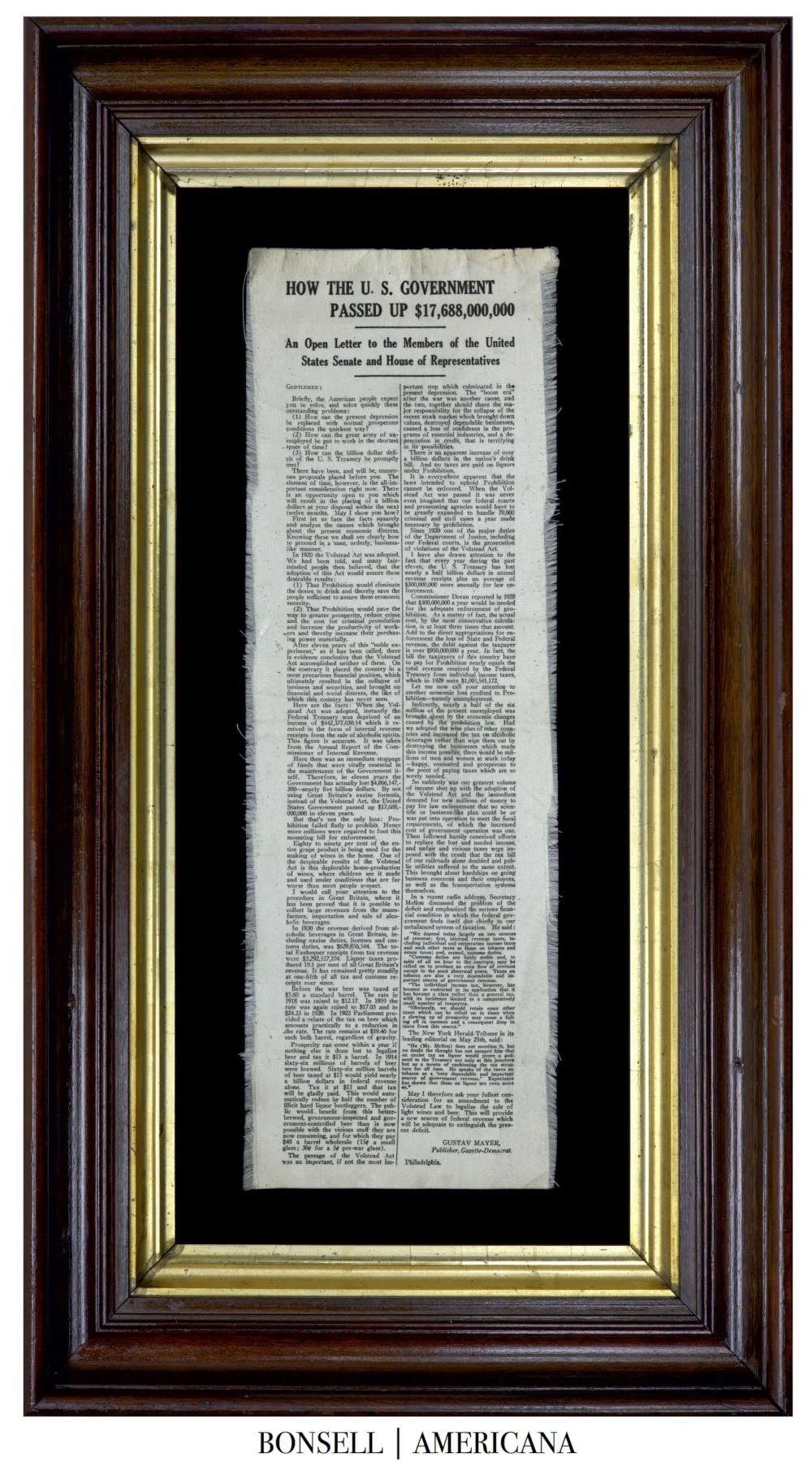
Frame Size (H x W): 17.75” x 6”
Broadside Size (H x W): 25.5” x 14”
Offered is a rare broadside titled "How the U.S. Government Passed Up $17,688,000,000," with the subtitle "An Open Letter to the Members of the United States Senate and House of Representatives" prominently printed in bold at the top. Featuring a two-column layout with densely packed text, it presents a detailed argument about the economic consequences of Prohibition, focusing on the loss of tax revenue from alcohol taxation. Printed on lightweight, plain-woven linen, the material adds both durability and a sense of significance to the document.
Crafted from the fibers of the flax plant, the plain-woven linen used for this broadside provides a smooth, durable, and slightly lustrous surface ideal for clear, detailed printing. Linen's lightweight nature made it practical for handling and transport while retaining its structural integrity. During the Prohibition era, linen’s prestige and resilience reflected the importance of its message, aligning with the cultural and historical demands of the period.
This broadside delivers an economic critique of Prohibition, highlighting the $17 billion in potential tax revenue forfeited due to the Volstead Act. Addressed to members of Congress, it frames Prohibition as both a moral failure and a financial catastrophe, urging lawmakers to reconsider the policy. By emphasizing the ban’s economic consequences, the piece shifts the debate from ideological concerns to pragmatic fiscal realities, making a strong case for repealing the legislation.
During Prohibition (1920–1933), alcohol was outlawed across the United States in an effort to curb societal issues such as crime and alcoholism. While initially seen as a moral victory, the policy's unintended consequences quickly became evident. Organized crime surged as illegal distilleries and bootleggers met the persistent demand for alcohol, while the federal government, heavily reliant on alcohol taxes, faced severe revenue shortfalls. This broadside criticizes these impacts, proposing that regulated alcohol production could restore public funding and weaken the black market.
The broadside also presents an alternative vision for alcohol regulation, advocating for government-controlled production and taxation to generate revenue and ensure safety. It argues that such regulation would benefit the economy and the public by replacing dangerous, unregulated liquor with inspected and affordable options. This pragmatic approach likely resonated with lawmakers and citizens alike, especially as the Great Depression deepened the need for economic reform.
This fabric broadside exemplifies the growing opposition to Prohibition in the late 1920s and early 1930s, reflecting grassroots pressure that contributed to the eventual repeal of the Volstead Act through the 21st Amendment in 1933. The choice to print on linen, rather than paper, underscores its intended durability and importance, ensuring the message's longevity. By grounding its argument in economic terms, this broadside serves as an artifact of the Prohibition era, reflecting the tensions and debates that shaped one of America’s most significant policy reversals.
Conservation Process: The broadside was hand sewn to cotton fabric, and both were hand sewn to a mounting board. To prevent the black dye in the cotton fabric from seeping into the broadside, it was first washed in a standard wash and then in a dye setting wash. The broadside is positioned behind Optium Museum Acrylic.
Frame: The frame is made of walnut and dates from 1860 to 1890. Its dark wood and simple craftsmanship reflect the style of the period.
Condition: The broadside is in excellent condition overall, with light staining that does not detract from its legibility or visual appeal. The fraying along the edges is consistent with the fabric's original lightweight linen construction and reflects its natural wear rather than damage.
Collectability Level: The Good – Perfect for Beginning Collectors and Gifts
Date of Origin: 1920-1933
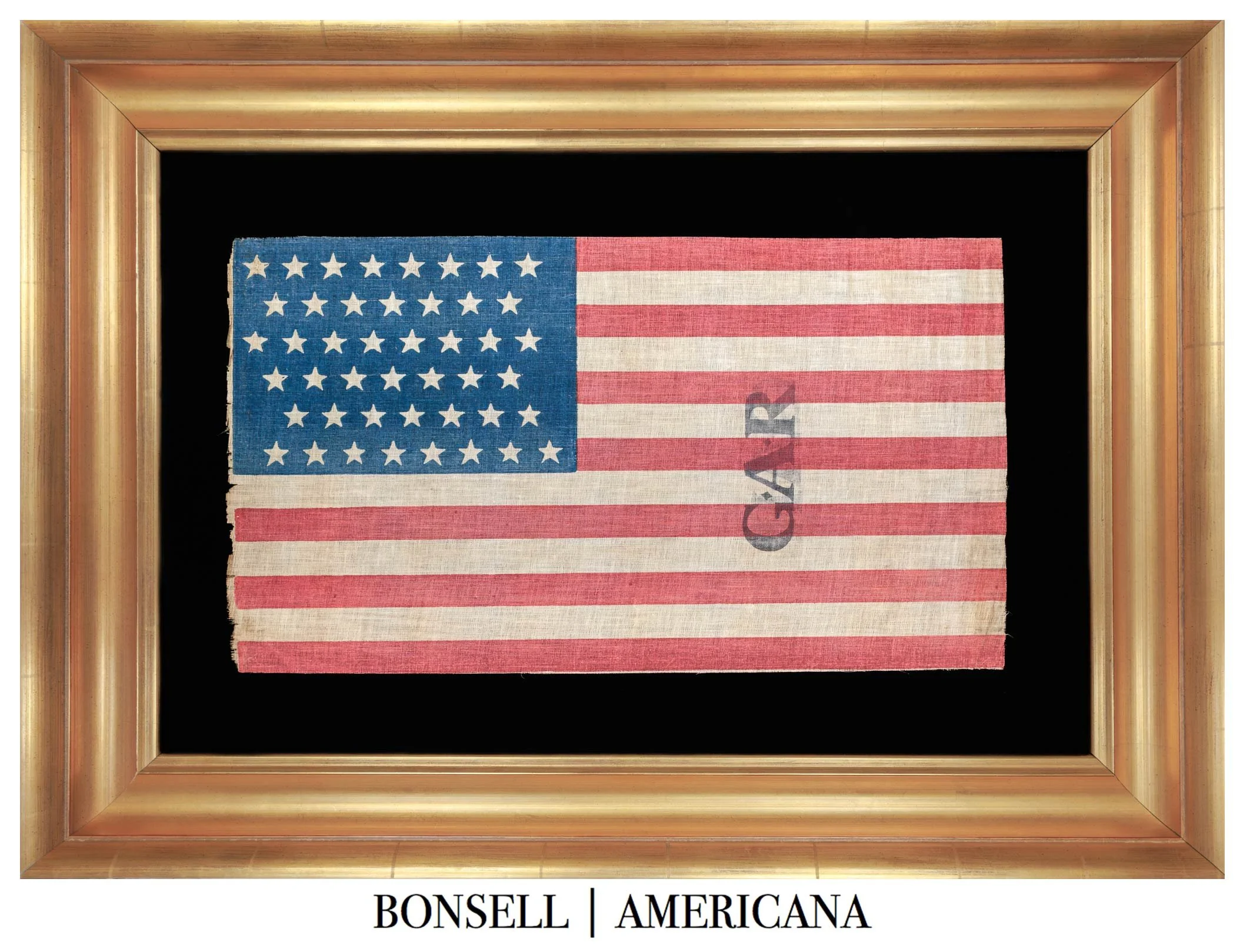
Frame Size (H x L): 22” x 31”
Flag Size (H x L): 12” x 21”
Offered is a forty-five star parade flag printed on glazed cotton. Parade flags are small scale flags that were meant to be used for a short time, typically at patriotic events and political rallies. Some parade flags include some kind of printing, such as this one, which includes Grand Army of the Republic (“GAR”) overprint. The GAR was a fraternal organization for the veterans of the Union Army, Union Navy, and Marines who served in the Civil War. GAR members provided support to one another and also remembered those who had fallen in battle. It was founded in 1866, peaked in 1890 with almost 500,000 members, and dissolved in 1956 when its last member died.
The stars of this flag are arranged in an 8-7-8-7-7-8 pattern. Each row of stars is offset relative to the adjacent rows. For example, the first and third rows are offset to the hoist end of the canton, while the last row is offset to the fly end of the canton. The remaining rows are relatively centered in the canton. This flag is unusually long in length, as it was not until 1912 that the proportions of the flags were officially specified. The combination of the GAR overprint, the staggered star pattern, and the proportions of this flag make for an interesting, desirable mantel piece.
The forty-five star flag represents the inclusion of Utah to the Union. Utah was admitted on January 4th, 1896, and this flag became official on July 4th, 1896. Presidents Grover Cleveland, William McKinley, and Teddy Roosevelt served under this flag, and the Spanish-American War was fought under it.
In 1848 Utah became a territory of the United States, and in 1849 its constitution was established as the Mormon State of Deseret. The next year, the State of Deseret applied to become a state, but Congress rejected the application and changed its name to the Utah Territory, which included the entirety of Nevada and portions of Colorado and Wyoming (as a section of the Missouri Compromise). Despite its continued efforts to gain statehood, it remained a territory, partially as a result of the Mormon Church and Utah authorities being openly tolerant of polygamy. In 1890 Utah outlawed the practice, and in 1896 Utah finally became the forty-fifth state. The forty-five star flag was official for 12 years up until July 4th, 1908, when the forty-six star flag became official and began to represent the inclusion of Oklahoma in the Union.
Conservation Process: This flag was hand sewn to cotton fabric, and both were hand sewn to a mounting board. To prevent the black dye in the cotton fabric from seeping into the flag, it was first washed in a standard wash and then in a dye setting wash. The flag is positioned behind Conservation Clear Acrylic (standard) or behind Optium Museum Acrylic (per request).
Frame: This offering is in our Large Gold Frame.
Condition Report: This flag has some very minor staining and some fading. There is some fraying along the hoist end of the flag. Many collectors prefer flags that show their use and age.
Collectability Level: The Good – Perfect for Beginning Collectors and Gifts
Date of Origin: 1896-1907
Number of Stars: 45
Associated War: Spanish-American War (1898)
Associated State: Utah
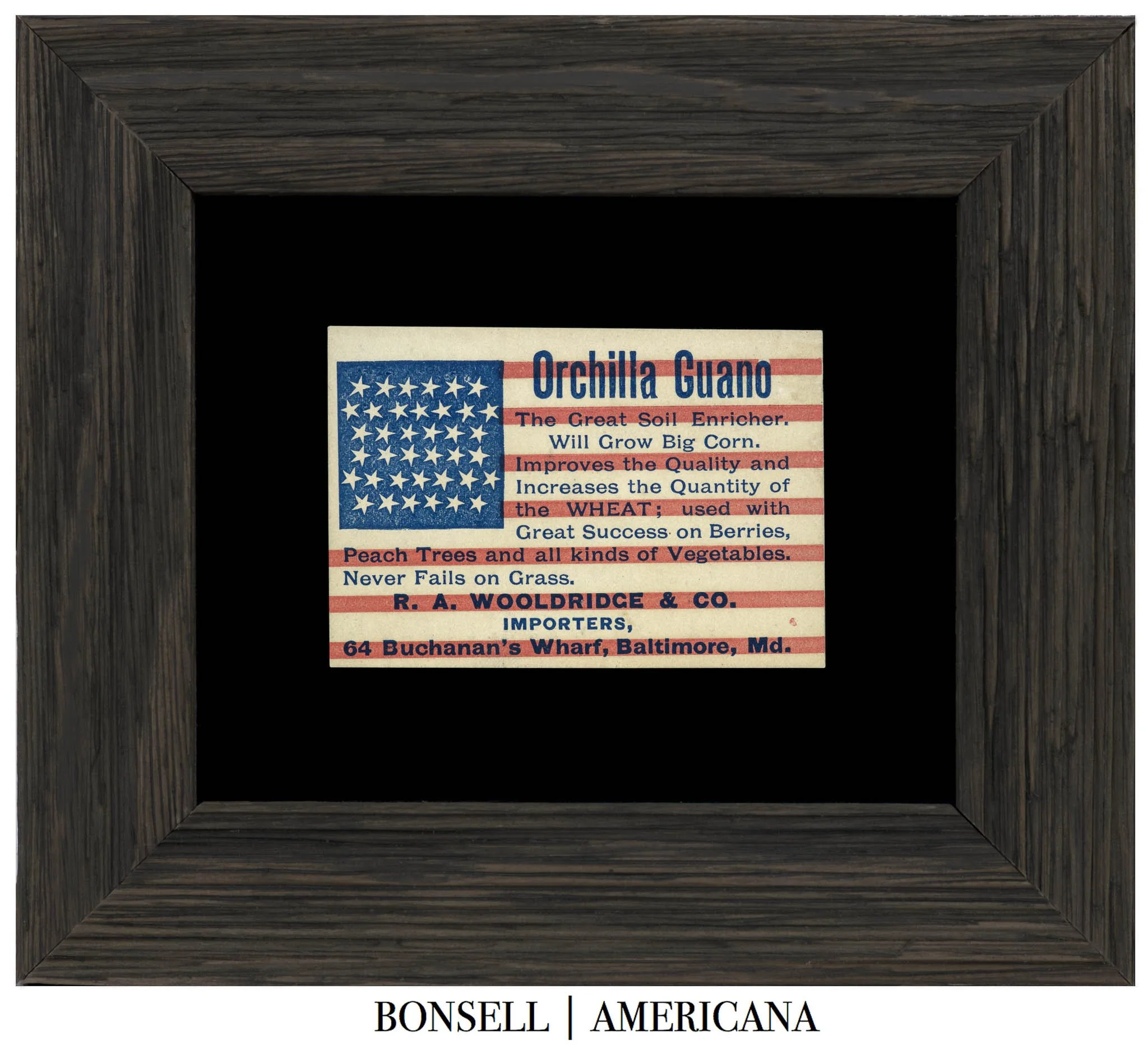
Frame Size (H x L): 6.5” x 7.5”
Flag Size (H x L): 2.25” x 3.25”
Offered is a thirty-eight star flag with a 6-7-6-6-7-6 configuration, presented in the form of a trade card. A trade card was an early form of advertising, popular in the 18th and 19th centuries, distributed by businesses to promote their products or services. These cards were typically small, printed on thick paper, and often elaborately designed, featuring images, product descriptions, and the company’s contact information. Trade cards functioned both as advertisements and business cards, providing potential customers with promotional or informational content.
In the 19th century, trade cards gained popularity in the U.S. and Europe due to advances in lithography, which made colorful and artistic prints more accessible. Businesses across many industries—from agriculture, such as the "Orchilla Guano" card advertising a soil enricher, to clothing and machinery—used them as a key marketing tool. Trade card collecting became a widespread hobby, which is why many of these cards have survived to the present day.
The Overprint
The trade card offered here includes the following overprint:
Orchilla Guano
The Great Soil Enricher.
Will Grow Big Corn.
Improves the Quality and
Increases the Quantity of
the WHEAT; used with
Great Success on Berries,
Peach Trees and all kinds of Vegetables.
Never Fails on Grass.
R. A. Wooldridge & Co.
IMPORTERS,
64 Buchanan's Wharf, Baltimore, Md.
Orchilla guano is a type of fertilizer made from seabird droppings, primarily found on islands in tropical and subtropical regions. This nutrient-rich guano is highly effective due to its concentrations of nitrogen, phosphate, and potassium—essential nutrients for plant growth. Guano has been used in agriculture for centuries, valued for its ability to improve soil fertility and boost crop yields. Its effectiveness stems from the natural processes that concentrate these valuable nutrients over time.
During the 19th century, guano played a significant role in global agriculture. Countries like the United States heavily relied on guano imports to replenish exhausted soils. Orchilla guano, sourced from the Orchilla Islands in Venezuela, became particularly popular with farmers looking to improve their corn, wheat, and other crop production. Its effectiveness made it a highly sought-after resource, and the guano trade became a significant industry, marking the "Guano Age" in agricultural history.
R. A. Wooldridge & Co.
R. A. Wooldridge & Co., located at 64 Buchanan's Wharf in Baltimore, Maryland, was a prominent importer during the 19th century, a period when Baltimore was a critical hub for trade and commerce. The company’s strategic location along the bustling waterfront enabled it to import goods like Orchilla guano efficiently, connecting domestic markets with international suppliers. Specializing in a range of imported products, R. A. Wooldridge & Co. contributed significantly to the flow of materials that supported regional agricultural and industrial sectors.
The firm gained a reputation for its reliability in ensuring the timely delivery of essential goods, becoming a key player in Baltimore’s maritime economy. Its operations were integral to the city’s growth as an industrial and commercial center, exemplifying the entrepreneurial spirit of 19th-century Baltimore as it fostered international trade connections that shaped the city’s economic landscape.
Thirty-Eight Star Flags Generally
The thirty-eight star flag represents the inclusion of Colorado into the Union. Colorado was admitted on August 1st, 1876, and this flag became official on July 4th, 1877. Presidents Hayes, Garfield, Arthur, Cleveland, and Harrison all served under this flag. Colorado earned the nickname "The Centennial State" due to its statehood occurring just twenty-eight days after the nation's centennial. While the official U.S. flag in 1876 had thirty-seven stars, flag makers often produced anticipatory flags ahead of official changes. As a result, the thirty-eight star flag—along with the thirteen star flag—were the two flags flown during the centennial celebrations of 1876.
The nation’s centennial in 1876 sparked a wave of patriotism across the country, helping reunite its citizens. Cities large and small hosted parades and celebrations, with homes and buildings adorned in red, white, and blue. Flags became the primary symbol of national pride. The most notable event was the Centennial International Exposition in Philadelphia, which hosted nearly 10 million visitors over six months and showcased groundbreaking exhibits such as the Corliss Steam Engine and Alexander Graham Bell’s telephone.
The thirty-eight star flag remained official until July 4th, 1890, when the forty-three star flag replaced it to represent the inclusion of North Dakota, South Dakota, Montana, Washington, and Idaho into the Union.
Conservation Process: This flag is positioned on a cotton rag board and behind Optium Museum Acrylic.
Frame: The frame features a rustic, wood-grain finish with a deeply textured pattern.
Condition Report: The front shows some light toning but remains in excellent overall condition. On the back, there are four small tape or glue marks, none of which are visible from the front.
Collectability Level: The Good – Perfect for Beginners and Gifts
Date of Origin: 1876-1889
Number of Stars: 38
Associated War: The Indian Wars (1860-1890)
Associated State: Colorado

Frame Size (H x L): 21” x 38”
Pennant Size (H x L): 12” x 29”
Offered is an antique pennant, made for the International Live Stock Show, held in Chicago. It is red and features overprints of a prize winning bull, hog, lamb, and horse. The horse is haltered and held by a woman, who is also holding a championship trophy.
INTERNATIONAL LIVE STOCK SHOW
The International Live Stock Show, also known as the Chicago International, was a major agricultural exhibition held annually, from 1900 until 1976. The show was one of the largest and most prestigious events of its kind. It featured a variety of livestock competitions, including judging of cattle, hogs, sheep, and horses, as well as exhibits of agricultural machinery, animal feed, and other related products.
Over the years, the International Live Stock Show grew in size and scope, attracting exhibitors and spectators from across the United States and around the world. In the early 20th century, the event became a key platform for promoting American agricultural exports to Europe and other global markets.
Despite its success, the International Live Stock Show faced challenges in the postwar era. Changes in the livestock industry, including the growth of large farms and the consolidation of meatpacking companies, led to declining interest in traditional livestock shows. In addition, rising urbanization and changing consumer preferences reduced the appeal of rural-themed events like the Chicago International.
Ultimately, in 1976, the International Live Stock Show was discontinued due to declining attendance and financial difficulties. Today, the legacy of the show lives on in the Union Stockyards Gate, a landmark entrance to the former stockyards site that has been preserved as a symbol of Chicago's agricultural heritage.
INTERNATIONAL AMPHITHEATRE
The bottom of the pennant offered herein includes an image of the International Amphitheatre, a multi-purpose indoor arena, opened in 1934. The arena was designed by Abraham Epstein and hosted a variety of events, including concerts; sports competitions; political conventions; trade shows; and of course, the International Live Stock Show. The International Amphitheatre hosted legendary musicians, such as Elvis and the Beatles, and several presidential nominating conventions. However, due to facilities eventually becoming outdated and the decline of the livestock industry in the surrounding neighborhood, the International Amphitheatre eventually closed and was demolished in 1999.
ADVERTISING FLAG COMPANY
This pennant was made by the Advertising Flag Company (i.e., as indicated by the reference thereto under the champion bull). It was founded in 1936 in Chicago, Illinois by Frank F. Smith, and quickly became known for its production of high-quality flags, banners, and promotional products. Later, the company expanded its offerings to include custom-designed products and supplied flags and banners for major events. In the 1960s, the Advertising Flag Company introduced new technology and production techniques, allowing for more complex designs and faster production times. The company's legacy as a pioneer in the flag and banner industry continues to be felt today, with a wide range of products still available for customers worldwide.
Conservation Process: This pennant was hand sewn to cotton fabric, and both were hand sewn to a mounting board. To prevent the black dye in the cotton fabric from seeping into the pennant, it was first washed in a standard wash and then in a dye setting wash. The pennant is positioned behind Optium Museum Acrylic.
Frame: This pennant is in a reclaimed wood frame.
Condition Report: There is some toning of the hoist strip. But overall, the pennant is in excellent condition.
Collectability Level: The Good – Perfect for Beginning Collectors and Gifts
Date of Origin: 1940-1960

Frame Size (H x L): 38.5” x 25”
Seed Sack Size (H x L): 29” x 15.5”
Offered is a vintage seed sack with the following overprint:
1513
PERM.PAST.MIX
Earl May
MAYGOLD
FARM SEED
EARL MAY SEED CO.
SHENANDOAH, IOWA
The sack further includes a fantastic image of an ear of corn with kernels falling into a pot. The pot includes a money sign, so as to symbolize healthy profits, stemming from a future, bumper crop.
The Earl May Seed Company was founded in Shenandoah, Iowa, in 1919 by Earl E. May. He started the business to sell quality seeds and gardening products to the local community. Over time, the company expanded to offer nursery plants, gardening tools, and other products. Shenandoah has a history of horticulture, which helped the company grow. Today, the Earl May Seed Company is known for its good customer service and reliable products, making it a go-to resource for many gardeners and farmers in the Midwest.
Conservation Process: This seed sack was hand sewn to cotton fabric, and both were hand sewn to a mounting board. To prevent the black dye in the cotton fabric from seeping into the sack, it was first washed in a standard wash and then in a dye setting wash. The sack is positioned behind Optium Museum Acrylic.
Frame: This offering is in a distressed wooden frame.
Condition Report: There are some minor stains, but overall it is in excellent condition.
Collectability Level: The Good – Perfect for Beginning Collectors and Gifts
Date of Origin: 1950-1960
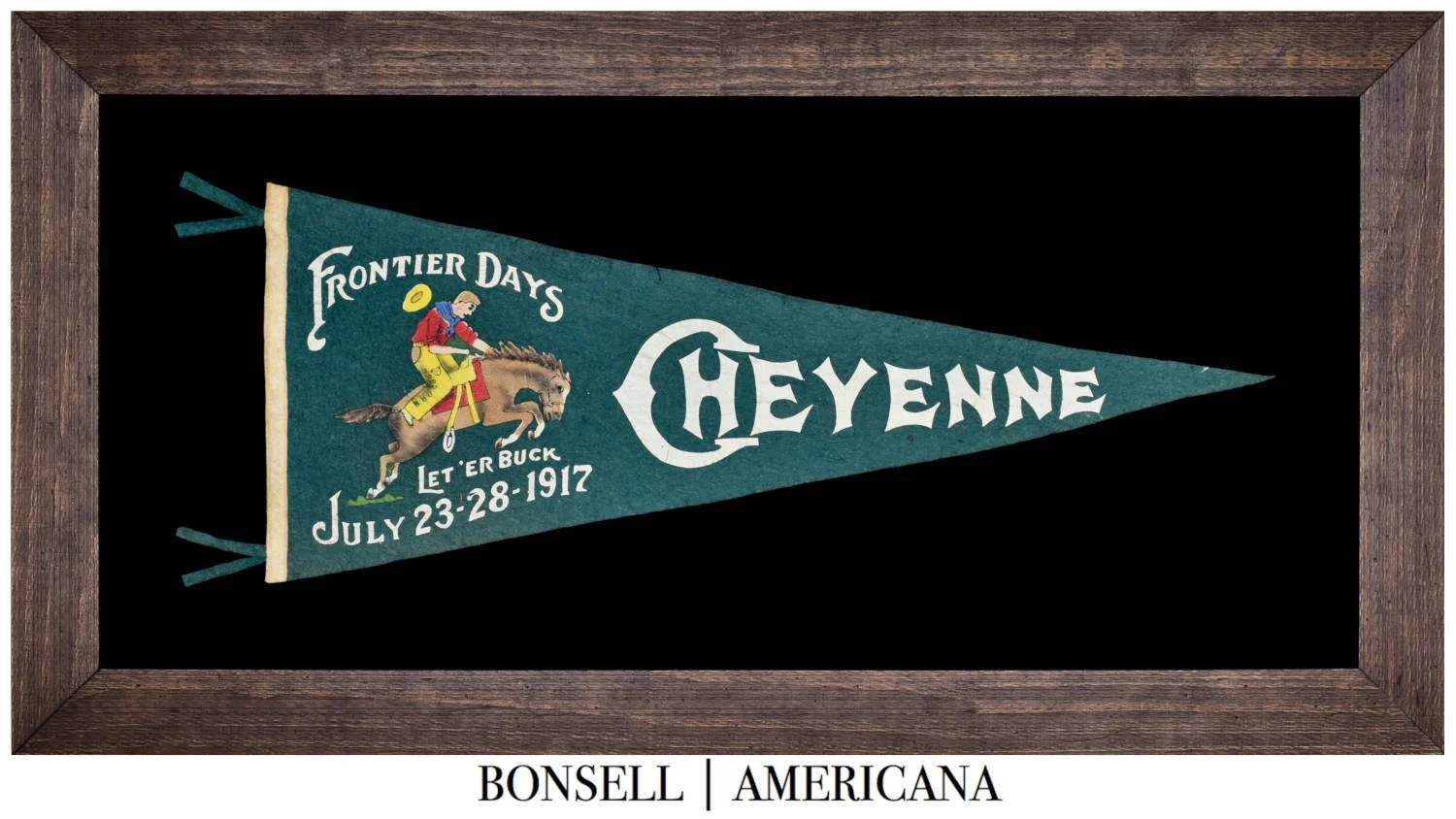
Frame Size (H x L): 21” x 40.5”
Pennant Size (H x L): 11” x 28” with 2.5” ties
Offered is an antique pennant, made for the Cheyenne Frontier Days. It features a cowboy atop a bucking bronco, as well as the following overprint:
FRONTIER DAYS
CHEYENNE
LET’ER BUCK
JULY 23-28-1917
The Cheyenne Frontier Days stands as an emblem of the enduring spirit of the American West. Founded in 1897, this event is more than a mere celebration; it encapsulates the essence of western heritage, becoming an enduring tradition that tells the story of a time gone by.
The origins of the Cheyenne Frontier Days can be traced back to the late 19th century when a group of visionary individuals from Cheyenne sought to commemorate the Old West's unique culture and traditions. Their goal was to create an event that would not only entertain but also educate attendees about the way of life, skills, and challenges of the frontier days. As a result, in 1897, the first "Frontier Day" was held, showcasing rodeo events, parades, and other western-themed festivities.
Over time, this annual event grew in scale and stature. Rodeo events expanded to include bull riding, steer wrestling, and barrel racing, among others, drawing participants from all over the country and later from around the world. The rodeo quickly became a central attraction, and the Cheyenne Frontier Days soon earned the title of the "World's Largest Outdoor Rodeo."
The Cheyenne Frontier Days offers more than just thrilling rodeo events. It serves as a living testament to the history of the West. The accompanying "Old Frontier Town" offers a step back in time, where attendees can experience firsthand the life of pioneers, gold prospectors, and cowboys. Craftsmen demonstrate traditional skills, such as blacksmithing and leatherworking, while Native American dancers and storytellers share their rich heritage and traditions.
This event has also always been a hub for music and entertainment. Over the years, it has seen performances from some of the biggest names in country music, further establishing its reputation as a major cultural event.
Beyond culture and entertainment, the Cheyenne Frontier Days holds substantial economic significance for Wyoming. Each year, the event draws a considerable number of tourists, boosting local businesses and contributing significantly to the state's economy. Hotels, restaurants, shops, and other local establishments benefit from the influx of visitors.
Socially, the event fosters a sense of community. Locals volunteer in various capacities, from organizing events to managing logistics. These collaborative efforts strengthen community bonds and promote a sense of pride and ownership in preserving and presenting their shared heritage.
The Cheyenne Frontier Days stands as a beacon of America's western heritage. It reminds us of the grit, determination, and adventurous spirit of those who lived during the frontier days. More than a century after its inception, it remains a symbol of the past, a celebration of the present, and a beacon for the future. It not only pays homage to the traditions and tales of the Old West but also provides an essential bridge connecting generations, ensuring that the stories, skills, and values of the frontier live on in the hearts and minds of all who attend.
Conservation Process: The pennant was hand sewn to cotton fabric, and both were hand sewn to a mounting board. To prevent the black dye in the cotton fabric from seeping into the pennant, it was first washed in a standard wash and then in a dye setting wash. The pennant is positioned behind Optium Museum Acrylic.
Frame: This pennant is in a reclaimed wood frame.
Condition Report: There are a few very small holes and tears. There is some toning along the hoist stripe. But generally, this pennant is in excellent condition and very attractive.
Collectability Level: The Good – Perfect for Beginning Collectors and Gifts
Date of Origin: 1917
Frame Size (H x L): 38” x 28”
Flag Size (H x L): 11” x 18” and Affixed to a 28” Staff
Offered is a forty-five star flag made of glazed cotton. The stars are arranged in an interesting 8-7-8-7-7-8 pattern, in which the first and third rows are staggered to the left, and the fifth row is alternatively staggered to the right. This is an unusual pattern, as most forty-five star flags are more symmetrical in nature. The forty-five star flag represents the inclusion of Utah to the Union. Utah was admitted on January 4th, 1896, and this flag became official on July 4th, 1896. Presidents Grover Cleveland, William McKinley, and Teddy Roosevelt served under this flag, and the Spanish-American War was fought under it.
In 1848 Utah became a territory of the United States, and in 1849 its constitution was established as the Mormon State of Deseret. The next year, the State of Deseret applied to become a state, but Congress rejected the application and changed its name to the Utah Territory, which included the entirety of Nevada and portions of Colorado and Wyoming (as a section of the Missouri Compromise). Despite its continued efforts to gain statehood, it remained a territory, partially as a result of the Mormon Church and Utah authorities being openly tolerant of polygamy. In 1890 Utah outlawed the practice, and in 1896 Utah finally became the forty-fifth state. The forty-five star flag was official for 12 years up until July 4th, 1908, when the forty-six star flag became official and began to represent the inclusion of Oklahoma in the Union.
Conservation Process: This flag was hand sewn to cotton fabric, and both were hand sewn to a mounting board. To prevent the black dye in the cotton fabric from seeping into the flag, it was first washed in a standard wash and then in a dye setting wash. The flag is positioned behind Conservation Clear Acrylic (standard) or behind Optium Museum Acrylic (per request).
Frame: The flag is housed in a stained wood frame with a broad, sloped profile. The dark finish shows subtle tonal variation that allows the wood grain to remain visible. The profile provides strong visual containment while remaining understated and appropriate for period display.
Condition Report: This flag has some minor stains, but otherwise is in excellent condition. Many collectors prefer flags that show their use and age.
Collectability Level: The Good – Perfect for Beginning Collectors and Gifts
Date of Origin: 1896-1907
Number of Stars: 45
Associated State: Utah
Associated War: The Spanish-American War (1898)