
Price: Call 618-553-2291, or email info@bonsellamericana.com
Frame Size (H x L): 52” x 67 ¼”
Flag Size (H x L): 39” x 54 ½”
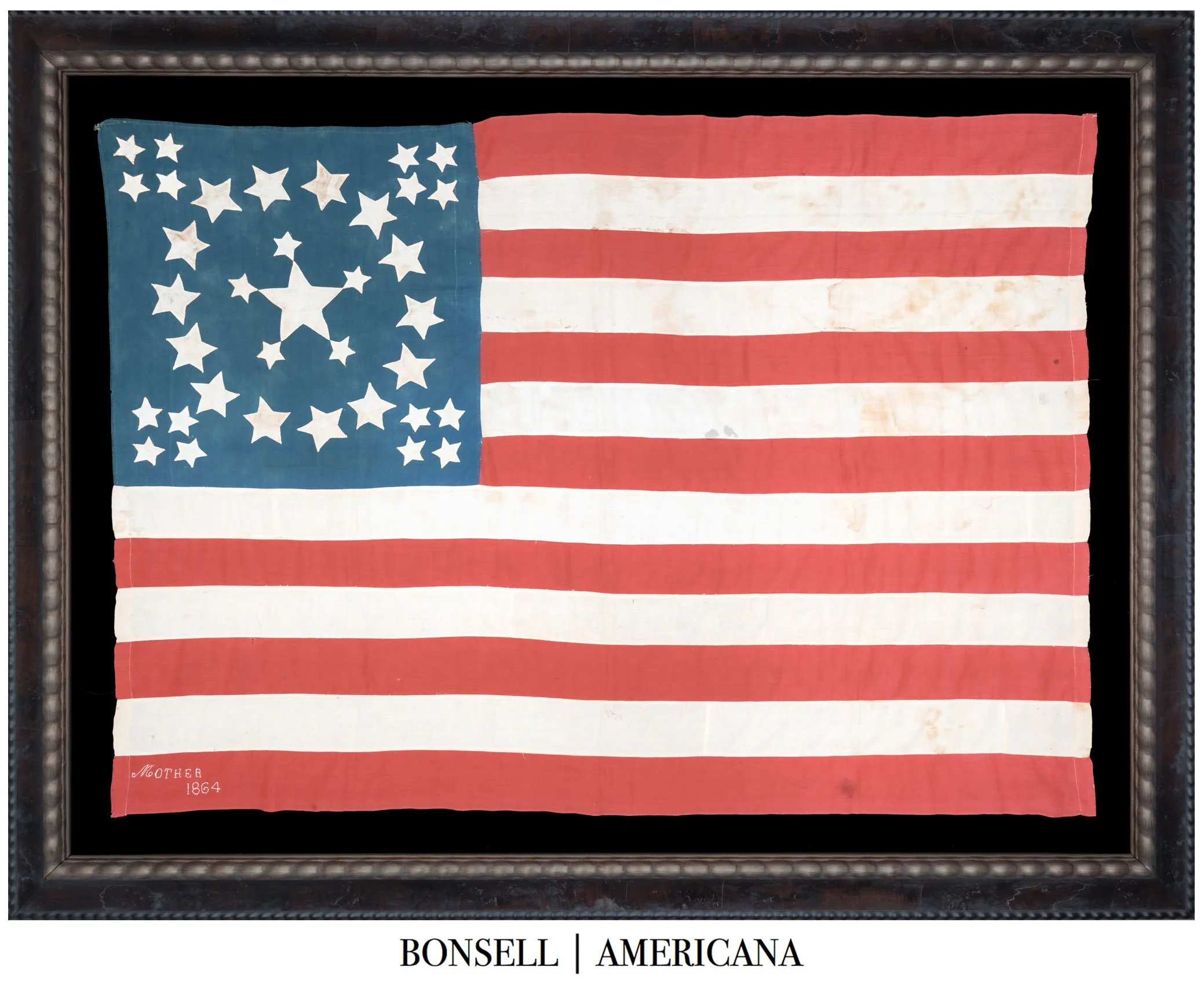
Offered is an exceptional 36-star antique American flag, made entirely of cotton and signed in handsewn thread, “Mother 1864.” Its star configuration is among the most visually arresting 36-star arrangements we have encountered: a large central star, representing Nevada, surrounded by five small stars placed at each of its points, a circular wreath of additional stars, and clusters of four stars in each corner of the canton. The result is dramatic, inventive, and highly personal — less a standardized national emblem than a carefully conceived piece of patriotic art.
The flag is made entirely by hand. The stripes, canton, hoist, and stars are all handsewn, a construction detail that places the object firmly within the world of mid-19th century textile production. Unlike commercially manufactured flags, which increasingly incorporated machine stitching by the Civil War period, this example retains the character of individual domestic manufacture.
The sewing is not merely utilitarian. It is deliberate, intimate, and expressive, culminating in the stitched inscription at the lower hoist: “Mother 1864.” The “M” is rendered in cursive, while the rest of the inscription is worked in small, careful lettering. It is common to encounter antique flags with names, dates, or inscriptions added in ink, paint, or later family notation. It is far more unusual to find a flag signed and dated in sewn thread, integrated into the object itself.
The inscription is one of the flag’s defining features. “Mother 1864” gives the flag both a firm year of manufacture and an unusually direct human connection. The wording strongly suggests that the flag was made by a mother for her family. Given the date, the possibility that it was made for a son or family member serving in the Union cause is compelling, though not provable. What can be said with confidence is that the flag was created in one of the most consequential years in American history, at the height of the Civil War and in the same year Nevada entered the Union. The inscription transforms the flag from a patriotic textile into a personal document. It records not only a national moment, but a private act of making, memory, and devotion.
The stars are single-appliquéd, meaning that each cotton star is sewn to only one side of the canton rather than being doubled on both sides. This method was practical and efficient. It conserved material, reduced the weight of the flag, and allowed the textile to move more easily in the air. In many early and mid-19th century flags, single-appliquéd stars also created a distinctive visual effect when light passed through the fabric. The stars could appear to glow, their forms animated by the contrast between the white cotton and the darker blue field. In this example, the technique is especially effective because of the complex star pattern and the varied scale of the stars. The large center star, medium-sized wreath stars, and smaller point and corner stars create a layered visual rhythm that is both disciplined and exuberant.
The star configuration is extraordinary. At the center of the canton is an oversized star, intended to represent Nevada, the newest state. Around it are five smaller stars, one placed at each tip, giving the central device a radiating, almost celestial quality. A ring of stars surrounds this center group, while four stars are placed in each corner of the canton. This combination of a large central star, surrounding point stars, circular wreath, and corner clusters creates a design that is bold, sophisticated, and unusually imaginative. Many 19th century flag makers used medallion arrangements, but few achieved this level of visual impact. The design is balanced without being mechanical, patriotic without being conventional, and decorative without feeling excessive.
The use of different star sizes adds significantly to the flag’s strength. The large central star immediately commands attention. The smaller stars at its points amplify the central motif, while the wreath creates movement around it. The corner clusters then anchor the composition and prevent the canton from feeling empty or overly centralized. This hierarchy of scale gives the flag a sense of depth and intentionality rarely encountered in flags of this size. It is precisely the sort of star pattern that elevates an already rare object into the highest tier of American flag collecting.
The flag measures approximately 39" x 54 1/2", a highly desirable scale that gives the piece real presence while remaining manageable for display.
The 36-star count places the flag in the period associated with Nevada statehood. Nevada was admitted to the Union on October 31, 1864, during the final year of the Civil War. As was customary, the new star count did not become official until the following Independence Day, July 4, 1865. The 36-star flag therefore became the first official national flag of the reunited postwar United States, remaining official until July 4, 1867, when the 37th star was added for Nebraska. This example is especially important because it is dated 1864, the very year Nevada joined the Union.
Nevada’s admission carried both symbolic and practical importance. The territory’s mineral wealth, especially the silver of the Comstock Lode, was of enormous value to the Union. Politically, Nevada also mattered to Abraham Lincoln and congressional Republicans during the 1864 election. Though sparsely populated, its statehood added electoral support and reinforced the national message that the Union was not only surviving the war, but expanding. The state’s constitution was famously transmitted by telegraph to Washington, D.C., an extraordinary act that underscored the urgency and political significance of its admission. In this context, the addition of a 36th star was not a minor update. It was a declaration that the Union endured.
The year 1864 was one of profound uncertainty and transformation. The Civil War had entered its fourth year. Casualties had mounted on an almost unimaginable scale. Lincoln faced reelection amid war weariness and political division. Yet 1864 also saw decisive movement toward Union victory, including Sherman’s Atlanta Campaign and Lincoln’s reelection in November. A flag made in that year, bearing 36 stars and signed “Mother,” belongs to this charged historical atmosphere. It speaks to the preservation of the Union not as an abstraction, but as something experienced in households, families, and communities.
This is one of the most compelling flags we have handled. Its merits are unusually complete: a desirable size, all-cotton construction, entirely handsewn manufacture, single-appliquéd stars, a spectacular medallion configuration, a large center star for Nevada, and a handsewn inscription that fixes the year and preserves the identity of the maker in the most intimate possible form. The combination is remarkable. Flags of this period are often historically important; fewer are this visually powerful. Fewer still carry such a direct and personal inscription. In both aesthetic and historical terms, this is a grail-level example.
Conservation Process: The flag was hand sewn to a cotton fabric backing, which was then hand sewn to a mounting board. To prevent dye migration from the black cotton, the fabric was pre-washed and treated with a dye-setting wash prior to mounting. The flag is displayed behind Optium Museum Acrylic.
Frame: The piece is presented in a substantial dark-stained frame with a broad, rounded profile and a beaded inner molding. The finish has deep brown-black tones with subtle reddish undertones and light surface variation, giving it a restrained, period-appropriate presence.
Condition Report: The flag presents beautifully, with expected age toning, scattered staining, minor discoloration, and gentle irregularity from handsewn construction. There are a few small holes that have been carefully masked with matching cotton, allowing them to recede visually while preserving the flag’s overall presentation. The textile retains strong color, excellent graphic impact, and a highly desirable surface appropriate to its age.
Collectability Level: The Extraordinary – Museum Quality Offerings
Date of Origin: 1864
Number of Stars: 36
Associated War: Civil War (1861-1865)
Associated State: Nevada
Price: Call 618-553-2291, or email info@bonsellamericana.com
Frame Size (H x L): 33” x 44”
Flag Size (H x L): 22” x 33”
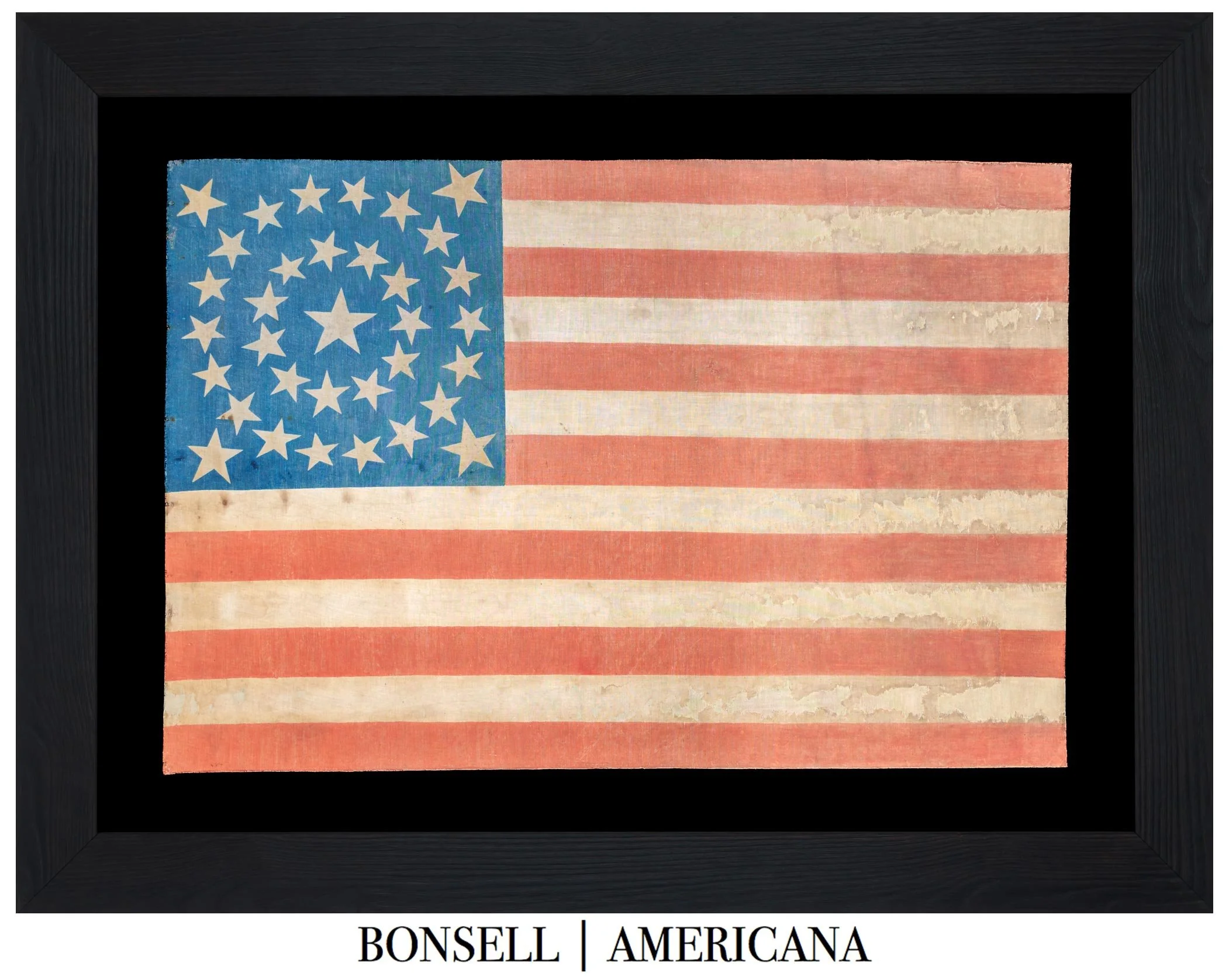
Offered is a 34-star American national flag, printed on glazed cotton and dating to the opening years of the Civil War, between 1861 and 1863.
The configuration of stars on this example is particularly noteworthy. At the center rests a single oversized star, representing Kansas, the newest state in the Union. Surrounding it is an inner wreath of eleven smaller stars, while an outer ring of eighteen stars completes the medallion configuration. Four medium-sized stars flank the design near the corners of the canton. The stars are canted in varying directions and exhibit irregular, folk-oriented geometry, lending the canton a visually animated quality.
The design possesses the sort of visual energy collectors seek in early American textiles. Rather than rigid uniformity, one finds subtle inconsistencies in star shape, orientation, and spacing that reflect the handmade aesthetic sensibilities still present in American flag production during the mid-nineteenth century. The oversized center star anchors the composition, while the rotating orientations of the surrounding stars create movement throughout the canton. We have handled many 34-star flags over the years, including numerous medallion examples, yet we have never encountered another precisely of this style. In our view, this strongly suggests a very scarce, and perhaps singular, surviving variety.
The coloration is equally appealing. The blue canton displays a strong Civil War-period blue, while the red stripes retain a warm tone characteristic of early printed pigments on glazed cotton. The surface exhibits the subtle sheen associated with glazed cotton construction, a finishing process frequently employed on mid-nineteenth century parade flags to provide visual crispness and modest resistance to dirt and moisture. The glazing remains visible across portions of the surface and contributes to the flag’s period character.
The flag survives in what is arguably the ideal scale for a Civil War-era parade flag: large enough to display boldly, yet small enough to have been intended for true patriotic use by a private citizen. Even among surviving Civil War flags, examples of this size are especially desirable.
The 34-star flag represents the admission of Kansas as the 34th state on January 29th, 1861. The official addition of the star occurred on July 4th of the same year, just months after the inauguration of Abraham Lincoln and only weeks after the outbreak of the Civil War. Because flag makers commonly anticipated official star counts, many 34-star flags were produced immediately upon Kansas statehood, prior even to the firing on Fort Sumter. The 34-star flag remained official until July 4th, 1863, when the 35-star flag entered service following the admission of West Virginia.
Among the most important and collectible of all nineteenth century American flags are 34-star and 35-star examples, which represent the primary star counts under which the Civil War was fought. Lincoln served almost his entire presidency beneath the 34-star flag, and the vast majority of the conflict’s defining events—from First Bull Run through Gettysburg—occurred while this count remained official. Flags from this era are especially coveted because patriotic display by private citizens prior to the Civil War was comparatively uncommon. Before 1861, the American flag was used principally for military and maritime identification, and most surviving examples from the antebellum era were massive garrison or ship flags intended for visibility at great distances. The explosion in small printed parade flags arose primarily from the emotional and political fervor surrounding the Civil War itself. As a result, authentic surviving parade flags of the period are both rare and historically important.
What elevates this flag further, however, is the remarkable handwritten note that accompanies it. Written on letterhead from the Commonwealth Bank of Baltimore, located at Howard and Madison Streets, the note reads:
“This flag at half mast was hung from the window of the Herring home in Baltimore when Lincoln was buried. Though Democrats they were compelled to do so.”
The significance of this statement is difficult to overstate. In nearly two decades handling and studying antique American flags, we have encountered very few notes of this nature, and none carrying quite this degree of political candor. The wording is concise and direct. Most importantly, it contains precisely the sort of socially revealing commentary one would expect from a genuine family or community remembrance rather than a later embellished story.
The phrase “Though Democrats they were compelled to do so” provides a glimpse into the divided political atmosphere that existed in Maryland during the Civil War and immediately following Lincoln’s assassination. Maryland occupied a uniquely fragile position during the conflict. Though it remained in the Union, the state contained substantial Southern sympathies, particularly among Democrats and conservative urban residents of Baltimore. Union troops had occupied Baltimore early in the war following violent unrest in 1861, and political tensions remained severe throughout the conflict.
When Lincoln was assassinated in April of 1865, the nation entered a period of public mourning. As Lincoln’s funeral train made its journey from Washington toward Springfield, Illinois, cities throughout the North and border states staged mourning observances. Buildings were draped in black crepe, church bells tolled, and flags appeared throughout urban streetscapes in public displays of grief and national unity. Baltimore, despite its divided loyalties, participated heavily in these ceremonies.
Within this context, the note becomes especially compelling. The implication is that the Herring family—identified by the writer as Democrats—displayed the flag publicly despite political sympathies that may not have aligned fully with Lincoln or the Union cause. Whether motivated by civic pressure, social expectation, fear of scrutiny, genuine mourning, or some combination thereof, the act was apparently memorable enough to be recorded decades later in handwritten form. The note preserves a revealing moment: a politically divided household navigating public expectation in one of the most emotionally charged weeks in American history.
Particularly interesting is the phrase “compelled to do so.” Such wording suggests that the display was perceived not merely as patriotic decoration, but as an act carrying political and social consequence. We have encountered Civil War flags accompanied by family stories, but never one whose associated documentation speaks so openly about political tension and reluctant public patriotism. It transforms the flag from a Civil War textile into a tangible artifact connected to the complexity surrounding Lincoln’s death and the Union victory.
Research into the Commonwealth Bank of Baltimore reveals that it was an established Baltimore institution operating by at least the 1890s, with its substantial building at Howard and Madison Streets constructed in the mid-1890s. The handwritten note, therefore, almost certainly dates to the late nineteenth or early twentieth century, placing it relatively close to the events it describes and well within the range of living memory.
An additional note accompanied the flag when acquired from Brendan Synnamon, owner of The Union Drummer Boy in Gettysburg, one of the nation’s best Civil War artifact galleries. Brendan is widely respected within the field of Civil War material culture and has spent decades handling, authenticating, and researching important artifacts related to the conflict. In addition to his work as a dealer, lecturer, and preservation advocate, Brendan has also served as an appraiser for the Antiques Roadshow. Brendan acquired the flag from the estate of longtime collector Stan Smullen, who reportedly purchased it directly from the Herring family estate.
The Herring family itself holds noteworthy historical and literary associations tied to Edgar Allan Poe. Henry Herring, a prominent Baltimore lumber dealer and the husband of Poe’s aunt, Elizabeth Poe Herring, maintained a household that Poe is known to have visited during his time in Baltimore. Historical accounts further record that Herring participated in the arrangements surrounding Poe’s death and burial in 1849, reportedly providing the coffin used for the funeral and assisting with related matters. The association with both the Herring family and the events surrounding Lincoln’s funeral procession through Baltimore adds another layer of historical interest to an already remarkable Civil War-era flag.
Regardless, the accompanying documentation remains exceptional. It is exceedingly rare to encounter a Civil War-period parade flag accompanied by a politically charged written remembrance tied specifically to the mourning ceremonies surrounding Lincoln’s assassination and funeral procession. Combined with the flag’s striking and apparently unique medallion configuration, attractive coloration, and association with one of the defining moments in American history, this example stands among the most interesting 34-star parade flags we have encountered.
Conservation Process: This flag was professionally conserved and restored. It is sewn to silk and positioned behind Optium Museum Acrylic.
Frame: The flag is presented within a hardwood frame finished in matte black with visible grain.
Condition Report: The flag was professionally conserved and restored. There is moderate to significant fading and oxidation throughout, accompanied by scattered soiling, areas of pigment loss, and restoration to the striped field, particularly within the white stripes toward the fly end. Despite this, the flag presents beautifully, with strong overall color, an especially attractive blue canton, and excellent visual impact. The unusual medallion configuration and the extraordinary accompanying note more than justify the conservation work undertaken to preserve this rare Civil War-era survivor.
Collectability Level: The Extraordinary – Museum Quality Offerings
Date of Origin: 1861-1863
Number of Stars: 34
Associated War: The Civil War (1861-1865)
Associated State: Kansas
Frame Size (H x L): 16.75” x 22”
Flag Size (H x L): 9” x 14”
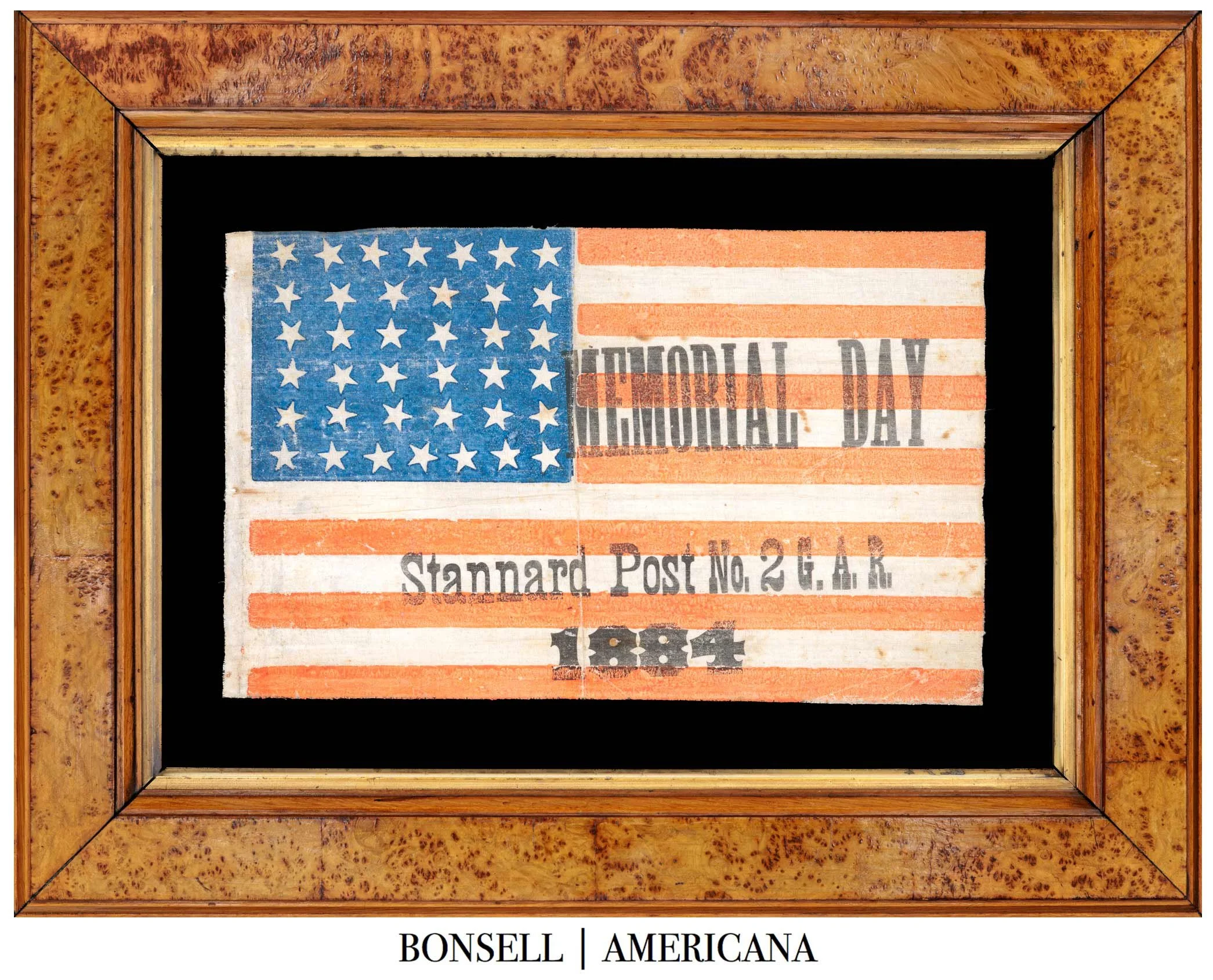
Offered is a 38-star American parade flag, printed on glazed cotton and overprinted for MEMORIAL DAY with a secondary, stamped overprint, referencing Stannard Post No. 2 of the Grand Army of the Republic (G.A.R.), dated 1884.
The canton displays a 7-6-6-6-6-7 star configuration, with stars arranged in generally linear rows and canted in varying directions, lending a lively, almost animated quality to the field. The stripes present in a particularly attractive orange-red tone, a result of period pigments and printing techniques, and provide strong visual contrast against the blue canton. Across the striped field appears the boldly applied, all-capital MEMORIAL DAY overprint, printed at a slight angle. The typography is somewhat crude, yet visually compelling, with additional text reading “Stannard Post No. 2 G.A.R.” and the date “1884,” offering the rare advantage of a clearly documented moment of use. This is the first example of this specific overprint and flag that we have encountered.
The presence of the MEMORIAL DAY overprint, combined with the identification of Stannard Post No. 2, firmly anchors this flag within the culture of Civil War remembrance. The Grand Army of the Republic, founded in 1866, was the leading fraternal organization of Union veterans, and its posts were deeply involved in the establishment and perpetuation of Memorial Day observances across the United States. These events were among the most important civic rituals of the late 19th century, involving parades, cemetery ceremonies, speeches, and the decoration of soldiers’ graves. Flags such as this were produced for precisely these occasions, often in limited quantities and for local use, which contributes to their rarity today.
Stannard Post No. 2 was located in Burlington, Vermont, and was named in honor of General George Jerrison Stannard, a Union officer best known for his leadership at the Battle of Gettysburg. The identification of a specific G.A.R. post is particularly desirable, as it ties the object to a defined community of veterans and a known geographic location. Unlike generic patriotic flags, this example was created for a specific group and event, elevating both its historical and interpretive value.
Of further interest is documentary evidence connecting the post to its membership. Period records, including the obituary of Leander W. Freeman, identify him as a member of Stannard Post No. 2. Freeman, an African American veteran who served in Company F of the 54th Massachusetts Colored Volunteers, represents an important and often underrepresented dimension of G.A.R. membership. His presence within the post underscores the degree to which African American veterans participated in these organizations and in Memorial Day observances, particularly in Northern communities. While it cannot be said that this flag was directly associated with Freeman himself, the documented connection between the post and one of its members adds a meaningful layer of human context and historical depth.
The 38 stars on this flag represent Colorado’s admission to the Union on August 1st, 1876. Known as the “Centennial State,” Colorado achieved statehood just 28 days after the nation’s 100th anniversary. Although the 38-star flag did not become official until July 4th, 1877, it remained in use through July 3rd, 1890, spanning a period of westward expansion, industrial growth, and national consolidation following the Civil War. By the date of this flag’s overprint—1884—the star count was fully official and widely produced, placing this example firmly within its proper historical context rather than among earlier anticipatory issues made for the Centennial.
The printing method and material further support an 1880s date. The use of glazed cotton, along with printed application of color, is consistent with parade flags of the period. The slightly irregular saturation of the pigments, especially in the stripes, contributes to the warm, almost burnished appearance that clients find particularly appealing. The overprint reflects the practical realities of such commemorative objects—standard flags customized for local events through secondary application.
Flags with specific Memorial Day overprints tied to named G.A.R. posts are rare, particularly those bearing a clear and early date. The combination of a desirable 38-star count, strong visual presentation, documented year of use, and direct association with a Grand Army post in Burlington makes this an especially compelling example. It stands not only as a patriotic object, but as a tangible artifact of post-war remembrance, community and identity.
Conservation Process: This flag was hand sewn to cotton fabric, and both were hand sewn to a mounting board. To prevent the black dye in the cotton fabric from seeping into the flag, it was first washed in a standard wash and then in a dye setting wash. The flag is positioned behind Optium Museum Acrylic.
Frame: The flag is housed in a handsome antique frame of birdseye maple, displaying dense, highly figured grain with warm, honeyed tones typical of 19th-century examples, likely dating to the mid- to late-1800s. A narrow gilded liner provides a refined inner border. The surface exhibits a naturally aged patina consistent with its period, enhancing its depth and character.
Condition Report: The flag shows moderate overall wear consistent with age and use, including scattered foxing, minor staining, and areas of pigment loss, particularly within the overprint and along the stripes. There is a vertical fold line through the center with associated light fabric breakdown, accompanied by minor fraying and edge wear along the perimeter. Despite these condition issues, the fabric remains stable, with strong visual presentation and legibility of both the star field and the MEMORIAL DAY overprint.
Collectability Level: The Great – Perfect for Rising Collectors
Date of Origin: 1884
Number of Stars: 38
Associated War: The Indian Wars (1860-1890)
Associated State: Colorado
Frame Size (H x L): 32” x 37.75”
Broadside Size (H x L): 21” x 26.75”
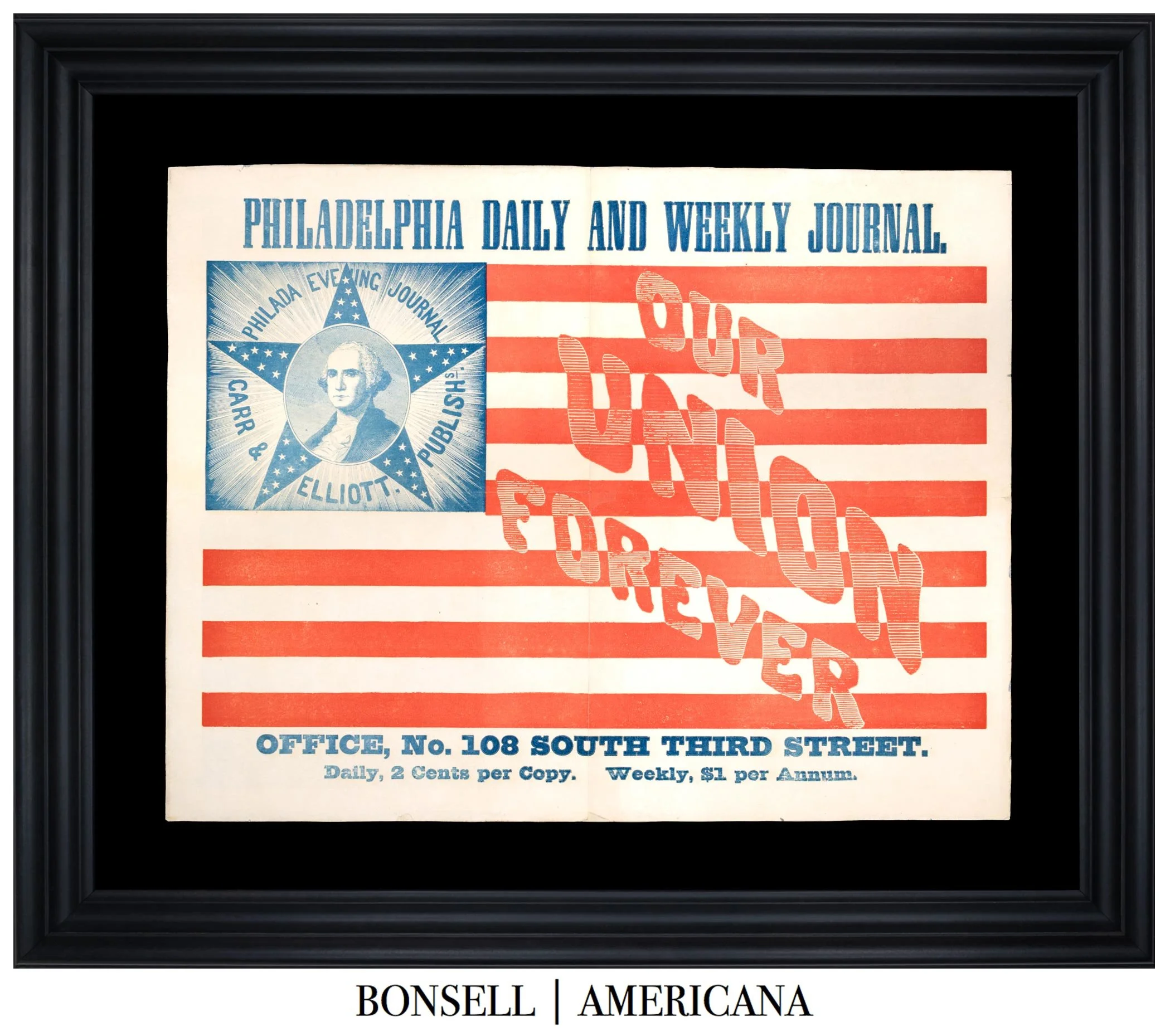
Offered is a Civil War–period advertising broadside for the Philadelphia Daily and Weekly Journal, printed in red and blue and designed in the form of an American flag. Produced in Philadelphia, Pennsylvania, circa 1861–1862, the sheet promotes the newspaper published by Carr & Elliott, whose office was located at No. 108 South Third Street. Combining patriotic imagery with commercial promotion, the broadside reflects the powerful role newspapers played in shaping public sentiment during the opening years of the American Civil War.
The broadside is printed on a single sheet and arranged as a stylized American flag. Across the upper portion appears the title “PHILADELPHIA DAILY AND WEEKLY JOURNAL.” Beneath this heading the design transitions into the striped field of the flag, printed in bold red bands. Running diagonally across the stripes in large block lettering is the emphatic slogan “OUR UNION FOREVER.” At the bottom of the sheet appears the imprint identifying the newspaper’s location and subscription terms: “OFFICE, No. 108 SOUTH THIRD STREET.” The cost of the publication is also clearly stated: “Daily, 2 Cents per Copy. Weekly, $1 per Annum.” These details underscore the dual purpose of the sheet as both patriotic display and newspaper advertisement.
The canton occupies the upper left portion of the design and contains one of the most visually compelling elements of the broadside. Within the blue field appears a portrait of George Washington, framed within the outline of a large star. Washington’s likeness is rendered in a circular medallion at the center of the device, surrounded by radiating lines that draw attention to the image. Around the portrait appears the text “PHILADA EVENING JOURNAL” and “CARR & ELLIOTT PUBLISHES,” directly associating the revered figure of the nation’s founding with the newspaper being advertised. The use of Washington in this context is deliberate and symbolic. During the Civil War, Washington’s image served as a reminder of the founding of the United States and of the struggle to preserve the Union he helped create.
Within the large star that frames the portrait are 34 smaller stars, representing the official 34-star count of the United States flag. The 34-star flag corresponds to the admission of Kansas as the 34th state on January 29, 1861. This star count became the official national flag on July 4, 1861 and remained in effect until July 3, 1863. In this design, the smaller stars are arranged within the outline of the larger star, which functions as a decorative framing device rather than an additional star in the count. The arrangement creates a visually striking canton while preserving the historically accurate star count associated with the early war period.
The newspaper promoted by the broadside was published by Carr & Elliott, a Philadelphia partnership active during the early years of the Civil War. Their paper, the Philadelphia Evening Journal, was part of a vibrant and competitive newspaper culture in the city. Philadelphia was one of the most important publishing centers in the United States during the nineteenth century, and its newspapers played a central role in shaping public opinion. Papers such as the Philadelphia Evening Journal provided daily coverage of the war while simultaneously promoting strong Unionist sentiment among readers.
The address listed on the broadside—108 South Third Street—places the newspaper within the historic commercial district of Philadelphia, only a short distance from Independence Hall and other landmarks associated with the founding of the United States. During the mid-nineteenth century this area was home to numerous printers, publishers, and booksellers. The location situates Carr & Elliott within the long-standing printing and publishing tradition of the city.
The slogan “OUR UNION FOREVER” is one of the most significant elements of the design. Appearing boldly across the stripes of the flag, the phrase encapsulates the central political and emotional message of the Union cause during the American Civil War. In the months following the outbreak of hostilities in 1861, Northern printers, publishers, and artists produced a wide range of patriotic imagery emphasizing the preservation of the United States. Slogans invoking the permanence of the Union were especially common, serving both as expressions of loyalty and as tools for rallying public support for the war effort. By integrating this phrase directly into the flag design, the broadside transforms the newspaper advertisement into a statement of national unity and resolve.
The visual strategy employed here reflects a broader pattern in Civil War graphic culture. Printers frequently combined patriotic imagery with commercial or informational content, creating designs that were both decorative and persuasive. In this example, the American flag serves as the organizing structure for the entire composition, while the slogan, portrait, and newspaper information are integrated seamlessly into the design. The result is a piece that would have functioned effectively both as an advertisement and as a patriotic display suitable for posting in a public space.
Institutional records place the broadside within the broader category of Civil War printed ephemera. An example is documented in the collection of the Library Company of Philadelphia, one of the nation’s most important repositories for early American printing and Civil War graphics. The recorded example was originally preserved in a Civil War scrapbook compiled by John A. McAllister, whose extensive collection of wartime prints and ephemera forms an important historical archive of the period.
Broadsides of this type occupy an important place in the history of American printing. Unlike bound publications, broadsides were typically produced for immediate display or distribution and were often discarded once their immediate purpose had passed. Surviving examples therefore provide valuable insight into the visual and political culture of their time. This example is especially notable for its strong graphic design, its integration of patriotic symbolism with newspaper advertising, and its clear association with the early years of the Civil War.
Taken together, the elements of the design—the American flag format, the 34-star canton, the portrait of Washington, and the bold proclamation “OUR UNION FOREVER”—create a powerful visual statement reflecting the atmosphere of the Union states during the opening phase of the Civil War. At the same time, the inclusion of the newspaper’s name, address, and subscription terms reminds us that this striking patriotic image also served a practical purpose: promoting the circulation of a Philadelphia newspaper during one of the most consequential periods in American history.
Frame: The frame is a deep-profile moulding with a simple, classical profile, finished in a dark cocoa-brown tone.
Condition: The broadside has been professionally conserved by a paper conservator and presents well overall. The sheet shows a vertical center fold, with additional light handling creases consistent with age and original distribution. There is minor scattered toning and a few small areas of edge wear, along with subtle surface irregularities typical of nineteenth-century paper broadsides. Overall, the colors remain strong and the piece displays attractively.
Collectability Level: The Best – Perfect for Advanced Collectors
Date of Origin: 1861-1862
Price: Call 618-553-2291, or email info@bonsellamericana.com
Frame Size (H x L): 38” x 53”
Flag Size (H x L): 26 ¾” x 41 ¾”
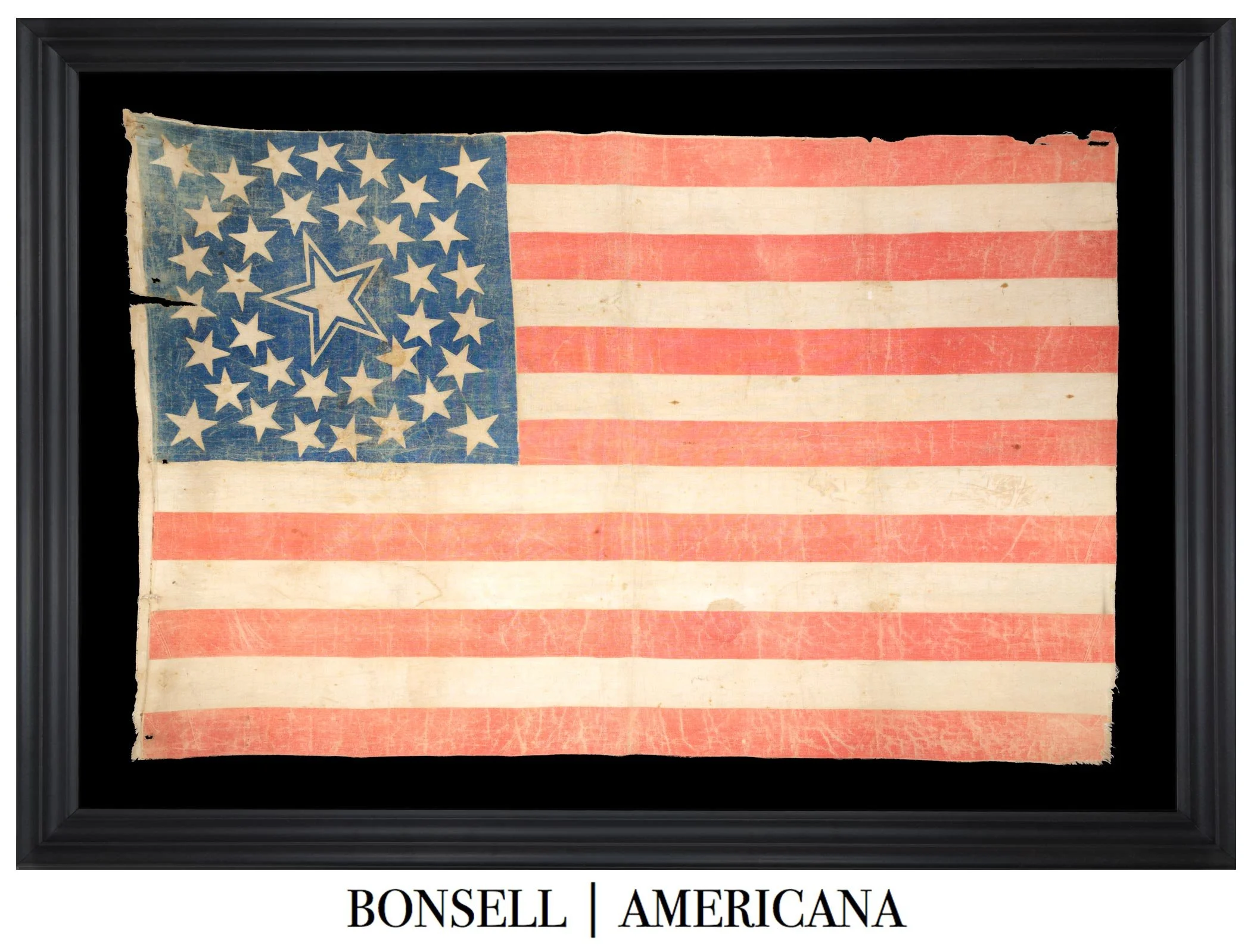
Offered is a remarkable 36-star American national flag, printed on coarse, glazed cotton, and dating to the immediate post–Civil War period. This unusually large example features one of the most visually sophisticated star configurations of the nineteenth century: a medallion pattern centered by a boldly rendered, haloed star. The flag is further distinguished by its generous scale, its striking color palette, and an extraordinary body of accompanying documentation tracing its descent within a Union household directly involved in both military and humanitarian service during the Civil War.
Flags of this quality, scale, and documentation are rare. Taken together, the object and its provenance present a compelling artifact of Union victory, postwar remembrance, and nineteenth-century American civic life.
STAR COUNT, CONFIGURATION, AND SCALE
The flag bears 36 stars, representing the admission of Nevada as the 36th state. The stars are arranged in a classic medallion configuration, one of the most visually dynamic and carefully considered layouts employed by nineteenth-century flag makers.
At the center of the canton lies a large, canted star, boldly outlined and visually dominant. This central device is encircled by concentric rings of smaller stars, forming a balanced and deliberate composition. Completing the design are additional stars positioned to fill the remaining field, creating a sense of motion and cohesion that distinguishes medallion patterns from later, rectilinear layouts.
Of particular note is the haloed treatment of the center star. Within the large central star appears a secondary, smaller star enclosed by a faint outline, producing a layered, dimensional effect. Haloed stars of this type are scarce and appear to be the hallmark of a single, as yet unidentified, nineteenth-century manufacturer. Surviving examples of haloed center star flags are known across several star counts — including 30-star, 34-star, 35-star, 36-star, and 42-star examples — but they remain uncommon in all forms, particularly in large formats such as this.
This flag is a large example within the category of haloed medallion flags, exceeding the dimensions of most comparable examples we have handled. Its scale amplifies the visual impact of the star configuration, allowing the central device and surrounding rings to read clearly and forcefully from a distance. Large medallion flags were well suited to prominent display — whether in public settings, civic gatherings, or significant domestic interiors — and their survival rate is markedly lower than that of smaller parade or hand-held flags.
CONSTRUCTION, MATERIALS, AND COLOR
The flag is printed on coarse, glazed cotton, a textile commonly employed for nineteenth-century civilian and ceremonial flags. The glaze provided a modest sheen and helped stiffen the fabric, allowing printed imagery to register crisply while remaining lightweight.
The stars and stripes were applied through a stamping or printing process, rather than appliqué. This method allowed for efficient production while still accommodating creative freedom in star arrangement — a freedom that flag makers would gradually abandon as industrial standardization increased toward the end of the century. Printed cotton flags of this type were distinct from wool bunting flags, which were more commonly produced for naval and military use. Cotton examples were intended for patriotic display, political events, commemorations, and domestic settings.
The canton presents as a muted, slate-blue field, while the red stripes have mellowed to a warm salmon-to-orange hue. This coloration is characteristic of mid-nineteenth-century dye chemistry and long-term oxidation. During this period, red dyes were most commonly derived from madder root and cochineal, both of which could produce a range of tones depending on concentration, mordants, and exposure to light. Over time, these dyes often shift away from deep crimson toward softer, warmer hues, lending early flags a distinctive and highly valued patina.
THE 36-STAR FLAG IN HISTORICAL CONTEXT
Nevada was admitted to the Union on October 31, 1864, in the midst of the Civil War. As was customary, however, the official adoption of a new star count did not occur until the following July 4, 1865, meaning that 36-star flags became official several months after the conclusion of hostilities.
As such, the 36-star flag occupies a unique position in American history. It was the first official national flag of the postwar United States and remained in use throughout the early years of Reconstruction, until July 4, 1867, when the 37-star flag was introduced to mark Nebraska’s statehood.
Nevada’s admission itself was politically and economically significant. Despite its small population, the territory’s vast mineral wealth — most notably the Comstock Lode — played a critical role in financing the Union war effort. President Abraham Lincoln and congressional Republicans also recognized the strategic value of Nevada’s electoral votes during the pivotal 1864 election. In an extraordinary technological feat, Nevada’s entire state constitution was transmitted by telegraph to Washington, D.C., enabling rapid admission.
Flags bearing 36 stars thus became potent symbols of Union preservation, victory, and national continuity at the moment when the country sought to define itself anew.
FAMILY NOTE, PROVENANCE, AND DOCUMENTATION
Accompanying the flag is an extensive written note provided by a direct descendant, outlining the family history of Elon Nelson Lee, a Union veteran in whose household the flag was preserved. According to the family account, the flag was passed from Lee to later generations and remained within the family well into the twentieth century. In the early 1950s, it was given by Lee’s granddaughter to her daughter and stored wrapped in tissue in a drawer at the base of a bookcase, where it remained carefully preserved until it was ultimately passed down again.
What distinguishes this note is not sentiment alone, but its remarkable consistency with a wide body of independent documentation, including military records, university publications, genealogical society material, and published county histories. The family narrative aligns precisely with known service dates, locations, and postwar life events, elevating it from anecdotal history to credible provenance.
The flag descends in the family of Elon Nelson Lee (1840–1938), whose life and service are documented across multiple independent sources, including Grand Army of the Republic records; regimental rosters for the 10th Wisconsin Infantry and the 134th Illinois Infantry; University of Chicago student and alumni publications; fraternity and alumni records (The Shield); county and genealogical histories from Wisconsin and Iowa; and family letters, diaries, and typed transcriptions. Few privately held American flags are accompanied by such a broad and internally consistent documentary record.
ELON NELSON LEE: SERVICE, EDUCATION, AND CIVIC LIFE
Elon Nelson Lee enlisted twice in the Union Army. His first enlistment was in Company A, 10th Wisconsin Infantry, a regiment that saw service in the Western Theater. During this term, Lee fell seriously ill while stationed in Kentucky and was ultimately discharged in 1862. Though officially diagnosed with tuberculosis of the lungs, later family accounts suggest pneumonia resulting from measles as the more likely cause.
In 1864, while attending the University of Chicago, Lee joined fellow students and faculty in enlisting for a second term of service. He entered Company G, 134th Illinois Infantry, a 100-day regiment raised for rear-area security and logistical duties, freeing veteran troops for frontline service. Lee was discharged later that year in Elizabethtown, Kentucky. While not associated with major battlefield engagements, his service reflects the broader reality of Union military life in the Western Theater, where disease, supply operations, and occupation duties were as consequential as combat.
Lee returned to the University of Chicago following his wartime service and completed his studies, earning the degree of S.B. (Bachelor of Science) with the Class of 1868, reflecting period academic conventions. In civilian life, he became a school superintendent, farmer, and lumber dealer, ultimately residing in Webster City, Iowa. His professional trajectory reflects the civic engagement and upward mobility characteristic of many educated Union veterans during the Reconstruction and post-Reconstruction eras.
An extraordinary dimension of this flag’s history lies in the documented wartime service of Lee’s mother, Mary Elizabeth Lee. Published county histories and genealogical records confirm that she traveled south in 1862 to care for her ailing son in Kentucky. Witnessing widespread suffering among wounded and sick soldiers, she became actively involved in sanitary aid and hospital service, working in Louisville, Danville, Nashville, and Murfreesboro. Her efforts were supported by credentials and letters from state officials and the Chicago Sanitary Aid Society, situating the Lee household as active participants in the Union war effort on both military and civilian fronts.
A FLAG OF UNION MEMORY AND CONTINUITY
This 36-star flag should be understood not as a battlefield relic, but as a postwar emblem of Union victory and remembrance, preserved within a household that had lived the war intimately. Its medallion configuration, haloed center star, large scale, and warm coloration reflect the artistic freedom of nineteenth-century flag making at its height.
Its survival, coupled with exceptional documentation, offers a rare opportunity to study an object that bridges the lived experience of the Civil War with the national identity forged in its aftermath. Few flags encapsulate this transition as completely or as credibly as this example.
Conservation Process: The flag was hand sewn to a cotton fabric backing, which was then hand sewn to a mounting board. To prevent dye migration from the black cotton, the fabric was pre-washed and treated with a dye-setting wash prior to mounting. The flag is displayed behind Optium Museum Acrylic.
Frame: The frame is a deep-profile moulding with a simple, classical profile, finished in a dark cocoa-brown tone. Its broad face provides visual support without ornament, allowing the flag to remain the primary focus. The subdued finish is well suited to the display of nineteenth-century textiles.
Condition Report: The flag presents in very attractive, honest condition, with strong overall eye appeal. There is expected age-related wear, including scattered staining, minor fabric losses along the hoist and edges, and areas of surface abrasion consistent with nineteenth-century glazed cotton flags that saw use and long-term storage. The canton retains good visual integrity, with the haloed center star remaining crisp and legible despite light wear and toning. The stripes exhibit pleasing oxidation and mellowed coloration, contributing to a warm, balanced presentation that enhances the flag’s historic character rather than detracting from it.
Collectability Level: The Extraordinary – Museum Quality Offerings
Date of Origin: 1864-1867
Number of Stars: 36
Associated War: Civil War (1861-1865)
Associated State: Nevada
Additional Research Materials
The historical account presented here derives from extensive family documentation provided by a direct descendant of Elon Nelson Lee. While the underlying letters, diaries, and related writings remain in the possession of the family, their existence and content are well documented. For reasons of privacy, the family member’s name is not published; however, it is retained on file. Should a future owner wish to pursue further research, we would be pleased to facilitate an introduction, at the family’s discretion.
Frame Size (H x L): 12” x 15”
Flag Size (H x L): 6” x 9”
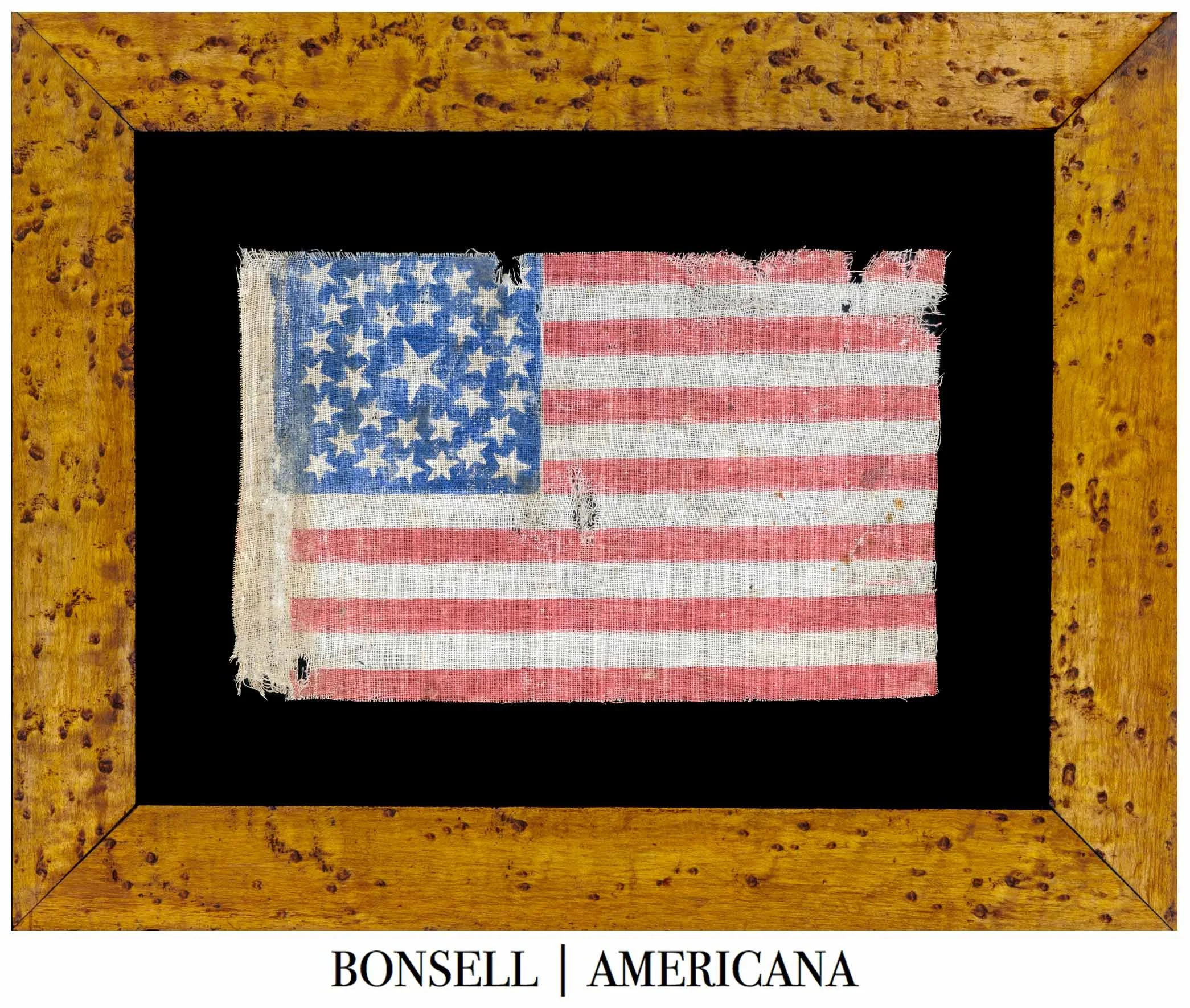
Offered is a 33-star American national flag, printed on glazed cotton and executed in a highly distinctive medallion-style star configuration. At the center of the canton is a single, oversized “center star,” canted to approximately the 11:00 position. This center star is widely understood to represent the most recently admitted state—Oregon in the case of the 33-star flag. Surrounding the center star are two concentric rings of smaller stars, with four additional stars positioned in the corners of the canton, completing the design.
The stars are notably pointy and irregular in form, lending the flag a distinctly folksy, hand-rendered appearance. They are tightly packed within the canton, a visual characteristic emblematic of a small and well-recognized family of mid-19th-century printed flags. Although the maker of this example remains unidentified, the star shapes, spacing, and overall layout are consistent across a limited group of flags known to have originated from the same workshop.
This workshop is documented to have produced flags in 6 different star counts, all sharing the same stylistic vocabulary: 7-star, 13-star, 15-star, 29-star, 33-star, and 35-star examples. Each star count corresponds to a specific historical or commemorative purpose. Flags with 7 stars acknowledged the first seven states to secede from the Union; 13-star flags referenced the original colonies; 15-star flags commemorated Kentucky’s centennial; and the 29-star, 33-star, and 35-star flags celebrated the admission of Iowa, Oregon, and West Virginia, respectively. The recurrence of this design across multiple star counts suggests a commercially oriented maker responding quickly to current events and prevailing public sentiment.
The 33-star flag represents the admission of Oregon, which became the 33rd state on February 14, 1859. In accordance with federal law, the star count was updated on the following Independence Day, making July 4, 1859, the official beginning of the 33-star flag’s period of use. It remained the official national flag until July 4, 1861, when the 34-star flag—reflecting the admission of Kansas—was formally adopted.
The historical timing of the 33-star flag is particularly significant. Its official period of use overlaps directly with the secession crisis and the opening months of the Civil War. At the time the 33-star flag became official, multiple Southern states had already left the Union, yet no stars were ever removed from the flag. As a result, the 33-star flag represents a Union that was legally intact but politically fractured—an important and meaningful distinction for collectors.
This association is underscored by a notable historical reference: a 33-star flag was flying at Fort Sumter when Confederate forces launched their attack in April of 1861. Because of this, the 33-star flag is among the earliest star counts directly tied to the Civil War and is often regarded as a visual symbol of the nation on the brink of armed conflict.
Although the 33-star flag was officially replaced in July of 1861, it continued to be used well into the Civil War. Wartime supply constraints meant that existing flags remained in service, and manufacturers did not immediately discard earlier printing blocks or designs. As a result, 33-star flags are documented in both pre-war and early-war contexts, adding to their historical depth and complexity.
From a broader collecting perspective, flags from the Civil War era are among the most sought-after of all antique American flags. Prior to the late 1850s, flags were not commonly displayed by civilians for patriotic purposes, and even military use was relatively limited. Earlier flags were typically produced for maritime identification and were often very large in scale. The mass production of smaller, affordable flags—intended for rallies, political events, and personal display—emerged with the election of Abraham Lincoln and accelerated rapidly with the onset of the Civil War. The 33-star flag sits squarely at the beginning of this transformation.
Taken as a whole, the 33-star flag occupies a uniquely compelling position in the history of American national flags. It represents the Union at a moment of profound tension—legally whole, yet politically fractured—while also marking the transition from large, utilitarian flags to smaller examples made expressly for public display and personal expression. Combined with its association with the opening chapter of the Civil War, its relatively brief official lifespan, and the bold medallion-style configuration seen here, the 33-star flag stands among the most historically resonant and visually distinctive star counts available to collectors today.
Conservation Process: This flag was hand sewn to cotton fabric, and both were hand sewn to a mounting board. To prevent the black dye in the cotton fabric from seeping into the flag, it was first washed in a standard wash and then in a dye setting wash. The flag is positioned behind Optium Museum Acrylic.
Frame: The flag is housed in a solid birdseye maple frame, chosen for its warm tone and distinctive figured grain. Its restrained profile provides a clean, complementary presentation without distracting from the flag itself.
Condition Report: The flag presents with expected wear consistent with age and use, including overall fabric softening, light surface soiling, and moderate fraying along the edges. There is a small area of fabric loss and a short vertical tear within the striped field, accompanied by scattered minor holes and thread loss elsewhere. Despite these condition issues, the flag remains stable, visually compelling, and well suited for display.
Collectability Level: The Great – Perfect for Rising Collectors
Date of Origin: 1859-1861
Number of Stars: 33
Associated War: Pre-Civil War
Associated State: Oregon
Price: Call 618-553-2291, or email info@bonsellamericana.com
Frame Size (H x L): 20.5” x 26.5”
Flag Size (H x L): 11.5” x 17.5”
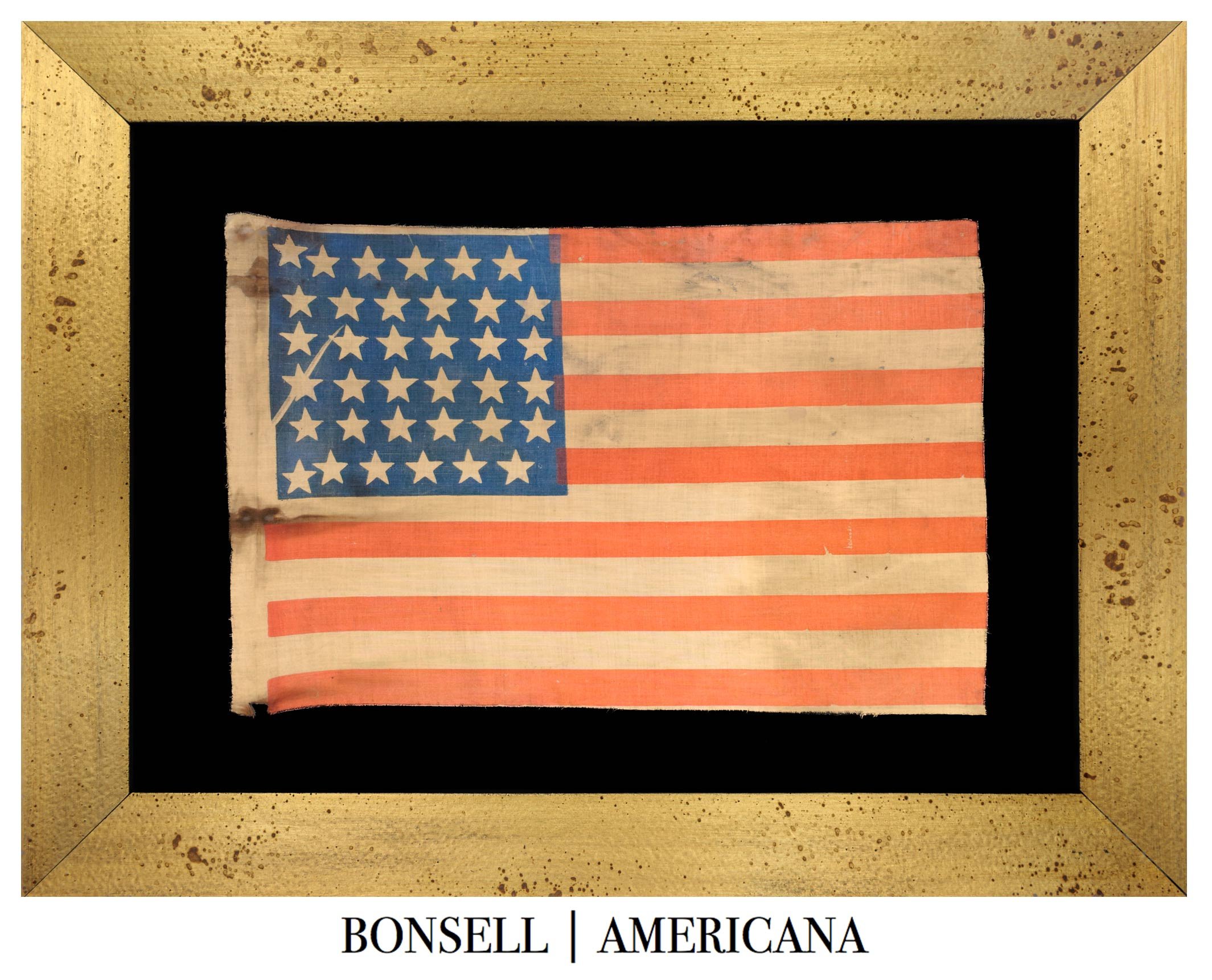
Offered is a scarce and historically resonant 36-star American parade flag, dating to the final years of the Civil War and the opening phase of Reconstruction, circa 1864–1867. Printed on cotton for public display, this flag reflects both the urgency of wartime patriotism and the latitude that 19th-century Americans exercised in interpreting and reshaping national symbols.
The canton bears a linear arrangement of stars framing three sides, creating a pronounced open-sided form that can reasonably be read as a visual reference to the Union itself. During the Civil War, the concept of Union was not merely political but existential, and visual shorthand for unity appears across a wide range of patriotic objects—from banners and badges to textiles and printed ephemera. Flags such as this one demonstrate how star placement, rather than being strictly ornamental, could be used to convey allegiance and resolve at a glance.
This configuration also places the flag within a small but documented family of beehive-related star patterns. When rotated ninety degrees, the linear stacking of stars closely resembles a beehive arrangement, aligning it conceptually with known 38-star and 42-star beehive flags produced later in the 19th century. In those examples, the beehive form is more explicit, but the underlying visual logic—organized, collective structure built from individual units—is consistent. The beehive was a long-established symbol in American civic and fraternal culture, representing industry, cooperation, and collective strength, themes that carried particular relevance during the war and the nation’s subsequent rebuilding.
From a manufacturing perspective, the flag illustrates the adaptive practices of mid-19th-century commercial flag-makers. Small parade flags were typically block-printed, using carved wooden forms designed for repeated use. As new states were admitted to the Union in quick succession, it was common for makers to modify existing blocks rather than commission entirely new carvings. In this case, the layout strongly suggests derivation from a 34-star pattern, with two stars added at the upper and lower corners of the hoist end to bring the count to thirty-six. The resulting design balances expediency with intentionality, combining practical production decisions with visually meaningful outcomes.
Several technical characteristics further distinguish the flag. The white ground appears to have been printed with white pigment prior to the application of color, a step that would have brightened the fabric and improved color adhesion. Additionally, the flag was printed on both sides, an uncommon feature among parade flags, which were more often printed on one side only, relying on pigment bleed-through to create a usable reverse. This added effort suggests an intent to produce a more visually finished object for display.
The thirty-six stars commemorate the admission of Nevada to the Union on October 31, 1864. Nevada’s statehood was driven by wartime necessity as much as geography. Its rapid admission was designed to reinforce support for President Abraham Lincoln during the 1864 election and to strengthen Republican influence in Congress. Equally significant were Nevada’s vast silver deposits, which were viewed as essential to sustaining Union finances during the war and addressing the immense fiscal demands that followed.
Although Nevada entered the Union in 1864, the 36-star flag did not become official until July 4, 1865, in accordance with federal flag protocol that delayed star additions until the first Independence Day following a state’s admission. As a result, the 36-star flag flew during the immediate postwar moment, when the nation was grappling with reunification, demobilization, and the early stages of Reconstruction. It remained the official flag of the United States until July 3, 1867, when it was superseded by the 37-star flag following Nebraska’s statehood. During this brief but consequential period, the 36-star flag served as a national emblem of a Union preserved at extraordinary cost.
In total, this flag stands as a rare convergence of symbolic design, adaptive manufacture, and historical timing. Its distinctive star arrangement, relationship to known beehive-pattern flags, and close association with the Civil War and its aftermath distinguish it as an intellectually engaging and historically significant example of American patriotic textiles.
Conservation Process: The flag was hand sewn to cotton fabric, and both were hand sewn to a mounting board. To prevent the black dye in the cotton fabric from seeping into the flag, it was first washed in a standard wash and then in a dye setting wash. The flag is positioned behind Optium Museum Acrylic.
Frame: The flag is housed in a wide, sloped molding with an aged gold surface, intentionally distressed to evoke the appearance of early gilded frames. The profile is substantial without being heavy, providing visual weight that complements the period character of the flag while maintaining a clean, restrained presentation.
Condition Report: The flag presents in sound, stable condition for its age, with expected wear consistent with mid-19th-century parade flags. There is moderate staining and discoloration along the hoist end, accompanied by scattered areas of minor pigment loss and surface abrasion throughout, most notably within the canton and along the stripes. The fabric remains intact overall, with light fraying at the edges and no major structural losses, allowing the flag to display well while retaining clear evidence of period use and age.
Collectability Level: The Best – Perfect for Advanced Collectors
Date of Origin: 1864-1867
Number of Stars: 36
Associated War: Civil War (1861-1865)
Associated State: Nevada
Price: Call 618-553-2291, or email info@bonsellamericana.com
Frame Size (H x L): 32” x 41”
Flag Size (H x L): 21” x 30”
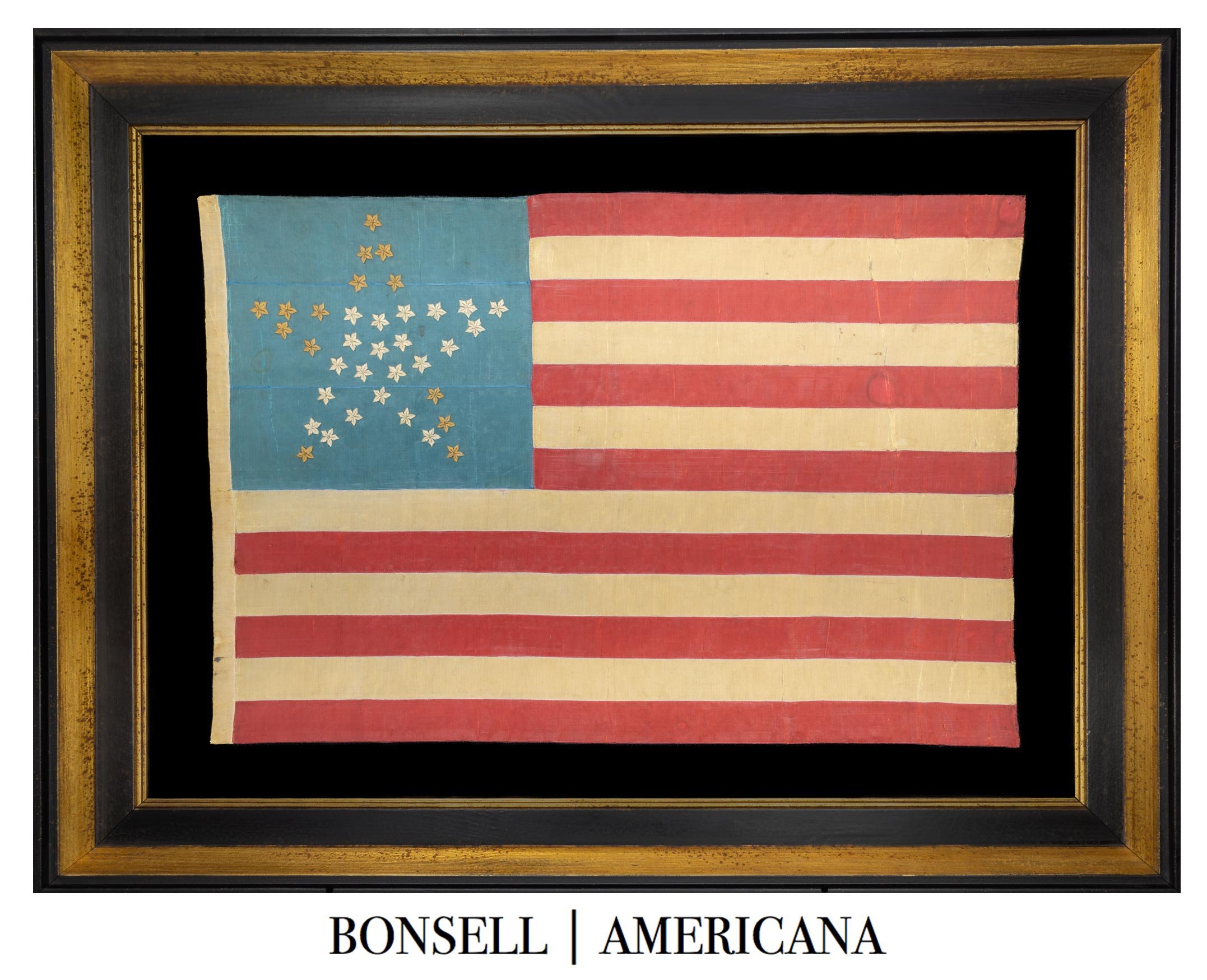
Offered is a thirty-six star parade flag, which is unquestionably one of our favorite offerings to date. The stripes of this flag are made of individual strips of red and white silk, the canton is made of three strips of blue silk, and the hoist is made of a strip of white silk. Each star is hand embroidered, fourteen of which are embroidered with gold string and twenty-two of which are embroidered with white string. Each star includes five split petals and a center portion. The entire flag is hand sewn with gorgeous, precision-like stitches.
The inclusion of both gold and white stars is a trait that we had never previously encountered before discovering this flag. This contrast may be an indication that this flag was made with whatever materials were available to the maker. This is likely the case, given that this flag was made during the Civil War. Alternatively, the inclusion of gold and white stars may have some kind of symbolism. For example, the maker may have intended that the white stars represent the Northern States, while the gold stars represent the eleven Southern States plus three additional states that the maker viewed as having southern sympathies. Regardless of the reason for having both gold and white stars, this is an extremely rare feature.
This flag is small in size for a piece-and-sewn flag, dating to the Civil War. This adds considerably to its appeal, as it can be easily displayed. It was not until the Civil War that small piece-and-sewn flags were made with any frequency at all, and not until the 1890s that they were made with regularity. During most of the 19th century, flags made with piece-and-sewn construction had a width of at least eight feet, as they were typically used as signaling devices for the military or by sailors. Even the flags that were used for decorative purposes usually had a width of six feet or more, and versions smaller than this were quite rare.
This flag is not made of weighted silk, unlike many of its Civil War era counterparts. Silk was originally sold by length and width, but in the early 19th century, it was sold by the pound. For this reason, many silk manufacturers began dipping and weighting their silk with mineral salts. And while this increased profits, mineral salts slowly damage silk and many significant antique flags have thus been lost as a result of this practice. Fortunately, this flag was not made of weighted silk, hence its good condition for its age and construction.
The stars on this flag are arranged in a "Great Star" pattern, one of the rarest and most beautiful patterns encountered in antique flags. The Great Star pattern is a large star made of smaller stars. The smaller stars may be a variety of sizes, and may be canted in a various directions. Such a pattern was perfectly acceptable, as prior to President Taft's Executive Order 1556 in 1912, flag makers were free to place the stars however they wished.
US Naval Captain Samuel Reid is credited with designing the Great Star pattern in 1818. Captain Reid was an officer in the US Navy and commanded the privateer General Armstrong during the War of 1812. Andrew Jackson credited Captain Reid's heroism in delaying the British Squadron in the Battle of Fayal, and aiding in General Jackson's defense of New Orleans. Captain Reid and his crew were greeted as heroes.
The Second Flag Act, passed in 1794, stated that the flag would have fifteen stars and fifteen stripes, in response to Vermont and Kentucky being added to the Union. Knowing that this approach would not be sustainable, with Captain Reid's help, Congress passed the Flag Act of 1818, specifying that the flag should only have thirteen stripes, but should have a star for each state admitted to the Union. It further specified that the addition of each star should be on the Fourth of July following its respective state's admission.
Captain Reid played a significant role in the Flag Act of 1818, and recommended a basic design of thirteen horizontal alternating stripes in honor of the thirteen colonies, and a star in honor of each state. He further recommended several potential star patterns, including twenty stars in the shape of a larger star for general use. Reid suggested this pattern to make the flag consistent and easily identifiable, particularly at long distances and at sea. His star pattern recommendation was not ultimately included in the Act, nor was any star pattern, but Captain Reid is universally credited with designing the Great Star pattern. Its use peaked in the 1840s, but it was also used during the Civil War and occasionally during Centennial Celebrations. Its last known commercial use was on a thirty-eight star flag.
The thirty-six star flag represents the inclusion of Nevada to the Union. Nevada was admitted on October 31st, 1864, and this flag became official on July 4th, 1865. Nevada was originally part of the Utah Territory beginning in 1850, became its own territory in 1861, and became its own state in 1864. The timing of Nevada's inclusion was politically and economically based. For political reasons, Nevada was admitted to the Union just eight days prior to President Lincoln's re-election bid against General George McClellan. Such timing was meant to benefit Lincoln and his fellow Republicans. For economic reasons, Nevada was included as part of the Union to help it pay off the country’s war debts. Economically, Nevada was particularly attractive at the time, because of its significant silver mining industry. Nevada expanded its borders in 1866 when the western Utah Territory was added to its eastern side, and further expanded in 1867 when a portion Pah-Ute County in the Arizona Territory was added to its southern side.
The thirty-six star flag was the official flag for the last six months of the Civil War, and was used by the military during that time. It was also the official flag during a portion of the Reconstruction era. Ultimately, the thirty-six star flag was official until July 4th, 1867, the time at which the thirty-seven star flag became official and began to represent the inclusion of Nebraska in the Union.
Conservation Process: This flag was professionally conserved. It is sewn to silk and positioned behind Conservation Clear Acrylic (standard) or behind Optium Museum Acrylic (per request).
Frame: This offering is in our Large Distressed Black and Gold Frame.
Condition Report: This flag exhibits a few minor tears, most notably along the top of the hoist and along the top of the red stripe along the hoist. It does have some minor stains, as shown in the pictures. Despite these flaws, this flag is a true survivor and one of the best Civil War flags to ever surface.
Collectability Level: The Extraordinary – Museum Quality Offerings
Date of Origin: 1864-1867
Number of Stars: 36
Associated War: Civil War (1861-1865)
Associated State: Nevada
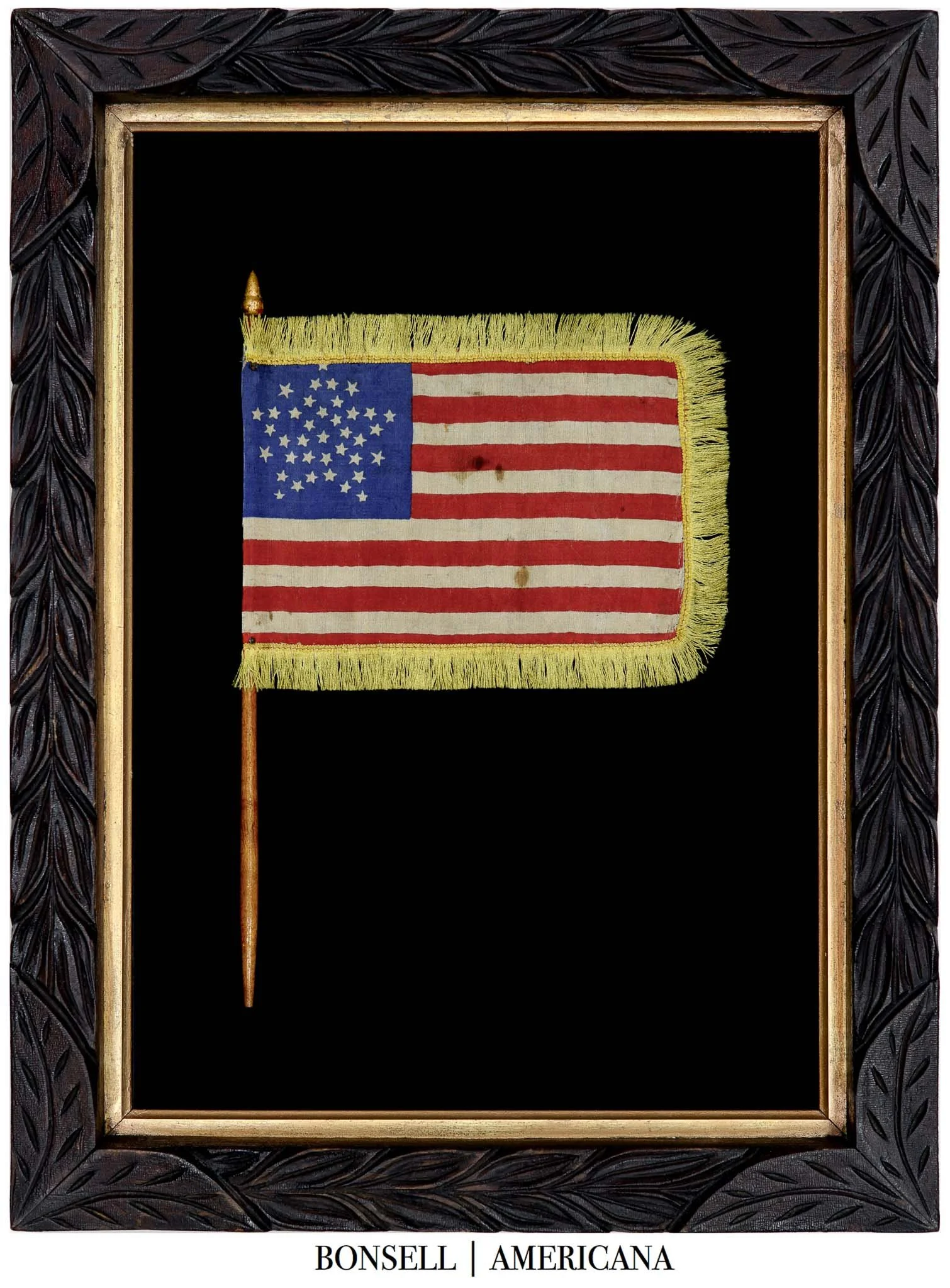
Price: Call 618-553-2291, or email info@bonsellamericana.com
Frame Size (H x L): 16.75” x 12.75”
Flag Size (H x L): 5.5” x 6.75” and Affixed to a 10.5” Staff
Offered is a 38-star American parade flag, printed on fine silk, bordered on three sides with gold fringe, and mounted to its original turned-wood staff with a smooth finish, gilt spear finial, and sharpened lower point. The stars are arranged in a Great Star—or Great Luminary—pattern, consisting of 34 stars forming the larger star and four flanking stars in the corners.
The flag’s construction and finish indicate use in a formal or ceremonial context. The printed silk, gold fringe, and carefully finished staff are consistent with patriotic and commemorative flags produced in Philadelphia and other major cities during the mid-nineteenth century.
THE FLAG
This small silk flag was printed with precise registration and even coloration, the stripes sharply defined and the canton evenly inked. The silk’s fine weave and sheen reflect a quality consistent with high-end commercial production. The flag remains attached to its original turned-wood staff by two small nails driven through the hoist—an attachment method typical of finer ceremonial flags, providing a secure but discreet means of fastening while preserving the textile’s presentation.
The gold fringe, sewn by hand along three sides, was reserved for interior and commemorative use. The smooth, turned staff with gilt finial and sharpened point suggests the flag was intended for formal display rather than outdoor procession. The combination of materials and finish places it among the more refined small-format silk parade flags of its period.
THE GREAT STAR PATTERN
The Great Star, or Great Luminary, pattern arranges smaller stars into the form of a single large five-pointed star, representing the idea that many states together form one nation. The design is credited to U.S. Naval Captain Samuel Chester Reid (1783–1861), a veteran of the War of 1812 and longtime harbor master of New York. Reid gained public recognition for his defense of the privateer General Armstrong at the Azores in 1814—an engagement that delayed the British fleet bound for New Orleans—and later became known for his expertise in maritime signals and his advocacy for a more standardized approach to American flag design.
In early 1818, as Congress debated how to revise the expanding and cumbersome fifteen-stripe flag created under the 1794 act, Reid corresponded with Representative Peter Wendover of New York and proposed a simplified system: thirteen stripes to honor the founding colonies and one star for each state, arranged in a coherent geometric form. Among several suggested layouts, Reid’s preferred design placed the smaller stars into the shape of a single large star—“a constellation within a constellation”—to convey unity and legibility at distance, particularly at sea.
Although the resulting Flag Act of 1818 adopted Reid’s principle of thirteen stripes and one star per state, it did not legislate any specific star pattern, leaving the arrangement to individual makers. The Great Star, however, quickly became one of the most admired and enduring designs of the nineteenth century. It appeared on printed parade flags, campaign banners, and naval ensigns, valued for its symmetry and balance.
By the time of the Civil War, the Great Star carried both historical and patriotic associations. It was viewed as a traditional pattern linking the modern Union to the ideals of the early Republic. Flag makers continued to employ it for ceremonial and commemorative use, particularly on fine silk parade flags and memorial banners. In this example, 34 stars form the large central figure, while four stars placed beyond the points complete the count of 38, producing a bold and symmetrical display consistent with the best mid-century printed examples.
ANTICIPATORY MANUFACTURE
The 38-star count corresponds to Colorado’s admission to the Union on August 1, 1876, though this star count did not become official until July 4, 1877. During the nineteenth century, flag makers frequently issued new designs before formal adoption, anticipating the next state to enter the Union.
This practice of pre-admission manufacture was both commercially practical and culturally symbolic. It allowed printers to offer “updated” flags immediately after statehood while reflecting public optimism about westward expansion. Comparable anticipatory flags exist for earlier admissions, including Kansas (1861) and Nevada (1864).
Colorado’s path to statehood began well before 1876, with petitions for admission introduced as early as 1864, during the Civil War. Congress debated its admission repeatedly over the following decade, and newspapers in eastern cities, including Philadelphia, reported on its prospects alongside those of Nebraska and Nevada. The anticipation of new western states encouraged flag makers to prepare designs reflecting expanded star counts.
By the mid-1860s, Philadelphia had become one of the nation’s foremost centers for patriotic manufacture. Firms such as Annin & Co., Horstmann Brothers, and numerous smaller print shops along Chestnut and Market Streets produced silk and cotton parade flags in a range of star configurations, often ahead of official adoption. These companies marketed their goods for parades, civic events, and military ceremonies, where flags bearing more than the current official number of stars were common symbols of national growth and optimism.
Within this commercial environment, a 38-star flag printed in the 1860s would not have been unusual. The practice of speculative printing—producing new star counts in expectation of future admissions—was routine. The combination of silk fabric, applied gold fringe, and finished wooden staff seen here reflects the upper tier of that market: a ceremonial-quality flag made for display rather than distribution. Such details are consistent with the craftsmanship of Philadelphia’s mid-century flag and military outfitters and with the city’s role as a major supplier of patriotic materials during and immediately after the Civil War.
CEREMONIAL AND MEMORIAL USE
Flags of this type were made for civic and commemorative display, not mass distribution. During the Civil War and Reconstruction periods, small silk flags with fringe were used to decorate interior spaces, honor guards, and funeral settings.
In the days following Lincoln’s assassination, cities across the Union displayed mourning drapery and American flags. In Philadelphia, the ceremonies of April 1865 made extensive use of flags and banners, both in the procession and in the interior of Independence Hall. Surviving period descriptions mention flags arranged around the casket and within the Assembly Room.
The materials and construction of this flag correspond closely to that setting. The quality of printing, the fringe, and the fine staff align with the decorative standards of funeral and memorial display rather than the rougher cotton handwavers distributed to the public.
PROVENANCE AND DOCUMENTATION
A typed and signed affidavit dated November 1, 1934, accompanies the flag. It was written by Louis Irving Reichner (1871–1942) of Philadelphia, a lawyer and genealogist. In the statement, Reichner records that his grandmother, Eliza J. Stephens, was present in Independence Hall during the removal of Lincoln’s remains on April 24, 1865, and that a soldier guarding the casket gave her one of the American flags placed around it.
The affidavit’s content and dates correspond exactly to the documented record of Lincoln’s funeral. A certified Philadelphia birth record, issued in 1918, confirms Reichner’s birth on July 14, 1871, to Louis Reichner, Jr. and Christiana (Stephens) Reichner, verifying his descent from Eliza J. Stephens.
Both the affidavit and birth certificate were found in Reichner’s personal Bushnell’s “Paperoid” expanding wallet, manufactured by the Alvah Bushnell Company of Philadelphia and gilt-stamped “L.I.R. / Life Ins.” The wallet retains its original paper envelope and maker’s printed insert.
Reichner’s obituary (1942) records a long and accomplished career. Born in Philadelphia in 1871, he attended the William Penn Charter School before earning degrees from Princeton University (M.A., 1897) and the University of Pennsylvania Law School. Following admission to the bar, he joined the Fidelity Trust Company in Philadelphia, where he worked in the trust and estate division before entering private practice. By 1910 he had become associated with the firm of Duane, Morris & Heckscher, one of the city’s oldest and most respected law offices, known for its corporate and banking clientele. In 1926 he accepted a position in New York as counsel for the National Properties Corporation, continuing to specialize in trust and real-estate matters.
During the First World War, Reichner served as a Captain in the U.S. Army Ordnance Department, responsible for procurement and supply logistics. He was promoted to Major in the Reserve Corps in 1919 and later to Lieutenant Colonel in 1929, remaining active in military reserve service into the 1930s.
Beyond his professional work, Reichner was deeply involved in civic and cultural organizations. He was a founding member and officer of the Princeton Club of Philadelphia, a long-time participant in the Orpheus Club, and a member of the Sons of the Revolution, the Society of the War of 1812, and the Genealogical Society of Pennsylvania. These affiliations reflect both his social standing and his enduring interest in American history and lineage. His involvement in genealogical and patriotic societies, coupled with his training as a lawyer, made him unusually well suited to document family history with care and precision—an aptitude reflected in the 1934 affidavit that accompanies this flag.
LINCOLN’S FUNERAL IN PHILADELPHIA
When the funeral train carrying Abraham Lincoln’s remains left Washington on April 21, 1865, it began a twelve-day journey to Springfield, Illinois. The Philadelphia stop was among the most elaborate and most attended of the entire route.
The train arrived at the Broad Street Station on Saturday, April 22. The casket was transferred to a hearse draped in black, drawn by eight gray horses, and escorted by city officials, soldiers, and members of the fire companies. The procession moved north on Broad Street and east along Chestnut toward Independence Hall. Contemporary reports describe a silent crowd and buildings covered in mourning cloth.
A correspondent for the New-York Daily Tribune (April 24, 1865) noted the depth and decorum of the city’s mourning: “The good taste of the citizens of Philadelphia was displayed in the mourning habiliments of their dwellings and places of business yesterday to-day, as well as during the entire week. Among the most prominent were the residences of Gens. Grant and Meade, which were covered with flags festooned with crape. Numerous military officers have their headquarters in Girard-st., and they are beautifully draped. The ladies appear with mourning badges on their left shoulders, and this custom had become so general that its non-observance is noticed.”
Inside the Assembly Room of Independence Hall, the coffin was placed on a raised platform. Soldiers stood guard as thousands filed past. The room was decorated with floral wreaths, patriotic emblems, and heavy black drapery.
A front-page engraving in the Philadelphia Inquirer (April 25, 1865), titled “President Lincoln’s Remains in Independence Hall,” depicts the scene. In the image, the bier stands in the center of the chamber beneath swags of bunting and banner-shaped hangings that fill the background. While discrete small hand-held flags are not identifiable, the décor includes flag-like folds and shield emblems that convey the patriotic symbolism described in contemporary accounts. The National Park Service, drawing from period descriptions, similarly notes that the Assembly Room was “adorned in mourning from floor to ceiling” as approximately 100,000 (or more) mourners filed past over twenty hours of visitation.
Public viewing began on the evening of April 22 and continued through Sunday, April 23. At dawn on Monday, April 24, the casket was closed and borne again to a hearse under escort of soldiers and firemen for transport to the depot. Although the departure took place before sunrise—around four o’clock in the morning—large crowds gathered once more along Chestnut and Broad Streets to pay their final respects. Contemporary accounts describe men, women, and children standing in silence as the hearse passed, church bells tolling in the distance, and flags lowered throughout the city. The train departed amid this quiet vigil, beginning the next stage of its journey to New York.
Reichner’s 1934 affidavit, written nearly seventy years later, aligns closely with these records: his grandmother’s presence on the day of removal, the guard stationed beside the casket, and the presence of American flags among the decorations. While no contemporary photograph of such flags survives, the affidavit’s details correspond precisely to the documented sequence of the Philadelphia ceremonies and to the known decorative traditions of that event.
SIGNIFICANCE
This flag and its documentation form a coherent and verifiable group. The flag itself is a fine example of small-format silk printing from the mid-nineteenth century, made with quality materials suited for ceremonial use. Its 38-star Great Star pattern reflects both patriotic symbolism and the practice of anticipatory manufacture.
The supporting documents—the affidavit, birth record, and personal wallet—create an unbroken chain of ownership from an eyewitness at Lincoln’s funeral to her grandson, who recorded and preserved the story. The group provides unusually complete provenance for an object of this nature and situates it clearly within the broader context of American mourning and civic commemoration in 1865.
Taken together, these materials represent a rare survival linking a known family witness to one of the most important public ceremonies in nineteenth-century American history.
Conservation Process: This flag was professionally conserved. It is sewn to silk and positioned behind Optium Museum Acrylic.
Frame: The frame is a circa 1900 hand-carved wood example with a dark-stained finish and excellent corner joints. It features a repeating leaf-and-stem motif and a gilt-painted inner liner that provides a simple, period-appropriate contrast. Solidly constructed and well-preserved, it is typical of quality American craftsmanship from the early 20th century.
Condition Report: The flag shows moderate signs of age and use consistent with its period. The silk remains intact with some scattered stains, light surface soiling, and minor splits visible under magnification. The colors are strong for its age, with the red slightly muted and the blue well preserved. The gold fringe and staff remain firmly attached and in stable condition.
Collectability Level: The Extraordinary – Museum Quality Offerings
Date of Origin: 1865
Number of Stars: 38
Associated War: The Civil War (1861-1865)
Associated State: Colorado

Frame Size (H x L): 6.5” x 8”
Flag Size (H x L): 3” x 5.5”
Offered is a 34-star patriotic flag cover bearing a bold “UNION” printed across the canton within a Great Star arrangement. The placement of text on the canton—rather than along the stripes—is notably desirable and especially associated with the early Civil War period, when patriotic envelopes served as both stationery and expressions of political loyalty. Although this style of cover continued to appear into the 1880s, examples combining a Civil War star count, an uncommon star pattern, and an added slogan remain among the most sought-after varieties.
These patriotic envelopes were typically produced through relief printing in multiple stages, with different elements of the flag design printed from separate blocks or plates. Printers often applied the colors and any accompanying text in successive impressions, each requiring its own inking, alignment, and drying time. Because this work was done quickly and by hand in mid-19th-century job shops, period examples frequently show subtle variations in registration, ink density, and pressure.
The stars are arranged in the Great Star or Grand Luminary pattern, in which smaller stars form the outline of a single large star. This configuration is one of the most visually compelling designs encountered in 19th-century flags. Before President Taft’s 1912 Executive Order introduced the first formal regulations on star placement, American flag makers and patriotic printers enjoyed complete freedom in arranging the stars. Among the diverse patterns that emerged, the Great Star stands out both for its geometric harmony and for its early pedigree.
The pattern is traditionally credited to Captain Samuel Chester Reid, a naval hero of the War of 1812 whose defense of the privateer General Armstrong at the Battle of Fayal delayed a British naval squadron bound for New Orleans. Reid’s actions contributed materially to General Andrew Jackson’s ability to fortify the city, and he was celebrated as a national hero. In 1818, Reid participated in the discussions that produced the Flag Act of 1818, which restored the number of stripes to thirteen and established the practice of adding one star for each new state. Reid recommended the Great Star pattern as a standardized, easily recognizable arrangement, particularly useful for naval identification at long distances. Although no specific pattern was mandated by Congress, Reid’s design achieved considerable influence and enjoyed intermittent commercial popularity from the 1820s through the Civil War and into the Centennial era.
The 34-star flag reflects the admission of Kansas to the Union on January 29, 1861, a moment that carried significance well beyond the addition of a single state. Kansas’s entry concluded nearly a decade of sectional conflict—popularly known as “Bleeding Kansas”—in which pro-slavery and free-state factions violently contested the territory’s political future. Its ultimate admission as a free state on the eve of Lincoln’s inauguration underscored the deepening national divide and served as an early signal of the constitutional crisis that would erupt into civil war within weeks.
This star count became official on July 4, 1861, and remained so until July 4, 1863, when the wartime creation of West Virginia increased the count to 35. Because flag makers typically adopted new star counts immediately upon a state’s admission—rather than waiting for the formal July 4 effective date—many 34-star flags predate the opening shots at Fort Sumter. As a result, this configuration is strongly associated with the transitional period between political fracture and open conflict, and it is widely regarded by collectors as one of the most evocative star counts of the 19th century.
Both 34-star and 35-star flags were used throughout the Civil War and together encompass the official star counts of Lincoln’s presidency, though other star counts appeared in limited or anticipatory forms. They appeared on recruitment broadsides, volunteer militia banners, camp gear, and patriotic ephemera of all kinds, becoming central visual markers of Union identity during the conflict. For this reason, the 34-star configuration—situated at the threshold of war—remains especially prized for its association with the earliest mobilization of Northern sentiment and the preservation of the Union.
This example, combining a Civil War-era star count, a rare Great Star medallion, and a bold UNION slogan printed directly on the canton, represents a compelling intersection of patriotic imagery and wartime sentiment.
Conservation Process: The flag is sandwiched between cotton rag board and a UV resistant acrylic.
Frame: The flag cover is housed in an older wooden frame with a dark, timeworn surface and an applied gilded inner lip.
Condition Report: The cover remains in very good condition with strong color retention and only light scattered surface wear typical of mid-19th-century patriotic envelopes. Minor toning and small handling marks are present but do not detract from the clarity or overall presentation of the piece.
Collectability Level: The Great – Perfect for Rising Collectors
Date of Origin: 1861-1890
Number of Stars: 34
Associated War: The Civil War (1861-1865)
Associated State: Kansas
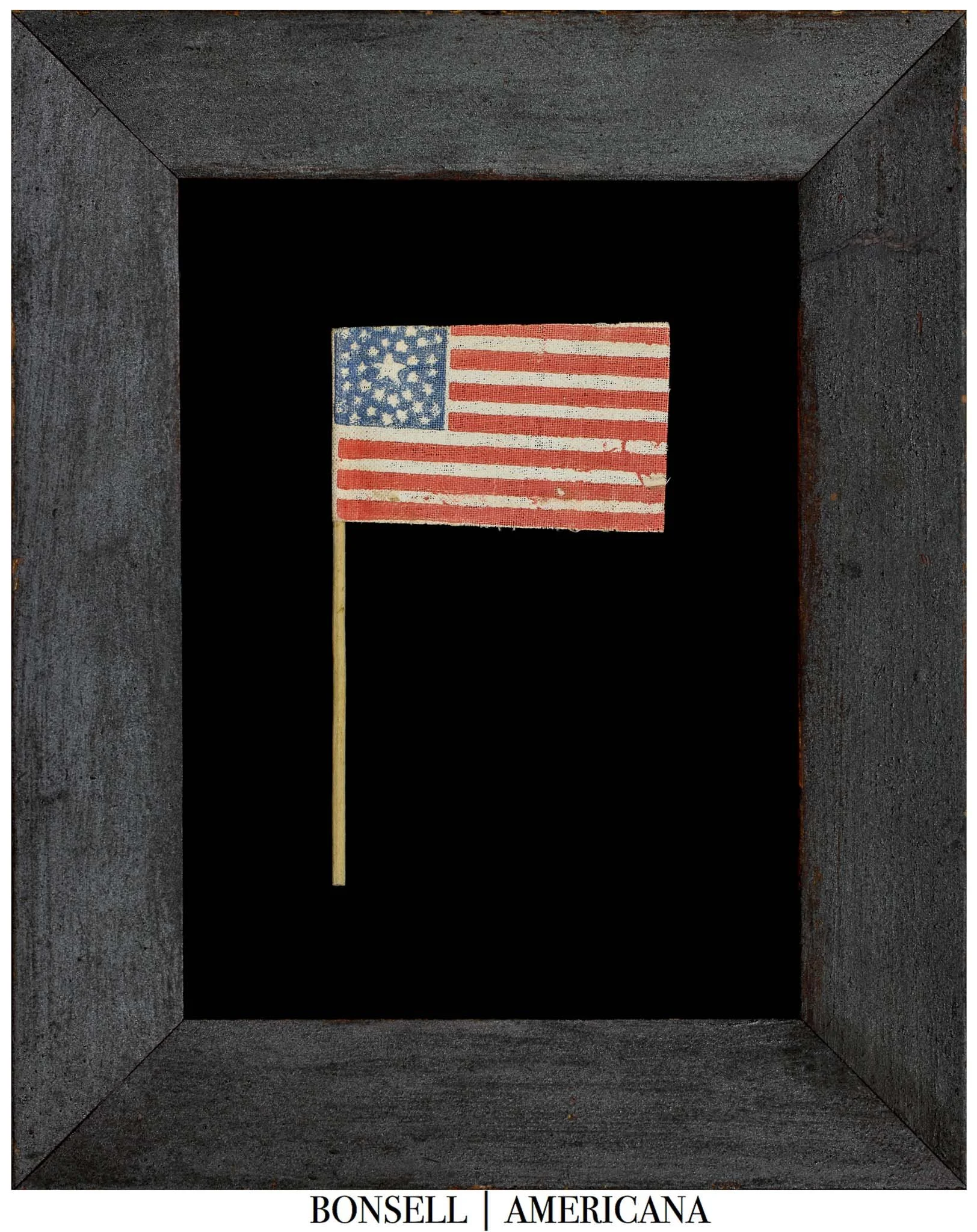
Frame Size (H x L): 12.25” x 10”
Flag Size (H x L): 2.5” x 3.5” and Affixed to a 6” Staff
Offered is a scarce and visually striking 36-star antique American parade flag, printed on coarse cotton and presented on its original wooden staff. Parade flags such as this were made for short-term patriotic display at parades, political rallies, celebrations, and inaugurations. Despite their ephemeral purpose, they remain among the most evocative and collectible forms of 19th-century Americana.
The stars on this flag are arranged in what is known as a medallion configuration—a visually arresting layout favored during the mid-19th century. At the center of the canton is a large star, encircled by two concentric rings: the inner ring features 10 stars, while the outer ring contains 17. Completing the design are corner stars flanking the medallion. While medallion patterns were especially popular between 1861 and 1876, they largely disappeared from production by 1890, replaced by more uniform rows and columns. Their ornate, almost celebratory feel sets them apart from the rigid star alignments of later eras.
This specific example bears 36 stars, representing the admission of Nevada into the Union. Though Nevada officially joined on October 31, 1864, the 36-star flag did not become official until July 4, 1865—just after the conclusion of the Civil War. Nevada’s statehood was strategically timed. Politically, it was intended to support President Abraham Lincoln’s 1864 re-election and to solidify Republican control during Reconstruction. Economically, the state’s immense silver reserves were seen as critical to financing the Union war effort and addressing postwar debt.
The 36-star flag served as the nation’s official flag for two years, from July 4, 1865, to July 3, 1867. During this time, it flew over a country grappling with the aftermath of the Civil War and beginning the long road toward Reconstruction. It was also used by the U.S. military during the final months of the war. The 37-star flag, recognizing Nebraska’s statehood, would succeed it on July 4, 1867.
Extremely close inspection of this example reveals important details about its manufacture. The flag is printed on a coarse, plain-weave cotton consistent with mid-19th-century domestic cloth. The pigments sit visibly atop the fibers, pooling around the yarn intersections in a manner characteristic of early block or stencil printing rather than later roller-printed methods. The blue displays the dark, slightly green-cast tone associated with Prussian blue, and the red carries the matte, mineral quality of iron-oxide pigments—both typical of inexpensive patriotic printing of the period. Uneven pressure during the print strike softens some stars and enhances others, creating subtle mis-registration that underscores its hand-guided, utilitarian origins.
Conservation Process: The flag was hand sewn to cotton fabric, and both were hand sewn to a mounting board. To prevent the black dye in the cotton fabric from seeping into the flag, it was first washed in a standard wash and then in a dye setting wash. The flag is positioned behind Optium Museum Acrylic.
Frame: The flag is housed in an early American, splined-miter frame dating to approximately 1830–1860, retaining its original lampblack or ‘dry black’ surface. The hand-cut joinery, early iron hanging hardware, and oxidized hardwood construction are all consistent with antebellum rural framing practices.
Condition Report: The flag survives in honest condition with scattered small losses and light surface wear typical of early printed parade flags on open-weave cotton. Most distinctive is the originally irregular top edge, where the trimming or print strike cuts partially into the canton and grazes the upper red stripe — a characteristic result of the rudimentary, hand-guided production methods used for these inexpensive flags. Despite its modest imperfections, it retains strong visual character and an appealing, untouched presentation.
Collectability Level: The Great – Perfect for Rising Collectors
Date of Origin: 1864-1867
Number of Stars: 36
Associated War: Civil War (1861-1865)
Associated State: Nevada

Frame Size (H x L): 33.25” x 61.5”
Overall Flag Size (H x L): 22” x 51.5”
Offered is an outstanding 34-star American flag repurposed in 1880 to support the Republican presidential ticket of James A. Garfield and Chester A. Arthur. The flag’s body was produced during the early Civil War period, when Kansas entered the Union as the 34th state, and was later adapted for campaign use through the addition of a white cotton strip printed on each side with “GARFIELD AND ARTHUR.” The piece unites two defining moments in American history—the preservation of the Union and the political renewal of the postwar Republic.
The flag’s body measures approximately 22 by 46 inches, excluding the added campaign strip, which brings the full length to about 51.5 inches overall. It displays 34 press-dyed stars arranged in a rare 8-1-8-8-1-8 configuration. The proportions are elongated and the design distinctly folk, suggesting small-shop or regional manufacture rather than factory production. The star pattern, with its two offset outliers near the hoist, lends the canton a lively sense of movement, departing from the rigid grids typical of printed parade flags.
CONSTRUCTION
The red-and-white field is one continuous length of woven cotton, not pieced or printed. The alternating stripes were produced at the loom by alternating red-dyed warp threads with undyed (white) warps across the beam, while the weft remained white throughout. The red color is therefore structural, derived from the yarn itself rather than applied pigment. Where the red and white warp groups meet, the colors blend softly, creating subtle transitions characteristic of mid-19th-century striped cottons.
This warp-dyed “colored sheeting” was a staple product of American mills in the 1850s and 1860s, made by dyeing warp yarns in Turkey-red or madder baths before weaving. Combined with plain white weft, the process yielded finished yard goods ideal for flag production and removed the need for pieced stripes or surface printing in many cases. The fabric’s slightly coarse, wool-like texture results from short-staple cotton fibers, uneven spinning, and residual starch sizing applied for loom stability—features typical of patriotic bunting of the era.
The blue canton is made of a separate piece of undyed cotton, hand-sewn to the striped field with small whipstitches visible along the inner edge. Its coloration was achieved by press-dyeing, a resist-dye process in which star forms were masked with a wax or paste compound before the fabric was pressed between dye-soaked pads or immersed under pressure in a blue dye bath. When the resist was removed, undyed stars remained against a deep matte blue ground. The blue pigment penetrates evenly through the cloth, producing soft feathering along the star edges rather than the crisp mechanical borders of roller printing.
The hoist consists of a separately applied band of plain-weave cotton, folded and hand-stitched to the canton and field with heavy cotton thread. The pair of small circular apertures, near the top and bottom, are hand-worked and reinforced with thread, not fitted with a metal grommet. Along the hoist appear inked notations reading “22 × 46” and “–CX2,” the latter preceded by a faint, indecipherable character. The marks were applied in the same hand and ink, likely by the original maker to indicate dimensions and batch or pattern identification.
At the fly end, a white cotton strip approximately five and a half inches wide was added during the 1880 campaign. The fabric differs markedly from the main field—finer in weave and with a subtle calendered finish intended to accept ink evenly. It was attached by a straight, machine-sewn line of undyed cotton thread, executed with the precision and tension consistency typical of a treadle sewing machine. The seam is nearly invisible today, as both thread and fabric have aged to the same pale ivory tone. After attachment, the legend “GARFIELD AND ARTHUR” was stenciled by hand in black oil-based pigment. The pigment penetrates fully through the fibers, showing minor haloing and variation in opacity from letter to letter. Its oxidized gray tone and lack of embossing confirm a brush or pad application through a cut stencil rather than mechanical printing.
Taken together, these details reveal a flag produced in 1861 to 1863 for patriotic display, later reissued circa 1880 as a campaign banner.
HISTORICAL CONTEXT
The 34-star flag officially represented the United States from July 4, 1861, to July 3, 1863, commemorating Kansas’s admission to the Union. It flew during the first two years of the Civil War, a period marked by uncertainty, sacrifice, and the forging of a new national identity. By 1880, such flags were already antiquated, yet their presence remained familiar. Merchants and campaign committees occasionally repurposed Civil War–era stock by printing or sewing candidate names across surviving examples. In some cases, this was an intentional gesture—an effort to evoke wartime unity and the victory of the Union cause. In others, it was a matter of simple pragmatism: the ready availability of leftover flags and bunting from earlier decades made them a natural choice for campaign display.
The Garfield–Arthur ticket arose from a deeply divided Republican Party. In the aftermath of Reconstruction, the party fractured between reformers who sought to curb political patronage and traditionalists who defended the existing system. When the Republican National Convention deadlocked between Ulysses S. Grant and James G. Blaine, delegates turned to James A. Garfield of Ohio, a respected former Union general, scholar, and nine-term congressman, as a compromise nominee. To balance the ticket, they selected Chester A. Arthur of New York, an ally of the powerful party machine led by Roscoe Conkling.
The 1880 campaign emphasized national unity, economic growth, and the moral integrity of Republican leadership. Garfield’s image as a self-made man—born in a log cabin, educated through sheer persistence, and rising from canal laborer to college president—resonated with voters still drawn to the ideal of the citizen-soldier. His war service at Shiloh and Chickamauga lent authenticity to his calls for stability and reconciliation. By contrast, Democratic nominee Winfield Scott Hancock, also a Union general and war hero, made the race unusually close, with both candidates celebrated for their military valor.
Garfield and Arthur ultimately prevailed by one of the narrowest popular margins in U.S. history—a difference of just about 10,000 votes nationwide—but secured a comfortable 214 to 155 victory in the Electoral College. Their triumph reaffirmed the Republican Party’s national dominance in the postwar era and its identification with Union loyalty and progress.
Garfield’s presidency, however, was tragically brief. Barely four months after his inauguration, he was shot by a disgruntled office seeker, Charles Guiteau, and died eleven weeks later, in September 1881. The event shocked the nation and stirred widespread disgust with the patronage system that had divided the party. Chester A. Arthur, long viewed as a machine politician, ascended to the presidency amid skepticism but soon surprised the public by embracing civil service reform, signing the Pendleton Act in 1883 and earning an enduring reputation for integrity and restraint.
Against that backdrop, this flag stands as a poignant emblem of the political and cultural crosscurrents of its age—a Civil War–era banner literally reborn for the campaign that would reshape the Republican Party and usher in the modern civil service system. Whether reused deliberately to recall Union victory or simply drawn from surviving stock, its adaptation links two defining eras in American history: the struggle for national preservation and the postwar effort to reform and reunify the nation.
PROVENANCE
This example originates from the collection of Dr. Jeffrey Kenneth Kohn, M.D., one of the country’s foremost authorities on historic American flags. Dr. Kohn began collecting in the early 1980s, assembling one of the most comprehensive private holdings of 19th-century flags and patriotic textiles. A respected historian and lecturer, he served as Historian for the Philadelphia Flag Day Association, curated major flag exhibitions at the Union League and Betsy Ross House, and co-authored American Flags: Designs for a Young Nation. His expertise in textile analysis, manufacturing techniques, and period dye processes has informed museum collections nationwide. The association with his collection underscores this flag’s authenticity and importance within the broader field of American political textiles.
SIGNIFICANCE
In both construction and historical resonance, this flag offers a remarkably complete picture of American textile and political culture in transition. Its woven red and white stripes, press-dyed canton, hand-sewn hoist, machine-stitched campaign strip, and stenciled inscription together embody two generations of craftsmanship—one rooted in hand production, the other in emerging industrial methods. Each layer reflects a different chapter of the national story: the technical ingenuity of mid-19th-century cotton mills, the artistry of resist dyeing, the rise of mechanical sewing, and the enduring impulse to reinterpret patriotic symbols through political expression.
The survival of all these elements, unaltered and intact, makes this one of the most compelling known Garfield & Arthur campaign flags.
Conservation Process: The flag was hand sewn to cotton fabric, and both were hand sewn to a mounting board. To prevent the black dye in the cotton fabric from seeping into the flag, it was first washed in a standard wash and then in a dye setting wash. The flag is positioned behind Optium Museum Acrylic.
Frame: The flag is presented within a hardwood frame finished in matte black with visible grain.
Condition Report: The flag displays strong overall integrity, with the fabric stable and the colors in the canton and stripes still well defined. Expected signs of age are present, including minor fabric thinning, small losses along portions of the red stripes, and light wear at the upper edge. The “GARFIELD AND ARTHUR” printing shows fading and surface wear, yet remains legible. The weave throughout the textile is sound and tightly set.
Collectability Level: The Best – Perfect for Advanced Collectors
Date of Origin: 1861-1863, Repurposed 1880
Number of Stars: 34
Associated War: The Civil War (1861-1865) and the Indian Wars (1860-1890)
Associated State: Kansas
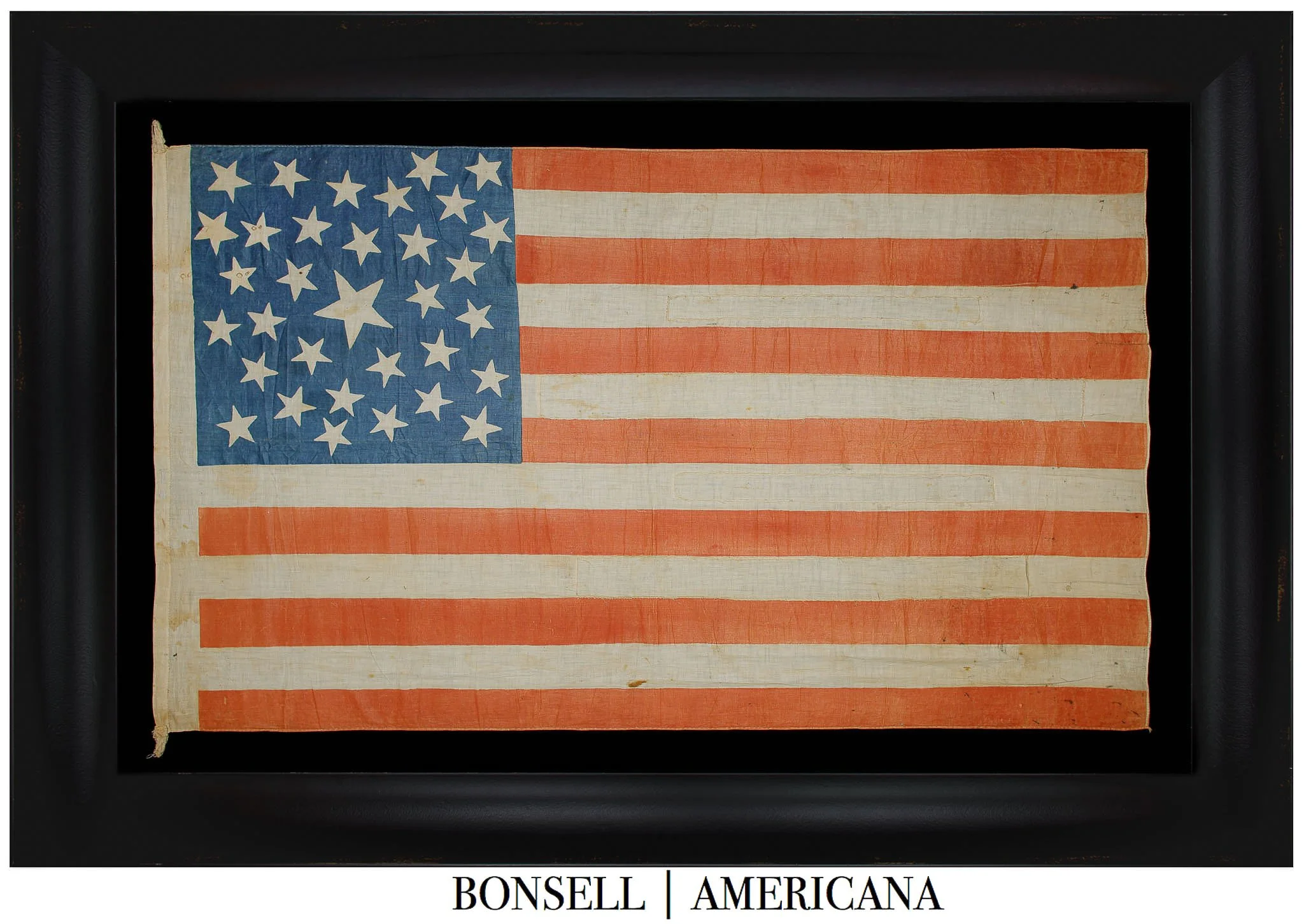
Price: Call 618-553-2291, or email info@bonsellamericana.com
Frame Size (H x L): 42” x 62”
Flag Size (H x L): 30.5” x 50.5”
Offered is an extraordinary antique American flag printed on a fine, thin cotton fabric that presents with an unusually smooth and lustrous surface. Though at first glance it almost evokes the sheen of silk, the textile is glazed cotton—a material often prized by mid-19th-century textile printers for its crisp finish and ability to take saturated color. The canton is printed in a rich indigo blue that slightly darkens where the glaze remains strongest, while the stripes appear in a vibrant shade that reads today as orange-red rather than the deep scarlet seen on modern flags. This tonal variation was common among mid-19th-century examples, as no official specification for the national colors yet existed, and the appearance of the red often reflected the particular dye formulas available to individual printers or the natural fading of the pigment over time. Each of the red stripes exhibits a faintly raised texture from the pigment application, sometimes referred to as a “paint-printed” or “pigment-dyed” process.
The white stripes display an especially intriguing feature: several hand-sewn patches that appear to be period repairs or intentional reinforcements, made from fabric identical to the surrounding material. Their hand stitching is neat and deliberate, suggesting an early attempt to correct printing or structural irregularities. Whatever the purpose, the presence of these period-applied patches adds to the flag’s individuality and speaks to the resourceful, hands-on nature of early textile making.
A separately applied cotton hoist is machine-stitched to the flag’s left edge, with short cords at both the upper and lower corners, indicating that it was once intended for functional display. The flag is exceptionally lightweight and delicate in hand, its surface marked by subtle creases and the characteristic sheen of early printed cotton flags produced during the Civil War era, circa 1859–1861.
The configuration of stars on this 33-star flag belongs to a small and fascinating group of designs generally classified as pentagon or heart medallions—patterns that emerged during the late 1850s and persisted into the early years of the Civil War. In this example, a large central star, representing Oregon’s admission as the 33rd state in 1859, anchors the design. Around it are two loosely pentagonal rings of smaller stars, producing a form that falls somewhere between a five-sided figure and a subtle shield shape. The result is a layout that is geometrically deliberate but slightly irregular, a quality that gives early printed flags of this period their distinctive handmade character.
This format is closely related to the series of medallion-style flags associated with H.C. Howard of Philadelphia, one of the most important early makers of printed parade flags. Active from roughly 1856 through the early 1860s, Howard’s name appears on documented examples made for presidential campaigns including those of John C. Frémont and Abraham Lincoln. His designs are noted for their bold central stars, experimental geometry, and unusually fine printing quality for the time. While this flag bears no maker’s mark, its structural rhythm and medallion form align strongly with Howard’s known work or that of those influenced by his shop, which helped set the visual language for pre-war and early wartime flag design.
The use of a large central star carries both symbolic and compositional meaning. In 19th-century American flags, the center star was often used to emphasize new statehood or the unity of the nation as a whole. Here it marks Oregon’s addition to the Union—a moment of western expansion and fragile national optimism on the eve of conflict. This convention—highlighting the newest state through size or placement—became common among skilled flag printers, allowing a single star to serve as both a visual anchor and a narrative device within the canton.
Oregon’s path to statehood was long and politically complex. Originally part of the vast Oregon Territory established in 1848, the region’s admission as a state was driven by years of settlement along the Oregon Trail and debates over the expansion of slavery. The territory’s provisional government had already outlawed slavery in 1844, and when Oregon sought admission, it entered the Union as a free state—an outcome that heightened sectional tensions in the years preceding the Civil War. President James Buchanan signed the act admitting Oregon on February 14, 1859, making it the nation’s 33rd state and extending American sovereignty to the Pacific Northwest. The inclusion of Oregon added both geographic reach and symbolic weight to the Union, representing the final realization of a continental republic just as the nation was fracturing along ideological lines.
The 33-star flag represents a narrow and historically pivotal moment. Oregon achieved statehood on February 14, 1859, and the flag bearing 33 stars became official on July 4 of that year. It remained current until July 4, 1861, when Kansas’ admission introduced the 34-star flag. For this reason, the 33-star flag bridges two eras: the final years of the antebellum period and the first months of the Civil War. One such flag was flying above Fort Sumter when Confederate forces opened fire in April 1861.
Flags associated with this brief window are among the rarest of all American flags. Prior to the Civil War, Americans seldom displayed the national flag for patriotic purposes, and even the U.S. Army did not regularly carry it until the 1830s and 1840s. Before this time, the Stars and Stripes functioned mainly as a naval ensign, and most examples were extremely large. Consequently, pre-war flags—especially small printed examples suitable for personal use—represent only a minute portion of surviving 19th-century flags.
The 33-star era thus occupies a unique position in American history. It marks the final official design adopted before the outbreak of war and the first widely produced during it. The rise of patriotic sentiment surrounding Lincoln’s election and the preservation of the Union spurred the creation of small printed flags for rallies, parades, and home display—objects that transformed the Stars and Stripes from a maritime signal into a national symbol of unity.
Because production of 33-star flags ended by mid-1861, surviving examples are exceedingly scarce. This flag, with its fine printed cotton construction, luminous surface, rare pentagon-style medallion, and curious period hand-sewn patches, represents not only the artistic innovation of its maker but also the moment when Americans first began to embrace the flag as a personal emblem of loyalty and identity.
Conservation Process: This flag was hand sewn to cotton fabric, and both were hand sewn to a mounting board. To prevent the black dye in the cotton fabric from seeping into the flag, it was first washed in a standard wash and then in a dye setting wash. The flag is positioned behind Optium Museum Acrylic.
Frame: The flag is presented in a deep, black-painted frame with a softly scooped profile and a lightly weathered surface that reveals subtle undertones of warm brown beneath the finish. The design is both substantial and refined, with a gently burnished texture that complements the age and character of the flag. Its depth allows the textile to be recessed slightly, giving the presentation a shadowbox effect that enhances contrast and visual presence.
Condition Report: The flag presents beautifully with strong color and excellent overall preservation for its period. The orange-red stripes remain vivid, and the blue canton retains much of its original depth and saturation. Scattered, small hand-sewn patches appear in the white stripes, all executed in matching period fabric and thread, adding both character and evidence of early care or construction refinement. Minor toning, light creasing, and modest wear are present, consistent with age and the delicate nature of mid-19th-century printed cotton, but the flag survives in an exceptional state of integrity for a pre–Civil War example.
Collectability Level: The Extraordinary – Museum Quality Offerings
Date of Origin: 1859-1861
Number of Stars: 33
Associated War: Pre-Civil War
Associated State: Oregon
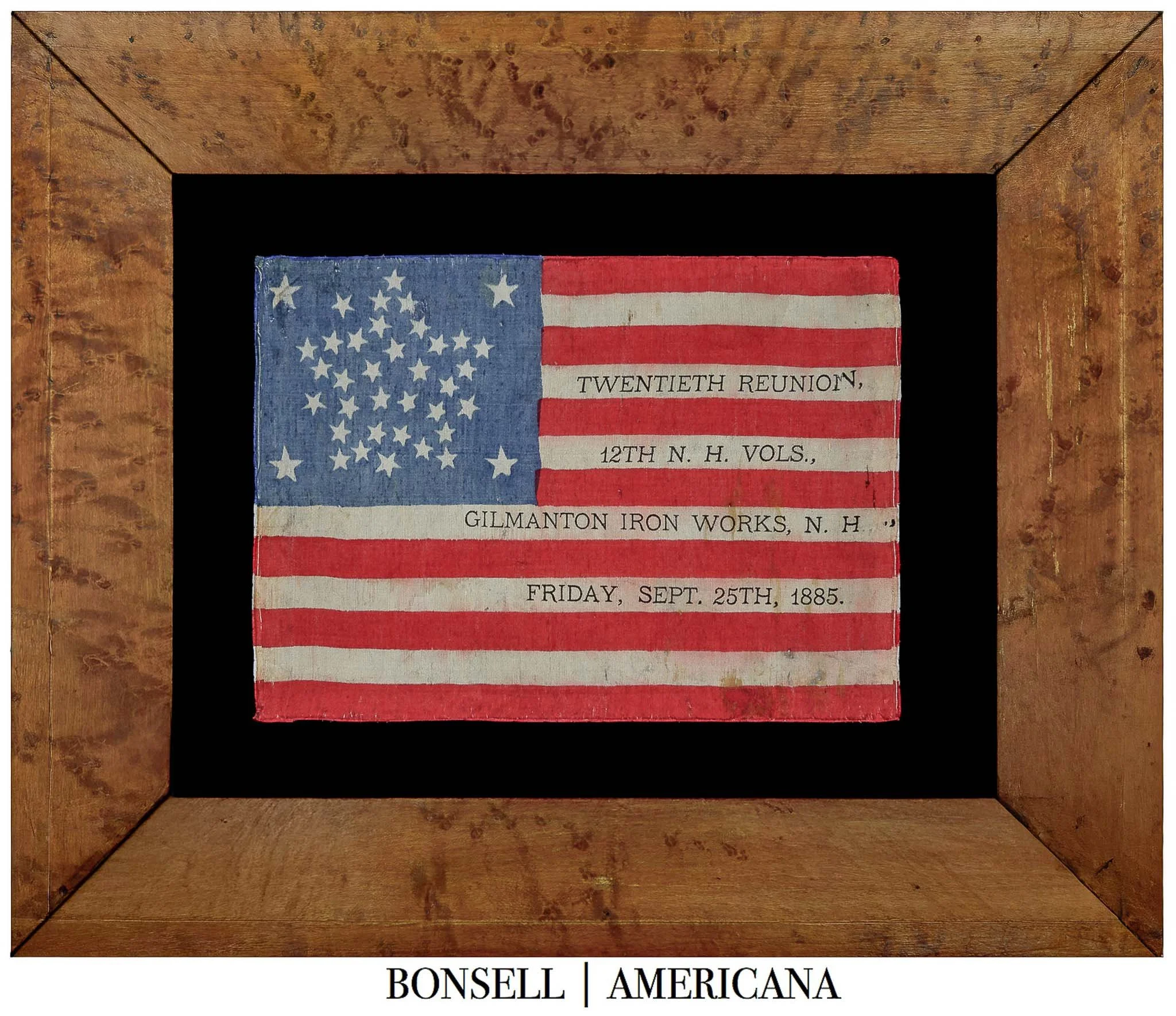
Frame Size (H x L): 14” x 17”
Flag Size (H x L): 6.5” x 9.25”
Offered is a remarkable 38-star printed silk parade flag commemorating the Twentieth Reunion of the 12th New Hampshire Volunteer Infantry, held at Gilmanton Iron Works, New Hampshire, on Friday, September 25th, 1885. It is overprinted with the following inscription:
TWENTIETH REUNION,
12TH N. H. VOLS.,
GILMANTON IRON WORKS, N. H.,
FRIDAY, SEPT. 25TH, 1885.
The “12TH N. H. VOLS.” refers to the 12th New Hampshire Infantry Regiment, a Union Army unit mustered in at Concord in September 1862 and mustered out in June 1865. The regiment saw heavy combat in several major engagements, including Fredericksburg, Chancellorsville, and Gettysburg. At Chancellorsville, it was the last unit under General Sickles’ command to withdraw from the field—suffering 69 killed and 250 wounded out of 580 men engaged. At Gettysburg, the 12th held ground north of the Klingel Farm under fierce attack by the Alabama Brigade, with 26 killed, 73 wounded, and 6 additional deaths from wounds among its 224 participants.
The reference to a “Twentieth Reunion” suggests the regiment began annual gatherings in 1866, immediately following the war. While most Civil War veteran flags feature overprints from the Grand Army of the Republic (GAR), this example is unusual in that it references a specific regimental reunion. Moreover, it predates the more commonly encountered GAR reunion flags, most of which date to the early 20th century.
The flag’s canton features a rare and desirable “Great Star” pattern—an arrangement where smaller stars form the outline of a larger five-pointed star. This example includes 25 stars forming the outer shape, 5 within its interior, 4 interstitial stars surrounding the main form, and 4 canted corner stars. The slight asymmetry and open gaps likely allowed space for a future star, symbolizing the evolving Union.
The Great Star configuration is credited to U.S. Navy Captain Samuel Chester Reid, who proposed the design in 1818 while advising Congress on flag standardization. Reid's ideas helped shape the Flag Act of 1818, which fixed the number of stripes at thirteen and mandated that a new star be added for each new state on the July 4th following its admission. While his favored star pattern was not codified in law, the Great Star design became popular for its visual impact, especially when flown at sea. Though it saw greatest use in the 1840s, it remained in occasional production through the Centennial era. The last known commercial use of the pattern appeared on 38-star flags.
A matching example to the flag offered here was discovered in its original shipping tube bearing a two-cent stamp and the printed return address:
From
R.W. MUSGROVE,
Book and Job Printer.
R.W. Musgrove, a Civil War veteran and editor of the Bristol Enterprise, is confirmed to have produced these flags. To attribute a 19th-century printed flag to a specific maker is exceedingly rare and adds significant historical value.
The 38-star count represents the admission of Colorado to the Union on August 1, 1876, with the flag becoming official on July 4, 1877. The 38-star flag remained official through 1889 and into mid-1890, covering the administrations of Presidents Hayes, Garfield, Arthur, Cleveland, and Harrison. Though the 37-star flag was official during the nation’s Centennial in 1876, both the 13-star and 38-star flags were widely used to commemorate the event, especially by manufacturers eager to anticipate Colorado’s statehood.
The Centennial celebrations of 1876 ignited a renewed national pride. Cities hosted parades, homes were decorated in patriotic colors, and flags became a central symbol of unity and identity. The most prominent celebration was the Centennial International Exposition in Philadelphia, which attracted nearly 10 million visitors and introduced marvels such as the Corliss Steam Engine and Alexander Graham Bell’s telephone.
This flag, dating to 1885, stands apart as an early and regimental-specific veteran reunion artifact—bearing direct connection to one of the war’s hard-fought Union regiments, with a star pattern rooted in early 19th-century naval heritage. It is a compelling piece of Civil War memory.
Conservation Process: This flag was professionally conserved. "It is mounted to silk backing and positioned behind Optium Museum Acrylic.
Frame: The flag is mounted in a birdseye maple frame, likely dating to the mid-to-late 19th century, with a distinctive swirling grain and warm amber tone.
Condition Report: The flag is in good overall condition, with solid color retention and a clearly legible overprint. The silk exhibits typical age-related wear, including light creasing, a few small splits, and scattered staining—most notably some faint gold-toned discoloration.
Collectability Level: The Extraordinary – Museum Quality Offerings
Date of Origin: 1885
Number of Stars: 38
Associated War: The Indian Wars (1860-1890)
Associated State: Colorado
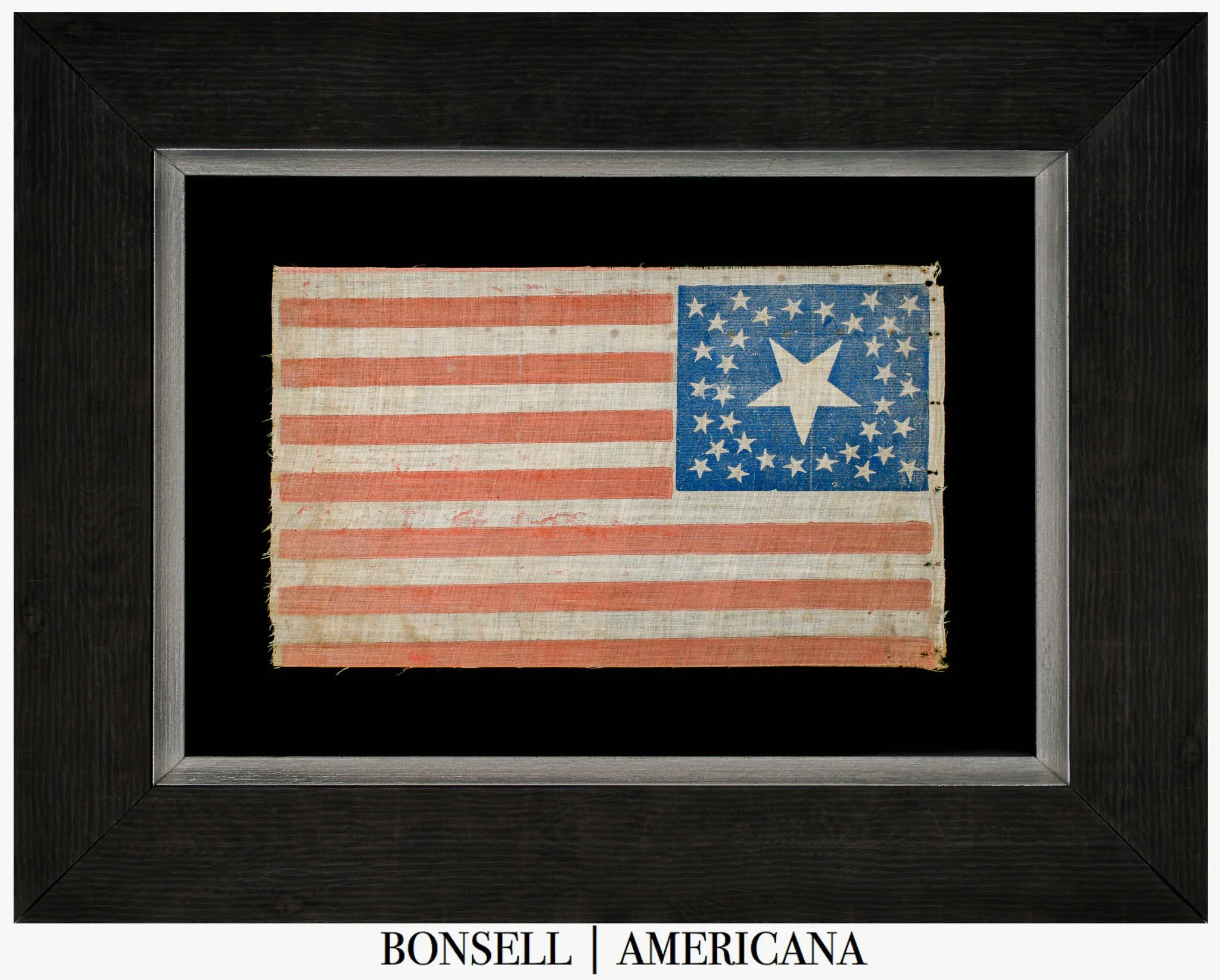
Frame Size (H x L): 18.5” x 24”
Flag Size (H x L): 8.5” x 14”
Offered is a thirty-six star antique flag, printed on coarse glazed cotton and bearing one of the most unusual and distinctive star configurations known in 19th-century American flags. The design features a massive central star set in the middle of the canton. Encircling it is a wreath of seventeen stars, followed by a larger parenthesis of fourteen stars—seven to the left and seven to the right. Four additional stars, one in each corner of the canton, frame the entire composition. Together, these elements form a clear and deliberate arrangement that is highly structured and visually balanced.
The use of a parenthesis formation in a star pattern is exceptionally rare. While 19th-century flag makers employed a wide range of designs—including medallions, wreaths, great stars, and snowflakes—very few surviving examples include a true left-right arc that resembles a bracketed enclosure. In the few that do, the arcs are typically subtle and easily lost within a field of other stars. In contrast, the parenthesis on this flag is plainly visible and integral to the design. We are aware of only three examples of this exact configuration, and no other known pattern presents the parenthesis in this prominent a way.
The massive center star is a form sometimes referred to as a “center star,” a feature occasionally used to represent the newest state admitted to the Union. In this case, that state is Nevada. Center stars are usually only modestly larger than surrounding stars. Here, however, the center star is dramatically oversized and dominates the canton. It is also inverted, with one point facing downward. The reasons for this orientation are unclear. In many cases, 19th-century makers did not follow a standard orientation and may not have viewed any one direction as “up.”
The remaining stars are irregular in shape and size. The stripes have faded to a salmon or orange hue, which aligns with the use of madder or cochineal dyes—commonly used between 1850 and 1880—and known to fade in this way over time.
This flag includes an extra white stripe along the top, an unusual but not symbolic feature. It likely results from how the flag was cut from a larger bolt of glazed cotton that included multiple printed flags. Depending on the cut, individual examples could include one or more additional stripes. In this case, the extra stripe adds visual interest.
This is the third known example of this flag type. One is held in the Pierce Collection of American Parade Flags and is published on page 18 of The Stars and Stripes: Fabric of the American Spirit. A second example previously passed through our hands.
Thirty-six star flags represent the admission of Nevada to the Union. Although Nevada became a state on October 31, 1864, the thirty-six star flag became official on July 4, 1865. That date came shortly after the end of the Civil War, and the flag is often associated with Union victory and the early years of Reconstruction. The thirty-six star flag remained official until July 4, 1867, when the thirty-seven star flag was adopted to include Nebraska.
Nevada’s admission was driven by both political and economic motives. It occurred just eight days before President Lincoln’s re-election, bolstering Republican electoral strength. Economically, Nevada’s silver mining industry was seen as important to financing the Union’s war debt. The state’s borders were later expanded in 1866 and again in 1867, adding land from the Utah and Arizona territories.
This flag stands out for its oversized center star, visible parenthesis arrangement, and added stripe—features that place it among the most distinctive and scarce known designs from the Civil War era.
Conservation Process: This flag was hand sewn to cotton fabric, and both were hand sewn to a mounting board. To prevent the black dye in the cotton fabric from seeping into the flag, it was first washed in a standard wash and then in a dye setting wash. The flag is positioned behind Optium Museum Acrylic.
Frame: The flag is presented in a custom two-part frame. The outer frame is a dark wood with a subtle grain texture, while the inner liner is a metallic silver, offering a clean contrast that highlights the colors and form of the flag.
Condition Report: The flag is in sound condition, with moderate wear consistent with age and use. Toning and soiling are present throughout, and there is some minor fraying along the edges. The colors have faded, particularly the red stripes, which now appear as a muted orange—typical of madder-based dyes used during the period. A line of old nail holes runs vertically along the right edge, evidence of the flag’s original attachment to a wooden staff.
Collectability Level: The Best – Perfect for Advanced Collectors
Date of Origin: 1864-1867
Number of Stars: 36
Associated War: Civil War (1861-1865)
Associated State: Nevada
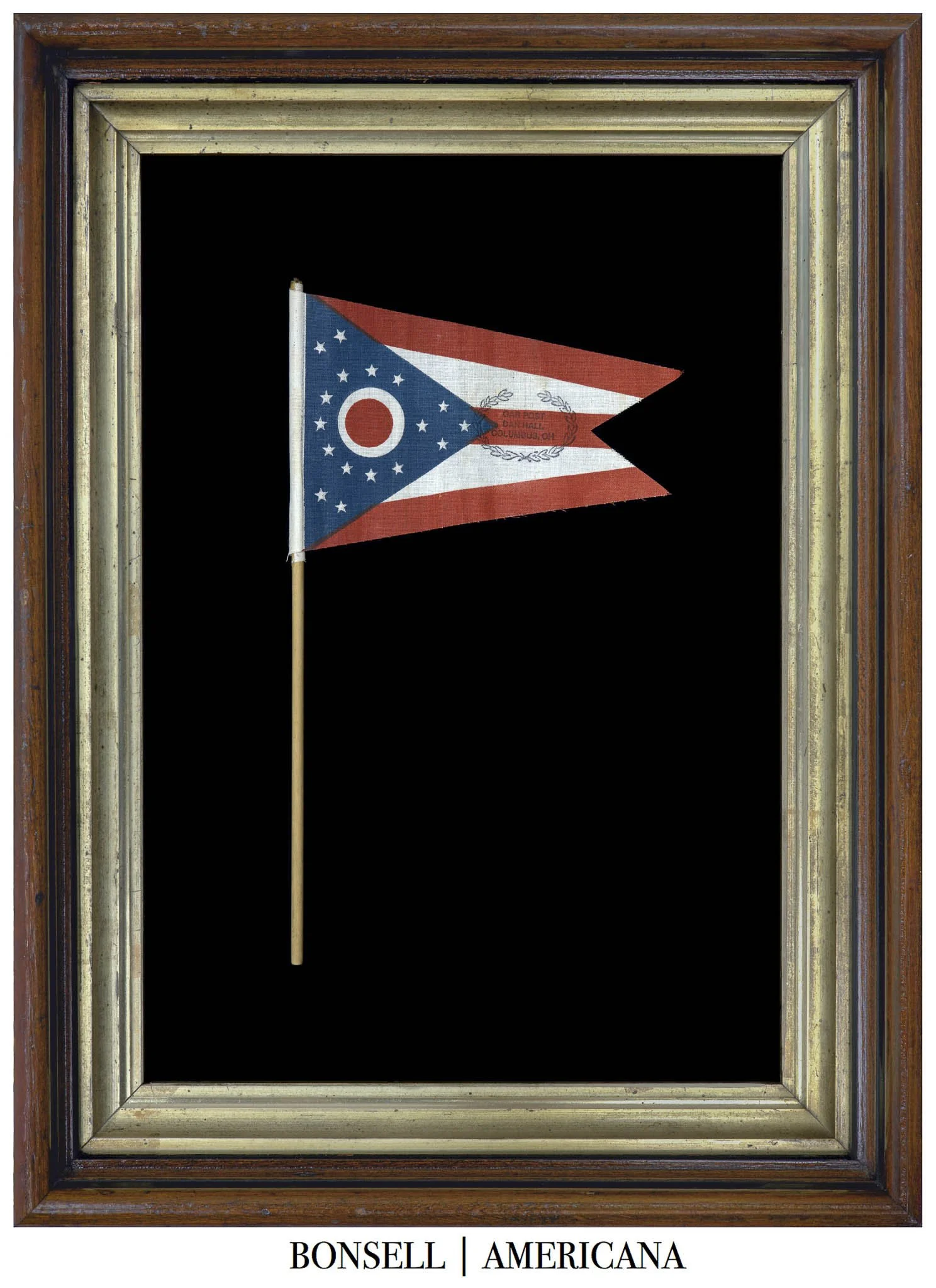
Frame Size (H x L): 17” x 13”
Flag Size (H x L): 4” x 6” on a 10” Staff
Offered is an Ohio state flag, dating to 1925. It is an exceptional artifact of historical significance, crafted to honor the life and legacy of Daniel M. Hall, a celebrated Civil War veteran and National Commander of the Grand Army of the Republic (“GAR”). Made from plain weave cotton, the flag reflects the practical materials commonly used for commemorative items of the period. The cotton is treated with a finish to make it more durable and water-resistant, mimicking the qualities of oilcloth.
Its distinctive swallowtail design, featuring vibrant red, white, and blue elements, mirrors the official Ohio state flag adopted in 1902, a design inspired by Civil War cavalry guidons. Mounted on its original wooden staff, this flag was intended for ceremonial use, serving as a reminder of Hall’s legacy.
What elevates this flag’s historical importance is its overprint, stamped in black ink on the striped field. Enclosed within a laurel wreath, the inscription reads, “GAR Post, Dan Hall, Columbus, OH,” directly tying the flag to the GAR and specifically commemorating Hall’s death in 1925, just before his 83rd birthday. Flags with overprints dedicated to specific individuals are rare, making this an especially coveted piece for collectors.
The GAR, founded in 1866, was one of the most influential veterans’ organizations in American history. Dedicated to uniting Union Civil War veterans, the GAR blended social fellowship with political advocacy. Members, often called “comrades,” donned their wartime uniforms to march in parades, participate in reunions, and advocate for veterans’ benefits such as pensions. The organization also played a central role in establishing Memorial Day as a national holiday. Structurally, the GAR mirrored the military, with local “posts” acting as chapters under the leadership of state and national commanders. By fostering a sense of brotherhood and preserving the memory of Union service, the GAR had a profound impact on postwar society and veterans’ rights.
Daniel M. Hall exemplified the dedication and leadership of the GAR’s membership. Born on October 20th, 1842, Hall served with distinction in the 2nd and 12th Ohio Cavalry regiments during the Civil War. After mustering out in 1865, he became deeply involved in veterans’ affairs, joining the Hamlin Post of the GAR in Columbus, Ohio, in 1883. Hall’s organizational skills and leadership propelled him to prominence, ultimately serving as the Commander of the Ohio Department and later as National Commander-in-Chief. His efforts focused on preserving the bonds of fellowship among veterans and honoring their sacrifices. Hall’s passing in 1925 marked the loss of a respected leader, memorialized through artifacts like this flag.
The Hamlin Post, based in Columbus, was among many GAR chapters that served as vital centers for veterans’ social and charitable activities. Posts like Hamlin provided support to veterans and their families, organized community events, and preserved the shared memory of Union service. Under Hall’s leadership, the Hamlin Post became an integral part of the GAR’s Ohio Department, further elevating its historical significance. The creation of this overprinted flag in Hall’s memory underscores the deep respect he commanded within the organization and the lasting impact of his contributions.
The Ohio state flag itself, adopted in 1902, is among the most distinctive in the United States. Designed by Cleveland architect John Eisenmann, it was created for the Pan-American Exposition in Buffalo, New York, in 1901. Its unusual swallowtail shape sets it apart, drawing inspiration from both Civil War-era cavalry guidons and maritime burgees. This shape, along with its bold and symbolic design, captures the spirit of Ohio’s heritage and geography. At its center is a red disc set within a white circular field, representing the letter “O” for Ohio and the buckeye, the state’s iconic symbol. Five alternating red and white stripes symbolize the state’s waterways and roads, while the blue triangular field, representing hills and valleys, features 17 stars: 13 for the original colonies and four more to signify Ohio’s admission as the 17th state.
This symbolic depth, paired with its unconventional design, ensures the Ohio flag’s enduring appeal. Over the decades, it has been a source of pride for the state and its citizens, appearing in civic ceremonies and historical commemorations alike. The flag’s resemblance to Civil War guidons serves as a reminder of Ohio’s significant contributions to the Union during the Civil War, while its design elements reflect the state’s natural and cultural heritage. Together, the Ohio flag and artifacts like this overprinted version serve as emblems of the state’s history and the lasting legacy of its citizens.
Conservation Process: This flag was hand sewn to cotton fabric, and both were hand sewn to a mounting board. To prevent the black dye in the cotton fabric from seeping into the flag, it was first washed in a standard wash and then in a dye setting wash. The flag is positioned behind Optium Museum Acrylic.
Frame: The frame is made of walnut and dates from 1860 to 1890. Its dark wood and simple craftsmanship reflect the style of the period.
Condition Report: The flag is in remarkably clean and well-preserved condition, with vibrant colors and minimal signs of wear. Only a few faint yellow stains are visible, adding subtle character while not detracting from its overall appearance.
Collectability Level: The Great – Perfect for Rising Collectors
Date of Origin: 1925
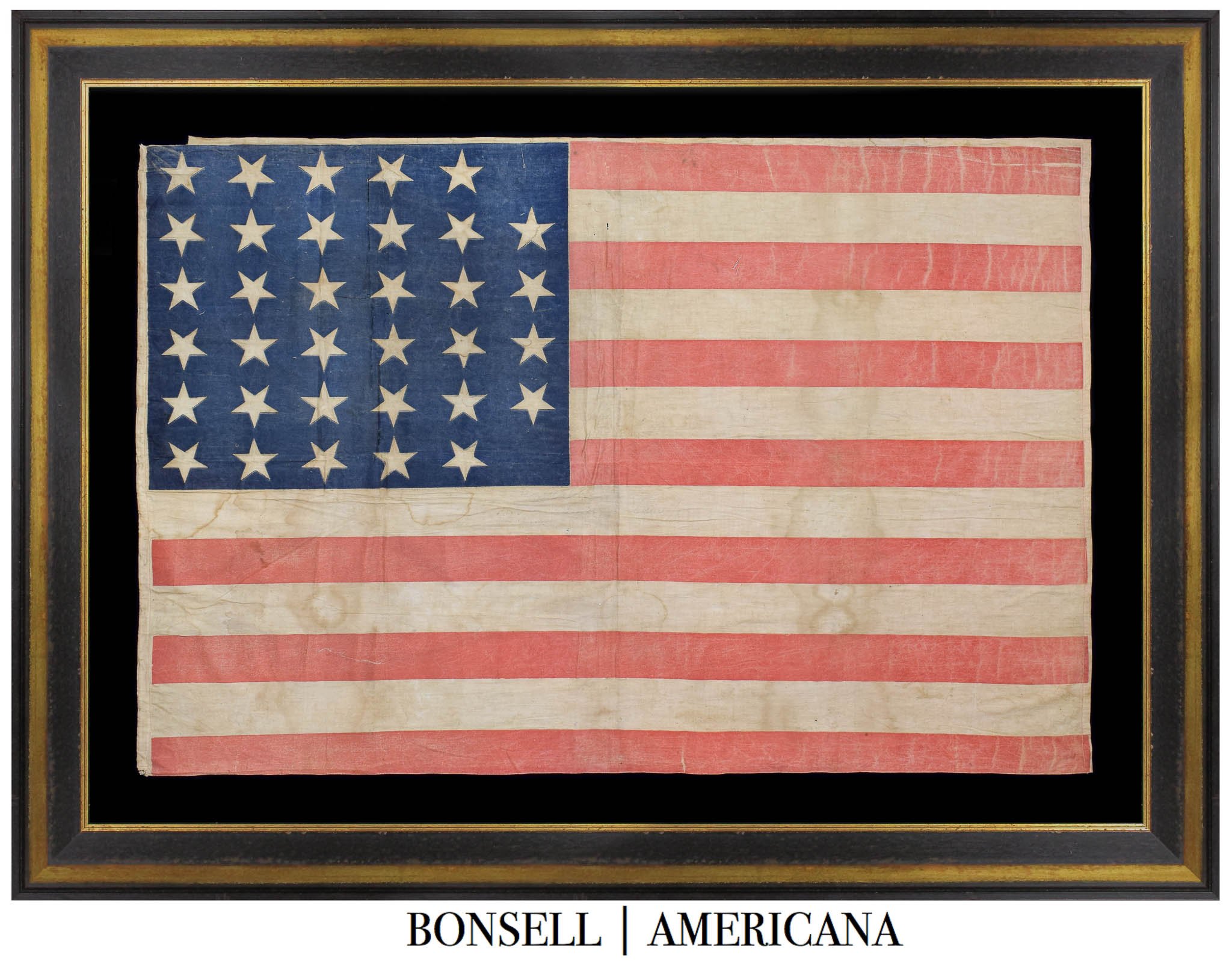
Price: Call 618-553-2291, or email info@bonsellamericana.com
Frame Size (H x L): 42.5” x 58”
Flag Size (H x L): 31.5” x 47”
Offered is a thirty-four star antique flag, printed on cotton. Its stars are arranged in a 5-6-6-6-6-5 pattern, with notches in the upper-right and lower-right corners. The stars are tumbling relative to one another, whether viewed via the columns or the rows.
The stripes are closer to orange than red. The orange is a result of the use of either madder or cochineal to create the red dye, and is common in flags dating between 1850 and 1880. The orange color of the “red” stripes is attractive and a desirable to collectors.
The thirty-four star flag represents the inclusion of Kansas to the Union. Kansas was admitted on January 29th, 1861, and this flag became official on July 4th, 1861. President Lincoln served, and the Civil War was fought, under this star count. Many thirty-four star flags predate the first shots of the Civil War in 1861, as flag makers began producing them upon the admission of the Kansas, instead of the time at which the flag was officially admitted to the Union later in the same year. The thirty-four star flag was official until July 4th 1863, the time at which the thirty-five star flag became official and began to represent the inclusion of West Virginia in the Union.
Thirty-four and thirty-five star flags were the official flags for the majority of the Civil War, and for this reason, both are extremely collectible. Flags associated with this time period (1861-1865) and earlier are among the rarest and most desirable of all US flags. Prior to the Civil War, Americans did not typically display flags for patriotic purposes. In fact, even the military did not regularly use the flag, as it was not until 1834 that the army field artillery was permitted to carry the traditional US flag, and not until 1841 that regiments carried it. Instead, most flags prior to the Civil War were used to mark ships, and were massive in scale so as to be seen from large distances.
The surge in small US flags for patriotic purposes began primarily with onset of the Civil War. This flag was made during this surge and is a rare survivor. In fact, this is the only example of this style of flag that we have encountered.
Conservation Process: This flag was hand sewn to cotton fabric, and both were hand sewn to a mounting board. To prevent the black dye in the cotton fabric from seeping into the flag, it was first washed in a standard wash and then in a dye setting wash. The flag is positioned behind Optium Museum Acrylic.
Frame: This offering is in our Large Distressed Black and Gold Frame.
Condition Report: There is oxidation and staining across the entirety of the flag. The most noticeable such issues are (1) below the canton and (2) in a vertical strip, positioned between the canton and the fly edge. There is a vertical tear through the canton. There are printing errors across several of the red stripes. The aforementioned issues are age appropriate and typical of the era.
Collectability Level: The Best – Perfect for Advanced Collectors
Date of Origin: 1861-1863
Number of Stars: 34
Associated War: The Civil War (1861-1865)
Associated State: Kansas

Price: Call 618-553-2291, or email info@bonsellamericana.com
Frame Size (H x L): 30” x 39.5”
Flag Size (H x L): 19.5” x 28.5”
Offered is an extraordinary thirty-six star American flag, printed on coarse, glazed cotton. This striking example features a highly desirable medallion star pattern, a design that is both visually captivating and historically significant. At the heart of the canton lies a bold center star, encircled by two rings of stars, with additional flanking stars positioned in each corner—creating a stunning and meticulously balanced composition.
MEDALLION FLAGS: A REFLECTION OF AMERICAN PATRIOTISM AND ARTISTIC EXPRESSION
Medallion-patterned flags were a product of their time, appearing most frequently between 1861 and 1876. Unlike today’s standardized designs, nineteenth-century flag makers had the freedom to arrange the stars in any pattern they chose, resulting in highly creative and often elaborate designs. Among these, the medallion configuration was particularly prized, as it created a sense of order and symmetry while also making a bold visual statement.
Medallion flags were commonly used for patriotic displays, political rallies, and ceremonial occasions. They were typically printed on lightweight cotton or silk, making them more delicate than their wool bunting counterparts, which were more commonly used for military and naval applications. While many medallion-patterned flags were handmade or printed in small batches, their use declined by the late nineteenth century as industrialization led to mass production and increasing standardization. By the 1890s, most flag manufacturers had moved toward linear arrangements, a trend that was eventually codified in 1912 when President William Howard Taft issued Executive Order 1556, which mandated the arrangement of stars into rectilinear rows.
THE CENTER STAR: A SYMBOL OF GROWTH AND UNITY
One of the defining features of this flag is the large, canted center star—a hallmark of some of the most striking nineteenth-century flag designs. Unlike the Great Star pattern, in which a single large star is formed by smaller stars, the center star is a singular, prominent feature placed at the heart of the canton. Historically, the center star was often used to symbolize the most recently admitted state—in this case, Nevada.
Adding to the flag’s rarity, the center star is haloed, featuring a smaller, bold star enclosed within a faint outline. Haloed stars are highly collectible, as this unique design choice appears to have been the hallmark of a single, yet unidentified, manufacturer. This particular maker produced multiple haloed center star flags across different star counts, including examples with thirty, thirty-four, thirty-five, thirty-six, and forty-two stars.
THE DISTINCTIVE STRIPES
Another striking element of this flag is its orange-toned stripes. Instead of the deep crimson we associate with American flags today, the red stripes have taken on a distinctive orange hue. This variation is due to the natural dyes used during the period, primarily madder root and cochineal. Both dyes were commonly used between 1850 and 1880, and their hues could range from deep red to orange, depending on the concentration, mordant, and exposure to light over time. The warm patina of the stripes adds to the overall character of this piece, making it an even more compelling example of early American flag-making.
NEVADA’S PATH TO STATEHOOD
The thirty-six star flag represents the admission of Nevada into the Union on October 31st, 1864, in the midst of the Civil War. However, as was customary, the official adoption of the new star count took place the following July 4th, 1865. This flag was, therefore, the official banner of the United States for the last six months of the war and continued to be used throughout the early Reconstruction era.
Nevada’s road to statehood was both unique and deeply tied to national political and economic concerns. The region was originally part of the Utah Territory when it was established in 1850, but due to increasing tensions between Mormon settlers and non-Mormon mining communities, it was separated and designated as the Nevada Territory in 1861. However, despite its immense mineral wealth—particularly the Comstock Lode, one of the richest silver deposits in the world—Nevada had a small population and did not meet the typical requirements for statehood.
President Abraham Lincoln and congressional Republicans saw great strategic value in admitting Nevada as a state. Politically, Lincoln was seeking re-election in 1864 and needed additional electoral votes to secure victory against his Democratic opponent, General George McClellan. The addition of a Republican-leaning state to the Union would help bolster support for Lincoln’s administration and ensure continued backing for the war effort. Additionally, Nevada’s silver mining industry was crucial to the federal government, as the Civil War had placed enormous financial strain on the nation. The revenue from Nevada’s mines helped finance the Union’s war expenses, making the territory’s inclusion an economic necessity.
Statehood was fast-tracked, with Lincoln urging Nevada’s territorial leaders to draft a state constitution. In an unprecedented move, Nevada’s entire constitution was telegraphed to Washington, D.C., in October 1864, an act that was considered a remarkable technological feat at the time, as it was the longest telegraph transmission ever sent. Just days later, on October 31st, 1864, Lincoln signed the proclamation officially admitting Nevada as the thirty-sixth state.
Following its admission, Nevada’s borders expanded in 1866 when the western portion of Utah Territory was annexed to its eastern boundary. The following year, in 1867, another addition from Pah-Ute County, Arizona Territory, further extended the state’s southern region.
A FLAG THAT BRIDGES TWO ERAS
The thirty-six star flag is significant not only because of its association with the Civil War but also because it marks a transitional period in American history. It was the official flag at the close of the war, flown as Union forces achieved final victory over the Confederacy. It was also present during the beginning of Reconstruction, a complex and contentious era in which the nation grappled with reintegration and the rights of newly freed African Americans.
This flag remained the official U.S. flag until July 4th, 1867, when the thirty-seven star flag was introduced to commemorate Nebraska’s statehood. However, flags with thirty-six stars likely continued to be used well beyond their official tenure, as flag replacement was often slow, particularly in military and civilian contexts.
With its eye-catching medallion pattern, haloed center star, and unique orange-toned stripes, this flag stands out as an exceptional representation of American history. Whether displayed as a collector’s centerpiece, studied for its craftsmanship, or appreciated as a tangible connection to the Civil War and the Reconstruction era, this remarkable example encapsulates the artistry and patriotic fervor of the mid-nineteenth century.
Conservation Process: This flag was hand sewn to cotton fabric, and both were hand sewn to a mounting board. To prevent the black dye in the cotton fabric from seeping into the flag, it was first washed in a standard wash and then in a dye setting wash. The flag is positioned behind Optium Museum Acrylic.
Frame: The frame is a blend of contemporary and traditional styles, designed to bring the beauty of nature to any setting. Made in Italy and finished in an opaque black color, it adds a touch of elegance and sophistication to an office, home, or other environment.
Condition Report: This flag exhibits the expected wear and patina of a well-preserved mid-nineteenth-century textile. The cotton shows signs of age, with some staining and discoloration, particularly in the white stripes, which have developed a warm, aged tone. The canton retains strong coloration, though there is some fading and minor fraying along the edges. To enhance its presentation, cotton has been carefully placed behind certain portions of the flag to mask flaws and stabilize areas of wear.
Collectability Level: The Best – Perfect for Advanced Collectors
Date of Origin: 1864-1867
Number of Stars: 36
Associated War: Civil War (1861-1865)
Associated State: Nevada
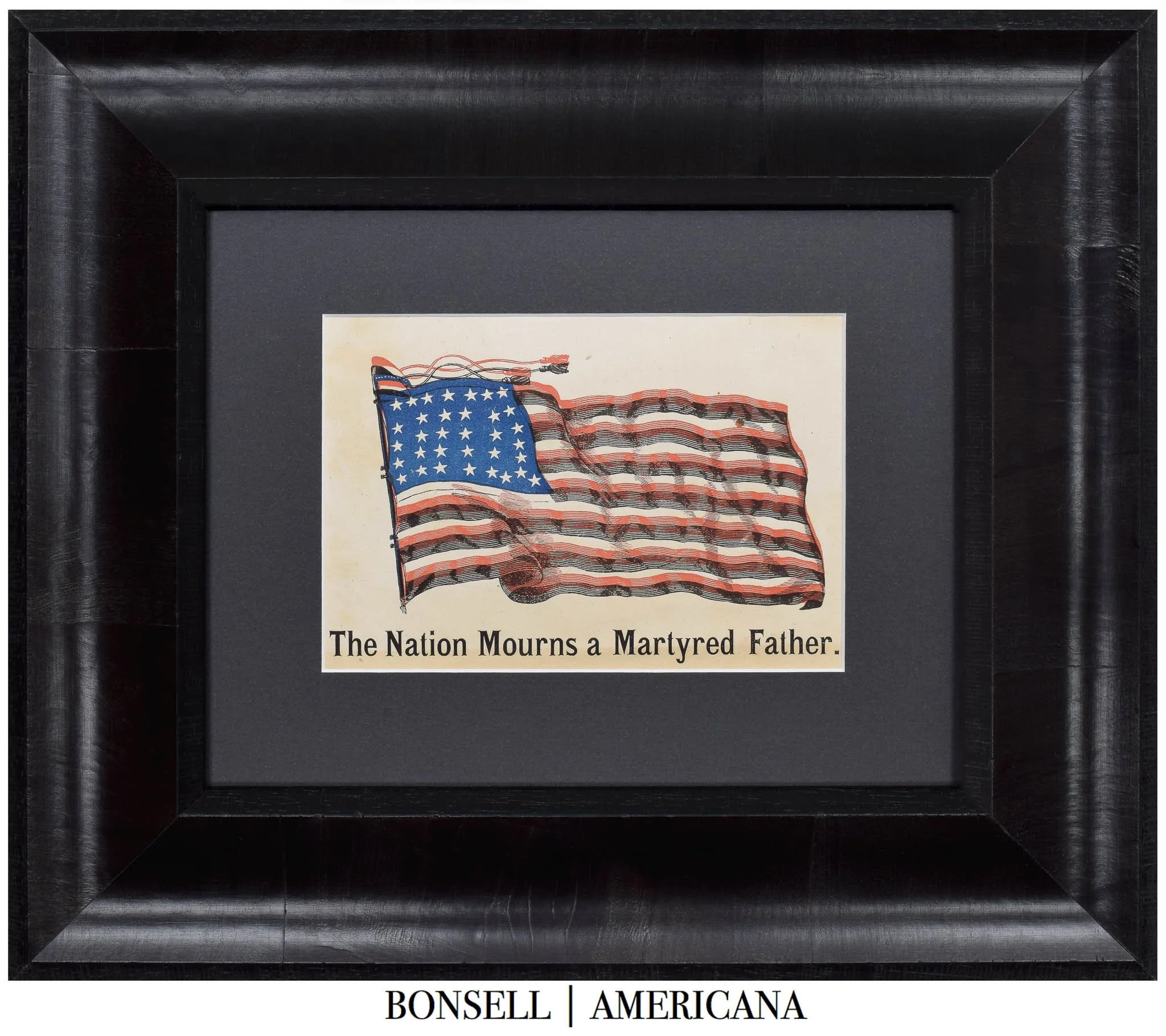
Frame Size (H x L): 12” x 14.25”
Flag Size (H x L): 4.25” x 6.25”
Offered is a paper broadside, featuring a flag and the following overprint: The Nation Mourns a Martyred Father. It was made to mourn the assassination of Abraham Lincoln and was likely handed out along his funeral route.
Flags printed on paper trade cards and broadsides tend to have unusual star patterns, and the flag offered herein aligns with this notion. It includes thirty-four stars that are neither arranged by column; nor by row; nor by concentric rings; nor by any logical manner, for that matter. Rather, the stars are arranged randomly, such that there is no distinct, recognizable pattern. The flag offered herein was made in 1865, even though thirty-four star flags were official only between 1861 and 1863. During the nineteenth century, makers sometimes used greater or fewer stars than the official number of stars, likely because it did not make a big difference to either the maker or the user, just as long as the number was relatively close to what was official.
More unique than the star pattern and count, however, is that the flag includes red, white, and black stripes—a feature that is unique, in our experience, to this broadside. It also includes red; white; and black tassels, flowing horizontally above the blue canton. Per Victorian-era tradition, black was used to show mourning and grief. Thus, following the assassination of Lincoln, everything from buildings, to homes, to outfits, and flags were draped in black (or made to include black, like in the case of the flag offered herein).
Paper mourning flags, made following Lincoln’s assassination, have survived in several different forms with several different overprints. For example, such flags featured in the Stars and Stripes, written by J. Richard Pierce, include the following overprints:
· GOD’S Illustrious Servant! FAITHFUL TO THE END.
· WE MOURN! OUR CHIEF HAS FALLEN.
· WE LOVE HIM—LIVING. WE REVERE HIM—DEAD
· THE NATION MOURNS A MARTYRED FATHER.
Lincoln mourning flags are as rare as these overprints are interesting, and they are a highly desirable subset of antique American flags. They also offer a comparatively affordable entry point into Lincoln related flags, as compared to Lincoln campaign flags, for example.
THE ASSASSINATION
On April 9th, 1865, Confederate General Robert E. Lee surrendered his army at Appomattox Court House, Virginia, ending the Civil War. It was assumed that the country would return to a peaceful state, and that such a return would be relatively swift and widespread. But just five days later, on April 14th, chaos erupted and sadness ensured yet again when John Wilkes Booth—a Confederate Sympathizer and famous actor—assassinated Lincoln at Ford’s Theater in Washington D.C.
Booth was born, in 1838, in Maryland, a state that allowed the slave trade, yet also a state that remained part of the Union. During the 1860s, he was one of America’s best known and most popular stage actors. He had leading roles from New Orleans to Chicago to Boston and many other cities therebetween. He was good looking, he was charming, and he was a heartthrob—so much so that he is thought to be the first actor to ever have his clothes torn off by adoring fans.
Booth hated abolitionists, whom he thought were destroying the country. He considered fighting for the Confederacy, but his mother talked him out of doing so. The guilt associated with staying on the sidelines was overwhelming to him, particularly as the defeat of the South was becoming more and more likely. The guilt was so debilitating that he and a group of associates—in a desperate attempt “to do something”—conspired to kidnap Lincoln, in Richmond, Virginia, the Capital of the Confederacy. They planned to kidnap Lincoln on March 20th, 1865, but their planned attack point never overlapped with his movements. Thus, their plan had been foiled.
Thereafter, Booth and his co-conspirators were growing increasingly desperate and becoming increasingly sinister, so much so that they pivoted their plan from kidnapping Lincoln to killing him. Booth saw an opening in which to assassinate Lincoln, after learning that Lincoln would attend Laura Keene’s performance of “Our American Cousin” at Ford’s Theatre. In coordination therewith, Booth’s associate, George Atzerodt, planned to kill Vice President Andrew Johnson at the Kirkwood Hotel, and Booth’s associates, Lewis Powell and David Herold, planned to kill Secretary of State William H. Seward at his home, the thinking being that killing Lincoln and his possible successors would throw the U.S. government into chaos. These two subplots were failures: Seward was only wounded, and Johnson was spared entirely as his would-be attacker lost his nerve.
Lincoln and Mary Todd Lincoln arrived late for the show, but even so, witnesses reported that Lincoln was happy, relaxed, and laughing throughout the production. They sat in a private box above the stage, along with Henry Rathbone, a young army officer, and Clara Harris, Rathbone’s fiancé and daughter of New York Senator Ira Harris.
At 10:15, Booth slipped into Lincoln’s private box and shot him in the head, using a .44-caliber derringer pistol and just a single shot therefrom. Rathbone rushed Booth. Booth countered by stabbing Rathbone in the shoulder. Booth then jumped out of the box and onto the stage. He broke his leg upon his landing and then shouted the Latin phrase “sic semper tyrannis,” which translates to “thus always to tyrants” in English, which translates to “I bring death to tyrants” in plain English. The audience initially thought that commotion was part of the production, but Mary Todd’s screams quickly suggested otherwise. Immediately thereafter, Booth left the theater and escaped by horseback. Despite this all happening in just seconds, many in the audience were still able to recognize the assassin as Booth, due to his widespread fame.
LINCOLN’S DEATH
After Lincoln was shot, Charles Leale, a young doctor who was in the audience, rushed to his side and found him slumped in his chair, unable to move, and struggling to breath. Soldiers carried Lincoln to a boardinghouse across from the theater and placed him into a bed. The surgeon general rushed to the boardinghouse, only to determine that Lincoln would die, likely sometime in the night.
Vice President Andrew Johnson, members of Lincoln’s cabinet, and several of Lincoln’s friends stood at his bedside. Mary Todd was in bed, in an adjoining room, overwhelmed with shock and grief, while Robert Todd, her eldest son, stood by her side in support. Lincoln died at 7:22 A.M. on April 15th. He was 56 years old.
BOOTH’S CAPTURE AND DEATH
On April 26th, Union soldiers found Booth and David Herold, an accomplice, in a Virginia barn. The soldiers set the barn on fire, the purpose being to flush them from the barn and to capture them. Indeed, Herold surrendered. But in contrast, Booth stayed in the barn and allegedly raised his gun to shoot at the surrounding soldiers. To counter, one of the soldiers shot Booth in his neck. Thereafter, the soldiers carried Booth from the barn. He died just three hours later, but not before gazing at his hands and uttering his last words, “useless, useless.”
MOURNING LINCOLN
The news of Lincoln’s death spread like wildfire and sent shockwaves through the nation. By the end of April 15th, flags were at half-mast, the country was shut down, and the jubilee associated with the War’s end was replaced with the mourning associated with Lincoln’s assassination. Also, by the end of April 15th, Lincoln’s body was back at the White House, specifically in the East Room thereof for several days of public viewing. On April 19th, there was a funeral service and, thereafter, his body was transported down Pennsylvania Avenue and placed in the Capitol Rotunda for further viewings and services.
On April 21st, the honor guard took Lincoln’s body to the train depot, and the train then departed from Washington D.C. with 10,000 people in attendance, including cabinet secretaries, Edwin Stanton, Gideon Welles, Hugh McCulloch, and John Palmer Usher; the Commanding General of the U.S. Army, Ulysses S. Grant; and the Quartermaster General, Montgomery C. Meigs. The last stop on the train route was Springfield, Illinois, Lincoln’s hometown. The trip thereto generally traced (in reverse) Lincoln’s route, from Springfield to Washington, in 1860, to attend fist first inauguration.
In total, citizens observed, honored, and mourned Lincoln along 1,654 miles of track and at stops in Washington D.C.; Baltimore, Maryland; Harrisburg, Pennsylvania; Philadelphia, Pennsylvania; New York City; Albany, New York; Buffalo, New York; Cleveland, Ohio; Columbus, Ohio; Indianapolis, Indiana; Michigan City, Indiana; Chicago, Illinois; Springfield, Illinois. Lincoln’s funeral train was the first commemoration of a president’s death via rail.
THIRTY-FOUR STAR FLAGS GENERALLY
The thirty-four star flag represents the inclusion of Kansas to the Union. Kansas was admitted on January 29th, 1861, and this flag became official on July 4th, 1861. President Lincoln served, and the Civil War was fought, under this star count. Many thirty-four star flags predate the first shots of the Civil War in 1861, as flag makers began producing them upon the admission of the Kansas, instead of the time at which the flag was officially admitted to the Union later in the same year. The thirty-four star flag was official until July 4th 1863, the time at which the thirty-five star flag became official and began to represent the inclusion of West Virginia in the Union.
Thirty-four and thirty-five star flags were the official flags for the majority of the Civil War, and for this reason, both are extremely collectible. Flags associated with this time period (1861-1865) and earlier are among the rarest and most desirable of all US flags. Prior to the Civil War, Americans did not typically display flags for patriotic purposes. In fact, even the military did not regularly use the flag, as it was not until 1834 that the army field artillery was permitted to carry the traditional US flag, and not until 1841 that regiments carried it. Instead, most flags prior to the Civil War were used to mark ships, and were massive in scale so as to be seen from large distances. The surge in small US flags for patriotic purposes began primarily with onset of the Civil War.
Conservation Process: The flag is mounted behind a mat and Optium Museum Acrylic.
Frame: The flag offered herein is in an outstanding, modern black frame.
Condition Report: There is some age-appropriate toning. Overall, the flag is in excellent condition.
Collectability Level: The Great – Perfect for Rising Collectors
Date of Origin: 1865
Number of Stars: 34
Associated War: The Civil War (1861-1865)
Associated State: Kansas

Frame Size (H x L): 27” x 35”
Flag Size (H x L): 15.5” x 25”
Offered is a 35-star American flag printed on plain weave cotton, commemorating the 71st New York Volunteer Infantry with overprinted battle honors. This exceedingly rare type is one of just a handful of known varieties of printed parade flags with regimental battle honors, making it an exceptional survivor from the postwar era of remembrance.
The stars are arranged in a medallion configuration: two concentric wreaths with a large center star and four flanking stars in the corners of the canton. This design recalls the pattern used on Civil War flank markers (guidons). While the medallion is a recognized arrangement, it is rarely encountered in printed parade flags, lending this example a striking visual distinction.
The regiment’s designation, “71ST NEW YORK VOL. INFT”, is boldly printed across the fourth white stripe. Above appears BULL RUN, while FREDERICKSBURG and CHANCELLORSVILLE appear below, side by side. Anchoring the design is GETTYSBURG. The presence of these inscriptions ties the flag directly to the service of the regiment in a way that is almost never seen in printed flags.
THE 71ST NEW YORK VOLUNTEER INFANTRY & ITS BATTLE HONORS
The 71st New York Volunteer Infantry, part of Daniel Sickles’ Excelsior Brigade, mustered into service in the summer of 1861 with recruits from Cattaraugus, Delaware, and Ulster counties. Its baptism of fire came at Bull Run in July 1861, where the regiment fought in the Union Army’s first major engagement. The battle ended in Confederate victory, but the experience marked the beginning of the 71st’s service.
The regiment next saw heavy action at Fredericksburg in December 1862, one of the Union’s most severe defeats. The 71st participated in the bloody assaults on fortified Confederate positions at Marye’s Heights, contributing to the staggering Federal casualties.
At Chancellorsville in May 1863, the 71st endured the shock of Stonewall Jackson’s flank attack. Though the larger battle was another Union defeat, the regiment managed to withdraw under intense pressure, sustaining heavy losses in the process.
Their defining service came at Gettysburg in July 1863, where they fought on the second day in the Wheatfield and Peach Orchard. The ground shifted hands repeatedly in brutal, close-quarter fighting, and the regiment’s defense helped blunt the Confederate advance on the Union left. Though it suffered heavily, the 71st’s stand at Gettysburg linked its name permanently with the battle that became the turning point of the war.
After Gettysburg, the regiment continued in the Eastern Theater until July 1864, when the original term of enlistment expired. While many men were discharged, others responded to President Lincoln’s personal appeal to extend their service. The regiment’s reputation for endurance and sacrifice was honored in the postwar years, when veterans gathered at reunions where flags such as this were displayed.
PRODUCTION & DATING
The materials and printing technique of this flag are highly unusual. Unlike the coarse, glazed cotton and vegetable-based dyes typically used on 19th-century parade flags, this flag is made from a plain weave cotton of atypical weight and bears a pigment that has a paint-like quality. The method suggests production outside the ordinary flag trade — possibly by a skilled printer who had never before made flags, working under deadline to produce commemorative pieces for a reunion.
Scholars have debated the precise dating. Some have speculated as early as 1864, though the absence of coarse cotton and orange-faded dyes suggests manufacture after 1880. On the other hand, the 50th anniversary of Gettysburg in 1913 provides a logical “no-later-than” date. The most likely range is 1880–1913, coinciding with the height of veterans’ reunions.
A small cache of these flags was discovered decades ago by a Civil War enthusiast at a Pennsylvania flea market, rolled up under a table. Though dispersed, examples occasionally resurface, each reaffirming the unusual character and limited production of this type.
THE 35-STAR FLAG
The 35-star flag represents the admission of West Virginia to the Union on June 20, 1863, a moment of political and symbolic importance. West Virginia was formed during the Civil War when the northwestern counties of Virginia, loyal to the Union, broke away in opposition to secession. President Abraham Lincoln signed the statehood bill in December 1862, and after a period of debate over its constitutionality, the new state was formally admitted the following summer.
The flag with 35 stars became official on July 4, 1863, one day after the conclusion of the Battle of Gettysburg and at nearly the same time as the Union victory at Vicksburg. These twin triumphs, coupled with the addition of a new loyal state, represented a turning point in the war when Union confidence was restored.
The 35-star flag is unique in being the only star count both added and recognized during the Civil War itself. It remained official until July 4, 1865, when a 36th star was added for Nevada. In practice, many flag makers continued to produce 34-star flags throughout 1863, partly because of existing stock and partly because updates were slow to spread. This makes true period 35-star flags comparatively rare.
Because of this scarcity, and because of their association with the turning point of the war, the 35-star count is regarded as one of the most evocative of the Civil War era. Reunion-period examples like the present flag, especially those that directly tie to regiments and their battle honors, embody both the symbolism of Union expansion and the lived memory of the men who fought to preserve it.
SIGNIFICANCE
This flag brings together an uncommon star configuration, regimental designation, and printed battle honors in a form seldom encountered. Its unusual materials, compelling design, and layered historical context—touching on West Virginia statehood, Union battlefield service, and the culture of postwar remembrance—place it among the most historically resonant printed flags of the late 19th and early 20th century.
Conservation Process: This flag was hand sewn to cotton fabric, and both were hand sewn to a mounting board. To prevent the black dye in the cotton fabric from seeping into the flag, it was first washed in a standard wash and then in a dye setting wash. The flag is positioned behind Optium Museum Acrylic.
Frame: This offering is in our Large Distressed Black and Gold Frame.
Condition Report: The flag shows expected age-related wear consistent with its period. There is soiling and staining scattered across the stripes, most notable in the white fields around the regimental designation and battle honors. Small holes and fabric losses are present, particularly along the fly end and in the area of the overprint text, though these have been masked with matching fabric to stabilize the presentation. Despite these imperfections, the colors remain strong, and the inscriptions are clear and legible.
Collectability Level: The Extraordinary – Museum Quality Offerings
Date of Origin: 1880-1913
Number of Stars: 35
Associated War: Civil War (1861-1865)
Associated State: West Virginia
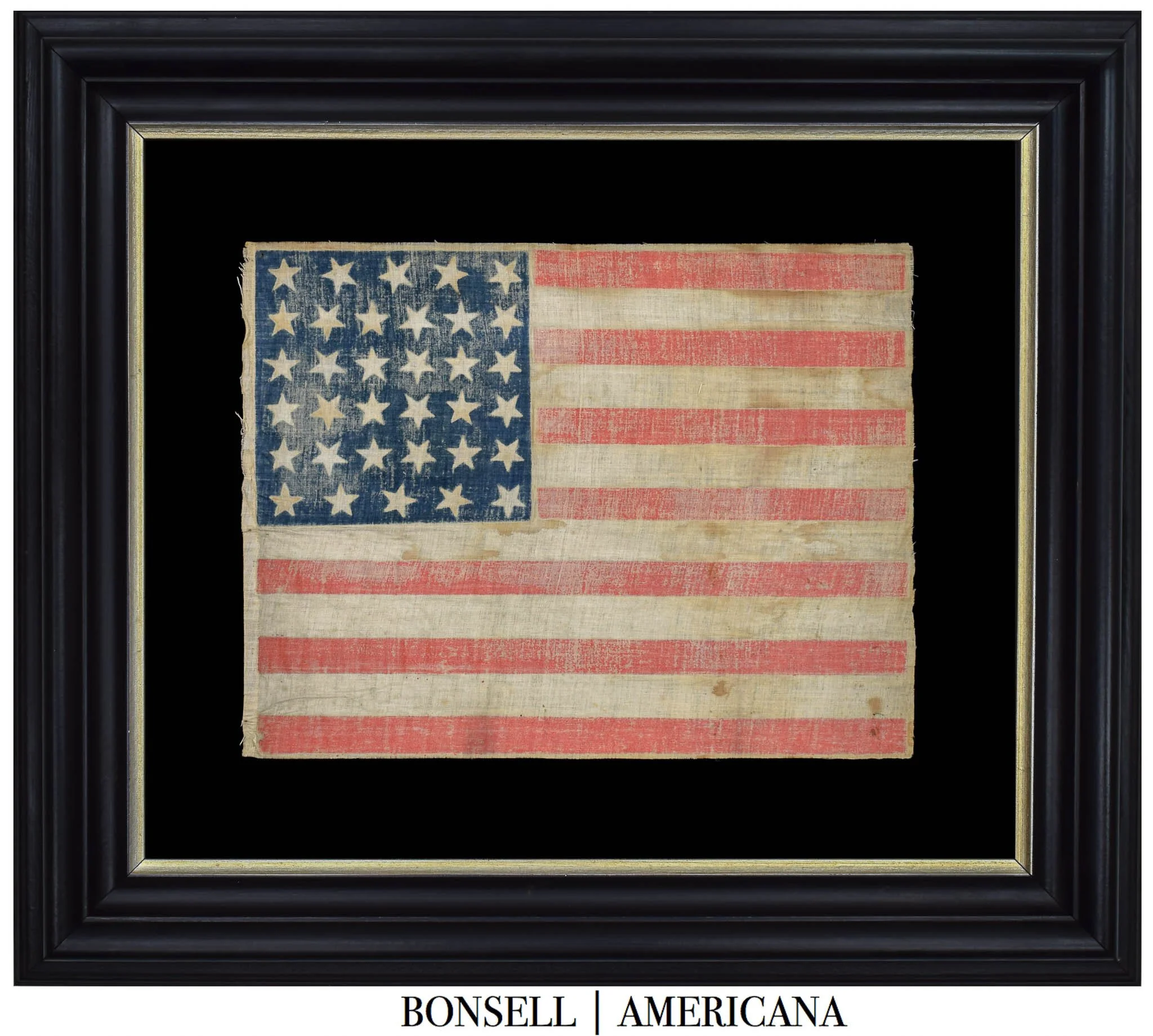
Price: Call 618-553-2291, or email info@bonsellamericana.com
Frame Size (H x L): 22” x 25.5”
Flag Size (H x L): 11” x 15”
Offered is a thirty-four star antique flag printed on glazed cotton. Its stars are arranged in a 5-6-6-6-6-5 pattern. The stars in the first and sixth rows are canted in various directions. In contrast, the stars in the other rows are tumbling relative to one another, creating a dancing effect between the stars as they appear to be partnering and dancing with one another. When the second through fifth rows are instead viewed as columns, the stars are pointing either consistently upwards or consistently downwards.
This flag is square in its proportions, instead of elongated. The First Flag Act of 1777 did not specify the dimensions or proportions of the American flag. And such freedom extended up until 1912, the time at which President Taft issued Executive Order 1556, establishing official proportions.
The stripes of this flag are closer to orange than red. Such a color is a result of the use of either madder or cochineal to create the red dye, and is common in flags dating between 1850 and 1880. The orange color of the “red” stripes is attractive and a desirable to collectors.
The thirty-four star flag represents the inclusion of Kansas to the Union. Kansas was admitted on January 29th, 1861, and this flag became official on July 4th, 1861. President Lincoln served, and the Civil War was fought, under this star count. Many thirty-four star flags predate the first shots of the Civil War in 1861, as flag makers began producing them upon the admission of the Kansas, instead of the time at which the flag was officially admitted to the Union later in the same year. The thirty-four star flag was official until July 4th 1863, the time at which the thirty-five star flag became official and began to represent the inclusion of West Virginia in the Union.
Thirty-four and thirty-five star flags were the official flags for the majority of the Civil War, and for this reason, both are extremely collectible. Flags associated with this time period (1861-1865) and earlier are among the rarest and most desirable of all US flags. Prior to the Civil War, Americans did not typically display flags for patriotic purposes. In fact, even the military did not regularly use the flag, as it was not until 1834 that the army field artillery was permitted to carry the traditional US flag, and not until 1841 that regiments carried it. Instead, most flags prior to the Civil War were used to mark ships, and were massive in scale so as to be seen from large distances.
The surge in small US flags for patriotic purposes began primarily with onset of the Civil War. This flag was made during this surge and is a rare survivor. In fact, this is the only example of this style of flag that we have encountered.
Conservation Process: This flag was hand sewn to cotton fabric, and both were hand sewn to a mounting board. To prevent the black dye in the cotton fabric from seeping into the flag, it was first washed in a standard wash and then in a dye setting wash. The flag is positioned behind Optium Museum Acrylic.
Frame: This offering is in a distressed black and silver frame.
Condition Report: This flag exhibits some staining and foxing. Its stripes and canton are faded. Despite these issues, this flag displays well and has the Civil War era appearance that our clients desire.
Collectability Level: The Best – Perfect for Advanced Collectors
Date of Origin: 1861-1863
Number of Stars: 34
Associated War: The Civil War (1861-1865)
Associated State: Kansas
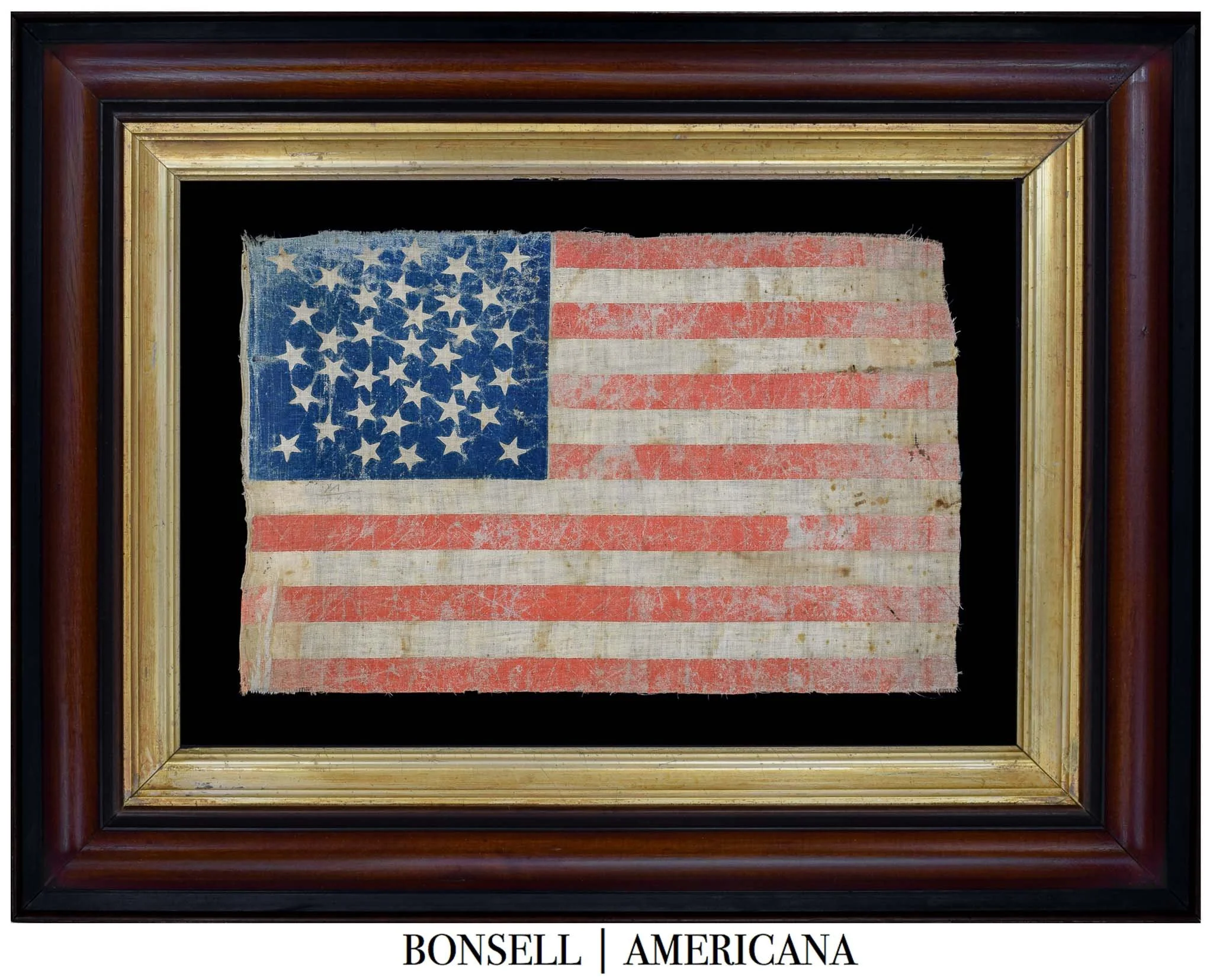
Frame Size (H x L): 22” x 29”
Flag Size (H x L): 11.5” x 18”
Offered is a thirty-six star antique flag printed on coarse glazed cotton. It is a medium sized flag that is big enough to make a statement, yet small enough that it can be displayed almost anywhere.
The stars of this flag are in a whimsical medallion configuration. Upon initial inspection, the stars thereof appear to be arranged randomly. But upon closer inspection, the inner stars of the medallion are arranged purposely, so as to define a “Grand Luminary” configuration. This combination—basically, a medallion that defines a Grand Luminary, not to mention the flanking corner stars—is amongst the most rare and desirable configurations one will ever encounter.
The Grand Luminary configuration is a large star made of smaller stars. The smaller stars may be a variety of sizes, and they may be canted in a variety of directions. Such a configuration was for a time perfectly acceptable, as prior to an Executive Order in 1912, flag makers were free to place the stars however they wished.
US Naval Captain Samuel Reid is credited with designing the Grand Luminary configuration in 1818. Reid was an officer in the US Navy and commanded the privateer General Armstrong during the War of 1812. Andrew Jackson credited Reid's heroism in delaying the British Squadron in the Battle of Fayal and aiding in General Jackson's defense of New Orleans. Reid and his crew were considered heroes.
The Second Flag Act, passed in 1794, stated that the flag would have fifteen stars and fifteen stripes, in response to Vermont and Kentucky being added to the Union. Knowing that this approach would be unsustainable, with Reid's help, Congress passed the Flag Act of 1818, specifying that the flag should have thirteen stripes and a star for each state admitted to the Union. It further specified that the addition of each star should be on the Fourth of July following each respective state's admission.
Reid played a significant role in the Flag Act of 1818, and in doing so, he recommended several potential star configurations, including twenty stars in the shape of a larger star for general use. Reid suggested this configuration to make the flag consistent and easily identifiable, particularly at long distances and at sea. His star configuration recommendation was not ultimately included in the Act, nor was any star configuration, but still Reid is universally credited with designing the Grand Luminary. Its use peaked in the 1840s, but it was also used during the Civil War and occasionally during Centennial Celebrations. Its last known commercial use was on thirty-eight star flags.
Thirty-six star flags represent the inclusion of Nevada to the Union, and such flags were waved in celebration of the conclusion of the Civil War. Nevada was admitted on October 31st, 1864, and this flag became official on July 4th, 1865. Nevada was originally part of the Utah Territory beginning in 1850, became its own territory in 1861, and became its own state in 1864.
The timing of Nevada's inclusion was politically and economically based. For political reasons, Nevada was admitted to the Union just eight days prior to President Lincoln's re-election bid against General George McClellan. Such timing was meant to benefit Lincoln and his fellow Republicans. For economic reasons, Nevada was included as part of the Union to help it pay off the country’s war debts. Economically, Nevada was particularly attractive at the time, because of its significant silver mining industry. Nevada expanded its borders in 1866 when the western Utah Territory was added to its eastern side, and further expanded in 1867 when a portion Pah-Ute County in the Arizona Territory was added to its southern side.
The thirty-six star flag was the official flag for the last six months of the Civil War, and was used by the military during that time. It was also the official flag during a portion of the Reconstruction era. The thirty-six star flag was official until July 4th, 1867, the time at which the thirty-seven star flag became official and began to represent the inclusion of Nebraska in the Union.
Conservation Process: This flag was hand sewn to cotton fabric, and both were hand sewn to a mounting board. To prevent the black dye in the cotton fabric from seeping into the flag, it was first washed in a standard wash and then in a dye setting wash. The flag is positioned behind Conservation Clear Acrylic (standard) or behind Optium Museum Acrylic (per request).
Frame: This flag is in a multitiered frame with an outer walnut layer and an inner gilded layer. It dates to between 1860 and 1890.
Condition Report: There is a small tear that runs parallel to the hoist edge. The small tear begins at the bottom edge and extends approximately two inches. We masked the tear with old glazed cotton. Thus, the tear has been camouflaged. There is minor fading through the blue canton and the red stripes. There is notable fading located across the top of the canton. Further, there is notable fading and staining that is vertically oriented near the fly end (i.e., the 20% closest thereto). This flag was likely rolled and placed into storage. Over time, the outermost portion of the roll was damaged, while the innermost portion was protected. Such damage is encountered in many antique flags, because they were easiest to store in this fashion, particularly those of which that were attached to a staff. Its overall appearance is age appropriate and extremely attractive. Simply put, this is the appearance that collectors desire.
Collectability Level: The Best – Perfect for Advanced Collectors
Date of Origin: 1864-1867
Number of Stars: 36
Associated War: Civil War (1861-1865)
Associated State: Nevada

Price: Call 618-553-2291, or email info@bonsellamericana.com
Frame Size (H x L): 55” x 80”
Flag Size (H x L): 42” x 68”
Offered is an extremely desirable thirty-six star flag. The stars on this flag are arranged in a "Great Star" pattern, one of the rarest and most beautiful patterns encountered in antique flags. The Great Star pattern is a large star made of smaller stars. The smaller stars may be a variety of sizes and be canted in a various directions. Such a pattern was perfectly acceptable, as prior to President Taft's Executive Order 1556 in 1912, flag makers were free to place the stars however they wished.
US Naval Captain Samuel Reid is credited with designing the Great Star pattern in 1818. Captain Reid was an officer in the US Navy and commanded the privateer General Armstrong during the War of 1812. Andrew Jackson credited Captain Reid's heroism in delaying the British Squadron in the Battle of Fayal, and aiding in General Jackson's defense of New Orleans. Captain Reid and his crew were greeted as heroes.
The Second Flag Act, passed in 1794, stated that the flag would have fifteen stars and fifteen stripes, in response to Vermont and Kentucky being added to the Union. Knowing that this approach would not be sustainable, with Captain Reid's help, Congress passed the Flag Act of 1818, specifying that the flag should only have thirteen stripes, but should have a star for each state admitted to the Union. It further specified that the addition of each star should be on the Fourth of July following its respective state's admission.
Captain Reid played a significant role in the Flag Act of 1818, and recommended a basic design of thirteen horizontal alternating stripes in honor of the thirteen colonies, and a star in honor of each state. He further recommended several potential star patterns, including twenty stars in the shape of a larger star for general use. Reid suggested this pattern to make the flag consistent and easily identifiable, particularly at long distances and at sea. His star pattern recommendation was not ultimately included in the Act, nor was any star pattern, but Captain Reid is universally credited with designing the Great Star pattern. Its use peaked in the 1840s, but it was also used during the Civil War and occasionally during Centennial Celebrations. Its last known commercial use was on a thirty-eight star flag.
The stripes and canton of this flag are made of fine, blended wool. The use of such wool for the stripes is unusual for a Civil War era flag and indicates that this was a premium flag (as opposed to one with regular wool stripes), probably intended for a wealthy or discerning customer.
The stripes are individually cut and machine sewn together, the canton is machine sewn to the stripes, and the hoist is machine sewn to both the stripes and canton. More specifically, the stripes, the canton, and the hoist are joined via treadle stitching. Treadle stitching was a technical possibility beginning in the 1830s, but not a realistic possibility until the 1850s. Treadle stitching became relatively common by the 1860s and was used in approximately half of flags made between 1861 and 1865, typically to sew the stripes, the canton, and/or the hoist.
The stars of this flag are made of cotton. They are sewn to both sides of the canton (i.e., double appliequed), using a lineal treadle stitch. Lineal treadle stiches are most commonly found on flags dating between 1885 and 1895. Prior to this time, stars were commonly applied by hand, and after this, they were commonly applied using a zig-zag stitch. While lineal treadle stitches were sometimes used to sew the stars on Civil War flags, it is the exception, rather than rule. The reason for its rarity in this era is simply a function of the available technology. Prior to Singer’s introduction of the electric sewing machine in 1889, flag makers applying a lineal stich had to place each star on the canton, fold its edges under, pump a treadle machine—and while doing all of this—properly move both the star and canton through it. While this was not an impossible task, the introduction of the electric sewing machine made it much easier. By 1895, most flag makers had transitioned away from the lineal stitch and to the zig-zag stitch, as its use provided the advantage of not having to fold the edges of the stars.
This flag is small in size for a piece-and-sewn flag, dating to the Civil War. This adds considerably to its appeal, as it can be easily displayed. It was not until the Civil War that small piece-and-sewn flags were made with any frequency at all, and not until the 1890s that they were made with regularity. During most of the 19th century, flags made with piece-and-sewn construction had a width of at least eight feet, as they were typically used as signaling devices for the military or by sailors. Even the flags that were used for decorative purposes usually had a width of six feet or more, and versions smaller than this were quite rare.
The thirty-six star flag represents the inclusion of Nevada to the Union. Nevada was admitted on October 31st, 1864, and this flag became official on July 4th, 1865. Nevada was originally part of the Utah Territory beginning in 1850, became its own territory in 1861, and became its own state in 1864. The timing of Nevada's inclusion was politically and economically based. For political reasons, Nevada was admitted to the Union just eight days prior to President Lincoln's re-election bid against General George McClellan. Such timing was meant to benefit Lincoln and his fellow Republicans. For economic reasons, Nevada was included as part of the Union to help it pay off the country’s war debts. Economically, Nevada was particularly attractive at the time, because of its significant silver mining industry. Nevada expanded its borders in 1866 when the western Utah Territory was added to its eastern side, and further expanded in 1867 when a portion Pah-Ute County in the Arizona Territory was added to its southern side.
The thirty-six star flag was the official flag for the last six months of the Civil War, and was used by the military during that time. It was also the official flag during a portion of the Reconstruction era. Ultimately, the thirty-six star flag was official until July 4th, 1867, the time at which the thirty-seven star flag became official and began to represent the inclusion of Nebraska in the Union.
Conservation Process: This flag was hand sewn to silk organza, and both were hand sewn to cotton fabric. The silk organza provides a strong layer of protection and a professional appearance. The flag, the silk organza, and the cotton fabric were then hand sewn to a mounting board. To prevent the black dye in the cotton fabric from seeping into the flag, it was first washed in a standard wash and then in a dye setting wash. The flag is positioned behind Conservation Clear Acrylic (standard) or behind Optium Museum Acrylic (per request).
Frame: This offering is in a special edition X-Large Frame. However, it can be reframed and would look great using any one of our standard Large or X-Large Frames, which are shown in the final two images. The pricing associated with the different framing options may vary. Reframing of an offering may delay shipment by up to two weeks.
Condition Report: This flag exhibits minor mothing and a tear near its hoist edge. It otherwise in excellent condition and among the best-preserved examples of the Civil War era.
Collectability Level: The Extraordinary – Museum Quality Offerings
Date of Origin: 1864-1867
Number of Stars: 36
Associated War: Civil War (1861-1865)
Associated State: Nevada
Price: Call 618-553-2291, or email info@bonsellamericana.com
Frame Size (H x L): 12” x 14”
Flag Size (H x L): 5.5” x 8”
Offered is a 13-star antique American parade flag, printed on glazed cotton, and exhibiting one of the rarest star configurations found on any 19th-century printed American flag. The 13 stars are arranged to form a large, six-pointed version of the “Great Star” or “Great Luminary” pattern, in which a larger star is created from a constellation of smaller stars.
Great Star flags are highly prized among collectors, but this six-pointed interpretation is far more unusual than the five-pointed versions more commonly encountered in American flag design. The result is both graphic and mysterious: a bold, star-shaped device that immediately distinguishes this flag from nearly all other 13-star parade flags.
Printed parade flags exhibiting this pattern are extremely rare and are known in what we refer to as small, medium, and large varieties. The example offered here is the medium version, measuring approximately 5.5" x 8". Within this scarce family, the medium variety is limited to just four or five known examples, one of which includes a “Lincoln & Hamlin” overprint from Abraham Lincoln’s 1860 presidential campaign.
The flag dates to approximately 1848–1865. The beginning of this date range is based on the early use of printed parade flags in presidential campaigning by 1848, while the latter date corresponds with the conclusion of the Civil War. The rarity of this six-pointed star configuration, together with the flag’s coarse glazed cotton, early printing method, dyes, and the existence of the related Lincoln & Hamlin campaign example, strongly supports a date from the Civil War era or earlier.
The reason for arranging the stars in this six-pointed form is unknown, though two principal explanations are plausible.
As a first theory, the six-pointed star may reference the constellation of stars above the eagle on the Great Seal of the United States. The Great Seal, adopted in 1782, was created to authenticate official documents of the federal government and became one of the nation’s most important symbols. Francis Hopkinson played a key role in designing the Great Seal and has also often been credited as a designer of the United States flag, in contrast to the more familiar but historically debated Betsy Ross tradition. Although original sketches for the stars on the Great Seal were more loosely arranged, the engraver of the original die selected a six-pointed star form, likely influenced by European heraldic convention.
As a second, alternative theory, the configuration may be visually related to the Star of David, also known as the Shield of David. Modern viewers naturally recognize the six-pointed form in that context. The symbol itself dates back centuries and was used historically in decorative, ancestral, and religious contexts, though its widespread adoption as a primary emblem of Jewish identity developed more fully over time. By the 19th century, its use among European Jewish communities had increased, making the association possible within the period of this flag’s manufacture.
That said, the Star of David interpretation should be treated as a possibility rather than a certainty. The six-pointed form may instead have been selected because it was a balanced, visually logical, and highly effective way to arrange 13 stars into one larger star-shaped device. Whatever the maker’s intention, the result is among the most distinctive star patterns known in early American printed flags.
The flag is printed on glazed cotton, a material commonly associated with early parade flags. These small printed flags were inexpensive, portable, and intended for temporary display at political rallies, patriotic events, civic gatherings, and public celebrations. Their survival is often precarious because they were not generally made as permanent objects. The coarse weave, irregular printing, and softened red and blue pigments give this example the surface and character collectors associate with early printed cotton flags.
Prior to the Civil War, private use of the American flag was comparatively limited. Most early parade flags made for the civilian market appear to have been used in political rallies, campaign events, and other public gatherings. The known Lincoln & Hamlin example in this same general style is therefore especially important. It suggests that flags of this pattern were likely produced for political display, even when surviving examples do not bear printed campaign text.
While we may never know whether this flag was intended to reference the Great Seal, the Star of David, another historical source, or simply the most elegant arrangement of 13 stars into a six-pointed device, its importance is clear. It belongs to one of the rarest families of 13-star printed parade flags known to survive. Small in scale but powerful in design, it is an exceptional example for collectors of early American flags, political textiles, and rare patriotic printed cottons.
The original use of the 13-star flag dates to June 14, 1777, when the Continental Congress adopted the first official flag resolution. The resolution stated: “Resolved, that the flag of the United States be made of thirteen stripes, alternate red and white, that the union be thirteen stars, white on a blue field, representing a new constellation.” Thirteen-star flags were official from 1777 until 1795, but they have remained in use throughout American history.
The 13-star count was later used for a wide variety of patriotic, military, political, and commemorative purposes. Small U.S. Navy boats used 13-star flags as ensigns from 1795 until 1916, in part because fewer stars were easier to distinguish at a distance on small flags. Commercial flag-makers mirrored this practice, and some private vessels also flew 13-star flags during the same general period.
Thirteen-star flags were also flown in connection with major patriotic events, including observances following George Washington’s death in 1799, celebrations of the nation’s 50th anniversary in 1824, and public commemorations surrounding General Lafayette’s return to the United States in 1824–1825. Lafayette’s tour inspired celebrations in New York, Boston, Philadelphia, and many other communities throughout the country.
The 13-star flag also carried special meaning during the Mexican War and the Civil War. Both conflicts inspired renewed patriotic display, and during the Civil War especially, the flag became a powerful public symbol of Union, liberty, and national preservation. In that context, the 13-star count deliberately recalled the original colonies and the founding struggle for American independence.
Thirteen-star flags were again widely displayed during the Centennial celebrations of 1876, most notably at the Centennial International Exhibition in Philadelphia. By that time, the 13-star flag had become both a historic emblem and a flexible patriotic device, capable of referring to the Revolution, the Founding generation, national unity, and American endurance.
This example is especially compelling because it combines that historic 13-star symbolism with one of the rarest and most visually arresting star patterns known in early printed American flags. Its small scale, coarse glazed cotton, early printing, and six-pointed Great Star configuration make it a remarkable survivor from the formative period of American political and patriotic display.
Conservation Process: The flag was hand sewn to cotton fabric, and both were hand sewn to a mounting board. To prevent the black dye in the cotton fabric from seeping into the flag, it was first washed in a standard wash and then in a dye setting wash. The flag is positioned behind Optium Museum Acrylic.
Frame: A handsome 19th-century American frame with a rich, dark, hand-finished surface exhibiting pronounced craquelure throughout, indicative of age and original finish. The textured, slightly irregular surface and warm tonality provide a strong visual counterpoint to the textile, enhancing its period presence without distraction.
Condition Report: Condition is very good for an early printed parade flag of this type, with expected oxidation, minor staining, surface soiling, and scattered pigment loss throughout. There is fraying along the perimeter, especially at the fly end and along the top and bottom edges, with small areas of thread separation and fabric loss. A small horizontal tear is present near the fly end. The printed colors remain attractive, with a pleasingly faded red and strong blue canton, and the overall presentation is excellent.
Collectability Level: The Best – Perfect for Advanced Collectors
Date of Origin: 1848-1865
Number of Stars: 13
Associated War: The Civil War (1861-1865)
Associated State: Original 13 Colonies