
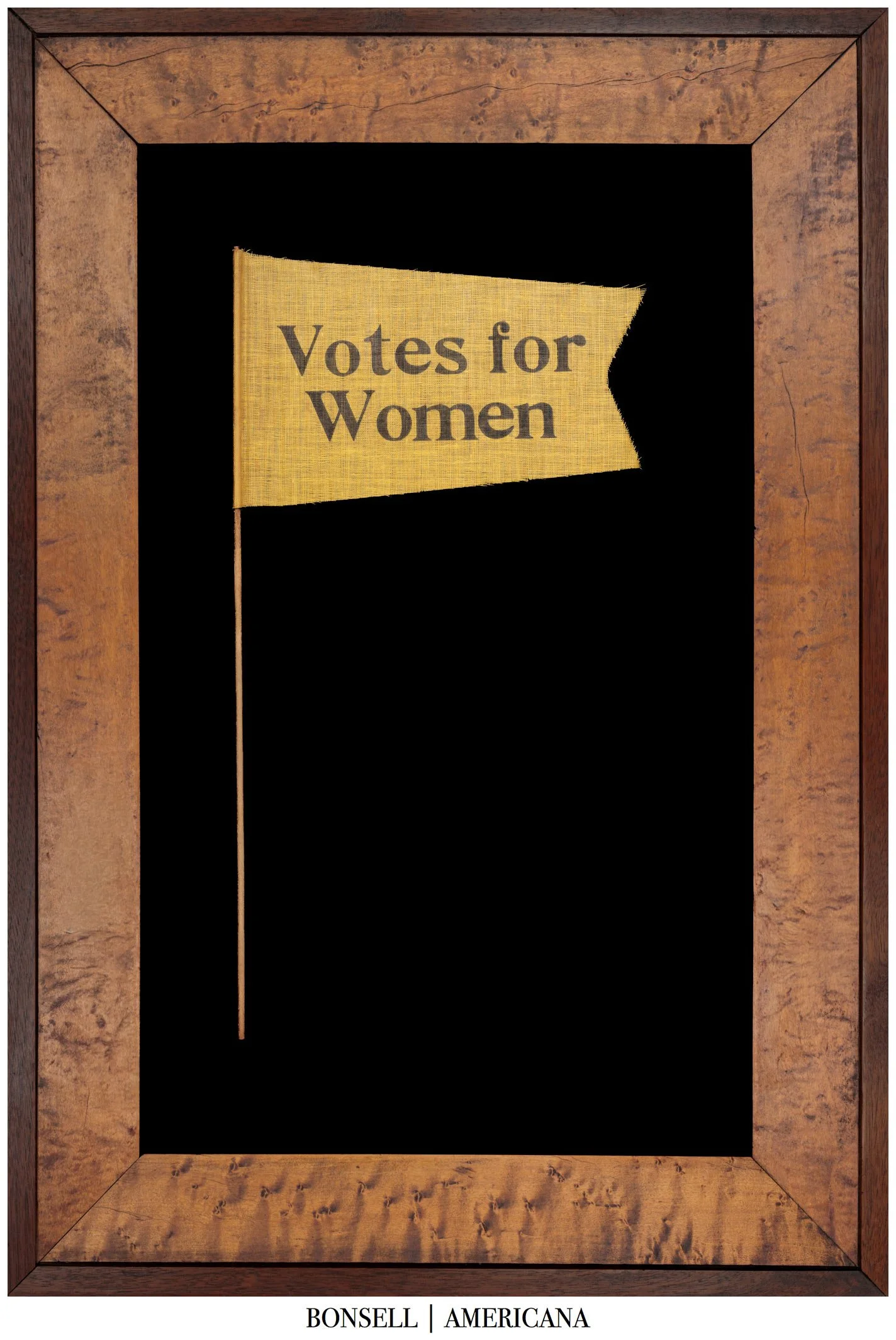
Frame Size (H x L): 31.5” x 21.5”
Pennant Size (H x L): 6.25” x 10” and Affixed to an 18” Staff
Offered is an American women’s suffrage pennant advocating “Votes for Women.” The pennant is made of cotton and constructed in a swallowtail form, a shape commonly used for political and reform-related textiles in the late-19th and early-20th centuries. The field is yellow, with the slogan printed in black across the surface. The pennant remains affixed to its original wooden staff.
Yellow was the primary color associated with the women’s suffrage movement in the United States and was widely adopted by suffrage organizations beginning in the late-19th century. It was frequently paired with black to create a bold, high-contrast design that could be read easily during marches, meetings, and public demonstrations. Pennants and related textiles were produced for active use and functioned as direct statements of political purpose.
The organized movement for women’s voting rights in the United States is generally traced to 1848, when Lucretia Mott and Elizabeth Cady Stanton convened the first women’s rights convention in Seneca Falls, New York. That meeting produced the Declaration of Sentiments, a document asserting women’s claims to political equality, education, and employment. Over the following decades, the movement expanded through conventions, lectures, and organized advocacy.
In 1906, Harriot Stanton Blatch—daughter of Elizabeth Cady Stanton—founded the Equality League of Self-Supporting Women, later renamed the Women’s Political Union. This organization focused on mobilizing working-class women and increasing the public visibility of the suffrage movement. In 1910, the group organized the first large-scale suffrage march in the United States, held in New York City. Textiles such as pennants and banners were used extensively during this period to convey clear, readable messages during marches and public gatherings.
Although early efforts focused on securing voting rights at the state level, it became increasingly clear that a constitutional amendment was necessary to guarantee suffrage nationwide. Proposed amendments were introduced in Congress in 1878 and again in 1914, but both attempts failed. Momentum shifted during and after World War I, when women’s contributions to the war effort helped secure bipartisan political support. In January 1918, the House of Representatives approved a suffrage amendment by the required two-thirds majority, followed by Senate approval in June 1919.
On August 18, 1920, Tennessee became the thirty-sixth state to ratify the amendment, providing the necessary three-quarters majority of states. Eight days later, on August 26, 1920, the Nineteenth Amendment was formally adopted into the Constitution, stating:
“The right of citizens of the United States to vote shall not be denied or abridged by the United States or by any State on account of sex. Congress shall have power to enforce this article by appropriate legislation.”
Surviving suffrage pennants are uncommon, particularly examples that retain their original staff and exhibit strong color and legibility. Pieces such as this were produced for use in marches, meetings, and public demonstrations and reflect the material culture of the American women’s suffrage movement.
Conservation Process: This pennant was hand sewn to cotton fabric, and both were hand sewn to a mounting board. To prevent the black dye in the cotton fabric from seeping into the pennant, it was first washed in a standard wash and then in a dye setting wash. The pennant is positioned behind Optium Museum Acrylic.
Frame: The pennant is housed in an impressive antique frame featuring a broad birdseye maple interior molding surrounded by a darker hardwood outer border, which appears more consistent with walnut than mahogany. The contrasting woods, veneered construction, and restrained mitered profile are characteristic of 19th-century American framing, and the frame likely dates to the mid-to-late 1800s.
Condition Report: The pennant remains in very good overall condition, with strong yellow coloration and clear, legible black lettering. There is expected fraying and minor loss along the outer edges, particularly at the swallowtail end, along with light surface wear consistent with age and use. The staff remains intact and is original to the pennant.
Collectability Level: The Great – Perfect for Rising Collectors
Date of Origin: 1910-1920
Price: Call 618-553-2291, or email info@bonsellamericana.com
Frame Size (H x L): 25” x 30.5”
Flag Size (H x L): 15.5” x 21.25”
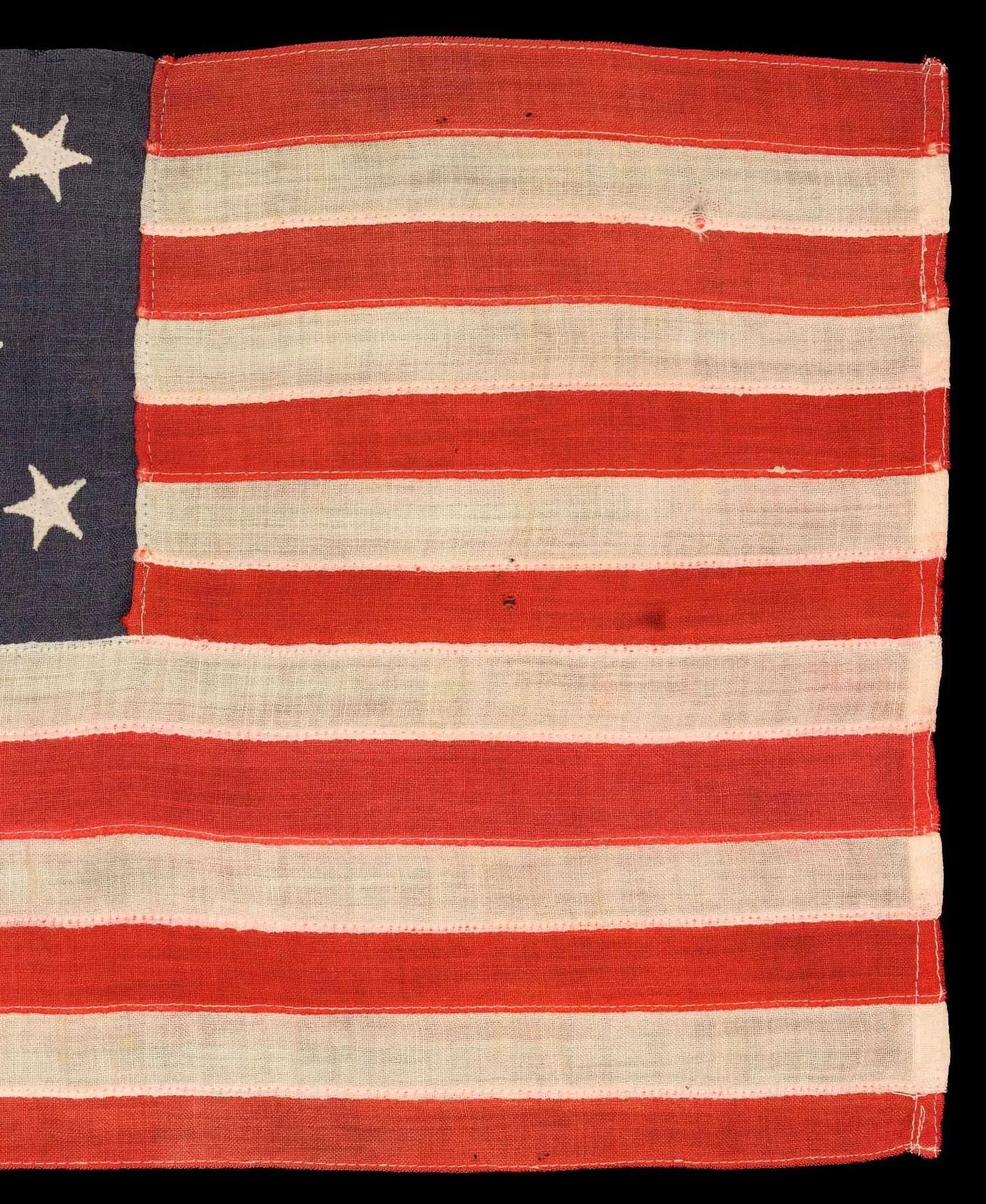
Offered is a 13-star antique American flag of wool bunting with cotton stars that are double-appliquéd—sewn to both sides of the canton so the design presents correctly on either face. It is an unusually small example of a fully pieced-and-sewn flag from the late 19th or early 20th century. While small printed flags were produced in great numbers during this period, traditional sewn flags at this diminutive scale are considerably less common.
The canton displays a classic medallion configuration centered on a single star, surrounded by a circular arrangement of eight stars, with four additional stars positioned toward the corners. The resulting pattern is one of the most recognizable configurations associated with 13-star flags. At this compact scale, the arrangement is particularly effective, allowing the stars to remain comparatively large and distinct while creating a strong, balanced composition within the canton.
The flag is constructed in the manner of a conventional full-size sewn flag despite its unusually small proportions. The red and white wool-bunting stripes are individually pieced and joined by machine stitching, while the canton is likewise made of wool bunting. The cotton stars are applied to both sides and secured with zig-zag machine stitching. The hoist is made of cotton.
The zig-zag stitching used to secure the stars provides useful chronological guidance. In August 1889, Henry Bowman filed a patent application for a “method of making flags,” which was granted in February 1892 as U.S. Patent No. 469,395. Bowman specifically claimed the use of zig-zag stitching in flag construction, a technique particularly well suited to binding the unfinished edges of appliquéd stars. Similar stitching became increasingly common among commercial flag manufacturers during the 1890s and remained in widespread use during the early decades of the 20th century.
The unusually small scale of the present flag is an important part of its appeal. Although compact, its manufacture required essentially the same basic operations as a substantially larger example: piecing the individual stripes, assembling the canton, cutting and applying the stars, and finishing the hoist. Small sewn flags were practical for boats, architectural display, ceremonial use, and other settings where a conventional large flag would have been unnecessary or impractical. Their reduced scale also favored the use of 13 stars, which could remain individually prominent where the full complement of stars then representing the Union would have required a much smaller and more crowded arrangement.
The 13-star American flag traces its origin to June 14, 1777, when the Continental Congress resolved that the national flag should contain 13 alternating red and white stripes and “thirteen stars, white in a blue field, representing a new constellation.” Although the official star count increased as new states entered the Union, the 13-star configuration never disappeared from American use. Instead, it developed into an intentional reference to the original states and the nation’s Revolutionary founding.
Throughout the 19th century, 13-star flags appeared in military, maritime, commemorative, and patriotic settings. Interest increased considerably around the Centennial of American independence in 1876 and continued during the Colonial Revival of the late 19th and early 20th centuries, when Revolutionary-era imagery enjoyed renewed popularity. The United States Navy also continued to employ 13-star ensigns on small boats into the early 20th century, further reinforcing the design’s association with compact maritime flags. The Sesquicentennial of American independence in 1926 provided another period of heightened interest in the imagery of the founding era.
Based upon its wool-bunting construction, double-appliquéd cotton stars, machine stitching, zig-zag application, and overall form, we date the flag to approximately 1895–1926. Its combination of a classic medallion star configuration and unusually small scale makes it a particularly appealing example of the commercially produced 13-star flags of the late 19th and early 20th centuries.
Conservation Process: This flag was hand sewn to silk organza, and both were hand sewn to cotton fabric. The silk organza provides a strong layer of protection and a professional appearance. The flag, the silk organza, and the cotton fabric were then hand sewn to a mounting board. To prevent the black dye in the cotton fabric from seeping into the flag, it was first washed in a standard wash and then in a dye setting wash. The flag is positioned behind Optium Museum Acrylic.
Frame: The flag is housed in a wide, sloped molding with an aged gold surface, intentionally distressed to evoke the appearance of early gilded frames.
Condition Report: The flag survives in very good overall condition, with strong color and only minor scattered staining, small areas of soiling, and limited wear consistent with age and use. There are a few small holes or separations within the striped field, along with a couple of tack holes and associated stains on the hoist. The fabric remains substantially intact, and the canton and star field present especially well.
Collectability Level: The Great – Perfect for Rising Collectors
Date of Origin: 1895-1926
Number of Stars: 13
Associated War: Spanish-American War (1898)
Associated State: Original 13 Colonies
Price: Call 618-553-2291, or email info@bonsellamericana.com
Frame Size (H x L): 38” x 54”
Flag Size (H x L): 25 ¼” x 42 ¼”
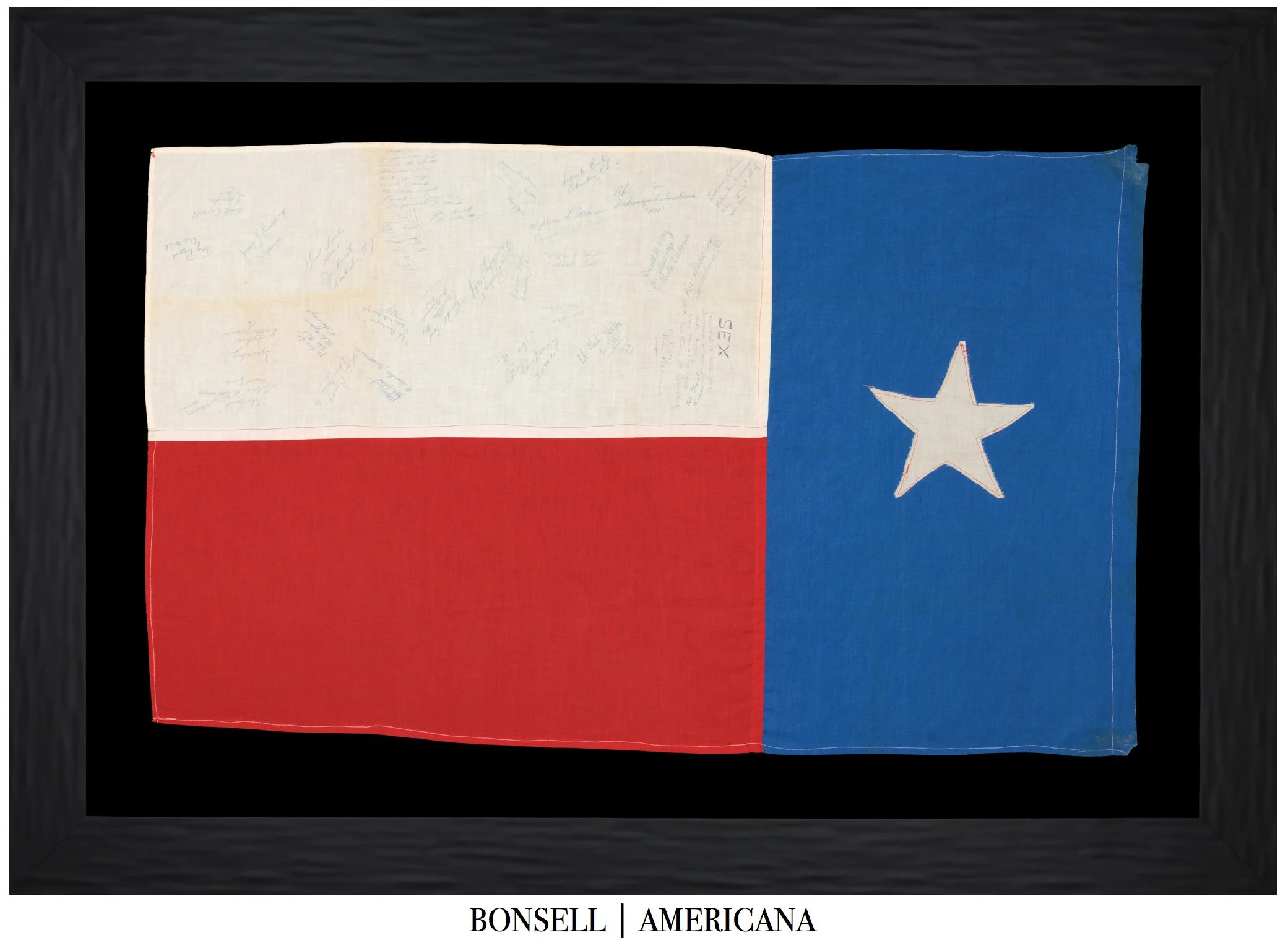
Offered is an exceptional Texas state flag, made and signed in 1966 by a group of young United States Air Force airmen at the conclusion of a shared period of military training. More than a collection of signatures, the flag is a personal Vietnam-era farewell piece, covered with names, hometowns, jokes, good wishes, and references to the places these men had come from and, in some instances, where they were headed next.
The flag is constructed entirely of cotton and is machine-sewn throughout. Its individual construction, irregular proportions, and straightforward workmanship suggest that it was made as a one-off piece rather than purchased as a commercially manufactured state flag. Given its association with Air Force personnel, it is entirely possible that it was assembled in a military setting specifically for the occasion.
Interestingly, the flag was constructed so that the signed side was clearly intended to be its primary viewing side. When displayed in this manner, the blue vertical field appears at the right rather than at the left, making the Texas flag appear reversed to the modern viewer. This is not simply the back of a conventionally made flag turned around for display; the construction indicates that this orientation was deliberate. More importantly, it is this side that the airmen chose to cover with their names and messages, and it is therefore the side on which the history of the object survives.
The most compelling aspect of the flag is the unmistakable sense of camaraderie preserved across its white field. The inscriptions appear to have been made as these men were preparing to go their separate ways following training. A date of August 12, 1966 appears among the writing, placing the flag squarely within the massive Vietnam-era expansion of the United States Air Force.
Several of the men can be independently connected with Air Force service, including Claude “Buzz” Kenney, who went on to serve for more than 21 years, and William L. Adkison, later a Staff Sergeant whose military record identifies him as a Vietnam veteran.
Another apparent signer, Michael Azzara, provides a particularly good illustration of what was happening to these young men as their time together came to an end. Azzara enlisted in the Air Force in 1966 and subsequently spent 18 months at Eielson Air Force Base in Alaska before transferring to Misawa Air Base in Japan. His path helps illustrate how quickly men who had trained together could be dispersed across the country and around the world.
One inscription identifies its writer as an “Air Commando,” a particularly evocative designation in 1966. Air Commando organizations were then deeply involved in the rapidly expanding American air war in Southeast Asia, undertaking missions that included air support, combat airlift, reconnaissance, unconventional warfare, search and rescue, and psychological operations. The presence of the term on this flag gives the piece an especially strong connection to the military environment of the Vietnam era, even though the exact subsequent assignment of the signer remains unknown.
Yet what makes the flag memorable is not the formal military history alone. It is the personality of the men.
One airman employed a joke almost guaranteed to get the attention of a barracks full of young men, writing in large letters:
SEX
and underneath
now that I have your undivided attention
Take it easy,
WALK TALL & LOOK TOUGH
AND GO EASY ON CALIFORNIA.
The reference to California is directed at the recipient of the flag and suggests that he was preparing to leave Texas for an assignment there. Elsewhere, another friend offered a practical California connection, writing that if he ever got around the North Hollywood area he should look up the writer’s aunt.
These messages make clear that this was not just an object passed around for anonymous signatures. These were friends saying goodbye.
Their hometown inscriptions also create a snapshot of America in the mid-1960s. One man proudly identifies “Indianapolis, Indiana” and adds “500,” an obvious reference to the Indianapolis 500. Another writes:
Milwaukee, Wisconsin
where you get all of
your beer
Russell M. Wong identifies himself with El Cerrito, California, along with the playful notation “ex-yellow rope,” apparently referencing a student leadership position during Air Force training. Other men came from communities scattered across the country. Taken together, the inscriptions read almost like a miniature map of the United States: young men from different regions, backgrounds, and hometowns brought together by military service, becoming friends for a short but formative period before being sent in different directions.
That quality is poignant in the context of 1966. Some would remain in the United States. Others would be sent to Alaska, Japan, Europe, the Pacific, or Southeast Asia. At least one identifiable signer later served in Vietnam. Others made the Air Force a career. At the moment this flag was signed, however, those futures were still ahead of them. What survives here is the point immediately before the group broke apart—the jokes, nicknames, hometown pride, and genuine affection between young men who knew that their time together was ending.
The choice of a Texas flag as their canvas was fitting. The familiar Lone Star design originated as the national flag of the independent Republic of Texas. It was adopted in January 1839 during the presidency of Mirabeau B. Lamar and later continued as the state flag after Texas joined the United States. The basic design has endured essentially unchanged: a vertical blue field bearing a single white star, accompanied by horizontal white and red fields.
Under Texas law today, the colors carry specific meanings: red for bravery, white for purity, and blue for loyalty. Those meanings seem particularly appropriate here. The Lone Star itself had represented Texas since the Republic era and had already been formally adopted as the Republic’s emblem before the familiar 1839 flag was created.
In this example, however, the Texas flag became something more personal. It became a yearbook, farewell card, inside joke, and record of friendship all at once.
The result is an evocative piece of Vietnam-era Americana. Rather than commemorate a battle or formal military ceremony, it preserves something more intimate: the friendships formed among a group of young Air Force airmen during training, and the moment when those friends prepared to leave one another and begin the next chapter of their military service. Their inscriptions—California, Hollywood, Milwaukee beer, the Indy 500, Air Commandos, nicknames, jokes, and good wishes—give the flag a warmth and immediacy rarely encountered in military textiles.
It is ultimately a Texas flag that tells a much larger American story.
Conservation Process: This flag was hand sewn to cotton fabric, and both were hand sewn to a mounting board. To prevent the black dye in the cotton fabric from seeping into the flag, it was first washed in a standard wash and then in a dye setting wash. The flag is positioned behind Optium Museum Acrylic.
Frame: The flag is housed in a substantial, wide-profile frame with a matte charcoal finish and subtle linear graining across the face.
Condition Report: The flag is in very good overall condition, with strong, vibrant color throughout and only light age-related wear. There is minor fraying and irregularity along portions of the outer edges, along with some loose threads around the appliquéd star and scattered light surface marks or staining. The inscriptions remain well preserved and largely legible.
Collectability Level: The Great – Perfect for Rising Collectors
Date of Origin: 1966
Price: Call 618-553-2291, or email info@bonsellamericana.com
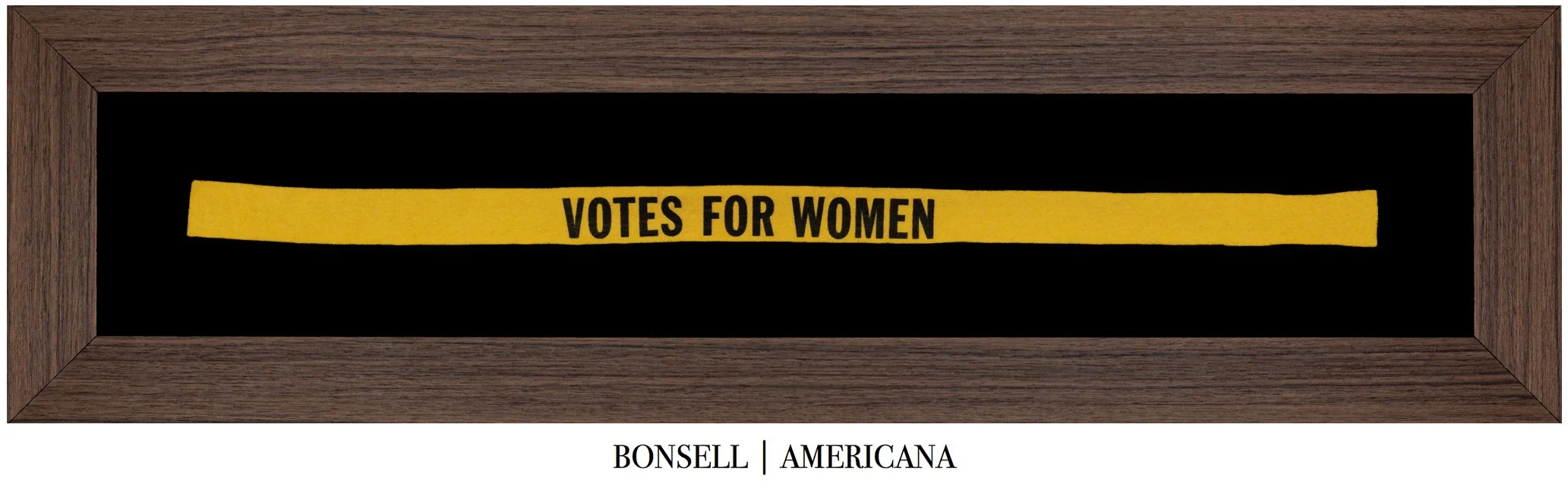
Frame Size (H x L): 9” x 32 ½”
Textile Size (H x L): 1 ¼” x 25 ½”
Offered is a rare “VOTES FOR WOMEN” suffrage armband, fashioned from yellow felt with bold black lettering. Bands of this form were worn around the arm and, in some instances, around a hat, providing supporters with a simple and highly visible way to identify themselves with the women’s suffrage movement. The direct slogan, strong contrast, and unmistakable yellow-and-black color scheme made pieces such as this particularly effective at rallies, conventions, parades, and other public demonstrations.
Yellow became one of the most recognizable colors associated with the American women’s suffrage movement. Its use can be traced to the campaign for suffrage in Kansas in 1867, where the sunflower—Kansas’s state flower—was adopted as a symbol by supporters. The color was later embraced by major national suffrage organizations and appeared extensively on banners, ribbons, sashes, pennants, buttons, and other campaign material. Yellow was frequently paired with black lettering, as seen here, producing a combination that was both visually striking and easily legible from a distance.
The organized American women’s rights movement is generally traced to the Seneca Falls Convention of 1848, organized principally by Elizabeth Cady Stanton and Lucretia Mott. The convention produced the Declaration of Sentiments, modeled in part on the Declaration of Independence, which outlined a broad series of grievances regarding the legal, political, educational, and economic status of women. Among its most consequential demands was the assertion that women should possess the right to vote.
Over the following decades, suffrage advocates organized conventions, petition drives, speaking tours, publications, marches, and political campaigns throughout the country. Progress initially came largely on a state-by-state basis, particularly in the West, where a number of states enfranchised women before a federal amendment was adopted. At the same time, national organizations increasingly focused their efforts on securing an amendment to the United States Constitution that would prohibit the denial of voting rights on the basis of sex.
A federal women’s suffrage amendment was first introduced in Congress in 1878. For decades it failed to receive sufficient support, despite the increasingly organized efforts of suffragists across the country. By the 1910s, however, the movement had gained substantial political momentum. Highly visible demonstrations, coordinated lobbying campaigns, and the prominent role played by women during World War I helped place suffrage at the center of national political debate.
The proposed amendment passed the House of Representatives on May 21, 1919, followed by the Senate on June 4. It was then submitted to the states for ratification. On August 18, 1920, Tennessee became the 36th state to ratify the amendment, providing the three-fourths majority then required. The 19th Amendment was formally certified on August 26, 1920, declaring:
“The right of citizens of the United States to vote shall not be denied or abridged by the United States or by any State on account of sex.”
Small wearable textiles such as this armband represent the public-facing side of the suffrage campaign. Unlike formal banners intended for organizational headquarters or large demonstrations, armbands and hatbands could be worn directly by individual supporters, effectively turning the wearer into a moving advertisement for the cause. Their relatively ephemeral nature also contributes to their scarcity today, as pieces made for active campaign use were far less likely to be preserved than medals, buttons, or printed ephemera.
With its bold “VOTES FOR WOMEN” message and classic yellow-and-black suffrage coloration, this is an excellent surviving example of the material culture produced during one of the most consequential political reform movements in American history.
Conservation Process: This armband was hand sewn to cotton fabric, and both were hand sewn to a mounting board. To prevent the black dye in the cotton fabric from seeping into the armband, it was first washed in a standard wash and then in a dye setting wash. The armband is positioned behind Optium Museum Acrylic.
Frame: The armband is presented in a flat-profile dark walnut frame with a clean, understated finish.
Condition Report: The armband remains in excellent condition, with exceptionally strong yellow coloration and crisp, bold black lettering. The felt is remarkably well preserved, showing only the slightest age-related surface variation and no significant staining, losses, or damage.
Collectability Level: The Great – Perfect for Rising Collectors
Date of Origin: 1910-1920
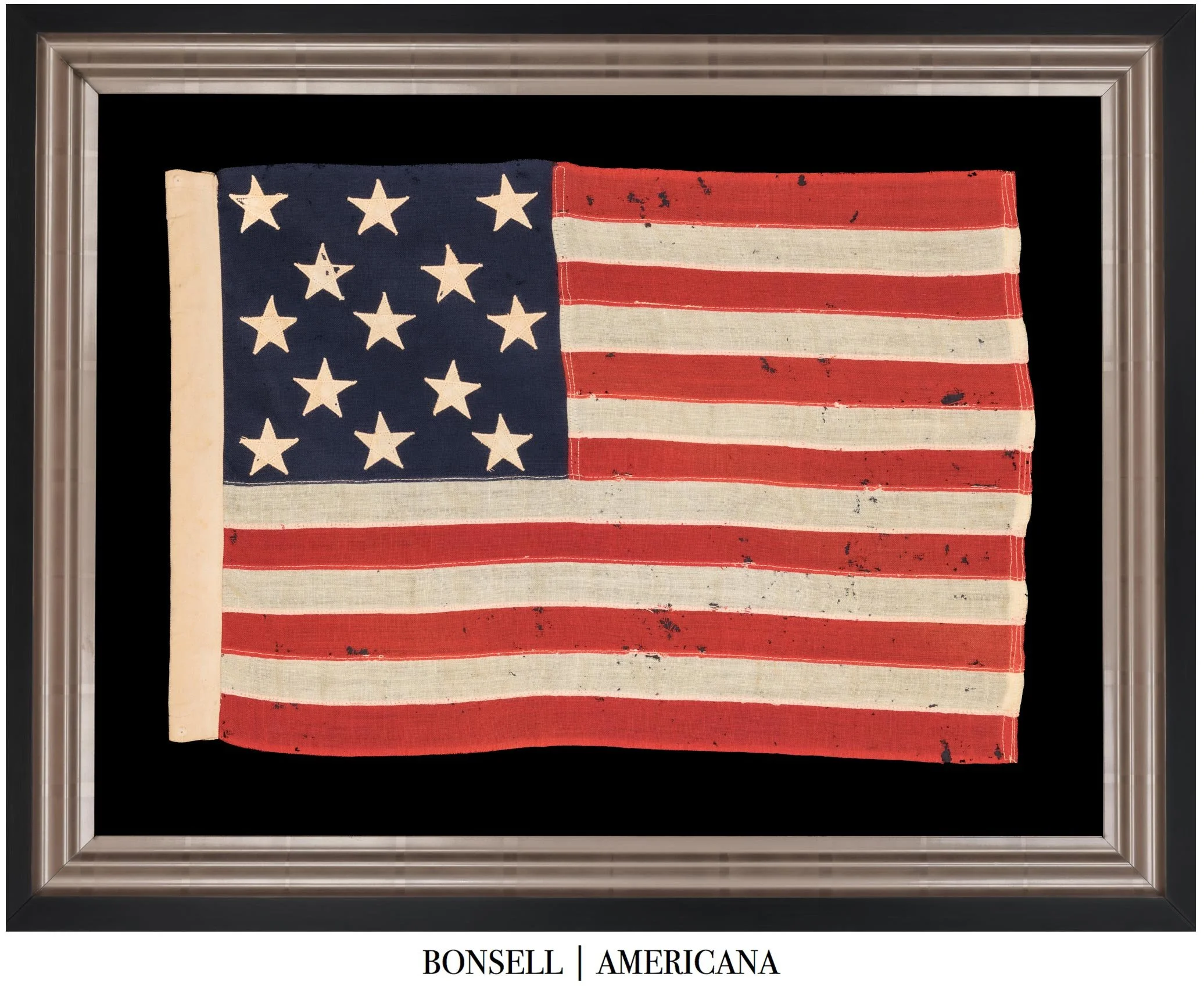
Frame Size (H x L): 26” x 33”
Flag Size (H x L): 17” x 24”
Offered is a 13-star antique American flag, featuring a 3-2-3-2-3 arrangement of stars. Constructed of wool bunting with double-appliquéd cotton stars, it is an unusually small example of a fully pieced-and-sewn commercial flag. While diminutive flags of this general period are encountered, examples of traditional sewn construction at this scale are considerably less common than their larger counterparts.
Viewed as a whole, the star configuration produces a diamond-shaped arrangement at the center, surrounded by a star at each corner of the canton. This design is commonly referred to as the Hopkinson pattern, after Francis Hopkinson, the New Jersey delegate to the Continental Congress and signer of the Declaration of Independence who is generally credited with playing the principal role in designing the first American national flag.
The Flag Resolution adopted by the Continental Congress on June 14, 1777 specified only that the new national flag contain 13 alternating red and white stripes and a union of 13 white stars on a blue field, representing “a new constellation.” Congress provided no instructions regarding the arrangement, number of points, or orientation of the stars. Consequently, a number of different 13-star configurations appeared during the nation’s earliest years, and the precise appearance of the first official American flag remains unknown.
Francis Hopkinson nevertheless has the strongest surviving documentary claim to its design. In 1780, he submitted a request for compensation for various designs he had furnished to the government, specifically including the “flag of the United States of America.” His proposed compensation famously included a “Quarter Cask of the public wine.” When that request was not honored, he later submitted a monetary claim. Congress did not dispute that Hopkinson had participated in the design work, but declined to compensate him on the basis that he was not the only individual who had been consulted. The surviving documentation has led most historians to credit Hopkinson with the design of the American flag, although no surviving drawing conclusively establishes the precise arrangement of stars that he employed.
The familiar association between Hopkinson and the 3-2-3-2-3 configuration is therefore best understood as a historical attribution rather than a certainty. The pattern appears on later representations associated with the early flag and became particularly common on 13-star flags manufactured during the late 19th and early 20th centuries. Its strong geometry and relatively large stars also made it particularly well suited to small flags such as the present example, where attempting to accommodate the full complement of stars then in the Union would have required stars of considerably smaller size.
The stripes and canton of this flag are made of wool bunting and joined by machine stitching. Its hoist is made of cotton twill, while its cotton stars are sewn to both sides of the canton, a construction method commonly referred to as double appliqué, and are secured with zig-zag stitching. The latter is particularly useful for binding the unfinished edges of appliquéd stars and became widespread among commercial flag manufacturers during the late 19th century. Henry Bowman sought patent protection for a method of flag construction employing this technique in 1889, receiving U.S. Patent No. 469,395 in February 1892. Similar construction is regularly encountered on commercially produced American flags beginning in the 1890s.
As mentioned, the present flag is noteworthy for its compact scale. Most sewn wool flags were intended to function as actual outdoor flags, where greater dimensions improved visibility. Small sewn examples required essentially the same basic manufacturing operations—piecing 13 individual stripes, constructing the canton, cutting and applying stars, and finishing the hoist—while producing an object with considerably less surface area. Their small size made them practical for boats, architectural display, ceremonial use, and other applications where a conventional large flag was unnecessary or impractical.
Although the United States had long since expanded beyond 13 states when this flag was made, the 13-star flag never disappeared from American use. Rather, 13 stars became a historical and patriotic device representing the original states and the founding generation. Such flags appeared throughout the 19th century in commemorative, military, maritime, and celebratory contexts and experienced renewed popularity during events that encouraged Americans to look back to the Revolutionary period.
This was especially true during the nation’s Centennial in 1876 and again during the decades surrounding the turn of the century, when Colonial Revival interest in the country’s founding history became widespread. Thirteen-star flags were also well suited to yachts and small boats, where reducing the number of stars allowed them to remain individually legible on comparatively small ensigns. Commercial flag makers continued to produce 13-star examples well into the 20th century for precisely these historical, decorative, and maritime purposes.
Based upon its wool-bunting construction, machine stitching, double-appliquéd cotton stars, zig-zag stitching, and overall form, we date the flag to approximately 1895-1926. The upper end of this range encompasses the Sesquicentennial of American independence in 1926, another period of intense interest in Revolutionary imagery and 13-star flags.
The combination of the classic 3-2-3-2-3 star configuration and exceptionally small 17” x 24” size makes this an especially appealing example of the commercially produced 13-star flags of the late 19th and early 20th centuries.
Conservation Process: This flag was hand sewn to silk organza, and both were hand sewn to cotton fabric. The silk organza provides a strong layer of protection and a professional appearance. The flag, the silk organza, and the cotton fabric were then hand sewn to a mounting board. To prevent the black dye in the cotton fabric from seeping into the flag, it was first washed in a standard wash and then in a dye setting wash. The flag is positioned behind Optium Museum Acrylic.
Frame: The frame features a wide black outer profile with a stepped, silver-toned inner detail, all incorporated into a single molding. The layered profile gives the frame depth and definition.
Condition Report: The flag exhibits scattered small holes, surface wear, and areas of staining and discoloration throughout, with somewhat heavier wear along portions of the stripes and fly end. There are also a couple of small pin holes in the hoist. Overall, the fabric remains intact and the colors retain good visual presence.
Collectability Level: The Great – Perfect for Rising Collectors
Date of Origin: 1895-1926
Number of Stars: 13
Associated War: Spanish-American War (1898) and World War I (1914-1918)
Associated State: Original 13 Colonies
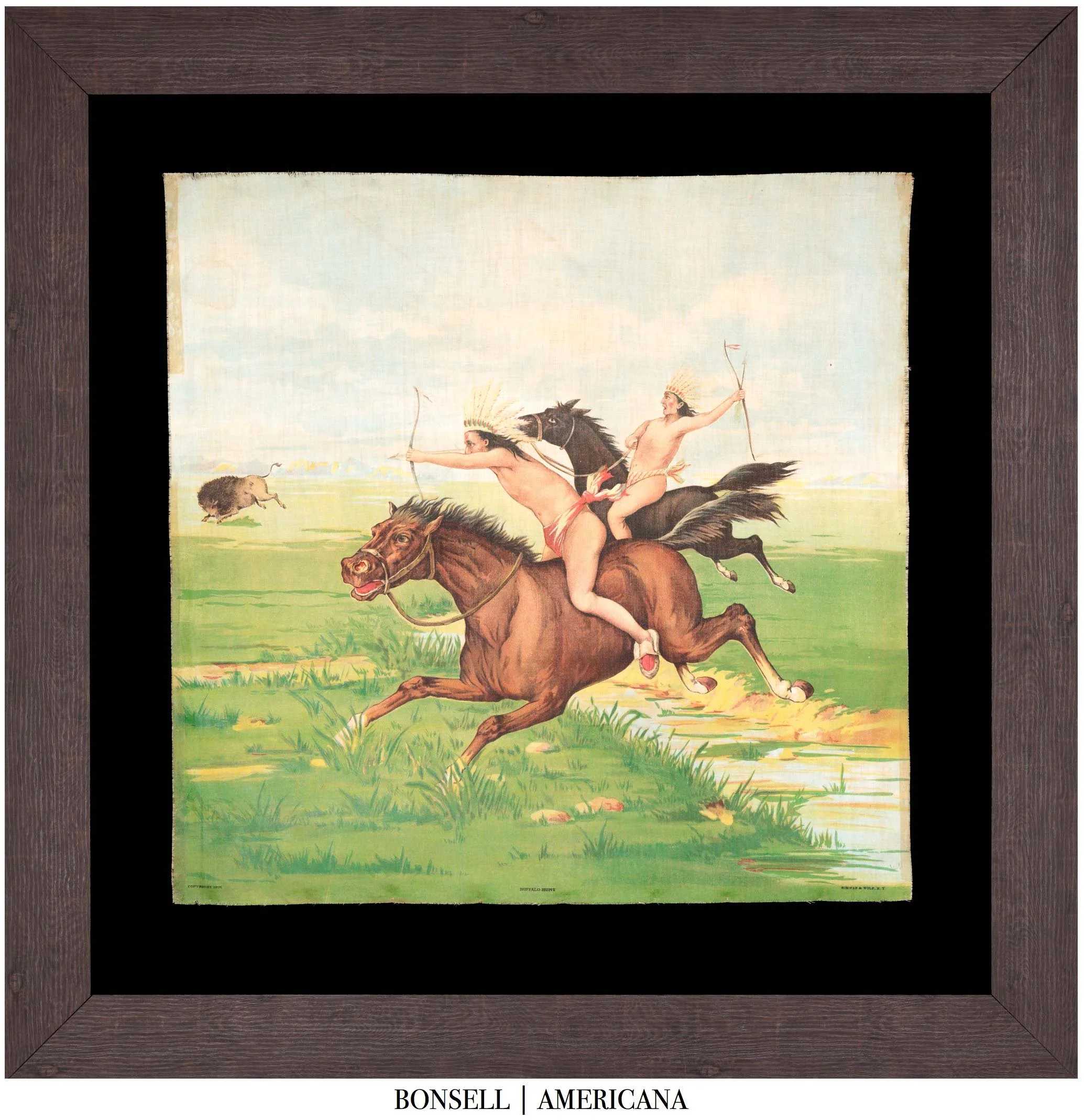
Frame Size (H x L): 34” x 34”
Textile Size (H x L): 23” x 23”
Offered is a lithographed linen textile made by Schwab & Wolf of New York in 1907. It features two Native American hunters on horseback pursuing buffalo across an open Western landscape. Printed along the lower margin is the title, “BUFFALO HUNT,” together with the manufacturer’s name and date.
The image is organized around the two horses and their riders, both shown at full gallop. The foremost hunter rides a chestnut horse and draws a bow toward a buffalo visible at the left of the composition, while a second hunter follows on a dark horse carrying a spear or lance. The prairie landscape, distant mountains, and broad sky provide a restrained backdrop for the principal action.
Schwab & Wolf was a New York firm active by at least the turn of the 20th century and involved in both conventional textile manufacturing and printed novelty goods. It operated within the city’s established textile and dry-goods trade and developed a substantial line of copyrighted pictorial designs. Surviving examples and contemporary copyright records document subjects ranging from sporting and military scenes to patriotic, Native American, and other topical imagery. This broader body of work places Buffalo Hunt within an identifiable line of commercial pictorial textiles rather than as an isolated design.
Western imagery remained highly popular with American audiences when this textile was produced. During the late 19th and early 20th centuries, paintings, illustrated publications, Wild West exhibitions, advertising, and popular entertainment helped establish a familiar visual vocabulary centered on buffalo, Native American life, cowboys, and the Western frontier. By 1907, the great buffalo herds of the 19th-century Plains had largely disappeared, and scenes such as this increasingly represented an earlier period of the American West.
Buffalo hunting had been central to the economy and material culture of numerous Plains tribes. Buffalo supplied meat as well as hides, sinew, bone, and other materials used in daily life. The widespread adoption of the horse transformed hunting practices and made the mounted buffalo hunt an important feature of life on the Plains during portions of the 18th and 19th centuries. The Schwab & Wolf image draws upon this history, although its composition is best understood as a commercial interpretation intended for an early 20th-century audience rather than as an ethnographic depiction.
The lithographic process allowed Schwab & Wolf to reproduce detailed, multicolored imagery directly on fabric, giving these textiles much of the visual character of contemporary chromolithographic prints while retaining the texture and flexibility of linen. Other surviving examples demonstrate that the firm applied the same approach to a wide range of subjects, including Western, patriotic, military, and sporting themes.
Dating precisely to 1907, Buffalo Hunt is an unusual surviving example of Schwab & Wolf’s pictorial textile production and of the continuing popularity of Western subject matter in American decorative arts during the opening decade of the 20th century. Its documented maker, date, and subject provide a particularly strong context for understanding this specialized category of American printed textile.
Conservation Process: This textile was hand sewn to cotton fabric, and both were hand sewn to a mounting board. To prevent the black dye in the cotton fabric from seeping into the textile, it was first washed in a standard wash and then in a dye setting wash. The textile is positioned behind Optium Museum Acrylic.
Frame: The textile is housed in a modern, wide, dark-stained wood frame with a simple profile and visible grain, giving it a restrained, period-appropriate appearance.
Condition Report: The textile is in good overall condition, with strong color and a largely intact printed surface. There is minor toning and scattered discoloration, most noticeable in the lighter areas of the sky and along the edges, together with light fraying at the perimeter and a few small areas of wear.
Collectability Level: The Great – Perfect for Rising Collectors
Date of Origin: 1907

Frame Size (H x L): 24” x 47”
Pennant Size (H x L): 13” x 36”
Offered is an antique pennant with a “JOHN DEERE ‘34” overprint. It is made of felt and has a green field. The lettering and hoist stripe are white. It was made to promote the release of the John Deere Model A tractor. It is the first such pennant that we have encountered.
The John Deere Model A tractor, produced between 1934 and 1952, represents a significant chapter in the history of American agriculture. It was during this period that the United States was in the throes of the Great Depression and then transitioned to a war economy during World War II. In this context, the Model A emerged not just as a tool for the farm but as a symbol of resilience and innovation.
The story of the Model A began when John Deere recognized the need for a more versatile and robust tractor than what they had previously offered. The company's prior model, the "D," had been on the market since 1923. While it had its merits, there was a need for a machine that could cater to a broader range of tasks. With that vision, the development of the Model A commenced.
In 1934, John Deere did not hold a singular, major publicity event specifically for the Model A tractor as we might envision a product launch today. However, John Deere made considerable efforts to market and publicize its new tractor to the farming community. Dealerships showcased the new models, and they were featured in farming magazines and other advertisements of the time. They were also showcased at fairs, farm shows, and other similar events.
The Model A was equipped with a 2-cylinder engine. Its design was both practical and innovative. Unlike many of its contemporaries, the Model A's engine started on gasoline and then, once warmed up, could switch to run on cheaper kerosene. This dual-fuel system was a cost-saving feature that made it particularly attractive to farmers during those economically challenging times.
Several features distinguished the Model A from other tractors of the era. Its engine was not only powerful but also boasted a design that allowed it to operate efficiently at lower RPMs. The tractor also had an adjustable wheel tread and a wide front end, making it adaptable to different crop rows—a crucial feature for diverse agricultural tasks. Another key feature was the presence of an easy-to-use hand clutch. This clutch made it possible for the operator to control the tractor's speed without stopping, thus ensuring smooth operation.
But the Model A wasn't just about new features; it also reflected John Deere's commitment to durability. Its construction was robust, with high-quality materials ensuring that the tractor could withstand the rigorous demands of daily farm use. This commitment to quality made the Model A a favorite among farmers and ensured that many units remained operational for decades.
Over its production run, the Model A underwent several modifications to further improve its efficiency and adapt to the evolving needs of American farmers. By the time production ceased in 1952, it had firmly established itself as one of the most iconic tractors in John Deere's lineup. Numerous units are still operable today, a testament to the Model A's enduring design and reliability.
The John Deere Model A tractor is not just a piece of machinery but a part of American agricultural history. It symbolizes a period of challenge and change, reflecting both the economic hardships and the technological progress of its time. Through its innovative design, adaptability, and durable construction, the Model A proved to be a tool of progress for farmers across the nation.
Conservation Process: The pennant was hand sewn to cotton fabric, and both were hand sewn to a mounting board. To prevent the black dye in the cotton fabric from seeping into the pennant, it was first washed in a standard wash and then in a dye setting wash. The pennant is positioned behind Optium Museum Acrylic.
Frame: This offering is in our X-Large Distressed Black and Silver Frame.
Condition Report: There are two pinholes in the hoist strip, likely the result of the pennant being attached to a staff. There is some fading and staining. There are some losses to the felt, but they have been masked with green fabric. Overall, the pennant is age appropriate and attractive.
Collectability Level: The Great – Perfect for Rising Collectors
Date of Origin: 1934
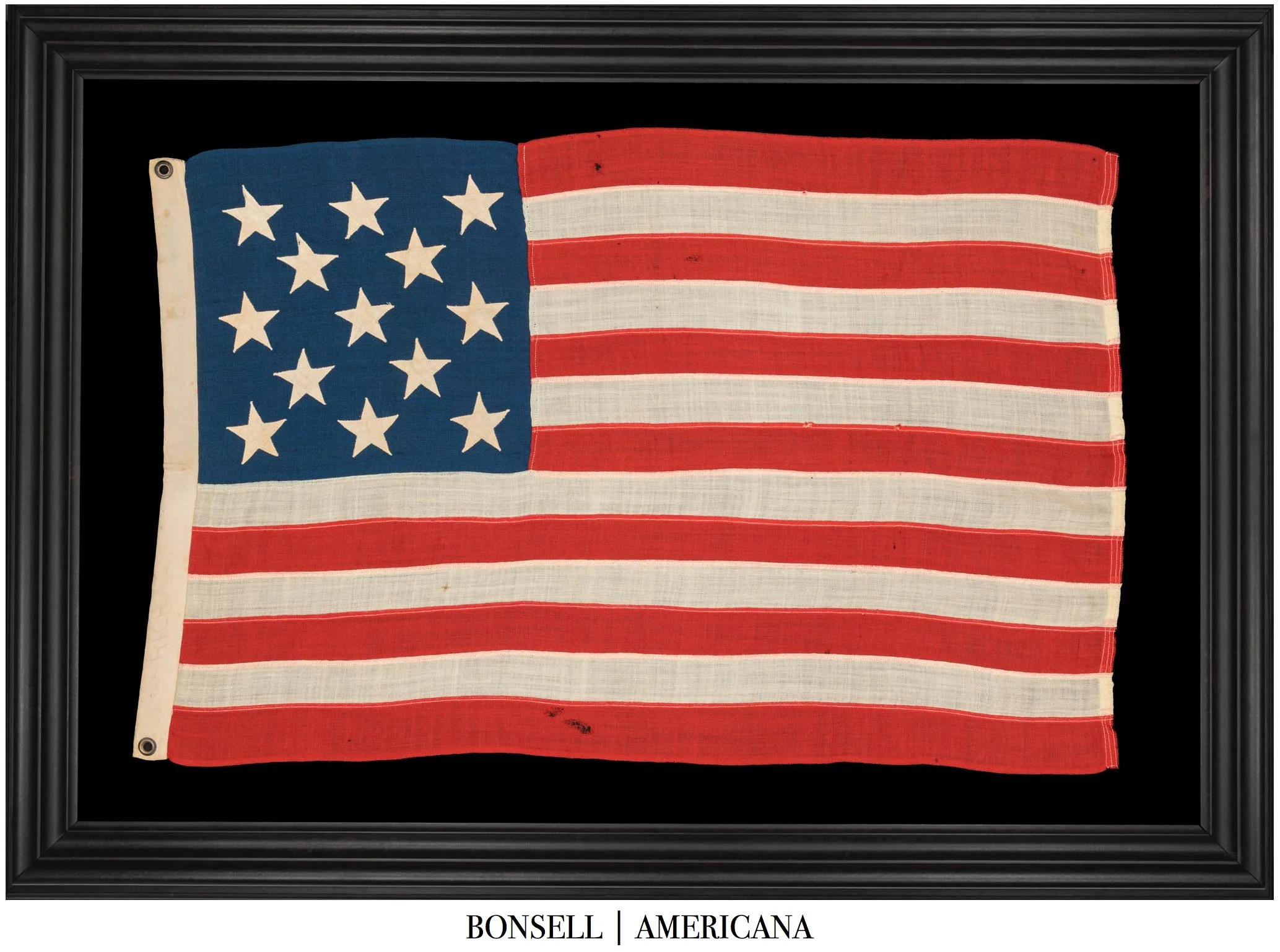
Frame Size (H x L): 33” x 46”
Flag Size (H x L): 23” x 36”
Offered is a 13-star antique American flag in the 3-2-3-2-3 configuration, constructed of wool bunting with double-appliquéd cotton stars and dating to approximately 1895–1926.
The star arrangement consists of three stars in the first row, two in the second, three in the third, two in the fourth, and three in the fifth. Visually, this produces a diamond-shaped core framed by four corner stars. The configuration is commonly associated with Francis Hopkinson and is often referred to as the “Hopkinson pattern.” While no surviving example can be definitively linked to the first national flag, many historians attribute the original design of the American flag to Hopkinson, a member of the Continental Congress and a signer of the Declaration of Independence.
Hopkinson submitted a formal petition to the Continental Congress requesting compensation for having furnished the design of “the flag of the United States of America.” He initially asked to be paid with a quarter cask of public wine and later requested monetary compensation. Although Congress acknowledged his role, payment was refused on the grounds that others had been consulted in the process. Regardless of the outcome, his documented claim provides firmer historical footing than the later Betsy Ross narrative, which emerged decades after the Revolution and lacks contemporary documentation.
The 13-star count represents the original thirteen colonies and was formally adopted on June 14, 1777, when Congress resolved:
“Resolved, that the flag of the United States be made of thirteen stripes, alternate red and white, that the union be thirteen stars, white on a blue field, representing a new constellation.”
From 1777 until May 1, 1795, the 13-star flag served as the official national flag of the United States. With the admission of Vermont and Kentucky, the star count increased to 15. After that date, however, the 13-star flag did not disappear. Instead, it evolved into a powerful and enduring symbol of the nation’s founding.
By the early nineteenth century, the 13-star count had come to represent the Revolutionary generation and the origins of American independence. Such flags were displayed during the return tour of General Lafayette in 1824–1825, when public ceremonies across the country emphasized continuity with the founding era. They appeared again during periods of heightened nationalism, including the Mexican War (1846–1848) and especially during the Civil War (1861–1865), when affirmations of unity and constitutional permanence carried particular resonance.
The Centennial International Exhibition of 1876 in Philadelphia further strengthened the association between the 13-star flag and Revolutionary commemoration. The centennial year prompted renewed interest in early American imagery, and 13-star flags were produced in meaningful numbers for decorative and ceremonial use. This revival of Revolutionary symbolism extended into the late nineteenth and early twentieth centuries, particularly in connection with patriotic anniversaries, veterans’ organizations, civic observances, and the approach to the 150th anniversary of American independence in 1926.
The present example belongs to that late nineteenth- to early twentieth-century revival period. Its construction characteristics are consistent with commercial flag production between approximately 1895 and 1926. The canton and stripes are made of wool bunting, the preferred material for outdoor flags due to its durability and ability to shed wind. The lengths of bunting are machine-stitched together, reflecting industrial manufacturing methods rather than hand-sewn construction.
The stars are fashioned of cotton and are double-appliquéd—applied to both sides of the canton so that the flag presents correctly from either orientation. They are secured with a zig-zag machine stitch, a method patented in 1892 and widely adopted thereafter. This stitching technique provides a reliable chronological indicator and places the flag securely in the post-1892 period.
The hoist is made of cotton twill and fitted with rolled-rim brass grommets. The grommets exhibit the warm golden tone and mellow oxidation typical of aged brass rather than plated steel. Brass was commonly used in quality commercial flag production during this period due to its resistance to corrosion, particularly for outdoor and maritime use. The rolled-rim style seen here is consistent with late nineteenth- and early twentieth-century manufacture and supports the circa 1895–1926 dating.
This example also exhibits somewhat squarer proportions than what later became standard. The proportions of the United States flag were not formally regulated until the 1912 executive order issued under President William Howard Taft, which specified the arrangement and relative dimensions of the stars and stripes for official government use. Prior to that standardization, flag makers exercised broad discretion in overall proportions, canton dimensions, and star spacing. As a result, pre-1912 flags frequently display meaningful variation in aspect ratio. The squarer presentation seen here reflects that earlier flexibility and is entirely consistent with a circa 1895–1926 date range.
The 3-2-3-2-3 configuration remained popular well into the twentieth century because it offers both visual balance and strong geometric clarity. The central diamond anchors the design, while the four corner stars stabilize the canton composition. Among the various 13-star arrangements employed during the revival period—including wreath patterns, medallions, staggered rows, and circular configurations—the 3-2-3-2-3 pattern maintained a particularly direct association with early national imagery.
Importantly, 13-star flags produced during this era were not intended to reflect the contemporary number of states in the Union. Rather, they functioned symbolically. They invoked the founding generation and the nation’s original compact, serving as emblems of continuity rather than literal enumerations of statehood. They were frequently displayed at civic buildings, maritime installations, patriotic celebrations, and commemorative events where reference to Revolutionary heritage was deliberate and understood.
Within that historical and manufacturing context, this flag represents a well-constructed commercial example from the height of the early American revival movement. Its materials, stitching techniques, hardware, and proportions align with established production practices of the late nineteenth and early twentieth centuries. It stands as a deliberate and historically grounded evocation of the nation’s beginnings, executed with the industrial craftsmanship characteristic of its era.
Conservation Process: This flag was hand sewn to silk organza, and both were hand sewn to cotton fabric. The silk organza provides a strong layer of protection and a professional appearance. The flag, the silk organza, and the cotton fabric were then hand sewn to a mounting board. To prevent the black dye in the cotton fabric from seeping into the flag, it was first washed in a standard wash and then in a dye setting wash. The flag is positioned behind Optium Museum Acrylic.
Frame: The frame is a deep-profile moulding with a simple, classical profile, finished in a dark cocoa-brown tone. Its broad face provides visual support without ornament, allowing the flag to remain the primary focus. The subdued finish is well suited to the display of nineteenth-century textiles.
Condition Report: The flag remains in very good overall condition, with strong, saturated color and only minor age-related toning and scattered soiling. There are a few small areas of staining and discoloration, primarily within the white stripes and red field, along with light wear at the edges and hoist. The fabric is otherwise notably intact, with no significant losses or major tears visible.
Collectability Level: The Great – Perfect for Rising Collectors
Date of Origin: 1895-1926
Number of Stars: 13
Associated War: Spanish-American War (1898) and World War I (1914-1918)
Associated State: Original 13 Colonies
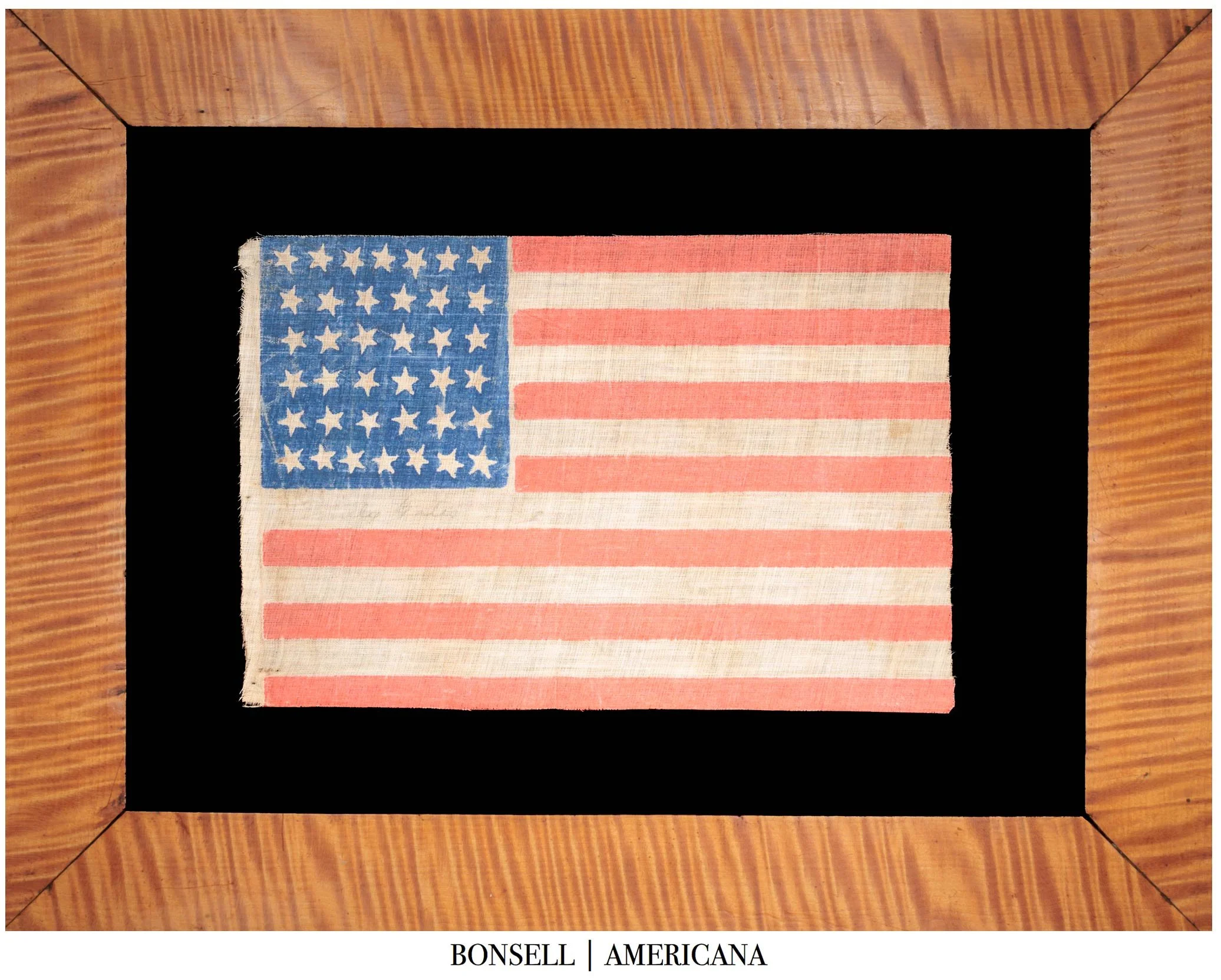
Frame Size (H x L): 13” x 17”
Flag Size (H x L): 6.75” x 10”
Offered is a 38-star American parade flag, printed on glazed cotton and dating to the period following Colorado’s admission to the Union. The canton displays a 7-6-6-6-6-7 star configuration, with the stars arranged in generally linear rows and oriented in slightly varying directions. The stripes retain a warm orange-red tone, contrasting with the blue canton and giving the flag the characteristic appearance of a 19th-century printed parade flag.
Of particular interest is a period pencil inscription that appears to read “Emily Gates,” written in cursive. Personal inscriptions are occasionally encountered on 19th-century flags and can take the form of names, dates, locations, messages, or other notations. Small parade flags were commonly carried at political rallies, civic parades, veterans’ gatherings, holiday celebrations, and similar events, and inscriptions sometimes served simply to identify the owner.
While the identity of Emily Gates has not been established, the inscription provides evidence of individual ownership or use. This is a meaningful distinction, as the majority of surviving parade flags remain anonymous. The inscription therefore adds a personal element to an otherwise commercially produced patriotic textile.
The 38 stars represent Colorado’s admission to the Union on August 1st, 1876. Colorado became the 38th state just 28 days after the nation’s centennial and consequently became known as the “Centennial State.” The 38-star flag officially became the national standard on July 4th, 1877, in accordance with the established practice of adding new stars on the Independence Day following a state’s admission.
The 38-star flag remained official until July 3rd, 1890. Its period of use coincided with significant national growth, including continued western expansion, railroad development, industrialization, and the post-Reconstruction period. Because Colorado entered the Union during the Centennial year, 38-star flags are also closely associated with the broad wave of patriotic material produced during and immediately after the celebrations of 1876.
The timing of Colorado statehood is important when considering surviving 38-star flags. Flag makers were already producing large quantities of patriotic textiles for the Centennial, and some manufacturers incorporated 38 stars in anticipation of Colorado’s admission or immediately afterward. Other examples were produced throughout the official 1877–1890 period. As a result, the star count can appear on flags made both for Centennial-related use and for later patriotic events.
This example is printed on glazed cotton, a material commonly used for parade flags during the period. Unlike large sewn flags intended for sustained outdoor use, printed parade flags were inexpensive, portable, and suitable for distribution in quantity. They were used at political events, military reunions, civic ceremonies, and public celebrations. Their relatively lightweight construction also meant that many were discarded or damaged, contributing to the scarcity of well-preserved examples today.
The printed surface exhibits the irregularities associated with period production, including slight variation in color saturation and star orientation. The red stripes have mellowed toward a warm orange-red, while the blue canton remains clearly defined. These characteristics are consistent with the pigments, printing methods, and materials used in late-19th-century parade flags.
The combination of a desirable 38-star count, glazed-cotton construction, attractive period coloration, and the handwritten “Emily Gates” inscription makes this a particularly strong example of a late-19th-century American parade flag. The inscription is especially noteworthy, providing a direct indication of personal ownership or use and adding a level of historical context not present on most comparable examples.
Conservation Process: This flag was hand sewn to cotton fabric, and both were hand sewn to a mounting board. To prevent the black dye in the cotton fabric from seeping into the flag, it was first washed in a standard wash and then in a dye setting wash. The flag is positioned behind Optium Museum Acrylic.
Frame: The flag is in an attractive tiger maple frame. Tiger maple frames are cherished for their striking, wavy grain patterns that shimmer with a unique iridescence, reminiscent of a tiger's coat.
Condition Report: The flag is in very good overall condition for its age, with strong, legible colors and no significant losses. There is minor fraying along the perimeter, particularly at the hoist, along with scattered light soiling, staining, and areas of wear consistent with age and use.
Collectability Level: The Great – Perfect for Rising Collectors
Date of Origin: 1876-1890
Number of Stars: 38
Associated War: The Indian Wars (1860-1890)
Associated State: Colorado
Price: Call 618-553-2291, or email info@bonsellamericana.com
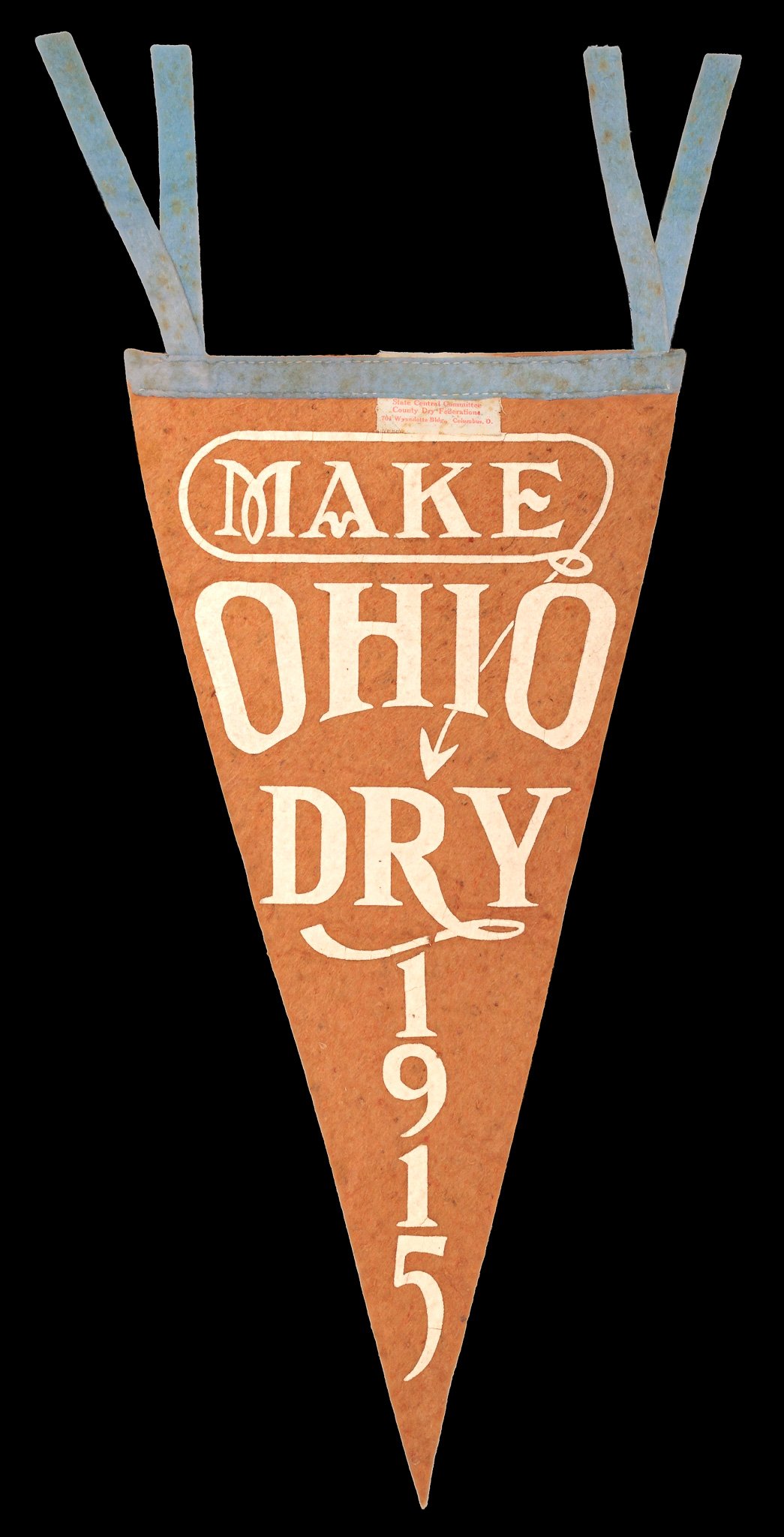
Frame Size (H x L): 30.5” x 19”
Pennant Size (H x L): 17” x 8.25” with 4.75” ties
Offered is a rare political campaign pennant produced for Ohio's landmark 1915 statewide prohibition referendum, boldly printed "MAKE OHIO DRY 1915" in white lettering against an orange wool felt field. The pennant is of classic early twentieth-century construction, with a tapered felt body, stitched blue felt binding across the hoist, and matching blue felt ties designed for attachment to clothing, a vehicle, or display at rallies and public gatherings. Intended as a highly visible campaign accessory, it represents one of the more recognizable surviving slogans associated with Ohio's statewide prohibition movement.
The pennant survives with two original identifying labels, an unusual and important feature that documents both the organization responsible for the campaign and the Columbus firm that produced or supplied the piece. Sewn beneath the blue felt binding on the front is a printed label reading:
State Central Committee
County Dry Federations
701 Wyandotte Bldg.
Columbus, O.
Rather than identifying a commercial maker, this label attributes the pennant to the statewide committee representing Ohio's network of County Dry Federations. Contemporary records confirm that county dry federations operated throughout Ohio during this period, bringing together churches, temperance organizations, civic leaders, and local supporters in a coordinated effort to secure statewide prohibition. While the Ohio Anti-Saloon League remained the movement's best-known organization, period publications demonstrate that the statewide campaign functioned as a broad coalition of cooperating groups rather than a single organization acting alone. The committee headquartered in Columbus coordinated these county organizations during the statewide referendum campaign of 1915.
The Columbus address itself is noteworthy. The committee occupied offices in the Wyandotte Building, one of the city's most prominent commercial office buildings. Completed in 1898 and designed by Daniel Burnham & Company, the steel-frame structure was Columbus's first skyscraper and remained among the city's premier business addresses during the early twentieth century. Housing the campaign headquarters in the Wyandotte Building reflects the organized, professional character of the prohibition movement, which by 1915 had developed an extensive statewide administrative structure capable of coordinating thousands of local volunteers and supporters.
Equally important is the original label retained on the reverse, identifying:
Shipley & Company
Advertising Specialists
Columbus, Ohio
Contemporary Columbus city directories and period advertising establish Shipley & Company as one of the city's leading advertising specialty firms. The company supplied a remarkably broad range of custom promotional merchandise, including banners, badges, calendars, celluloid novelties, leather goods, metal souvenirs, and other advertising specialties produced for businesses, civic organizations, and political campaigns. Their own advertising promoted custom souvenirs among their principal offerings, making the firm a logical supplier for campaign material such as this pennant. The presence of both original labels provides an uncommon level of documentation, identifying not only the organization responsible for distributing the pennant but also the Columbus advertising firm that produced or supplied it.
The campaign represented by this pennant sought to unite a diverse cross-section of Ohio society. Contemporary publications identify ministers, businessmen, educators, farmers, labor representatives, members of the Woman's Christian Temperance Union, and other civic leaders among those directing the statewide effort. One such figure was Worthington Kautzman of Columbus, a prominent businessman and former Adjutant General of Ohio, whose name appears in contemporary campaign literature associated with the movement. Rather than functioning as a narrow political organization, the campaign emphasized cooperation among the various "dry" organizations operating throughout the state, a theme repeatedly stressed in contemporary publications.
The significance of this pennant extends beyond the unsuccessful referendum of 1915. Although Ohio voters rejected the proposed constitutional amendment that November, the campaign itself did not end. Instead, the statewide organization remained intact, retaining the familiar "Make Ohio Dry" slogan and continuing under campaign manager James A. White. Publications issued by the Ohio Dry Federation in 1917 demonstrate the direct continuation of the movement, describing the cooperation between county chairmen, the Ohio Dry Federation, and the Ohio Anti-Saloon League as they prepared a renewed statewide campaign. That effort proved successful. In November 1918, Ohio voters approved statewide prohibition legislation, making Ohio a dry state months before national prohibition took effect. The following January, Ohio became one of the states to ratify the Eighteenth Amendment to the United States Constitution, helping secure the national prohibition of intoxicating liquor, which went into effect on January 17, 1920.
As a result, this pennant represents more than a souvenir of a single political campaign. It is an artifact from the opening phase of the movement that ultimately transformed Ohio law and contributed directly to one of the most significant constitutional changes in American history. Political textiles documenting statewide reform campaigns are encountered far less frequently than those associated with presidential elections, and examples retaining original organizational and maker's labels are rarer still. Combining bold graphic appeal with exceptional historical documentation, this is an outstanding surviving example from Ohio's determined campaign to "Make Ohio Dry."
Conservation Process: This pennant was hand sewn to cotton fabric, and both were hand sewn to a mounting board. To prevent the black dye in the cotton fabric from seeping into the pennant, it was first washed in a standard wash and then in a dye setting wash. The pennant is positioned behind Optium Museum Acrylic.
Frame: The pennant has been presented in an Italian molding with a broad, flat profile and a satin black finish. Crisp, clean lines and gently beveled inner and outer edges lend the frame a refined, understated appearance that complements the textile without competing for attention.
Condition Report: There is modest, expected wear from age and use, accompanied by scattered soiling and oxidation throughout the felt, particularly along the blue binding and ties. Minor age-related crazing is present in the printed white lettering, with light surface wear elsewhere, while the original organizational label remains intact. Despite this honest wear, the pennant retains outstanding visual impact and displays exceptionally well.
Collectability Level: The Great – Perfect for Rising Collectors
Date of Origin: 1915

Frame Size (H x L): 37.5” x 52”
Flag Size (H x L): 27” x 41”
Offered is a 13-star American yacht ensign, made by Annin & Co. and bearing the firm's “Sterling” trademark, produced between 1913 and 1926. Constructed of wool bunting with cotton-appliqued stars and anchor, the flag represents an early 20th century example of one of America's most recognizable maritime signals. It was intended for active use aboard a pleasure craft and survives with its original brass grommets and maker's mark intact.
The canton is made of dark navy wool bunting and displays a fouled anchor surrounded by a wreath of thirteen stars. Both the stars and anchor are fashioned from cotton and are applied with zig-zag machine stitching. The red and white stripes are made of wool bunting and joined with machine stitching throughout. The hoist is bound in a heavy plain-weave cotton heading fitted with brass grommets. Along the hoist appears a tag stating the following:
STERLING
REG. U.S. PAT. OFF.
ALL WOOL DOUBLE WARP
BUNTING
“Sterling” was a trademark of Annin, America's oldest and longest-operating flag manufacturer. The trademark was formally registered for bunting in 1913. A July 5th, 1913 trade publication notice records that “Annin Co., New York, N.Y.” had been granted registration of the word “Sterling” as a trademark for bunting. By 1917 the trademark was appearing in national advertising, and by the early 1920's Annin was actively promoting Sterling as its premium grade of all-wool bunting. The presence of the Sterling mark establishes a firm earliest possible date of 1913, while the overall construction and materials suggest manufacture during the period extending through the mid-1920's.
Founded in New York City in 1847, Annin is recognized as the nation's oldest flag manufacturer and remains in operation today. The company supplied flags for military, governmental, maritime, commercial, and patriotic use throughout the nineteenth and twentieth centuries, earning a reputation for quality construction and innovation in flag-making. During the early twentieth century, Annin expanded significantly, establishing a major manufacturing facility in Verona, New Jersey, while maintaining offices and production operations in New York. The firm's products were widely distributed throughout the United States, and its branded lines, such as Sterling, reflected a commitment to producing premium-grade flags for demanding outdoor service.
The yacht ensign occupies a unique place in American maritime history. Although often mistaken for a naval flag, it was developed for civilian recreational vessels. The design combines the familiar thirteen-star arrangement associated with America's earliest national flags with a fouled anchor, the traditional symbol of maritime service and seamanship. The thirteen stars reference the original colonies and the nation's founding era, while the anchor communicates a connection to navigation, commerce, and life at sea.
The origins of the yacht ensign date to the nineteenth century and are tied to the growing popularity of recreational boating among America's expanding middle and upper classes. In 1848 Congress granted vessels enrolled in qualifying yacht clubs the privilege of flying a distinctive ensign featuring a fouled anchor within the canton. The purpose was practical as well as symbolic. The special ensign identified pleasure craft that were exempt from certain customs inspections and distinguished privately owned yachts from commercial vessels. As boating culture expanded during the late nineteenth and early twentieth centuries, the yacht ensign became one of the most familiar and enduring symbols of American recreational sailing.
By the turn of the twentieth century, yacht ensigns were widely available through commercial makers such as Annin, who produced examples in a variety of sizes for use aboard everything from small launches to substantial sailing yachts. Examples intended for active service were typically constructed of wool bunting, then considered the preferred material for outdoor flags because of its strength, relatively light weight, and ability to shed wind. Cotton elements were commonly used for appliqued devices and stars, while reinforced cotton headings and brass grommets provided durability at the point of greatest stress.
The present example displays all of the characteristics collectors associate with quality commercial manufacture during the period. The wool bunting remains attractive in color, the cotton anchor and stars are crisply executed, and the heavy plain-weave cotton heading reflects a higher-grade construction than the lighter twill bindings often encountered on lesser examples. Particularly noteworthy is the Sterling trademark, which links the flag to Annin's premium wool bunting line and provides a useful point of reference for dating.
Today, antique yacht ensigns are collected both for their maritime associations and for their visual appeal. The combination of the fouled anchor and thirteen-star configuration creates one of the most distinctive flag designs employed in the United States. Their connection to America's boating traditions, combined with the symbolism of the nation's founding era, makes them equally at home in collections focused on maritime history, early American symbolism, patriotic textiles, or decorative Americana.
Conservation Process: This flag was hand sewn to cotton fabric, and both were hand sewn to a mounting board. To prevent the black dye in the cotton fabric from seeping into the flag, it was first washed in a standard wash and then in a dye setting wash. The flag is positioned behind Optium Museum Acrylic.
Frame: The frame is a dark-stained hardwood molding with a clean square profile and subtle variations in grain and tone that lend warmth and visual depth.
Condition Report: There is minor soiling and scattered small dark stains in limited areas, accompanied by a few tiny losses and areas of wear consistent with age and use. A small pink stain is present on the cotton hoist. The colors remain vibrant, the wool bunting retains strong integrity, and the flag presents beautifully overall. The brass grommets, Sterling maker's mark, and all primary design elements remain intact.
Collectability Level: The Great – Perfect for Rising Collectors
Date of Origin: 1913-1926
Number of Stars: 13
Associated War: World War I (1914-1918)
Associated State: Original 13 Colonies
Frame Size (H x L): 33” x 32”
Flag Size (H x L): 22.5” x 21”
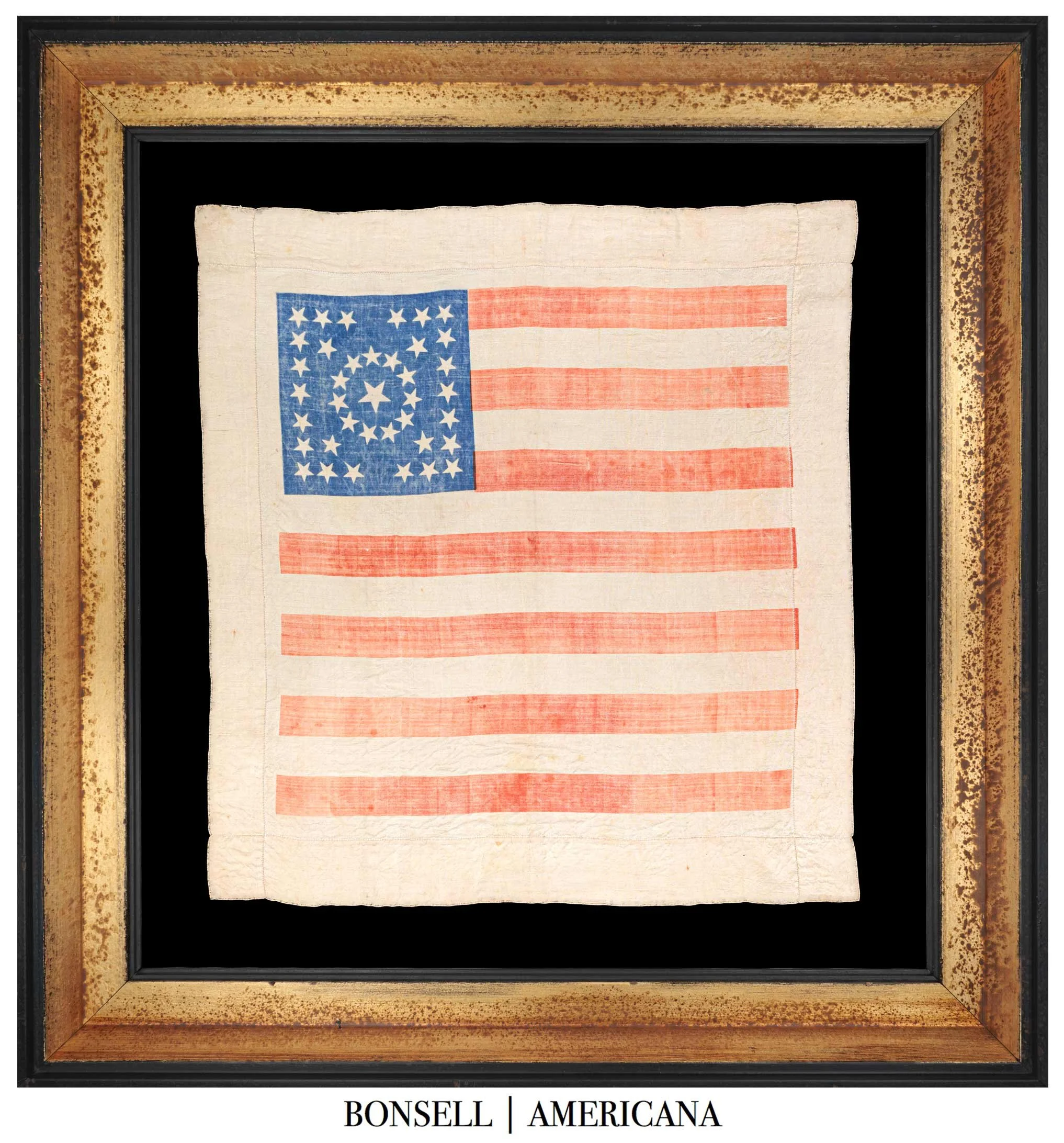
Offered is a rare and visually compelling 38-star American flag bandanna, produced in silk and rendered in the form of the Stars & Stripes, with the printed flag itself inset within a larger square field. The format possesses exceptional visual balance, with broad margins surrounding the printed design that reinforce its presentation as both a textile and a patriotic object. Two horizontal seams and two vertical seams, all machine-sewn, join the silk panels together, lending the piece a distinctly period method of construction and underscoring its manufacture during the late 19th century.
The star configuration is among the bandanna’s most memorable and attractive features. At its center is a large, canted star representing Colorado, the newest state admitted to the Union at the time the design originated. This oversized center star is encircled by a wreath of eleven smaller stars, creating a medallion-like presentation. Flanking this central device are four additional stars, while linear groupings of stars to the left and right create the impression of enclosing brackets or a squared framework around the central medallion. The arrangement is highly unusual and visually dynamic, balancing formal structure with folk-like irregularity. The stars are canted in various directions rather than mechanically aligned, and their forms vary subtly in proportion and execution, adding both movement and charm. Such variation is highly desirable among collectors, as it reflects the more artistic and less standardized production methods of the period.
The canton is paired with bold red stripes that have mellowed beautifully over time, taking on the warm orange-red cast often encountered in 19th century textiles. This transformation is especially attractive here, contrasting wonderfully against the soft blue canton and creamy silk ground. The resulting palette is considerably more nuanced than the stark primary coloration associated with later printed flags and contributes substantially to the textile’s visual appeal.
This exact variety is illustrated as item number 637 in Threads of History: Americana Recorded on Cloth, 1775 to the Present, the landmark exhibition catalogue produced in association with the Smithsonian Institution. For collectors unfamiliar with the publication, Threads of History is widely regarded as one of the most important references ever produced on American political textiles, parade flags, kerchiefs, and related patriotic cloth objects. Compiled by Herbert Ridgeway Collins and published in conjunction with the Smithsonian’s major bicentennial-era exhibition, the work documented some of the finest and most historically significant textiles known at the time. Inclusion within its pages represents an important point of scholarly recognition.
The catalogue notes that this bandanna was “used in the political campaign of 1888,” and another closely related example is illustrated nearby as item number 636. That counterpart employs a different flag and star configuration, yet shares the same general format, dimensions, and construction, suggesting that the two likely originated from the same manufacturer or workshop. The relationship between the two textiles provides an especially interesting glimpse into the diversity of patriotic printed goods produced during the period. Rather than relying upon a single standardized design, makers experimented with varying star arrangements and visual compositions while maintaining the same overall concept and scale.
The proposed 1888 campaign association places this textile within one of the more contentious presidential elections of the late 19th century. The election pitted incumbent President Grover Cleveland, the Democrat, against Republican challenger Benjamin Harrison. Tariff policy emerged as the defining issue of the campaign, with Cleveland advocating lower tariffs and Harrison supporting protective measures intended to bolster American industry. Although Cleveland won the national popular vote, Harrison secured victory in the Electoral College. The campaign unfolded during a period of rapid industrialization, expanding rail networks, and growing national identity, conditions that fueled demand for patriotic imagery and political textiles alike. Objects such as this bandanna occupied a unique space between political memorabilia and decorative Americana, serving both as expressions of patriotism and as tangible artifacts of campaign culture.
Its square proportions are particularly appealing. Unlike many parade flags and kerchiefs that feel visually elongated, this example possesses a balanced, almost architectural presentation that allows the star configuration to command attention without overwhelming the striped field. The inset format further heightens this effect, creating a framed composition within the textile itself. Combined with the medallion-style arrangement of stars, the result is exceptionally graphic and immediately recognizable from across a room.
The 38-star count on this flag reflects Colorado’s admission to the Union on August 1st, 1876. Known as the “Centennial State,” Colorado earned its nickname for achieving statehood just twenty-eight days after the nation’s centennial celebrations. Colorado’s path to statehood began with the establishment of the Colorado Territory in 1861, spurred by the Pike’s Peak Gold Rush, which brought a dramatic influx of settlers to the region. Early efforts toward statehood met setbacks, including a veto by President Andrew Johnson in the 1860s, but renewed momentum in the mid-1870s ultimately culminated in Colorado’s official admission as the nation’s 38th state.
Although the 38-star flag did not become official until July 4th, 1877, flag makers frequently produced anticipatory examples ahead of official adoption. These flags played a major role during the Centennial celebrations of 1876, alongside revival designs featuring 13 stars in homage to the original colonies. The Centennial year proved to be a defining moment in American visual culture, fostering renewed patriotism and unity following the divisions of the Civil War. Homes, businesses, parade grounds, and public buildings were adorned with red, white, and blue decoration, and flags became the centerpiece of this widespread national expression.
The Centennial International Exposition in Philadelphia served as the focal point of these celebrations, attracting nearly ten million visitors between May and November of 1876. The exposition showcased American innovation on a grand scale, introducing many visitors to technological marvels such as Alexander Graham Bell’s telephone and the enormous Corliss Steam Engine. Within this atmosphere of patriotic enthusiasm and industrial optimism, the production of decorative flag textiles flourished.
The 38-star flag officially served from July 4th, 1877, until July 4th, 1890, spanning the administrations of Presidents Rutherford B. Hayes, James A. Garfield, Chester A. Arthur, Grover Cleveland, and Benjamin Harrison. It represented a nation undergoing dramatic transformation through westward expansion, mining booms, railroad construction, and accelerating industrial growth. In 1890, the admission of North Dakota, South Dakota, Montana, Washington, and Idaho necessitated adoption of the 43-star flag, bringing the 38-star era to a close. Today, surviving textiles from this period remain especially prized among collectors for their inventive medallion configurations, strong folk qualities, and close association with the Centennial era, one of the most visually dynamic and patriotic periods in American flag history.
Conservation Process: This bandanna was hand sewn to cotton fabric, and both were hand sewn to a mounting board. To prevent the black dye in the cotton fabric from seeping into the bandanna, it was first washed in a standard wash and then in a dye setting wash. The bandanna is positioned behind Optium Museum Acrylic.
Frame: This offering is in our Large Distressed Gold Frame.
Condition Report: The silk exhibits modest to moderate age-related wear, accompanied by minor soiling, scattered pigment loss, and areas of thinning consistent with the textile’s age and delicate nature. There is gentle creasing throughout, accompanied by minor irregularities along the edges and at the seams. The printed coloration has softened beautifully over time, with the red pigments mellowing to an especially attractive orange-red tone. Overall, the bandanna presents exceptionally well, with strong visual impact and remarkable survivability for a late 19th century silk textile.
Collectability Level: The Great – Perfect for Rising Collectors
Date of Origin: 1888
Number of Stars: 38
Associated War: The Indian Wars (1860-1890)
Associated State: Colorado
Frame Size (H x L): 28.5” x 13”
Flag Size (H x L): 4” x 5.75”
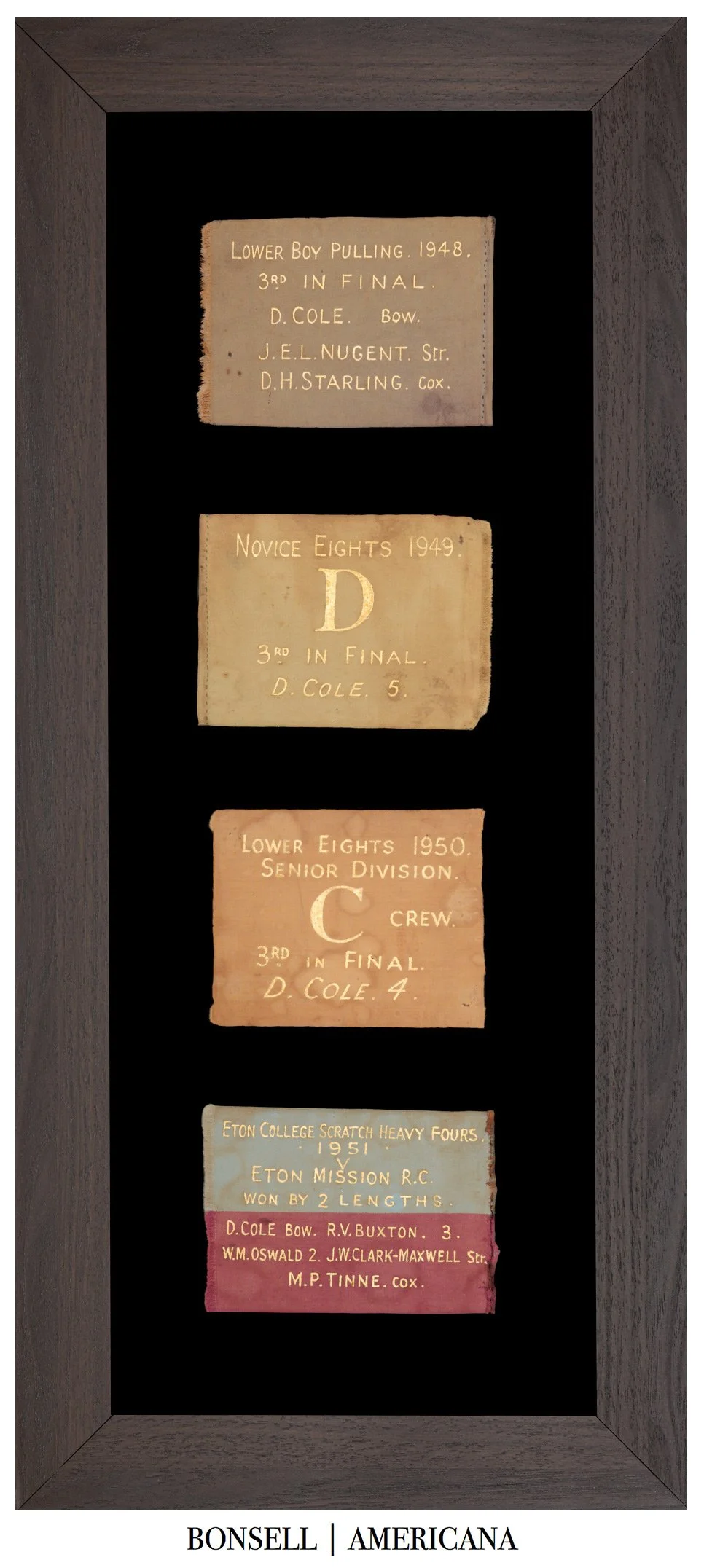
Offered is a rare and engaging group of four mid-20th century rowing pennants, produced for competition at Eton College and dating from 1948 through 1951. Hand-lettered on fabric and originally mounted to small staffs, these flags document the progress of a single oarsman—identified throughout as “D. Cole”—within one of the most tradition-rich athletic systems in the world.
Founded in 1440 by King Henry VI, Eton College stands among the most storied educational institutions globally. Though termed a “public school” in England, it is in fact an elite, all-boys boarding school, long associated with Britain’s political and cultural leadership. For American audiences, it may be best understood as a hybrid of a top preparatory academy and a historic institution of national identity. Its traditions are both preserved and performed—uniforms, ceremonies, and hierarchies remaining largely intact across centuries. Its alumni include numerous British prime ministers, among them Boris Johnson and David Cameron, as well as literary figures such as George Orwell.
Rowing occupies a central place within this culture. Situated along the River Thames, Eton developed one of the most competitive and structured schoolboy rowing programs in existence. Under the auspices of the Eton College Boat Club, students are organized into multiple crews by age, experience, and ability, competing both internally and in prestigious external events such as the Henley Royal Regatta. Advancement through these crews is a defining aspect of student life, reflecting discipline, endurance, and status within the school.
The present group captures this progression in tangible form. Each flag records a specific race, division, and outcome, offering a concise but remarkably vivid record of participation:
The earliest example, dated 1948, is inscribed “Lower Boy Pulling, 3rd in Final,” and lists the full crew by position, including bow, stroke, and coxswain. In rowing terms, “Lower Boy” denotes a younger division, indicating early participation. The fabric is a natural, undyed tone, with hand-painted lettering in a pale gold or cream pigment, and a roughly finished edge that suggests utilitarian production.
The 1949 flag, labeled “Novice Eights,” reflects the next stage. An “eight” refers to a boat crewed by eight rowers plus a coxswain, and “novice” indicates limited prior experience. The large letter “D” identifies the specific crew within the broader field—Eton commonly designates its multiple boats alphabetically. Again, the crew placed third in the final, and D. Cole appears in seat five, a central rowing position.
By 1950, the inscription reads “Lower Eights, Senior Division, C Crew.” This indicates advancement into a more competitive grouping, with “Senior Division” suggesting increased experience and performance level. The flag retains the same general format—hand-lettered text on a plain fabric ground—but shows slightly deeper coloration, likely from age or variation in material.
The final example, dated 1951, is the most visually distinctive. Titled “Eton College Scratch Heavy Fours,” it refers to a four-man boat assembled for a specific event (“scratch” meaning not a fixed crew). The two-tone coloration—light above and a reddish lower field—may relate to crew or event designation. Unlike the others, this flag records a victory: “Won by 2 Lengths.” It also references “Eton Mission R.C.,” a charitable rowing initiative associated with the school’s outreach efforts in London. The full crew is again listed, with D. Cole returning to the bow position.
Across all four examples, the consistent presence of D. Cole allows the group to be understood not merely as isolated artifacts, but as a cohesive record of athletic development over time—moving from junior to more advanced divisions within a highly structured system.
Taken together, these pennants offer a compelling intersection of sport, education, and social history. They speak to the traditions of Eton College, the discipline of competitive rowing, and the personal narrative of a student progressing through both. At once modest in scale and rich in context, they represent the sort of “gentleman’s antique” that resonates through association—where institution, tradition, and lived experience converge in a quietly meaningful way.
Conservation Process: The flag was hand sewn to cotton fabric, and both were hand sewn to a mounting board. To prevent the black dye in the cotton fabric from seeping into the flag, it was first washed in a standard wash and then in a dye setting wash. The flag is positioned behind Optium Museum Acrylic.
Frame: The frame features a broad, flat face with a clean, squared profile and a gently stepped inner rabbet, finished in a deep walnut tone.
Condition Report: The 1948 example shows moderate fraying along the hoist edge, with minor scattered staining and light surface soiling, consistent with use. The 1949 flag exhibits similar edge wear, along with areas of discoloration and toning to the fabric, particularly toward the right side. The 1950 example presents with more pronounced overall toning and light surface wear, though the lettering remains clear and legible. The 1951 pennant, the most visually distinctive, shows expected wear at the edges and some color variation and minor staining, particularly along the upper right, consistent with age and handling.
Collectability Level: The Great – Perfect for Rising Collectors
Date of Origin: 1948-1951
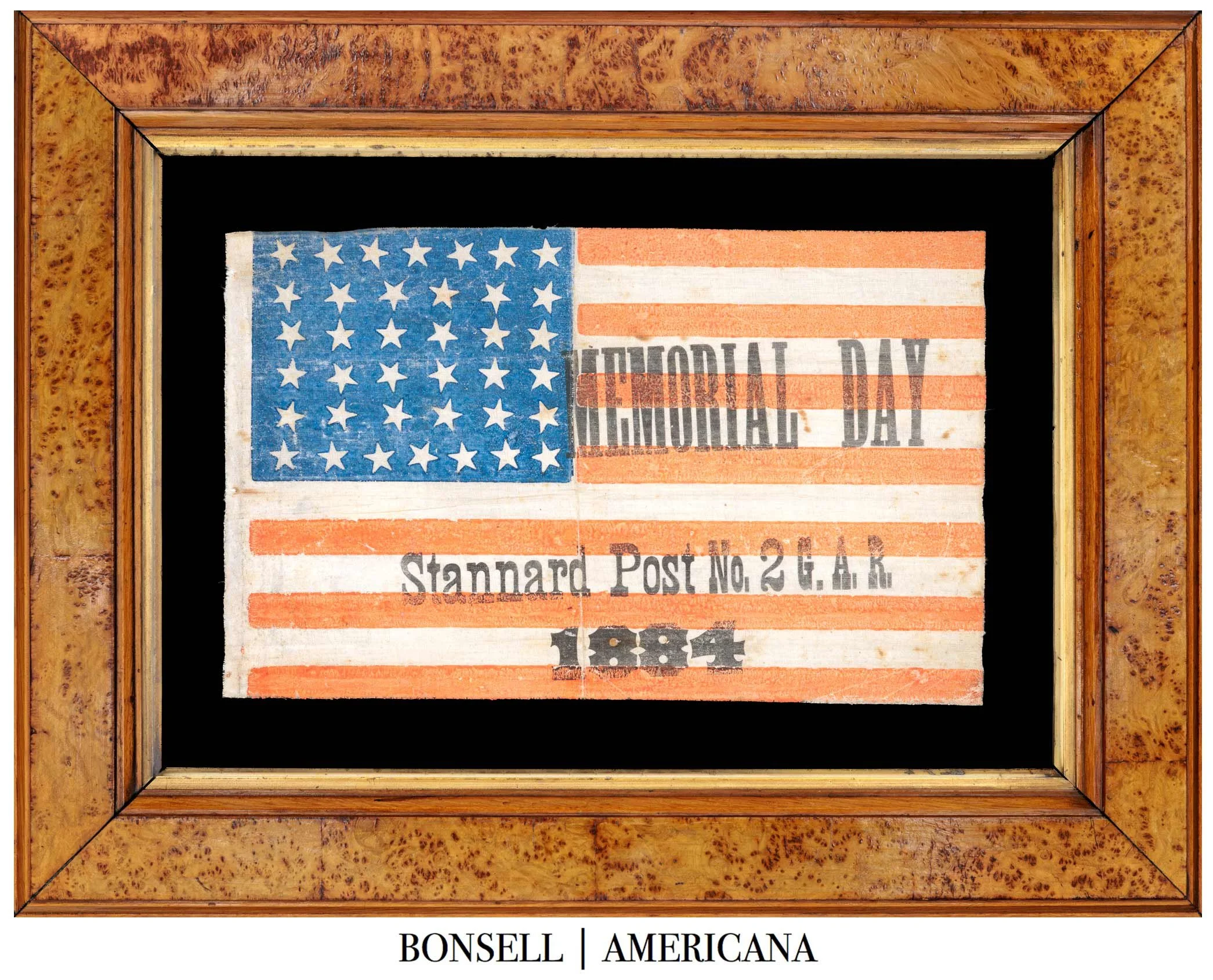
Frame Size (H x L): 16.75” x 22”
Flag Size (H x L): 9” x 14”
Offered is a 38-star American parade flag, printed on glazed cotton and overprinted for MEMORIAL DAY with a secondary, stamped overprint, referencing Stannard Post No. 2 of the Grand Army of the Republic (G.A.R.), dated 1884.
The canton displays a 7-6-6-6-6-7 star configuration, with stars arranged in generally linear rows and canted in varying directions, lending a lively, almost animated quality to the field. The stripes present in a particularly attractive orange-red tone, a result of period pigments and printing techniques, and provide strong visual contrast against the blue canton. Across the striped field appears the boldly applied, all-capital MEMORIAL DAY overprint, printed at a slight angle. The typography is somewhat crude, yet visually compelling, with additional text reading “Stannard Post No. 2 G.A.R.” and the date “1884,” offering the rare advantage of a clearly documented moment of use. This is the first example of this specific overprint and flag that we have encountered.
The presence of the MEMORIAL DAY overprint, combined with the identification of Stannard Post No. 2, firmly anchors this flag within the culture of Civil War remembrance. The Grand Army of the Republic, founded in 1866, was the leading fraternal organization of Union veterans, and its posts were deeply involved in the establishment and perpetuation of Memorial Day observances across the United States. These events were among the most important civic rituals of the late 19th century, involving parades, cemetery ceremonies, speeches, and the decoration of soldiers’ graves. Flags such as this were produced for precisely these occasions, often in limited quantities and for local use, which contributes to their rarity today.
Stannard Post No. 2 was located in Burlington, Vermont, and was named in honor of General George Jerrison Stannard, a Union officer best known for his leadership at the Battle of Gettysburg. The identification of a specific G.A.R. post is particularly desirable, as it ties the object to a defined community of veterans and a known geographic location. Unlike generic patriotic flags, this example was created for a specific group and event, elevating both its historical and interpretive value.
Of further interest is documentary evidence connecting the post to its membership. Period records, including the obituary of Leander W. Freeman, identify him as a member of Stannard Post No. 2. Freeman, an African American veteran who served in Company F of the 54th Massachusetts Colored Volunteers, represents an important and often underrepresented dimension of G.A.R. membership. His presence within the post underscores the degree to which African American veterans participated in these organizations and in Memorial Day observances, particularly in Northern communities. While it cannot be said that this flag was directly associated with Freeman himself, the documented connection between the post and one of its members adds a meaningful layer of human context and historical depth.
The 38 stars on this flag represent Colorado’s admission to the Union on August 1st, 1876. Known as the “Centennial State,” Colorado achieved statehood just 28 days after the nation’s 100th anniversary. Although the 38-star flag did not become official until July 4th, 1877, it remained in use through July 3rd, 1890, spanning a period of westward expansion, industrial growth, and national consolidation following the Civil War. By the date of this flag’s overprint—1884—the star count was fully official and widely produced, placing this example firmly within its proper historical context rather than among earlier anticipatory issues made for the Centennial.
The printing method and material further support an 1880s date. The use of glazed cotton, along with printed application of color, is consistent with parade flags of the period. The slightly irregular saturation of the pigments, especially in the stripes, contributes to the warm, almost burnished appearance that clients find particularly appealing. The overprint reflects the practical realities of such commemorative objects—standard flags customized for local events through secondary application.
Flags with specific Memorial Day overprints tied to named G.A.R. posts are rare, particularly those bearing a clear and early date. The combination of a desirable 38-star count, strong visual presentation, documented year of use, and direct association with a Grand Army post in Burlington makes this an especially compelling example. It stands not only as a patriotic object, but as a tangible artifact of post-war remembrance, community and identity.
Conservation Process: This flag was hand sewn to cotton fabric, and both were hand sewn to a mounting board. To prevent the black dye in the cotton fabric from seeping into the flag, it was first washed in a standard wash and then in a dye setting wash. The flag is positioned behind Optium Museum Acrylic.
Frame: The flag is housed in a handsome antique frame of birdseye maple, displaying dense, highly figured grain with warm, honeyed tones typical of 19th-century examples, likely dating to the mid- to late-1800s. A narrow gilded liner provides a refined inner border. The surface exhibits a naturally aged patina consistent with its period, enhancing its depth and character.
Condition Report: The flag shows moderate overall wear consistent with age and use, including scattered foxing, minor staining, and areas of pigment loss, particularly within the overprint and along the stripes. There is a vertical fold line through the center with associated light fabric breakdown, accompanied by minor fraying and edge wear along the perimeter. Despite these condition issues, the fabric remains stable, with strong visual presentation and legibility of both the star field and the MEMORIAL DAY overprint.
Collectability Level: The Great – Perfect for Rising Collectors
Date of Origin: 1884
Number of Stars: 38
Associated War: The Indian Wars (1860-1890)
Associated State: Colorado
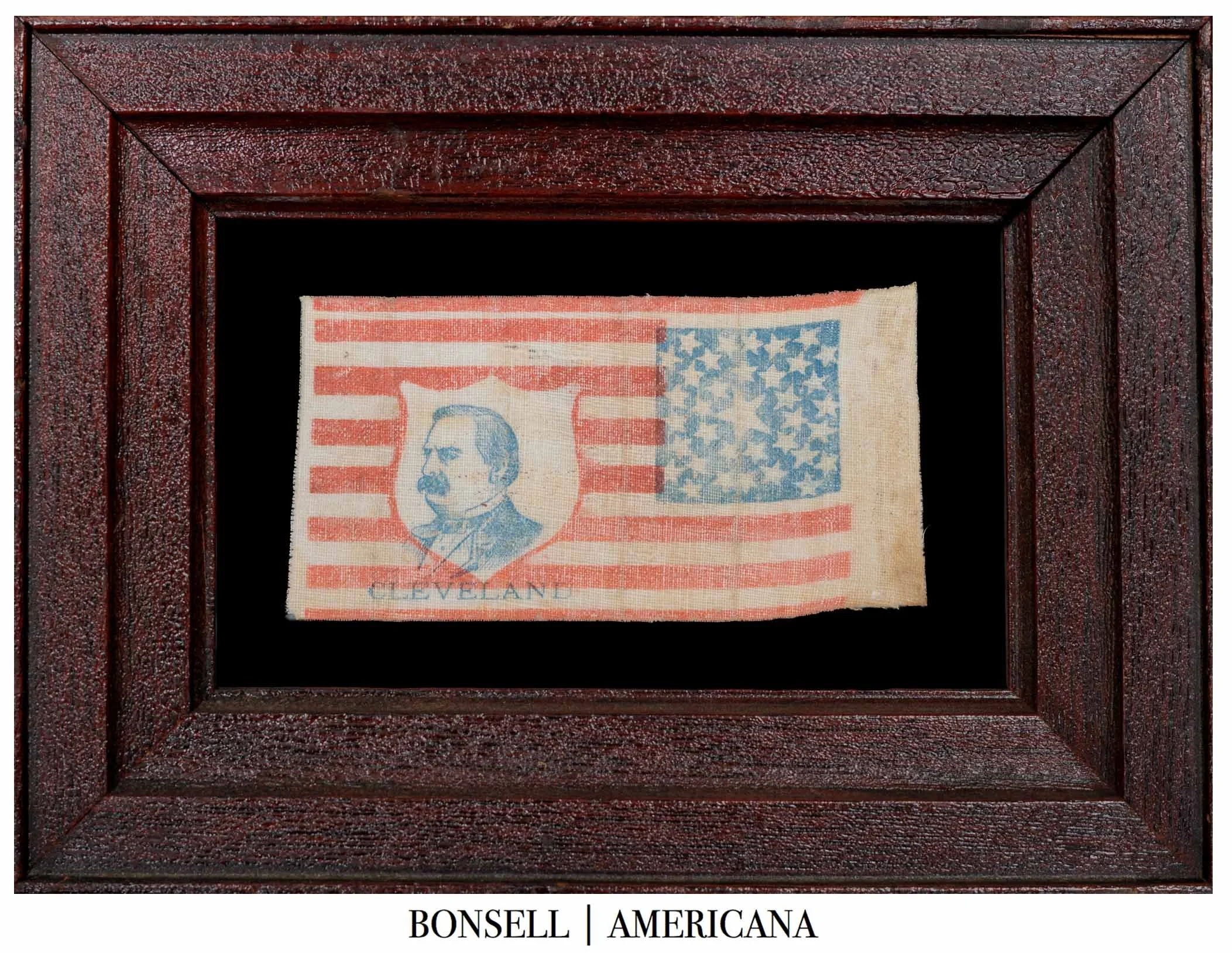
Frame Size (H x L): 6” x 8”
Flag Size (H x L): 2.25” x 4.25”
Offered is a miniature portrait campaign flag of Grover Cleveland, printed on coarse cotton and dating to the 1884 presidential election. The textile features Cleveland’s likeness rendered in blue within a shield, set against a field of red stripes and a blue canton populated by 36 stars. Beneath the portrait appears a bold, block-letter overprint reading “CLEVELAND,” executed in the same blue pigment. Small in scale yet visually assertive, the piece belongs to a scarce and highly collectible class of political textiles produced for campaign display and distribution.
The canton presents a medallion star configuration, a format rooted in mid-19th century design. A large central star—distinctively canted—anchors the composition, encircled by two rings of smaller stars, with additional stars completing the outer field. In total, the design incorporates 36 stars, corresponding to Nevada’s admission to the Union. While this count was official from July 4, 1865, to July 3, 1867, it was long obsolete by the time of Cleveland’s 1884 campaign, when the nation bore 38 states. The presence of a 36-star count here is therefore not literal, but instructive: it strongly suggests that the printing block employed for this flag originated earlier and was retained for later use. Rather than commissioning a new, updated design, printers appear to have repurposed an existing block, preserving both the earlier star count and the medallion format.
This retention of anachronistic imagery was not uncommon in inexpensive campaign ephemera. In this instance, it yields a visually compelling hybrid—late 19th-century political messaging expressed through a design vocabulary more typical of the Civil War era. The medallion configuration itself, with its celebratory and somewhat ornamental character, had largely fallen out of favor by circa 1890, replaced by rectilinear arrangements following the standardization of the flag in 1912. Its presence here adds both aesthetic distinction and historical depth.
Notably, the flag is presented in reverse orientation, with the canton appearing at the upper right rather than the upper left. This is not an error. During the 19th century, there was no official designation of a “front” or “back” to the American flag, nor a universally mandated canton position in printed parade flags and small textiles. As such, reverse-oriented examples like this are encountered and should be understood within the flexible conventions of the period.
The inclusion of a portrait within a shield is another point of distinction. While political textiles frequently incorporate candidate names or slogans, figural portraiture—especially integrated into a shield device—is less commonly encountered in flags of this scale. Cleveland’s likeness is crisply executed given the medium, with the shield serving both as a framing device and as a symbolic reference to national identity and civic virtue. The pairing of portrait and overprint reinforces the object’s intended function: immediate visual recognition in a crowded campaign environment.
From a production standpoint, the flag exhibits characteristics consistent with economical, large-quantity manufacture. The cotton is of a coarse, plain weave, and the pigments sit atop the fibers rather than penetrating them fully, indicative of block or stencil printing. Minor irregularities in saturation and registration are visible upon close inspection, lending the surface a slightly uneven but authentic quality. These features align with known examples of period campaign flags, which prioritized speed and cost-efficiency over refinement.
Historically, the flag relates to the fiercely contested 1884 presidential election between Grover Cleveland and James G. Blaine. Cleveland, the Democratic governor of New York, ran on a platform of reform and opposition to political corruption, while Blaine, the Republican nominee, carried the baggage of prior scandal. The campaign was marked by intense partisan rhetoric and remains one of the more colorful contests of the late 19th century. Objects such as this were produced to galvanize public support, serving as both promotional tools and personal tokens of political allegiance.
Examples of Cleveland campaign flags in this format are infrequently encountered, and those incorporating a medallion star field and portrait-on-shield design are particularly scarce. Campaign flags as a category occupy a special position within the field of American flag collecting, bridging political history and textile design. Their ephemeral nature—produced for short-term use and often discarded—has ensured that surviving examples are limited.
In sum, this is a compelling and visually distinctive example of late 19th-century political material culture: a Grover Cleveland campaign flag that combines an earlier star configuration, a dynamic medallion layout, and an uncommon portrait presentation within a single, compact textile.
Conservation Process: The flag was hand sewn to cotton fabric, and both were hand sewn to a mounting board. To prevent the black dye in the cotton fabric from seeping into the flag, it was first washed in a standard wash and then in a dye setting wash. The flag is positioned behind Optium Museum Acrylic.
Frame: A handsome 19th-century American frame with a rich, dark, hand-finished surface exhibiting pronounced craquelure throughout, indicative of age and original finish. The textured, slightly irregular surface and warm tonality provide a strong visual counterpoint to the textile, enhancing its period presence without distraction.
Condition Report: The flag shows expected wear consistent with its age and utilitarian purpose, including fraying along the edges, minor losses at the margins, and light soiling throughout. There is modest fading to the pigments and some unevenness in the print, inherent to its method of manufacture. Overall, the textile remains stable, with its imagery clear and highly legible.
Collectability Level: The Great – Perfect for Rising Collectors
Date of Origin: 1884
Number of Stars: 36
Associated War: The Indian Wars (1860-1890)
Associated State: Nevada
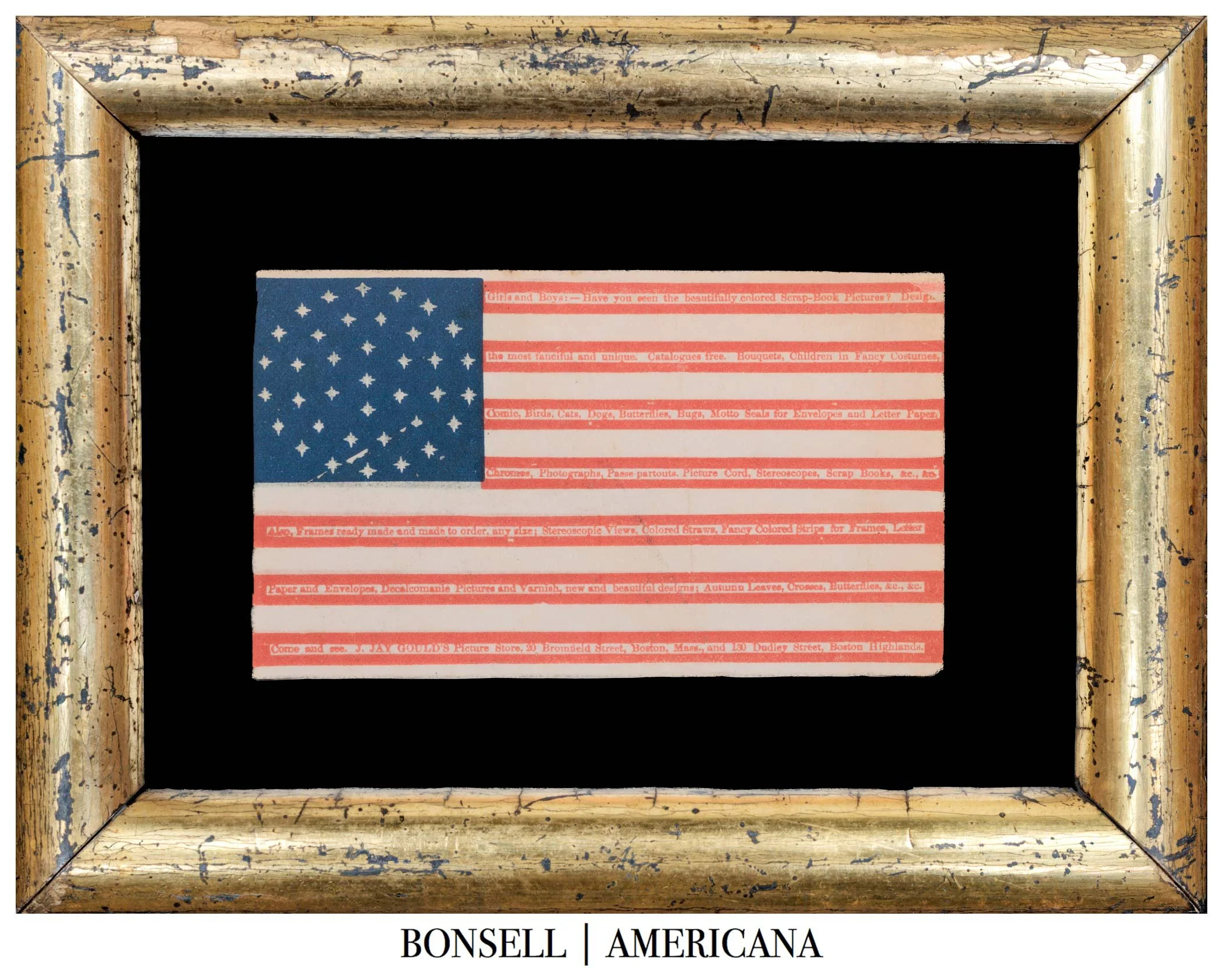
Frame Size (H x L): 6.5” x 8.5”
Flag Size (H x L): 2.75” x 5”
Offered is a 37-star American flag trade card, printed on paper and featuring an advertising overprint for J. Jay Gould’s Picture Store of Boston. Patriotic trade cards were widely produced in the late 19th century, but examples that combine an early star count with unusual graphic treatment and integrated advertising are less often encountered.
The star pattern is one of the more distinctive features. Arranged in a medallion formation with no outlying corner stars, the design departs from more typical linear or grid-based configurations. The stars themselves are also unusual. Rather than rounded or conventionally pointed forms, they have sharp, irregular points that give them an almost bursting appearance. The result is a more animated and expressive design than is usually seen in small printed flags of the period.
The placement of the advertising text is equally noteworthy. The overprint appears within the red stripes, executed in white lettering. In most known examples of overprinted patriotic paper items, text is placed in the white stripes for clarity and contrast. Here, the choice to print within the red required more careful registration and produced a more integrated effect, with the advertising functioning as part of the overall flag design rather than as a separate layer added afterward. This is an uncommon feature and one of the card’s most interesting visual characteristics.
The contents of the overprint offer insight into both the business itself and the consumer culture of the period. The text advertises “beautifully colored scrap-book pictures,” with catalogues offered free, and promotes a broad assortment of decorative and novelty goods. Among the subjects mentioned are bouquets, children in fancy costumes, comic scenes, animals, butterflies, and motto subjects for scrapbooks and letter paper. References to stereoscopic views and colored engravings reflect the strong demand for affordable visual material in the years after the Civil War, while the mention of frames made to order and “fancy colored mats” suggests that the shop also served customers interested in the display of images in the home. Other items, including albums, photographs, passe-partouts, picture cords, and ornamental paper goods, further indicate a business centered on the sale of inexpensive, attractive, mass-produced imagery and related decorative materials. Taken together, the overprint reads almost like a condensed catalogue of popular visual culture in the period.
The advertisement identifies J. Jay Gould’s Picture Store at 20 Bromfield Street and 120 Dudley Street in Boston. The presence of two addresses suggests an established retail operation serving different parts of the city, and the specificity of the imprint is useful both historically and for dating purposes. Trade cards such as this were intended to advertise, but they were also meant to be kept. Their small format, colorful presentation, and novelty value made them ideal for retention in albums and scrapbooks, which helps explain why surviving examples remain of interest today.
From a collecting standpoint, the piece sits at the intersection of early American flags and 19th-century advertising ephemera. The unusual star shapes, medallion configuration, and red-stripe overprint distinguish it from more standard examples, while its small format reflects its original purpose as a portable promotional item.
The 37-star count corresponds to Nebraska’s admission as the 37th state on March 1, 1867. The official 37-star flag remained in use from July 4, 1867 through July 3, 1877, placing this card within the Reconstruction era and into the years leading up to the 1876 Centennial, when patriotic imagery was widely employed in both civic and commercial settings. The star count therefore provides a clear historical framework for the piece.
Overall, this is a strong example of late 19th-century patriotic advertising, made more interesting by several features not commonly encountered in combination. The unusual medallion star pattern, the sharply stylized stars, the placement of the overprint in the red stripes, and the specific connection to a Boston picture store all contribute to its appeal. It is a compact but layered object that brings together graphic interest, historical context, and crossover value for collectors of both flags and advertising ephemera.
Frame: The card is housed in an antique frame with a lemon gold finish, characterized by a soft, pale gilt tone with a gentle luster. The finish is consistent with mid- to late-19th century gilt frames, circa 1850–1880, and presents a refined, understated appearance typical of the period.
Condition Report: The trade card has been professionally conserved by a paper conservator. There is expected light toning and minor wear consistent with age and handling, but the surface remains stable and well-preserved. Any prior issues have been addressed through conservation, allowing the piece to present cleanly while retaining appropriate signs of age.
Collectability Level: The Great – Perfect for Rising Collectors
Date of Origin: 1867-1876
Number of Stars: 37
Associated War: The Indian Wars (1860-1890)
Associated State: Nebraska

Frame Size (H x L): 28.5” x 33.5”
Broadside Size (H x L): 19.25” x 24”
Offered is a World War I agricultural recruitment broadside produced for use in Illinois under the auspices of the U.S. Boys’ Working Reserve. Printed in red and blue inks on cream machine-made paper, the poster urges farmers to “Take a Boy Now to Help You Farm,” presenting agricultural labor as a direct contribution to the national war effort.
Issued during America’s involvement in the First World War (1917–1918), the broadside responds to labor shortages caused by military enlistment and wartime industrial expansion. The text states that “20,000 Illinois boys (between 16 and 21) have volunteered in the U.S. Boys’ Working Reserve to help Illinois farmers produce the food to win the war,” explicitly linking agricultural production with national victory. While military enlistment posters are more commonly encountered, this material reflects the parallel mobilization taking place on the American home front.
HISTORICAL CONTEXT
The U.S. Boys’ Working Reserve was organized in 1917 under the United States Department of Labor to mobilize teenage boys for essential wartime labor. As adult farm workers entered military service or relocated to industrial employment, agricultural output faced measurable strain. State programs recruited, screened, trained, and placed high school-aged boys in agricultural positions.
Illinois played a meaningful role in this effort. The broadside describes participants as “carefully picked young men — able-bodied and eager for hard work — intelligent, of good character — trained to learn and to obey.” It further notes that many received “SPECIAL EDUCATION FOR FARM WORK,” including instruction in handling horses and farm machinery. The language reflects Progressive Era emphasis on discipline, character, and organized civic participation.
The text asserts that Federal and State governments “GUARANTEE THESE YOUNG MEN,” an assurance intended to address farmers’ concerns regarding reliability and preparedness. The statement that each boy would be “worth his keep from the first day” frames the program in practical economic terms alongside its patriotic purpose.
The broadside bears the printed names of Samuel Insull, Chairman of the Illinois State Council of Defense, and Burridge D. Butler, Federal State Director of the U.S. Boys’ Working Reserve for Illinois. The printer’s imprint at the lower margin reads “Ryan & Hart Co., Printers, Chicago,” placing the production firmly within Illinois’ wartime administrative structure.
DESIGN, PRINTING, AND PHYSICAL CHARACTERISTICS
The headline “TAKE A BOY NOW” appears in large red block letters across the upper field, with supporting text printed in blue to establish clear visual hierarchy. At left center, a shield device encloses a portrait of a neatly dressed young man in suit and tie rather than work clothing. The imagery presents the recruit as disciplined, educated, and dependable. The shield motif reinforces themes of duty and service, aligning agricultural labor with national defense.
The layout is structured and direct, framed by double red and blue rule borders that organize the text into defined blocks. The concluding directive, “ASK THE MAN IN CHARGE HERE,” indicates intended display in a public or administrative setting where local coordination of placements occurred.
The broadside was printed by letterpress on paper, with red and blue inks applied in separate passes. Registration is clean and typographic impressions remain sharp. It is a single-sheet printed broadside featuring a bold typographic header, a shield-form portrait vignette, and structured text contained within rule borders. The lower margin carries the printer’s imprint of Ryan & Hart Co., Chicago. Visible fold lines are consistent with original folded distribution for mailing or shipment to county offices and agricultural agencies.
This U.S. Boys’ Working Reserve broadside documents the organized mobilization of agricultural labor on the American home front during World War I, combining state-level administration, disciplined wartime messaging, and strong graphic structure in a format intended for public display.
Frame: The broadside is housed in a wide, sloped molding with an aged gold surface, intentionally distressed to evoke the appearance of early gilded frames.
Condition: The broadside has been professionally conserved by a paper conservator and presents well overall. Visible horizontal and vertical fold lines remain from original distribution, with minor residual creasing and slight separation previously present at fold intersections. There is light, even toning consistent with age, along with scattered minor edge wear and small imperfections that remain visible upon close inspection. The printed surface remains strong, with red and blue inks retaining good saturation and clarity.
Collectability Level: The Great – Perfect for Rising Collectors
Date of Origin: 1917-1918
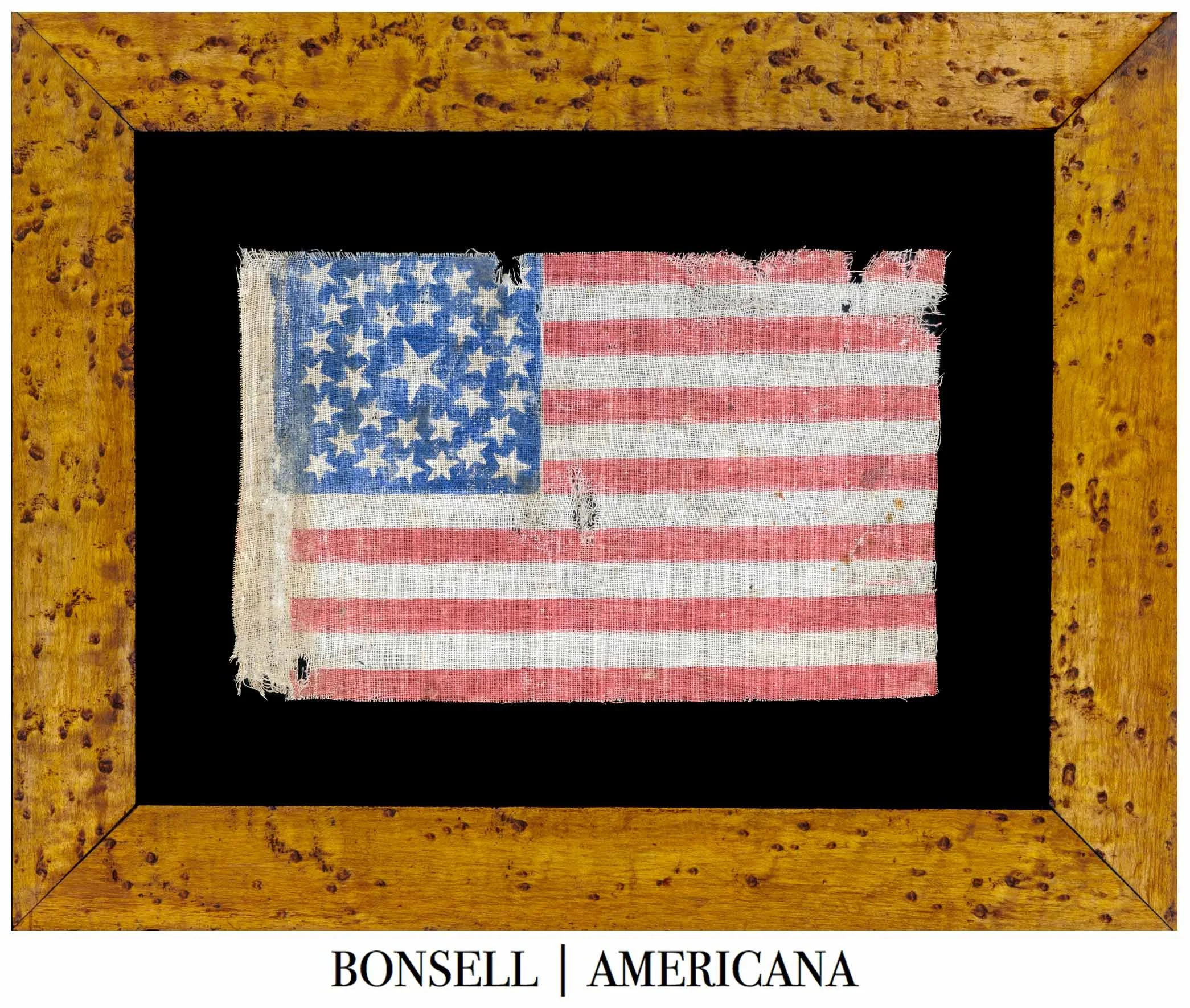
Frame Size (H x L): 12” x 15”
Flag Size (H x L): 6” x 9”
Offered is a 33-star American national flag, printed on glazed cotton and executed in a highly distinctive medallion-style star configuration. At the center of the canton is a single, oversized “center star,” canted to approximately the 11:00 position. This center star is widely understood to represent the most recently admitted state—Oregon in the case of the 33-star flag. Surrounding the center star are two concentric rings of smaller stars, with four additional stars positioned in the corners of the canton, completing the design.
The stars are notably pointy and irregular in form, lending the flag a distinctly folksy, hand-rendered appearance. They are tightly packed within the canton, a visual characteristic emblematic of a small and well-recognized family of mid-19th-century printed flags. Although the maker of this example remains unidentified, the star shapes, spacing, and overall layout are consistent across a limited group of flags known to have originated from the same workshop.
This workshop is documented to have produced flags in 6 different star counts, all sharing the same stylistic vocabulary: 7-star, 13-star, 15-star, 29-star, 33-star, and 35-star examples. Each star count corresponds to a specific historical or commemorative purpose. Flags with 7 stars acknowledged the first seven states to secede from the Union; 13-star flags referenced the original colonies; 15-star flags commemorated Kentucky’s centennial; and the 29-star, 33-star, and 35-star flags celebrated the admission of Iowa, Oregon, and West Virginia, respectively. The recurrence of this design across multiple star counts suggests a commercially oriented maker responding quickly to current events and prevailing public sentiment.
The 33-star flag represents the admission of Oregon, which became the 33rd state on February 14, 1859. In accordance with federal law, the star count was updated on the following Independence Day, making July 4, 1859, the official beginning of the 33-star flag’s period of use. It remained the official national flag until July 4, 1861, when the 34-star flag—reflecting the admission of Kansas—was formally adopted.
The historical timing of the 33-star flag is particularly significant. Its official period of use overlaps directly with the secession crisis and the opening months of the Civil War. At the time the 33-star flag became official, multiple Southern states had already left the Union, yet no stars were ever removed from the flag. As a result, the 33-star flag represents a Union that was legally intact but politically fractured—an important and meaningful distinction for collectors.
This association is underscored by a notable historical reference: a 33-star flag was flying at Fort Sumter when Confederate forces launched their attack in April of 1861. Because of this, the 33-star flag is among the earliest star counts directly tied to the Civil War and is often regarded as a visual symbol of the nation on the brink of armed conflict.
Although the 33-star flag was officially replaced in July of 1861, it continued to be used well into the Civil War. Wartime supply constraints meant that existing flags remained in service, and manufacturers did not immediately discard earlier printing blocks or designs. As a result, 33-star flags are documented in both pre-war and early-war contexts, adding to their historical depth and complexity.
From a broader collecting perspective, flags from the Civil War era are among the most sought-after of all antique American flags. Prior to the late 1850s, flags were not commonly displayed by civilians for patriotic purposes, and even military use was relatively limited. Earlier flags were typically produced for maritime identification and were often very large in scale. The mass production of smaller, affordable flags—intended for rallies, political events, and personal display—emerged with the election of Abraham Lincoln and accelerated rapidly with the onset of the Civil War. The 33-star flag sits squarely at the beginning of this transformation.
Taken as a whole, the 33-star flag occupies a uniquely compelling position in the history of American national flags. It represents the Union at a moment of profound tension—legally whole, yet politically fractured—while also marking the transition from large, utilitarian flags to smaller examples made expressly for public display and personal expression. Combined with its association with the opening chapter of the Civil War, its relatively brief official lifespan, and the bold medallion-style configuration seen here, the 33-star flag stands among the most historically resonant and visually distinctive star counts available to collectors today.
Conservation Process: This flag was hand sewn to cotton fabric, and both were hand sewn to a mounting board. To prevent the black dye in the cotton fabric from seeping into the flag, it was first washed in a standard wash and then in a dye setting wash. The flag is positioned behind Optium Museum Acrylic.
Frame: The flag is housed in a solid birdseye maple frame, chosen for its warm tone and distinctive figured grain. Its restrained profile provides a clean, complementary presentation without distracting from the flag itself.
Condition Report: The flag presents with expected wear consistent with age and use, including overall fabric softening, light surface soiling, and moderate fraying along the edges. There is a small area of fabric loss and a short vertical tear within the striped field, accompanied by scattered minor holes and thread loss elsewhere. Despite these condition issues, the flag remains stable, visually compelling, and well suited for display.
Collectability Level: The Great – Perfect for Rising Collectors
Date of Origin: 1859-1861
Number of Stars: 33
Associated War: Pre-Civil War
Associated State: Oregon
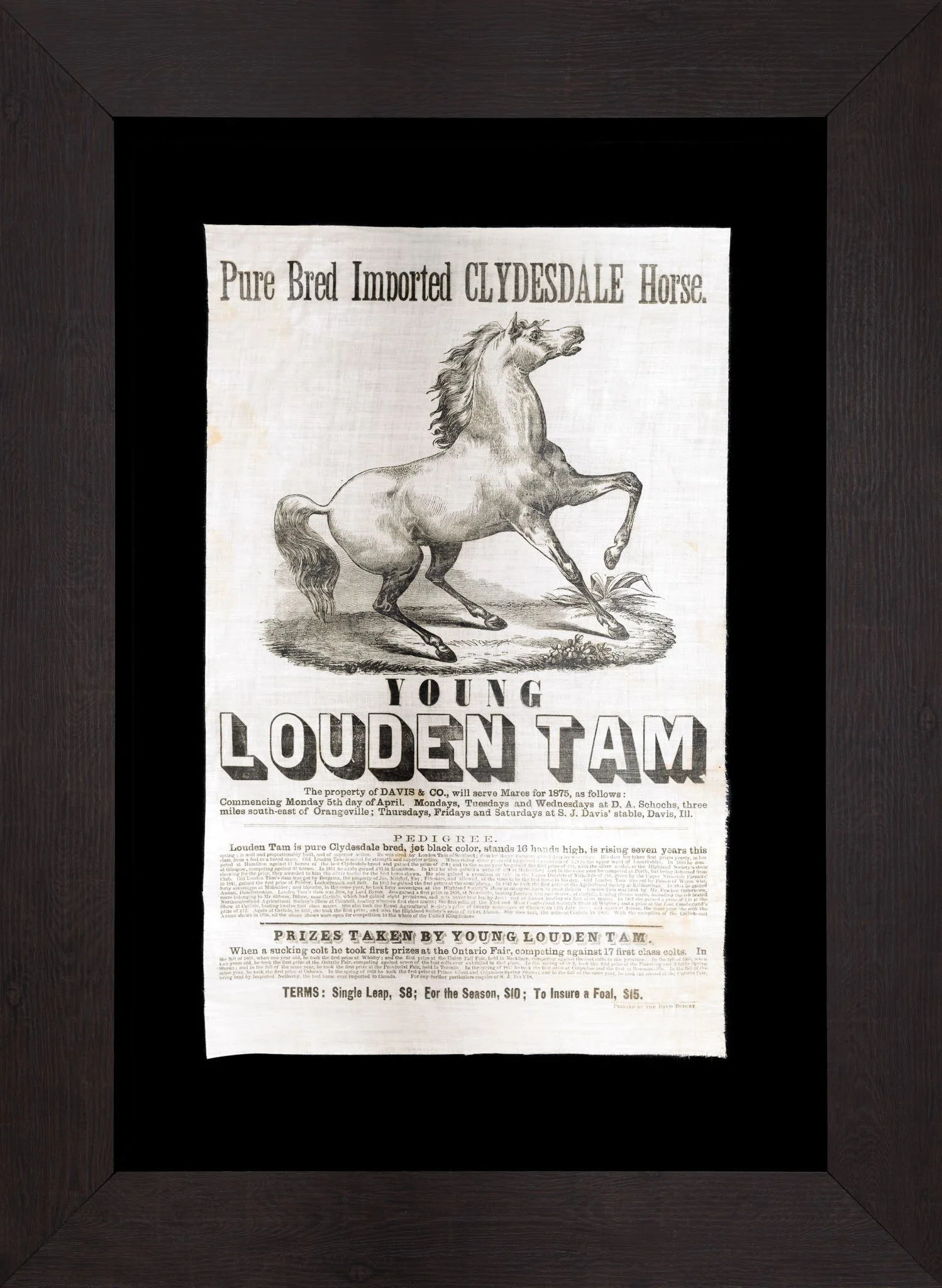
Frame Size (H x L): 30” x 22.5”
Broadside Size (H x L): 21” x 13”
Offered is a rare nineteenth-century American livestock advertising broadside, promoting the breeding services of the purebred imported Clydesdale stallion Young Louden Tam. Printed on glazed cotton and issued for the 1875 breeding season, the broadside was produced for use in northern Illinois, with service locations listed near Orangeville and at S. J. Davis’s stable in Davis, Illinois. It reflects a period when draft-horse breeding was central to agricultural productivity and regional commerce in the Midwest.
Broadsides of this type were created for temporary public display in livery stables, feed stores, fairgrounds, and other agricultural centers. They announced a stallion’s availability, outlined pedigree and terms, and circulated locally during a single breeding season before being replaced. As a result, examples that remain today—particularly those produced on textile substrates rather than paper—are uncommon.
Young Louden Tam is described as a jet-black Clydesdale stallion, standing 16 hands high and rising seven years of age in 1875, an age regarded as ideal for breeding. He is identified as the son of Louden Tam of Scotland, with extended pedigree text noting show prizes and premiums earned abroad. In the decades following the Civil War, Illinois farmers actively sought imported British draft stock to improve strength, size, and consistency in working horses. Clydesdales were especially valued for their combination of power and sound movement, qualities well suited to the demands of Midwestern farming and freight work.
The terms of service reflect the structured and increasingly professional nature of horse breeding at the time. Fees ranged from $8 for a single leap to $15 to insure a foal, amounts that represented a serious investment for farmers. The listed schedule and multiple service locations illustrate how stallions were moved between communities to reach a wider clientele. In Illinois, where mixed grain farming, hauling, and land improvement all depended on animal power, access to a proven imported stallion carried both economic and practical importance.
This broadside is printed on glazed cotton, a durable textile sometimes used for agricultural advertising intended for repeated handling and display. The surface treatment provided greater resilience than paper and helps explain the survival of examples such as this. The central image is a wood engraving of the stallion, paired with bold, utilitarian typography designed for clear visibility in public settings. The overall layout prioritizes clarity and information, combining image, pedigree, schedule, and terms in a direct commercial format.
Taken as a whole, this broadside offers a clear window into nineteenth-century horse breeding in Illinois, where imported bloodlines, regional circulation of stallions, and printed advertising worked together to support an agricultural economy still fundamentally dependent on draft power. It stands as a well-preserved document of that system, valued both for its historical content and for its survival on an uncommon textile medium.
Conservation Process: The broadside was hand sewn to a cotton fabric backing, which was then hand sewn to a mounting board. To prevent dye migration from the black cotton, the fabric was pre-washed and treated with a dye-setting wash prior to mounting. The broadside is displayed behind Optium Museum Acrylic.
Frame: The frame features a wide, flat-profile wood molding finished in dark walnut. Its clean lines and subdued grain provide a strong, understated presentation. The profile offers visual weight without distraction.
Condition: The surface shows light, uneven discoloration, most noticeable in the lighter areas of the field, consistent with age and historical use. These tonal variations do not obscure the printed text or imagery and are typical of glazed cotton advertising from the period. Overall presentation remains clear and well preserved for a nineteenth-century working textile.
Collectability Level: The Great – Perfect for Rising Collectors
Date of Origin: 1875
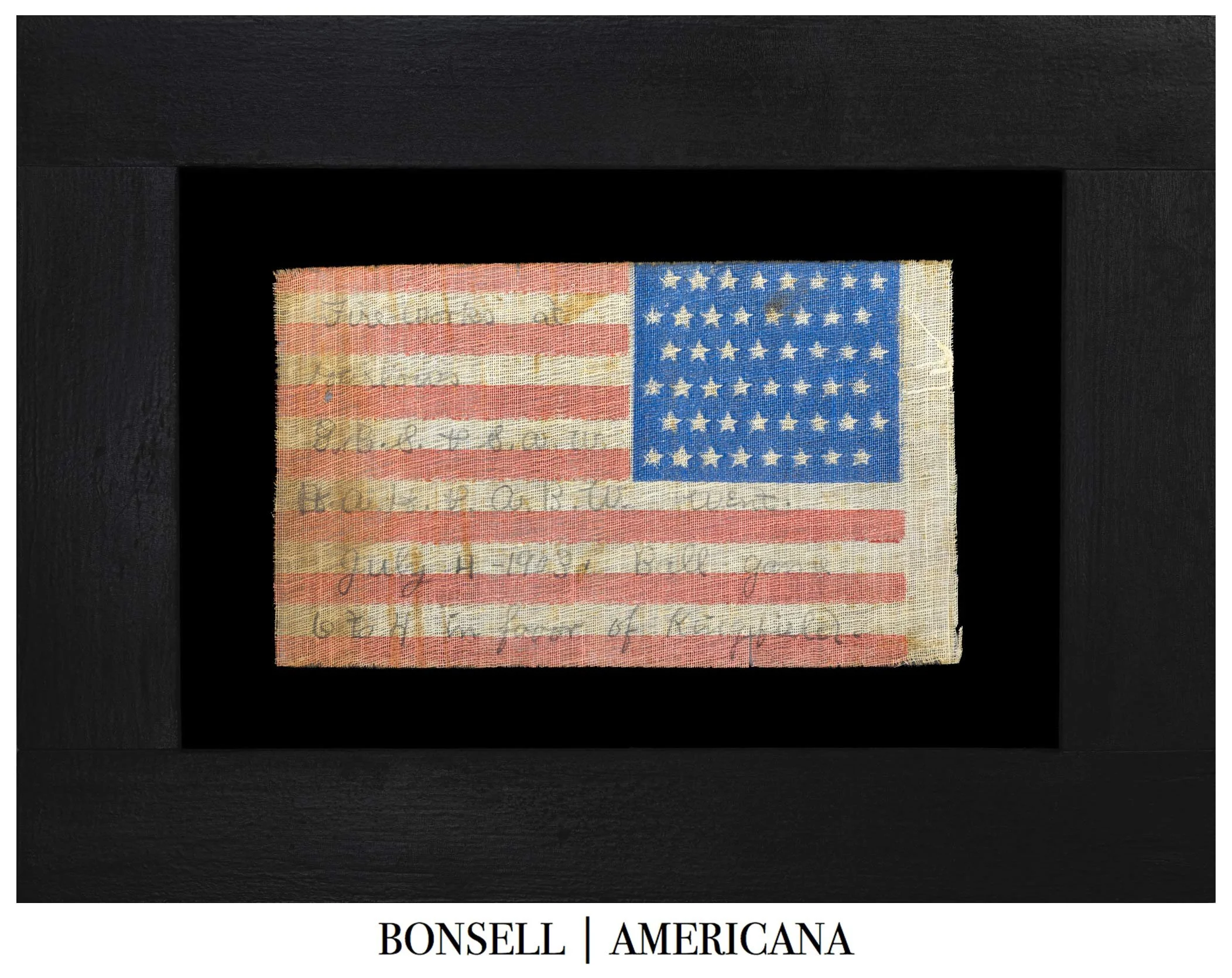
Frame Size (H x L): 9.5” x 13”
Flag Size (H x L): 4.5” x 7.5”
Offered is a 48-star American parade flag, printed on glazed cotton, notable for its early, non-regulated star arrangement and for the presence of handwritten inscriptions that record a specific Independence Day celebration. In addition to its patriotic function, this flag preserves contemporaneous written details relating to a local baseball game and Fourth of July festivities.
The handwritten inscriptions appear on both sides of the 48-star flag and are central to its significance. One side records the setting, participants, and date of the celebration, while the other reiterates the date and game details. Because portions of the writing are faint and partially obscured, the inscriptions are transcribed here verbatim so that the historical information is fully accessible.
The inscription on the side shown reads as follows:
Fireworks at
Harlows
G.B.S. & S.A.W.
H.A.H. & A.B.W. Went
July 4, 1903. Ball game
6 to 4 in favor of Kingfield.
The inscription on the other side reads as follows:
July 4, 1903.
H.A.H.
Ball game between Lexington &
Kingfield, 6 to 4 in favor of Kingfield.
Together, these inscriptions anchor the 48-star flag to a Fourth of July celebration in 1903 in western Maine. The named towns—Kingfield and Lexington—were neighboring rural communities, and holiday baseball games between such towns were a common feature of Independence Day observances at the turn of the twentieth century. These games were typically informal and locally organized, often accompanied by picnics and fireworks and held on private farms or open land rather than at formal municipal venues. The reference to “Harlows” is consistent with this practice and appears to denote a locally known family property used as the gathering site.
The recorded score—six to four in favor of Kingfield—suggests local pride and firsthand participation. A series of initials appears on both sides of the flag (G.B.S., S.A.W., H.A.H., and A.B.W.). While their specific identities remain unknown, such initials are typical of informal, personal inscriptions of the period and likely reference individuals present at, or involved in, the day’s events.
The 48-star count is anticipatory. This flag dates to 1903, nearly a decade before the 48-star flag became official on July 4, 1912, following the admission of New Mexico and Arizona earlier that year. In the late nineteenth and early twentieth centuries, American flag makers regularly anticipated future state admissions and produced flags reflecting projected star counts well in advance of official adoption. As a result, 48-star flags are known from the 1890s onward, long before the configuration was formally recognized.
Prior to June 24, 1912—when President Taft issued Executive Order 1556—there were no federal specifications governing star arrangement or flag proportions. Flag makers were free to arrange the stars within the canton as they saw fit, and proportions varied widely. Many early 48-star flags therefore display staggered or offset star patterns and elongated formats, characteristics present in this example and consistent with its early date of manufacture. Exact shades of red, white, and blue were likewise unregulated until 1934.
The 48-star flag holds a uniquely long and consequential place in American history. It became official on July 4, 1912, and remained the national flag for forty-seven years, until July 4, 1959, when Alaska prompted the adoption of the 49-star flag. During this extended period of use, the United States experienced many of the defining events of the twentieth century, including World War I, World War II, and the Korean War, all fought under the 48-star flag. Eight U.S. presidents served while it was the official national emblem, and for many Americans it became the flag most closely associated with the country’s emergence as a global power.
Seen in this light, the presence of a 48-star flag at a small-town Fourth of July celebration in 1903 feels notably forward-looking. Long before the star count became official—and decades before it would fly during some of the nation’s most consequential moments—this flag was already in use as part of everyday civic life, carried and written upon by ordinary Americans marking a summer holiday with baseball and fireworks.
Importantly, this is the exact 48-star flag illustrated and discussed in The Stars and Stripes: Fabric of the American Spirit by J. Richard Pierce. Pierce is widely regarded as one of the foremost private collectors and scholars of American parade flags, and his collection—formed over decades—has served as the basis for exhibitions and scholarship at major institutions. Inclusion in his work places this flag within a rigorously studied and well-documented corpus of American textiles.
The flag is also referenced in a published article in Antiques & The Arts and was publicly exhibited as part of The Stars and Stripes: Fabric of the American Spirit, including exhibitions at Hancock Shaker Village and Morven Museum & Garden. These references establish the flag as a documented and exhibited example.
Taken together, the anticipatory 48-star count, early production characteristics, precise date, named towns, recorded score, handwritten inscriptions, and published exhibition history place this flag within the broader context of American flag-making, early baseball culture, and Independence Day traditions at the turn of the twentieth century.
Conservation Process: This flag was hand sewn to cotton fabric, and both were hand sewn to a mounting board. To prevent the black dye in the cotton fabric from seeping into the flag, it was first washed in a standard wash and then in a dye setting wash. The flag is positioned behind Optium Museum Acrylic.
Frame: The flag is housed in an early frame with a dry black surface, dating to approximately the 1840s. The frame is constructed from four straight lengths of molding joined at the corners rather than mitred, a method associated with utilitarian framing practices of the period.
Condition Report: The flag presents with honest wear consistent with age and use. There is a small hole near the fly end, located beneath the handwritten reference to Harlows, as well as a small vertical tear between the letters “g” and “f” in “Kingfield.” Additional minor fading and surface wear are present throughout, but the flag remains stable, legible, and visually appealing, with the inscriptions and star field clearly intact.
Collectability Level: The Great – Perfect for Rising Collectors
Date of Origin: 1903
Number of Stars: 48
Associated War: WWI, WWII, and Korean War
Associated State: Arizona
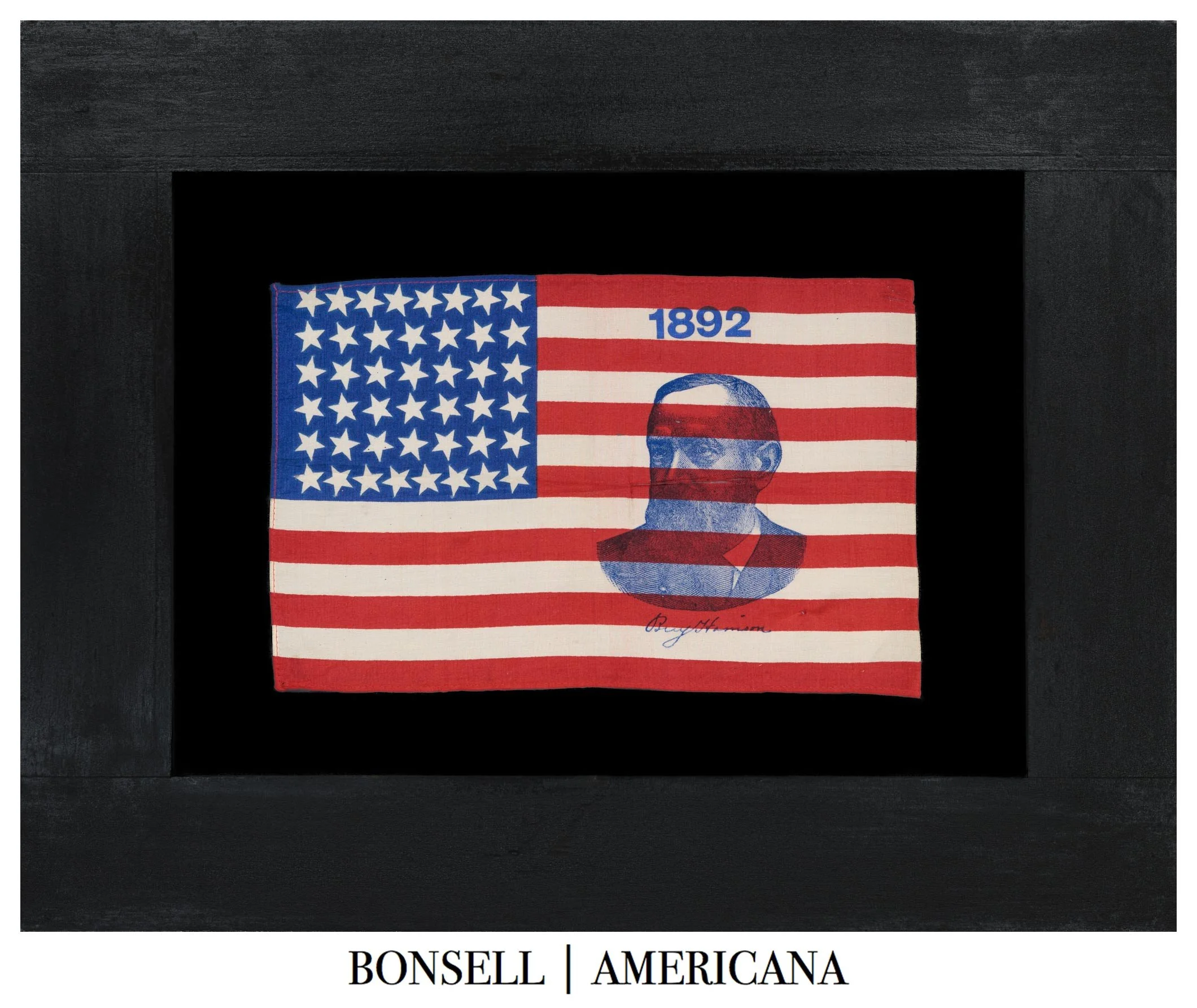
Frame Size (H x L): 14.5” x 18.5”
Flag Size (H x L): 8.75” x 10.5”
Offered is a 44-star American silk parade flag produced for the presidential election of 1892 and overprinted with a portrait of Republican candidate Benjamin Harrison, along with a facsimile of his signature and the campaign year, “1892.”
Printed on silk and intended for parade or public display, this flag represents a documented form of late-19th-century political ephemera that integrates national symbolism, portrait imagery, and campaign identification within a single textile. The canton contains forty-four white stars arranged in regular rows on a blue field, corresponding to the official star count following Wyoming’s admission to the Union in 1890. Harrison’s portrait is printed directly across the striped field, visually linking the candidate to the national flag in a manner consistent with campaign display practices of the period.
The portrait used on this flag is derived from a painted likeness by Eastman Johnson, executed circa 1889 and associated with the National Portrait Gallery. Johnson was a prominent American artist of the 19th century, and the use of his painted portrait as the basis for campaign imagery reflects a common practice of adapting established presidential likenesses for political ephemera. The source of the portrait confirms that the image was not a generic engraving but one grounded in an officially recognized representation of the candidate.
This Harrison portrait flag is documented in authoritative reference works on American political textiles and is represented in major institutional collections. An example of this flag is held by the Smithsonian Institution, within its Division of Political History. Additional examples are documented in the Pierce Collection, one of the most significant private collections of American parade flags and political cloth. The appearance of this flag in both institutional and private reference contexts establishes it as a recognized campaign type rather than an isolated or undocumented variant.
The underlying 44-star silk flag used for this Harrison example was manufactured as a standardized base and later adapted through overprinting. The same base flag was also used for the 1892 Democratic campaign of Grover Cleveland, substituting Cleveland’s portrait and signature while retaining the identical star field and stripe layout. Outside of politics, this flag format appears with other period overprints, including a commemorative example marking the one-hundredth performance of actor John Drew, as well as a salesman’s sample intended to demonstrate advertising possibilities on parade flags. These related examples illustrate the commercial practices of late-19th-century flag makers, who produced high-quality patriotic textiles that could be customized for different clients and purposes.
A notable feature of the Harrison and Cleveland campaign flags is the method of overprinting. Unlike most political parade flags of the era, which were typically overprinted in black ink after the base flag was produced, the portrait and text on this flag were printed in blue ink matching that of the canton. This approach results in a unified visual treatment and distinguishes this group of flags from more common black-overprinted campaign examples.
The election of 1892 provides relevant historical context for this flag. It marked a rematch between incumbent president Benjamin Harrison and former president Grover Cleveland, following Cleveland’s defeat in 1888. The campaign centered on economic policy and tariffs, and Cleveland’s victory made him the only president in U.S. history to serve two non-consecutive terms. Campaign materials from this election reflect a period in which political messaging increasingly relied on mass-produced visual objects intended for public display.
Silk parade flags from the 19th century survive in limited numbers due to the inherent fragility of the material and their intended use. This example remains a clear and legible representation of a documented 1892 campaign design, supported by reference literature and institutional comparators. Its silk construction, identifiable portrait source, and established place within a known family of related flags make it a representative example of American political textiles from the late 19th century.
Conservation Process: The flag was hand sewn to cotton fabric, and both were hand sewn to a mounting board. To prevent the black dye in the cotton fabric from seeping into the flag, it was first washed in a standard wash and then in a dye setting wash. The flag is positioned behind Optium Museum Acrylic.
Frame: The flag is housed in an early frame with a dry black surface, dating to approximately the 1840s. The frame is constructed from four straight lengths of molding joined at the corners rather than mitred, a method associated with utilitarian framing practices of the period.
Condition Report: The silk shows expected age-related wear, including a few small holes. There is a horizontal tear that begins just to the left of Harrison’s portrait at approximately nose level and extends toward the ear. Despite these condition issues, the textile remains stable, attractive, and visually cohesive.
Collectability Level: The Great – Perfect for Rising Collectors
Date of Origin: 1892
Number of Stars: 44
Associated State: Wyoming
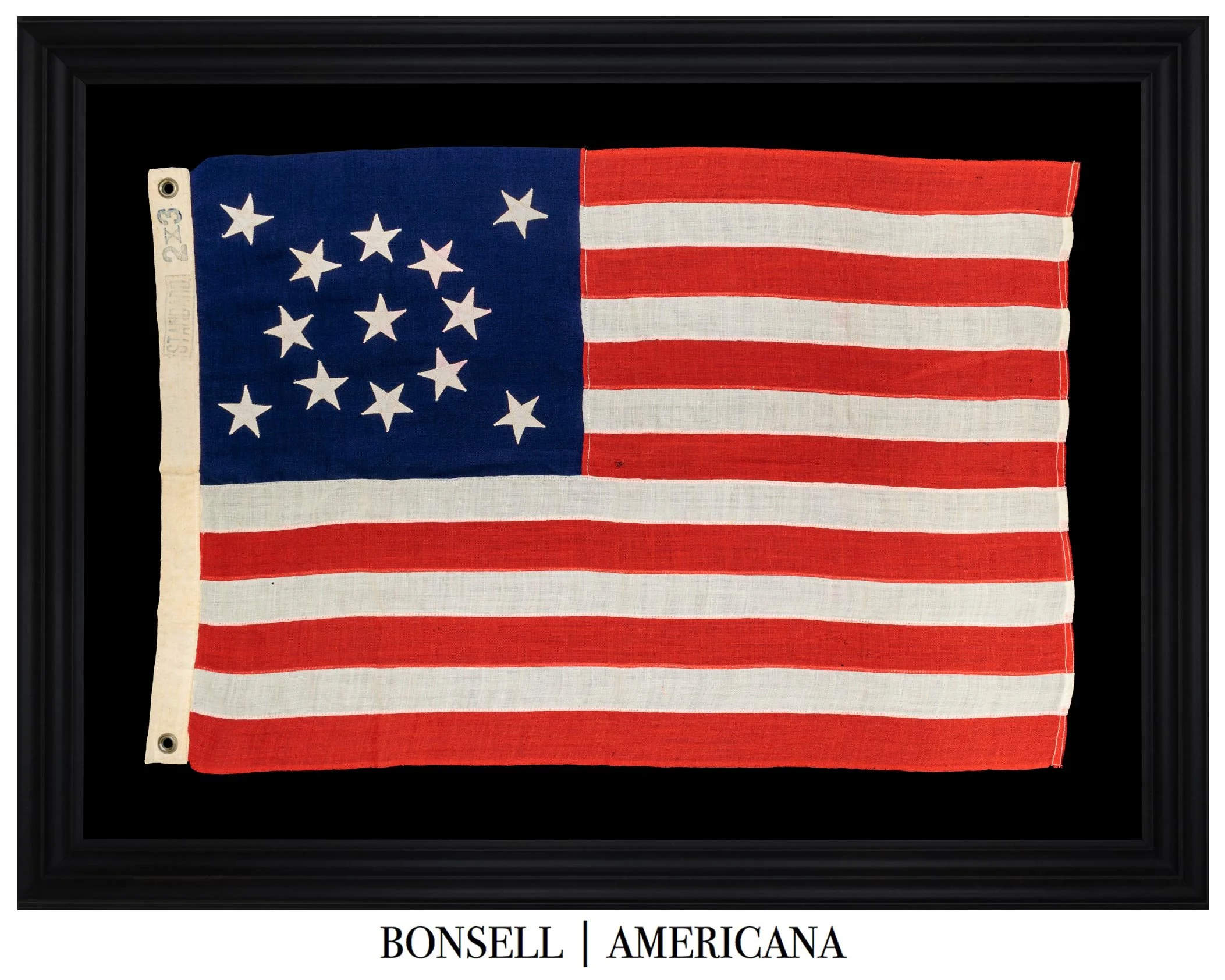
Frame Size (H x L): 35” x 47”
Flag Size (H x L): 24” x 36”
Offered is a 13-star American flag of wool bunting with cotton stars that are double-appliquéd—sewn to both sides of the canton so the design presents correctly on either face. This method of construction reflects quality commercial manufacture of the late 19th and early 20th centuries, when durability, clarity, and efficiency were central to flag production.
The stars are secured with a zig-zag machine stitch, a distinctive back-and-forth technique that provides meaningful chronological guidance. In August of 1889, Henry Bowman filed a patent application for a “method of making flags,” granted in February of 1892 as U.S. Patent No. 469,395. The patent specifically claimed the zig-zag stitch as applied to flag construction. As such, the 1889 filing date provides a reliable “not-earlier-than” reference point when this stitching is present. In practice, zig-zag stitching is most commonly encountered on flags produced from approximately 1895 through the early decades of the 20th century, whereas examples from the early 1890s more often display a linear treadle stitch.
The canton displays a classic medallion configuration centered on a single star, surrounded by a wreath of eight stars forming an inner ring, with four additional stars placed in the corners to complete the thirteen. All stars are uniform in size, lending the arrangement a disciplined, balanced character. The corner stars visually anchor the composition, while the circular wreath establishes a strong radial rhythm around the center. The generous blue field between elements enhances legibility, allowing the medallion pattern to read with clarity even at a distance.
The hoist retains its original stencil reading “STANDARD 2 X 3.” “STANDARD” denotes standard-grade wool bunting, while “2 X 3” identifies the intended dimensions in feet. Flags of this scale were versatile and practical, well suited for small-boat use, civic display, fraternal organizations, and private patriotic presentation. The survival of the stencil reinforces the flag’s authenticity and firmly situates it within established late-19th- and early-20th-century commercial manufacturing practice.
The 13-star flag traces its origin to June 14, 1777, when the Continental Congress resolved: “That the flag of the United States be made of thirteen stripes, alternate red and white; that the union be thirteen stars, white in a blue field, representing a new constellation.”
Although the official star count increased in 1795, the 13-star configuration remained in continued and intentional use. Rather than disappearing, it evolved into a conscious emblem of the nation’s founding era. Throughout the 19th century, 13-star flags appeared at commemorations, anniversaries, and moments of heightened national identity. They were displayed during Lafayette’s celebrated return tour of 1824–1825, during the Mexican-American War, and prominently during the Civil War, when public exhibition of the national flag became widespread. The United States Navy continued to employ 13-star ensigns on small boats until 1916, reinforcing the design’s enduring official presence. Following the 1876 Centennial, Americans experienced renewed interest in Revolutionary symbolism, and manufacturers responded by producing 13-star flags as historical tributes.
Dating to approximately 1895–1920s based on its materials and stitching characteristics, this flag reflects the late-19th-century revival of the 13-star design. Its wool bunting construction, double-appliquéd cotton stars, Bowman-era zig-zag stitching, original brass grommets, and intact hoist stencil together define a strong and authentic medallion example from the period.
Conservation Process: This flag was hand sewn to silk organza, and both were hand sewn to cotton fabric. The silk organza provides a strong layer of protection and a professional appearance. The flag, the silk organza, and the cotton fabric were then hand sewn to a mounting board. To prevent the black dye in the cotton fabric from seeping into the flag, it was first washed in a standard wash and then in a dye setting wash. The flag is positioned behind Optium Museum Acrylic.
Frame: The frame is a deep-profile moulding with a simple, classical profile, finished in a dark cocoa-brown tone. Its broad face provides visual support without ornament, allowing the flag to remain the primary focus. The subdued finish is well suited to the display of nineteenth-century textiles.
Condition Report: The flag is in excellent overall condition. There are a handful of tiny holes consistent with light, honest period wear. Several of the cotton stars show very slight red dye bleed from adjacent stripes, a common occurrence in wool bunting examples of this era. The colors remain strong, and the fabric retains its structural integrity.
Collectability Level: The Great – Perfect for Rising Collectors
Date of Origin: 1895-1926
Number of Stars: 13
Associated War: Spanish-American War (1898)
Associated State: Original 13 Colonies

Frame Size (H x L): 20” x 16”
Flag Size (H x L): 4.5” x 6” and Affixed to a 10” Staff
Offered is a forty-five star parade flag with a fantastic overprint of the following:
SMOKER
GIVEN TO THE MEN OF THE
NORTH ATLANTIC SQUADRON
By the Citizens of Pensacola, Florida
APRIL 14, 1903
As shown in the attached photograph and newspaper article, the North Atlantic Squadron (later renamed the North Atlantic Fleet) docked in Pensacola, and a social event (i.e., a smoker) was held between the men of the Squadron and the citizens of Pensacola. Among those in attendance was Francis J. Higginson, who was an officer in the US Navy during the Civil War and the Spanish-American War. He was the last commander in chief of the North Atlantic Fleet.
Overprints on flags come in a variety of forms, and are most frequently encountered in flags dating to between 1860 and 1910. This overprinted flag is among the best that we have ever encountered, both for its form and rarity. In terms of form, it is a great because of its varying fonts and sizes, its centering over the entire width of the flag, and its subject matter. In terms of rarity, this is only version of this flag that we have ever encountered, and it is reasonable to assume that very few (if any) others have survived.
The stars appear to be arranged in an 8-7-8-7-8-7 pattern. The canton of the flag is a beautiful cornflower blue, and its stripes are a deep red. The First Flag Act of 1777 specified the number of stripes and the colors of the flag, but did not specify the exact shades of each color, which is why some flags—like this one—have unusual colors. The exact shades were not officially specified until 1934.
The forty-five star flag represents the inclusion of Utah to the Union. Utah was admitted on January 4th, 1896, and this flag became official on July 4th, 1896. Presidents Grover Cleveland, William McKinley, and Teddy Roosevelt served under this flag, and the Spanish-American War was fought under it.
In 1848 Utah became a territory of the United States, and in 1849 its constitution was established as the Mormon State of Deseret. The next year, the State of Deseret applied to become a state, but Congress rejected the application and changed its name to the Utah Territory, which included the entirety of Nevada and portions of Colorado and Wyoming (as a section of the Missouri Compromise). Despite its continued efforts to gain statehood, it remained a territory, partially as a result of the Mormon Church and Utah authorities being openly tolerant of polygamy. In 1890 Utah outlawed the practice, and in 1896 Utah finally became the forty-fifth state. The forty-five star flag was official for 12 years up until July 4th, 1908, when the forty-six star flag became official and began to represent the inclusion of Oklahoma in the Union.
Conservation Process: This flag was hand sewn to cotton fabric, and both were hand sewn to a mounting board. To prevent the black dye in the cotton fabric from seeping into the flag, it was first washed in a standard wash and then in a dye setting wash. The flag is positioned behind Conservation Clear Acrylic (standard) or behind Optium Museum Acrylic (per request).
Frame: The frame dates to between 1860 and 1890, and includes a gold liner and extensive decorating.
Condition Report: This flag has some minor staining and some fading. There is some minor fraying along the bottom of the flag. Many collectors prefer flags that show their use and age.
Collectability Level: The Great – Perfect for Rising Collectors
Date of Origin: 1903
Number of Stars: 45
Associated War: Spanish-American War (1898)
Associated State: Utah

Frame Size (H x L): 6.5” x 8”
Flag Size (H x L): 3” x 5.5”
Offered is a 34-star patriotic flag cover bearing a bold “UNION” printed across the canton within a Great Star arrangement. The placement of text on the canton—rather than along the stripes—is notably desirable and especially associated with the early Civil War period, when patriotic envelopes served as both stationery and expressions of political loyalty. Although this style of cover continued to appear into the 1880s, examples combining a Civil War star count, an uncommon star pattern, and an added slogan remain among the most sought-after varieties.
These patriotic envelopes were typically produced through relief printing in multiple stages, with different elements of the flag design printed from separate blocks or plates. Printers often applied the colors and any accompanying text in successive impressions, each requiring its own inking, alignment, and drying time. Because this work was done quickly and by hand in mid-19th-century job shops, period examples frequently show subtle variations in registration, ink density, and pressure.
The stars are arranged in the Great Star or Grand Luminary pattern, in which smaller stars form the outline of a single large star. This configuration is one of the most visually compelling designs encountered in 19th-century flags. Before President Taft’s 1912 Executive Order introduced the first formal regulations on star placement, American flag makers and patriotic printers enjoyed complete freedom in arranging the stars. Among the diverse patterns that emerged, the Great Star stands out both for its geometric harmony and for its early pedigree.
The pattern is traditionally credited to Captain Samuel Chester Reid, a naval hero of the War of 1812 whose defense of the privateer General Armstrong at the Battle of Fayal delayed a British naval squadron bound for New Orleans. Reid’s actions contributed materially to General Andrew Jackson’s ability to fortify the city, and he was celebrated as a national hero. In 1818, Reid participated in the discussions that produced the Flag Act of 1818, which restored the number of stripes to thirteen and established the practice of adding one star for each new state. Reid recommended the Great Star pattern as a standardized, easily recognizable arrangement, particularly useful for naval identification at long distances. Although no specific pattern was mandated by Congress, Reid’s design achieved considerable influence and enjoyed intermittent commercial popularity from the 1820s through the Civil War and into the Centennial era.
The 34-star flag reflects the admission of Kansas to the Union on January 29, 1861, a moment that carried significance well beyond the addition of a single state. Kansas’s entry concluded nearly a decade of sectional conflict—popularly known as “Bleeding Kansas”—in which pro-slavery and free-state factions violently contested the territory’s political future. Its ultimate admission as a free state on the eve of Lincoln’s inauguration underscored the deepening national divide and served as an early signal of the constitutional crisis that would erupt into civil war within weeks.
This star count became official on July 4, 1861, and remained so until July 4, 1863, when the wartime creation of West Virginia increased the count to 35. Because flag makers typically adopted new star counts immediately upon a state’s admission—rather than waiting for the formal July 4 effective date—many 34-star flags predate the opening shots at Fort Sumter. As a result, this configuration is strongly associated with the transitional period between political fracture and open conflict, and it is widely regarded by collectors as one of the most evocative star counts of the 19th century.
Both 34-star and 35-star flags were used throughout the Civil War and together encompass the official star counts of Lincoln’s presidency, though other star counts appeared in limited or anticipatory forms. They appeared on recruitment broadsides, volunteer militia banners, camp gear, and patriotic ephemera of all kinds, becoming central visual markers of Union identity during the conflict. For this reason, the 34-star configuration—situated at the threshold of war—remains especially prized for its association with the earliest mobilization of Northern sentiment and the preservation of the Union.
This example, combining a Civil War-era star count, a rare Great Star medallion, and a bold UNION slogan printed directly on the canton, represents a compelling intersection of patriotic imagery and wartime sentiment.
Conservation Process: The flag is sandwiched between cotton rag board and a UV resistant acrylic.
Frame: The flag cover is housed in an older wooden frame with a dark, timeworn surface and an applied gilded inner lip.
Condition Report: The cover remains in very good condition with strong color retention and only light scattered surface wear typical of mid-19th-century patriotic envelopes. Minor toning and small handling marks are present but do not detract from the clarity or overall presentation of the piece.
Collectability Level: The Great – Perfect for Rising Collectors
Date of Origin: 1861-1890
Number of Stars: 34
Associated War: The Civil War (1861-1865)
Associated State: Kansas
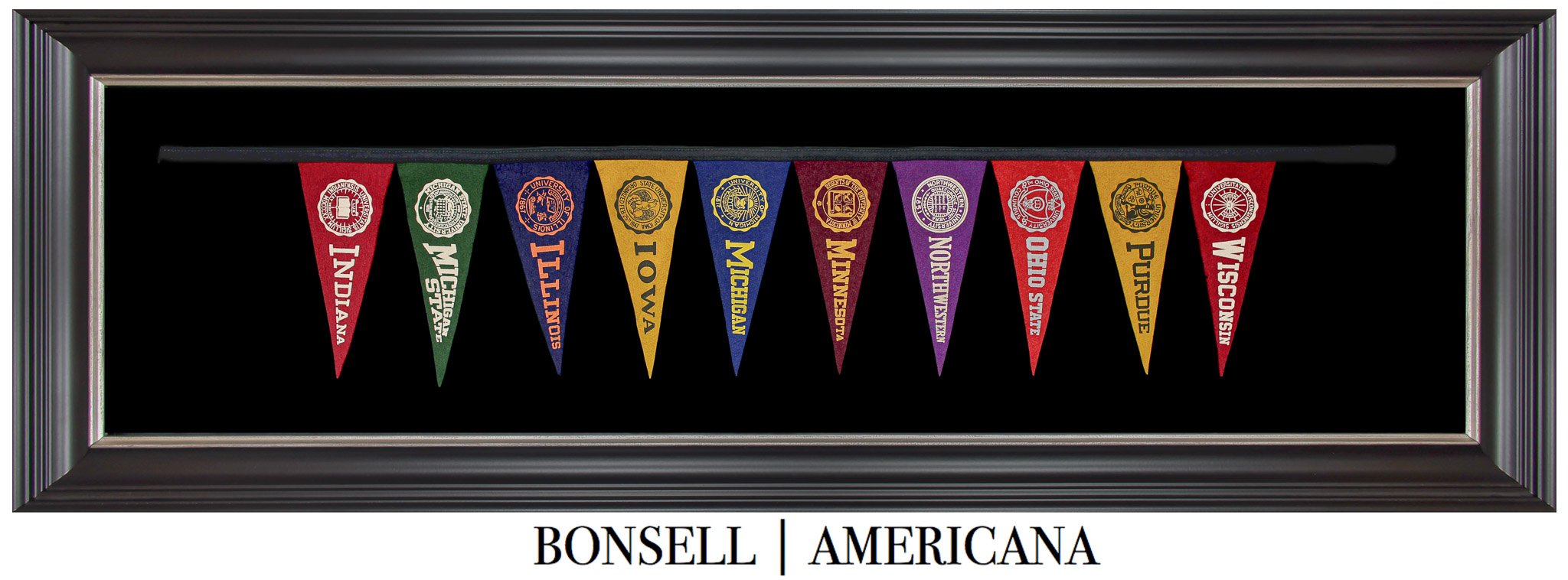
Frame Size (H x L): 18.5” x 57”
Banner Length (H x L): 47”
Size of Each Pennant (H x L): 3.75” x 8.75”
Offered is a complete string of felt pennants representing the original Big Ten schools, each triangular in form and crafted from colored felt with bold collegiate lettering and seal graphics printed in contrasting inks. The set includes Indiana (red), Michigan State (green), Illinois (navy with orange), Iowa (gold), Michigan (blue with maize), Minnesota (maroon), Northwestern (purple), Ohio State (red), Purdue (gold), and Wisconsin (red). Each pennant is uniform in size, tapering to a sharp point at the bottom, and displays crisp, collegiate block lettering alongside detailed institutional seals rendered with fine linework. The vibrant color palette, paired with the strong felt texture, creates a striking visual display when presented together as a banner.
The set of pennants dates between approximately 1955 and 1965, a period when collegiate imagery and athletic traditions became central to campus culture across the United States. The inclusion of the original Big Ten schools, along with their institutional seals and formal lettering, reflects mid-20th century design trends that emphasized tradition and academic prestige. During this time, universities were expanding rapidly, fueled by the GI Bill, postwar prosperity, and the Baby Boom generation, all of which contributed to swelling enrollments and a deepening culture of school identity. Collectible felt pennants such as these were popular mementos for students and fans, functioning as both souvenirs and emblems of pride.
The Big Ten Conference itself was entering a defining era in the mid-20th century. Formed in 1896 as the Western Conference, it had become firmly established as one of the nation’s premier athletic and academic alliances by the 1950s. Member schools—Indiana, Michigan State, Illinois, Iowa, Michigan, Minnesota, Northwestern, Ohio State, Purdue, and Wisconsin—were known not only for football and basketball powerhouses, but also for fostering a sense of shared Midwestern identity. Rivalries such as Ohio State vs. Michigan and Indiana vs. Purdue took on even greater significance during this period, drawing national attention and helping to elevate college sports into a cultural force.
The imagery on the pennants is itself an important historical clue in dating the piece. Michigan State University is identified by its full name, which the institution officially adopted in 1955 after previously being known as Michigan State College. This detail confirms that the set could not have been produced before that year. The consistent use of university seals, with their formal Latin inscriptions and detailed institutional crests, reflects a design language common to the 1950s and early 1960s. Later pennants from the late 1960s onward often shifted toward bolder, simplified logos and mascots, part of a broader cultural move toward modern branding and mass marketing.
This period was also one in which college sports were expanding their reach on radio and television, embedding the Big Ten more firmly in the American consciousness. Ohio State’s football dominance under Woody Hayes, Indiana’s and Illinois’ basketball rivalries, and Michigan State’s football rise under coach Duffy Daugherty all occurred within the timeframe of these pennants. Collectors today see such banners not only as decorative pieces, but as artifacts of a golden age of collegiate sport, when the bonds of conference membership and university loyalty were expressed in tangible, enduring forms.
Taken together, these pennants represent more than school pride—they embody the traditions, rivalries, and cultural growth of the Big Ten during the mid-20th century. They tie directly to an era when universities were consolidating their roles as both educational and athletic powerhouses, and when students and alumni alike sought keepsakes that celebrated both their academic institutions and the sports that bound them together.
Conservation Process: This banner was hand sewn to cotton fabric, and both were hand sewn to a mounting board. To prevent the black dye in the cotton fabric from seeping into the banner, it was first washed in a standard wash and then in a dye setting wash. The banner is positioned behind Optium Museum Acrylic.
Frame: The pennants are displayed in a modern frame with a dark finish and simple metallic accents. The frame has a clean, straightforward profile that provides a sharp contrast to the colors of the pennants and allows them to stand out clearly.
Condition Report: The string of pennants remains in strong overall condition, with vibrant colors and well-preserved printed imagery that retains excellent clarity. Minor age toning and light wear can be seen at the edges consistent with handling and display, but there are no significant losses or distracting flaws. The set presents exceptionally well, especially considering its mid-20th century origin.
Collectability Level: The Great – Perfect for Rising Collectors
Date of Origin: 1955-1965
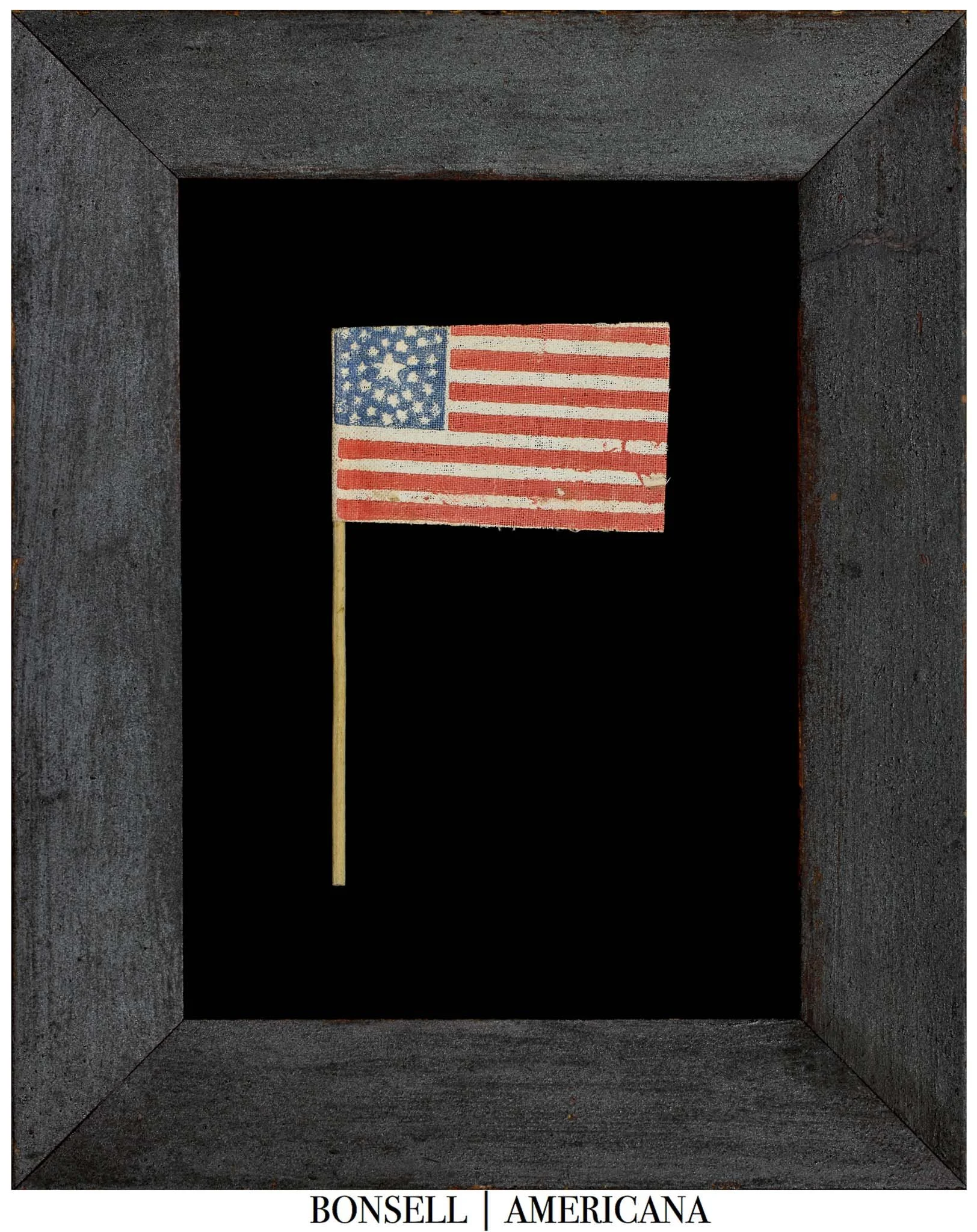
Frame Size (H x L): 12.25” x 10”
Flag Size (H x L): 2.5” x 3.5” and Affixed to a 6” Staff
Offered is a scarce and visually striking 36-star antique American parade flag, printed on coarse cotton and presented on its original wooden staff. Parade flags such as this were made for short-term patriotic display at parades, political rallies, celebrations, and inaugurations. Despite their ephemeral purpose, they remain among the most evocative and collectible forms of 19th-century Americana.
The stars on this flag are arranged in what is known as a medallion configuration—a visually arresting layout favored during the mid-19th century. At the center of the canton is a large star, encircled by two concentric rings: the inner ring features 10 stars, while the outer ring contains 17. Completing the design are corner stars flanking the medallion. While medallion patterns were especially popular between 1861 and 1876, they largely disappeared from production by 1890, replaced by more uniform rows and columns. Their ornate, almost celebratory feel sets them apart from the rigid star alignments of later eras.
This specific example bears 36 stars, representing the admission of Nevada into the Union. Though Nevada officially joined on October 31, 1864, the 36-star flag did not become official until July 4, 1865—just after the conclusion of the Civil War. Nevada’s statehood was strategically timed. Politically, it was intended to support President Abraham Lincoln’s 1864 re-election and to solidify Republican control during Reconstruction. Economically, the state’s immense silver reserves were seen as critical to financing the Union war effort and addressing postwar debt.
The 36-star flag served as the nation’s official flag for two years, from July 4, 1865, to July 3, 1867. During this time, it flew over a country grappling with the aftermath of the Civil War and beginning the long road toward Reconstruction. It was also used by the U.S. military during the final months of the war. The 37-star flag, recognizing Nebraska’s statehood, would succeed it on July 4, 1867.
Extremely close inspection of this example reveals important details about its manufacture. The flag is printed on a coarse, plain-weave cotton consistent with mid-19th-century domestic cloth. The pigments sit visibly atop the fibers, pooling around the yarn intersections in a manner characteristic of early block or stencil printing rather than later roller-printed methods. The blue displays the dark, slightly green-cast tone associated with Prussian blue, and the red carries the matte, mineral quality of iron-oxide pigments—both typical of inexpensive patriotic printing of the period. Uneven pressure during the print strike softens some stars and enhances others, creating subtle mis-registration that underscores its hand-guided, utilitarian origins.
Conservation Process: The flag was hand sewn to cotton fabric, and both were hand sewn to a mounting board. To prevent the black dye in the cotton fabric from seeping into the flag, it was first washed in a standard wash and then in a dye setting wash. The flag is positioned behind Optium Museum Acrylic.
Frame: The flag is housed in an early American, splined-miter frame dating to approximately 1830–1860, retaining its original lampblack or ‘dry black’ surface. The hand-cut joinery, early iron hanging hardware, and oxidized hardwood construction are all consistent with antebellum rural framing practices.
Condition Report: The flag survives in honest condition with scattered small losses and light surface wear typical of early printed parade flags on open-weave cotton. Most distinctive is the originally irregular top edge, where the trimming or print strike cuts partially into the canton and grazes the upper red stripe — a characteristic result of the rudimentary, hand-guided production methods used for these inexpensive flags. Despite its modest imperfections, it retains strong visual character and an appealing, untouched presentation.
Collectability Level: The Great – Perfect for Rising Collectors
Date of Origin: 1864-1867
Number of Stars: 36
Associated War: Civil War (1861-1865)
Associated State: Nevada
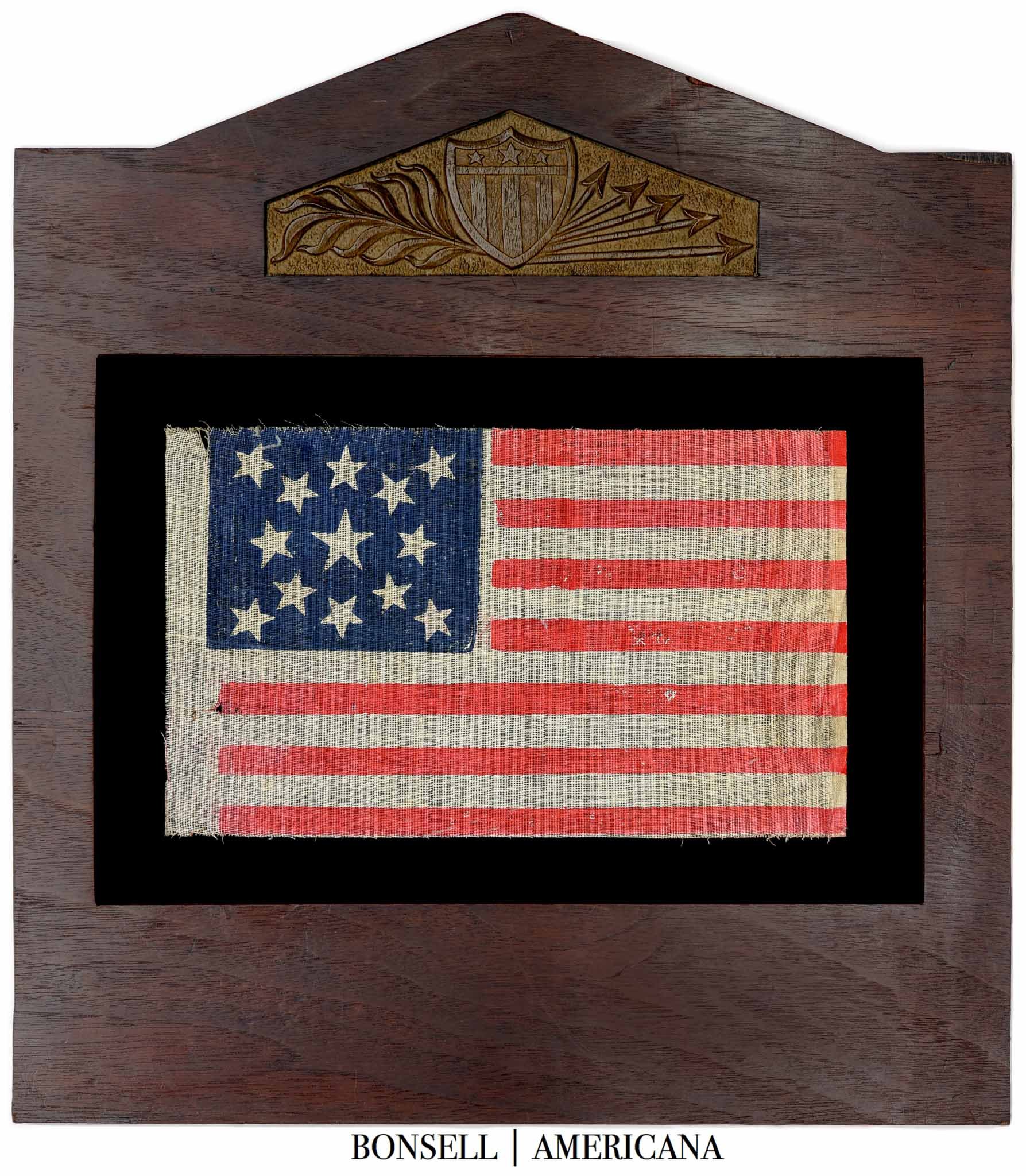
Frame Size (H x L): 15.25” x 14.5”
Flag Size (H x L): 6” x 9”
Offered is a 13-star American flag, printed on glazed cotton, that displays a bold and distinctly folk-like character. The canton features thirteen white stars arranged in a medallion pattern, with a large center star encircled by a ring of eight and complemented by one in each corner. The stars vary slightly in proportion and spacing, underscoring the hand-rendered quality of the design despite its printed manufacture. The stripes, rendered in alternating red and white, extend the full length of the flag, with areas of uneven inking and light wear. The glazed finish lends a subtle sheen, and the fabric presents a strong yet time-softened appearance typical of the period.
While the size of this flag may initially appear to be small, it is in fact an unusually large and rare size for the era. The most typical printed parade flags produced for the Centennial measured just 2" x 3", whereas the example offered here measures 6" x 9"—approximately three times larger than the common variety.
The nation’s Centennial in 1876 sparked widespread patriotism and served to reunite citizens in the decade following the Civil War. Communities across the country organized parades and public events, and homes and buildings were decorated with red, white, and blue. The largest celebration was the Centennial International Exposition in Philadelphia, which welcomed nearly ten million visitors over six months and introduced groundbreaking innovations such as the Corliss Steam Engine and Alexander Graham Bell’s telephone.
During the Centennial year, President Ulysses S. Grant signed the proclamation admitting Colorado as the 38th state. The official star count remained 37, but flag makers often produced 38-star flags in anticipation of Colorado’s addition. Thirteen-star flags also appeared widely, chosen for their historical connection to the nation’s origins. This echoed the original 1777 resolution of the Continental Congress, which specified a flag with thirteen stripes and thirteen stars to represent the new union.
Although officially replaced in 1795, 13-star flags remained in use for special occasions. They flew on small U.S. Navy boats until 1916, at George Washington’s death in 1799, and during the nation’s 50th anniversary in 1824, when they were displayed to honor General Lafayette’s return tour. They were also used during the Mexican War of 1846–48 and during the Civil War of 1861–65, both periods when patriotism encouraged the display of historical emblems. Their presence in the Centennial celebrations reinforced a direct link to the Revolutionary era and to the ideals on which the nation was founded. This 6" x 9" example reflects that tradition in both form and symbolism.
Conservation Process: The flag was hand sewn to cotton fabric, and both were hand sewn to a mounting board. To prevent the black dye in the cotton fabric from seeping into the flag, it was first washed in a standard wash and then in a dye setting wash. The flag is positioned behind Optium Museum Acrylic.
Frame: The flag is housed in a dark-stained wooden frame with a peaked crest, giving it an architectural form. At the top is a carved patriotic motif featuring a federal shield flanked by stylized rays and foliate elements, reinforcing its American theme. The frame shows some age and wear, consistent with an early 20th-century origin, and was chosen to complement the historic character of the flag while emphasizing its patriotic symbolism.
Condition Report: The flag shows moderate wear consistent with its age, including light fraying along the fly end and minor tears at the upper-left corner. The printed colors have softened over time, with scattered areas of fading and uneven inking visible in both the canton and the stripes. Overall, the flag remains strong and displays well, with condition that is very attractive for a Centennial-era printed example.
Collectability Level: The Great – Perfect for Rising Collectors
Date of Origin: 1876
Number of Stars: 13
Associated War: The Indian Wars (1860-1890)
Associated State: Original 13 Colonies
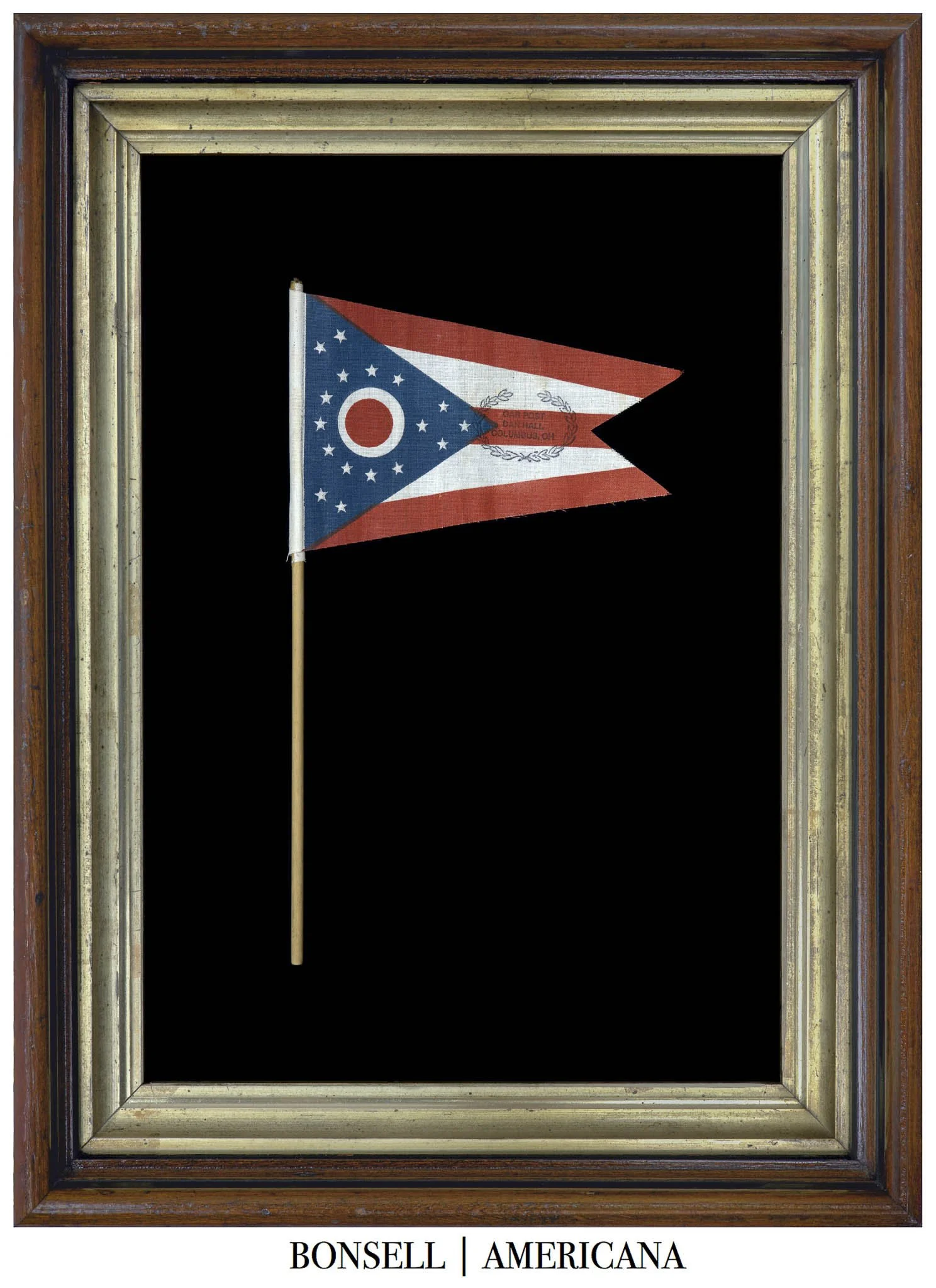
Frame Size (H x L): 17” x 13”
Flag Size (H x L): 4” x 6” on a 10” Staff
Offered is an Ohio state flag, dating to 1925. It is an exceptional artifact of historical significance, crafted to honor the life and legacy of Daniel M. Hall, a celebrated Civil War veteran and National Commander of the Grand Army of the Republic (“GAR”). Made from plain weave cotton, the flag reflects the practical materials commonly used for commemorative items of the period. The cotton is treated with a finish to make it more durable and water-resistant, mimicking the qualities of oilcloth.
Its distinctive swallowtail design, featuring vibrant red, white, and blue elements, mirrors the official Ohio state flag adopted in 1902, a design inspired by Civil War cavalry guidons. Mounted on its original wooden staff, this flag was intended for ceremonial use, serving as a reminder of Hall’s legacy.
What elevates this flag’s historical importance is its overprint, stamped in black ink on the striped field. Enclosed within a laurel wreath, the inscription reads, “GAR Post, Dan Hall, Columbus, OH,” directly tying the flag to the GAR and specifically commemorating Hall’s death in 1925, just before his 83rd birthday. Flags with overprints dedicated to specific individuals are rare, making this an especially coveted piece for collectors.
The GAR, founded in 1866, was one of the most influential veterans’ organizations in American history. Dedicated to uniting Union Civil War veterans, the GAR blended social fellowship with political advocacy. Members, often called “comrades,” donned their wartime uniforms to march in parades, participate in reunions, and advocate for veterans’ benefits such as pensions. The organization also played a central role in establishing Memorial Day as a national holiday. Structurally, the GAR mirrored the military, with local “posts” acting as chapters under the leadership of state and national commanders. By fostering a sense of brotherhood and preserving the memory of Union service, the GAR had a profound impact on postwar society and veterans’ rights.
Daniel M. Hall exemplified the dedication and leadership of the GAR’s membership. Born on October 20th, 1842, Hall served with distinction in the 2nd and 12th Ohio Cavalry regiments during the Civil War. After mustering out in 1865, he became deeply involved in veterans’ affairs, joining the Hamlin Post of the GAR in Columbus, Ohio, in 1883. Hall’s organizational skills and leadership propelled him to prominence, ultimately serving as the Commander of the Ohio Department and later as National Commander-in-Chief. His efforts focused on preserving the bonds of fellowship among veterans and honoring their sacrifices. Hall’s passing in 1925 marked the loss of a respected leader, memorialized through artifacts like this flag.
The Hamlin Post, based in Columbus, was among many GAR chapters that served as vital centers for veterans’ social and charitable activities. Posts like Hamlin provided support to veterans and their families, organized community events, and preserved the shared memory of Union service. Under Hall’s leadership, the Hamlin Post became an integral part of the GAR’s Ohio Department, further elevating its historical significance. The creation of this overprinted flag in Hall’s memory underscores the deep respect he commanded within the organization and the lasting impact of his contributions.
The Ohio state flag itself, adopted in 1902, is among the most distinctive in the United States. Designed by Cleveland architect John Eisenmann, it was created for the Pan-American Exposition in Buffalo, New York, in 1901. Its unusual swallowtail shape sets it apart, drawing inspiration from both Civil War-era cavalry guidons and maritime burgees. This shape, along with its bold and symbolic design, captures the spirit of Ohio’s heritage and geography. At its center is a red disc set within a white circular field, representing the letter “O” for Ohio and the buckeye, the state’s iconic symbol. Five alternating red and white stripes symbolize the state’s waterways and roads, while the blue triangular field, representing hills and valleys, features 17 stars: 13 for the original colonies and four more to signify Ohio’s admission as the 17th state.
This symbolic depth, paired with its unconventional design, ensures the Ohio flag’s enduring appeal. Over the decades, it has been a source of pride for the state and its citizens, appearing in civic ceremonies and historical commemorations alike. The flag’s resemblance to Civil War guidons serves as a reminder of Ohio’s significant contributions to the Union during the Civil War, while its design elements reflect the state’s natural and cultural heritage. Together, the Ohio flag and artifacts like this overprinted version serve as emblems of the state’s history and the lasting legacy of its citizens.
Conservation Process: This flag was hand sewn to cotton fabric, and both were hand sewn to a mounting board. To prevent the black dye in the cotton fabric from seeping into the flag, it was first washed in a standard wash and then in a dye setting wash. The flag is positioned behind Optium Museum Acrylic.
Frame: The frame is made of walnut and dates from 1860 to 1890. Its dark wood and simple craftsmanship reflect the style of the period.
Condition Report: The flag is in remarkably clean and well-preserved condition, with vibrant colors and minimal signs of wear. Only a few faint yellow stains are visible, adding subtle character while not detracting from its overall appearance.
Collectability Level: The Great – Perfect for Rising Collectors
Date of Origin: 1925
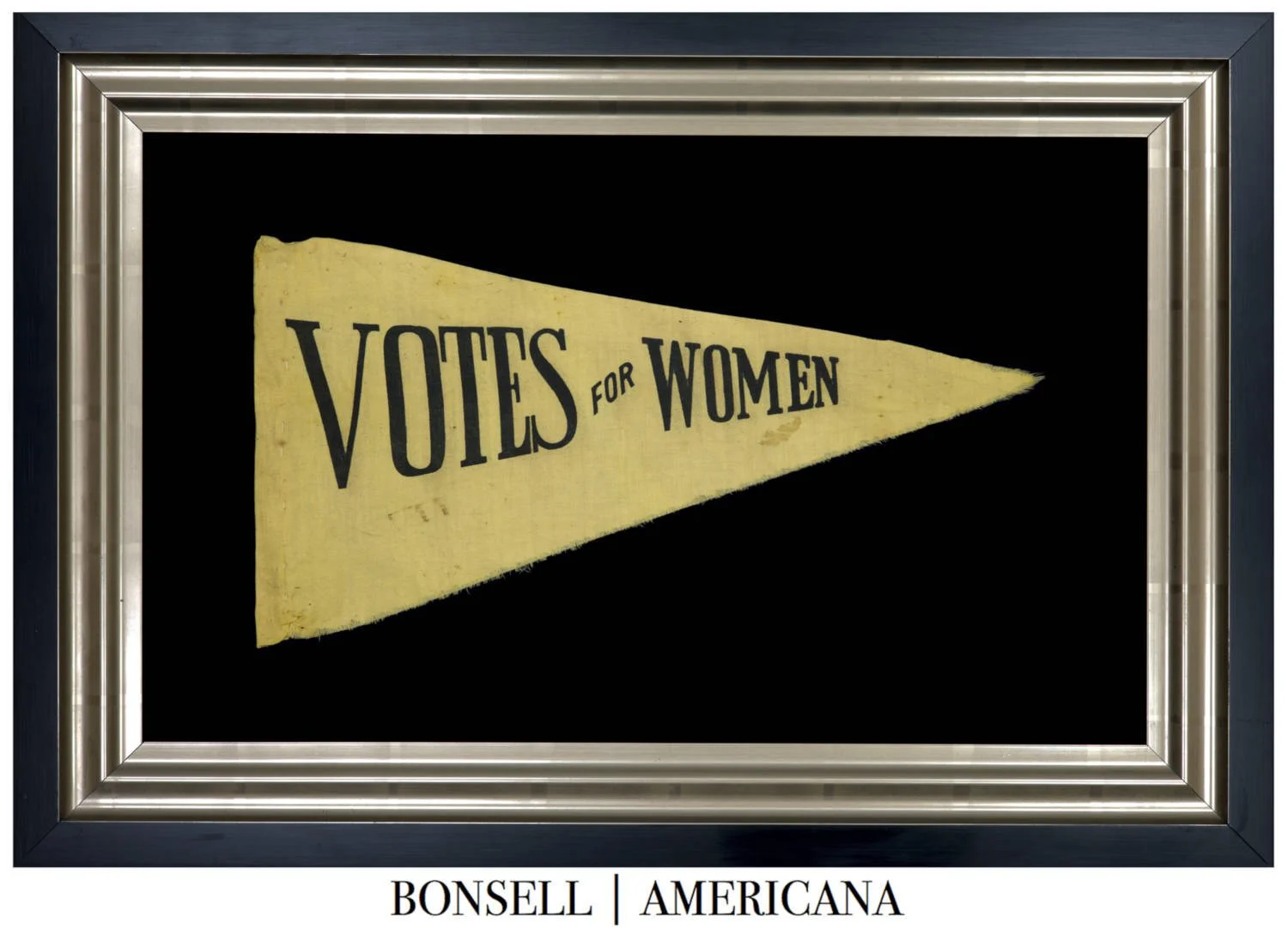
Price: Please call 618-553-2291, or email info@bonsellamericana.com
Frame Size (H x L): 18” x 26”
Pennant Size (H x L): 8.5” x 16.5”
Offered is a pennant made of cotton. It has a triangular shape with a yellow background, a common color used in the women’s suffrage movement. The text "VOTES FOR WOMEN" is boldly printed in black capital letters across the surface, emphasizing the message central to the early 20th century suffrage campaign.
The pennant is a symbolic artifact from the women’s suffrage movement, which was a pivotal social and political campaign of the late 19th and early 20th centuries. In the United States, the movement sought to secure women's right to vote and challenged the entrenched inequalities in political representation. The suffrage movement emerged in response to broader conversations about civil rights, as women activists argued that they, too, should be granted the same voting rights that men enjoyed. This effort reached its height in the early 20th century, as suffragists organized rallies, distributed literature, and used visual symbols like pennants to garner public support for their cause.
The use of pennants like this one became a powerful tool for protest, as they were easily portable, visually striking, and could be displayed in public spaces to attract attention to the suffrage cause. The yellow color was often associated with the suffragist movement in the U.S., particularly the National Woman’s Party, which was one of the most prominent organizations advocating for women’s voting rights. This vibrant hue, combined with slogans like "Votes for Women," helped unify supporters of the cause and provided a sense of solidarity in the fight for equality. The phrase “Votes for Women” became a rallying cry that encapsulated the demands of the movement.
The suffrage movement faced significant opposition from those who believed that granting women the right to vote would disrupt traditional gender roles and undermine social stability. Despite these challenges, activists like Susan B. Anthony, Elizabeth Cady Stanton, and later Alice Paul continued their advocacy, using peaceful protests, lobbying efforts, and visual campaigns to pressure politicians and influence public opinion. As the movement gained momentum, these symbols of suffrage, such as pennants, buttons, and banners, became increasingly visible across the country.
Ultimately, the persistence of the women’s suffrage movement led to the ratification of the 19th Amendment to the U.S. Constitution in 1920, which prohibited the federal government and states from denying citizens the right to vote based on sex. This monumental victory came after decades of tireless activism and was a turning point in the struggle for gender equality in America. The "Votes for Women" pennant, therefore, not only represents a specific moment in history but also serves as a lasting symbol of the determination and resilience of the suffragists who fought for political inclusion.
Conservation Process: This pennant was hand sewn to cotton fabric, and both were hand sewn to a mounting board. To prevent the black dye in the cotton fabric from seeping into the pennant, it was first washed in a standard wash and then in a dye setting wash. The pennant is positioned behind Optium Museum Acrylic.
Frame: The frame has a sleek, modern design with a black outer edge and an inner metallic silver border. It features multiple beveled layers, creating a visually striking contrast that enhances the presentation of the pennant.
Condition Report: The pennant is in generally good condition, showing some signs of aging with light discoloration and a few small stains. These minor imperfections are typical for an artifact of its age, and they add to its historical character.
Collectability Level: The Great – Perfect for Rising Collectors
Date of Origin: 1910-1920
Price: Call 618-553-2291, or email info@bonsellamericana.com
Frame Size (H x L): 32” x 34”
Flag Size (H x L): 21” x 23”
Offered is a particularly fun and highly personal Texas state flag, dating to 1986 and used during a black powder rifle exercise at Philmont Scout Ranch in northern New Mexico. Printed on a single piece of cotton, the flag was transformed from an otherwise straightforward Texas flag into a one-of-a-kind record of a Scout experience through a combination of handwritten inscriptions, a drawn bullseye, a remarkably centered bullet hole, and the names of those who witnessed the shot.
Across the white field, written in pencil, are the words “Bullseye,” “Black Powder Rifle,” “Philmont Scout Ranch,” and “86.” Below this inscription is a hand-drawn target composed of concentric circles and directional marks. At the very center is the actual bullet hole, placed almost perfectly within the bullseye. The relationship between the drawn target and the shot is what gives the flag much of its appeal. This was not simply a flag carried to camp or signed as a souvenir; it was deliberately preserved as evidence of a memorable shot.
To the right is a ruled box headed “WITNESSES,” followed by the names of five individuals. These appear to read Rob Shaw, Terry King, an additional name that is presently difficult to decipher, Arik Couch, and Matt Swinford. Elsewhere, a much lighter inscription appears to identify a Scoutmaster with the surname Green, lending another layer of documentation to the event. Taken together, the inscriptions have the character of a group making an informal record immediately following the shot—essentially turning the flag into a trophy, certificate, and camp souvenir all at once.
The setting is significant. Philmont Scout Ranch, near Cimarron, New Mexico, is one of the most storied institutions in American Scouting. The ranch traces its origins to oilman Waite Phillips and his wife, Genevieve, who donated more than 127,000 acres to the Boy Scouts of America in two major gifts in 1938 and 1941. The first Scouts arrived in 1939, when the property was known as Philturn Rocky Mountain Scoutcamp; following the larger 1941 gift, it became Philmont Scout Ranch. Today the property encompasses roughly 140,000 acres of mountainous backcountry and has hosted generations of Scouts in programs centered on hiking, outdoor skills, western history, conservation, and marksmanship.
Black powder shooting has long been one of Philmont's historically themed activities. Participants learn the process of loading and firing a muzzle-loading rifle using the traditional components of powder, patch, ball, ramrod, and percussion cap. Modern Philmont program literature describes the use of .50- and .58-caliber muzzle-loading rifles, with the activity intended not only as a shooting exercise but also as an introduction to the firearms and methods associated with nineteenth-century western life. Although the precise circumstances surrounding this 1986 shot are not known, the inscriptions leave little doubt that the flag was connected directly to such a black powder rifle exercise at Philmont.
What makes the piece especially compelling is the way the participants documented the moment. A successful shot at camp might ordinarily survive only as a story or perhaps a paper target. Here, however, someone chose a Texas flag, drew the target directly onto it, recorded the location and type of shooting, dated the event, and had witnesses identify themselves alongside it. The bullet hole at dead center makes the story immediately understandable without explanation. The result is less a conventional flag than a piece of American vernacular history—an object created spontaneously to commemorate a small but evidently memorable achievement.
The use of a Texas flag adds another layer of character. The familiar Lone Star design originated as the national flag of the independent Republic of Texas. The Texas Congress approved the design on January 25, 1839, during the presidency of Mirabeau B. Lamar. Its composition—a vertical blue field containing a single white star, together with horizontal white and red fields—later became the state flag and remains essentially unchanged.
Under the modern Texas Flag Code, the colors are assigned the meanings of blue for loyalty, white for purity, and red for bravery. Earlier recommendations made during the Republic period proposed somewhat different symbolism—blue for friendship, white for peace, and red for war—but that language was not formally adopted by the Texas Congress. The lone five-pointed star became the enduring emblem of Texas itself, one whose history reaches back to the Republic and ultimately gave Texas its familiar identity as the Lone Star State.
Against that history, this particular flag has an especially American quality. It combines the iconography of Texas, the traditions of Scouting, the western heritage emphasized at Philmont, and the camaraderie of a group who considered a single rifle shot important enough to document for posterity. Its appeal comes precisely from its informality: the penciled lettering, the hand-drawn target, the witness list, and, above all, the bullet hole precisely where the shooter hoped it would be.
Dating to 1986, it is obviously much younger than many antique American flags, but age is not the principal attraction here. This is an object with a specific event permanently recorded upon it. Very few flags can be tied so visually and directly to a particular moment. As a Texas flag, a Philmont Scout Ranch artifact, and a remarkably graphic piece of shooting and Scouting history, it is an unusual and exceptionally engaging piece of Americana.