
Price: Call 618-553-2291, or email info@bonsellamericana.com
Frame Size (H x L): 22” x 42”
Pennant Size (H x L): 11” x 30”
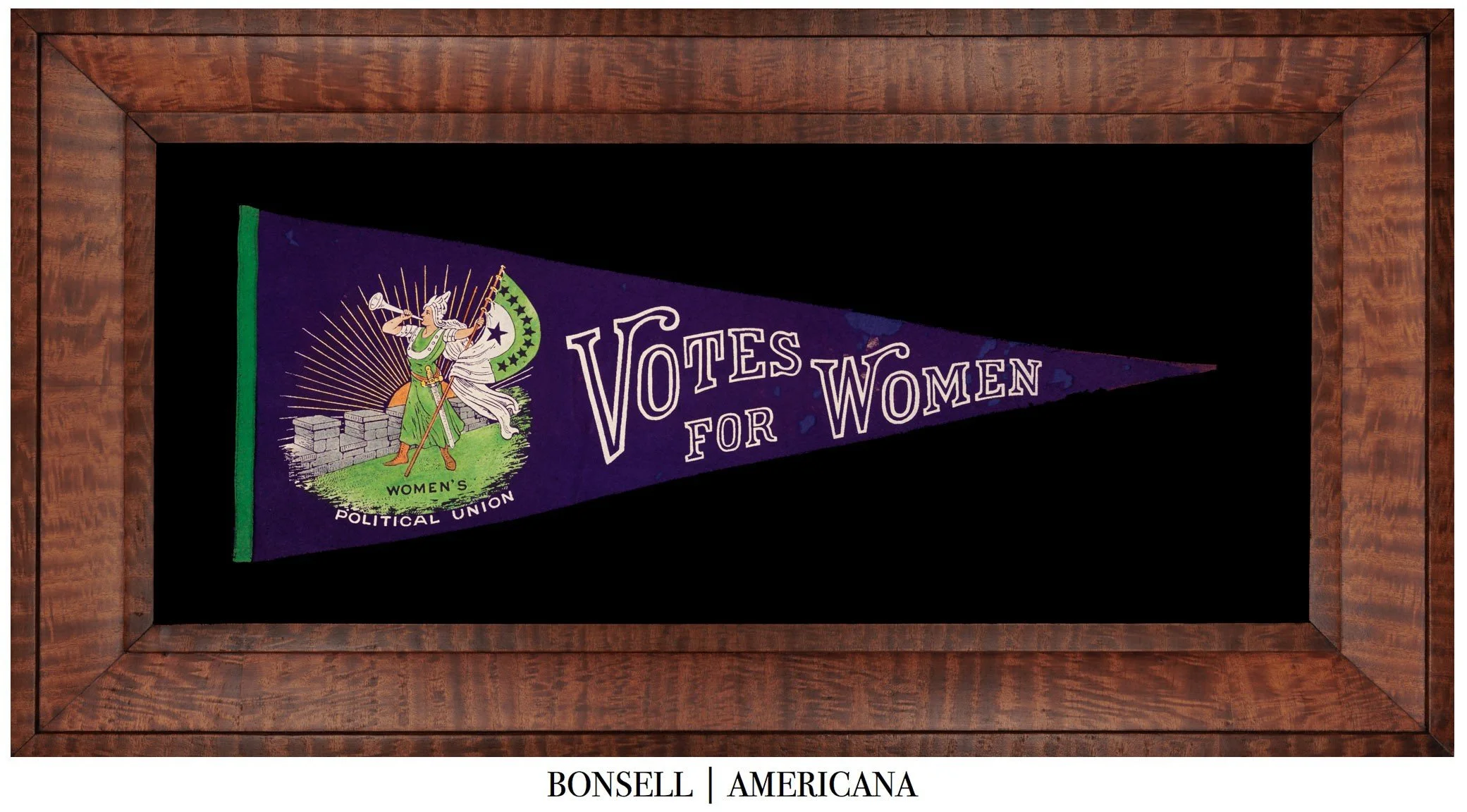
Offered is a women’s suffrage pennant produced for the Women’s Political Union of New York, and one of the more visually accomplished pieces of American suffrage material from the years immediately preceding passage of the Nineteenth Amendment. Printed on a rich purple felt ground, the pennant combines the words “VOTES FOR WOMEN” with an elaborate allegorical figure, radiating lines, stars, and the name “WOMEN’S POLITICAL UNION.” The combination of purple, green, white, and gold distinguishes it from the comparatively simple lettering and limited palettes found on many surviving suffrage pennants.
The central image is generally known as the “Bugler Girl” or “Clarion Girl,” an important suffrage emblem whose origins lie in the British movement for women’s voting rights. The figure was created by British artist and suffragist Caroline Watts and depicts an armored female herald sounding a bugle while advancing forward. The imagery was direct and purposeful: the clarion call announces the movement, while the advancing woman represents determination and progress. Behind her are radiating lines and a crescent-like arrangement of stars, creating one of the more elaborate graphic compositions found on suffrage material of the period.
Harriot Stanton Blatch adopted the imagery for use by the Women’s Political Union in the United States. Blatch was the daughter of Elizabeth Cady Stanton, one of the foundational figures of the American women’s rights movement, but became an important suffrage leader in her own right. After spending many years in England, where she became familiar with the increasingly active British suffrage campaign, Blatch returned to the United States and helped introduce some of its organizational methods and visual language to the American movement.
In 1907, Blatch founded the Equality League of Self-Supporting Women in New York. The organization was intended in part to broaden the constituency of the suffrage movement by bringing working women into organized political activity. In 1910, the group became the Women’s Political Union, or WPU. Blatch favored highly visible public campaigning, including open-air meetings, parades, banners, pennants, and other forms of political advertising intended to move the suffrage question beyond meeting halls and into the streets.
The present pennant is a strong example of that strategy. Its message could hardly be more direct. “VOTES FOR WOMEN” occupies most of the field in large decorative lettering, while the more elaborate image at the hoist gives the viewer something immediately recognizable to associate with the cause. At a time when political organizations increasingly understood the value of visual identity, the WPU produced material intended not simply to communicate a position, but to attract attention and remain memorable.
Its purple, green, and white coloration also reflects the transatlantic history of the design. Those colors had strong associations with the British women’s suffrage movement and differ markedly from the yellow and black more frequently encountered on American suffrage material. Blatch’s use of the British-derived imagery and palette makes the pennant particularly useful as evidence of the exchange of ideas, tactics, and graphic language between the British and American movements.
The pennant belongs to a recognizable WPU design represented in institutional collections. An example held by the Onondaga Historical Association has been reproduced by the New York State Museum in educational material devoted to the women’s suffrage movement and dated circa 1915. Another example is in the collection of the Museum of the City of New York and has been published by The Magazine Antiques, where it was dated circa 1917. These surviving examples help place the design firmly within the active campaigning years of the Women’s Political Union and document its place within the material culture of the suffrage movement.
Dating examples of this type with absolute precision can be difficult. The Women’s Political Union name came into use in 1910, while the organization’s activities increasingly overlapped with the broader national suffrage campaign during the middle of the decade. Blatch eventually aligned the WPU with Alice Paul’s Congressional Union, and the Women’s Political Union ceased operating as a distinct organization during this period. Taken together with the dating of surviving institutional examples, a circa 1910–1917 date range is appropriate for the present pennant.
One particularly interesting aspect of this example is its later history of use. When acquired, the pennant had been incorporated into a pillow, paired with another example of the same suffrage pennant with stuffing placed between the two. Political textiles of this type were often ephemeral objects, intended for rallies, marches, meetings, and public display rather than long-term preservation. Converting the pennants into a household object may have contributed to their survival long after the campaign for which they were originally produced.
The reverse of the pennant offered here adds another unusual element to its history. On the opposite side is printing for Hartford, Connecticut. The combination strongly suggests that the textile had a meaningful connection with Hartford. While the precise circumstances cannot presently be established, the Hartford association is worth noting, particularly because Connecticut itself had an active suffrage movement during this period and Hartford served as one of the state’s principal political and civic centers.
Among surviving women’s suffrage pennants, this design is notable for the amount of visual information it incorporates. Many suffrage textiles rely almost entirely upon wording or simple color symbolism. Here, the Women’s Political Union combined an unmistakable political slogan with sophisticated illustration, striking color, patriotic symbolism, and one of the movement’s recognizable allegorical figures.
Conservation Process: This pennant was hand sewn to cotton fabric, and both were hand sewn to a mounting board. To prevent the black dye in the cotton fabric from seeping into the pennant, it was first washed in a standard wash and then in a dye setting wash. The pennant is positioned behind Optium Museum Acrylic.
Frame: The pennant is housed in an exceptional antique tiger maple frame of substantial scale and unusually strong figure. The frame is constructed in two primary sections, with the outer molding wrapping around the stepped inner elements to create a layered, architectural profile; the richness of the maple and quality of construction make this one of the best frames we have handled.
Condition Report: The pennant presents well overall, with strong surviving color and graphics. There is visible discoloration at the pointed end, along with several holes and areas of loss throughout the felt; these have been discreetly backed with purple fabric so the missing areas blend closely with the original ground when viewed in person. The losses remain visible on close inspection, but the backing substantially reduces their visual impact and allows the design to read clearly.
Collectability Level: The Best – Perfect for Advanced Collectors
Date of Origin: 1910-1917
Frame Size (H x L): 34” x 34”
Quilt Size (H x L): 23” x 23”
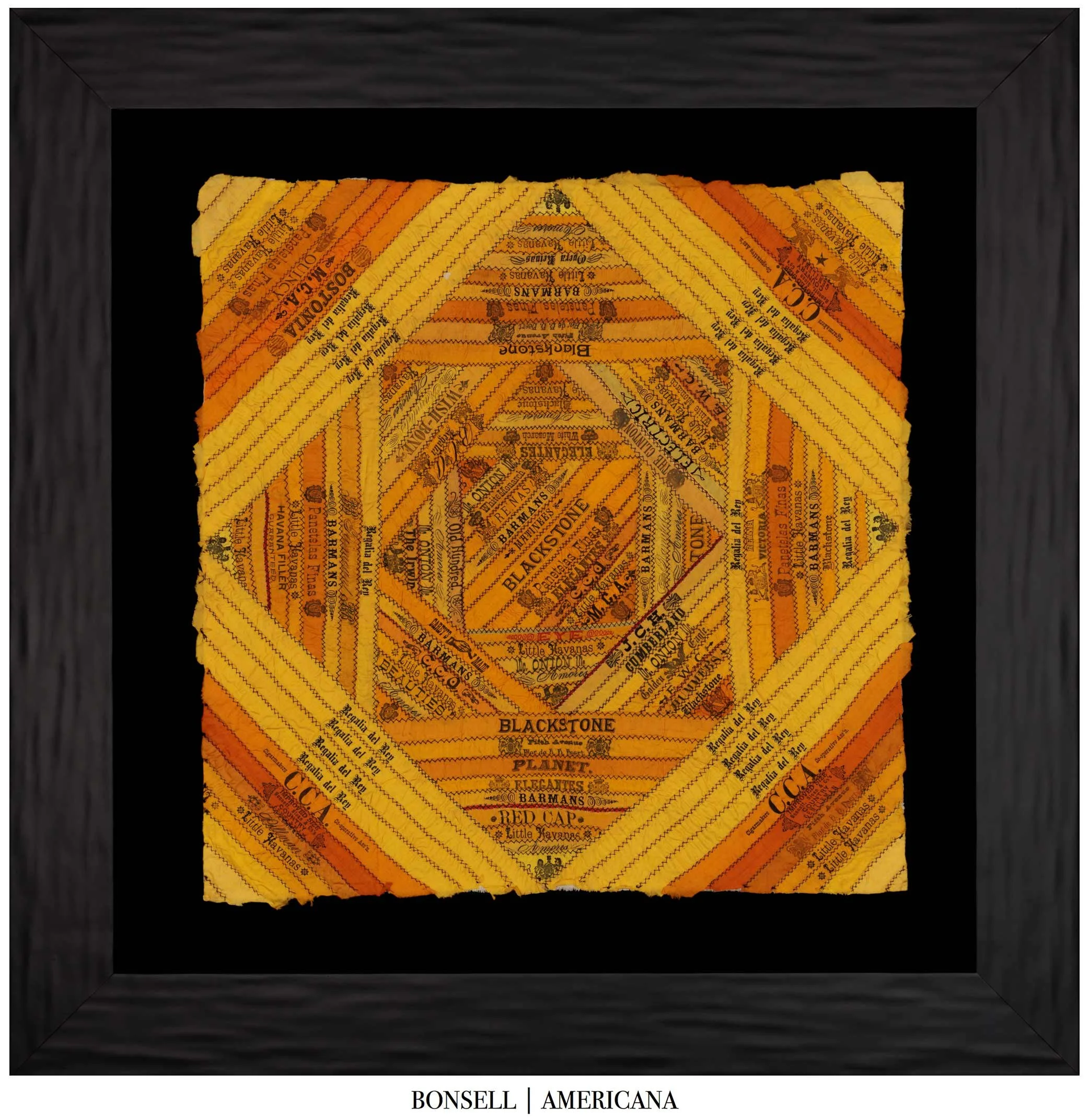
Offered is a quilt made of silk cigar ribbons, dating to between 1880 and 1910.
In the nineteenth century, most men enjoyed a good cigar, so much so that nearly every household had at least one cigar smoker. At the time, it was considered a gentlemanly and leisurely activity. As Mark Twain often did, he famously quipped and captured the status of cigars with respect to himself and American men generally in saying, “If I cannot smoke in heaven, then I shall not go.” Even the most debonair in the United States and elsewhere were fond of cigars, such as King Edward VII, who announced to his acquaintances, in protest of Queen Victoria’s smoke free policy, “Gentlemen, you may smoke.”
In the United States, cigar smoking was at its peak in 1895, and at that time, there were thousands of cigar manufacturers, in a range of sizes, to meet the corresponding demand. In Cleveland, Ohio, for example, there were 330 cigar manufacturers at the peak (versus none today). On one end of the spectrum, some “manufacturers” were nothing more than a family rolling cigars in a New York apartment or a farmer rolling cigars in an Ohio barn. On the other end, some manufacturers were large, sophisticated organizations, such as those in Connecticut and Florida, the success of Connecticut’s manufacturers being based on the state’s outstanding soil composition, and the success of Florida’s manufacturers being based on the state’s easy access to Cuban suppliers.
Cigar manufacturers sold to distributors. In some cases, the manufacturer would package the cigars for the distributor—but with the end customer in mind—in a wooden box, or alternatively the manufacturer would wrap the cigars with a silk ribbon. In other cases, the manufacturer would package the cigars in mass quantities in a barrel or box, and then the distributor would package the cigars in the wooden box or wrap the cigars. Typically, when wrapped, cigars were sold in quantities of either 25 or 50. Early cigars were much smaller than today’s, almost to the point of being closer in size to a modern cigarette than a modern cigar.
Cigar ribbons were made of silk and each featured the respective manufacturer’s name, essentially being a combination of a packaging material, an advertisement, and a differentiator. A higher quality cigar had higher quality ribbon, while a lower quality cigar had a lower quality ribbon. Most ribbons had a field in a shade of yellow or orange, and most had an overprinting in black. The different shades of yellow and orange seemed to be a function of the different shades of ribbons available, or alternatively a function of the manufacturers wanting to distinguish themselves from the others. Despite a general focus on yellow and orange, some manufacturers used other colors, such as pink, blue, red, and green. Cigar ribbons were typically shy of an inch in width and between 12 and 15 inches in length.
Cigar ribbons—being essentially a form of packaging—were generally thrown away after their respective cigars were smoked. However, some smokers (or their wives) collected the ribbons for enjoyment or for use in a project, such as a table cover, a pillowcase, or a quilt. Such thriftiness was common in the nineteenth and early twentieth centuries, not to mention during the Great Depression and afterwards.
Cigar quilts surface in a variety of sizes. The quilt offered herein is on the smaller end of the spectrum and is desirable for collecting, framing, and displaying. Bigger quilts are sometimes as large is 5 feet by 5 feet. While such quilts are dramatic, they are difficult to display and, thus, often less desirable.
The ribbons of the quilt herein form a diamond in a level square, surrounded by a larger tipped square, surrounded by an even larger level square, and so on. The ribbons are from different manufacturers, including Blackstone, Red Cap, Little Havanas, and Elegantes, to name just a few examples. The maker placed the manufacturers and their respective colors, so as to make a thoughtful, attractive design.
By the 1910s, 20s, and 30s, demand for cigars began to waiver and factories began to shutter, mostly as a result of cigarettes becoming a serious competitor thereto and as a result of the Great Depression. Following this downfall, cigars were significantly less popular for decades, even to the point that manufacturers wondered whether the industry would survive in any form at all. However, beginning in the 1990s—with the introduction of Cigar Afficionado and an increasing interest in old gentlemanly pursuits—cigars made a comeback and are still very much a part of American culture, albeit on a much smaller scale as compared to the nineteenth and early twentieth centuries.
Conservation Process: This quilt was hand sewn to cotton fabric, and both were hand sewn to a mounting board. To prevent the black dye in the cotton fabric from seeping into the quilt, it was first washed in a standard wash and then in a dye setting wash. The quilt is positioned behind Conservation Clear Acrylic (standard) or behind Optium Museum Acrylic (per request).
Frame: The flag is housed in a substantial, wide-profile frame with a matte charcoal finish and subtle linear graining across the face.
Condition: Variations along the raw edges are period to the piece. This quilt is in excellent condition.
Collectability Level: The Good – Perfect for Beginning Collectors and Gifts
Date of Origin: 1880-1910
Price: Call 618-553-2291, or email info@bonsellamericana.com
Frame Size (H x L): 13” x 20”
Pennant Size (H x L): 4 ¾” x 11 ½”
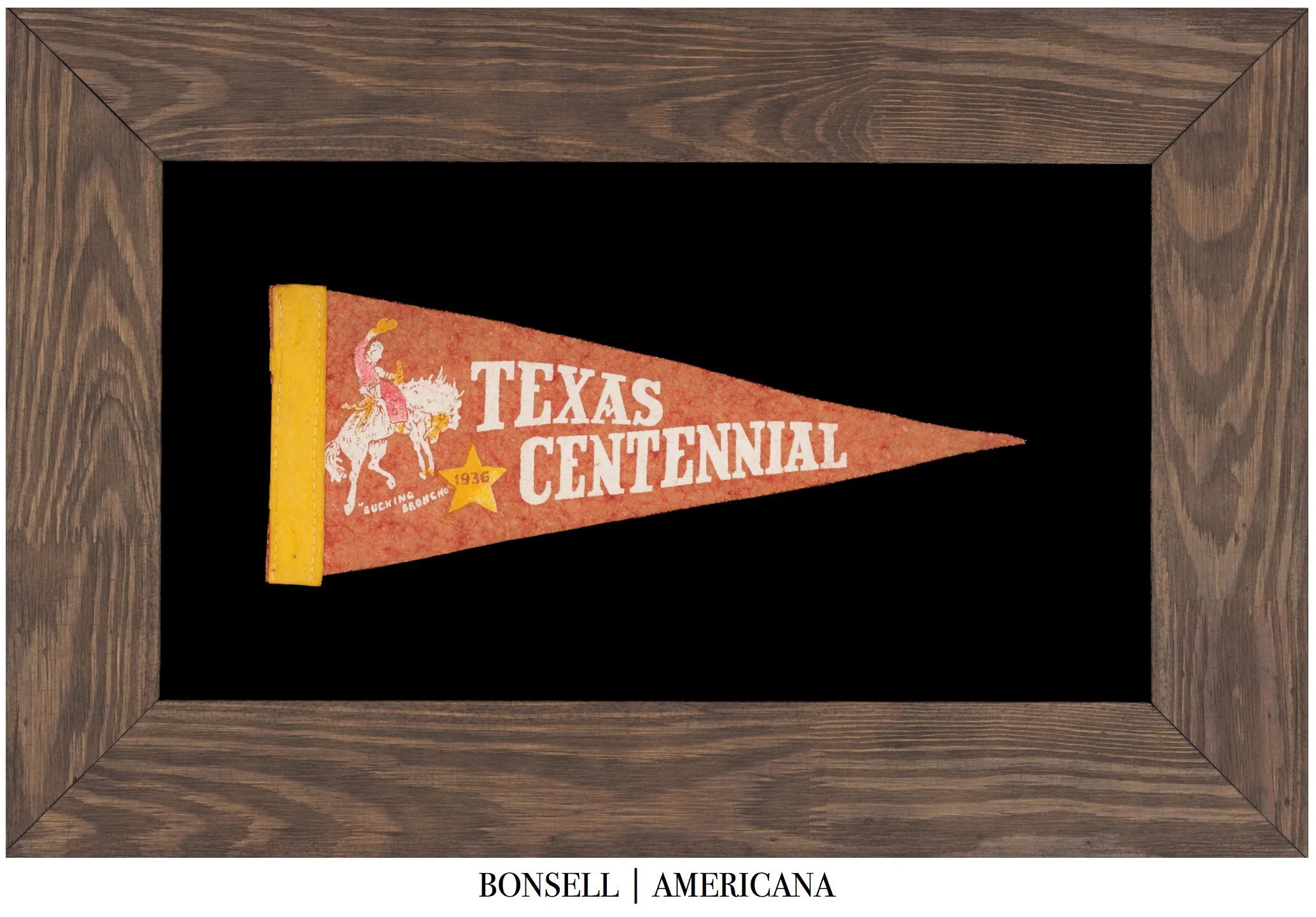
Offered is a striking Texas Centennial pennant dating to 1936, printed on felt and featuring bold western imagery associated with the celebration of the 100th anniversary of Texas independence. The pennant is rendered in a warm red-orange field with a contrasting yellow hoist, while the graphics are printed primarily in white, yellow, and red.
The design is dominated by the words “TEXAS CENTENNIAL” in large white block lettering, immediately identifying the piece with the statewide centennial celebration. To the left is a dramatic image of a cowboy riding a bucking bronco, an especially appropriate motif for an event that leaned heavily into Texas history, ranching culture, and the mythology of the American West. Beneath the horse appears the printed phrase “BUCKING BRONCHO,” while a yellow five-pointed star carries the date “1936.” Together, the typography and imagery give the pennant the unmistakable visual character of 1930s exposition and souvenir material.
The Texas Centennial commemorated the 100th anniversary of Texas independence in 1836. Although events were held throughout the state, the centerpiece was the Texas Centennial Exposition in Dallas, which opened at Fair Park in June 1936. The exposition combined Texas history with an emphasis on modernization, industry, culture, and progress, drawing millions of visitors during its run.
The celebration was far larger than a single fair. Centennial projects and events took place throughout Texas, resulting in new museums, monuments, restored historic sites, and commemorative buildings. The effort was both historical and promotional, presenting Texas as a place with a distinctive past and an ambitious future.
Souvenir pennants such as this were especially well suited to large public celebrations of the era. Made inexpensively from felt, they could incorporate colorful printed graphics and be easily carried home by visitors. Their imagery often distilled an event into a handful of immediately recognizable symbols. Here, the cowboy, bucking horse, star, and oversized Texas lettering present an idealized vision of the state that would have been immediately recognizable to visitors in 1936.
More than simply a Texas souvenir, the pennant is a colorful surviving artifact from one of the state's largest commemorative events of the 20th century. Its strong period graphics, western imagery, and prominent Centennial lettering make it an especially appealing example of Texas exposition material from 1936.
Conservation Process: This pennant was hand sewn to cotton fabric, and both were hand sewn to a mounting board. To prevent the black dye in the cotton fabric from seeping into the pennant, it was first washed in a standard wash and then in a dye setting wash. The pennant is positioned behind Optium Museum Acrylic.
Frame: The pennant is housed in a wide, rustic wood frame with a dark brown finish that allows the natural grain to remain clearly visible.
Condition Report: The pennant is in good overall condition, with age-related fading, mottling, and scattered discoloration throughout the felt. The printed graphics and lettering remain strong and readily legible, with only minor surface wear and softening along the edges consistent with age.
Collectability Level: The Good – For Beginners and Gifts
Date of Origin: 1936
Price: Call 618-553-2291, or email info@bonsellamericana.com
Frame Size (H x L): 32” x 34”
Flag Size (H x L): 21” x 23”
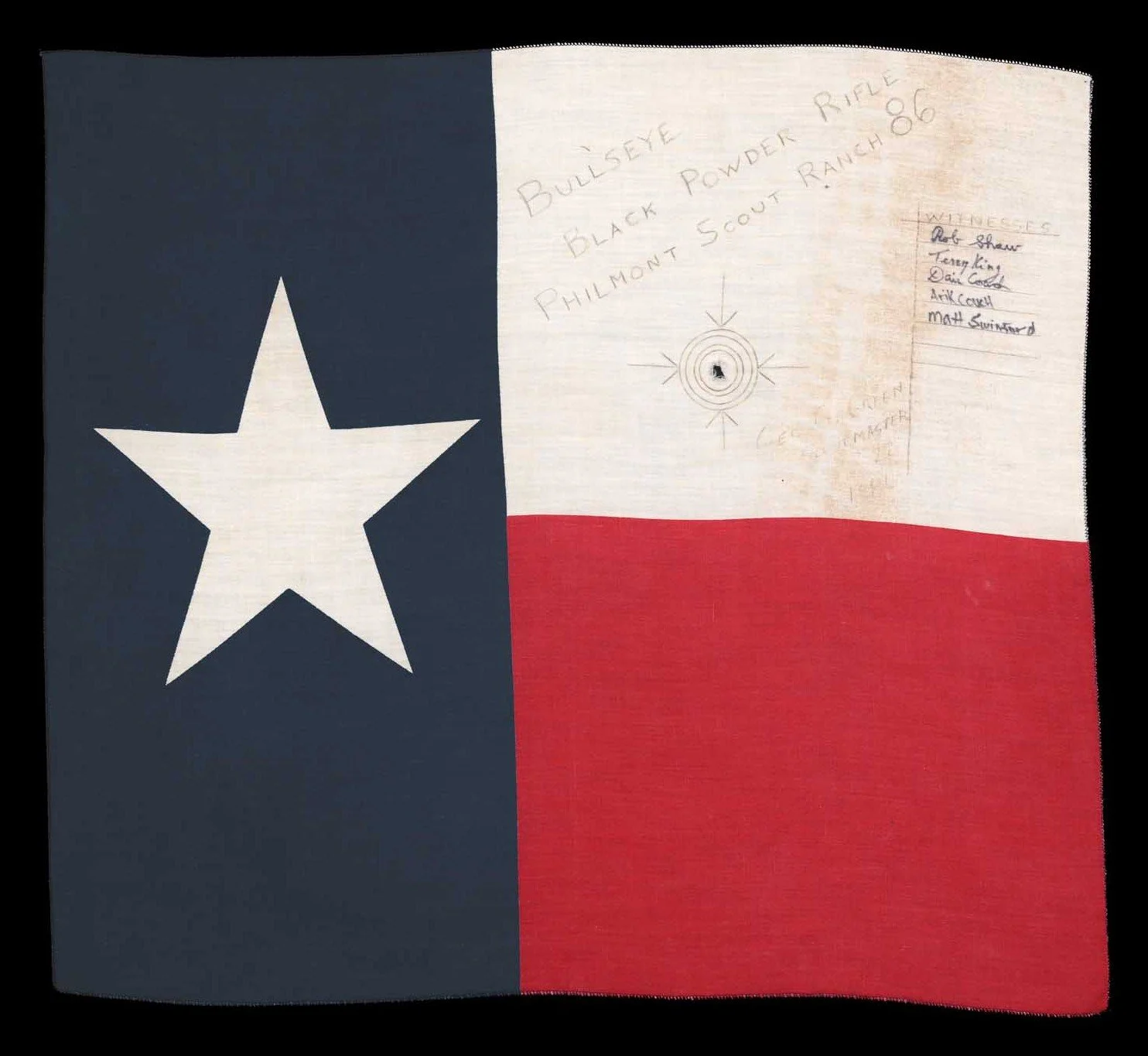
Offered is a particularly fun and highly personal Texas state flag, dating to 1986 and used during a black powder rifle exercise at Philmont Scout Ranch in northern New Mexico. Printed on a single piece of cotton, the flag was transformed from an otherwise straightforward Texas flag into a one-of-a-kind record of a Scout experience through a combination of handwritten inscriptions, a drawn bullseye, a remarkably centered bullet hole, and the names of those who witnessed the shot.
Across the white field, written in pencil, are the words “Bullseye,” “Black Powder Rifle,” “Philmont Scout Ranch,” and “86.” Below this inscription is a hand-drawn target composed of concentric circles and directional marks. At the very center is the actual bullet hole, placed almost perfectly within the bullseye. The relationship between the drawn target and the shot is what gives the flag much of its appeal. This was not simply a flag carried to camp or signed as a souvenir; it was deliberately preserved as evidence of a memorable shot.
To the right is a ruled box headed “WITNESSES,” followed by the names of five individuals. These appear to read Rob Shaw, Terry King, an additional name that is presently difficult to decipher, Arik Couch, and Matt Swinford. Elsewhere, a much lighter inscription appears to identify a Scoutmaster with the surname Green, lending another layer of documentation to the event. Taken together, the inscriptions have the character of a group making an informal record immediately following the shot—essentially turning the flag into a trophy, certificate, and camp souvenir all at once.
The setting is significant. Philmont Scout Ranch, near Cimarron, New Mexico, is one of the most storied institutions in American Scouting. The ranch traces its origins to oilman Waite Phillips and his wife, Genevieve, who donated more than 127,000 acres to the Boy Scouts of America in two major gifts in 1938 and 1941. The first Scouts arrived in 1939, when the property was known as Philturn Rocky Mountain Scoutcamp; following the larger 1941 gift, it became Philmont Scout Ranch. Today the property encompasses roughly 140,000 acres of mountainous backcountry and has hosted generations of Scouts in programs centered on hiking, outdoor skills, western history, conservation, and marksmanship.
Black powder shooting has long been one of Philmont's historically themed activities. Participants learn the process of loading and firing a muzzle-loading rifle using the traditional components of powder, patch, ball, ramrod, and percussion cap. Modern Philmont program literature describes the use of .50- and .58-caliber muzzle-loading rifles, with the activity intended not only as a shooting exercise but also as an introduction to the firearms and methods associated with nineteenth-century western life. Although the precise circumstances surrounding this 1986 shot are not known, the inscriptions leave little doubt that the flag was connected directly to such a black powder rifle exercise at Philmont.
What makes the piece especially compelling is the way the participants documented the moment. A successful shot at camp might ordinarily survive only as a story or perhaps a paper target. Here, however, someone chose a Texas flag, drew the target directly onto it, recorded the location and type of shooting, dated the event, and had witnesses identify themselves alongside it. The bullet hole at dead center makes the story immediately understandable without explanation. The result is less a conventional flag than a piece of American vernacular history—an object created spontaneously to commemorate a small but evidently memorable achievement.
The use of a Texas flag adds another layer of character. The familiar Lone Star design originated as the national flag of the independent Republic of Texas. The Texas Congress approved the design on January 25, 1839, during the presidency of Mirabeau B. Lamar. Its composition—a vertical blue field containing a single white star, together with horizontal white and red fields—later became the state flag and remains essentially unchanged.
Under the modern Texas Flag Code, the colors are assigned the meanings of blue for loyalty, white for purity, and red for bravery. Earlier recommendations made during the Republic period proposed somewhat different symbolism—blue for friendship, white for peace, and red for war—but that language was not formally adopted by the Texas Congress. The lone five-pointed star became the enduring emblem of Texas itself, one whose history reaches back to the Republic and ultimately gave Texas its familiar identity as the Lone Star State.
Against that history, this particular flag has an especially American quality. It combines the iconography of Texas, the traditions of Scouting, the western heritage emphasized at Philmont, and the camaraderie of a group who considered a single rifle shot important enough to document for posterity. Its appeal comes precisely from its informality: the penciled lettering, the hand-drawn target, the witness list, and, above all, the bullet hole precisely where the shooter hoped it would be.
Dating to 1986, it is obviously much younger than many antique American flags, but age is not the principal attraction here. This is an object with a specific event permanently recorded upon it. Very few flags can be tied so visually and directly to a particular moment. As a Texas flag, a Philmont Scout Ranch artifact, and a remarkably graphic piece of shooting and Scouting history, it is an unusual and exceptionally engaging piece of Americana.

Price: Call 618-553-2291, or email info@bonsellamericana.com
Frame Size (H x L): 34 ½” x 46”
Flag Size (H x L): 23” x 34 ½”
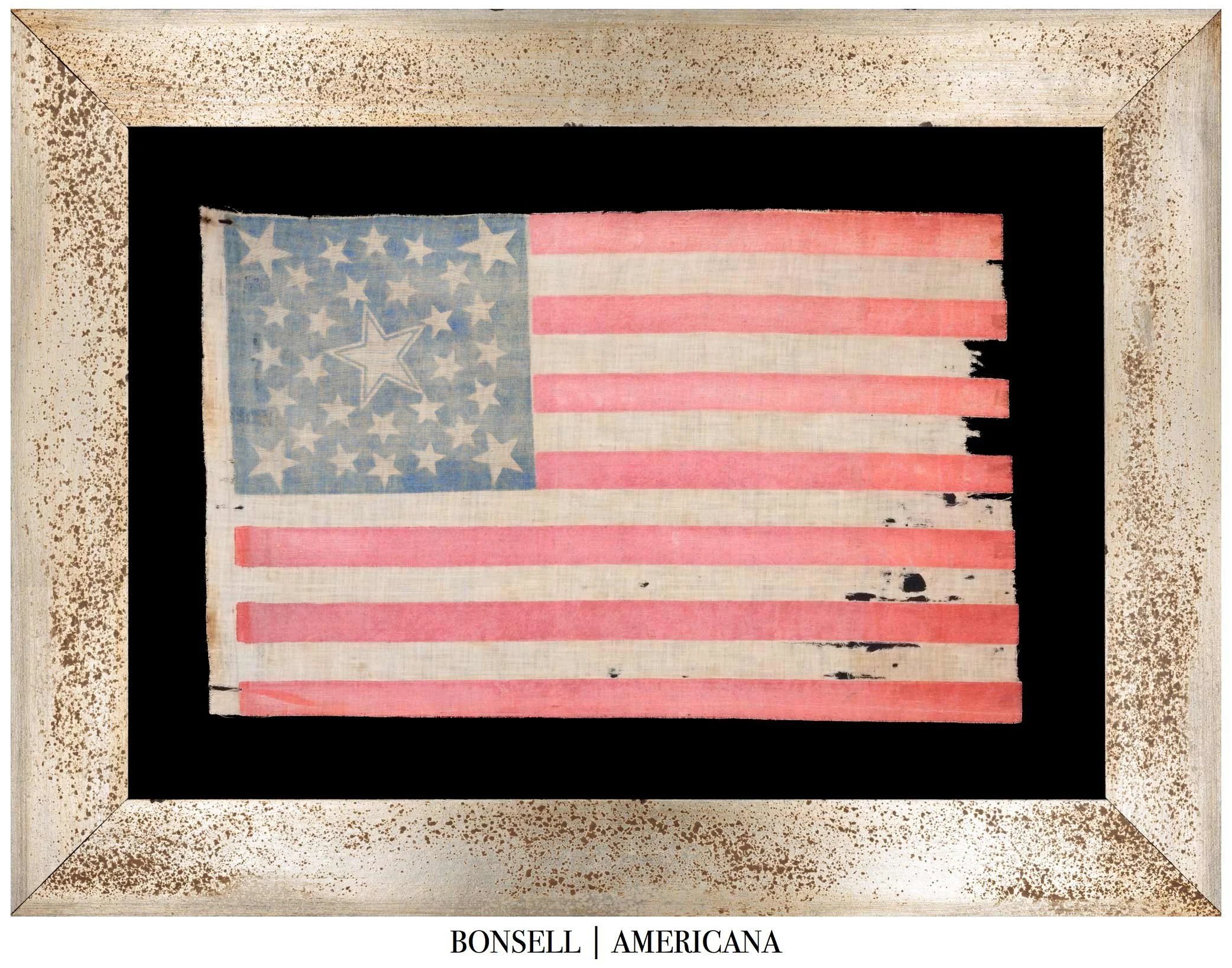
Offered is a remarkable 38-star antique American flag, printed on coarse, glazed cotton and dating to the period surrounding the nation’s Centennial. The flag is distinguished by an especially unusual star configuration that combines a circular medallion with a secondary five-pointed star—often called a Great Star or Grand Luminary—formed from individual stars within the larger arrangement.
At first glance, the configuration can be difficult to discern. A ring of stars establishes the dominant circular form, while additional stars within the circle are positioned to create the outline of a large five-pointed star. Several of the stars at the tips of this secondary formation intersect with the surrounding wreath, allowing the two patterns to function together rather than as separate devices. A single star occupies the center. The result is an unusually sophisticated design in which the 38 stars form multiple patterns simultaneously.
The Grand Luminary was among the most visually ambitious star arrangements employed on 19th-century American flags. Rather than arranging the stars in simple rows, the maker used the stars themselves to construct a much larger star, transforming the canton into an overtly patriotic graphic. Great Star patterns appeared periodically throughout the 19th century, particularly on flags produced for celebrations, political events, and other occasions where visual impact was important. Combining such a device with a medallion configuration, as was done here, produced an especially elaborate result.
Also noteworthy are the stars positioned outside the principal medallion. Rather than the four corner stars frequently encountered on medallion-pattern flags, this example incorporates only two such stars. The remaining space contributes to the asymmetrical and almost hand-composed character of the canton and further distinguishes the design from more conventional 38-star arrangements.
The flag may initially appear to be displayed “backwards,” because the canton occupies the upper right when viewed from this side. This is, however, the intended face of the textile. The flag was printed in this orientation rather than simply being shown from its reverse.
Such construction is an important reminder that the conventions governing the display of the American flag were far less rigid during the 19th century than they would become in the 20th. Modern viewers are accustomed to standardized rules governing the position of the canton, particularly when a flag is displayed vertically or against a wall. Makers of early American flags operated in a period when such details were not yet governed by a comprehensive national code. Surviving examples consequently exhibit considerable variation in orientation, proportions, star arrangement, and construction. What today might initially appear incorrect was not necessarily regarded that way when the flag was made.
The 38-star flag is closely associated with one of the most important patriotic periods of the 19th century. Colorado entered the Union as the 38th state on August 1, 1876—just weeks after the United States celebrated the 100th anniversary of the Declaration of Independence. Colorado's admission during the Centennial year subsequently earned it the enduring nickname “The Centennial State.”
Under the Flag Act of 1818, a newly admitted state's star was formally added to the national flag on the Fourth of July following admission. Colorado's star therefore officially entered the flag on July 4, 1877, and the 38-star flag remained the official national flag until July 4, 1890.
Commercial practice did not always wait for the statutory date. Flag makers routinely anticipated statehood, particularly when admission appeared imminent, and 38-star flags were produced during 1876 in anticipation of Colorado joining the Union. This coincided with an extraordinary demand for patriotic material generated by the Centennial celebration.
The Centennial International Exhibition opened in Philadelphia in May 1876 and became the largest public celebration of the nation's first century. Flags, banners, bunting, shields, and other patriotic textiles appeared throughout the exhibition grounds and across the country as Americans commemorated the anniversary. It was an environment particularly conducive to inventive flag making. Makers were not confined to orderly rows of stars and instead produced medallions, wreaths, Great Stars, double wreaths, and other decorative configurations that transformed the canton into a design element in its own right.
For this reason, some of the most graphically interesting American flags date to the Centennial era. The 38-star count sits directly at the intersection of the nation's 100th anniversary and its continuing westward expansion. Colorado's admission provided flag makers with an opportunity to combine a new star count with the heightened patriotism of 1876, and many responded with arrangements far more imaginative than those that became customary in later decades.
The present example embodies that spirit particularly well. Its inset Grand Luminary is not immediately obvious, rewarding closer examination before the larger five-pointed star emerges from the surrounding medallion. The irregularity of the printing, the unusually complex canton, and the unconventional orientation all speak to an era when American flag design retained a remarkable degree of individual expression.
The result is a particularly compelling Colorado-statehood flag: not simply a 38-star example, but one whose composition reflects the experimentation and patriotic exuberance that characterized American flag making during the Centennial period.
Conservation Process: This flag was hand sewn to cotton fabric, and both were hand sewn to a mounting board. To prevent the black dye in the cotton fabric from seeping into the flag, it was first washed in a standard wash and then in a dye setting wash. The flag is positioned behind Optium Museum Acrylic.
Frame: The flag is housed in a substantial, wide-profile frame with a matte charcoal finish and subtle linear graining across the face.
Condition Report: The flag exhibits substantial but visually appealing age and use, including overall fading, oxidation, scattered staining, and areas of pigment loss throughout both the stripes and canton. There are several small holes, edge losses, and minor tears, with more pronounced wear along the hoist and upper fly end. Despite this, the flag remains remarkably complete, and the star configuration is still clearly legible.
Collectability Level: The Best – Perfect for Advanced Collectors
Date of Origin: 1876-1890
Number of Stars: 38
Associated War: The Indian Wars (1860-1890)
Associated State: Colorado
Price: Call 618-553-2291, or email info@bonsellamericana.com
Frame Size (H x L): 26” x 34 ½”
Flag Size (H x L): 14 ¾” x 23”
Offered is an exceptional 30-star antique American flag, printed on cotton and dating to one of the earliest periods of commercially printed American flags. The canton features an elaborate medallion configuration centered by a large, haloed star, making this a particularly striking example of an already exceedingly scarce star count.
The 30-star flag represents the admission of Wisconsin as the 30th state. Wisconsin entered the Union on May 29, 1848, and under the Flag Act of 1818 its star was officially added to the American flag on July 4 of that year. The 30-star flag remained official until July 3, 1851, when California's admission resulted in the 31-star flag.
Flags dating to the years before the Civil War survive in comparatively small numbers, particularly those intended for public, political, or celebratory use. The American flag had not yet assumed the near-universal place in civic and domestic life that it would acquire during and after the Civil War. Even within the military, the familiar Stars and Stripes was adopted gradually. Army regulations of 1834 prescribed a Stars and Stripes national color for artillery, while infantry was not authorized to carry the Stars and Stripes as its national color until 1841.
This flag therefore belongs to a formative period in the development of the American flag as a widely recognized national emblem. Its printed construction is especially noteworthy. Printed parade flags became increasingly important as inexpensive flags could be produced for political rallies, public celebrations, parades, and other civic events, but examples from the 1840s remain exceptionally early. This flag dates only about a decade after the 26-star period of 1837–1845 and well before the enormous expansion in flag production brought about by the Civil War.
The star configuration is among the most compelling features of the flag. Rather than employing simple horizontal or vertical rows, the maker arranged the stars in an elaborate medallion. A large star occupies the center of the canton, surrounded by concentric arrangements of smaller stars, with additional stars positioned toward the corners. The resulting design is both highly graphic and distinctly representative of the freedom enjoyed by 19th-century flag makers.
There was no federally prescribed arrangement of the stars during this period. The Flag Act of 1818 established that the flag would contain one star for each state, with additional stars added on the Fourth of July following a state's admission, but it did not dictate how those stars were to be arranged. Makers were therefore free to employ circles, medallions, Great Stars, staggered rows, and numerous other patterns. The federal government did not standardize the arrangement and proportions of the national flag until 1912, during the administration of President William Howard Taft.
At the center of this example is an unusually large, canted star surrounded by a narrow outlined or "haloed" border. This type of device is sometimes described by collectors as a center star and should be distinguished from a Great Star, in which numerous smaller stars are themselves arranged to form the outline of one large star. Here, the center star is an individual printed element around which the remainder of the constellation is organized.
The oversized center star is traditionally interpreted on flags of this type as representing the newest state—in this case Wisconsin. Whether every maker consciously intended that symbolism cannot be established, but the placement would have been particularly appropriate in 1848, when Wisconsin's admission was the event that brought the national constellation to 30 stars.
The halo surrounding the center star is another notable feature. Similar haloed center-star devices appear on a small group of printed American flags from the middle decades of the 19th century and are immediately recognizable for their distinctive appearance. The identity of the printer remains unknown, but similarities in printing style and canton design among surviving examples suggest that related flags may have originated with the same maker or closely associated manufacturers. On this example, the pale outline around the large star creates a strong focal point within an already complex medallion.
The historical moment represented by the flag is equally important. The 30-star period encompassed the presidential election of 1848, held only months after Wisconsin entered the Union. Whig nominee Zachary Taylor, a celebrated general of the Mexican-American War, faced Democratic nominee Lewis Cass and former President Martin Van Buren, who ran as the candidate of the newly organized Free Soil Party. Taylor won the election, propelled in large part by his national reputation as a military hero.
Taylor's supporters organized political clubs, rallies, and public gatherings around the image of "Old Rough and Ready," while the Free Soil campaign made the expansion of slavery into the western territories a central national political issue. The election took place as the country confronted the enormous territorial gains resulting from the Mexican-American War and the increasingly contentious question of whether slavery would expand westward.
A small printed flag such as this would have been well suited to the political and public gatherings of the period. Without specific provenance it is impossible to assign this particular example to the Taylor campaign, but its 1848–1851 date, portable format, and printed cotton construction place it squarely within the type of flag used at political rallies, parades, patriotic celebrations, and other public events during the era.
Taylor's presidency proved remarkably brief. He died on July 9, 1850, roughly 16 months after taking office, and was succeeded by Vice President Millard Fillmore. His administration coincided with rapidly increasing sectional conflict surrounding slavery and the territories acquired from Mexico, placing the 30-star period immediately before the political crises of the 1850s that eventually culminated in the Civil War.
The survival of any printed American flag from this period is notable. The combination present here—a 30-star count, pre-Civil War manufacture, elaborate medallion configuration, oversized haloed center star, and early printed cotton construction—places this example among the more visually distinctive forms produced during the formative years of the American flag. It represents Wisconsin's entry into the Union, the presidential politics of 1848, and an era when flag makers were still free to interpret the national constellation with extraordinary creativity.
Conservation Process: This flag was hand sewn to cotton fabric, and both were hand sewn to a mounting board. To prevent the black dye in the cotton fabric from seeping into the flag, it was first washed in a standard wash and then in a dye setting wash. The flag is positioned behind Optium Museum Acrylic.
Frame: The flag is housed in a wide, contemporary frame with a softly sloped profile and an aged silver finish. The surface is deliberately distressed, with warm brown and muted gold undertones showing through the silver, giving the frame an understated, timeworn appearance that complements the flag without competing with it.
Condition Report: The flag is in good condition for its age, with strong overall presentation and attractive, softly faded color. There is scattered fabric loss and fraying, concentrated primarily along the fly end and in several areas of the lower white stripes, along with minor staining and small scattered losses elsewhere. Despite these condition issues, the canton and distinctive haloed medallion configuration remain well preserved and highly legible.
Collectability Level: The Best – Perfect for Advanced Collectors
Date of Origin: 1848-1851
Number of Stars: 30
Associated State: Wisconsin
Frame Size (H x L): 31.5” x 21.5”
Pennant Size (H x L): 6.25” x 10” and Affixed to an 18” Staff
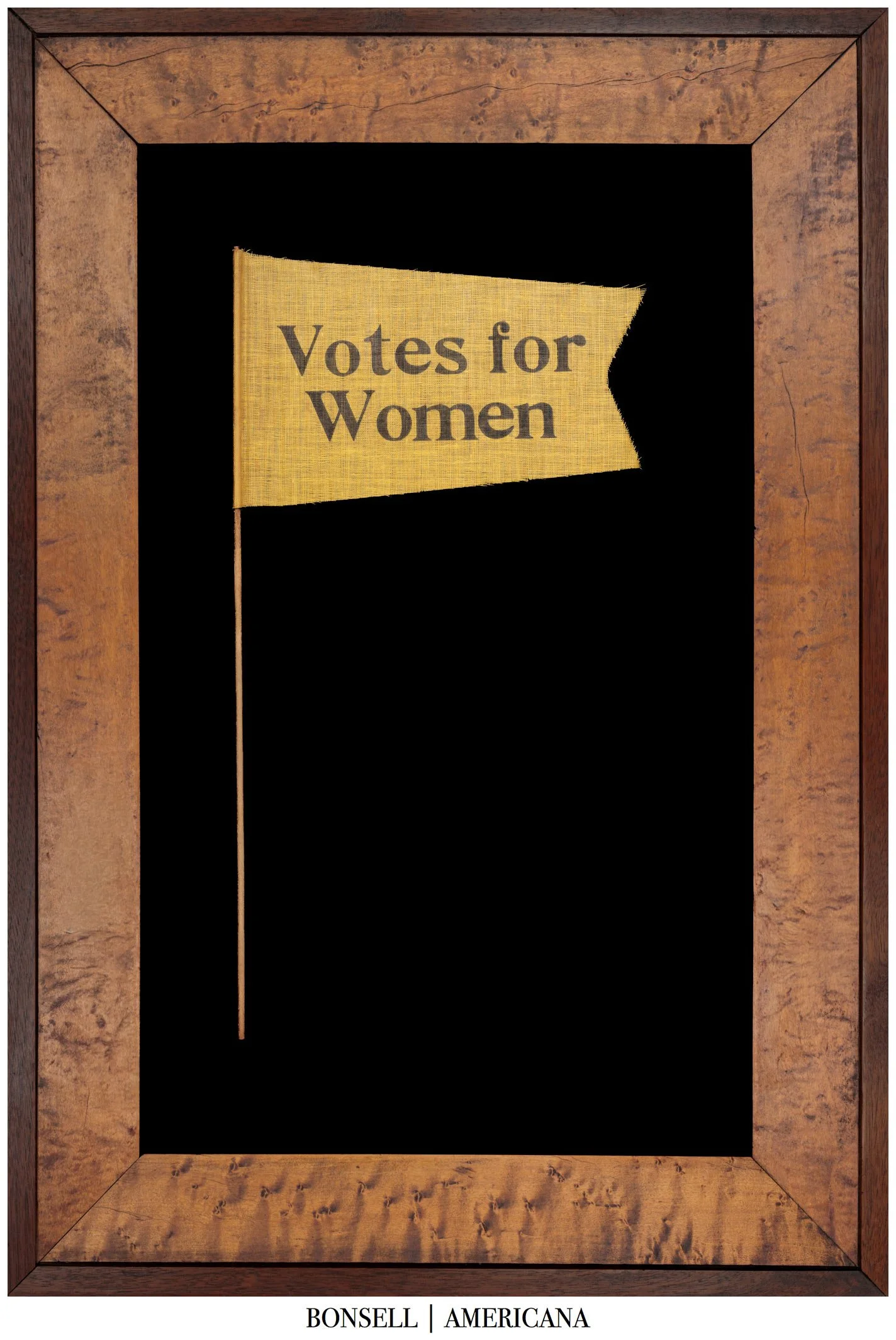
Offered is an American women’s suffrage pennant advocating “Votes for Women.” The pennant is made of cotton and constructed in a swallowtail form, a shape commonly used for political and reform-related textiles in the late-19th and early-20th centuries. The field is yellow, with the slogan printed in black across the surface. The pennant remains affixed to its original wooden staff.
Yellow was the primary color associated with the women’s suffrage movement in the United States and was widely adopted by suffrage organizations beginning in the late-19th century. It was frequently paired with black to create a bold, high-contrast design that could be read easily during marches, meetings, and public demonstrations. Pennants and related textiles were produced for active use and functioned as direct statements of political purpose.
The organized movement for women’s voting rights in the United States is generally traced to 1848, when Lucretia Mott and Elizabeth Cady Stanton convened the first women’s rights convention in Seneca Falls, New York. That meeting produced the Declaration of Sentiments, a document asserting women’s claims to political equality, education, and employment. Over the following decades, the movement expanded through conventions, lectures, and organized advocacy.
In 1906, Harriot Stanton Blatch—daughter of Elizabeth Cady Stanton—founded the Equality League of Self-Supporting Women, later renamed the Women’s Political Union. This organization focused on mobilizing working-class women and increasing the public visibility of the suffrage movement. In 1910, the group organized the first large-scale suffrage march in the United States, held in New York City. Textiles such as pennants and banners were used extensively during this period to convey clear, readable messages during marches and public gatherings.
Although early efforts focused on securing voting rights at the state level, it became increasingly clear that a constitutional amendment was necessary to guarantee suffrage nationwide. Proposed amendments were introduced in Congress in 1878 and again in 1914, but both attempts failed. Momentum shifted during and after World War I, when women’s contributions to the war effort helped secure bipartisan political support. In January 1918, the House of Representatives approved a suffrage amendment by the required two-thirds majority, followed by Senate approval in June 1919.
On August 18, 1920, Tennessee became the thirty-sixth state to ratify the amendment, providing the necessary three-quarters majority of states. Eight days later, on August 26, 1920, the Nineteenth Amendment was formally adopted into the Constitution, stating:
“The right of citizens of the United States to vote shall not be denied or abridged by the United States or by any State on account of sex. Congress shall have power to enforce this article by appropriate legislation.”
Surviving suffrage pennants are uncommon, particularly examples that retain their original staff and exhibit strong color and legibility. Pieces such as this were produced for use in marches, meetings, and public demonstrations and reflect the material culture of the American women’s suffrage movement.
Conservation Process: This pennant was hand sewn to cotton fabric, and both were hand sewn to a mounting board. To prevent the black dye in the cotton fabric from seeping into the pennant, it was first washed in a standard wash and then in a dye setting wash. The pennant is positioned behind Optium Museum Acrylic.
Frame: The pennant is housed in an impressive antique frame featuring a broad birdseye maple interior molding surrounded by a darker hardwood outer border, which appears more consistent with walnut than mahogany. The contrasting woods, veneered construction, and restrained mitered profile are characteristic of 19th-century American framing, and the frame likely dates to the mid-to-late 1800s.
Condition Report: The pennant remains in very good overall condition, with strong yellow coloration and clear, legible black lettering. There is expected fraying and minor loss along the outer edges, particularly at the swallowtail end, along with light surface wear consistent with age and use. The staff remains intact and is original to the pennant.
Collectability Level: The Great – Perfect for Rising Collectors
Date of Origin: 1910-1920
Price: Call 618-553-2291, or email info@bonsellamericana.com
Frame Size (H x L): 25” x 30.5”
Flag Size (H x L): 15.5” x 21.25”
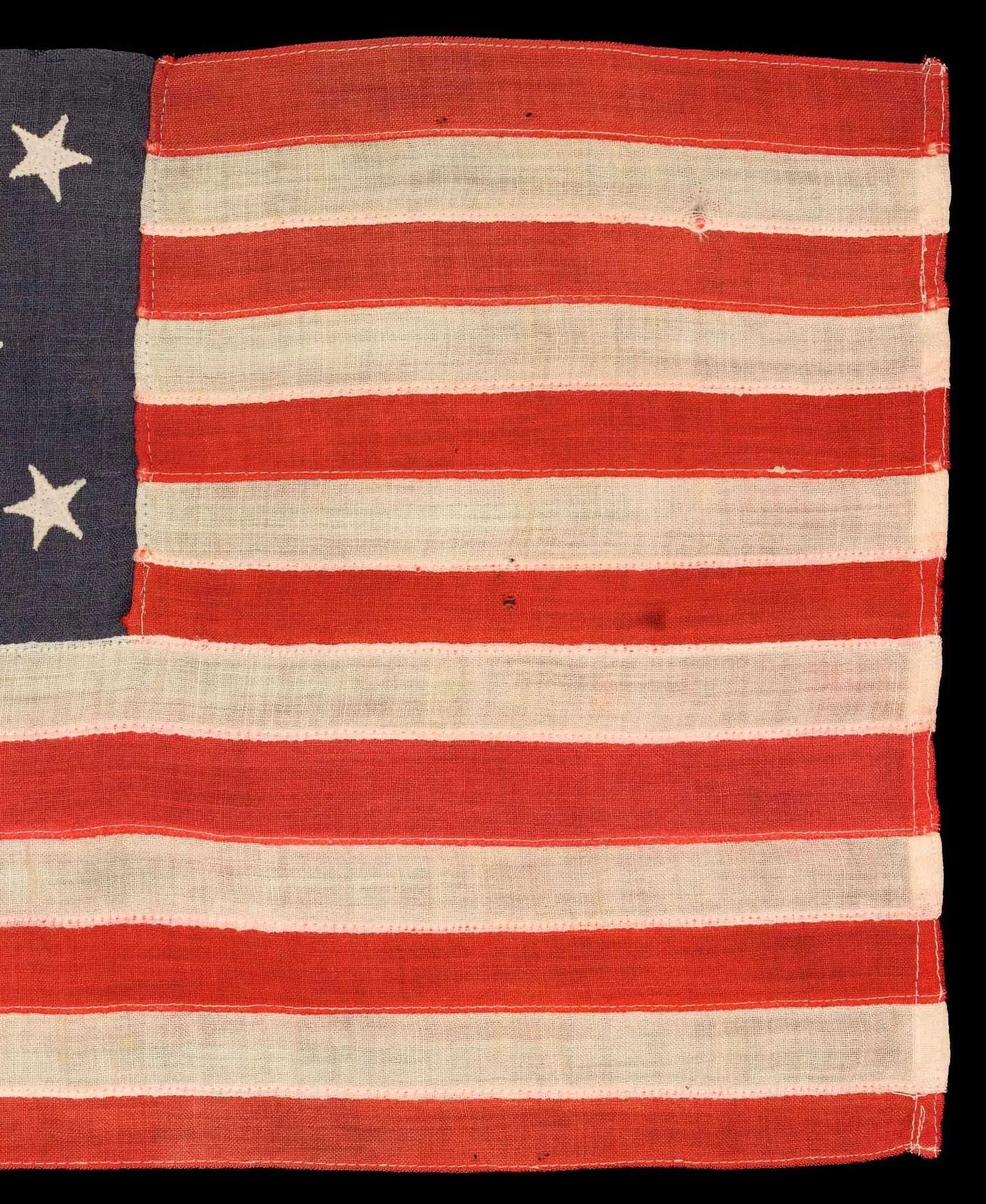
Offered is a 13-star antique American flag of wool bunting with cotton stars that are double-appliquéd—sewn to both sides of the canton so the design presents correctly on either face. It is an unusually small example of a fully pieced-and-sewn flag from the late 19th or early 20th century. While small printed flags were produced in great numbers during this period, traditional sewn flags at this diminutive scale are considerably less common.
The canton displays a classic medallion configuration centered on a single star, surrounded by a circular arrangement of eight stars, with four additional stars positioned toward the corners. The resulting pattern is one of the most recognizable configurations associated with 13-star flags. At this compact scale, the arrangement is particularly effective, allowing the stars to remain comparatively large and distinct while creating a strong, balanced composition within the canton.
The flag is constructed in the manner of a conventional full-size sewn flag despite its unusually small proportions. The red and white wool-bunting stripes are individually pieced and joined by machine stitching, while the canton is likewise made of wool bunting. The cotton stars are applied to both sides and secured with zig-zag machine stitching. The hoist is made of cotton.
The zig-zag stitching used to secure the stars provides useful chronological guidance. In August 1889, Henry Bowman filed a patent application for a “method of making flags,” which was granted in February 1892 as U.S. Patent No. 469,395. Bowman specifically claimed the use of zig-zag stitching in flag construction, a technique particularly well suited to binding the unfinished edges of appliquéd stars. Similar stitching became increasingly common among commercial flag manufacturers during the 1890s and remained in widespread use during the early decades of the 20th century.
The unusually small scale of the present flag is an important part of its appeal. Although compact, its manufacture required essentially the same basic operations as a substantially larger example: piecing the individual stripes, assembling the canton, cutting and applying the stars, and finishing the hoist. Small sewn flags were practical for boats, architectural display, ceremonial use, and other settings where a conventional large flag would have been unnecessary or impractical. Their reduced scale also favored the use of 13 stars, which could remain individually prominent where the full complement of stars then representing the Union would have required a much smaller and more crowded arrangement.
The 13-star American flag traces its origin to June 14, 1777, when the Continental Congress resolved that the national flag should contain 13 alternating red and white stripes and “thirteen stars, white in a blue field, representing a new constellation.” Although the official star count increased as new states entered the Union, the 13-star configuration never disappeared from American use. Instead, it developed into an intentional reference to the original states and the nation’s Revolutionary founding.
Throughout the 19th century, 13-star flags appeared in military, maritime, commemorative, and patriotic settings. Interest increased considerably around the Centennial of American independence in 1876 and continued during the Colonial Revival of the late 19th and early 20th centuries, when Revolutionary-era imagery enjoyed renewed popularity. The United States Navy also continued to employ 13-star ensigns on small boats into the early 20th century, further reinforcing the design’s association with compact maritime flags. The Sesquicentennial of American independence in 1926 provided another period of heightened interest in the imagery of the founding era.
Based upon its wool-bunting construction, double-appliquéd cotton stars, machine stitching, zig-zag application, and overall form, we date the flag to approximately 1895–1926. Its combination of a classic medallion star configuration and unusually small scale makes it a particularly appealing example of the commercially produced 13-star flags of the late 19th and early 20th centuries.
Conservation Process: This flag was hand sewn to silk organza, and both were hand sewn to cotton fabric. The silk organza provides a strong layer of protection and a professional appearance. The flag, the silk organza, and the cotton fabric were then hand sewn to a mounting board. To prevent the black dye in the cotton fabric from seeping into the flag, it was first washed in a standard wash and then in a dye setting wash. The flag is positioned behind Optium Museum Acrylic.
Frame: The flag is housed in a wide, sloped molding with an aged gold surface, intentionally distressed to evoke the appearance of early gilded frames.
Condition Report: The flag survives in very good overall condition, with strong color and only minor scattered staining, small areas of soiling, and limited wear consistent with age and use. There are a few small holes or separations within the striped field, along with a couple of tack holes and associated stains on the hoist. The fabric remains substantially intact, and the canton and star field present especially well.
Collectability Level: The Great – Perfect for Rising Collectors
Date of Origin: 1895-1926
Number of Stars: 13
Associated War: Spanish-American War (1898)
Associated State: Original 13 Colonies
Price: Call 618-553-2291, or email info@bonsellamericana.com
Frame Size (H x L): 38” x 54”
Flag Size (H x L): 25 ¼” x 42 ¼”
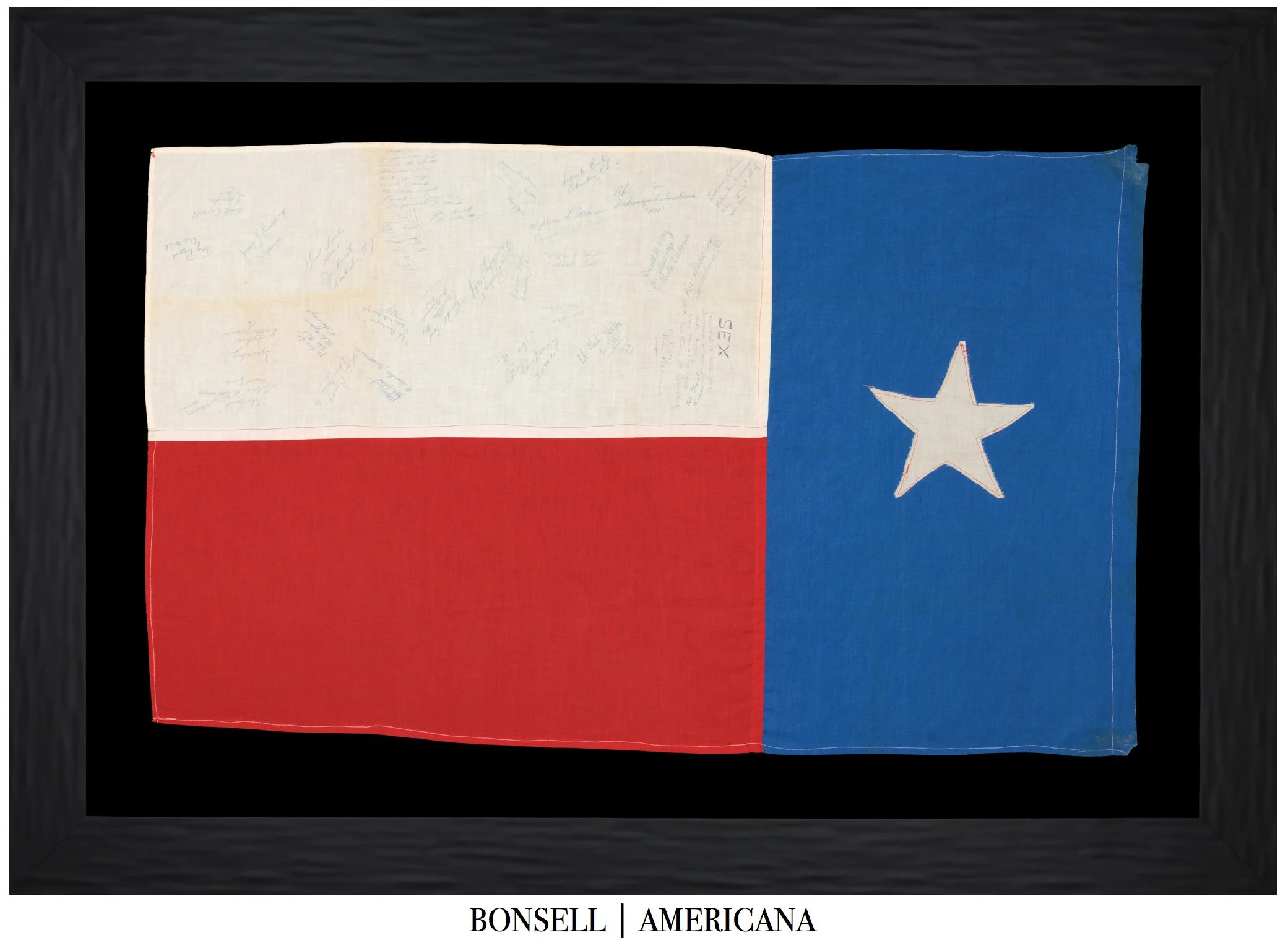
Offered is an exceptional Texas state flag, made and signed in 1966 by a group of young United States Air Force airmen at the conclusion of a shared period of military training. More than a collection of signatures, the flag is a personal Vietnam-era farewell piece, covered with names, hometowns, jokes, good wishes, and references to the places these men had come from and, in some instances, where they were headed next.
The flag is constructed entirely of cotton and is machine-sewn throughout. Its individual construction, irregular proportions, and straightforward workmanship suggest that it was made as a one-off piece rather than purchased as a commercially manufactured state flag. Given its association with Air Force personnel, it is entirely possible that it was assembled in a military setting specifically for the occasion.
Interestingly, the flag was constructed so that the signed side was clearly intended to be its primary viewing side. When displayed in this manner, the blue vertical field appears at the right rather than at the left, making the Texas flag appear reversed to the modern viewer. This is not simply the back of a conventionally made flag turned around for display; the construction indicates that this orientation was deliberate. More importantly, it is this side that the airmen chose to cover with their names and messages, and it is therefore the side on which the history of the object survives.
The most compelling aspect of the flag is the unmistakable sense of camaraderie preserved across its white field. The inscriptions appear to have been made as these men were preparing to go their separate ways following training. A date of August 12, 1966 appears among the writing, placing the flag squarely within the massive Vietnam-era expansion of the United States Air Force.
Several of the men can be independently connected with Air Force service, including Claude “Buzz” Kenney, who went on to serve for more than 21 years, and William L. Adkison, later a Staff Sergeant whose military record identifies him as a Vietnam veteran.
Another apparent signer, Michael Azzara, provides a particularly good illustration of what was happening to these young men as their time together came to an end. Azzara enlisted in the Air Force in 1966 and subsequently spent 18 months at Eielson Air Force Base in Alaska before transferring to Misawa Air Base in Japan. His path helps illustrate how quickly men who had trained together could be dispersed across the country and around the world.
One inscription identifies its writer as an “Air Commando,” a particularly evocative designation in 1966. Air Commando organizations were then deeply involved in the rapidly expanding American air war in Southeast Asia, undertaking missions that included air support, combat airlift, reconnaissance, unconventional warfare, search and rescue, and psychological operations. The presence of the term on this flag gives the piece an especially strong connection to the military environment of the Vietnam era, even though the exact subsequent assignment of the signer remains unknown.
Yet what makes the flag memorable is not the formal military history alone. It is the personality of the men.
One airman employed a joke almost guaranteed to get the attention of a barracks full of young men, writing in large letters:
SEX
and underneath
now that I have your undivided attention
Take it easy,
WALK TALL & LOOK TOUGH
AND GO EASY ON CALIFORNIA.
The reference to California is directed at the recipient of the flag and suggests that he was preparing to leave Texas for an assignment there. Elsewhere, another friend offered a practical California connection, writing that if he ever got around the North Hollywood area he should look up the writer’s aunt.
These messages make clear that this was not just an object passed around for anonymous signatures. These were friends saying goodbye.
Their hometown inscriptions also create a snapshot of America in the mid-1960s. One man proudly identifies “Indianapolis, Indiana” and adds “500,” an obvious reference to the Indianapolis 500. Another writes:
Milwaukee, Wisconsin
where you get all of
your beer
Russell M. Wong identifies himself with El Cerrito, California, along with the playful notation “ex-yellow rope,” apparently referencing a student leadership position during Air Force training. Other men came from communities scattered across the country. Taken together, the inscriptions read almost like a miniature map of the United States: young men from different regions, backgrounds, and hometowns brought together by military service, becoming friends for a short but formative period before being sent in different directions.
That quality is poignant in the context of 1966. Some would remain in the United States. Others would be sent to Alaska, Japan, Europe, the Pacific, or Southeast Asia. At least one identifiable signer later served in Vietnam. Others made the Air Force a career. At the moment this flag was signed, however, those futures were still ahead of them. What survives here is the point immediately before the group broke apart—the jokes, nicknames, hometown pride, and genuine affection between young men who knew that their time together was ending.
The choice of a Texas flag as their canvas was fitting. The familiar Lone Star design originated as the national flag of the independent Republic of Texas. It was adopted in January 1839 during the presidency of Mirabeau B. Lamar and later continued as the state flag after Texas joined the United States. The basic design has endured essentially unchanged: a vertical blue field bearing a single white star, accompanied by horizontal white and red fields.
Under Texas law today, the colors carry specific meanings: red for bravery, white for purity, and blue for loyalty. Those meanings seem particularly appropriate here. The Lone Star itself had represented Texas since the Republic era and had already been formally adopted as the Republic’s emblem before the familiar 1839 flag was created.
In this example, however, the Texas flag became something more personal. It became a yearbook, farewell card, inside joke, and record of friendship all at once.
The result is an evocative piece of Vietnam-era Americana. Rather than commemorate a battle or formal military ceremony, it preserves something more intimate: the friendships formed among a group of young Air Force airmen during training, and the moment when those friends prepared to leave one another and begin the next chapter of their military service. Their inscriptions—California, Hollywood, Milwaukee beer, the Indy 500, Air Commandos, nicknames, jokes, and good wishes—give the flag a warmth and immediacy rarely encountered in military textiles.
It is ultimately a Texas flag that tells a much larger American story.
Conservation Process: This flag was hand sewn to cotton fabric, and both were hand sewn to a mounting board. To prevent the black dye in the cotton fabric from seeping into the flag, it was first washed in a standard wash and then in a dye setting wash. The flag is positioned behind Optium Museum Acrylic.
Frame: The flag is housed in a substantial, wide-profile frame with a matte charcoal finish and subtle linear graining across the face.
Condition Report: The flag is in very good overall condition, with strong, vibrant color throughout and only light age-related wear. There is minor fraying and irregularity along portions of the outer edges, along with some loose threads around the appliquéd star and scattered light surface marks or staining. The inscriptions remain well preserved and largely legible.
Collectability Level: The Great – Perfect for Rising Collectors
Date of Origin: 1966
Price: Call 618-553-2291, or email info@bonsellamericana.com
Frame Size (H x L): 40” x 105”
Flag Size (H x L): 24 ½” x 88 ½”
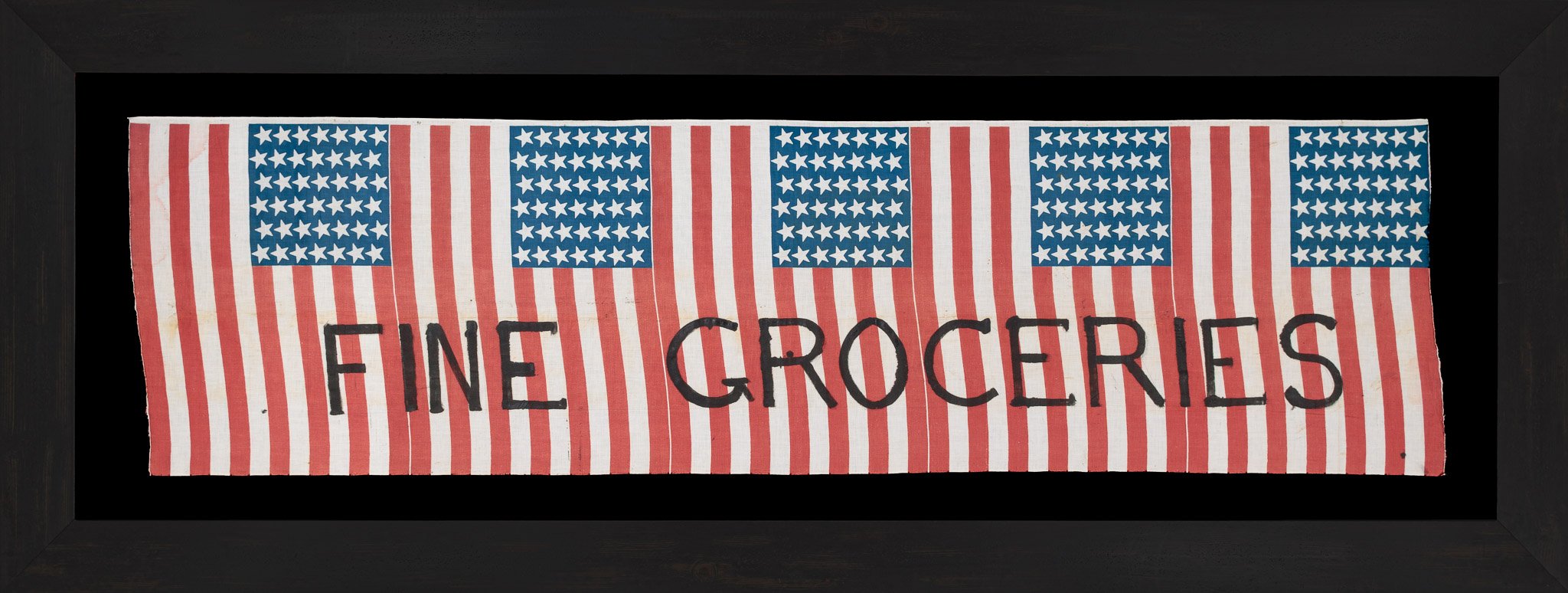
Offered is an unusual late 19th century advertising banner constructed from five connected 42-star American parade flags, printed on cotton and boldly hand-painted with the words “FINE GROCERIES.” The piece is notable on several levels: the flags themselves represent one of the more interesting unofficial star counts of the period, they remain joined in a continuous strip of five, and the group was later adapted for commercial use.
Each of the five flags contains 42 white stars on a blue canton. The stars are arranged in six vertical columns of seven, with alternating columns positioned at slightly different heights to create a subtle wave-like configuration. All of the stars are oriented with two points upward rather than the more familiar single point. There is no known significance to this orientation. During the 19th century, star arrangement and orientation were largely left to the discretion of flag makers, and the present configuration appears to have been simply a distinctive design choice.
The 42-star count corresponds to a particularly interesting moment in American expansion. North Dakota and South Dakota entered the Union on November 2nd, 1889, followed by Montana on November 8th and Washington on November 11th. Washington therefore became the 42nd state.
Flag manufacturers often responded to statehood more quickly than federal law did. Under the Flag Act of 1818, stars representing newly admitted states were formally added to the national flag on the following July 4th. In practice, commercial flag makers frequently introduced new star counts immediately after states were admitted, both to reflect the actual number of states and to keep pace with competing manufacturers.
That practice explains the appearance of the 42-star flag. Following Washington’s admission in November 1889, manufacturers began producing flags with 42 stars even though the official national flag still contained 38. Even though the 42-star count was expected to become official on July 4th, 1890, it never did.
Idaho was admitted as the 43rd state on July 3rd, 1890, just one day before the anticipated 42-star flag would have taken effect. Wyoming followed on July 10th as the 44th state. As a result, 42 stars never constituted an official United States flag count. Surviving 42-star flags therefore represent the relatively brief interval between Washington’s admission and Idaho’s entry into the Union, when manufacturers were anticipating the next official flag.
The present banner is especially interesting because the five flags were never separated. Small printed parade flags of this type were commonly manufactured in multiples on continuous lengths of cloth. Individual flags could then be cut apart for sale, distribution, or use at political rallies, patriotic celebrations, and other public events. Here, five examples remain joined together, preserving the manner in which they were originally printed rather than the individual format in which these flags are usually encountered.
The repeating design gives the banner a strong visual rhythm. Five blue cantons appear in sequence across the upper portion, while the red and white stripes continue below. The survival of this many connected examples also provides a useful illustration of how inexpensive printed parade flags were manufactured and distributed in the late 19th century.
At some point, the connected strip was repurposed as a commercial sign. Across the center, in large black letters, someone painted: FINE GROCERIES
Fine pencil guidelines remain visible around portions of the lettering, showing that the inscription was carefully laid out before the paint was applied. The irregularities in the letter forms and the surviving pencil marks make clear that the wording was applied by hand rather than mechanically printed.
The phrase itself points toward the banner’s likely use. “Fine Groceries” was a familiar period description used by grocers, general merchants, and food dealers to advertise better-quality provisions and specialty goods. Although the specific business associated with the banner is unknown, it was presumably displayed in a grocery store, market, general store, or similar commercial setting.
Its reuse in this fashion is an important part of the object’s history. Rather than being separated into individual flags, the strip was retained intact and turned into functional advertising. The existing patriotic imagery provided a highly visible background, while the painted inscription allowed the merchant to adapt an already decorative textile for practical use.
American flags and other patriotic devices were widely incorporated into commercial displays during the late 19th and early 20th centuries. Bunting, shields, eagles, and national colors appeared in shop windows, storefronts, exhibitions, and advertising displays. This banner belongs to that broader tradition while retaining a particularly direct connection to the flag trade itself.
The date at which the lettering was added cannot be established with certainty. The flags themselves were produced in connection with the 42-state period beginning in late 1889 and extending into 1890. The advertising inscription may have been applied at approximately the same time, although it is also possible that an unused strip remained in stock and was adapted somewhat later. Without documentation linking the banner to a specific business, a narrower date for its commercial use would be speculative.
Taken as a whole, the piece brings together two distinct areas of late 19th century material culture. The flags document the rapid changes in the national star count during the admission of the western states, while the painted inscription reflects the practical reuse of patriotic textiles in everyday American commerce.
The survival of five connected 42-star flags is unusual in itself. Their conversion into a hand-painted “FINE GROCERIES” banner makes the piece considerably more distinctive. It functions simultaneously as a statehood-era flag textile and as a surviving example of vernacular commercial signage, with strong relevance to collectors of American flags, advertising, store displays, and food-related material culture.
Conservation Process: The banner was hand sewn to cotton fabric, and both were hand sewn to a mounting board. To prevent the black dye in the cotton fabric from seeping into the banner, it was first washed in a standard wash and then in a dye setting wash. The banner is positioned behind Optium Museum Acrylic.
Frame: The banner is housed in a substantial flat-profile wooden frame with a distressed black finish and subtle natural undertones visible along the surface and edges. The wide, restrained molding gives the piece a strong architectural presence while remaining visually secondary to the textile.
Condition Report: The banner remains in very good overall condition, with strong red and blue coloration and the painted lettering remaining bold and legible. There is scattered light soiling, minor staining, and small marks consistent with age and use, along with slight irregularity and wear at the outer edges.
Collectability Level: The Best – Perfect for Advanced Collectors
Date of Origin: 1889-1890
Number of Stars: 42
Associated State: Washington
Price: Call 618-553-2291, or email info@bonsellamericana.com
Frame Size (H x L): 9” x 32 ½”
Textile Size (H x L): 1 ¼” x 25 ½”
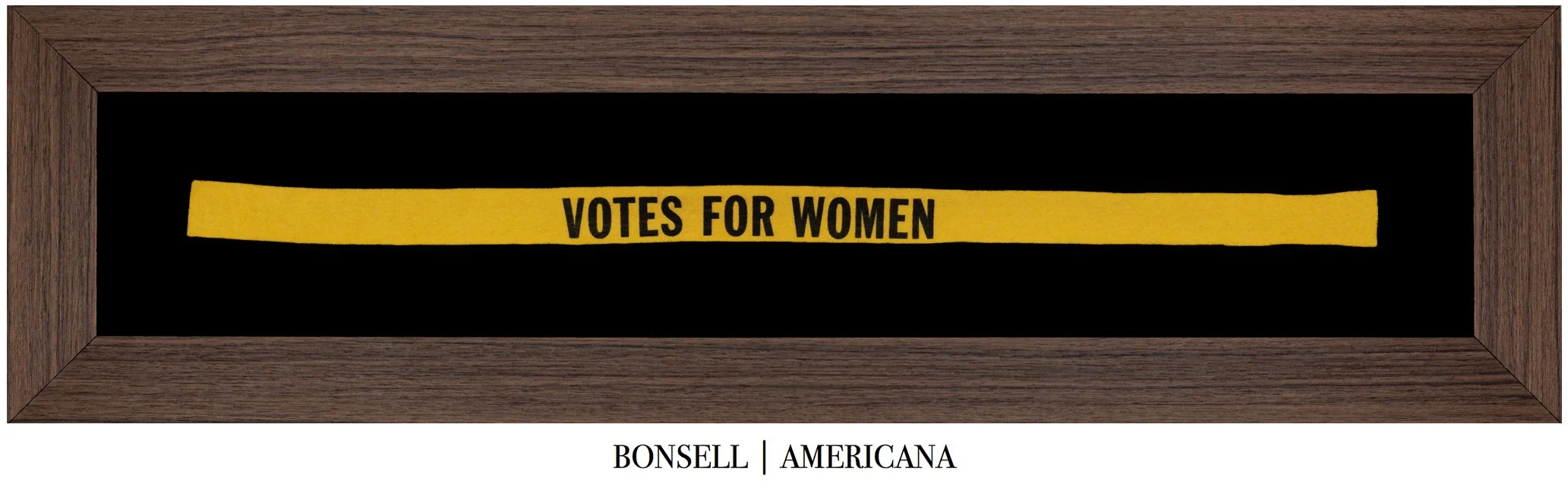
Offered is a rare “VOTES FOR WOMEN” suffrage armband, fashioned from yellow felt with bold black lettering. Bands of this form were worn around the arm and, in some instances, around a hat, providing supporters with a simple and highly visible way to identify themselves with the women’s suffrage movement. The direct slogan, strong contrast, and unmistakable yellow-and-black color scheme made pieces such as this particularly effective at rallies, conventions, parades, and other public demonstrations.
Yellow became one of the most recognizable colors associated with the American women’s suffrage movement. Its use can be traced to the campaign for suffrage in Kansas in 1867, where the sunflower—Kansas’s state flower—was adopted as a symbol by supporters. The color was later embraced by major national suffrage organizations and appeared extensively on banners, ribbons, sashes, pennants, buttons, and other campaign material. Yellow was frequently paired with black lettering, as seen here, producing a combination that was both visually striking and easily legible from a distance.
The organized American women’s rights movement is generally traced to the Seneca Falls Convention of 1848, organized principally by Elizabeth Cady Stanton and Lucretia Mott. The convention produced the Declaration of Sentiments, modeled in part on the Declaration of Independence, which outlined a broad series of grievances regarding the legal, political, educational, and economic status of women. Among its most consequential demands was the assertion that women should possess the right to vote.
Over the following decades, suffrage advocates organized conventions, petition drives, speaking tours, publications, marches, and political campaigns throughout the country. Progress initially came largely on a state-by-state basis, particularly in the West, where a number of states enfranchised women before a federal amendment was adopted. At the same time, national organizations increasingly focused their efforts on securing an amendment to the United States Constitution that would prohibit the denial of voting rights on the basis of sex.
A federal women’s suffrage amendment was first introduced in Congress in 1878. For decades it failed to receive sufficient support, despite the increasingly organized efforts of suffragists across the country. By the 1910s, however, the movement had gained substantial political momentum. Highly visible demonstrations, coordinated lobbying campaigns, and the prominent role played by women during World War I helped place suffrage at the center of national political debate.
The proposed amendment passed the House of Representatives on May 21, 1919, followed by the Senate on June 4. It was then submitted to the states for ratification. On August 18, 1920, Tennessee became the 36th state to ratify the amendment, providing the three-fourths majority then required. The 19th Amendment was formally certified on August 26, 1920, declaring:
“The right of citizens of the United States to vote shall not be denied or abridged by the United States or by any State on account of sex.”
Small wearable textiles such as this armband represent the public-facing side of the suffrage campaign. Unlike formal banners intended for organizational headquarters or large demonstrations, armbands and hatbands could be worn directly by individual supporters, effectively turning the wearer into a moving advertisement for the cause. Their relatively ephemeral nature also contributes to their scarcity today, as pieces made for active campaign use were far less likely to be preserved than medals, buttons, or printed ephemera.
With its bold “VOTES FOR WOMEN” message and classic yellow-and-black suffrage coloration, this is an excellent surviving example of the material culture produced during one of the most consequential political reform movements in American history.
Conservation Process: This armband was hand sewn to cotton fabric, and both were hand sewn to a mounting board. To prevent the black dye in the cotton fabric from seeping into the armband, it was first washed in a standard wash and then in a dye setting wash. The armband is positioned behind Optium Museum Acrylic.
Frame: The armband is presented in a flat-profile dark walnut frame with a clean, understated finish.
Condition Report: The armband remains in excellent condition, with exceptionally strong yellow coloration and crisp, bold black lettering. The felt is remarkably well preserved, showing only the slightest age-related surface variation and no significant staining, losses, or damage.
Collectability Level: The Great – Perfect for Rising Collectors
Date of Origin: 1910-1920
Frame Size (H x L): 26” x 33”
Flag Size (H x L): 17” x 24”
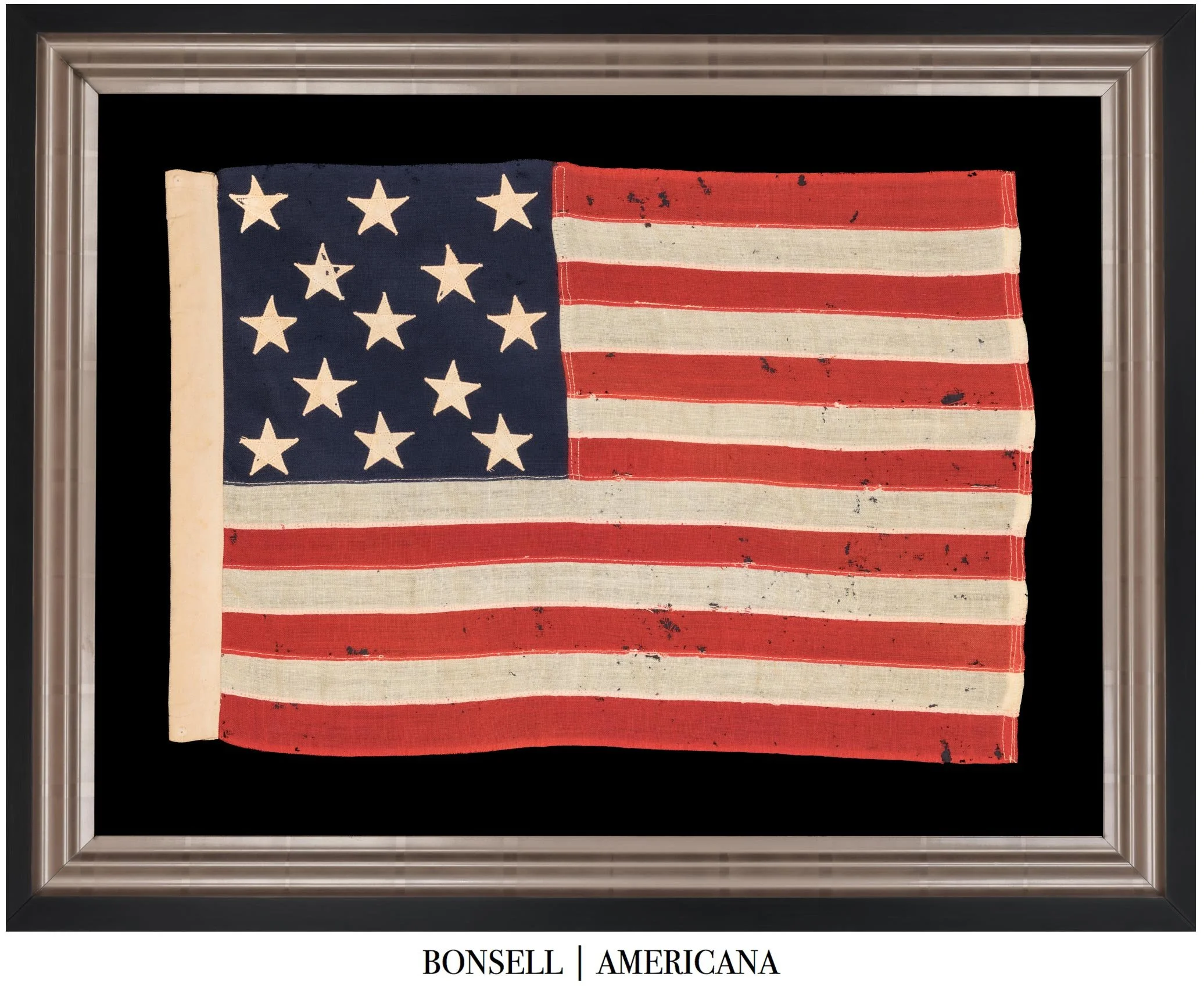
Offered is a 13-star antique American flag, featuring a 3-2-3-2-3 arrangement of stars. Constructed of wool bunting with double-appliquéd cotton stars, it is an unusually small example of a fully pieced-and-sewn commercial flag. While diminutive flags of this general period are encountered, examples of traditional sewn construction at this scale are considerably less common than their larger counterparts.
Viewed as a whole, the star configuration produces a diamond-shaped arrangement at the center, surrounded by a star at each corner of the canton. This design is commonly referred to as the Hopkinson pattern, after Francis Hopkinson, the New Jersey delegate to the Continental Congress and signer of the Declaration of Independence who is generally credited with playing the principal role in designing the first American national flag.
The Flag Resolution adopted by the Continental Congress on June 14, 1777 specified only that the new national flag contain 13 alternating red and white stripes and a union of 13 white stars on a blue field, representing “a new constellation.” Congress provided no instructions regarding the arrangement, number of points, or orientation of the stars. Consequently, a number of different 13-star configurations appeared during the nation’s earliest years, and the precise appearance of the first official American flag remains unknown.
Francis Hopkinson nevertheless has the strongest surviving documentary claim to its design. In 1780, he submitted a request for compensation for various designs he had furnished to the government, specifically including the “flag of the United States of America.” His proposed compensation famously included a “Quarter Cask of the public wine.” When that request was not honored, he later submitted a monetary claim. Congress did not dispute that Hopkinson had participated in the design work, but declined to compensate him on the basis that he was not the only individual who had been consulted. The surviving documentation has led most historians to credit Hopkinson with the design of the American flag, although no surviving drawing conclusively establishes the precise arrangement of stars that he employed.
The familiar association between Hopkinson and the 3-2-3-2-3 configuration is therefore best understood as a historical attribution rather than a certainty. The pattern appears on later representations associated with the early flag and became particularly common on 13-star flags manufactured during the late 19th and early 20th centuries. Its strong geometry and relatively large stars also made it particularly well suited to small flags such as the present example, where attempting to accommodate the full complement of stars then in the Union would have required stars of considerably smaller size.
The stripes and canton of this flag are made of wool bunting and joined by machine stitching. Its hoist is made of cotton twill, while its cotton stars are sewn to both sides of the canton, a construction method commonly referred to as double appliqué, and are secured with zig-zag stitching. The latter is particularly useful for binding the unfinished edges of appliquéd stars and became widespread among commercial flag manufacturers during the late 19th century. Henry Bowman sought patent protection for a method of flag construction employing this technique in 1889, receiving U.S. Patent No. 469,395 in February 1892. Similar construction is regularly encountered on commercially produced American flags beginning in the 1890s.
As mentioned, the present flag is noteworthy for its compact scale. Most sewn wool flags were intended to function as actual outdoor flags, where greater dimensions improved visibility. Small sewn examples required essentially the same basic manufacturing operations—piecing 13 individual stripes, constructing the canton, cutting and applying stars, and finishing the hoist—while producing an object with considerably less surface area. Their small size made them practical for boats, architectural display, ceremonial use, and other applications where a conventional large flag was unnecessary or impractical.
Although the United States had long since expanded beyond 13 states when this flag was made, the 13-star flag never disappeared from American use. Rather, 13 stars became a historical and patriotic device representing the original states and the founding generation. Such flags appeared throughout the 19th century in commemorative, military, maritime, and celebratory contexts and experienced renewed popularity during events that encouraged Americans to look back to the Revolutionary period.
This was especially true during the nation’s Centennial in 1876 and again during the decades surrounding the turn of the century, when Colonial Revival interest in the country’s founding history became widespread. Thirteen-star flags were also well suited to yachts and small boats, where reducing the number of stars allowed them to remain individually legible on comparatively small ensigns. Commercial flag makers continued to produce 13-star examples well into the 20th century for precisely these historical, decorative, and maritime purposes.
Based upon its wool-bunting construction, machine stitching, double-appliquéd cotton stars, zig-zag stitching, and overall form, we date the flag to approximately 1895-1926. The upper end of this range encompasses the Sesquicentennial of American independence in 1926, another period of intense interest in Revolutionary imagery and 13-star flags.
The combination of the classic 3-2-3-2-3 star configuration and exceptionally small 17” x 24” size makes this an especially appealing example of the commercially produced 13-star flags of the late 19th and early 20th centuries.
Conservation Process: This flag was hand sewn to silk organza, and both were hand sewn to cotton fabric. The silk organza provides a strong layer of protection and a professional appearance. The flag, the silk organza, and the cotton fabric were then hand sewn to a mounting board. To prevent the black dye in the cotton fabric from seeping into the flag, it was first washed in a standard wash and then in a dye setting wash. The flag is positioned behind Optium Museum Acrylic.
Frame: The frame features a wide black outer profile with a stepped, silver-toned inner detail, all incorporated into a single molding. The layered profile gives the frame depth and definition.
Condition Report: The flag exhibits scattered small holes, surface wear, and areas of staining and discoloration throughout, with somewhat heavier wear along portions of the stripes and fly end. There are also a couple of small pin holes in the hoist. Overall, the fabric remains intact and the colors retain good visual presence.
Collectability Level: The Great – Perfect for Rising Collectors
Date of Origin: 1895-1926
Number of Stars: 13
Associated War: Spanish-American War (1898) and World War I (1914-1918)
Associated State: Original 13 Colonies
Frame Size (H x L): 34” x 34”
Textile Size (H x L): 23” x 23”
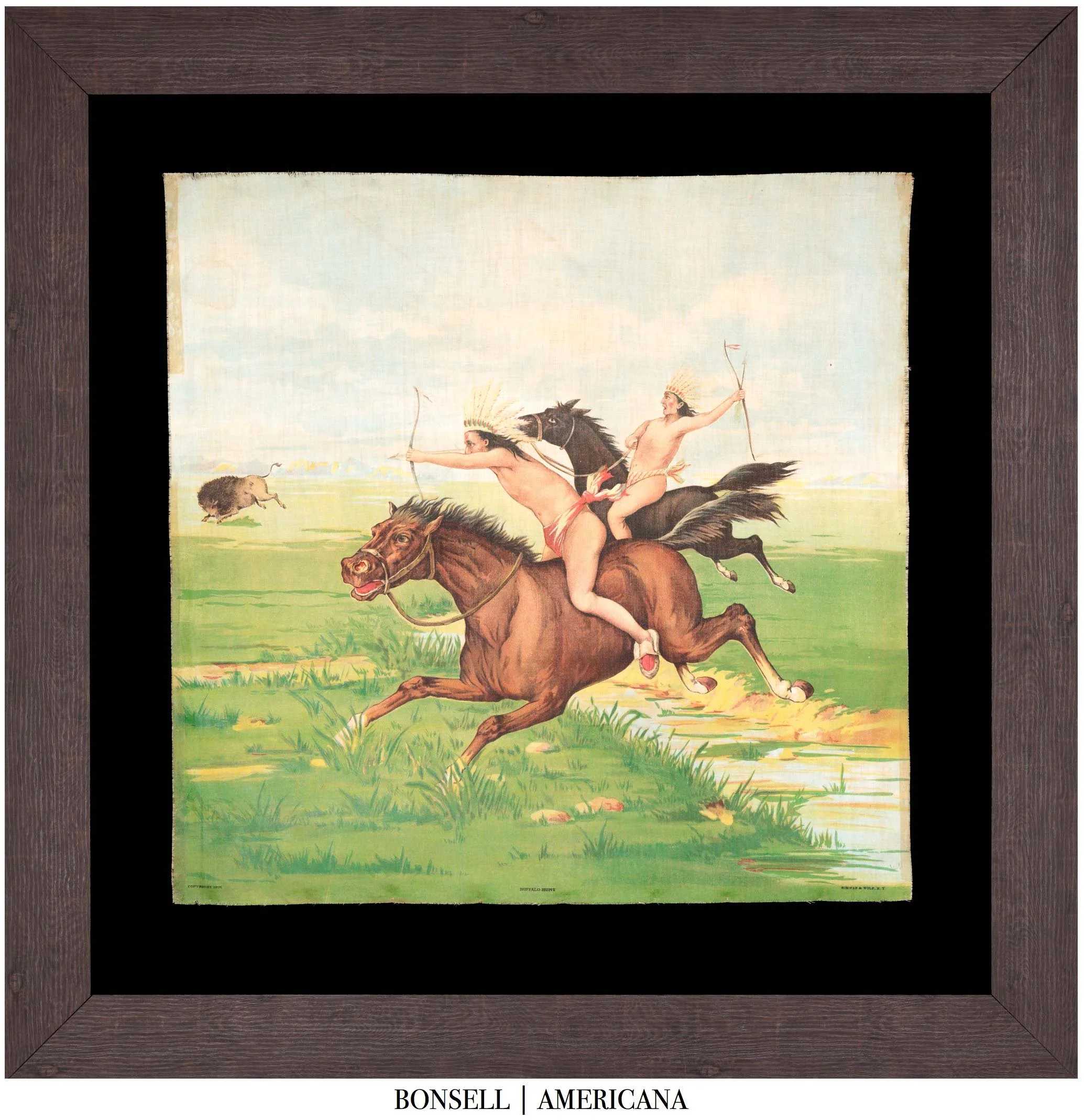
Offered is a lithographed linen textile made by Schwab & Wolf of New York in 1907. It features two Native American hunters on horseback pursuing buffalo across an open Western landscape. Printed along the lower margin is the title, “BUFFALO HUNT,” together with the manufacturer’s name and date.
The image is organized around the two horses and their riders, both shown at full gallop. The foremost hunter rides a chestnut horse and draws a bow toward a buffalo visible at the left of the composition, while a second hunter follows on a dark horse carrying a spear or lance. The prairie landscape, distant mountains, and broad sky provide a restrained backdrop for the principal action.
Schwab & Wolf was a New York firm active by at least the turn of the 20th century and involved in both conventional textile manufacturing and printed novelty goods. It operated within the city’s established textile and dry-goods trade and developed a substantial line of copyrighted pictorial designs. Surviving examples and contemporary copyright records document subjects ranging from sporting and military scenes to patriotic, Native American, and other topical imagery. This broader body of work places Buffalo Hunt within an identifiable line of commercial pictorial textiles rather than as an isolated design.
Western imagery remained highly popular with American audiences when this textile was produced. During the late 19th and early 20th centuries, paintings, illustrated publications, Wild West exhibitions, advertising, and popular entertainment helped establish a familiar visual vocabulary centered on buffalo, Native American life, cowboys, and the Western frontier. By 1907, the great buffalo herds of the 19th-century Plains had largely disappeared, and scenes such as this increasingly represented an earlier period of the American West.
Buffalo hunting had been central to the economy and material culture of numerous Plains tribes. Buffalo supplied meat as well as hides, sinew, bone, and other materials used in daily life. The widespread adoption of the horse transformed hunting practices and made the mounted buffalo hunt an important feature of life on the Plains during portions of the 18th and 19th centuries. The Schwab & Wolf image draws upon this history, although its composition is best understood as a commercial interpretation intended for an early 20th-century audience rather than as an ethnographic depiction.
The lithographic process allowed Schwab & Wolf to reproduce detailed, multicolored imagery directly on fabric, giving these textiles much of the visual character of contemporary chromolithographic prints while retaining the texture and flexibility of linen. Other surviving examples demonstrate that the firm applied the same approach to a wide range of subjects, including Western, patriotic, military, and sporting themes.
Dating precisely to 1907, Buffalo Hunt is an unusual surviving example of Schwab & Wolf’s pictorial textile production and of the continuing popularity of Western subject matter in American decorative arts during the opening decade of the 20th century. Its documented maker, date, and subject provide a particularly strong context for understanding this specialized category of American printed textile.
Conservation Process: This textile was hand sewn to cotton fabric, and both were hand sewn to a mounting board. To prevent the black dye in the cotton fabric from seeping into the textile, it was first washed in a standard wash and then in a dye setting wash. The textile is positioned behind Optium Museum Acrylic.
Frame: The textile is housed in a modern, wide, dark-stained wood frame with a simple profile and visible grain, giving it a restrained, period-appropriate appearance.
Condition Report: The textile is in good overall condition, with strong color and a largely intact printed surface. There is minor toning and scattered discoloration, most noticeable in the lighter areas of the sky and along the edges, together with light fraying at the perimeter and a few small areas of wear.
Collectability Level: The Great – Perfect for Rising Collectors
Date of Origin: 1907
Frame Size (H x L): 29” x 38.75”
Flag Size (H x L): 16” x 22.5”
Offered is a 38-star antique American parade flag, printed on cotton and bearing the patriotic overprint CENTENNIAL | 1876. Made during the nation’s centennial year, the flag combines two important events of 1876: the celebration of the 100th anniversary of American independence and the admission of Colorado as the 38th state.
The centennial prompted an extraordinary display of patriotic material culture throughout the United States. Cities and towns hosted parades, ceremonies, exhibitions, and public gatherings, while homes, businesses, and civic buildings were decorated with flags and other red, white, and blue textiles. At the center of these celebrations was the Centennial International Exhibition in Philadelphia, held from May through November 1876 and recognized as the first official world’s fair in the United States. The exposition attracted millions of visitors and provided a national stage for American industry, technology, art, and culture.
This particular pattern appears to have a strong association with Philadelphia and the Centennial Exhibition. Surviving examples are scarce, with approximately twenty presently known in collections and the marketplace, and examples have frequently surfaced in Philadelphia and the surrounding region. More compellingly, a documented example bears the period inscription “Philadelphia, Sept 1876, G.N.M.”, providing direct evidence that flags of this pattern were present in the city during the exposition.
The canton contains 38 stars arranged in six vertical columns. The first and last columns contain seven stars each, while the four interior columns contain six. Their orientation alternates in an unusual fashion: the stars in the first, third, fourth, and sixth columns point downward, while those in the second and fifth columns point upward. The resulting arrangement is distinctive and readily identifiable among surviving Centennial-era parade flags.
Of particular interest, the blue used for the canton closely corresponds to that of the CENTENNIAL | 1876 inscription. This suggests that the inscription was incorporated into the original printing process rather than applied as a later secondary overprint. Many 19th-century parade flags were produced as standard patriotic flags and subsequently customized with campaign slogans, commercial advertising, commemorative text, or organizational information, often in black or another contrasting ink. Here, the coordinated printing strongly indicates that the flag was conceived specifically as a Centennial commemorative textile.
The flag was also printed in what collectors commonly describe as a reverse-mount orientation, with the canton positioned at upper right when the flag is viewed as shown. Although modern display convention calls for the canton to appear at upper left when a flag is presented horizontally, 19th-century manufacturers were considerably less standardized in this respect. Reverse-oriented parade flags are encountered with some regularity among early printed examples and reflect the broad variety of formats produced for decorative and commemorative use.
An example of this same flag is documented as item 437 in Threads of History: Americana Recorded on Cloth, 1775 to the Present, by Herbert Ridgeway Collins, then curator of political history at the Smithsonian Institution. The landmark reference illustrates more than 1,500 examples of American political and patriotic textiles, many drawn from the collection of Boleslaw and Marie-Louise Mastai. Another example appears in J. Richard Pierce’s The Stars and Stripes: Fabric of the American Spirit. The Pierce example carries the aforementioned inscription “Philadelphia, Sept 1876, G.N.M.”, providing important period documentation for the pattern and supporting its association with Philadelphia’s Centennial celebrations.
The presence of 38 stars is especially appropriate to the year. Colorado was admitted to the Union on August 1, 1876, earning its enduring nickname, the “Centennial State.” Under federal convention, the additional star formally became part of the national flag on July 4, 1877. Consequently, the official American flag throughout the Centennial Exhibition still contained 37 stars. Flag makers, however, routinely anticipated the admission of new states, and 38-star flags were produced and displayed well before their official date. Alongside 13-star flags recalling the original colonies, 38-star examples became particularly fitting symbols of the Centennial year: one looking back to the nation’s founding and the other acknowledging its newest state.
The 38-star flag remained the official national flag from July 4, 1877 until July 3, 1890. It served during the administrations of Rutherford B. Hayes, James A. Garfield, Chester A. Arthur, Grover Cleveland, and Benjamin Harrison. On July 4, 1890, it was succeeded by the 43-star flag following the admission of North Dakota, South Dakota, Montana, Washington, and Idaho.
This example is notable for its CENTENNIAL | 1876 inscription, unusual star arrangement, and documented connection to other known examples associated with Philadelphia. These features place it among a small group of identifiable parade flags produced in direct response to the nation’s 1876 centennial celebrations.
Conservation Process: This flag was hand sewn to cotton fabric, and both were hand sewn to a mounting board. To prevent the black dye in the cotton fabric from seeping into the flag, it was first washed in a standard wash and then in a dye setting wash. The flag is positioned behind Optium Museum Acrylic.
Frame: The flag is housed in a substantial circa-1830s figured birch frame, with pronounced flaming grain and a warm period finish. The frame incorporates a narrow ripple-molded outer edge and a modern inner gilt fillet, creating a restrained but elegant presentation. It retains an exceptional degree of original character and surface.
Condition Report: Overall good condition for its age, with moderate fading to the red stripes, scattered staining and light soiling, and minor areas of discoloration throughout. There is some fraying and small losses along the edges, including a more noticeable loss at the upper-left corner, along with minor wear near the fly end. The blue canton and CENTENNIAL | 1876 overprint remain strong and clearly legible.
Collectability Level: The Best – Perfect for Advanced Collectors
Date of Origin: 1876
Number of Stars: 38
Associated War: The Indian Wars (1860-1890)
Associated State: Colorado

Frame Size (H x L): 24” x 47”
Pennant Size (H x L): 13” x 36”
Offered is an antique pennant with a “JOHN DEERE ‘34” overprint. It is made of felt and has a green field. The lettering and hoist stripe are white. It was made to promote the release of the John Deere Model A tractor. It is the first such pennant that we have encountered.
The John Deere Model A tractor, produced between 1934 and 1952, represents a significant chapter in the history of American agriculture. It was during this period that the United States was in the throes of the Great Depression and then transitioned to a war economy during World War II. In this context, the Model A emerged not just as a tool for the farm but as a symbol of resilience and innovation.
The story of the Model A began when John Deere recognized the need for a more versatile and robust tractor than what they had previously offered. The company's prior model, the "D," had been on the market since 1923. While it had its merits, there was a need for a machine that could cater to a broader range of tasks. With that vision, the development of the Model A commenced.
In 1934, John Deere did not hold a singular, major publicity event specifically for the Model A tractor as we might envision a product launch today. However, John Deere made considerable efforts to market and publicize its new tractor to the farming community. Dealerships showcased the new models, and they were featured in farming magazines and other advertisements of the time. They were also showcased at fairs, farm shows, and other similar events.
The Model A was equipped with a 2-cylinder engine. Its design was both practical and innovative. Unlike many of its contemporaries, the Model A's engine started on gasoline and then, once warmed up, could switch to run on cheaper kerosene. This dual-fuel system was a cost-saving feature that made it particularly attractive to farmers during those economically challenging times.
Several features distinguished the Model A from other tractors of the era. Its engine was not only powerful but also boasted a design that allowed it to operate efficiently at lower RPMs. The tractor also had an adjustable wheel tread and a wide front end, making it adaptable to different crop rows—a crucial feature for diverse agricultural tasks. Another key feature was the presence of an easy-to-use hand clutch. This clutch made it possible for the operator to control the tractor's speed without stopping, thus ensuring smooth operation.
But the Model A wasn't just about new features; it also reflected John Deere's commitment to durability. Its construction was robust, with high-quality materials ensuring that the tractor could withstand the rigorous demands of daily farm use. This commitment to quality made the Model A a favorite among farmers and ensured that many units remained operational for decades.
Over its production run, the Model A underwent several modifications to further improve its efficiency and adapt to the evolving needs of American farmers. By the time production ceased in 1952, it had firmly established itself as one of the most iconic tractors in John Deere's lineup. Numerous units are still operable today, a testament to the Model A's enduring design and reliability.
The John Deere Model A tractor is not just a piece of machinery but a part of American agricultural history. It symbolizes a period of challenge and change, reflecting both the economic hardships and the technological progress of its time. Through its innovative design, adaptability, and durable construction, the Model A proved to be a tool of progress for farmers across the nation.
Conservation Process: The pennant was hand sewn to cotton fabric, and both were hand sewn to a mounting board. To prevent the black dye in the cotton fabric from seeping into the pennant, it was first washed in a standard wash and then in a dye setting wash. The pennant is positioned behind Optium Museum Acrylic.
Frame: This offering is in our X-Large Distressed Black and Silver Frame.
Condition Report: There are two pinholes in the hoist strip, likely the result of the pennant being attached to a staff. There is some fading and staining. There are some losses to the felt, but they have been masked with green fabric. Overall, the pennant is age appropriate and attractive.
Collectability Level: The Great – Perfect for Rising Collectors
Date of Origin: 1934
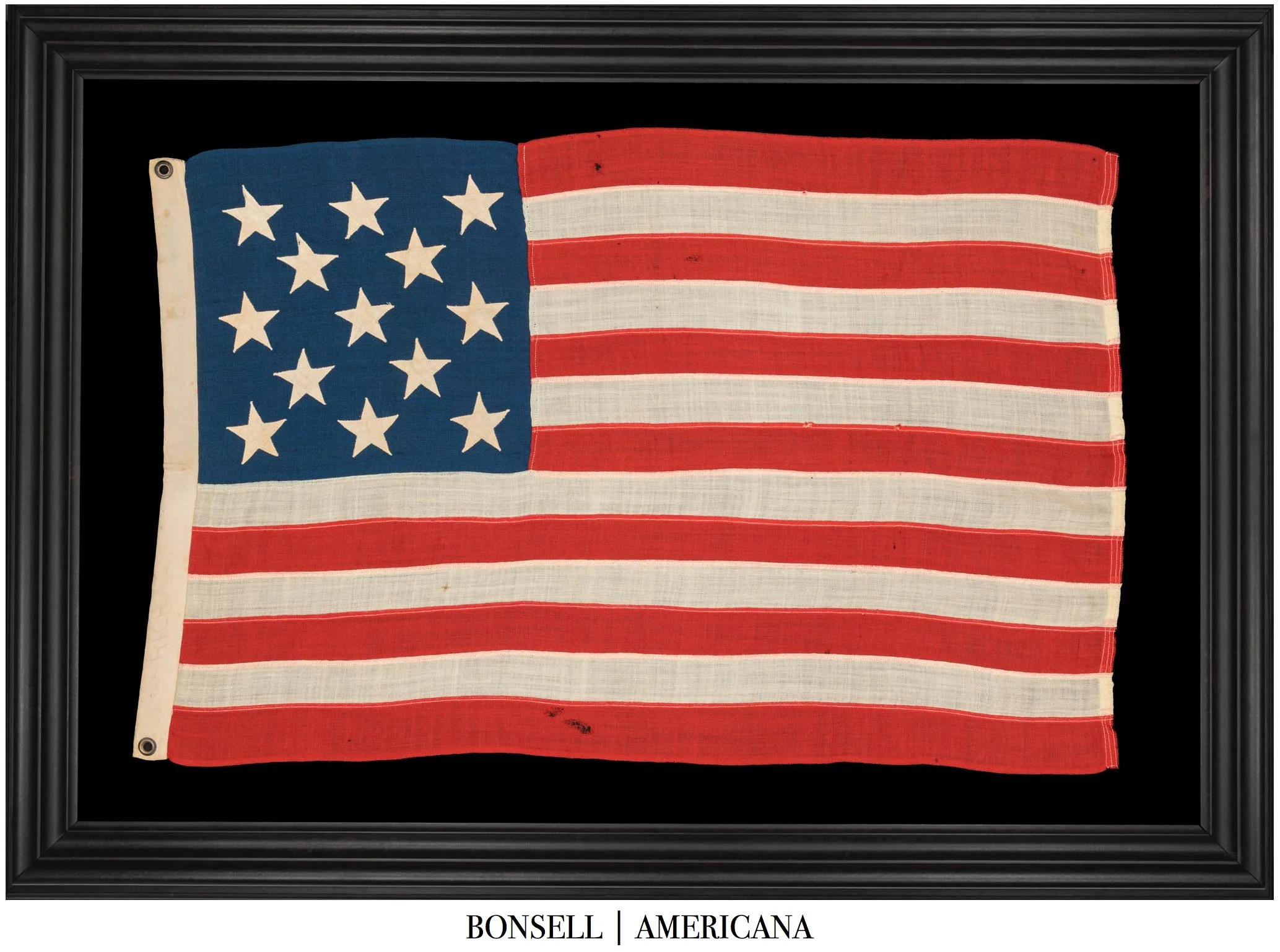
Frame Size (H x L): 33” x 46”
Flag Size (H x L): 23” x 36”
Offered is a 13-star antique American flag in the 3-2-3-2-3 configuration, constructed of wool bunting with double-appliquéd cotton stars and dating to approximately 1895–1926.
The star arrangement consists of three stars in the first row, two in the second, three in the third, two in the fourth, and three in the fifth. Visually, this produces a diamond-shaped core framed by four corner stars. The configuration is commonly associated with Francis Hopkinson and is often referred to as the “Hopkinson pattern.” While no surviving example can be definitively linked to the first national flag, many historians attribute the original design of the American flag to Hopkinson, a member of the Continental Congress and a signer of the Declaration of Independence.
Hopkinson submitted a formal petition to the Continental Congress requesting compensation for having furnished the design of “the flag of the United States of America.” He initially asked to be paid with a quarter cask of public wine and later requested monetary compensation. Although Congress acknowledged his role, payment was refused on the grounds that others had been consulted in the process. Regardless of the outcome, his documented claim provides firmer historical footing than the later Betsy Ross narrative, which emerged decades after the Revolution and lacks contemporary documentation.
The 13-star count represents the original thirteen colonies and was formally adopted on June 14, 1777, when Congress resolved:
“Resolved, that the flag of the United States be made of thirteen stripes, alternate red and white, that the union be thirteen stars, white on a blue field, representing a new constellation.”
From 1777 until May 1, 1795, the 13-star flag served as the official national flag of the United States. With the admission of Vermont and Kentucky, the star count increased to 15. After that date, however, the 13-star flag did not disappear. Instead, it evolved into a powerful and enduring symbol of the nation’s founding.
By the early nineteenth century, the 13-star count had come to represent the Revolutionary generation and the origins of American independence. Such flags were displayed during the return tour of General Lafayette in 1824–1825, when public ceremonies across the country emphasized continuity with the founding era. They appeared again during periods of heightened nationalism, including the Mexican War (1846–1848) and especially during the Civil War (1861–1865), when affirmations of unity and constitutional permanence carried particular resonance.
The Centennial International Exhibition of 1876 in Philadelphia further strengthened the association between the 13-star flag and Revolutionary commemoration. The centennial year prompted renewed interest in early American imagery, and 13-star flags were produced in meaningful numbers for decorative and ceremonial use. This revival of Revolutionary symbolism extended into the late nineteenth and early twentieth centuries, particularly in connection with patriotic anniversaries, veterans’ organizations, civic observances, and the approach to the 150th anniversary of American independence in 1926.
The present example belongs to that late nineteenth- to early twentieth-century revival period. Its construction characteristics are consistent with commercial flag production between approximately 1895 and 1926. The canton and stripes are made of wool bunting, the preferred material for outdoor flags due to its durability and ability to shed wind. The lengths of bunting are machine-stitched together, reflecting industrial manufacturing methods rather than hand-sewn construction.
The stars are fashioned of cotton and are double-appliquéd—applied to both sides of the canton so that the flag presents correctly from either orientation. They are secured with a zig-zag machine stitch, a method patented in 1892 and widely adopted thereafter. This stitching technique provides a reliable chronological indicator and places the flag securely in the post-1892 period.
The hoist is made of cotton twill and fitted with rolled-rim brass grommets. The grommets exhibit the warm golden tone and mellow oxidation typical of aged brass rather than plated steel. Brass was commonly used in quality commercial flag production during this period due to its resistance to corrosion, particularly for outdoor and maritime use. The rolled-rim style seen here is consistent with late nineteenth- and early twentieth-century manufacture and supports the circa 1895–1926 dating.
This example also exhibits somewhat squarer proportions than what later became standard. The proportions of the United States flag were not formally regulated until the 1912 executive order issued under President William Howard Taft, which specified the arrangement and relative dimensions of the stars and stripes for official government use. Prior to that standardization, flag makers exercised broad discretion in overall proportions, canton dimensions, and star spacing. As a result, pre-1912 flags frequently display meaningful variation in aspect ratio. The squarer presentation seen here reflects that earlier flexibility and is entirely consistent with a circa 1895–1926 date range.
The 3-2-3-2-3 configuration remained popular well into the twentieth century because it offers both visual balance and strong geometric clarity. The central diamond anchors the design, while the four corner stars stabilize the canton composition. Among the various 13-star arrangements employed during the revival period—including wreath patterns, medallions, staggered rows, and circular configurations—the 3-2-3-2-3 pattern maintained a particularly direct association with early national imagery.
Importantly, 13-star flags produced during this era were not intended to reflect the contemporary number of states in the Union. Rather, they functioned symbolically. They invoked the founding generation and the nation’s original compact, serving as emblems of continuity rather than literal enumerations of statehood. They were frequently displayed at civic buildings, maritime installations, patriotic celebrations, and commemorative events where reference to Revolutionary heritage was deliberate and understood.
Within that historical and manufacturing context, this flag represents a well-constructed commercial example from the height of the early American revival movement. Its materials, stitching techniques, hardware, and proportions align with established production practices of the late nineteenth and early twentieth centuries. It stands as a deliberate and historically grounded evocation of the nation’s beginnings, executed with the industrial craftsmanship characteristic of its era.
Conservation Process: This flag was hand sewn to silk organza, and both were hand sewn to cotton fabric. The silk organza provides a strong layer of protection and a professional appearance. The flag, the silk organza, and the cotton fabric were then hand sewn to a mounting board. To prevent the black dye in the cotton fabric from seeping into the flag, it was first washed in a standard wash and then in a dye setting wash. The flag is positioned behind Optium Museum Acrylic.
Frame: The frame is a deep-profile moulding with a simple, classical profile, finished in a dark cocoa-brown tone. Its broad face provides visual support without ornament, allowing the flag to remain the primary focus. The subdued finish is well suited to the display of nineteenth-century textiles.
Condition Report: The flag remains in very good overall condition, with strong, saturated color and only minor age-related toning and scattered soiling. There are a few small areas of staining and discoloration, primarily within the white stripes and red field, along with light wear at the edges and hoist. The fabric is otherwise notably intact, with no significant losses or major tears visible.
Collectability Level: The Great – Perfect for Rising Collectors
Date of Origin: 1895-1926
Number of Stars: 13
Associated War: Spanish-American War (1898) and World War I (1914-1918)
Associated State: Original 13 Colonies
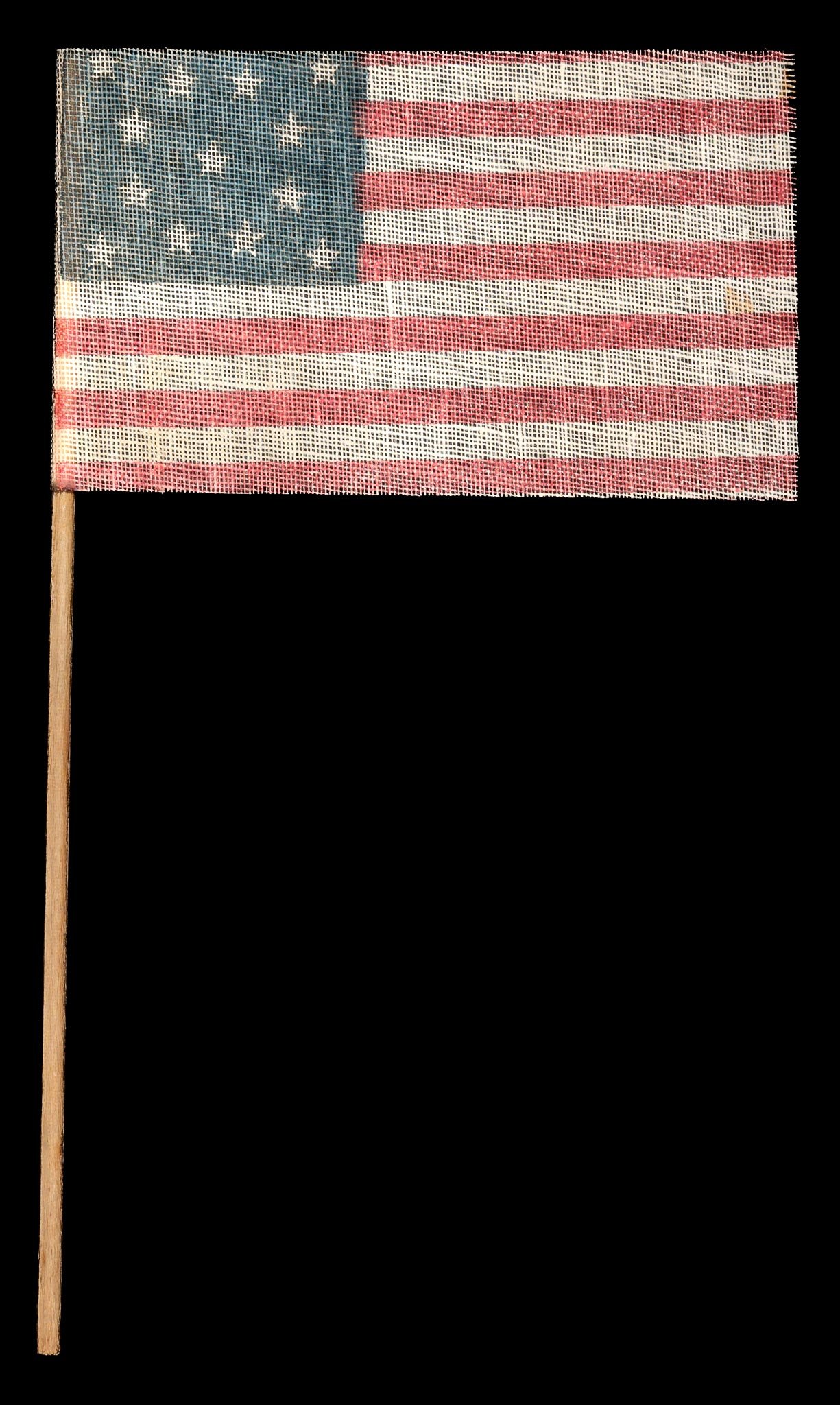
Frame Size (H x L): 13.5” x 10.5”
Flag Size (H x L): 2.5” x 4 and Affixed to a 7” Staff
Offered is a 13-star American parade flag, made for the patriotic celebrations surrounding the United States Centennial of 1876. Printed on plain weave cotton and mounted to its original wooden staff, the flag is characteristic of the small hand-waving flags carried in parades, political gatherings, public ceremonies, and other patriotic events during the latter nineteenth century.
The Centennial represented an extraordinary moment in American history. Just eleven years after the conclusion of the Civil War, the nation celebrated the 100th anniversary of the Declaration of Independence amid an enormous revival of patriotic imagery. Cities and towns throughout the country organized parades, speeches, military demonstrations, fireworks, and public gatherings, while homes, businesses, and civic buildings were decorated extensively in red, white, and blue. American flags—particularly small parade flags such as this example—were among the most visible symbols of the celebration.
The centerpiece of the Centennial year was the Centennial International Exhibition in Philadelphia, the first official world's fair held in the United States. Open from May through November 1876, the exhibition attracted nearly ten million visitors and showcased American industry, technology, art, agriculture, and manufacturing to an international audience. Among its celebrated attractions were the enormous Corliss steam engine that powered much of Machinery Hall and Alexander Graham Bell's recently developed telephone, which was famously demonstrated before exhibition judges.
Although the official flag of the United States during most of the Centennial year contained 37 stars, flag makers were rarely constrained by official star counts. Colorado was admitted to the Union on August 1, 1876, becoming the 38th state and earning its enduring nickname, the “Centennial State.” Anticipating Colorado's admission, manufacturers produced large numbers of 38-star flags before that count formally became official on July 4, 1877.
Alongside the 37- and 38-star flags, however, 13-star flags enjoyed renewed popularity during the Centennial because of their direct association with the nation's founding. Rather than representing the contemporary number of states, the 13 stars recalled the 13 original colonies and the American Revolution. For a country celebrating its first hundred years, the symbolism was especially appropriate, and manufacturers produced 13-star flags in numerous arrangements and sizes for Centennial displays and festivities.
The origins of the 13-star American flag extend to June 14, 1777, when the Continental Congress adopted the first national flag resolution:
“Resolved, That the flag of the thirteen United States be thirteen stripes, alternate red and white; that the union be thirteen stars, white in a blue field, representing a new constellation.”
The precise arrangement of those 13 stars was not specified, resulting in an extraordinary variety of patterns during the early national period. Thirteen remained the official number of stars until Vermont and Kentucky entered the Union and the 15-star flag was adopted in 1795.
Importantly, the 13-star configuration did not disappear as additional states joined the nation. It continued to be employed for practical, naval, commemorative, and patriotic purposes throughout the nineteenth century. Its visual connection to the Revolution made it especially attractive whenever Americans sought to evoke the country's founding generation. Thirteen-star flags consequently appeared during periods of heightened patriotism, including the Mexican War, the Civil War, and celebrations honoring Revolutionary War history.
The return of the Marquis de Lafayette to the United States in 1824 provides an early example of this revival of Revolutionary symbolism. Lafayette, the celebrated French officer who had fought alongside the Americans during the Revolution, was welcomed during an extensive national tour with elaborate parades, banquets, speeches, and public ceremonies. Similar appeals to the imagery of the founding era became increasingly common as the nineteenth century progressed.
That tradition reached its greatest expression with the Centennial in 1876. Few flags could have conveyed the meaning of the occasion more directly than a flag bearing 13 stars: a visual reference to the original states displayed exactly one hundred years after American independence.
Small parade flags from the Centennial period are particularly evocative artifacts because they were intended to be held and waved rather than simply displayed from buildings. Their modest scale, lightweight construction, and wooden staffs allowed thousands of participants and spectators to carry the national colors personally through the parades and celebrations that defined America's 100th anniversary.
This example survives as a wonderful artifact of that period—a miniature American flag whose 13 stars deliberately look backward to the nation's founding while celebrating its first century.
Conservation Process: This flag was hand sewn to cotton fabric, and both were hand sewn to a mounting board. To prevent the black dye in the cotton fabric from seeping into the flag, it was first washed in a standard wash and then in a dye setting wash. The flag is positioned behind Optium Museum Acrylic.
Frame: The flag is presented in an antique marquetry frame with richly figured wood veneers arranged in geometric bands. The layered construction, warm patina, and dark inner molding provide an especially handsome period presentation for the flag.
Condition Report: The flag is in very good condition for its age, retaining strong red and blue coloration with attractive overall fading and toning. There is minor fraying and thread loss along the outer edges, along with scattered small stains and areas of discoloration consistent with age and use.
Collectability Level: The Good – Perfect for Beginning Collectors and Gifts
Date of Origin: 1876
Number of Stars: 13
Associated War: The Indian Wars (1860-1890)
Associated State: Original 13 Colonies
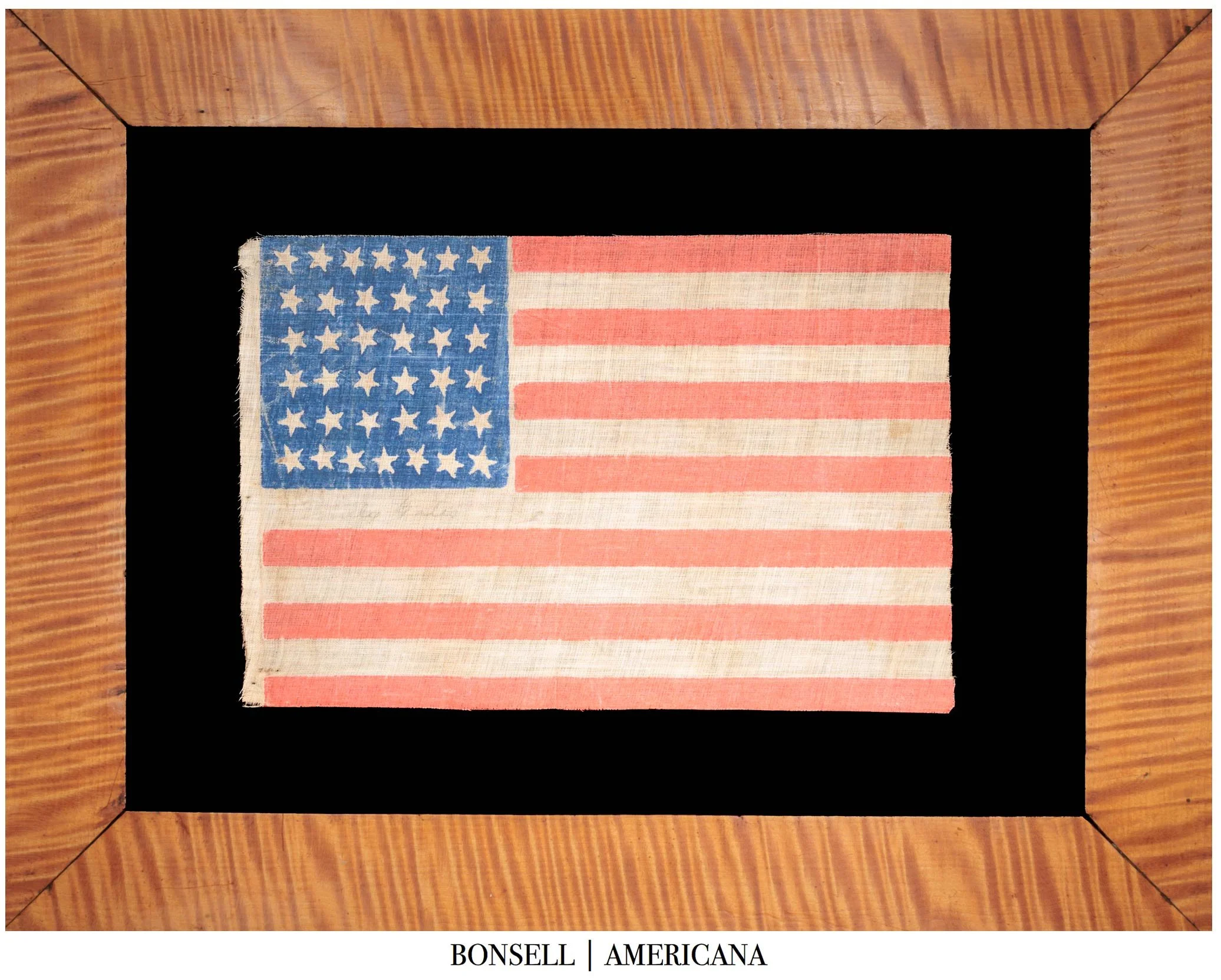
Frame Size (H x L): 13” x 17”
Flag Size (H x L): 6.75” x 10”
Offered is a 38-star American parade flag, printed on glazed cotton and dating to the period following Colorado’s admission to the Union. The canton displays a 7-6-6-6-6-7 star configuration, with the stars arranged in generally linear rows and oriented in slightly varying directions. The stripes retain a warm orange-red tone, contrasting with the blue canton and giving the flag the characteristic appearance of a 19th-century printed parade flag.
Of particular interest is a period pencil inscription that appears to read “Emily Gates,” written in cursive. Personal inscriptions are occasionally encountered on 19th-century flags and can take the form of names, dates, locations, messages, or other notations. Small parade flags were commonly carried at political rallies, civic parades, veterans’ gatherings, holiday celebrations, and similar events, and inscriptions sometimes served simply to identify the owner.
While the identity of Emily Gates has not been established, the inscription provides evidence of individual ownership or use. This is a meaningful distinction, as the majority of surviving parade flags remain anonymous. The inscription therefore adds a personal element to an otherwise commercially produced patriotic textile.
The 38 stars represent Colorado’s admission to the Union on August 1st, 1876. Colorado became the 38th state just 28 days after the nation’s centennial and consequently became known as the “Centennial State.” The 38-star flag officially became the national standard on July 4th, 1877, in accordance with the established practice of adding new stars on the Independence Day following a state’s admission.
The 38-star flag remained official until July 3rd, 1890. Its period of use coincided with significant national growth, including continued western expansion, railroad development, industrialization, and the post-Reconstruction period. Because Colorado entered the Union during the Centennial year, 38-star flags are also closely associated with the broad wave of patriotic material produced during and immediately after the celebrations of 1876.
The timing of Colorado statehood is important when considering surviving 38-star flags. Flag makers were already producing large quantities of patriotic textiles for the Centennial, and some manufacturers incorporated 38 stars in anticipation of Colorado’s admission or immediately afterward. Other examples were produced throughout the official 1877–1890 period. As a result, the star count can appear on flags made both for Centennial-related use and for later patriotic events.
This example is printed on glazed cotton, a material commonly used for parade flags during the period. Unlike large sewn flags intended for sustained outdoor use, printed parade flags were inexpensive, portable, and suitable for distribution in quantity. They were used at political events, military reunions, civic ceremonies, and public celebrations. Their relatively lightweight construction also meant that many were discarded or damaged, contributing to the scarcity of well-preserved examples today.
The printed surface exhibits the irregularities associated with period production, including slight variation in color saturation and star orientation. The red stripes have mellowed toward a warm orange-red, while the blue canton remains clearly defined. These characteristics are consistent with the pigments, printing methods, and materials used in late-19th-century parade flags.
The combination of a desirable 38-star count, glazed-cotton construction, attractive period coloration, and the handwritten “Emily Gates” inscription makes this a particularly strong example of a late-19th-century American parade flag. The inscription is especially noteworthy, providing a direct indication of personal ownership or use and adding a level of historical context not present on most comparable examples.
Conservation Process: This flag was hand sewn to cotton fabric, and both were hand sewn to a mounting board. To prevent the black dye in the cotton fabric from seeping into the flag, it was first washed in a standard wash and then in a dye setting wash. The flag is positioned behind Optium Museum Acrylic.
Frame: The flag is in an attractive tiger maple frame. Tiger maple frames are cherished for their striking, wavy grain patterns that shimmer with a unique iridescence, reminiscent of a tiger's coat.
Condition Report: The flag is in very good overall condition for its age, with strong, legible colors and no significant losses. There is minor fraying along the perimeter, particularly at the hoist, along with scattered light soiling, staining, and areas of wear consistent with age and use.
Collectability Level: The Great – Perfect for Rising Collectors
Date of Origin: 1876-1890
Number of Stars: 38
Associated War: The Indian Wars (1860-1890)
Associated State: Colorado
Price: Call 618-553-2291, or email info@bonsellamericana.com
Frame Size (H x L): 30.5” x 19”
Pennant Size (H x L): 17” x 8.25” with 4.75” ties
Offered is a rare political campaign pennant produced for Ohio's landmark 1915 statewide prohibition referendum, boldly printed "MAKE OHIO DRY 1915" in white lettering against an orange wool felt field. The pennant is of classic early twentieth-century construction, with a tapered felt body, stitched blue felt binding across the hoist, and matching blue felt ties designed for attachment to clothing, a vehicle, or display at rallies and public gatherings. Intended as a highly visible campaign accessory, it represents one of the more recognizable surviving slogans associated with Ohio's statewide prohibition movement.
The pennant survives with two original identifying labels, an unusual and important feature that documents both the organization responsible for the campaign and the Columbus firm that produced or supplied the piece. Sewn beneath the blue felt binding on the front is a printed label reading:
State Central Committee
County Dry Federations
701 Wyandotte Bldg.
Columbus, O.
Rather than identifying a commercial maker, this label attributes the pennant to the statewide committee representing Ohio's network of County Dry Federations. Contemporary records confirm that county dry federations operated throughout Ohio during this period, bringing together churches, temperance organizations, civic leaders, and local supporters in a coordinated effort to secure statewide prohibition. While the Ohio Anti-Saloon League remained the movement's best-known organization, period publications demonstrate that the statewide campaign functioned as a broad coalition of cooperating groups rather than a single organization acting alone. The committee headquartered in Columbus coordinated these county organizations during the statewide referendum campaign of 1915.
The Columbus address itself is noteworthy. The committee occupied offices in the Wyandotte Building, one of the city's most prominent commercial office buildings. Completed in 1898 and designed by Daniel Burnham & Company, the steel-frame structure was Columbus's first skyscraper and remained among the city's premier business addresses during the early twentieth century. Housing the campaign headquarters in the Wyandotte Building reflects the organized, professional character of the prohibition movement, which by 1915 had developed an extensive statewide administrative structure capable of coordinating thousands of local volunteers and supporters.
Equally important is the original label retained on the reverse, identifying:
Shipley & Company
Advertising Specialists
Columbus, Ohio
Contemporary Columbus city directories and period advertising establish Shipley & Company as one of the city's leading advertising specialty firms. The company supplied a remarkably broad range of custom promotional merchandise, including banners, badges, calendars, celluloid novelties, leather goods, metal souvenirs, and other advertising specialties produced for businesses, civic organizations, and political campaigns. Their own advertising promoted custom souvenirs among their principal offerings, making the firm a logical supplier for campaign material such as this pennant. The presence of both original labels provides an uncommon level of documentation, identifying not only the organization responsible for distributing the pennant but also the Columbus advertising firm that produced or supplied it.
The campaign represented by this pennant sought to unite a diverse cross-section of Ohio society. Contemporary publications identify ministers, businessmen, educators, farmers, labor representatives, members of the Woman's Christian Temperance Union, and other civic leaders among those directing the statewide effort. One such figure was Worthington Kautzman of Columbus, a prominent businessman and former Adjutant General of Ohio, whose name appears in contemporary campaign literature associated with the movement. Rather than functioning as a narrow political organization, the campaign emphasized cooperation among the various "dry" organizations operating throughout the state, a theme repeatedly stressed in contemporary publications.
The significance of this pennant extends beyond the unsuccessful referendum of 1915. Although Ohio voters rejected the proposed constitutional amendment that November, the campaign itself did not end. Instead, the statewide organization remained intact, retaining the familiar "Make Ohio Dry" slogan and continuing under campaign manager James A. White. Publications issued by the Ohio Dry Federation in 1917 demonstrate the direct continuation of the movement, describing the cooperation between county chairmen, the Ohio Dry Federation, and the Ohio Anti-Saloon League as they prepared a renewed statewide campaign. That effort proved successful. In November 1918, Ohio voters approved statewide prohibition legislation, making Ohio a dry state months before national prohibition took effect. The following January, Ohio became one of the states to ratify the Eighteenth Amendment to the United States Constitution, helping secure the national prohibition of intoxicating liquor, which went into effect on January 17, 1920.
As a result, this pennant represents more than a souvenir of a single political campaign. It is an artifact from the opening phase of the movement that ultimately transformed Ohio law and contributed directly to one of the most significant constitutional changes in American history. Political textiles documenting statewide reform campaigns are encountered far less frequently than those associated with presidential elections, and examples retaining original organizational and maker's labels are rarer still. Combining bold graphic appeal with exceptional historical documentation, this is an outstanding surviving example from Ohio's determined campaign to "Make Ohio Dry."
Conservation Process: This pennant was hand sewn to cotton fabric, and both were hand sewn to a mounting board. To prevent the black dye in the cotton fabric from seeping into the pennant, it was first washed in a standard wash and then in a dye setting wash. The pennant is positioned behind Optium Museum Acrylic.
Frame: The pennant has been presented in an Italian molding with a broad, flat profile and a satin black finish. Crisp, clean lines and gently beveled inner and outer edges lend the frame a refined, understated appearance that complements the textile without competing for attention.
Condition Report: There is modest, expected wear from age and use, accompanied by scattered soiling and oxidation throughout the felt, particularly along the blue binding and ties. Minor age-related crazing is present in the printed white lettering, with light surface wear elsewhere, while the original organizational label remains intact. Despite this honest wear, the pennant retains outstanding visual impact and displays exceptionally well.
Collectability Level: The Great – Perfect for Rising Collectors
Date of Origin: 1915
Frame Size (H x L): 22.5” x 43.5”
Pennant Size (H x L): 12” x 29.75” with 4” tassels.
Offered is a vintage University of Iowa felt pennant, dating to approximately 1950–1960. Rendered in Iowa’s familiar black and gold, the pennant features a large flying hawk beneath the phrase “The Hawk Eyes,” followed by an oversized “IOWA” extending nearly the full length of the field. Its animated imagery, bold typography, and elongated proportions make it a strong example of mid-20th-century collegiate souvenir design.
The pennant is constructed from black felt and finished along the hoist with a narrow yellow felt binding. Four yellow felt ties extend from the top and bottom, allowing the pennant to be secured to a wall, display rod, or other support. This tie-style construction was commonly used on collegiate and athletic pennants during the first half of the 20th century and remained popular into the postwar years. The long, sharply tapered body gives the piece a dramatic horizontal presence, while the yellow decoration stands out clearly against the black ground.
Near the hoist is a detailed illustration of a hawk in flight. The bird is shown with raised wings, spread tail feathers, extended talons, and an open beak. Fine black lines define the feathers, face, body, and claws within the yellow silhouette, giving the image more detail than is usually encountered on later collegiate pennants. A small varsity-style letter appears on the bird’s head, further linking the image to the University of Iowa and its athletic programs.
Above the bird appears the phrase “The Hawk Eyes,” divided into two lines and rendered in serif lettering. The two-word treatment is noteworthy. Although “Hawkeyes” had long been established as the nickname for Iowans and the university’s athletic teams, souvenir manufacturers sometimes altered familiar names for graphic effect. Here, the phrase may also have been intended as a playful reference to the watchful bird shown immediately below.
The remainder of the pennant is dominated by the word “IOWA.” The lettering decreases in scale as it follows the narrowing shape of the felt field toward the point. This arrangement allowed the manufacturer to make full use of the available space while preserving the pennant’s strongly tapered profile. The substantial serif lettering and slight irregularity of the composition are characteristic of collegiate graphics made before school logos and athletic identities became more rigidly standardized.
The University of Iowa’s association with the Hawkeye name dates well before the manufacture of this pennant. By the middle of the 20th century, hawk imagery had become an increasingly important part of the university’s visual identity. The cartoon mascot later known as Herky the Hawk originated in the late 1940s and helped transform the Hawkeye from a regional nickname into a recognizable athletic character.
The bird shown here appears to belong to that early period of mascot development. Rather than the upright, humanlike figure commonly associated with later versions of Herky, this pennant presents a largely naturalistic hawk with an exaggerated expression and collegiate insignia. This combination is consistent with the transitional mascot imagery of the postwar years, when manufacturers often created their own interpretations of school symbols.
The pennant’s construction and graphic treatment support a date of approximately 1950–1960. Its black felt body, separately applied yellow hoist and ties, detailed surface-printed illustration, traditional serif lettering, and early interpretation of the Iowa hawk all correspond with collegiate pennants made during the 1950s.
With its expressive flying hawk, unusual “The Hawk Eyes” wording, and especially bold presentation of the Iowa name, this pennant captures the spirited visual culture surrounding American college athletics during the postwar era.
Conservation Process: This pennant was hand sewn to cotton fabric, and both were hand sewn to a mounting board. To prevent the black dye in the cotton fabric from seeping into the pennant, it was first washed in a standard wash and then in a dye setting wash. The pennant is positioned behind Optium Museum Acrylic.
Frame: The pennant is presented in a substantial black frame with a classic reverse-scoop profile and satin finish. A narrow gilded inner edge adds definition and complements the pennant’s yellow graphics.
Condition Report: The pennant is in good overall condition for its age, with scattered cracking and minor loss to the yellow printed decoration, most noticeably within the final letters of “IOWA.” The pointed end shows fraying, thinning, and a small area of material loss, while the black felt field and yellow ties otherwise remain largely intact.
Collectability Level: The Extraordinary – Museum Quality Offerings
Date of Origin: 1950-1960
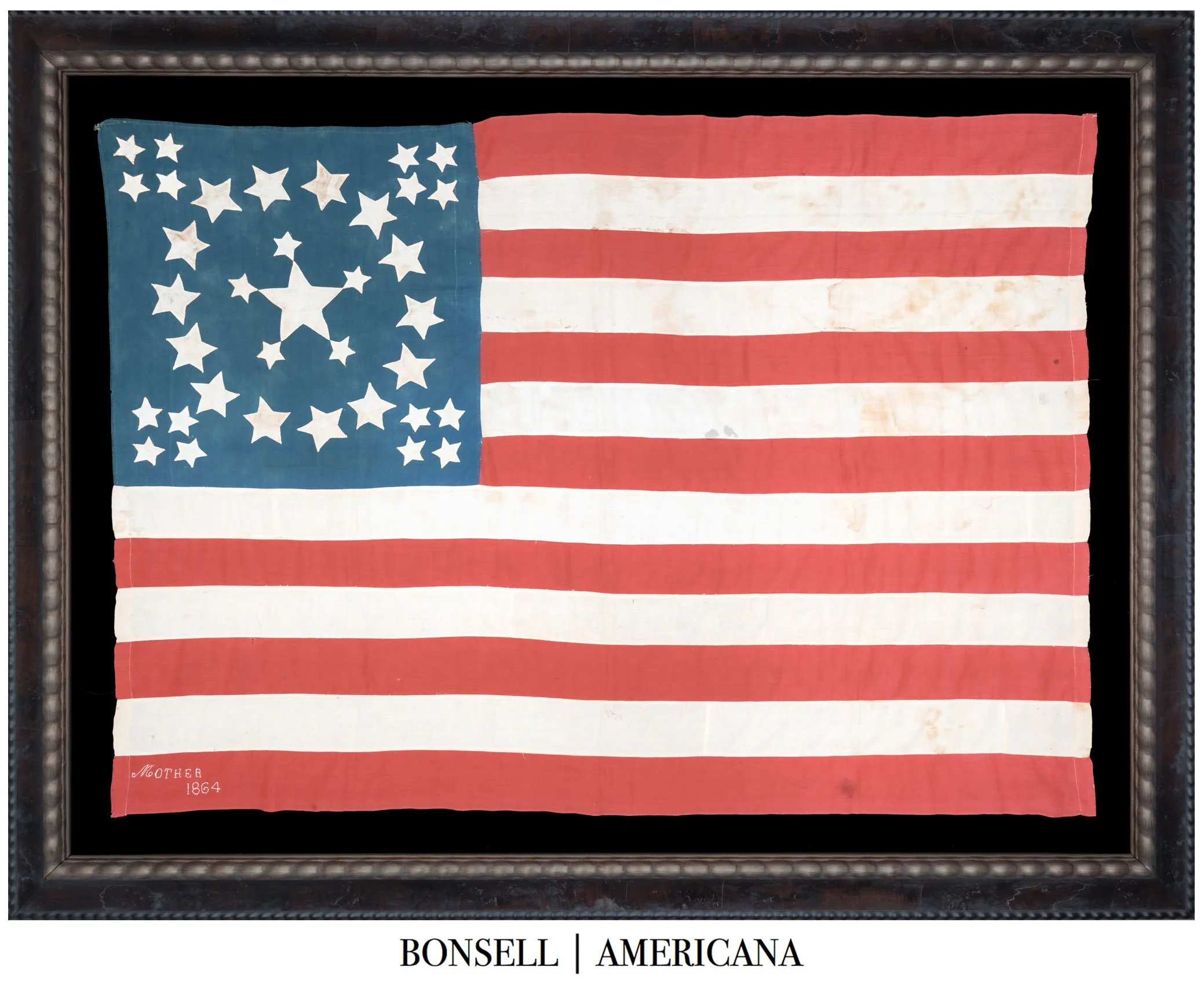
Price: Call 618-553-2291, or email info@bonsellamericana.com
Frame Size (H x L): 52” x 67 ¼”
Flag Size (H x L): 39” x 54 ½”
Offered is an exceptional 36-star antique American flag, made entirely of cotton and signed in handsewn thread, “Mother 1864.” Its star configuration is among the most visually arresting 36-star arrangements we have encountered: a large central star, representing Nevada, surrounded by five small stars placed at each of its points, a circular wreath of additional stars, and clusters of four stars in each corner of the canton. The result is dramatic, inventive, and highly personal — less a standardized national emblem than a carefully conceived piece of patriotic art.
The flag is made entirely by hand. The stripes, canton, hoist, and stars are all handsewn, a construction detail that places the object firmly within the world of mid-19th century textile production. Unlike commercially manufactured flags, which increasingly incorporated machine stitching by the Civil War period, this example retains the character of individual domestic manufacture.
The sewing is not merely utilitarian. It is deliberate, intimate, and expressive, culminating in the stitched inscription at the lower hoist: “Mother 1864.” The “M” is rendered in cursive, while the rest of the inscription is worked in small, careful lettering. It is common to encounter antique flags with names, dates, or inscriptions added in ink, paint, or later family notation. It is far more unusual to find a flag signed and dated in sewn thread, integrated into the object itself.
The inscription is one of the flag’s defining features. “Mother 1864” gives the flag both a firm year of manufacture and an unusually direct human connection. The wording strongly suggests that the flag was made by a mother for her family. Given the date, the possibility that it was made for a son or family member serving in the Union cause is compelling, though not provable. What can be said with confidence is that the flag was created in one of the most consequential years in American history, at the height of the Civil War and in the same year Nevada entered the Union. The inscription transforms the flag from a patriotic textile into a personal document. It records not only a national moment, but a private act of making, memory, and devotion.
The stars are single-appliquéd, meaning that each cotton star is sewn to only one side of the canton rather than being doubled on both sides. This method was practical and efficient. It conserved material, reduced the weight of the flag, and allowed the textile to move more easily in the air. In many early and mid-19th century flags, single-appliquéd stars also created a distinctive visual effect when light passed through the fabric. The stars could appear to glow, their forms animated by the contrast between the white cotton and the darker blue field. In this example, the technique is especially effective because of the complex star pattern and the varied scale of the stars. The large center star, medium-sized wreath stars, and smaller point and corner stars create a layered visual rhythm that is both disciplined and exuberant.
The star configuration is extraordinary. At the center of the canton is an oversized star, intended to represent Nevada, the newest state. Around it are five smaller stars, one placed at each tip, giving the central device a radiating, almost celestial quality. A ring of stars surrounds this center group, while four stars are placed in each corner of the canton. This combination of a large central star, surrounding point stars, circular wreath, and corner clusters creates a design that is bold, sophisticated, and unusually imaginative. Many 19th century flag makers used medallion arrangements, but few achieved this level of visual impact. The design is balanced without being mechanical, patriotic without being conventional, and decorative without feeling excessive.
The use of different star sizes adds significantly to the flag’s strength. The large central star immediately commands attention. The smaller stars at its points amplify the central motif, while the wreath creates movement around it. The corner clusters then anchor the composition and prevent the canton from feeling empty or overly centralized. This hierarchy of scale gives the flag a sense of depth and intentionality rarely encountered in flags of this size. It is precisely the sort of star pattern that elevates an already rare object into the highest tier of American flag collecting.
The flag measures approximately 39" x 54 1/2", a highly desirable scale that gives the piece real presence while remaining manageable for display.
The 36-star count places the flag in the period associated with Nevada statehood. Nevada was admitted to the Union on October 31, 1864, during the final year of the Civil War. As was customary, the new star count did not become official until the following Independence Day, July 4, 1865. The 36-star flag therefore became the first official national flag of the reunited postwar United States, remaining official until July 4, 1867, when the 37th star was added for Nebraska. This example is especially important because it is dated 1864, the very year Nevada joined the Union.
Nevada’s admission carried both symbolic and practical importance. The territory’s mineral wealth, especially the silver of the Comstock Lode, was of enormous value to the Union. Politically, Nevada also mattered to Abraham Lincoln and congressional Republicans during the 1864 election. Though sparsely populated, its statehood added electoral support and reinforced the national message that the Union was not only surviving the war, but expanding. The state’s constitution was famously transmitted by telegraph to Washington, D.C., an extraordinary act that underscored the urgency and political significance of its admission. In this context, the addition of a 36th star was not a minor update. It was a declaration that the Union endured.
The year 1864 was one of profound uncertainty and transformation. The Civil War had entered its fourth year. Casualties had mounted on an almost unimaginable scale. Lincoln faced reelection amid war weariness and political division. Yet 1864 also saw decisive movement toward Union victory, including Sherman’s Atlanta Campaign and Lincoln’s reelection in November. A flag made in that year, bearing 36 stars and signed “Mother,” belongs to this charged historical atmosphere. It speaks to the preservation of the Union not as an abstraction, but as something experienced in households, families, and communities.
This is one of the most compelling flags we have handled. Its merits are unusually complete: a desirable size, all-cotton construction, entirely handsewn manufacture, single-appliquéd stars, a spectacular medallion configuration, a large center star for Nevada, and a handsewn inscription that fixes the year and preserves the identity of the maker in the most intimate possible form. The combination is remarkable. Flags of this period are often historically important; fewer are this visually powerful. Fewer still carry such a direct and personal inscription. In both aesthetic and historical terms, this is a grail-level example.
Conservation Process: The flag was hand sewn to a cotton fabric backing, which was then hand sewn to a mounting board. To prevent dye migration from the black cotton, the fabric was pre-washed and treated with a dye-setting wash prior to mounting. The flag is displayed behind Optium Museum Acrylic.
Frame: The piece is presented in a substantial dark-stained frame with a broad, rounded profile and a beaded inner molding. The finish has deep brown-black tones with subtle reddish undertones and light surface variation, giving it a restrained, period-appropriate presence.
Condition Report: The flag presents beautifully, with expected age toning, scattered staining, minor discoloration, and gentle irregularity from handsewn construction. There are a few small holes that have been carefully masked with matching cotton, allowing them to recede visually while preserving the flag’s overall presentation. The textile retains strong color, excellent graphic impact, and a highly desirable surface appropriate to its age.
Collectability Level: The Extraordinary – Museum Quality Offerings
Date of Origin: 1864
Number of Stars: 36
Associated War: Civil War (1861-1865)
Associated State: Nevada
Frame Size (H x L): 10.25” x 7.5”
Flag Size (H x L): 6.5” x 3.5”
Offered is a vertically oriented and highly unusual 42-star American parade flag, printed on open-weave, plain weave cotton and bearing a commemorative overprint for an Ancient Order of United Workmen (A.O.U.W.) Fourth of July picnic held in 1896. The flag displays a distinctly folk quality, with 42 stars arranged in six linear rows of seven stars each. The stars vary noticeably in shape and placement, lending the design a charmingly irregular appearance despite its commercially printed construction.
Adding substantially to the appeal of the present example is the overprinted decoration occupying the center of the striped field. Printed in dark blue ink, the design advertises an “A.O.U.W. Picnic” held on July 4th, 1896. At center is the emblem of the Ancient Order of United Workmen, incorporating a shield, anchor, symbols of fraternity and labor, and radiating lines that emphasize the device in a manner reminiscent of a medal or civic badge. Encircling the emblem is the organization’s Latin motto, “alter alterius auxilio eget,” generally translated as “each needs the help of another.” The phrase succinctly expressed the society’s central principle of mutual aid and collective responsibility.
Founded in 1868 by John Jordan Upchurch, the Ancient Order of United Workmen emerged during a period when commercial life insurance remained beyond the reach of many working Americans. The organization combined social fellowship, civic engagement, and a system of mutual financial protection through which members contributed to a fund providing benefits to the families of deceased brethren. The concept proved enormously successful. By the final decades of the 19th century, the A.O.U.W. had become one of the largest fraternal organizations in the nation and served as a model for many later fraternal insurance societies.
Public gatherings formed an important component of lodge life. Picnics, parades, excursions, and Independence Day celebrations provided opportunities for members and their families to gather while simultaneously promoting the organization’s ideals within the broader community. Textiles such as the present example were produced specifically for such occasions and served as both patriotic decorations and commemorative souvenirs. Their survival rate was naturally low, owing to their lightweight construction and intended use during outdoor festivities.
The 42-star count reflects the admission of Washington as the 42nd state on November 11th, 1889. In accordance with the Flag Act of 1818, the 42-star flag became official on July 4th, 1890. Its official period was exceptionally brief, lasting just one year before the admissions of Idaho and Wyoming resulted in the 44-star flag on July 4th, 1891.
Interestingly, the overprint on the present example is dated July 4th, 1896, several years after the official period of the 42-star flag. While this might initially appear contradictory, such discrepancies are frequently encountered on 19th century parade flags and other commercially printed patriotic textiles. Manufacturers often continued to employ existing printing patterns long after a particular star count had passed from official use, especially on inexpensive souvenir, advertising, and commemorative flags. As a result, it is not unusual to encounter late 19th century examples bearing star counts that predate the event or occasion for which they were produced. In this case, the 1896 overprint provides the most reliable evidence for the date of its event-related production and use.
The combination of a 42-star count, folksy presentation, open-weave cotton construction, and dated fraternal overprint creates an object that exists at the intersection of American flag collecting, social history, and fraternal benefit society history.
Conservation Process: The flag was hand sewn to cotton fabric, and both were hand sewn to a mounting board. To prevent the black dye in the cotton fabric from seeping into the flag, it was first washed in a standard wash and then in a dye setting wash. The flag is positioned behind Optium Museum Acrylic.
Frame: The flag is in an attractive tiger maple frame. Tiger maple frames are cherished for their striking, wavy grain patterns that shimmer with a unique iridescence, reminiscent of a tiger's coat.
Condition Report: The flag presents with expected wear for its age and lightweight construction, including fraying and small losses along the edges. There is scattered soiling, fading, and surface abrasion throughout, with areas of ink and pigment loss, particularly in the canton.
Collectability Level: The Good – Perfect for Beginning Collectors and Gifts
Date of Origin: 1896
Number of Stars: 42
Associated State: Washington
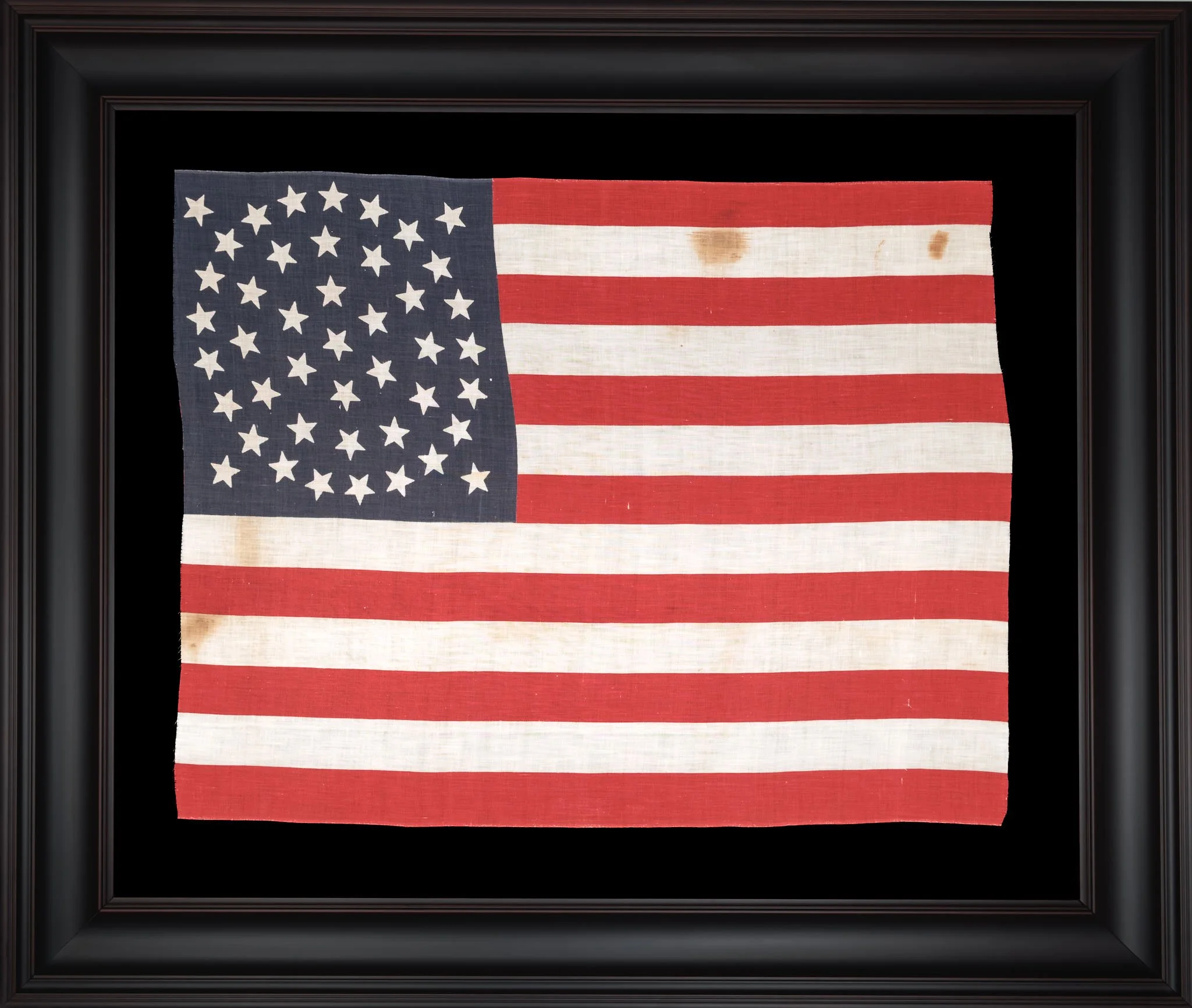
Frame Size (H x L): 35" x 42”
Flag Size (H x L): 24” x 31”
Offered is a forty-four star flag made of cotton. The stars on this flag are arranged in a medallion pattern, one of the most beautiful and desirable patterns in the hobby. This particular medallion has a center star that is surrounded by three concentric rings of stars. The three rings are then surrounded by four flanking corner stars.
Medallion pattern flags date to at least as early as the twenty-six star flag, and at least as late as the forty-eight star flag. The majority of medallion pattern flags, however, date to between 1861 and 1876. During this period, many flag makers would include a center star, surround it with one or more wreaths of stars, and then surround the wreaths with flanking stars (i.e., corner stars). Beginning in the 1890s, the beautiful medallion patterns became less common, and linear arrangements became the norm. Why this occurred is unclear, as flag makers had the freedom to place the stars however they liked until 1912, when President Taft issued Executive Order 1556 establishing the arrangement of the stars into rectilinear rows.
The forty-four star flag represents the inclusion of Wyoming to the Union. Wyoming was admitted on July 10th, 1890, and this flag became official on July 4th, 1891. Presidents Benjamin Harrison and Grover Cleveland served under this flag.
In 1889, Congress considered adding the Dakota Territory as a single state. What happened, however, was that the Dakota Territory was split it into two states: North Dakota and South Dakota, and they were both admitted on November 2nd, 1889. Soon thereafter, on November 8th, 1889, Montana was admitted as the forty-first state, and on November 11th, 1889, Washington was admitted as the forty-second. When Congress went on break, flag makers began producing anticipatory forty-two star flags for the following July 4th, 1890.
To the surprise of many, on July 3rd, 1890—just one day before the forty-two star flag was going to be official—Congress admitted Idaho as the forty-third state. As a result, the forty-two star flag never became official, but the forty-three star did. Just a few days later, on July 10th, 1890, Congress admitted Wyoming as the forty-fourth state. As a result of this rapid succession of state admissions, flag makers made large quantities of unofficial forty-two star flags and official forty-four star flags, but hardly any forty-three star flags (despite it being an official star count).
The forty-four star flag is relatively rare when compared to, for example, the forty-five star flag, as a result of it being used after the Centennial, but before the Spanish American War. The forty-four star flag was the official flag for five years up until July 4th, 1896, the time at which the forty-five star flag became official and began to represent the inclusion of Utah in the Union.
Conservation Process: This flag was hand sewn to cotton fabric, and both were hand sewn to a mounting board. To prevent the black dye in the cotton fabric from seeping into the flag, it was first washed in a standard wash and then in a dye setting wash. The flag is positioned behind Optium Museum Acrylic.
Frame: Housed in a wide, black-painted molded frame with a deep cove profile and stepped inner and outer edges. Subtle reddish-brown undertones in the grooves give the frame warmth and an antique-style character while maintaining a clean, formal presentation.
Condition Report: The flag presents well overall, with strong color and a legible medallion star pattern. There is age-appropriate toning and surface soiling throughout, most visible in the white stripes, along with several scattered brown stains, including examples near the upper fly, upper center, and lower hoist.
Collectability Level: The Best – Perfect for Advanced Collectors
Date of Origin: 1890-1896
Number of Stars: 44
Associated War: The Indian Wars (1860-1890)
Associated State: Wyoming
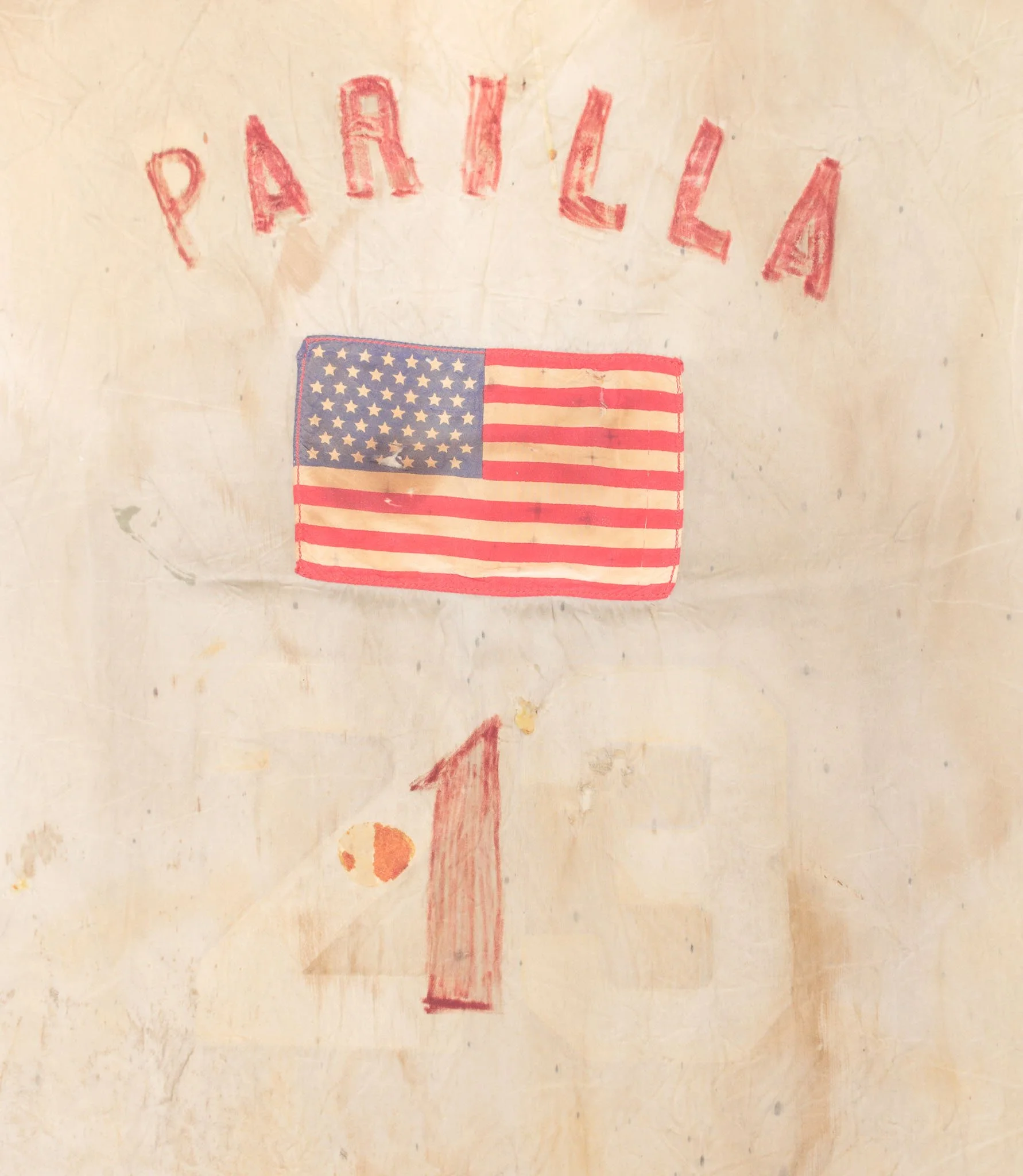
Frame Size (H x L): 34.5” x 31.5”
Jersey Size (H x L): 23.5” x 20.5”
Offered is a sleeveless motorcycle racing vest attributed to Richard “Dick” Gariepy of Barre, Massachusetts, a leading East Coast scrambles rider and the 1962 North American Scrambles Champion. Dating to circa 1962–1963, the vest is made from rayon and is marked with the Italian motorcycle name PARILLA, a large red numeral 1, and silk 49-star American flags sewn to both the front and back. The side shown here is the back of the garment.
The vest was intended to be worn over a long-sleeved shirt, sweater, or other riding apparel. Period photographs show Gariepy and other scrambles riders wearing this general type of sleeveless outer jersey over a contrasting long-sleeved layer. Such garments provided a practical surface for displaying a rider’s number, motorcycle marque, sponsor, or national identity while allowing the clothing underneath to be changed according to weather and track conditions.
The garment closes along the left side with a metal Talon zipper, allowing it to be pulled over other clothing without a center-front opening. Talon was one of the principal American zipper manufacturers of the period, and the metal fastener is consistent with an early-1960s date.
Across the upper back, the name PARILLA is painted by hand in large red letters. Beneath the flag is a similarly hand-painted red numeral 1.
A faint but legible 23 remains visible beneath and around the painted numeral. In person, the number appears as cleaner or less-damaged fabric. This suggests that applied numerals, perhaps adhesive-backed or heat-applied, once covered the textile and protected it from wear and discoloration. After the numerals were removed, their outline remained as a ghost image.
This corresponds with a documented Gariepy racing entry. In the program for the June 22, 1963 Laconia 90-Mile 250cc Road Race, Richard Gariepy of Barre was entered as No. 23 aboard a Parilla. The match among rider, motorcycle, and number is notable. It cannot be proven that the ghosted number on the vest relates specifically to that race, given motorcycle numbers often changed by event and class, but the association is logical. The later painted “1” indicates that the vest was likely renumbered for another competition.
The silk American flags sewn to the front and back each contain 49 stars arranged in seven rows of seven. The flags are machine sewn around their perimeters. The 49-star count has a narrow historical period. Alaska entered the Union on January 3, 1959, and the 49-star flag became official on July 4 of that year. Hawaii entered the Union later in 1959, and the 50-star flag became official on July 4, 1960. The 49-star flag was therefore official for only one year.
The flags do not necessarily date the completed vest to 1959–1960. Small 49-star flags remained available after the official change and could have been incorporated into a garment several years later. The stronger dating evidence is Gariepy’s documented Parilla activity in 1962 and 1963. The vest is therefore most reasonably dated to that period.
Richard Rice Gariepy became an accomplished New England motorcycle racer during the period when American scrambles competition was developing toward what is now generally called motocross. Scrambles combined dirt, natural terrain, elevation changes, and high-speed sections, requiring both speed and control. Gariepy also competed in TT events and road racing.
His most significant season came in 1962, when he raced a 250cc Parilla Wildcat. Period accounts credit him with victories at the Canadian National Championship Scramble, the AMA National TT Motorcycle Scramble Championship at Edgewood, Maryland, and the North-South Challenge. At Edgewood, he won both the 250cc expert-class championship and the overall lightweight-division championship in a field reported to include more than 100 lightweight riders. Together with his Canadian victory, the result established him as the North American Scrambles Champion.
Contemporary Parilla advertising used Gariepy’s championship success to promote the 250cc Wildcat. One advertisement announced “PARILLA WINS NATIONAL CHAMPIONSHIP” and identified him as the North American Scrambles Champion. Period photographs also show Gariepy wearing sleeveless outer racing garments of the same general type as the present vest.
Parilla was founded in Milan, Italy, by Giovanni Parrilla after World War II. The company became known for technically advanced lightweight motorcycles and achieved success in road races and scrambles competitions. The 250cc Wildcat was marketed as a serious lightweight competition motorcycle, and Gariepy’s 1962 victories became an important part of its American advertising.
Gariepy continued racing for decades. His obituary noted that he won back-to-back vintage motorcycle championships in 2011 and 2012 while in his seventies. The present vest dates from the early and most historically significant period of his career.
The combination of the hand-painted Parilla name, changing race numbers, Talon side zipper, paired silk 49-star flags, and Gariepy provenance places the vest within early-1960s American motorcycle competition and Parilla’s brief but successful racing presence in the United States.
Conservation Process: The jersey was hand sewn to cotton fabric, and both were hand sewn to a mounting board. To prevent the black dye in the cotton fabric from seeping into the jersey, it was first washed in a standard wash and then in a dye setting wash. The jersey is positioned behind Optium Museum Acrylic.
Frame: The frame is a deep-profile moulding with a simple, classical profile, finished in a dark cocoa-brown tone.
Condition Report: The vest exhibits extensive period wear, including overall soiling, discoloration, scattered staining, creasing, and surface abrasion. There are several small holes and losses, particularly near the center and lower portions, along with wear at the neckline, arm openings, seams, and zipper area. As the garment was used as a motorcycle racing jersey, at least some of this wear is likely associated with track use. The painted lettering and numeral remain legible, while the applied flags show minor soiling and localized wear.
Collectability Level: The Good – Perfect for Beginners and Gifts
Date of Origin: 1962-1963

Frame Size (H x L): 37.5” x 52”
Flag Size (H x L): 27” x 41”
Offered is a 13-star American yacht ensign, made by Annin & Co. and bearing the firm's “Sterling” trademark, produced between 1913 and 1926. Constructed of wool bunting with cotton-appliqued stars and anchor, the flag represents an early 20th century example of one of America's most recognizable maritime signals. It was intended for active use aboard a pleasure craft and survives with its original brass grommets and maker's mark intact.
The canton is made of dark navy wool bunting and displays a fouled anchor surrounded by a wreath of thirteen stars. Both the stars and anchor are fashioned from cotton and are applied with zig-zag machine stitching. The red and white stripes are made of wool bunting and joined with machine stitching throughout. The hoist is bound in a heavy plain-weave cotton heading fitted with brass grommets. Along the hoist appears a tag stating the following:
STERLING
REG. U.S. PAT. OFF.
ALL WOOL DOUBLE WARP
BUNTING
“Sterling” was a trademark of Annin, America's oldest and longest-operating flag manufacturer. The trademark was formally registered for bunting in 1913. A July 5th, 1913 trade publication notice records that “Annin Co., New York, N.Y.” had been granted registration of the word “Sterling” as a trademark for bunting. By 1917 the trademark was appearing in national advertising, and by the early 1920's Annin was actively promoting Sterling as its premium grade of all-wool bunting. The presence of the Sterling mark establishes a firm earliest possible date of 1913, while the overall construction and materials suggest manufacture during the period extending through the mid-1920's.
Founded in New York City in 1847, Annin is recognized as the nation's oldest flag manufacturer and remains in operation today. The company supplied flags for military, governmental, maritime, commercial, and patriotic use throughout the nineteenth and twentieth centuries, earning a reputation for quality construction and innovation in flag-making. During the early twentieth century, Annin expanded significantly, establishing a major manufacturing facility in Verona, New Jersey, while maintaining offices and production operations in New York. The firm's products were widely distributed throughout the United States, and its branded lines, such as Sterling, reflected a commitment to producing premium-grade flags for demanding outdoor service.
The yacht ensign occupies a unique place in American maritime history. Although often mistaken for a naval flag, it was developed for civilian recreational vessels. The design combines the familiar thirteen-star arrangement associated with America's earliest national flags with a fouled anchor, the traditional symbol of maritime service and seamanship. The thirteen stars reference the original colonies and the nation's founding era, while the anchor communicates a connection to navigation, commerce, and life at sea.
The origins of the yacht ensign date to the nineteenth century and are tied to the growing popularity of recreational boating among America's expanding middle and upper classes. In 1848 Congress granted vessels enrolled in qualifying yacht clubs the privilege of flying a distinctive ensign featuring a fouled anchor within the canton. The purpose was practical as well as symbolic. The special ensign identified pleasure craft that were exempt from certain customs inspections and distinguished privately owned yachts from commercial vessels. As boating culture expanded during the late nineteenth and early twentieth centuries, the yacht ensign became one of the most familiar and enduring symbols of American recreational sailing.
By the turn of the twentieth century, yacht ensigns were widely available through commercial makers such as Annin, who produced examples in a variety of sizes for use aboard everything from small launches to substantial sailing yachts. Examples intended for active service were typically constructed of wool bunting, then considered the preferred material for outdoor flags because of its strength, relatively light weight, and ability to shed wind. Cotton elements were commonly used for appliqued devices and stars, while reinforced cotton headings and brass grommets provided durability at the point of greatest stress.
The present example displays all of the characteristics collectors associate with quality commercial manufacture during the period. The wool bunting remains attractive in color, the cotton anchor and stars are crisply executed, and the heavy plain-weave cotton heading reflects a higher-grade construction than the lighter twill bindings often encountered on lesser examples. Particularly noteworthy is the Sterling trademark, which links the flag to Annin's premium wool bunting line and provides a useful point of reference for dating.
Today, antique yacht ensigns are collected both for their maritime associations and for their visual appeal. The combination of the fouled anchor and thirteen-star configuration creates one of the most distinctive flag designs employed in the United States. Their connection to America's boating traditions, combined with the symbolism of the nation's founding era, makes them equally at home in collections focused on maritime history, early American symbolism, patriotic textiles, or decorative Americana.
Conservation Process: This flag was hand sewn to cotton fabric, and both were hand sewn to a mounting board. To prevent the black dye in the cotton fabric from seeping into the flag, it was first washed in a standard wash and then in a dye setting wash. The flag is positioned behind Optium Museum Acrylic.
Frame: The frame is a dark-stained hardwood molding with a clean square profile and subtle variations in grain and tone that lend warmth and visual depth.
Condition Report: There is minor soiling and scattered small dark stains in limited areas, accompanied by a few tiny losses and areas of wear consistent with age and use. A small pink stain is present on the cotton hoist. The colors remain vibrant, the wool bunting retains strong integrity, and the flag presents beautifully overall. The brass grommets, Sterling maker's mark, and all primary design elements remain intact.
Collectability Level: The Great – Perfect for Rising Collectors
Date of Origin: 1913-1926
Number of Stars: 13
Associated War: World War I (1914-1918)
Associated State: Original 13 Colonies
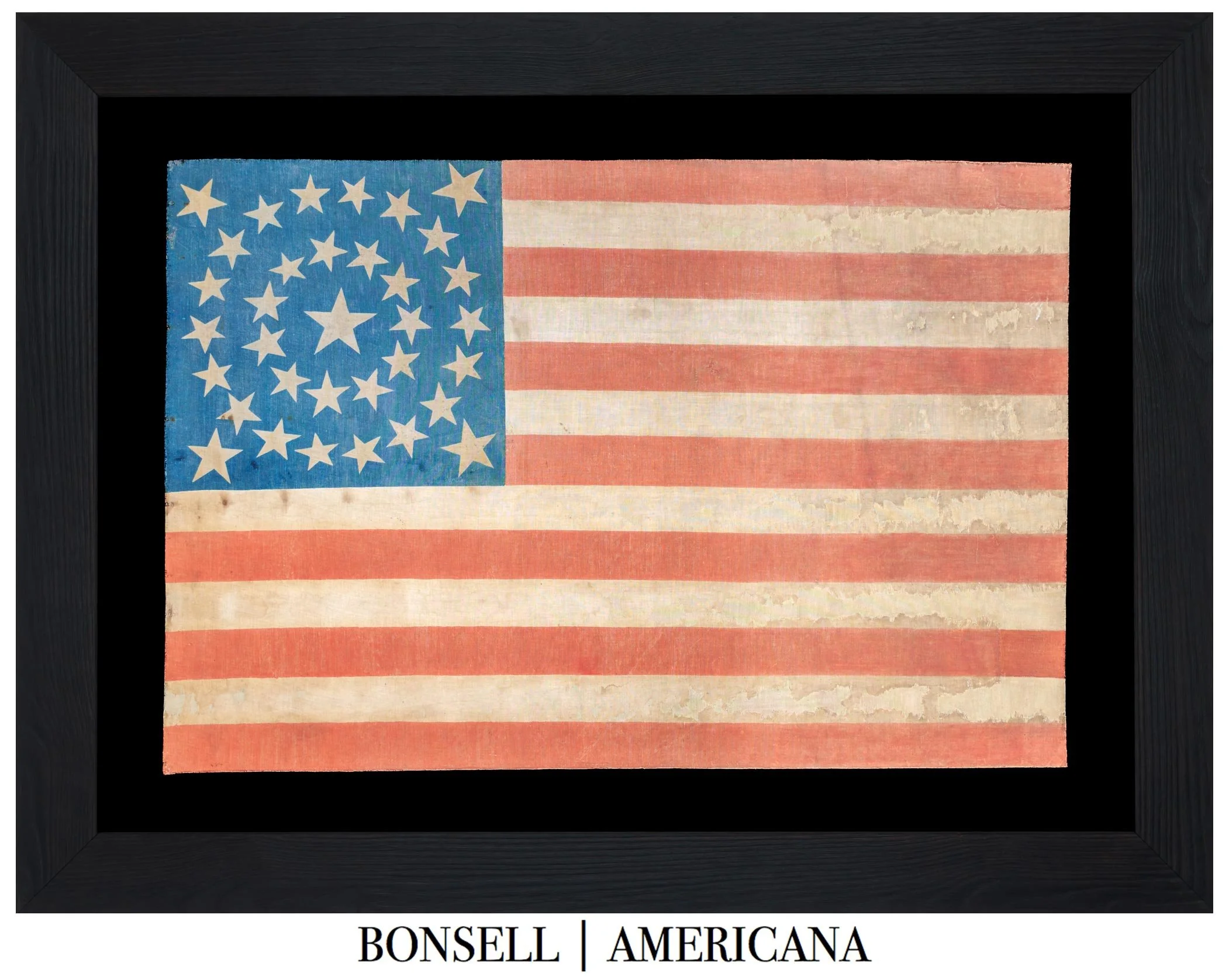
Price: Call 618-553-2291, or email info@bonsellamericana.com
Frame Size (H x L): 33” x 44”
Flag Size (H x L): 22” x 33”
Offered is a 34-star American national flag, printed on glazed cotton and dating to the opening years of the Civil War, between 1861 and 1863.
The configuration of stars on this example is particularly noteworthy. At the center rests a single oversized star, representing Kansas, the newest state in the Union. Surrounding it is an inner wreath of eleven smaller stars, while an outer ring of eighteen stars completes the medallion configuration. Four medium-sized stars flank the design near the corners of the canton. The stars are canted in varying directions and exhibit irregular, folk-oriented geometry, lending the canton a visually animated quality.
The design possesses the sort of visual energy collectors seek in early American textiles. Rather than rigid uniformity, one finds subtle inconsistencies in star shape, orientation, and spacing that reflect the handmade aesthetic sensibilities still present in American flag production during the mid-nineteenth century. The oversized center star anchors the composition, while the rotating orientations of the surrounding stars create movement throughout the canton. We have handled many 34-star flags over the years, including numerous medallion examples, yet we have never encountered another precisely of this style. In our view, this strongly suggests a very scarce, and perhaps singular, surviving variety.
The coloration is equally appealing. The blue canton displays a strong Civil War-period blue, while the red stripes retain a warm tone characteristic of early printed pigments on glazed cotton. The surface exhibits the subtle sheen associated with glazed cotton construction, a finishing process frequently employed on mid-nineteenth century parade flags to provide visual crispness and modest resistance to dirt and moisture. The glazing remains visible across portions of the surface and contributes to the flag’s period character.
The flag survives in what is arguably the ideal scale for a Civil War-era parade flag: large enough to display boldly, yet small enough to have been intended for true patriotic use by a private citizen. Even among surviving Civil War flags, examples of this size are especially desirable.
The 34-star flag represents the admission of Kansas as the 34th state on January 29th, 1861. The official addition of the star occurred on July 4th of the same year, just months after the inauguration of Abraham Lincoln and only weeks after the outbreak of the Civil War. Because flag makers commonly anticipated official star counts, many 34-star flags were produced immediately upon Kansas statehood, prior even to the firing on Fort Sumter. The 34-star flag remained official until July 4th, 1863, when the 35-star flag entered service following the admission of West Virginia.
Among the most important and collectible of all nineteenth century American flags are 34-star and 35-star examples, which represent the primary star counts under which the Civil War was fought. Lincoln served almost his entire presidency beneath the 34-star flag, and the vast majority of the conflict’s defining events—from First Bull Run through Gettysburg—occurred while this count remained official. Flags from this era are especially coveted because patriotic display by private citizens prior to the Civil War was comparatively uncommon. Before 1861, the American flag was used principally for military and maritime identification, and most surviving examples from the antebellum era were massive garrison or ship flags intended for visibility at great distances. The explosion in small printed parade flags arose primarily from the emotional and political fervor surrounding the Civil War itself. As a result, authentic surviving parade flags of the period are both rare and historically important.
What elevates this flag further, however, is the remarkable handwritten note that accompanies it. Written on letterhead from the Commonwealth Bank of Baltimore, located at Howard and Madison Streets, the note reads:
“This flag at half mast was hung from the window of the Herring home in Baltimore when Lincoln was buried. Though Democrats they were compelled to do so.”
The significance of this statement is difficult to overstate. In nearly two decades handling and studying antique American flags, we have encountered very few notes of this nature, and none carrying quite this degree of political candor. The wording is concise and direct. Most importantly, it contains precisely the sort of socially revealing commentary one would expect from a genuine family or community remembrance rather than a later embellished story.
The phrase “Though Democrats they were compelled to do so” provides a glimpse into the divided political atmosphere that existed in Maryland during the Civil War and immediately following Lincoln’s assassination. Maryland occupied a uniquely fragile position during the conflict. Though it remained in the Union, the state contained substantial Southern sympathies, particularly among Democrats and conservative urban residents of Baltimore. Union troops had occupied Baltimore early in the war following violent unrest in 1861, and political tensions remained severe throughout the conflict.
When Lincoln was assassinated in April of 1865, the nation entered a period of public mourning. As Lincoln’s funeral train made its journey from Washington toward Springfield, Illinois, cities throughout the North and border states staged mourning observances. Buildings were draped in black crepe, church bells tolled, and flags appeared throughout urban streetscapes in public displays of grief and national unity. Baltimore, despite its divided loyalties, participated heavily in these ceremonies.
Within this context, the note becomes especially compelling. The implication is that the Herring family—identified by the writer as Democrats—displayed the flag publicly despite political sympathies that may not have aligned fully with Lincoln or the Union cause. Whether motivated by civic pressure, social expectation, fear of scrutiny, genuine mourning, or some combination thereof, the act was apparently memorable enough to be recorded decades later in handwritten form. The note preserves a revealing moment: a politically divided household navigating public expectation in one of the most emotionally charged weeks in American history.
Particularly interesting is the phrase “compelled to do so.” Such wording suggests that the display was perceived not merely as patriotic decoration, but as an act carrying political and social consequence. We have encountered Civil War flags accompanied by family stories, but never one whose associated documentation speaks so openly about political tension and reluctant public patriotism. It transforms the flag from a Civil War textile into a tangible artifact connected to the complexity surrounding Lincoln’s death and the Union victory.
Research into the Commonwealth Bank of Baltimore reveals that it was an established Baltimore institution operating by at least the 1890s, with its substantial building at Howard and Madison Streets constructed in the mid-1890s. The handwritten note, therefore, almost certainly dates to the late nineteenth or early twentieth century, placing it relatively close to the events it describes and well within the range of living memory.
An additional note accompanied the flag when acquired from Brendan Synnamon, owner of The Union Drummer Boy in Gettysburg, one of the nation’s best Civil War artifact galleries. Brendan is widely respected within the field of Civil War material culture and has spent decades handling, authenticating, and researching important artifacts related to the conflict. In addition to his work as a dealer, lecturer, and preservation advocate, Brendan has also served as an appraiser for the Antiques Roadshow. Brendan acquired the flag from the estate of longtime collector Stan Smullen, who reportedly purchased it directly from the Herring family estate.
The Herring family itself holds noteworthy historical and literary associations tied to Edgar Allan Poe. Henry Herring, a prominent Baltimore lumber dealer and the husband of Poe’s aunt, Elizabeth Poe Herring, maintained a household that Poe is known to have visited during his time in Baltimore. Historical accounts further record that Herring participated in the arrangements surrounding Poe’s death and burial in 1849, reportedly providing the coffin used for the funeral and assisting with related matters. The association with both the Herring family and the events surrounding Lincoln’s funeral procession through Baltimore adds another layer of historical interest to an already remarkable Civil War-era flag.
Regardless, the accompanying documentation remains exceptional. It is exceedingly rare to encounter a Civil War-period parade flag accompanied by a politically charged written remembrance tied specifically to the mourning ceremonies surrounding Lincoln’s assassination and funeral procession. Combined with the flag’s striking and apparently unique medallion configuration, attractive coloration, and association with one of the defining moments in American history, this example stands among the most interesting 34-star parade flags we have encountered.
Conservation Process: This flag was professionally conserved and restored. It is sewn to silk and positioned behind Optium Museum Acrylic.
Frame: The flag is presented within a hardwood frame finished in matte black with visible grain.
Condition Report: The flag was professionally conserved and restored. There is moderate to significant fading and oxidation throughout, accompanied by scattered soiling, areas of pigment loss, and restoration to the striped field, particularly within the white stripes toward the fly end. Despite this, the flag presents beautifully, with strong overall color, an especially attractive blue canton, and excellent visual impact. The unusual medallion configuration and the extraordinary accompanying note more than justify the conservation work undertaken to preserve this rare Civil War-era survivor.
Collectability Level: The Extraordinary – Museum Quality Offerings
Date of Origin: 1861-1863
Number of Stars: 34
Associated War: The Civil War (1861-1865)
Associated State: Kansas
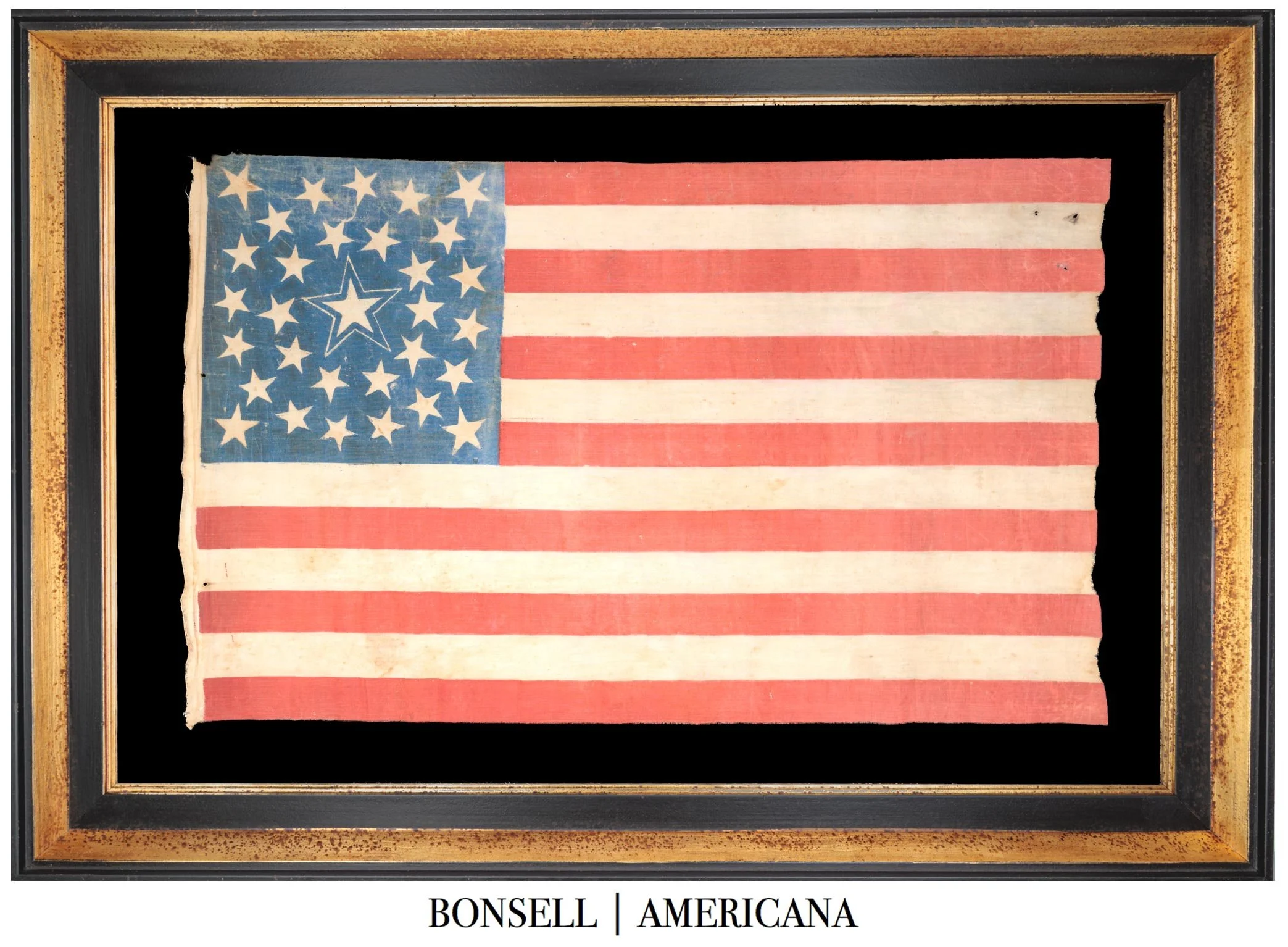
Price: Call 618-553-2291, or email info@bonsellamericana.com
Frame Size (H x L): 33.25” x 48”
Flag Size (H x L): 22.25” x 37”
Offered is a rare and highly desirable 31-star American parade flag, printed on glazed cotton and dating to the period between 1851 and 1858, during the official use of the 31-star count. Flags of this era are among the rarest and most coveted of all surviving American flags, both because they predate the Civil War and because the use of the national flag in everyday American life was still comparatively limited. Prior to the outbreak of the Civil War in 1861, Americans did not commonly display the Stars & Stripes for general patriotic decoration in the way that later generations would. The widespread civilian use of the American flag is largely a post-Civil War phenomenon, fueled by wartime nationalism, veterans’ organizations, political campaigning, public schools, and the country’s growing industrial ability to mass-produce patriotic textiles. As a result, flags made before the Civil War survive in extraordinarily small numbers relative to those produced afterward. Among 19th century flags as a whole, pre-Civil War examples comprise only a tiny fraction of surviving material.
This example is particularly compelling for both its visual impact and its unusually attractive star arrangement. The stars are configured in a striking medallion pattern that consists of a large center star, surrounded by two concentric wreaths of smaller stars, with a single flanking star positioned in each corner of the canton. Medallion patterns are among the most sought-after of all 19th century arrangements, prized for their balance, folk quality, and strong graphic presentation. While linear configurations would eventually become standardized in the 20th century, 19th century flag makers enjoyed considerable freedom in arranging stars, resulting in an extraordinary range of whimsical and artistic patterns. Medallions are widely considered among the most beautiful of these arrangements and are especially associated with mid-19th century American parade flags.
The oversized center star is especially significant. Sometimes referred to as a “center star,” this feature differs from what collectors commonly call a “Great Star” or “Great Luminary” configuration. In a Great Star arrangement, the smaller stars collectively form the shape of one large star. In a center star design such as this one, however, the large star occupies the middle of the canton independently, while the surrounding stars radiate outward around it in concentric fashion. In many examples of this type, the center star was intended to represent the newest state admitted to the Union. In the case of a 31-star flag, that state was California.
Particularly noteworthy is the construction of the center star itself. Rather than consisting solely of a single bold outline, it includes a secondary outer border that creates a luminous “halo” effect around the star. Haloed stars are among the most visually dynamic elements found on printed parade flags of the period and are strongly associated with a small and distinctive family of mid-19th century printed flags. The exact maker of these haloed flags remains unidentified, yet surviving examples reveal enough similarities in execution, scale, printing style, and artistic treatment to strongly suggest common manufacture. Comparable haloed examples are known in 30-star, 31-star, 34-star, 35-star, 36-star, and 42-star counts, among others, forming one of the more recognizable and beloved groups within early printed American flags.
This flag belongs to a particularly early generation of printed parade flags. The earliest known printed American parade flags date to the late 1830s and early 1840s, shortly after advances in textile printing technology made such production commercially viable. Twenty-six star examples, representing Michigan statehood, are generally regarded as the earliest surviving printed parade flags, dating between approximately 1837 and 1845. This 31-star example was therefore produced only a relatively short time later, placing it very near the beginning of printed flag production in the United States. Surviving examples from this formative period are scarce in all star counts, and especially so in counts preceding the Civil War.
The coloration of the stripes is especially attractive. Rather than displaying the deep saturated red commonly associated with later flags, the stripes exhibit a warm orange-red hue that is characteristic of many mid-19th century textiles. This coloration is generally attributed to the use of natural dyes such as madder and cochineal, both of which were widely employed during the period before the later standardization of synthetic aniline dyes. Over time, these pigments often mellow into softer tones ranging from salmon to burnt orange, lending early American flags a distinctive warmth that collectors find especially appealing. The canton likewise displays a beautiful dusty blue coloration that differs markedly from the darker navy tones seen on later examples. Because official standards governing the precise shades of red and blue had not yet been firmly established, considerable variation existed among textile makers during the mid-19th century, contributing to the highly individual character of flags from this era.
California’s admission to the Union—and the resulting creation of the 31-star flag—occurred during one of the most transformative moments in American history. The discovery of gold at Sutter’s Mill in 1848 triggered the California Gold Rush, one of the largest mass migrations in world history. Tens of thousands of fortune seekers from across the United States and abroad flooded into the territory with astonishing speed. Between 1848 and 1850, California’s non-native population exploded, creating urgent pressure for civil government and eventual statehood. Unlike many western territories that spent years or decades under territorial administration before entering the Union, California moved toward statehood with remarkable rapidity.
The question of California’s admission also became deeply entangled in the sectional tensions surrounding slavery in the years leading to the Civil War. As the nation expanded westward following the Mexican-American War, fierce political debate erupted over whether new territories would permit slavery. California sought admission as a free state, upsetting the delicate balance between free and slave states in Congress. Its admission ultimately formed a central component of the Compromise of 1850, the complex legislative package engineered primarily by Henry Clay in an effort to preserve the Union. Signed into law in September of that year, the compromise temporarily eased sectional conflict while simultaneously revealing just how fragile the national political balance had become.
California officially entered the Union on September 9th, 1850, as the 31st state. In accordance with the Third Flag Act of 1818, however, new stars were not officially added to the American flag until the following Independence Day. Thus, the 31-star flag became official on July 4th, 1851. It remained the official national flag until July 3rd, 1858, after which the 32-star count replaced it following the admission of Minnesota. The official lifespan of the 31-star flag therefore spanned just seven years, encompassing a period of extraordinary expansion, political volatility, western migration, and accelerating national change immediately preceding the Civil War.
An interesting aspect of this particular example is its provenance, as the flag at one point belonged specifically to Robert Endres, from whose family it was acquired. Endres played football at Ohio State University, serving as an offensive tackle for the Buckeyes during the mid-20th century. Contemporary coverage described him as a dependable mainstay on the offensive line, following two years of junior varsity play before advancing to the varsity squad in his senior year. While unrelated to the flag’s original period of manufacture, the association adds an appealing layer of Americana, linking this mid-19th century national textile to a later tradition of American collegiate athletics.
Because relatively few flags were made during this era—and because even fewer survived the passage of more than 170 years—authentic 31-star parade flags rank among the rarest and most desirable of all 19th century American flags. Examples featuring highly graphic medallion arrangements, especially those with haloed center stars and strong folk characteristics, occupy an especially important place within advanced collections of early American textiles and political Americana.
Conservation Process: This flag was hand sewn to cotton fabric, and both were hand sewn to a mounting board. To prevent the black dye in the cotton fabric from seeping into the flag, it was first washed in a standard wash and then in a dye setting wash. The flag is positioned behind Optium Museum Acrylic.
Frame: This offering is in our Large Distressed Black and Gold Frame.
Condition Report: The flag displays moderate to modest wear consistent with its age and use, including scattered soiling, minor foxing, and areas of pigment loss and fading throughout. There is light fraying and minor loss along the fly end and hoist, accompanied by a few tiny holes and small areas of fabric separation. The glazed cotton has mellowed beautifully over time, resulting in especially attractive coloration in both the dusty blue canton and the warm orange-red stripes. Overall, the flag presents exceptionally well and retains outstanding visual impact, particularly in the dramatic haloed medallion configuration.
Collectability Level: The Extraordinary – Museum Quality Offerings
Date of Origin: 1850-1858
Number of Stars: 31
Associated State: California
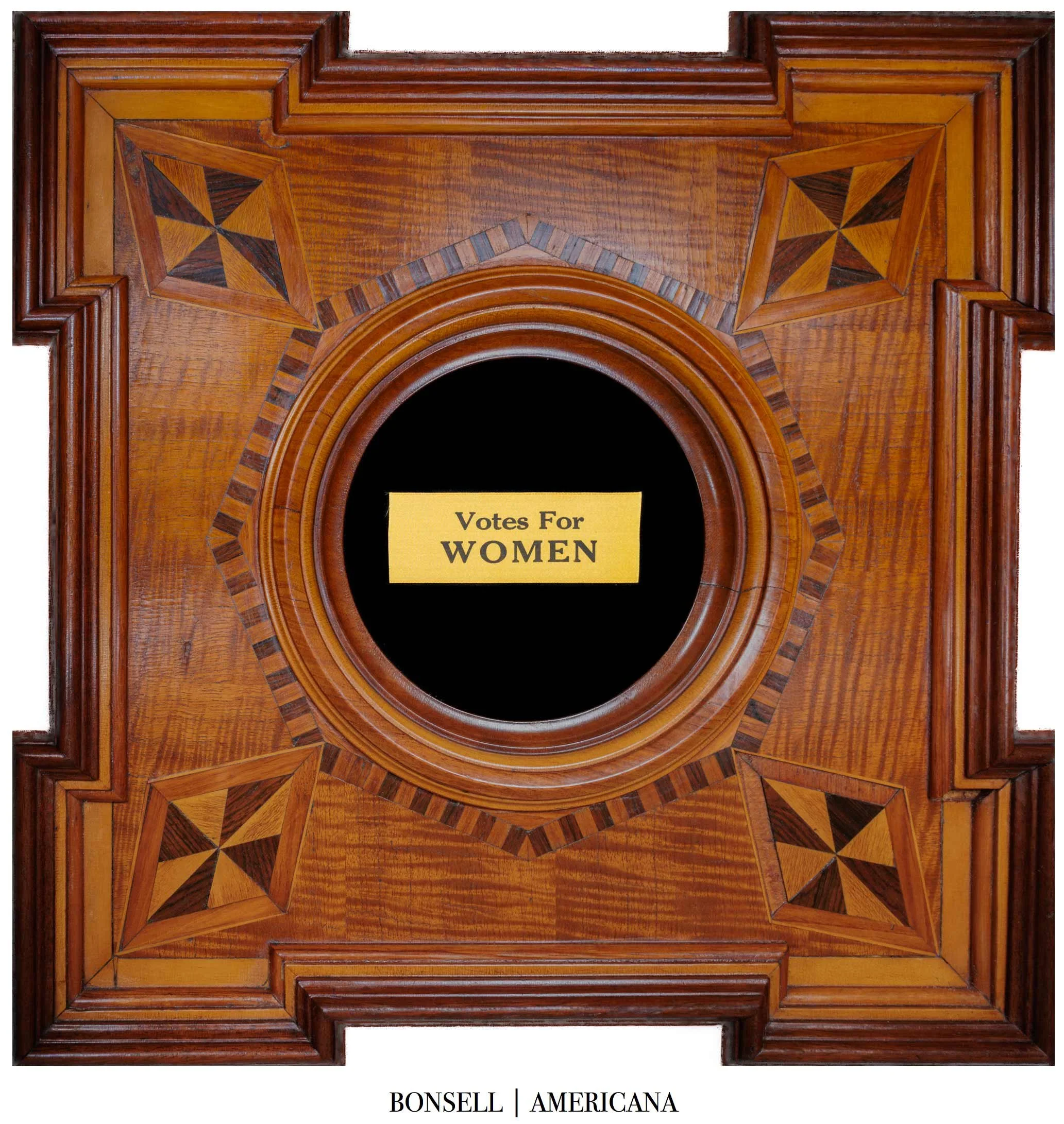
Frame Size (H x L): 17” x 17”
Textile Size (H x L): 1.5” x 3.5”
Offered is a rare “Votes for Women” ribbon. The field is yellow, and the verbiage is in all black caps. Yellow was the primary color in the women’s suffrage movement in the US, and was combined with various other colors, though in most instances was combined with black. In England, violet and green were the primary colors.
In 1848, Lucretia Mott and Elizabeth Cady Stanton organized the first women’s rights convention in Seneca Falls, New York. As a result of this meeting in Stanton’s hometown, the document containing a declaration for women’s suffrage, right to education, and right to employment was drafted. Over the next 50 years, numerous women’s conventions were hosted to bring strength to the movement in masses.
Though initially targeted as a state-by-state movement, it was ultimately recognized that only an amendment to the Constitution would grant all women the right to vote. Amendments were introduced in 1878 and 1914, both of which were defeated. By 1918, both political parties were committed to women’s suffrage, in part based on the major role women played in World War I. As such, in January of 1918 and June of 1919, an amendment was passed by two-thirds majorities in the House and Senate, respectively. On August 18th, 1920, Tennessee became the 36th state to ratify the amendment, giving the two-thirds of state legislators necessary to ratify the amendment. On August 26th, the Nineteenth Amendment became part of the Constitution, and read as follows:
The right of citizens of the United States to vote shall not be denied or abridged by the United States or by any State on account of sex. Congress shall have power to enforce this article by appropriate legislation.
Conservation Process: This ribbon was hand sewn to cotton fabric, and both were hand sewn to a mounting board. To prevent the black dye in the cotton fabric from seeping into the ribbon, it was first washed in a standard wash and then in a dye setting wash. The ribbon is positioned behind Optium Museum Acrylic.
Frame: The frame dates to approximately 1890. It is multi-tiered and made of mahogany, oak, and maple. It is a frame of the highest quality.
Condition Report: This ribbon is in excellent condition.
Collectability Level: The Good – Perfect for Beginning Collectors and Gifts
Date of Origin: 1913-1920
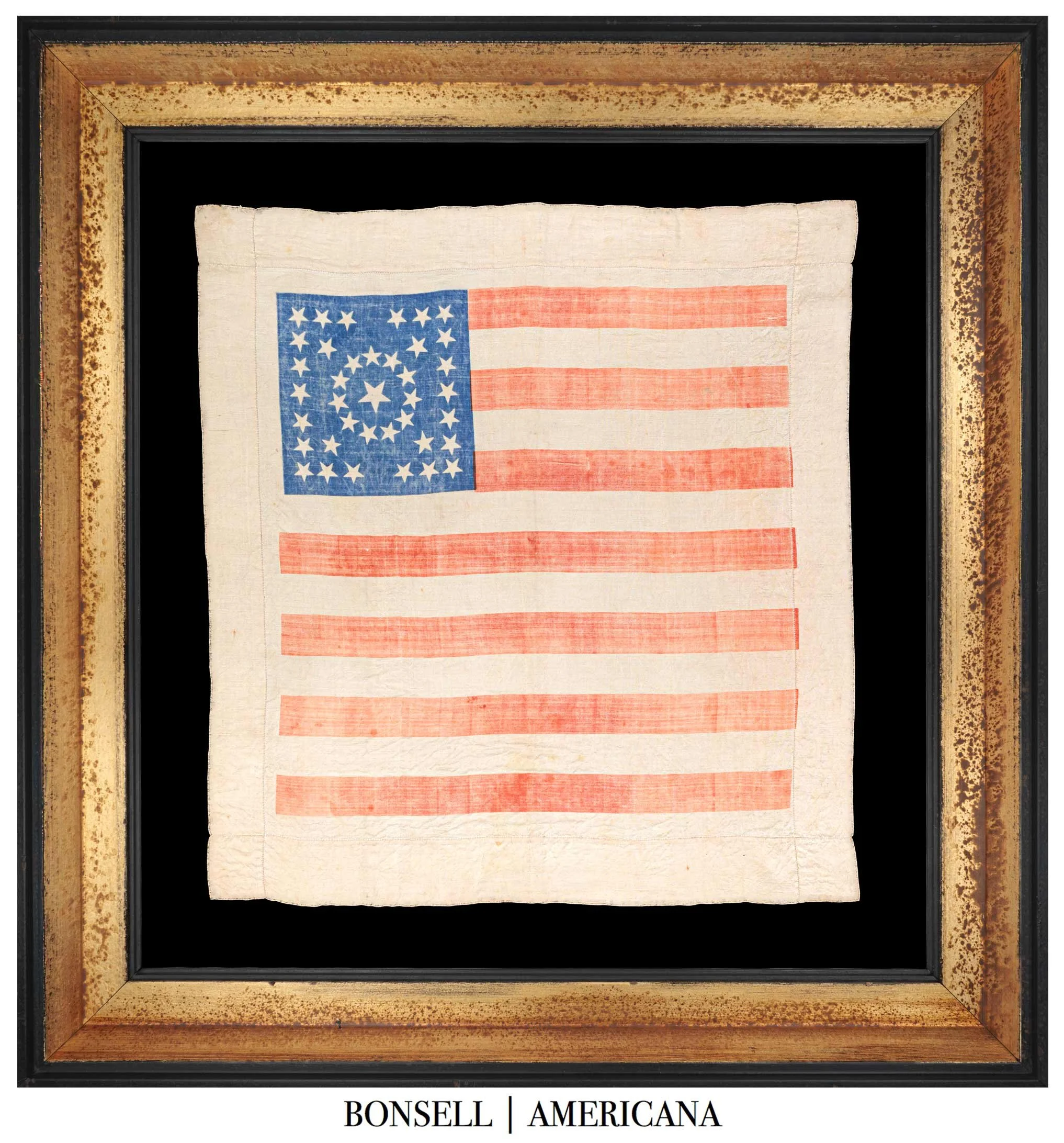
Frame Size (H x L): 33” x 32”
Flag Size (H x L): 22.5” x 21”
Offered is a rare and visually compelling 38-star American flag bandanna, produced in silk and rendered in the form of the Stars & Stripes, with the printed flag itself inset within a larger square field. The format possesses exceptional visual balance, with broad margins surrounding the printed design that reinforce its presentation as both a textile and a patriotic object. Two horizontal seams and two vertical seams, all machine-sewn, join the silk panels together, lending the piece a distinctly period method of construction and underscoring its manufacture during the late 19th century.
The star configuration is among the bandanna’s most memorable and attractive features. At its center is a large, canted star representing Colorado, the newest state admitted to the Union at the time the design originated. This oversized center star is encircled by a wreath of eleven smaller stars, creating a medallion-like presentation. Flanking this central device are four additional stars, while linear groupings of stars to the left and right create the impression of enclosing brackets or a squared framework around the central medallion. The arrangement is highly unusual and visually dynamic, balancing formal structure with folk-like irregularity. The stars are canted in various directions rather than mechanically aligned, and their forms vary subtly in proportion and execution, adding both movement and charm. Such variation is highly desirable among collectors, as it reflects the more artistic and less standardized production methods of the period.
The canton is paired with bold red stripes that have mellowed beautifully over time, taking on the warm orange-red cast often encountered in 19th century textiles. This transformation is especially attractive here, contrasting wonderfully against the soft blue canton and creamy silk ground. The resulting palette is considerably more nuanced than the stark primary coloration associated with later printed flags and contributes substantially to the textile’s visual appeal.
This exact variety is illustrated as item number 637 in Threads of History: Americana Recorded on Cloth, 1775 to the Present, the landmark exhibition catalogue produced in association with the Smithsonian Institution. For collectors unfamiliar with the publication, Threads of History is widely regarded as one of the most important references ever produced on American political textiles, parade flags, kerchiefs, and related patriotic cloth objects. Compiled by Herbert Ridgeway Collins and published in conjunction with the Smithsonian’s major bicentennial-era exhibition, the work documented some of the finest and most historically significant textiles known at the time. Inclusion within its pages represents an important point of scholarly recognition.
The catalogue notes that this bandanna was “used in the political campaign of 1888,” and another closely related example is illustrated nearby as item number 636. That counterpart employs a different flag and star configuration, yet shares the same general format, dimensions, and construction, suggesting that the two likely originated from the same manufacturer or workshop. The relationship between the two textiles provides an especially interesting glimpse into the diversity of patriotic printed goods produced during the period. Rather than relying upon a single standardized design, makers experimented with varying star arrangements and visual compositions while maintaining the same overall concept and scale.
The proposed 1888 campaign association places this textile within one of the more contentious presidential elections of the late 19th century. The election pitted incumbent President Grover Cleveland, the Democrat, against Republican challenger Benjamin Harrison. Tariff policy emerged as the defining issue of the campaign, with Cleveland advocating lower tariffs and Harrison supporting protective measures intended to bolster American industry. Although Cleveland won the national popular vote, Harrison secured victory in the Electoral College. The campaign unfolded during a period of rapid industrialization, expanding rail networks, and growing national identity, conditions that fueled demand for patriotic imagery and political textiles alike. Objects such as this bandanna occupied a unique space between political memorabilia and decorative Americana, serving both as expressions of patriotism and as tangible artifacts of campaign culture.
Its square proportions are particularly appealing. Unlike many parade flags and kerchiefs that feel visually elongated, this example possesses a balanced, almost architectural presentation that allows the star configuration to command attention without overwhelming the striped field. The inset format further heightens this effect, creating a framed composition within the textile itself. Combined with the medallion-style arrangement of stars, the result is exceptionally graphic and immediately recognizable from across a room.
The 38-star count on this flag reflects Colorado’s admission to the Union on August 1st, 1876. Known as the “Centennial State,” Colorado earned its nickname for achieving statehood just twenty-eight days after the nation’s centennial celebrations. Colorado’s path to statehood began with the establishment of the Colorado Territory in 1861, spurred by the Pike’s Peak Gold Rush, which brought a dramatic influx of settlers to the region. Early efforts toward statehood met setbacks, including a veto by President Andrew Johnson in the 1860s, but renewed momentum in the mid-1870s ultimately culminated in Colorado’s official admission as the nation’s 38th state.
Although the 38-star flag did not become official until July 4th, 1877, flag makers frequently produced anticipatory examples ahead of official adoption. These flags played a major role during the Centennial celebrations of 1876, alongside revival designs featuring 13 stars in homage to the original colonies. The Centennial year proved to be a defining moment in American visual culture, fostering renewed patriotism and unity following the divisions of the Civil War. Homes, businesses, parade grounds, and public buildings were adorned with red, white, and blue decoration, and flags became the centerpiece of this widespread national expression.
The Centennial International Exposition in Philadelphia served as the focal point of these celebrations, attracting nearly ten million visitors between May and November of 1876. The exposition showcased American innovation on a grand scale, introducing many visitors to technological marvels such as Alexander Graham Bell’s telephone and the enormous Corliss Steam Engine. Within this atmosphere of patriotic enthusiasm and industrial optimism, the production of decorative flag textiles flourished.
The 38-star flag officially served from July 4th, 1877, until July 4th, 1890, spanning the administrations of Presidents Rutherford B. Hayes, James A. Garfield, Chester A. Arthur, Grover Cleveland, and Benjamin Harrison. It represented a nation undergoing dramatic transformation through westward expansion, mining booms, railroad construction, and accelerating industrial growth. In 1890, the admission of North Dakota, South Dakota, Montana, Washington, and Idaho necessitated adoption of the 43-star flag, bringing the 38-star era to a close. Today, surviving textiles from this period remain especially prized among collectors for their inventive medallion configurations, strong folk qualities, and close association with the Centennial era, one of the most visually dynamic and patriotic periods in American flag history.
Conservation Process: This bandanna was hand sewn to cotton fabric, and both were hand sewn to a mounting board. To prevent the black dye in the cotton fabric from seeping into the bandanna, it was first washed in a standard wash and then in a dye setting wash. The bandanna is positioned behind Optium Museum Acrylic.
Frame: This offering is in our Large Distressed Gold Frame.
Condition Report: The silk exhibits modest to moderate age-related wear, accompanied by minor soiling, scattered pigment loss, and areas of thinning consistent with the textile’s age and delicate nature. There is gentle creasing throughout, accompanied by minor irregularities along the edges and at the seams. The printed coloration has softened beautifully over time, with the red pigments mellowing to an especially attractive orange-red tone. Overall, the bandanna presents exceptionally well, with strong visual impact and remarkable survivability for a late 19th century silk textile.
Collectability Level: The Great – Perfect for Rising Collectors
Date of Origin: 1888
Number of Stars: 38
Associated War: The Indian Wars (1860-1890)
Associated State: Colorado
Price: Call 618-553-2291, or email info@bonsellamericana.com
Frame Size (H x L): 28” x 38”
Flag Size (H x L): 17” x 27”
Offered is an unusual 13-star American flag, dating to approximately 1910–1940, with its stars arranged in the widely recognized “Betsy Ross” pattern. The flag is particularly interesting for its unconventional construction, incorporating what appear to be materials repurposed from an earlier American flag, a separately attached blue canton, and 13 paper stars glued directly to the fabric. As homemade example, it may have originated as a school project, classroom display, or other patriotic exercise intended to commemorate the nation's founding.
The flag's 13 stars are arranged in a circular formation, representing the original 13 colonies. While this configuration is among the most recognizable in American flag history, antique examples are surprisingly uncommon. Most surviving 13-star flags feature either the traditional 3-2-3-2-3 arrangement or some variation of the medallion pattern. Flags displaying a simple circle of 13 stars constitute a much smaller portion of the surviving population.
The arrangement is closely associated with Betsy Ross, the Philadelphia upholsterer traditionally credited with making the first American flag. Although the historical foundation of that story is questionable, its influence on American patriotic imagery has been substantial. The circular pattern has become so closely associated with the nation's founding that it is frequently assumed to have been the original arrangement adopted in 1777, despite the absence of contemporary documentation establishing that fact.
CONSTRUCTION AND DATING
One of the most compelling aspects of this flag is the manner in which it was assembled. The red and white stripes appear to have been cut from an earlier American flag, rather than manufactured specifically for this example. The fabric is glazed cotton, with a relatively open weave and a red coloration consistent with many commercially produced flags of the early twentieth century. The red is notably a true red, rather than the orange-red frequently encountered on printed flags of the late nineteenth century, particularly those dating to the 38-star period.
Based on these characteristics, we believe the striped fabric likely originated from a flag manufactured sometime between approximately 1910 and 1940. A 48-star American flag, representing the period following Arizona's admission to the Union in 1912, is perhaps the most plausible source, although earlier 42-star to 46-star flags cannot be ruled out. Without the original canton, the precise star count of the source flag cannot be established.
The blue canton appears to be glazed cotton as well, although its surface is somewhat shinier and its weave noticeably tighter than that of the striped field. The canton was machine-sewn to the striped field, further supporting the conclusion that the flag was assembled from individual components.
Most unusual are the 13 stars, which are made of paper and adhered directly to the blue canton. Their individual shapes and placement have a distinctly handmade character. This method of construction would have been impractical for a flag intended to fly outdoors, where exposure to wind and moisture would quickly compromise the paper elements. It is instead consistent with an object intended for interior display, educational use, or some other commemorative purpose.
Taken together, these characteristics suggest a homemade flag, perhaps assembled by a student or teacher as part of a classroom lesson on American history. The use of an existing flag would have provided readily available red and white stripes, while the separately attached canton and paper stars allowed the maker to recreate the familiar Betsy Ross design. Although its original purpose is unknown, a schoolroom origin seems plausible given the prominence of the Betsy Ross story in American education during the early twentieth century.
We favor a date of approximately 1910–1940 for the completed flag, although the materials could have been reused some years after their original manufacture.
THE BETSY ROSS LEGEND
Betsy Ross is perhaps the most recognizable figure associated with the creation of the American flag. According to popular tradition, she was visited in Philadelphia in 1776 or 1777 by George Washington and a small committee seeking a flag for the newly independent nation. Ross purportedly agreed to manufacture the flag but suggested replacing the six-pointed stars in the proposed design with five-pointed stars, demonstrating how the latter could be produced with a single cut of folded paper.
Despite its enduring popularity, there is no surviving contemporary documentation establishing that Ross designed or made the first American flag. She was a working upholsterer and flagmaker during the Revolutionary era, but the specific claim that she created the first national flag rests on family testimony recorded many decades after the alleged event.
The story first gained significant public attention in 1870, when William Canby, Ross's grandson, presented an account of her involvement to the Historical Society of Pennsylvania. Canby relied on family recollections and affidavits rather than contemporary letters, contracts, or official records. His narrative was subsequently repeated in popular publications, including an 1873 account in Harper's New Monthly Magazine, helping establish the story in the American imagination.
By contrast, documentary evidence links Francis Hopkinson, a signer of the Declaration of Independence and member of the Continental Congress, to the design of the American flag. In 1780, Hopkinson sought compensation from Congress for designing what he described as the flag of the United States of America. Although his claim does not conclusively establish every detail of the earliest flag's appearance, it provides a contemporary documentary foundation lacking in the Betsy Ross account.
The historical uncertainty surrounding Ross did little to diminish the story's popularity. In the decades following the Civil War, Americans increasingly embraced patriotic narratives celebrating the Revolutionary generation. The Centennial of American independence in 1876 gave particular momentum to this movement, and the Ross story offered a memorable account connecting George Washington, the nation's first flag, and the contributions of an American woman.
By the late nineteenth and early twentieth centuries, the legend had become firmly established in classrooms, patriotic literature, and public commemorations. Ross's descendants Rachel Albright and Sarah Wilson contributed to its popularity by producing and selling handmade reproductions of the supposed original flag at Independence Hall in Philadelphia, principally during the period from approximately 1895 to 1913. Their examples were generally made of silk, with carefully embroidered stars, and are distinctly different from the flag offered here.
If made between 1910 and 1940, the present example would have originated during a period when the Betsy Ross narrative was deeply embedded in American popular culture. Its paper stars and repurposed fabric seem particularly appropriate for an educational or patriotic project, in which reproducing the familiar design may have mattered more than following conventional flagmaking practices.
13-STAR FLAGS GENERALLY
The first national flag was established by the Continental Congress on June 14, 1777. The resolution specified 13 alternating red and white stripes and 13 white stars on a blue field, representing a new constellation. Importantly, it did not prescribe a particular arrangement for the stars. Consequently, several configurations appeared on early American flags, and no surviving congressional directive establishes the familiar Betsy Ross circle as the original design.
Although the official number of stars increased as additional states entered the Union, 13-star flags continued to be manufactured and displayed for generations. They remained associated with the nation's founding and appeared in patriotic celebrations, military and maritime contexts, and commemorations of American independence. The 1876 Centennial was an especially important occasion for their revival, while later anniversary celebrations helped sustain their popularity well into the twentieth century.
Of the various 13-star arrangements, the Betsy Ross circle is among the most familiar to the public yet one of the less frequently encountered patterns on genuinely antique flags. Its prevalence in modern reproductions should not be confused with its relative scarcity among surviving historical examples.
The flag offered here is a particularly interesting survivor of that tradition. Its modest materials and unconventional construction distinguish it from professionally manufactured flags of the period, while its circular arrangement of paper stars speaks directly to the enduring influence of the Betsy Ross legend. Whether produced in a classroom, a private home, or for a patriotic celebration, it represents an early twentieth-century interpretation of one of America's best-known flag designs.
Conservation Process: The flag has been professionally conserved, mounted to silk, and is now protected behind Optium Museum Acrylic to ensure long-term preservation.
Frame: The frame is a dark-stained hardwood molding with a clean square profile and subtle variations in grain and tone that lend warmth and visual depth.
Condition Report: The flag is in good overall condition, with scattered discoloration and staining throughout, particularly along the hoist and portions of the white stripes. There is some fading and minor wear to the fabric, including small areas of fraying along the edges. Several of the paper stars exhibit staining, wear, and partial loss, most notably one near the bottom of the canton.
Collectability Level: The Best – Perfect for Advanced Collectors
Date of Origin: 1895-1913
Number of Stars: 13
Associated State: Original 13 Colonies