
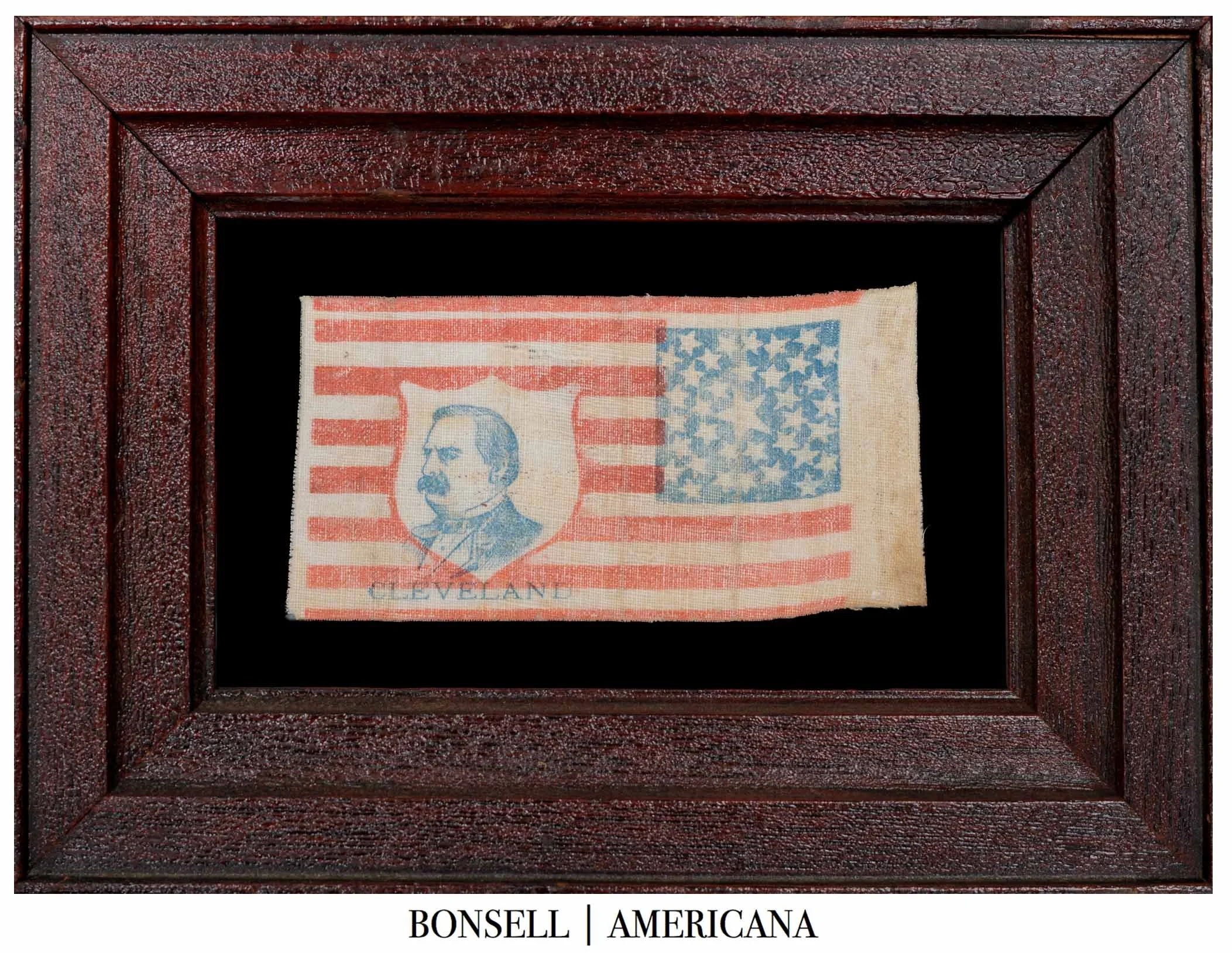
Frame Size (H x L): 6” x 8”
Flag Size (H x L): 2.25” x 4.25”
Offered is a miniature portrait campaign flag of Grover Cleveland, printed on coarse cotton and dating to the 1884 presidential election. The textile features Cleveland’s likeness rendered in blue within a shield, set against a field of red stripes and a blue canton populated by 36 stars. Beneath the portrait appears a bold, block-letter overprint reading “CLEVELAND,” executed in the same blue pigment. Small in scale yet visually assertive, the piece belongs to a scarce and highly collectible class of political textiles produced for campaign display and distribution.
The canton presents a medallion star configuration, a format rooted in mid-19th century design. A large central star—distinctively canted—anchors the composition, encircled by two rings of smaller stars, with additional stars completing the outer field. In total, the design incorporates 36 stars, corresponding to Nevada’s admission to the Union. While this count was official from July 4, 1865, to July 3, 1867, it was long obsolete by the time of Cleveland’s 1884 campaign, when the nation bore 38 states. The presence of a 36-star count here is therefore not literal, but instructive: it strongly suggests that the printing block employed for this flag originated earlier and was retained for later use. Rather than commissioning a new, updated design, printers appear to have repurposed an existing block, preserving both the earlier star count and the medallion format.
This retention of anachronistic imagery was not uncommon in inexpensive campaign ephemera. In this instance, it yields a visually compelling hybrid—late 19th-century political messaging expressed through a design vocabulary more typical of the Civil War era. The medallion configuration itself, with its celebratory and somewhat ornamental character, had largely fallen out of favor by circa 1890, replaced by rectilinear arrangements following the standardization of the flag in 1912. Its presence here adds both aesthetic distinction and historical depth.
Notably, the flag is presented in reverse orientation, with the canton appearing at the upper right rather than the upper left. This is not an error. During the 19th century, there was no official designation of a “front” or “back” to the American flag, nor a universally mandated canton position in printed parade flags and small textiles. As such, reverse-oriented examples like this are encountered and should be understood within the flexible conventions of the period.
The inclusion of a portrait within a shield is another point of distinction. While political textiles frequently incorporate candidate names or slogans, figural portraiture—especially integrated into a shield device—is less commonly encountered in flags of this scale. Cleveland’s likeness is crisply executed given the medium, with the shield serving both as a framing device and as a symbolic reference to national identity and civic virtue. The pairing of portrait and overprint reinforces the object’s intended function: immediate visual recognition in a crowded campaign environment.
From a production standpoint, the flag exhibits characteristics consistent with economical, large-quantity manufacture. The cotton is of a coarse, plain weave, and the pigments sit atop the fibers rather than penetrating them fully, indicative of block or stencil printing. Minor irregularities in saturation and registration are visible upon close inspection, lending the surface a slightly uneven but authentic quality. These features align with known examples of period campaign flags, which prioritized speed and cost-efficiency over refinement.
Historically, the flag relates to the fiercely contested 1884 presidential election between Grover Cleveland and James G. Blaine. Cleveland, the Democratic governor of New York, ran on a platform of reform and opposition to political corruption, while Blaine, the Republican nominee, carried the baggage of prior scandal. The campaign was marked by intense partisan rhetoric and remains one of the more colorful contests of the late 19th century. Objects such as this were produced to galvanize public support, serving as both promotional tools and personal tokens of political allegiance.
Examples of Cleveland campaign flags in this format are infrequently encountered, and those incorporating a medallion star field and portrait-on-shield design are particularly scarce. Campaign flags as a category occupy a special position within the field of American flag collecting, bridging political history and textile design. Their ephemeral nature—produced for short-term use and often discarded—has ensured that surviving examples are limited.
In sum, this is a compelling and visually distinctive example of late 19th-century political material culture: a Grover Cleveland campaign flag that combines an earlier star configuration, a dynamic medallion layout, and an uncommon portrait presentation within a single, compact textile.
Conservation Process: The flag was hand sewn to cotton fabric, and both were hand sewn to a mounting board. To prevent the black dye in the cotton fabric from seeping into the flag, it was first washed in a standard wash and then in a dye setting wash. The flag is positioned behind Optium Museum Acrylic.
Frame: A handsome 19th-century American frame with a rich, dark, hand-finished surface exhibiting pronounced craquelure throughout, indicative of age and original finish. The textured, slightly irregular surface and warm tonality provide a strong visual counterpoint to the textile, enhancing its period presence without distraction.
Condition Report: The flag shows expected wear consistent with its age and utilitarian purpose, including fraying along the edges, minor losses at the margins, and light soiling throughout. There is modest fading to the pigments and some unevenness in the print, inherent to its method of manufacture. Overall, the textile remains stable, with its imagery clear and highly legible.
Collectability Level: The Great – Perfect for Rising Collectors
Date of Origin: 1884
Number of Stars: 36
Associated War: The Indian Wars (1860-1890)
Associated State: Nevada
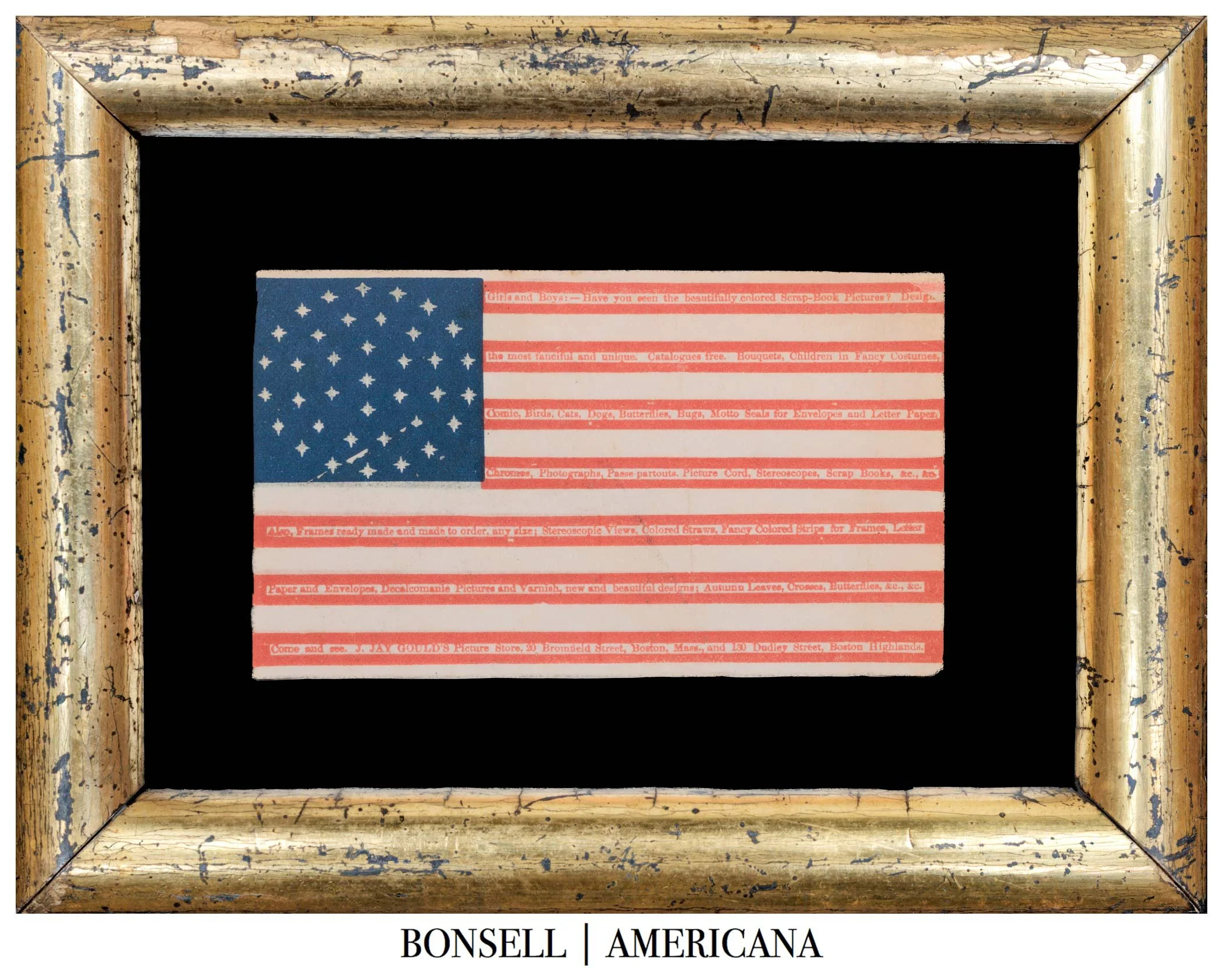
Frame Size (H x L): 6.5” x 8.5”
Flag Size (H x L): 2.75” x 5”
Offered is a 37-star American flag trade card, printed on paper and featuring an advertising overprint for J. Jay Gould’s Picture Store of Boston. Patriotic trade cards were widely produced in the late 19th century, but examples that combine an early star count with unusual graphic treatment and integrated advertising are less often encountered.
The star pattern is one of the more distinctive features. Arranged in a medallion formation with no outlying corner stars, the design departs from more typical linear or grid-based configurations. The stars themselves are also unusual. Rather than rounded or conventionally pointed forms, they have sharp, irregular points that give them an almost bursting appearance. The result is a more animated and expressive design than is usually seen in small printed flags of the period.
The placement of the advertising text is equally noteworthy. The overprint appears within the red stripes, executed in white lettering. In most known examples of overprinted patriotic paper items, text is placed in the white stripes for clarity and contrast. Here, the choice to print within the red required more careful registration and produced a more integrated effect, with the advertising functioning as part of the overall flag design rather than as a separate layer added afterward. This is an uncommon feature and one of the card’s most interesting visual characteristics.
The contents of the overprint offer insight into both the business itself and the consumer culture of the period. The text advertises “beautifully colored scrap-book pictures,” with catalogues offered free, and promotes a broad assortment of decorative and novelty goods. Among the subjects mentioned are bouquets, children in fancy costumes, comic scenes, animals, butterflies, and motto subjects for scrapbooks and letter paper. References to stereoscopic views and colored engravings reflect the strong demand for affordable visual material in the years after the Civil War, while the mention of frames made to order and “fancy colored mats” suggests that the shop also served customers interested in the display of images in the home. Other items, including albums, photographs, passe-partouts, picture cords, and ornamental paper goods, further indicate a business centered on the sale of inexpensive, attractive, mass-produced imagery and related decorative materials. Taken together, the overprint reads almost like a condensed catalogue of popular visual culture in the period.
The advertisement identifies J. Jay Gould’s Picture Store at 20 Bromfield Street and 120 Dudley Street in Boston. The presence of two addresses suggests an established retail operation serving different parts of the city, and the specificity of the imprint is useful both historically and for dating purposes. Trade cards such as this were intended to advertise, but they were also meant to be kept. Their small format, colorful presentation, and novelty value made them ideal for retention in albums and scrapbooks, which helps explain why surviving examples remain of interest today.
From a collecting standpoint, the piece sits at the intersection of early American flags and 19th-century advertising ephemera. The unusual star shapes, medallion configuration, and red-stripe overprint distinguish it from more standard examples, while its small format reflects its original purpose as a portable promotional item.
The 37-star count corresponds to Nebraska’s admission as the 37th state on March 1, 1867. The official 37-star flag remained in use from July 4, 1867 through July 3, 1877, placing this card within the Reconstruction era and into the years leading up to the 1876 Centennial, when patriotic imagery was widely employed in both civic and commercial settings. The star count therefore provides a clear historical framework for the piece.
Overall, this is a strong example of late 19th-century patriotic advertising, made more interesting by several features not commonly encountered in combination. The unusual medallion star pattern, the sharply stylized stars, the placement of the overprint in the red stripes, and the specific connection to a Boston picture store all contribute to its appeal. It is a compact but layered object that brings together graphic interest, historical context, and crossover value for collectors of both flags and advertising ephemera.
Frame: The card is housed in an antique frame with a lemon gold finish, characterized by a soft, pale gilt tone with a gentle luster. The finish is consistent with mid- to late-19th century gilt frames, circa 1850–1880, and presents a refined, understated appearance typical of the period.
Condition Report: The trade card has been professionally conserved by a paper conservator. There is expected light toning and minor wear consistent with age and handling, but the surface remains stable and well-preserved. Any prior issues have been addressed through conservation, allowing the piece to present cleanly while retaining appropriate signs of age.
Collectability Level: The Great – Perfect for Rising Collectors
Date of Origin: 1867-1876
Number of Stars: 37
Associated War: The Indian Wars (1860-1890)
Associated State: Nebraska

Frame Size (H x L): 6” x 8.5”
Flag Size (H x L): 3” x 5.5”
Offered is an eighteen-star advertising trade card in the form of a flag, dating to 1885.
THE OBVERSE
It is made of paper and its obverse includes the following overprint:
BUY THE
UNITED * STATES
PLAYING CARDS
MANUFACTURED BY THE RUSSELL & MORGAN PRINTING CO., CINCINNATI, O.
over
The Russel & Morgan Company was founded in 1867 by A.O. Russell and Robert J. Morgan, upon their purchase of the printing section of the Cincinnati Enquirer. In 1880, the Company purchased equipment to begin printing playing cards. By 1881, it was producing 1600 packs per day via a team of 20 employees. In 1894, the playing card business became so large that it was separated off into its own and called the United States Playing Card Company. It is still in existence today and is the largest playing card manufacturer in the world.
The canton of the flag includes a large center star and 17 stars bursting away from it. The inside of the center star includes “U.S.” printed in red. Typically, 18 stars is representative of Louisiana statehood. However, in the case of this flag, the count of 18 stars is likely just a function of what would fit in the canton as part of a starburst pattern.
The combination of the overprint across the stripes and the canton, the folksy subject matter, and the interesting star pattern makes for a tremendous combination of desirable features on a single flag.
THE REVERSE
The reverse of the trade card includes the following verbiage:
U.S. PLAYING CARDS.
PRICE LIST.
No. 9.—Oct. 1, 1885.
No. | Per Gross.
101. TIGERS…$7.50
Assorted Plaid, Star and Calico Backs.
155. TOURIST’S…13.50
Neat Set Pattern Backs.
188. CAPITOL…24.00
Enameled. Fancy Backs.
188.X CAPITOL…39.00
Gilt Edges. Enameled. Fancy Backs.
202. SPORTSMAN’S…36.00
Enameled, high finish. Assor’d Backs.
202.X SPORTSMAN’S…54.00
Gilt Edges. Enameled, high finish.
Assorted Backs.
303. ARMY AND NAVY…48.00
All Linen. Ass’d Fancy Backs. Double
Enam’d, highest finish. Cloth Boxes.
Superfine Poker Cards
404. CONGRESS…66.00
Finest Double Enameled. Gilt Backs.
Cloth Boxes
505. EXTRA ARMY AND NAVY…72.00
Gilt Edges. All Linen. Double Enam-
eled. Cloth Boxes.
606. EXTRA CONGRESS…90.00
Gilt Edges. Finest Double Enameled.
Cloth Boxes stamped in gold.
707. CABINET, FOR Progressive Euchre,…33.00
Double Enameled. Original Assorted
Backs. Cloth Boxes.
707.X CABINET, for Progr’ve Euchre…48.00
Gilt Edges. Cloth Boxes Stamped in
gold.
808. BICYCLE…18.00
White Enameled. Bicycle Backs.
Order by the above Numbers.
JAS. E. DAVIS & CO
DETROIT, MICH.
Conservation Process: This flag is positioned on a cotton rag board and behind Optium Museum Acrylic.
Frame: The antique frame has a crackled, painted surface. It dates to approximately 1880 and compliments the flag.
Condition Report: This flag is in excellent condition.
Collectability Level: The Good – Perfect for Beginning Collectors and Gifts
Date of Origin: 1885
Number of Stars: 18

Frame Size (H x L): 6.5” x 8”
Flag Size (H x L): 3” x 5.5”
Offered is a 34-star patriotic flag cover bearing a bold “UNION” printed across the canton within a Great Star arrangement. The placement of text on the canton—rather than along the stripes—is notably desirable and especially associated with the early Civil War period, when patriotic envelopes served as both stationery and expressions of political loyalty. Although this style of cover continued to appear into the 1880s, examples combining a Civil War star count, an uncommon star pattern, and an added slogan remain among the most sought-after varieties.
These patriotic envelopes were typically produced through relief printing in multiple stages, with different elements of the flag design printed from separate blocks or plates. Printers often applied the colors and any accompanying text in successive impressions, each requiring its own inking, alignment, and drying time. Because this work was done quickly and by hand in mid-19th-century job shops, period examples frequently show subtle variations in registration, ink density, and pressure.
The stars are arranged in the Great Star or Grand Luminary pattern, in which smaller stars form the outline of a single large star. This configuration is one of the most visually compelling designs encountered in 19th-century flags. Before President Taft’s 1912 Executive Order introduced the first formal regulations on star placement, American flag makers and patriotic printers enjoyed complete freedom in arranging the stars. Among the diverse patterns that emerged, the Great Star stands out both for its geometric harmony and for its early pedigree.
The pattern is traditionally credited to Captain Samuel Chester Reid, a naval hero of the War of 1812 whose defense of the privateer General Armstrong at the Battle of Fayal delayed a British naval squadron bound for New Orleans. Reid’s actions contributed materially to General Andrew Jackson’s ability to fortify the city, and he was celebrated as a national hero. In 1818, Reid participated in the discussions that produced the Flag Act of 1818, which restored the number of stripes to thirteen and established the practice of adding one star for each new state. Reid recommended the Great Star pattern as a standardized, easily recognizable arrangement, particularly useful for naval identification at long distances. Although no specific pattern was mandated by Congress, Reid’s design achieved considerable influence and enjoyed intermittent commercial popularity from the 1820s through the Civil War and into the Centennial era.
The 34-star flag reflects the admission of Kansas to the Union on January 29, 1861, a moment that carried significance well beyond the addition of a single state. Kansas’s entry concluded nearly a decade of sectional conflict—popularly known as “Bleeding Kansas”—in which pro-slavery and free-state factions violently contested the territory’s political future. Its ultimate admission as a free state on the eve of Lincoln’s inauguration underscored the deepening national divide and served as an early signal of the constitutional crisis that would erupt into civil war within weeks.
This star count became official on July 4, 1861, and remained so until July 4, 1863, when the wartime creation of West Virginia increased the count to 35. Because flag makers typically adopted new star counts immediately upon a state’s admission—rather than waiting for the formal July 4 effective date—many 34-star flags predate the opening shots at Fort Sumter. As a result, this configuration is strongly associated with the transitional period between political fracture and open conflict, and it is widely regarded by collectors as one of the most evocative star counts of the 19th century.
Both 34-star and 35-star flags were used throughout the Civil War and together encompass the official star counts of Lincoln’s presidency, though other star counts appeared in limited or anticipatory forms. They appeared on recruitment broadsides, volunteer militia banners, camp gear, and patriotic ephemera of all kinds, becoming central visual markers of Union identity during the conflict. For this reason, the 34-star configuration—situated at the threshold of war—remains especially prized for its association with the earliest mobilization of Northern sentiment and the preservation of the Union.
This example, combining a Civil War-era star count, a rare Great Star medallion, and a bold UNION slogan printed directly on the canton, represents a compelling intersection of patriotic imagery and wartime sentiment.
Conservation Process: The flag is sandwiched between cotton rag board and a UV resistant acrylic.
Frame: The flag cover is housed in an older wooden frame with a dark, timeworn surface and an applied gilded inner lip.
Condition Report: The cover remains in very good condition with strong color retention and only light scattered surface wear typical of mid-19th-century patriotic envelopes. Minor toning and small handling marks are present but do not detract from the clarity or overall presentation of the piece.
Collectability Level: The Great – Perfect for Rising Collectors
Date of Origin: 1861-1890
Number of Stars: 34
Associated War: The Civil War (1861-1865)
Associated State: Kansas

Frame Size (H x L): 5” x 6.25”
Flag Size (H x L): 1.5” x 2”
Offered is a 13-star American flag ribbon dating to the period between approximately 1876 and 1910. Woven entirely of silk rather than printed, the flag’s stars and stripes are integrated directly into the weave, producing a luminous, ribbed texture that reflects the higher level of craftsmanship found in woven badge ribbons of the late 19th century. The canton bears thirteen white stars arranged in the 3-2-3-2-3 pattern—the configuration most frequently encountered on 19th-century examples and one that recalls the early federal symbolism of the nation’s formative years. These ribbons were made in various sizes and formats to adorn lapels, medals, and fraternal insignia, serving as subtle yet fashionable expressions of patriotism.
The 3-2-3-2-3 arrangement of stars emerged as one of the earliest and most enduring patterns for 13-star flags. Though the precise layout of the original 1777 flag was never specified, makers from the late 18th century onward experimented with multiple constellations. The staggered rows of the 3-2-3-2-3 pattern provided an appealing sense of symmetry and movement while remaining easily reproducible by hand or loom. By the mid-19th century, this configuration had become the de facto standard for small printed and woven flags representing the original thirteen colonies. Its visual balance and historical associations made it especially popular during periods of patriotic revival, including the Centennial of 1876 and later commemorative events.
The production of such ribbons coincided with a period of heightened national pride and commemoration that followed the Civil War. The Centennial of 1876 inspired an outpouring of decorative and utilitarian objects bearing early American motifs, and the 13-star flag emerged as a favored emblem of that movement. Its revival continued into the Spanish–American War era, when veterans’ organizations, political groups, and civic associations adopted historic symbols of the Revolution to evoke unity and national strength. Woven flag ribbons like this one were distributed at parades, reunions, and public celebrations, linking modern expressions of loyalty to the founding ideals of the Republic.
Although the 13-star flag was official only from 1777 to 1795, its enduring use in the late 19th and early 20th centuries reflects how deeply the design had become embedded in America’s visual language of heritage and patriotism.
Conservation Process: This flag was hand sewn to cotton fabric, and both were hand sewn to a mounting board. To prevent the black dye in the cotton fabric from seeping into the flag, it was first washed in a standard wash and then in a dye setting wash. The flag is positioned behind Optium Museum Acrylic.
Frame: The ribbon is presented in an oval solid hardwood frame fitted with a gilded metal liner. The frame is carved from a single block of wood and retains a warm, reddish-brown finish that contrasts nicely with the bright metallic inner molding.
Condition Report: The ribbon remains in excellent condition, with vibrant color and strong silk luster. The weave is tight and stable, with no tears, fraying, or areas of loss.
Collectability Level: The Good – Perfect for Beginning Collectors and Gifts
Date of Origin: 1876-1910
Number of Stars: 13
Associated War: The Civil War (1861-1865)
Associated State: Original 13 Colonies
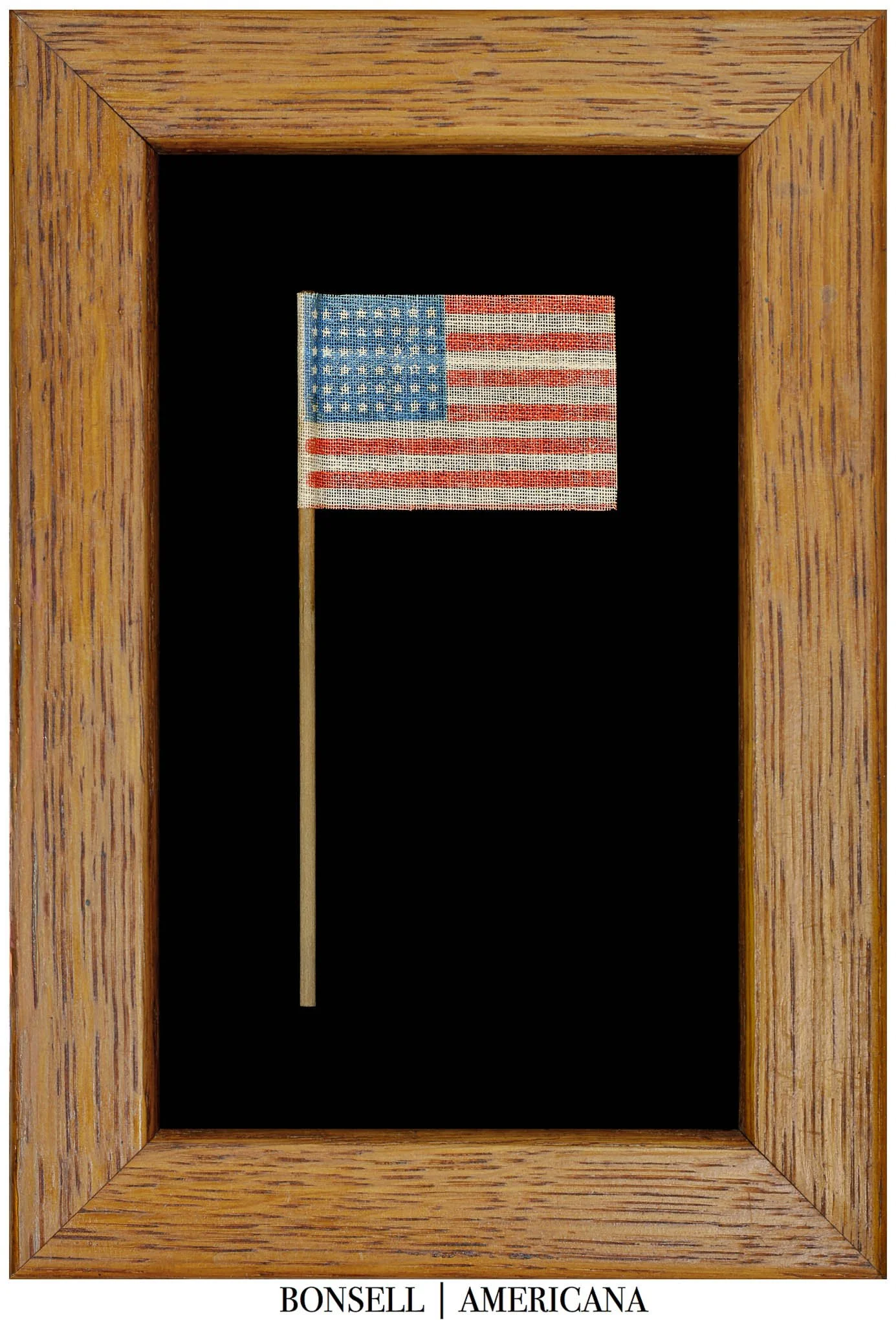
Frame Size (H x L): 10.75” x 7.25”
Flag Size (H x L): 2” x 3” and Affixed to a 6” Staff
Offered is a 48-star American national flag printed on glazed cotton and mounted on its original wooden staff. The fabric displays a distinctive open-weave texture visible between the printed elements and retains a faint surface sheen from the original glazing. This treatment, typical of parade flags from the early 20th century, stiffened the cloth, enhanced brightness, and provided limited resistance to moisture during outdoor use. The weave and finish are consistent with printed parade flags made between 1912 and 1930, when lightly glazed cotton was the preferred medium for economical yet visually striking patriotic display.
The stars are arranged in six straight horizontal rows of eight—known as the 8-8-8-8-8-8 configuration—adopted as the official layout following President William Howard Taft’s Executive Order of June 24, 1912. This rectilinear pattern replaced the varied and often irregular designs of earlier flags, marking the first formal standardization of the American flag’s star arrangement. The compact canton and irregular ink saturation seen here reflect early printing methods, likely achieved by roller or block press before the widespread use of rotary or screen processes.
The 48-star flag represents the admission of New Mexico (January 6, 1912) and Arizona (February 14, 1912) as the 47th and 48th states. Officially adopted on July 4th of that year, it remained the national banner for forty-seven years—longer than any design before it. During this period, the flag accompanied the United States through both World Wars, the Great Depression, and the Korean War, symbolizing a nation emerging as a global power. It was flown at countless milestones in American history—from the dedication of the Lincoln Memorial and the raising at Iwo Jima to the presidencies of Taft, Wilson, Harding, Coolidge, Hoover, Roosevelt, Truman, and Eisenhower. Its longevity and ubiquity make the 48-star flag one of the most recognizable and enduring designs in the evolution of the Stars and Stripes.
Small parade flags such as this were distributed at patriotic celebrations, political rallies, and community parades throughout the early decades of the 20th century. Their lightweight construction and bright printed colors made them inexpensive to produce yet expressive symbols of civic pride. Surviving examples are prized for their authenticity and connection to a formative era in America’s national identity.
Conservation Process: This flag was hand sewn to cotton fabric, and both were hand sewn to a mounting board. To prevent the black dye in the cotton fabric from seeping into the flag, it was first washed in a standard wash and then in a dye setting wash. The flag is positioned behind Optium Museum Acrylic.
Frame: The frame is made of solid oak with a warm golden finish and pronounced quarter-sawn grain. Its clean lines and straightforward joinery reflect early 20th-century craftsmanship and design sensibilities.
Condition Report: The flag remains in excellent condition with vibrant color and only mild, natural oxidation to the white cotton. Minor wear appears along the hoist where the fabric was wrapped around the original wooden staff, but there are no tears, losses, or repairs.
Collectability Level: The Good – Perfect for Beginning Collectors and Gifts
Date of Origin: 1912-1930
Number of Stars: 48
Associated War: WWI, WWII, and Korean War
Associated State: Arizona
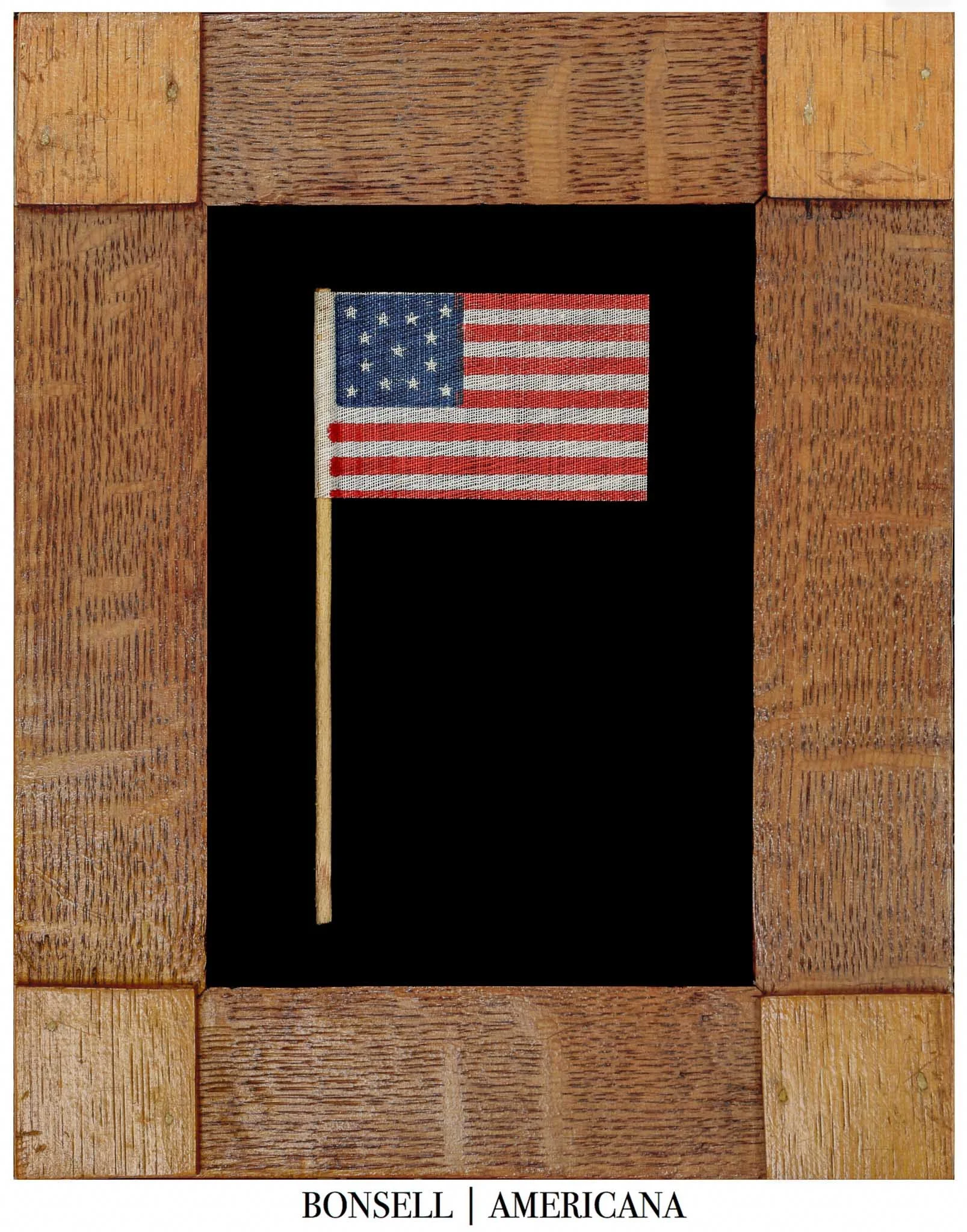
Frame Size (H x L): 10.75” x 8.5”
Flag Size (H x L): 2” x 3” and Affixed to a 6” Staff
Offered is a 13-star printed parade flag produced to commemorate the Centennial of American independence in 1876. A decade after the Civil War, the Centennial inspired an extraordinary outpouring of patriotism and national pride. Communities across the reunited states—large cities and small towns alike—organized parades, civic pageants, and decorative displays. Homes, schools, and public buildings were draped in red, white, and blue bunting, with the national flag serving as the central symbol of unity and renewal.
The most ambitious celebration was the Centennial International Exposition in Philadelphia, the first official World’s Fair held in the United States. Over six months, nearly ten million visitors attended, marveling at technological and cultural exhibits that defined America’s industrial ascendance. Among its landmark presentations were the debut of Alexander Graham Bell’s telephone and the Corliss Steam Engine—then the largest engine ever built.
At the time of the Exposition, the official star count of the United States flag was 37, reflecting the admission of Nebraska in 1867. Yet 1876 also marked the entry of Colorado as the 38th state, earning it the nickname “The Centennial State.” Flag makers, always eager to anticipate new additions, produced both 38-star flags and, for symbolic and historical reasons, 13-star flags—reviving the design of the original Revolutionary era as a nostalgic emblem of the nation’s birth. During the Centennial year, these 13-star flags were among the most popular decorative forms seen in parades, civic halls, and patriotic displays.
The use of the 13-star format dates to June 14, 1777, when the Continental Congress resolved: “That the flag of the United States be made of thirteen stripes, alternate red and white; that the union be thirteen stars, white on a blue field, representing a new constellation.” This pattern represented the original colonies and remained official until 1795, when two stars and two stripes were added for Vermont and Kentucky. Nonetheless, the 13-star configuration never disappeared.
It remained in continuous ceremonial use well into the nineteenth century. The U.S. Navy flew 13-star ensigns on small boats from 1795 through 1916 to maintain clear identification at sea. The design was hoisted at the death of George Washington in 1799, and again during the nation’s semicentennial in 1824, when General Lafayette toured the United States as a living link to the Revolution. Similar flags reappeared during subsequent patriotic moments—the Mexican War (1846–1848), the Civil War (1861–1865), and the Centennial celebrations of 1876—each time symbolizing a return to the founding ideals of the Republic.
By the time this example was produced, the 13-star flag had evolved from a functional design into a revered patriotic motif—an emblem not of a single moment, but of the enduring American story from independence through reconciliation and progress.
Conservation Process: The flag was hand sewn to cotton fabric, and both were hand sewn to a mounting board. To prevent the black dye in the cotton fabric from seeping into the flag, it was first washed in a standard wash and then in a dye setting wash. The flag is positioned behind Optium Museum Acrylic.
Frame: The flag is presented in a period-style cornerblock frame made of oak, modeled after late 19th-century designs. The frame itself likely dates to the mid-20th century and is joined at the miters with corrugated fasteners typical of that period.
Condition Report: The flag remains in excellent condition, with strong color retention and only light toning to the white areas. The glazed cotton is stable and well-preserved, showing no notable fraying or loss beyond a few small areas where the fabric was wrapped around the staff.
Collectability Level: The Good – Perfect for Beginning Collectors and Gifts
Date of Origin: 1876
Number of Stars: 13
Associated War: The Indian Wars (1860-1890)
Associated State: Original 13 Colonies
Frame Size (H x L): 6.5” x 7.5”
Flag Size (H x L): 2.25” x 3.25”
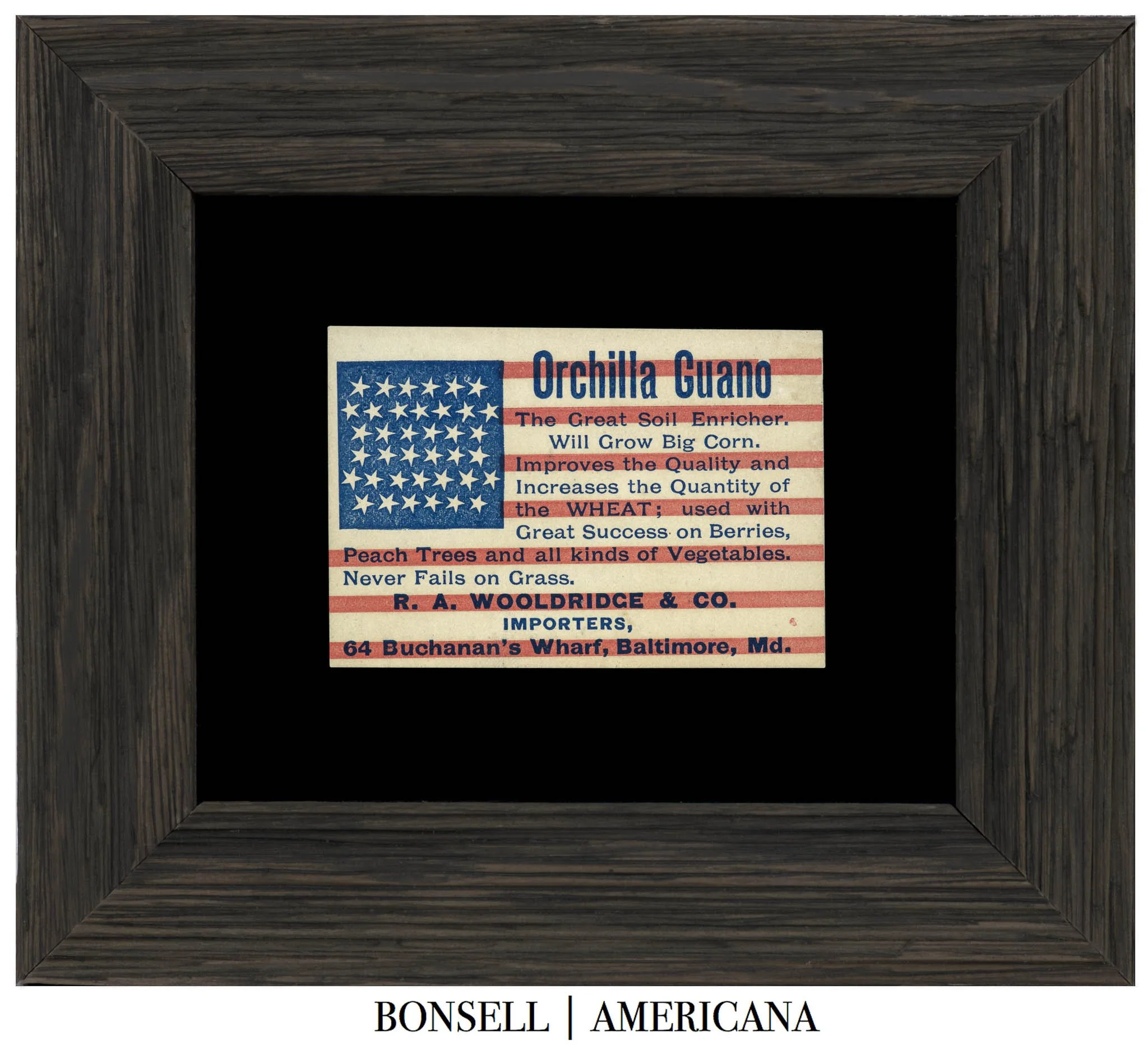
Offered is a thirty-eight star flag with a 6-7-6-6-7-6 configuration, presented in the form of a trade card. A trade card was an early form of advertising, popular in the 18th and 19th centuries, distributed by businesses to promote their products or services. These cards were typically small, printed on thick paper, and often elaborately designed, featuring images, product descriptions, and the company’s contact information. Trade cards functioned both as advertisements and business cards, providing potential customers with promotional or informational content.
In the 19th century, trade cards gained popularity in the U.S. and Europe due to advances in lithography, which made colorful and artistic prints more accessible. Businesses across many industries—from agriculture, such as the "Orchilla Guano" card advertising a soil enricher, to clothing and machinery—used them as a key marketing tool. Trade card collecting became a widespread hobby, which is why many of these cards have survived to the present day.
The Overprint
The trade card offered here includes the following overprint:
Orchilla Guano
The Great Soil Enricher.
Will Grow Big Corn.
Improves the Quality and
Increases the Quantity of
the WHEAT; used with
Great Success on Berries,
Peach Trees and all kinds of Vegetables.
Never Fails on Grass.
R. A. Wooldridge & Co.
IMPORTERS,
64 Buchanan's Wharf, Baltimore, Md.
Orchilla guano is a type of fertilizer made from seabird droppings, primarily found on islands in tropical and subtropical regions. This nutrient-rich guano is highly effective due to its concentrations of nitrogen, phosphate, and potassium—essential nutrients for plant growth. Guano has been used in agriculture for centuries, valued for its ability to improve soil fertility and boost crop yields. Its effectiveness stems from the natural processes that concentrate these valuable nutrients over time.
During the 19th century, guano played a significant role in global agriculture. Countries like the United States heavily relied on guano imports to replenish exhausted soils. Orchilla guano, sourced from the Orchilla Islands in Venezuela, became particularly popular with farmers looking to improve their corn, wheat, and other crop production. Its effectiveness made it a highly sought-after resource, and the guano trade became a significant industry, marking the "Guano Age" in agricultural history.
R. A. Wooldridge & Co.
R. A. Wooldridge & Co., located at 64 Buchanan's Wharf in Baltimore, Maryland, was a prominent importer during the 19th century, a period when Baltimore was a critical hub for trade and commerce. The company’s strategic location along the bustling waterfront enabled it to import goods like Orchilla guano efficiently, connecting domestic markets with international suppliers. Specializing in a range of imported products, R. A. Wooldridge & Co. contributed significantly to the flow of materials that supported regional agricultural and industrial sectors.
The firm gained a reputation for its reliability in ensuring the timely delivery of essential goods, becoming a key player in Baltimore’s maritime economy. Its operations were integral to the city’s growth as an industrial and commercial center, exemplifying the entrepreneurial spirit of 19th-century Baltimore as it fostered international trade connections that shaped the city’s economic landscape.
Thirty-Eight Star Flags Generally
The thirty-eight star flag represents the inclusion of Colorado into the Union. Colorado was admitted on August 1st, 1876, and this flag became official on July 4th, 1877. Presidents Hayes, Garfield, Arthur, Cleveland, and Harrison all served under this flag. Colorado earned the nickname "The Centennial State" due to its statehood occurring just twenty-eight days after the nation's centennial. While the official U.S. flag in 1876 had thirty-seven stars, flag makers often produced anticipatory flags ahead of official changes. As a result, the thirty-eight star flag—along with the thirteen star flag—were the two flags flown during the centennial celebrations of 1876.
The nation’s centennial in 1876 sparked a wave of patriotism across the country, helping reunite its citizens. Cities large and small hosted parades and celebrations, with homes and buildings adorned in red, white, and blue. Flags became the primary symbol of national pride. The most notable event was the Centennial International Exposition in Philadelphia, which hosted nearly 10 million visitors over six months and showcased groundbreaking exhibits such as the Corliss Steam Engine and Alexander Graham Bell’s telephone.
The thirty-eight star flag remained official until July 4th, 1890, when the forty-three star flag replaced it to represent the inclusion of North Dakota, South Dakota, Montana, Washington, and Idaho into the Union.
Conservation Process: This flag is positioned on a cotton rag board and behind Optium Museum Acrylic.
Frame: The frame features a rustic, wood-grain finish with a deeply textured pattern.
Condition Report: The front shows some light toning but remains in excellent overall condition. On the back, there are four small tape or glue marks, none of which are visible from the front.
Collectability Level: The Good – Perfect for Beginners and Gifts
Date of Origin: 1876-1889
Number of Stars: 38
Associated War: The Indian Wars (1860-1890)
Associated State: Colorado
Price: Call 618-553-2291, or email info@bonsellamericana.com
Frame Size (H x L): 9” x 10.5”
Flag Size (H x L): 4” x 5.75”
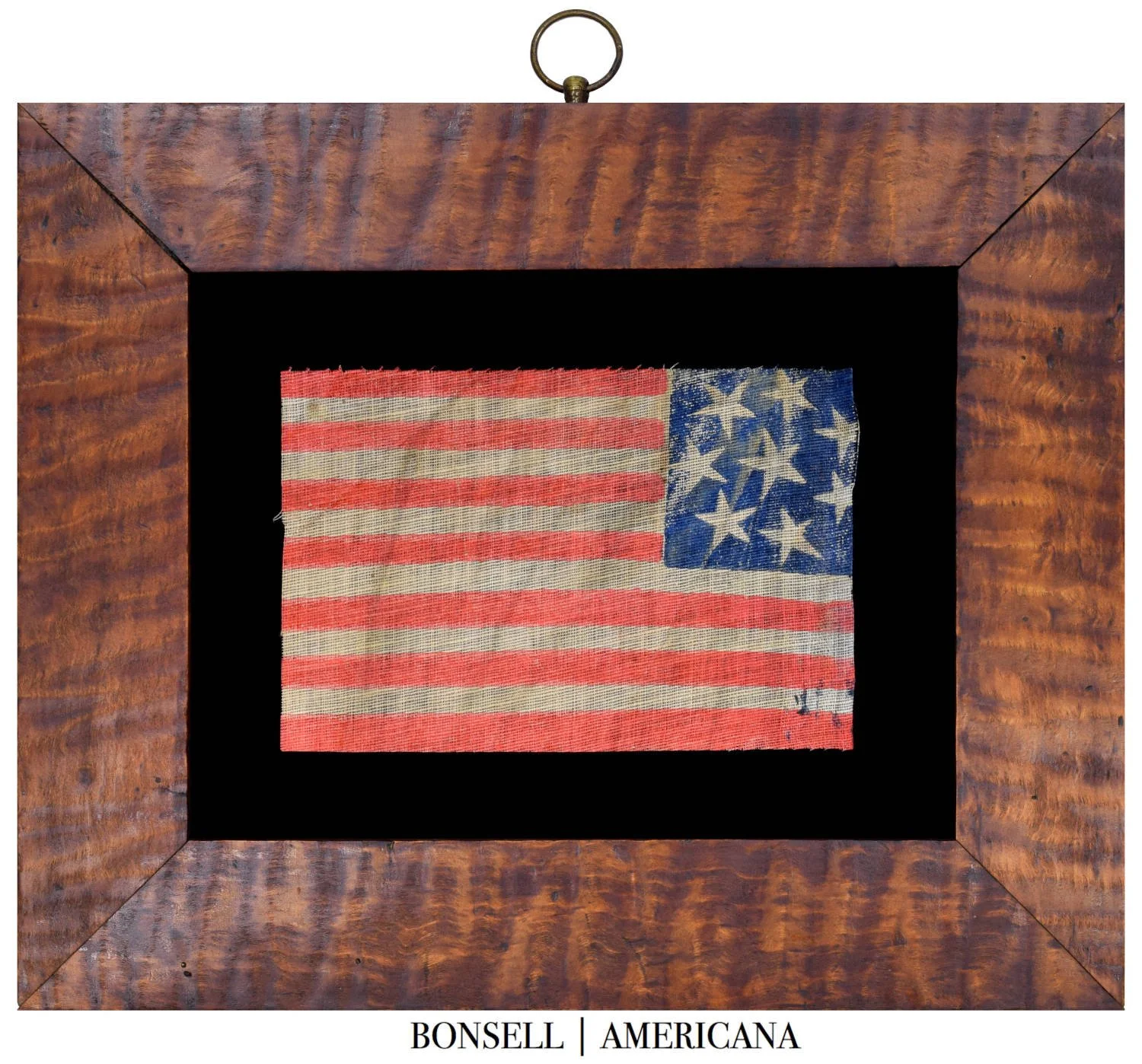
Offered is a rare eight-star parade flag made in celebration of Virginia's secession from the Union. It is printed on glazed cotton and includes stripes that lean towards orange. The star pattern includes a canted center star, and it is surrounded by a ring of randomly canted stars of the same size. All of the stars are poorly and whimsically printed, as is often the case on flags dating to the Civil War.
Seven-star flags were made with Southern sympathies and commemorated the first wave of states that seceded from the Union, starting in February of 1861. The first wave included Louisiana, Georgia, Alabama, Florida, Mississippi, South Carolina, and Texas. Later, in April of 1861, Virginia seceded as the eighth state. Similar to the seven-star flags, this eight-star version commemorated the secession of the Southern states and, specifically, the historically important state of Virginia.
All known eight-star parade flags date to the Civil War, while some seven-star parade flags date to as late as 1890. Of the parade flags having fewer than thirteen-stars, the eight and nine-star versions are by far the rarest. Seven-star parade flags, for example, outnumber their eight-star counterparts by a ratio of 100-to-1.
This flag was manufactured in a reverse mount orientation. A reverse mount is one in which the canton of a US flag is positioned in the upper-right corner. Current flag ethics state that the canton should always be placed on upper-left, but such a requirement did not exist in the 19th century.
Conservation Process: This flag was hand sewn to cotton fabric, and both were hand sewn to a mounting board. To prevent the black dye in the cotton fabric from seeping into the flag, it was first washed in a standard wash and then in a dye setting wash. The flag is positioned behind Optium Museum Acrylic.
Frame: The frame is made of tiger maple and dates to approximately 1840. It is a highly desirable frame and outstanding in its appearance.
Condition Report: There is some staining and fading across the surface. There is a blue stain on the bottom white stripe, along and near the right edge. This stain appears to be a period stain, likely as a result of the printing process. A portion of the right edge is missing, perhaps because it was originally affixed to a staff via glue.
Collectability Level: The Best – Perfect for Advanced Collectors
Date of Origin: 1861
Number of Stars: 8
Associated War: The Civil War (1861-1865)
Associated State: Virginia

Frame Size (H x L): 11” x 9.25”
Flag Size (H x L): 5.5” x 4”
Offered is a French tricolor flag, discovered with a memorial card dated August 15, 1873, that narrates a story that weaves together the fabric of France's tumultuous 19th century with the personal grief and political aspirations of the Bonaparte lineage.
The French flag—with its bands of blue, white, and red—stands as an icon of the Republic and a testament to the tumult of revolution. Its roots stretch back to the French Revolution, when in July 1789, after the storming of the Bastille, the ancient regime's white was merged with the blue and red of the Paris militia to form a symbol of unity and the newfound republicanism. Over the years, this emblem has stood as a beacon of liberty, equality, and fraternity—the founding principles of the Republic.
However, the flag's journey through history is as storied as the nation it represents. During the reign of Napoleon Bonaparte, the tricolor was hoisted as a symbol of the revolutionary ideals that had catapulted him to power. It fluttered across Europe as the Grande Armée marched from victory to victory, and it graced the institutions of the Napoleonic state. Later, under Napoleon III, it came to symbolize the Second Empire's modernity and authority, a period marked by industrial expansion, urban transformation, and a fraught relationship with the burgeoning forces of nationalism and republicanism.
The discovery of the tricolor, inscribed with "VIVE NAPOLÉON III," alongside the memorial card, casts the flag not merely as a national emblem but as a personal signifier of loyalty and remembrance. This particular flag, likely used at a tribute to the late emperor, signifies a period of nostalgia for the Bonapartist regime, a time when the tricolor was intertwined with the Emperor's vision for France—a vision abruptly halted by the Franco-Prussian War and the subsequent declaration of the Third Republic.
As a piece of political memorabilia, the flag, found with the Prince Imperial's card, becomes a poignant emblem of fidelity to the fallen empire. The Prince's words, encapsulating the gratitude and principles of his father's reign, provide the context needed to understand the flag's presence at such a tribute. It would have been a backdrop to somber commemorations, perhaps held aloft by those who remembered the days of the empire with fondness and who sought to keep the memory of Napoleon III alive in the collective consciousness of the Bonapartist faction.
The significance of the flag is further enriched by its presence at a tribute tied to such a specific date. The Feast of the Assumption, a day steeped in religious and, by extension, monarchical tradition, provided a fitting backdrop for honoring a man who had sought to reconcile the ideas of empire with the republican sentiment of a modern France. It is a reminder of the ebb and flow of French history, where republics rise and fall, emperors come and go, but the flag remains a constant—though its meaning shifts with the tides of time.
The combined narrative of the flag and the card tells a story of a France at the crossroads of its past and future. The tricolor, once a revolutionary standard, then an imperial ensign, now emerged as a symbol of collective memory and a focal point for political and familial loyalty. It is a testament to the flag's enduring ability to embody the values and sentiments of its people—whether they be the revolutionary masses, the imperial guard, or the nostalgic loyalists of a bygone era.
In the folds of the tricolor, one can read the history of France—a history of revolution, of empire, of the aspiration to liberty, and the complex dance of continuity and change. The flag, in its discovery with the memorial card, thus serves not only as a piece of historical evidence but as a reminder of the power of symbols to encapsulate the essence of a nation and the hearts of its people. It is a silent yet resounding affirmation of the unbroken spirit of France, a spirit that, much like the tricolor, endures and adapts, forever woven into the fabric of history.
ADDITIONAL BACKGROUDN MATERIAL: TRANSLATION OF THE MEMORIAL CARD
PLEBISCITE
From December 10, 1848
5,434,226 yes
PLEBISCITE
From December 20, 1851
7,473,531 yes
PLEBISCITE
From November 21-22, 1852
7,824,489 yes
PLEBISCITE
From May 8, 1870
7,350,142 yes
AUGUST 15, 1873
I thank you in the name of the Empress and myself for coming to join your prayers with ours, and for not forgetting the path you have arduously traveled a few months ago; I also thank the faithful friends who have sent us from afar numerous testimonies of their affection and their devotion.
As for myself, in exile and near the Emperor's tomb, I meditate on the teachings he left me; I find in the paternal heritage the principle of national sovereignty and the flag that consecrates it.
This principle, the founder of our dynasty summarized it in these words, to which I will always be faithful:
Everything for the People and by the People.
[Signature of Napoleon]
Paris. Ehrmann, photographer, 20, Chaussée d'Antin.
Typ. Monis et Fils, 61, Rue Amelot.
FINAL NOTES
The card's message, attributed to the Prince Imperial, serves not only as a eulogy to his father but also as a solemn vow to uphold the Napoleonic ideals of national sovereignty. A plebiscite, as listed at the beginning of the card, is a direct vote by the entire electorate on a specific proposal, often used to decide a critical constitutional or political question. This process, employed significantly during the Napoleonic era, underscored the principle of direct public participation in governance. The Prince's commitment to "Everything for the People and by the People" reflects a lineage that, despite the tides of political change, remained dedicated to the welfare of France. It is this dedication that resonates with the symbolism of the flag found beside it, a remembrance of the past and a pledge for the future.
Conservation Process: This flag was hand sewn to cotton fabric, and both were hand sewn to a mounting board. To prevent the black dye in the cotton fabric from seeping into the flag, it was first washed in a standard wash and then in a dye setting wash. The flag is positioned behind Optium Museum Acrylic.
Frame: This flag is in a Birdseye Maple frame, dating to the middle of the 19th century.
Condition Report: There are minor stains and small spots across the surface of the flag. These are consistent with its age and do not detract from the overall integrity and appeal of the piece.
Collectability Level: The Great – Perfect for Rising Collectors
Date of Origin: 1864-1867
Number of Stars: 36
Associated War: Civil War (1861-1865)
Associated State: Nevada
Frame Size (H x L): 10.25” x 7.5”
Flag Size (H x L): 6.5” x 3.5”
Offered is a vertically oriented and highly unusual 42-star American parade flag, printed on open-weave, plain weave cotton and bearing a commemorative overprint for an Ancient Order of United Workmen (A.O.U.W.) Fourth of July picnic held in 1896. The flag displays a distinctly folk quality, with 42 stars arranged in six linear rows of seven stars each. The stars vary noticeably in shape and placement, lending the design a charmingly irregular appearance despite its commercially printed construction.
Adding substantially to the appeal of the present example is the overprinted decoration occupying the center of the striped field. Printed in dark blue ink, the design advertises an “A.O.U.W. Picnic” held on July 4th, 1896. At center is the emblem of the Ancient Order of United Workmen, incorporating a shield, anchor, symbols of fraternity and labor, and radiating lines that emphasize the device in a manner reminiscent of a medal or civic badge. Encircling the emblem is the organization’s Latin motto, “alter alterius auxilio eget,” generally translated as “each needs the help of another.” The phrase succinctly expressed the society’s central principle of mutual aid and collective responsibility.
Founded in 1868 by John Jordan Upchurch, the Ancient Order of United Workmen emerged during a period when commercial life insurance remained beyond the reach of many working Americans. The organization combined social fellowship, civic engagement, and a system of mutual financial protection through which members contributed to a fund providing benefits to the families of deceased brethren. The concept proved enormously successful. By the final decades of the 19th century, the A.O.U.W. had become one of the largest fraternal organizations in the nation and served as a model for many later fraternal insurance societies.
Public gatherings formed an important component of lodge life. Picnics, parades, excursions, and Independence Day celebrations provided opportunities for members and their families to gather while simultaneously promoting the organization’s ideals within the broader community. Textiles such as the present example were produced specifically for such occasions and served as both patriotic decorations and commemorative souvenirs. Their survival rate was naturally low, owing to their lightweight construction and intended use during outdoor festivities.
The 42-star count reflects the admission of Washington as the 42nd state on November 11th, 1889. In accordance with the Flag Act of 1818, the 42-star flag became official on July 4th, 1890. Its official period was exceptionally brief, lasting just one year before the admissions of Idaho and Wyoming resulted in the 44-star flag on July 4th, 1891.
Interestingly, the overprint on the present example is dated July 4th, 1896, several years after the official period of the 42-star flag. While this might initially appear contradictory, such discrepancies are frequently encountered on 19th century parade flags and other commercially printed patriotic textiles. Manufacturers often continued to employ existing printing patterns long after a particular star count had passed from official use, especially on inexpensive souvenir, advertising, and commemorative flags. As a result, it is not unusual to encounter late 19th century examples bearing star counts that predate the event or occasion for which they were produced. In this case, the 1896 overprint provides the most reliable evidence for the date of its event-related production and use.
The combination of a 42-star count, folksy presentation, open-weave cotton construction, and dated fraternal overprint creates an object that exists at the intersection of American flag collecting, social history, and fraternal benefit society history.
Conservation Process: The flag was hand sewn to cotton fabric, and both were hand sewn to a mounting board. To prevent the black dye in the cotton fabric from seeping into the flag, it was first washed in a standard wash and then in a dye setting wash. The flag is positioned behind Optium Museum Acrylic.
Frame: The flag is in an attractive tiger maple frame. Tiger maple frames are cherished for their striking, wavy grain patterns that shimmer with a unique iridescence, reminiscent of a tiger's coat.
Condition Report: The flag presents with expected wear for its age and lightweight construction, including fraying and small losses along the edges. There is scattered soiling, fading, and surface abrasion throughout, with areas of ink and pigment loss, particularly in the canton.
Collectability Level: The Good – Perfect for Beginning Collectors and Gifts
Date of Origin: 1896
Number of Stars: 42
Associated State: Washington