
Price: Call 618-553-2291, or email info@bonsellamericana.com
Frame Size (H x L): 32” x 34”
Flag Size (H x L): 21” x 23”
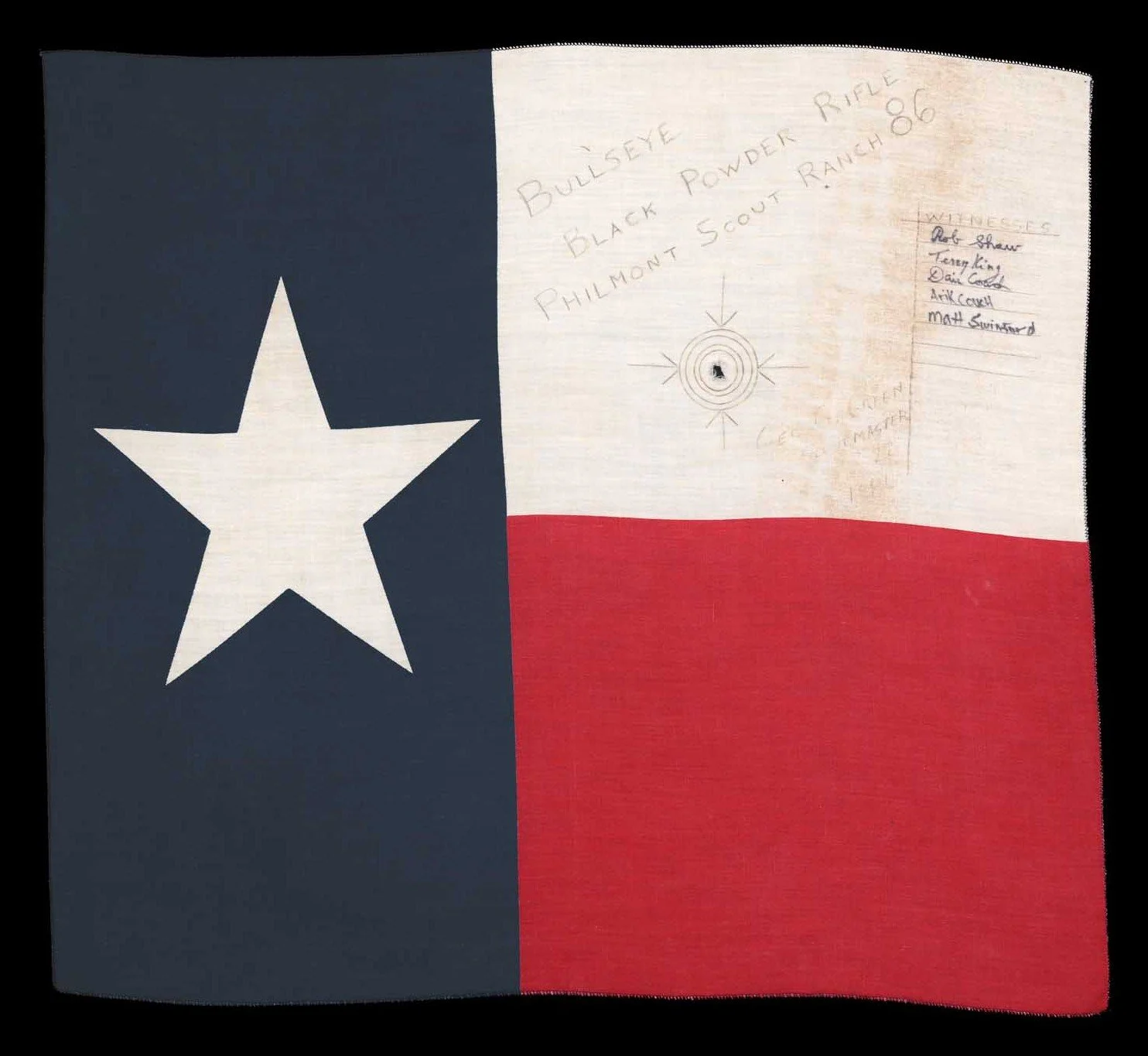
Offered is a particularly fun and highly personal Texas state flag, dating to 1986 and used during a black powder rifle exercise at Philmont Scout Ranch in northern New Mexico. Printed on a single piece of cotton, the flag was transformed from an otherwise straightforward Texas flag into a one-of-a-kind record of a Scout experience through a combination of handwritten inscriptions, a drawn bullseye, a remarkably centered bullet hole, and the names of those who witnessed the shot.
Across the white field, written in pencil, are the words “Bullseye,” “Black Powder Rifle,” “Philmont Scout Ranch,” and “86.” Below this inscription is a hand-drawn target composed of concentric circles and directional marks. At the very center is the actual bullet hole, placed almost perfectly within the bullseye. The relationship between the drawn target and the shot is what gives the flag much of its appeal. This was not simply a flag carried to camp or signed as a souvenir; it was deliberately preserved as evidence of a memorable shot.
To the right is a ruled box headed “WITNESSES,” followed by the names of five individuals. These appear to read Rob Shaw, Terry King, an additional name that is presently difficult to decipher, Arik Couch, and Matt Swinford. Elsewhere, a much lighter inscription appears to identify a Scoutmaster with the surname Green, lending another layer of documentation to the event. Taken together, the inscriptions have the character of a group making an informal record immediately following the shot—essentially turning the flag into a trophy, certificate, and camp souvenir all at once.
The setting is significant. Philmont Scout Ranch, near Cimarron, New Mexico, is one of the most storied institutions in American Scouting. The ranch traces its origins to oilman Waite Phillips and his wife, Genevieve, who donated more than 127,000 acres to the Boy Scouts of America in two major gifts in 1938 and 1941. The first Scouts arrived in 1939, when the property was known as Philturn Rocky Mountain Scoutcamp; following the larger 1941 gift, it became Philmont Scout Ranch. Today the property encompasses roughly 140,000 acres of mountainous backcountry and has hosted generations of Scouts in programs centered on hiking, outdoor skills, western history, conservation, and marksmanship.
Black powder shooting has long been one of Philmont's historically themed activities. Participants learn the process of loading and firing a muzzle-loading rifle using the traditional components of powder, patch, ball, ramrod, and percussion cap. Modern Philmont program literature describes the use of .50- and .58-caliber muzzle-loading rifles, with the activity intended not only as a shooting exercise but also as an introduction to the firearms and methods associated with nineteenth-century western life. Although the precise circumstances surrounding this 1986 shot are not known, the inscriptions leave little doubt that the flag was connected directly to such a black powder rifle exercise at Philmont.
What makes the piece especially compelling is the way the participants documented the moment. A successful shot at camp might ordinarily survive only as a story or perhaps a paper target. Here, however, someone chose a Texas flag, drew the target directly onto it, recorded the location and type of shooting, dated the event, and had witnesses identify themselves alongside it. The bullet hole at dead center makes the story immediately understandable without explanation. The result is less a conventional flag than a piece of American vernacular history—an object created spontaneously to commemorate a small but evidently memorable achievement.
The use of a Texas flag adds another layer of character. The familiar Lone Star design originated as the national flag of the independent Republic of Texas. The Texas Congress approved the design on January 25, 1839, during the presidency of Mirabeau B. Lamar. Its composition—a vertical blue field containing a single white star, together with horizontal white and red fields—later became the state flag and remains essentially unchanged.
Under the modern Texas Flag Code, the colors are assigned the meanings of blue for loyalty, white for purity, and red for bravery. Earlier recommendations made during the Republic period proposed somewhat different symbolism—blue for friendship, white for peace, and red for war—but that language was not formally adopted by the Texas Congress. The lone five-pointed star became the enduring emblem of Texas itself, one whose history reaches back to the Republic and ultimately gave Texas its familiar identity as the Lone Star State.
Against that history, this particular flag has an especially American quality. It combines the iconography of Texas, the traditions of Scouting, the western heritage emphasized at Philmont, and the camaraderie of a group who considered a single rifle shot important enough to document for posterity. Its appeal comes precisely from its informality: the penciled lettering, the hand-drawn target, the witness list, and, above all, the bullet hole precisely where the shooter hoped it would be.
Dating to 1986, it is obviously much younger than many antique American flags, but age is not the principal attraction here. This is an object with a specific event permanently recorded upon it. Very few flags can be tied so visually and directly to a particular moment. As a Texas flag, a Philmont Scout Ranch artifact, and a remarkably graphic piece of shooting and Scouting history, it is an unusual and exceptionally engaging piece of Americana.
Price: Call 618-553-2291, or email info@bonsellamericana.com
Frame Size (H x L): 26” x 34 ½”
Flag Size (H x L): 14 ¾” x 23”
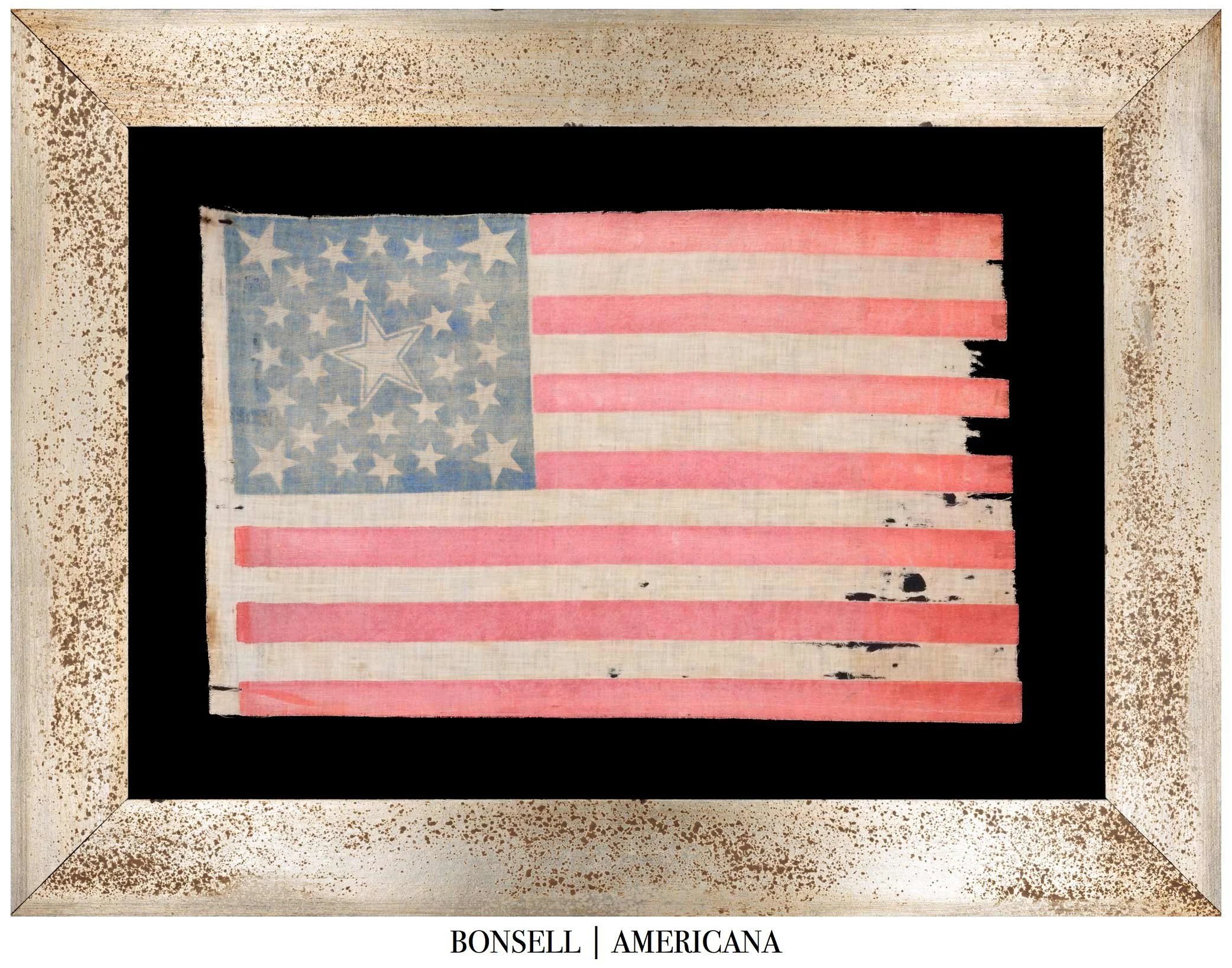
Offered is an exceptional 30-star antique American flag, printed on cotton and dating to one of the earliest periods of commercially printed American flags. The canton features an elaborate medallion configuration centered by a large, haloed star, making this a particularly striking example of an already exceedingly scarce star count.
The 30-star flag represents the admission of Wisconsin as the 30th state. Wisconsin entered the Union on May 29, 1848, and under the Flag Act of 1818 its star was officially added to the American flag on July 4 of that year. The 30-star flag remained official until July 3, 1851, when California's admission resulted in the 31-star flag.
Flags dating to the years before the Civil War survive in comparatively small numbers, particularly those intended for public, political, or celebratory use. The American flag had not yet assumed the near-universal place in civic and domestic life that it would acquire during and after the Civil War. Even within the military, the familiar Stars and Stripes was adopted gradually. Army regulations of 1834 prescribed a Stars and Stripes national color for artillery, while infantry was not authorized to carry the Stars and Stripes as its national color until 1841.
This flag therefore belongs to a formative period in the development of the American flag as a widely recognized national emblem. Its printed construction is especially noteworthy. Printed parade flags became increasingly important as inexpensive flags could be produced for political rallies, public celebrations, parades, and other civic events, but examples from the 1840s remain exceptionally early. This flag dates only about a decade after the 26-star period of 1837–1845 and well before the enormous expansion in flag production brought about by the Civil War.
The star configuration is among the most compelling features of the flag. Rather than employing simple horizontal or vertical rows, the maker arranged the stars in an elaborate medallion. A large star occupies the center of the canton, surrounded by concentric arrangements of smaller stars, with additional stars positioned toward the corners. The resulting design is both highly graphic and distinctly representative of the freedom enjoyed by 19th-century flag makers.
There was no federally prescribed arrangement of the stars during this period. The Flag Act of 1818 established that the flag would contain one star for each state, with additional stars added on the Fourth of July following a state's admission, but it did not dictate how those stars were to be arranged. Makers were therefore free to employ circles, medallions, Great Stars, staggered rows, and numerous other patterns. The federal government did not standardize the arrangement and proportions of the national flag until 1912, during the administration of President William Howard Taft.
At the center of this example is an unusually large, canted star surrounded by a narrow outlined or "haloed" border. This type of device is sometimes described by collectors as a center star and should be distinguished from a Great Star, in which numerous smaller stars are themselves arranged to form the outline of one large star. Here, the center star is an individual printed element around which the remainder of the constellation is organized.
The oversized center star is traditionally interpreted on flags of this type as representing the newest state—in this case Wisconsin. Whether every maker consciously intended that symbolism cannot be established, but the placement would have been particularly appropriate in 1848, when Wisconsin's admission was the event that brought the national constellation to 30 stars.
The halo surrounding the center star is another notable feature. Similar haloed center-star devices appear on a small group of printed American flags from the middle decades of the 19th century and are immediately recognizable for their distinctive appearance. The identity of the printer remains unknown, but similarities in printing style and canton design among surviving examples suggest that related flags may have originated with the same maker or closely associated manufacturers. On this example, the pale outline around the large star creates a strong focal point within an already complex medallion.
The historical moment represented by the flag is equally important. The 30-star period encompassed the presidential election of 1848, held only months after Wisconsin entered the Union. Whig nominee Zachary Taylor, a celebrated general of the Mexican-American War, faced Democratic nominee Lewis Cass and former President Martin Van Buren, who ran as the candidate of the newly organized Free Soil Party. Taylor won the election, propelled in large part by his national reputation as a military hero.
Taylor's supporters organized political clubs, rallies, and public gatherings around the image of "Old Rough and Ready," while the Free Soil campaign made the expansion of slavery into the western territories a central national political issue. The election took place as the country confronted the enormous territorial gains resulting from the Mexican-American War and the increasingly contentious question of whether slavery would expand westward.
A small printed flag such as this would have been well suited to the political and public gatherings of the period. Without specific provenance it is impossible to assign this particular example to the Taylor campaign, but its 1848–1851 date, portable format, and printed cotton construction place it squarely within the type of flag used at political rallies, parades, patriotic celebrations, and other public events during the era.
Taylor's presidency proved remarkably brief. He died on July 9, 1850, roughly 16 months after taking office, and was succeeded by Vice President Millard Fillmore. His administration coincided with rapidly increasing sectional conflict surrounding slavery and the territories acquired from Mexico, placing the 30-star period immediately before the political crises of the 1850s that eventually culminated in the Civil War.
The survival of any printed American flag from this period is notable. The combination present here—a 30-star count, pre-Civil War manufacture, elaborate medallion configuration, oversized haloed center star, and early printed cotton construction—places this example among the more visually distinctive forms produced during the formative years of the American flag. It represents Wisconsin's entry into the Union, the presidential politics of 1848, and an era when flag makers were still free to interpret the national constellation with extraordinary creativity.
Conservation Process: This flag was hand sewn to cotton fabric, and both were hand sewn to a mounting board. To prevent the black dye in the cotton fabric from seeping into the flag, it was first washed in a standard wash and then in a dye setting wash. The flag is positioned behind Optium Museum Acrylic.
Frame: The flag is housed in a wide, contemporary frame with a softly sloped profile and an aged silver finish. The surface is deliberately distressed, with warm brown and muted gold undertones showing through the silver, giving the frame an understated, timeworn appearance that complements the flag without competing with it.
Condition Report: The flag is in good condition for its age, with strong overall presentation and attractive, softly faded color. There is scattered fabric loss and fraying, concentrated primarily along the fly end and in several areas of the lower white stripes, along with minor staining and small scattered losses elsewhere. Despite these condition issues, the canton and distinctive haloed medallion configuration remain well preserved and highly legible.
Collectability Level: The Best – Perfect for Advanced Collectors
Date of Origin: 1848-1851
Number of Stars: 30
Associated State: Wisconsin
Frame Size (H x L): 31.5” x 21.5”
Pennant Size (H x L): 6.25” x 10” and Affixed to an 18” Staff
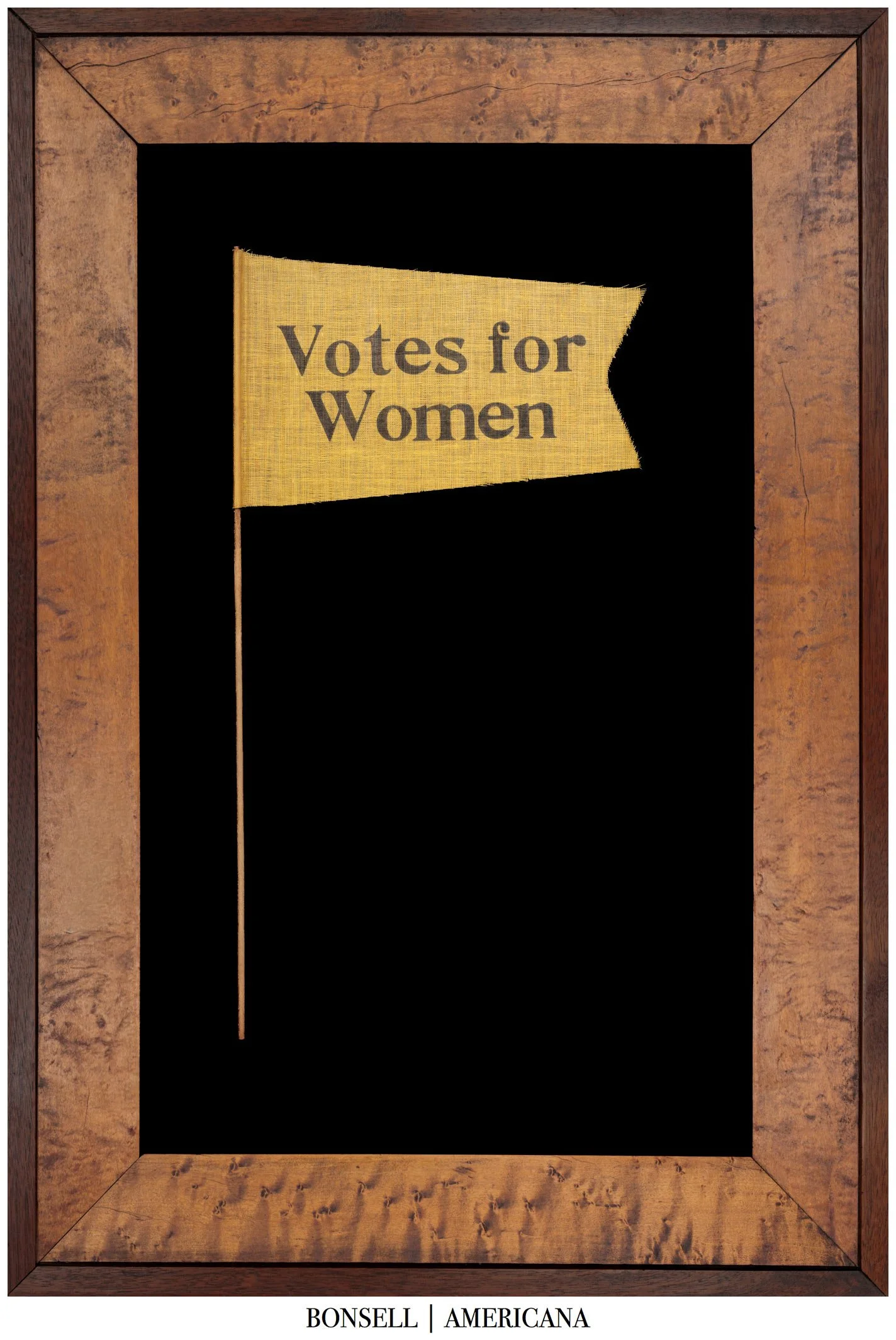
Offered is an American women’s suffrage pennant advocating “Votes for Women.” The pennant is made of cotton and constructed in a swallowtail form, a shape commonly used for political and reform-related textiles in the late-19th and early-20th centuries. The field is yellow, with the slogan printed in black across the surface. The pennant remains affixed to its original wooden staff.
Yellow was the primary color associated with the women’s suffrage movement in the United States and was widely adopted by suffrage organizations beginning in the late-19th century. It was frequently paired with black to create a bold, high-contrast design that could be read easily during marches, meetings, and public demonstrations. Pennants and related textiles were produced for active use and functioned as direct statements of political purpose.
The organized movement for women’s voting rights in the United States is generally traced to 1848, when Lucretia Mott and Elizabeth Cady Stanton convened the first women’s rights convention in Seneca Falls, New York. That meeting produced the Declaration of Sentiments, a document asserting women’s claims to political equality, education, and employment. Over the following decades, the movement expanded through conventions, lectures, and organized advocacy.
In 1906, Harriot Stanton Blatch—daughter of Elizabeth Cady Stanton—founded the Equality League of Self-Supporting Women, later renamed the Women’s Political Union. This organization focused on mobilizing working-class women and increasing the public visibility of the suffrage movement. In 1910, the group organized the first large-scale suffrage march in the United States, held in New York City. Textiles such as pennants and banners were used extensively during this period to convey clear, readable messages during marches and public gatherings.
Although early efforts focused on securing voting rights at the state level, it became increasingly clear that a constitutional amendment was necessary to guarantee suffrage nationwide. Proposed amendments were introduced in Congress in 1878 and again in 1914, but both attempts failed. Momentum shifted during and after World War I, when women’s contributions to the war effort helped secure bipartisan political support. In January 1918, the House of Representatives approved a suffrage amendment by the required two-thirds majority, followed by Senate approval in June 1919.
On August 18, 1920, Tennessee became the thirty-sixth state to ratify the amendment, providing the necessary three-quarters majority of states. Eight days later, on August 26, 1920, the Nineteenth Amendment was formally adopted into the Constitution, stating:
“The right of citizens of the United States to vote shall not be denied or abridged by the United States or by any State on account of sex. Congress shall have power to enforce this article by appropriate legislation.”
Surviving suffrage pennants are uncommon, particularly examples that retain their original staff and exhibit strong color and legibility. Pieces such as this were produced for use in marches, meetings, and public demonstrations and reflect the material culture of the American women’s suffrage movement.
Conservation Process: This pennant was hand sewn to cotton fabric, and both were hand sewn to a mounting board. To prevent the black dye in the cotton fabric from seeping into the pennant, it was first washed in a standard wash and then in a dye setting wash. The pennant is positioned behind Optium Museum Acrylic.
Frame: The pennant is housed in an impressive antique frame featuring a broad birdseye maple interior molding surrounded by a darker hardwood outer border, which appears more consistent with walnut than mahogany. The contrasting woods, veneered construction, and restrained mitered profile are characteristic of 19th-century American framing, and the frame likely dates to the mid-to-late 1800s.
Condition Report: The pennant remains in very good overall condition, with strong yellow coloration and clear, legible black lettering. There is expected fraying and minor loss along the outer edges, particularly at the swallowtail end, along with light surface wear consistent with age and use. The staff remains intact and is original to the pennant.
Collectability Level: The Great – Perfect for Rising Collectors
Date of Origin: 1910-1920
Price: Call 618-553-2291, or email info@bonsellamericana.com
Frame Size (H x L): 25” x 30.5”
Flag Size (H x L): 15.5” x 21.25”
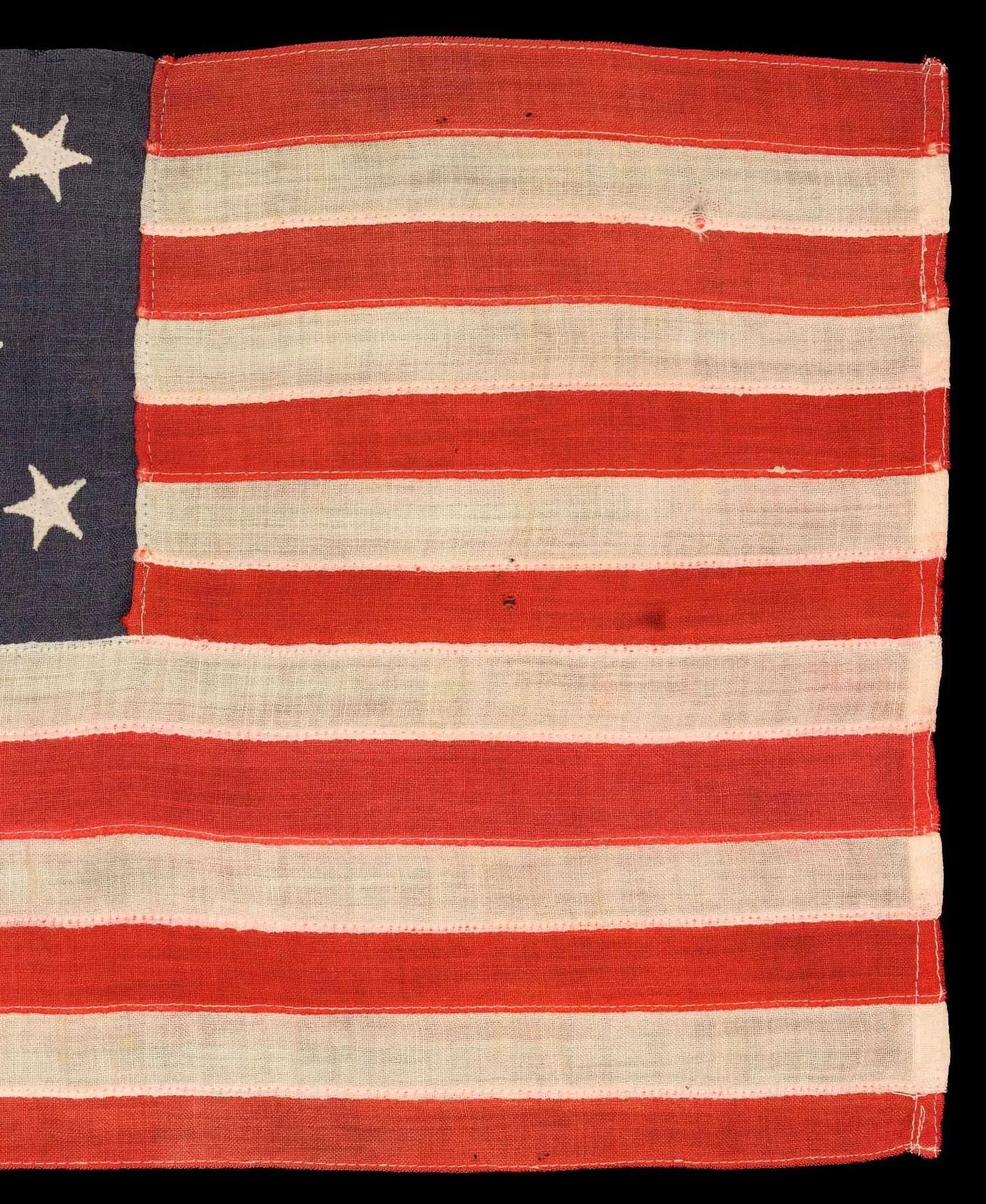
Offered is a 13-star antique American flag of wool bunting with cotton stars that are double-appliquéd—sewn to both sides of the canton so the design presents correctly on either face. It is an unusually small example of a fully pieced-and-sewn flag from the late 19th or early 20th century. While small printed flags were produced in great numbers during this period, traditional sewn flags at this diminutive scale are considerably less common.
The canton displays a classic medallion configuration centered on a single star, surrounded by a circular arrangement of eight stars, with four additional stars positioned toward the corners. The resulting pattern is one of the most recognizable configurations associated with 13-star flags. At this compact scale, the arrangement is particularly effective, allowing the stars to remain comparatively large and distinct while creating a strong, balanced composition within the canton.
The flag is constructed in the manner of a conventional full-size sewn flag despite its unusually small proportions. The red and white wool-bunting stripes are individually pieced and joined by machine stitching, while the canton is likewise made of wool bunting. The cotton stars are applied to both sides and secured with zig-zag machine stitching. The hoist is made of cotton.
The zig-zag stitching used to secure the stars provides useful chronological guidance. In August 1889, Henry Bowman filed a patent application for a “method of making flags,” which was granted in February 1892 as U.S. Patent No. 469,395. Bowman specifically claimed the use of zig-zag stitching in flag construction, a technique particularly well suited to binding the unfinished edges of appliquéd stars. Similar stitching became increasingly common among commercial flag manufacturers during the 1890s and remained in widespread use during the early decades of the 20th century.
The unusually small scale of the present flag is an important part of its appeal. Although compact, its manufacture required essentially the same basic operations as a substantially larger example: piecing the individual stripes, assembling the canton, cutting and applying the stars, and finishing the hoist. Small sewn flags were practical for boats, architectural display, ceremonial use, and other settings where a conventional large flag would have been unnecessary or impractical. Their reduced scale also favored the use of 13 stars, which could remain individually prominent where the full complement of stars then representing the Union would have required a much smaller and more crowded arrangement.
The 13-star American flag traces its origin to June 14, 1777, when the Continental Congress resolved that the national flag should contain 13 alternating red and white stripes and “thirteen stars, white in a blue field, representing a new constellation.” Although the official star count increased as new states entered the Union, the 13-star configuration never disappeared from American use. Instead, it developed into an intentional reference to the original states and the nation’s Revolutionary founding.
Throughout the 19th century, 13-star flags appeared in military, maritime, commemorative, and patriotic settings. Interest increased considerably around the Centennial of American independence in 1876 and continued during the Colonial Revival of the late 19th and early 20th centuries, when Revolutionary-era imagery enjoyed renewed popularity. The United States Navy also continued to employ 13-star ensigns on small boats into the early 20th century, further reinforcing the design’s association with compact maritime flags. The Sesquicentennial of American independence in 1926 provided another period of heightened interest in the imagery of the founding era.
Based upon its wool-bunting construction, double-appliquéd cotton stars, machine stitching, zig-zag application, and overall form, we date the flag to approximately 1895–1926. Its combination of a classic medallion star configuration and unusually small scale makes it a particularly appealing example of the commercially produced 13-star flags of the late 19th and early 20th centuries.
Conservation Process: This flag was hand sewn to silk organza, and both were hand sewn to cotton fabric. The silk organza provides a strong layer of protection and a professional appearance. The flag, the silk organza, and the cotton fabric were then hand sewn to a mounting board. To prevent the black dye in the cotton fabric from seeping into the flag, it was first washed in a standard wash and then in a dye setting wash. The flag is positioned behind Optium Museum Acrylic.
Frame: The flag is housed in a wide, sloped molding with an aged gold surface, intentionally distressed to evoke the appearance of early gilded frames.
Condition Report: The flag survives in very good overall condition, with strong color and only minor scattered staining, small areas of soiling, and limited wear consistent with age and use. There are a few small holes or separations within the striped field, along with a couple of tack holes and associated stains on the hoist. The fabric remains substantially intact, and the canton and star field present especially well.
Collectability Level: The Great – Perfect for Rising Collectors
Date of Origin: 1895-1926
Number of Stars: 13
Associated War: Spanish-American War (1898)
Associated State: Original 13 Colonies
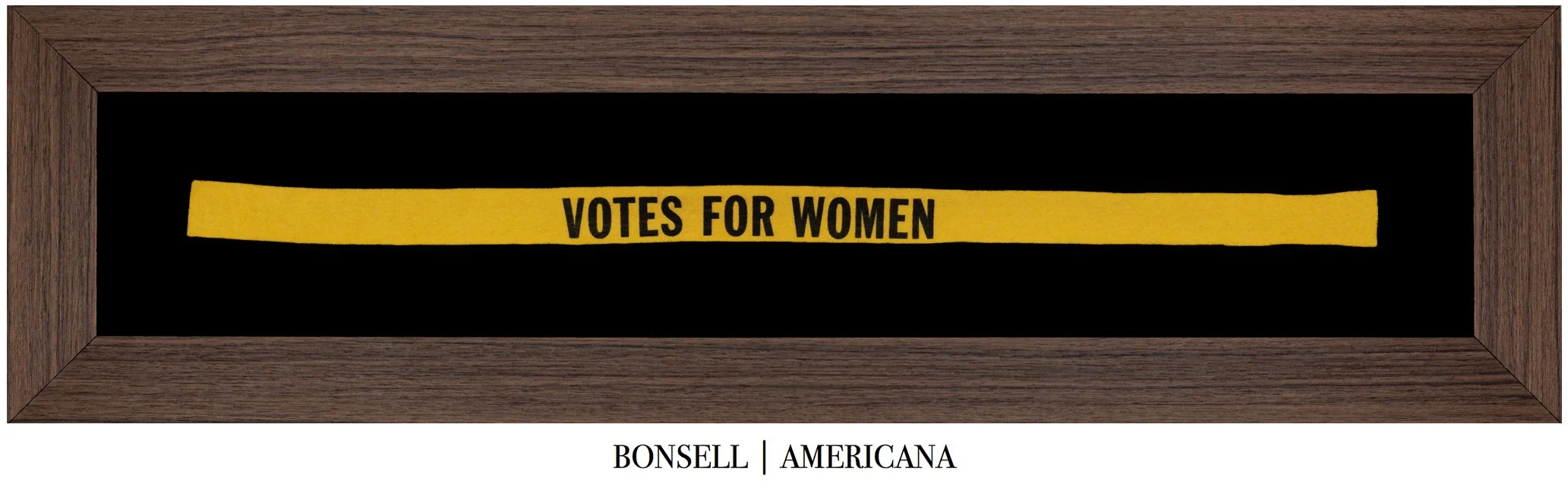
Price: Call 618-553-2291, or email info@bonsellamericana.com
Frame Size (H x L): 9” x 32 ½”
Textile Size (H x L): 1 ¼” x 25 ½”
Offered is a rare “VOTES FOR WOMEN” suffrage armband, fashioned from yellow felt with bold black lettering. Bands of this form were worn around the arm and, in some instances, around a hat, providing supporters with a simple and highly visible way to identify themselves with the women’s suffrage movement. The direct slogan, strong contrast, and unmistakable yellow-and-black color scheme made pieces such as this particularly effective at rallies, conventions, parades, and other public demonstrations.
Yellow became one of the most recognizable colors associated with the American women’s suffrage movement. Its use can be traced to the campaign for suffrage in Kansas in 1867, where the sunflower—Kansas’s state flower—was adopted as a symbol by supporters. The color was later embraced by major national suffrage organizations and appeared extensively on banners, ribbons, sashes, pennants, buttons, and other campaign material. Yellow was frequently paired with black lettering, as seen here, producing a combination that was both visually striking and easily legible from a distance.
The organized American women’s rights movement is generally traced to the Seneca Falls Convention of 1848, organized principally by Elizabeth Cady Stanton and Lucretia Mott. The convention produced the Declaration of Sentiments, modeled in part on the Declaration of Independence, which outlined a broad series of grievances regarding the legal, political, educational, and economic status of women. Among its most consequential demands was the assertion that women should possess the right to vote.
Over the following decades, suffrage advocates organized conventions, petition drives, speaking tours, publications, marches, and political campaigns throughout the country. Progress initially came largely on a state-by-state basis, particularly in the West, where a number of states enfranchised women before a federal amendment was adopted. At the same time, national organizations increasingly focused their efforts on securing an amendment to the United States Constitution that would prohibit the denial of voting rights on the basis of sex.
A federal women’s suffrage amendment was first introduced in Congress in 1878. For decades it failed to receive sufficient support, despite the increasingly organized efforts of suffragists across the country. By the 1910s, however, the movement had gained substantial political momentum. Highly visible demonstrations, coordinated lobbying campaigns, and the prominent role played by women during World War I helped place suffrage at the center of national political debate.
The proposed amendment passed the House of Representatives on May 21, 1919, followed by the Senate on June 4. It was then submitted to the states for ratification. On August 18, 1920, Tennessee became the 36th state to ratify the amendment, providing the three-fourths majority then required. The 19th Amendment was formally certified on August 26, 1920, declaring:
“The right of citizens of the United States to vote shall not be denied or abridged by the United States or by any State on account of sex.”
Small wearable textiles such as this armband represent the public-facing side of the suffrage campaign. Unlike formal banners intended for organizational headquarters or large demonstrations, armbands and hatbands could be worn directly by individual supporters, effectively turning the wearer into a moving advertisement for the cause. Their relatively ephemeral nature also contributes to their scarcity today, as pieces made for active campaign use were far less likely to be preserved than medals, buttons, or printed ephemera.
With its bold “VOTES FOR WOMEN” message and classic yellow-and-black suffrage coloration, this is an excellent surviving example of the material culture produced during one of the most consequential political reform movements in American history.
Conservation Process: This armband was hand sewn to cotton fabric, and both were hand sewn to a mounting board. To prevent the black dye in the cotton fabric from seeping into the armband, it was first washed in a standard wash and then in a dye setting wash. The armband is positioned behind Optium Museum Acrylic.
Frame: The armband is presented in a flat-profile dark walnut frame with a clean, understated finish.
Condition Report: The armband remains in excellent condition, with exceptionally strong yellow coloration and crisp, bold black lettering. The felt is remarkably well preserved, showing only the slightest age-related surface variation and no significant staining, losses, or damage.
Collectability Level: The Great – Perfect for Rising Collectors
Date of Origin: 1910-1920
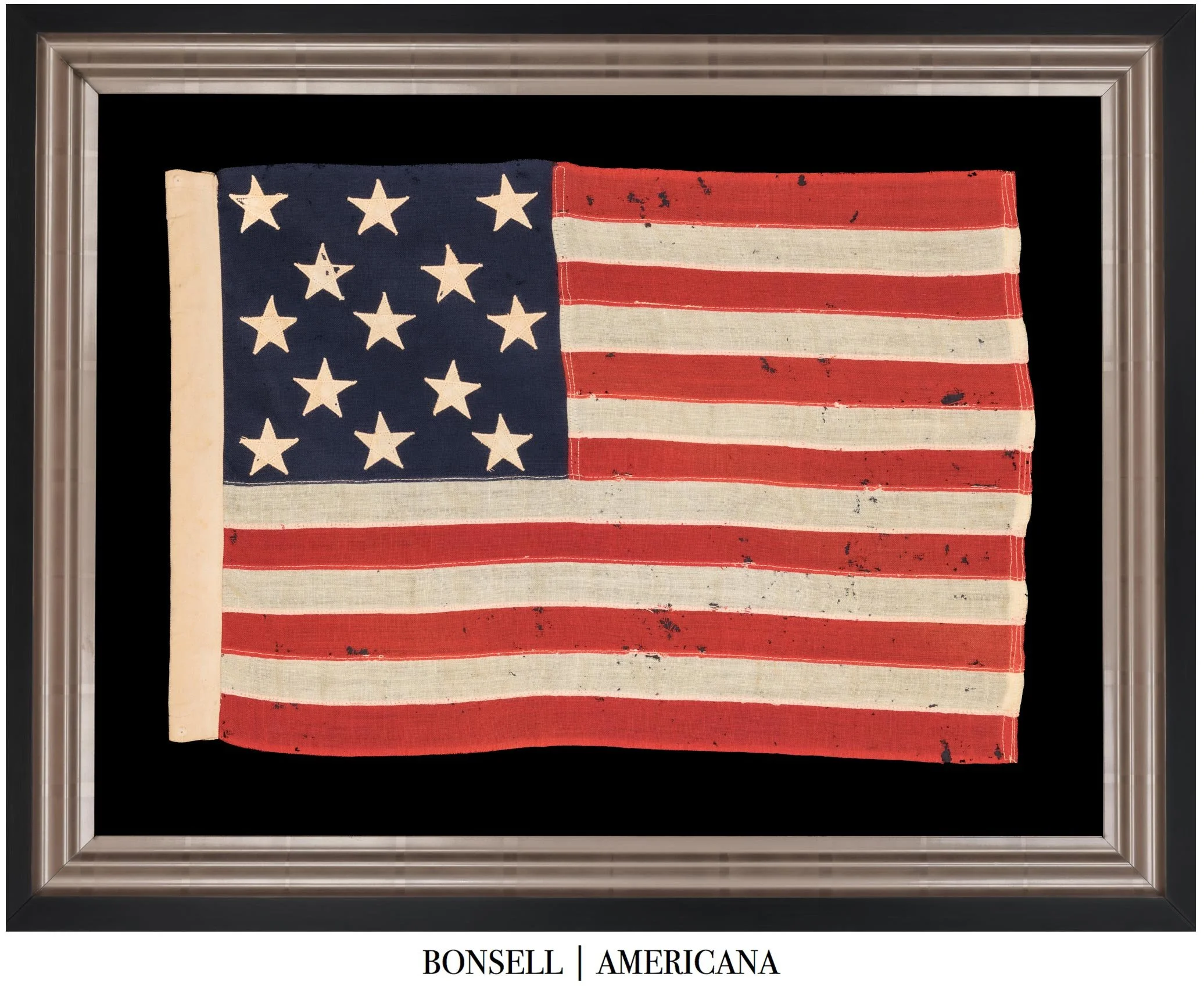
Frame Size (H x L): 26” x 33”
Flag Size (H x L): 17” x 24”
Offered is a 13-star antique American flag, featuring a 3-2-3-2-3 arrangement of stars. Constructed of wool bunting with double-appliquéd cotton stars, it is an unusually small example of a fully pieced-and-sewn commercial flag. While diminutive flags of this general period are encountered, examples of traditional sewn construction at this scale are considerably less common than their larger counterparts.
Viewed as a whole, the star configuration produces a diamond-shaped arrangement at the center, surrounded by a star at each corner of the canton. This design is commonly referred to as the Hopkinson pattern, after Francis Hopkinson, the New Jersey delegate to the Continental Congress and signer of the Declaration of Independence who is generally credited with playing the principal role in designing the first American national flag.
The Flag Resolution adopted by the Continental Congress on June 14, 1777 specified only that the new national flag contain 13 alternating red and white stripes and a union of 13 white stars on a blue field, representing “a new constellation.” Congress provided no instructions regarding the arrangement, number of points, or orientation of the stars. Consequently, a number of different 13-star configurations appeared during the nation’s earliest years, and the precise appearance of the first official American flag remains unknown.
Francis Hopkinson nevertheless has the strongest surviving documentary claim to its design. In 1780, he submitted a request for compensation for various designs he had furnished to the government, specifically including the “flag of the United States of America.” His proposed compensation famously included a “Quarter Cask of the public wine.” When that request was not honored, he later submitted a monetary claim. Congress did not dispute that Hopkinson had participated in the design work, but declined to compensate him on the basis that he was not the only individual who had been consulted. The surviving documentation has led most historians to credit Hopkinson with the design of the American flag, although no surviving drawing conclusively establishes the precise arrangement of stars that he employed.
The familiar association between Hopkinson and the 3-2-3-2-3 configuration is therefore best understood as a historical attribution rather than a certainty. The pattern appears on later representations associated with the early flag and became particularly common on 13-star flags manufactured during the late 19th and early 20th centuries. Its strong geometry and relatively large stars also made it particularly well suited to small flags such as the present example, where attempting to accommodate the full complement of stars then in the Union would have required stars of considerably smaller size.
The stripes and canton of this flag are made of wool bunting and joined by machine stitching. Its hoist is made of cotton twill, while its cotton stars are sewn to both sides of the canton, a construction method commonly referred to as double appliqué, and are secured with zig-zag stitching. The latter is particularly useful for binding the unfinished edges of appliquéd stars and became widespread among commercial flag manufacturers during the late 19th century. Henry Bowman sought patent protection for a method of flag construction employing this technique in 1889, receiving U.S. Patent No. 469,395 in February 1892. Similar construction is regularly encountered on commercially produced American flags beginning in the 1890s.
As mentioned, the present flag is noteworthy for its compact scale. Most sewn wool flags were intended to function as actual outdoor flags, where greater dimensions improved visibility. Small sewn examples required essentially the same basic manufacturing operations—piecing 13 individual stripes, constructing the canton, cutting and applying stars, and finishing the hoist—while producing an object with considerably less surface area. Their small size made them practical for boats, architectural display, ceremonial use, and other applications where a conventional large flag was unnecessary or impractical.
Although the United States had long since expanded beyond 13 states when this flag was made, the 13-star flag never disappeared from American use. Rather, 13 stars became a historical and patriotic device representing the original states and the founding generation. Such flags appeared throughout the 19th century in commemorative, military, maritime, and celebratory contexts and experienced renewed popularity during events that encouraged Americans to look back to the Revolutionary period.
This was especially true during the nation’s Centennial in 1876 and again during the decades surrounding the turn of the century, when Colonial Revival interest in the country’s founding history became widespread. Thirteen-star flags were also well suited to yachts and small boats, where reducing the number of stars allowed them to remain individually legible on comparatively small ensigns. Commercial flag makers continued to produce 13-star examples well into the 20th century for precisely these historical, decorative, and maritime purposes.
Based upon its wool-bunting construction, machine stitching, double-appliquéd cotton stars, zig-zag stitching, and overall form, we date the flag to approximately 1895-1926. The upper end of this range encompasses the Sesquicentennial of American independence in 1926, another period of intense interest in Revolutionary imagery and 13-star flags.
The combination of the classic 3-2-3-2-3 star configuration and exceptionally small 17” x 24” size makes this an especially appealing example of the commercially produced 13-star flags of the late 19th and early 20th centuries.
Conservation Process: This flag was hand sewn to silk organza, and both were hand sewn to cotton fabric. The silk organza provides a strong layer of protection and a professional appearance. The flag, the silk organza, and the cotton fabric were then hand sewn to a mounting board. To prevent the black dye in the cotton fabric from seeping into the flag, it was first washed in a standard wash and then in a dye setting wash. The flag is positioned behind Optium Museum Acrylic.
Frame: The frame features a wide black outer profile with a stepped, silver-toned inner detail, all incorporated into a single molding. The layered profile gives the frame depth and definition.
Condition Report: The flag exhibits scattered small holes, surface wear, and areas of staining and discoloration throughout, with somewhat heavier wear along portions of the stripes and fly end. There are also a couple of small pin holes in the hoist. Overall, the fabric remains intact and the colors retain good visual presence.
Collectability Level: The Great – Perfect for Rising Collectors
Date of Origin: 1895-1926
Number of Stars: 13
Associated War: Spanish-American War (1898) and World War I (1914-1918)
Associated State: Original 13 Colonies
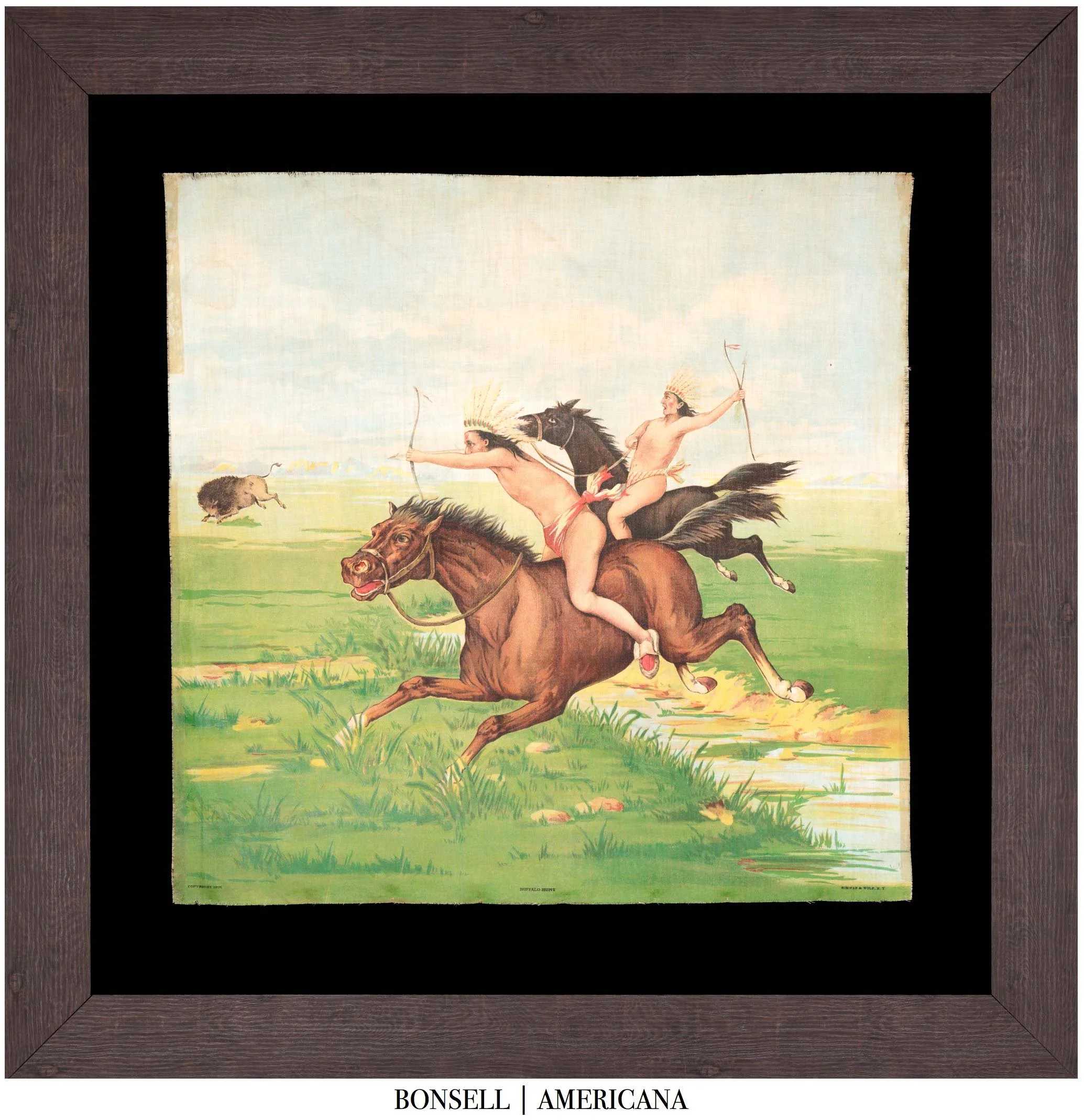
Frame Size (H x L): 34” x 34”
Textile Size (H x L): 23” x 23”
Offered is a lithographed linen textile made by Schwab & Wolf of New York in 1907. It features two Native American hunters on horseback pursuing buffalo across an open Western landscape. Printed along the lower margin is the title, “BUFFALO HUNT,” together with the manufacturer’s name and date.
The image is organized around the two horses and their riders, both shown at full gallop. The foremost hunter rides a chestnut horse and draws a bow toward a buffalo visible at the left of the composition, while a second hunter follows on a dark horse carrying a spear or lance. The prairie landscape, distant mountains, and broad sky provide a restrained backdrop for the principal action.
Schwab & Wolf was a New York firm active by at least the turn of the 20th century and involved in both conventional textile manufacturing and printed novelty goods. It operated within the city’s established textile and dry-goods trade and developed a substantial line of copyrighted pictorial designs. Surviving examples and contemporary copyright records document subjects ranging from sporting and military scenes to patriotic, Native American, and other topical imagery. This broader body of work places Buffalo Hunt within an identifiable line of commercial pictorial textiles rather than as an isolated design.
Western imagery remained highly popular with American audiences when this textile was produced. During the late 19th and early 20th centuries, paintings, illustrated publications, Wild West exhibitions, advertising, and popular entertainment helped establish a familiar visual vocabulary centered on buffalo, Native American life, cowboys, and the Western frontier. By 1907, the great buffalo herds of the 19th-century Plains had largely disappeared, and scenes such as this increasingly represented an earlier period of the American West.
Buffalo hunting had been central to the economy and material culture of numerous Plains tribes. Buffalo supplied meat as well as hides, sinew, bone, and other materials used in daily life. The widespread adoption of the horse transformed hunting practices and made the mounted buffalo hunt an important feature of life on the Plains during portions of the 18th and 19th centuries. The Schwab & Wolf image draws upon this history, although its composition is best understood as a commercial interpretation intended for an early 20th-century audience rather than as an ethnographic depiction.
The lithographic process allowed Schwab & Wolf to reproduce detailed, multicolored imagery directly on fabric, giving these textiles much of the visual character of contemporary chromolithographic prints while retaining the texture and flexibility of linen. Other surviving examples demonstrate that the firm applied the same approach to a wide range of subjects, including Western, patriotic, military, and sporting themes.
Dating precisely to 1907, Buffalo Hunt is an unusual surviving example of Schwab & Wolf’s pictorial textile production and of the continuing popularity of Western subject matter in American decorative arts during the opening decade of the 20th century. Its documented maker, date, and subject provide a particularly strong context for understanding this specialized category of American printed textile.
Conservation Process: This textile was hand sewn to cotton fabric, and both were hand sewn to a mounting board. To prevent the black dye in the cotton fabric from seeping into the textile, it was first washed in a standard wash and then in a dye setting wash. The textile is positioned behind Optium Museum Acrylic.
Frame: The textile is housed in a modern, wide, dark-stained wood frame with a simple profile and visible grain, giving it a restrained, period-appropriate appearance.
Condition Report: The textile is in good overall condition, with strong color and a largely intact printed surface. There is minor toning and scattered discoloration, most noticeable in the lighter areas of the sky and along the edges, together with light fraying at the perimeter and a few small areas of wear.
Collectability Level: The Great – Perfect for Rising Collectors
Date of Origin: 1907
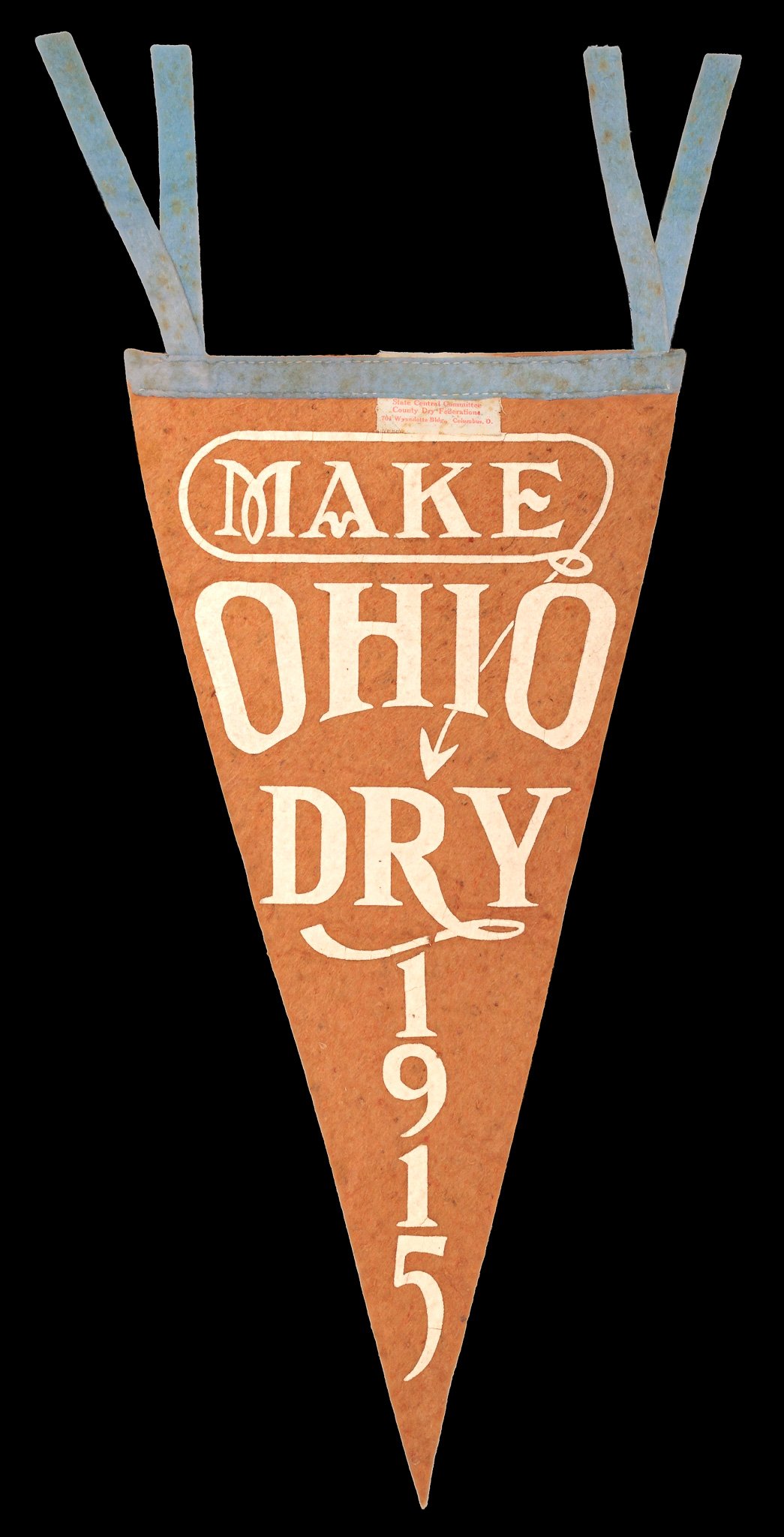
Price: Call 618-553-2291, or email info@bonsellamericana.com
Frame Size (H x L): 30.5” x 19”
Pennant Size (H x L): 17” x 8.25” with 4.75” ties
Offered is a rare political campaign pennant produced for Ohio's landmark 1915 statewide prohibition referendum, boldly printed "MAKE OHIO DRY 1915" in white lettering against an orange wool felt field. The pennant is of classic early twentieth-century construction, with a tapered felt body, stitched blue felt binding across the hoist, and matching blue felt ties designed for attachment to clothing, a vehicle, or display at rallies and public gatherings. Intended as a highly visible campaign accessory, it represents one of the more recognizable surviving slogans associated with Ohio's statewide prohibition movement.
The pennant survives with two original identifying labels, an unusual and important feature that documents both the organization responsible for the campaign and the Columbus firm that produced or supplied the piece. Sewn beneath the blue felt binding on the front is a printed label reading:
State Central Committee
County Dry Federations
701 Wyandotte Bldg.
Columbus, O.
Rather than identifying a commercial maker, this label attributes the pennant to the statewide committee representing Ohio's network of County Dry Federations. Contemporary records confirm that county dry federations operated throughout Ohio during this period, bringing together churches, temperance organizations, civic leaders, and local supporters in a coordinated effort to secure statewide prohibition. While the Ohio Anti-Saloon League remained the movement's best-known organization, period publications demonstrate that the statewide campaign functioned as a broad coalition of cooperating groups rather than a single organization acting alone. The committee headquartered in Columbus coordinated these county organizations during the statewide referendum campaign of 1915.
The Columbus address itself is noteworthy. The committee occupied offices in the Wyandotte Building, one of the city's most prominent commercial office buildings. Completed in 1898 and designed by Daniel Burnham & Company, the steel-frame structure was Columbus's first skyscraper and remained among the city's premier business addresses during the early twentieth century. Housing the campaign headquarters in the Wyandotte Building reflects the organized, professional character of the prohibition movement, which by 1915 had developed an extensive statewide administrative structure capable of coordinating thousands of local volunteers and supporters.
Equally important is the original label retained on the reverse, identifying:
Shipley & Company
Advertising Specialists
Columbus, Ohio
Contemporary Columbus city directories and period advertising establish Shipley & Company as one of the city's leading advertising specialty firms. The company supplied a remarkably broad range of custom promotional merchandise, including banners, badges, calendars, celluloid novelties, leather goods, metal souvenirs, and other advertising specialties produced for businesses, civic organizations, and political campaigns. Their own advertising promoted custom souvenirs among their principal offerings, making the firm a logical supplier for campaign material such as this pennant. The presence of both original labels provides an uncommon level of documentation, identifying not only the organization responsible for distributing the pennant but also the Columbus advertising firm that produced or supplied it.
The campaign represented by this pennant sought to unite a diverse cross-section of Ohio society. Contemporary publications identify ministers, businessmen, educators, farmers, labor representatives, members of the Woman's Christian Temperance Union, and other civic leaders among those directing the statewide effort. One such figure was Worthington Kautzman of Columbus, a prominent businessman and former Adjutant General of Ohio, whose name appears in contemporary campaign literature associated with the movement. Rather than functioning as a narrow political organization, the campaign emphasized cooperation among the various "dry" organizations operating throughout the state, a theme repeatedly stressed in contemporary publications.
The significance of this pennant extends beyond the unsuccessful referendum of 1915. Although Ohio voters rejected the proposed constitutional amendment that November, the campaign itself did not end. Instead, the statewide organization remained intact, retaining the familiar "Make Ohio Dry" slogan and continuing under campaign manager James A. White. Publications issued by the Ohio Dry Federation in 1917 demonstrate the direct continuation of the movement, describing the cooperation between county chairmen, the Ohio Dry Federation, and the Ohio Anti-Saloon League as they prepared a renewed statewide campaign. That effort proved successful. In November 1918, Ohio voters approved statewide prohibition legislation, making Ohio a dry state months before national prohibition took effect. The following January, Ohio became one of the states to ratify the Eighteenth Amendment to the United States Constitution, helping secure the national prohibition of intoxicating liquor, which went into effect on January 17, 1920.
As a result, this pennant represents more than a souvenir of a single political campaign. It is an artifact from the opening phase of the movement that ultimately transformed Ohio law and contributed directly to one of the most significant constitutional changes in American history. Political textiles documenting statewide reform campaigns are encountered far less frequently than those associated with presidential elections, and examples retaining original organizational and maker's labels are rarer still. Combining bold graphic appeal with exceptional historical documentation, this is an outstanding surviving example from Ohio's determined campaign to "Make Ohio Dry."
Conservation Process: This pennant was hand sewn to cotton fabric, and both were hand sewn to a mounting board. To prevent the black dye in the cotton fabric from seeping into the pennant, it was first washed in a standard wash and then in a dye setting wash. The pennant is positioned behind Optium Museum Acrylic.
Frame: The pennant has been presented in an Italian molding with a broad, flat profile and a satin black finish. Crisp, clean lines and gently beveled inner and outer edges lend the frame a refined, understated appearance that complements the textile without competing for attention.
Condition Report: There is modest, expected wear from age and use, accompanied by scattered soiling and oxidation throughout the felt, particularly along the blue binding and ties. Minor age-related crazing is present in the printed white lettering, with light surface wear elsewhere, while the original organizational label remains intact. Despite this honest wear, the pennant retains outstanding visual impact and displays exceptionally well.
Collectability Level: The Great – Perfect for Rising Collectors
Date of Origin: 1915
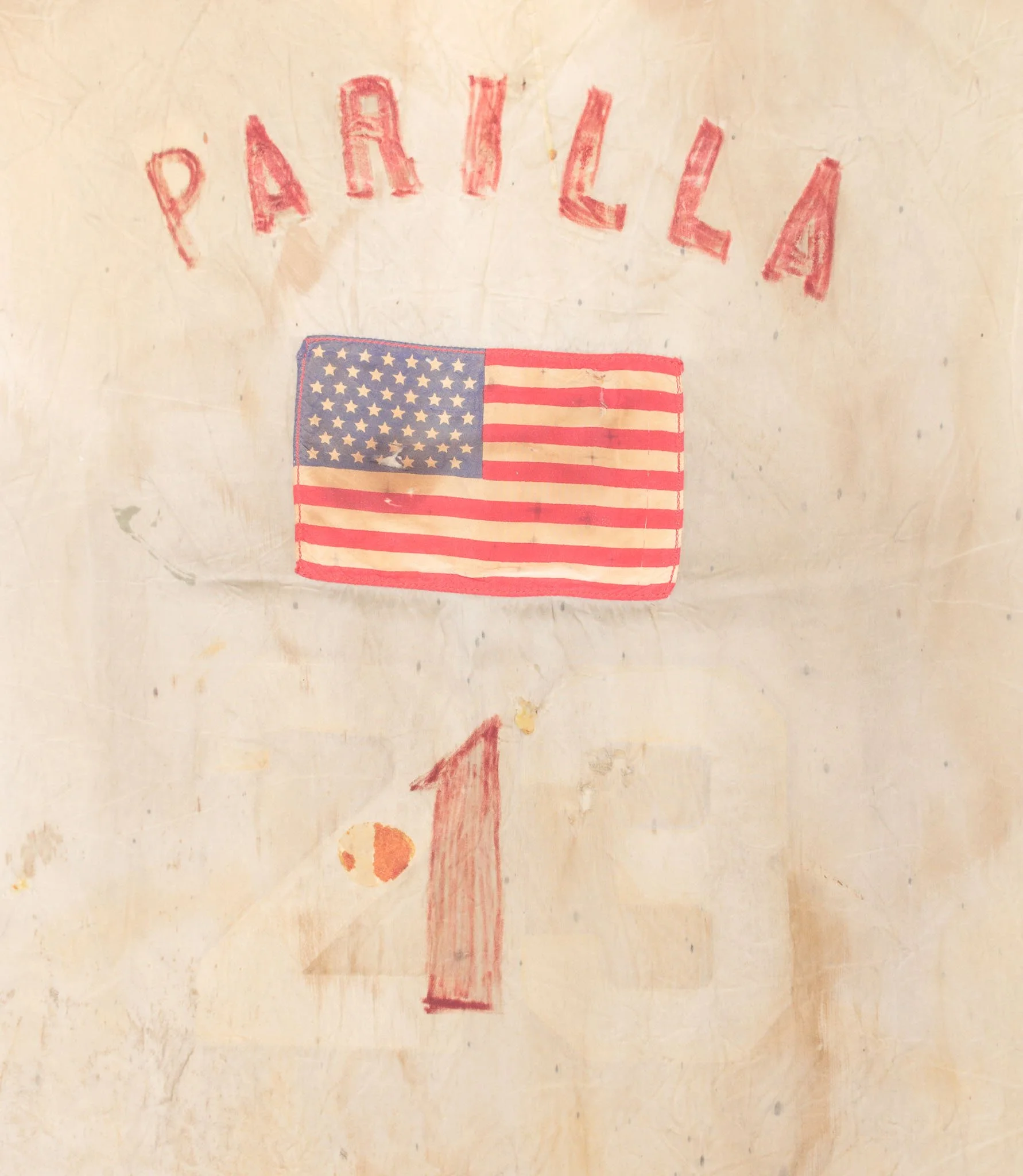
Frame Size (H x L): 34.5” x 31.5”
Jersey Size (H x L): 23.5” x 20.5”
Offered is a sleeveless motorcycle racing vest attributed to Richard “Dick” Gariepy of Barre, Massachusetts, a leading East Coast scrambles rider and the 1962 North American Scrambles Champion. Dating to circa 1962–1963, the vest is made from rayon and is marked with the Italian motorcycle name PARILLA, a large red numeral 1, and silk 49-star American flags sewn to both the front and back. The side shown here is the back of the garment.
The vest was intended to be worn over a long-sleeved shirt, sweater, or other riding apparel. Period photographs show Gariepy and other scrambles riders wearing this general type of sleeveless outer jersey over a contrasting long-sleeved layer. Such garments provided a practical surface for displaying a rider’s number, motorcycle marque, sponsor, or national identity while allowing the clothing underneath to be changed according to weather and track conditions.
The garment closes along the left side with a metal Talon zipper, allowing it to be pulled over other clothing without a center-front opening. Talon was one of the principal American zipper manufacturers of the period, and the metal fastener is consistent with an early-1960s date.
Across the upper back, the name PARILLA is painted by hand in large red letters. Beneath the flag is a similarly hand-painted red numeral 1.
A faint but legible 23 remains visible beneath and around the painted numeral. In person, the number appears as cleaner or less-damaged fabric. This suggests that applied numerals, perhaps adhesive-backed or heat-applied, once covered the textile and protected it from wear and discoloration. After the numerals were removed, their outline remained as a ghost image.
This corresponds with a documented Gariepy racing entry. In the program for the June 22, 1963 Laconia 90-Mile 250cc Road Race, Richard Gariepy of Barre was entered as No. 23 aboard a Parilla. The match among rider, motorcycle, and number is notable. It cannot be proven that the ghosted number on the vest relates specifically to that race, given motorcycle numbers often changed by event and class, but the association is logical. The later painted “1” indicates that the vest was likely renumbered for another competition.
The silk American flags sewn to the front and back each contain 49 stars arranged in seven rows of seven. The flags are machine sewn around their perimeters. The 49-star count has a narrow historical period. Alaska entered the Union on January 3, 1959, and the 49-star flag became official on July 4 of that year. Hawaii entered the Union later in 1959, and the 50-star flag became official on July 4, 1960. The 49-star flag was therefore official for only one year.
The flags do not necessarily date the completed vest to 1959–1960. Small 49-star flags remained available after the official change and could have been incorporated into a garment several years later. The stronger dating evidence is Gariepy’s documented Parilla activity in 1962 and 1963. The vest is therefore most reasonably dated to that period.
Richard Rice Gariepy became an accomplished New England motorcycle racer during the period when American scrambles competition was developing toward what is now generally called motocross. Scrambles combined dirt, natural terrain, elevation changes, and high-speed sections, requiring both speed and control. Gariepy also competed in TT events and road racing.
His most significant season came in 1962, when he raced a 250cc Parilla Wildcat. Period accounts credit him with victories at the Canadian National Championship Scramble, the AMA National TT Motorcycle Scramble Championship at Edgewood, Maryland, and the North-South Challenge. At Edgewood, he won both the 250cc expert-class championship and the overall lightweight-division championship in a field reported to include more than 100 lightweight riders. Together with his Canadian victory, the result established him as the North American Scrambles Champion.
Contemporary Parilla advertising used Gariepy’s championship success to promote the 250cc Wildcat. One advertisement announced “PARILLA WINS NATIONAL CHAMPIONSHIP” and identified him as the North American Scrambles Champion. Period photographs also show Gariepy wearing sleeveless outer racing garments of the same general type as the present vest.
Parilla was founded in Milan, Italy, by Giovanni Parrilla after World War II. The company became known for technically advanced lightweight motorcycles and achieved success in road races and scrambles competitions. The 250cc Wildcat was marketed as a serious lightweight competition motorcycle, and Gariepy’s 1962 victories became an important part of its American advertising.
Gariepy continued racing for decades. His obituary noted that he won back-to-back vintage motorcycle championships in 2011 and 2012 while in his seventies. The present vest dates from the early and most historically significant period of his career.
The combination of the hand-painted Parilla name, changing race numbers, Talon side zipper, paired silk 49-star flags, and Gariepy provenance places the vest within early-1960s American motorcycle competition and Parilla’s brief but successful racing presence in the United States.
Conservation Process: The jersey was hand sewn to cotton fabric, and both were hand sewn to a mounting board. To prevent the black dye in the cotton fabric from seeping into the jersey, it was first washed in a standard wash and then in a dye setting wash. The jersey is positioned behind Optium Museum Acrylic.
Frame: The frame is a deep-profile moulding with a simple, classical profile, finished in a dark cocoa-brown tone.
Condition Report: The vest exhibits extensive period wear, including overall soiling, discoloration, scattered staining, creasing, and surface abrasion. There are several small holes and losses, particularly near the center and lower portions, along with wear at the neckline, arm openings, seams, and zipper area. As the garment was used as a motorcycle racing jersey, at least some of this wear is likely associated with track use. The painted lettering and numeral remain legible, while the applied flags show minor soiling and localized wear.
Collectability Level: The Good – Perfect for Beginners and Gifts
Date of Origin: 1962-1963
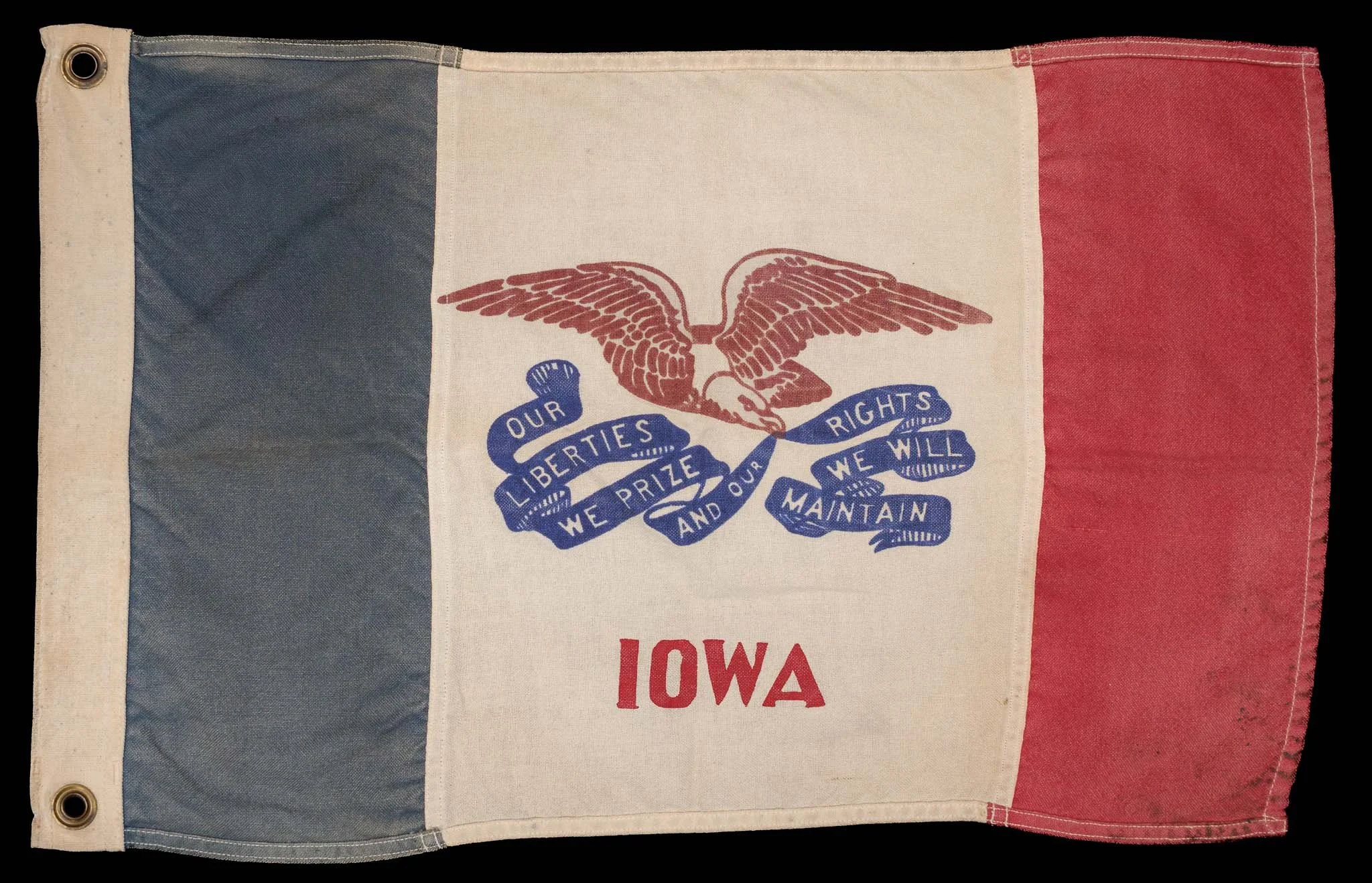
Frame Size (H x L): 22.75” x 31.25”
Flag Size (H x L): 15” x 23”
Offered is a vintage Iowa state flag, commercially made of cotton and dating to approximately 1940–1960. The flag presents Iowa’s familiar vertical tricolor of blue, white, and red, with the state’s eagle-and-ribbon device printed prominently upon the broad white center panel and the name “IOWA” printed below in red.
The body is assembled from three separate panels of plain-weave cotton, joined vertically by machine stitching. The white center panel is noticeably wider than the colored outer sections, providing ample space for the central device. The blue and red panels have mellowed considerably with age, particularly the blue, which has faded unevenly along areas exposed to light and use. Both colors remain easily legible, however, and the softer palette gives the flag an appealing, unmistakably vintage appearance.
The central imagery is printed directly onto the cotton. A red eagle appears with wings extended, carrying a flowing blue ribbon in its beak. The ribbon bears Iowa’s state motto: “Our liberties we prize and our rights we will maintain.” The individual words are distributed across the folds of the streamer in hand-rendered white lettering. Beneath the device, “IOWA” appears in large red slab-serif capitals.
The printing retains the slightly irregular quality associated with traditional textile production. Ink follows the weave of the cotton, with subtle variations in density and softly defined edges. The eagle is rendered in a subdued brick-red or reddish-brown, while the ribbon is printed in a rich blue. The imagery is bold enough to be recognized from a distance, yet retains considerable detail in the eagle’s feathers, talons, beak, and the many folds of the ribbon.
The flag is finished along the hoist with a substantial folded cotton heading. Two large brass grommets, one at each end, allowed the flag to be secured to a staff or halyard. The grommets are set through multiple layers of fabric and show an appropriately aged surface. Short, closely spaced machine stitches reinforce the heading near the grommets and at the points where the perimeter hems meet the hoist. These concentrated areas of stitching helped distribute the strain created when the flag was flown.
Construction throughout is by straight machine stitching. The panels are joined with neatly executed vertical seams, while the top and bottom edges are secured with narrow folded hems and parallel rows of stitching. Additional back-tacking or reinforcement appears at panel junctions and at the ends of sewing runs. The fly end is similarly folded and machine sewn. Although efficiently made, the flag reflects a period when even commercially produced state flags were commonly constructed from woven cotton rather than the synthetic fabrics that became increasingly prevalent later in the 20th century.
Iowa’s state flag was designed by Dixie Cornell Gebhardt of Knoxville, Iowa, a member of the Daughters of the American Revolution. Gebhardt initially developed the design during the First World War, when Iowa guardsmen serving along the Mexican border needed a state banner. The Iowa General Assembly formally adopted her design as the official state flag on March 29, 1921.
The arrangement was patterned after the vertical blue, white, and red tricolor of France, acknowledging the period during which the territory that became Iowa was under French control. In the symbolism described for the flag, blue represents loyalty, white purity, and red courage. The American eagle and the ribbon bearing the state motto place Iowa firmly within the United States while emphasizing the preservation of liberty and legal rights.
The present example was produced several decades after the design’s official adoption. Its woven cotton construction, separately sewn panels, heavy cotton hoist, brass grommets, direct textile printing, and straightforward lockstitch assembly are consistent with commercially manufactured flags of the middle decades of the 20th century. The materials and methods do not support an especially early date, but they are characteristic of a durable institutional or outdoor flag made before lightweight synthetic state flags became dominant.
Conservation Process: This flag was hand sewn to cotton fabric, and both were hand sewn to a mounting board. To prevent the black dye in the cotton fabric from seeping into the flag, it was first washed in a standard wash and then in a dye setting wash. The flag is positioned behind Optium Museum Acrylic.
Frame: The flag is presented in a substantial black-painted wood frame with a stepped, deeply molded profile and subtle gray inner lip.
Condition Report: The flag is in good vintage condition, with overall fading and mellowing of the blue, red, and natural cotton consistent with age and prior display. There is scattered soiling, minor staining, and localized wear, most notably along the lower portion of the red fly end, with light fraying and small edge losses. The printed eagle, motto, and “IOWA” remain strong and readily legible, while the hoist and both brass grommets remain intact.
Collectability Level: The Good – Perfect for Beginners and Gifts
Date of Origin: 1940-1960
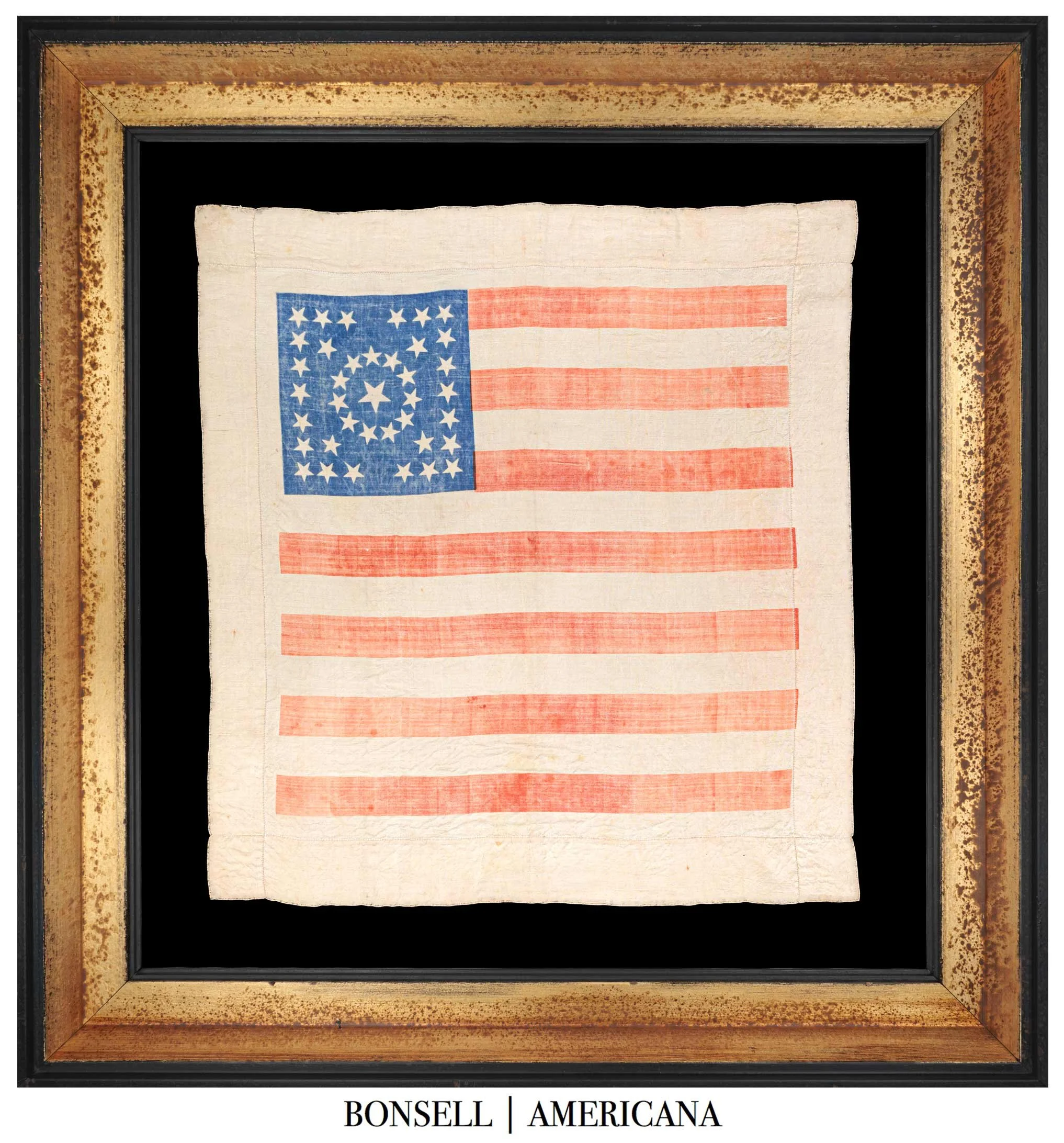
Frame Size (H x L): 33” x 32”
Flag Size (H x L): 22.5” x 21”
Offered is a rare and visually compelling 38-star American flag bandanna, produced in silk and rendered in the form of the Stars & Stripes, with the printed flag itself inset within a larger square field. The format possesses exceptional visual balance, with broad margins surrounding the printed design that reinforce its presentation as both a textile and a patriotic object. Two horizontal seams and two vertical seams, all machine-sewn, join the silk panels together, lending the piece a distinctly period method of construction and underscoring its manufacture during the late 19th century.
The star configuration is among the bandanna’s most memorable and attractive features. At its center is a large, canted star representing Colorado, the newest state admitted to the Union at the time the design originated. This oversized center star is encircled by a wreath of eleven smaller stars, creating a medallion-like presentation. Flanking this central device are four additional stars, while linear groupings of stars to the left and right create the impression of enclosing brackets or a squared framework around the central medallion. The arrangement is highly unusual and visually dynamic, balancing formal structure with folk-like irregularity. The stars are canted in various directions rather than mechanically aligned, and their forms vary subtly in proportion and execution, adding both movement and charm. Such variation is highly desirable among collectors, as it reflects the more artistic and less standardized production methods of the period.
The canton is paired with bold red stripes that have mellowed beautifully over time, taking on the warm orange-red cast often encountered in 19th century textiles. This transformation is especially attractive here, contrasting wonderfully against the soft blue canton and creamy silk ground. The resulting palette is considerably more nuanced than the stark primary coloration associated with later printed flags and contributes substantially to the textile’s visual appeal.
This exact variety is illustrated as item number 637 in Threads of History: Americana Recorded on Cloth, 1775 to the Present, the landmark exhibition catalogue produced in association with the Smithsonian Institution. For collectors unfamiliar with the publication, Threads of History is widely regarded as one of the most important references ever produced on American political textiles, parade flags, kerchiefs, and related patriotic cloth objects. Compiled by Herbert Ridgeway Collins and published in conjunction with the Smithsonian’s major bicentennial-era exhibition, the work documented some of the finest and most historically significant textiles known at the time. Inclusion within its pages represents an important point of scholarly recognition.
The catalogue notes that this bandanna was “used in the political campaign of 1888,” and another closely related example is illustrated nearby as item number 636. That counterpart employs a different flag and star configuration, yet shares the same general format, dimensions, and construction, suggesting that the two likely originated from the same manufacturer or workshop. The relationship between the two textiles provides an especially interesting glimpse into the diversity of patriotic printed goods produced during the period. Rather than relying upon a single standardized design, makers experimented with varying star arrangements and visual compositions while maintaining the same overall concept and scale.
The proposed 1888 campaign association places this textile within one of the more contentious presidential elections of the late 19th century. The election pitted incumbent President Grover Cleveland, the Democrat, against Republican challenger Benjamin Harrison. Tariff policy emerged as the defining issue of the campaign, with Cleveland advocating lower tariffs and Harrison supporting protective measures intended to bolster American industry. Although Cleveland won the national popular vote, Harrison secured victory in the Electoral College. The campaign unfolded during a period of rapid industrialization, expanding rail networks, and growing national identity, conditions that fueled demand for patriotic imagery and political textiles alike. Objects such as this bandanna occupied a unique space between political memorabilia and decorative Americana, serving both as expressions of patriotism and as tangible artifacts of campaign culture.
Its square proportions are particularly appealing. Unlike many parade flags and kerchiefs that feel visually elongated, this example possesses a balanced, almost architectural presentation that allows the star configuration to command attention without overwhelming the striped field. The inset format further heightens this effect, creating a framed composition within the textile itself. Combined with the medallion-style arrangement of stars, the result is exceptionally graphic and immediately recognizable from across a room.
The 38-star count on this flag reflects Colorado’s admission to the Union on August 1st, 1876. Known as the “Centennial State,” Colorado earned its nickname for achieving statehood just twenty-eight days after the nation’s centennial celebrations. Colorado’s path to statehood began with the establishment of the Colorado Territory in 1861, spurred by the Pike’s Peak Gold Rush, which brought a dramatic influx of settlers to the region. Early efforts toward statehood met setbacks, including a veto by President Andrew Johnson in the 1860s, but renewed momentum in the mid-1870s ultimately culminated in Colorado’s official admission as the nation’s 38th state.
Although the 38-star flag did not become official until July 4th, 1877, flag makers frequently produced anticipatory examples ahead of official adoption. These flags played a major role during the Centennial celebrations of 1876, alongside revival designs featuring 13 stars in homage to the original colonies. The Centennial year proved to be a defining moment in American visual culture, fostering renewed patriotism and unity following the divisions of the Civil War. Homes, businesses, parade grounds, and public buildings were adorned with red, white, and blue decoration, and flags became the centerpiece of this widespread national expression.
The Centennial International Exposition in Philadelphia served as the focal point of these celebrations, attracting nearly ten million visitors between May and November of 1876. The exposition showcased American innovation on a grand scale, introducing many visitors to technological marvels such as Alexander Graham Bell’s telephone and the enormous Corliss Steam Engine. Within this atmosphere of patriotic enthusiasm and industrial optimism, the production of decorative flag textiles flourished.
The 38-star flag officially served from July 4th, 1877, until July 4th, 1890, spanning the administrations of Presidents Rutherford B. Hayes, James A. Garfield, Chester A. Arthur, Grover Cleveland, and Benjamin Harrison. It represented a nation undergoing dramatic transformation through westward expansion, mining booms, railroad construction, and accelerating industrial growth. In 1890, the admission of North Dakota, South Dakota, Montana, Washington, and Idaho necessitated adoption of the 43-star flag, bringing the 38-star era to a close. Today, surviving textiles from this period remain especially prized among collectors for their inventive medallion configurations, strong folk qualities, and close association with the Centennial era, one of the most visually dynamic and patriotic periods in American flag history.
Conservation Process: This bandanna was hand sewn to cotton fabric, and both were hand sewn to a mounting board. To prevent the black dye in the cotton fabric from seeping into the bandanna, it was first washed in a standard wash and then in a dye setting wash. The bandanna is positioned behind Optium Museum Acrylic.
Frame: This offering is in our Large Distressed Gold Frame.
Condition Report: The silk exhibits modest to moderate age-related wear, accompanied by minor soiling, scattered pigment loss, and areas of thinning consistent with the textile’s age and delicate nature. There is gentle creasing throughout, accompanied by minor irregularities along the edges and at the seams. The printed coloration has softened beautifully over time, with the red pigments mellowing to an especially attractive orange-red tone. Overall, the bandanna presents exceptionally well, with strong visual impact and remarkable survivability for a late 19th century silk textile.
Collectability Level: The Great – Perfect for Rising Collectors
Date of Origin: 1888
Number of Stars: 38
Associated War: The Indian Wars (1860-1890)
Associated State: Colorado
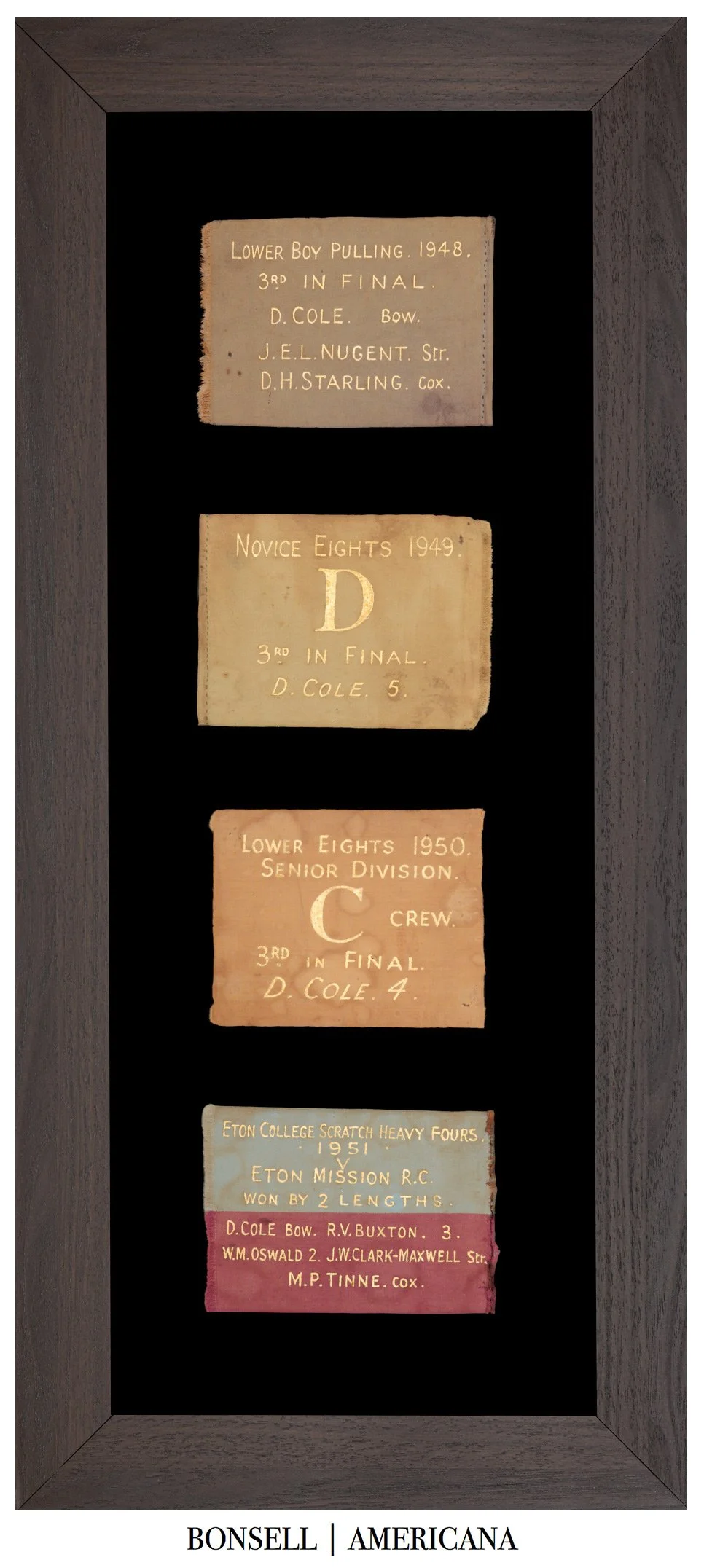
Frame Size (H x L): 28.5” x 13”
Flag Size (H x L): 4” x 5.75”
Offered is a rare and engaging group of four mid-20th century rowing pennants, produced for competition at Eton College and dating from 1948 through 1951. Hand-lettered on fabric and originally mounted to small staffs, these flags document the progress of a single oarsman—identified throughout as “D. Cole”—within one of the most tradition-rich athletic systems in the world.
Founded in 1440 by King Henry VI, Eton College stands among the most storied educational institutions globally. Though termed a “public school” in England, it is in fact an elite, all-boys boarding school, long associated with Britain’s political and cultural leadership. For American audiences, it may be best understood as a hybrid of a top preparatory academy and a historic institution of national identity. Its traditions are both preserved and performed—uniforms, ceremonies, and hierarchies remaining largely intact across centuries. Its alumni include numerous British prime ministers, among them Boris Johnson and David Cameron, as well as literary figures such as George Orwell.
Rowing occupies a central place within this culture. Situated along the River Thames, Eton developed one of the most competitive and structured schoolboy rowing programs in existence. Under the auspices of the Eton College Boat Club, students are organized into multiple crews by age, experience, and ability, competing both internally and in prestigious external events such as the Henley Royal Regatta. Advancement through these crews is a defining aspect of student life, reflecting discipline, endurance, and status within the school.
The present group captures this progression in tangible form. Each flag records a specific race, division, and outcome, offering a concise but remarkably vivid record of participation:
The earliest example, dated 1948, is inscribed “Lower Boy Pulling, 3rd in Final,” and lists the full crew by position, including bow, stroke, and coxswain. In rowing terms, “Lower Boy” denotes a younger division, indicating early participation. The fabric is a natural, undyed tone, with hand-painted lettering in a pale gold or cream pigment, and a roughly finished edge that suggests utilitarian production.
The 1949 flag, labeled “Novice Eights,” reflects the next stage. An “eight” refers to a boat crewed by eight rowers plus a coxswain, and “novice” indicates limited prior experience. The large letter “D” identifies the specific crew within the broader field—Eton commonly designates its multiple boats alphabetically. Again, the crew placed third in the final, and D. Cole appears in seat five, a central rowing position.
By 1950, the inscription reads “Lower Eights, Senior Division, C Crew.” This indicates advancement into a more competitive grouping, with “Senior Division” suggesting increased experience and performance level. The flag retains the same general format—hand-lettered text on a plain fabric ground—but shows slightly deeper coloration, likely from age or variation in material.
The final example, dated 1951, is the most visually distinctive. Titled “Eton College Scratch Heavy Fours,” it refers to a four-man boat assembled for a specific event (“scratch” meaning not a fixed crew). The two-tone coloration—light above and a reddish lower field—may relate to crew or event designation. Unlike the others, this flag records a victory: “Won by 2 Lengths.” It also references “Eton Mission R.C.,” a charitable rowing initiative associated with the school’s outreach efforts in London. The full crew is again listed, with D. Cole returning to the bow position.
Across all four examples, the consistent presence of D. Cole allows the group to be understood not merely as isolated artifacts, but as a cohesive record of athletic development over time—moving from junior to more advanced divisions within a highly structured system.
Taken together, these pennants offer a compelling intersection of sport, education, and social history. They speak to the traditions of Eton College, the discipline of competitive rowing, and the personal narrative of a student progressing through both. At once modest in scale and rich in context, they represent the sort of “gentleman’s antique” that resonates through association—where institution, tradition, and lived experience converge in a quietly meaningful way.
Conservation Process: The flag was hand sewn to cotton fabric, and both were hand sewn to a mounting board. To prevent the black dye in the cotton fabric from seeping into the flag, it was first washed in a standard wash and then in a dye setting wash. The flag is positioned behind Optium Museum Acrylic.
Frame: The frame features a broad, flat face with a clean, squared profile and a gently stepped inner rabbet, finished in a deep walnut tone.
Condition Report: The 1948 example shows moderate fraying along the hoist edge, with minor scattered staining and light surface soiling, consistent with use. The 1949 flag exhibits similar edge wear, along with areas of discoloration and toning to the fabric, particularly toward the right side. The 1950 example presents with more pronounced overall toning and light surface wear, though the lettering remains clear and legible. The 1951 pennant, the most visually distinctive, shows expected wear at the edges and some color variation and minor staining, particularly along the upper right, consistent with age and handling.
Collectability Level: The Great – Perfect for Rising Collectors
Date of Origin: 1948-1951
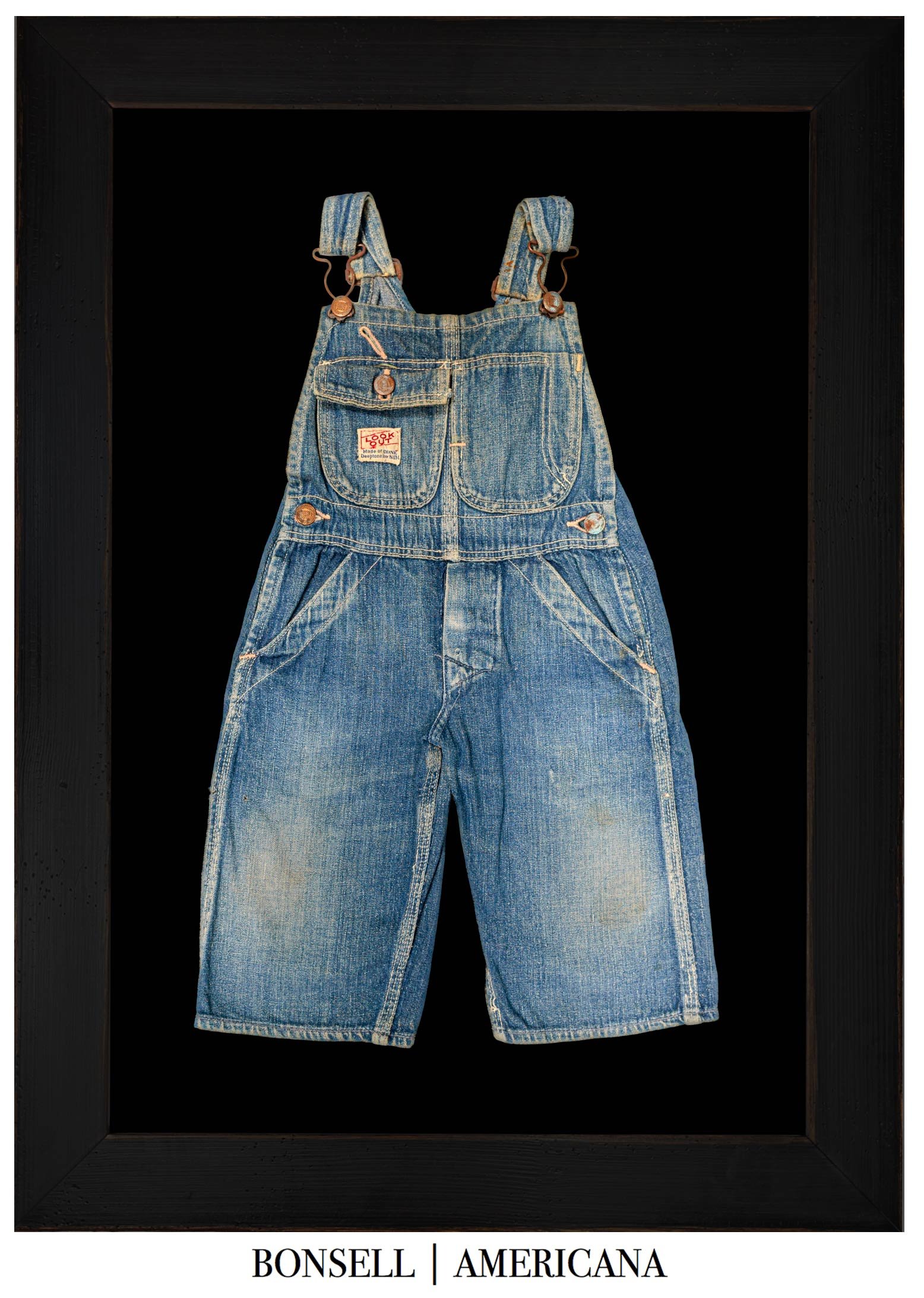
Frame Size (H x L): 33.5” x 24.75”
Overalls Size (H x L): 12” x 23”
Offered is a pair of antique children’s denim overalls produced under the “Look Out” brand and constructed of Cone “Deeptone” denim, dating to approximately the 1930s–1940s. The surviving cloth label on the bib pocket reads “LOOK OUT – Made of Cone Deeptone Denim,” identifying both the brand name and the textile source. Cone Mills of Greensboro, North Carolina, was the most influential American manufacturer of denim during the twentieth century, supplying fabric to many of the country’s best-known workwear companies. Garments bearing references to Cone denim reflect the widespread reliance on this durable indigo cloth in the manufacture of utilitarian clothing intended for both labor and everyday wear.
The overall style reflects classic early twentieth-century American workwear construction, scaled for children. The garment features a traditional bib front with shoulder straps secured by metal hook fasteners, a configuration commonly used on bib overalls prior to the widespread adoption of later adjustable clasp systems. The bib includes a central pocket with a flap closure and button, beneath which the “Look Out” label is sewn. Two additional front pockets appear at the waist, with reinforcement stitching at points of stress. The legs are cut wide in the manner typical of period work garments, allowing freedom of movement for active wear.
Children’s overalls of this type were widely worn throughout the United States during the early twentieth century. They served both practical and economical purposes, providing a durable outer garment that protected clothing beneath while allowing children to participate in farm work, chores, and play. Denim overalls became a particularly common sight in rural communities and small towns, where sturdy garments were essential and clothing was expected to withstand heavy use. The association between overalls and childhood in America during the 1930s and 1940s is well documented in photographs, advertisements, and mail-order catalogs from the period.
The use of Cone “Deeptone” denim reflects the emphasis placed on durability and colorfastness in workwear fabrics of the era. Cone Mills developed several branded denim lines to promote the quality of its indigo-dyed cloth, and the “Deeptone” designation referred to the deep coloration achieved through repeated indigo dyeing of the warp yarns. This process produced denim that aged attractively with wear, gradually developing lighter areas and soft contrasts where the fabric was repeatedly flexed or abraded.
Surviving examples such as this illustrate the durable clothing commonly worn by American children during the first half of the twentieth century and reflect the widespread use of Cone Mills denim in garments intended for everyday wear.
Conservation Process: The overalls were hand sewn to cotton fabric, and both were hand sewn to a mounting board. To prevent the black dye in the cotton fabric from seeping into the overalls, the cotton was first washed in a standard wash and then in a dye setting wash. The overalls are positioned behind Optium Museum Acrylic.
Frame: The frame has a relatively flat profile with a matte black finish. The surface shows intentional distressing with subtle texture and light variation in the finish, giving it a restrained, aged appearance.
Condition Report: The overalls show honest wear consistent with age and use, including areas of fading, light fraying, and minor scattered wear to the denim. The metal hardware shows oxidation and age, while the fabric exhibits attractive, natural distressing throughout. Overall, the garment presents very well, with the kind of authentic wear that collectors appreciate in early denim workwear.
Collectability Level: The Good – Perfect for Beginners and Gifts
Date of Origin: 1930-1949

Frame Size (H x L): 28.5” x 33.5”
Broadside Size (H x L): 19.25” x 24”
Offered is a World War I agricultural recruitment broadside produced for use in Illinois under the auspices of the U.S. Boys’ Working Reserve. Printed in red and blue inks on cream machine-made paper, the poster urges farmers to “Take a Boy Now to Help You Farm,” presenting agricultural labor as a direct contribution to the national war effort.
Issued during America’s involvement in the First World War (1917–1918), the broadside responds to labor shortages caused by military enlistment and wartime industrial expansion. The text states that “20,000 Illinois boys (between 16 and 21) have volunteered in the U.S. Boys’ Working Reserve to help Illinois farmers produce the food to win the war,” explicitly linking agricultural production with national victory. While military enlistment posters are more commonly encountered, this material reflects the parallel mobilization taking place on the American home front.
HISTORICAL CONTEXT
The U.S. Boys’ Working Reserve was organized in 1917 under the United States Department of Labor to mobilize teenage boys for essential wartime labor. As adult farm workers entered military service or relocated to industrial employment, agricultural output faced measurable strain. State programs recruited, screened, trained, and placed high school-aged boys in agricultural positions.
Illinois played a meaningful role in this effort. The broadside describes participants as “carefully picked young men — able-bodied and eager for hard work — intelligent, of good character — trained to learn and to obey.” It further notes that many received “SPECIAL EDUCATION FOR FARM WORK,” including instruction in handling horses and farm machinery. The language reflects Progressive Era emphasis on discipline, character, and organized civic participation.
The text asserts that Federal and State governments “GUARANTEE THESE YOUNG MEN,” an assurance intended to address farmers’ concerns regarding reliability and preparedness. The statement that each boy would be “worth his keep from the first day” frames the program in practical economic terms alongside its patriotic purpose.
The broadside bears the printed names of Samuel Insull, Chairman of the Illinois State Council of Defense, and Burridge D. Butler, Federal State Director of the U.S. Boys’ Working Reserve for Illinois. The printer’s imprint at the lower margin reads “Ryan & Hart Co., Printers, Chicago,” placing the production firmly within Illinois’ wartime administrative structure.
DESIGN, PRINTING, AND PHYSICAL CHARACTERISTICS
The headline “TAKE A BOY NOW” appears in large red block letters across the upper field, with supporting text printed in blue to establish clear visual hierarchy. At left center, a shield device encloses a portrait of a neatly dressed young man in suit and tie rather than work clothing. The imagery presents the recruit as disciplined, educated, and dependable. The shield motif reinforces themes of duty and service, aligning agricultural labor with national defense.
The layout is structured and direct, framed by double red and blue rule borders that organize the text into defined blocks. The concluding directive, “ASK THE MAN IN CHARGE HERE,” indicates intended display in a public or administrative setting where local coordination of placements occurred.
The broadside was printed by letterpress on paper, with red and blue inks applied in separate passes. Registration is clean and typographic impressions remain sharp. It is a single-sheet printed broadside featuring a bold typographic header, a shield-form portrait vignette, and structured text contained within rule borders. The lower margin carries the printer’s imprint of Ryan & Hart Co., Chicago. Visible fold lines are consistent with original folded distribution for mailing or shipment to county offices and agricultural agencies.
This U.S. Boys’ Working Reserve broadside documents the organized mobilization of agricultural labor on the American home front during World War I, combining state-level administration, disciplined wartime messaging, and strong graphic structure in a format intended for public display.
Frame: The broadside is housed in a wide, sloped molding with an aged gold surface, intentionally distressed to evoke the appearance of early gilded frames.
Condition: The broadside has been professionally conserved by a paper conservator and presents well overall. Visible horizontal and vertical fold lines remain from original distribution, with minor residual creasing and slight separation previously present at fold intersections. There is light, even toning consistent with age, along with scattered minor edge wear and small imperfections that remain visible upon close inspection. The printed surface remains strong, with red and blue inks retaining good saturation and clarity.
Collectability Level: The Great – Perfect for Rising Collectors
Date of Origin: 1917-1918
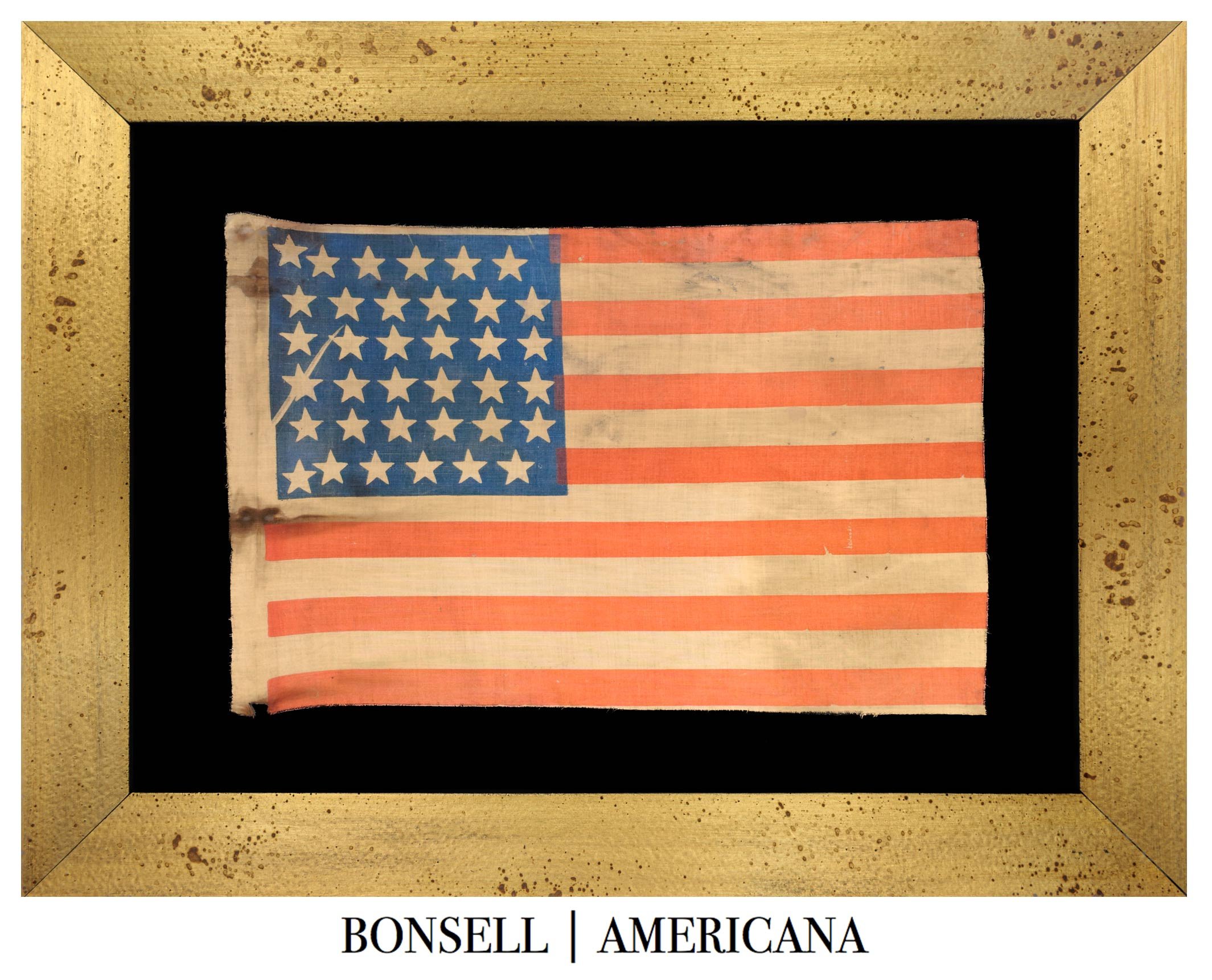
Price: Call 618-553-2291, or email info@bonsellamericana.com
Frame Size (H x L): 20.5” x 26.5”
Flag Size (H x L): 11.5” x 17.5”
Offered is a scarce and historically resonant 36-star American parade flag, dating to the final years of the Civil War and the opening phase of Reconstruction, circa 1864–1867. Printed on cotton for public display, this flag reflects both the urgency of wartime patriotism and the latitude that 19th-century Americans exercised in interpreting and reshaping national symbols.
The canton bears a linear arrangement of stars framing three sides, creating a pronounced open-sided form that can reasonably be read as a visual reference to the Union itself. During the Civil War, the concept of Union was not merely political but existential, and visual shorthand for unity appears across a wide range of patriotic objects—from banners and badges to textiles and printed ephemera. Flags such as this one demonstrate how star placement, rather than being strictly ornamental, could be used to convey allegiance and resolve at a glance.
This configuration also places the flag within a small but documented family of beehive-related star patterns. When rotated ninety degrees, the linear stacking of stars closely resembles a beehive arrangement, aligning it conceptually with known 38-star and 42-star beehive flags produced later in the 19th century. In those examples, the beehive form is more explicit, but the underlying visual logic—organized, collective structure built from individual units—is consistent. The beehive was a long-established symbol in American civic and fraternal culture, representing industry, cooperation, and collective strength, themes that carried particular relevance during the war and the nation’s subsequent rebuilding.
From a manufacturing perspective, the flag illustrates the adaptive practices of mid-19th-century commercial flag-makers. Small parade flags were typically block-printed, using carved wooden forms designed for repeated use. As new states were admitted to the Union in quick succession, it was common for makers to modify existing blocks rather than commission entirely new carvings. In this case, the layout strongly suggests derivation from a 34-star pattern, with two stars added at the upper and lower corners of the hoist end to bring the count to thirty-six. The resulting design balances expediency with intentionality, combining practical production decisions with visually meaningful outcomes.
Several technical characteristics further distinguish the flag. The white ground appears to have been printed with white pigment prior to the application of color, a step that would have brightened the fabric and improved color adhesion. Additionally, the flag was printed on both sides, an uncommon feature among parade flags, which were more often printed on one side only, relying on pigment bleed-through to create a usable reverse. This added effort suggests an intent to produce a more visually finished object for display.
The thirty-six stars commemorate the admission of Nevada to the Union on October 31, 1864. Nevada’s statehood was driven by wartime necessity as much as geography. Its rapid admission was designed to reinforce support for President Abraham Lincoln during the 1864 election and to strengthen Republican influence in Congress. Equally significant were Nevada’s vast silver deposits, which were viewed as essential to sustaining Union finances during the war and addressing the immense fiscal demands that followed.
Although Nevada entered the Union in 1864, the 36-star flag did not become official until July 4, 1865, in accordance with federal flag protocol that delayed star additions until the first Independence Day following a state’s admission. As a result, the 36-star flag flew during the immediate postwar moment, when the nation was grappling with reunification, demobilization, and the early stages of Reconstruction. It remained the official flag of the United States until July 3, 1867, when it was superseded by the 37-star flag following Nebraska’s statehood. During this brief but consequential period, the 36-star flag served as a national emblem of a Union preserved at extraordinary cost.
In total, this flag stands as a rare convergence of symbolic design, adaptive manufacture, and historical timing. Its distinctive star arrangement, relationship to known beehive-pattern flags, and close association with the Civil War and its aftermath distinguish it as an intellectually engaging and historically significant example of American patriotic textiles.
Conservation Process: The flag was hand sewn to cotton fabric, and both were hand sewn to a mounting board. To prevent the black dye in the cotton fabric from seeping into the flag, it was first washed in a standard wash and then in a dye setting wash. The flag is positioned behind Optium Museum Acrylic.
Frame: The flag is housed in a wide, sloped molding with an aged gold surface, intentionally distressed to evoke the appearance of early gilded frames. The profile is substantial without being heavy, providing visual weight that complements the period character of the flag while maintaining a clean, restrained presentation.
Condition Report: The flag presents in sound, stable condition for its age, with expected wear consistent with mid-19th-century parade flags. There is moderate staining and discoloration along the hoist end, accompanied by scattered areas of minor pigment loss and surface abrasion throughout, most notably within the canton and along the stripes. The fabric remains intact overall, with light fraying at the edges and no major structural losses, allowing the flag to display well while retaining clear evidence of period use and age.
Collectability Level: The Best – Perfect for Advanced Collectors
Date of Origin: 1864-1867
Number of Stars: 36
Associated War: Civil War (1861-1865)
Associated State: Nevada
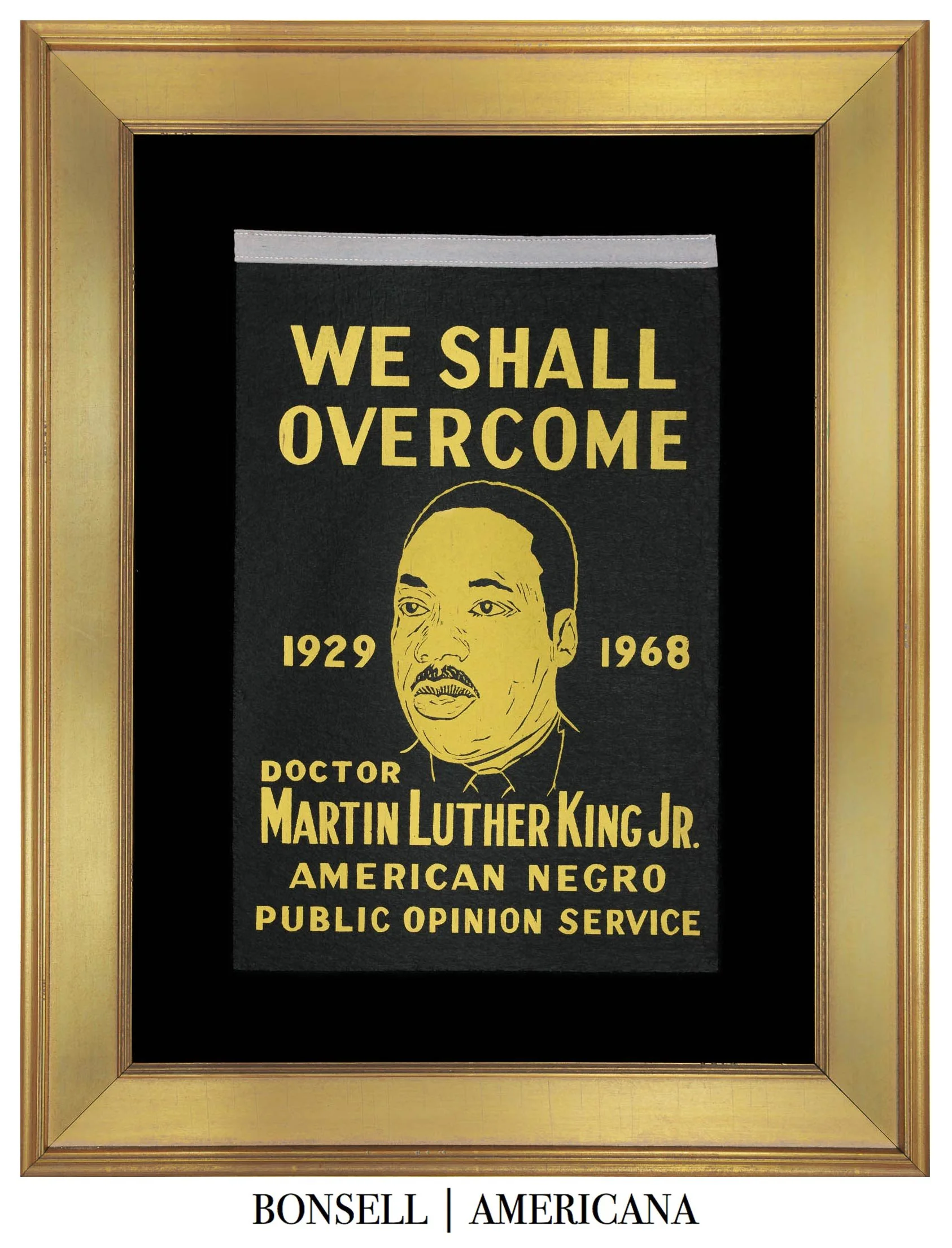
Frame Size (H x L): 28” x 22”
Banner Size (H x L): 18” x 12”
Offered is a Martin Luther King Jr. banner, dating to 1968. The verbiage “WE SHALL | OVERCOME” is printed at the top, and “DOCTOR | MARTIN LUTHER KING JR. | AMERICAN NEGRO | PUBLIC OPINION SERVICE” is printed at the bottom. In the middle of the banner is an image of Dr. King’s face, which is surrounded by 1929 on one side and 1968 on the other side. The verbiage of the overprinting, the image of Dr. King, and the colors combine to make for a fantastic piece.
Conservation Process: This banner was hand sewn to cotton fabric, and both were hand sewn to a mounting board. To prevent the black dye in the cotton fabric from seeping into the banner, it was first washed in a standard wash and then in a dye setting wash. The banner is positioned behind Conservation Clear Acrylic (standard) or behind Optium Museum Acrylic (per request).
Frame: This offering is in our Medium Gold with Flat Profile Frame.
Condition Report: This banner is in excellent condition and presents wonderfully.
Collectability Level: The Good – Perfect for Beginning Collectors and Gifts
Date of Origin: 1968
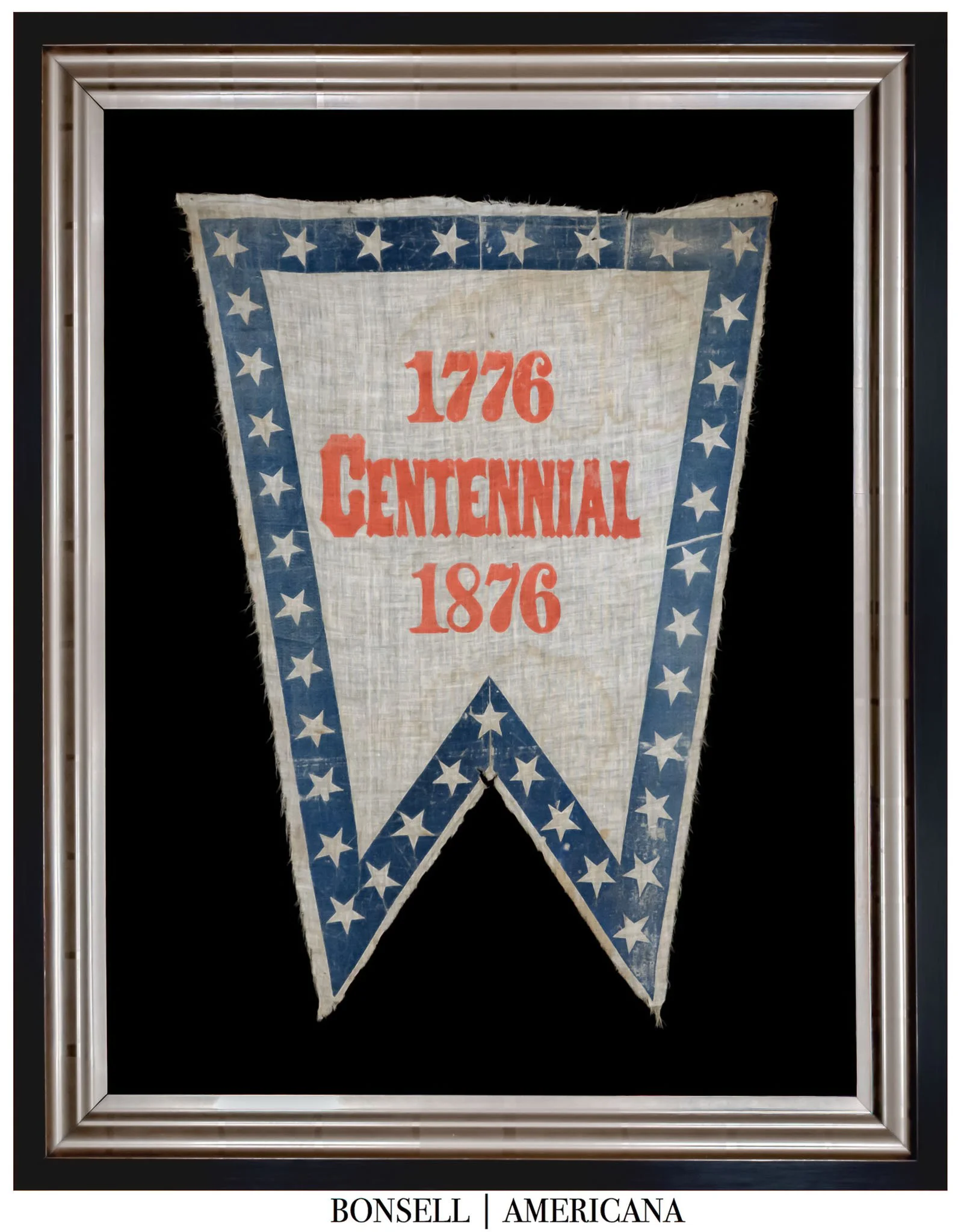
Frame Size (H x L): 33” x 26.75”
Flag Size (H x L): 23.5” x 17.5”
Offered is a patriotic banner made of glazed cotton, commemorating the centennial of the United States in 1876. It features a distinctive swallowtail design with a pointed bottom. The central portion of the banner is a white field, prominently displaying the bold red text "1776 CENTENNIAL 1876" in a stylized font. The lettering stands out against the background, emphasizing the historical significance of the piece.
Surrounding the central area is a wide blue border adorned with evenly spaced white five-pointed stars, reinforcing its American patriotic theme. In total, there are 37 stars, reflecting the official number of states in the Union from 1867 to 1877, following Nebraska’s admission as the 37th state. This star count aligns with the 1876 Centennial era, as the U.S. flag design remained unchanged until Colorado became the 38th state in August 1876.
This banner celebrates the United States' centennial, marking 100 years since the signing of the Declaration of Independence. Given its vibrant design and patriotic symbolism, it was almost certainly waved with pride at a centennial celebration or purchased as a keepsake during the nationwide festivities of 1876.
The banner was made by the American Flag Company, a well-documented producer of patriotic textiles during the 1876 Centennial celebrations. While the company was formally incorporated in New York in 1893, evidence from The Threads of History confirms that it was actively manufacturing banners, pennants, and flags in the 1870s, including designs nearly identical to this one. The American Flag Company played a significant role in producing high-quality patriotic memorabilia, supplying decorative textiles for centennial parades, expositions, and public celebrations. Given the banner’s distinctive swallowtail shape, color scheme, and typographic style—hallmarks of the company’s known centennial-era work—it is consistent with their production methods.
During the centennial, the demand for patriotic banners surged as Americans sought to commemorate the nation’s 100th anniversary with bold, symbolic decorations. The American Flag Company was at the forefront of this movement, manufacturing pieces that not only honored the past but also reflected the nation’s optimism for the future.
The United States Centennial in 1876 was a grand celebration marking the 100th anniversary of the nation’s independence, symbolizing a century of progress, resilience, and patriotism. This milestone came at a time of national reflection, as the country had recently emerged from the Civil War and was working toward reunification and industrial advancement. The centennial was a moment for Americans to honor the achievements of their young nation while looking forward to its future growth. Citizens across the country participated in parades, fireworks displays, and special ceremonies, reinforcing a sense of national pride and unity.
The most significant event of the centennial celebrations was the 1876 Centennial Exposition in Philadelphia, Pennsylvania. This world’s fair, held in Fairmount Park, was the first major international exhibition hosted by the United States. Spanning six months, from May to November, the exposition showcased the latest technological innovations, industrial advancements, and cultural exhibits from both the U.S. and other participating nations. More than 10 million visitors attended, including notable figures such as President Ulysses S. Grant and Emperor Dom Pedro II of Brazil. Among the most famous exhibits were Alexander Graham Bell’s telephone, the Corliss steam engine, and a massive arm and torch from the yet-to-be-completed Statue of Liberty.
Beyond the exposition, centennial celebrations took place in cities and towns across the nation. Patriotic symbols such as the Liberty Bell, bald eagle, and stars and stripes were widely displayed in decorations, banners, and commemorative items, reinforcing national identity. Newspapers and publications of the time encouraged citizens to reflect on the ideals of the Declaration of Independence, with many speeches focusing on themes of freedom, democracy, and innovation.
Additionally, centennial-themed art, music, and literature flourished, further cementing the event’s cultural significance. The centennial also served as a turning point in America’s transition from an agrarian society to an industrial power. The inventions and advancements displayed at the exposition underscored the rapid technological growth that would define the coming decades. It was a time when the nation embraced modernization while still paying homage to its revolutionary roots.
For many Americans, the centennial reinforced the belief that the United States had not only survived its first century but had emerged stronger and more capable of leading on the world stage. This banner, with its powerful iconography and exceptional craftsmanship, serves as a tangible reminder of that momentous occasion—an artifact that was likely held aloft in the excitement of a centennial parade or purchased as a cherished souvenir of the grandest celebration in the nation's history.
Conservation Process: This banner was hand sewn to cotton fabric, and both were hand sewn to a mounting board. To prevent the black dye in the cotton fabric from seeping into the banner, it was first washed in a standard wash and then in a dye setting wash. The banner is positioned behind Optium Museum Acrylic.
Frame: The frame features a black outer border with a silver-toned inner portion, creating a sophisticated contrast that draws attention to the banner’s patriotic design.
Condition Report: The banner is in well-preserved condition for its age, with some signs of wear consistent with its historical use. The fabric exhibits light fading, creasing, and minor fraying along the edges, particularly at the swallowtail points. There is some missing fabric along the top edge, more pronounced on the right side than the left, adding to its authentic, timeworn character. Despite these age-related imperfections, the colors remain vibrant, and the printed text and star pattern are still bold and legible, making it an excellent example of a centennial-era patriotic textile.
Collectability Level: The Good – Perfect for Beginners and Gifts
Date of Origin: 1876
Number of Stars: 37
Associated War: The Indian Wars (1860-1890)
Associated State: Colorado
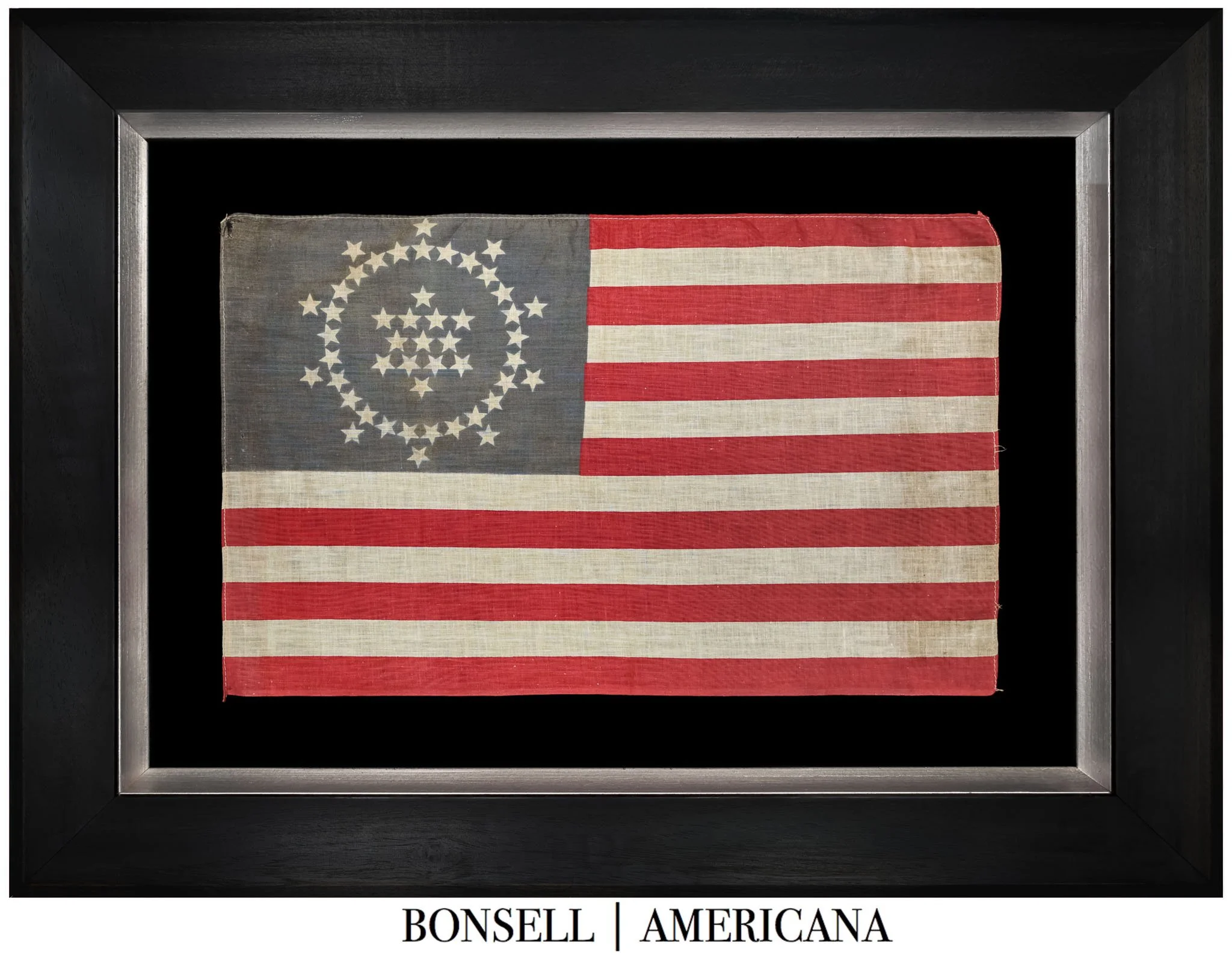
Price: Call 618-553-2291, or email info@bonsellamericana.com
Frame Size (H x L): 24.75” x 33”
Flag Size (H x L): 14” x 22.5”
Offered is an exceptional and historically meaningful printed cotton flag featuring the celebrated Whipple pattern, produced between 1909 and 1912. This rare early 20th-century design represents one of the most ambitious alternative star configurations proposed just before the federal government standardized the forty-eight-star flag in 1912.
From the earliest years of the Republic, American flag makers enjoyed considerable freedom in arranging the stars. Although the First Flag Act of 1777 established the basic elements of the flag, no law specified how the stars should be configured. The result was more than a century of extraordinary variety—sunbursts, wreaths, great stars, medallions, and countless regional or maker-specific arrangements—each reflecting artistic preference, patriotic symbolism, or contemporary sentiment.
This long period of experimentation came to an end as the nation approached the admission of New Mexico and Arizona in 1912. To settle the matter, President William Howard Taft issued Executive Order 1556, which established a fixed pattern of six rows of eight stars and formalized the proportions of the U.S. flag. With a single directive, the era of creative unofficial star configurations drew to a close.
Among the most compelling designs proposed during the run-up to this change was the Whipple Peace Flag, created by author and historian Wayne Whipple of Philadelphia. Whipple sought a design that honored both the origins and the growth of the Union. At its center is a large Great Star composed of thirteen stars for the original colonies. Surrounding this are two rings: an inner ring of twenty-five stars representing states admitted between 1776 and 1876, and an outer ring of ten stars for those added afterward. The wide spacing of the outer ring was intentional, allowing room for future expansion. Whipple viewed the design as a symbol of unity, continuity, and national optimism, and he promoted it widely; it even drew the interest of President Taft.
Whipple’s proposal did not emerge in isolation. By the early 20th century, newspapers regularly published speculative star patterns, and patriotic organizations debated which arrangements best embodied the expanding nation. Whipple—already known nationally as a historian and author of patriotic literature—became one of the most visible advocates for a symbolic, historically grounded design. He published pamphlets, contributed articles, and delivered public lectures explaining the layered meaning behind his concentric rings of stars.
His design gained additional momentum in 1910 and 1911, when the federal government explored how a future standardized flag might be constructed. Whipple submitted his model to the War Department and to the White House, where numerous proposals were reviewed. Period newspapers reported that President Taft personally examined Whipple’s design and appreciated its symbolism. For a brief but notable period, the Whipple configuration appeared in editorials and patriotic publications as a serious contender for the official U.S. flag. Its eventual rejection—in favor of a simpler, more industrially efficient grid—captures the tension of the era, as the United States shifted from expressive, artisanal variations to a standardized national emblem aligned with modern manufacturing.
This example is printed on a lightweight, plain-weave cotton with clearly defined warp and weft yarns, typical of commercially produced parade flags of the early 20th century. The flagmaker finished the hoist, fly, and top edges with machine stitching. In contrast, the bottom edge was left unstitched because it is the original woven selvage of the fabric, which is naturally stable and does not fray. Together, these construction details reflect the practical, straightforward methods used for printed cotton flags intended for patriotic use in the years immediately preceding the adoption of the standardized forty-eight-star design. As both a patriotic artifact and an alternative vision for the national flag, this Whipple-pattern example stands as a compelling piece of pre–World War I Americana.
Conservation Process: This flag was hand sewn to cotton fabric, and both were hand sewn to a mounting board. To prevent the black dye in the cotton fabric from seeping into the flag, it was first washed in a standard wash and then in a dye setting wash. The flag is positioned behind Optium Museum Acrylic.
Frame: The flag is presented in a striking two-part custom frame composed of a wide, matte black outer moulding paired with a contrasting inner liner in a soft metallic tone. The combination creates depth and visual separation, allowing the flag to sit prominently.
Condition Report: The flag remains in attractive overall condition, with strong color in the red stripes and good clarity in the Whipple star configuration. Light discoloration appears along portions of the fly edge, likely the result of long-term storage in a rolled state, where the outermost layers were more exposed to ambient conditions. Of the minor fabric breaks present, the most notable is a small tear at the upper hoist corner; its placement suggests it may relate to early tacking—whether to a staff, a wall, or another display surface is uncertain.
Collectability Level: The Best – Perfect for Advanced Collectors
Date of Origin: 1909-1912
Number of Stars: 48
Associated State: Arizona
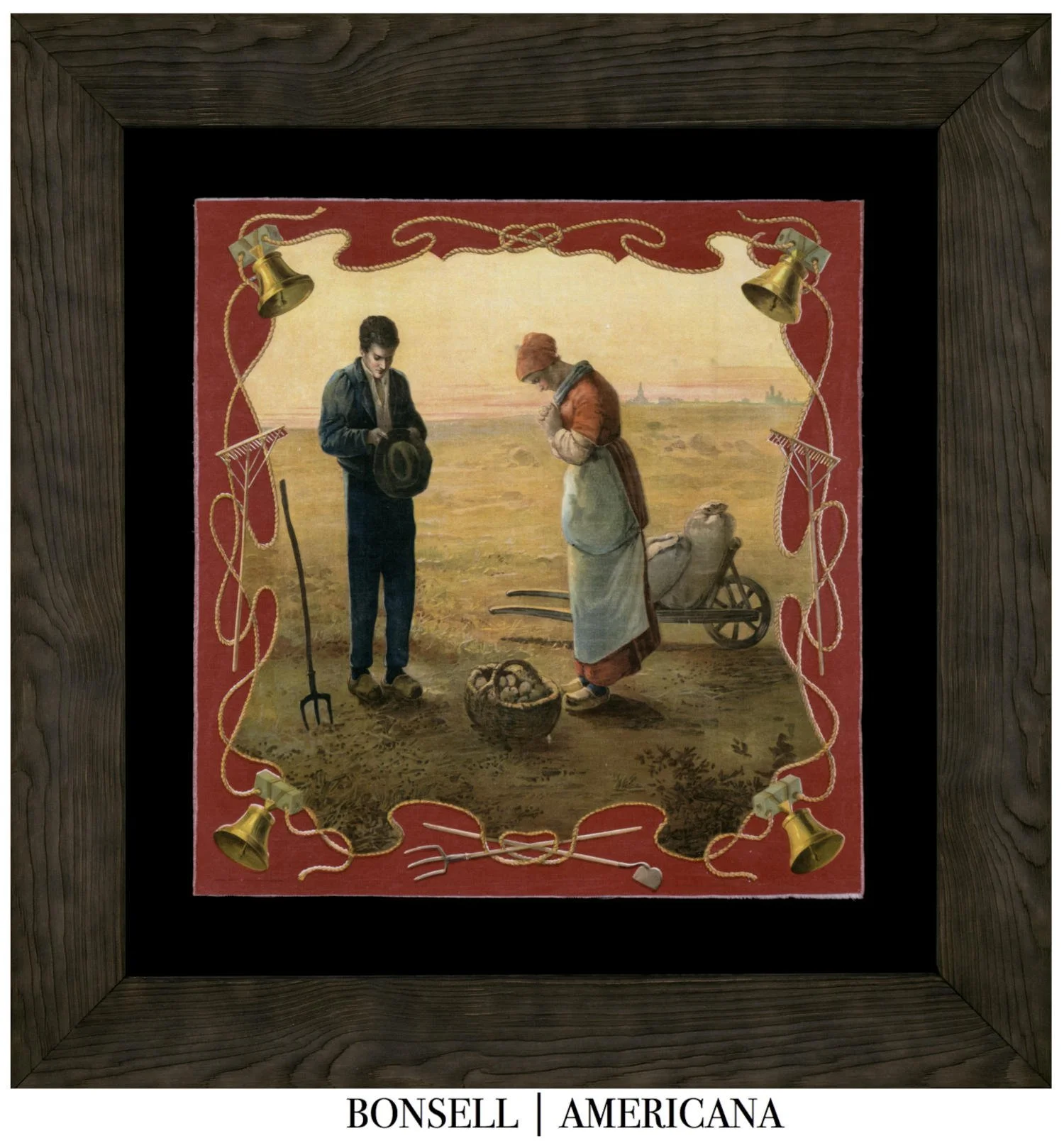
Frame Size (H x L): 34.5” x 33”
Textile Size (H x L): 22.5” x 21.5”
Offered is a printed cotton textile dating to 1900, featuring a reproduction of The Angelus, the well-known painting by French artist Jean-François Millet. Originally painted between 1857 and 1859, The Angelus depicts two peasants in a field at dusk, bowing their heads in prayer as the church bell tolls. The figures stand beside a wheelbarrow and a basket of potatoes, underscoring the theme of rural labor and humility. The image highlights the rhythms of agricultural life and the connection between work and devotion. The painting became one of the most widely reproduced religious and sentimental works of the 19th century.
This textile adaptation was published and copyrighted in 1900 by Campbell, Metzger & Jacobson, a decorative textile and lithography firm based at 446 Broadway in New York City. The company was active around the turn of the 20th century and specialized in printed pillow fronts, wall panels, and other home furnishings. Their products were distributed widely through upholstery suppliers and dry goods retailers. The copyright line, printed along the lower edge of the textile, reads: “Copyright 1900 by Campbell, Metzger & Jacobson.”
The scene is framed by a red printed border containing rope, brass bells, and agricultural tools such as pitchforks and rakes. These design elements complement the setting of the central image and reinforce its agrarian character. The printing technique is chromolithography, applied using multiple passes of oil-based ink to produce rich color and tonal variation. The textile was likely intended as a pillow front or decorative wall panel, suitable for use in homes that identified with themes of faith, farming, and hard work.
The base fabric is a 2/1 cotton twill, identified by its subtle diagonal rib pattern. This weave provided both durability and a smooth surface for detailed printing. Unlike the wool felts used in lower-cost tobacco premiums of the era, this cotton textile would have been marketed toward the upholstery and home furnishing trade, where clearer image reproduction and sewing ease were priorities.
Three supporting images are included to help document and contextualize the piece. The first is a period trade article describing Campbell, Metzger & Jacobson’s offerings, including lithographed pillow fronts. The second is an early 20th-century photograph of the firm's storefront at 446 Broadway. The third is a modern-day photograph of the same building, which still stands in lower Manhattan. These references help confirm the publisher’s identity and provide visual evidence of their business operations at the time this textile was produced.
This piece reflects the intersection of printed art, domestic decoration, and agricultural symbolism in the early 1900s. It connects a prominent European painting to the American market through chromolithographic textile printing. The result is a well-documented example of a decorative object rooted in both fine art and the values of rural labor.
Conservation Process: This textile was hand sewn to cotton fabric, and both were hand sewn to a mounting board. To prevent the black dye in the cotton fabric from seeping into the textile, it was first washed in a standard wash and then in a dye setting wash. The textile is positioned behind Optium Museum Acrylic.
Frame: The frame is constructed from dark-stained wood with a visible grain pattern and a wide, flat profile. It features a clean, modern design
Condition Report: The textile is in sound condition, with strong color retention and no major losses. Minor wear is visible at the edges, along with a few small surface marks consistent with age. The printed image remains clear and well-preserved.
Collectability Level: The Good – Perfect for Beginning Collectors and Gifts
Date of Origin: 1900
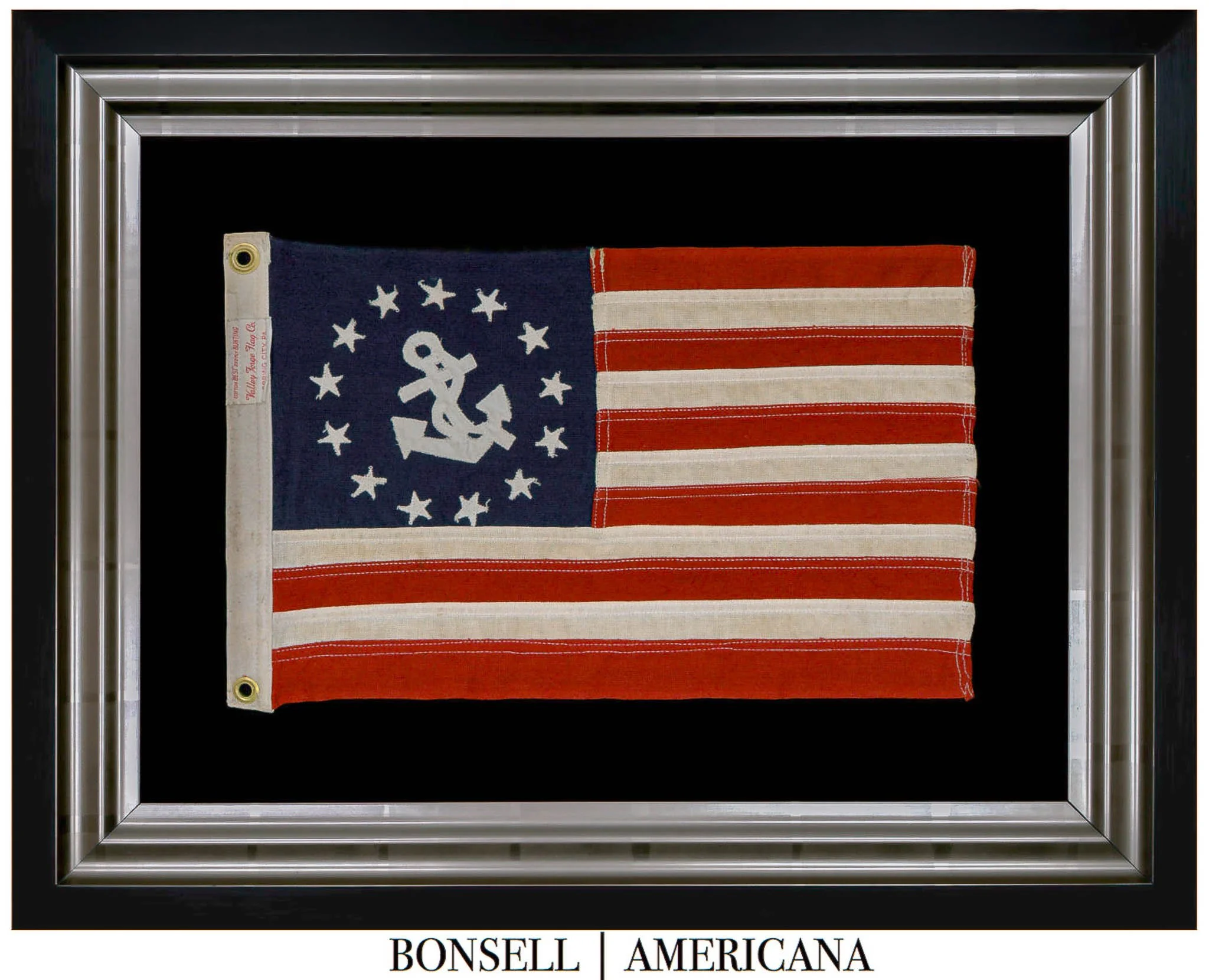
Frame Size (H x L): 19.5” x 25”
Flag Size (H x L): 23” x 35”
Offered is a mid-20th-century American yacht ensign, manufactured by the Valley Forge Flag Company of Spring City, Pennsylvania. These flags were traditionally flown in place of the standard U.S. national flag on private pleasure craft operating in U.S. waters. Distinctive in design, they feature a canted white anchor encircled by 13 white stars—representing the original 13 colonies—set within a blue canton. This emblem, unique to yacht ensigns, has long symbolized both American patriotism and nautical tradition.
The use of a dedicated U.S. yacht ensign arose in the 19th century, when customs officials frequently inspected all incoming vessels, including private yachts rarely involved in commerce. To address this, Congress passed legislation in 1848 authorizing a separate ensign for registered yachts. Vessels flying the yacht ensign were exempt from routine customs inspections, allowing owners uninterrupted leisure sailing while still maintaining official identification on the water.
While never intended to replace the national ensign, the yacht flag was typically flown from the masthead, with the national flag flown from the stern or gaff. Over time, however, many yachts flew the yacht ensign exclusively—an unofficial yet widespread practice driven by the flag’s aesthetic appeal and practicality. Though the law authorizing its use was repealed in 1980, the tradition endures, and the design remains a beloved emblem of American yachting culture.
CONSTRUCTION
This example was produced by the Valley Forge Flag Company, a prominent American maker active in flag production since 1918. A machine-sewn tag along the hoist reads:
“COTTON BEST 2X2 FLY BUNTING / Valley Forge Flag Co. / Spring City, PA.”
The tag’s wording, lack of zip code, and overall style—combined with the use of cotton bunting—indicate a date of manufacture between circa 1935 and 1955.
The flag is constructed from cotton bunting, which was widely used for ceremonial and recreational flags before synthetic materials became the standard in the 1960s. The red and white stripes are machine-pieced with straight seams, while the navy canton is appliquéd with a white anchor surrounded by 13 stars. All design elements in the canton are made from cotton and double-appliquéd to both sides using a zig-zag stitch.
A reinforced white twill hoist bears the manufacturer’s tag and is fitted with two metal grommets, likely nickel-plated brass—a corrosion-resistant alloy preferred for maritime use. The overall construction reflects the evolution of American flag-making in the postwar era: mass-produced, yet still rooted in traditional craftsmanship and patriotic symbolism.
THIRTEEN-STAR FLAGS GENERALLY
The 13-star flag originated with the Continental Congress’s resolution of June 14, 1777, establishing the first official national flag of the United States. While its official tenure lasted until 1795, the design remained symbolically powerful well into the 19th and 20th centuries.
From 1795 to 1916, the 13-star flag served as the standard ensign on small U.S. Navy boats. It was also flown during moments of national mourning and celebration, including George Washington’s death in 1799, the 50th anniversary of American independence, and General Lafayette’s 1824 return tour. Its Revolutionary War associations made it a fitting choice for commemorative and patriotic events throughout American history.
The design saw renewed prominence during the Mexican-American War and Civil War, when its ties to the founding era made it a potent symbol of national unity. By the centennial celebrations of 1876, the 13-star flag had become an enduring emblem of American resilience, often appearing at public events and historical commemorations.
Steeped in symbolic meaning and patriotic heritage, the 13-star flag continues to serve as a visual reminder of the nation’s founding ideals—unity, independence, and perseverance.
Conservation Process: This flag was hand sewn to cotton fabric, and both were hand sewn to a mounting board. To prevent the black dye in the cotton fabric from seeping into the flag, it was first washed in a standard wash and then in a dye setting wash. The flag is positioned behind Optium Museum Acrylic.
Frame: The flag is housed in a modern, shadowbox-style frame featuring a bold, stepped profile. The frame has a black outer edge with a metallic silver inner liner, providing a clean, high-contrast presentation that complements the flag.
Condition Report: The flag is in sound condition, with strong color retention in both the stripes and the canton. There is minor toning and light soiling, primarily along the hoist and edges. The fabric remains stable, with no significant fraying or loss.
Collectability Level: The Good – Perfect for Beginning Collectors and Gifts
Date of Origin: 1935-1955
Number of Stars: 13
Associated War: World War II (1941-1945)
Associated State: Original 13 Colonies
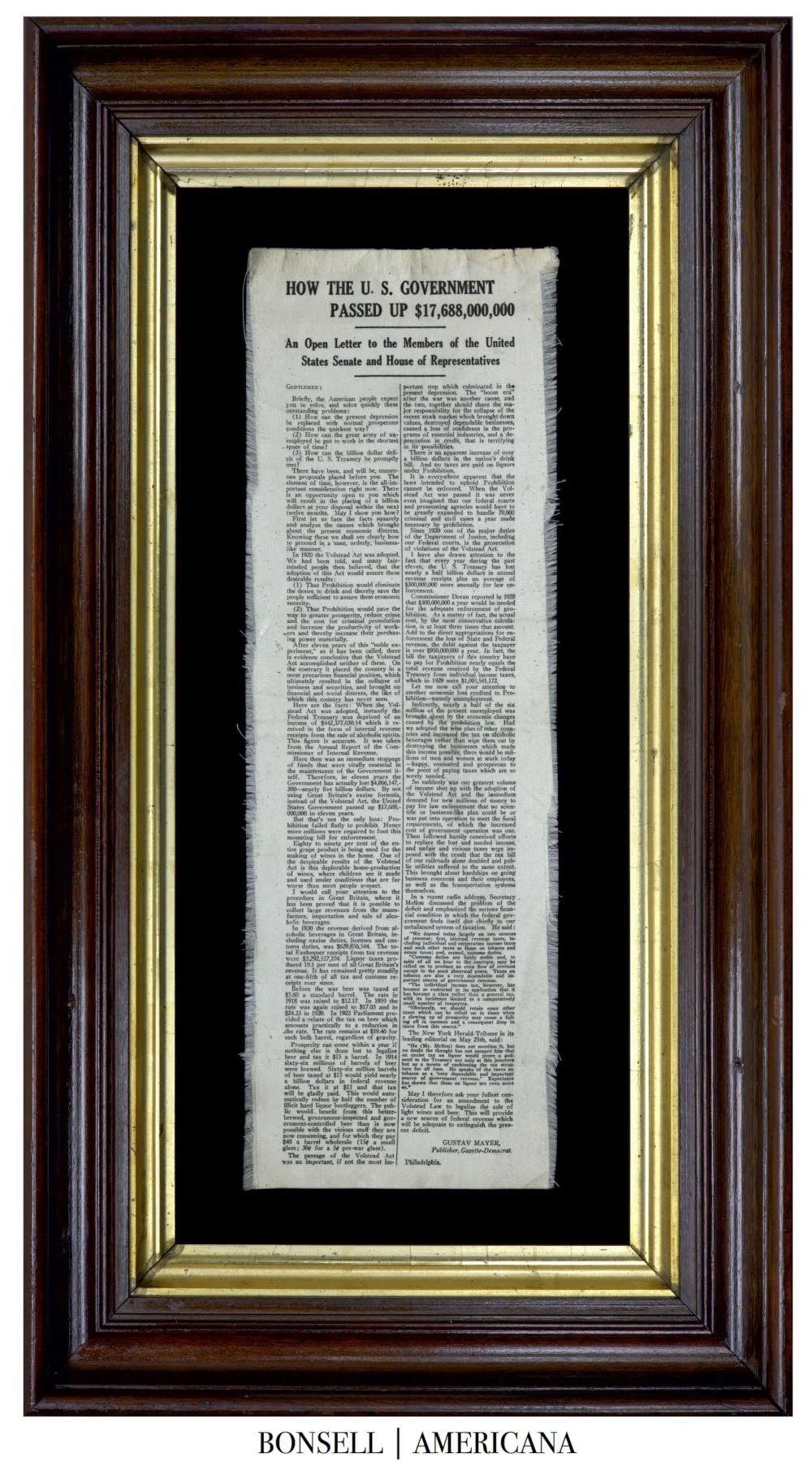
Frame Size (H x W): 17.75” x 6”
Broadside Size (H x W): 25.5” x 14”
Offered is a rare broadside titled "How the U.S. Government Passed Up $17,688,000,000," with the subtitle "An Open Letter to the Members of the United States Senate and House of Representatives" prominently printed in bold at the top. Featuring a two-column layout with densely packed text, it presents a detailed argument about the economic consequences of Prohibition, focusing on the loss of tax revenue from alcohol taxation. Printed on lightweight, plain-woven linen, the material adds both durability and a sense of significance to the document.
Crafted from the fibers of the flax plant, the plain-woven linen used for this broadside provides a smooth, durable, and slightly lustrous surface ideal for clear, detailed printing. Linen's lightweight nature made it practical for handling and transport while retaining its structural integrity. During the Prohibition era, linen’s prestige and resilience reflected the importance of its message, aligning with the cultural and historical demands of the period.
This broadside delivers an economic critique of Prohibition, highlighting the $17 billion in potential tax revenue forfeited due to the Volstead Act. Addressed to members of Congress, it frames Prohibition as both a moral failure and a financial catastrophe, urging lawmakers to reconsider the policy. By emphasizing the ban’s economic consequences, the piece shifts the debate from ideological concerns to pragmatic fiscal realities, making a strong case for repealing the legislation.
During Prohibition (1920–1933), alcohol was outlawed across the United States in an effort to curb societal issues such as crime and alcoholism. While initially seen as a moral victory, the policy's unintended consequences quickly became evident. Organized crime surged as illegal distilleries and bootleggers met the persistent demand for alcohol, while the federal government, heavily reliant on alcohol taxes, faced severe revenue shortfalls. This broadside criticizes these impacts, proposing that regulated alcohol production could restore public funding and weaken the black market.
The broadside also presents an alternative vision for alcohol regulation, advocating for government-controlled production and taxation to generate revenue and ensure safety. It argues that such regulation would benefit the economy and the public by replacing dangerous, unregulated liquor with inspected and affordable options. This pragmatic approach likely resonated with lawmakers and citizens alike, especially as the Great Depression deepened the need for economic reform.
This fabric broadside exemplifies the growing opposition to Prohibition in the late 1920s and early 1930s, reflecting grassroots pressure that contributed to the eventual repeal of the Volstead Act through the 21st Amendment in 1933. The choice to print on linen, rather than paper, underscores its intended durability and importance, ensuring the message's longevity. By grounding its argument in economic terms, this broadside serves as an artifact of the Prohibition era, reflecting the tensions and debates that shaped one of America’s most significant policy reversals.
Conservation Process: The broadside was hand sewn to cotton fabric, and both were hand sewn to a mounting board. To prevent the black dye in the cotton fabric from seeping into the broadside, it was first washed in a standard wash and then in a dye setting wash. The broadside is positioned behind Optium Museum Acrylic.
Frame: The frame is made of walnut and dates from 1860 to 1890. Its dark wood and simple craftsmanship reflect the style of the period.
Condition: The broadside is in excellent condition overall, with light staining that does not detract from its legibility or visual appeal. The fraying along the edges is consistent with the fabric's original lightweight linen construction and reflects its natural wear rather than damage.
Collectability Level: The Good – Perfect for Beginning Collectors and Gifts
Date of Origin: 1920-1933
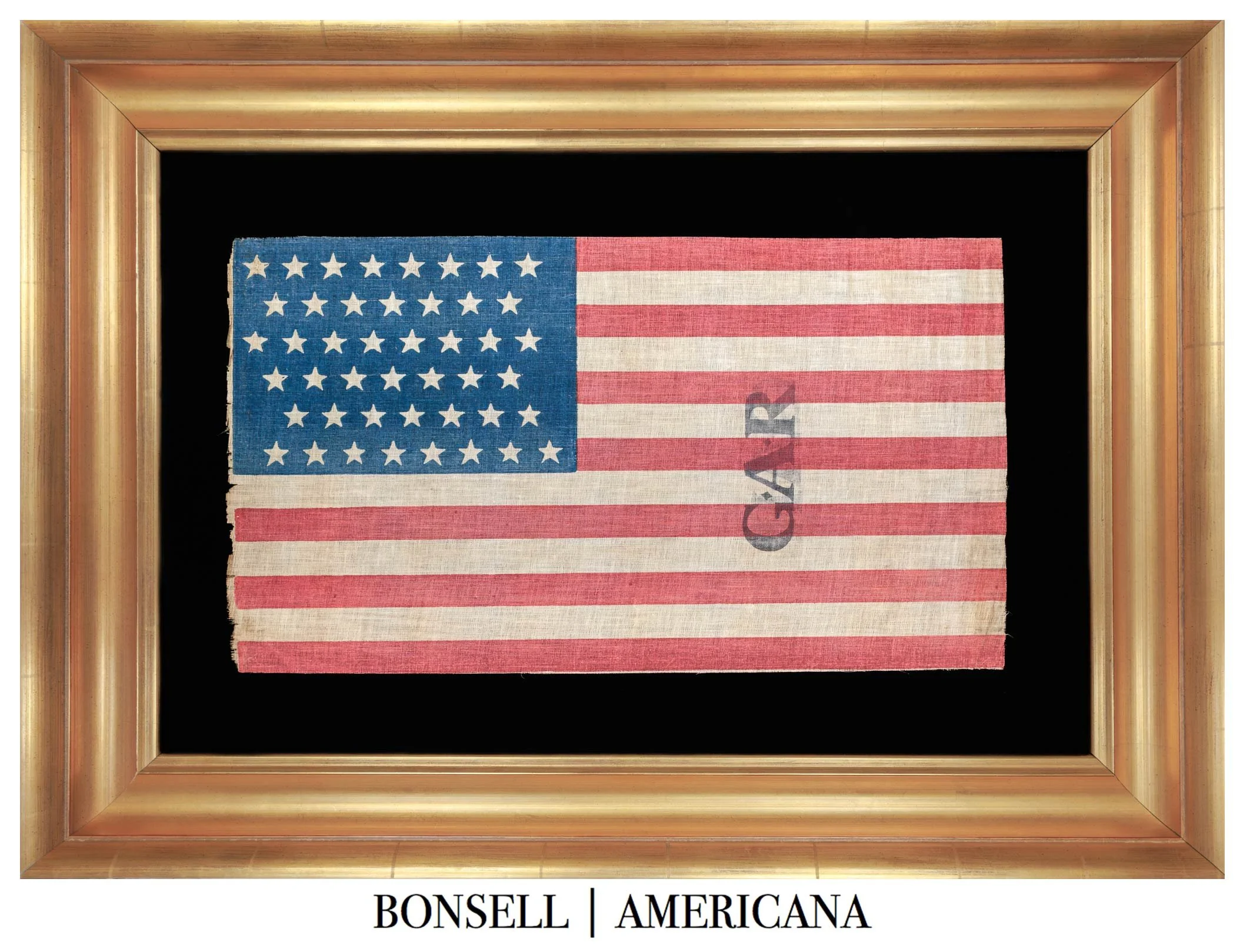
Frame Size (H x L): 22” x 31”
Flag Size (H x L): 12” x 21”
Offered is a forty-five star parade flag printed on glazed cotton. Parade flags are small scale flags that were meant to be used for a short time, typically at patriotic events and political rallies. Some parade flags include some kind of printing, such as this one, which includes Grand Army of the Republic (“GAR”) overprint. The GAR was a fraternal organization for the veterans of the Union Army, Union Navy, and Marines who served in the Civil War. GAR members provided support to one another and also remembered those who had fallen in battle. It was founded in 1866, peaked in 1890 with almost 500,000 members, and dissolved in 1956 when its last member died.
The stars of this flag are arranged in an 8-7-8-7-7-8 pattern. Each row of stars is offset relative to the adjacent rows. For example, the first and third rows are offset to the hoist end of the canton, while the last row is offset to the fly end of the canton. The remaining rows are relatively centered in the canton. This flag is unusually long in length, as it was not until 1912 that the proportions of the flags were officially specified. The combination of the GAR overprint, the staggered star pattern, and the proportions of this flag make for an interesting, desirable mantel piece.
The forty-five star flag represents the inclusion of Utah to the Union. Utah was admitted on January 4th, 1896, and this flag became official on July 4th, 1896. Presidents Grover Cleveland, William McKinley, and Teddy Roosevelt served under this flag, and the Spanish-American War was fought under it.
In 1848 Utah became a territory of the United States, and in 1849 its constitution was established as the Mormon State of Deseret. The next year, the State of Deseret applied to become a state, but Congress rejected the application and changed its name to the Utah Territory, which included the entirety of Nevada and portions of Colorado and Wyoming (as a section of the Missouri Compromise). Despite its continued efforts to gain statehood, it remained a territory, partially as a result of the Mormon Church and Utah authorities being openly tolerant of polygamy. In 1890 Utah outlawed the practice, and in 1896 Utah finally became the forty-fifth state. The forty-five star flag was official for 12 years up until July 4th, 1908, when the forty-six star flag became official and began to represent the inclusion of Oklahoma in the Union.
Conservation Process: This flag was hand sewn to cotton fabric, and both were hand sewn to a mounting board. To prevent the black dye in the cotton fabric from seeping into the flag, it was first washed in a standard wash and then in a dye setting wash. The flag is positioned behind Conservation Clear Acrylic (standard) or behind Optium Museum Acrylic (per request).
Frame: This offering is in our Large Gold Frame.
Condition Report: This flag has some very minor staining and some fading. There is some fraying along the hoist end of the flag. Many collectors prefer flags that show their use and age.
Collectability Level: The Good – Perfect for Beginning Collectors and Gifts
Date of Origin: 1896-1907
Number of Stars: 45
Associated War: Spanish-American War (1898)
Associated State: Utah
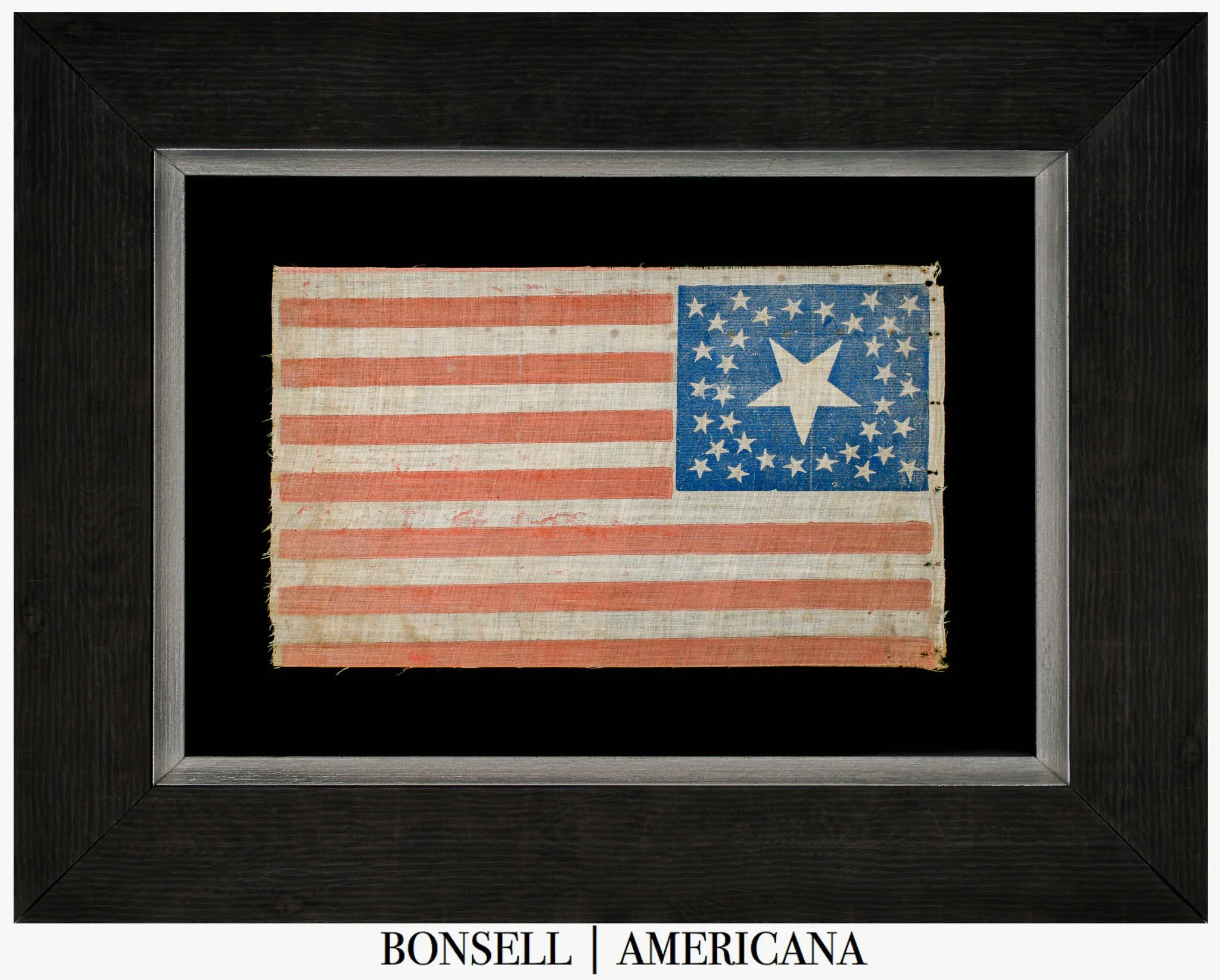
Frame Size (H x L): 18.5” x 24”
Flag Size (H x L): 8.5” x 14”
Offered is a thirty-six star antique flag, printed on coarse glazed cotton and bearing one of the most unusual and distinctive star configurations known in 19th-century American flags. The design features a massive central star set in the middle of the canton. Encircling it is a wreath of seventeen stars, followed by a larger parenthesis of fourteen stars—seven to the left and seven to the right. Four additional stars, one in each corner of the canton, frame the entire composition. Together, these elements form a clear and deliberate arrangement that is highly structured and visually balanced.
The use of a parenthesis formation in a star pattern is exceptionally rare. While 19th-century flag makers employed a wide range of designs—including medallions, wreaths, great stars, and snowflakes—very few surviving examples include a true left-right arc that resembles a bracketed enclosure. In the few that do, the arcs are typically subtle and easily lost within a field of other stars. In contrast, the parenthesis on this flag is plainly visible and integral to the design. We are aware of only three examples of this exact configuration, and no other known pattern presents the parenthesis in this prominent a way.
The massive center star is a form sometimes referred to as a “center star,” a feature occasionally used to represent the newest state admitted to the Union. In this case, that state is Nevada. Center stars are usually only modestly larger than surrounding stars. Here, however, the center star is dramatically oversized and dominates the canton. It is also inverted, with one point facing downward. The reasons for this orientation are unclear. In many cases, 19th-century makers did not follow a standard orientation and may not have viewed any one direction as “up.”
The remaining stars are irregular in shape and size. The stripes have faded to a salmon or orange hue, which aligns with the use of madder or cochineal dyes—commonly used between 1850 and 1880—and known to fade in this way over time.
This flag includes an extra white stripe along the top, an unusual but not symbolic feature. It likely results from how the flag was cut from a larger bolt of glazed cotton that included multiple printed flags. Depending on the cut, individual examples could include one or more additional stripes. In this case, the extra stripe adds visual interest.
This is the third known example of this flag type. One is held in the Pierce Collection of American Parade Flags and is published on page 18 of The Stars and Stripes: Fabric of the American Spirit. A second example previously passed through our hands.
Thirty-six star flags represent the admission of Nevada to the Union. Although Nevada became a state on October 31, 1864, the thirty-six star flag became official on July 4, 1865. That date came shortly after the end of the Civil War, and the flag is often associated with Union victory and the early years of Reconstruction. The thirty-six star flag remained official until July 4, 1867, when the thirty-seven star flag was adopted to include Nebraska.
Nevada’s admission was driven by both political and economic motives. It occurred just eight days before President Lincoln’s re-election, bolstering Republican electoral strength. Economically, Nevada’s silver mining industry was seen as important to financing the Union’s war debt. The state’s borders were later expanded in 1866 and again in 1867, adding land from the Utah and Arizona territories.
This flag stands out for its oversized center star, visible parenthesis arrangement, and added stripe—features that place it among the most distinctive and scarce known designs from the Civil War era.
Conservation Process: This flag was hand sewn to cotton fabric, and both were hand sewn to a mounting board. To prevent the black dye in the cotton fabric from seeping into the flag, it was first washed in a standard wash and then in a dye setting wash. The flag is positioned behind Optium Museum Acrylic.
Frame: The flag is presented in a custom two-part frame. The outer frame is a dark wood with a subtle grain texture, while the inner liner is a metallic silver, offering a clean contrast that highlights the colors and form of the flag.
Condition Report: The flag is in sound condition, with moderate wear consistent with age and use. Toning and soiling are present throughout, and there is some minor fraying along the edges. The colors have faded, particularly the red stripes, which now appear as a muted orange—typical of madder-based dyes used during the period. A line of old nail holes runs vertically along the right edge, evidence of the flag’s original attachment to a wooden staff.
Collectability Level: The Best – Perfect for Advanced Collectors
Date of Origin: 1864-1867
Number of Stars: 36
Associated War: Civil War (1861-1865)
Associated State: Nevada
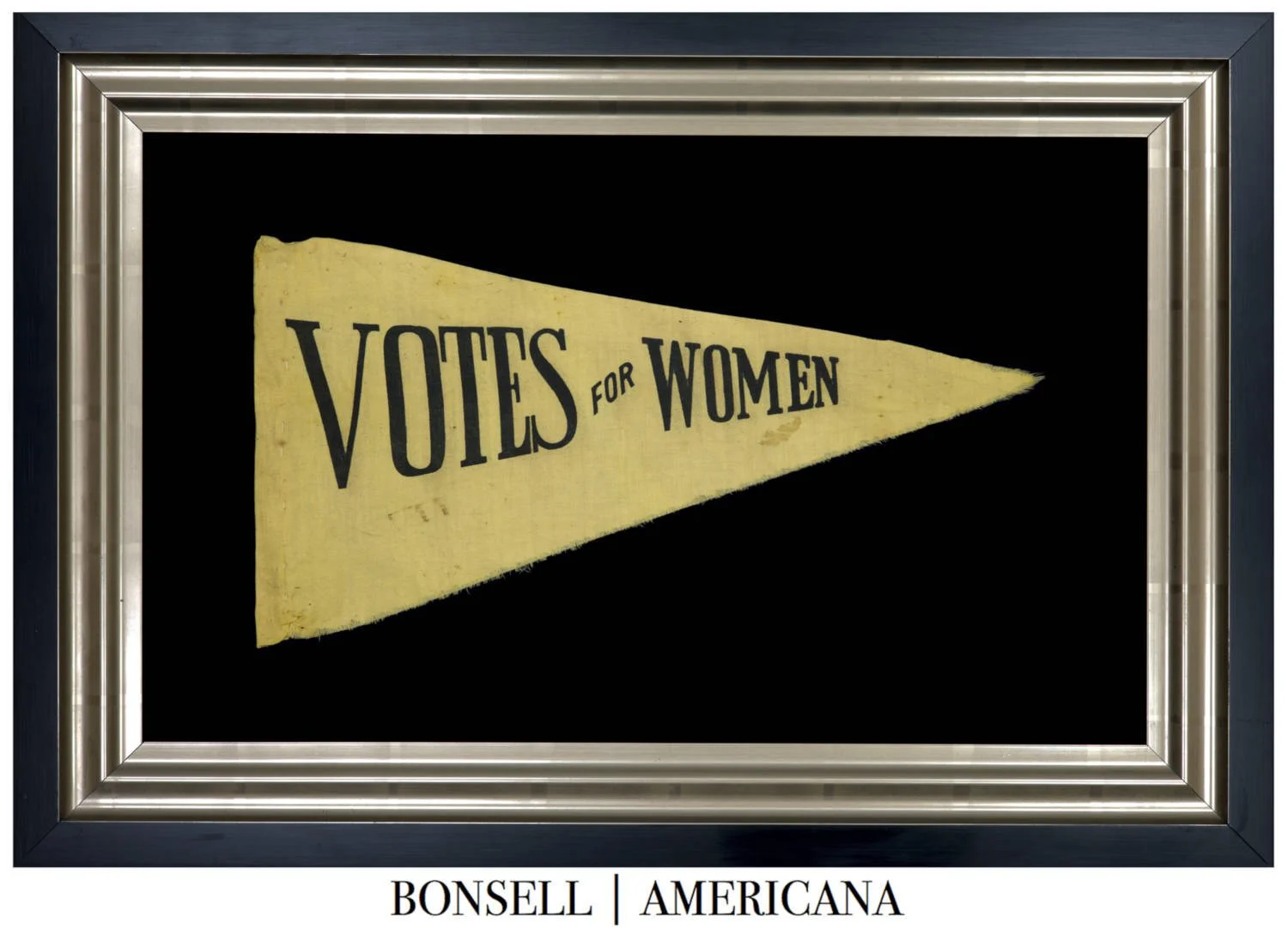
Price: Please call 618-553-2291, or email info@bonsellamericana.com
Frame Size (H x L): 18” x 26”
Pennant Size (H x L): 8.5” x 16.5”
Offered is a pennant made of cotton. It has a triangular shape with a yellow background, a common color used in the women’s suffrage movement. The text "VOTES FOR WOMEN" is boldly printed in black capital letters across the surface, emphasizing the message central to the early 20th century suffrage campaign.
The pennant is a symbolic artifact from the women’s suffrage movement, which was a pivotal social and political campaign of the late 19th and early 20th centuries. In the United States, the movement sought to secure women's right to vote and challenged the entrenched inequalities in political representation. The suffrage movement emerged in response to broader conversations about civil rights, as women activists argued that they, too, should be granted the same voting rights that men enjoyed. This effort reached its height in the early 20th century, as suffragists organized rallies, distributed literature, and used visual symbols like pennants to garner public support for their cause.
The use of pennants like this one became a powerful tool for protest, as they were easily portable, visually striking, and could be displayed in public spaces to attract attention to the suffrage cause. The yellow color was often associated with the suffragist movement in the U.S., particularly the National Woman’s Party, which was one of the most prominent organizations advocating for women’s voting rights. This vibrant hue, combined with slogans like "Votes for Women," helped unify supporters of the cause and provided a sense of solidarity in the fight for equality. The phrase “Votes for Women” became a rallying cry that encapsulated the demands of the movement.
The suffrage movement faced significant opposition from those who believed that granting women the right to vote would disrupt traditional gender roles and undermine social stability. Despite these challenges, activists like Susan B. Anthony, Elizabeth Cady Stanton, and later Alice Paul continued their advocacy, using peaceful protests, lobbying efforts, and visual campaigns to pressure politicians and influence public opinion. As the movement gained momentum, these symbols of suffrage, such as pennants, buttons, and banners, became increasingly visible across the country.
Ultimately, the persistence of the women’s suffrage movement led to the ratification of the 19th Amendment to the U.S. Constitution in 1920, which prohibited the federal government and states from denying citizens the right to vote based on sex. This monumental victory came after decades of tireless activism and was a turning point in the struggle for gender equality in America. The "Votes for Women" pennant, therefore, not only represents a specific moment in history but also serves as a lasting symbol of the determination and resilience of the suffragists who fought for political inclusion.
Conservation Process: This pennant was hand sewn to cotton fabric, and both were hand sewn to a mounting board. To prevent the black dye in the cotton fabric from seeping into the pennant, it was first washed in a standard wash and then in a dye setting wash. The pennant is positioned behind Optium Museum Acrylic.
Frame: The frame has a sleek, modern design with a black outer edge and an inner metallic silver border. It features multiple beveled layers, creating a visually striking contrast that enhances the presentation of the pennant.
Condition Report: The pennant is in generally good condition, showing some signs of aging with light discoloration and a few small stains. These minor imperfections are typical for an artifact of its age, and they add to its historical character.
Collectability Level: The Great – Perfect for Rising Collectors
Date of Origin: 1910-1920

Frame Size (H x L): 31.5” x 34”
Bandanna Size (H x L): 20.5” x 23”
Offered is a rare 1912 Teddy Roosevelt campaign bandanna. It is printed on red silk with beige and black designs of two of Teddy’s hats and three moose. The large moose, in the center, is surrounded by a red and white floral pattern, and the pattern is surrounded by a red border. The Progressive Party campaigned heavily with the use of flags and bandannas, yet this style is particularly hard to find.
Campaign bandannas were initially produced beginning in the first quarter of the nineteenth century, but became a particularly popular campaign tool in the time period between 1850 and 1920. They were worn, presented in store fronts, waved in parades, flown at political rallies, and hung from buggy whips.
An example of this bandanna is documented in the Threads of History, written by Herbert Ridgeway Collins (see item number 939). Mr. Collins was the curator of the Division of Political History at the Smithsonian Institute. His book is the best reference available for political textile collectors and includes over fifteen-hundred examples, dating from 1775 to 1979. In writing his book, Mr. Collins sent thousands of letters to collectors, museums, and universities, and requested their assistance in his quest to document every known political textile.
Theodore Roosevelt—a writer, soldier, naturalist, and statesmen—was the 26th president of the United States from 1901 until 1909. Roosevelt was elected as the governor of New York in 1898, and in this position, he was a reformer who was best known for removing corrupt officials and regulating corporations. Such actions irritated Republican leaders. And in response, they urged him to run as the vice presidential nominee with William McKinley in 1900, the thought being that Roosevelt's vice presidential role would be ceremonial in nature and sidetrack him from continuing to reform and regulate. In 1901, however, McKinley was assassinated, and Roosevelt became the youngest president in history.
Roosevelt was known for raising awareness of the nation's role in world politics, trust busting, regulating the railroads, and continuing to fight political corruption. Notably, in 1902, Roosevelt intervened in the anthracite coal strike upon threats to cut off heating fuel for homes, schools, and hospitals. He responded by stating that the army would run the mines, and by having Wall Street withhold credit to the coal companies and dump their stocks. His actions ended the strike and resulted in a pay increase for the miners. This was the first time that a President had publicly intervened in a labor dispute for the laborers, and he characterized his actions as working toward a "Square Deal" between capital and labor. This became Roosevelt's slogan in his 1904 election, in which he ran against democratic contender Alton Parker. Roosevelt overwhelmingly defeated him by 336 electoral votes to 140. He carried every region in the Union, minus the South.
In 1908, Roosevelt honored his promise not to run for a third term, and he persuaded William Taft to become his Republican successor. Taft defeated William Jennings Bryan for the presidency in 1908, and he defeated Roosevelt for the Republican nomination in 1912. Taft was a conservative republican, and Roosevelt was a progressive republican. Because of this difference and Roosevelt's frustration with not getting the Republican Party's nomination, he formed the Progressive Party, nicknamed the Bull Moose Party following a letter from Roosevelt declaring that he considered himself "as strong as a bull moose." Roosevelt argued for a "New Nationalism" in support of greater governmental regulation and promotion of social welfare, in hopes of attracting votes from the Democratic nominee, Woodrow Wilson. Despite Roosevelt's message and popularity, Wilson easily defeated him by 435 electoral votes to Roosevelt's 88. The Progressive Party elected very few candidates, and as a result, Roosevelt knew it was not a viable long-term party. He kept it alive, but only to the extent that he could use it as a bargaining chip for his return to the Republican Party.
Conservation Process: This bandanna was hand sewn to cotton fabric, and both were hand sewn to a mounting board. To prevent the black dye in the cotton fabric from seeping into the bandanna, it was first washed in a standard wash and then in a dye setting wash. The bandanna is positioned behind Optium Museum Acrylic.
Frame: This offering is in our X-Large Distressed Black and Silver Frame.
Condition Report: This bandanna has a few small holes. In other respects, it is in excellent condition.
Collectability Level: The Great – Perfect for Rising Collectors
Date of Origin: 1912
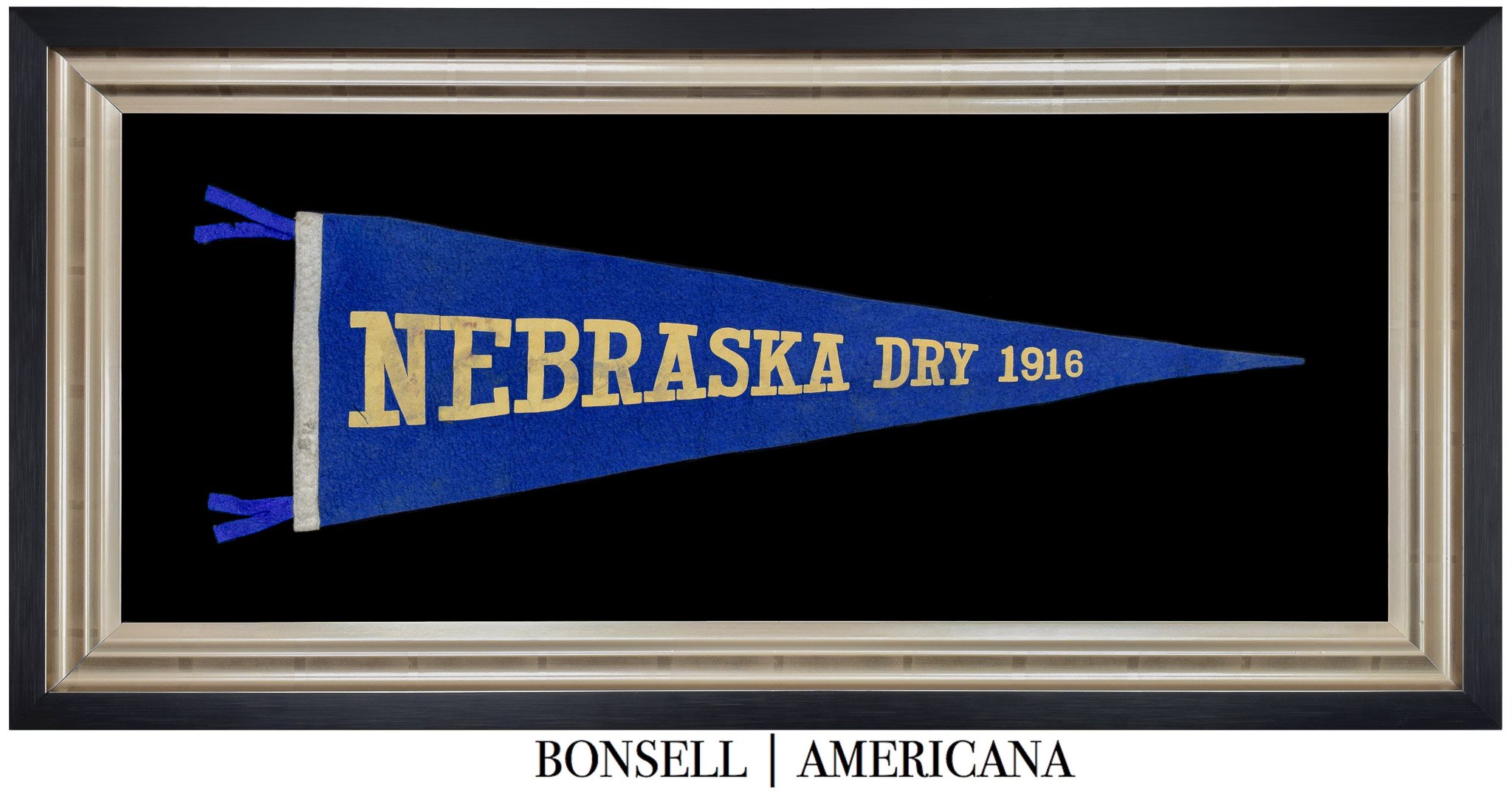
Frame Size (H x L): 18” x 36.5”
Pennant Size (H x L): 8” x 24.75” with 2” ties
Offered is an antique pennant with a “NEBRASKA DRY 1916” overprint. It is made of felt and includes a blue field with white lettering.
In the early 20th century, amid an intense national debate over the role of alcohol in society, many states began to consider prohibition measures. This "NEBRASKA DRY 1916" pennant offers a window into the fervor of the prohibition movement and its impact on the state of Nebraska.
The late 19th and early 20th centuries in America saw the rapid growth of the temperance movement, which advocated for the reduction or elimination of alcohol consumption. This movement was rooted in concerns about public morality, the social ills associated with drunkenness, and the influence of saloons in politics and community life. Organizations like the Woman's Christian Temperance Union (WCTU) and the Anti-Saloon League played central roles in pushing for prohibition at both the state and national levels.
By the time the pennant was created, Nebraska was no stranger to the debates surrounding alcohol. The state's engagement with prohibition began much earlier than 1916, with localized movements and laws restricting or banning the sale of alcohol. However, it was in 1916 that Nebraska's relationship with alcohol reached a significant turning point. That year, the state passed a prohibition amendment to its constitution. The subsequent law went into effect in 1917, making Nebraska one of the many states to embrace prohibition before the nationwide ban in 1920.
The "Nebraska Dry 1916" pennant would have been a potent symbol during this period. Its bold proclamation of "dry" signified Nebraska's stance against the sale and consumption of alcohol. Given its celebratory tone, the pennant was likely used to rally support during the campaign leading up to the vote or to commemorate the passage of the prohibition amendment.
This pennant, as a historical artifact, carries layers of meaning. On a basic level, it represents Nebraska's decision to go "dry" and the state's role in the broader national movement towards prohibition. The pennant serves as a testament to the intense social and political activism of the era, where grassroots movements could galvanize public opinion and effect legislative change.
However, beyond the immediate historical context, the pennant also embodies the broader cultural tensions of the early 20th century. The fight over prohibition was not just about alcohol; it was intertwined with debates over public morality, the role of women in public life (given their significant role in the temperance movement), and the struggle between rural and urban values in a rapidly changing America.
The pennant is a snapshot of a transformative era in Nebraska and American history. Through objects like this, we are reminded of the power of collective movements and the ways in which society's values evolve over time.
Conservation Process: The pennant was hand sewn to cotton fabric, and both were hand sewn to a mounting board. To prevent the black dye in the cotton fabric from seeping into the pennant, it was first washed in a standard wash and then in a dye setting wash. The pennant is positioned behind Optium Museum Acrylic.
Frame: The pennant is in a modern black and silver frame.
Condition Report: There is some staining, most notably over the white vertical strip and over the lettering. Overall, the pennant is age appropriate and attractive.
Collectability Level: The Great – Perfect for Rising Collectors
Date of Origin: 1916

Frame Size (H x L): 36” x 20.75”
Pennant Size (H x L): 26” x 10”
Offered is an antique prohibition pennant in the classic elongated triangular form, tapering sharply to a point. The background is a muted purple. White lettering is arranged in a bold, visually balanced layout. Along the hoist edge, “VOTE YES” appears vertically in tall block letters, setting a strong tone.
Centered on the pennant is the rallying cry: “CALIFORNIA DRY.” “CALIFORNIA” is rendered in large capital letters, with “DRY” below it in a slightly smaller font. Notably, the “D” in “DRY” contains tally marks—five lines crossed diagonally—suggesting themes of voting and civic action. Below, “NOV 3” anchors the design in time.
At the pointed tip, “1914” runs horizontally, underlined with a stylized line that draws the eye to the end. The typography shifts subtly to fit the space, maintaining clarity while enhancing the urgency of its original message.
This pennant commemorates a pivotal moment in California’s history, set against the backdrop of the early 20th-century temperance movement. By 1914, national momentum for prohibition was surging, fueled by decades of grassroots advocacy from organizations like the Anti-Saloon League and the Woman’s Christian Temperance Union. These groups saw alcohol as a root cause of societal ills—crime, poverty, domestic violence, and moral decay—and worked tirelessly to bring about change.
The slogan “California Dry” was part of a statewide campaign urging voters to support a ban on the manufacture and sale of alcohol. The scheduled vote on November 3, 1914, marked California’s own reckoning with the growing national call for temperance.
Although California voters ultimately rejected the prohibition measure in 1914, the campaign was emblematic of a broader cultural shift that culminated just a few years later. By 1919, the 18th Amendment had been ratified, launching national Prohibition in 1920. But that national effort was built on years of local and state-level battles, battles like the one this pennant represents. In fact, many counties and municipalities in California had already gone “dry” prior to the statewide vote, adopting local ordinances in response to public pressure.
The 1914 campaign also reflected a deeper clash of values within California itself. Urban centers like San Francisco and Los Angeles—with their diverse immigrant populations and thriving nightlife—largely opposed prohibition. In contrast, rural and religious communities were more inclined to support it. The debate underscored broader societal tensions: progressivism vs. personal liberty, tradition vs. modernization, rural conservatism vs. urban dynamism.
The temperance movement in California was further complicated by the state’s unique cultural and demographic makeup. California was home to large immigrant communities—particularly from Italy, Germany, and China—many of whom brought longstanding cultural traditions involving alcohol, whether in winemaking, beer brewing, or social consumption. These communities viewed prohibition as an assault not only on personal freedom but on cultural identity itself. As a result, anti-prohibition forces in the state often framed their opposition in terms of civil rights, economic livelihood, and ethnic representation, further polarizing the electorate.
Despite the 1914 defeat, California would continue to play a nuanced role in the prohibition era. While the state never passed a sweeping statewide ban, numerous towns and counties enacted local prohibition laws, creating a patchwork of dry and wet jurisdictions. These localized efforts mirrored national trends, where enforcement varied widely and resistance was often spirited. California’s complex geography, extensive coastline, and border with Mexico also made it a hotbed for bootlegging and smuggling during national prohibition—an unintended consequence that revealed the limitations of enforcement and foreshadowed the law’s eventual repeal.
The slogan “Vote Yes California Dry” was more than a political message—it was a call for moral reform, social order, and a vision of a better society during a time of rapid change.
Today, this pennant stands as a artifact of grassroots activism and civic mobilization. It captures a moment when Americans were deeply engaged in questions about the role of government, personal responsibility, and the power of collective action. While national Prohibition would ultimately be repealed in 1933 with the 21st Amendment, the legacy of the movement—its fervor, its controversy, and its impact—echoes in the stories of campaigns like California’s 1914 vote.
Conservation Process: This pennant was hand sewn to cotton fabric, and both were hand sewn to a mounting board. To prevent the black dye in the cotton fabric from seeping into the pennant, the fabric was first washed in a standard wash and then in a dye setting wash. The pennant is positioned behind Optium Museum Acrylic.
Frame: Framed in a matte black wood frame with subtle grain texture, the presentation is both understated and elegant.
Condition Report: The pennant shows moderate fading consistent with age, but the lettering remains bold and legible. The felt is intact with no major flaws, making it a well-preserved example of early political ephemera.
Collectability Level: The Great – Perfect for Rising Collectors
Date of Origin: 1914
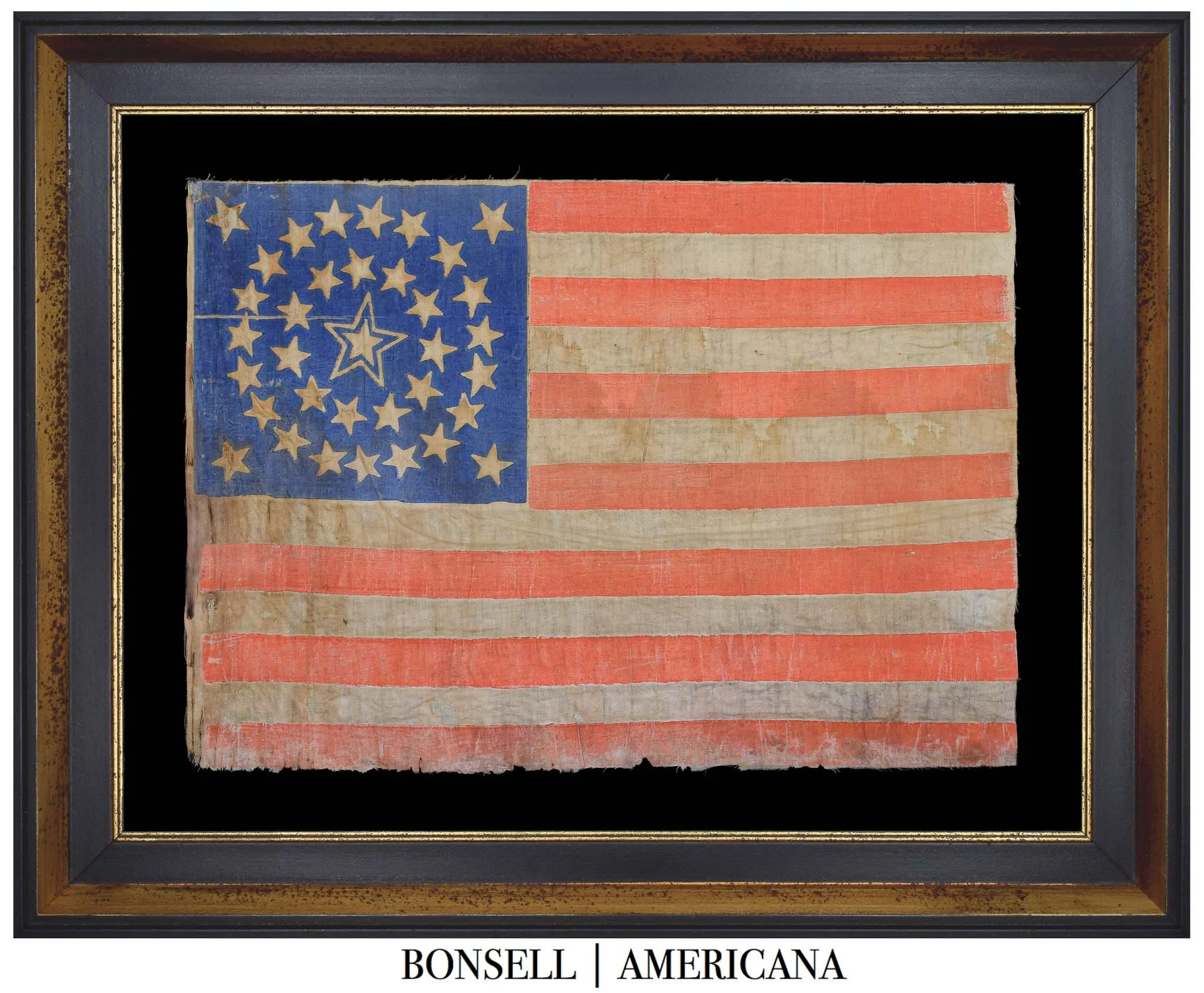
Frame Size (H x L): 30.5” x 38.5”
Flag Size (H x L): 20” x 28”
Offered is an extremely rare thirty-five star antique flag. Its stars are arranged in a medallion pattern. This particular medallion includes a large star in the middle, two rings of stars surrounding the large star, and a flanking star in each corner surrounding the rings. The majority of medallion pattern flags date to between 1861 and 1876. Beginning in the 1890s, linear patterns began to replace medallion patterns, though the reasoning for this transition, at this time, is unclear—in large part because it was not until 1912 that President Taft issued Executive Order 1556, establishing an official star pattern of rectilinear rows.
The large canted star in the middle is referred to as the “center star.” A center star is different than a great star, a term used to describe a star made up of smaller stars. A center star is almost always positioned in the very middle of the canton. The rest of the stars are then positioned around the center star, and form various different patterns. The center star represents the newest state added to the Union (e.g., West Virginia in the case of this thirty-five star flag).
The large center star includes two parts: a bold center star and a surrounding halo. Haloed flags are extremely attractive and collectible. The maker of this flag is unknown, but it is clear that the same company produced most, if not all, haloed flags, including flags with thirty, thirty-four, thirty-five, thirty-six, and forty-two stars. In our experience, the thirty-five star variation is the rarest.
THIRTY-FIVE STAR FLAGS GENERALLY
As noted above, the thirty-five star flag represents the inclusion of West Virginia to the Union. West Virginia was admitted on June 20th, 1863, and this flag became official on July 4th 1863. The thirty-five star flag is the only flag that (1) represents a state admitted during the Civil War time period, and that also (2) became official during the Civil War. Because it was official for a short time period—around 18 months—and because so many flags were produced in 1861 and 1862, thirty-five star flags are the rarest and the most desirable of the Civil War counts.
The thirty-five star flag was official until July 4th, 1865, the time at which the thirty-six star flag official and began to represent the inclusion of Nevada in the Union.
WEST-VIRGINIA STATEHOOD
Prior to the Civil War, what is now West Virginia was part of Virginia. In 1861, when Virginia seceded from the Union, the western portion of the state did not agree with this decision and formed its own government, the Restored Government of Virginia. This government declared its loyalty to the Union and began the process of creating a new state.
In 1862, Congress passed a bill allowing the formation of a new state from the western counties of Virginia. The people of the region held a convention and drafted a constitution for the proposed state, which was then approved by Congress. Despite this, Virginia did not give its consent to the creation of the new state, leading to a legal dispute therebetween.
President Lincoln issued a proclamation recognizing the new state of West Virginia, and as mentioned above, it was admitted to the Union on June 20th, 1863. West Virginia was the only state to be created during the Civil War. The creation of West Virginia was controversial at the time, and its admission to the Union was opposed by some who argued that it was an unconstitutional maneuver.
Ultimately, the state's creation was analyzed by the Supreme Court, in 1871, in the case of Virginia v. West Virginia. Virginia argued that the creation of West Virginia was unconstitutional and that its land should be returned to Virginia. The Supreme Court, in a 6-3 decision, rejected Virginia's argument and upheld the creation of West Virginia. The Court held that Congress had the authority under the Constitution to admit new states to the Union, and that the creation of West Virginia was consistent with that authority. The Court also found that the Restored Government of Virginia was the legitimate government of the state and had the power to create a new state. The case had significant implications for the legality of secession and the power of Congress to admit new states during times of political turmoil. It also affirmed the legitimacy of the creation of West Virginia.
Conservation Process: This flag was hand sewn to cotton fabric, and both were hand sewn to a mounting board. To prevent the black dye in the cotton fabric from seeping into the flag, it was first washed in a standard wash and then in a dye setting wash. The flag is positioned behind Optium Museum Acrylic.
Frame: This offering is in our Large Distressed Black and Gold Frame.
Condition Report: There is oxidation across the entirety of the flag. But the most noticeable oxidation, however, is over the white stripes; below the canton, near the hoist edge; and to the right of the canton. There are tears running along the hoist edge, but they have been stabilized by the mounting of the flag. The bottom red stripe is faded, almost of the point of being white in the lower half thereof. There is a printing error across a portion of the canton (i.e., starting at the hoist edge and ending at the large center star). These issues are age appropriate and typical of haloed flags. Many of our clients prefer flags that show these signs of age.
Collectability Level: The Extraordinary – Museum Quality Offerings
Date of Origin: 1863-1865
Number of Stars: 35
Associated War: Civil War (1861-1865)
Associated State: West Virginia
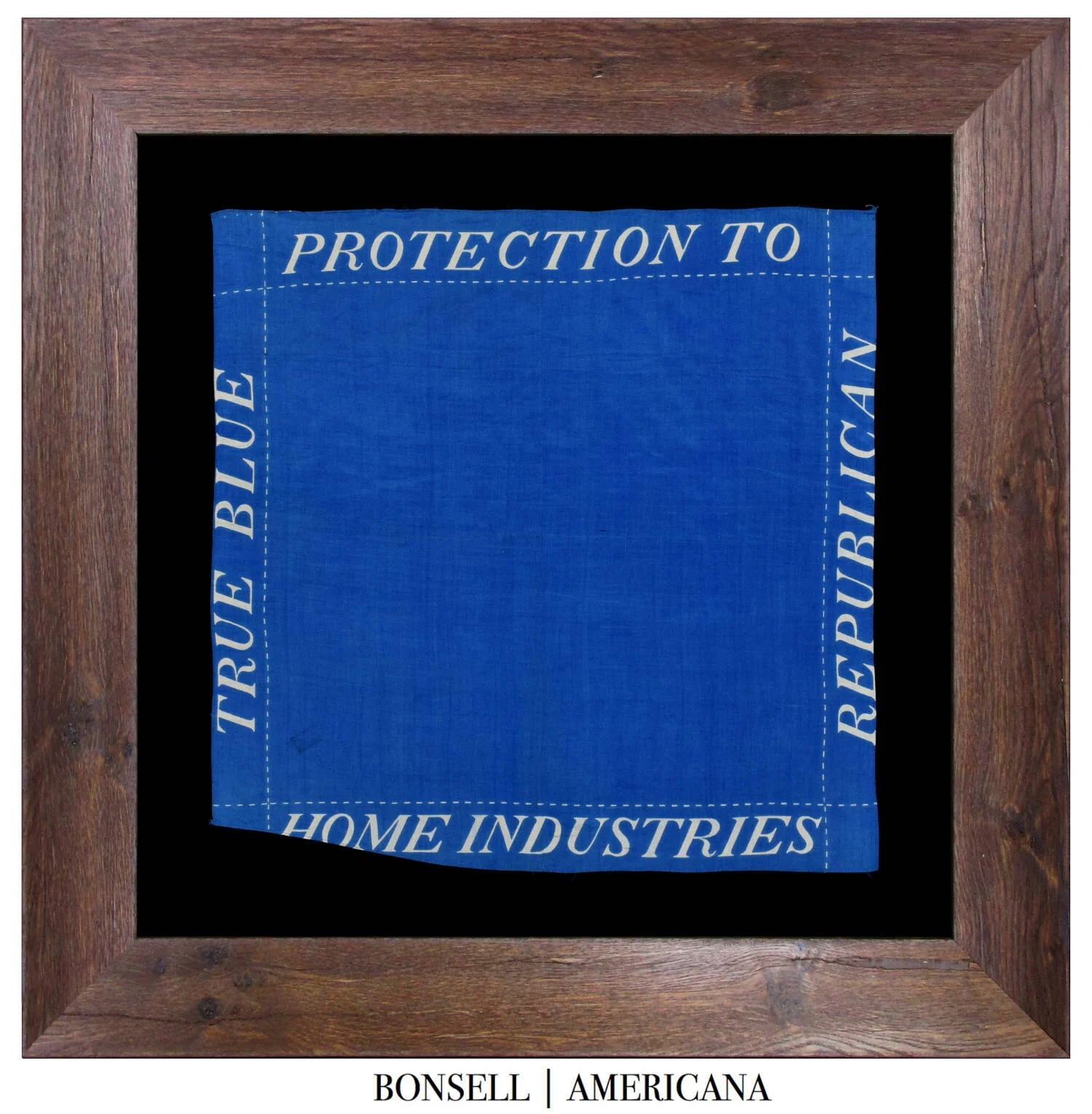
Frame Size (H x L): 32” x 31”
Kerchief Size (H x L): 21” x 20”
Offered is patriotic kerchief made for the Benjamin Harrison campaign. It is made of blue silk and features a pair of overprints. The first overprint states, “TRUE BLUE REPUBLICAN.” And the second overprint states, “PROTECTION TO HOME INDUSTRIES,” a slogan and theme of the Benjamin Harrison campaign in 1888. Campaign kerchiefs were initially produced beginning in the first quarter of the nineteenth century, but became a particularly popular campaign tool in the time period between 1850 and 1920. Campaign kerchiefs were worn, presented in store fronts, waved in parades, flown at political rallies, and hung from buggy whips.
An example of this kerchief is documented in the Threads of History, written by Herbert Ridgeway Collins (item number 582). The referenced example was held in the Ralph E. Becker Collection. Mr. Collins was the curator of the Division of Political History at the Smithsonian Institute. His book is the best reference available for political textile collectors and includes over fifteen-hundred examples, dating from 1775 to 1979.
Harrison was a moderate Republican and was elected as the 23rd president in the election of 1888. Harrison ran against Grover Cleveland, the incumbent President and a Democrat. Harrison lost the popular vote, but won the electoral vote with 233 electoral votes to Cleveland's 168. Harrison signed into law the Sherman Antitrust Act in 1890, the first legislation prohibiting business combinations in restraint of trade. Despite this, many Americans viewed Harrison and the Republicans as being too closely aligned with the wealthy elite, and as wasteful. Upon Harrison's election, the treasury had a great surplus, but the "Billion-Dollar Congress" spent enormous sums on soldiers' pensions and business subsidies, erasing the surplus. By 1890, the Democrats recaptured the House of Representatives by a large majority, and in turn, Harrison had little influence on legislation. In the election of 1892, Harrison lost the electoral vote with 145 electoral votes to Cleveland's 277.
Conservation Process: This kerchief was hand sewn to cotton fabric, and both were hand sewn to a mounting board. To prevent the black dye in the cotton fabric from seeping into the kerchief, it was first washed in a standard wash and then in a dye setting wash. The kerchief is positioned behind Conservation Clear Acrylic (standard) or behind Optium Museum Acrylic (per request).
Frame: This offering is in our Large Reclaimed Wood Frame. However, it can be reframed and would look great using any one of our Medium or Large Frames, which are shown in the final two images. The pricing associated with the different framing options may vary. Reframing of an offering may delay shipment by up to two weeks.
Condition Report: There are a few minor stains, a pair of which are roughly in the center of the kerchief and one of which is in the lower left corner. The blue has faded slightly but is still bright and natural in appearance. The lower left corner is sewn at an angle, such that a portion of the “O” is folded under and a slightly larger portion of the “H” is folded under. The angle of the sewing appears to be original to the kerchief, in contrast to a repair that may have been made at some time thereafter. Overall, the kerchief is age appropriate and looks great.
Collectability Level: The Great – Perfect for Rising Collectors
Date of Origin: 1888
Frame Size (H x L): 34” x 34”
Quilt Size (H x L): 23” x 23”
Offered is a quilt made of silk cigar ribbons, dating to between 1880 and 1910.
In the nineteenth century, most men enjoyed a good cigar, so much so that nearly every household had at least one cigar smoker. At the time, it was considered a gentlemanly and leisurely activity. As Mark Twain often did, he famously quipped and captured the status of cigars with respect to himself and American men generally in saying, “If I cannot smoke in heaven, then I shall not go.” Even the most debonair in the United States and elsewhere were fond of cigars, such as King Edward VII, who announced to his acquaintances, in protest of Queen Victoria’s smoke free policy, “Gentlemen, you may smoke.”
In the United States, cigar smoking was at its peak in 1895, and at that time, there were thousands of cigar manufacturers, in a range of sizes, to meet the corresponding demand. In Cleveland, Ohio, for example, there were 330 cigar manufacturers at the peak (versus none today). On one end of the spectrum, some “manufacturers” were nothing more than a family rolling cigars in a New York apartment or a farmer rolling cigars in an Ohio barn. On the other end, some manufacturers were large, sophisticated organizations, such as those in Connecticut and Florida, the success of Connecticut’s manufacturers being based on the state’s outstanding soil composition, and the success of Florida’s manufacturers being based on the state’s easy access to Cuban suppliers.
Cigar manufacturers sold to distributors. In some cases, the manufacturer would package the cigars for the distributor—but with the end customer in mind—in a wooden box, or alternatively the manufacturer would wrap the cigars with a silk ribbon. In other cases, the manufacturer would package the cigars in mass quantities in a barrel or box, and then the distributor would package the cigars in the wooden box or wrap the cigars. Typically, when wrapped, cigars were sold in quantities of either 25 or 50. Early cigars were much smaller than today’s, almost to the point of being closer in size to a modern cigarette than a modern cigar.
Cigar ribbons were made of silk and each featured the respective manufacturer’s name, essentially being a combination of a packaging material, an advertisement, and a differentiator. A higher quality cigar had higher quality ribbon, while a lower quality cigar had a lower quality ribbon. Most ribbons had a field in a shade of yellow or orange, and most had an overprinting in black. The different shades of yellow and orange seemed to be a function of the different shades of ribbons available, or alternatively a function of the manufacturers wanting to distinguish themselves from the others. Despite a general focus on yellow and orange, some manufacturers used other colors, such as pink, blue, red, and green. Cigar ribbons were typically shy of an inch in width and between 12 and 15 inches in length.
Cigar ribbons—being essentially a form of packaging—were generally thrown away after their respective cigars were smoked. However, some smokers (or their wives) collected the ribbons for enjoyment or for use in a project, such as a table cover, a pillowcase, or a quilt. Such thriftiness was common in the nineteenth and early twentieth centuries, not to mention during the Great Depression and afterwards.
Cigar quilts surface in a variety of sizes. The quilt offered herein is on the smaller end of the spectrum and is desirable for collecting, framing, and displaying. Bigger quilts are sometimes as large is 5 feet by 5 feet. While such quilts are dramatic, they are difficult to display and, thus, often less desirable.
The ribbons of the quilt herein form a diamond in a level square, surrounded by a larger tipped square, surrounded by an even larger level square, and so on. The ribbons are from different manufacturers, including Blackstone, Red Cap, Little Havanas, and Elegantes, to name just a few examples. The maker placed the manufacturers and their respective colors, so as to make a thoughtful, attractive design.
By the 1910s, 20s, and 30s, demand for cigars began to waiver and factories began to shutter, mostly as a result of cigarettes becoming a serious competitor thereto and as a result of the Great Depression. Following this downfall, cigars were significantly less popular for decades, even to the point that manufacturers wondered whether the industry would survive in any form at all. However, beginning in the 1990s—with the introduction of Cigar Afficionado and an increasing interest in old gentlemanly pursuits—cigars made a comeback and are still very much a part of American culture, albeit on a much smaller scale as compared to the nineteenth and early twentieth centuries.
Conservation Process: This quilt was hand sewn to cotton fabric, and both were hand sewn to a mounting board. To prevent the black dye in the cotton fabric from seeping into the quilt, it was first washed in a standard wash and then in a dye setting wash. The quilt is positioned behind Conservation Clear Acrylic (standard) or behind Optium Museum Acrylic (per request).
Frame: The flag is housed in a substantial, wide-profile frame with a matte charcoal finish and subtle linear graining across the face.
Condition: Variations along the raw edges are period to the piece. This quilt is in excellent condition.
Collectability Level: The Good – Perfect for Beginning Collectors and Gifts
Date of Origin: 1880-1910