
Price: Call 618-553-2291, or email info@bonsellamericana.com
Frame Size (H x L): 33.25” x 48”
Flag Size (H x L): 22.25” x 37”
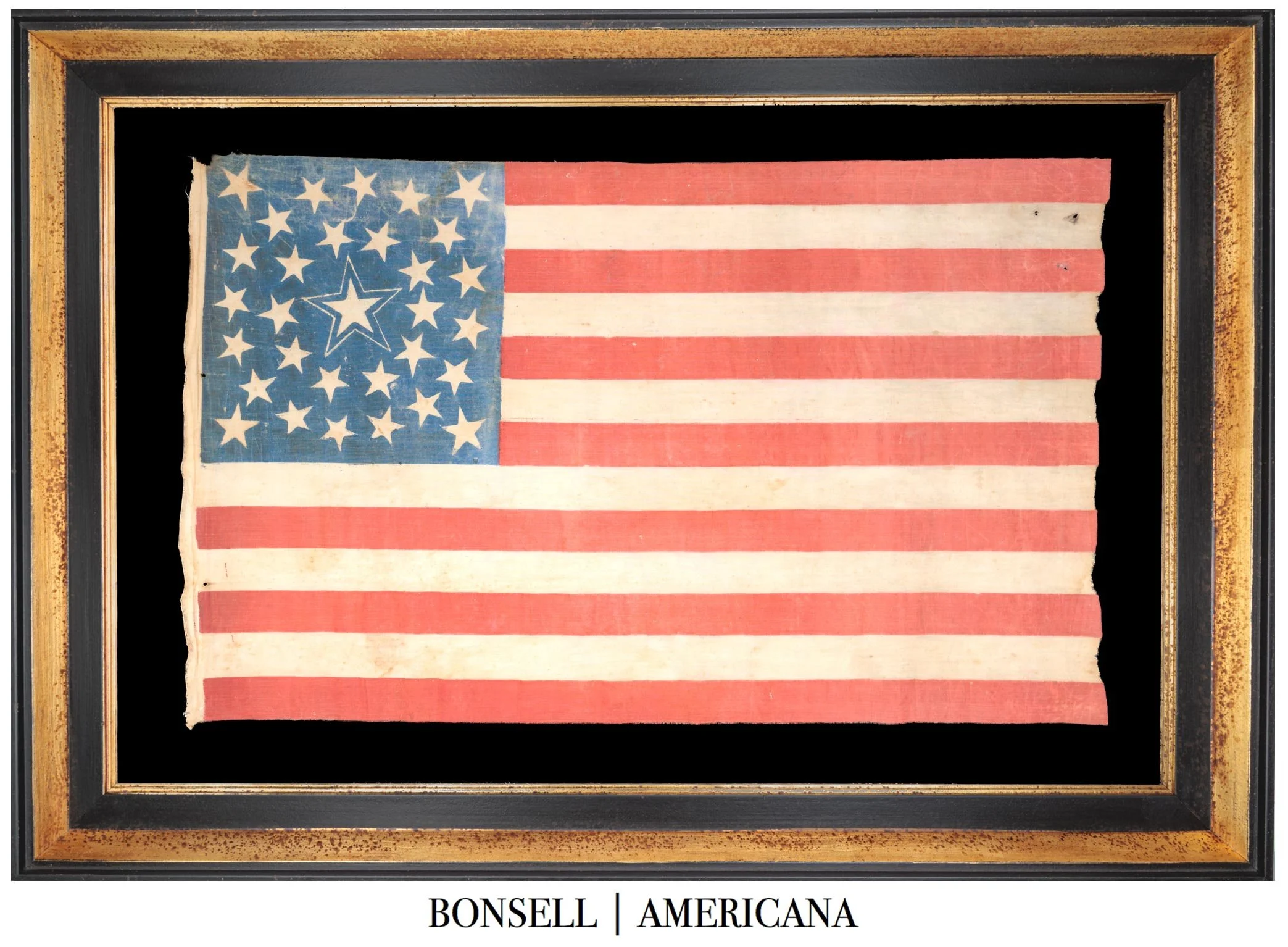
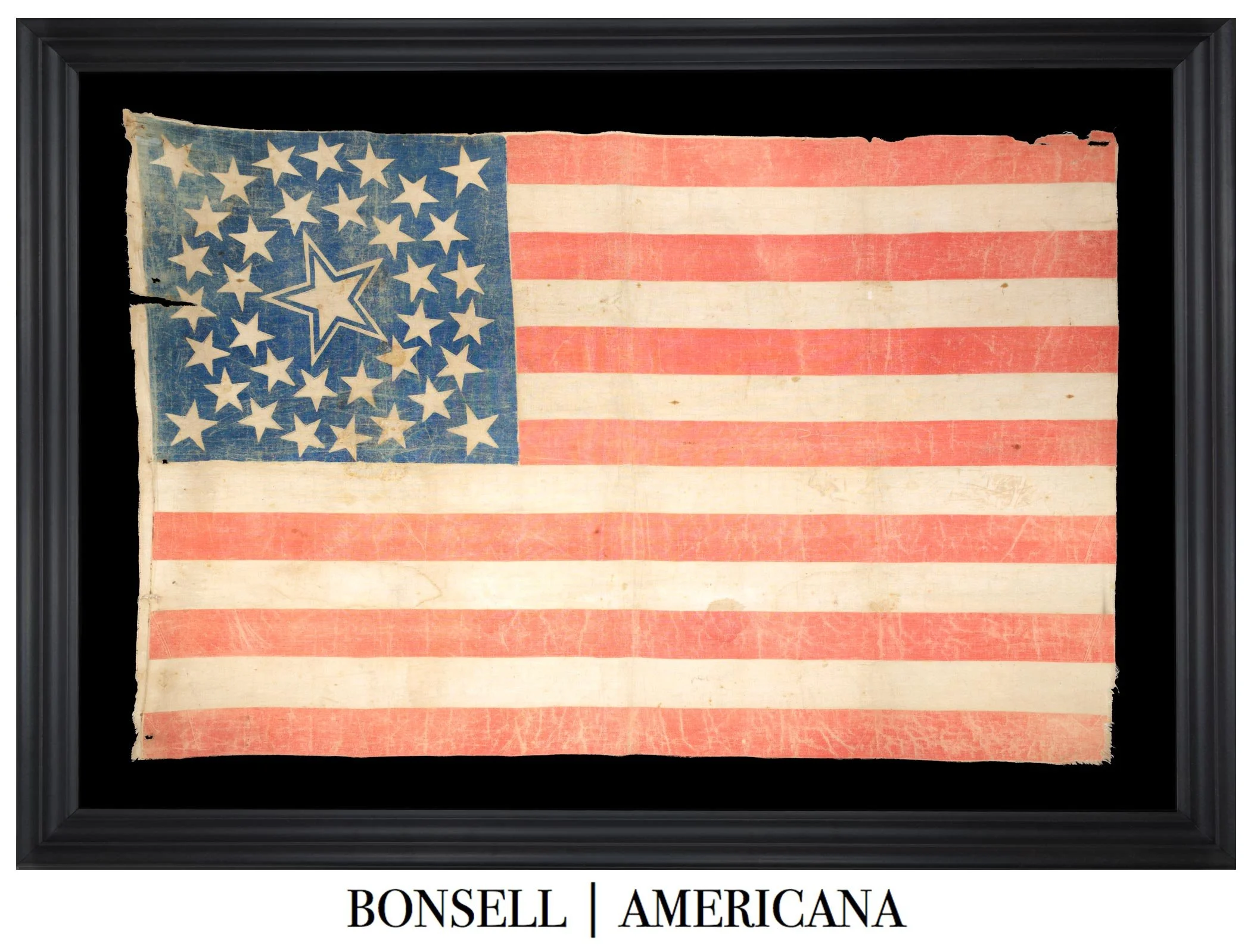
Offered is a rare and highly desirable 31-star American parade flag, printed on glazed cotton and dating to the period between 1851 and 1858, during the official use of the 31-star count. Flags of this era are among the rarest and most coveted of all surviving American flags, both because they predate the Civil War and because the use of the national flag in everyday American life was still comparatively limited. Prior to the outbreak of the Civil War in 1861, Americans did not commonly display the Stars & Stripes for general patriotic decoration in the way that later generations would. The widespread civilian use of the American flag is largely a post-Civil War phenomenon, fueled by wartime nationalism, veterans’ organizations, political campaigning, public schools, and the country’s growing industrial ability to mass-produce patriotic textiles. As a result, flags made before the Civil War survive in extraordinarily small numbers relative to those produced afterward. Among 19th century flags as a whole, pre-Civil War examples comprise only a tiny fraction of surviving material.
This example is particularly compelling for both its visual impact and its unusually attractive star arrangement. The stars are configured in a striking medallion pattern that consists of a large center star, surrounded by two concentric wreaths of smaller stars, with a single flanking star positioned in each corner of the canton. Medallion patterns are among the most sought-after of all 19th century arrangements, prized for their balance, folk quality, and strong graphic presentation. While linear configurations would eventually become standardized in the 20th century, 19th century flag makers enjoyed considerable freedom in arranging stars, resulting in an extraordinary range of whimsical and artistic patterns. Medallions are widely considered among the most beautiful of these arrangements and are especially associated with mid-19th century American parade flags.
The oversized center star is especially significant. Sometimes referred to as a “center star,” this feature differs from what collectors commonly call a “Great Star” or “Great Luminary” configuration. In a Great Star arrangement, the smaller stars collectively form the shape of one large star. In a center star design such as this one, however, the large star occupies the middle of the canton independently, while the surrounding stars radiate outward around it in concentric fashion. In many examples of this type, the center star was intended to represent the newest state admitted to the Union. In the case of a 31-star flag, that state was California.
Particularly noteworthy is the construction of the center star itself. Rather than consisting solely of a single bold outline, it includes a secondary outer border that creates a luminous “halo” effect around the star. Haloed stars are among the most visually dynamic elements found on printed parade flags of the period and are strongly associated with a small and distinctive family of mid-19th century printed flags. The exact maker of these haloed flags remains unidentified, yet surviving examples reveal enough similarities in execution, scale, printing style, and artistic treatment to strongly suggest common manufacture. Comparable haloed examples are known in 30-star, 31-star, 34-star, 35-star, 36-star, and 42-star counts, among others, forming one of the more recognizable and beloved groups within early printed American flags.
This flag belongs to a particularly early generation of printed parade flags. The earliest known printed American parade flags date to the late 1830s and early 1840s, shortly after advances in textile printing technology made such production commercially viable. Twenty-six star examples, representing Michigan statehood, are generally regarded as the earliest surviving printed parade flags, dating between approximately 1837 and 1845. This 31-star example was therefore produced only a relatively short time later, placing it very near the beginning of printed flag production in the United States. Surviving examples from this formative period are scarce in all star counts, and especially so in counts preceding the Civil War.
The coloration of the stripes is especially attractive. Rather than displaying the deep saturated red commonly associated with later flags, the stripes exhibit a warm orange-red hue that is characteristic of many mid-19th century textiles. This coloration is generally attributed to the use of natural dyes such as madder and cochineal, both of which were widely employed during the period before the later standardization of synthetic aniline dyes. Over time, these pigments often mellow into softer tones ranging from salmon to burnt orange, lending early American flags a distinctive warmth that collectors find especially appealing. The canton likewise displays a beautiful dusty blue coloration that differs markedly from the darker navy tones seen on later examples. Because official standards governing the precise shades of red and blue had not yet been firmly established, considerable variation existed among textile makers during the mid-19th century, contributing to the highly individual character of flags from this era.
California’s admission to the Union—and the resulting creation of the 31-star flag—occurred during one of the most transformative moments in American history. The discovery of gold at Sutter’s Mill in 1848 triggered the California Gold Rush, one of the largest mass migrations in world history. Tens of thousands of fortune seekers from across the United States and abroad flooded into the territory with astonishing speed. Between 1848 and 1850, California’s non-native population exploded, creating urgent pressure for civil government and eventual statehood. Unlike many western territories that spent years or decades under territorial administration before entering the Union, California moved toward statehood with remarkable rapidity.
The question of California’s admission also became deeply entangled in the sectional tensions surrounding slavery in the years leading to the Civil War. As the nation expanded westward following the Mexican-American War, fierce political debate erupted over whether new territories would permit slavery. California sought admission as a free state, upsetting the delicate balance between free and slave states in Congress. Its admission ultimately formed a central component of the Compromise of 1850, the complex legislative package engineered primarily by Henry Clay in an effort to preserve the Union. Signed into law in September of that year, the compromise temporarily eased sectional conflict while simultaneously revealing just how fragile the national political balance had become.
California officially entered the Union on September 9th, 1850, as the 31st state. In accordance with the Third Flag Act of 1818, however, new stars were not officially added to the American flag until the following Independence Day. Thus, the 31-star flag became official on July 4th, 1851. It remained the official national flag until July 3rd, 1858, after which the 32-star count replaced it following the admission of Minnesota. The official lifespan of the 31-star flag therefore spanned just seven years, encompassing a period of extraordinary expansion, political volatility, western migration, and accelerating national change immediately preceding the Civil War.
An interesting aspect of this particular example is its provenance, as the flag at one point belonged specifically to Robert Endres, from whose family it was acquired. Endres played football at Ohio State University, serving as an offensive tackle for the Buckeyes during the mid-20th century. Contemporary coverage described him as a dependable mainstay on the offensive line, following two years of junior varsity play before advancing to the varsity squad in his senior year. While unrelated to the flag’s original period of manufacture, the association adds an appealing layer of Americana, linking this mid-19th century national textile to a later tradition of American collegiate athletics.
Because relatively few flags were made during this era—and because even fewer survived the passage of more than 170 years—authentic 31-star parade flags rank among the rarest and most desirable of all 19th century American flags. Examples featuring highly graphic medallion arrangements, especially those with haloed center stars and strong folk characteristics, occupy an especially important place within advanced collections of early American textiles and political Americana.
Conservation Process: This flag was hand sewn to cotton fabric, and both were hand sewn to a mounting board. To prevent the black dye in the cotton fabric from seeping into the flag, it was first washed in a standard wash and then in a dye setting wash. The flag is positioned behind Optium Museum Acrylic.
Frame: This offering is in our Large Distressed Black and Gold Frame.
Condition Report: The flag displays moderate to modest wear consistent with its age and use, including scattered soiling, minor foxing, and areas of pigment loss and fading throughout. There is light fraying and minor loss along the fly end and hoist, accompanied by a few tiny holes and small areas of fabric separation. The glazed cotton has mellowed beautifully over time, resulting in especially attractive coloration in both the dusty blue canton and the warm orange-red stripes. Overall, the flag presents exceptionally well and retains outstanding visual impact, particularly in the dramatic haloed medallion configuration.
Collectability Level: The Extraordinary – Museum Quality Offerings
Date of Origin: 1850-1858
Number of Stars: 31
Associated State: California
Price: Call 618-553-2291, or email info@bonsellamericana.com
Frame Size (H x L): 36” x 36”
Flag Size (H x L): 25” x 25”
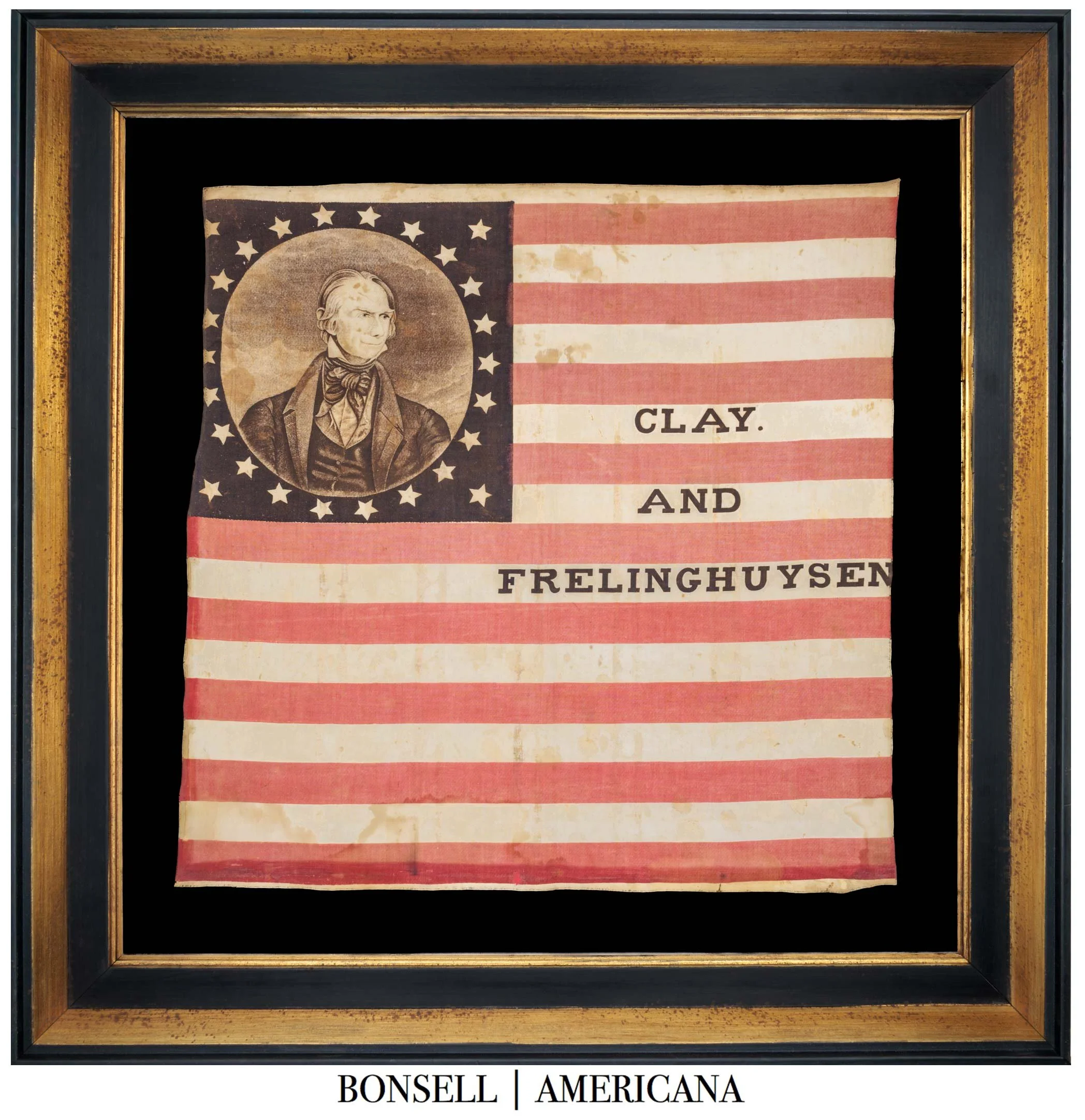
Offered is a rare and important printed cotton campaign flag, produced for the 1844 presidential election of Henry Clay and his running mate, Theodore Frelinghuysen. Executed in red, white, and blue on a single length of cotton, the design combines portraiture, national symbolism, and political messaging within a unified and highly deliberate composition. At the hoist, within a square canton, a circular medallion encloses a portrait of Clay, surrounded by a wreath of 26 stars. Extending across the striped field are the words “CLAY | AND | FRELINGHUYSEN.” The result is a cohesive graphic arrangement in which image and text are structurally integrated into the format of the American flag.
The canton functions as a formal portrait device, with Clay’s likeness rendered in a sepia-toned print derived from an engraved source and adapted for textile production. The surrounding stars form a continuous ring, both framing the portrait and reinforcing the national context of the campaign. The stripes are boldly rendered and evenly spaced, providing a strong horizontal counterbalance to the centralized portrait. The typography is clear and assertive, occupying three lines across the field in a manner that is both legible and visually balanced. Unlike later parade flags, where printed slogans are often secondary additions, the text here is integral to the design from inception.
The flag is printed on cotton, likely by means of block or early roller printing techniques. As is typical of mid-19th century textile production, minor irregularities in ink saturation and distribution are present, contributing to the hand-produced character of the piece. The pigments have mellowed over time in a manner consistent with early dyes, with the canton presenting as a deep, dark tone and the red stripes retaining strong visual presence.
The near-square proportions—approximately in keeping with known examples of the type—are a defining characteristic of early flags of this period. Unlike later, more standardized parade flags, which tend to adopt elongated rectangular formats, these earlier examples often reflect the proportions of military and presentation standards of the late 18th and early 19th centuries. The format enhances the visual impact of the design, allowing the portrait medallion and surrounding elements to occupy a central and commanding position.
The 1844 presidential campaign in which this flag was produced stands as a pivotal moment in American political history. Henry Clay, the Whig candidate, was one of the most influential statesmen of the first half of the 19th century, having served as Speaker of the House, U.S. Senator, and Secretary of State. A principal architect of what became known as the “American System,” Clay advocated for a program of economic development centered on protective tariffs, a national banking system, and federal support for internal improvements such as roads and canals. His running mate, Theodore Frelinghuysen of New Jersey, was a prominent lawyer, senator, and later president of Rutgers College, known for his moral reform positions and national visibility within the Whig Party.
Opposing Clay was Democrat James K. Polk, whose campaign emphasized territorial expansion, including the annexation of Texas and the acquisition of Oregon. While Clay’s platform reflected a vision of structured economic growth and national cohesion, Polk’s expansionist message ultimately resonated more strongly with voters, and he prevailed in the election. Textiles associated with the Clay campaign, including flags such as the present example, represent a sophisticated and early use of visual media in American political life, bridging the gap between printed campaign ephemera and later mass-produced patriotic objects.
Flags of this type occupy a narrow and important window in the evolution of American flag production. The 26-star count corresponds to the admission of Michigan as the 26th state on January 26th, 1837. Under the flag acts of the period, new stars were officially added on the following July 4th, making the 26-star flag the official national flag from July 4th, 1837 through July 3rd, 1845. This eight-year span encompasses some of the earliest known examples of printed American flags made for political purposes. While earlier campaign textiles exist, including banners from the 1840 campaign of William Henry Harrison, the Clay and Frelinghuysen examples of 1844 remain among the earliest surviving instances in which the American flag format was adapted so directly and effectively for political messaging.
The present design is documented in Herbert Ridgeway Collins’ Threads of History: Americana Recorded on Cloth, 1775 to the Present (Smithsonian Press, 1979), where it appears as example number 179. Collins classifies it as a “flag banner,” noting its cotton construction, near-square proportions, and the presence of the Clay portrait within a ring of 26 stars. The inclusion of this pattern in a foundational institutional reference underscores its importance within the canon of American textile history and provides a firm basis for identification and dating.
Additional institutional examples further support the significance of this design. An identical Clay and Frelinghuysen campaign flag is held within the collections of Rutgers University, directly connecting the object to Frelinghuysen’s later role as president of that institution. Such examples reinforce both the historical grounding of the type and its recognition within academic and museum contexts. Surviving flags of this variety are limited in number.
What distinguishes this flag, beyond its historical context, is the strength and clarity of its graphic presentation. The balance between image and typography is particularly successful, creating a composition that is both visually engaging and immediately understandable. The scale is also highly desirable—large enough to command attention in display, yet manageable within a framed presentation.
Campaign flags from the pre-Civil War era are widely regarded among collectors as some of the most compelling forms of American patriotic textile, combining rarity, historical importance, and strong visual design. Within this category, portrait examples such as the present flag are especially sought after, due to the added dimension of figural imagery and the direct association with prominent political figures.
Conservation Process: The flag was hand sewn to a cotton fabric backing, which was then hand sewn to a mounting board. To prevent dye migration from the black cotton, the fabric was pre-washed and treated with a dye-setting wash prior to mounting. The flag is displayed behind Optium Museum Acrylic.
Frame: This offering is in our Large Distressed Black and Gold Frame.
Condition Report: There is moderate to significant foxing and staining throughout, most evident in the striped field and along the lower portion, accompanied by areas of pigment loss and uneven toning consistent with age. The canton has darkened, and there is scattered discoloration within the portrait area, along with minor edge wear and small areas of fabric loss. Despite these characteristics, the imagery remains clear and the text fully legible, with strong overall visual presentation.
Collectability Level: The Extraordinary – Museum Quality Offerings
Date of Origin: 1844
Number of Stars: 26
Associated State: Michigan
Price: Call 618-553-2291, or email info@bonsellamericana.com
Frame Size (H x L): 13” x 16.5”
Flag Size (H x L): 6.5” x 10”
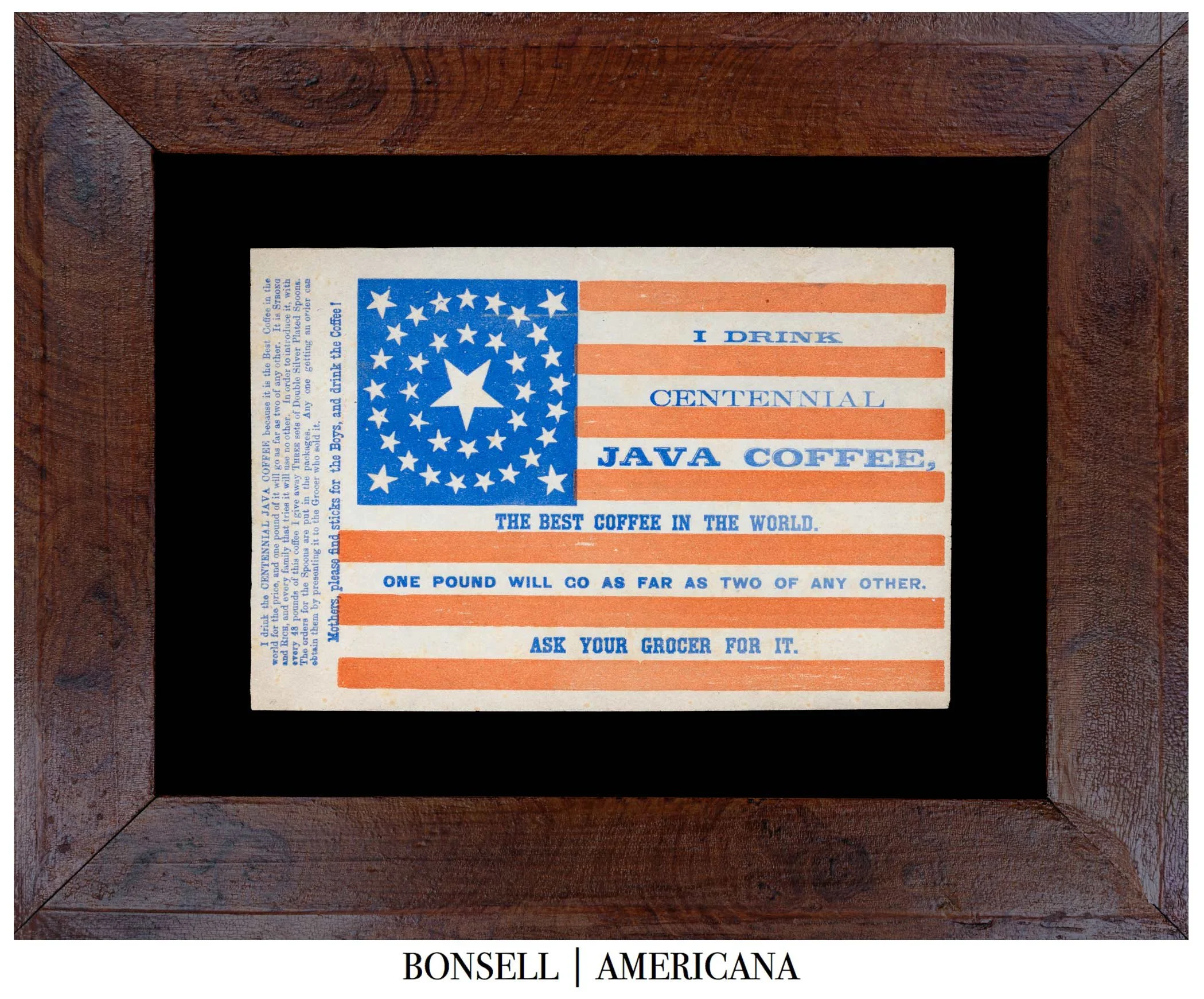
Offered is a rare and visually striking 38-star American flag trade flag, produced in the Centennial era and featuring an extensive advertising overprint for “CENTENNIAL JAVA COFFEE.” Printed on paper in an unusually large format measuring approximately 6.5 by 10 inches—roughly double the size of most surviving trade cards—this example occupies a compelling space between traditional advertising ephemera and a hand-held parade flag.
The canton displays a highly graphic and well-balanced medallion configuration, composed of a single, oversized center star surrounded by two concentric rings of smaller stars, with four additional flanking stars completing the count of thirty-eight. The inner ring contains 12 stars, while the outer ring presents 21, forming a bold and symmetrical arrangement that is both visually dynamic and carefully structured. The large center star serves as a strong focal point within the design and may be interpreted as an intentional visual emphasis on Colorado, the 38th state.
The overprint is exceptional in both scale and execution. Spanning the stripes in varying typefaces, it reads: “I DRINK CENTENNIAL JAVA COFFEE, THE BEST COFFEE IN THE WORLD. ONE POUND WILL GO AS FAR AS TWO OF ANY OTHER. ASK YOUR GROCER FOR IT.” The typography shifts from line to line, creating a layered and energetic visual rhythm that enhances the overall composition. Along the hoist, a vertical block of text further promotes the quality of the product, while an additional vertical instruction—directed to mothers—encourages the mounting of the flag on a stick for children to wave. This directive provides clear evidence that the piece was intended for active use as a hand-held display, rather than passive advertising alone.
The coloration is equally noteworthy. The red stripes, rendered in a distinctly orange-red tone, provide vivid contrast against the blue canton and contribute to the flag’s strong visual presence. Combined with the bold overprint and varied typography, the result is an unusually lively and engaging piece of printed Americana.
The broader context of this object is further enriched by period concerns surrounding the quality and purity of coffee. Late 19th-century reports on food adulteration reveal that a significant portion of commercially available ground coffee was diluted with roasted grains, legumes, and chicory. Within this environment, claims such as “ONE POUND WILL GO AS FAR AS TWO OF ANY OTHER” take on added meaning, functioning not merely as advertising rhetoric but as a direct appeal to consumers wary of inferior or adulterated products. Contemporary documentation even records “CENTENNIAL JAVA” among branded coffees in circulation, reinforcing the authenticity of the marketing language employed here.
The convergence of Centennial-era patriotism with commercial promotion is executed at an unusually high level in this 38-star example, both graphically and conceptually. Its large format, dynamic medallion star configuration, extensive overprint, and clear evidence of intended use as a parade flag combine to set it apart from more typical trade cards. Examples of this scale and visual impact are seldom encountered, and this is the first of this specific design that we have handled. Simply put, it ranks among the most compelling and visually engaging 19th-century American flag trade flags to surface.
The 38 stars on this flag represent Colorado’s admission to the Union on August 1st, 1876. Known as the “Centennial State,” Colorado earned its nickname for achieving statehood just 28 days after the nation’s centennial celebrations. Colorado’s journey to statehood began with the establishment of the Colorado Territory in 1861, spurred by the Pike’s Peak Gold Rush, which brought a wave of settlers to the region. Early statehood efforts faced setbacks, including a veto by President Andrew Johnson in the 1860s, but a renewed push in the mid-1870s culminated in Colorado’s official entry as the 38th state following Congress’s passage of an enabling act.
Although the 38-star flag did not become official until July 4th, 1877, flag makers frequently produced anticipatory examples ahead of such changes. These flags played a prominent role during the centennial celebrations of 1876, alongside revival designs featuring thirteen stars to commemorate the original colonies. The Centennial year was a watershed moment for the United States, fostering a renewed sense of patriotism and unity after the divisions of the Civil War. Communities across the nation adorned homes, businesses, and public spaces with red, white, and blue decorations, and flags became the centerpiece of this outpouring of national pride.
The Centennial International Exposition in Philadelphia was the highlight of these celebrations, attracting nearly ten million visitors between May and November of 1876. This world’s fair showcased American ingenuity on a grand scale, with notable exhibits including the Corliss Steam Engine and Alexander Graham Bell’s telephone, which would go on to revolutionize communication.
The 38-star flag officially served from July 4th, 1877, to July 4th, 1890, during which it flew over the administrations of Presidents Rutherford B. Hayes, James A. Garfield, Chester A. Arthur, Grover Cleveland, and Benjamin Harrison. This flag represented a nation growing both geographically and industrially. Colorado’s statehood symbolized the United States’ expansion westward, driven by mining booms, railroad construction, and the development of new settlements.
In 1890, the addition of five new states—North Dakota, South Dakota, Montana, Washington, and Idaho—necessitated a redesign, and the 43- star flag replaced the 38-star version. Despite its relatively short tenure, the 38-star flag remains a prized artifact, celebrated for its vibrant medallion designs and its connection to the Centennial year—a defining moment in American history when the nation reflected on its first century and welcomed Colorado as a symbol of progress and unity.
Frame: Housed in a beautiful American frame dating to circa 1840, crafted in hand-painted faux bois to simulate richly grained, knotty light mahogany. The surface displays exceptional graining with a warm, nuanced finish that complements the flag without overpowering it. The profile and early construction lend an appropriate sense of age and authenticity, enhancing the overall presentation.
Condition Report: The flag has been professionally conserved by a paper conservator, resulting in stable overall condition. There is moderate, even toning to the paper, accompanied by scattered foxing and minor surface soiling consistent with age. Evidence of prior handling is present in the form of minor edge wear, none of which detracts from the strong visual presentation. The printed imagery and overprint remain bold and highly legible throughout.
Collectability Level: The Extraordinary – Museum Quality Offerings
Date of Origin: 1860-1890
Associated War: The Indian Wars (1860-1890)
Frame Size (H x L): 41.5” x 64”
Flag Size (H x L): 30.75” x 52”
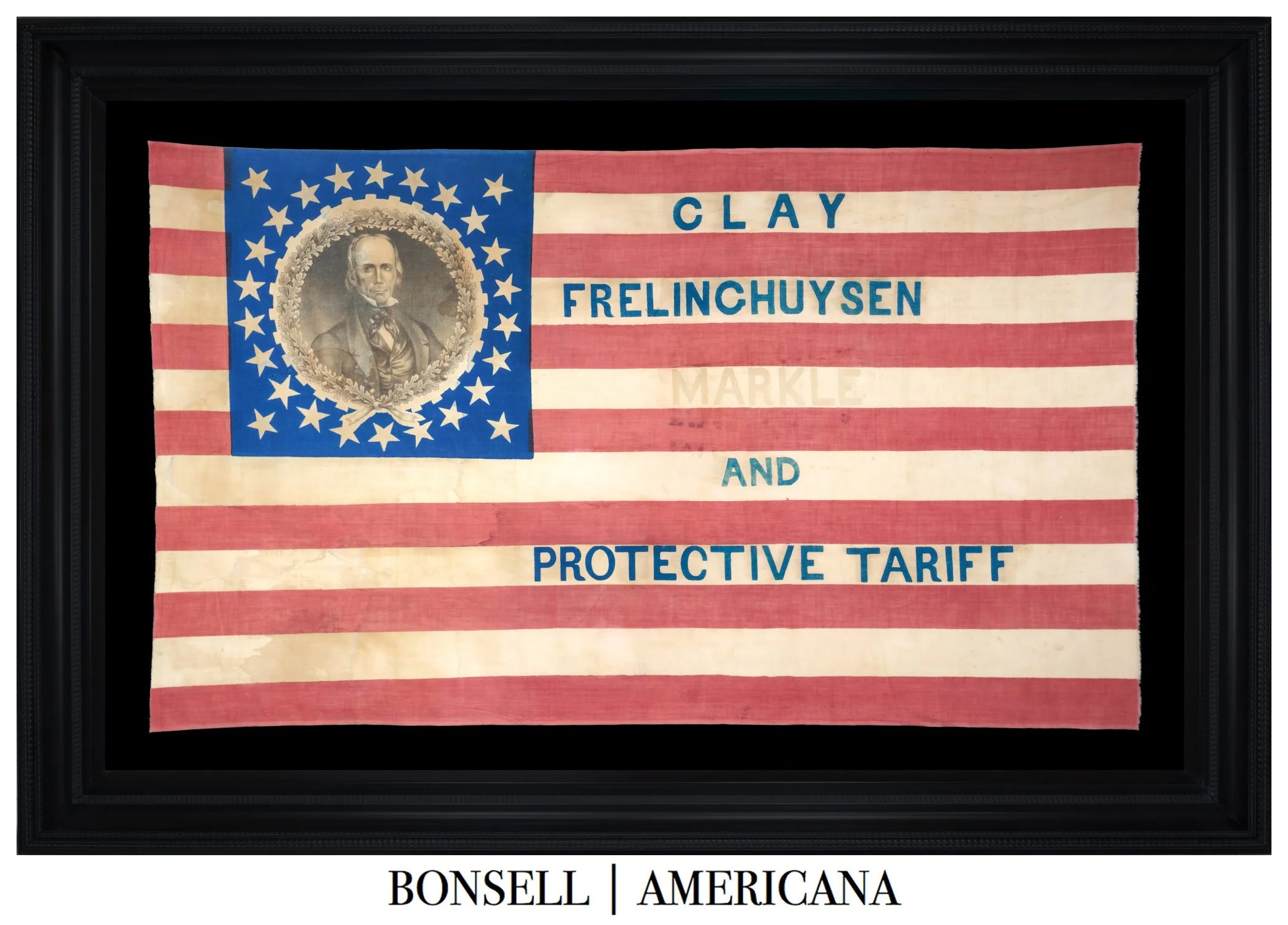
Offered is a 26-star American parade flag, printed on cotton for the 1844 presidential campaign of Whig candidate Henry Clay and his running mate Theodore Frelinghuysen. The design centers on a portrait of Clay within a medallion of 26 stars, framed by an oak-leaf wreath and gear-form border, with campaign text boldly overprinted across the striped field. Produced during the official 26-star period of the American national flag, this textile belongs to the earliest generation of printed political parade flags and represents one of the most ambitious campaign formats of the antebellum era.
The 26-star count corresponds to Michigan’s admission to the Union on January 26, 1837. The 26-star count became official on July 4 of that year and remained in effect until July 3, 1845. Flags bearing this count were contemporary to both the 1840 Harrison campaign and the pivotal 1844 contest between Clay and James K. Polk. Within this narrowly defined eight-year window, printed parade flags emerged as instruments of organized political expression, marking a transition from sewn national banners to graphic campaign textiles designed for rallies and public demonstration.
The 26-star configuration represents a precise historical moment in the evolution of the Union. It bridged the late Jacksonian period and the escalating sectional debates of the 1840s. While 13-star flags continued to be produced for commemorative purposes, the 26-star count reflected the contemporary nation and carried political significance. In campaign contexts, it reinforced legitimacy, unity, and constitutional continuity.
Equally significant is the relationship between the 26-star period and the rise of printed cotton flags. Prior to the late 1830s, most American flags were pieced and sewn from wool bunting. The development of printed cotton formats allowed for elaborate graphic programs, including portrait medallions and large-scale typography. Because such textiles were intended for outdoor political use, survival rates are inherently low. Large portrait campaign flags from this formative era therefore occupy an early and foundational position in American political material culture.
DESIGN, ICONOGRAPHY, AND PRODUCTION
The strength of this flag lies in the integration of portraiture, national symbolism, and political messaging into a unified composition.
At the center of the blue canton appears a finely rendered portrait of Henry Clay, executed in engraved copperplate style. The likeness presents Clay as composed and deliberate, emphasizing statesmanship over theatricality. The precision of the facial modeling and attire reflects a printing process of notable sophistication for a mid-nineteenth-century campaign textile.
The portrait is enclosed within a wreath of oak leaves and acorns, tied at the base with a ribbon. Surrounding this device is a medallion of 26-stars arranged in even radial spacing. Encircling the wreath is a gear-form border, visually reinforcing Clay’s economic program and advocacy of industrial development under the American System.
Across the striped field appear the overprinted words:
CLAY
FRELINGHUYSEN
MARKLE
AND
PROTECTIVE TARIFF
The inclusion of “MARKLE” identifies this example as the Pennsylvania variant of the design. Joseph Markle was the Whig candidate for governor of Pennsylvania in 1844, and his addition to the flag reflects coordinated state and national campaigning within a crucial electoral state.
The “MARKLE” overprint appears faint relative to the surrounding text. This likely reflects the mechanics of mid-nineteenth-century textile printing. The base design may have been produced first, with regional candidates added in a subsequent phase. Variations in ink density, plate wear, or printing pressure could result in lighter impressions. The existence of multiple overprint configurations within this production family supports such a modular printing strategy.
Importantly, this design and its related variants are documented in Threads of History: Americana Recorded by the Smithsonian Institution, the seminal 1979 study by Herbert Ridgeway Collins. Examples of the Clay portrait medallion format, including both name-only and tariff variants, are illustrated therein and are held in institutional collections such as the Smithsonian and West Point Museum. The documentation of this format within that reference confirms both its historical authenticity and its recognized place within the corpus of early American political textiles.
Surviving examples reveal that the core portrait medallion design remained consistent, while textual elements were adapted for differing political and geographic contexts. Known variants include name-only versions, examples incorporating “Protective Tariff,” Pennsylvania forms adding “Markle,” Delaware versions including “Stockton” and “Houston,” and related Polk and Dallas adaptations. The present configuration—combining presidential, vice-presidential, gubernatorial, and policy messaging—represents one of the most textually comprehensive forms within the group.
THE 1844 ELECTION AND THE AMERICAN SYSTEM
The presidential election of 1844 was among the most consequential of the antebellum era. Henry Clay (1777–1852), often referred to as the “Great Compromiser,” was one of the most influential American statesmen of his generation. Born in Virginia and later associated with Kentucky, Clay served as Speaker of the House, United States Senator, and Secretary of State. He played central roles in the Missouri Compromise of 1820 and the Compromise of 1850. By 1844, he was widely regarded as a figure of national stature and institutional continuity.
Theodore Frelinghuysen (1787–1862), Clay’s running mate, was a New Jersey senator known for his opposition to Andrew Jackson’s Indian removal policies and for his alignment with reform constituencies. His presence on the ticket balanced Clay geographically and ideologically.
Central to Clay’s platform was the protective tariff. Designed to shield American manufacturers from foreign competition, the tariff imposed duties on imported goods to encourage domestic production. Clay believed that a diversified industrial economy would strengthen national independence and foster internal development. The protective tariff formed a cornerstone of his American System, which also included federal support for infrastructure and a stable national banking framework.
In industrial states such as Pennsylvania, tariff protection was politically potent. The explicit inclusion of “Protective Tariff” on this flag underscores its electoral importance. While tariffs did stimulate industrial growth in certain regions, they were controversial and contributed to sectional tension. By 1844, the tariff debate symbolized broader disagreements about the nation’s economic direction.
Clay’s opponent, James K. Polk, campaigned on territorial expansion. Expansionist sentiment ultimately proved decisive, and Polk’s victory accelerated territorial enlargement while intensifying sectional divisions. Within this political climate, campaign textiles such as this flag functioned as instruments of persuasion and spectacle. Large portrait banners were designed to unify supporters visually and project allegiance unmistakably in public demonstrations.
SCALE, SURVIVAL, AND HISTORICAL SIGNIFICANCE
Large-format printed political flags from the 1840s are inherently uncommon. Their size, cotton construction, and exposure to outdoor conditions significantly reduced survival rates.
Printed pigments were susceptible to fading, and white cotton grounds readily absorbed staining and moisture. As a result, well-preserved examples of early portrait campaign flags are scarce. Moreover, the 26-star portrait format predates the mass patriotic textile production of the Civil War by nearly two decades, placing it within an early stage of American political graphic design.
Few nineteenth-century political textiles combine a contemporary national star count, engraved presidential portrait, explicit economic messaging, and coordinated state-level overprint within a single integrated composition. Documented in Threads of History and represented in institutional collections, this format occupies a recognized position within early American political material culture.
It stands as both a visually compelling banner and a primary artifact of organized political communication in the antebellum United States.
Conservation Process: The flag was hand sewn to a cotton fabric backing, which was then hand sewn to a mounting board. To prevent dye migration from the black cotton, the fabric was pre-washed and treated with a dye-setting wash prior to mounting. The flag is displayed behind Optium Museum Acrylic.
Frame: The frame features a dramatic scoop profile in a deep Dutch black finish, with a curved inner cove that creates pronounced shadow and depth. A subtle ripple detail along the inner edge adds texture and refinement, while the stepped outer molding lends architectural structure.
Condition Report: The flag retains strong color throughout, with a vivid blue canton and bold red striping. There is moderate, even toning to the white cotton ground, accompanied by scattered areas of light staining, most noticeable in the lower stripes and within portions of the portrait field. The “MARKLE” overprint appears faint relative to the surrounding text, consistent with the printing characteristics discussed above. Minor surface creasing and age-related wear are present, but the textile remains structurally sound and displays with excellent clarity and impact. Compared with examples that have surfaced through major dealers and auction houses, this is a notably strong and comparatively clean survivor within the known group.
Collectability Level: The Extraordinary – Museum Quality Offerings
Date of Origin: 1844
Number of Stars: 26
Associated State: Michigan
Price: Call 618-553-2291, or email info@bonsellamericana.com
Frame Size (H x L): 38” x 53”
Flag Size (H x L): 26 ¾” x 41 ¾”
Offered is a remarkable 36-star American national flag, printed on coarse, glazed cotton, and dating to the immediate post–Civil War period. This unusually large example features one of the most visually sophisticated star configurations of the nineteenth century: a medallion pattern centered by a boldly rendered, haloed star. The flag is further distinguished by its generous scale, its striking color palette, and an extraordinary body of accompanying documentation tracing its descent within a Union household directly involved in both military and humanitarian service during the Civil War.
Flags of this quality, scale, and documentation are rare. Taken together, the object and its provenance present a compelling artifact of Union victory, postwar remembrance, and nineteenth-century American civic life.
STAR COUNT, CONFIGURATION, AND SCALE
The flag bears 36 stars, representing the admission of Nevada as the 36th state. The stars are arranged in a classic medallion configuration, one of the most visually dynamic and carefully considered layouts employed by nineteenth-century flag makers.
At the center of the canton lies a large, canted star, boldly outlined and visually dominant. This central device is encircled by concentric rings of smaller stars, forming a balanced and deliberate composition. Completing the design are additional stars positioned to fill the remaining field, creating a sense of motion and cohesion that distinguishes medallion patterns from later, rectilinear layouts.
Of particular note is the haloed treatment of the center star. Within the large central star appears a secondary, smaller star enclosed by a faint outline, producing a layered, dimensional effect. Haloed stars of this type are scarce and appear to be the hallmark of a single, as yet unidentified, nineteenth-century manufacturer. Surviving examples of haloed center star flags are known across several star counts — including 30-star, 34-star, 35-star, 36-star, and 42-star examples — but they remain uncommon in all forms, particularly in large formats such as this.
This flag is a large example within the category of haloed medallion flags, exceeding the dimensions of most comparable examples we have handled. Its scale amplifies the visual impact of the star configuration, allowing the central device and surrounding rings to read clearly and forcefully from a distance. Large medallion flags were well suited to prominent display — whether in public settings, civic gatherings, or significant domestic interiors — and their survival rate is markedly lower than that of smaller parade or hand-held flags.
CONSTRUCTION, MATERIALS, AND COLOR
The flag is printed on coarse, glazed cotton, a textile commonly employed for nineteenth-century civilian and ceremonial flags. The glaze provided a modest sheen and helped stiffen the fabric, allowing printed imagery to register crisply while remaining lightweight.
The stars and stripes were applied through a stamping or printing process, rather than appliqué. This method allowed for efficient production while still accommodating creative freedom in star arrangement — a freedom that flag makers would gradually abandon as industrial standardization increased toward the end of the century. Printed cotton flags of this type were distinct from wool bunting flags, which were more commonly produced for naval and military use. Cotton examples were intended for patriotic display, political events, commemorations, and domestic settings.
The canton presents as a muted, slate-blue field, while the red stripes have mellowed to a warm salmon-to-orange hue. This coloration is characteristic of mid-nineteenth-century dye chemistry and long-term oxidation. During this period, red dyes were most commonly derived from madder root and cochineal, both of which could produce a range of tones depending on concentration, mordants, and exposure to light. Over time, these dyes often shift away from deep crimson toward softer, warmer hues, lending early flags a distinctive and highly valued patina.
THE 36-STAR FLAG IN HISTORICAL CONTEXT
Nevada was admitted to the Union on October 31, 1864, in the midst of the Civil War. As was customary, however, the official adoption of a new star count did not occur until the following July 4, 1865, meaning that 36-star flags became official several months after the conclusion of hostilities.
As such, the 36-star flag occupies a unique position in American history. It was the first official national flag of the postwar United States and remained in use throughout the early years of Reconstruction, until July 4, 1867, when the 37-star flag was introduced to mark Nebraska’s statehood.
Nevada’s admission itself was politically and economically significant. Despite its small population, the territory’s vast mineral wealth — most notably the Comstock Lode — played a critical role in financing the Union war effort. President Abraham Lincoln and congressional Republicans also recognized the strategic value of Nevada’s electoral votes during the pivotal 1864 election. In an extraordinary technological feat, Nevada’s entire state constitution was transmitted by telegraph to Washington, D.C., enabling rapid admission.
Flags bearing 36 stars thus became potent symbols of Union preservation, victory, and national continuity at the moment when the country sought to define itself anew.
FAMILY NOTE, PROVENANCE, AND DOCUMENTATION
Accompanying the flag is an extensive written note provided by a direct descendant, outlining the family history of Elon Nelson Lee, a Union veteran in whose household the flag was preserved. According to the family account, the flag was passed from Lee to later generations and remained within the family well into the twentieth century. In the early 1950s, it was given by Lee’s granddaughter to her daughter and stored wrapped in tissue in a drawer at the base of a bookcase, where it remained carefully preserved until it was ultimately passed down again.
What distinguishes this note is not sentiment alone, but its remarkable consistency with a wide body of independent documentation, including military records, university publications, genealogical society material, and published county histories. The family narrative aligns precisely with known service dates, locations, and postwar life events, elevating it from anecdotal history to credible provenance.
The flag descends in the family of Elon Nelson Lee (1840–1938), whose life and service are documented across multiple independent sources, including Grand Army of the Republic records; regimental rosters for the 10th Wisconsin Infantry and the 134th Illinois Infantry; University of Chicago student and alumni publications; fraternity and alumni records (The Shield); county and genealogical histories from Wisconsin and Iowa; and family letters, diaries, and typed transcriptions. Few privately held American flags are accompanied by such a broad and internally consistent documentary record.
ELON NELSON LEE: SERVICE, EDUCATION, AND CIVIC LIFE
Elon Nelson Lee enlisted twice in the Union Army. His first enlistment was in Company A, 10th Wisconsin Infantry, a regiment that saw service in the Western Theater. During this term, Lee fell seriously ill while stationed in Kentucky and was ultimately discharged in 1862. Though officially diagnosed with tuberculosis of the lungs, later family accounts suggest pneumonia resulting from measles as the more likely cause.
In 1864, while attending the University of Chicago, Lee joined fellow students and faculty in enlisting for a second term of service. He entered Company G, 134th Illinois Infantry, a 100-day regiment raised for rear-area security and logistical duties, freeing veteran troops for frontline service. Lee was discharged later that year in Elizabethtown, Kentucky. While not associated with major battlefield engagements, his service reflects the broader reality of Union military life in the Western Theater, where disease, supply operations, and occupation duties were as consequential as combat.
Lee returned to the University of Chicago following his wartime service and completed his studies, earning the degree of S.B. (Bachelor of Science) with the Class of 1868, reflecting period academic conventions. In civilian life, he became a school superintendent, farmer, and lumber dealer, ultimately residing in Webster City, Iowa. His professional trajectory reflects the civic engagement and upward mobility characteristic of many educated Union veterans during the Reconstruction and post-Reconstruction eras.
An extraordinary dimension of this flag’s history lies in the documented wartime service of Lee’s mother, Mary Elizabeth Lee. Published county histories and genealogical records confirm that she traveled south in 1862 to care for her ailing son in Kentucky. Witnessing widespread suffering among wounded and sick soldiers, she became actively involved in sanitary aid and hospital service, working in Louisville, Danville, Nashville, and Murfreesboro. Her efforts were supported by credentials and letters from state officials and the Chicago Sanitary Aid Society, situating the Lee household as active participants in the Union war effort on both military and civilian fronts.
A FLAG OF UNION MEMORY AND CONTINUITY
This 36-star flag should be understood not as a battlefield relic, but as a postwar emblem of Union victory and remembrance, preserved within a household that had lived the war intimately. Its medallion configuration, haloed center star, large scale, and warm coloration reflect the artistic freedom of nineteenth-century flag making at its height.
Its survival, coupled with exceptional documentation, offers a rare opportunity to study an object that bridges the lived experience of the Civil War with the national identity forged in its aftermath. Few flags encapsulate this transition as completely or as credibly as this example.
Conservation Process: The flag was hand sewn to a cotton fabric backing, which was then hand sewn to a mounting board. To prevent dye migration from the black cotton, the fabric was pre-washed and treated with a dye-setting wash prior to mounting. The flag is displayed behind Optium Museum Acrylic.
Frame: The frame is a deep-profile moulding with a simple, classical profile, finished in a dark cocoa-brown tone. Its broad face provides visual support without ornament, allowing the flag to remain the primary focus. The subdued finish is well suited to the display of nineteenth-century textiles.
Condition Report: The flag presents in very attractive, honest condition, with strong overall eye appeal. There is expected age-related wear, including scattered staining, minor fabric losses along the hoist and edges, and areas of surface abrasion consistent with nineteenth-century glazed cotton flags that saw use and long-term storage. The canton retains good visual integrity, with the haloed center star remaining crisp and legible despite light wear and toning. The stripes exhibit pleasing oxidation and mellowed coloration, contributing to a warm, balanced presentation that enhances the flag’s historic character rather than detracting from it.
Collectability Level: The Extraordinary – Museum Quality Offerings
Date of Origin: 1864-1867
Number of Stars: 36
Associated War: Civil War (1861-1865)
Associated State: Nevada
Additional Research Materials
The historical account presented here derives from extensive family documentation provided by a direct descendant of Elon Nelson Lee. While the underlying letters, diaries, and related writings remain in the possession of the family, their existence and content are well documented. For reasons of privacy, the family member’s name is not published; however, it is retained on file. Should a future owner wish to pursue further research, we would be pleased to facilitate an introduction, at the family’s discretion.
Price: Call 618-553-2291, or email info@bonsellamericana.com
Frame Size (H x L): 32” x 41”
Flag Size (H x L): 21” x 30”
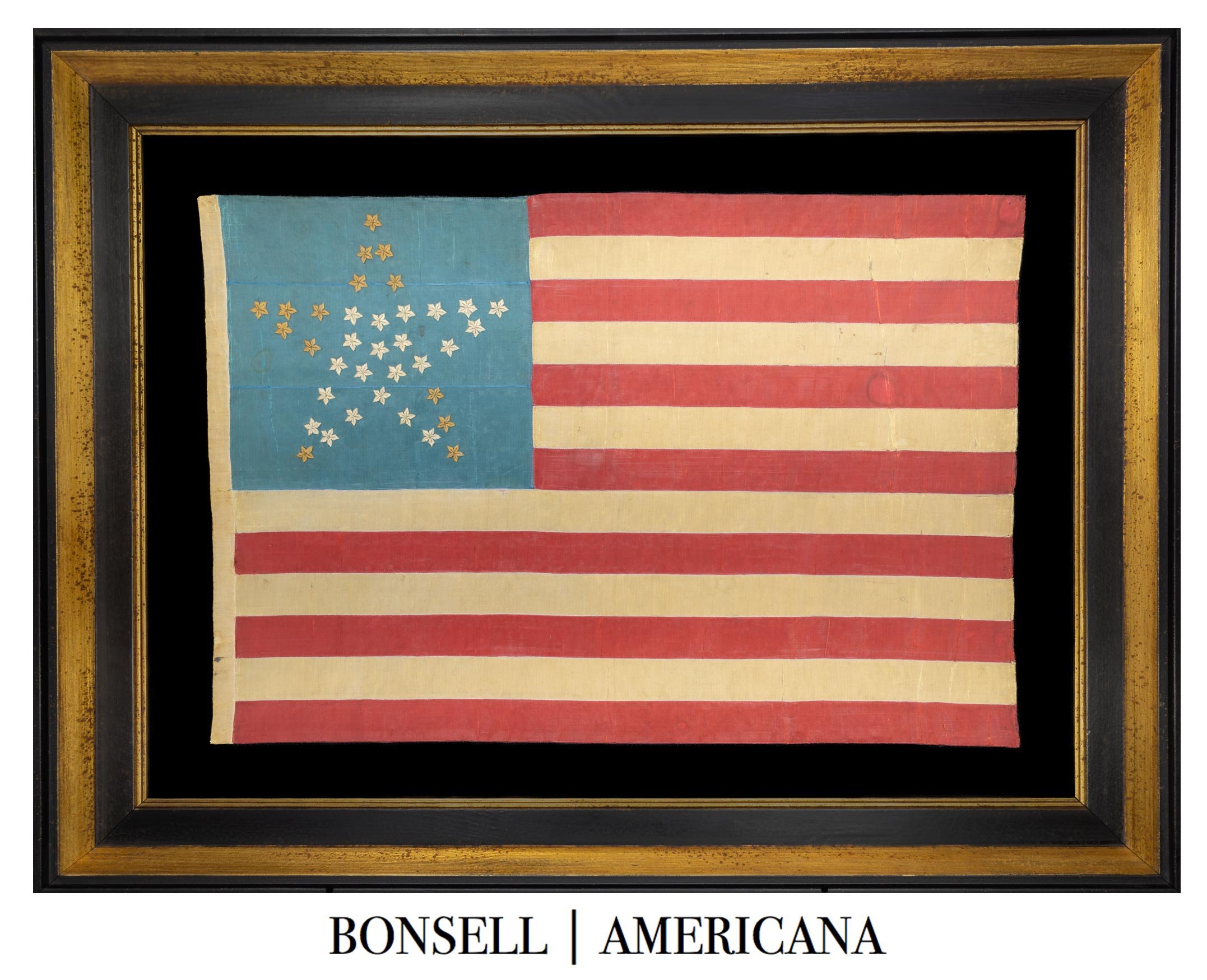
Offered is a thirty-six star parade flag, which is unquestionably one of our favorite offerings to date. The stripes of this flag are made of individual strips of red and white silk, the canton is made of three strips of blue silk, and the hoist is made of a strip of white silk. Each star is hand embroidered, fourteen of which are embroidered with gold string and twenty-two of which are embroidered with white string. Each star includes five split petals and a center portion. The entire flag is hand sewn with gorgeous, precision-like stitches.
The inclusion of both gold and white stars is a trait that we had never previously encountered before discovering this flag. This contrast may be an indication that this flag was made with whatever materials were available to the maker. This is likely the case, given that this flag was made during the Civil War. Alternatively, the inclusion of gold and white stars may have some kind of symbolism. For example, the maker may have intended that the white stars represent the Northern States, while the gold stars represent the eleven Southern States plus three additional states that the maker viewed as having southern sympathies. Regardless of the reason for having both gold and white stars, this is an extremely rare feature.
This flag is small in size for a piece-and-sewn flag, dating to the Civil War. This adds considerably to its appeal, as it can be easily displayed. It was not until the Civil War that small piece-and-sewn flags were made with any frequency at all, and not until the 1890s that they were made with regularity. During most of the 19th century, flags made with piece-and-sewn construction had a width of at least eight feet, as they were typically used as signaling devices for the military or by sailors. Even the flags that were used for decorative purposes usually had a width of six feet or more, and versions smaller than this were quite rare.
This flag is not made of weighted silk, unlike many of its Civil War era counterparts. Silk was originally sold by length and width, but in the early 19th century, it was sold by the pound. For this reason, many silk manufacturers began dipping and weighting their silk with mineral salts. And while this increased profits, mineral salts slowly damage silk and many significant antique flags have thus been lost as a result of this practice. Fortunately, this flag was not made of weighted silk, hence its good condition for its age and construction.
The stars on this flag are arranged in a "Great Star" pattern, one of the rarest and most beautiful patterns encountered in antique flags. The Great Star pattern is a large star made of smaller stars. The smaller stars may be a variety of sizes, and may be canted in a various directions. Such a pattern was perfectly acceptable, as prior to President Taft's Executive Order 1556 in 1912, flag makers were free to place the stars however they wished.
US Naval Captain Samuel Reid is credited with designing the Great Star pattern in 1818. Captain Reid was an officer in the US Navy and commanded the privateer General Armstrong during the War of 1812. Andrew Jackson credited Captain Reid's heroism in delaying the British Squadron in the Battle of Fayal, and aiding in General Jackson's defense of New Orleans. Captain Reid and his crew were greeted as heroes.
The Second Flag Act, passed in 1794, stated that the flag would have fifteen stars and fifteen stripes, in response to Vermont and Kentucky being added to the Union. Knowing that this approach would not be sustainable, with Captain Reid's help, Congress passed the Flag Act of 1818, specifying that the flag should only have thirteen stripes, but should have a star for each state admitted to the Union. It further specified that the addition of each star should be on the Fourth of July following its respective state's admission.
Captain Reid played a significant role in the Flag Act of 1818, and recommended a basic design of thirteen horizontal alternating stripes in honor of the thirteen colonies, and a star in honor of each state. He further recommended several potential star patterns, including twenty stars in the shape of a larger star for general use. Reid suggested this pattern to make the flag consistent and easily identifiable, particularly at long distances and at sea. His star pattern recommendation was not ultimately included in the Act, nor was any star pattern, but Captain Reid is universally credited with designing the Great Star pattern. Its use peaked in the 1840s, but it was also used during the Civil War and occasionally during Centennial Celebrations. Its last known commercial use was on a thirty-eight star flag.
The thirty-six star flag represents the inclusion of Nevada to the Union. Nevada was admitted on October 31st, 1864, and this flag became official on July 4th, 1865. Nevada was originally part of the Utah Territory beginning in 1850, became its own territory in 1861, and became its own state in 1864. The timing of Nevada's inclusion was politically and economically based. For political reasons, Nevada was admitted to the Union just eight days prior to President Lincoln's re-election bid against General George McClellan. Such timing was meant to benefit Lincoln and his fellow Republicans. For economic reasons, Nevada was included as part of the Union to help it pay off the country’s war debts. Economically, Nevada was particularly attractive at the time, because of its significant silver mining industry. Nevada expanded its borders in 1866 when the western Utah Territory was added to its eastern side, and further expanded in 1867 when a portion Pah-Ute County in the Arizona Territory was added to its southern side.
The thirty-six star flag was the official flag for the last six months of the Civil War, and was used by the military during that time. It was also the official flag during a portion of the Reconstruction era. Ultimately, the thirty-six star flag was official until July 4th, 1867, the time at which the thirty-seven star flag became official and began to represent the inclusion of Nebraska in the Union.
Conservation Process: This flag was professionally conserved. It is sewn to silk and positioned behind Conservation Clear Acrylic (standard) or behind Optium Museum Acrylic (per request).
Frame: This offering is in our Large Distressed Black and Gold Frame.
Condition Report: This flag exhibits a few minor tears, most notably along the top of the hoist and along the top of the red stripe along the hoist. It does have some minor stains, as shown in the pictures. Despite these flaws, this flag is a true survivor and one of the best Civil War flags to ever surface.
Collectability Level: The Extraordinary – Museum Quality Offerings
Date of Origin: 1864-1867
Number of Stars: 36
Associated War: Civil War (1861-1865)
Associated State: Nevada
Price: Call 618-553-2291, or email info@bonsellamericana.com
Frame Size (H x L): 39” x 56.5”
Flag Size (H x L): 28” x 44.5”
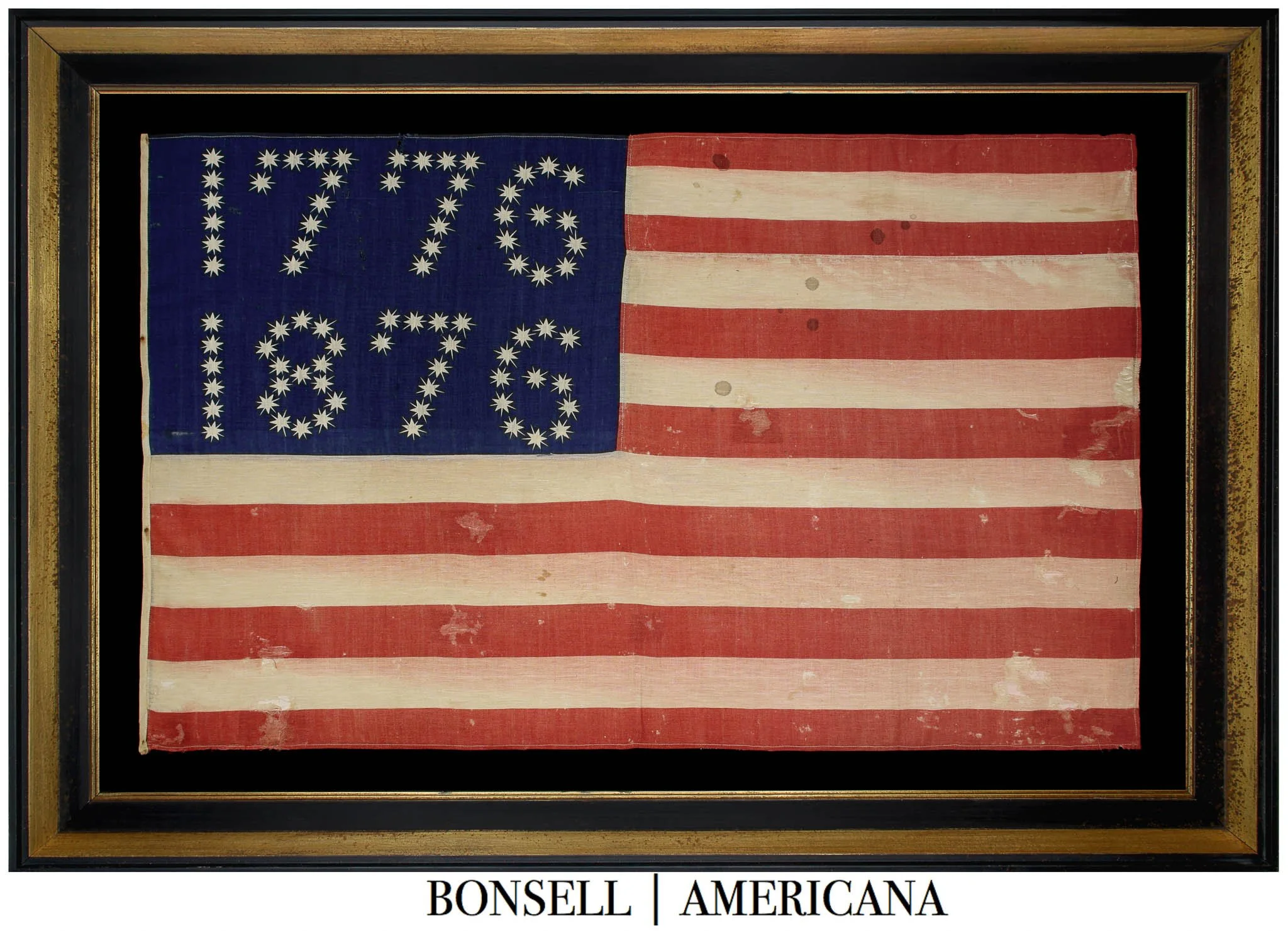
Offered is an exceptional American flag featuring a highly unusual 1776–1876 centennial star configuration, created to commemorate the 100th anniversary of the Declaration of Independence. The nation’s centennial inspired an extraordinary wave of patriotic expression and served as a symbolic reunification following the Civil War. Communities across the country marked the occasion with parades, public ceremonies, and elaborate decorations, with flags serving as the most prominent and potent emblem of national identity. Centennial-period flags are particularly noted for their inventive and symbolic star arrangements, and this example stands among the most sophisticated and visually compelling of the period.
The stars are arranged to form the dates “1776” and “1876,” a design that is both celebratory and emblematic of late-19th-century graphic ingenuity. The composition is balanced, legible, and striking, elevating the flag beyond a simple patriotic object into a carefully conceived commemorative textile. Flags of this specific configuration are rare, and examples with this level of visual impact are scarcer still.
The flag is constructed of a cotton-and-wool blend. The inclusion of wool is significant and suggests that the flag was intended for extended display rather than brief outdoor use. This material choice, along with the complexity of the design, strongly indicates production for Philadelphia’s Centennial International Exposition of 1876. Unlike most parade flags of the era—which were commonly made of cotton or silk and intended for short-term use—the wool component provided greater durability, allowing the flag to withstand prolonged exhibition over the exposition’s six-month duration.
The Centennial International Exposition was the most important centennial celebration in the United States, drawing nearly ten million visitors and showcasing American innovation, industry, and culture. Among its most famous exhibits were the Corliss Steam Engine and Alexander Graham Bell’s telephone, both emblematic of the technological optimism that defined the era. Flags such as this were integral to the visual language of the exposition and were produced in comparatively limited numbers for this singular event.
The flag was produced using a method known as press dyeing, an early textile-printing technique patented in the mid-19th century. This process employed a dye vat in combination with a fitted dyeing frame designed to block dye from selected areas of the fabric—such as stars and white stripes—while allowing color to penetrate elsewhere. Although innovative, press dyeing was never widely adopted due to its tendency to produce minor irregularities and printing blemishes, characteristics that are consistent with early examples and that underscore their handmade, experimental nature.
The stars themselves are particularly noteworthy. Each features five primary arms, with five additional thin arms extending outward between them, creating a radiant, almost luminary effect. This star form is extraordinarily rare, and we are not aware of another American flag employing this precise design.
The “1776” portion of the composition contains thirty-eight stars, referencing the admission of Colorado to the Union. Colorado achieved statehood on August 1, 1876, just weeks after the centennial celebrations, earning its enduring nickname, the Centennial State. Although the official national flag during 1876 remained the thirty-seven-star count, it was common for flag makers to produce anticipatory designs in advance of official adoption dates. As a result, both thirteen-star and thirty-eight-star flags were among the most frequently displayed during centennial festivities.
The thirty-eight-star flag became official on July 4, 1877, and remained so until July 4, 1890. The “1876” portion of the design contains forty-three stars. The “7” is composed of ten stars, while the “8” contains fifteen. The rationale for the forty-three-star count is not definitively known. It may reflect anticipation of future state admissions, or it may have been selected to achieve visual balance and symmetry across the overall composition—an approach commonly seen in centennial-era graphic design.
Construction details further support a high level of craftsmanship. The canton is made from a single piece of cotton-and-wool fabric, while the striped field is constructed from two joined sections of the same material. The hoist is formed of twill-weave cotton, and the components are joined with treadle stitching, consistent with period production methods.
Attribution has not been conclusively established, though the flag may plausibly be associated with John Holt or the Horstmann Brothers, both of whom were active in Philadelphia during the centennial period and are known to have experimented with press dyeing techniques. Both were also directly connected to the Centennial International Exposition.
Documented examples of this flag appear in several major institutional and private collections. One was held in the Mastai Collection and sold as Lot 109 in Sotheby’s Important Americana auction on October 10, 2002. Another was part of the Connelly Collection and sold as Lot 136 in Sotheby’s Important Americana auction on May 23, 2002. A further example resides in the permanent collection of the Smithsonian Institution and is illustrated as item 441 in Threads of History by Herbert Ridgeway Collins, former curator of political history at the Smithsonian.
Conservation Process: This flag was hand sewn to cotton fabric, and both were hand sewn to a mounting board. To prevent the black dye in the cotton fabric from seeping into the flag, it was first washed in a standard wash and then in a dye setting wash. The flag is positioned behind Optium Museum Acrylic.
Frame: This offering is in our Large Distressed Black and Gold Frame.
Condition Report: The flag presents in honest, period-appropriate condition, with moderate fabric wear consistent with extended 19th-century use and display. There are scattered areas of loss, small holes, and minor tears throughout, several of which have been stabilized with early matching fabric patches that blend well with the surrounding material and do not detract from the overall presentation. Light soiling and scattered staining are present, along with minor dye migration, where the red has lightly bled into adjacent white stripes
Collectability Level: The Extraordinary – Museum Quality Offerings
Date of Origin: 1876
Associated War: The Indian Wars (1860-1890)
Associated State: Colorado
Price: Call 618-553-2291, or email info@bonsellamericana.com
Frame Size (H x L): 16.75” x 12.75”
Flag Size (H x L): 5.5” x 6.75” and Affixed to a 10.5” Staff
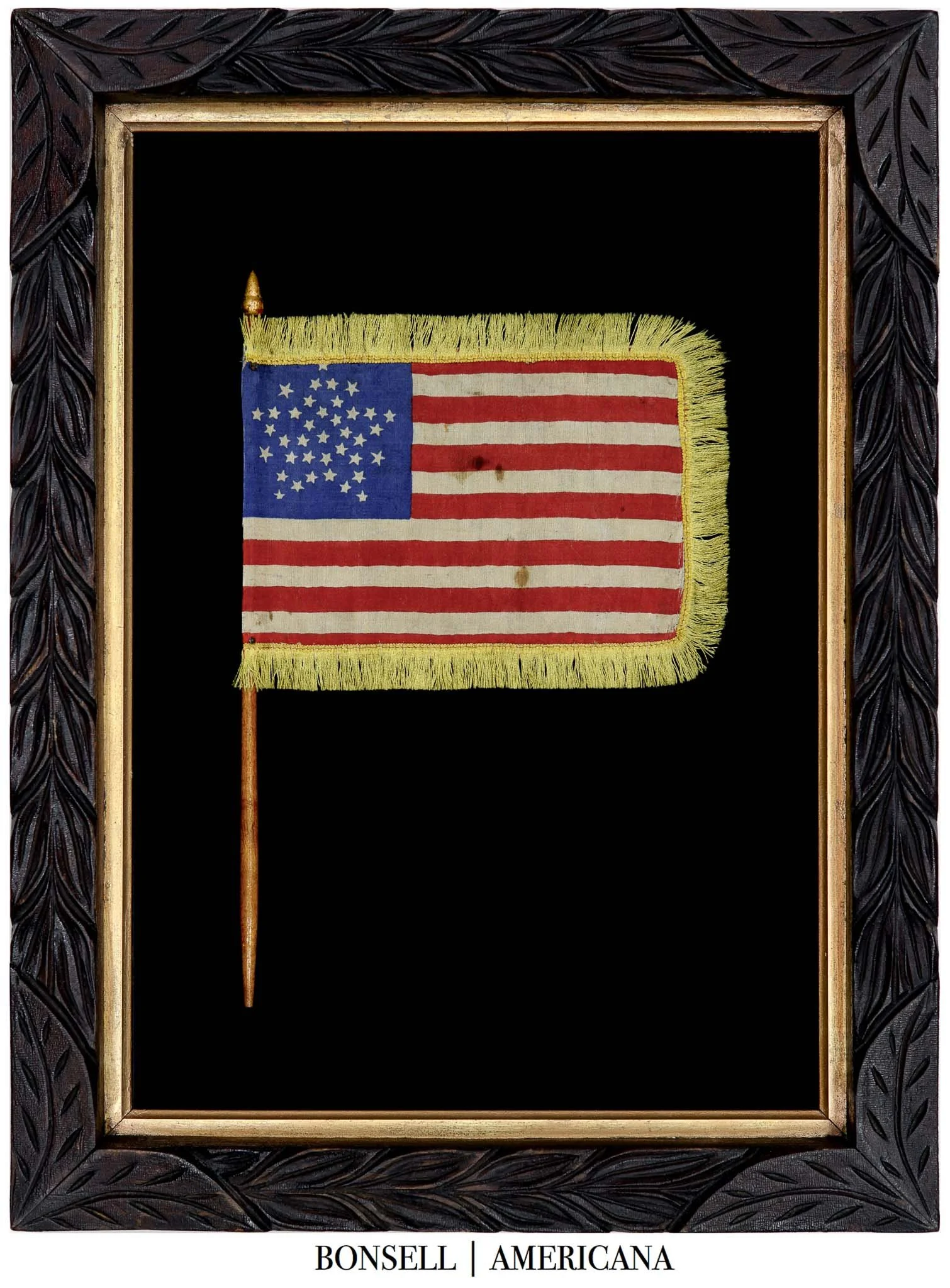
Offered is a 38-star American parade flag, printed on fine silk, bordered on three sides with gold fringe, and mounted to its original turned-wood staff with a smooth finish, gilt spear finial, and sharpened lower point. The stars are arranged in a Great Star—or Great Luminary—pattern, consisting of 34 stars forming the larger star and four flanking stars in the corners.
The flag’s construction and finish indicate use in a formal or ceremonial context. The printed silk, gold fringe, and carefully finished staff are consistent with patriotic and commemorative flags produced in Philadelphia and other major cities during the mid-nineteenth century.
THE FLAG
This small silk flag was printed with precise registration and even coloration, the stripes sharply defined and the canton evenly inked. The silk’s fine weave and sheen reflect a quality consistent with high-end commercial production. The flag remains attached to its original turned-wood staff by two small nails driven through the hoist—an attachment method typical of finer ceremonial flags, providing a secure but discreet means of fastening while preserving the textile’s presentation.
The gold fringe, sewn by hand along three sides, was reserved for interior and commemorative use. The smooth, turned staff with gilt finial and sharpened point suggests the flag was intended for formal display rather than outdoor procession. The combination of materials and finish places it among the more refined small-format silk parade flags of its period.
THE GREAT STAR PATTERN
The Great Star, or Great Luminary, pattern arranges smaller stars into the form of a single large five-pointed star, representing the idea that many states together form one nation. The design is credited to U.S. Naval Captain Samuel Chester Reid (1783–1861), a veteran of the War of 1812 and longtime harbor master of New York. Reid gained public recognition for his defense of the privateer General Armstrong at the Azores in 1814—an engagement that delayed the British fleet bound for New Orleans—and later became known for his expertise in maritime signals and his advocacy for a more standardized approach to American flag design.
In early 1818, as Congress debated how to revise the expanding and cumbersome fifteen-stripe flag created under the 1794 act, Reid corresponded with Representative Peter Wendover of New York and proposed a simplified system: thirteen stripes to honor the founding colonies and one star for each state, arranged in a coherent geometric form. Among several suggested layouts, Reid’s preferred design placed the smaller stars into the shape of a single large star—“a constellation within a constellation”—to convey unity and legibility at distance, particularly at sea.
Although the resulting Flag Act of 1818 adopted Reid’s principle of thirteen stripes and one star per state, it did not legislate any specific star pattern, leaving the arrangement to individual makers. The Great Star, however, quickly became one of the most admired and enduring designs of the nineteenth century. It appeared on printed parade flags, campaign banners, and naval ensigns, valued for its symmetry and balance.
By the time of the Civil War, the Great Star carried both historical and patriotic associations. It was viewed as a traditional pattern linking the modern Union to the ideals of the early Republic. Flag makers continued to employ it for ceremonial and commemorative use, particularly on fine silk parade flags and memorial banners. In this example, 34 stars form the large central figure, while four stars placed beyond the points complete the count of 38, producing a bold and symmetrical display consistent with the best mid-century printed examples.
ANTICIPATORY MANUFACTURE
The 38-star count corresponds to Colorado’s admission to the Union on August 1, 1876, though this star count did not become official until July 4, 1877. During the nineteenth century, flag makers frequently issued new designs before formal adoption, anticipating the next state to enter the Union.
This practice of pre-admission manufacture was both commercially practical and culturally symbolic. It allowed printers to offer “updated” flags immediately after statehood while reflecting public optimism about westward expansion. Comparable anticipatory flags exist for earlier admissions, including Kansas (1861) and Nevada (1864).
Colorado’s path to statehood began well before 1876, with petitions for admission introduced as early as 1864, during the Civil War. Congress debated its admission repeatedly over the following decade, and newspapers in eastern cities, including Philadelphia, reported on its prospects alongside those of Nebraska and Nevada. The anticipation of new western states encouraged flag makers to prepare designs reflecting expanded star counts.
By the mid-1860s, Philadelphia had become one of the nation’s foremost centers for patriotic manufacture. Firms such as Annin & Co., Horstmann Brothers, and numerous smaller print shops along Chestnut and Market Streets produced silk and cotton parade flags in a range of star configurations, often ahead of official adoption. These companies marketed their goods for parades, civic events, and military ceremonies, where flags bearing more than the current official number of stars were common symbols of national growth and optimism.
Within this commercial environment, a 38-star flag printed in the 1860s would not have been unusual. The practice of speculative printing—producing new star counts in expectation of future admissions—was routine. The combination of silk fabric, applied gold fringe, and finished wooden staff seen here reflects the upper tier of that market: a ceremonial-quality flag made for display rather than distribution. Such details are consistent with the craftsmanship of Philadelphia’s mid-century flag and military outfitters and with the city’s role as a major supplier of patriotic materials during and immediately after the Civil War.
CEREMONIAL AND MEMORIAL USE
Flags of this type were made for civic and commemorative display, not mass distribution. During the Civil War and Reconstruction periods, small silk flags with fringe were used to decorate interior spaces, honor guards, and funeral settings.
In the days following Lincoln’s assassination, cities across the Union displayed mourning drapery and American flags. In Philadelphia, the ceremonies of April 1865 made extensive use of flags and banners, both in the procession and in the interior of Independence Hall. Surviving period descriptions mention flags arranged around the casket and within the Assembly Room.
The materials and construction of this flag correspond closely to that setting. The quality of printing, the fringe, and the fine staff align with the decorative standards of funeral and memorial display rather than the rougher cotton handwavers distributed to the public.
PROVENANCE AND DOCUMENTATION
A typed and signed affidavit dated November 1, 1934, accompanies the flag. It was written by Louis Irving Reichner (1871–1942) of Philadelphia, a lawyer and genealogist. In the statement, Reichner records that his grandmother, Eliza J. Stephens, was present in Independence Hall during the removal of Lincoln’s remains on April 24, 1865, and that a soldier guarding the casket gave her one of the American flags placed around it.
The affidavit’s content and dates correspond exactly to the documented record of Lincoln’s funeral. A certified Philadelphia birth record, issued in 1918, confirms Reichner’s birth on July 14, 1871, to Louis Reichner, Jr. and Christiana (Stephens) Reichner, verifying his descent from Eliza J. Stephens.
Both the affidavit and birth certificate were found in Reichner’s personal Bushnell’s “Paperoid” expanding wallet, manufactured by the Alvah Bushnell Company of Philadelphia and gilt-stamped “L.I.R. / Life Ins.” The wallet retains its original paper envelope and maker’s printed insert.
Reichner’s obituary (1942) records a long and accomplished career. Born in Philadelphia in 1871, he attended the William Penn Charter School before earning degrees from Princeton University (M.A., 1897) and the University of Pennsylvania Law School. Following admission to the bar, he joined the Fidelity Trust Company in Philadelphia, where he worked in the trust and estate division before entering private practice. By 1910 he had become associated with the firm of Duane, Morris & Heckscher, one of the city’s oldest and most respected law offices, known for its corporate and banking clientele. In 1926 he accepted a position in New York as counsel for the National Properties Corporation, continuing to specialize in trust and real-estate matters.
During the First World War, Reichner served as a Captain in the U.S. Army Ordnance Department, responsible for procurement and supply logistics. He was promoted to Major in the Reserve Corps in 1919 and later to Lieutenant Colonel in 1929, remaining active in military reserve service into the 1930s.
Beyond his professional work, Reichner was deeply involved in civic and cultural organizations. He was a founding member and officer of the Princeton Club of Philadelphia, a long-time participant in the Orpheus Club, and a member of the Sons of the Revolution, the Society of the War of 1812, and the Genealogical Society of Pennsylvania. These affiliations reflect both his social standing and his enduring interest in American history and lineage. His involvement in genealogical and patriotic societies, coupled with his training as a lawyer, made him unusually well suited to document family history with care and precision—an aptitude reflected in the 1934 affidavit that accompanies this flag.
LINCOLN’S FUNERAL IN PHILADELPHIA
When the funeral train carrying Abraham Lincoln’s remains left Washington on April 21, 1865, it began a twelve-day journey to Springfield, Illinois. The Philadelphia stop was among the most elaborate and most attended of the entire route.
The train arrived at the Broad Street Station on Saturday, April 22. The casket was transferred to a hearse draped in black, drawn by eight gray horses, and escorted by city officials, soldiers, and members of the fire companies. The procession moved north on Broad Street and east along Chestnut toward Independence Hall. Contemporary reports describe a silent crowd and buildings covered in mourning cloth.
A correspondent for the New-York Daily Tribune (April 24, 1865) noted the depth and decorum of the city’s mourning: “The good taste of the citizens of Philadelphia was displayed in the mourning habiliments of their dwellings and places of business yesterday to-day, as well as during the entire week. Among the most prominent were the residences of Gens. Grant and Meade, which were covered with flags festooned with crape. Numerous military officers have their headquarters in Girard-st., and they are beautifully draped. The ladies appear with mourning badges on their left shoulders, and this custom had become so general that its non-observance is noticed.”
Inside the Assembly Room of Independence Hall, the coffin was placed on a raised platform. Soldiers stood guard as thousands filed past. The room was decorated with floral wreaths, patriotic emblems, and heavy black drapery.
A front-page engraving in the Philadelphia Inquirer (April 25, 1865), titled “President Lincoln’s Remains in Independence Hall,” depicts the scene. In the image, the bier stands in the center of the chamber beneath swags of bunting and banner-shaped hangings that fill the background. While discrete small hand-held flags are not identifiable, the décor includes flag-like folds and shield emblems that convey the patriotic symbolism described in contemporary accounts. The National Park Service, drawing from period descriptions, similarly notes that the Assembly Room was “adorned in mourning from floor to ceiling” as approximately 100,000 (or more) mourners filed past over twenty hours of visitation.
Public viewing began on the evening of April 22 and continued through Sunday, April 23. At dawn on Monday, April 24, the casket was closed and borne again to a hearse under escort of soldiers and firemen for transport to the depot. Although the departure took place before sunrise—around four o’clock in the morning—large crowds gathered once more along Chestnut and Broad Streets to pay their final respects. Contemporary accounts describe men, women, and children standing in silence as the hearse passed, church bells tolling in the distance, and flags lowered throughout the city. The train departed amid this quiet vigil, beginning the next stage of its journey to New York.
Reichner’s 1934 affidavit, written nearly seventy years later, aligns closely with these records: his grandmother’s presence on the day of removal, the guard stationed beside the casket, and the presence of American flags among the decorations. While no contemporary photograph of such flags survives, the affidavit’s details correspond precisely to the documented sequence of the Philadelphia ceremonies and to the known decorative traditions of that event.
SIGNIFICANCE
This flag and its documentation form a coherent and verifiable group. The flag itself is a fine example of small-format silk printing from the mid-nineteenth century, made with quality materials suited for ceremonial use. Its 38-star Great Star pattern reflects both patriotic symbolism and the practice of anticipatory manufacture.
The supporting documents—the affidavit, birth record, and personal wallet—create an unbroken chain of ownership from an eyewitness at Lincoln’s funeral to her grandson, who recorded and preserved the story. The group provides unusually complete provenance for an object of this nature and situates it clearly within the broader context of American mourning and civic commemoration in 1865.
Taken together, these materials represent a rare survival linking a known family witness to one of the most important public ceremonies in nineteenth-century American history.
Conservation Process: This flag was professionally conserved. It is sewn to silk and positioned behind Optium Museum Acrylic.
Frame: The frame is a circa 1900 hand-carved wood example with a dark-stained finish and excellent corner joints. It features a repeating leaf-and-stem motif and a gilt-painted inner liner that provides a simple, period-appropriate contrast. Solidly constructed and well-preserved, it is typical of quality American craftsmanship from the early 20th century.
Condition Report: The flag shows moderate signs of age and use consistent with its period. The silk remains intact with some scattered stains, light surface soiling, and minor splits visible under magnification. The colors are strong for its age, with the red slightly muted and the blue well preserved. The gold fringe and staff remain firmly attached and in stable condition.
Collectability Level: The Extraordinary – Museum Quality Offerings
Date of Origin: 1865
Number of Stars: 38
Associated War: The Civil War (1861-1865)
Associated State: Colorado
Price: Call 618-553-2291, or email info@bonsellamericana.com
Frame Size (H x L): 44” x 46”
Flag Size (H x L): 33” x 35”
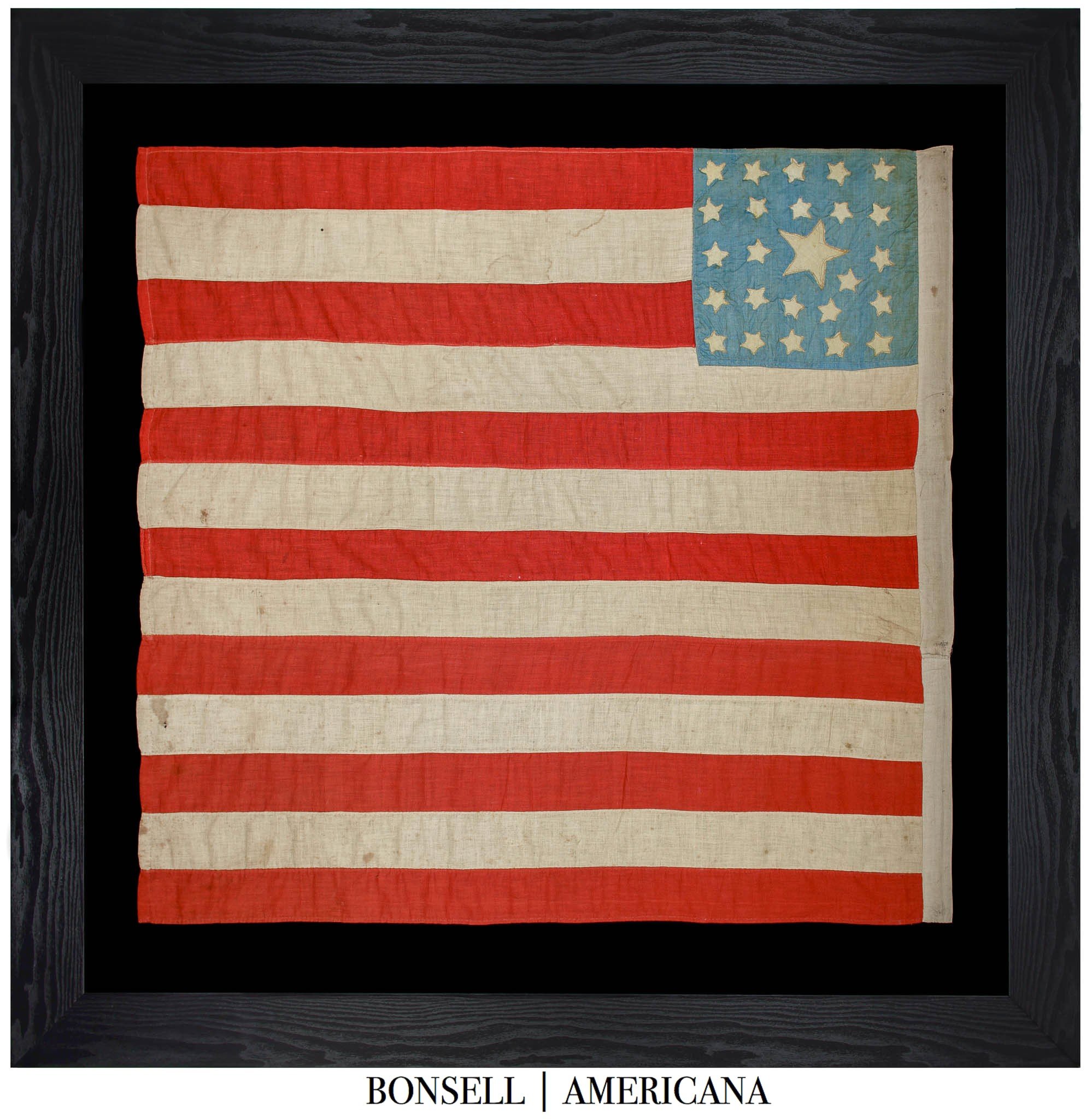
Offered is a 25-star American national flag of all-cotton construction, displaying a distinctive constellation built around a large central star. Surrounding it are two loose rows of smaller stars above and two below, creating a sense of balance while retaining the irregular, handmade quality typical of folk-produced flags.
The canton is small and nearly square, positioned high on the field so that it rests on the white stripe second from the bottom. This placement shortens the canton relative to the field, emphasizing its compact form and giving the design a visually dynamic character. The overall proportions are roughly square, a format that enhances the flag’s sense of balance and separates it from the long, narrow forms that became common later in the 19th century.
Measuring approximately 33 by 35 inches, the flag is ideal for framing and interior display. Many sewn examples from the period are too large for practical presentation; this scale combines visual strength with versatility, a major reason why flags of this size are especially desirable to collectors.
The blue canton has aged to a smoky tone between slate and denim, a color typical of 19th-century cotton dyes. Flags of this era often show variation in blue, from indigo to pale sky shades, depending on the dye and wash process used. Here, the softened blue complements the ivory stars and muted red stripes, producing a cohesive, aged palette. The combination of color, scale, and the canton’s high placement gives the flag a compact, well-composed appearance with strong visual appeal.
CONSTRUCTION
Made entirely of plain-weave cotton, the flag was intended for decorative or domestic use rather than military or maritime service. The stripes are treadle-sewn, showing the even looping characteristic of small home or workshop machines from the 1870s. The stars are double-appliquéd and sewn to both sides of the canton in white thread, brightening the blue field and reinforcing the design. Each star is carefully cut but slightly irregular, showing that they were positioned and stitched by hand using an early foot-powered machine.
The hoist edge lacks grommets or a separate binding, suggesting that it was likely tacked or pinned when displayed. The fly end is turned under and finished with a single line of machine stitching, a simple but sturdy method typical of Centennial-period flags. Every detail—the cotton fabric, white-thread sewing, and square proportions—matches the methods and materials used around 1876.
HISTORICAL CONTEXT
While a 25-star flag would officially correspond to the short period between July 4, 1836, and July 3, 1837, following Arkansas’s admission to the Union, this example was made several decades later. Its materials and machine stitching place it firmly in the Centennial era.
In 1876, the United States celebrated its 100th anniversary with widespread patriotic display. Streets, buildings, and homes across the country were draped in bunting, and parades featured flags of every size and design. At the Philadelphia Centennial Exposition and in towns nationwide, flags appeared on storefronts, homes, and clothing.
During the celebrations, 13-star flags recalling the original colonies and 38-star flags anticipating Colorado’s admission were the most common. Between these symbolic extremes, some makers produced nonstandard designs—reviving early star counts or creating imaginative layouts. This 25-star example fits within that tradition, expressing both nostalgia and creative independence.
The flag likely commemorated the nation’s growth while allowing the maker to experiment with composition and balance. A smaller star count gave room for design freedom that a crowded 37-star field would not. Sewn cotton examples like this were often made for parades, public events, or home display. While thousands of printed parade flags were produced during the Centennial year, sewn examples were fewer, and surviving specimens are now scarce. The flag’s modest size, square form, and individualized star pattern reflect the personal craftsmanship and pride characteristic of the Centennial generation.
SIGNIFICANCE
This flag is a rare and visually strong survivor from the late 19th century, when Americans marked the nation’s first century by reviving early patriotic imagery. Though its star count references Arkansas’s entry into the Union, its construction places it among the handmade Centennial commemoratives of the 1870s. Few 25-star examples of any kind exist, and this one stands out for its unusual layout, square proportions, and small canton.
For collectors of early American textiles, its appeal lies in the combination of rarity and design. The high-set canton compresses the star field toward the lower stripes, producing a composition that feels both balanced and visually engaging. It bridges folk art and patriotic display, representing the creative ways Americans participated in the Centennial celebrations.
In the years after the Civil War, such handmade flags also reflected a desire for national unity and reconciliation. They were expressions of shared history and identity, created in homes and small workshops across the country. While the Centennial saw the mass production of printed flags, this sewn example preserves the individual craftsmanship of an earlier time—a reminder that even in an age of industry, patriotism often found its purest form in handmade work.
Viewed as design, the flag’s loose rows of stars, oversized center, and compact canton create a rhythm that feels both structured and free. Its proportions, rare star count, and confident simplicity align it with the broader language of American folk design—part history, part abstraction.
When displaying historic flags, it is worth recalling that 19th-century conventions differed from modern practice. Parade flags were often printed on one side of long bolts of cotton or silk, with color bleeding through to form a lighter reverse. Makers sometimes oriented cantons differently depending on how the flag was hung or whether printed text needed to be read. At the time, such variations were entirely acceptable; the flag code and its modern display rules came much later. This historical context underscores how 19th-century Americans viewed the flag—with respect, but also with a degree of freedom that reflected the creative energy of the Centennial era.
In its compact scale and inventive design, this 25-star flag embodies the Centennial generation’s effort to celebrate a century of independence through personal craftsmanship—an enduring expression of national pride rendered in simple, lasting form.
Conservation Process: This flag was hand sewn to cotton fabric, and both were hand sewn to a mounting board. To prevent the black dye in the cotton fabric from seeping into the flag, it was first washed in a standard wash and then in a dye setting wash. The flag is positioned behind Optium Museum Acrylic.
Frame: A square-profile molding with a deep, charcoal-toned surface that mimics the look of hand-grained wood. Subtle linear patterning adds quiet texture and depth, while the finish maintains a restrained sophistication suitable for both period and modern interiors.
Condition Report: The flag shows expected signs of age with minor soiling and light wear scattered throughout the field and along the fly end. There are a few small stains and spots of discoloration consistent with 19th-century cotton. The colors remain strong, with the red and blue well preserved and the white tones evenly aged to a soft ivory. Overall, the flag presents in very good condition for its period, with no significant losses or repairs.
Collectability Level: The Extraordinary – Museum Quality Offerings
Date of Origin: 1876
Number of Stars: 25
Associated War: The Indian Wars (1860-1890)
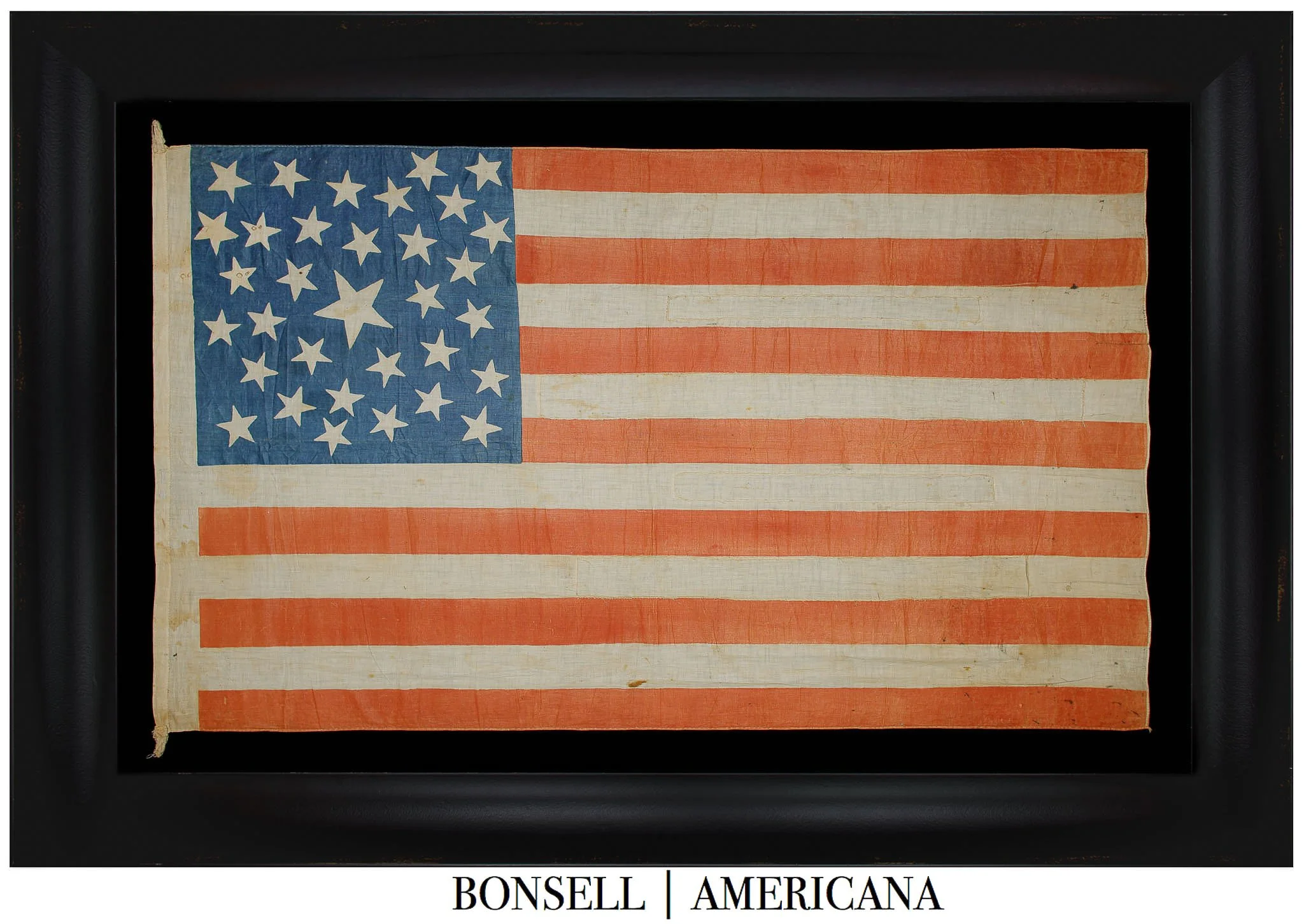
Price: Call 618-553-2291, or email info@bonsellamericana.com
Frame Size (H x L): 42” x 62”
Flag Size (H x L): 30.5” x 50.5”
Offered is an extraordinary antique American flag printed on a fine, thin cotton fabric that presents with an unusually smooth and lustrous surface. Though at first glance it almost evokes the sheen of silk, the textile is glazed cotton—a material often prized by mid-19th-century textile printers for its crisp finish and ability to take saturated color. The canton is printed in a rich indigo blue that slightly darkens where the glaze remains strongest, while the stripes appear in a vibrant shade that reads today as orange-red rather than the deep scarlet seen on modern flags. This tonal variation was common among mid-19th-century examples, as no official specification for the national colors yet existed, and the appearance of the red often reflected the particular dye formulas available to individual printers or the natural fading of the pigment over time. Each of the red stripes exhibits a faintly raised texture from the pigment application, sometimes referred to as a “paint-printed” or “pigment-dyed” process.
The white stripes display an especially intriguing feature: several hand-sewn patches that appear to be period repairs or intentional reinforcements, made from fabric identical to the surrounding material. Their hand stitching is neat and deliberate, suggesting an early attempt to correct printing or structural irregularities. Whatever the purpose, the presence of these period-applied patches adds to the flag’s individuality and speaks to the resourceful, hands-on nature of early textile making.
A separately applied cotton hoist is machine-stitched to the flag’s left edge, with short cords at both the upper and lower corners, indicating that it was once intended for functional display. The flag is exceptionally lightweight and delicate in hand, its surface marked by subtle creases and the characteristic sheen of early printed cotton flags produced during the Civil War era, circa 1859–1861.
The configuration of stars on this 33-star flag belongs to a small and fascinating group of designs generally classified as pentagon or heart medallions—patterns that emerged during the late 1850s and persisted into the early years of the Civil War. In this example, a large central star, representing Oregon’s admission as the 33rd state in 1859, anchors the design. Around it are two loosely pentagonal rings of smaller stars, producing a form that falls somewhere between a five-sided figure and a subtle shield shape. The result is a layout that is geometrically deliberate but slightly irregular, a quality that gives early printed flags of this period their distinctive handmade character.
This format is closely related to the series of medallion-style flags associated with H.C. Howard of Philadelphia, one of the most important early makers of printed parade flags. Active from roughly 1856 through the early 1860s, Howard’s name appears on documented examples made for presidential campaigns including those of John C. Frémont and Abraham Lincoln. His designs are noted for their bold central stars, experimental geometry, and unusually fine printing quality for the time. While this flag bears no maker’s mark, its structural rhythm and medallion form align strongly with Howard’s known work or that of those influenced by his shop, which helped set the visual language for pre-war and early wartime flag design.
The use of a large central star carries both symbolic and compositional meaning. In 19th-century American flags, the center star was often used to emphasize new statehood or the unity of the nation as a whole. Here it marks Oregon’s addition to the Union—a moment of western expansion and fragile national optimism on the eve of conflict. This convention—highlighting the newest state through size or placement—became common among skilled flag printers, allowing a single star to serve as both a visual anchor and a narrative device within the canton.
Oregon’s path to statehood was long and politically complex. Originally part of the vast Oregon Territory established in 1848, the region’s admission as a state was driven by years of settlement along the Oregon Trail and debates over the expansion of slavery. The territory’s provisional government had already outlawed slavery in 1844, and when Oregon sought admission, it entered the Union as a free state—an outcome that heightened sectional tensions in the years preceding the Civil War. President James Buchanan signed the act admitting Oregon on February 14, 1859, making it the nation’s 33rd state and extending American sovereignty to the Pacific Northwest. The inclusion of Oregon added both geographic reach and symbolic weight to the Union, representing the final realization of a continental republic just as the nation was fracturing along ideological lines.
The 33-star flag represents a narrow and historically pivotal moment. Oregon achieved statehood on February 14, 1859, and the flag bearing 33 stars became official on July 4 of that year. It remained current until July 4, 1861, when Kansas’ admission introduced the 34-star flag. For this reason, the 33-star flag bridges two eras: the final years of the antebellum period and the first months of the Civil War. One such flag was flying above Fort Sumter when Confederate forces opened fire in April 1861.
Flags associated with this brief window are among the rarest of all American flags. Prior to the Civil War, Americans seldom displayed the national flag for patriotic purposes, and even the U.S. Army did not regularly carry it until the 1830s and 1840s. Before this time, the Stars and Stripes functioned mainly as a naval ensign, and most examples were extremely large. Consequently, pre-war flags—especially small printed examples suitable for personal use—represent only a minute portion of surviving 19th-century flags.
The 33-star era thus occupies a unique position in American history. It marks the final official design adopted before the outbreak of war and the first widely produced during it. The rise of patriotic sentiment surrounding Lincoln’s election and the preservation of the Union spurred the creation of small printed flags for rallies, parades, and home display—objects that transformed the Stars and Stripes from a maritime signal into a national symbol of unity.
Because production of 33-star flags ended by mid-1861, surviving examples are exceedingly scarce. This flag, with its fine printed cotton construction, luminous surface, rare pentagon-style medallion, and curious period hand-sewn patches, represents not only the artistic innovation of its maker but also the moment when Americans first began to embrace the flag as a personal emblem of loyalty and identity.
Conservation Process: This flag was hand sewn to cotton fabric, and both were hand sewn to a mounting board. To prevent the black dye in the cotton fabric from seeping into the flag, it was first washed in a standard wash and then in a dye setting wash. The flag is positioned behind Optium Museum Acrylic.
Frame: The flag is presented in a deep, black-painted frame with a softly scooped profile and a lightly weathered surface that reveals subtle undertones of warm brown beneath the finish. The design is both substantial and refined, with a gently burnished texture that complements the age and character of the flag. Its depth allows the textile to be recessed slightly, giving the presentation a shadowbox effect that enhances contrast and visual presence.
Condition Report: The flag presents beautifully with strong color and excellent overall preservation for its period. The orange-red stripes remain vivid, and the blue canton retains much of its original depth and saturation. Scattered, small hand-sewn patches appear in the white stripes, all executed in matching period fabric and thread, adding both character and evidence of early care or construction refinement. Minor toning, light creasing, and modest wear are present, consistent with age and the delicate nature of mid-19th-century printed cotton, but the flag survives in an exceptional state of integrity for a pre–Civil War example.
Collectability Level: The Extraordinary – Museum Quality Offerings
Date of Origin: 1859-1861
Number of Stars: 33
Associated War: Pre-Civil War
Associated State: Oregon

Frame Size (H x L): 47.5” x 40”
Pennant Size (H x L): 35.5” x 28”
Offered is a set of sheepskin chaps tied to the historic CS Cattle Company of Cimarron, New Mexico, a remarkable example of early ranching gear. Likely dating to the late 1800s or early 1900s, they reflect the craftsmanship and functionality essential to ranch life during that era. Stamped with “CS Cattle Company Cimarron, New Mexico” and marked with the handwritten note “by Drover Jesus B.,” these chaps provide a tangible connection to the ranch’s history and their maker or user. Their design showcases rugged practicality, built to withstand the demands of daily ranch work.
Constructed from leather and sheepskin, the chaps feature a dual-layered belt system with brass hardware for a secure fit. Two front pockets offered practical storage for small tools or essentials, while decorative tassels along the seams reinforced durability and added aesthetic appeal. These details highlight the balance of utility and artistry typical of handmade gear from this period.
Whether from the late 19th or early 20th century, these chaps embody the resourcefulness and craftsmanship of ranching culture. Their sturdy materials, detailed construction, and clear provenance make them an exceptional artifact of ranching history, shedding light on the working conditions and ingenuity of ranchers in northeastern New Mexico.
The combination of sheepskin and a leather belt system, along with tassel reinforcements, aligns with a transitional period when ranching gear began evolving. This predates the widespread popularity of woolies in the early 20th century. The dual-layer belt with brass hardware and functional front pockets reflects the personalized, handmade craftsmanship typical before mass production. The “CS Cattle Company” stamp ties the chaps to the ranch established in 1873, and the handwritten note “by Drover Jesus B.” adds a personal touch, further suggesting their origin during the ranch’s early operations.
CHAP HISTORY
The term "chaps," derived from the Spanish word chaparreras, originated in the 16th and 17th centuries with Mexican vaqueros who used them as protective leg coverings in brushy or rugged environments. Early chaps, often crafted from thick leather, were tied to a belt or saddle and served to shield riders from thorny vegetation, harsh weather, and the wear and tear of horseback riding. As cattle herding spread across North America in the 19th century, chaps became essential gear for cowboys and ranchers.
By the 1800s, chaps evolved into various styles suited to specific needs. Shotgun chaps, with their straight-leg design, were practical for general work, while batwing chaps offered greater freedom of movement. Woolies, made from sheepskin or angora, gained popularity in colder climates for their warmth. Regardless of style, chaps were indispensable for protecting riders’ legs and clothing, symbolizing the resilience and ingenuity of ranching life.
CS CATTLE COMPANY
Established in 1873 by brothers Frank and Charles Springer, the CS Cattle Company is a historic working ranch in northeastern New Mexico, spanning 130,000 acres of plains, foothills, and mountain terrain. Originally part of the Maxwell Land Grant, the ranch carries a legacy of over 150 years of cattle ranching, horse breeding, and hunting under the stewardship of the Springer and Davis families.
Frank Springer, an Iowa-born lawyer, laid the foundation for the ranch in 1873 when he purchased his first 1,000 acres near the Sangre de Cristo Mountains. His brother Charles joined him in 1878, contributing the initials "CS" that define the ranch's brand. Over time, the ranch expanded, blending cattle ranching traditions with innovative practices, such as a horse breeding program that began in the 1880s and continues today.
Management of the ranch transitioned through generations, with Les Davis, Frank Springer’s grandson, taking leadership in 1947. Under his stewardship, the ranch diversified, enhancing its cattle operations and gaining recognition for its contributions to the American Quarter Horse breed. Horses bred at the CS were celebrated as cavalry mounts, polo ponies, and ranch horses.
Today, the CS Cattle Company remains a family-run enterprise, preserving its traditions while embracing modern practices. Its activities include cattle production, horse breeding, and guided hunting, utilizing its expansive terrain. The ranch endures as a symbol of resilience and innovation, embodying the spirit of the American West.
Conservation Process: The chaps were hand sewn to cotton fabric, and both were hand sewn to a mounting board. To prevent the black dye in the cotton fabric from seeping into the chaps, they were first washed in a standard wash and then in a dye setting wash. The chaps are positioned behind Optium Museum Acrylic.
Frame: The frame is a modern, rustic design crafted from textured brown wood. Its natural finish and visible grain patterns give it an authentic, handcrafted appearance, complementing the historic nature of the sheepskin chaps.
Condition Report: The sheepskin chaps show significant wear, with noticeable losses in the front, likely due to both extensive use and the passage of time. Stains and discoloration are present, further attesting to their heavy use in a working ranch environment. Despite these signs of wear, the condition adds a layer of authenticity and character, reflecting their history and the rugged demands of ranch life.
Collectability Level: The Extraordinary – Museum Quality Offerings
Date of Origin: 1873-1910
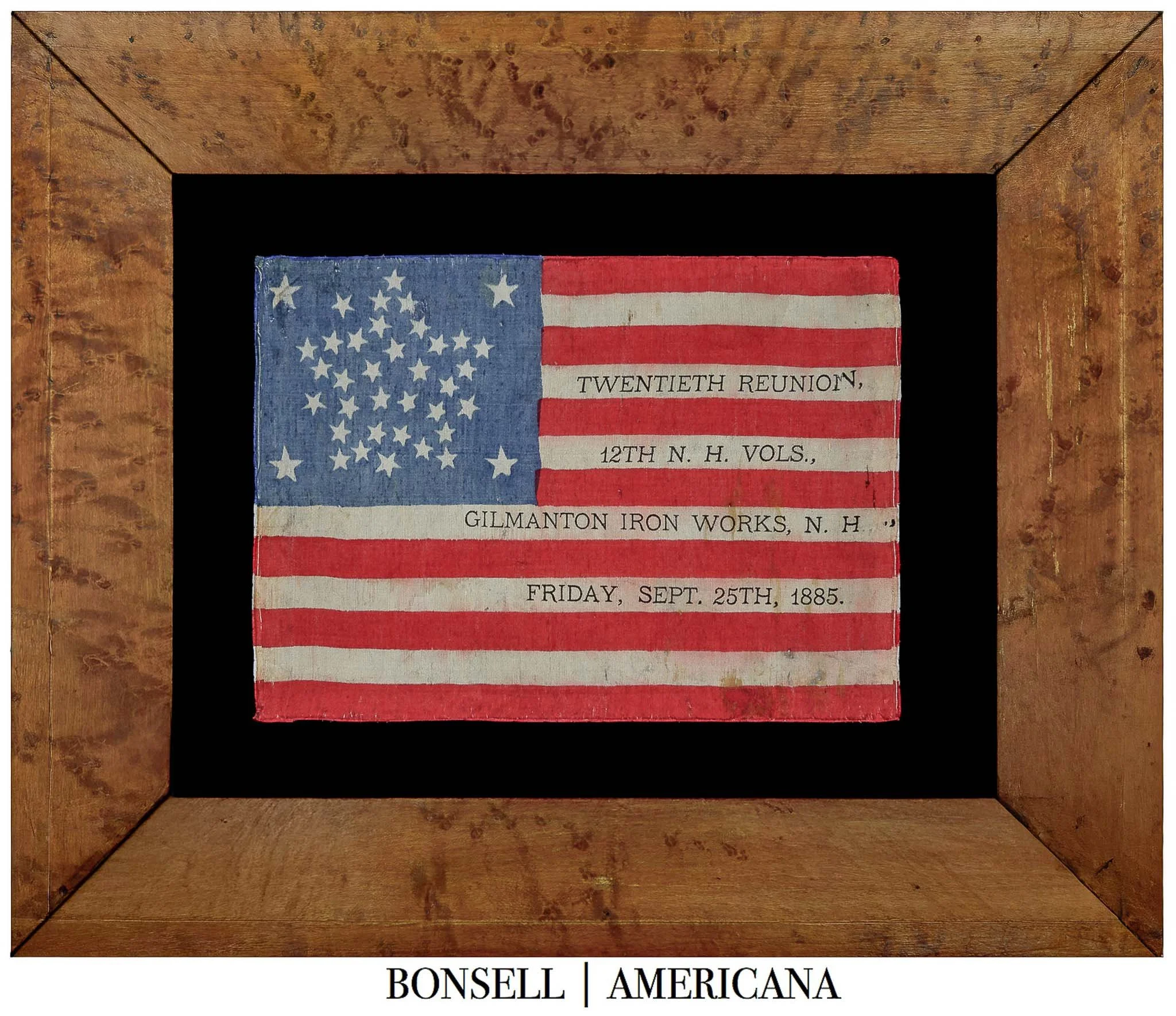
Frame Size (H x L): 14” x 17”
Flag Size (H x L): 6.5” x 9.25”
Offered is a remarkable 38-star printed silk parade flag commemorating the Twentieth Reunion of the 12th New Hampshire Volunteer Infantry, held at Gilmanton Iron Works, New Hampshire, on Friday, September 25th, 1885. It is overprinted with the following inscription:
TWENTIETH REUNION,
12TH N. H. VOLS.,
GILMANTON IRON WORKS, N. H.,
FRIDAY, SEPT. 25TH, 1885.
The “12TH N. H. VOLS.” refers to the 12th New Hampshire Infantry Regiment, a Union Army unit mustered in at Concord in September 1862 and mustered out in June 1865. The regiment saw heavy combat in several major engagements, including Fredericksburg, Chancellorsville, and Gettysburg. At Chancellorsville, it was the last unit under General Sickles’ command to withdraw from the field—suffering 69 killed and 250 wounded out of 580 men engaged. At Gettysburg, the 12th held ground north of the Klingel Farm under fierce attack by the Alabama Brigade, with 26 killed, 73 wounded, and 6 additional deaths from wounds among its 224 participants.
The reference to a “Twentieth Reunion” suggests the regiment began annual gatherings in 1866, immediately following the war. While most Civil War veteran flags feature overprints from the Grand Army of the Republic (GAR), this example is unusual in that it references a specific regimental reunion. Moreover, it predates the more commonly encountered GAR reunion flags, most of which date to the early 20th century.
The flag’s canton features a rare and desirable “Great Star” pattern—an arrangement where smaller stars form the outline of a larger five-pointed star. This example includes 25 stars forming the outer shape, 5 within its interior, 4 interstitial stars surrounding the main form, and 4 canted corner stars. The slight asymmetry and open gaps likely allowed space for a future star, symbolizing the evolving Union.
The Great Star configuration is credited to U.S. Navy Captain Samuel Chester Reid, who proposed the design in 1818 while advising Congress on flag standardization. Reid's ideas helped shape the Flag Act of 1818, which fixed the number of stripes at thirteen and mandated that a new star be added for each new state on the July 4th following its admission. While his favored star pattern was not codified in law, the Great Star design became popular for its visual impact, especially when flown at sea. Though it saw greatest use in the 1840s, it remained in occasional production through the Centennial era. The last known commercial use of the pattern appeared on 38-star flags.
A matching example to the flag offered here was discovered in its original shipping tube bearing a two-cent stamp and the printed return address:
From
R.W. MUSGROVE,
Book and Job Printer.
R.W. Musgrove, a Civil War veteran and editor of the Bristol Enterprise, is confirmed to have produced these flags. To attribute a 19th-century printed flag to a specific maker is exceedingly rare and adds significant historical value.
The 38-star count represents the admission of Colorado to the Union on August 1, 1876, with the flag becoming official on July 4, 1877. The 38-star flag remained official through 1889 and into mid-1890, covering the administrations of Presidents Hayes, Garfield, Arthur, Cleveland, and Harrison. Though the 37-star flag was official during the nation’s Centennial in 1876, both the 13-star and 38-star flags were widely used to commemorate the event, especially by manufacturers eager to anticipate Colorado’s statehood.
The Centennial celebrations of 1876 ignited a renewed national pride. Cities hosted parades, homes were decorated in patriotic colors, and flags became a central symbol of unity and identity. The most prominent celebration was the Centennial International Exposition in Philadelphia, which attracted nearly 10 million visitors and introduced marvels such as the Corliss Steam Engine and Alexander Graham Bell’s telephone.
This flag, dating to 1885, stands apart as an early and regimental-specific veteran reunion artifact—bearing direct connection to one of the war’s hard-fought Union regiments, with a star pattern rooted in early 19th-century naval heritage. It is a compelling piece of Civil War memory.
Conservation Process: This flag was professionally conserved. "It is mounted to silk backing and positioned behind Optium Museum Acrylic.
Frame: The flag is mounted in a birdseye maple frame, likely dating to the mid-to-late 19th century, with a distinctive swirling grain and warm amber tone.
Condition Report: The flag is in good overall condition, with solid color retention and a clearly legible overprint. The silk exhibits typical age-related wear, including light creasing, a few small splits, and scattered staining—most notably some faint gold-toned discoloration.
Collectability Level: The Extraordinary – Museum Quality Offerings
Date of Origin: 1885
Number of Stars: 38
Associated War: The Indian Wars (1860-1890)
Associated State: Colorado
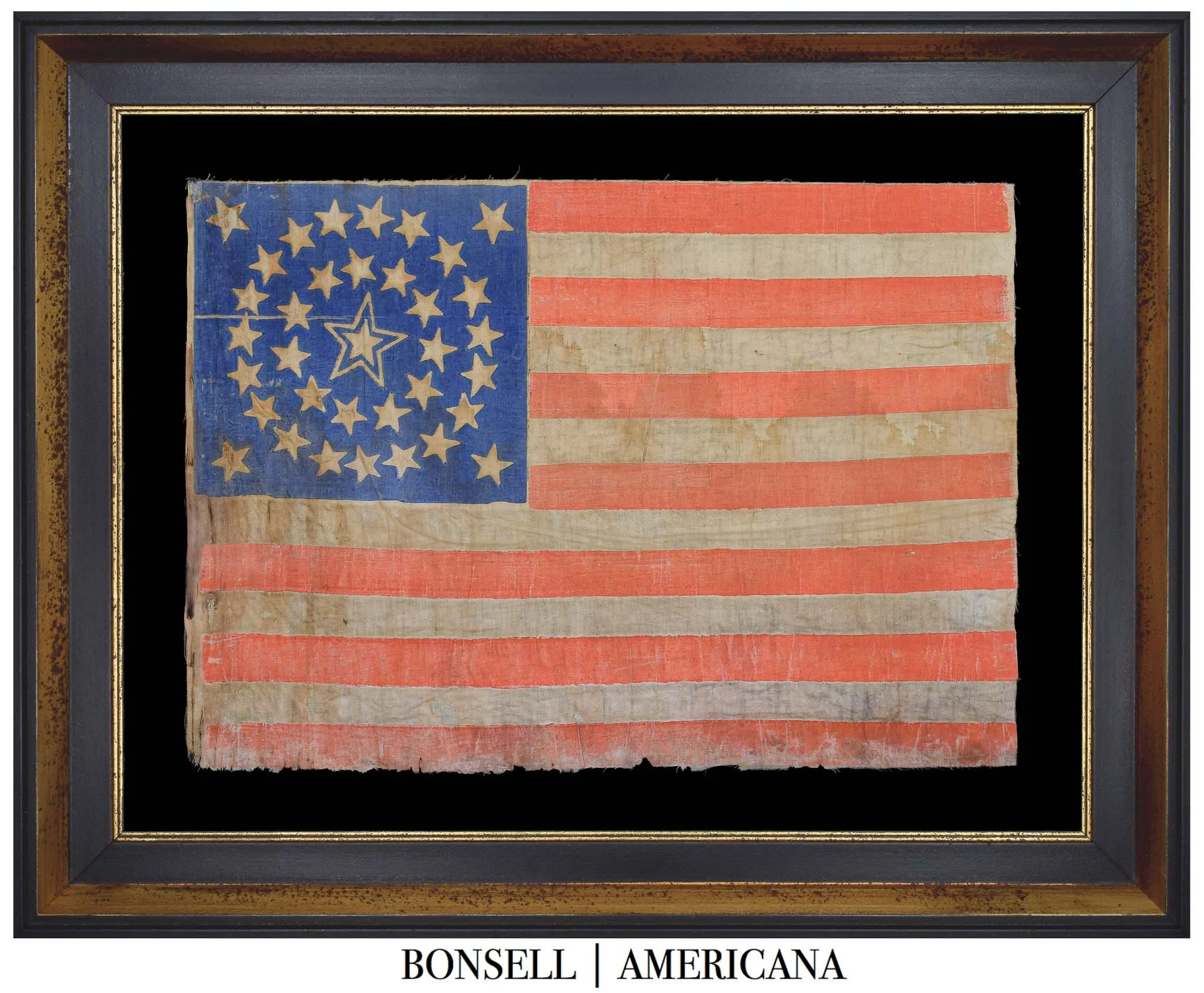
Frame Size (H x L): 30.5” x 38.5”
Flag Size (H x L): 20” x 28”
Offered is an extremely rare thirty-five star antique flag. Its stars are arranged in a medallion pattern. This particular medallion includes a large star in the middle, two rings of stars surrounding the large star, and a flanking star in each corner surrounding the rings. The majority of medallion pattern flags date to between 1861 and 1876. Beginning in the 1890s, linear patterns began to replace medallion patterns, though the reasoning for this transition, at this time, is unclear—in large part because it was not until 1912 that President Taft issued Executive Order 1556, establishing an official star pattern of rectilinear rows.
The large canted star in the middle is referred to as the “center star.” A center star is different than a great star, a term used to describe a star made up of smaller stars. A center star is almost always positioned in the very middle of the canton. The rest of the stars are then positioned around the center star, and form various different patterns. The center star represents the newest state added to the Union (e.g., West Virginia in the case of this thirty-five star flag).
The large center star includes two parts: a bold center star and a surrounding halo. Haloed flags are extremely attractive and collectible. The maker of this flag is unknown, but it is clear that the same company produced most, if not all, haloed flags, including flags with thirty, thirty-four, thirty-five, thirty-six, and forty-two stars. In our experience, the thirty-five star variation is the rarest.
THIRTY-FIVE STAR FLAGS GENERALLY
As noted above, the thirty-five star flag represents the inclusion of West Virginia to the Union. West Virginia was admitted on June 20th, 1863, and this flag became official on July 4th 1863. The thirty-five star flag is the only flag that (1) represents a state admitted during the Civil War time period, and that also (2) became official during the Civil War. Because it was official for a short time period—around 18 months—and because so many flags were produced in 1861 and 1862, thirty-five star flags are the rarest and the most desirable of the Civil War counts.
The thirty-five star flag was official until July 4th, 1865, the time at which the thirty-six star flag official and began to represent the inclusion of Nevada in the Union.
WEST-VIRGINIA STATEHOOD
Prior to the Civil War, what is now West Virginia was part of Virginia. In 1861, when Virginia seceded from the Union, the western portion of the state did not agree with this decision and formed its own government, the Restored Government of Virginia. This government declared its loyalty to the Union and began the process of creating a new state.
In 1862, Congress passed a bill allowing the formation of a new state from the western counties of Virginia. The people of the region held a convention and drafted a constitution for the proposed state, which was then approved by Congress. Despite this, Virginia did not give its consent to the creation of the new state, leading to a legal dispute therebetween.
President Lincoln issued a proclamation recognizing the new state of West Virginia, and as mentioned above, it was admitted to the Union on June 20th, 1863. West Virginia was the only state to be created during the Civil War. The creation of West Virginia was controversial at the time, and its admission to the Union was opposed by some who argued that it was an unconstitutional maneuver.
Ultimately, the state's creation was analyzed by the Supreme Court, in 1871, in the case of Virginia v. West Virginia. Virginia argued that the creation of West Virginia was unconstitutional and that its land should be returned to Virginia. The Supreme Court, in a 6-3 decision, rejected Virginia's argument and upheld the creation of West Virginia. The Court held that Congress had the authority under the Constitution to admit new states to the Union, and that the creation of West Virginia was consistent with that authority. The Court also found that the Restored Government of Virginia was the legitimate government of the state and had the power to create a new state. The case had significant implications for the legality of secession and the power of Congress to admit new states during times of political turmoil. It also affirmed the legitimacy of the creation of West Virginia.
Conservation Process: This flag was hand sewn to cotton fabric, and both were hand sewn to a mounting board. To prevent the black dye in the cotton fabric from seeping into the flag, it was first washed in a standard wash and then in a dye setting wash. The flag is positioned behind Optium Museum Acrylic.
Frame: This offering is in our Large Distressed Black and Gold Frame.
Condition Report: There is oxidation across the entirety of the flag. But the most noticeable oxidation, however, is over the white stripes; below the canton, near the hoist edge; and to the right of the canton. There are tears running along the hoist edge, but they have been stabilized by the mounting of the flag. The bottom red stripe is faded, almost of the point of being white in the lower half thereof. There is a printing error across a portion of the canton (i.e., starting at the hoist edge and ending at the large center star). These issues are age appropriate and typical of haloed flags. Many of our clients prefer flags that show these signs of age.
Collectability Level: The Extraordinary – Museum Quality Offerings
Date of Origin: 1863-1865
Number of Stars: 35
Associated War: Civil War (1861-1865)
Associated State: West Virginia
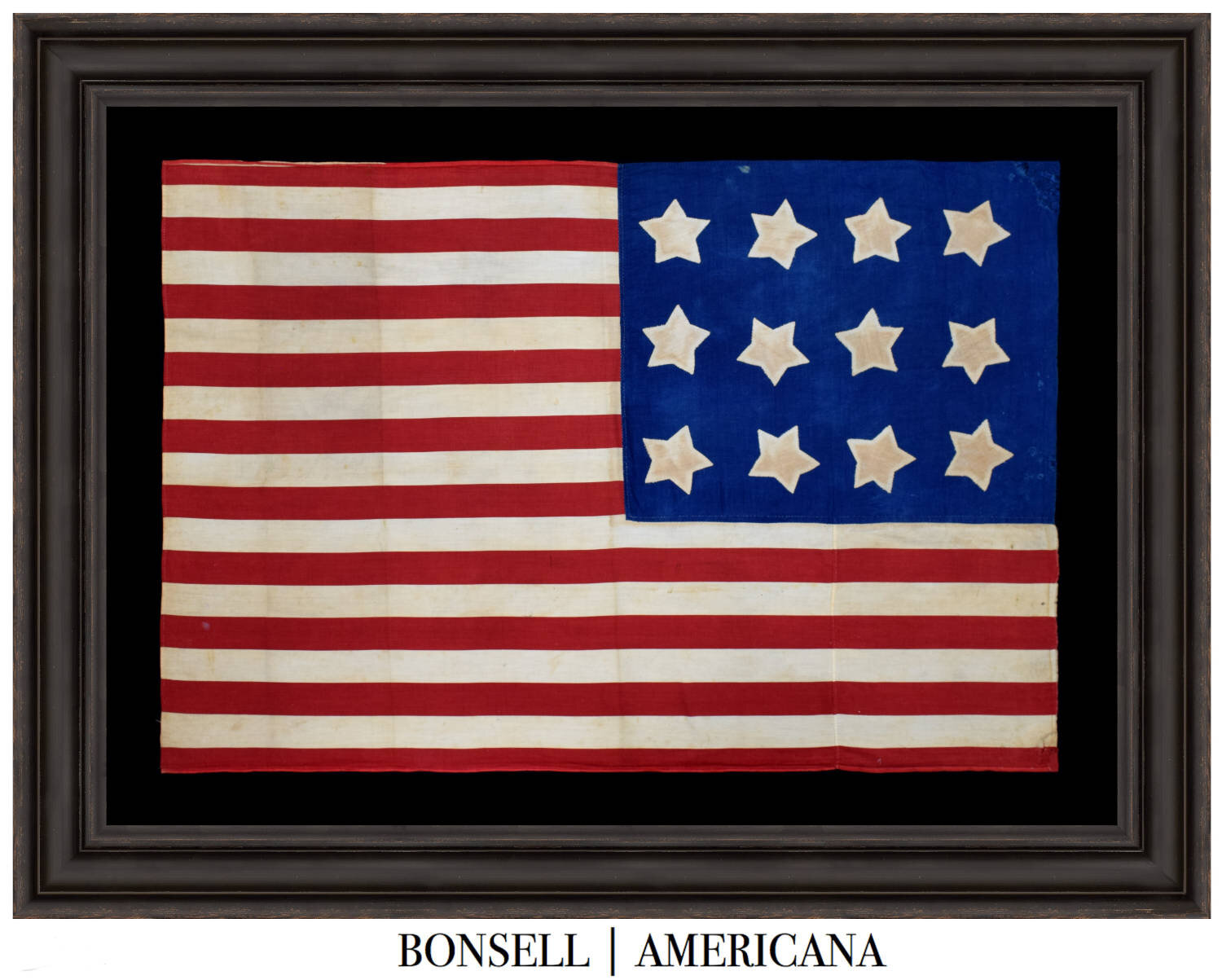
Frame Size (H x L): 42.5” x 57”
Flag Size (H x L): 30.5” x 45”
Offered is a spectacular twelve-star antique flag. It is a homemade example and visually striking in every respect. But perhaps most striking of all, it has nineteen stripes—among the most that we have ever encountered on an antique flag—rather than the standard thirteen. In some cases, the number of stripes has a symbolic meaning. However, the nineteen stripes of this flag are probably either a function of it being made with scraps from other projects or with whatever material happened to be available to the maker.
The stars are in a 4-4-4 rectilinear pattern, and they are canted in various, random directions. They are made of cotton, sewn by hand with a running stitch and a whipstitch, and single-appliquéd. When applied in this manner, the stars are sewn to just one side of the canton, the canton is cut away from behind each star, and the canton is then hemmed around each star. By doing this, the single piece of cotton used for each star can be seen on both sides of the flag. This method is difficult to execute, but the upside is that it conserves material, reduces weight, and allows the flag to flow horizontally and visibly in the wind.
Single-appliquéd flags are highly desirable. They are much rarer than double-appliquéd flags. Only around 20% of the flags made during the 1860s are single-appliquéd; only around 10% of those in the 1870s are as such; and only around 1% of those in the 1890s are such. Additionally, the stars on single-appliquéd flags are attractive and folksy. In the case of this flag, its stars resemble star fish and are visually interesting.
The First Flag Act of 1777 specified that the flag should have stars, stripes, and a canton. However, it did not specify the proportions of the individual components, the proportions of the components relative to one another, the proportions of the overall height relative to the overall width, and the like. Such proportions were not specified until 1912. In the case of this flag, its stars and canton are unusually large, and the overall length of the flag is relatively short (i.e., the flag looks stocky).
The First Flag Act also specified that the flag should be red, white, and blue, but it did not specify the shades of these colors. The shades thereof were not specified until 1934. Thus, flags made therebetween often exhibit unusual colors. In the case of this flag, it red stripes and the blue canton are both particularly vibrant.
The cotton canton is handsewn to the striped cotton bunting, using both a running stitch and a whipstitch. The canton is a single piece of material, while the bunting is two separate pieces. The separate pieces are handsewn to one another using a running stitch.
THE TWELVE STARS
The number of stars on a flag is generally a function of how many states were in the Union at the time the flag was made. In general, the star count is a reliable way to determine a flag’s age. However, there are many exceptions to this general rule, including anticipatory flags, which are older than the official dates normally associated with their star counts; thirteen-star flags, common throughout our nation’s history; and flags with “extra stars” that were added at some point after their initial date of manufacture.
In the case of this flag, knowing with certainty what the maker intended with respect to the twelve stars is not possible. However, there are at least three reasonable explanations.
FIRST THEORY | EXCLUSIONARY FLAG
The first theory is that this an exclusionary flag with a star count that represents Missouri, the twelfth state accepted to the Confederacy (even though its acceptance thereto was in opposition to Missouri’s controlling, pro-Union government wing).
An exclusionary flag is one that is meant to exclude a portion of the United States, and that includes fewer than the official number of stars for a given time period. Despite President Lincoln’s pleas to avoid such a practice, there were Northern flags that excluded the stars representing the Southern states, and there were Southern flags that excluded the stars representing the Northern States. These latter flags are more specifically referred to as secession flags or Southern sympathy flags.
When Lincoln was elected president, the South Carolina legislature perceived him as a threat, knowing that he was an opponent to slavery and particularly its expansion. In response, delegates voted to remove South Carolina from the Union. Following its secession, Mississippi, Florida, Alabama, Georgia, Louisiana, and Texas followed suit, in this order, in a first wave. Shortly thereafter, following the Confederacy’s’ attack on Fort Sumter, Virginia, Arkansas, Tennessee, and North Carolina also followed suit, in this order, in a second wave. These waves occurred in sudden fashion. South Carolina’s secession occurred on December 20th, 1860 and North Carolina’s secession occurred, just months later, on May 20th, 1861.
Missouri was a border state and political powder keg. Southerners traveling up the Mississippi and Missouri Rivers settled the state, and many of them brought slaves with them. Northerners also entered the state in large numbers and held their own political views. Missouri became a state in 1821, following the Missouri compromise in 1820, in which Congress agreed that slavery would be legal in therein, but otherwise illegal north of the 36°30' latitude. As part of the compromise, Maine would enter the Union as a free state, so as to maintain the overall balance between free and slave states.
In 1854, the Kansas-Nebraska Act nullified the Missouri Compromise by permitting the Kansas and Nebraska territories to decide for themselves, by a vote, whether they would be free or slave states upon joining the Union. At this time, federal law decreed that slaves that physically enter a free state become free themselves. In view of this, Missouri slave holders were concerned that if Kansas became a free state, then the entire border between Missouri and Kansas would be a conduit for smuggling slaves to freedom via the Underground Railroad. Pro-slavery residents of Missouri saw this as a threat, while in contrast, anti-slavery residents of Kansas saw this as an opportunity. Violence ensued therebetween, each side hoping to influence how Kansas would enter the Union.
In 1860, outgoing Governor Robert Marcellus Stewart, who had northern leanings, proposed that Missouri remain part of the Union and militarily neutral, the only exception being that Missouri should protect its borders. In contrast, incoming Governor Claiborne Fox Jackson had southern leanings, and following his election, he promoted Missouri’s secession, planned to seize a federal arsenal in St. Louis, and conspired to divert money to Missouri’s troops. Following a series of conflicts between Missouri and the Union, Jackson and remnants of the elected state government were driven to the southern part of the state. They developed a shadow government and enacted an Ordinance in Secession. In response, the Confederate States of America accepted Missouri as the twelfth state thereof and gave it votes in the Confederate Congress. In other respects, the shadow government was essentially powerless (relative to the remaining portions of the actual government).
In parallel with the shadow government’s supposed secession, the actual government reconvened via the Missouri Constitutional Convention and declared the Missouri governor’s office to be vacant. It appointed Hamilton Rowan Gamble as the new governor, who agreed to provide troops to the Union Army. Under his leadership, 447 Missouri Regiments fought for the Union, including the 1st Missouri Volunteer Calvary Regiment, which fought continuously throughout the entire conflict.
In the case of this flag, the twelve stars may represent Missouri’s status as the twelfth state in the Confederacy, while its overall traditional layout may represent national patriotism or respect for the stars-and-stripes. Additionally, as discussed, Missouri had mixed loyalties, and subtle symbolism via flags was sometimes used as a means of communication in such states. On at least some occasions, unusual flags were made to mark secret meeting locations or to signal that aid is available with respect to a cause.
SECOND THEORY | COMMEMORATIVE FLAG
The second theory is that this is a commemorative flag with a star count that represents North Carolina, the twelfth state to join the Union.
In 1787, the colonies held a Constitutional Convention and drafted the US Constitution. In 1788, North Carolina voted on whether to accept or reject it. It did the latter, the basis being a fear that the national government would be too powerful and the states too week. In 1789, it voted again and accepted it. The second vote was successful, because the national leaders added the Bill of Rights to the Constitution, which promised to protect the rights of the people, thus alleviating at least some of the concerns associated with the first vote. Additionally, the second vote was successful, because the wealthy plantation owners in the northeastern portion—who supported the Constitution even in the first vote and who held the bulk of the political power—threatened to seceded, absent a successful second vote. North Carolina became a state on November 21st, 1789.
In the case of this flag, it may commemorate North Carolina’s admission to the Union. It would not date to 1789 or anywhere close thereto. Rather, it would date to North Carolina’s 75th anniversary in 1864 or its 100th anniversary in 1889—the most logical boundaries from an anniversary perspective in view of the flag’s materials, construction, and appearance. To at least a certain extent, flags made for such events were handsewn and homemade, and they were flown in various manners, particularly on front porches, store fronts, and buildings.
Along similar lines, this flag may have been displayed at the Centennial International Exposition in Philadelphia in 1876 or the World’s Columbian Exposition in Chicago in 1893, both of which were patriotic events and logical in view of the flag’s construction and appearance. That said, flags flown at such events were typically made of wool, almost certainly in the case of flags flown outdoors. As such, in the case of this cotton flag, its material suggests that it would have been used indoors. Further, flags flown at such events were typically professionally manufactured. Thus, in the case of this flag, its handsewn construction and folksiness suggest that it probably was not used at the Expositions or similar events.
Of the different places and times mentioned under this second theory, we believe that it would most likely have been used as a commemorative flag with respect to an anniversary and flown informally at a home or shop. Damage to this hoist suggest that this flag was used with some frequency outdoors, but presumably with protection from the elements, particularly water. Alternatively, this flag may have been moved indoors and outdoors, per the weather. Such movement would logically fit with what a homeowner or shop owner might do with respect to a standard upkeep regimen.
THIRD THEORY | NAVY ENSIGN
The third theory is that this is a navy ensign with a rare count of twelve stars. An ensign, or sometimes referred to as a boat flag, is a national flag that is flown on a boat or ship, typically on the stern of the vessel. In the 18th century and much of the 19th century, the US flag was primarily considered a maritime flag, and for this reason, the national flag used on land was the same as the one used at sea. Beginning in the 1850s (and perhaps earlier), the US Navy began utilizing thirteen-star flags, so that each star could be as large as possible and, thus, make the US flag easily identifiable at long distances upon the open seas. In 1916, the US Navy discontinued this custom and transitioned to incorporating a full star count.
Ninety-five percent of ensigns include thirteen stars. In contrast, the other five percent include a combination of twelve, fifteen, sixteen, twenty, and twenty-four stars, all of which are star counts that are discernible from a distance, easy to place, and easy to arrange in a manner that mimics traditional military based formats.
Due to the extreme environment that ensigns endure, they typically include grommets, gussets, heavy grade wool, and extra stitching. Further, most ensigns appear to be “long” versus other flags. This is so that the ensign is easy to identify without taking up too much vertical space on the ship, and so that after extended use, it can be repeatedly trimmed and hemmed to repair any damage that may occur.
With this backdrop in mind, in the case of this flag, its star count suggests that it may be an ensign, but its cotton construction suggests differently. Cotton absorbs water and is relatively weak; Wool sheds water and is relatively strong. It is possible that a sailor made this flag for use in a dry place on a ship, such as the pilot house. Ultimately, we believe that this third theory is worth mentioning in the spirit of a complete analysis, but we also believe that it is the least likely of the theories presented herein (i.e., 5% chance or less).
DATE OF MANUFACTURE
Prior to the Civil War, the military did not regularly carry flags, and Americans did not typically display them for patriotic purposes. Instead, as discussed above, most flags prior to the Civil War were used to mark ships and massive in scale. The surge in small flags for patriotic purposes began with the election of Lincoln and the onset of the Civil War. This was the first time in our history that private citizens began purchasing, making, and displaying flags. For this primary reason, it is much harder to find flags that predate the Civil War, and much easier to find flags that date thereto or thereafter. As a general rule, pre-Civil War flags account for only 1% of nineteenth century flags.
In view of this backdrop, and in view of the construction, materials, and appearance of this flag, we believe that it dates to 1860 or later. If the first theory is correct, this flag would date to 1861 or thereabout. If the second theory is correct, then this flag would likely date to between 1864 and 1893. Its construction, materials, and appearance suggest that this flag dates to 1890 or earlier. In totality, we conservatively believe that this flag dates to between 1860 and 1893.
Regardless of which of the above theories is correcting, finding nineteenth century twelve-star flags is exceedingly difficult. This is the first one we have handled. It is hard to imagine an example much better than the one offered herein. It is extraordinary in every respect.
Conservation Process: This flag was hand sewn to cotton fabric, and both were hand sewn to a mounting board. To prevent the black dye in the cotton fabric from seeping into the flag, it was first washed in a standard wash and then in a dye setting wash. The flag is positioned behind Conservation Clear Acrylic (standard) or behind Optium Museum Acrylic (per request).
Frame: This flag is in our X-Large Distressed Black Frame. However, it can be reframed and would look great using any one of our Large or X-Large Frames, which are shown in the final two images. The pricing associated with the different framing options may vary. Reframing of the flag may delay shipment by up to two weeks.
Condition Report: This flag has some small tears and holes. Most notably, the top of the canton and the bottom of the stripes have been torn and are now missing. This flag was clearly flown and attached at these two points, hence the damage. Both areas have been masked. The canton is generally rich in color, but it has faded in certain distinct places. The white stripes and stars exhibit some staining and foxing. Overall, this flag is in excellent condition and is striking in person.
Collectability Level: The Extraordinary – Museum Quality Offerings
Date of Origin: 1860-1893
Number of Stars: 12
Associated War: Civil War (1861-1865)
Associated State: Missouri or North Carolina

Frame Size (H x L): 27” x 35”
Flag Size (H x L): 15.5” x 25”
Offered is a 35-star American flag printed on plain weave cotton, commemorating the 71st New York Volunteer Infantry with overprinted battle honors. This exceedingly rare type is one of just a handful of known varieties of printed parade flags with regimental battle honors, making it an exceptional survivor from the postwar era of remembrance.
The stars are arranged in a medallion configuration: two concentric wreaths with a large center star and four flanking stars in the corners of the canton. This design recalls the pattern used on Civil War flank markers (guidons). While the medallion is a recognized arrangement, it is rarely encountered in printed parade flags, lending this example a striking visual distinction.
The regiment’s designation, “71ST NEW YORK VOL. INFT”, is boldly printed across the fourth white stripe. Above appears BULL RUN, while FREDERICKSBURG and CHANCELLORSVILLE appear below, side by side. Anchoring the design is GETTYSBURG. The presence of these inscriptions ties the flag directly to the service of the regiment in a way that is almost never seen in printed flags.
THE 71ST NEW YORK VOLUNTEER INFANTRY & ITS BATTLE HONORS
The 71st New York Volunteer Infantry, part of Daniel Sickles’ Excelsior Brigade, mustered into service in the summer of 1861 with recruits from Cattaraugus, Delaware, and Ulster counties. Its baptism of fire came at Bull Run in July 1861, where the regiment fought in the Union Army’s first major engagement. The battle ended in Confederate victory, but the experience marked the beginning of the 71st’s service.
The regiment next saw heavy action at Fredericksburg in December 1862, one of the Union’s most severe defeats. The 71st participated in the bloody assaults on fortified Confederate positions at Marye’s Heights, contributing to the staggering Federal casualties.
At Chancellorsville in May 1863, the 71st endured the shock of Stonewall Jackson’s flank attack. Though the larger battle was another Union defeat, the regiment managed to withdraw under intense pressure, sustaining heavy losses in the process.
Their defining service came at Gettysburg in July 1863, where they fought on the second day in the Wheatfield and Peach Orchard. The ground shifted hands repeatedly in brutal, close-quarter fighting, and the regiment’s defense helped blunt the Confederate advance on the Union left. Though it suffered heavily, the 71st’s stand at Gettysburg linked its name permanently with the battle that became the turning point of the war.
After Gettysburg, the regiment continued in the Eastern Theater until July 1864, when the original term of enlistment expired. While many men were discharged, others responded to President Lincoln’s personal appeal to extend their service. The regiment’s reputation for endurance and sacrifice was honored in the postwar years, when veterans gathered at reunions where flags such as this were displayed.
PRODUCTION & DATING
The materials and printing technique of this flag are highly unusual. Unlike the coarse, glazed cotton and vegetable-based dyes typically used on 19th-century parade flags, this flag is made from a plain weave cotton of atypical weight and bears a pigment that has a paint-like quality. The method suggests production outside the ordinary flag trade — possibly by a skilled printer who had never before made flags, working under deadline to produce commemorative pieces for a reunion.
Scholars have debated the precise dating. Some have speculated as early as 1864, though the absence of coarse cotton and orange-faded dyes suggests manufacture after 1880. On the other hand, the 50th anniversary of Gettysburg in 1913 provides a logical “no-later-than” date. The most likely range is 1880–1913, coinciding with the height of veterans’ reunions.
A small cache of these flags was discovered decades ago by a Civil War enthusiast at a Pennsylvania flea market, rolled up under a table. Though dispersed, examples occasionally resurface, each reaffirming the unusual character and limited production of this type.
THE 35-STAR FLAG
The 35-star flag represents the admission of West Virginia to the Union on June 20, 1863, a moment of political and symbolic importance. West Virginia was formed during the Civil War when the northwestern counties of Virginia, loyal to the Union, broke away in opposition to secession. President Abraham Lincoln signed the statehood bill in December 1862, and after a period of debate over its constitutionality, the new state was formally admitted the following summer.
The flag with 35 stars became official on July 4, 1863, one day after the conclusion of the Battle of Gettysburg and at nearly the same time as the Union victory at Vicksburg. These twin triumphs, coupled with the addition of a new loyal state, represented a turning point in the war when Union confidence was restored.
The 35-star flag is unique in being the only star count both added and recognized during the Civil War itself. It remained official until July 4, 1865, when a 36th star was added for Nevada. In practice, many flag makers continued to produce 34-star flags throughout 1863, partly because of existing stock and partly because updates were slow to spread. This makes true period 35-star flags comparatively rare.
Because of this scarcity, and because of their association with the turning point of the war, the 35-star count is regarded as one of the most evocative of the Civil War era. Reunion-period examples like the present flag, especially those that directly tie to regiments and their battle honors, embody both the symbolism of Union expansion and the lived memory of the men who fought to preserve it.
SIGNIFICANCE
This flag brings together an uncommon star configuration, regimental designation, and printed battle honors in a form seldom encountered. Its unusual materials, compelling design, and layered historical context—touching on West Virginia statehood, Union battlefield service, and the culture of postwar remembrance—place it among the most historically resonant printed flags of the late 19th and early 20th century.
Conservation Process: This flag was hand sewn to cotton fabric, and both were hand sewn to a mounting board. To prevent the black dye in the cotton fabric from seeping into the flag, it was first washed in a standard wash and then in a dye setting wash. The flag is positioned behind Optium Museum Acrylic.
Frame: This offering is in our Large Distressed Black and Gold Frame.
Condition Report: The flag shows expected age-related wear consistent with its period. There is soiling and staining scattered across the stripes, most notable in the white fields around the regimental designation and battle honors. Small holes and fabric losses are present, particularly along the fly end and in the area of the overprint text, though these have been masked with matching fabric to stabilize the presentation. Despite these imperfections, the colors remain strong, and the inscriptions are clear and legible.
Collectability Level: The Extraordinary – Museum Quality Offerings
Date of Origin: 1880-1913
Number of Stars: 35
Associated War: Civil War (1861-1865)
Associated State: West Virginia
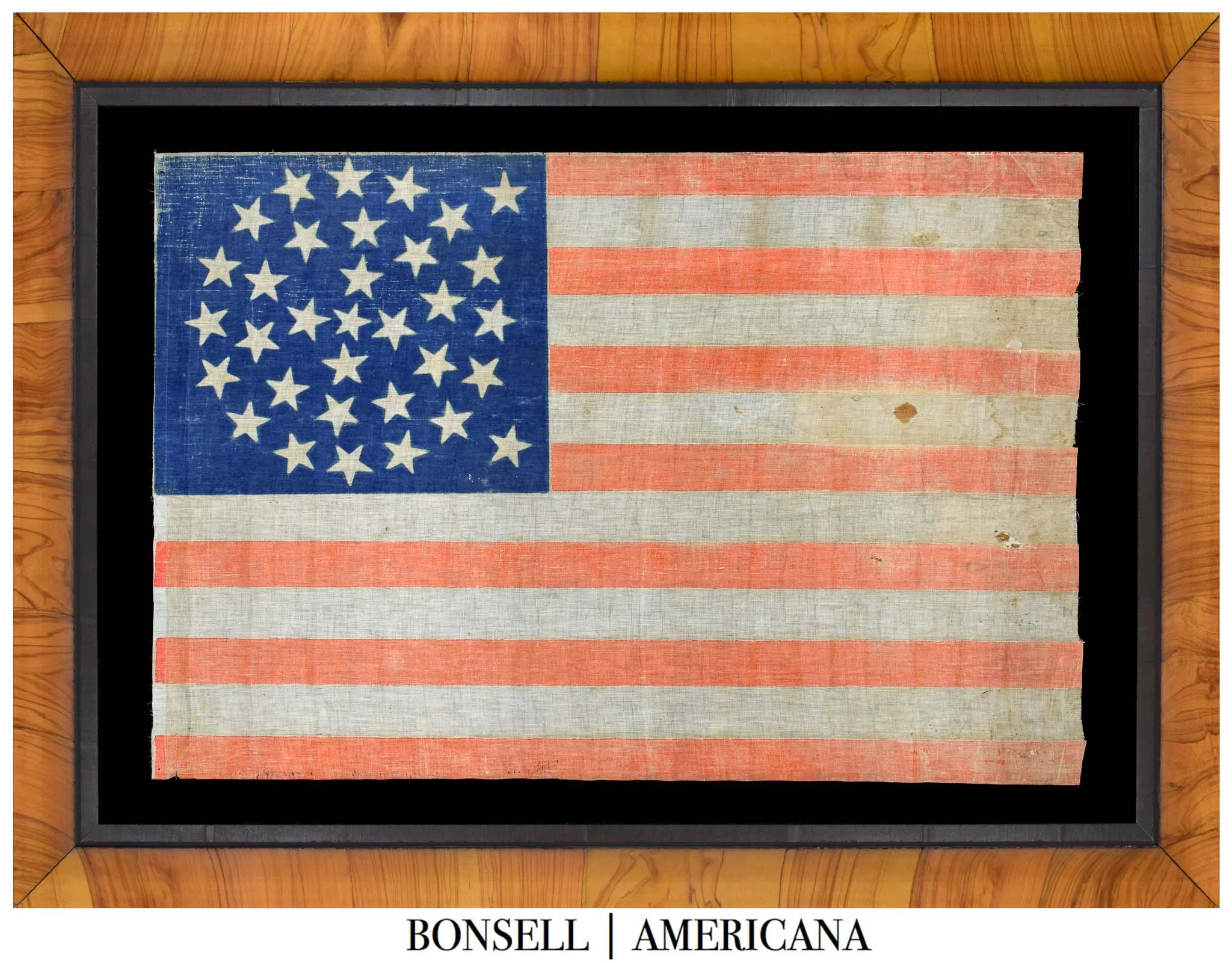
Price: Call 618-553-2291, or email info@bonsellamericana.com
Frame Size (H x L): 40” x 52.5”
Flag Size (H x L): 26.5” x 39”
Offered is a thirty-three star antique flag. It is one of approximately ten known examples and is outstanding in every respect. It is printed on glazed cotton. The star pattern of this flag includes a center star that is surrounded by three concentric rings of stars. The inner ring includes four stars, the middle ring includes ten stars, and the outer ring includes sixteen stars. The outer ring is flanked by an additional upper right star and a lower right star. This pattern is referred to as an offset medallion pattern, and is one of the classic configurations associated with nineteenth century antique flags.
The red stripes of this flag are orange in appearance, while the blue canton is dark blue in appearance. The First Flag Act of 1777 specified the number of stripes and the colors of the flag, but did not specify the exact shades of each color, which is why some flags—like this one—have unusual colors. The exact shades were not officially specified until 1934.
The thirty-three star flag represents the inclusion of Oregon to the Union. Oregon was admitted on February 14th, 1859, and this flag became official on July 4th, 1859. Use of the thirty-three star flag overlapped the beginning of the Civil War, as evidenced by, for example, a thirty-three star flag being flown at Fort Sumter when Confederate soldiers attacked it. Flags associated with the Civil War time period are among the rarest and most collectible of all antique flags. Prior to the Civil War, Americans did not typically display flags for patriotic purposes, and even the military did not regularly use it. Instead, most flags prior to the Civil War were used to mark ships and were massive in scale. The surge in small US flags for patriotic purposes began with the election of Lincoln and the onset of the Civil War.
Flags predating the Civil War (1861-1865) are the rarest and most desirable of all US flags. Prior to the Civil War, Americans did not typically display flags for patriotic purposes, and even the military did not regularly display it. This is because it was not until 1834 that the army field artillery was permitted to carry the traditional US flag, and not until 1841 that regiments carried it. Most flags made prior to the Civil War were used to mark ships and were large in scale. For these reasons, flags made prior to the Civil War account for only around 1-in-100 flags made in the 19th century, and examples small enough to display are even more scarce. It was not until 1861 that flags were produced in large numbers, and private citizens began waving them in public and displaying them at home.
The thirty-three star flag was official until July 4th, 1861, the time at which the thirty-four star flag became official and began to represent the inclusion of Kansas in the Union.
Conservation Process: This flag was hand sewn to cotton fabric, and both were hand sewn to a mounting board. To prevent the black dye in the cotton fabric from seeping into the flag, it was first washed in a standard wash and then in a dye setting wash. The flag is positioned behind Optium Museum Acrylic.
Frame: This offering is in a contemporary wooden frame of the highest quality.
Condition Report: There is staining and foxing, particularly along the fly end.
Collectability Level: The Extraordinary – Museum Quality Offerings
Date of Origin: 1859-1861
Number of Stars: 33
Associated War: Pre-Civil War
Associated State: Oregon

Price: Call 618-553-2291, or email info@bonsellamericana.com
Frame Size (H x L): 55” x 80”
Flag Size (H x L): 42” x 68”
Offered is an extremely desirable thirty-six star flag. The stars on this flag are arranged in a "Great Star" pattern, one of the rarest and most beautiful patterns encountered in antique flags. The Great Star pattern is a large star made of smaller stars. The smaller stars may be a variety of sizes and be canted in a various directions. Such a pattern was perfectly acceptable, as prior to President Taft's Executive Order 1556 in 1912, flag makers were free to place the stars however they wished.
US Naval Captain Samuel Reid is credited with designing the Great Star pattern in 1818. Captain Reid was an officer in the US Navy and commanded the privateer General Armstrong during the War of 1812. Andrew Jackson credited Captain Reid's heroism in delaying the British Squadron in the Battle of Fayal, and aiding in General Jackson's defense of New Orleans. Captain Reid and his crew were greeted as heroes.
The Second Flag Act, passed in 1794, stated that the flag would have fifteen stars and fifteen stripes, in response to Vermont and Kentucky being added to the Union. Knowing that this approach would not be sustainable, with Captain Reid's help, Congress passed the Flag Act of 1818, specifying that the flag should only have thirteen stripes, but should have a star for each state admitted to the Union. It further specified that the addition of each star should be on the Fourth of July following its respective state's admission.
Captain Reid played a significant role in the Flag Act of 1818, and recommended a basic design of thirteen horizontal alternating stripes in honor of the thirteen colonies, and a star in honor of each state. He further recommended several potential star patterns, including twenty stars in the shape of a larger star for general use. Reid suggested this pattern to make the flag consistent and easily identifiable, particularly at long distances and at sea. His star pattern recommendation was not ultimately included in the Act, nor was any star pattern, but Captain Reid is universally credited with designing the Great Star pattern. Its use peaked in the 1840s, but it was also used during the Civil War and occasionally during Centennial Celebrations. Its last known commercial use was on a thirty-eight star flag.
The stripes and canton of this flag are made of fine, blended wool. The use of such wool for the stripes is unusual for a Civil War era flag and indicates that this was a premium flag (as opposed to one with regular wool stripes), probably intended for a wealthy or discerning customer.
The stripes are individually cut and machine sewn together, the canton is machine sewn to the stripes, and the hoist is machine sewn to both the stripes and canton. More specifically, the stripes, the canton, and the hoist are joined via treadle stitching. Treadle stitching was a technical possibility beginning in the 1830s, but not a realistic possibility until the 1850s. Treadle stitching became relatively common by the 1860s and was used in approximately half of flags made between 1861 and 1865, typically to sew the stripes, the canton, and/or the hoist.
The stars of this flag are made of cotton. They are sewn to both sides of the canton (i.e., double appliequed), using a lineal treadle stitch. Lineal treadle stiches are most commonly found on flags dating between 1885 and 1895. Prior to this time, stars were commonly applied by hand, and after this, they were commonly applied using a zig-zag stitch. While lineal treadle stitches were sometimes used to sew the stars on Civil War flags, it is the exception, rather than rule. The reason for its rarity in this era is simply a function of the available technology. Prior to Singer’s introduction of the electric sewing machine in 1889, flag makers applying a lineal stich had to place each star on the canton, fold its edges under, pump a treadle machine—and while doing all of this—properly move both the star and canton through it. While this was not an impossible task, the introduction of the electric sewing machine made it much easier. By 1895, most flag makers had transitioned away from the lineal stitch and to the zig-zag stitch, as its use provided the advantage of not having to fold the edges of the stars.
This flag is small in size for a piece-and-sewn flag, dating to the Civil War. This adds considerably to its appeal, as it can be easily displayed. It was not until the Civil War that small piece-and-sewn flags were made with any frequency at all, and not until the 1890s that they were made with regularity. During most of the 19th century, flags made with piece-and-sewn construction had a width of at least eight feet, as they were typically used as signaling devices for the military or by sailors. Even the flags that were used for decorative purposes usually had a width of six feet or more, and versions smaller than this were quite rare.
The thirty-six star flag represents the inclusion of Nevada to the Union. Nevada was admitted on October 31st, 1864, and this flag became official on July 4th, 1865. Nevada was originally part of the Utah Territory beginning in 1850, became its own territory in 1861, and became its own state in 1864. The timing of Nevada's inclusion was politically and economically based. For political reasons, Nevada was admitted to the Union just eight days prior to President Lincoln's re-election bid against General George McClellan. Such timing was meant to benefit Lincoln and his fellow Republicans. For economic reasons, Nevada was included as part of the Union to help it pay off the country’s war debts. Economically, Nevada was particularly attractive at the time, because of its significant silver mining industry. Nevada expanded its borders in 1866 when the western Utah Territory was added to its eastern side, and further expanded in 1867 when a portion Pah-Ute County in the Arizona Territory was added to its southern side.
The thirty-six star flag was the official flag for the last six months of the Civil War, and was used by the military during that time. It was also the official flag during a portion of the Reconstruction era. Ultimately, the thirty-six star flag was official until July 4th, 1867, the time at which the thirty-seven star flag became official and began to represent the inclusion of Nebraska in the Union.
Conservation Process: This flag was hand sewn to silk organza, and both were hand sewn to cotton fabric. The silk organza provides a strong layer of protection and a professional appearance. The flag, the silk organza, and the cotton fabric were then hand sewn to a mounting board. To prevent the black dye in the cotton fabric from seeping into the flag, it was first washed in a standard wash and then in a dye setting wash. The flag is positioned behind Conservation Clear Acrylic (standard) or behind Optium Museum Acrylic (per request).
Frame: This offering is in a special edition X-Large Frame. However, it can be reframed and would look great using any one of our standard Large or X-Large Frames, which are shown in the final two images. The pricing associated with the different framing options may vary. Reframing of an offering may delay shipment by up to two weeks.
Condition Report: This flag exhibits minor mothing and a tear near its hoist edge. It otherwise in excellent condition and among the best-preserved examples of the Civil War era.
Collectability Level: The Extraordinary – Museum Quality Offerings
Date of Origin: 1864-1867
Number of Stars: 36
Associated War: Civil War (1861-1865)
Associated State: Nevada
Price: Call 618-553-2291, or email info@bonsellamericana.com
Frame Size (H x L): 33” x 44”
Flag Size (H x L): 22” x 33”
Offered is a 34-star American national flag, printed on glazed cotton and dating to the opening years of the Civil War, between 1861 and 1863.
The configuration of stars on this example is particularly noteworthy. At the center rests a single oversized star, representing Kansas, the newest state in the Union. Surrounding it is an inner wreath of eleven smaller stars, while an outer ring of eighteen stars completes the medallion configuration. Four medium-sized stars flank the design near the corners of the canton. The stars are canted in varying directions and exhibit irregular, folk-oriented geometry, lending the canton a visually animated quality.
The design possesses the sort of visual energy collectors seek in early American textiles. Rather than rigid uniformity, one finds subtle inconsistencies in star shape, orientation, and spacing that reflect the handmade aesthetic sensibilities still present in American flag production during the mid-nineteenth century. The oversized center star anchors the composition, while the rotating orientations of the surrounding stars create movement throughout the canton. We have handled many 34-star flags over the years, including numerous medallion examples, yet we have never encountered another precisely of this style. In our view, this strongly suggests a very scarce, and perhaps singular, surviving variety.
The coloration is equally appealing. The blue canton displays a strong Civil War-period blue, while the red stripes retain a warm tone characteristic of early printed pigments on glazed cotton. The surface exhibits the subtle sheen associated with glazed cotton construction, a finishing process frequently employed on mid-nineteenth century parade flags to provide visual crispness and modest resistance to dirt and moisture. The glazing remains visible across portions of the surface and contributes to the flag’s period character.
The flag survives in what is arguably the ideal scale for a Civil War-era parade flag: large enough to display boldly, yet small enough to have been intended for true patriotic use by a private citizen. Even among surviving Civil War flags, examples of this size are especially desirable.
The 34-star flag represents the admission of Kansas as the 34th state on January 29th, 1861. The official addition of the star occurred on July 4th of the same year, just months after the inauguration of Abraham Lincoln and only weeks after the outbreak of the Civil War. Because flag makers commonly anticipated official star counts, many 34-star flags were produced immediately upon Kansas statehood, prior even to the firing on Fort Sumter. The 34-star flag remained official until July 4th, 1863, when the 35-star flag entered service following the admission of West Virginia.
Among the most important and collectible of all nineteenth century American flags are 34-star and 35-star examples, which represent the primary star counts under which the Civil War was fought. Lincoln served almost his entire presidency beneath the 34-star flag, and the vast majority of the conflict’s defining events—from First Bull Run through Gettysburg—occurred while this count remained official. Flags from this era are especially coveted because patriotic display by private citizens prior to the Civil War was comparatively uncommon. Before 1861, the American flag was used principally for military and maritime identification, and most surviving examples from the antebellum era were massive garrison or ship flags intended for visibility at great distances. The explosion in small printed parade flags arose primarily from the emotional and political fervor surrounding the Civil War itself. As a result, authentic surviving parade flags of the period are both rare and historically important.
What elevates this flag further, however, is the remarkable handwritten note that accompanies it. Written on letterhead from the Commonwealth Bank of Baltimore, located at Howard and Madison Streets, the note reads:
“This flag at half mast was hung from the window of the Herring home in Baltimore when Lincoln was buried. Though Democrats they were compelled to do so.”
The significance of this statement is difficult to overstate. In nearly two decades handling and studying antique American flags, we have encountered very few notes of this nature, and none carrying quite this degree of political candor. The wording is concise and direct. Most importantly, it contains precisely the sort of socially revealing commentary one would expect from a genuine family or community remembrance rather than a later embellished story.
The phrase “Though Democrats they were compelled to do so” provides a glimpse into the divided political atmosphere that existed in Maryland during the Civil War and immediately following Lincoln’s assassination. Maryland occupied a uniquely fragile position during the conflict. Though it remained in the Union, the state contained substantial Southern sympathies, particularly among Democrats and conservative urban residents of Baltimore. Union troops had occupied Baltimore early in the war following violent unrest in 1861, and political tensions remained severe throughout the conflict.
When Lincoln was assassinated in April of 1865, the nation entered a period of public mourning. As Lincoln’s funeral train made its journey from Washington toward Springfield, Illinois, cities throughout the North and border states staged mourning observances. Buildings were draped in black crepe, church bells tolled, and flags appeared throughout urban streetscapes in public displays of grief and national unity. Baltimore, despite its divided loyalties, participated heavily in these ceremonies.
Within this context, the note becomes especially compelling. The implication is that the Herring family—identified by the writer as Democrats—displayed the flag publicly despite political sympathies that may not have aligned fully with Lincoln or the Union cause. Whether motivated by civic pressure, social expectation, fear of scrutiny, genuine mourning, or some combination thereof, the act was apparently memorable enough to be recorded decades later in handwritten form. The note preserves a revealing moment: a politically divided household navigating public expectation in one of the most emotionally charged weeks in American history.
Particularly interesting is the phrase “compelled to do so.” Such wording suggests that the display was perceived not merely as patriotic decoration, but as an act carrying political and social consequence. We have encountered Civil War flags accompanied by family stories, but never one whose associated documentation speaks so openly about political tension and reluctant public patriotism. It transforms the flag from a Civil War textile into a tangible artifact connected to the complexity surrounding Lincoln’s death and the Union victory.
Research into the Commonwealth Bank of Baltimore reveals that it was an established Baltimore institution operating by at least the 1890s, with its substantial building at Howard and Madison Streets constructed in the mid-1890s. The handwritten note, therefore, almost certainly dates to the late nineteenth or early twentieth century, placing it relatively close to the events it describes and well within the range of living memory.
An additional note accompanied the flag when acquired from Brendan Synnamon, owner of The Union Drummer Boy in Gettysburg, one of the nation’s best Civil War artifact galleries. Brendan is widely respected within the field of Civil War material culture and has spent decades handling, authenticating, and researching important artifacts related to the conflict. In addition to his work as a dealer, lecturer, and preservation advocate, Brendan has also served as an appraiser for the Antiques Roadshow. Brendan acquired the flag from the estate of longtime collector Stan Smullen, who reportedly purchased it directly from the Herring family estate.
The Herring family itself holds noteworthy historical and literary associations tied to Edgar Allan Poe. Henry Herring, a prominent Baltimore lumber dealer and the husband of Poe’s aunt, Elizabeth Poe Herring, maintained a household that Poe is known to have visited during his time in Baltimore. Historical accounts further record that Herring participated in the arrangements surrounding Poe’s death and burial in 1849, reportedly providing the coffin used for the funeral and assisting with related matters. The association with both the Herring family and the events surrounding Lincoln’s funeral procession through Baltimore adds another layer of historical interest to an already remarkable Civil War-era flag.
Regardless, the accompanying documentation remains exceptional. It is exceedingly rare to encounter a Civil War-period parade flag accompanied by a politically charged written remembrance tied specifically to the mourning ceremonies surrounding Lincoln’s assassination and funeral procession. Combined with the flag’s striking and apparently unique medallion configuration, attractive coloration, and association with one of the defining moments in American history, this example stands among the most interesting 34-star parade flags we have encountered.
Conservation Process: This flag was professionally conserved and restored. It is sewn to silk and positioned behind Optium Museum Acrylic.
Frame: The flag is presented within a hardwood frame finished in matte black with visible grain.
Condition Report: The flag was professionally conserved and restored. There is moderate to significant fading and oxidation throughout, accompanied by scattered soiling, areas of pigment loss, and restoration to the striped field, particularly within the white stripes toward the fly end. Despite this, the flag presents beautifully, with strong overall color, an especially attractive blue canton, and excellent visual impact. The unusual medallion configuration and the extraordinary accompanying note more than justify the conservation work undertaken to preserve this rare Civil War-era survivor.
Collectability Level: The Extraordinary – Museum Quality Offerings
Date of Origin: 1861-1863
Number of Stars: 34
Associated War: The Civil War (1861-1865)
Associated State: Kansas