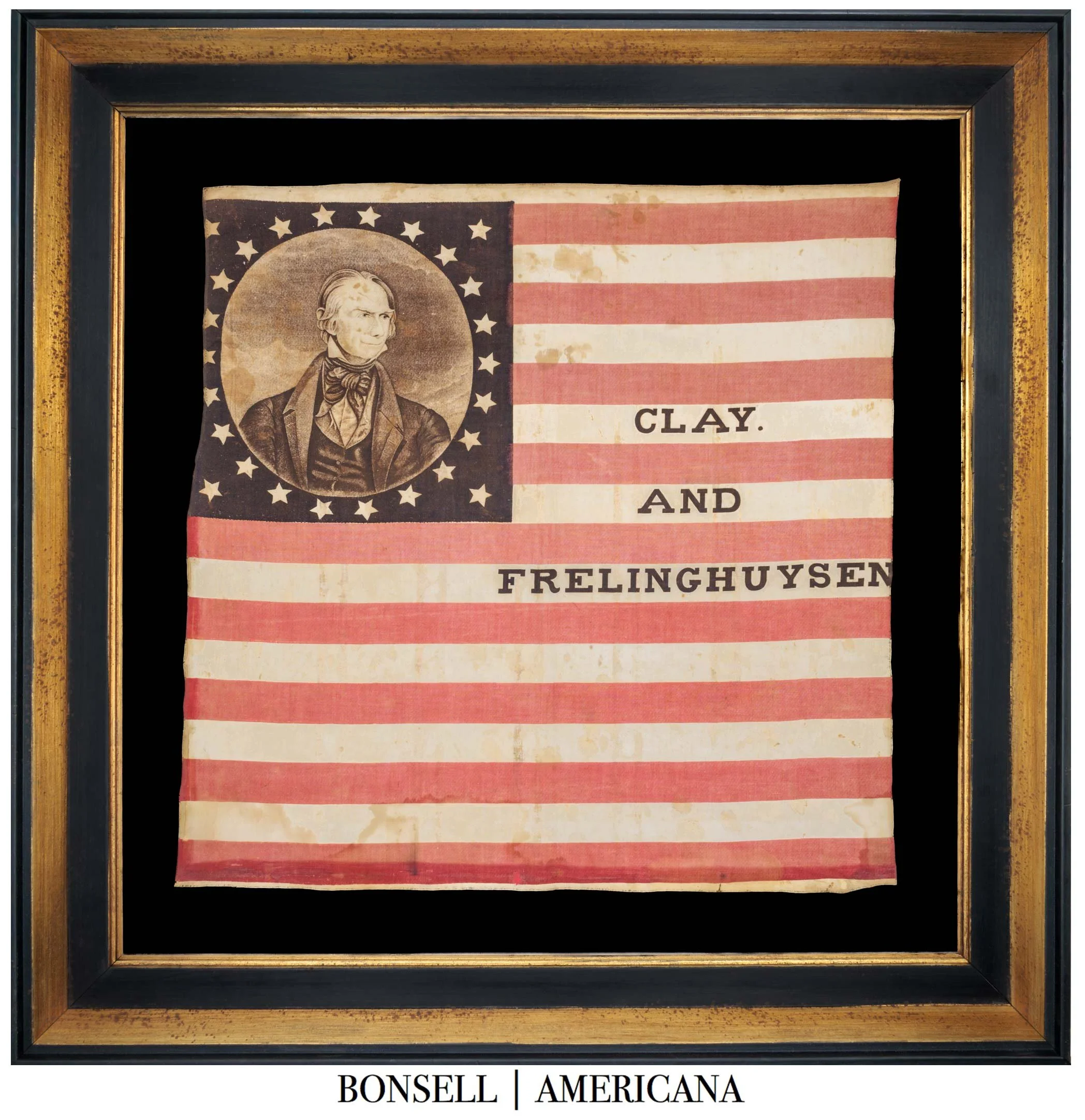
Antique Benjamin Harrison Portrait Campaign Flag with 44 Stars | Wyoming Statehood | Circa 1892
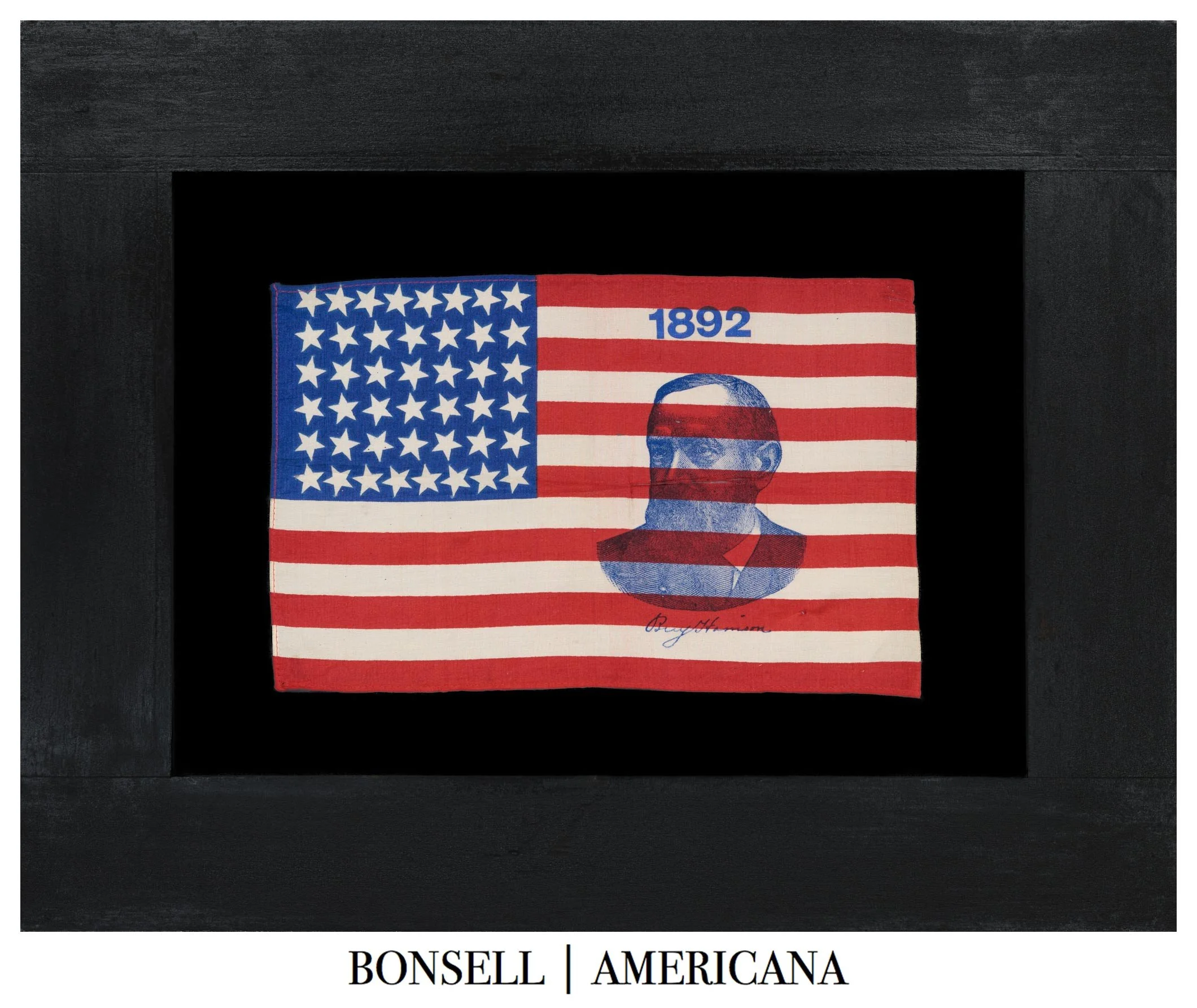
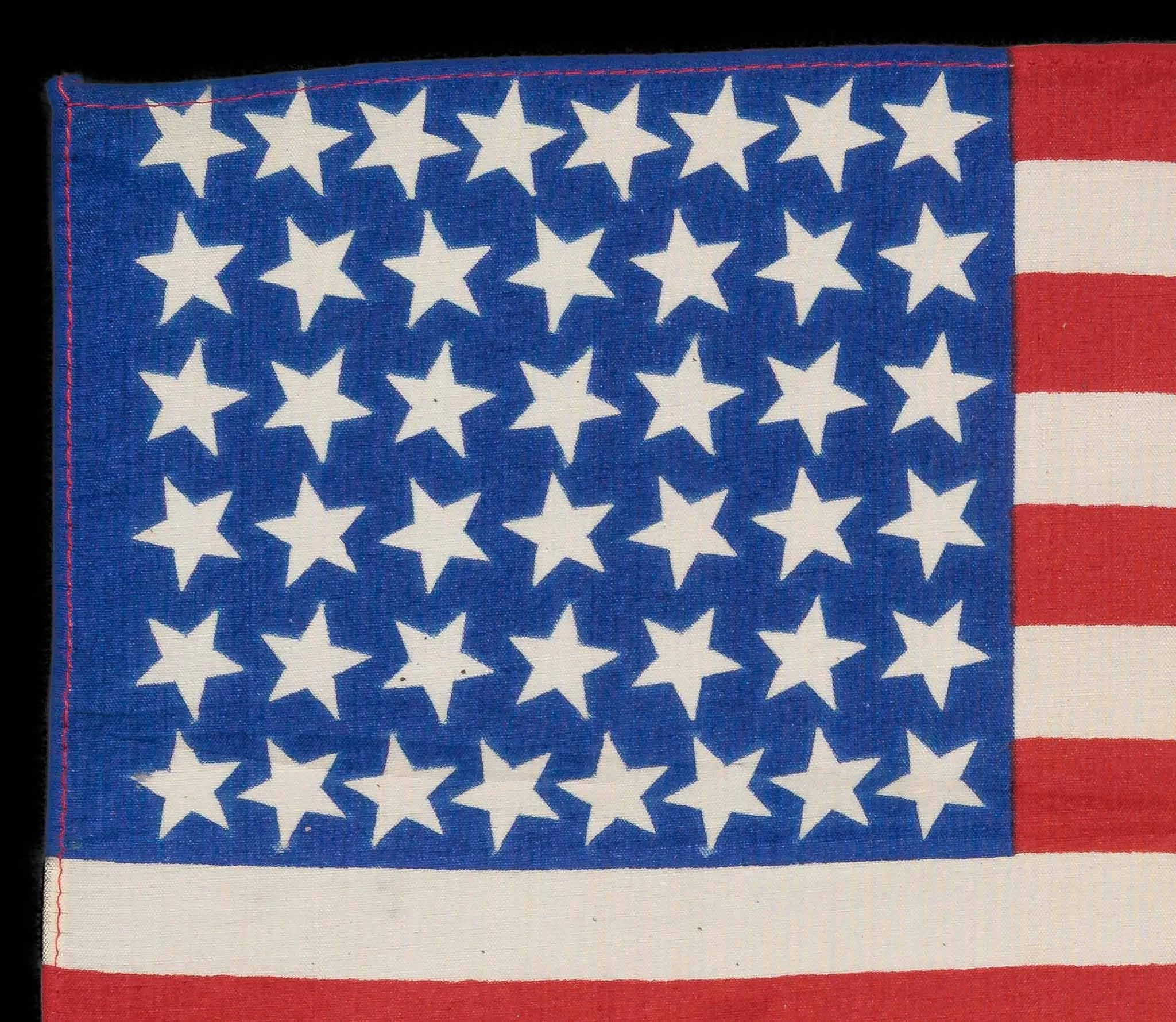
Antique Benjamin Harrison Portrait Campaign Flag with 44 Stars | Wyoming Statehood | Circa 1892
Frame Size (H x L): 14.5” x 18.5”
Flag Size (H x L): 8.75” x 10.5”
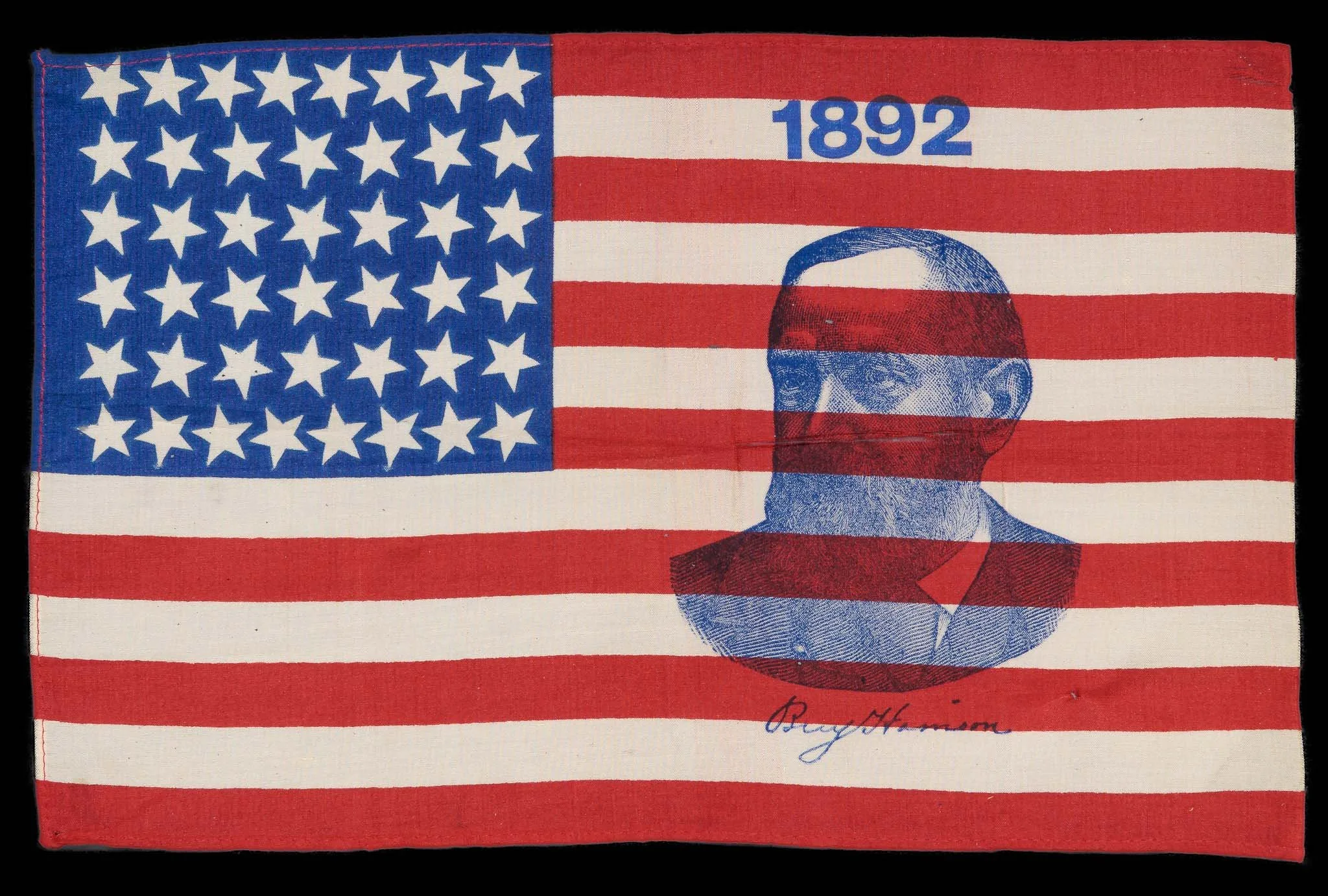
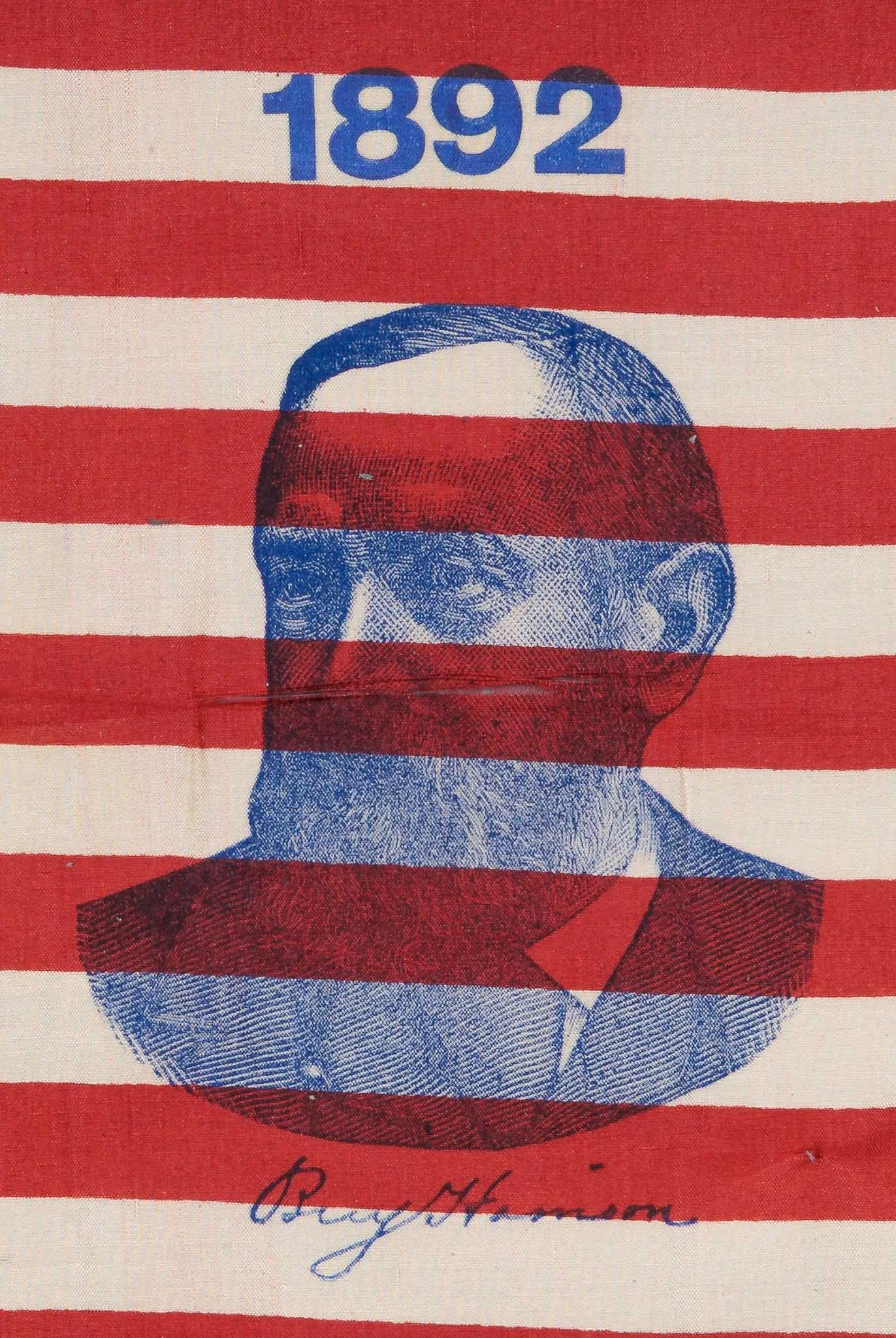
Offered is a 44-star American silk parade flag produced for the presidential election of 1892 and overprinted with a portrait of Republican candidate Benjamin Harrison, along with a facsimile of his signature and the campaign year, “1892.”
Printed on silk and intended for parade or public display, this flag represents a documented form of late-19th-century political ephemera that integrates national symbolism, portrait imagery, and campaign identification within a single textile. The canton contains forty-four white stars arranged in regular rows on a blue field, corresponding to the official star count following Wyoming’s admission to the Union in 1890. Harrison’s portrait is printed directly across the striped field, visually linking the candidate to the national flag in a manner consistent with campaign display practices of the period.
The portrait used on this flag is derived from a painted likeness by Eastman Johnson, executed circa 1889 and associated with the National Portrait Gallery. Johnson was a prominent American artist of the 19th century, and the use of his painted portrait as the basis for campaign imagery reflects a common practice of adapting established presidential likenesses for political ephemera. The source of the portrait confirms that the image was not a generic engraving but one grounded in an officially recognized representation of the candidate.
This Harrison portrait flag is documented in authoritative reference works on American political textiles and is represented in major institutional collections. An example of this flag is held by the Smithsonian Institution, within its Division of Political History. Additional examples are documented in the Pierce Collection, one of the most significant private collections of American parade flags and political cloth. The appearance of this flag in both institutional and private reference contexts establishes it as a recognized campaign type rather than an isolated or undocumented variant.
The underlying 44-star silk flag used for this Harrison example was manufactured as a standardized base and later adapted through overprinting. The same base flag was also used for the 1892 Democratic campaign of Grover Cleveland, substituting Cleveland’s portrait and signature while retaining the identical star field and stripe layout. Outside of politics, this flag format appears with other period overprints, including a commemorative example marking the one-hundredth performance of actor John Drew, as well as a salesman’s sample intended to demonstrate advertising possibilities on parade flags. These related examples illustrate the commercial practices of late-19th-century flag makers, who produced high-quality patriotic textiles that could be customized for different clients and purposes.
A notable feature of the Harrison and Cleveland campaign flags is the method of overprinting. Unlike most political parade flags of the era, which were typically overprinted in black ink after the base flag was produced, the portrait and text on this flag were printed in blue ink matching that of the canton. This approach results in a unified visual treatment and distinguishes this group of flags from more common black-overprinted campaign examples.
The election of 1892 provides relevant historical context for this flag. It marked a rematch between incumbent president Benjamin Harrison and former president Grover Cleveland, following Cleveland’s defeat in 1888. The campaign centered on economic policy and tariffs, and Cleveland’s victory made him the only president in U.S. history to serve two non-consecutive terms. Campaign materials from this election reflect a period in which political messaging increasingly relied on mass-produced visual objects intended for public display.
Silk parade flags from the 19th century survive in limited numbers due to the inherent fragility of the material and their intended use. This example remains a clear and legible representation of a documented 1892 campaign design, supported by reference literature and institutional comparators. Its silk construction, identifiable portrait source, and established place within a known family of related flags make it a representative example of American political textiles from the late 19th century.
Conservation Process: The flag was hand sewn to cotton fabric, and both were hand sewn to a mounting board. To prevent the black dye in the cotton fabric from seeping into the flag, it was first washed in a standard wash and then in a dye setting wash. The flag is positioned behind Optium Museum Acrylic.
Frame: The flag is housed in an early frame with a dry black surface, dating to approximately the 1840s. The frame is constructed from four straight lengths of molding joined at the corners rather than mitred, a method associated with utilitarian framing practices of the period.
Condition Report: The silk shows expected age-related wear, including a few small holes. There is a horizontal tear that begins just to the left of Harrison’s portrait at approximately nose level and extends toward the ear. Despite these condition issues, the textile remains stable, attractive, and visually cohesive.
Collectability Level: The Great – Perfect for Rising Collectors
Date of Origin: 1892
Number of Stars: 44
Associated State: Wyoming