Antique “Votes for Women” Suffrage Pennant | Women’s Suffrage Movement | Circa 1910–1920
Antique “Votes for Women” Suffrage Pennant | Women’s Suffrage Movement | Circa 1910–1920
Frame Size (H x L): 27” x 18.5”
Pennant Size (H x L): 6.25” x 10” and Affixed to an 18” Staff
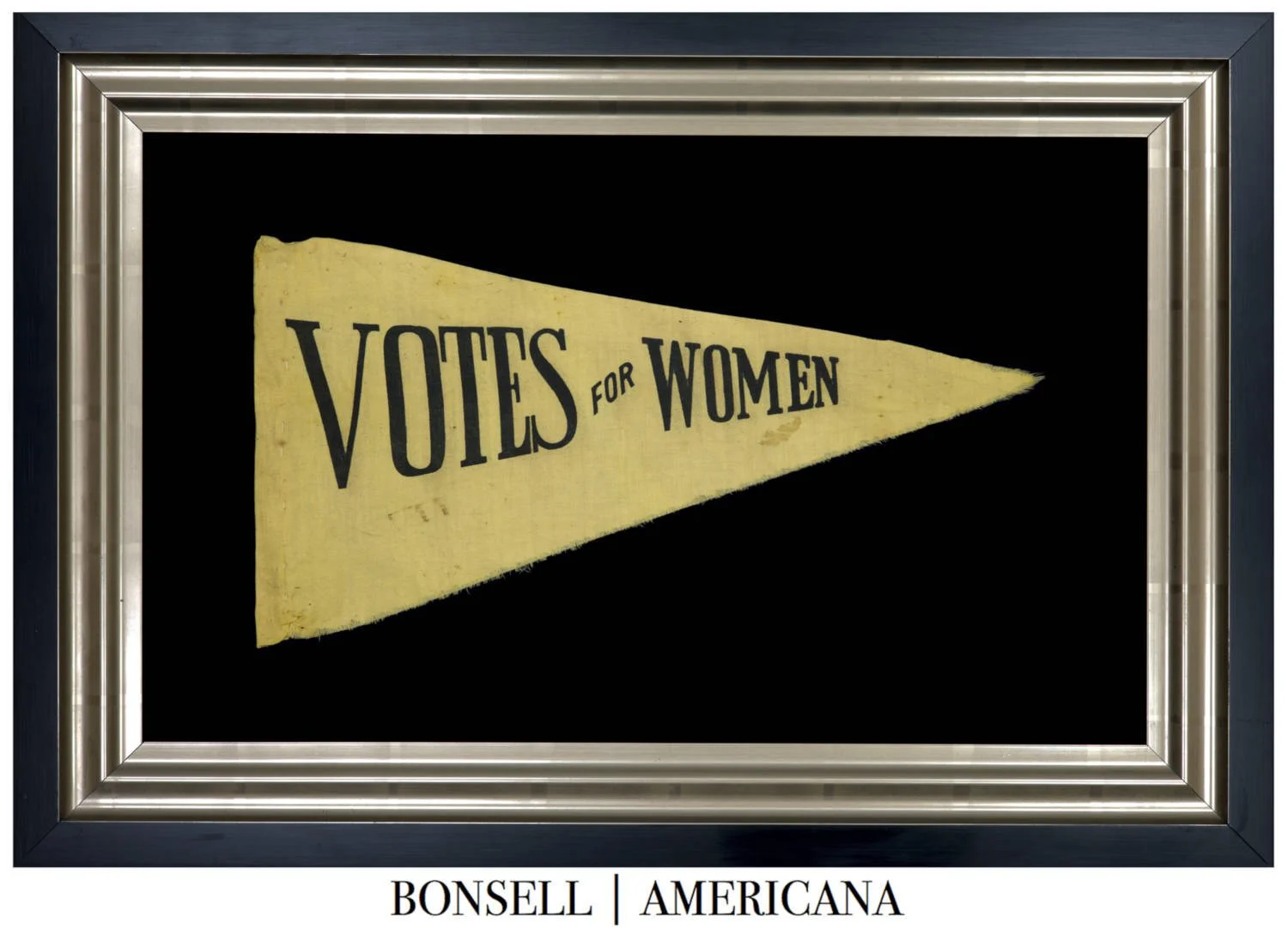
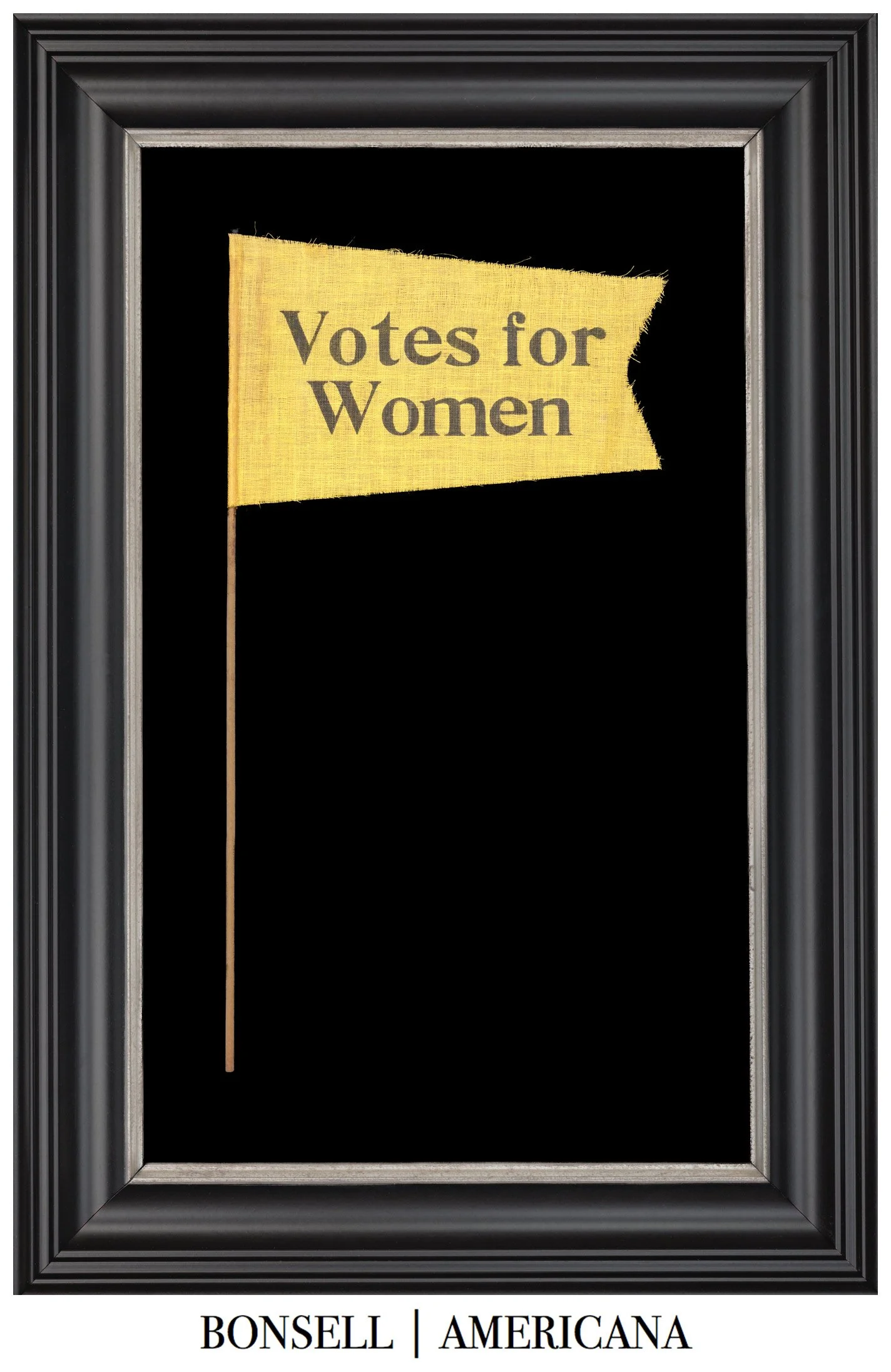
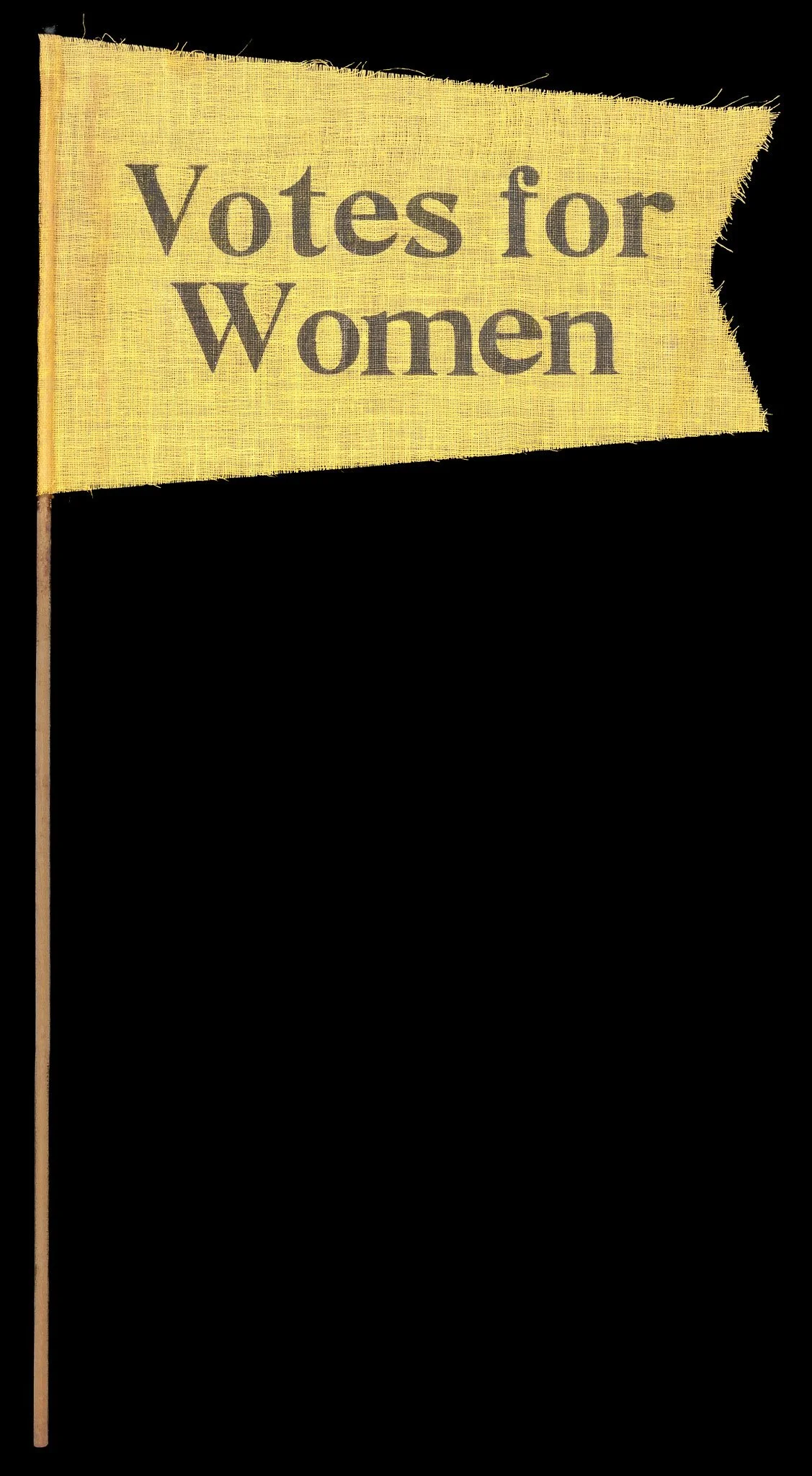
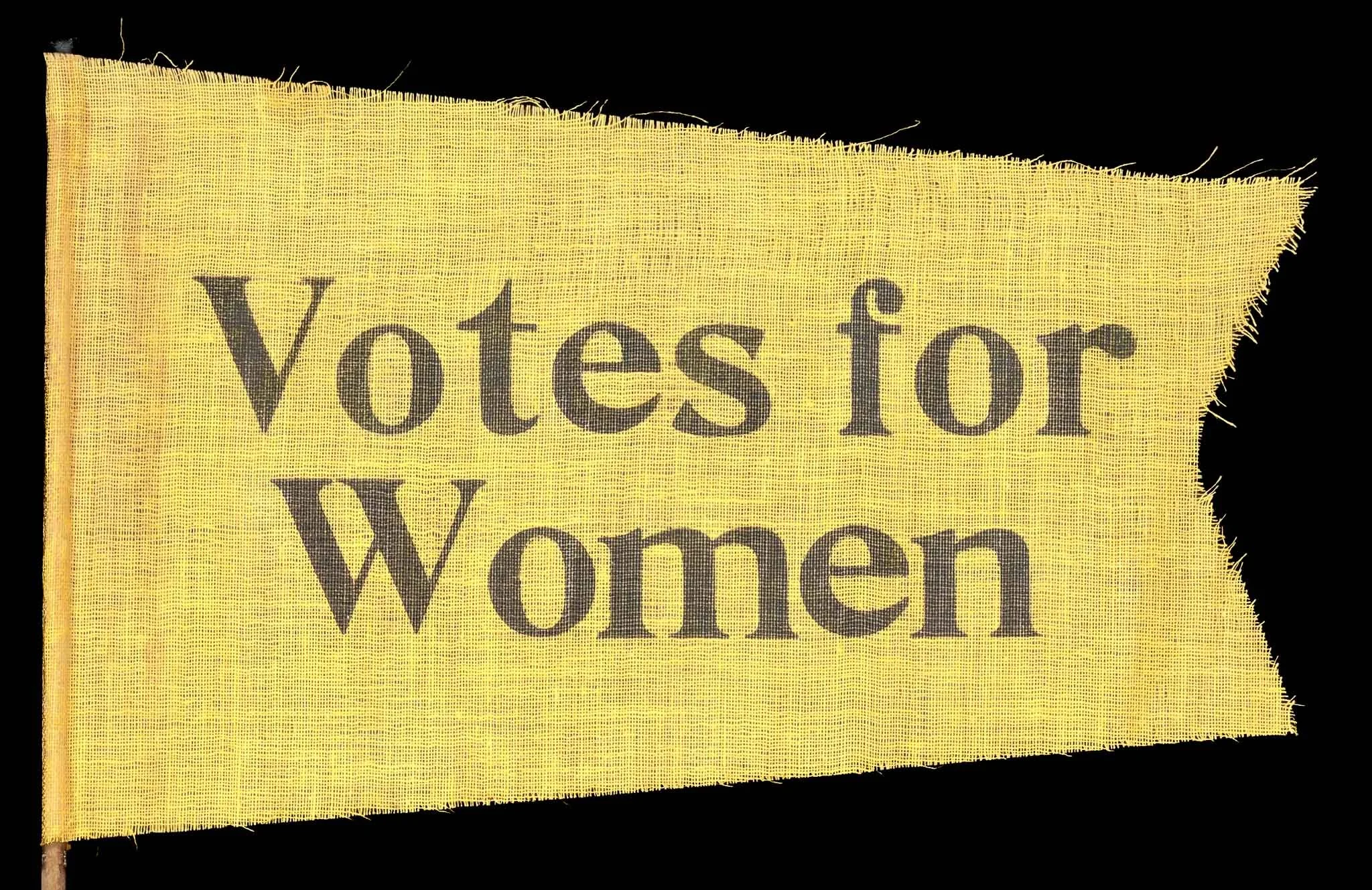
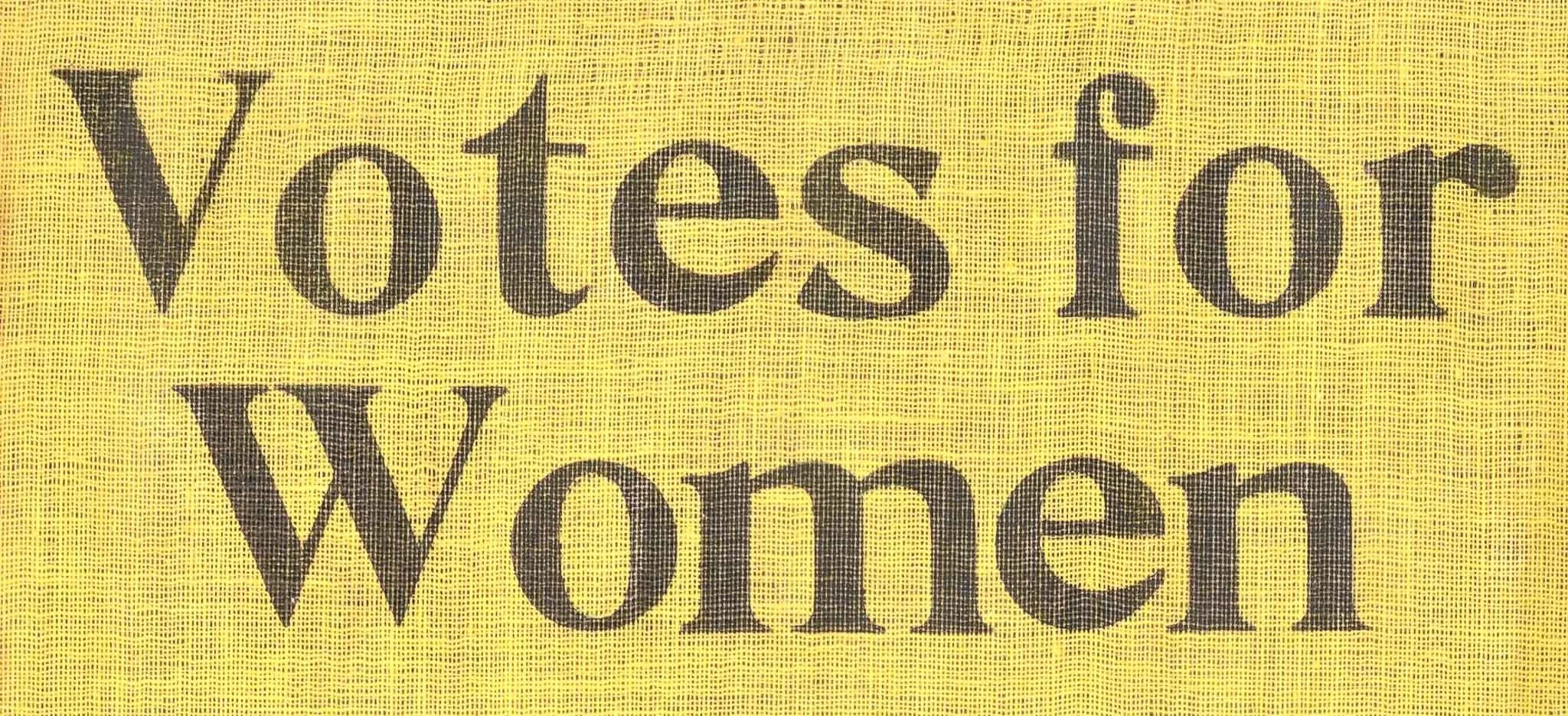
Offered is an American women’s suffrage pennant advocating “Votes for Women.” The pennant is made of cotton and constructed in a swallowtail form, a shape commonly used for political and reform-related textiles in the late-19th and early-20th centuries. The field is yellow, with the slogan printed in black across the surface. The pennant remains affixed to its original wooden staff.
Yellow was the primary color associated with the women’s suffrage movement in the United States and was widely adopted by suffrage organizations beginning in the late-19th century. It was frequently paired with black to create a bold, high-contrast design that could be read easily during marches, meetings, and public demonstrations. Pennants and related textiles were produced for active use and functioned as direct statements of political purpose.
The organized movement for women’s voting rights in the United States is generally traced to 1848, when Lucretia Mott and Elizabeth Cady Stanton convened the first women’s rights convention in Seneca Falls, New York. That meeting produced the Declaration of Sentiments, a document asserting women’s claims to political equality, education, and employment. Over the following decades, the movement expanded through conventions, lectures, and organized advocacy.
In 1906, Harriot Stanton Blatch—daughter of Elizabeth Cady Stanton—founded the Equality League of Self-Supporting Women, later renamed the Women’s Political Union. This organization focused on mobilizing working-class women and increasing the public visibility of the suffrage movement. In 1910, the group organized the first large-scale suffrage march in the United States, held in New York City. Textiles such as pennants and banners were used extensively during this period to convey clear, readable messages during marches and public gatherings.
Although early efforts focused on securing voting rights at the state level, it became increasingly clear that a constitutional amendment was necessary to guarantee suffrage nationwide. Proposed amendments were introduced in Congress in 1878 and again in 1914, but both attempts failed. Momentum shifted during and after World War I, when women’s contributions to the war effort helped secure bipartisan political support. In January 1918, the House of Representatives approved a suffrage amendment by the required two-thirds majority, followed by Senate approval in June 1919.
On August 18, 1920, Tennessee became the thirty-sixth state to ratify the amendment, providing the necessary three-quarters majority of states. Eight days later, on August 26, 1920, the Nineteenth Amendment was formally adopted into the Constitution, stating:
“The right of citizens of the United States to vote shall not be denied or abridged by the United States or by any State on account of sex. Congress shall have power to enforce this article by appropriate legislation.”
Surviving suffrage pennants are uncommon, particularly examples that retain their original staff and exhibit strong color and legibility. Pieces such as this were produced for use in marches, meetings, and public demonstrations and reflect the material culture of the American women’s suffrage movement.
Conservation Process: This pennant was hand sewn to cotton fabric, and both were hand sewn to a mounting board. To prevent the black dye in the cotton fabric from seeping into the pennant, it was first washed in a standard wash and then in a dye setting wash. The pennant is positioned behind Optium Museum Acrylic.
Frame: The pennant is presented in a black-painted wood frame with a stepped, molded profile that adds depth and visual structure. The finish is matte to satin, with subtle highlights along the contours of the molding.
Condition Report: The pennant shows light, expected wear from age and use, including minor fraying along the edges and at the swallowtail end. There is localized discoloration adjacent to the staff, consistent with long-term rolling of the textile against the wood. The printed lettering remains strong and legible, and the staff is intact and stable.
Collectability Level: The Great – Perfect for Rising Collectors
Date of Origin: 1910-1920