Large Printed Portrait of Abraham Lincoln on Muslin | Made by Jos. G. Rhein of Detroit, Michigan | A Spectacular Textile | Circa 1885–1895
Large Printed Portrait of Abraham Lincoln on Muslin | Made by Jos. G. Rhein of Detroit, Michigan | A Spectacular Textile | Circa 1885–1895
Price: Call 618-553-2291, or email info@bonsellamericana.com
Frame Size (H x L): 59” x 46.5”
Banner Size (H x L): 48” x 35.5”
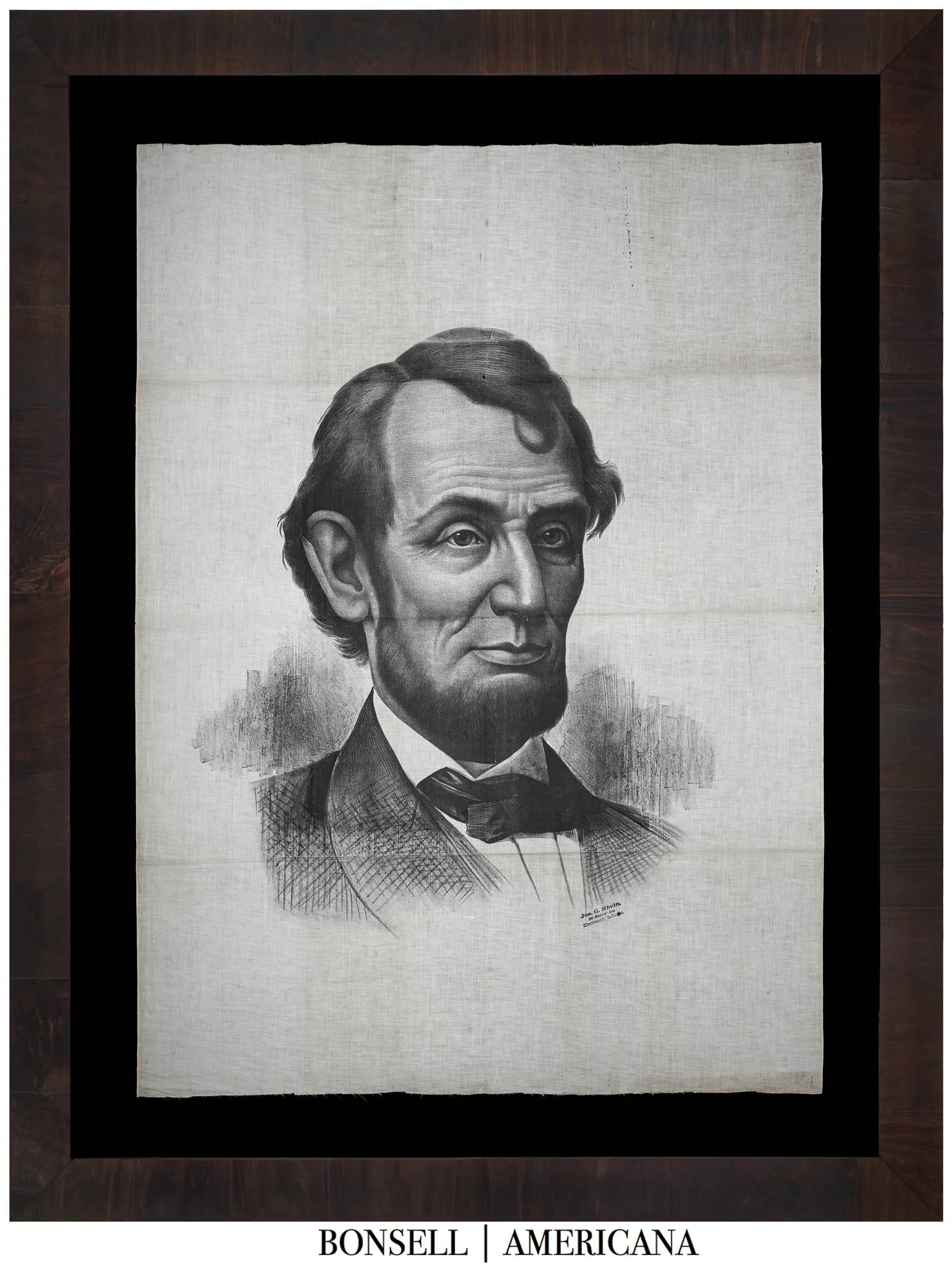
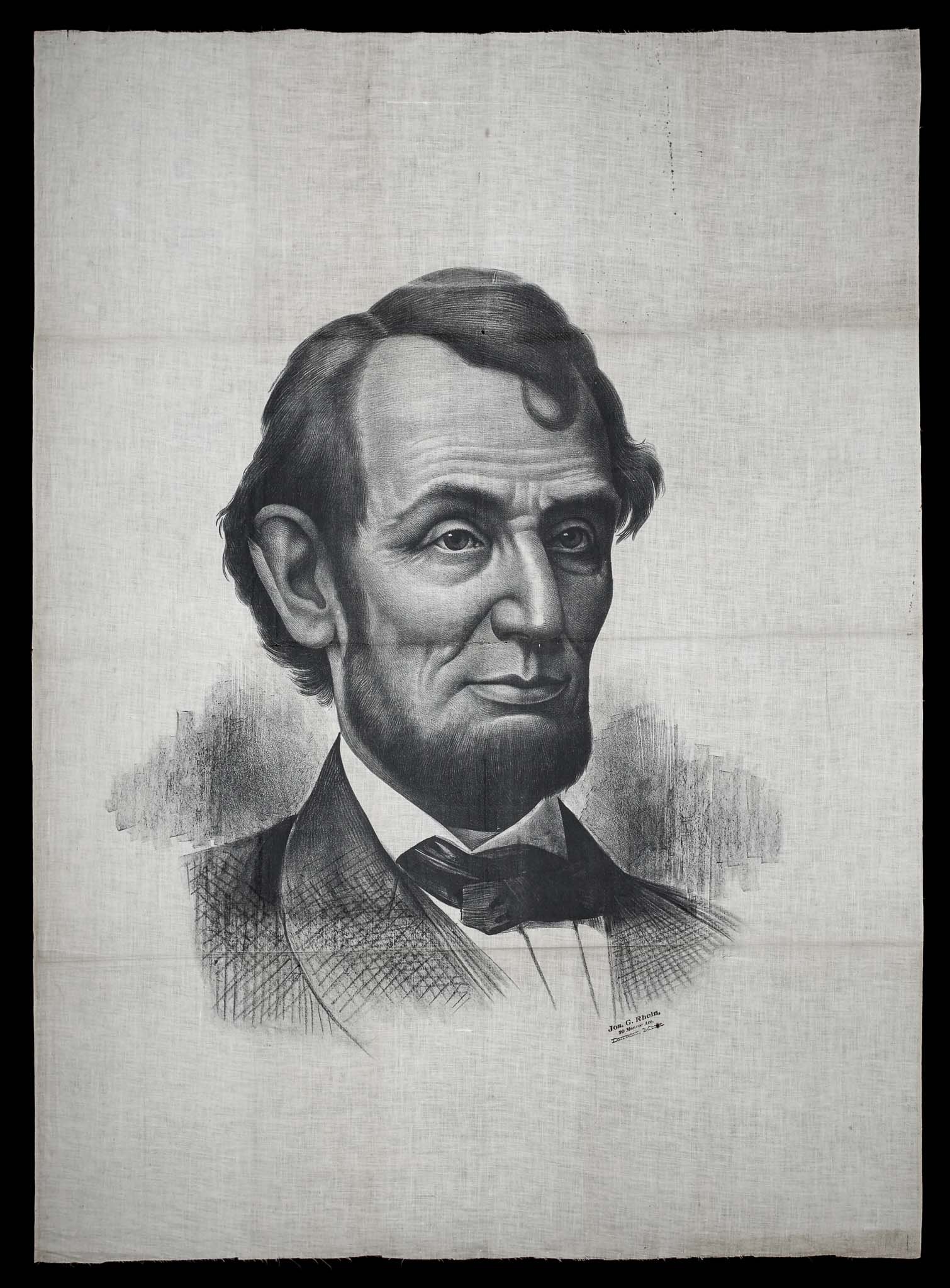
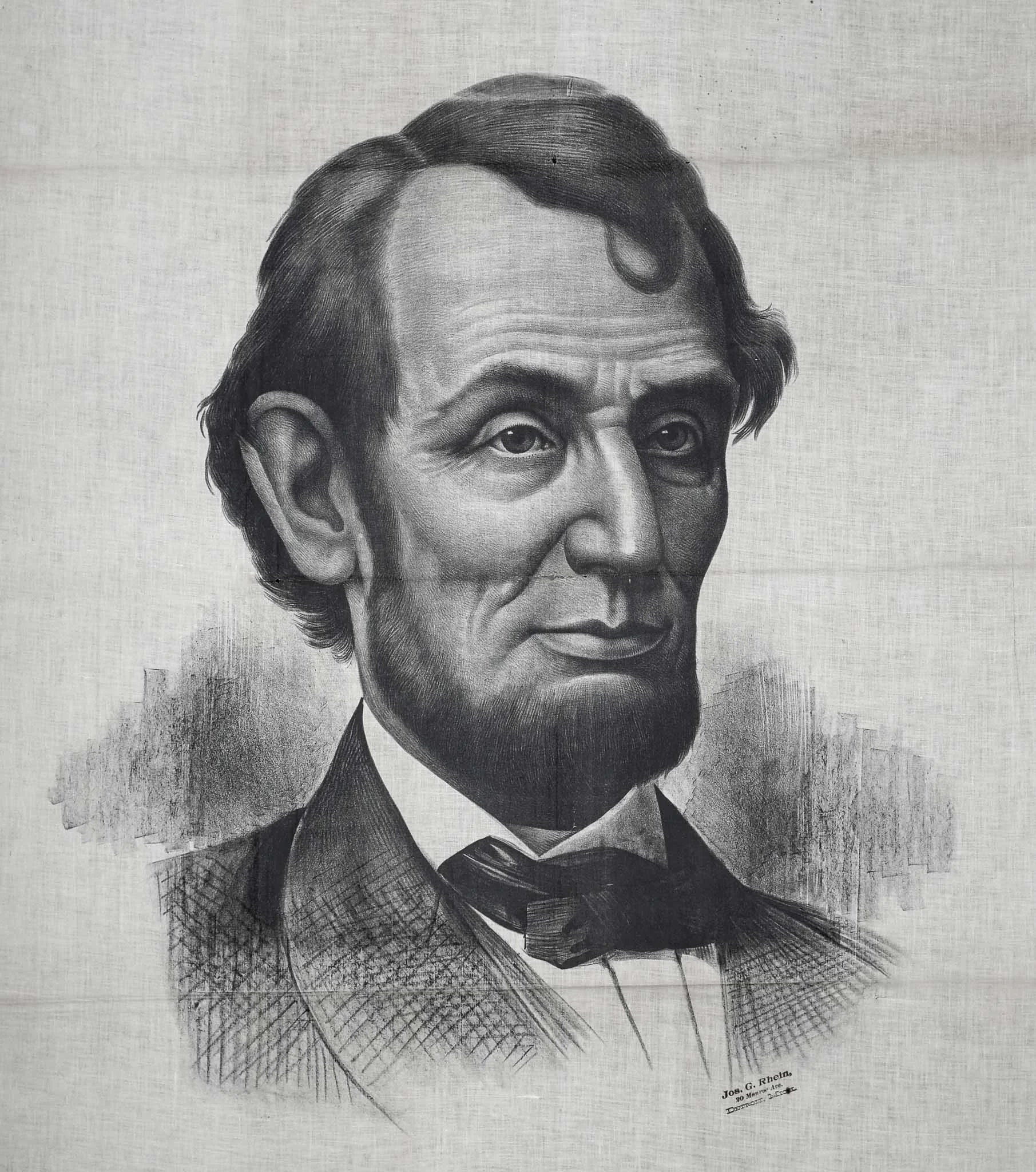
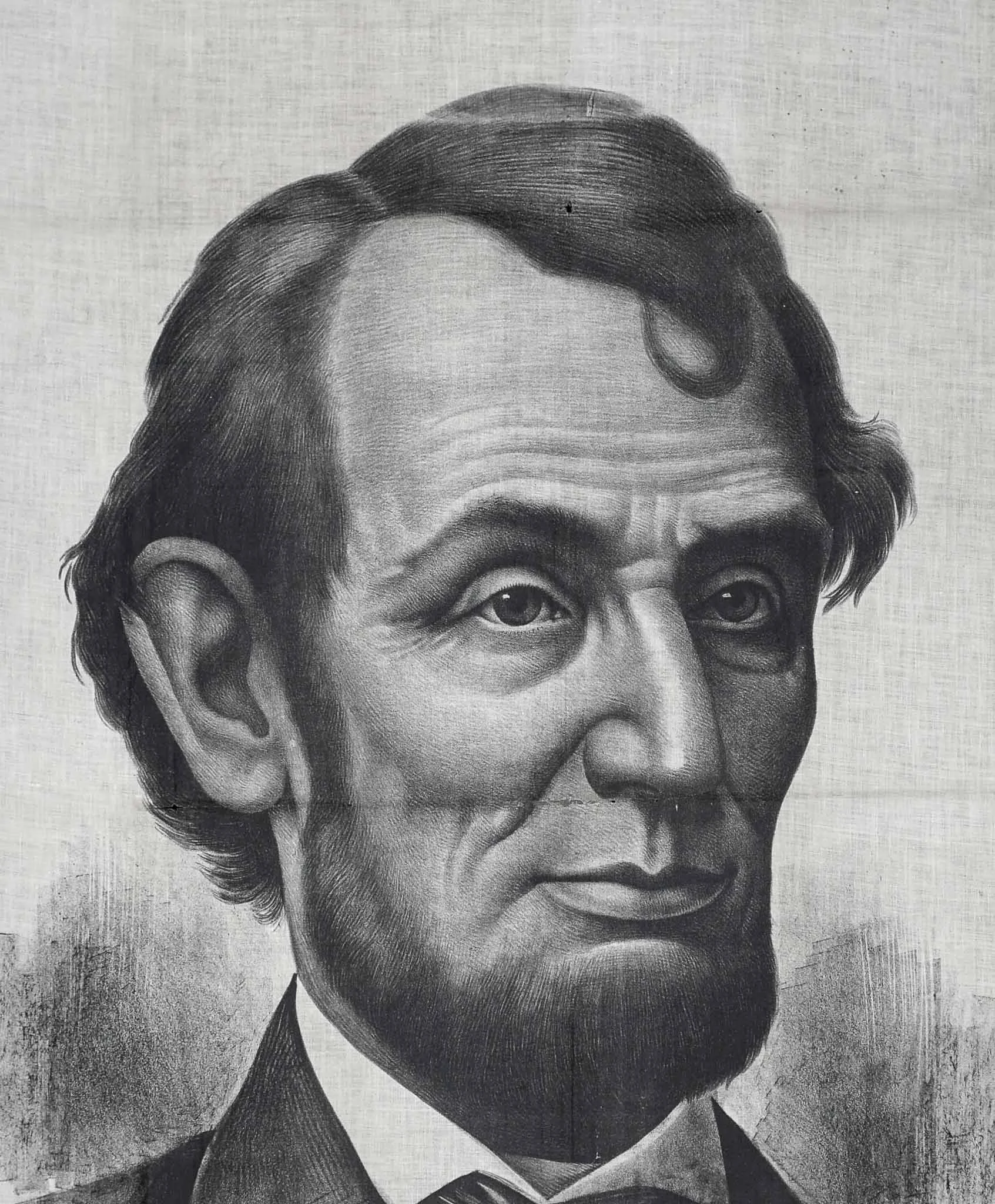
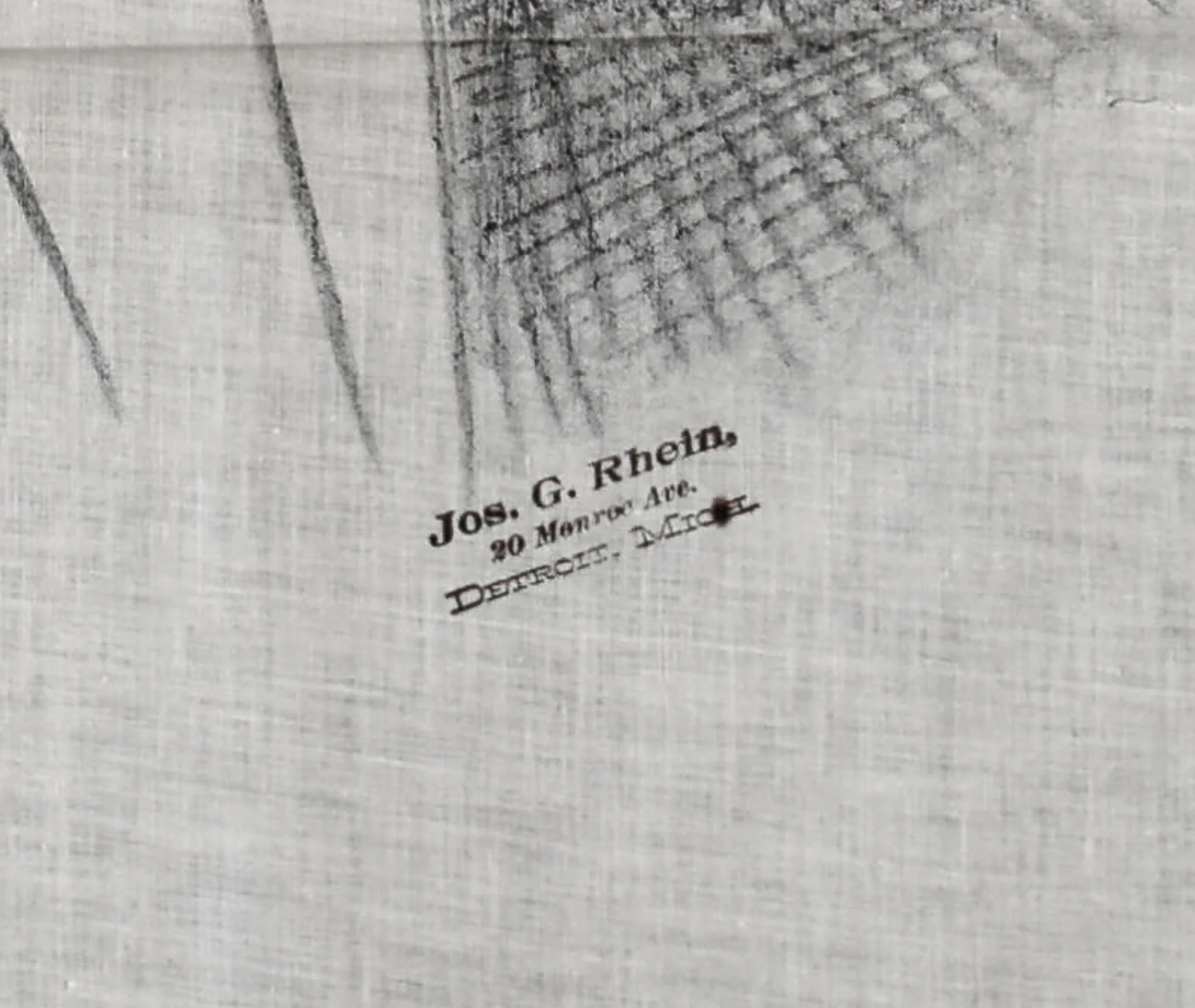
Offered is a large printed portrait of Abraham Lincoln, produced by Joseph G. Rhein of Detroit, Michigan, during the late nineteenth century. Executed in black ink on light, unglazed cotton muslin, the textile presents a half-length portrait of Lincoln turned slightly to his left, with his distinctive hair curl and trimmed beard. Rhein’s imprint—“Jos. G. Rhein, 20 Monroe Ave., Detroit, Mich.”—appears in the lower right quadrant, printed directly on the fabric below the coatline.
Measuring approximately 48 inches in height, the piece was conceived as a wall or memorial banner rather than a campaign flag. The composition is tightly rendered, with tonal gradation achieved through cross-hatching and stippled shading characteristic of commercial lithography from the 1880s–1890s. The ink penetrates the fibers, consistent with printing on unglazed muslin. The plain-weave structure of the textile, visible under magnification, confirms the use of commercially produced cotton sheeting typical of that period.
This is among the largest known printed Lincoln textiles from the late-nineteenth-century print trade. Its scale, monochrome palette, and sober expression associate it more closely with memorial and civic imagery produced in the decades following Lincoln’s assassination than with the brightly colored campaign flags of 1860 or 1864.
THE PRINTER: JOSEPH G. RHEIN (1864–1936)
Joseph G. Rhein was born in Cincinnati, Ohio, in August 1864 to Joseph Rhein Sr. and Johanna Metzger. By the mid-1880s, he had settled in Detroit, where he operated as a printer and lithographer under his own name. His earliest known business address—20 Monroe Avenue—appears on this banner and places it within his initial period of operation.
City directories trace Rhein’s subsequent career through a series of Detroit addresses: listed as manager of the Flag Decorating Company at 106 Woodward Avenue by 1905; as an independent lithographer at the same address by 1907; and as a printer at 469 Woodward Avenue by 1921. Rhein remained active in Detroit’s printing trade into the 1930s and died in 1936, with burial at Mount Olivet Cemetery.
Surviving works bearing Rhein’s imprint—including large textile portraits of Abraham Lincoln and Ulysses S. Grant held by the Chicago History Museum—illustrate his specialization in patriotic and commemorative printing.
HISTORICAL CONTEXT
By the 1880s, Lincoln’s image had become a national emblem of Union preservation and moral leadership. Civic organizations, schools, and veterans’ halls throughout the North displayed portraits of Lincoln alongside those of Washington and Grant. The Grand Army of the Republic (G.A.R.), then at its membership peak, was a principal patron of such imagery, commissioning banners and textiles for Decoration Day parades, reunions, and post-hall décor.
Detroit’s expanding print industry was well equipped to supply these materials at commercial scale. Rhein’s Monroe Avenue shop and his later “Flag Decorating Co.” on Woodward Avenue were positioned to serve this market, producing printed textiles that were durable, easily shipped, and visually prominent when displayed against bunting or drapery.
The present banner’s monochrome tone and monumental format reflect this shift from campaign promotion to commemoration. Its restrained rendering was designed to memorialize Lincoln’s legacy during an era of postwar nostalgia and national reconciliation. Such pieces were typically hung in courthouses, G.A.R. posts, and public halls during Lincoln Day observances and other patriotic celebrations.
ATTRIBUTION AND DATE
Physical and documentary evidence supports a production date between 1885 and 1895. The printed imprint—“Jos. G. Rhein, 20 Monroe Ave., Detroit, Mich.”—identifies Rhein’s earliest known business address. City directories place him at this location in the late 1880s and early 1890s; by 1905 he was operating from 106 Woodward Avenue as manager of the Flag Decorating Company, and by 1898 the Monroe Avenue premises had been taken over by another business, the Garibaldi Saloon. The Monroe imprint therefore confines production to the first phase of his Detroit career.
The textile and method of printing further corroborate this timeframe. The banner is printed on plain-weave, unglazed cotton muslin—a material widely used for commercial lithography only after the 1870s, when advances in roller presses and aniline inks made large-scale cloth printing practical. The even ink distribution, lack of hand tinting, and uniform tonal shading align with industrial lithographic transfers of the 1880s–1890s rather than the hand-colored stone lithographs of the Civil War era.
Comparable examples strengthen this attribution. The Chicago History Museum holds two large textile portraits—one of Lincoln and one of Ulysses S. Grant—bearing Rhein’s Detroit imprint. Both were long catalogued as campaign banners from the 1860s, yet Rhein’s birth in 1864 and the technical features shared with the present work confirm a later production date. Each employs the same muslin base, monochrome palette, and lithographic style, suggesting a consistent output from Rhein’s Detroit shop during the final decades of the nineteenth century.
Taken together, the imprint evidence, printing technology, and comparative materials demonstrate that this banner was produced as a commemorative textile of the late nineteenth century, rather than as a contemporaneous campaign artifact from Lincoln’s lifetime.
FINAL COMMENTS
This banner represents a scarce surviving example of late-nineteenth-century patriotic printing. Its impressive scale, intact imprint, and clear association with Joseph G. Rhein’s early career distinguish it from the few related examples known in institutional collections. Combining documentary value with striking visual presence, it stands as an uncommon record of how Lincoln’s image was reproduced and revered in the decades following his presidency.
Conservation Process: This banner was hand sewn to cotton fabric, and both were hand sewn to a mounting board. To prevent the black dye in the cotton fabric from seeping into the banner, it was first washed in a standard wash and then in a dye setting wash. The banner is positioned behind Optium Museum Acrylic.
Frame: The frame has a clean, substantial profile finished in a dark brown veneer called Cigar Leaf. Its surface has a soft, natural sheen that gives the impression of hand-rubbed wood rather than a heavy gloss. The overall look is simple but refined, with enough depth and warmth to complement the banner.
Condition Report: The banner is in excellent structural condition with no holes or losses. The printed image remains strong, with even black tone and minimal surface abrasion. Minor fold lines and light age toning are present, consistent with careful long-term storage. The fabric edges are stable with no significant fraying or repairs.
Collectability Level: The Best – Perfect for Advanced Collectors
Date of Origin: Circa 1885-1895