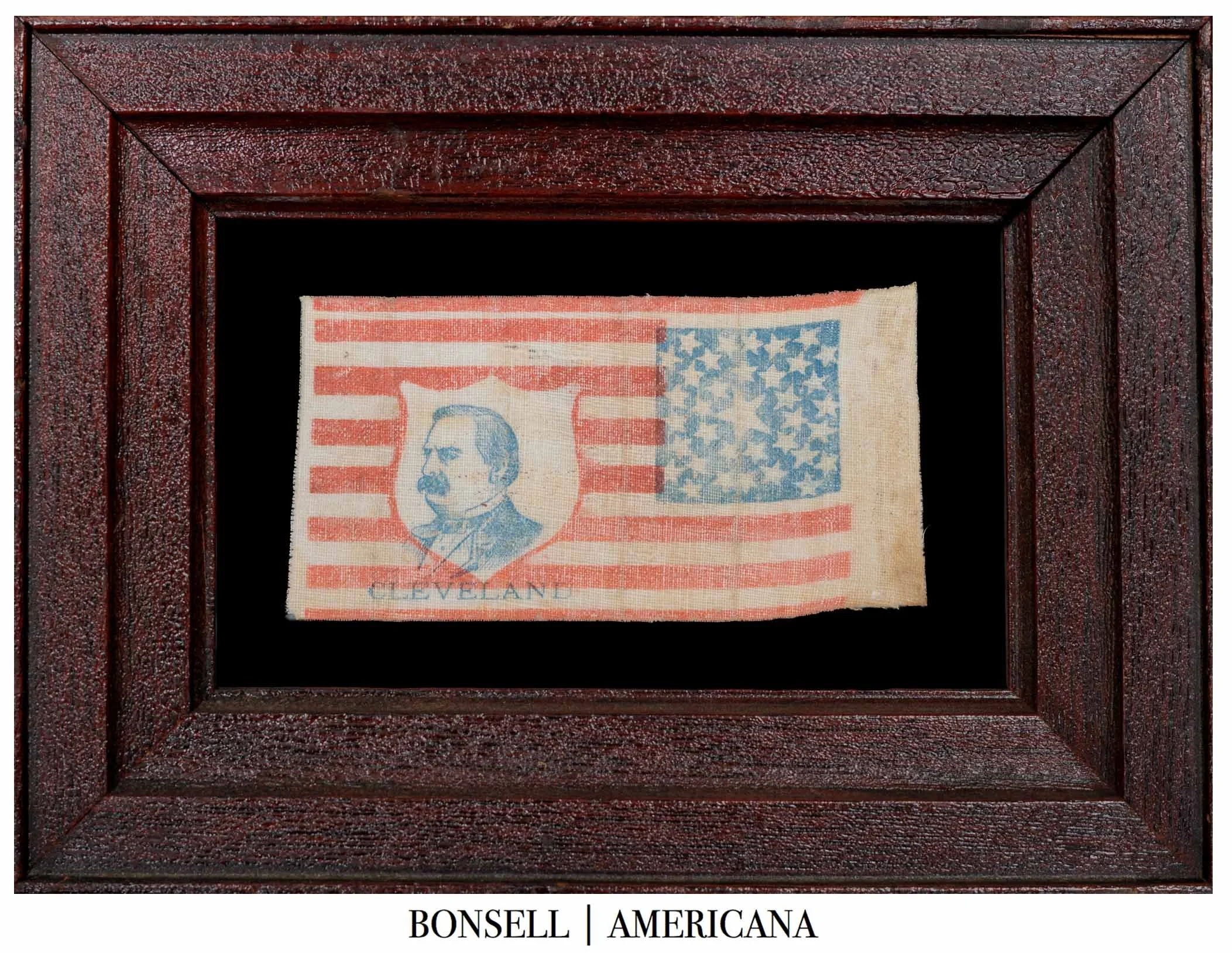
Outstanding 26 Star Antique Portrait Flag | Made for the Clay & Frelinghuysen Ticket | Michigan Statehood | Circa 1844
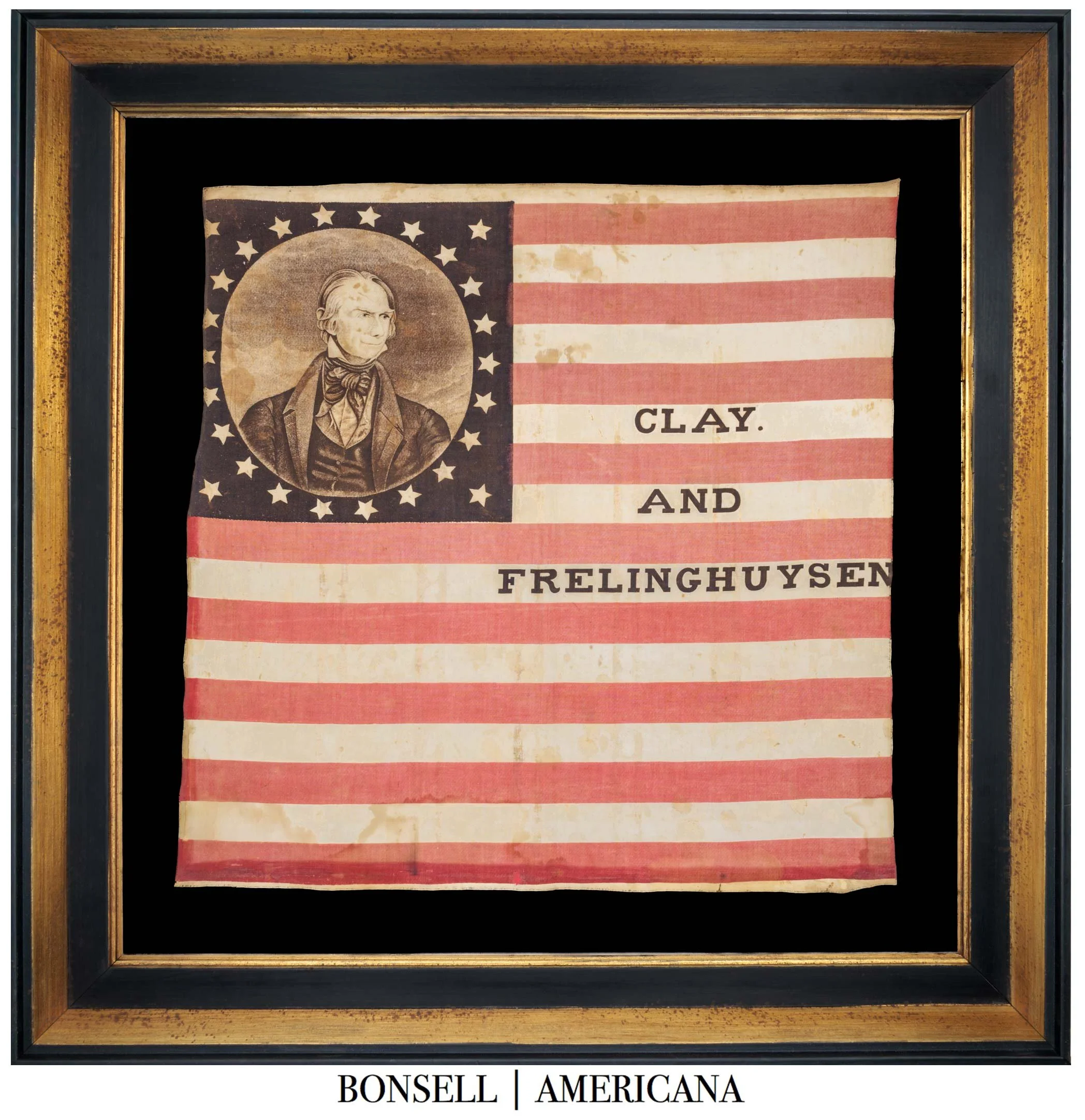
Outstanding 26 Star Antique Portrait Flag | Made for the Clay & Frelinghuysen Ticket | Michigan Statehood | Circa 1844
Price: Call 618-553-2291, or email info@bonsellamericana.com
Frame Size (H x L): 36” x 36”
Flag Size (H x L): 25” x 25”
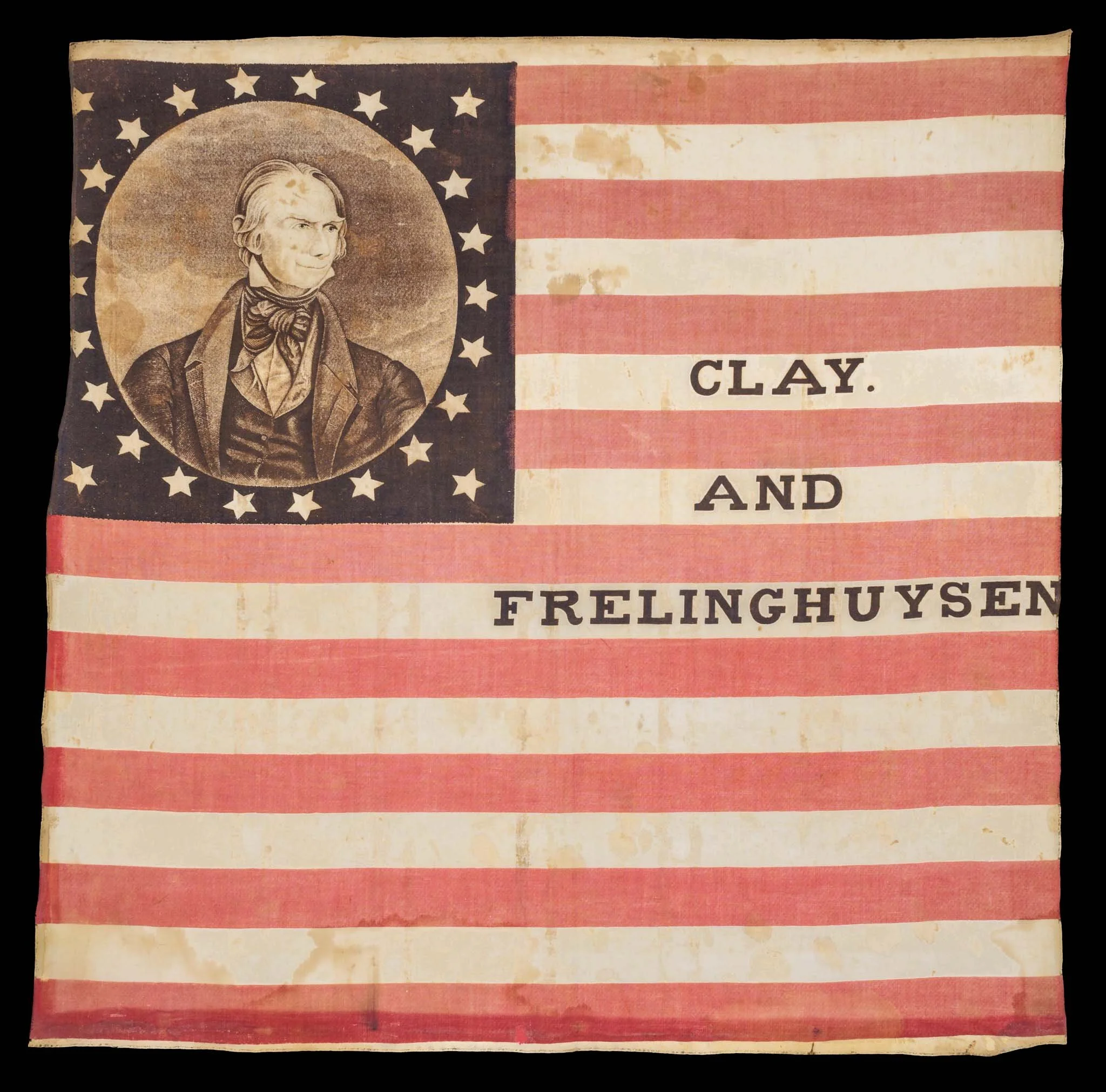
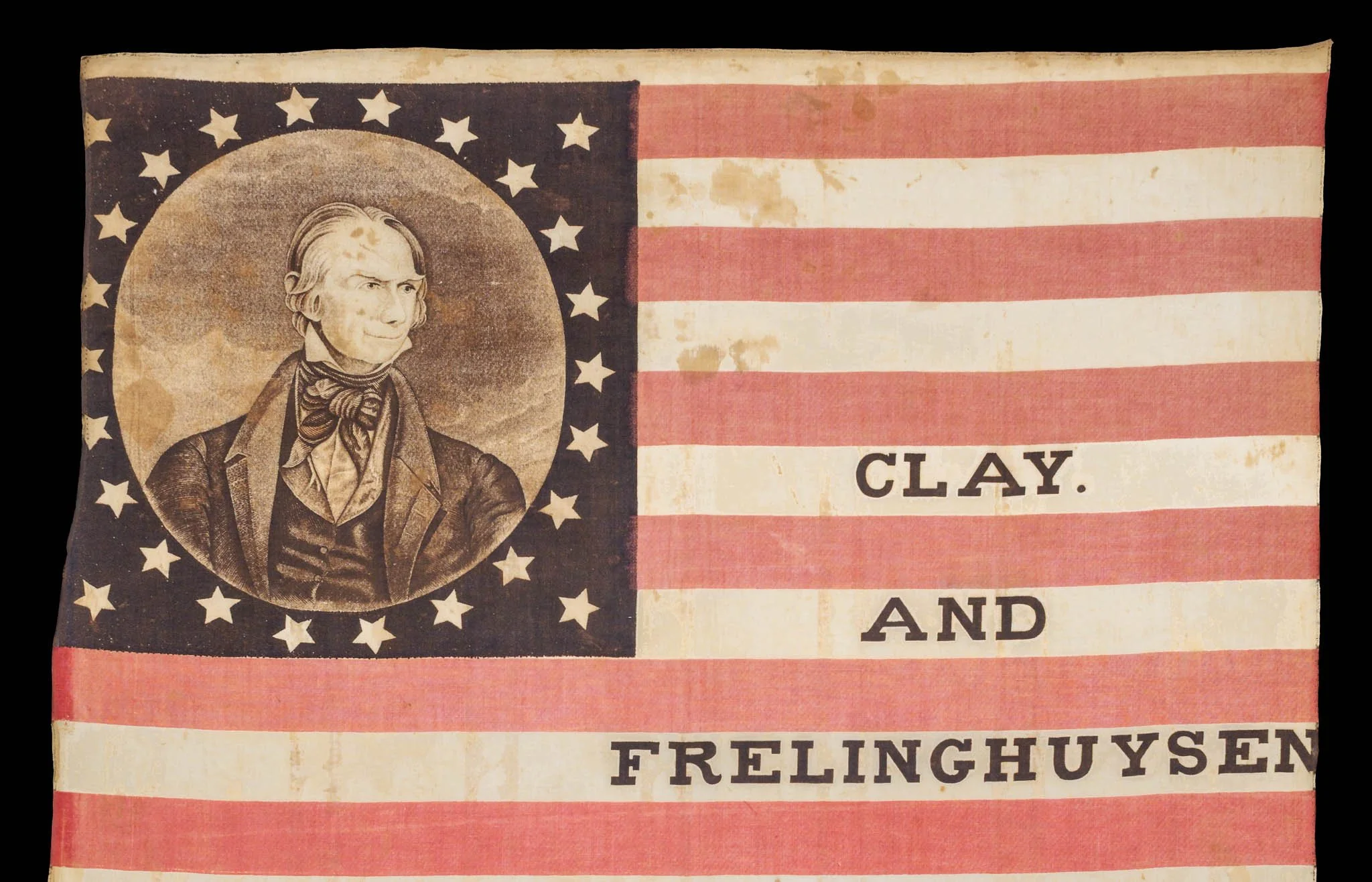
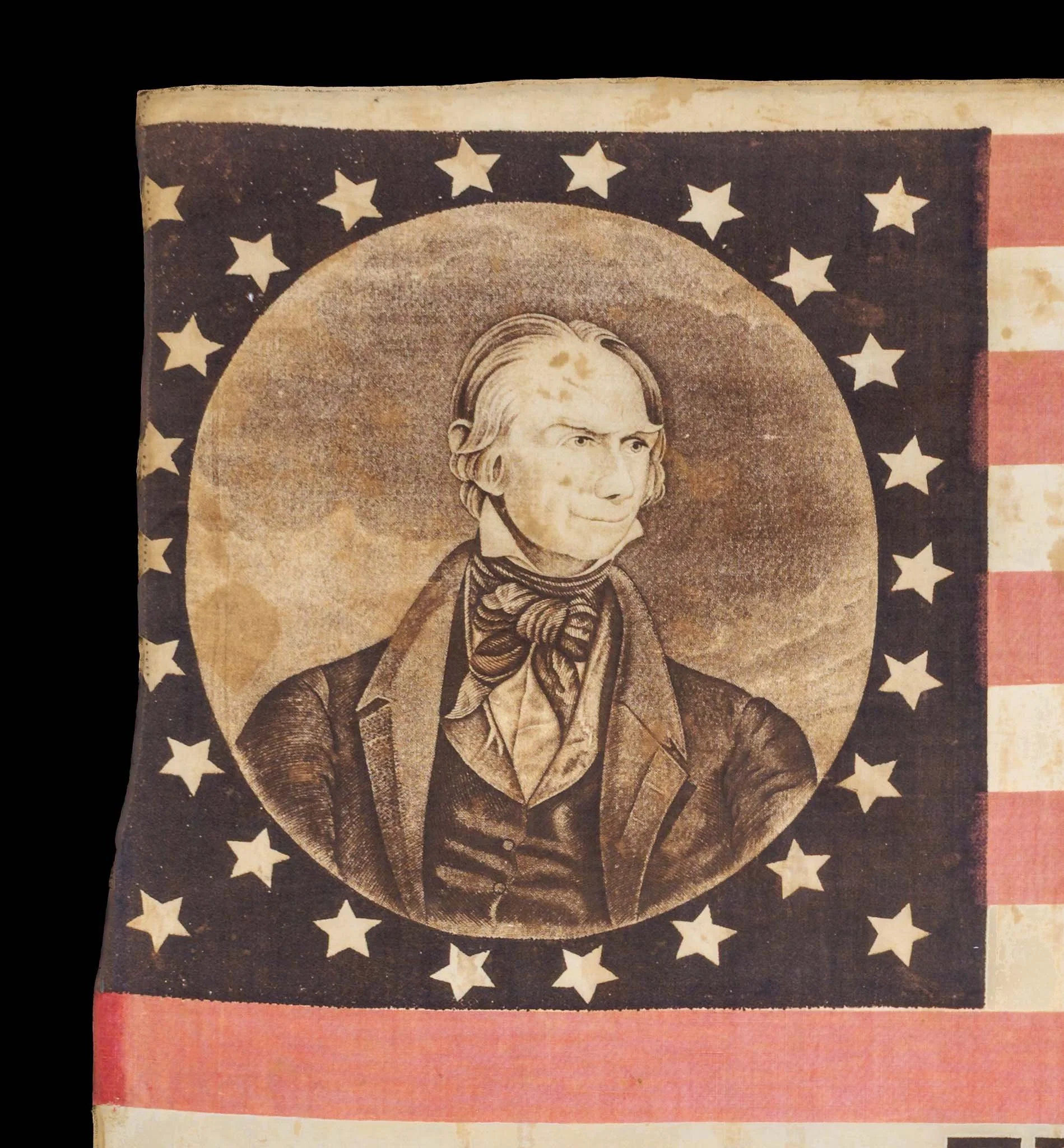
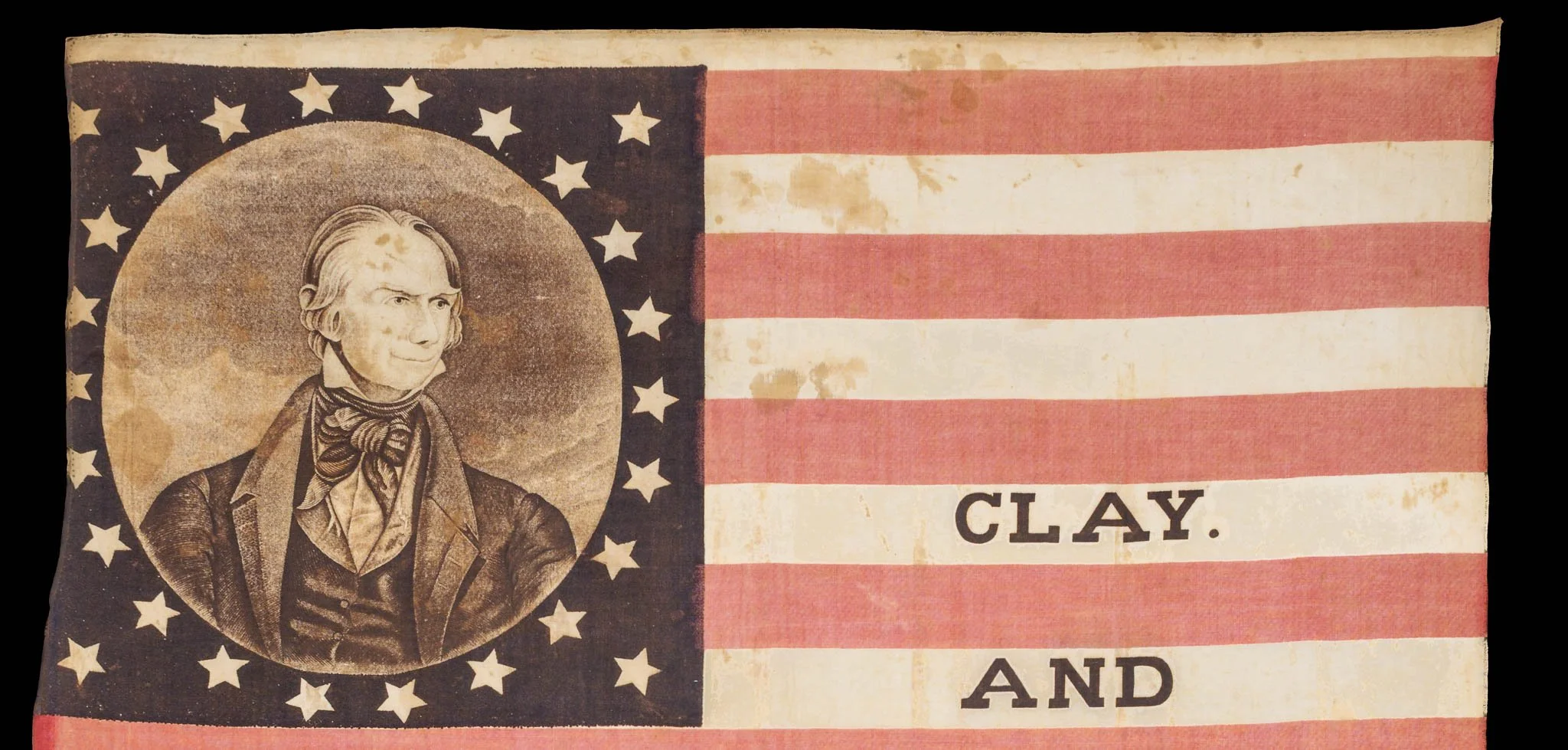
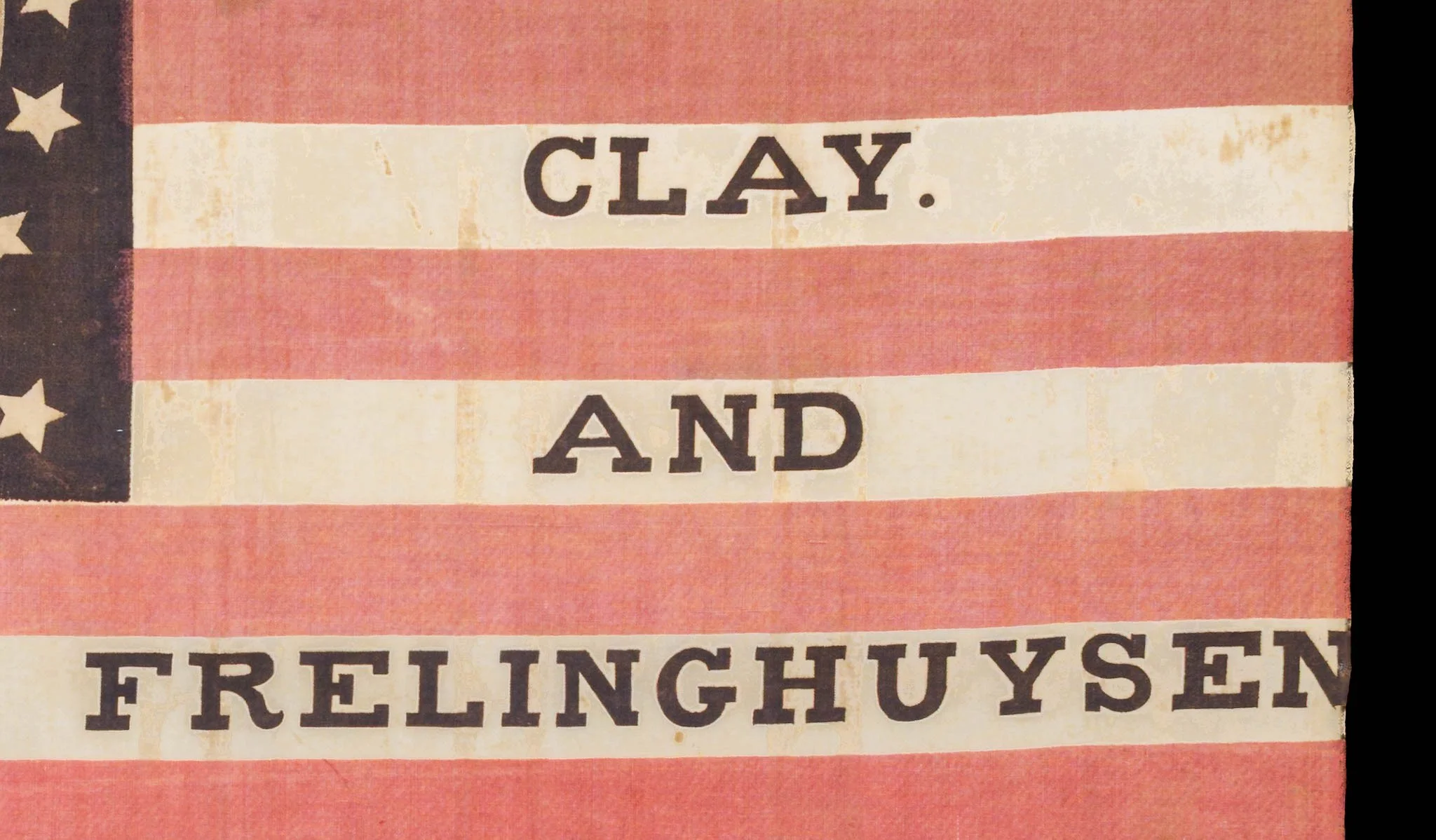
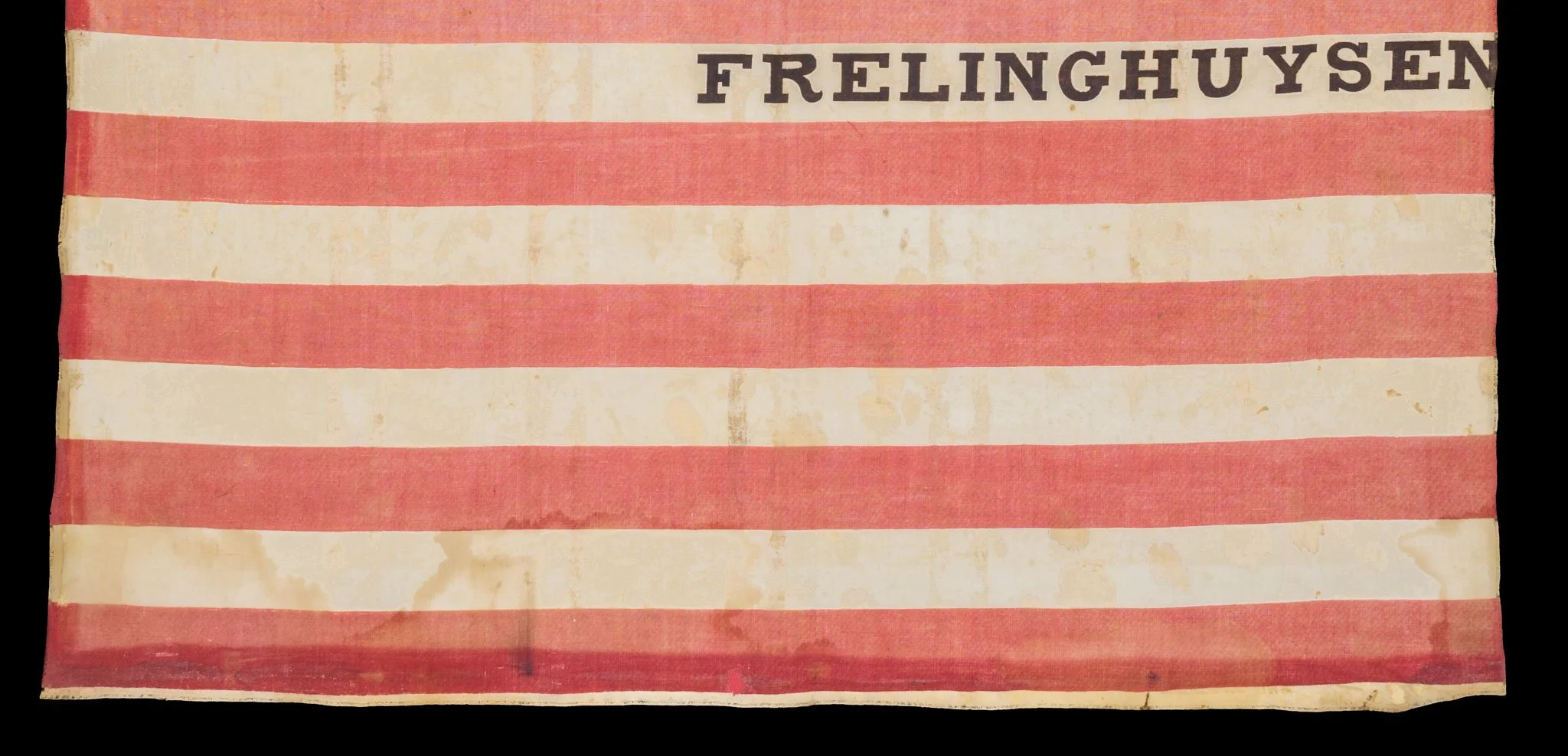
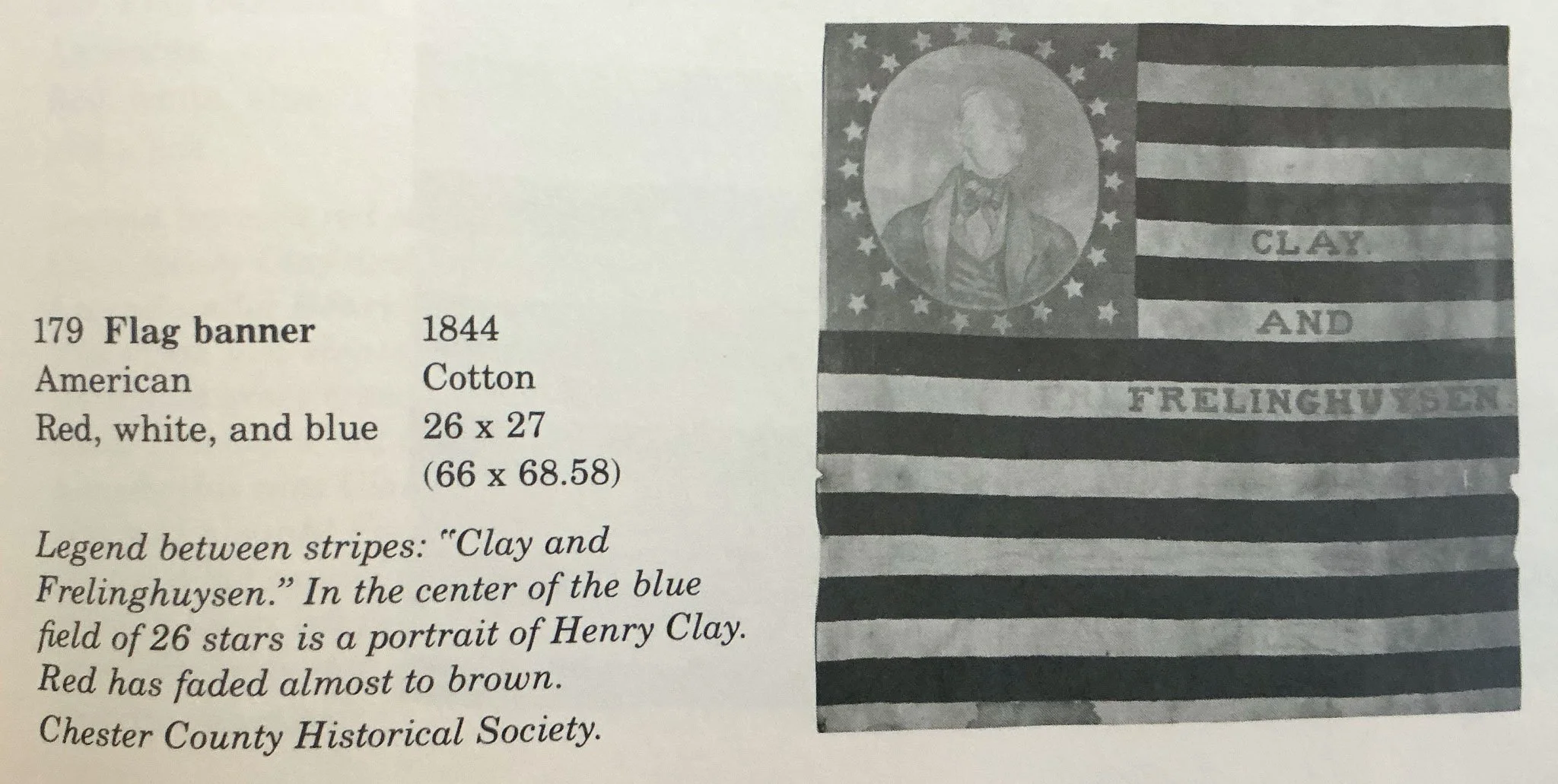
Offered is a rare and important printed cotton campaign flag, produced for the 1844 presidential election of Henry Clay and his running mate, Theodore Frelinghuysen. Executed in red, white, and blue on a single length of cotton, the design combines portraiture, national symbolism, and political messaging within a unified and highly deliberate composition. At the hoist, within a square canton, a circular medallion encloses a portrait of Clay, surrounded by a wreath of 26 stars. Extending across the striped field are the words “CLAY | AND | FRELINGHUYSEN.” The result is a cohesive graphic arrangement in which image and text are structurally integrated into the format of the American flag.
The canton functions as a formal portrait device, with Clay’s likeness rendered in a sepia-toned print derived from an engraved source and adapted for textile production. The surrounding stars form a continuous ring, both framing the portrait and reinforcing the national context of the campaign. The stripes are boldly rendered and evenly spaced, providing a strong horizontal counterbalance to the centralized portrait. The typography is clear and assertive, occupying three lines across the field in a manner that is both legible and visually balanced. Unlike later parade flags, where printed slogans are often secondary additions, the text here is integral to the design from inception.
The flag is printed on cotton, likely by means of block or early roller printing techniques. As is typical of mid-19th century textile production, minor irregularities in ink saturation and distribution are present, contributing to the hand-produced character of the piece. The pigments have mellowed over time in a manner consistent with early dyes, with the canton presenting as a deep, dark tone and the red stripes retaining strong visual presence.
The near-square proportions—approximately in keeping with known examples of the type—are a defining characteristic of early flags of this period. Unlike later, more standardized parade flags, which tend to adopt elongated rectangular formats, these earlier examples often reflect the proportions of military and presentation standards of the late 18th and early 19th centuries. The format enhances the visual impact of the design, allowing the portrait medallion and surrounding elements to occupy a central and commanding position.
The 1844 presidential campaign in which this flag was produced stands as a pivotal moment in American political history. Henry Clay, the Whig candidate, was one of the most influential statesmen of the first half of the 19th century, having served as Speaker of the House, U.S. Senator, and Secretary of State. A principal architect of what became known as the “American System,” Clay advocated for a program of economic development centered on protective tariffs, a national banking system, and federal support for internal improvements such as roads and canals. His running mate, Theodore Frelinghuysen of New Jersey, was a prominent lawyer, senator, and later president of Rutgers College, known for his moral reform positions and national visibility within the Whig Party.
Opposing Clay was Democrat James K. Polk, whose campaign emphasized territorial expansion, including the annexation of Texas and the acquisition of Oregon. While Clay’s platform reflected a vision of structured economic growth and national cohesion, Polk’s expansionist message ultimately resonated more strongly with voters, and he prevailed in the election. Textiles associated with the Clay campaign, including flags such as the present example, represent a sophisticated and early use of visual media in American political life, bridging the gap between printed campaign ephemera and later mass-produced patriotic objects.
Flags of this type occupy a narrow and important window in the evolution of American flag production. The 26-star count corresponds to the admission of Michigan as the 26th state on January 26th, 1837. Under the flag acts of the period, new stars were officially added on the following July 4th, making the 26-star flag the official national flag from July 4th, 1837 through July 3rd, 1845. This eight-year span encompasses some of the earliest known examples of printed American flags made for political purposes. While earlier campaign textiles exist, including banners from the 1840 campaign of William Henry Harrison, the Clay and Frelinghuysen examples of 1844 remain among the earliest surviving instances in which the American flag format was adapted so directly and effectively for political messaging.
The present design is documented in Herbert Ridgeway Collins’ Threads of History: Americana Recorded on Cloth, 1775 to the Present (Smithsonian Press, 1979), where it appears as example number 179. Collins classifies it as a “flag banner,” noting its cotton construction, near-square proportions, and the presence of the Clay portrait within a ring of 26 stars. The inclusion of this pattern in a foundational institutional reference underscores its importance within the canon of American textile history and provides a firm basis for identification and dating.
Additional institutional examples further support the significance of this design. An identical Clay and Frelinghuysen campaign flag is held within the collections of Rutgers University, directly connecting the object to Frelinghuysen’s later role as president of that institution. Such examples reinforce both the historical grounding of the type and its recognition within academic and museum contexts. Surviving flags of this variety are limited in number.
What distinguishes this flag, beyond its historical context, is the strength and clarity of its graphic presentation. The balance between image and typography is particularly successful, creating a composition that is both visually engaging and immediately understandable. The scale is also highly desirable—large enough to command attention in display, yet manageable within a framed presentation.
Campaign flags from the pre-Civil War era are widely regarded among collectors as some of the most compelling forms of American patriotic textile, combining rarity, historical importance, and strong visual design. Within this category, portrait examples such as the present flag are especially sought after, due to the added dimension of figural imagery and the direct association with prominent political figures.
Conservation Process: The flag was hand sewn to a cotton fabric backing, which was then hand sewn to a mounting board. To prevent dye migration from the black cotton, the fabric was pre-washed and treated with a dye-setting wash prior to mounting. The flag is displayed behind Optium Museum Acrylic.
Frame: This offering is in our Large Distressed Black and Gold Frame.
Condition Report: There is moderate to significant foxing and staining throughout, most evident in the striped field and along the lower portion, accompanied by areas of pigment loss and uneven toning consistent with age. The canton has darkened, and there is scattered discoloration within the portrait area, along with minor edge wear and small areas of fabric loss. Despite these characteristics, the imagery remains clear and the text fully legible, with strong overall visual presentation.
Collectability Level: The Extraordinary – Museum Quality Offerings
Date of Origin: 1844
Number of Stars: 26
Associated State: Michigan