
Extremely Early and Exceptional 26 Star Flag | U.S. Navy or Maritime Use | Michigan Statehood | Circa 1837-1845
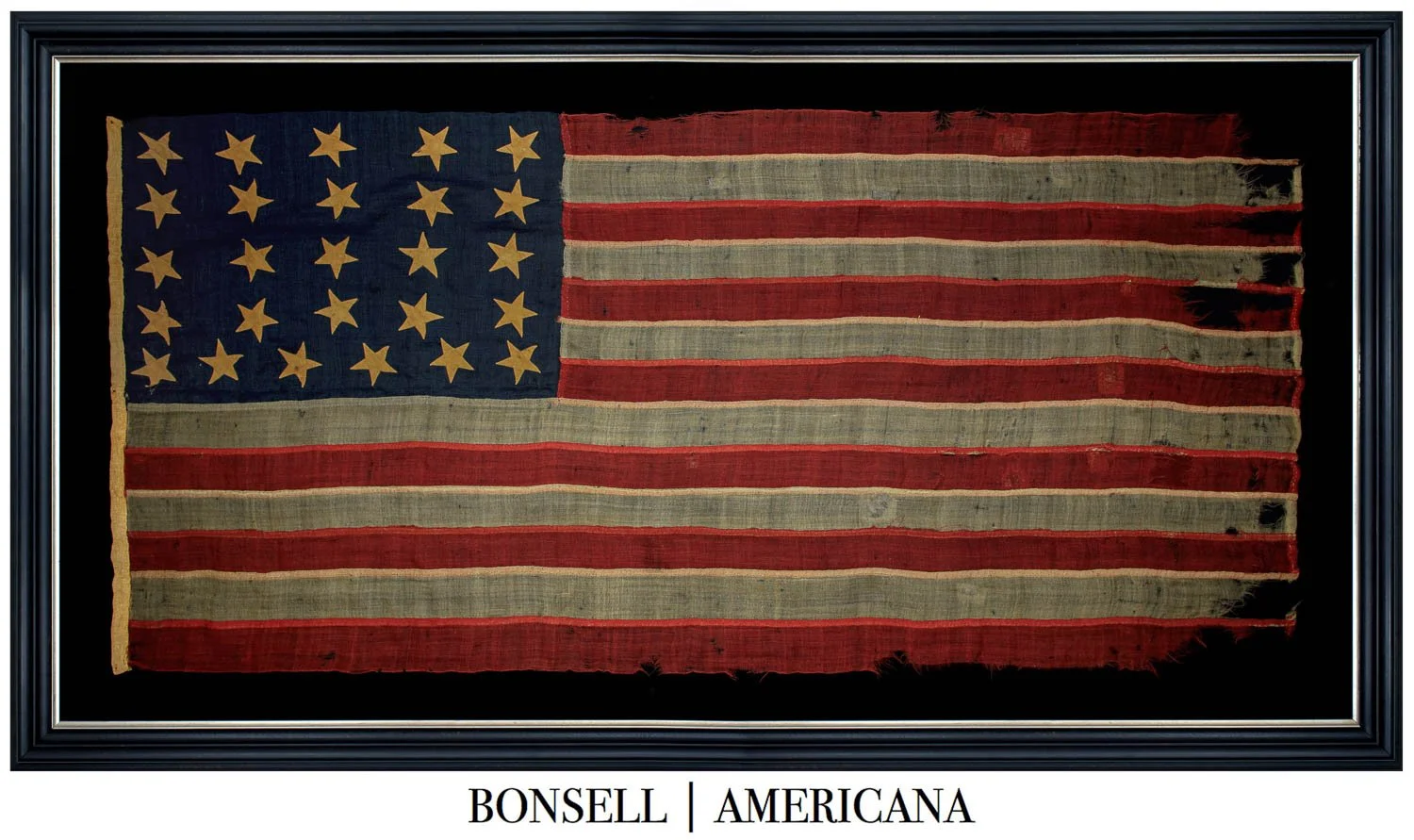
Extremely Early and Exceptional 26 Star Flag | U.S. Navy or Maritime Use | Michigan Statehood | Circa 1837-1845
Frame Size (H x L): 43.5” x 80”
Flag Size (H x L): 31.5” x 68”
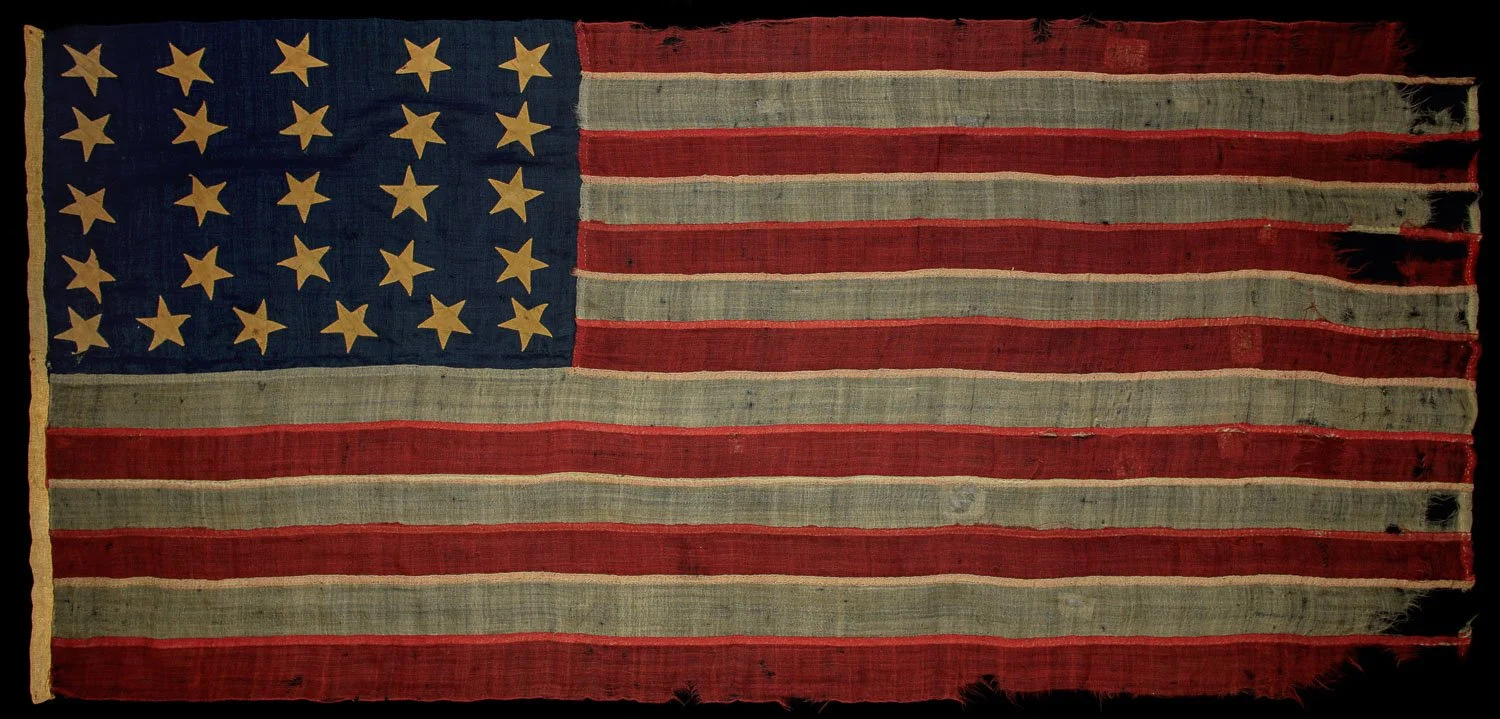
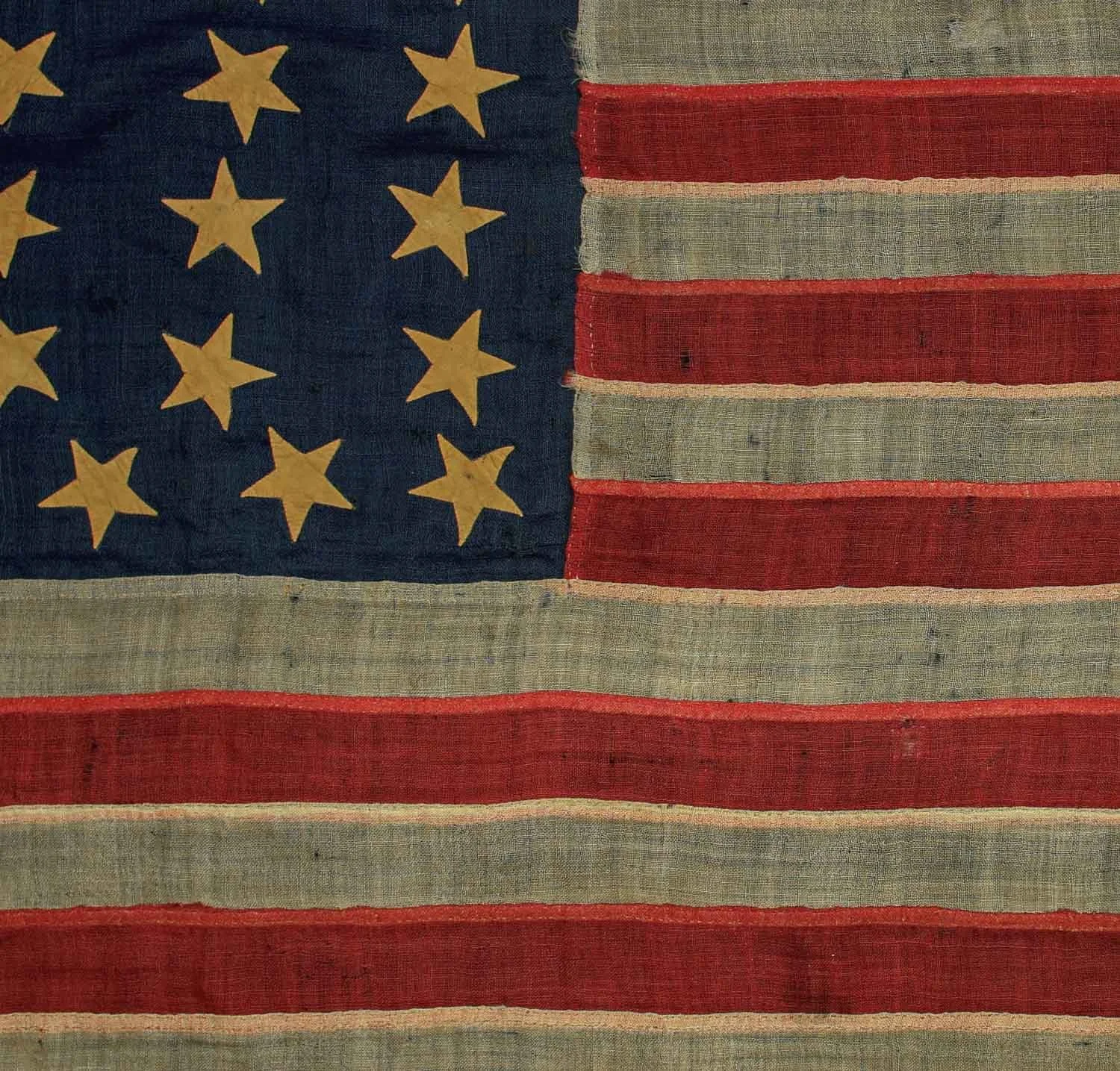
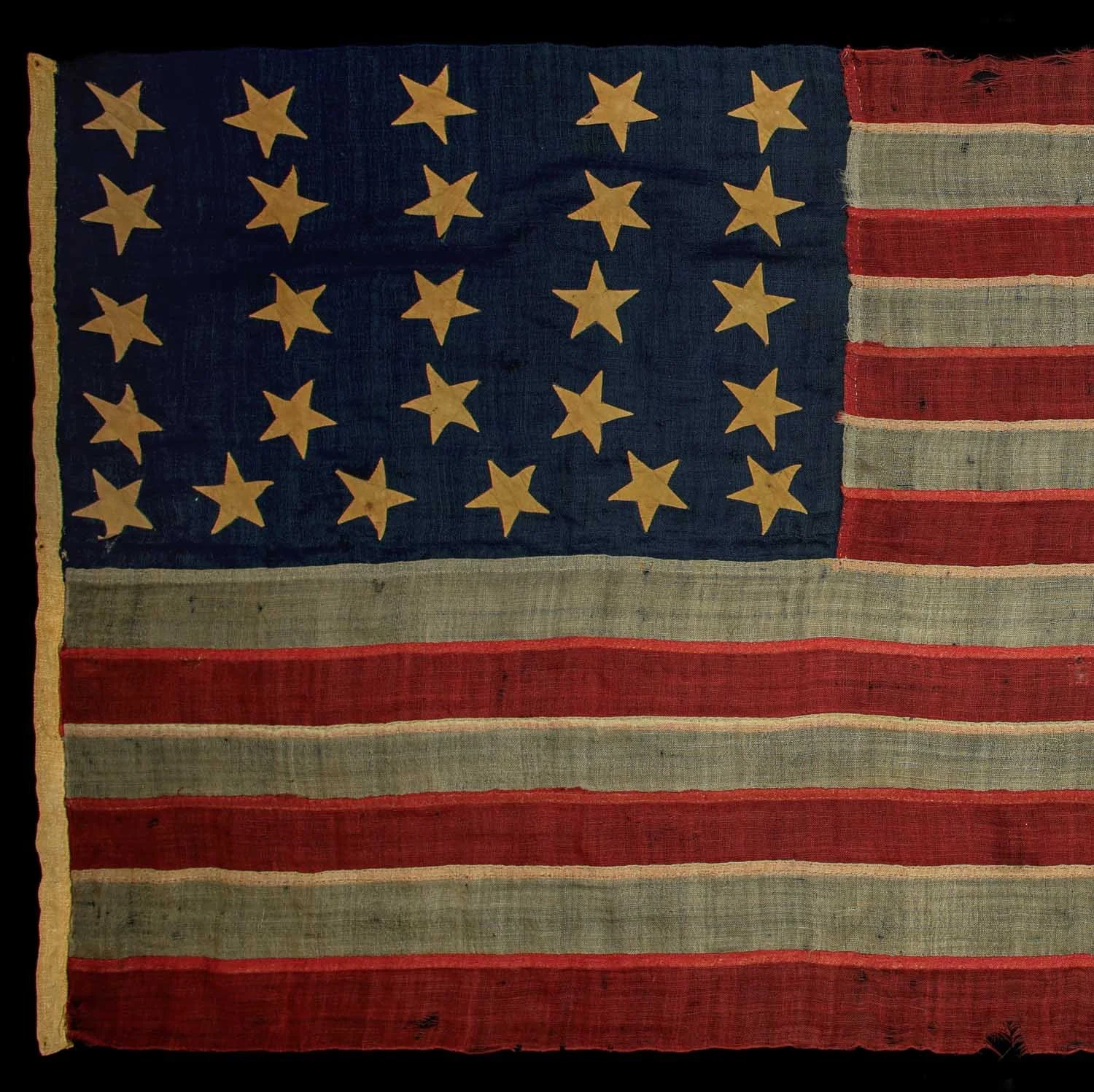
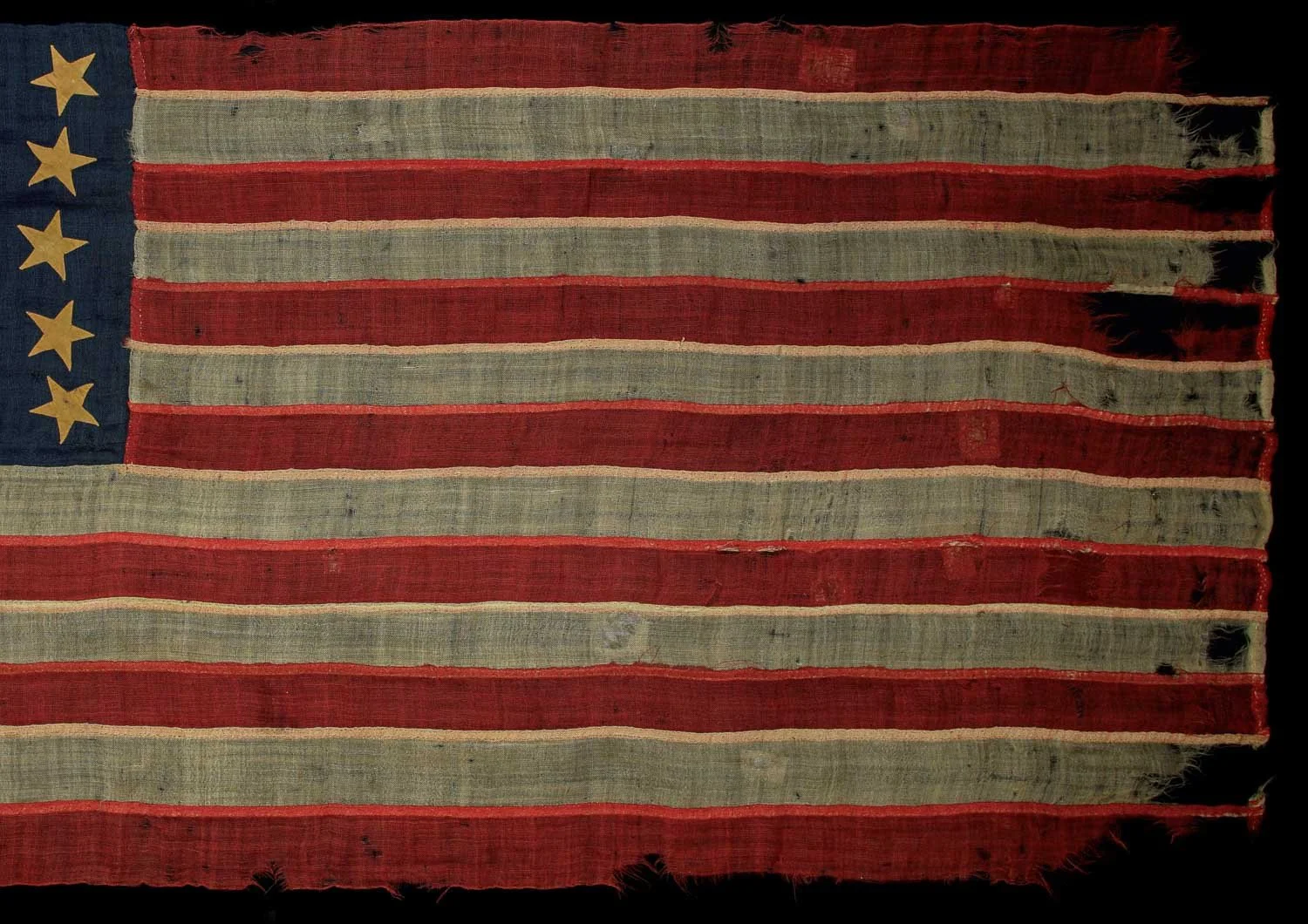
Offered is an entirely handsewn 26-star American flag, made of loosely woven wool bunting with cotton appliqué stars. The flag features thirteen horizontal stripes in alternating red and white, each joined with flat-felled seams and stitched by hand using waxed linen thread. This type of thread—commonly used in the early 19th century—was favored for its strength, water resistance, and durability, particularly in maritime or outdoor applications. The wool bunting is coarse and irregular, showing visible slubs, thick and thin areas, and other hallmarks of early loom work. The dyes have aged gracefully: the reds have softened to a muted brick hue, the whites have mellowed to ivory, and the blue canton has oxidized to a deep, slate-toned indigo.
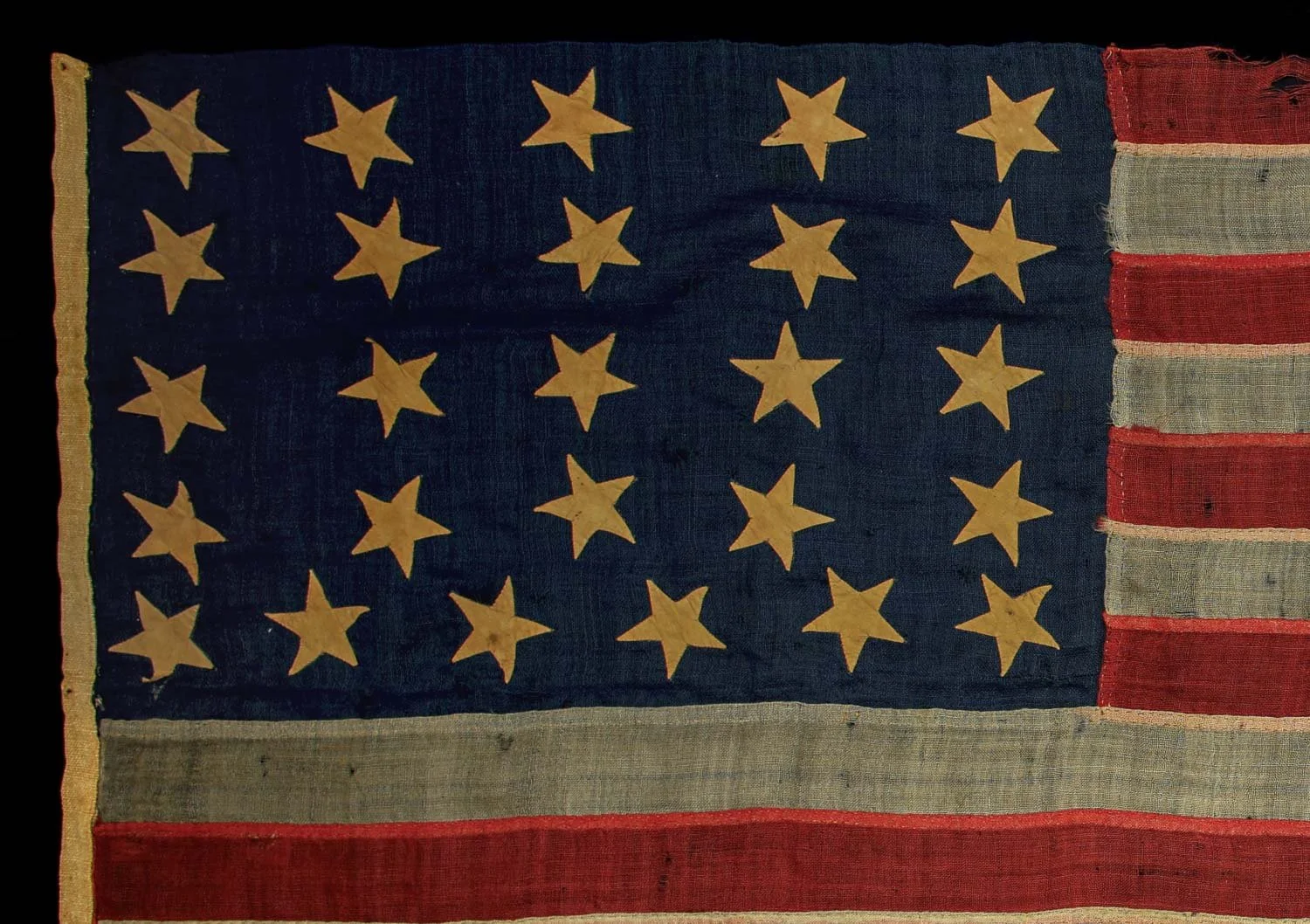
The canton is made from the same wool bunting and bears twenty-six stars, each cut from unbleached cotton and applied by hand. The stars are appliquéd to both sides of the canton. The stars are arranged in a 5-5-5-5-6 configuration across five horizontal rows, with the slightly offset final row lending a subtle cascading or “stepped” appearance to the overall design. The resulting pattern loosely resembles a series of shallow chevrons or gentle arcs—an effect that adds visual rhythm and emphasizes the hand-placed character of the stars. Each star was sewn using cotton thread and varies slightly in shape, size, and orientation, reflecting the handmade nature of the flag and contributing to its folk-art charm.
All construction throughout the flag was executed by hand. No machine stitching is present, and stitch lengths vary subtly across different sections—particularly in high-stress zones and around star points. Reinforcement stitches are visible in select areas. These construction features, along with the natural fiber types and absence of standardized manufacturing techniques, confidently date the flag to the 1837–1846 period—spanning Michigan’s entry into the Union as the 26th state and concluding before Florida’s admission as the 27th.
The hoist is constructed of a thick, coarse-weave cotton or jute webbing, commonly referred to in 19th-century terminology as sailcloth, canvas, or duck cloth. It is hand-sewn to the body of the flag to provide reinforcement for mounting and use. The weave is visibly rugged and durable, with a matte, fibrous texture and natural tan coloration typical of unbleached utility textiles from the period. Three small grommet holes are worked directly into the hoist and reinforced by hand with tight whipstitching. These show signs of tension and wear, consistent with repeated attachment to a staff or halyard. The absence of metal hardware aligns with early American flagmaking practices, predating the widespread use of brass grommets later in the 19th century. Combined with the flag’s rare star count, entirely handsewn construction, and signs of active use—including fraying at the fly end and scattered small losses—this textile stands as a rare and evocative relic from the antebellum era of American expansion.
Given its construction, materials, and the presence of double-appliquéd stars, this flag was almost certainly intended for maritime use—likely by the U.S. Navy or aboard a government-chartered vessel operating on inland or coastal waters. During the 1830s and 1840s, Navy regulations specified the use of wool bunting flags in various sizes, many of which were made by naval depots or contracted sailmakers. The robust hoist, weather-resistant waxed linen thread, and double-sided star field all point to functionality in high-exposure environments, such as the rigging of a sloop-of-war, revenue cutter, or Great Lakes naval vessel. The flag’s elongated proportions—wider than typical land-use flags—also support a maritime attribution, as longer formats were favored at sea for greater visibility in wind. At a time when few flags were made for civilian use—and with most army units not yet issued national colors—naval vessels were among the few places where the Stars and Stripes were flown daily. The scale of this example—small enough to be manageable, yet large enough to be seen from a distance—would have made it well-suited as a signal at sea.
Flags made before the Civil War (1861–1865) are the rarest and most sought-after of all U.S. flags. Prior to the outbreak of war, Americans did not commonly display the national flag for patriotic or decorative purposes. Even military usage was limited—U.S. Army field artillery was not authorized to carry the Stars and Stripes until 1834, and infantry regiments did not adopt it as a standard until 1841. Most flags produced in the prewar decades were maritime in nature, intended to mark ships or military installations, and were often quite large in scale. As a result, flags made before the Civil War account for only about one in every hundred 19th-century examples. Surviving flags from this period that are small enough to be displayed in a modern setting are especially rare. It was not until 1861, with the outbreak of the Civil War, that American flags began to be produced in large quantities and private citizens began to display them widely in homes, parades, and public events.
As noted above, the 26-star flag represents the inclusion of Michigan into the Union. Michigan was admitted as the 26th state on January 26, 1837, and the flag bearing 26 stars became official on the following Independence Day, July 4, 1837. Michigan had first petitioned for statehood in 1833, but its admission was delayed by Congress for two key reasons: first, because the addition of a free state threatened to upset the delicate balance between Northern and Southern states; and second, due to an unresolved boundary dispute with Ohio over the city of Toledo—an event often referred to as the "Toledo War." The political balance issue resolved naturally with the near-simultaneous admission of Arkansas as a slave state, and Congress ultimately conditioned Michigan’s statehood on resolving its dispute with Ohio. Michigan agreed to cede the contested Toledo Strip in exchange for the western portion of the Upper Peninsula, and statehood was granted in early 1837.
The 26-star flag remained the official U.S. flag from July 4, 1837, until July 4, 1845, when a 27th star was added to reflect Florida’s admission. Four U.S. presidents served under the 26-star flag: Martin Van Buren, William Henry Harrison, John Tyler, and James K. Polk. It was during this period that the nation continued its westward expansion, industrial development, and deepening political tensions that would eventually culminate in the Civil War. Flags from this era are extraordinarily rare—particularly those that survive in strong condition, with wholly handsewn construction and a star count that marks such a specific and pivotal moment in American history.
Conservation Process: This flag was hand sewn to cotton fabric, and both were hand sewn to a mounting board. To prevent the black dye in the cotton fabric from seeping into the flag, it was first washed in a standard wash and then in a dye setting wash. The flag is positioned behind Optium Museum Acrylic.
Frame: The flag is housed in a modern, one-piece black wooden frame with a satin finish and subtle ridged detailing. A narrow silver inner liner provides a clean visual separation between the textile and the frame.
Condition Report: The flag exhibits heavy wear along the fly edge, including fraying, small losses, and thread separation—typical of extended exposure to wind and weather. This type of wear is consistent with a flag that was flown regularly, likely in a maritime environment where constant motion and salt air would accelerate deterioration. The body of the flag shows scattered staining and minor fabric thinning, but the overall structure remains stable and intact. The visible use supports its likely role as a working naval or shipboard flag rather than a ceremonial or decorative piece.
Collectability Level: The Extraordinary – Museum Quality Offerings
Date of Origin: 1837-1846
Number of Stars: 26
Associated State: Michigan