
Outstanding 34 Star Bible Flag with Raised Embroidered Stars in a Loosely Linear “U” Formation | Civil War Period | Circa 1861–1863
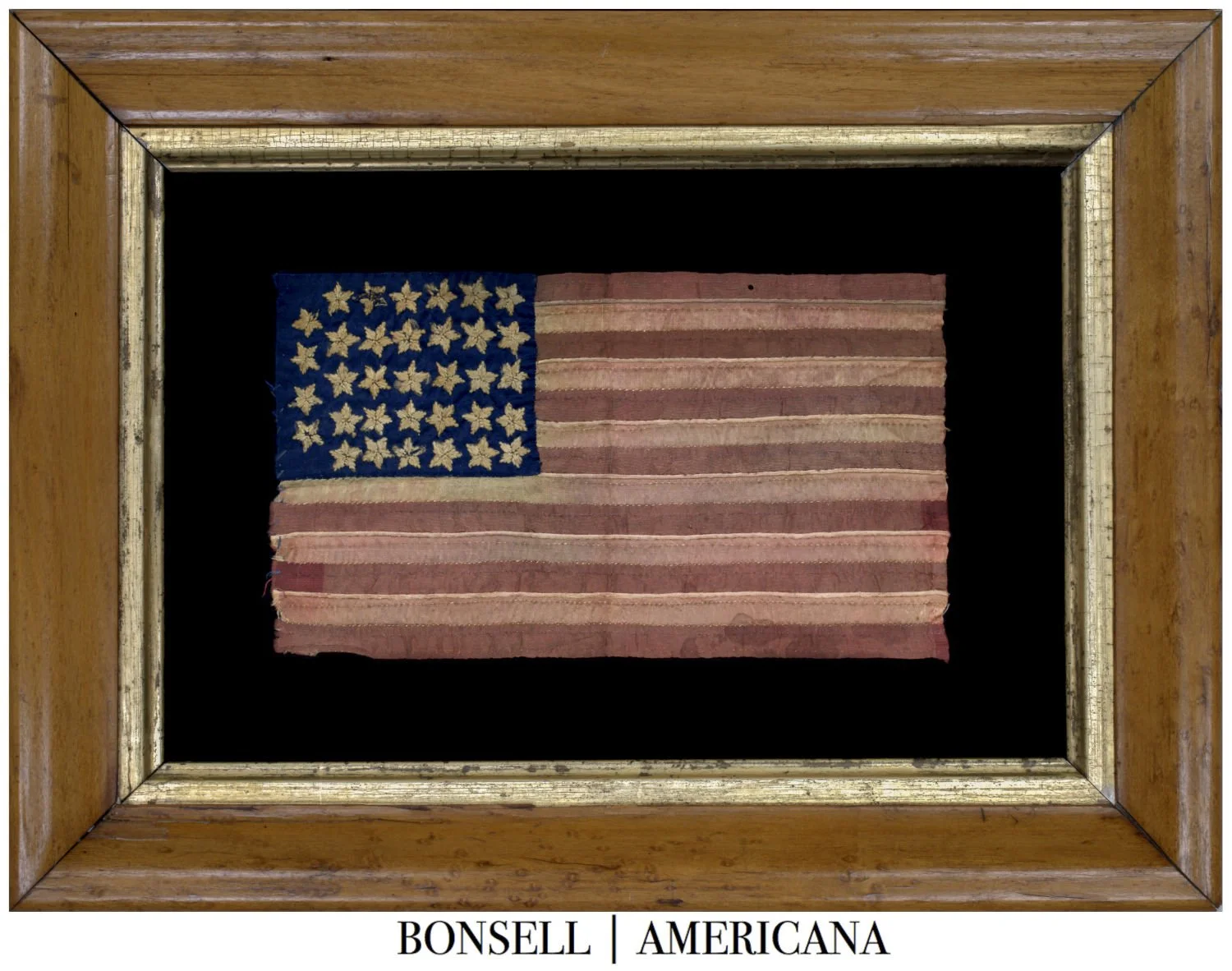
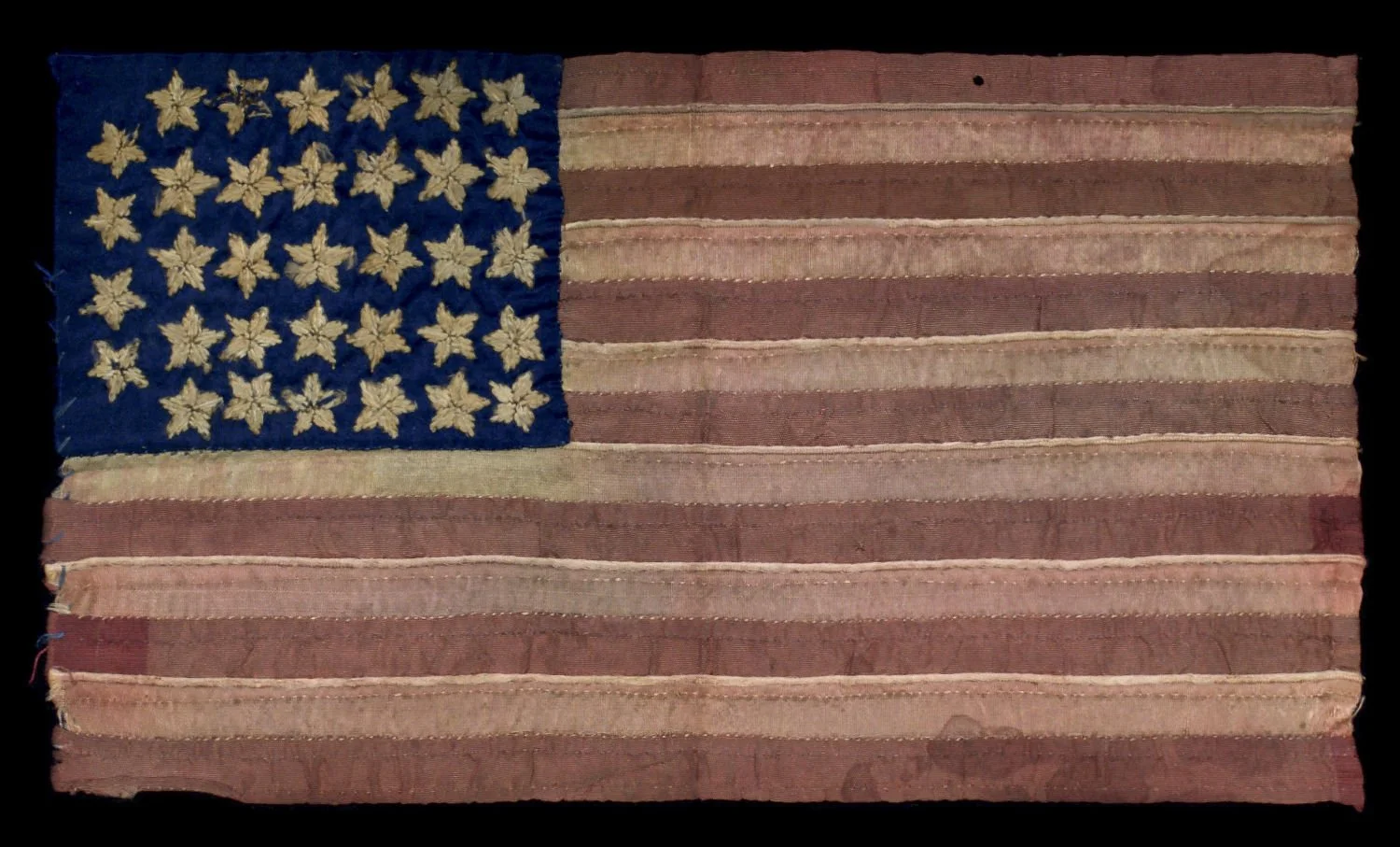
Outstanding 34 Star Bible Flag with Raised Embroidered Stars in a Loosely Linear “U” Formation | Civil War Period | Circa 1861–1863
Frame Size (H x L): 10.5” x 14”
Flag Size (H x L): 4.5” x 8”
Offered is an entirely handsewn Civil War-era Bible flag, made entirely of silk and featuring thirteen alternating red and white stripes joined with fine hand stitching. Compact in size, this type of flag was typically carried in a soldier’s Bible or personal effects, serving as a symbol of loyalty and comfort during wartime. The stripes run horizontally beneath a deep blue canton, which occupies the upper left corner in the traditional Union format.
The canton contains thirty-four hand-embroidered stars. Each star is executed in thick, raised stitching that gives it a textured, dimensional appearance—an uncommon and labor-intensive feature. The stars differ slightly in shape and orientation, underscoring the handcrafted nature of the work and lending the flag a distinctly personal character.
The thirty-four stars in the canton are arranged by rows, though with some variation in spacing and alignment that reflects their hand-embroidered nature. Notably, the stars in the top row, bottom row, and along the left edge form a subtle “U” shape—possibly a symbolic nod to the Union, a meaningful detail in the context of the Civil War. This layout, while informal, adds a layer of visual interest and personal expression typical of privately made flags from the period.
Bible flags are a historically significant category of Civil War artifacts. Typically small and made from lightweight fabrics like silk, these flags were often sewn by family members and tucked into soldiers’ Bibles, journals, or personal belongings before they left for war. They were not issued by the government but made privately, often by loved ones, and intended to provide both patriotic encouragement and spiritual reassurance. Because of their size, fragility, and limited production, surviving examples are rare.
What makes Bible flags particularly desirable is the way they combine national symbolism with personal and emotional meaning. Each one reflects the devotion of the person who made it and the soldier who carried it. The level of craftsmanship—often involving hand embroidery, as seen here—distinguishes them from more commonly produced flags of the period. For collectors and historians, Bible flags offer a direct and tangible connection to individual lives during the Civil War.
The thirty-four-star flag represents the admission of Kansas to the Union. Kansas joined on January 29, 1861, and the thirty-four-star flag became official on July 4th of that year. President Lincoln served under this flag, and it was in use throughout the early years of the Civil War. Many thirty-four star flags predate the official adoption date, as flag makers often began producing new versions as soon as a state was admitted, rather than waiting for the formal recognition on Independence Day. The flag remained official until July 4, 1863, when West Virginia’s entry into the Union brought the total to thirty-five stars.
The thirty-four and thirty-five star flags were official for most of the Civil War and are especially sought after. Flags from this period (1861–1865) and earlier are among the rarest and most desirable of all American flags. Prior to the war, flag use was limited: Americans did not commonly display flags for patriotic purposes, and even the military only gradually adopted the Stars and Stripes. Army field artillery was not authorized to carry the national flag until 1834, and infantry regiments followed in 1841. Most flags before the Civil War were made for maritime use and were typically large in scale so they could be seen from afar.
The outbreak of the Civil War sparked a major increase in the production of small flags for personal and patriotic use. This Bible flag was made during that surge and is a rare survivor.
Conservation Process: This flag was hand sewn to cotton fabric, and both were hand sewn to a mounting board. To prevent the black dye in the cotton fabric from seeping into the flag, it was first washed in a standard wash and then in a dye setting wash. The flag is positioned behind Optium Museum Acrylic.
Frame: The flag is housed in an 1860 birdseye maple frame with a warm, honey-toned finish. It features a gold-leafed inner sight.
Condition Report: The flag remains in good overall condition, with expected signs of age. The red dye has migrated into the adjacent white stripes, giving them a soft rose-colored tone that adds visual depth and character to the piece. Despite this bleeding, the flag retains an eye-catching presence.
Collectability Level: The Best – Perfect for Advanced Collectors
Date of Origin: 1861-1863
Number of Stars: 34
Associated War: The Civil War (1861-1865)
Associated State: Kansas