Attractive 35 Star American Flag | Unusual Painted Stars with Red Outlines | Civil War Period | Circa 1863–1865
Attractive 35 Star American Flag | Unusual Painted Stars with Red Outlines | Civil War Period | Circa 1863–1865
Price: Call 618-553-2291, or email info@bonsellamericana.com
Frame Size (H x L): 68.5” x 97”
Flag Size (H x L): 53.5” x 82”
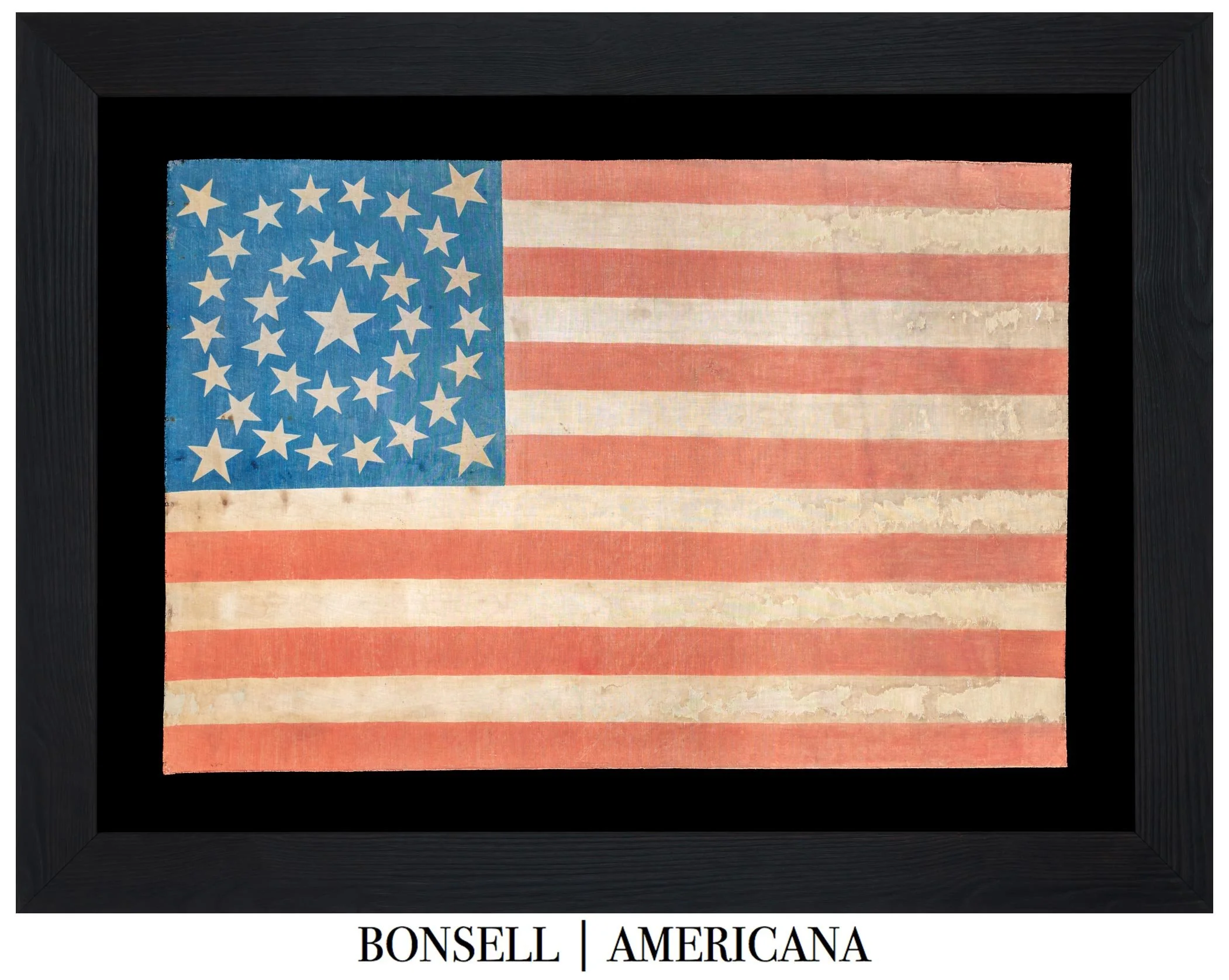
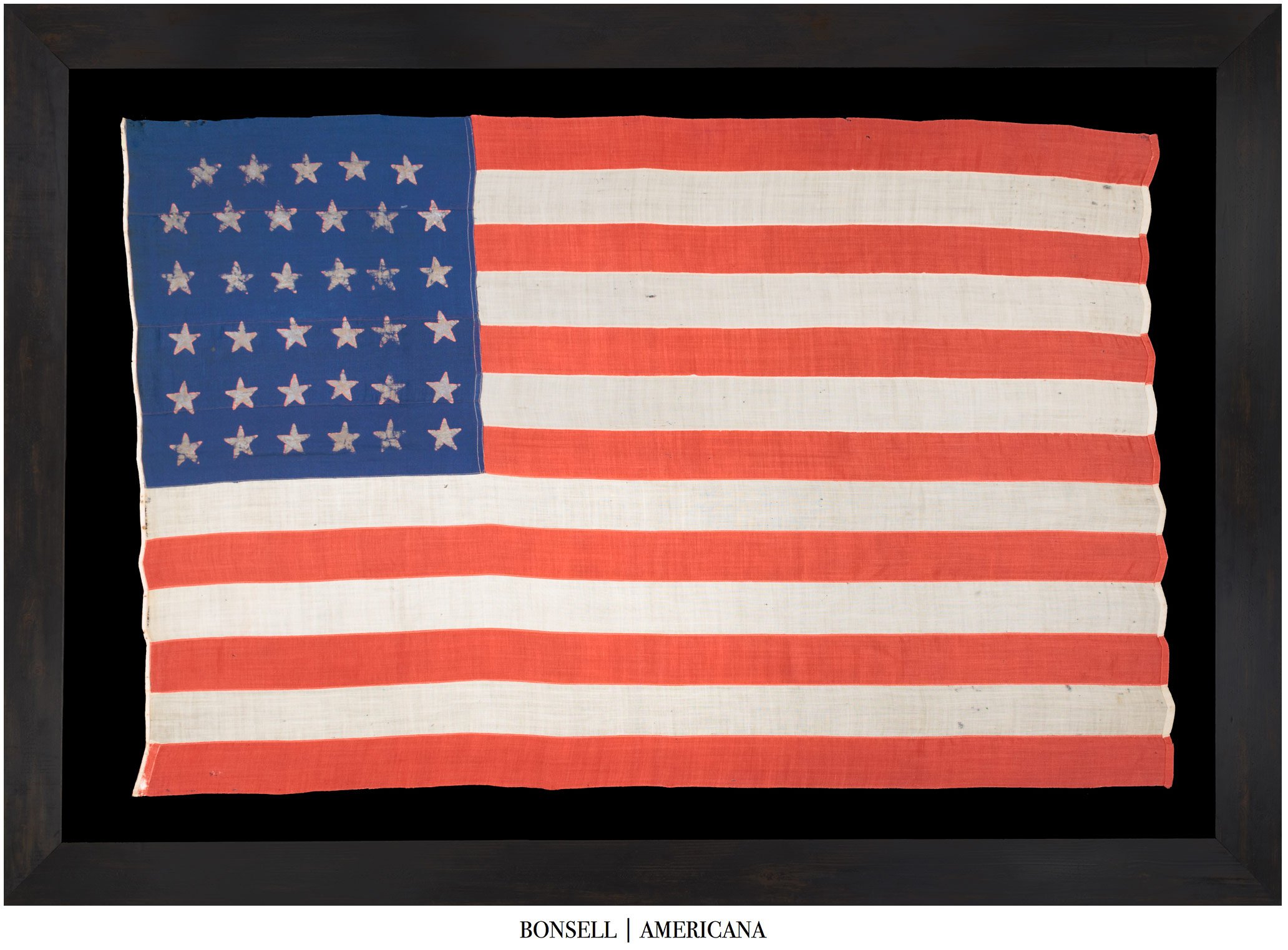
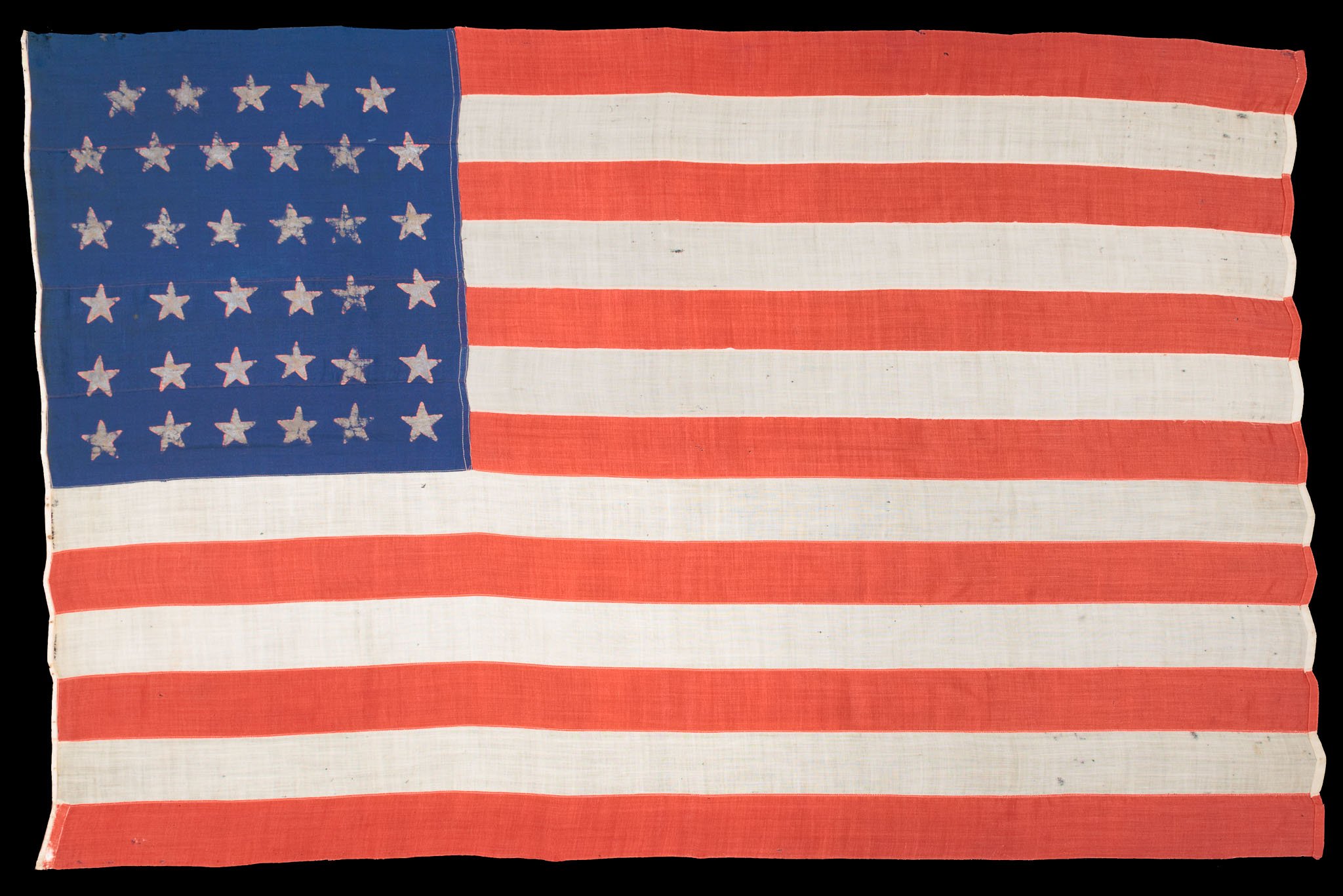
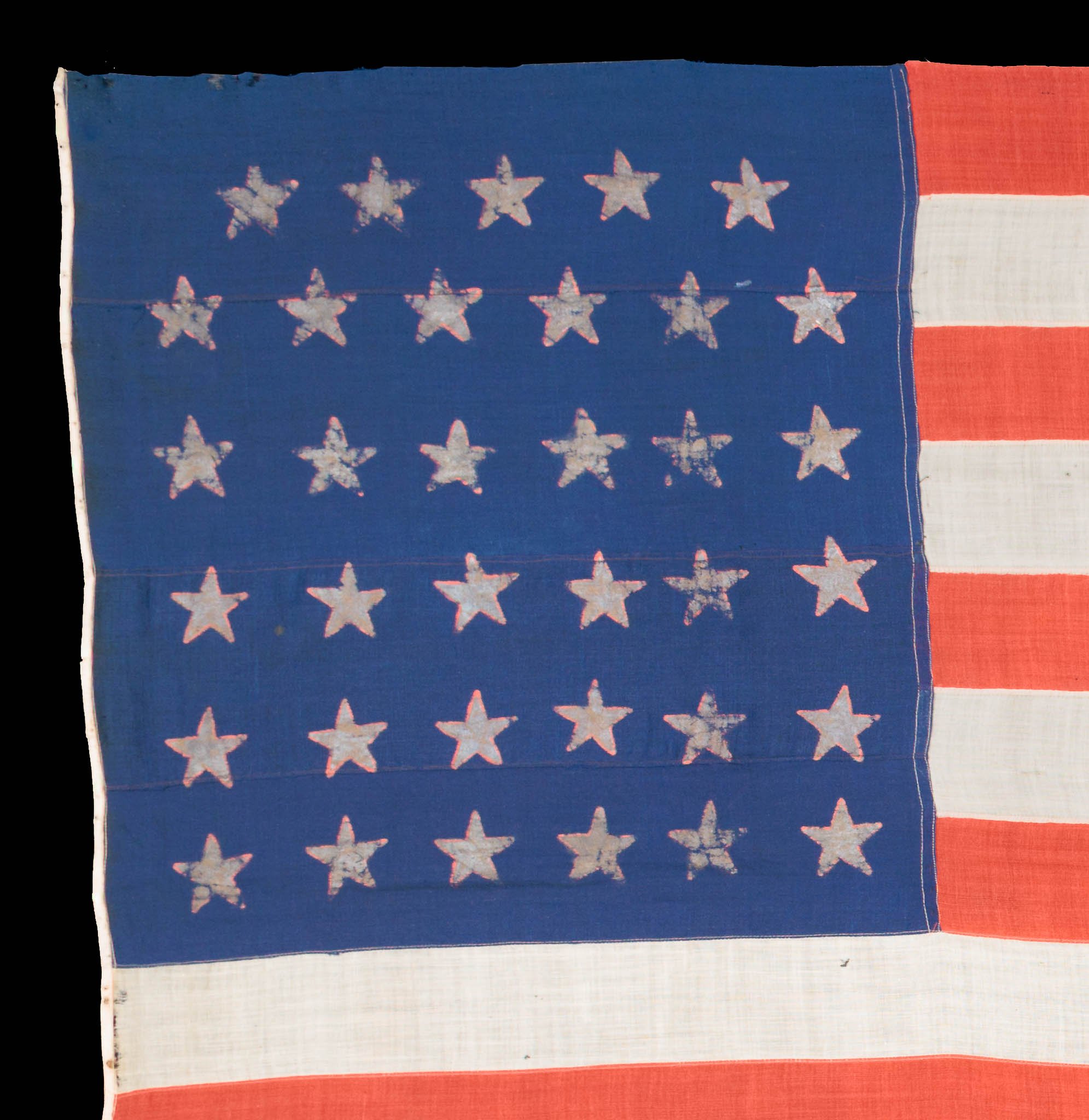
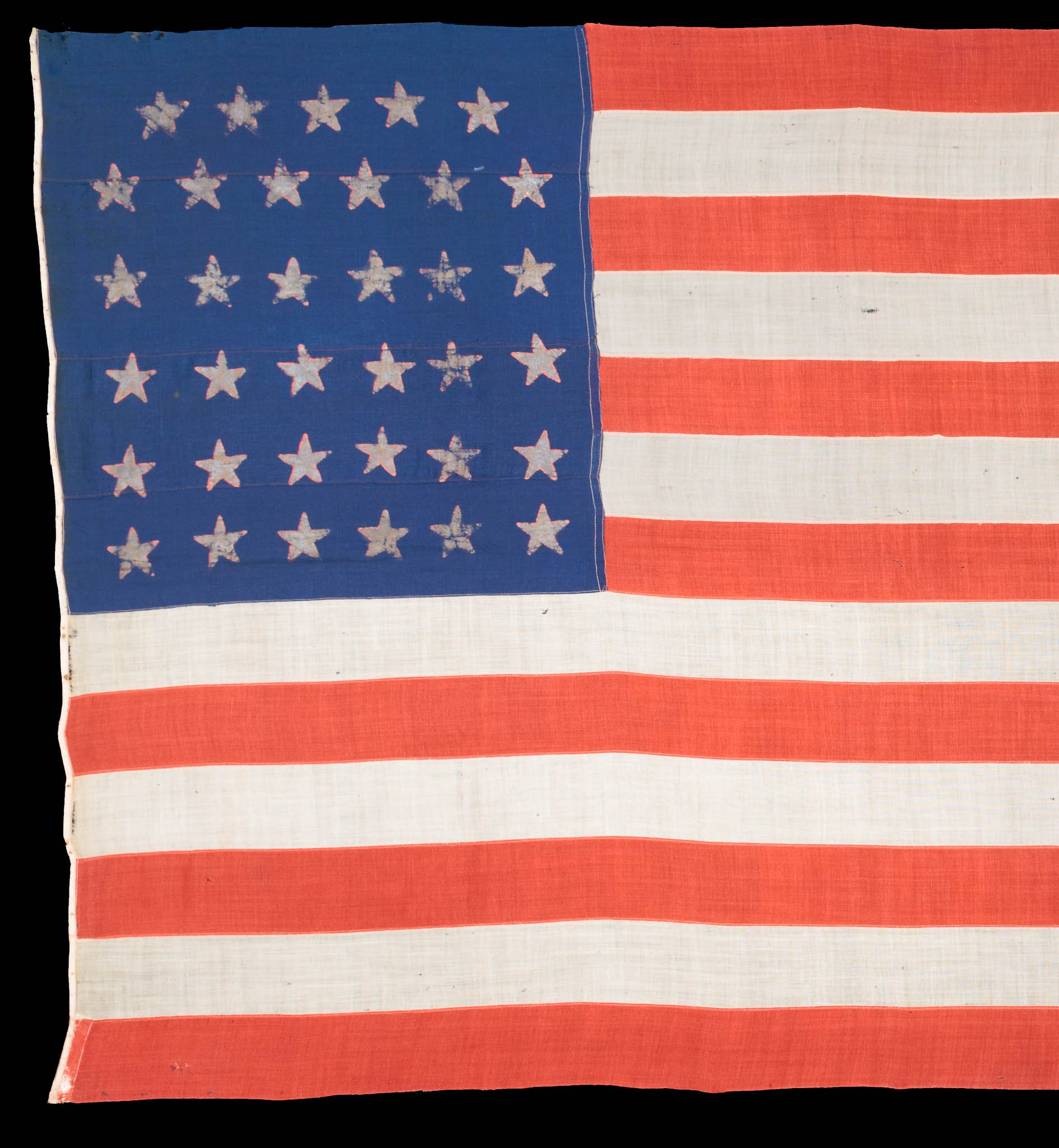
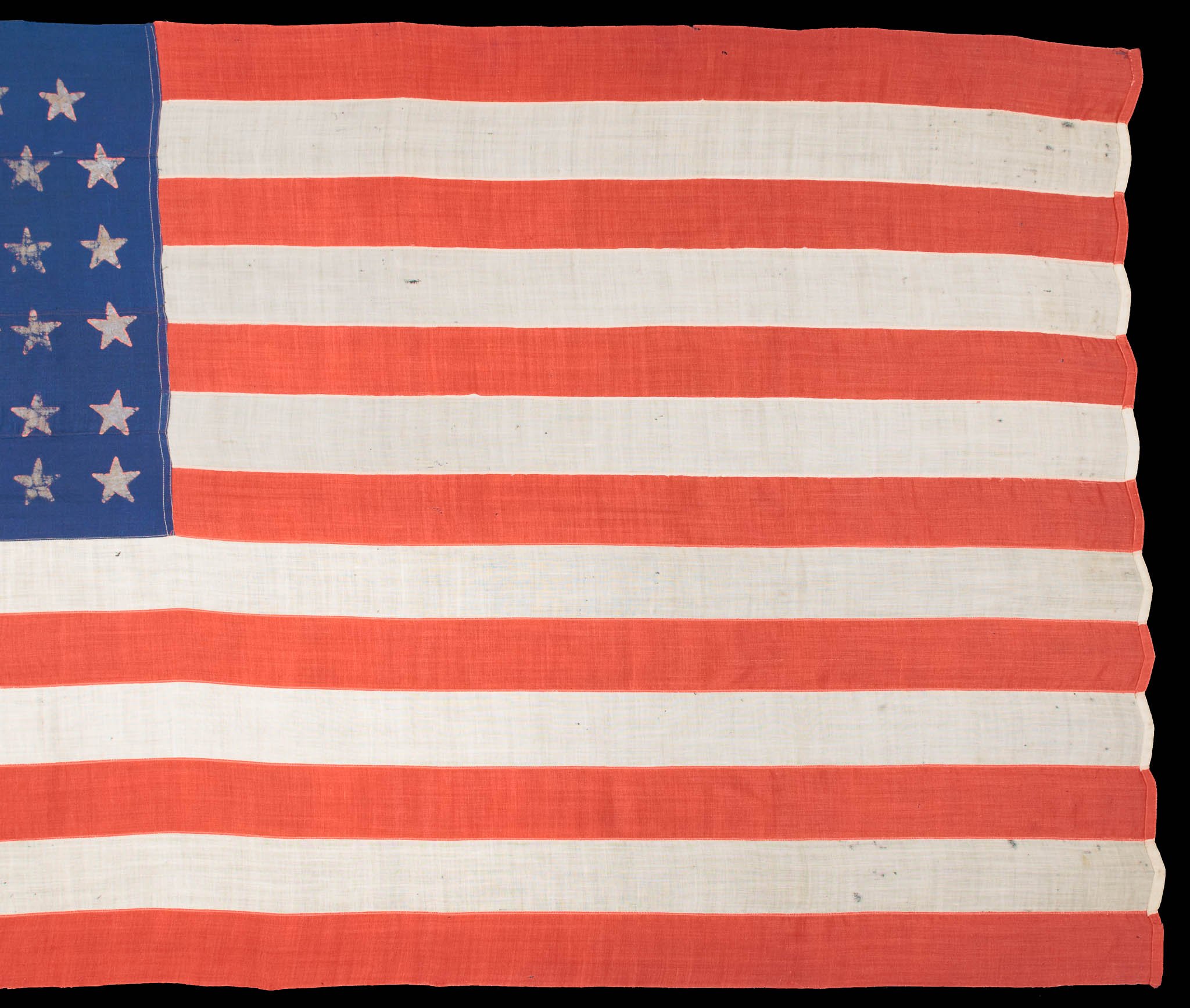
Offered is an exceptional 35-star American flag dating to the Civil War, circa 1863–1865. Constructed of wool bunting and featuring an unusual arrangement of painted stars, the flag is distinguished by its substantial size, striking coloration, and particularly interesting construction. Its 35 stars are arranged in 6 horizontal rows, in a 5-6-6-6-6-6 configuration. The stars exhibit an unusual combination of gold-toned and dark pigmentation, each outlined in red, creating a distinctive appearance seldom encountered on American flags of the period.
The 35-star American flag represents one of the most historically significant periods in the nation's history. West Virginia was admitted to the Union on June 20, 1863, becoming the 35th state. Its admission was particularly consequential, occurring in the midst of the Civil War and following the secession of Virginia from the United States. Unlike eastern Virginia, much of the state's western population remained loyal to the Union, ultimately pursuing separate statehood. The admission of West Virginia was therefore more than a routine expansion of the nation. It represented the formation of a new state from territory claimed by a Confederate state, an extraordinary development during a war being fought over the future of the Union.
The 35th star was officially added to the American flag on July 4, 1863. Its adoption coincided with 2 of the Civil War's most consequential military developments. The Battle of Gettysburg, fought July 1–3, 1863, ended with the defeat of General Robert E. Lee's invasion of Pennsylvania, while the Confederate stronghold of Vicksburg surrendered to Union forces on July 4. Together, these victories marked a major turning point in the conflict. The 35-star flag consequently emerged at a moment when the Union's military fortunes were improving, even as the outcome of the war remained uncertain.
Throughout the conflict, the United States continued to recognize the seceded Southern states as members of the Union, retaining their stars on the national flag. President Abraham Lincoln's administration maintained that secession was unlawful and that the Confederate states had never legally departed from the United States. The addition of West Virginia's star brought the total to 35 without removing any of the stars representing states in rebellion. In this respect, the flag embodied the federal government's position that the Union remained intact and would ultimately be restored.
The 35-star flag remained the official national flag from July 4, 1863, through July 3, 1865. Its relatively brief period of official use encompassed much of the latter half of the Civil War, including the Overland Campaign, the fall of Atlanta, Sherman's March to the Sea, and the eventual surrender of General Lee's Army of Northern Virginia at Appomattox Court House in April 1865. It was also the official American flag at the time of Lincoln's assassination, only days after Lee's surrender. Nevada entered the Union as the 36th state on October 31, 1864, although its star was not officially incorporated into the national flag until July 4, 1865. Consequently, the period during which the 35-star configuration was current was relatively short, particularly when compared with many 19th-century star counts.
The flag's construction is consistent with the materials and manufacturing practices employed by American flagmakers during the Civil War. Both the red and white stripes and the blue canton are fashioned from wool bunting, a lightweight, relatively open-weave woolen textile traditionally favored for flags. Wool bunting was particularly suitable for outdoor use because of its ability to withstand wind and exposure while remaining sufficiently lightweight to fly freely. It was widely employed in the manufacture of military, naval, and civilian flags throughout the 19th century.
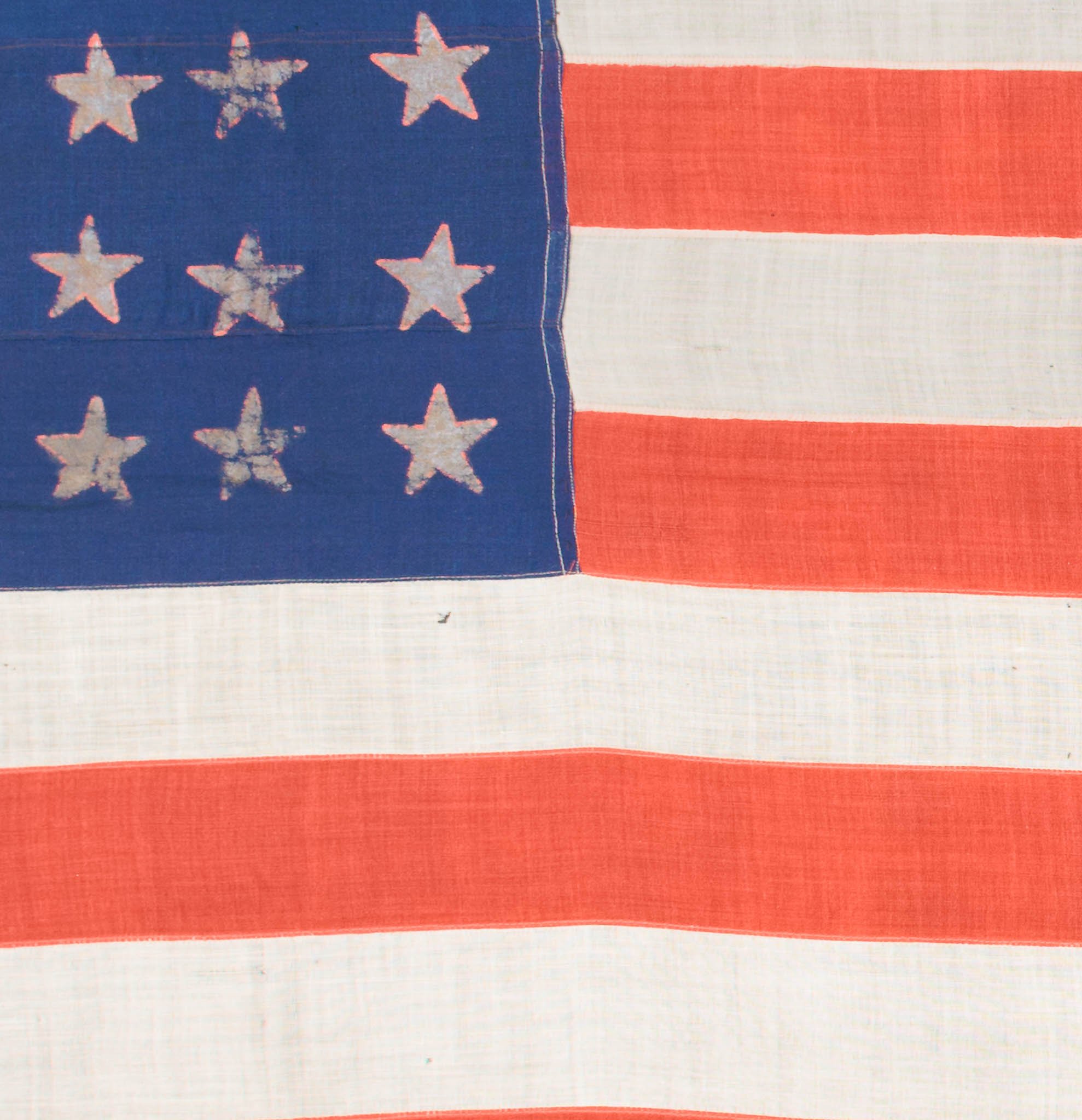
The canton is especially interesting, consisting of 4 separate pieces of blue wool bunting joined together with machine stitching. The use of multiple sections reflects the construction of larger 19th-century flags, when bunting was commonly manufactured in comparatively narrow widths and individual pieces were joined to produce the required dimensions. The red and white stripes are likewise constructed of wool bunting, with the stitching appearing to be machine-executed throughout. A narrow, apparently cotton hoist completes the assembly. The combination of wool bunting, a separate cotton hoist, and machine-sewn construction is entirely appropriate for a flag manufactured during this period.
Perhaps the most visually distinctive feature is the treatment of the 35 stars. Rather than employing the more familiar white cotton stars sewn or appliquéd to the canton, the stars are painted directly onto the blue wool bunting. Their gold-toned and dark appearance, combined with the pronounced red outlines, produces a particularly unusual color combination. The red borders distinguish the stars from the surrounding blue ground and introduce an additional element of color into the canton. The painted surfaces exhibit considerable variation, with some stars appearing lighter and others displaying more pronounced dark pigmentation. This variation contributes to the flag's individual character. While the precise composition of the paint has not been established, its appearance is markedly different from that of conventional white cotton appliqué stars.
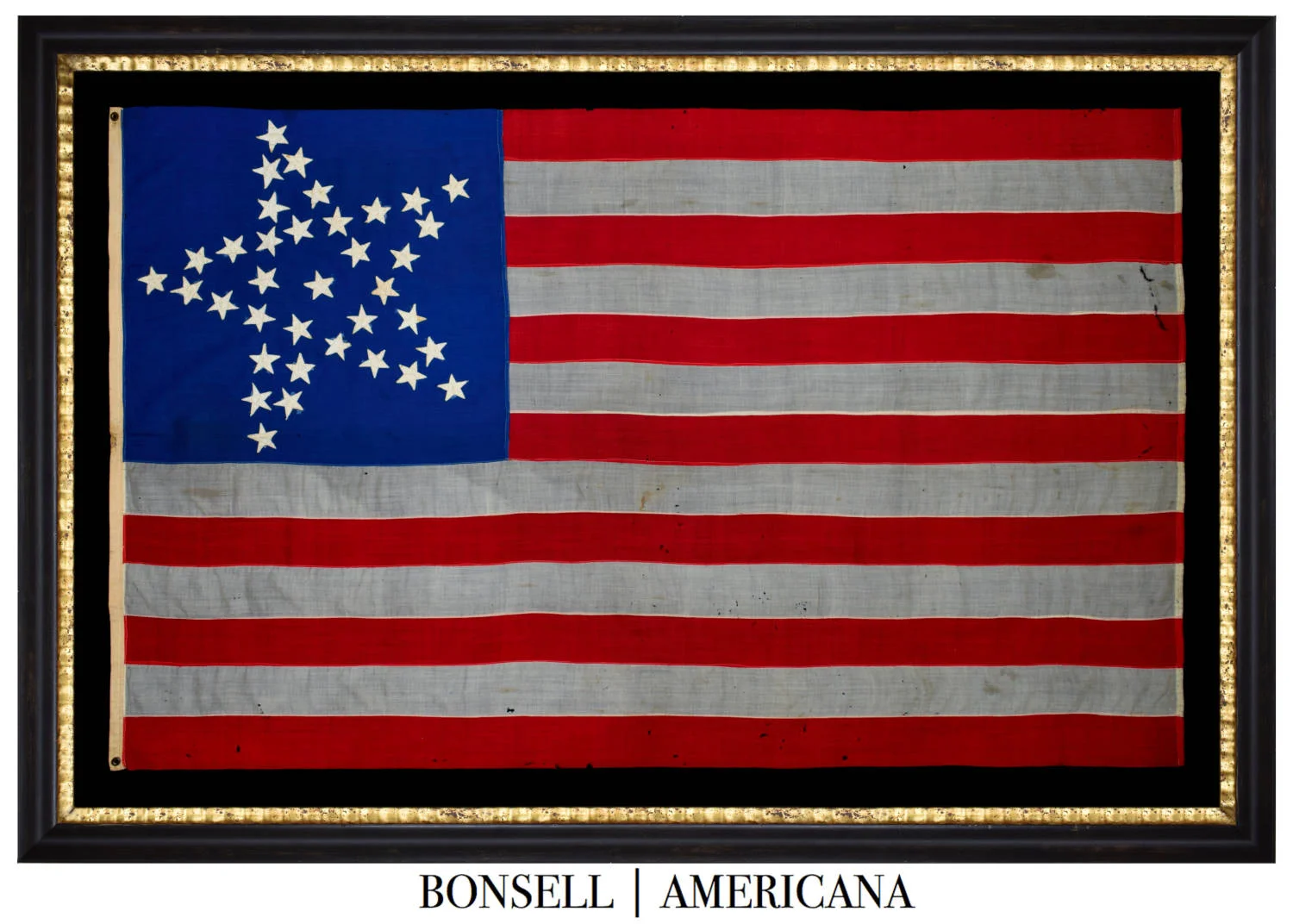
The arrangement of the stars further distinguishes the flag. The 35 five-pointed stars appear in 6 horizontal rows, with 5 stars occupying the uppermost row and 6 stars in each of the 5 succeeding rows. Although 35 stars are frequently encountered in arrangements of 5 rows of 7, there was no federally prescribed star configuration during the Civil War. Flagmakers exercised considerable latitude in arranging the stars, producing a variety of linear, staggered, medallion, and other patterns. The 6-row configuration employed here is an authentic period arrangement and is also documented on surviving Civil War military flags. Its slightly asymmetrical distribution gives the canton a distinctive appearance while preserving the orderly presentation characteristic of many commercially manufactured flags.
The use of painted stars is particularly noteworthy in the context of 19th-century flagmaking. Cotton appliqué stars were commonly used on sewn wool-bunting flags, requiring each star to be cut from fabric and attached individually. Applying the stars with paint eliminated that additional sewing operation and provided an alternative means of decorating the canton. Painted stars were employed on certain military and ceremonial flags of the period, including examples incorporating gold-colored stars. The present flag is especially distinctive for the appearance of its painted stars and their red outlines, an unusual departure from the more conventional white-on-blue treatment of the American flag.
With its substantial proportions and traditional 13-stripe construction, the flag possesses a commanding presence. Flags of this general type and scale were produced for a variety of purposes, including public and institutional display, patriotic celebrations, and other civilian or military settings. Although its original location and intended use have not been established, the flag's size, durable wool-bunting construction, and carefully assembled canton suggest that it was intended to serve as a prominent display of the national colors rather than as a small commemorative or decorative textile.
Today, surviving 35-star flags are particularly desirable for their direct association with the Civil War. Their comparatively narrow period of production, together with the considerable use and subsequent loss of 19th-century flags, makes authentic examples of interest to collectors and institutions specializing in American history. The present flag is further distinguished by its unusual painted stars, red outlining, 6-row configuration, and multi-piece wool-bunting canton. These characteristics combine to produce a visually compelling and historically important example of Civil War-era American flagmaking.
Dating squarely to the period in which the preservation of the Union was being decided, the flag represents an important chapter in American history. Its 35 stars commemorate the admission of West Virginia, while its construction and distinctive painted decoration illustrate the variety of materials and techniques employed by 19th-century flagmakers. Its substantial size, unusual coloration, and unmistakable Civil War association make it a particularly notable surviving example of the American national flag from 1863–1865.
Conservation Process: This flag was hand sewn to cotton fabric, and both were hand sewn to a mounting board. To prevent the black dye in the cotton fabric from seeping into the flag, it was first washed in a standard wash and then in a dye setting wash. The flag is positioned behind Optium Museum Acrylic.
Frame: The flag is presented in a substantial, wide-profile wooden frame featuring a distressed black finish with subtle natural undertones. The flat face, gently textured surface, and restrained detailing provide a traditional appearance that complements the historic character of the flag.
Condition Report: The flag remains in very good overall condition, with strong coloration and a generally intact wool-bunting construction. Scattered areas of discoloration, minor staining, and small spots of wear are present throughout, consistent with age and use. The painted stars exhibit varying degrees of pigment loss and surface wear, while the stripes retain their vibrant red and contrasting white coloration.
Collectability Level: The Great – Perfect for Rising Collectors
Date of Origin: 1863-1865
Number of Stars: 35
Associated War: Civil War (1861-1865)
Associated State: West Virginia