33 Star Antique Flag with an Exotic Pentagon-Formed Medallion | An Exceptional Flag in Every Respect | Oregon Statehood | Circa 1859-1861
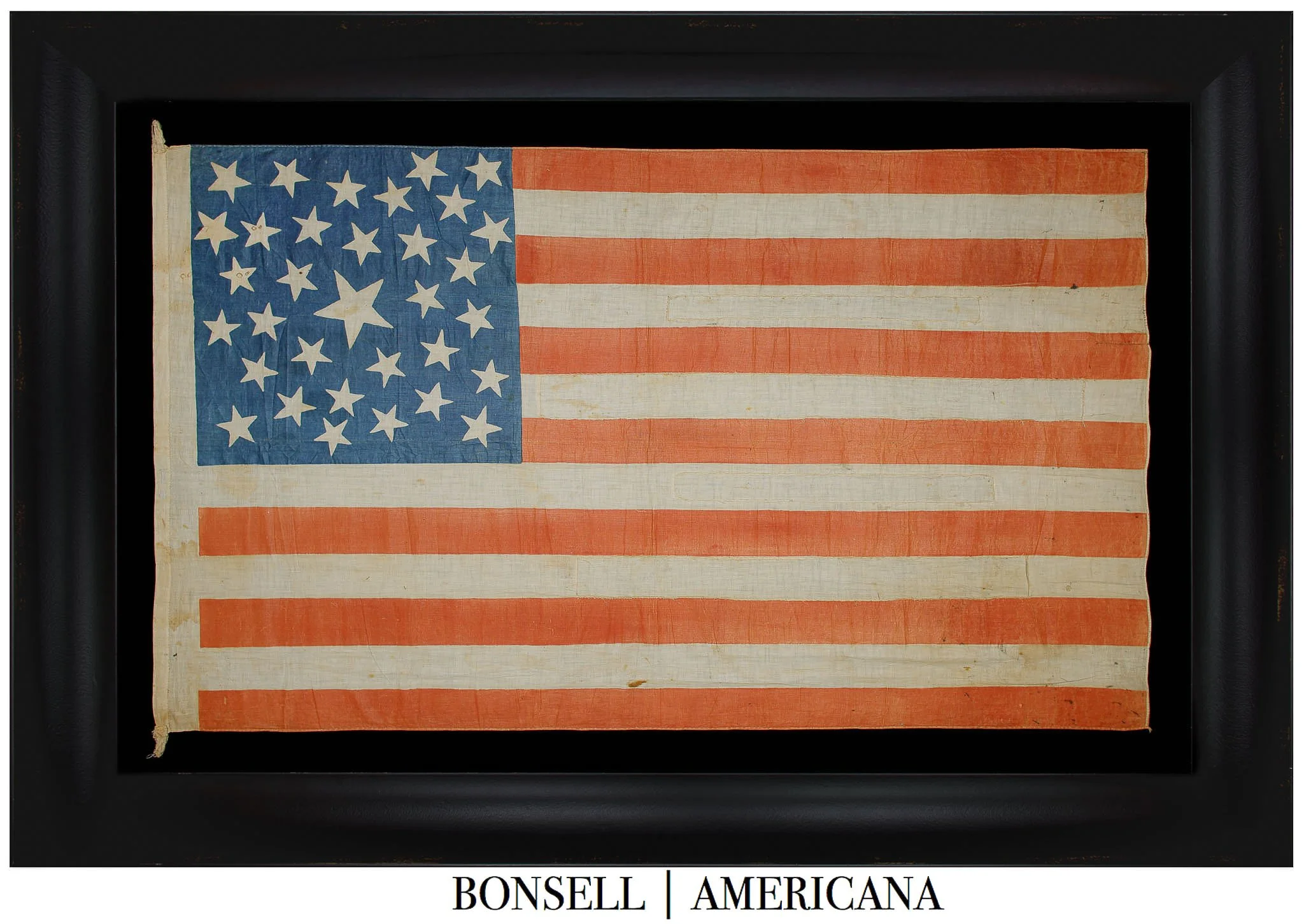


33 Star Antique Flag with an Exotic Pentagon-Formed Medallion | An Exceptional Flag in Every Respect | Oregon Statehood | Circa 1859-1861
Price: Call 618-553-2291, or email info@bonsellamericana.com
Frame Size (H x L): 42” x 62”
Flag Size (H x L): 30.5” x 50.5”
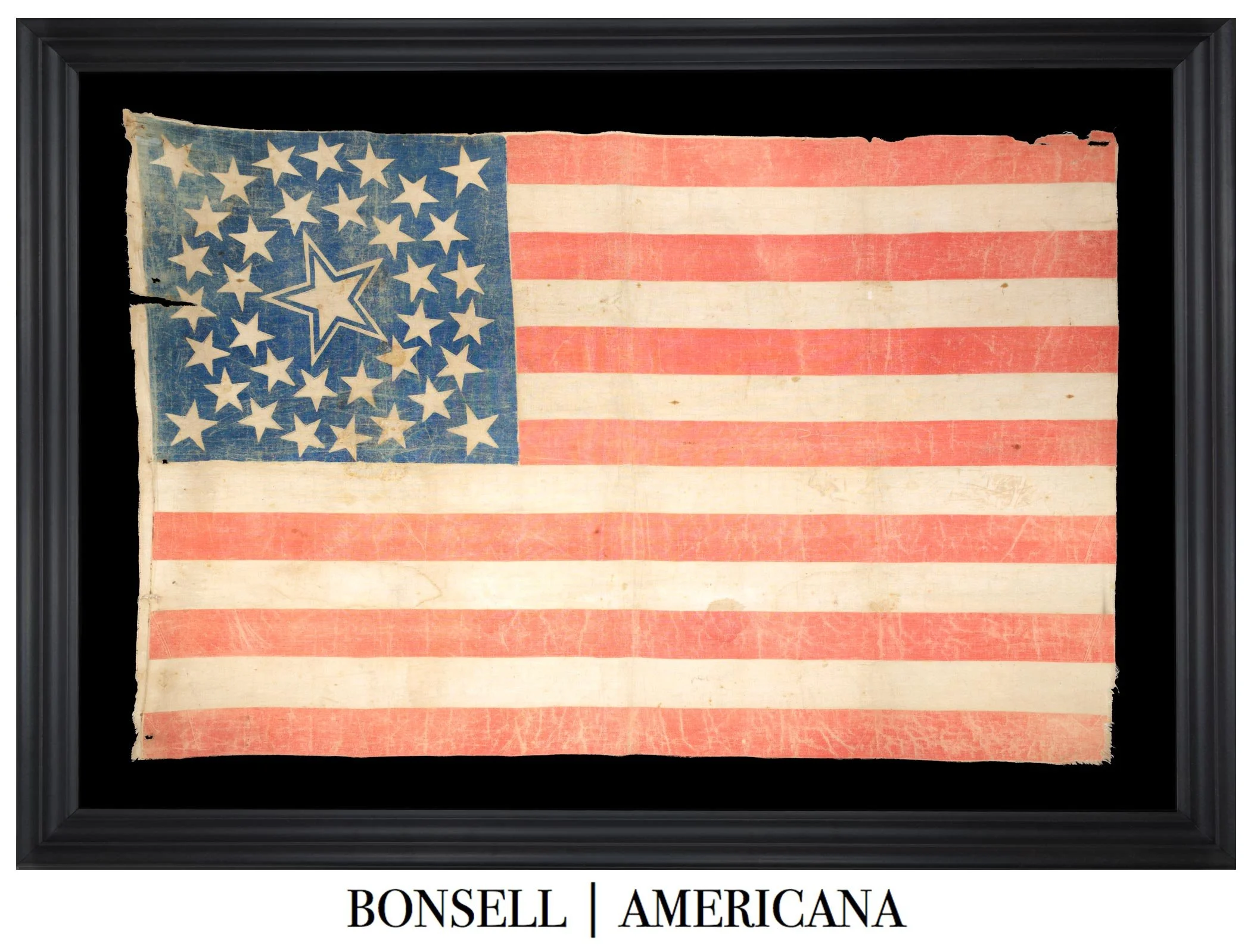
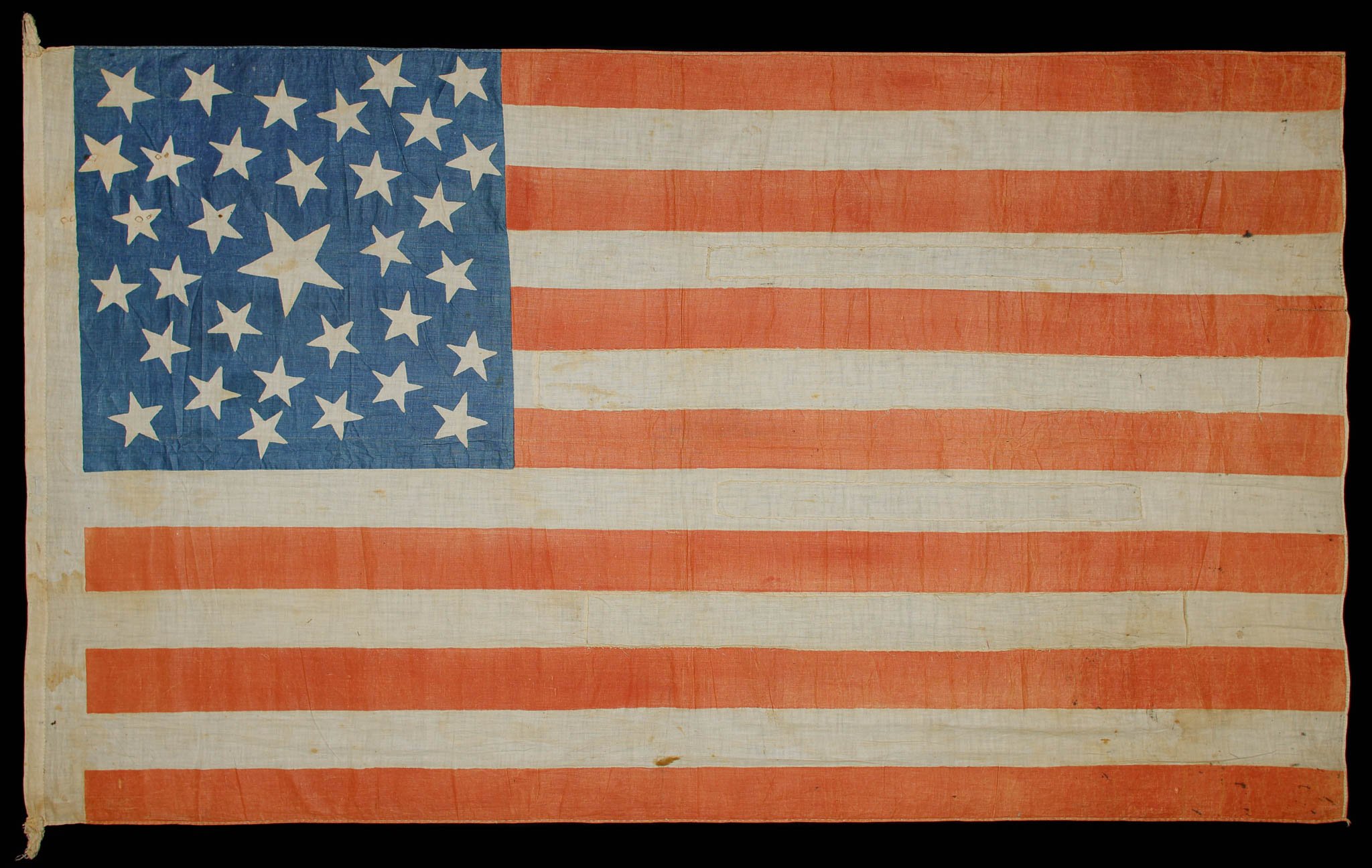
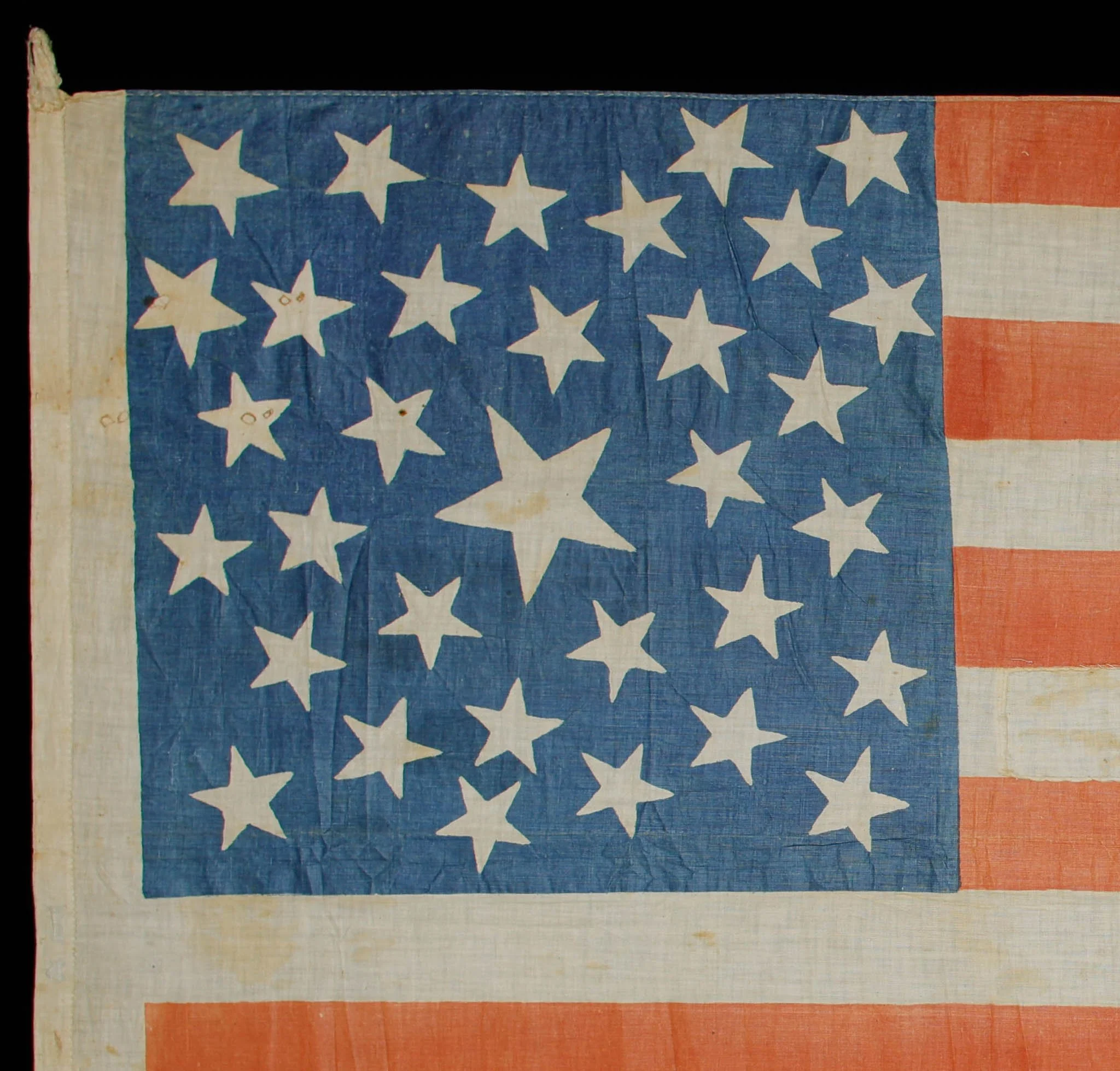
Offered is an extraordinary antique American flag printed on a fine, thin cotton fabric that presents with an unusually smooth and lustrous surface. Though at first glance it almost evokes the sheen of silk, the textile is glazed cotton—a material often prized by mid-19th-century textile printers for its crisp finish and ability to take saturated color. The canton is printed in a rich indigo blue that slightly darkens where the glaze remains strongest, while the stripes appear in a vibrant shade that reads today as orange-red rather than the deep scarlet seen on modern flags. This tonal variation was common among mid-19th-century examples, as no official specification for the national colors yet existed, and the appearance of the red often reflected the particular dye formulas available to individual printers or the natural fading of the pigment over time. Each of the red stripes exhibits a faintly raised texture from the pigment application, sometimes referred to as a “paint-printed” or “pigment-dyed” process.
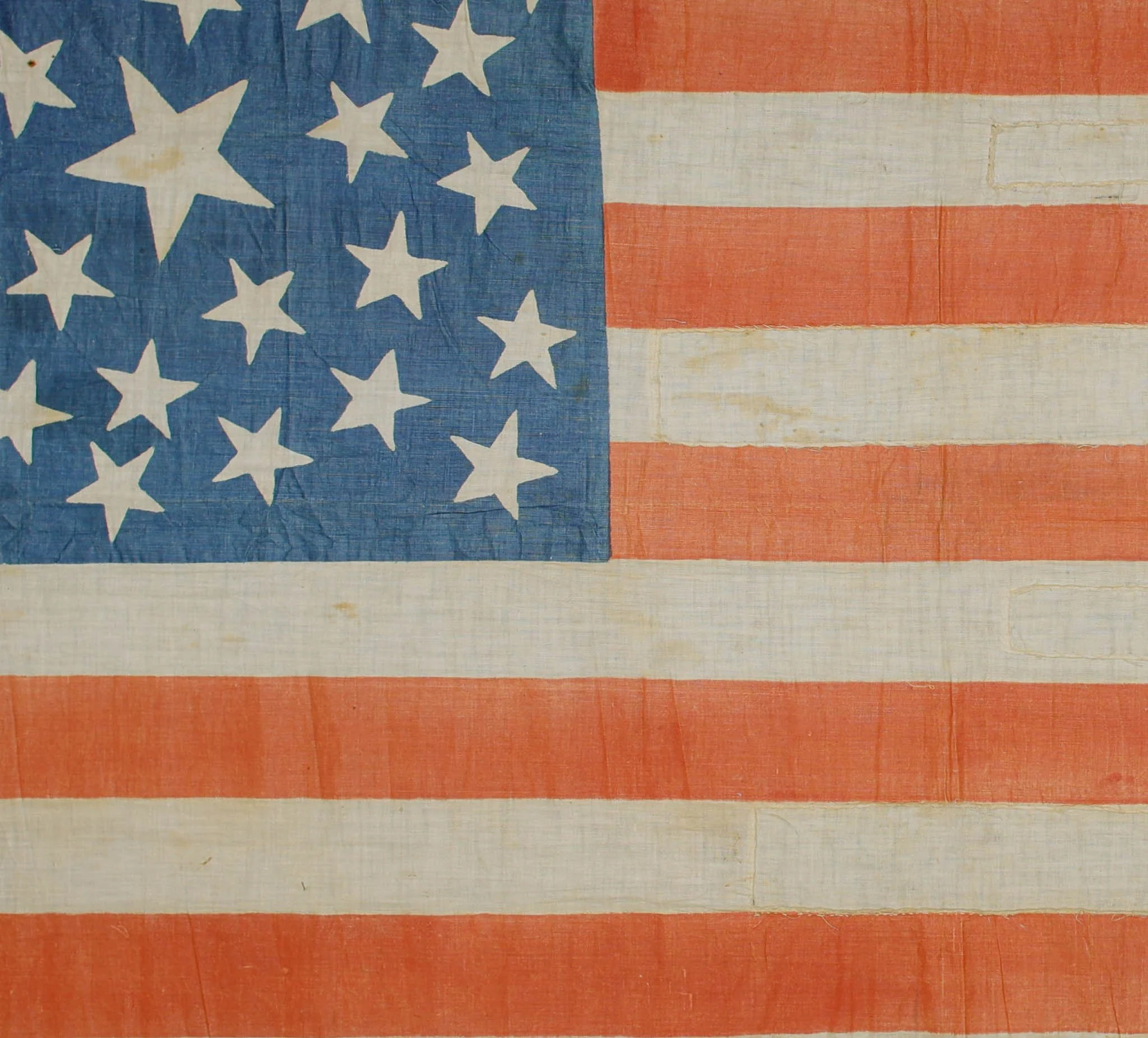
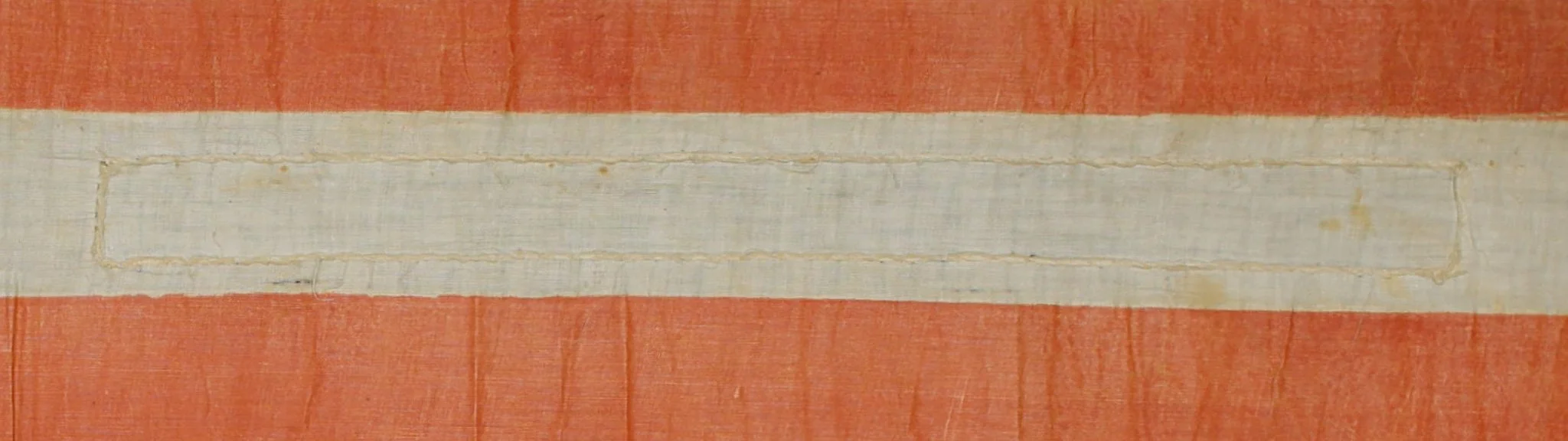
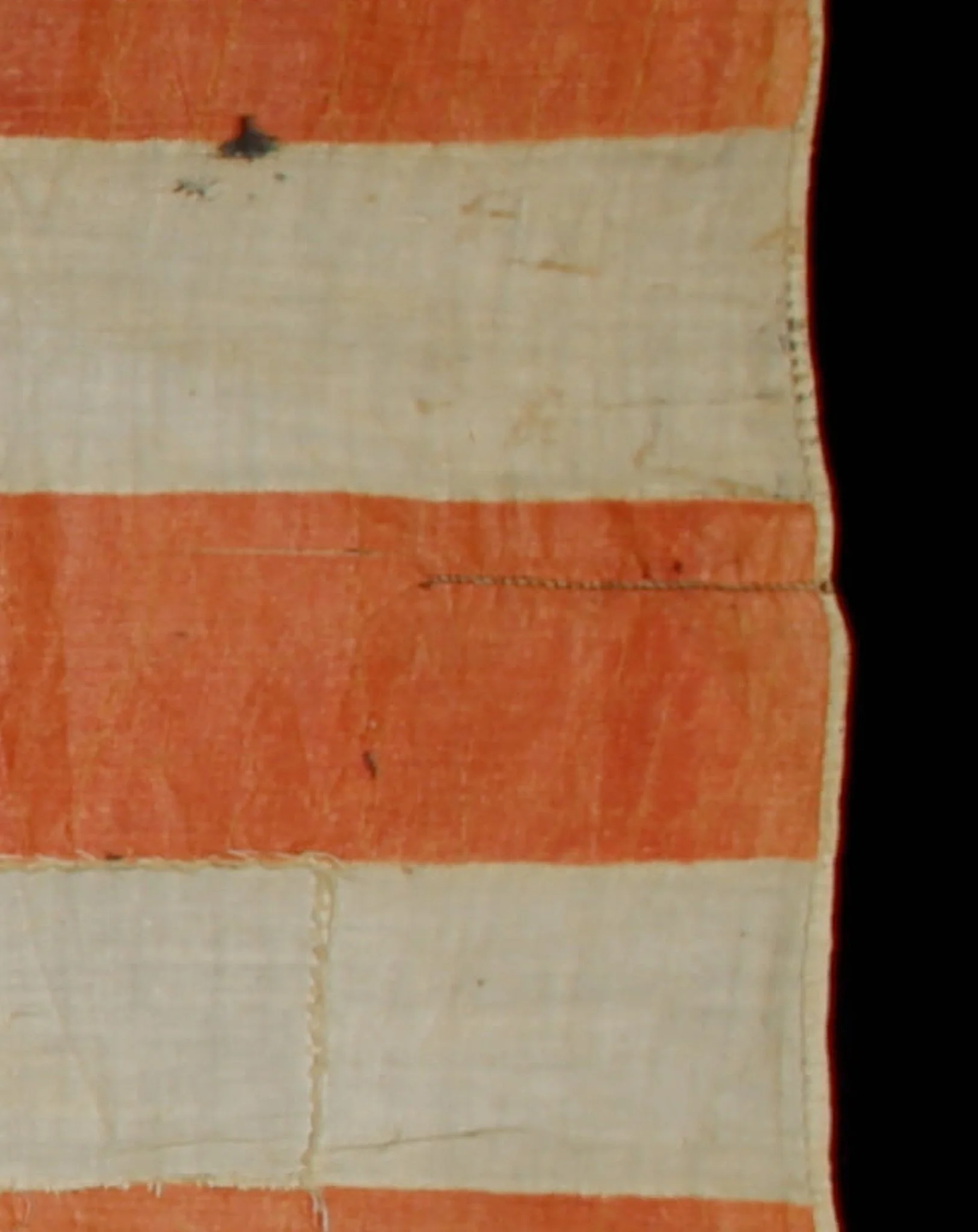
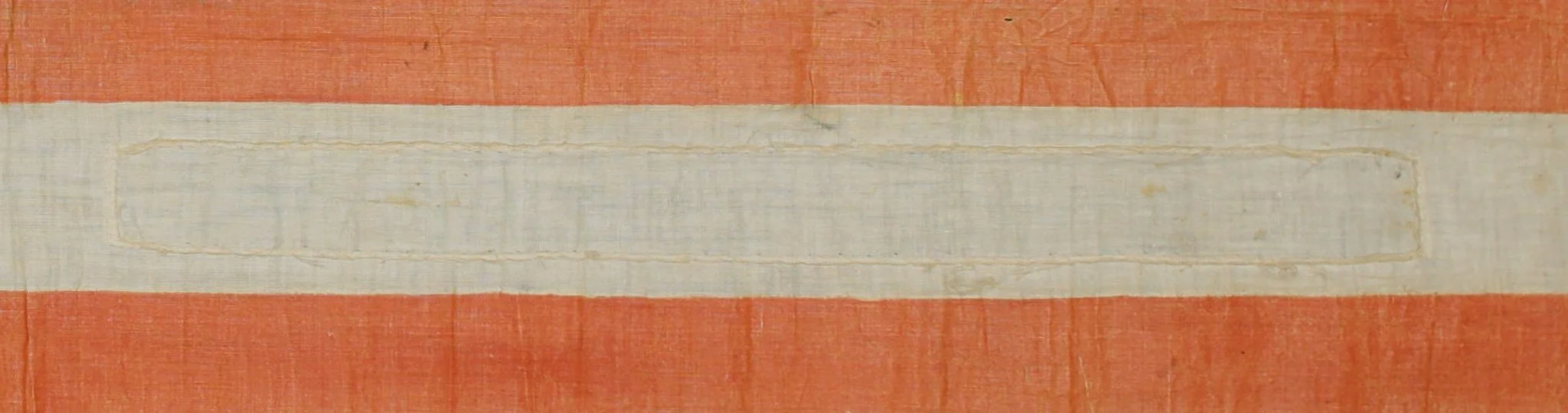
The white stripes display an especially intriguing feature: several hand-sewn patches that appear to be period repairs or intentional reinforcements, made from fabric identical to the surrounding material. Their hand stitching is neat and deliberate, suggesting an early attempt to correct printing or structural irregularities. Whatever the purpose, the presence of these period-applied patches adds to the flag’s individuality and speaks to the resourceful, hands-on nature of early textile making.
A separately applied cotton hoist is machine-stitched to the flag’s left edge, with short cords at both the upper and lower corners, indicating that it was once intended for functional display. The flag is exceptionally lightweight and delicate in hand, its surface marked by subtle creases and the characteristic sheen of early printed cotton flags produced during the Civil War era, circa 1859–1861.
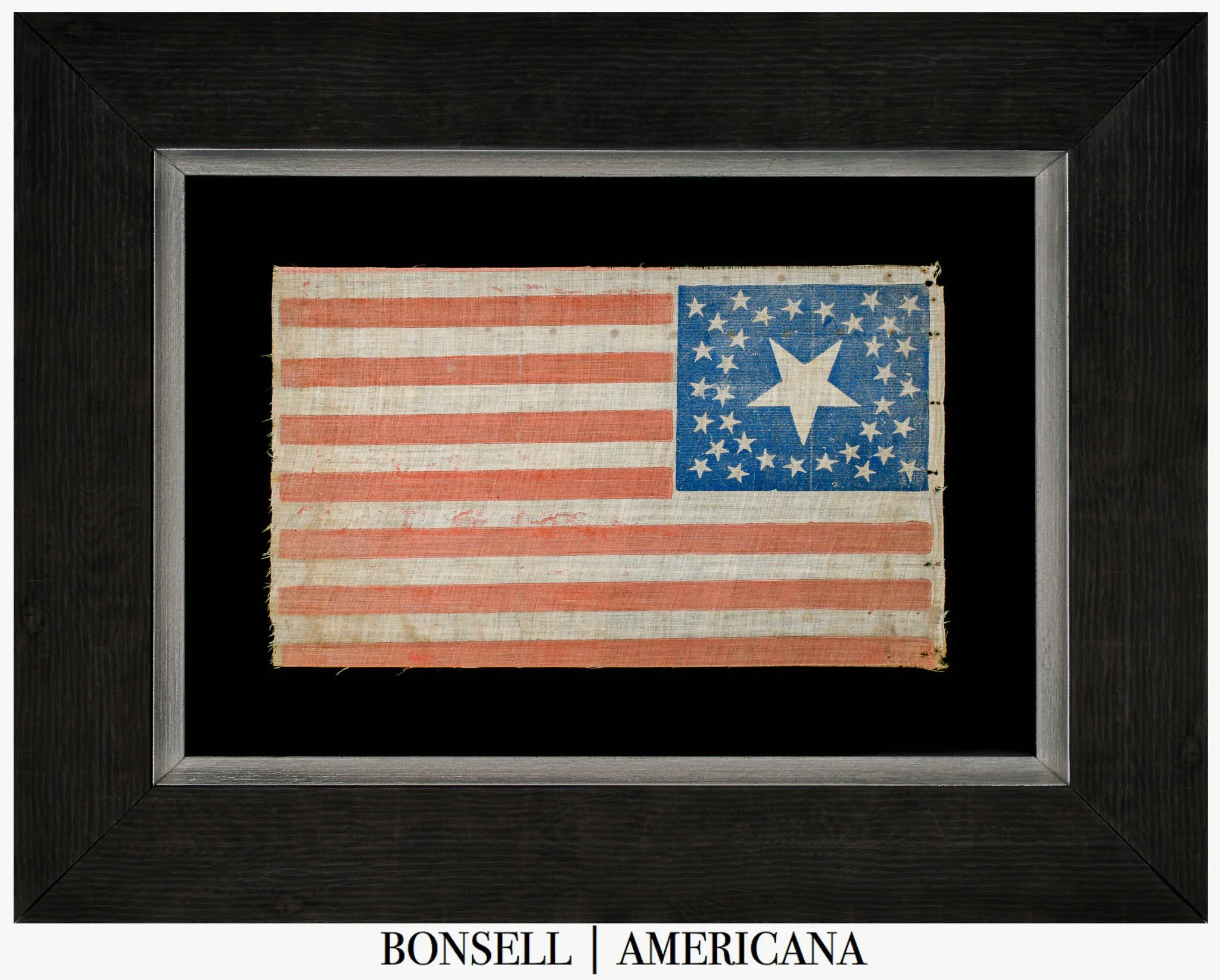
The configuration of stars on this 33-star flag belongs to a small and fascinating group of designs generally classified as pentagon or heart medallions—patterns that emerged during the late 1850s and persisted into the early years of the Civil War. In this example, a large central star, representing Oregon’s admission as the 33rd state in 1859, anchors the design. Around it are two loosely pentagonal rings of smaller stars, producing a form that falls somewhere between a five-sided figure and a subtle shield shape. The result is a layout that is geometrically deliberate but slightly irregular, a quality that gives early printed flags of this period their distinctive handmade character.
This format is closely related to the series of medallion-style flags associated with H.C. Howard of Philadelphia, one of the most important early makers of printed parade flags. Active from roughly 1856 through the early 1860s, Howard’s name appears on documented examples made for presidential campaigns including those of John C. Frémont and Abraham Lincoln. His designs are noted for their bold central stars, experimental geometry, and unusually fine printing quality for the time. While this flag bears no maker’s mark, its structural rhythm and medallion form align strongly with Howard’s known work or that of those influenced by his shop, which helped set the visual language for pre-war and early wartime flag design.
The use of a large central star carries both symbolic and compositional meaning. In 19th-century American flags, the center star was often used to emphasize new statehood or the unity of the nation as a whole. Here it marks Oregon’s addition to the Union—a moment of western expansion and fragile national optimism on the eve of conflict. This convention—highlighting the newest state through size or placement—became common among skilled flag printers, allowing a single star to serve as both a visual anchor and a narrative device within the canton.
Oregon’s path to statehood was long and politically complex. Originally part of the vast Oregon Territory established in 1848, the region’s admission as a state was driven by years of settlement along the Oregon Trail and debates over the expansion of slavery. The territory’s provisional government had already outlawed slavery in 1844, and when Oregon sought admission, it entered the Union as a free state—an outcome that heightened sectional tensions in the years preceding the Civil War. President James Buchanan signed the act admitting Oregon on February 14, 1859, making it the nation’s 33rd state and extending American sovereignty to the Pacific Northwest. The inclusion of Oregon added both geographic reach and symbolic weight to the Union, representing the final realization of a continental republic just as the nation was fracturing along ideological lines.
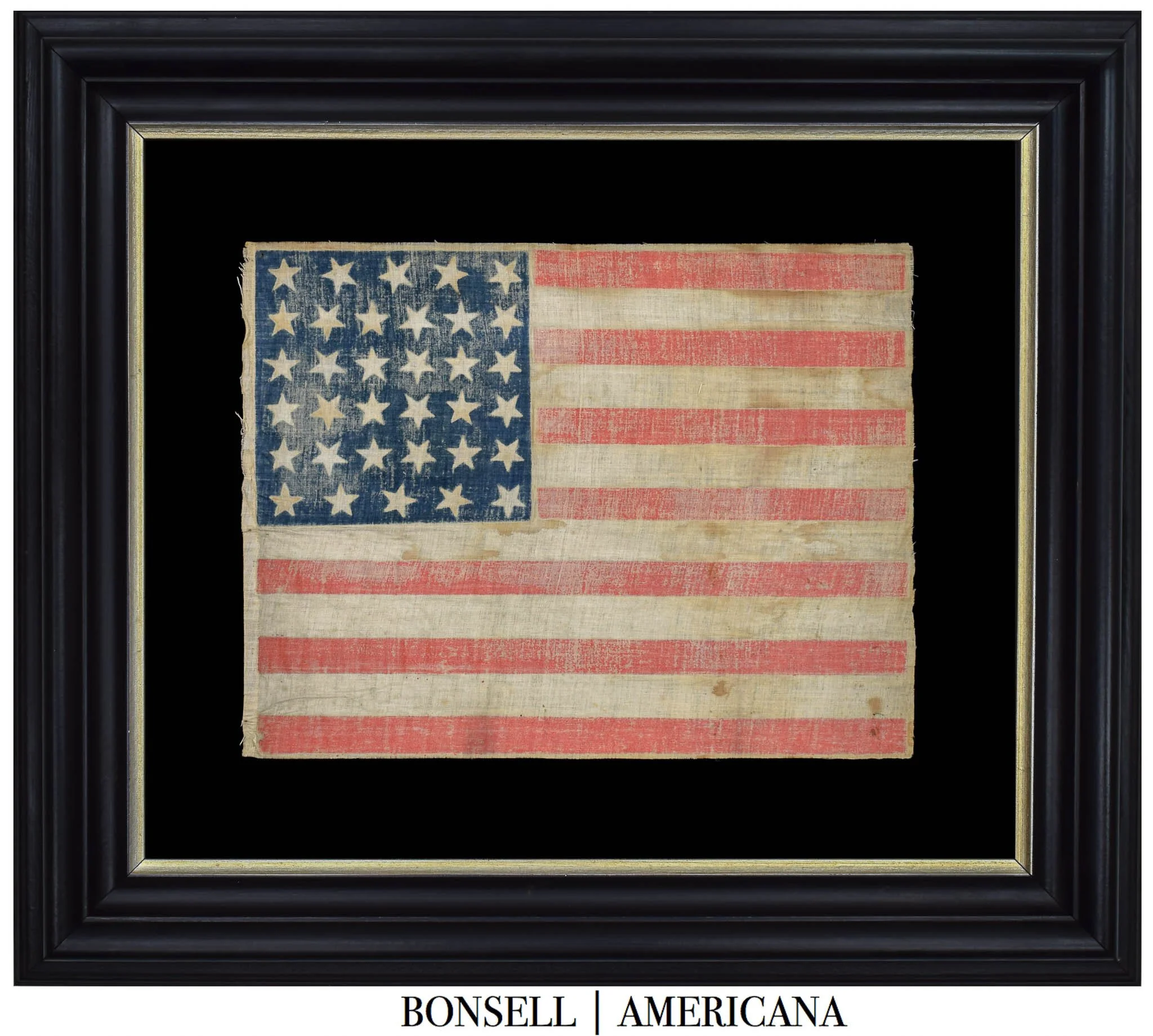
The 33-star flag represents a narrow and historically pivotal moment. Oregon achieved statehood on February 14, 1859, and the flag bearing 33 stars became official on July 4 of that year. It remained current until July 4, 1861, when Kansas’ admission introduced the 34-star flag. For this reason, the 33-star flag bridges two eras: the final years of the antebellum period and the first months of the Civil War. One such flag was flying above Fort Sumter when Confederate forces opened fire in April 1861.
Flags associated with this brief window are among the rarest of all American flags. Prior to the Civil War, Americans seldom displayed the national flag for patriotic purposes, and even the U.S. Army did not regularly carry it until the 1830s and 1840s. Before this time, the Stars and Stripes functioned mainly as a naval ensign, and most examples were extremely large. Consequently, pre-war flags—especially small printed examples suitable for personal use—represent only a minute portion of surviving 19th-century flags.
The 33-star era thus occupies a unique position in American history. It marks the final official design adopted before the outbreak of war and the first widely produced during it. The rise of patriotic sentiment surrounding Lincoln’s election and the preservation of the Union spurred the creation of small printed flags for rallies, parades, and home display—objects that transformed the Stars and Stripes from a maritime signal into a national symbol of unity.
Because production of 33-star flags ended by mid-1861, surviving examples are exceedingly scarce. This flag, with its fine printed cotton construction, luminous surface, rare pentagon-style medallion, and curious period hand-sewn patches, represents not only the artistic innovation of its maker but also the moment when Americans first began to embrace the flag as a personal emblem of loyalty and identity.
Conservation Process: This flag was hand sewn to cotton fabric, and both were hand sewn to a mounting board. To prevent the black dye in the cotton fabric from seeping into the flag, it was first washed in a standard wash and then in a dye setting wash. The flag is positioned behind Optium Museum Acrylic.
Frame: The flag is presented in a deep, black-painted frame with a softly scooped profile and a lightly weathered surface that reveals subtle undertones of warm brown beneath the finish. The design is both substantial and refined, with a gently burnished texture that complements the age and character of the flag. Its depth allows the textile to be recessed slightly, giving the presentation a shadowbox effect that enhances contrast and visual presence.
Condition Report: The flag presents beautifully with strong color and excellent overall preservation for its period. The orange-red stripes remain vivid, and the blue canton retains much of its original depth and saturation. Scattered, small hand-sewn patches appear in the white stripes, all executed in matching period fabric and thread, adding both character and evidence of early care or construction refinement. Minor toning, light creasing, and modest wear are present, consistent with age and the delicate nature of mid-19th-century printed cotton, but the flag survives in an exceptional state of integrity for a pre–Civil War example.
Collectability Level: The Extraordinary – Museum Quality Offerings
Date of Origin: 1859-1861
Number of Stars: 33
Associated War: Pre-Civil War
Associated State: Oregon