Grover Cleveland Portrait Campaign Flag | 36-Star Medallion Configuration | Unusual Shield Portrait Design | Circa 1884
Grover Cleveland Portrait Campaign Flag | 36-Star Medallion Configuration | Unusual Shield Portrait Design | Circa 1884
Frame Size (H x L): 6” x 8”
Flag Size (H x L): 2.25” x 4.25”
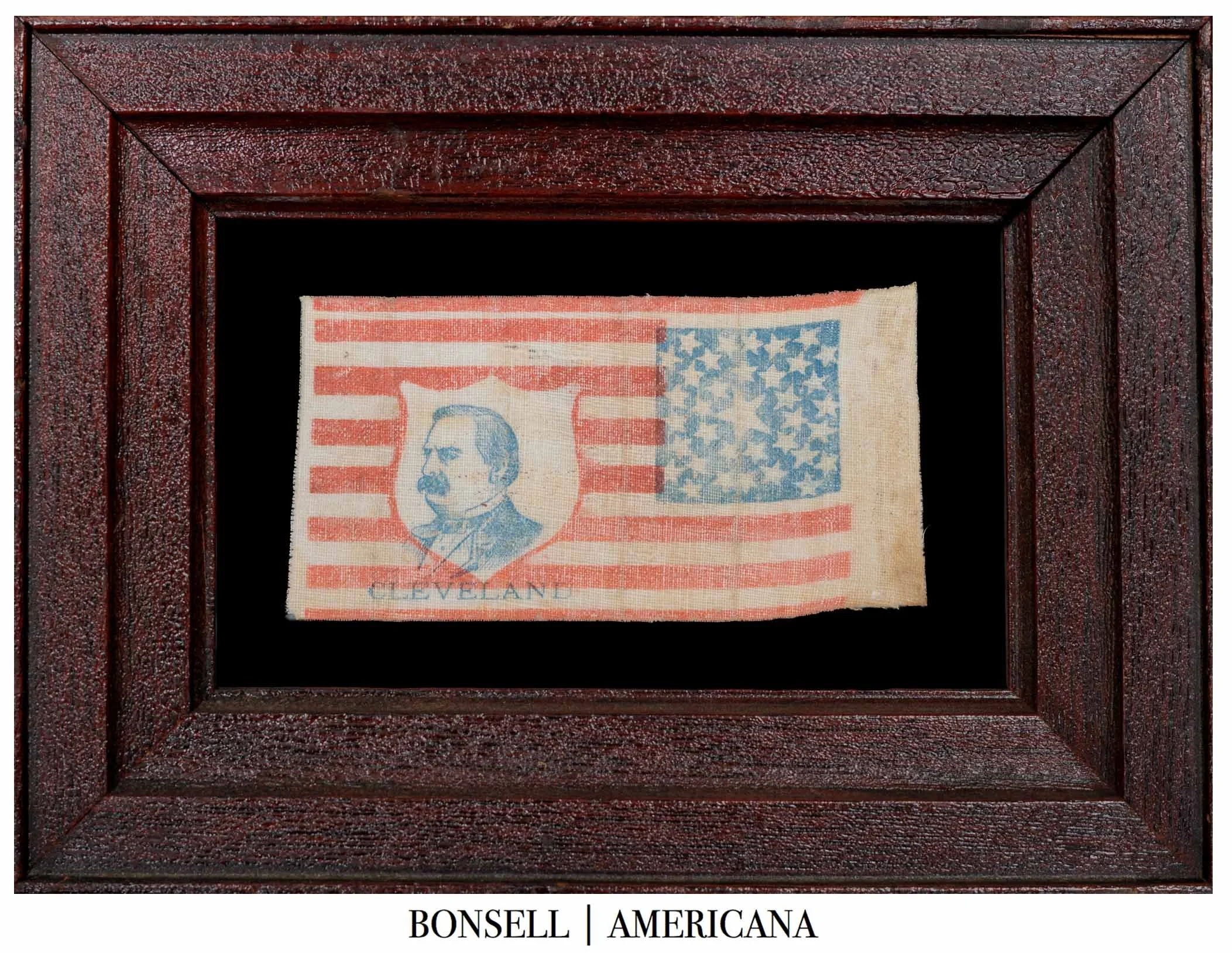
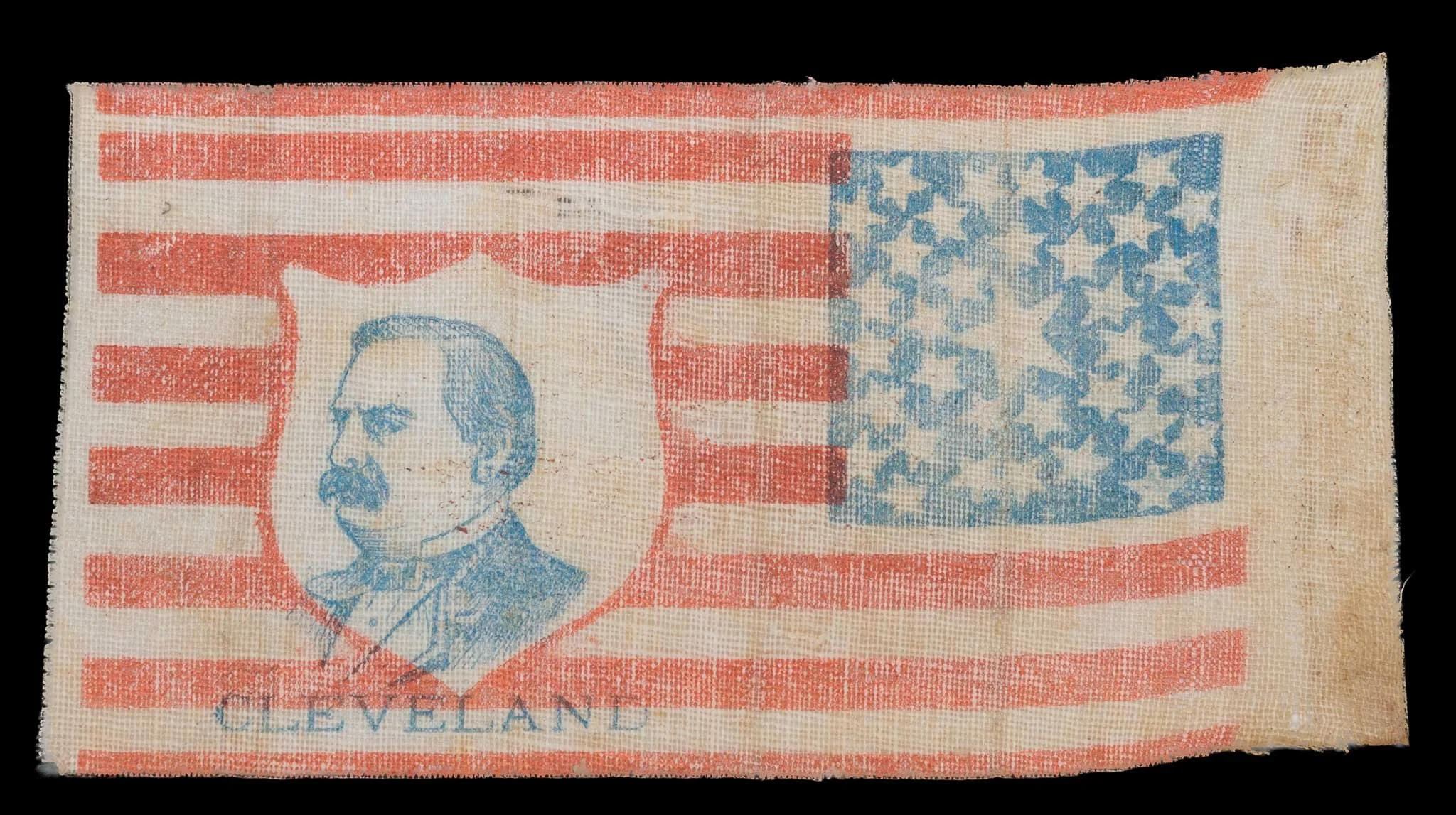
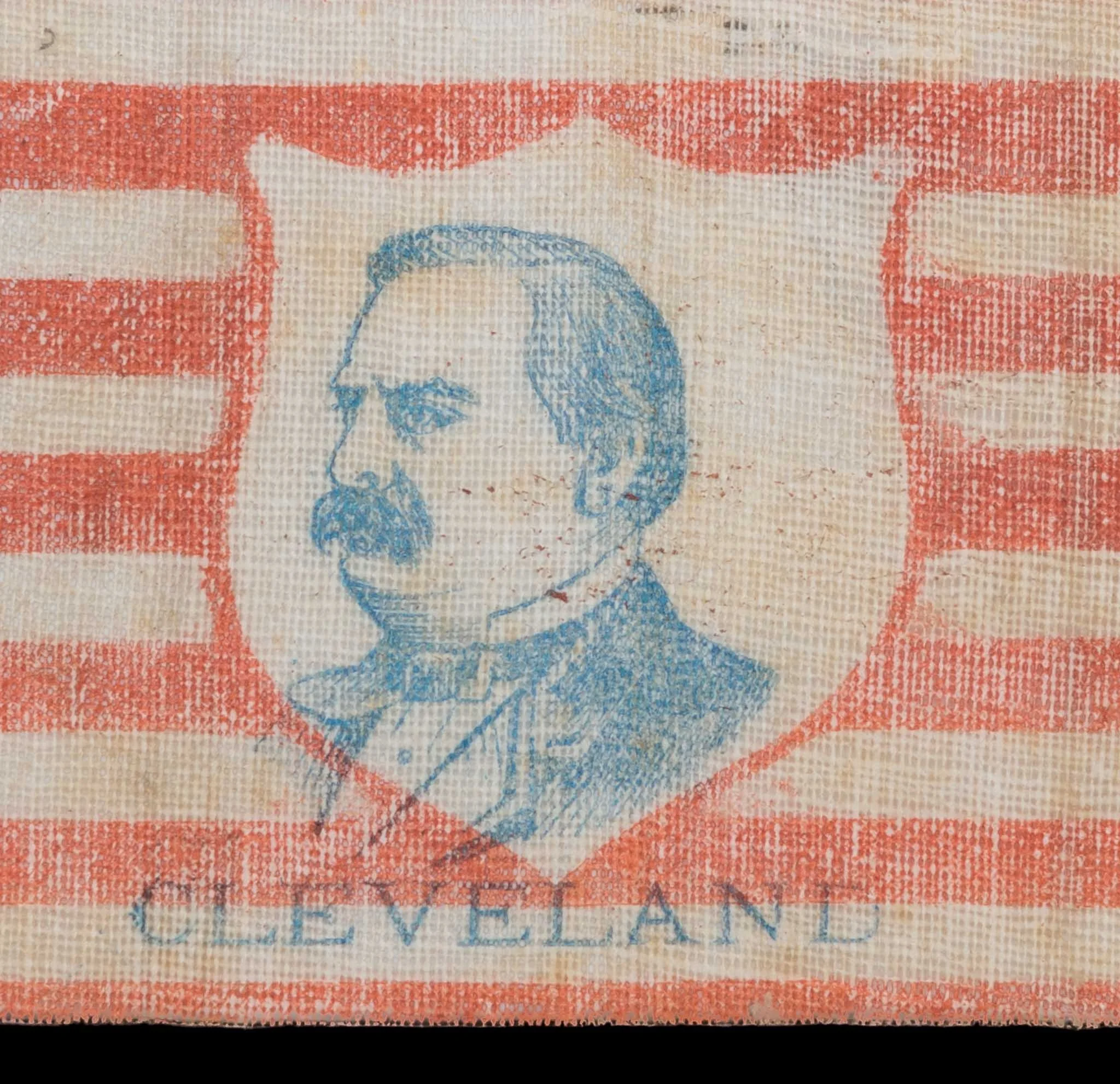
Offered is a miniature portrait campaign flag of Grover Cleveland, printed on coarse cotton and dating to the 1884 presidential election. The textile features Cleveland’s likeness rendered in blue within a shield, set against a field of red stripes and a blue canton populated by 36 stars. Beneath the portrait appears a bold, block-letter overprint reading “CLEVELAND,” executed in the same blue pigment. Small in scale yet visually assertive, the piece belongs to a scarce and highly collectible class of political textiles produced for campaign display and distribution.
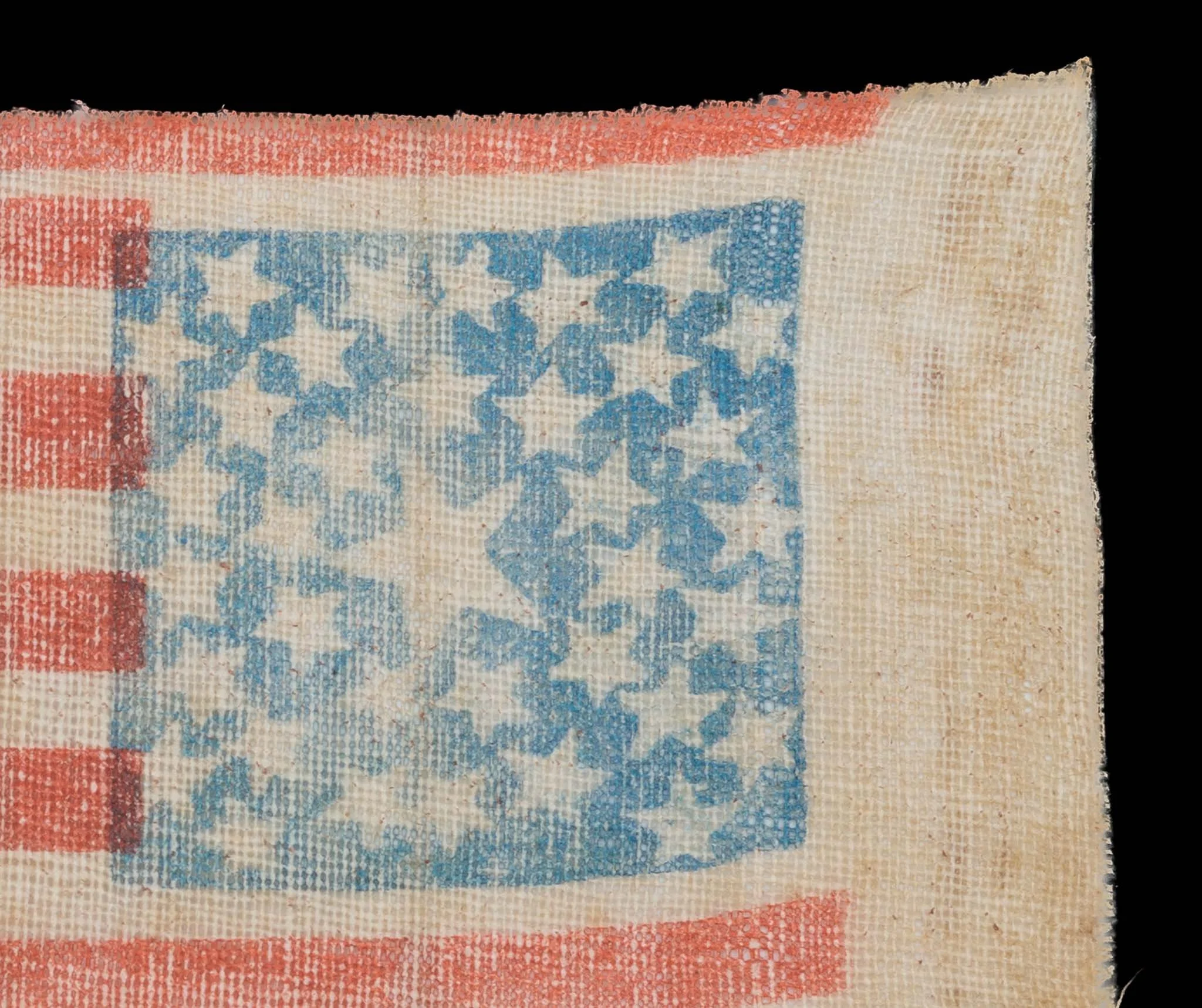
The canton presents a medallion star configuration, a format rooted in mid-19th century design. A large central star—distinctively canted—anchors the composition, encircled by two rings of smaller stars, with additional stars completing the outer field. In total, the design incorporates 36 stars, corresponding to Nevada’s admission to the Union. While this count was official from July 4, 1865, to July 3, 1867, it was long obsolete by the time of Cleveland’s 1884 campaign, when the nation bore 38 states. The presence of a 36-star count here is therefore not literal, but instructive: it strongly suggests that the printing block employed for this flag originated earlier and was retained for later use. Rather than commissioning a new, updated design, printers appear to have repurposed an existing block, preserving both the earlier star count and the medallion format.
This retention of anachronistic imagery was not uncommon in inexpensive campaign ephemera. In this instance, it yields a visually compelling hybrid—late 19th-century political messaging expressed through a design vocabulary more typical of the Civil War era. The medallion configuration itself, with its celebratory and somewhat ornamental character, had largely fallen out of favor by circa 1890, replaced by rectilinear arrangements following the standardization of the flag in 1912. Its presence here adds both aesthetic distinction and historical depth.
Notably, the flag is presented in reverse orientation, with the canton appearing at the upper right rather than the upper left. This is not an error. During the 19th century, there was no official designation of a “front” or “back” to the American flag, nor a universally mandated canton position in printed parade flags and small textiles. As such, reverse-oriented examples like this are encountered and should be understood within the flexible conventions of the period.
The inclusion of a portrait within a shield is another point of distinction. While political textiles frequently incorporate candidate names or slogans, figural portraiture—especially integrated into a shield device—is less commonly encountered in flags of this scale. Cleveland’s likeness is crisply executed given the medium, with the shield serving both as a framing device and as a symbolic reference to national identity and civic virtue. The pairing of portrait and overprint reinforces the object’s intended function: immediate visual recognition in a crowded campaign environment.
From a production standpoint, the flag exhibits characteristics consistent with economical, large-quantity manufacture. The cotton is of a coarse, plain weave, and the pigments sit atop the fibers rather than penetrating them fully, indicative of block or stencil printing. Minor irregularities in saturation and registration are visible upon close inspection, lending the surface a slightly uneven but authentic quality. These features align with known examples of period campaign flags, which prioritized speed and cost-efficiency over refinement.
Historically, the flag relates to the fiercely contested 1884 presidential election between Grover Cleveland and James G. Blaine. Cleveland, the Democratic governor of New York, ran on a platform of reform and opposition to political corruption, while Blaine, the Republican nominee, carried the baggage of prior scandal. The campaign was marked by intense partisan rhetoric and remains one of the more colorful contests of the late 19th century. Objects such as this were produced to galvanize public support, serving as both promotional tools and personal tokens of political allegiance.
Examples of Cleveland campaign flags in this format are infrequently encountered, and those incorporating a medallion star field and portrait-on-shield design are particularly scarce. Campaign flags as a category occupy a special position within the field of American flag collecting, bridging political history and textile design. Their ephemeral nature—produced for short-term use and often discarded—has ensured that surviving examples are limited.
In sum, this is a compelling and visually distinctive example of late 19th-century political material culture: a Grover Cleveland campaign flag that combines an earlier star configuration, a dynamic medallion layout, and an uncommon portrait presentation within a single, compact textile.
Conservation Process: The flag was hand sewn to cotton fabric, and both were hand sewn to a mounting board. To prevent the black dye in the cotton fabric from seeping into the flag, it was first washed in a standard wash and then in a dye setting wash. The flag is positioned behind Optium Museum Acrylic.
Frame: A handsome 19th-century American frame with a rich, dark, hand-finished surface exhibiting pronounced craquelure throughout, indicative of age and original finish. The textured, slightly irregular surface and warm tonality provide a strong visual counterpoint to the textile, enhancing its period presence without distraction.
Condition Report: The flag shows expected wear consistent with its age and utilitarian purpose, including fraying along the edges, minor losses at the margins, and light soiling throughout. There is modest fading to the pigments and some unevenness in the print, inherent to its method of manufacture. Overall, the textile remains stable, with its imagery clear and highly legible.
Collectability Level: The Great – Perfect for Rising Collectors
Date of Origin: 1884
Number of Stars: 36
Associated War: The Indian Wars (1860-1890)
Associated State: Nevada