Spectacular 36 Star Antique American Flag | Exotic Medallion Star Pattern | Signed “Mother” | Nevada Statehood | Circa 1864
Spectacular 36 Star Antique American Flag | Exotic Medallion Star Pattern | Signed “Mother” | Nevada Statehood | Circa 1864
Price: Call 618-553-2291, or email info@bonsellamericana.com
Frame Size (H x L): 52” x 67 ¼”
Flag Size (H x L): 39” x 54 ½”
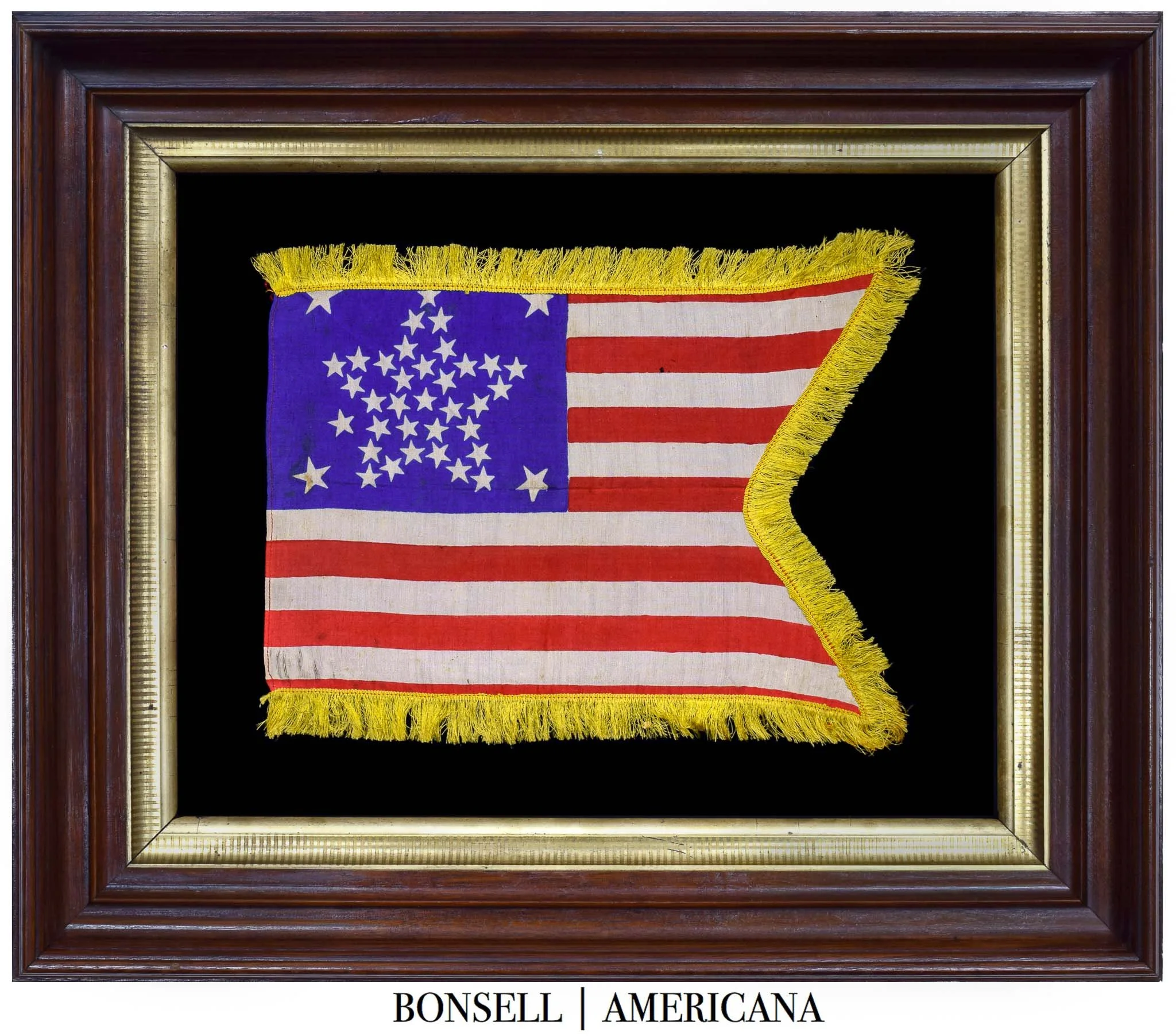
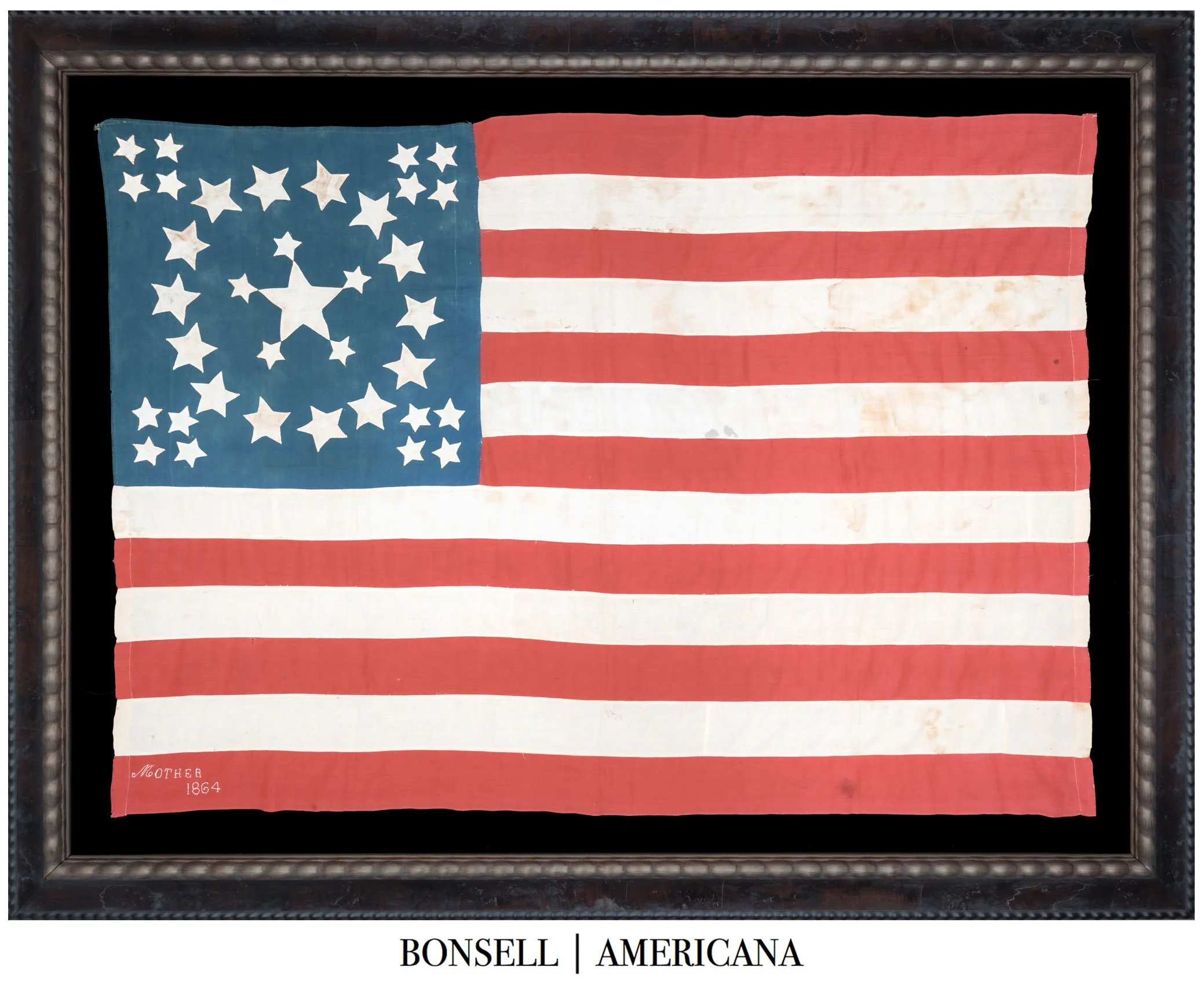
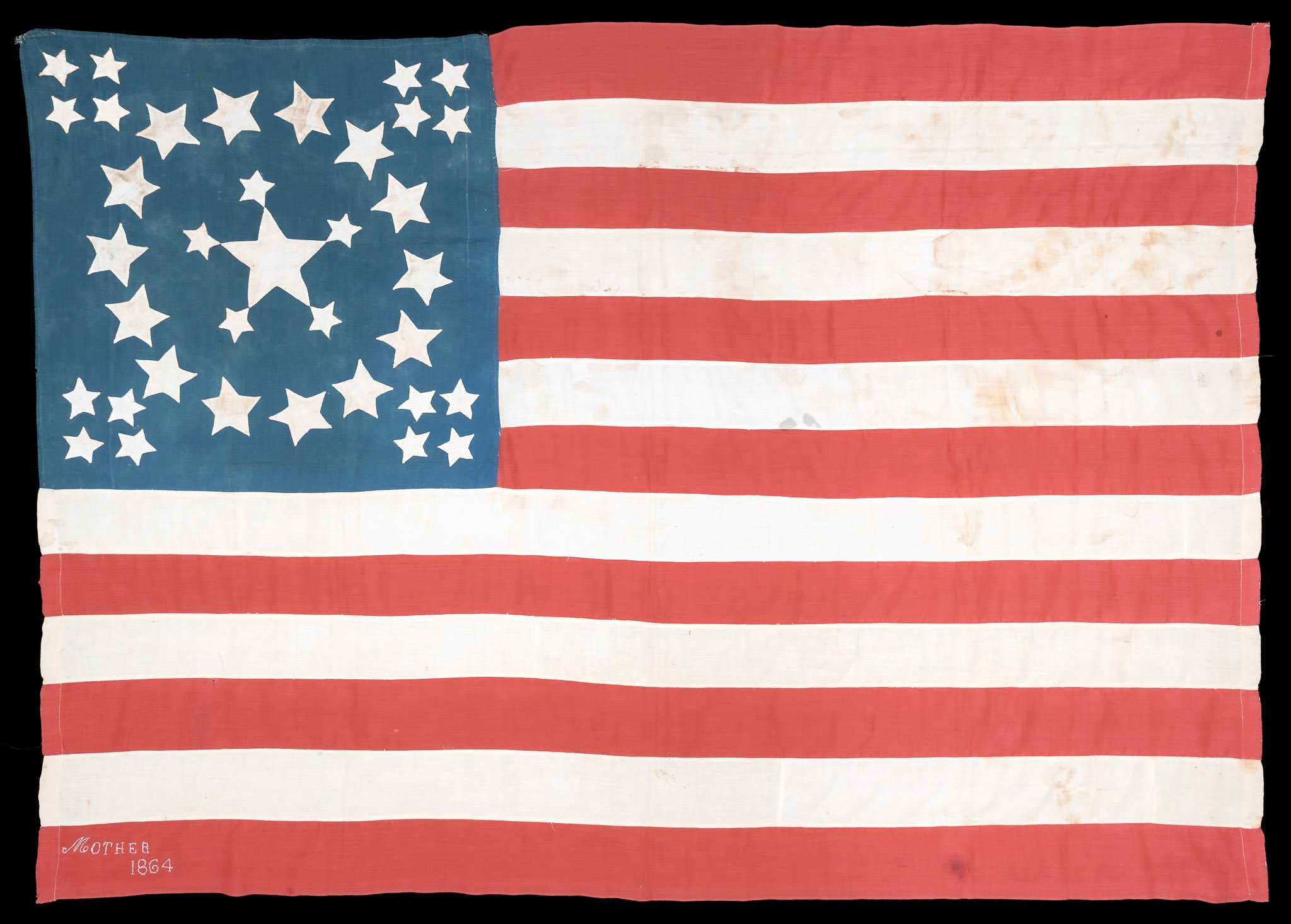
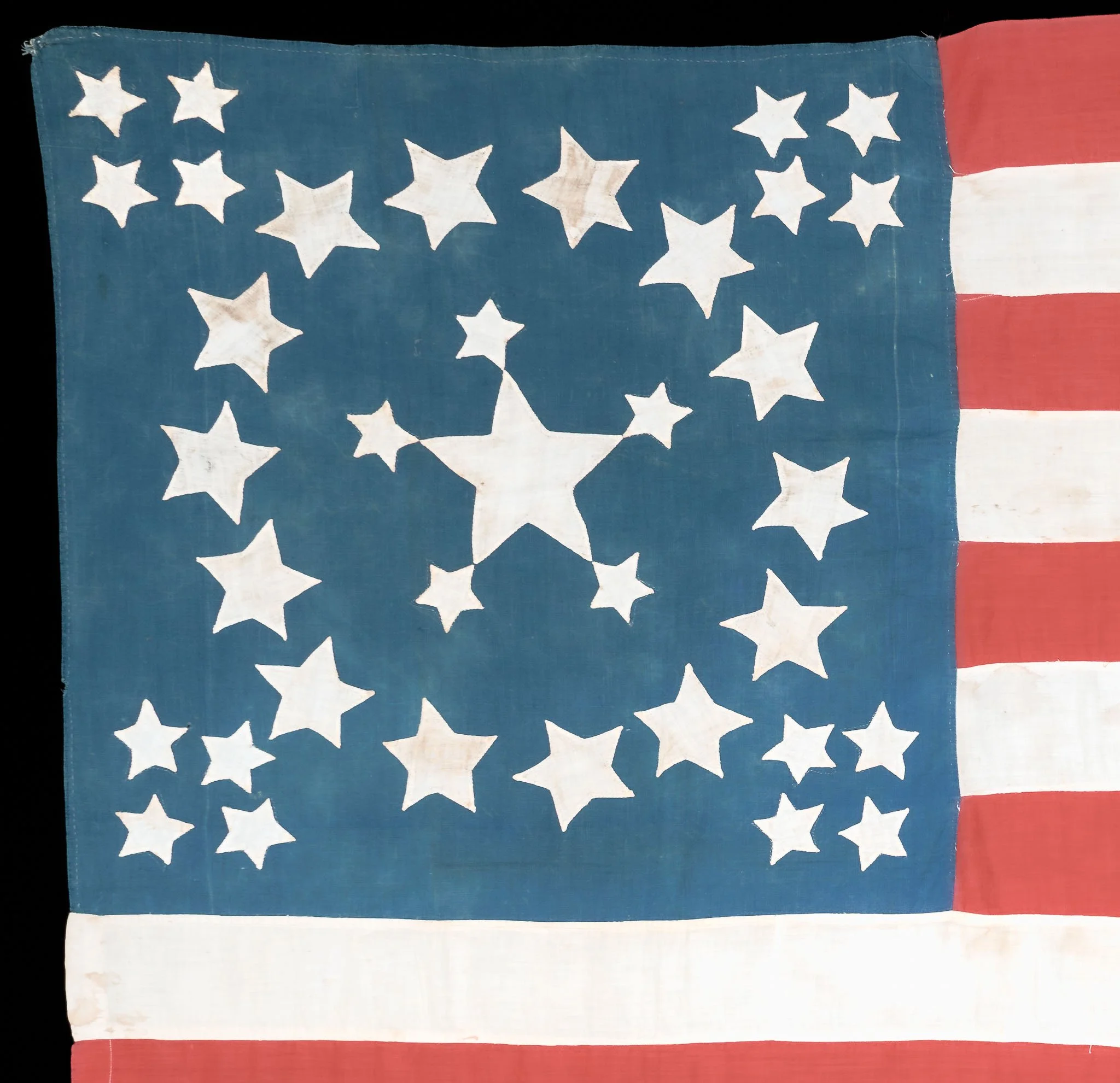
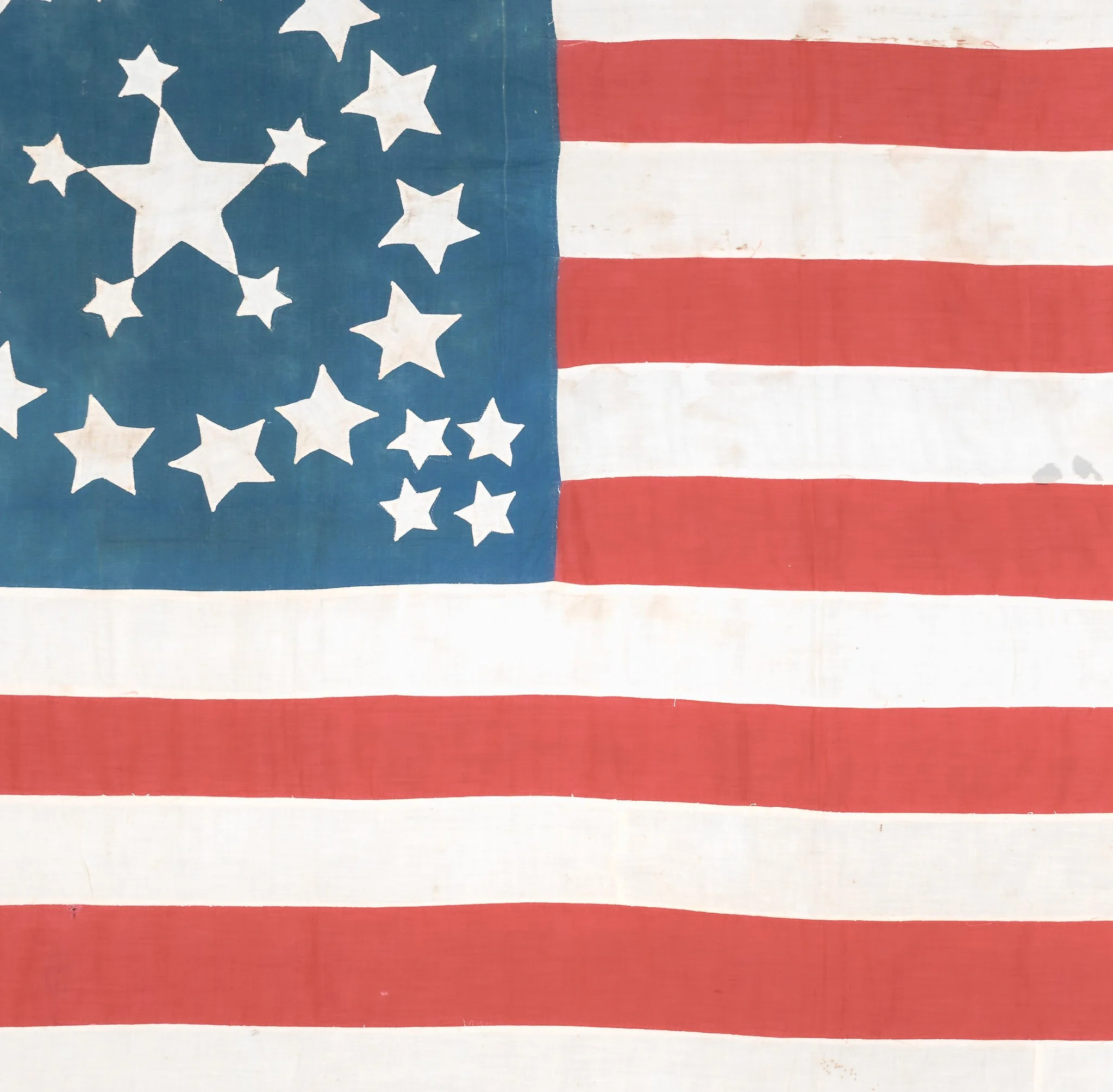
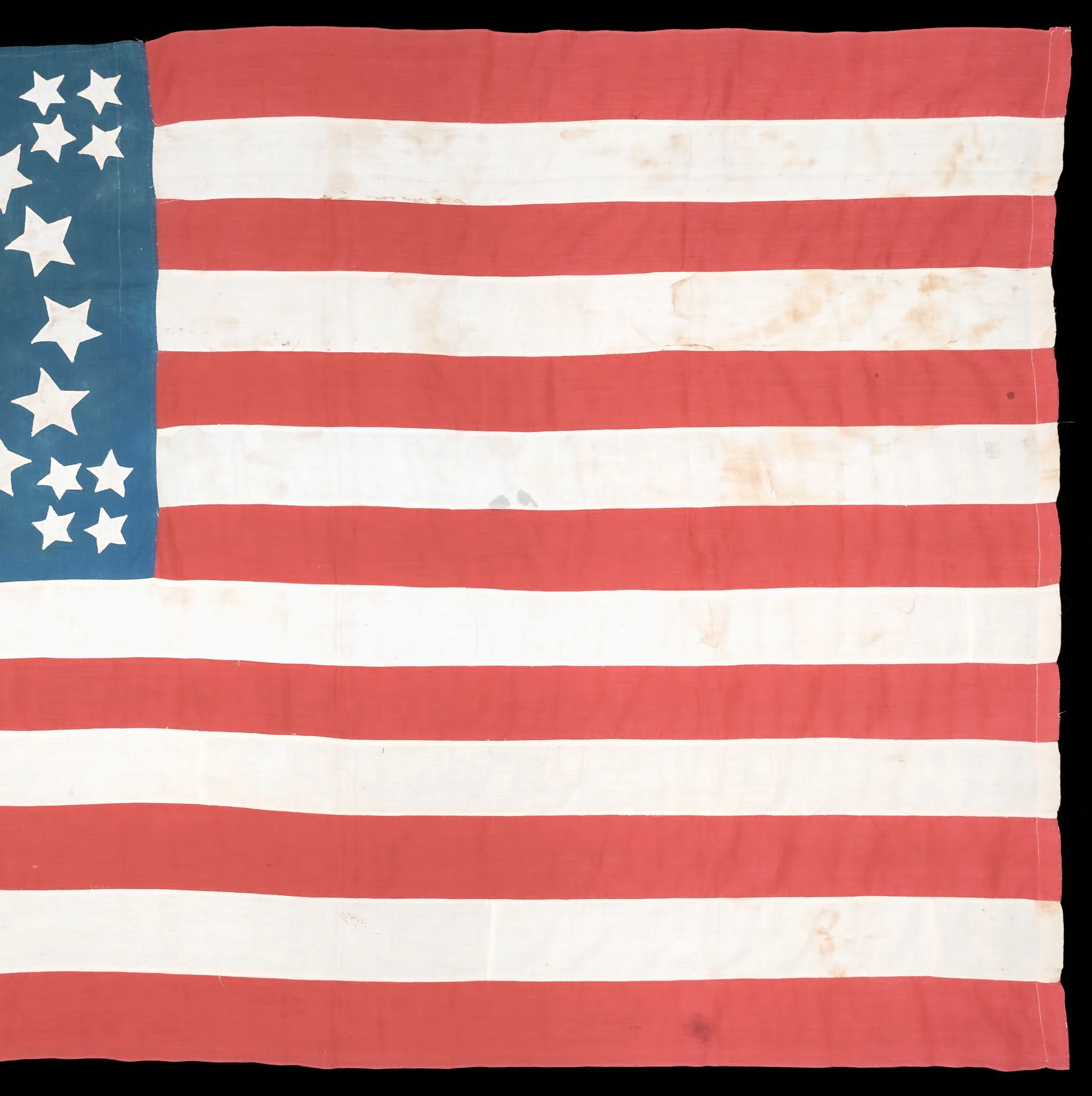
Offered is an exceptional 36-star antique American flag, made entirely of cotton and signed in handsewn thread, “Mother 1864.” Its star configuration is among the most visually arresting 36-star arrangements we have encountered: a large central star, representing Nevada, surrounded by five small stars placed at each of its points, a circular wreath of additional stars, and clusters of four stars in each corner of the canton. The result is dramatic, inventive, and highly personal — less a standardized national emblem than a carefully conceived piece of patriotic art.
The flag is made entirely by hand. The stripes, canton, hoist, and stars are all handsewn, a construction detail that places the object firmly within the world of mid-19th century textile production. Unlike commercially manufactured flags, which increasingly incorporated machine stitching by the Civil War period, this example retains the character of individual domestic manufacture.
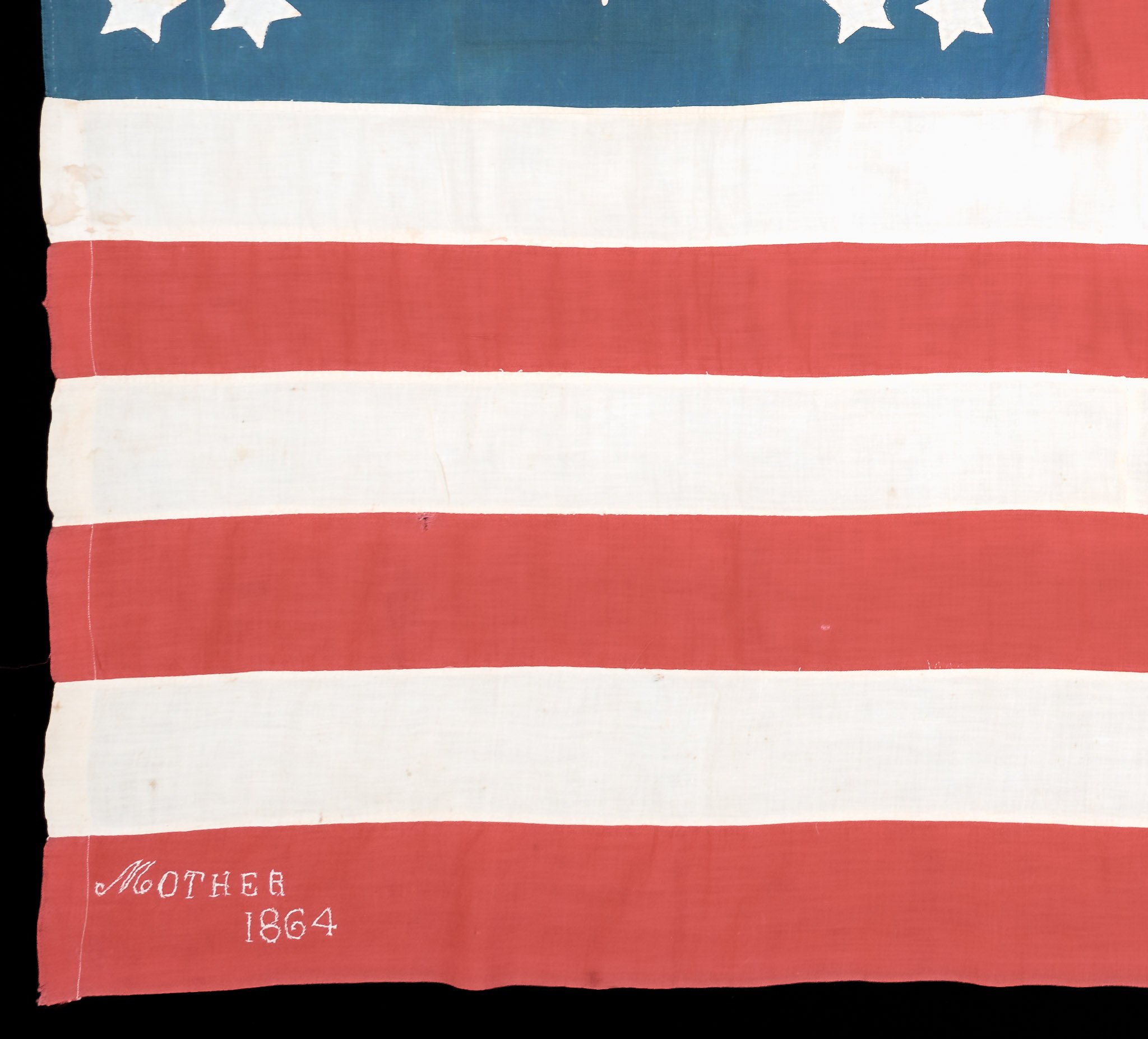
The sewing is not merely utilitarian. It is deliberate, intimate, and expressive, culminating in the stitched inscription at the lower hoist: “Mother 1864.” The “M” is rendered in cursive, while the rest of the inscription is worked in small, careful lettering. It is common to encounter antique flags with names, dates, or inscriptions added in ink, paint, or later family notation. It is far more unusual to find a flag signed and dated in sewn thread, integrated into the object itself.
The inscription is one of the flag’s defining features. “Mother 1864” gives the flag both a firm year of manufacture and an unusually direct human connection. The wording strongly suggests that the flag was made by a mother for her family. Given the date, the possibility that it was made for a son or family member serving in the Union cause is compelling, though not provable. What can be said with confidence is that the flag was created in one of the most consequential years in American history, at the height of the Civil War and in the same year Nevada entered the Union. The inscription transforms the flag from a patriotic textile into a personal document. It records not only a national moment, but a private act of making, memory, and devotion.
The stars are single-appliquéd, meaning that each cotton star is sewn to only one side of the canton rather than being doubled on both sides. This method was practical and efficient. It conserved material, reduced the weight of the flag, and allowed the textile to move more easily in the air. In many early and mid-19th century flags, single-appliquéd stars also created a distinctive visual effect when light passed through the fabric. The stars could appear to glow, their forms animated by the contrast between the white cotton and the darker blue field. In this example, the technique is especially effective because of the complex star pattern and the varied scale of the stars. The large center star, medium-sized wreath stars, and smaller point and corner stars create a layered visual rhythm that is both disciplined and exuberant.
The star configuration is extraordinary. At the center of the canton is an oversized star, intended to represent Nevada, the newest state. Around it are five smaller stars, one placed at each tip, giving the central device a radiating, almost celestial quality. A ring of stars surrounds this center group, while four stars are placed in each corner of the canton. This combination of a large central star, surrounding point stars, circular wreath, and corner clusters creates a design that is bold, sophisticated, and unusually imaginative. Many 19th century flag makers used medallion arrangements, but few achieved this level of visual impact. The design is balanced without being mechanical, patriotic without being conventional, and decorative without feeling excessive.
The use of different star sizes adds significantly to the flag’s strength. The large central star immediately commands attention. The smaller stars at its points amplify the central motif, while the wreath creates movement around it. The corner clusters then anchor the composition and prevent the canton from feeling empty or overly centralized. This hierarchy of scale gives the flag a sense of depth and intentionality rarely encountered in flags of this size. It is precisely the sort of star pattern that elevates an already rare object into the highest tier of American flag collecting.
The flag measures approximately 39" x 54 1/2", a highly desirable scale that gives the piece real presence while remaining manageable for display.
The 36-star count places the flag in the period associated with Nevada statehood. Nevada was admitted to the Union on October 31, 1864, during the final year of the Civil War. As was customary, the new star count did not become official until the following Independence Day, July 4, 1865. The 36-star flag therefore became the first official national flag of the reunited postwar United States, remaining official until July 4, 1867, when the 37th star was added for Nebraska. This example is especially important because it is dated 1864, the very year Nevada joined the Union.
Nevada’s admission carried both symbolic and practical importance. The territory’s mineral wealth, especially the silver of the Comstock Lode, was of enormous value to the Union. Politically, Nevada also mattered to Abraham Lincoln and congressional Republicans during the 1864 election. Though sparsely populated, its statehood added electoral support and reinforced the national message that the Union was not only surviving the war, but expanding. The state’s constitution was famously transmitted by telegraph to Washington, D.C., an extraordinary act that underscored the urgency and political significance of its admission. In this context, the addition of a 36th star was not a minor update. It was a declaration that the Union endured.
The year 1864 was one of profound uncertainty and transformation. The Civil War had entered its fourth year. Casualties had mounted on an almost unimaginable scale. Lincoln faced reelection amid war weariness and political division. Yet 1864 also saw decisive movement toward Union victory, including Sherman’s Atlanta Campaign and Lincoln’s reelection in November. A flag made in that year, bearing 36 stars and signed “Mother,” belongs to this charged historical atmosphere. It speaks to the preservation of the Union not as an abstraction, but as something experienced in households, families, and communities.
This is one of the most compelling flags we have handled. Its merits are unusually complete: a desirable size, all-cotton construction, entirely handsewn manufacture, single-appliquéd stars, a spectacular medallion configuration, a large center star for Nevada, and a handsewn inscription that fixes the year and preserves the identity of the maker in the most intimate possible form. The combination is remarkable. Flags of this period are often historically important; fewer are this visually powerful. Fewer still carry such a direct and personal inscription. In both aesthetic and historical terms, this is a grail-level example.
Conservation Process: The flag was hand sewn to a cotton fabric backing, which was then hand sewn to a mounting board. To prevent dye migration from the black cotton, the fabric was pre-washed and treated with a dye-setting wash prior to mounting. The flag is displayed behind Optium Museum Acrylic.
Frame: The piece is presented in a substantial dark-stained frame with a broad, rounded profile and a beaded inner molding. The finish has deep brown-black tones with subtle reddish undertones and light surface variation, giving it a restrained, period-appropriate presence.
Condition Report: The flag presents beautifully, with expected age toning, scattered staining, minor discoloration, and gentle irregularity from handsewn construction. There are a few small holes that have been carefully masked with matching cotton, allowing them to recede visually while preserving the flag’s overall presentation. The textile retains strong color, excellent graphic impact, and a highly desirable surface appropriate to its age.
Collectability Level: The Extraordinary – Museum Quality Offerings
Date of Origin: 1864
Number of Stars: 36
Associated War: Civil War (1861-1865)
Associated State: Nevada