Striking 38 Star American Flag | Rare “Global” Medallion Configuration | Homemade Cotton Construction | Colorado Statehood | Circa 1876-1889
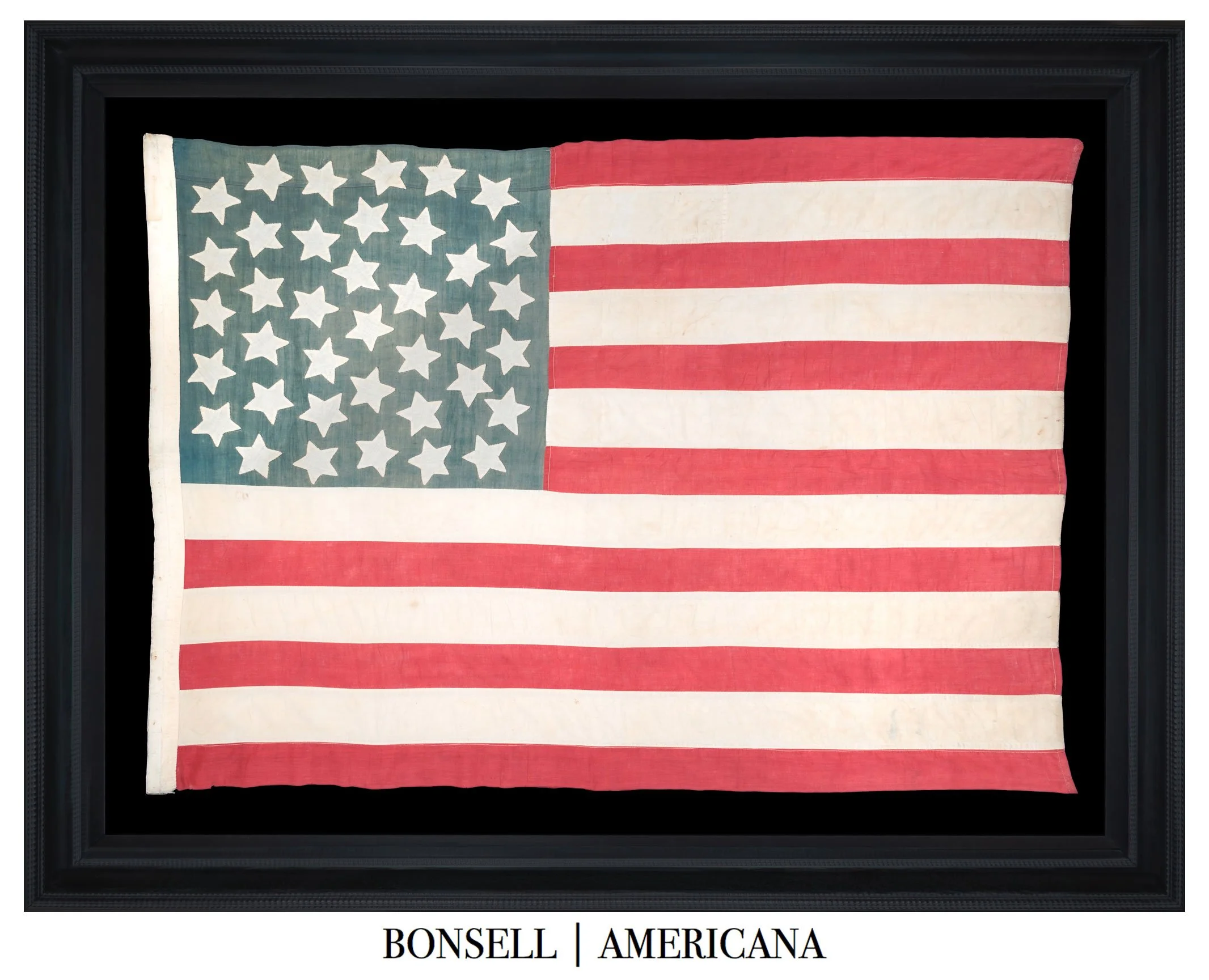
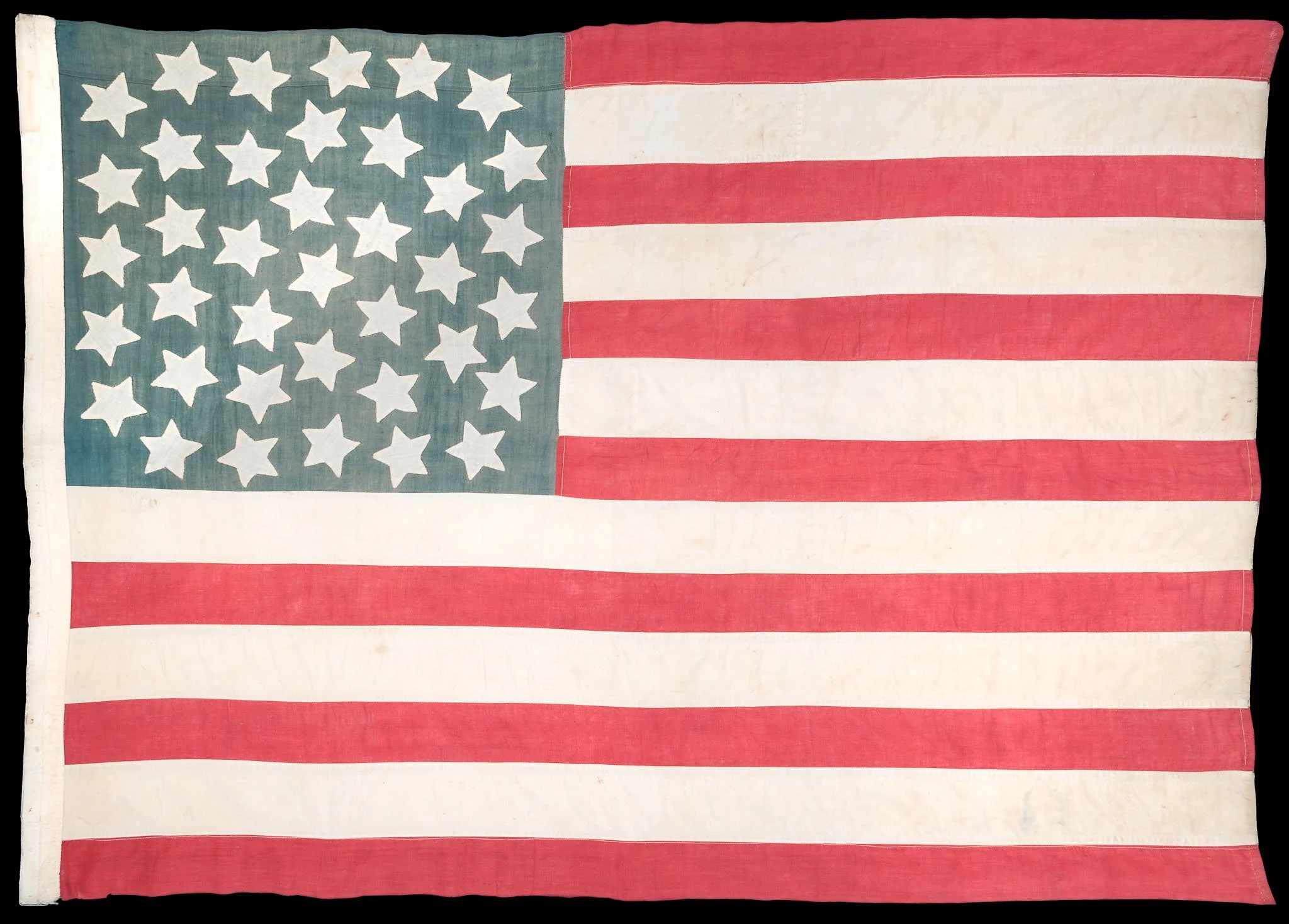
Striking 38 Star American Flag | Rare “Global” Medallion Configuration | Homemade Cotton Construction | Colorado Statehood | Circa 1876-1889
Price: Call 618-553-2291, or email info@bonsellamericana.com
Frame Size (H x L): 50.5” x 65.5”
Flag Size (H x L): 38” x 54”
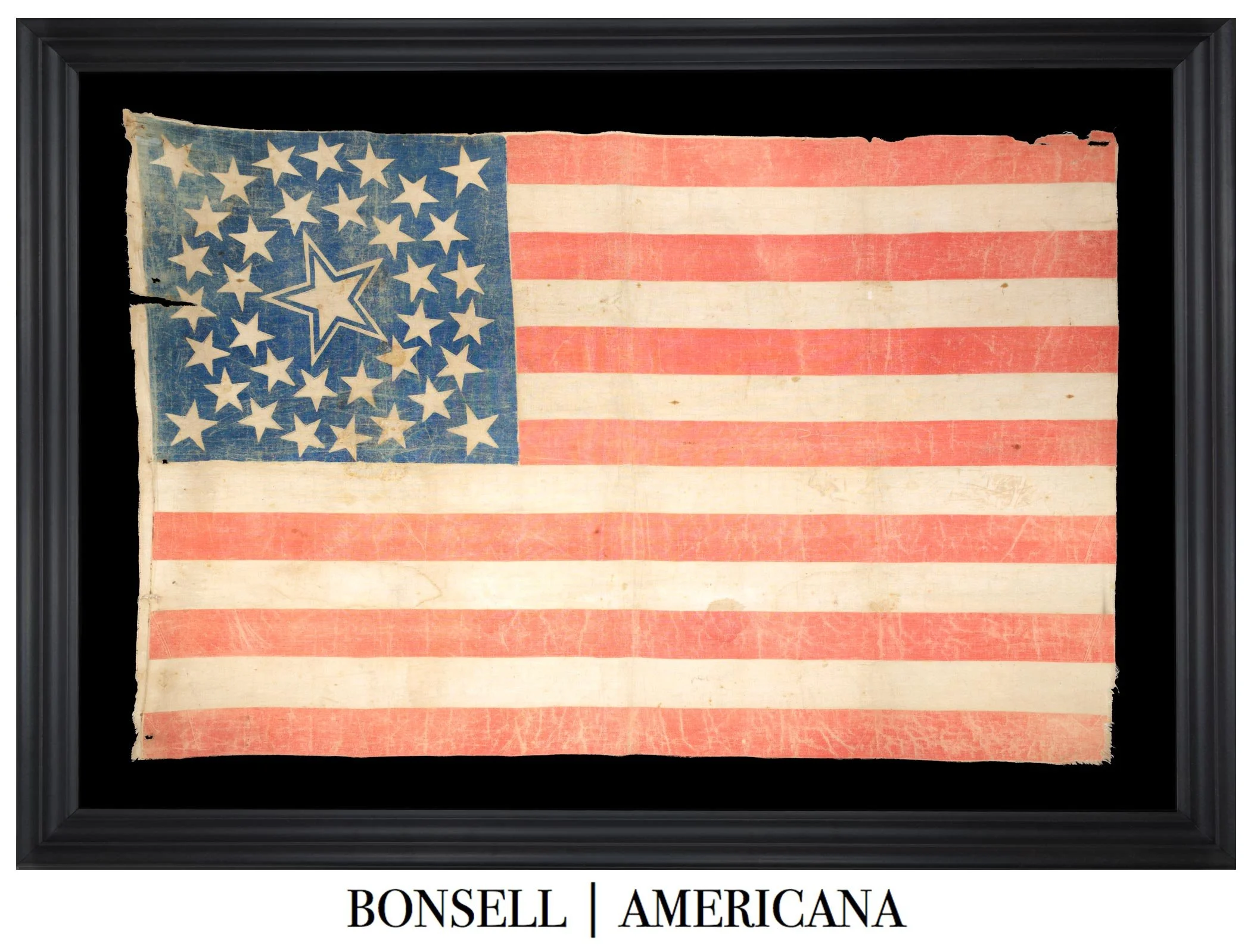
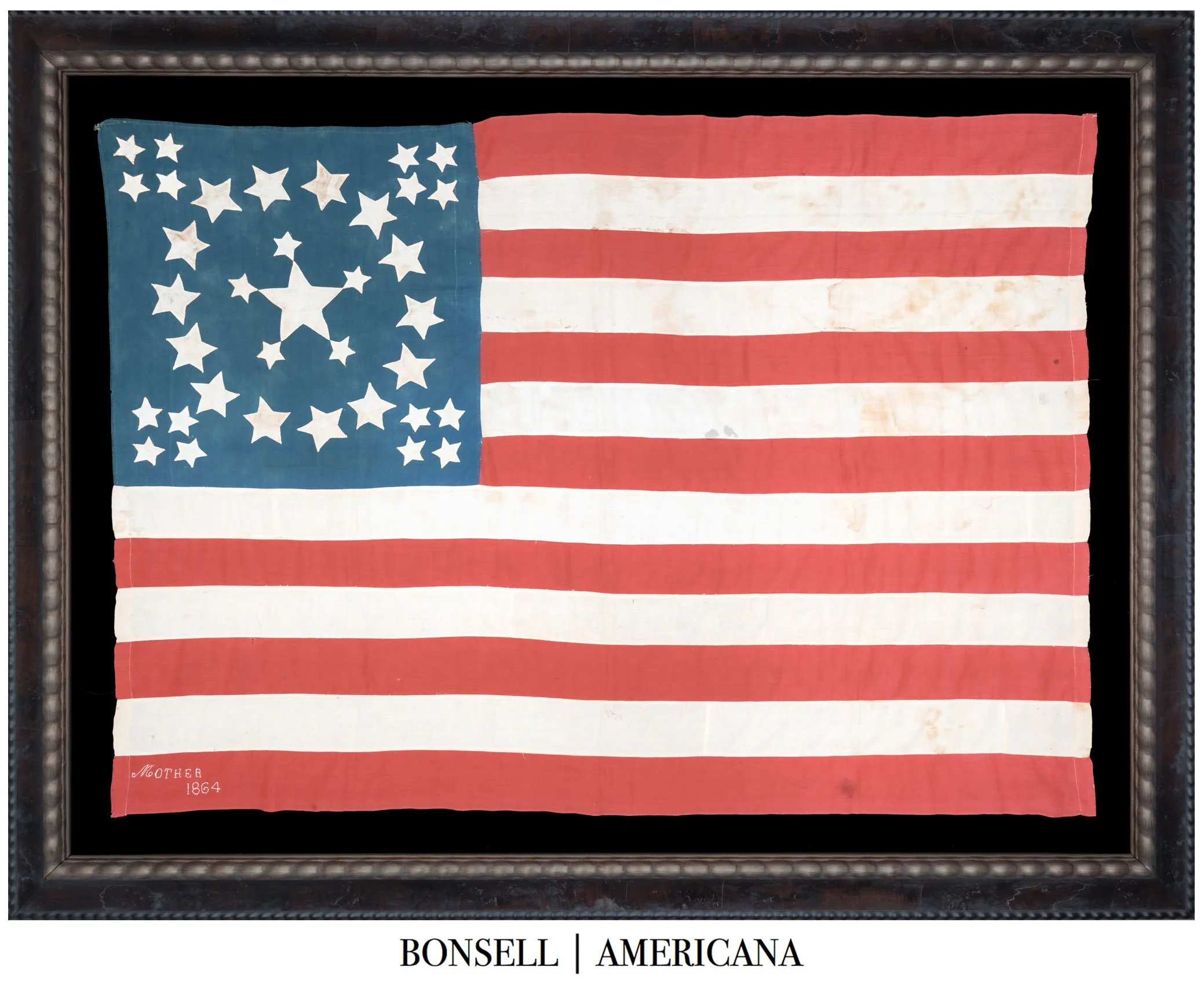
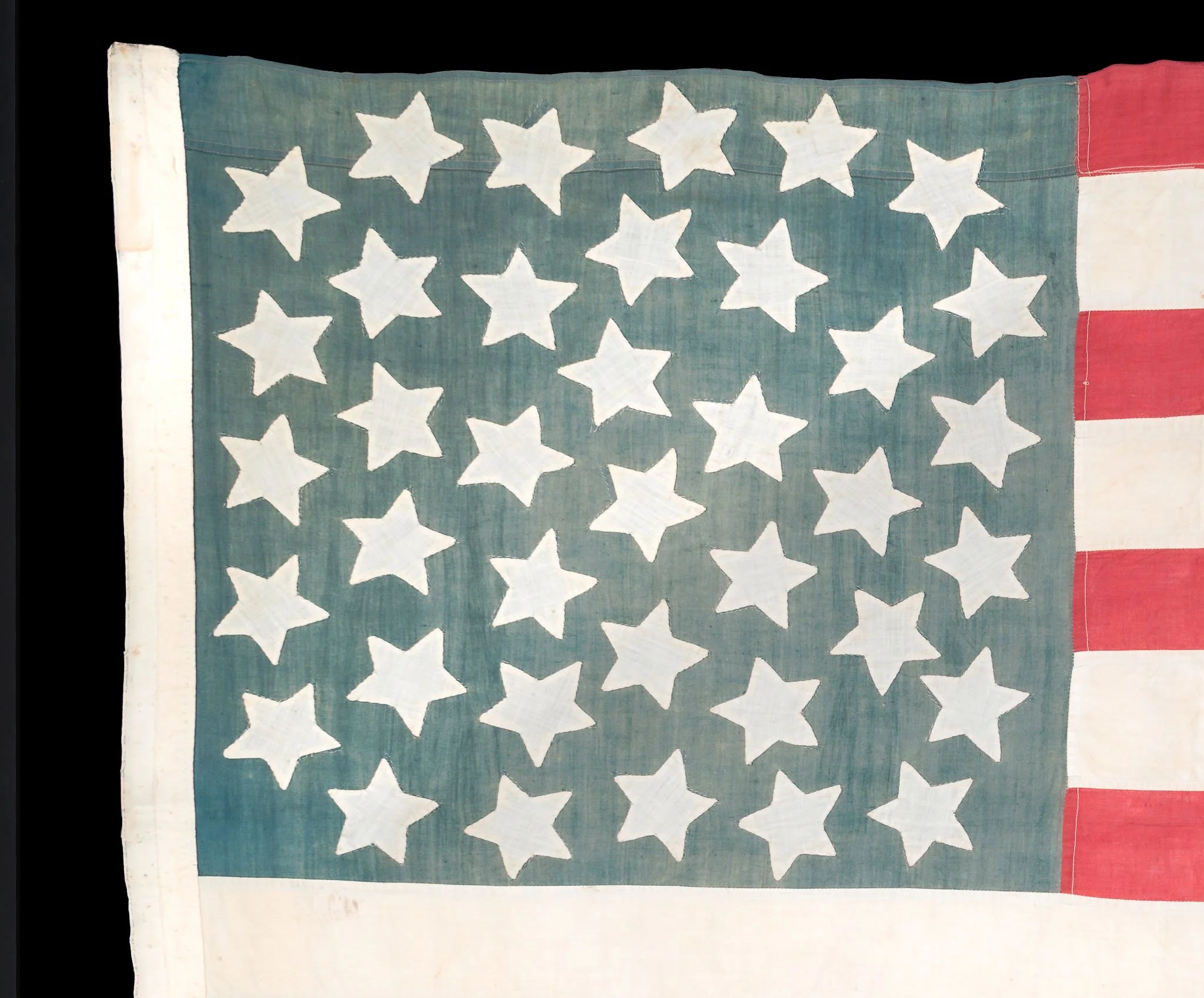
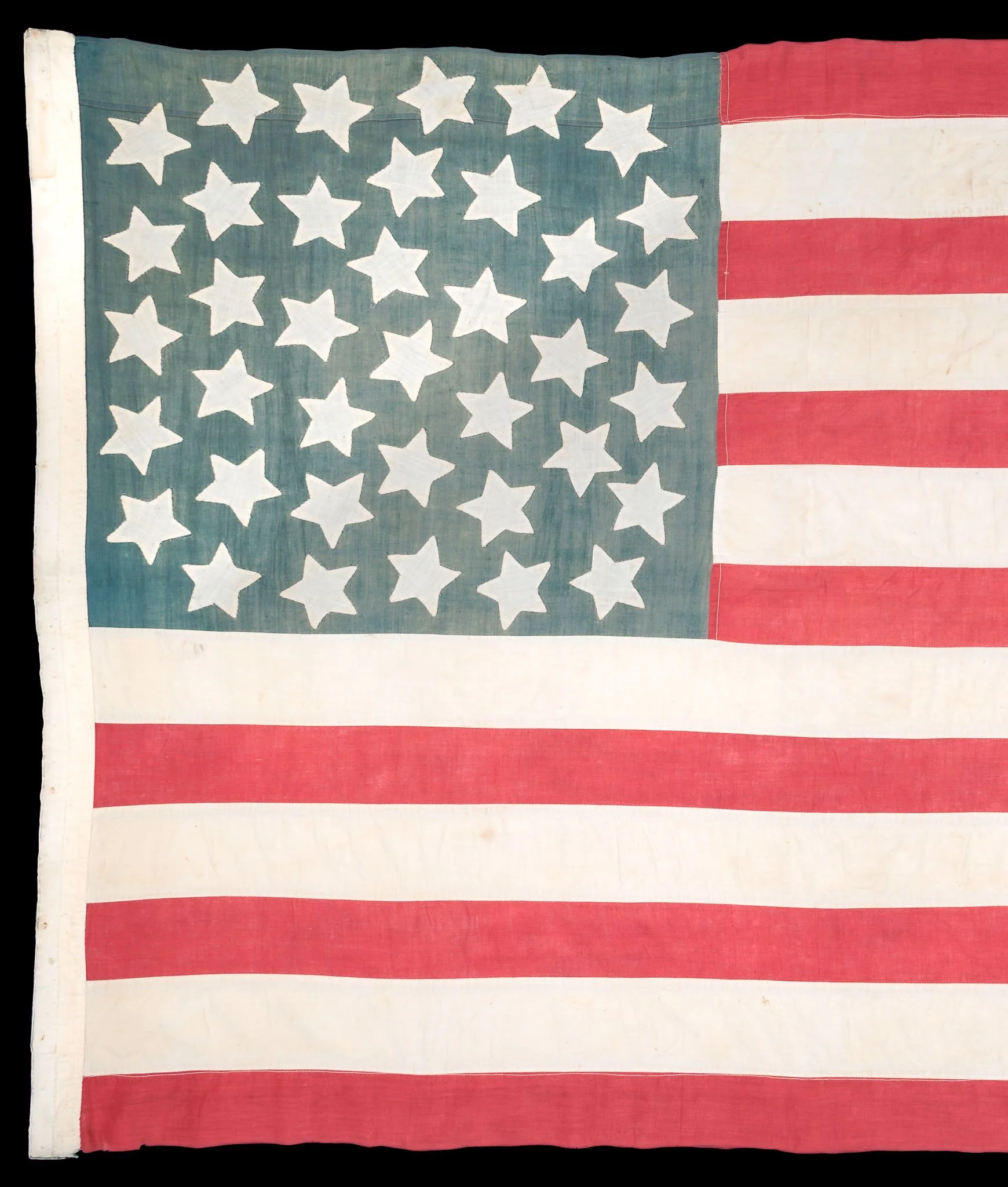
Offered is a 38-star American national flag of entirely homemade construction, executed in cotton throughout and distinguished by a striking and uncommon medallion configuration. The stars are arranged in a circular pattern often referred to as a “global” medallion, so named for its resemblance to a globe or celestial sphere. Unlike many 38-star examples—where one frequently encounters corner stars, particularly in the upper and lower right quadrants—this design is composed solely of the central medallion, with no flanking or outlying stars. The result is a visually cohesive and highly graphic presentation that feels both balanced and bold, elevating it well above more conventional arrangements of the period.
The medallion itself is composed of hand-sewn cotton stars that are dynamically oriented, each canted in slightly different directions, as though placed intuitively wherever space allowed. This imparts a sense of movement and individuality that is characteristic of vernacular, homemade flags. The stars exhibit a broad, generously proportioned form—often described by collectors as “starfish”-like—where the arms are thick and somewhat rounded rather than slender and angular. This feature, combined with their irregular orientation, contributes to a distinctly folk aesthetic that is both engaging and visually memorable.
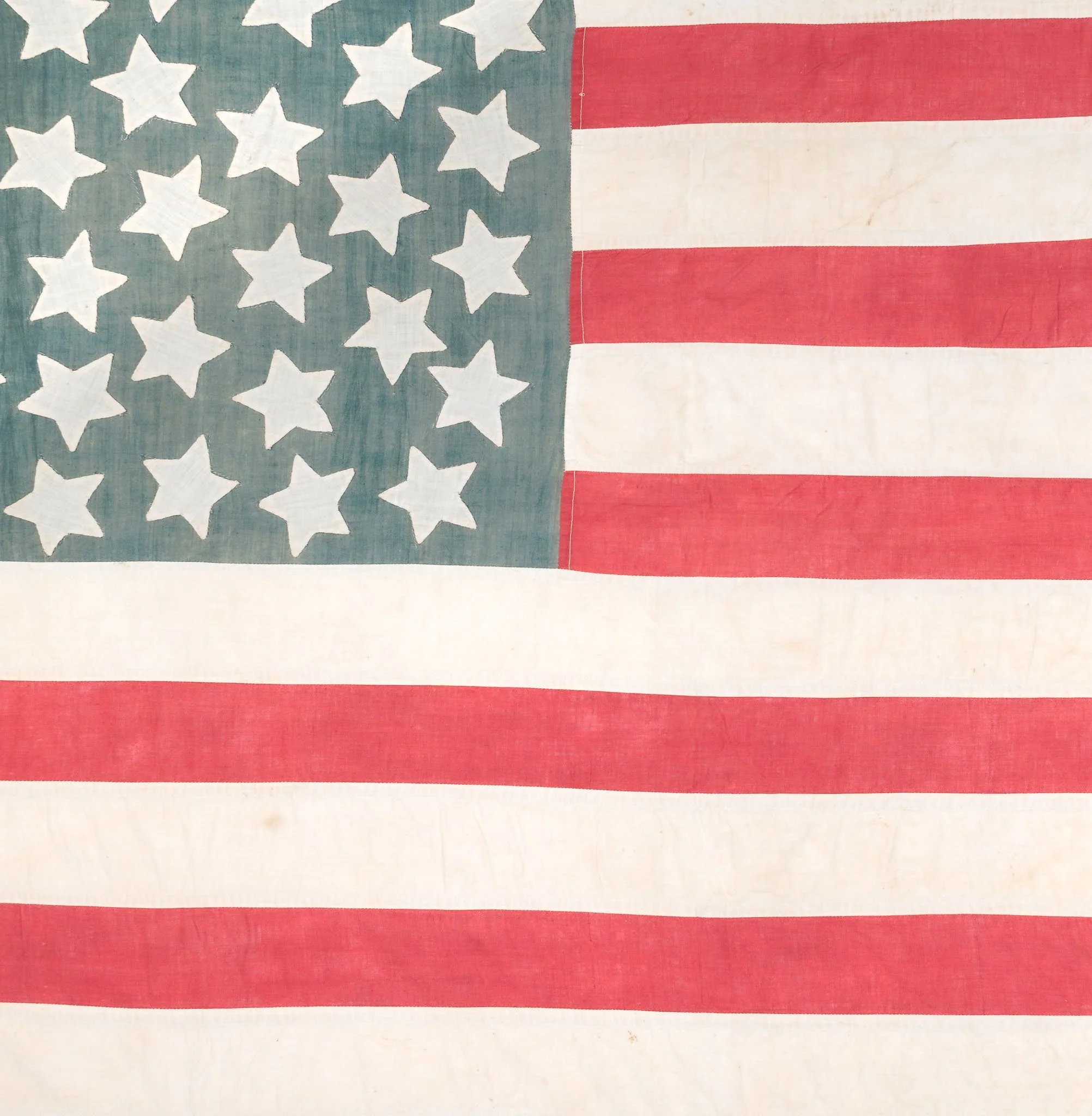
The canton is rendered in a particularly attractive shade of blue—lighter and more subdued than the deep navy commonly associated with later American flags. This soft, dusty blue tone reflects both the realities of 19th-century dye technology and the absence of standardized color specifications prior to the early 20th century. During this period, blue dyes could vary widely depending on their composition, method of application, and subsequent exposure to light and environment. The resulting palette, as seen here, often yields a more nuanced and visually appealing coloration that has become highly desirable among collectors.
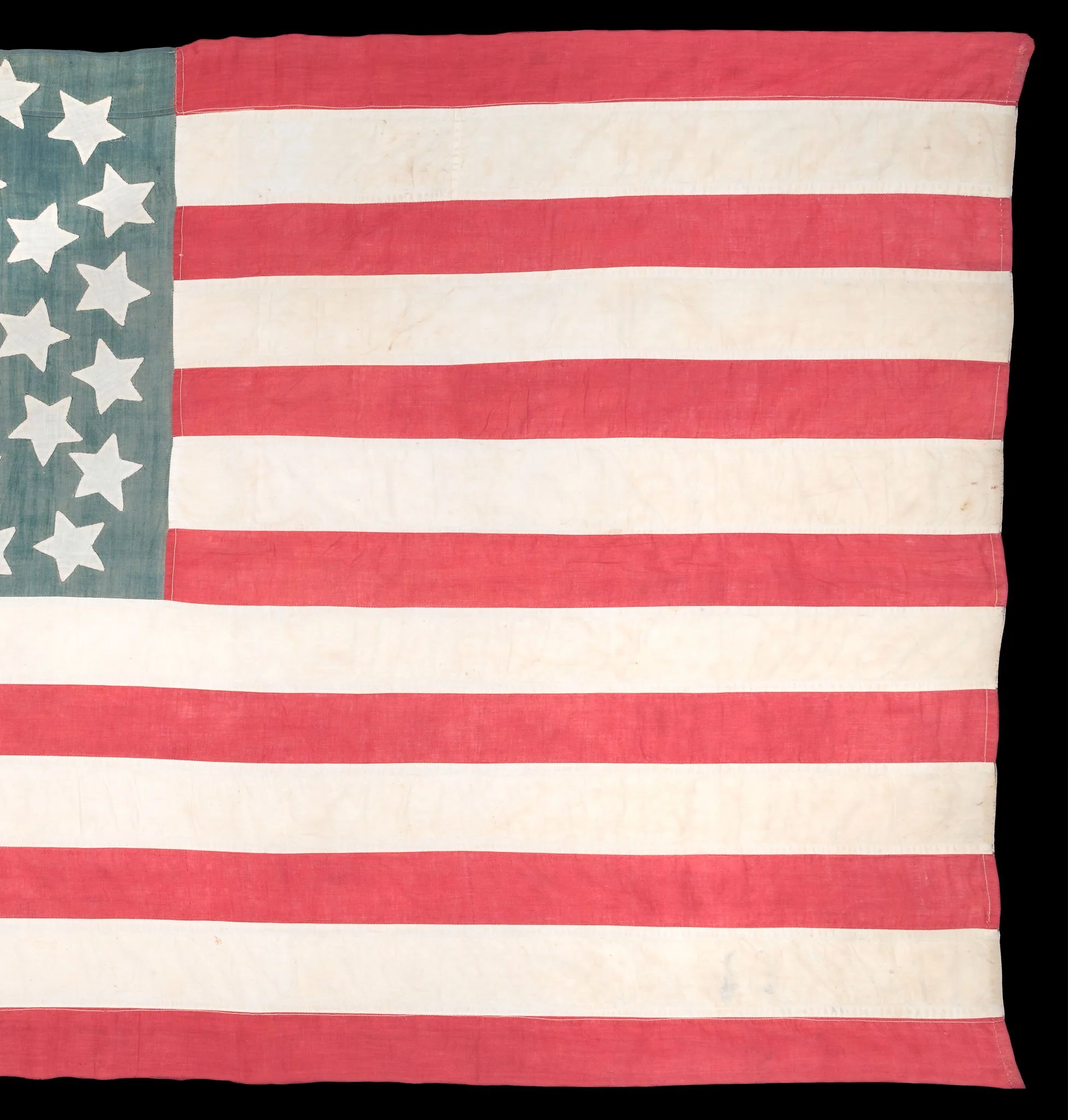
Construction details further reinforce the flag’s handmade origin. The stars are individually hand-sewn and applied to the canton, while the stripes are joined by treadle stitching, indicative of a sewing machine powered by foot pedal—technology widely adopted in the latter half of the 19th century. The canton is affixed to the striped field via treadle stitching as well, creating a clear interplay between handwork and early mechanized production. The hoist is likewise treadle-sewn to the stripes but incorporates hand-sewn elements within its own structure, and is composed of three separate pieces of cotton joined together. At the fly end, the edge is finished with hand-sewn hemming, completing a construction profile that reflects both practicality and resourcefulness.
The flag is rendered entirely in cotton, including the stars, stripes, and hoist—an important and desirable attribute. While wool bunting was often used for military and maritime flags, cotton was commonly employed in homemade or civilian examples, particularly those intended for display rather than extended outdoor use. The consistent use of cotton throughout speaks to the maker’s materials at hand and contributes to the flag’s cohesive appearance and texture.
The proportions are particularly compelling. Measuring approximately 38 inches by 54 inches, the flag occupies an ideal scale—large enough to command attention and anchor a space, yet sufficiently manageable for framing and interior display. Flags of this size strike a balance that is increasingly sought after, especially among collectors who value both presence and practicality.
The thirty-eight stars on this flag represent Colorado’s admission to the Union on August 1st, 1876. Known as the “Centennial State,” Colorado earned its nickname by achieving statehood just twenty-eight days after the nation’s one-hundredth anniversary. Its path to statehood began with the establishment of the Colorado Territory in 1861, fueled in large part by the Pike’s Peak Gold Rush, which drew significant population and investment to the region. Early efforts toward admission were unsuccessful, including a veto by President Andrew Johnson, but momentum resumed in the 1870s, culminating in Congressional approval and formal statehood in the summer of 1876.
Although the 38-star flag did not become official until July 4th, 1877, flag makers routinely anticipated such changes, producing what are now termed “anticipatory flags” in advance of formal adoption. This practice was especially pronounced during the Centennial year, when patriotic fervor reached a peak across the United States. Flags—both newly conceived and historically inspired—were produced in great numbers for display in homes, businesses, and public venues, serving as potent symbols of national pride and unity in the post–Civil War era.
The Centennial International Exposition, held in Philadelphia from May through November of 1876, stood as the centerpiece of these celebrations. Drawing nearly ten million visitors, it showcased American innovation and industrial progress on an unprecedented scale. Among its many highlights were the Corliss Steam Engine, a marvel of engineering, and Alexander Graham Bell’s telephone, which would soon transform communication. Against this backdrop, the emergence of the 38-star flag took on added significance, representing both a reflection on the nation’s first century and an optimistic взгляд toward its continued expansion.
Officially in use from July 4th, 1877, until July 4th, 1890, the 38-star flag spanned a dynamic period in American history. It flew during the administrations of Presidents Rutherford B. Hayes, James A. Garfield, Chester A. Arthur, Grover Cleveland, and Benjamin Harrison—a time marked by rapid industrialization, westward development, and increasing national cohesion. Colorado’s inclusion symbolized not only geographic expansion but also the ongoing integration of new territories into the Union’s political and economic fabric.
The addition of five states in 1889 and 1890—North Dakota, South Dakota, Montana, Washington, and Idaho—brought about the adoption of the 43-star flag, ending the official tenure of the 38-star design. Despite this relatively brief period of official use, 38-star flags remain among the most prized of 19th-century examples, particularly those with medallion configurations. Their strong visual appeal, combined with their direct association with the Centennial, renders them especially desirable.
Within this context, the present example stands apart. Its purely medallion—or “global”—arrangement, absent of corner stars, is both unusual and aesthetically compelling. Coupled with its handmade construction, dynamic star placement, appealing coloration, and ideal scale, it represents a confluence of qualities that define the most engaging and collectible flags of the Centennial era.
Conservation Process: This flag was hand sewn to cotton fabric, and both were hand sewn to a mounting board. To prevent the black dye in the cotton fabric from seeping into the flag, it was first washed in a standard wash and then in a dye setting wash. The flag is positioned behind Optium Museum Acrylic.
Frame: The frame features a dramatic scoop profile in a deep Dutch black finish, with a curved inner cove that creates pronounced shadow and depth. A subtle ripple detail along the inner edge adds texture and refinement, while the stepped outer molding lends architectural structure.
Condition Report: The flag presents in very good condition overall, with expected, moderate soiling and age-related toning throughout the white cotton field. There is minor, scattered discoloration and light staining, accompanied by gentle wear along the hoist and fly edges consistent with period use. Structural integrity remains strong, with no significant losses.
Collectability Level: The Extraordinary – Museum Quality Offerings
Date of Origin: 1876-1889
Number of Stars: 38
Associated War: The Indian Wars (1860-1890)
Associated State: Colorado