The Indians Are Coming | Western Movie Serial Lobby Display | Adventure Pictures | Tim McCoy & Allene Ray | Circa 1930

The Indians Are Coming | Western Movie Serial Lobby Display | Adventure Pictures | Tim McCoy & Allene Ray | Circa 1930
Frame Size (H x L): 26” x 39.75”
Lithograph Size (H x L): 16” x 29.75”
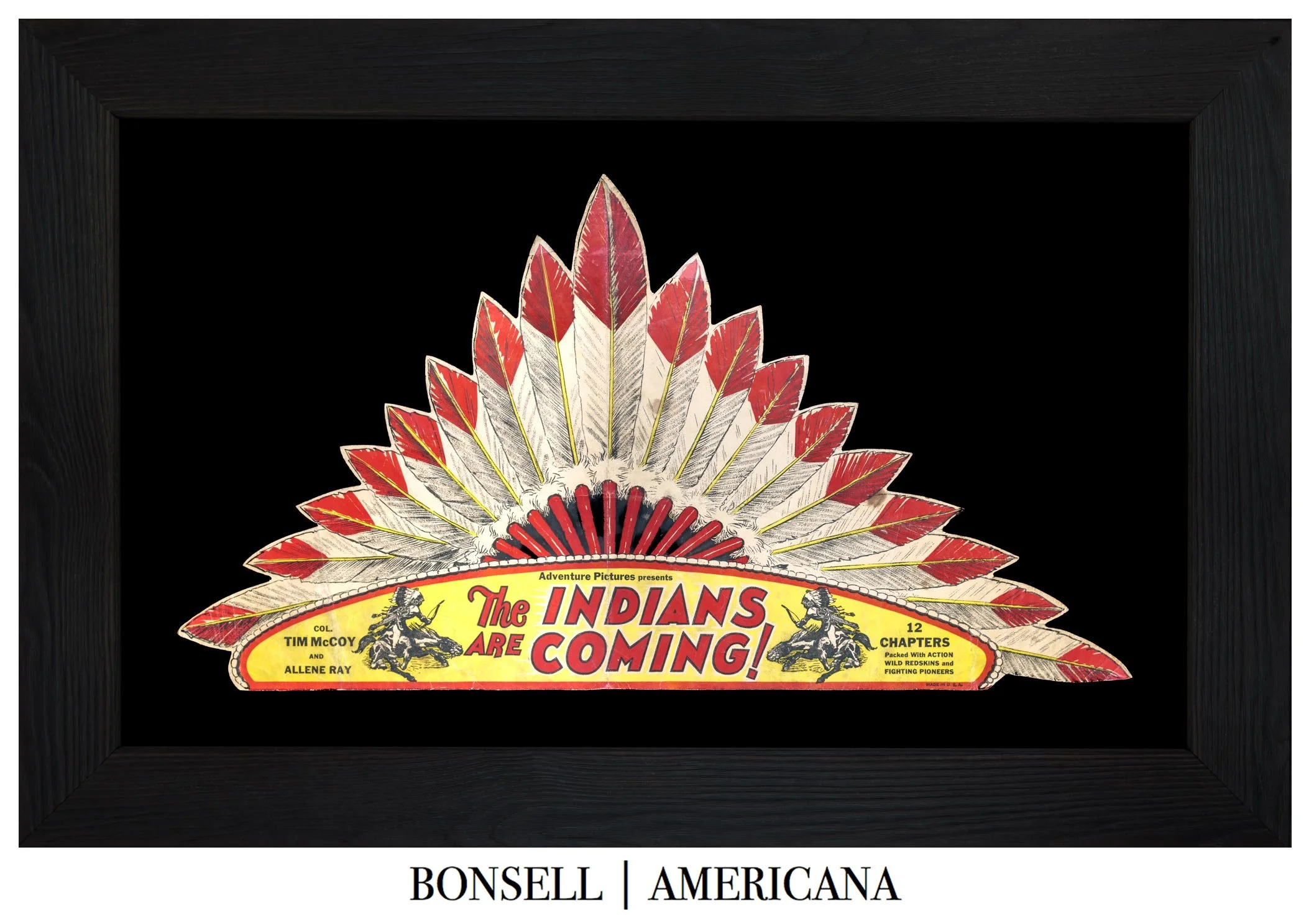
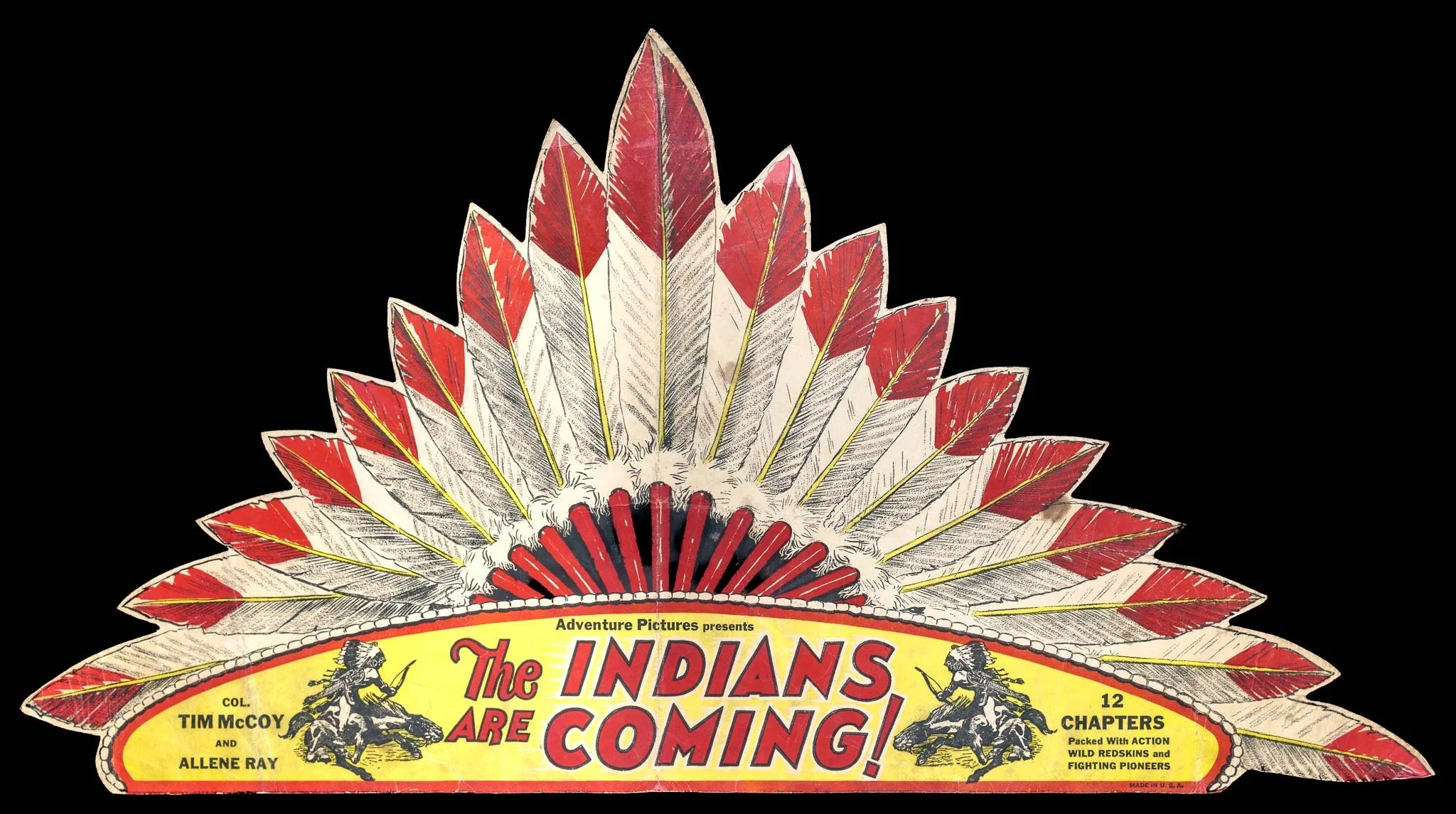
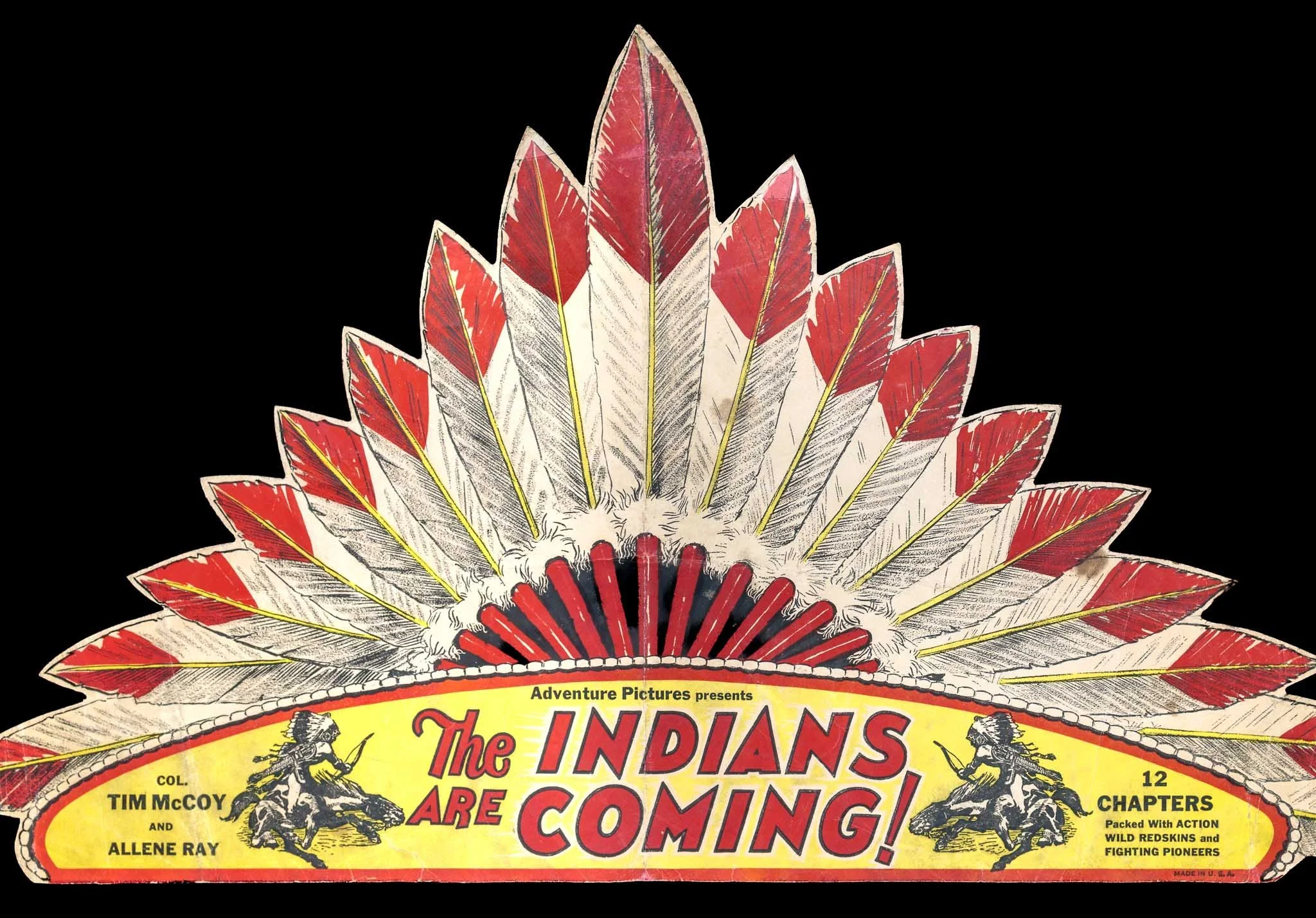
Offered is a die-cut, lithographed theatrical advertisement for the 1930 Western serial The Indians Are Coming, produced by Adventure Pictures and starring Col. Tim McCoy and Allene Ray. Intended for lobby or storefront display, the piece departs from the standard rectangular poster format and is cut in the silhouette of a feathered war bonnet, immediately identifying its Western theme to passing audiences. Strong color contrast, bold typography, and mounted warrior imagery were used to attract attention in a competitive theater setting.
Adventure Pictures was an independent American motion picture company active during the late silent and early sound era. By 1930, the serial format was an established commercial model. Instead of a single feature-length film, studios released productions in multiple short chapters, typically fifteen to twenty minutes in duration, issued weekly. Each chapter concluded with a cliffhanger, encouraging audiences to return. During the early years of the Great Depression, this structure helped stabilize attendance by promoting repeat visits. Independent companies such as Adventure Pictures relied heavily on Western and action-driven narratives, which were economical to produce and broadly marketable.
The Indians Are Coming was released in 1930 as a 12-chapter Western serial. Directed by Henry MacRae and filmed in California, it was distributed nationally through regional exchanges. The narrative centers on frontier conflict between settlers and Native American tribes, framed within the conventions of early twentieth-century Western cinema. The emphasis was action: horseback pursuit, ambush, siege, and rescue, structured in episodic progression. The title itself functioned as a marketing device, signaling danger and conflict rather than documentary history. The prominently printed “12 Chapters” designation advertised the serialized structure that formed the economic foundation of the production.
Colonel Tim McCoy (1891–1978) was an established Western film actor of the late silent and early sound period. Before entering films in the mid-1920s, he worked with Native American tribes and later served as a technical advisor in motion pictures involving Indigenous themes. His screen persona emphasized horsemanship and frontier authority. By 1930, he was a dependable lead capable of carrying multi-chapter productions such as this one. The honorary “Colonel” designation became part of his public identity and appeared consistently in promotional materials.
Allene Ray (1901–1979) was a serial and B-Western actress active during the same period. She frequently portrayed heroines placed in peril within episodic narratives, roles essential to sustaining suspense across weekly installments. Her billing alongside McCoy reflects the importance of recognizable co-stars in maintaining audience engagement throughout a serialized release.
The advertisement was printed on heavy stock paper using commercial color lithography. Multiple ink applications produce saturated reds, yellows, and blacks, with strong linework defining the feather shafts and mounted figures. The red feather tips and red title lettering reinforce themes of urgency and action, while the yellow ground ensures legibility from a distance. Black outlines unify the composition and provide clarity. The die-cut feathered crest gives the advertisement a dimensional presence distinct from a standard flat placard.
Flanking the title are mounted warrior figures, reinforcing themes of speed and confrontation. Horses functioned as visual shorthand in Western cinema, symbolizing mobility and frontier conflict. The war bonnet silhouette operates as a broad cultural signifier, designed for immediate recognition in popular advertising rather than ethnographic specificity. Such imagery was widely employed in early twentieth-century promotional material to evoke the mythologized American West.
The tagline, “Packed with Action – Wild Redskins and Fighting Pioneers,” reflects the marketing language common to 1930 Western promotion. Its phrasing emphasizes spectacle and simplifies frontier narratives into oppositional archetypes intended to heighten dramatic tension. From a historical standpoint, the language illustrates how early Western serials commercialized frontier themes for mass entertainment during the interwar period. The terminology belongs to the conventions of its time and underscores the action-driven tone expected of serial advertising.
Issued in 1930 at a transitional moment in American film history, this piece reflects the continued viability of the serial format during the industry’s shift to synchronized sound. Independent Western serials remained commercially important even as production technology evolved. Graphic lobby displays such as this were central to exhibition strategy, designed to attract attention and convert interest into ticket sales. As an object, it represents both a specific film production and the broader mechanics of serialized storytelling in early American cinema.
Frame: Housed in a new custom wood frame with a visible grain and black finish. The profile is flat and straightforward, providing a clean presentation. The dark tone creates strong contrast with the artwork.
Condition: The piece shows expected age-related wear, including scattered creasing, light surface wrinkles, and minor edge wear consistent with original theatrical use. Visible fold lines and small areas of paper separation along portions of the die-cut edges remain evident. The work has been stabilized by a professional paper conservator, with appropriate archival treatment undertaken to secure structural integrity while preserving original surface characteristics. Color remains strong and the printed graphics are clear overall.
Collectability Level: The Good – Perfect for Beginners and Gifts
Date of Origin: 1930