World War I American Agricultural Recruitment Broadside | U.S. Boys’ Working Reserve | Illinois | Circa 1917–1918

World War I American Agricultural Recruitment Broadside | U.S. Boys’ Working Reserve | Illinois | Circa 1917–1918
Frame Size (H x L): 28.5” x 33.5”
Broadside Size (H x L): 19.25” x 24”
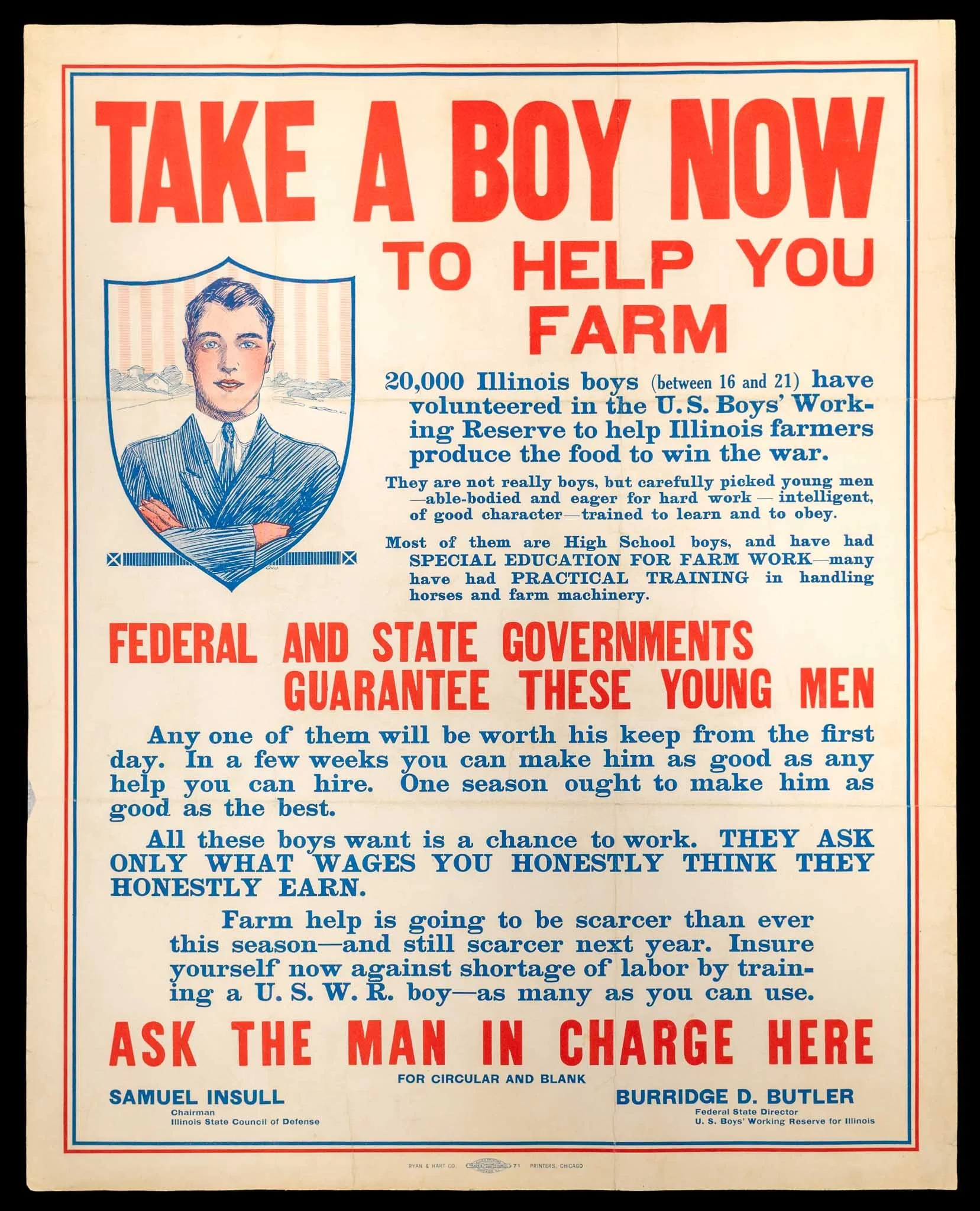
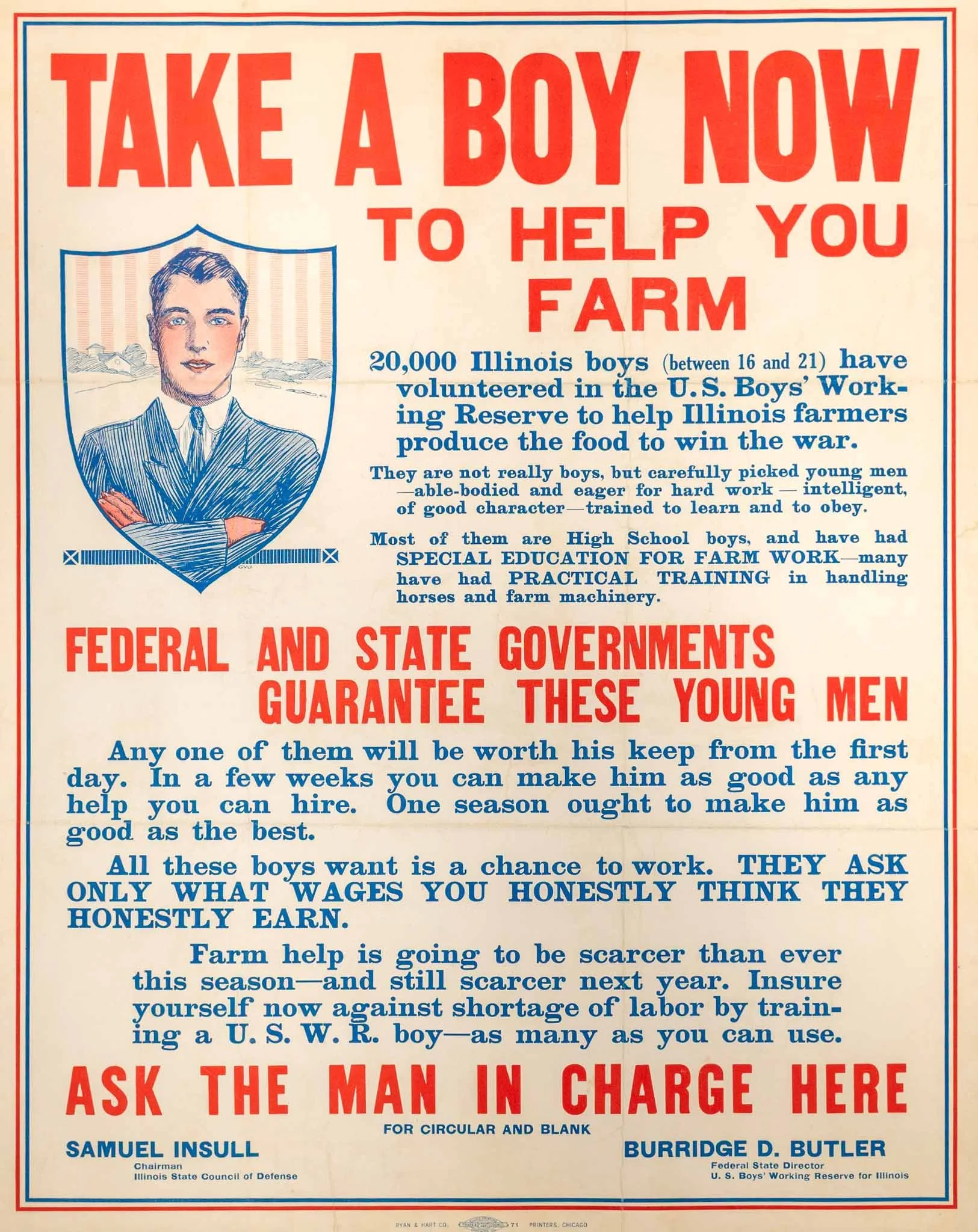
Offered is a World War I agricultural recruitment broadside produced for use in Illinois under the auspices of the U.S. Boys’ Working Reserve. Printed in red and blue inks on cream machine-made paper, the poster urges farmers to “Take a Boy Now to Help You Farm,” presenting agricultural labor as a direct contribution to the national war effort.
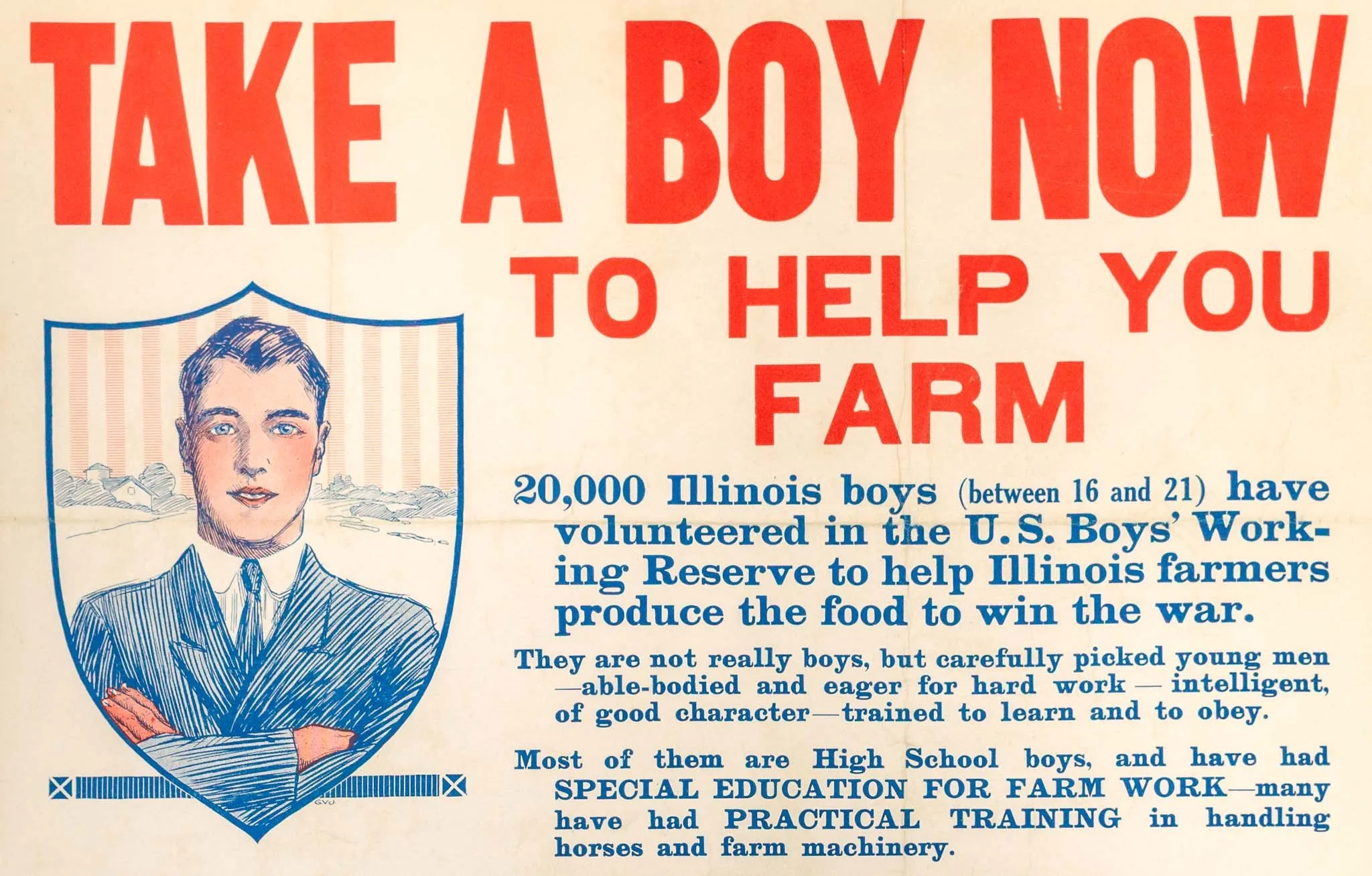
Issued during America’s involvement in the First World War (1917–1918), the broadside responds to labor shortages caused by military enlistment and wartime industrial expansion. The text states that “20,000 Illinois boys (between 16 and 21) have volunteered in the U.S. Boys’ Working Reserve to help Illinois farmers produce the food to win the war,” explicitly linking agricultural production with national victory. While military enlistment posters are more commonly encountered, this material reflects the parallel mobilization taking place on the American home front.
HISTORICAL CONTEXT
The U.S. Boys’ Working Reserve was organized in 1917 under the United States Department of Labor to mobilize teenage boys for essential wartime labor. As adult farm workers entered military service or relocated to industrial employment, agricultural output faced measurable strain. State programs recruited, screened, trained, and placed high school-aged boys in agricultural positions.
Illinois played a meaningful role in this effort. The broadside describes participants as “carefully picked young men — able-bodied and eager for hard work — intelligent, of good character — trained to learn and to obey.” It further notes that many received “SPECIAL EDUCATION FOR FARM WORK,” including instruction in handling horses and farm machinery. The language reflects Progressive Era emphasis on discipline, character, and organized civic participation.
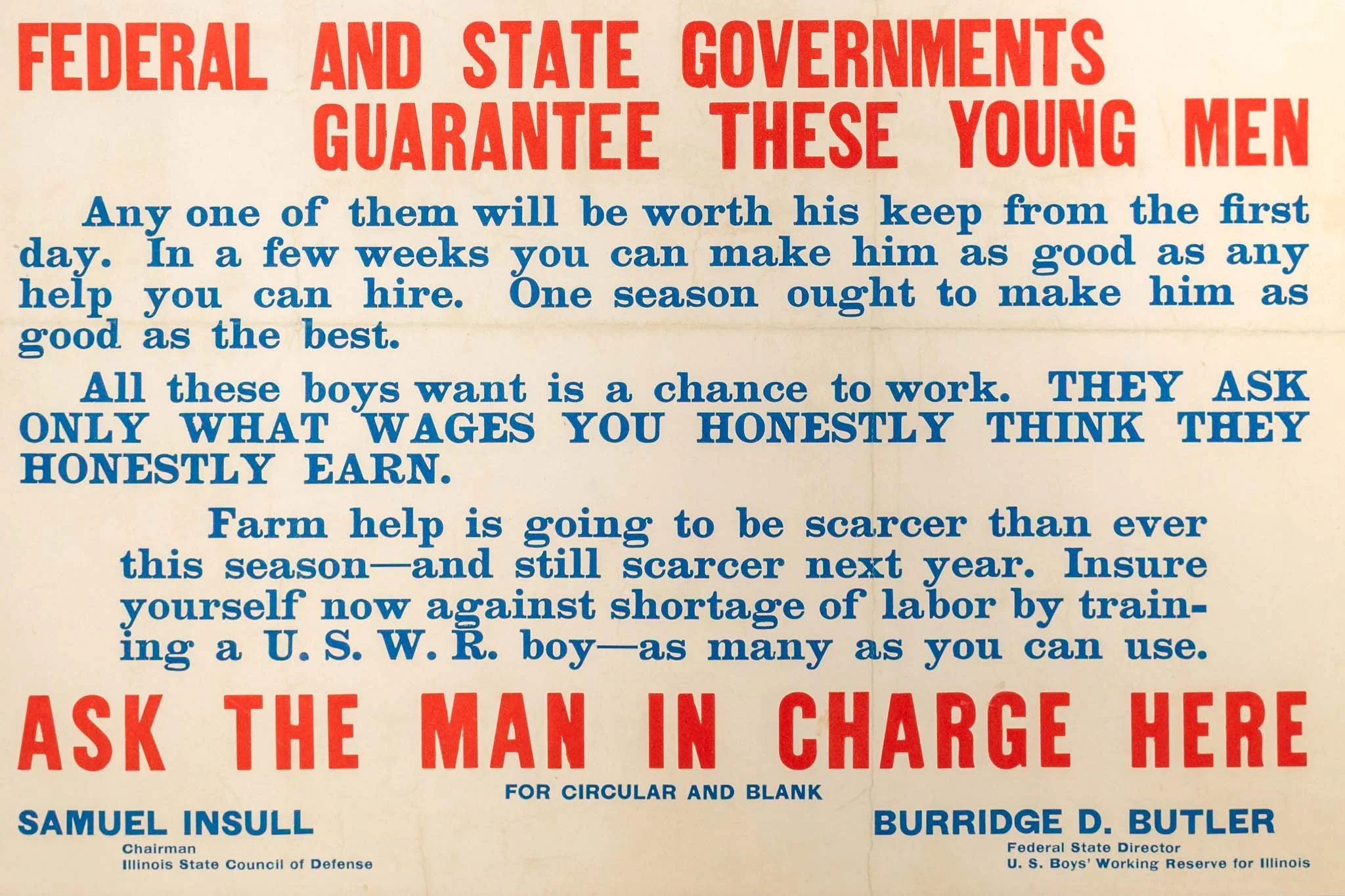
The text asserts that Federal and State governments “GUARANTEE THESE YOUNG MEN,” an assurance intended to address farmers’ concerns regarding reliability and preparedness. The statement that each boy would be “worth his keep from the first day” frames the program in practical economic terms alongside its patriotic purpose.
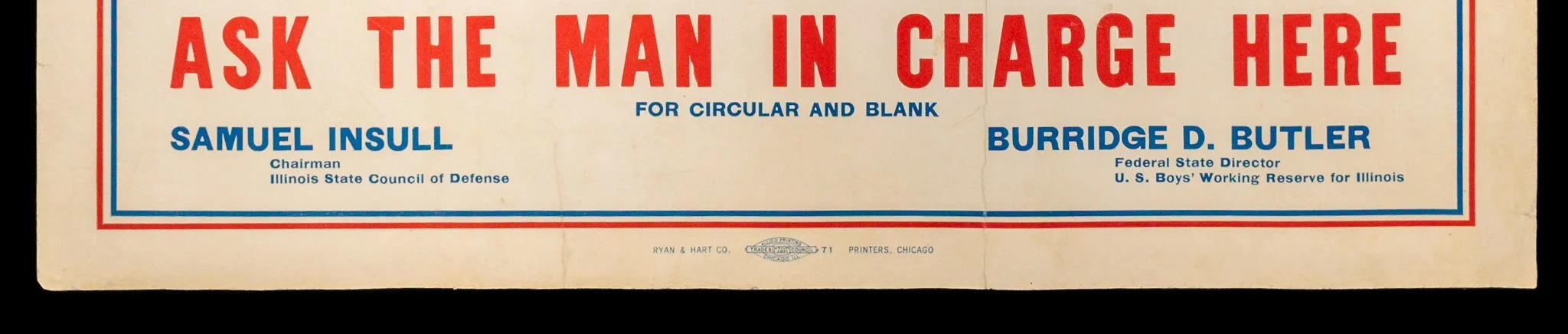
The broadside bears the printed names of Samuel Insull, Chairman of the Illinois State Council of Defense, and Burridge D. Butler, Federal State Director of the U.S. Boys’ Working Reserve for Illinois. The printer’s imprint at the lower margin reads “Ryan & Hart Co., Printers, Chicago,” placing the production firmly within Illinois’ wartime administrative structure.
DESIGN, PRINTING, AND PHYSICAL CHARACTERISTICS
The headline “TAKE A BOY NOW” appears in large red block letters across the upper field, with supporting text printed in blue to establish clear visual hierarchy. At left center, a shield device encloses a portrait of a neatly dressed young man in suit and tie rather than work clothing. The imagery presents the recruit as disciplined, educated, and dependable. The shield motif reinforces themes of duty and service, aligning agricultural labor with national defense.
The layout is structured and direct, framed by double red and blue rule borders that organize the text into defined blocks. The concluding directive, “ASK THE MAN IN CHARGE HERE,” indicates intended display in a public or administrative setting where local coordination of placements occurred.
The broadside was printed by letterpress on paper, with red and blue inks applied in separate passes. Registration is clean and typographic impressions remain sharp. It is a single-sheet printed broadside featuring a bold typographic header, a shield-form portrait vignette, and structured text contained within rule borders. The lower margin carries the printer’s imprint of Ryan & Hart Co., Chicago. Visible fold lines are consistent with original folded distribution for mailing or shipment to county offices and agricultural agencies.
This U.S. Boys’ Working Reserve broadside documents the organized mobilization of agricultural labor on the American home front during World War I, combining state-level administration, disciplined wartime messaging, and strong graphic structure in a format intended for public display.
Frame: The broadside is housed in a wide, sloped molding with an aged gold surface, intentionally distressed to evoke the appearance of early gilded frames.
Condition: The broadside has been professionally conserved by a paper conservator and presents well overall. Visible horizontal and vertical fold lines remain from original distribution, with minor residual creasing and slight separation previously present at fold intersections. There is light, even toning consistent with age, along with scattered minor edge wear and small imperfections that remain visible upon close inspection. The printed surface remains strong, with red and blue inks retaining good saturation and clarity.
Collectability Level: The Great – Perfect for Rising Collectors
Date of Origin: 1917-1918