36 Star Antique American Flag | A Commemorative Souvenir from the Philadelphia International Exhibition | Circa 1876
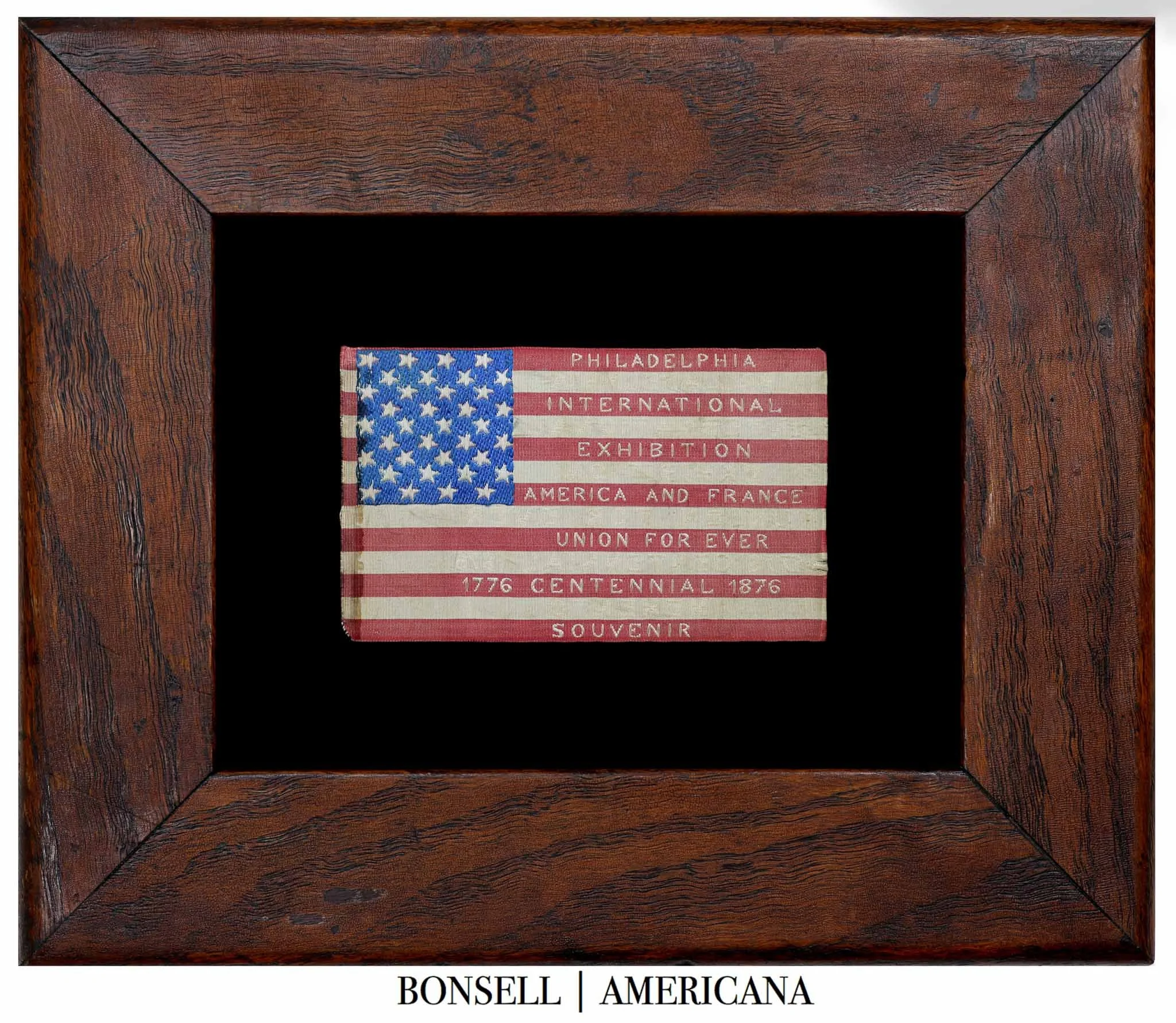
36 Star Antique American Flag | A Commemorative Souvenir from the Philadelphia International Exhibition | Circa 1876
Frame Size (H x L): 9” x 11”
Flag Size (H x L): 2.75” x 4.75”
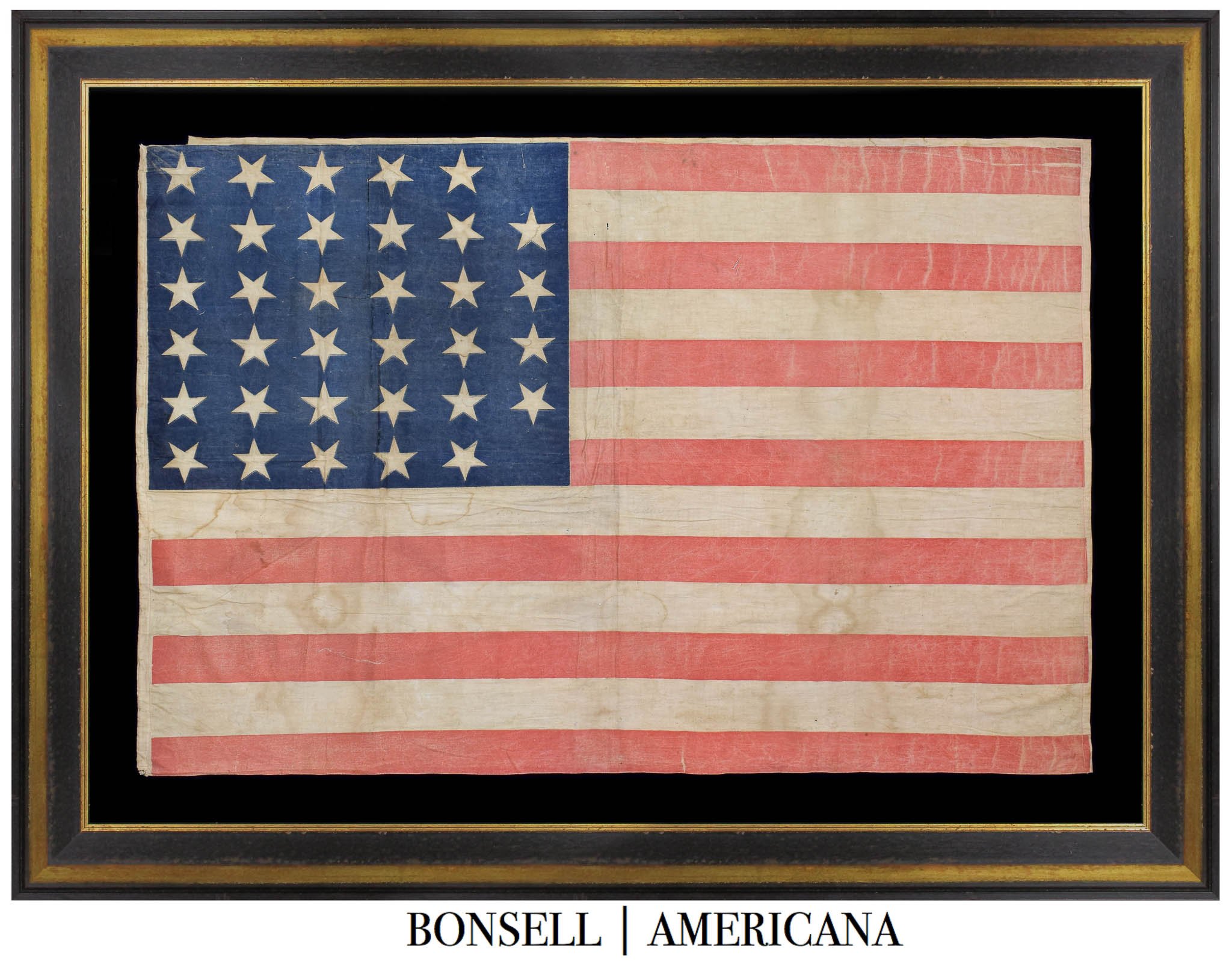
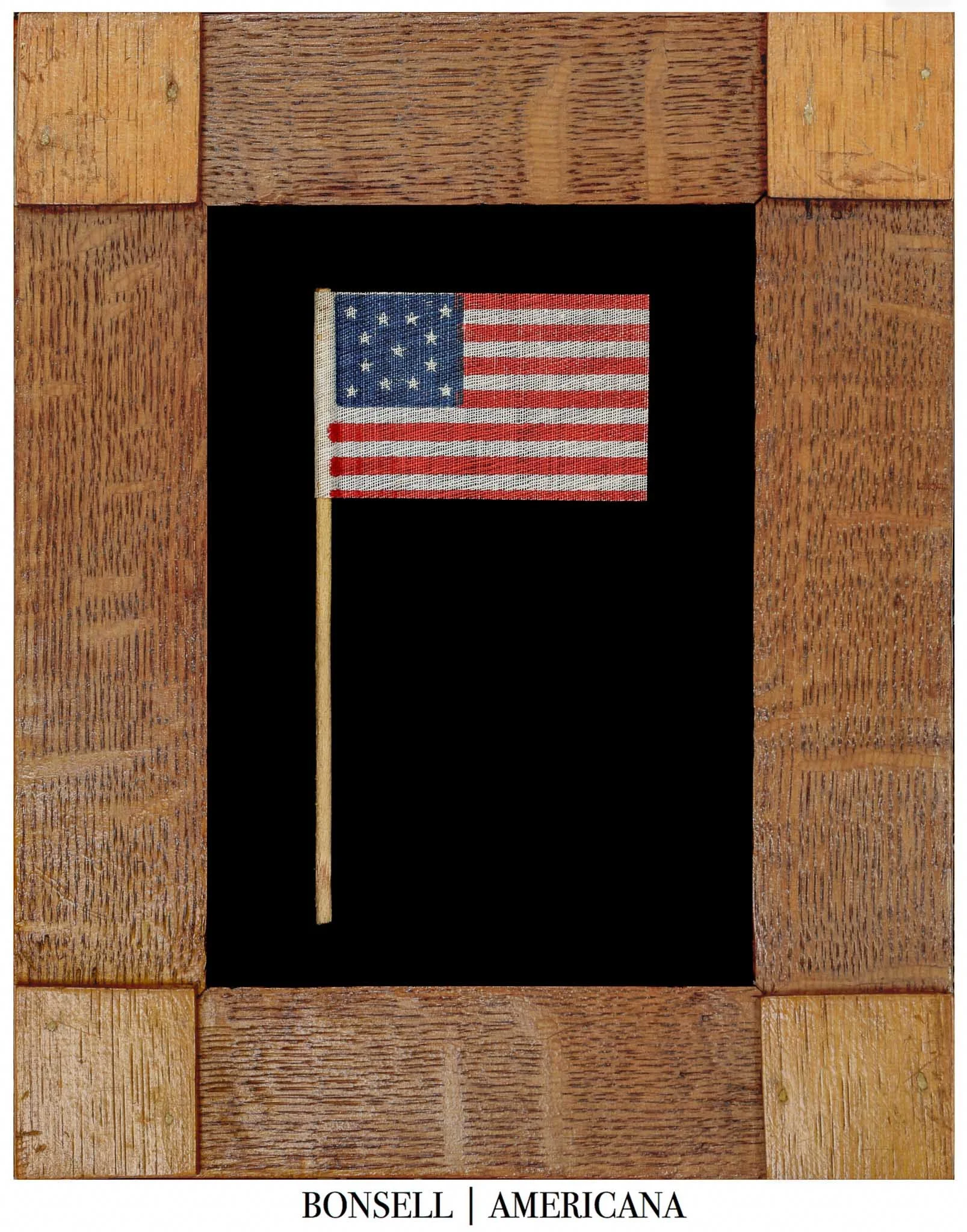
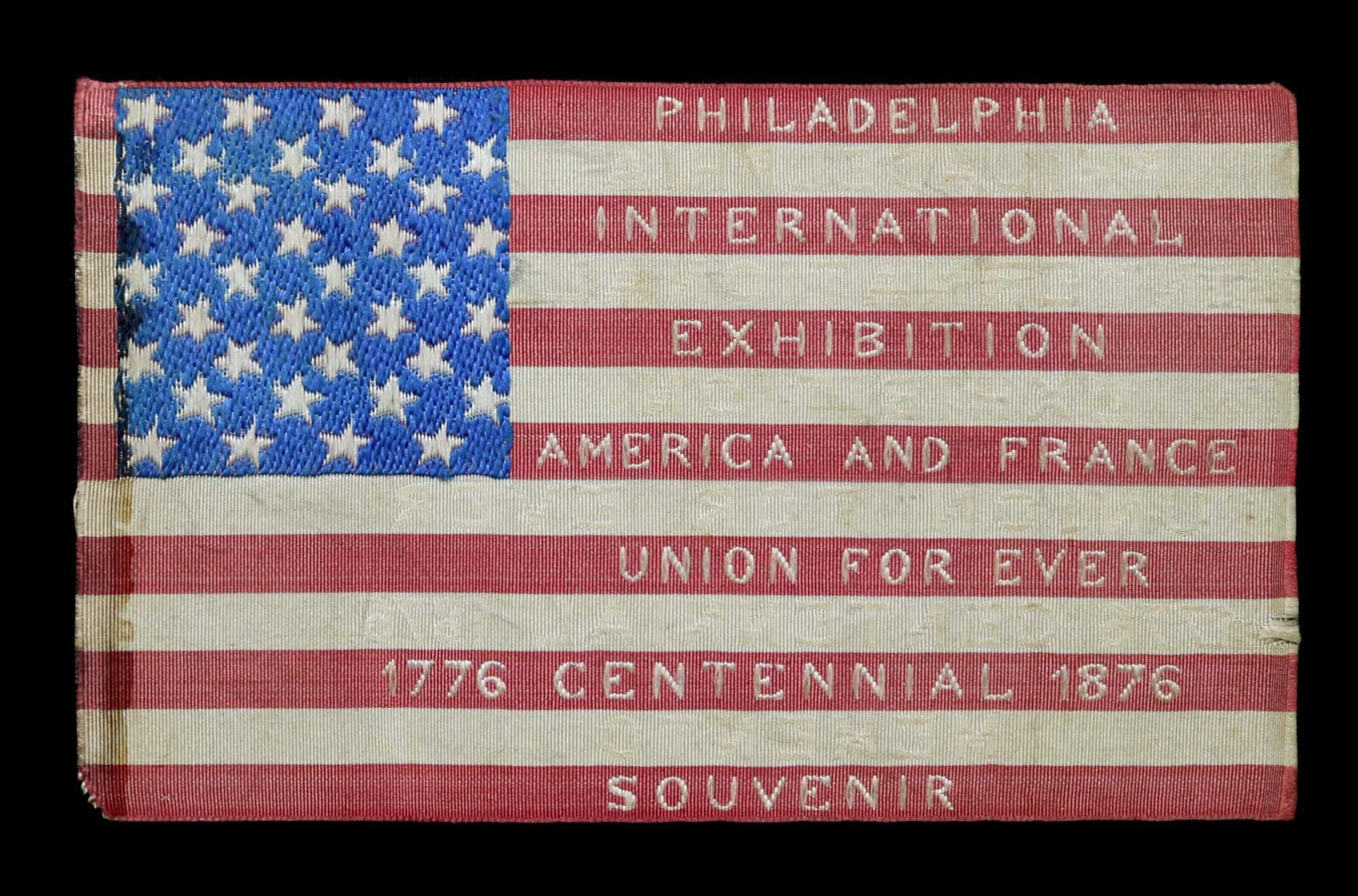
Offered is a small, woven silk American flag produced as a commemorative souvenir for the 1876 Centennial International Exposition in Philadelphia. The flag features thirteen alternating red and white stripes and a blue canton bearing 36 white stars, woven in linear rows. The use of 36 stars is notably outdated for the time of manufacture, as the 37-star flag—reflecting Nebraska’s admission—had already been adopted in 1867, nearly a decade earlier. Such discrepancies are not unusual on parade flags and souvenirs, particularly those produced for large public events or by foreign exhibitors who may not have been familiar with the current number of U.S. states. The design is not printed but rather woven into the fabric using a jacquard loom, resulting in crisp details and fine craftsmanship more typical of Stevensgraph-style souvenir ribbons than of conventional American flags.
Woven inscriptions are featured on both sides of the flag. On the front, white text runs across the red stripes and reads: “PHILADELPHIA / INTERNATIONAL / EXHIBITION / AMERICA AND FRANCE / UNION FOR EVER / 1776 CENTENNIAL 1876 / SOUVENIR.” On the reverse, additional woven text appears in the white stripes: “Philadelphia International Exhibition; Union For Ever; 1776 Centennial 1876; Memento.” This dual-sided weaving technique—produced from a single piece of silk with no layering—is highly unusual and technically sophisticated, requiring precise alignment and control on the loom. The result is a visually refined object with clean lines and striking symmetry, making it both a patriotic emblem and a showpiece of textile engineering.
The 1876 Centennial International Exposition marked the first official World's Fair held in the United States. Located in Philadelphia’s Fairmount Park, it ran from May through November and attracted nearly ten million visitors from around the globe. The event was intended to celebrate 100 years of American independence and to showcase the industrial, cultural, and scientific progress of the participating nations. France played a major role in the exposition.
36-star flags represent the admission of Nevada to the Union. Although Nevada became a state on October 31, 1864, the 36-star flag became official on July 4, 1865. That adoption came just after the end of the Civil War, and the flag is often associated with Union victory and the early years of Reconstruction. The 36-star flag remained in official use until July 4, 1867, when Nebraska’s admission brought the count to 37. Although the flag offered herein was produced in 1876—well after the official retirement of the 36-star design—it still carries the numerical association with Nevada’s statehood.
Nevada’s admission was driven by both political and economic factors. It occurred just eight days before President Lincoln’s re-election in 1864, helping to secure Republican strength in the Electoral College. At the same time, the state’s booming silver mining industry was seen as critical to financing the Union war effort. Nevada’s borders were expanded in 1866 and 1867, drawing in territory from Utah and Arizona. While the use of 36 stars on this flag does not reflect its actual date of manufacture, it adds an additional layer of historical reference, connecting this 1876 souvenir to an earlier period of post-war national unity and expansion.
Taken together, the flag’s technical sophistication, commemorative intent, and layered historical connections make it a compelling artifact. It reflects both the national pride of the Centennial and the ingenuity of late-19th-century textile production.
Conservation Process: The flag was hand sewn to cotton fabric, and both were hand sewn to a mounting board. To prevent the black dye in the cotton fabric from seeping into the flag, it was first washed in a standard wash and then in a dye setting wash. The flag is positioned behind Optium Museum Acrylic.
Frame: The flag is presented in an antique wooden frame with a wide, flat profile and mitered corners. The wood shows visible grain and a naturally aged surface, consistent with 19th-century construction. Its simple, solid design pairs well with the flag and reflects the period in which the flag was made.
Condition Report: The flag is in very good condition overall. There is minor fraying along the right edge and at the lower left corner, along with some light toning throughout. The woven silk appears stable and is of a heavier, more durable type than typically seen.
Collectability Level: The Great – Perfect for Rising Collectors
Date of Origin: 1876
Number of Stars: 36
Associated War: The Indian Wars (1860-1890)
Associated State: Nevada