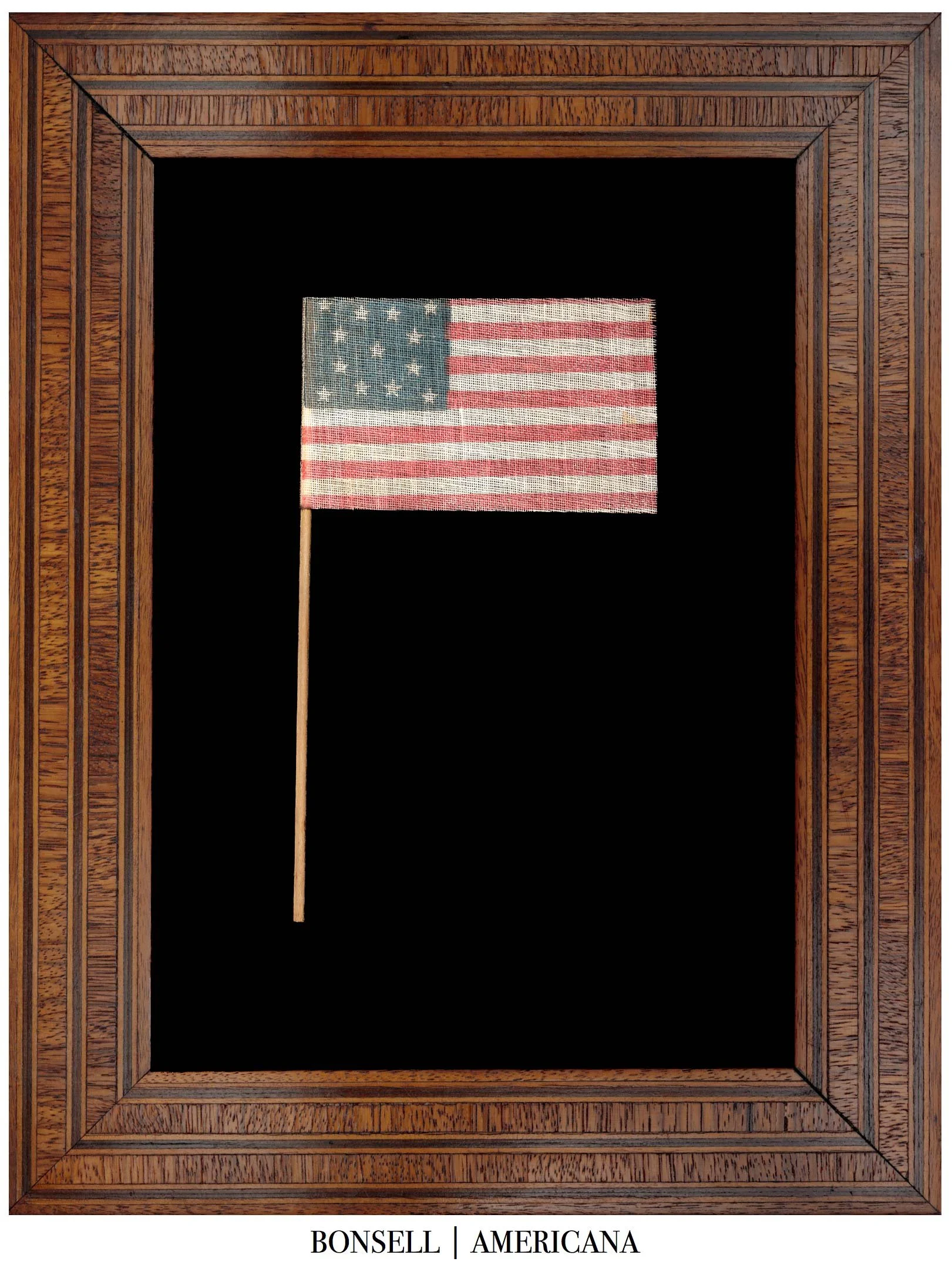
48 Star Antique Parade Flag with Handwritten Fourth of July Baseball Game Inscription | One of the Best Inscribed Flags We Have Encountered | From the J. Richard Pierce Collection | Circa 1903
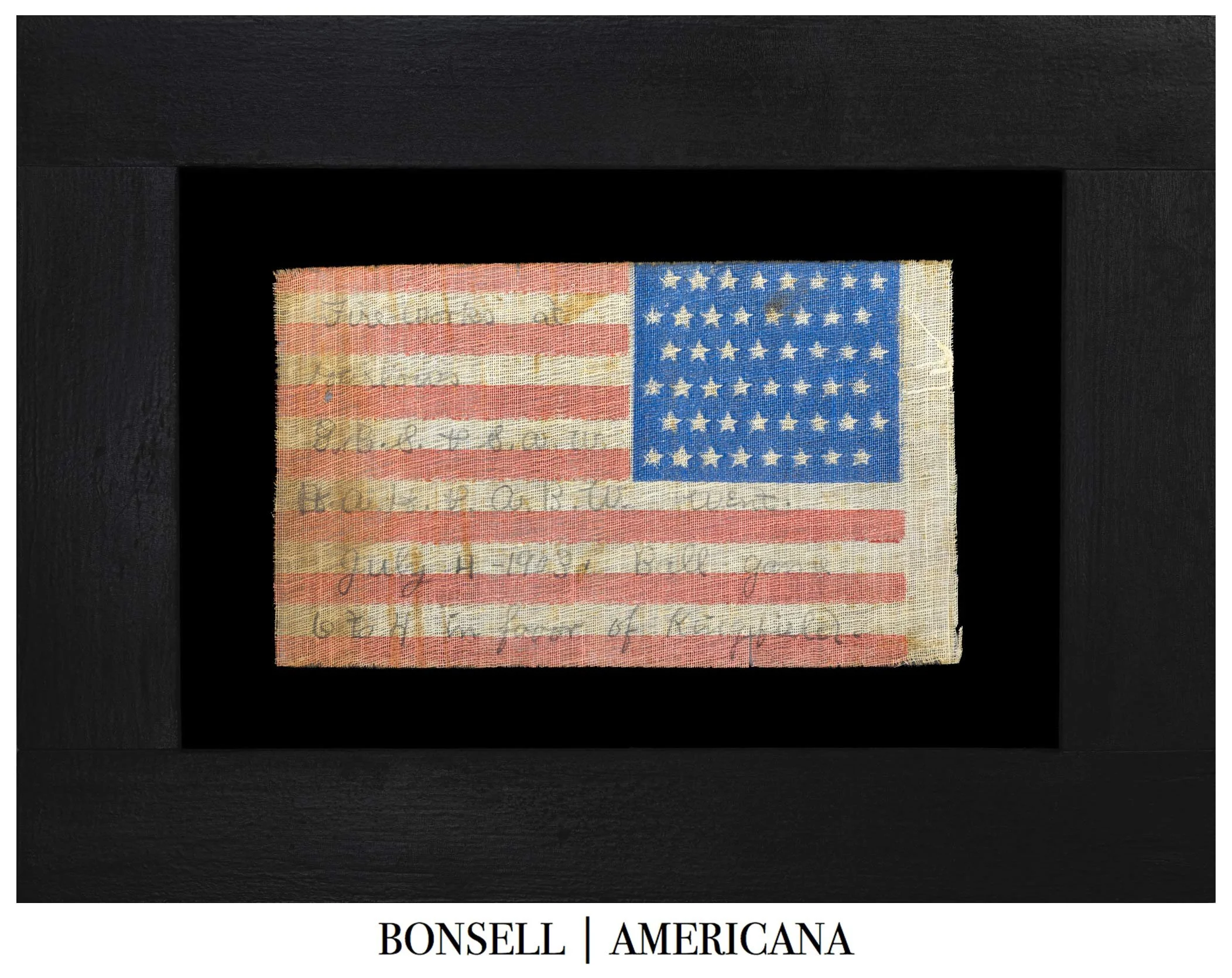
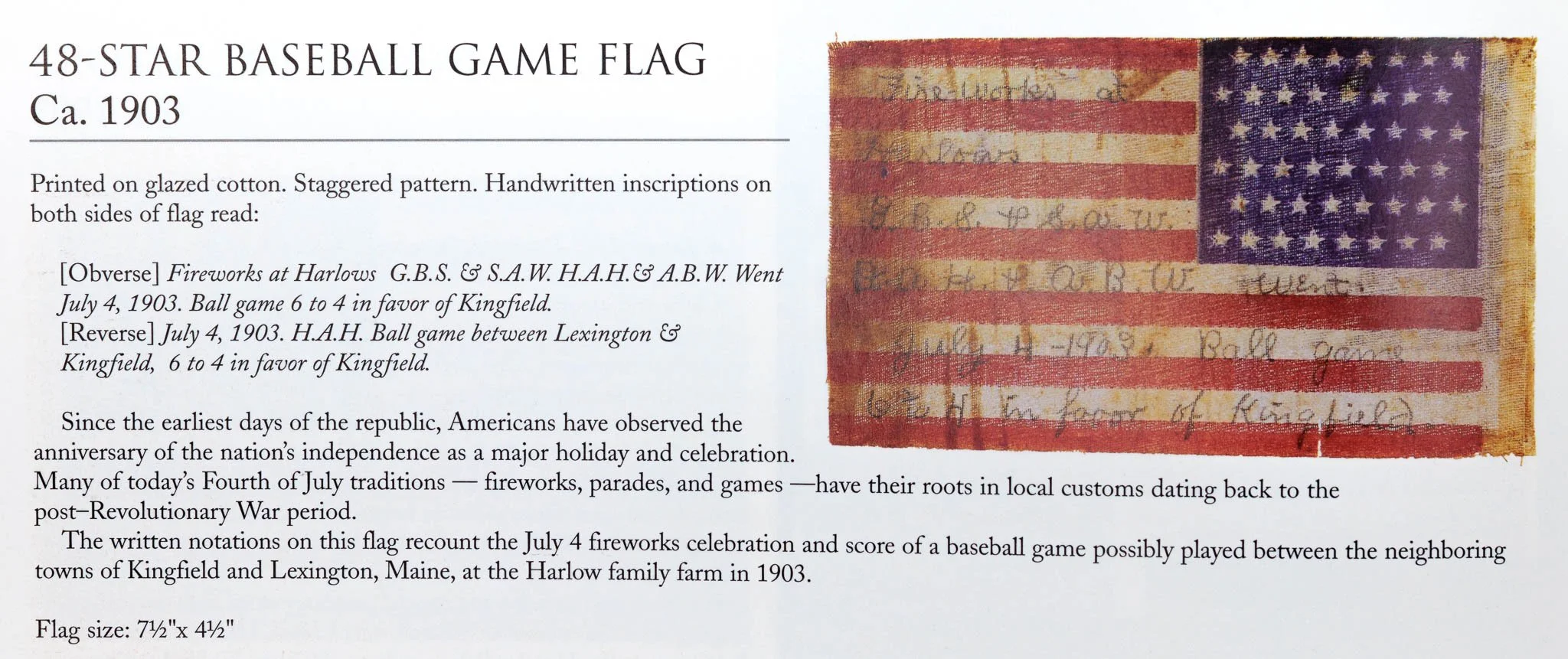
48 Star Antique Parade Flag with Handwritten Fourth of July Baseball Game Inscription | One of the Best Inscribed Flags We Have Encountered | From the J. Richard Pierce Collection | Circa 1903
Frame Size (H x L): 9.5” x 13”
Flag Size (H x L): 4.5” x 7.5”
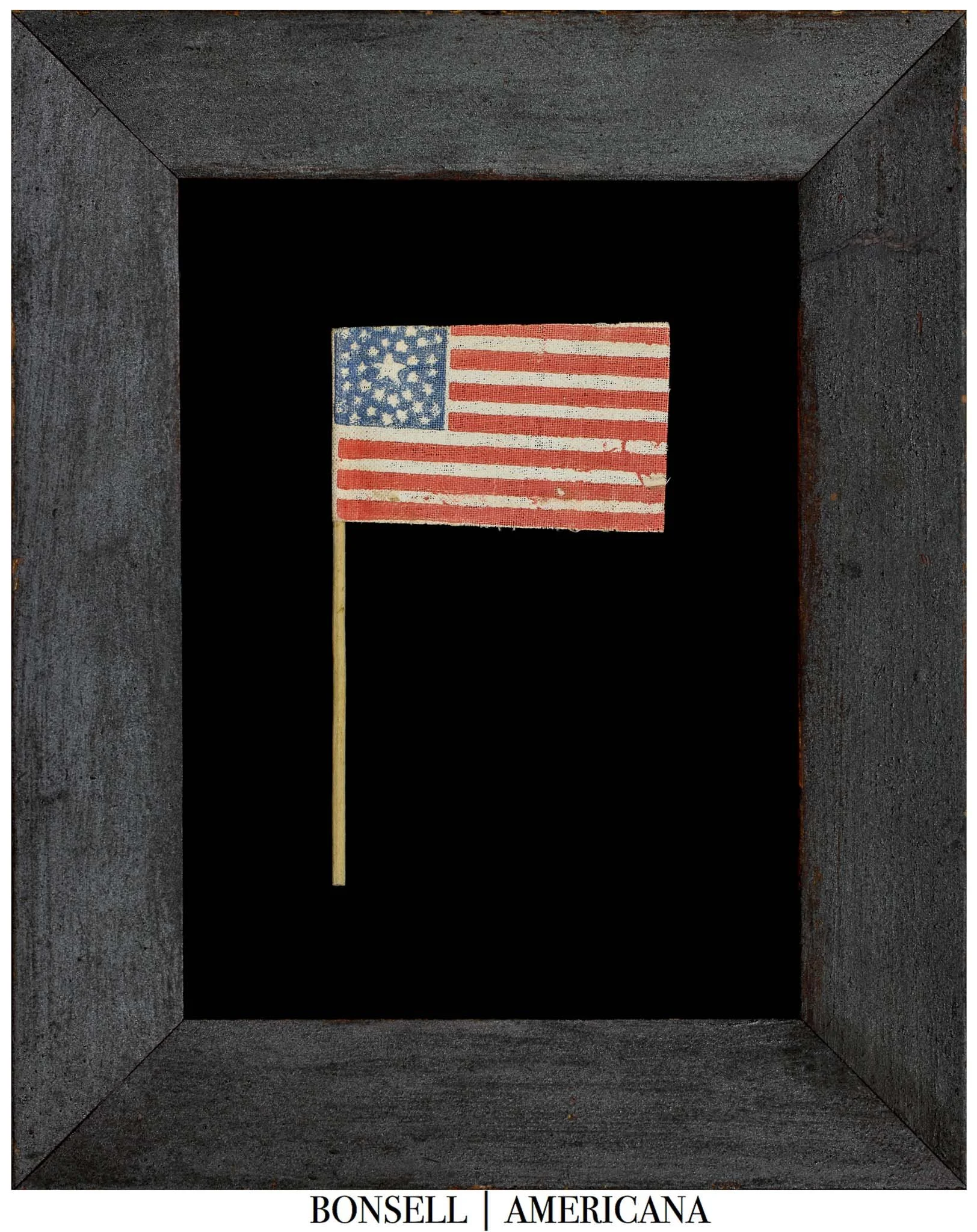
Offered is a 48-star American parade flag, printed on glazed cotton, notable for its early, non-regulated star arrangement and for the presence of handwritten inscriptions that record a specific Independence Day celebration. In addition to its patriotic function, this flag preserves contemporaneous written details relating to a local baseball game and Fourth of July festivities.
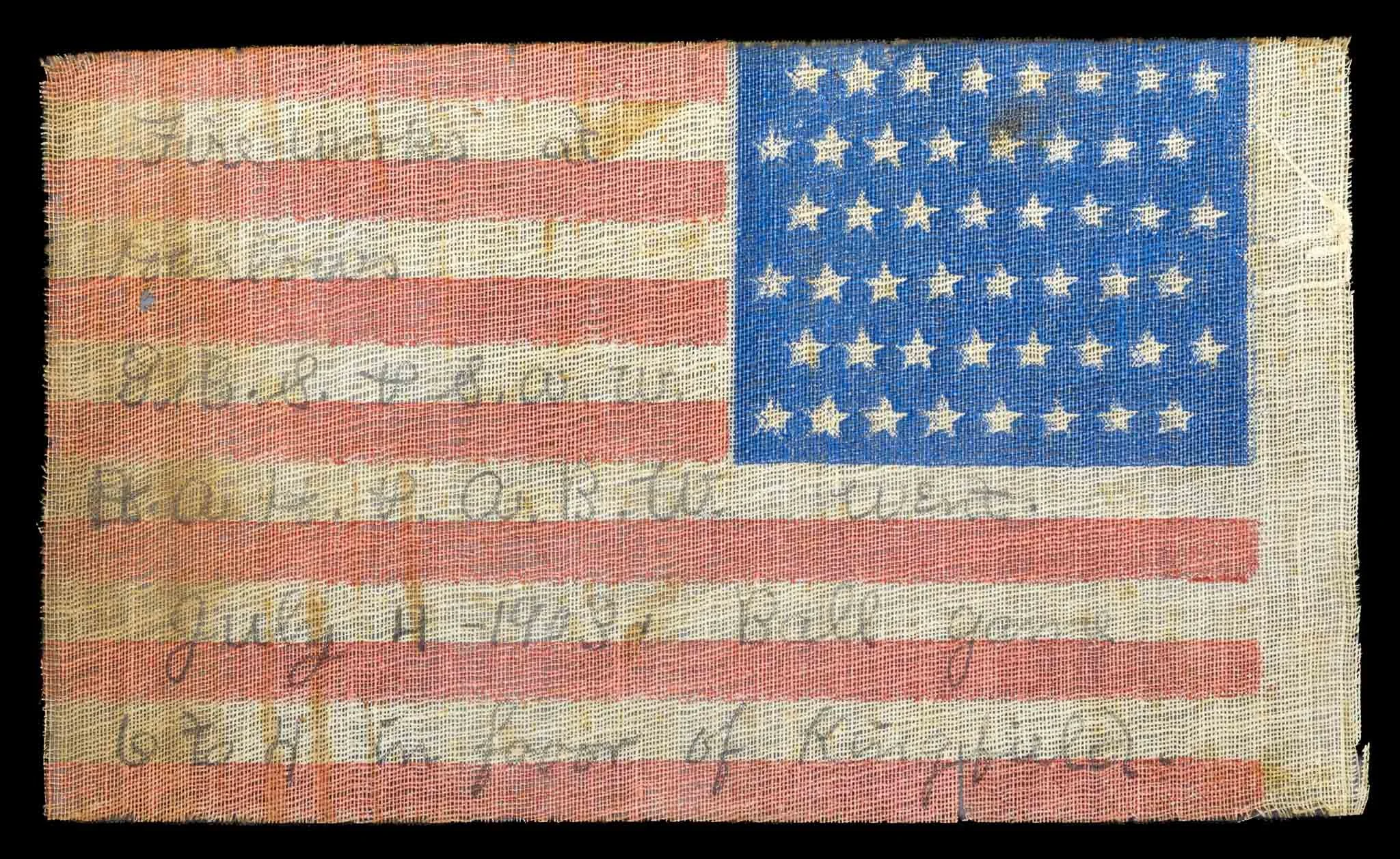
The handwritten inscriptions appear on both sides of the 48-star flag and are central to its significance. One side records the setting, participants, and date of the celebration, while the other reiterates the date and game details. Because portions of the writing are faint and partially obscured, the inscriptions are transcribed here verbatim so that the historical information is fully accessible.
The inscription on the side shown reads as follows:
Fireworks at
Harlows
G.B.S. & S.A.W.
H.A.H. & A.B.W. Went
July 4, 1903. Ball game
6 to 4 in favor of Kingfield.
The inscription on the other side reads as follows:
July 4, 1903.
H.A.H.
Ball game between Lexington &
Kingfield, 6 to 4 in favor of Kingfield.
Together, these inscriptions anchor the 48-star flag to a Fourth of July celebration in 1903 in western Maine. The named towns—Kingfield and Lexington—were neighboring rural communities, and holiday baseball games between such towns were a common feature of Independence Day observances at the turn of the twentieth century. These games were typically informal and locally organized, often accompanied by picnics and fireworks and held on private farms or open land rather than at formal municipal venues. The reference to “Harlows” is consistent with this practice and appears to denote a locally known family property used as the gathering site.
The recorded score—six to four in favor of Kingfield—suggests local pride and firsthand participation. A series of initials appears on both sides of the flag (G.B.S., S.A.W., H.A.H., and A.B.W.). While their specific identities remain unknown, such initials are typical of informal, personal inscriptions of the period and likely reference individuals present at, or involved in, the day’s events.
The 48-star count is anticipatory. This flag dates to 1903, nearly a decade before the 48-star flag became official on July 4, 1912, following the admission of New Mexico and Arizona earlier that year. In the late nineteenth and early twentieth centuries, American flag makers regularly anticipated future state admissions and produced flags reflecting projected star counts well in advance of official adoption. As a result, 48-star flags are known from the 1890s onward, long before the configuration was formally recognized.
Prior to June 24, 1912—when President Taft issued Executive Order 1556—there were no federal specifications governing star arrangement or flag proportions. Flag makers were free to arrange the stars within the canton as they saw fit, and proportions varied widely. Many early 48-star flags therefore display staggered or offset star patterns and elongated formats, characteristics present in this example and consistent with its early date of manufacture. Exact shades of red, white, and blue were likewise unregulated until 1934.
The 48-star flag holds a uniquely long and consequential place in American history. It became official on July 4, 1912, and remained the national flag for forty-seven years, until July 4, 1959, when Alaska prompted the adoption of the 49-star flag. During this extended period of use, the United States experienced many of the defining events of the twentieth century, including World War I, World War II, and the Korean War, all fought under the 48-star flag. Eight U.S. presidents served while it was the official national emblem, and for many Americans it became the flag most closely associated with the country’s emergence as a global power.
Seen in this light, the presence of a 48-star flag at a small-town Fourth of July celebration in 1903 feels notably forward-looking. Long before the star count became official—and decades before it would fly during some of the nation’s most consequential moments—this flag was already in use as part of everyday civic life, carried and written upon by ordinary Americans marking a summer holiday with baseball and fireworks.
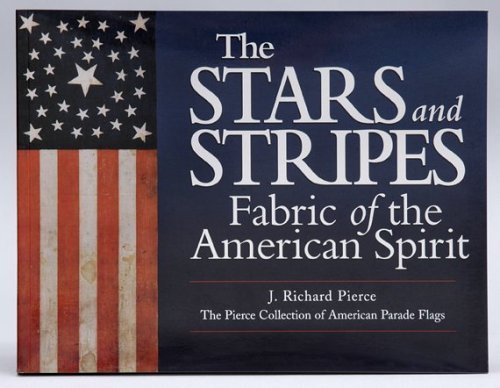
Importantly, this is the exact 48-star flag illustrated and discussed in The Stars and Stripes: Fabric of the American Spirit by J. Richard Pierce. Pierce is widely regarded as one of the foremost private collectors and scholars of American parade flags, and his collection—formed over decades—has served as the basis for exhibitions and scholarship at major institutions. Inclusion in his work places this flag within a rigorously studied and well-documented corpus of American textiles.
The flag is also referenced in a published article in Antiques & The Arts and was publicly exhibited as part of The Stars and Stripes: Fabric of the American Spirit, including exhibitions at Hancock Shaker Village and Morven Museum & Garden. These references establish the flag as a documented and exhibited example.
Taken together, the anticipatory 48-star count, early production characteristics, precise date, named towns, recorded score, handwritten inscriptions, and published exhibition history place this flag within the broader context of American flag-making, early baseball culture, and Independence Day traditions at the turn of the twentieth century.
Conservation Process: This flag was hand sewn to cotton fabric, and both were hand sewn to a mounting board. To prevent the black dye in the cotton fabric from seeping into the flag, it was first washed in a standard wash and then in a dye setting wash. The flag is positioned behind Optium Museum Acrylic.
Frame: The flag is housed in an early frame with a dry black surface, dating to approximately the 1840s. The frame is constructed from four straight lengths of molding joined at the corners rather than mitred, a method associated with utilitarian framing practices of the period.
Condition Report: The flag presents with honest wear consistent with age and use. There is a small hole near the fly end, located beneath the handwritten reference to Harlows, as well as a small vertical tear between the letters “g” and “f” in “Kingfield.” Additional minor fading and surface wear are present throughout, but the flag remains stable, legible, and visually appealing, with the inscriptions and star field clearly intact.
Collectability Level: The Great – Perfect for Rising Collectors
Date of Origin: 1903
Number of Stars: 48
Associated War: WWI, WWII, and Korean War
Associated State: Arizona