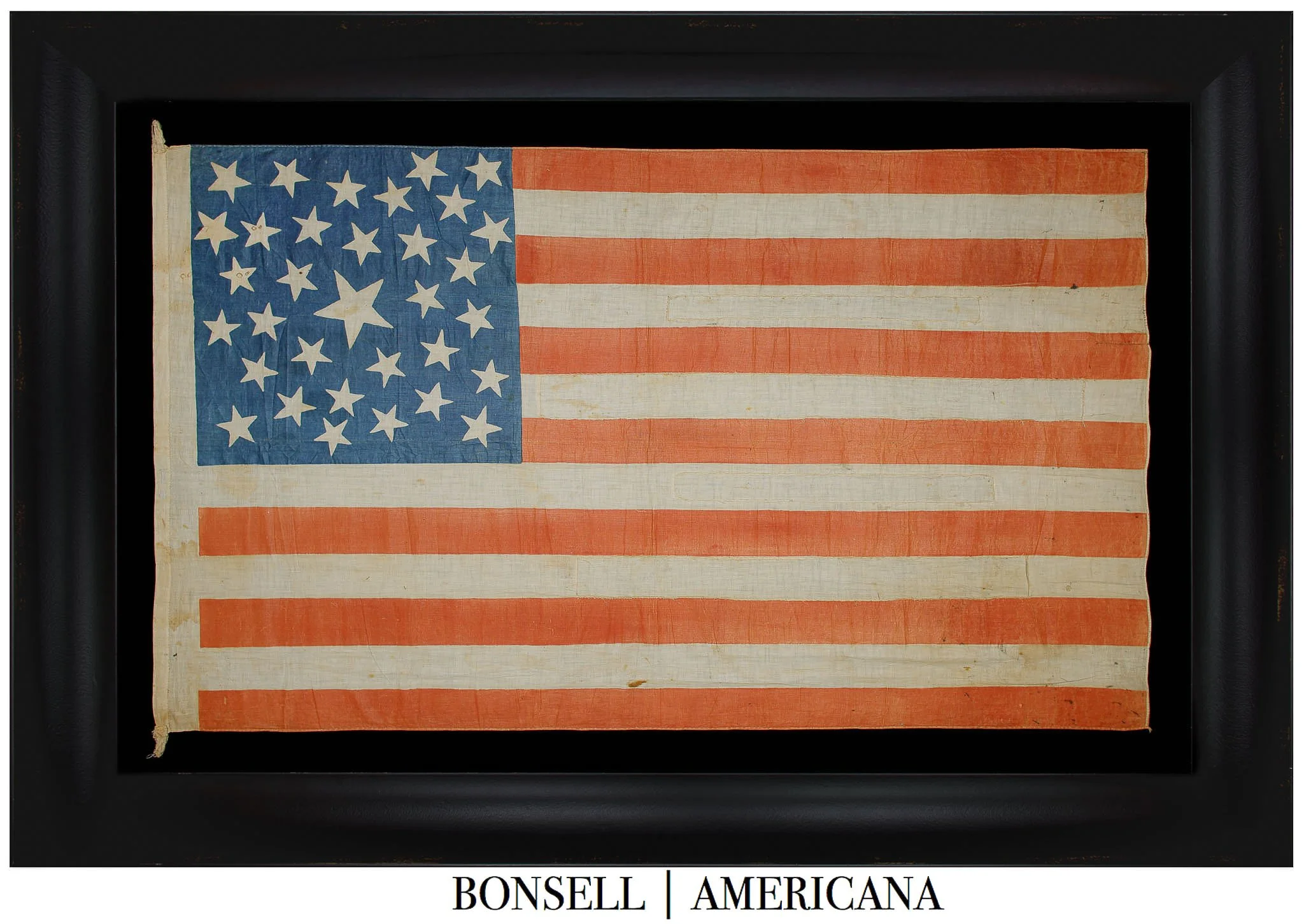
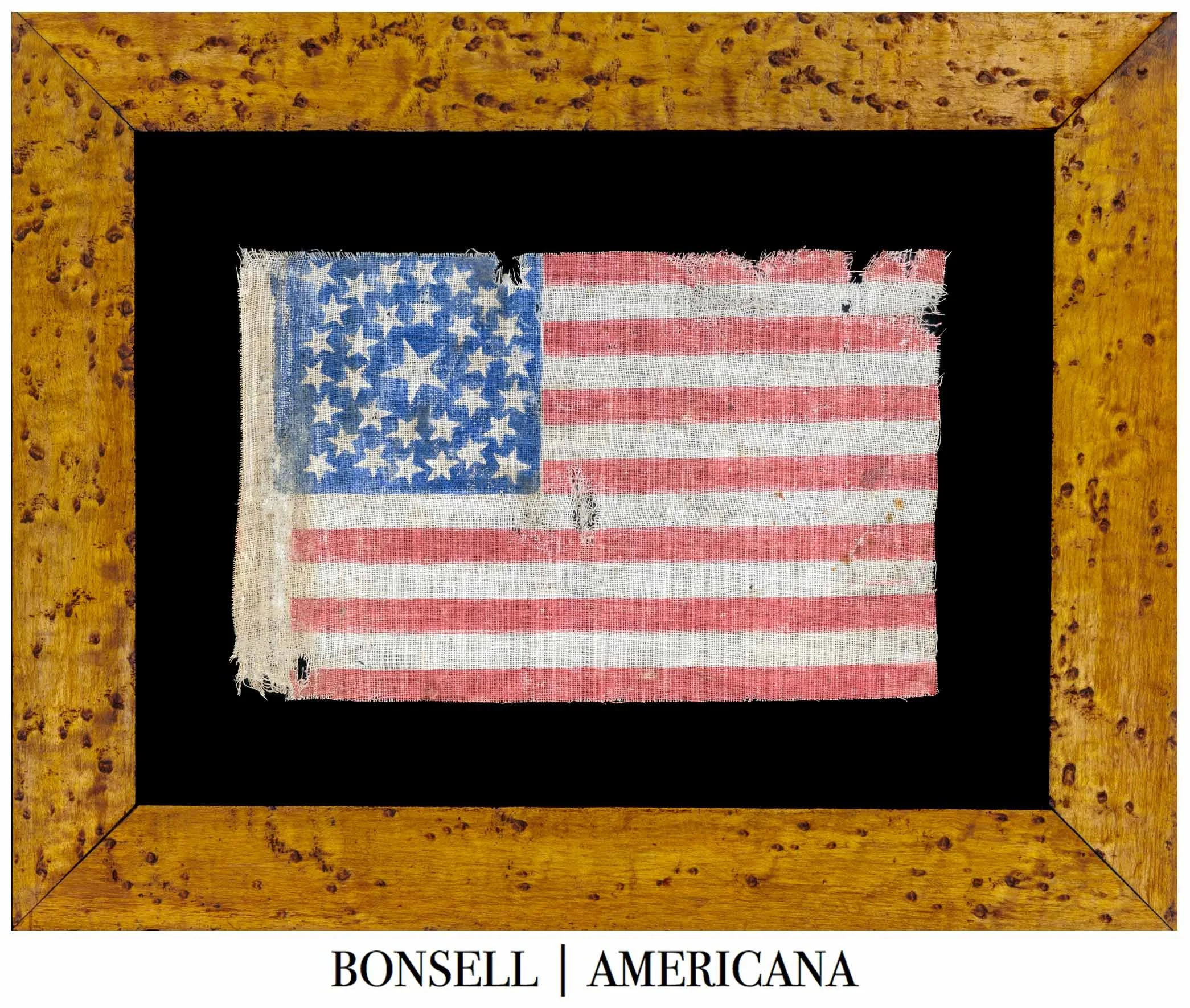
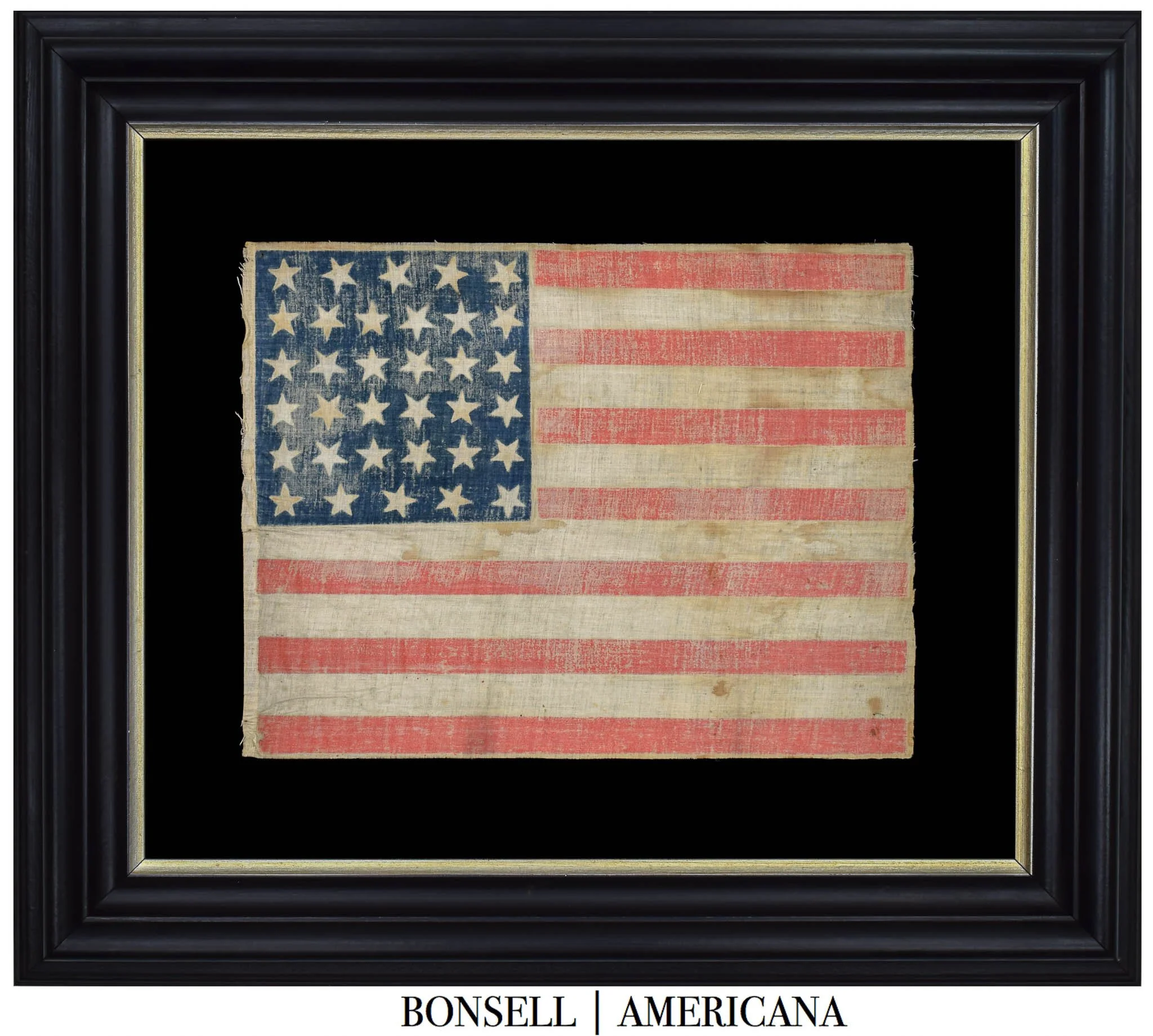
36 Star Antique American Parade Flag with a Striking Medallion Pattern | Nevada Statehood | Circa 1864-1867
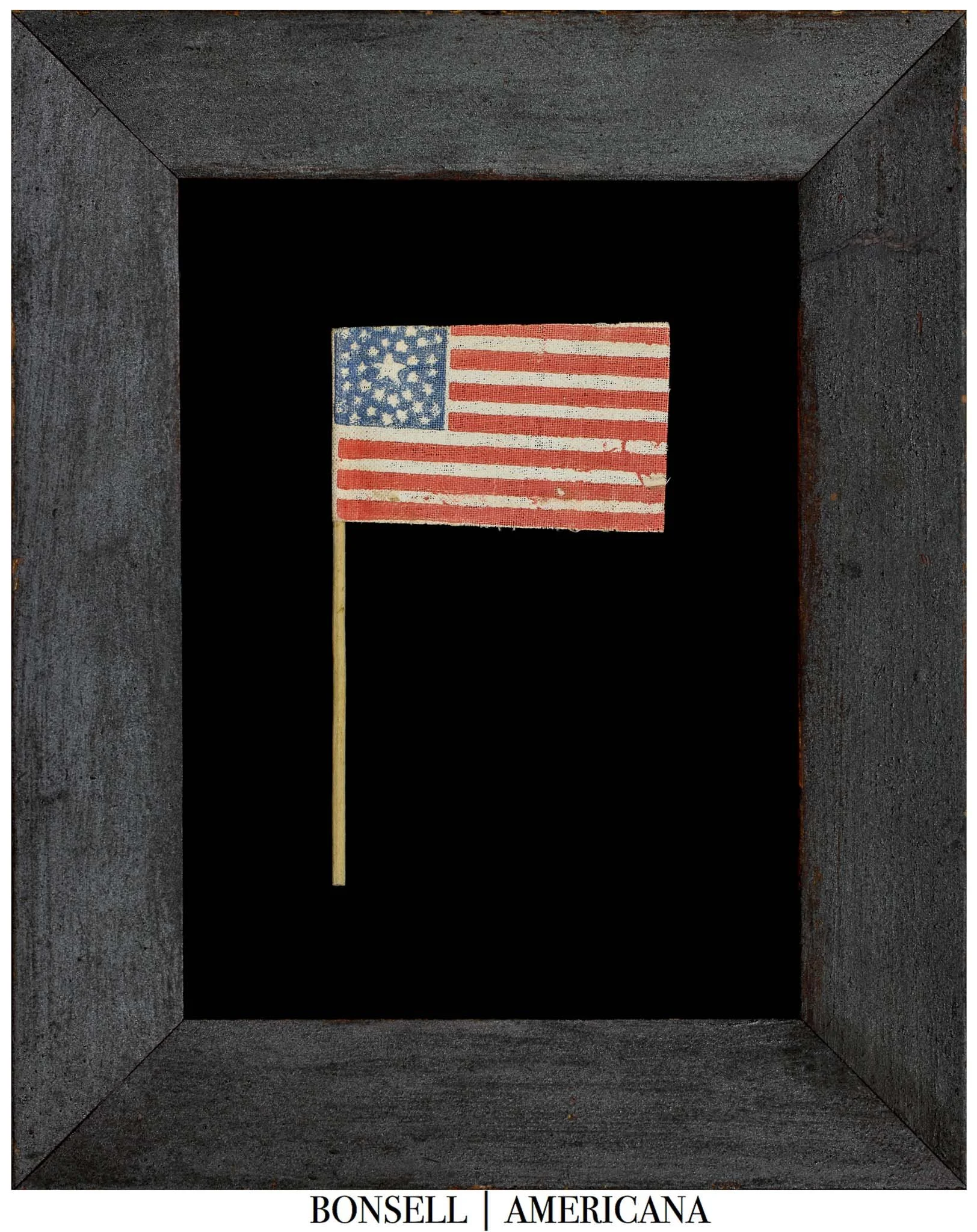
36 Star Antique American Parade Flag with a Striking Medallion Pattern | Nevada Statehood | Circa 1864-1867
Frame Size (H x L): 12.25” x 10”
Flag Size (H x L): 2.5” x 3.5” and Affixed to a 6” Staff
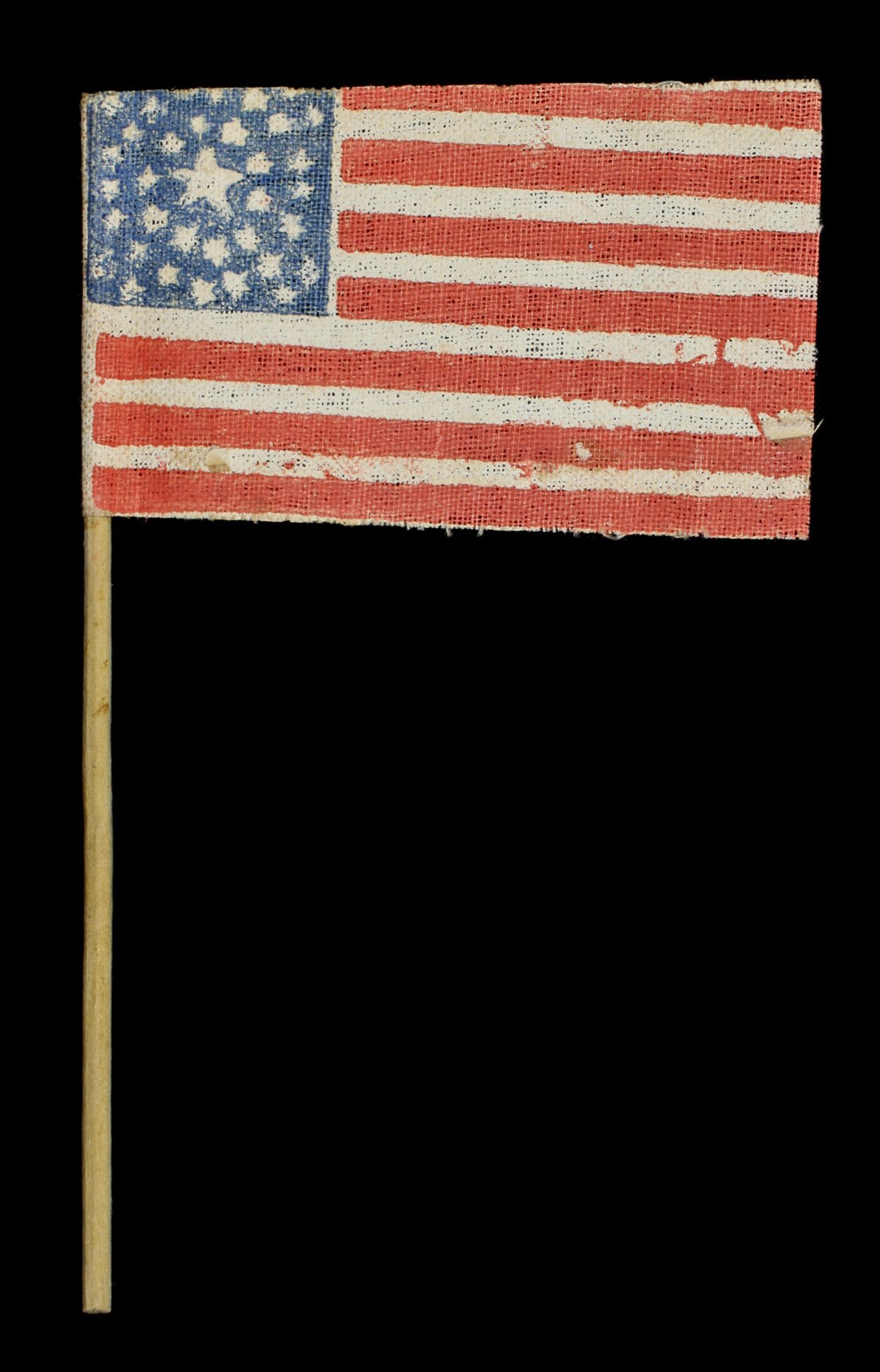
Offered is a scarce and visually striking 36-star antique American parade flag, printed on coarse cotton and presented on its original wooden staff. Parade flags such as this were made for short-term patriotic display at parades, political rallies, celebrations, and inaugurations. Despite their ephemeral purpose, they remain among the most evocative and collectible forms of 19th-century Americana.
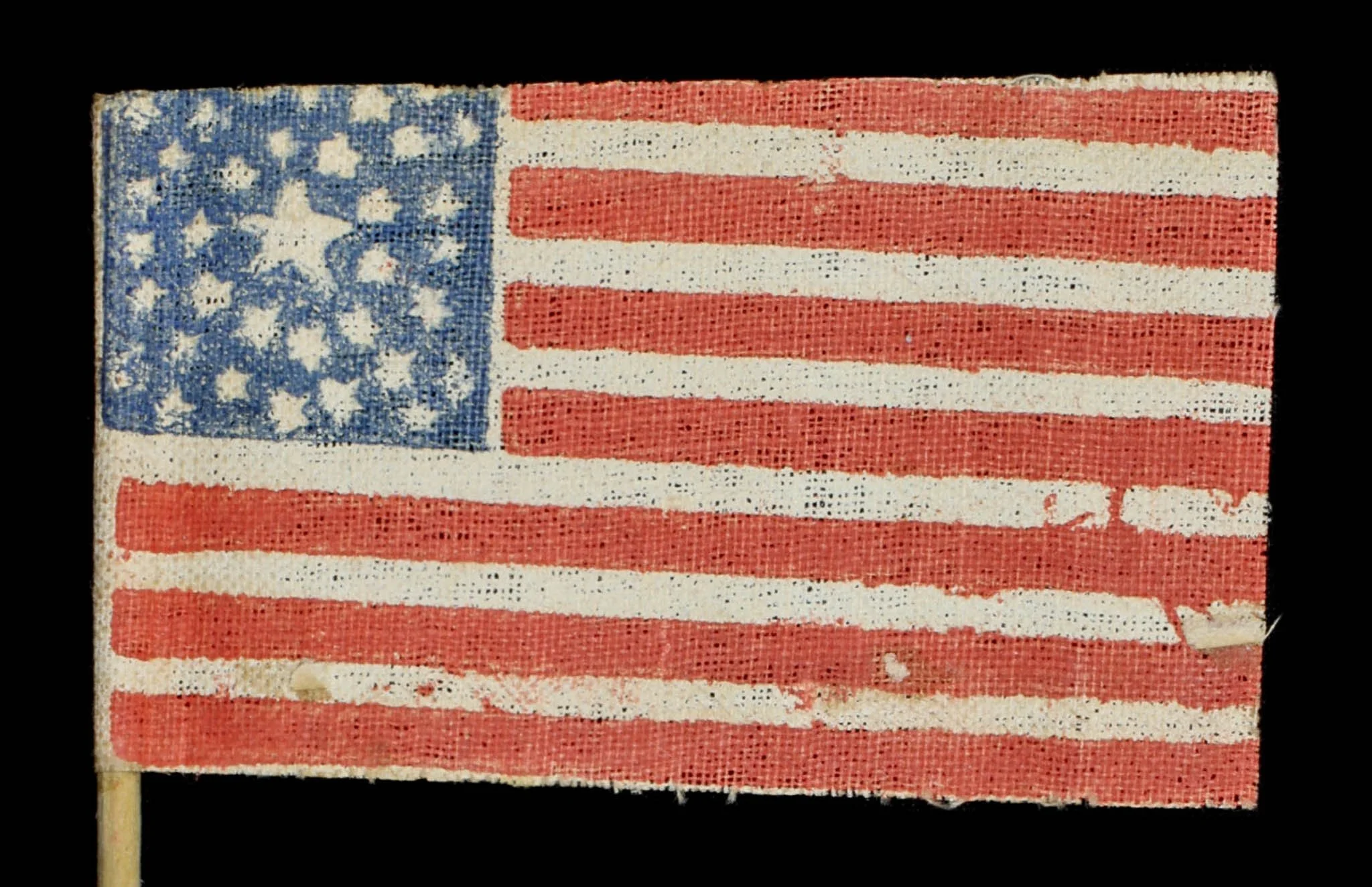
The stars on this flag are arranged in what is known as a medallion configuration—a visually arresting layout favored during the mid-19th century. At the center of the canton is a large star, encircled by two concentric rings: the inner ring features 10 stars, while the outer ring contains 17. Completing the design are corner stars flanking the medallion. While medallion patterns were especially popular between 1861 and 1876, they largely disappeared from production by 1890, replaced by more uniform rows and columns. Their ornate, almost celebratory feel sets them apart from the rigid star alignments of later eras.
This specific example bears 36 stars, representing the admission of Nevada into the Union. Though Nevada officially joined on October 31, 1864, the 36-star flag did not become official until July 4, 1865—just after the conclusion of the Civil War. Nevada’s statehood was strategically timed. Politically, it was intended to support President Abraham Lincoln’s 1864 re-election and to solidify Republican control during Reconstruction. Economically, the state’s immense silver reserves were seen as critical to financing the Union war effort and addressing postwar debt.
The 36-star flag served as the nation’s official flag for two years, from July 4, 1865, to July 3, 1867. During this time, it flew over a country grappling with the aftermath of the Civil War and beginning the long road toward Reconstruction. It was also used by the U.S. military during the final months of the war. The 37-star flag, recognizing Nebraska’s statehood, would succeed it on July 4, 1867.
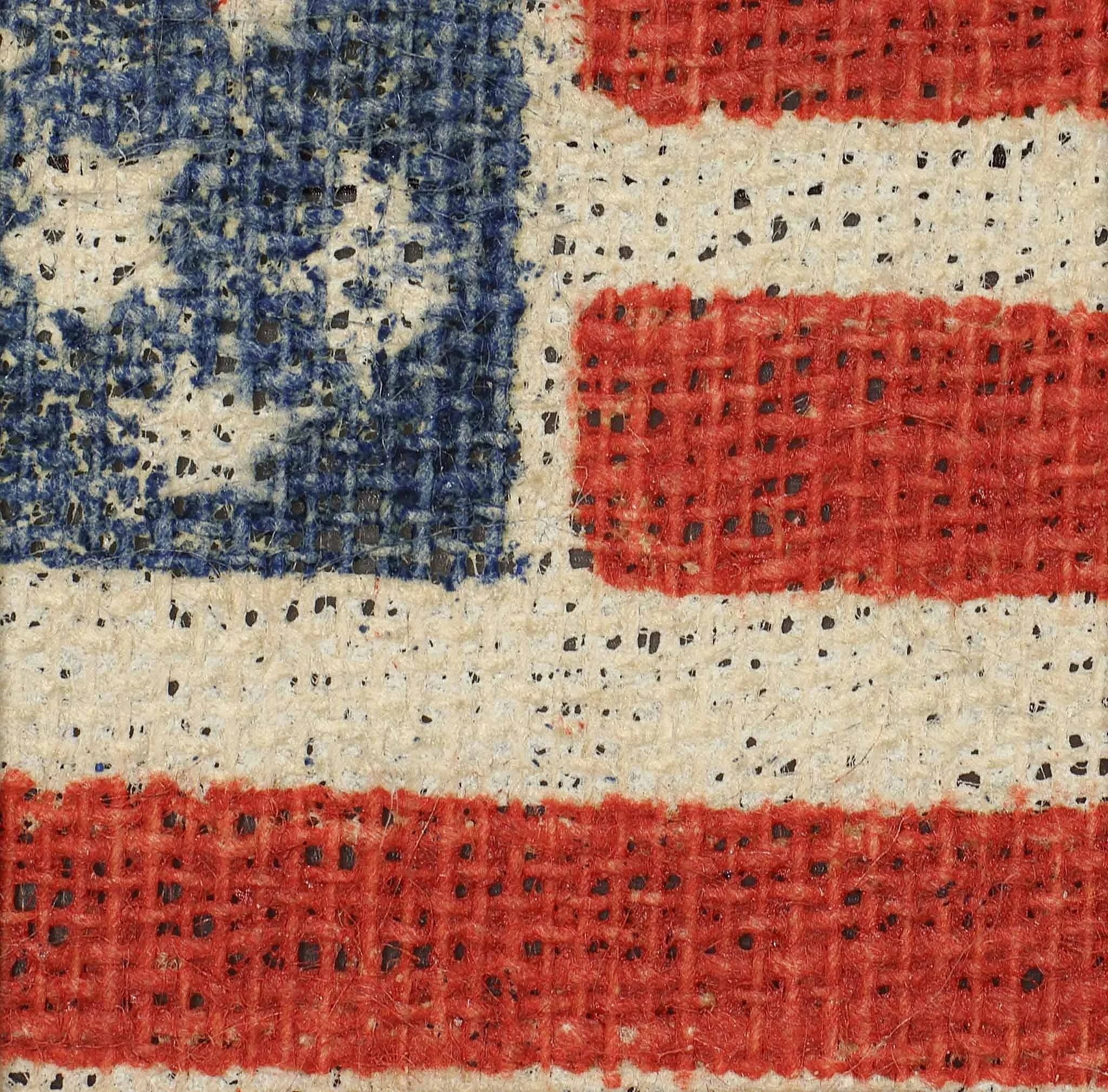
Extremely close inspection of this example reveals important details about its manufacture. The flag is printed on a coarse, plain-weave cotton consistent with mid-19th-century domestic cloth. The pigments sit visibly atop the fibers, pooling around the yarn intersections in a manner characteristic of early block or stencil printing rather than later roller-printed methods. The blue displays the dark, slightly green-cast tone associated with Prussian blue, and the red carries the matte, mineral quality of iron-oxide pigments—both typical of inexpensive patriotic printing of the period. Uneven pressure during the print strike softens some stars and enhances others, creating subtle mis-registration that underscores its hand-guided, utilitarian origins.
Conservation Process: The flag was hand sewn to cotton fabric, and both were hand sewn to a mounting board. To prevent the black dye in the cotton fabric from seeping into the flag, it was first washed in a standard wash and then in a dye setting wash. The flag is positioned behind Optium Museum Acrylic.
Frame: The flag is housed in an early American, splined-miter frame dating to approximately 1830–1860, retaining its original lampblack or ‘dry black’ surface. The hand-cut joinery, early iron hanging hardware, and oxidized hardwood construction are all consistent with antebellum rural framing practices.
Condition Report: The flag survives in honest condition with scattered small losses and light surface wear typical of early printed parade flags on open-weave cotton. Most distinctive is the originally irregular top edge, where the trimming or print strike cuts partially into the canton and grazes the upper red stripe — a characteristic result of the rudimentary, hand-guided production methods used for these inexpensive flags. Despite its modest imperfections, it retains strong visual character and an appealing, untouched presentation.
Collectability Level: The Great – Perfect for Rising Collectors
Date of Origin: 1864-1867
Number of Stars: 36
Associated War: Civil War (1861-1865)
Associated State: Nevada