Outstanding 13 Star Antique American Flag with a 4-5-4 Pattern | Civil War to Centennial Era | Circa 1861–1876
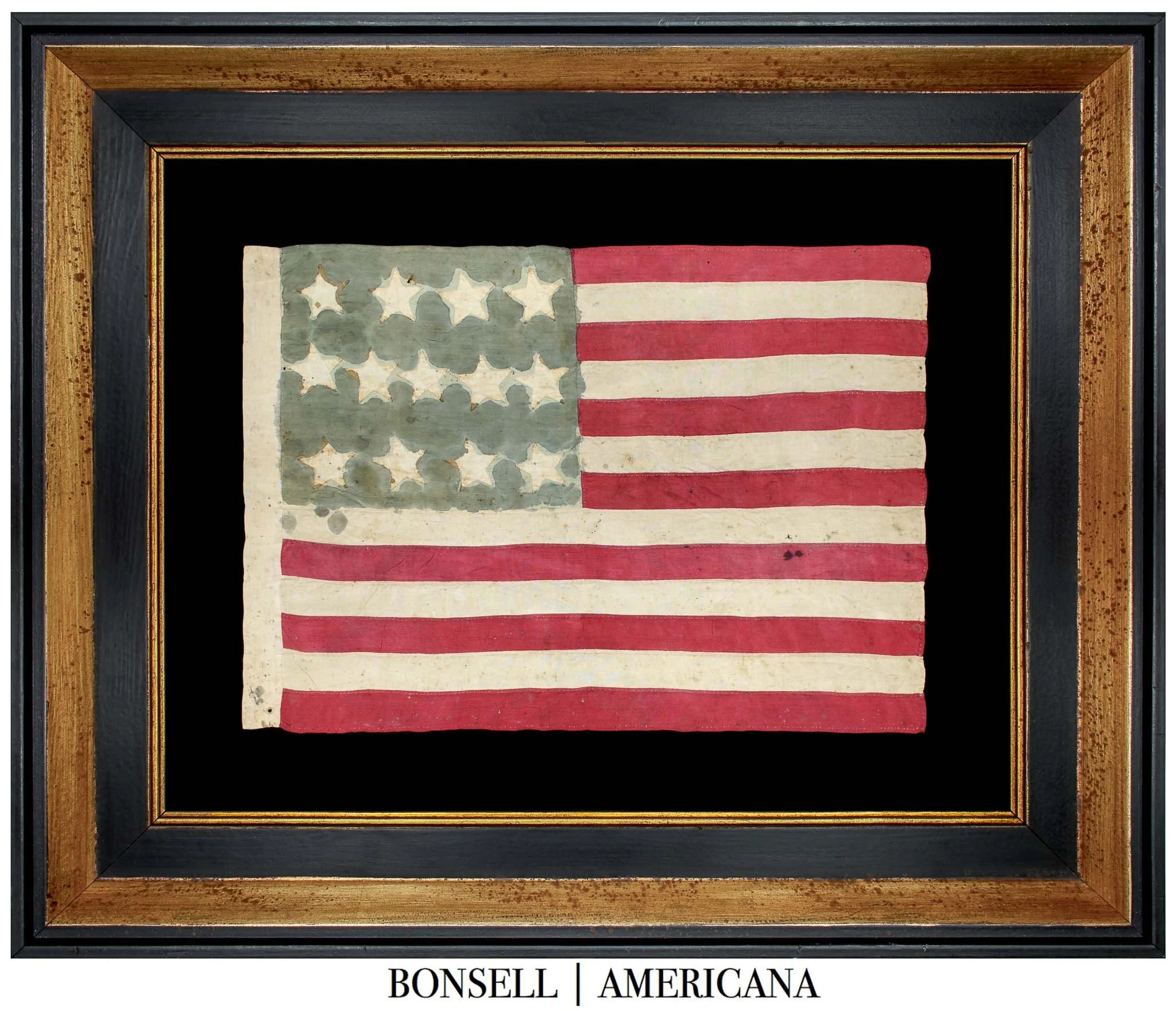
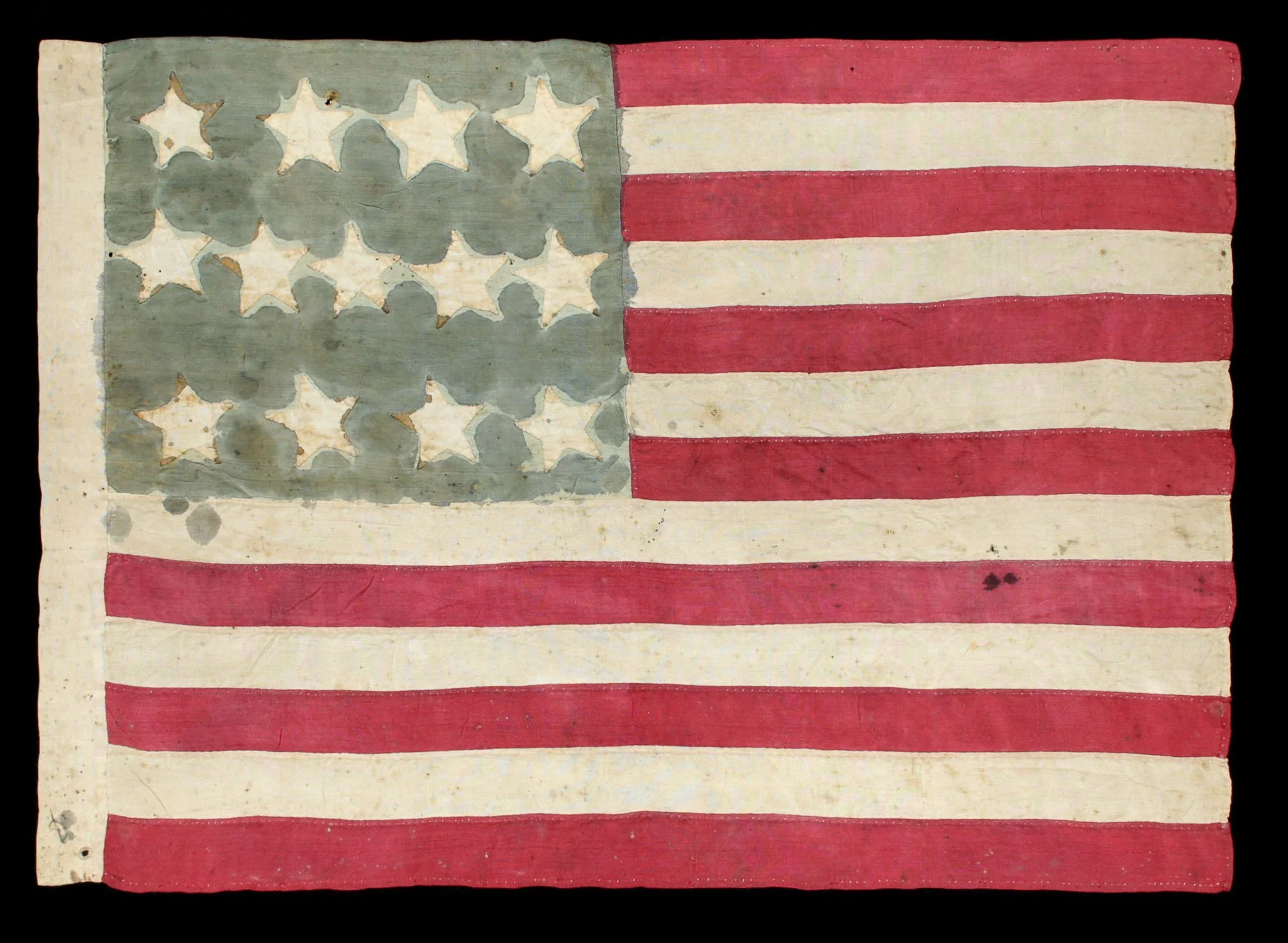
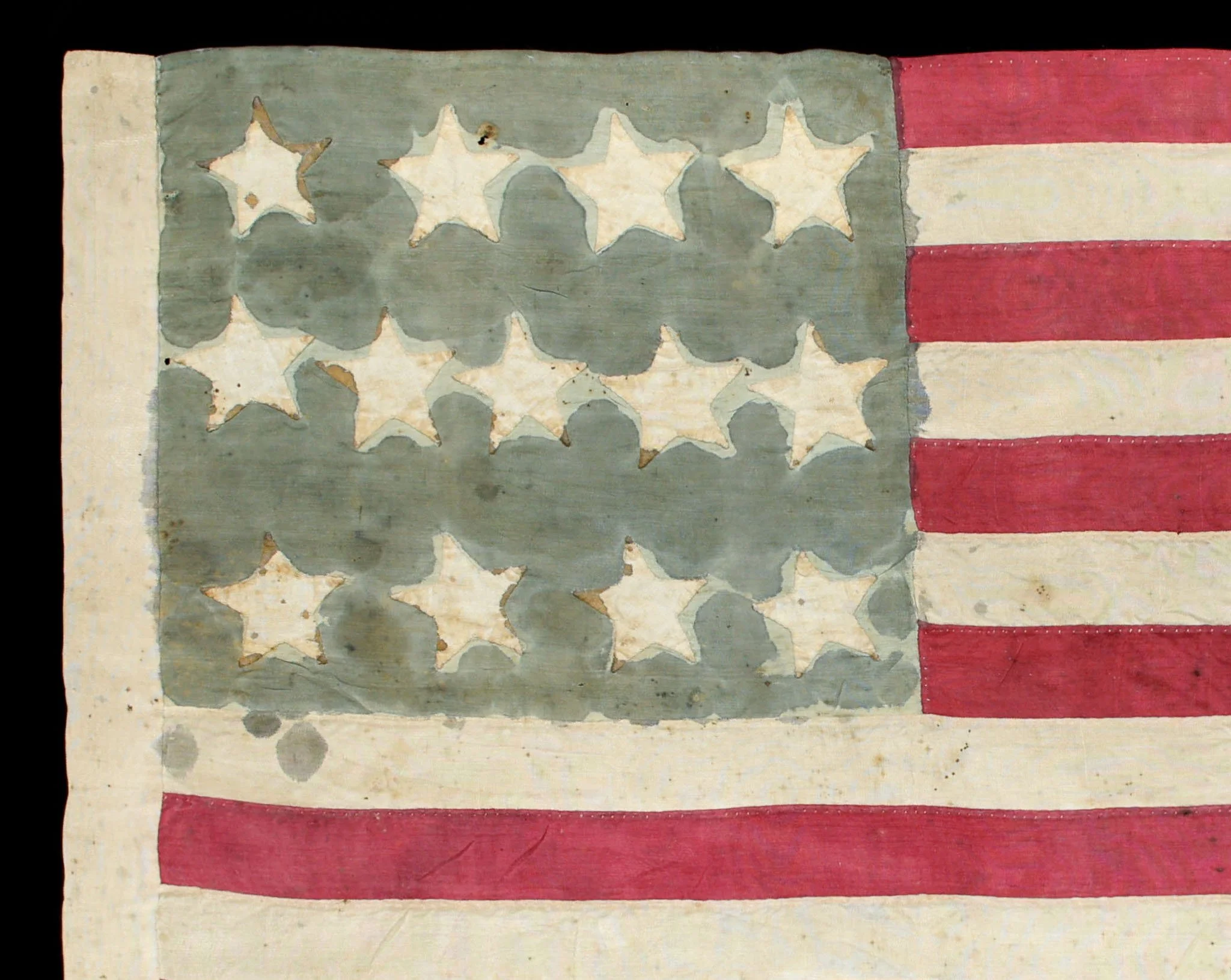
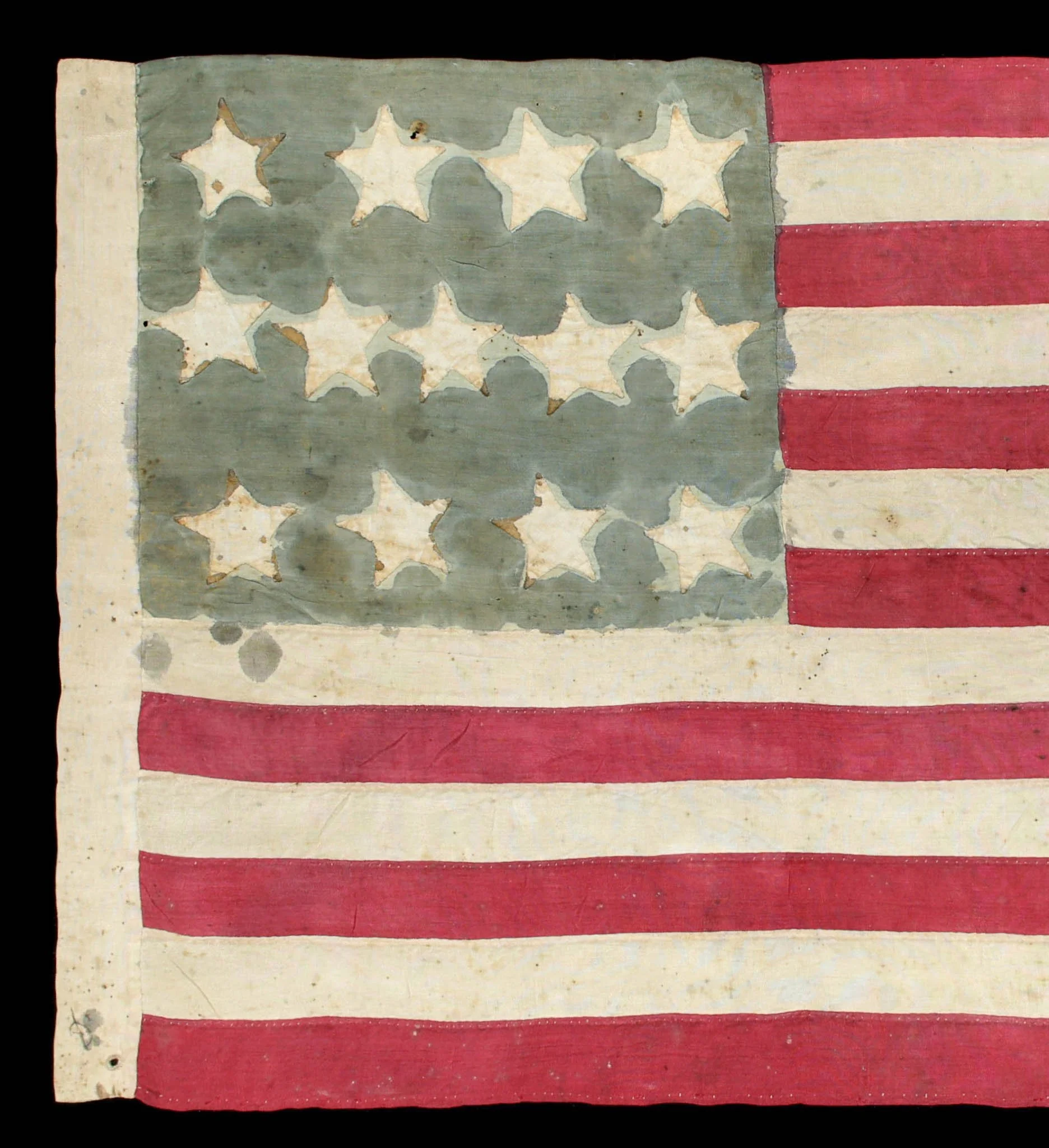
Outstanding 13 Star Antique American Flag with a 4-5-4 Pattern | Civil War to Centennial Era | Circa 1861–1876
Frame Size (H x L): 24” x 28.75”
Flag Size (H x L): 12.5” x 17.5”
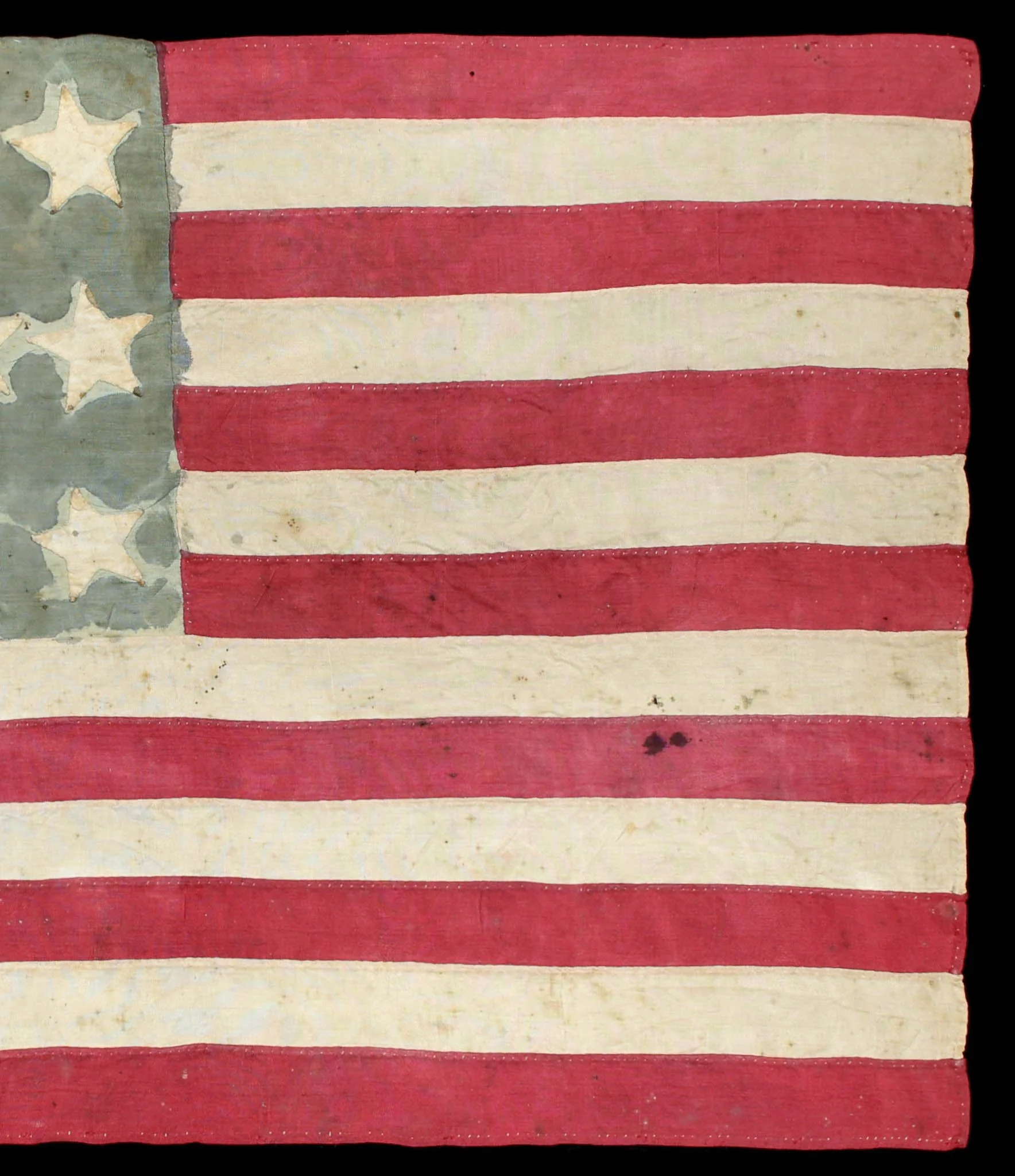
Offered is an entirely handsewn thirteen-star American flag, constructed with care and precision typical of the mid-19th century. The red silk trends toward a rich maroon, setting it apart from the brighter scarlets found in most flags. The silk canton is rendered in a lighter shade of blue, best described as cornflower. Each star is hand-appliquéd, and the stitching, while delicate, has held securely. At the lower left corner, there is a small handsewn grommet.
Though it shares similarities with Bible flags carried during the Civil War—particularly in terms of its general scale, sewing technique, and overall character—this flag is somewhat larger than one would expect for that category. Bible flags were typically pocket-sized tokens, given to soldiers by loved ones as mementos of faith and patriotism. This example, by contrast, was more likely intended as a presentation or display piece, or for use in private patriotic expression. The absence of machine stitching supports a date prior to the widespread adoption of sewing machines in flagmaking after the 1870s.
STAR CONFIGURATION
The star configuration is especially notable: a 4-5-4 arrangement, seldom seen in surviving examples. Flags with this pattern are among the most difficult of all thirteen-star flags to locate, and they possess strong visual appeal. In the marketplace, approximately 75% of antique thirteen-star flags appear in the 3-2-3-2-3 “Hopkinson” pattern, about 20% in some form of medallion, and the remaining 5% in less common variations such as the 4-5-4 or Betsy Ross designs. The 4-5-4 is generally encountered on flags dating to the Civil War and earlier, and its recurrence in early examples has led some scholars to suggest that it may have been the arrangement used in the very first American flag.
This layout departs from the more familiar rows or medallions of the 19th century, underscoring the individuality and creative license exercised by local makers. Such unusual configurations were not part of official naval or government practice but are found on homemade flags, where interpretation was left to the discretion of the maker. The result is a distinctly folk arrangement that contributes to both the rarity and the aesthetic appeal of the present example.
Taken together, the flag’s traits—the entirely handsewn construction, the hand-applied grommet, the maroon-leaning red, and the light cornflower blue canton—place it between 1861 and 1876, a period spanning the Civil War and the Centennial. The reliance on handwork leans toward an earlier origin, most likely 1861–1865, though the broader window is justified by the persistence of non-standard, homemade examples into the Centennial period.
THIRTEEN-STAR FLAGS
The thirteen-star flag was first adopted on June 14, 1777, when the Continental Congress resolved that “the flag of the United States be made of thirteen stripes, alternate red and white, that the union be thirteen stars, white on a blue field, representing a new constellation.” Although official only from 1777 to 1795, thirteen-star flags remained in use long afterward as a symbolic reference to the nation’s origins.
They appeared in a variety of contexts. Small U.S. Navy boats used them as ensigns from 1795 until 1916. They were displayed at the death of George Washington in 1799, during the nation’s 50th anniversary in 1824, and again in celebration of General Lafayette’s return that same year, when public events were held in major cities and throughout the South and West.
Their use was especially prominent during the Mexican War (1846–1848) and the Civil War (1861–1865), when the direct association with the Revolutionary generation carried strong patriotic meaning. The Centennial of 1876 marked another major revival, most notably at the Centennial International Exhibition in Philadelphia, where countless thirteen-star flags were flown as emblems of national pride.
Placed within this tradition, the present flag embodies both the creativity of its maker and the enduring resonance of the thirteen-star design. Its handsewn construction, unusual 4-5-4 configuration, and dating to the Civil War–Centennial era align it with a broader pattern in which the thirteen-star flag was not simply a relic of the Revolution, but a patriotic symbol revived during moments of national conflict and commemoration.
Conservation Process: This flag was hand sewn to cotton fabric, and both were hand sewn to a mounting board. To prevent the black dye in the cotton fabric from seeping into the flag, it was first washed in a standard wash and then in a dye setting wash. The flag is positioned behind Optium Museum Acrylic.
Frame: This offering is in our Large Distressed Black and Gold Frame.
Condition Report: The flag shows expected wear consistent with age and use. There are scattered stains and soiling throughout, with water exposure having caused visible “haloes” around the stars and areas of dye migration into the stripes and along the hoist. Stitching remains intact, and while there is light fraying at the edges, the overall structural integrity is sound.
Collectability Level: The Best – Perfect for Advanced Collectors
Date of Origin: 1861-1876
Number of Stars: 13
Associated State: Original 13 Colonies