Exceptional 38 Star Antique American Flag with Medallion and Inset Grand Luminary Configuration | Colorado Statehood | Circa 1876–1890




Exceptional 38 Star Antique American Flag with Medallion and Inset Grand Luminary Configuration | Colorado Statehood | Circa 1876–1890
Price: Call 618-553-2291, or email info@bonsellamericana.com
Frame Size (H x L): 34 ½” x 46”
Flag Size (H x L): 23” x 34 ½”
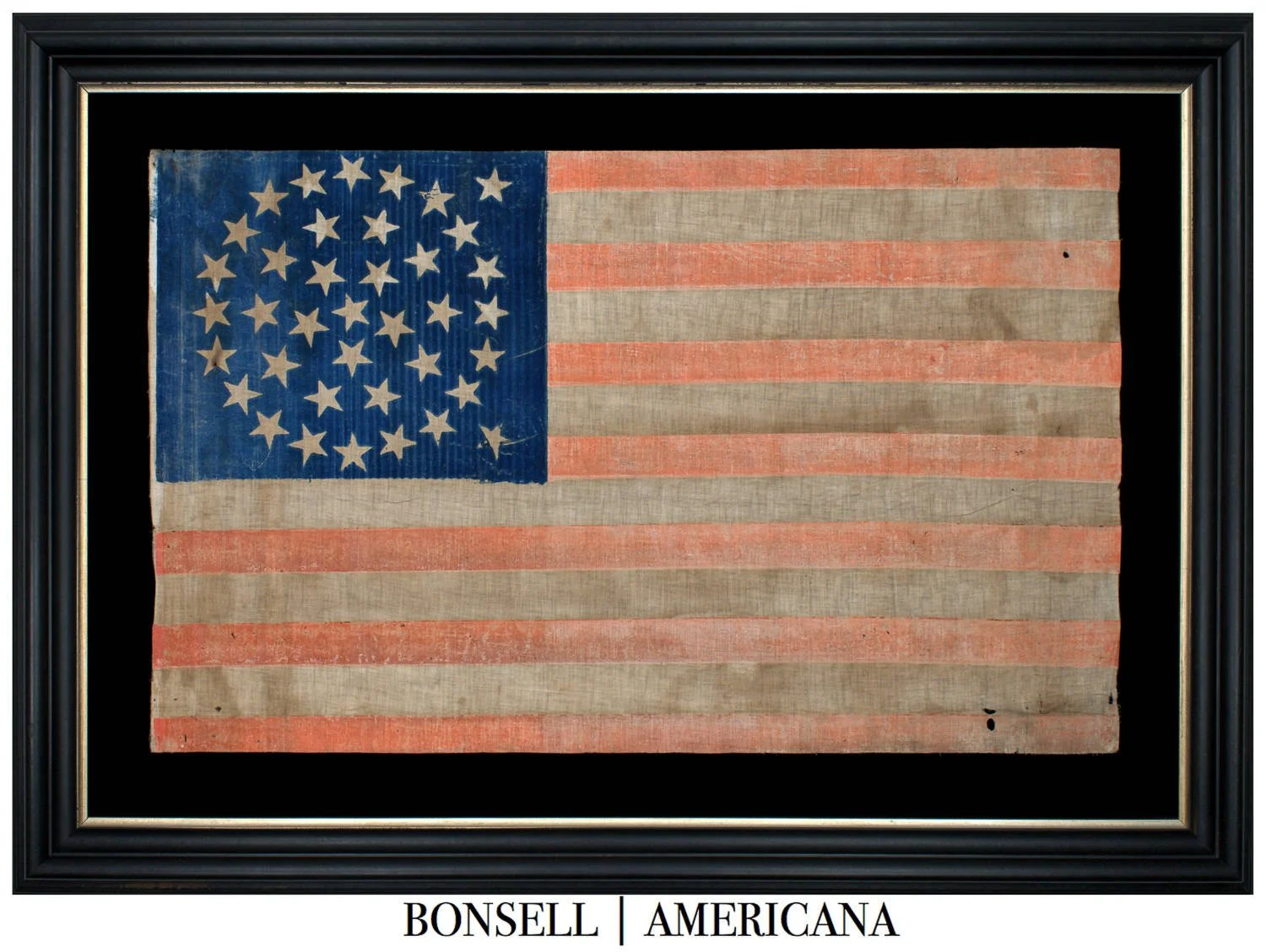
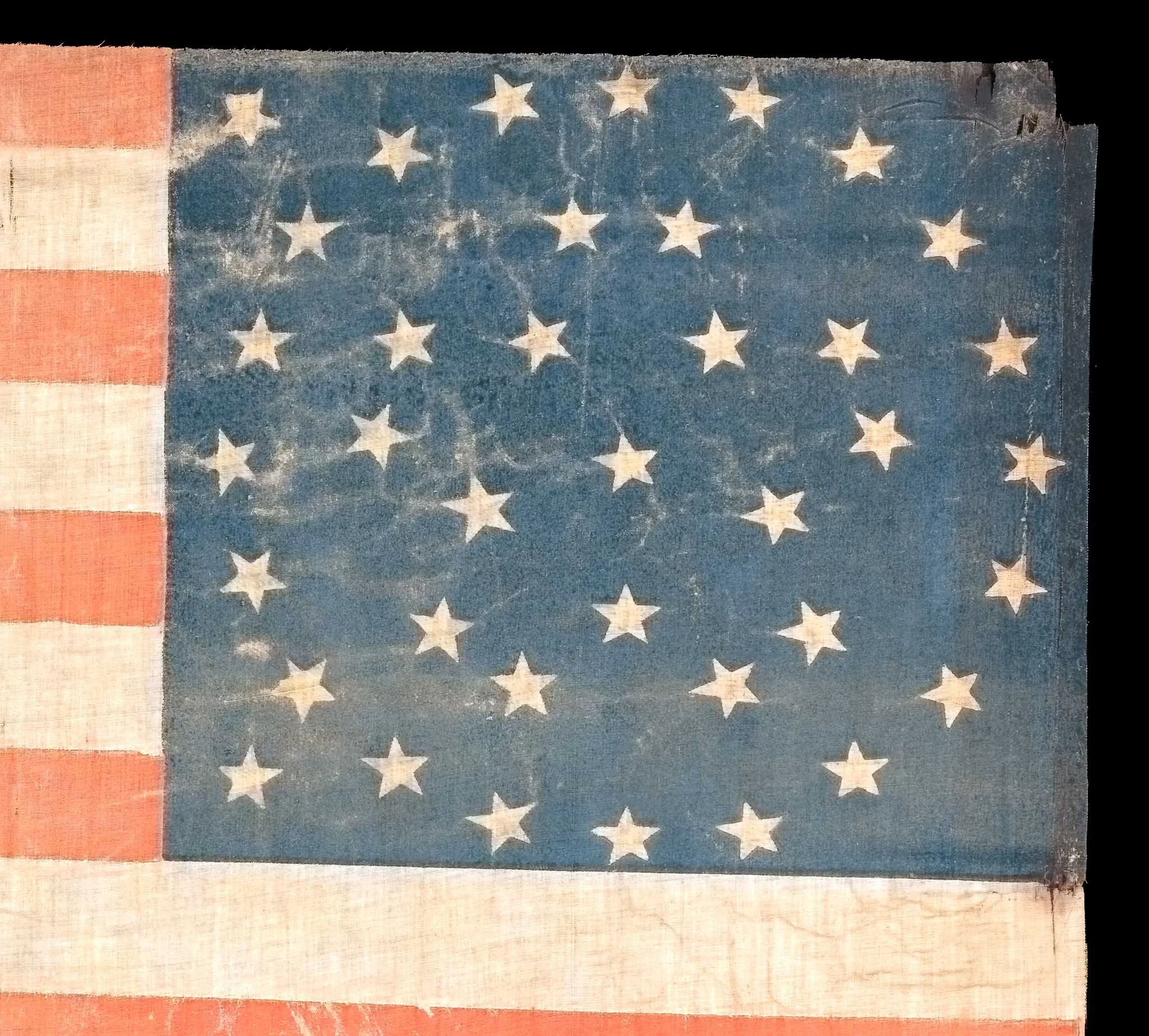
Offered is a remarkable 38-star antique American flag, printed on coarse, glazed cotton and dating to the period surrounding the nation’s Centennial. The flag is distinguished by an especially unusual star configuration that combines a circular medallion with a secondary five-pointed star—often called a Great Star or Grand Luminary—formed from individual stars within the larger arrangement.
At first glance, the configuration can be difficult to discern. A ring of stars establishes the dominant circular form, while additional stars within the circle are positioned to create the outline of a large five-pointed star. Several of the stars at the tips of this secondary formation intersect with the surrounding wreath, allowing the two patterns to function together rather than as separate devices. A single star occupies the center. The result is an unusually sophisticated design in which the 38 stars form multiple patterns simultaneously.
The Grand Luminary was among the most visually ambitious star arrangements employed on 19th-century American flags. Rather than arranging the stars in simple rows, the maker used the stars themselves to construct a much larger star, transforming the canton into an overtly patriotic graphic. Great Star patterns appeared periodically throughout the 19th century, particularly on flags produced for celebrations, political events, and other occasions where visual impact was important. Combining such a device with a medallion configuration, as was done here, produced an especially elaborate result.
Also noteworthy are the stars positioned outside the principal medallion. Rather than the four corner stars frequently encountered on medallion-pattern flags, this example incorporates only two such stars. The remaining space contributes to the asymmetrical and almost hand-composed character of the canton and further distinguishes the design from more conventional 38-star arrangements.
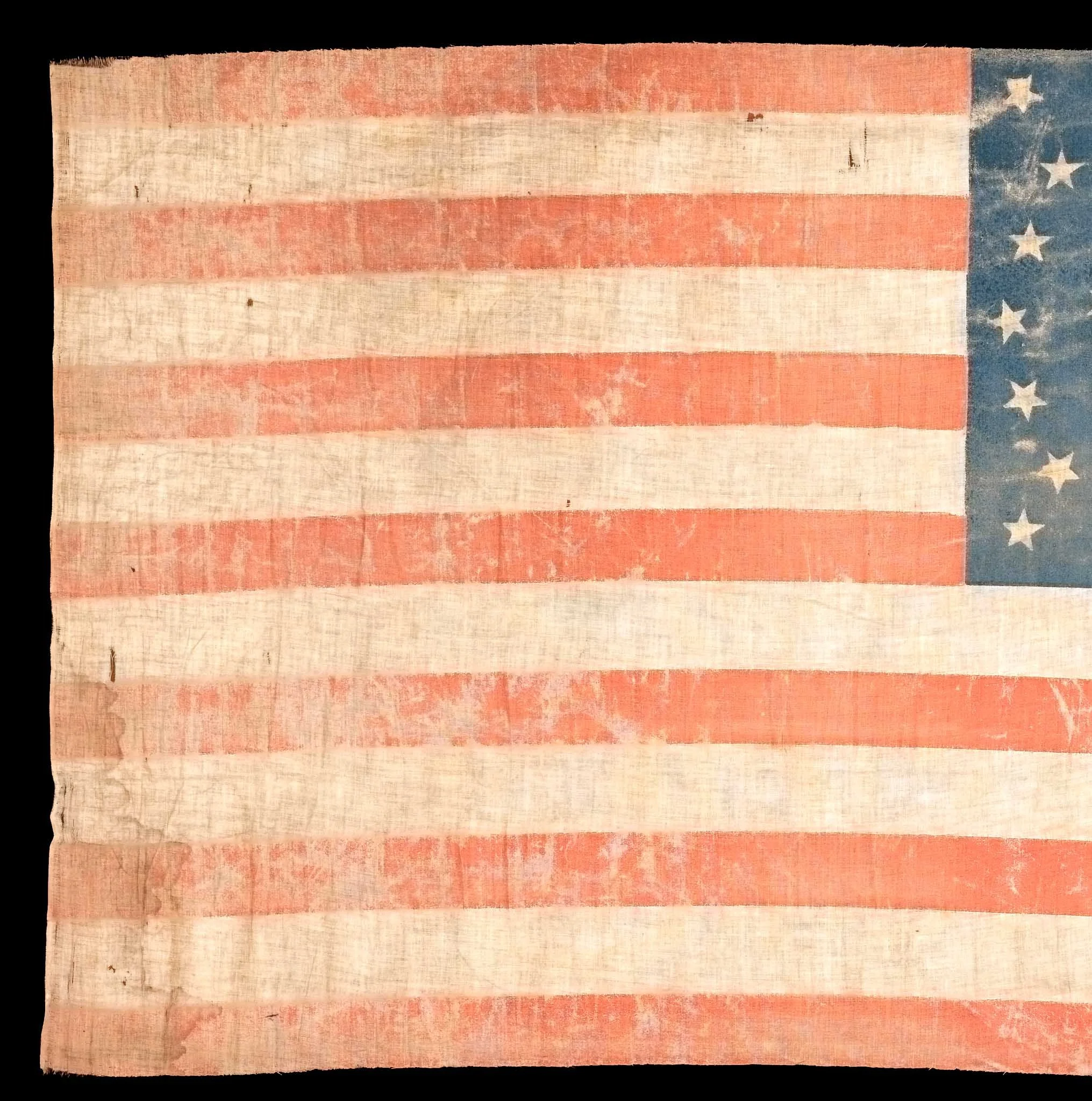
The flag may initially appear to be displayed “backwards,” because the canton occupies the upper right when viewed from this side. This is, however, the intended face of the textile. The flag was printed in this orientation rather than simply being shown from its reverse.
Such construction is an important reminder that the conventions governing the display of the American flag were far less rigid during the 19th century than they would become in the 20th. Modern viewers are accustomed to standardized rules governing the position of the canton, particularly when a flag is displayed vertically or against a wall. Makers of early American flags operated in a period when such details were not yet governed by a comprehensive national code. Surviving examples consequently exhibit considerable variation in orientation, proportions, star arrangement, and construction. What today might initially appear incorrect was not necessarily regarded that way when the flag was made.
The 38-star flag is closely associated with one of the most important patriotic periods of the 19th century. Colorado entered the Union as the 38th state on August 1, 1876—just weeks after the United States celebrated the 100th anniversary of the Declaration of Independence. Colorado's admission during the Centennial year subsequently earned it the enduring nickname “The Centennial State.”
Under the Flag Act of 1818, a newly admitted state's star was formally added to the national flag on the Fourth of July following admission. Colorado's star therefore officially entered the flag on July 4, 1877, and the 38-star flag remained the official national flag until July 4, 1890.
Commercial practice did not always wait for the statutory date. Flag makers routinely anticipated statehood, particularly when admission appeared imminent, and 38-star flags were produced during 1876 in anticipation of Colorado joining the Union. This coincided with an extraordinary demand for patriotic material generated by the Centennial celebration.
The Centennial International Exhibition opened in Philadelphia in May 1876 and became the largest public celebration of the nation's first century. Flags, banners, bunting, shields, and other patriotic textiles appeared throughout the exhibition grounds and across the country as Americans commemorated the anniversary. It was an environment particularly conducive to inventive flag making. Makers were not confined to orderly rows of stars and instead produced medallions, wreaths, Great Stars, double wreaths, and other decorative configurations that transformed the canton into a design element in its own right.
For this reason, some of the most graphically interesting American flags date to the Centennial era. The 38-star count sits directly at the intersection of the nation's 100th anniversary and its continuing westward expansion. Colorado's admission provided flag makers with an opportunity to combine a new star count with the heightened patriotism of 1876, and many responded with arrangements far more imaginative than those that became customary in later decades.
The present example embodies that spirit particularly well. Its inset Grand Luminary is not immediately obvious, rewarding closer examination before the larger five-pointed star emerges from the surrounding medallion. The irregularity of the printing, the unusually complex canton, and the unconventional orientation all speak to an era when American flag design retained a remarkable degree of individual expression.
The result is a particularly compelling Colorado-statehood flag: not simply a 38-star example, but one whose composition reflects the experimentation and patriotic exuberance that characterized American flag making during the Centennial period.
Conservation Process: This flag was hand sewn to cotton fabric, and both were hand sewn to a mounting board. To prevent the black dye in the cotton fabric from seeping into the flag, it was first washed in a standard wash and then in a dye setting wash. The flag is positioned behind Optium Museum Acrylic.
Frame: The flag is housed in a substantial, wide-profile frame with a matte charcoal finish and subtle linear graining across the face.
Condition Report: The flag exhibits substantial but visually appealing age and use, including overall fading, oxidation, scattered staining, and areas of pigment loss throughout both the stripes and canton. There are several small holes, edge losses, and minor tears, with more pronounced wear along the hoist and upper fly end. Despite this, the flag remains remarkably complete, and the star configuration is still clearly legible.
Collectability Level: The Best – Perfect for Advanced Collectors
Date of Origin: 1876-1890
Number of Stars: 38
Associated War: The Indian Wars (1860-1890)
Associated State: Colorado