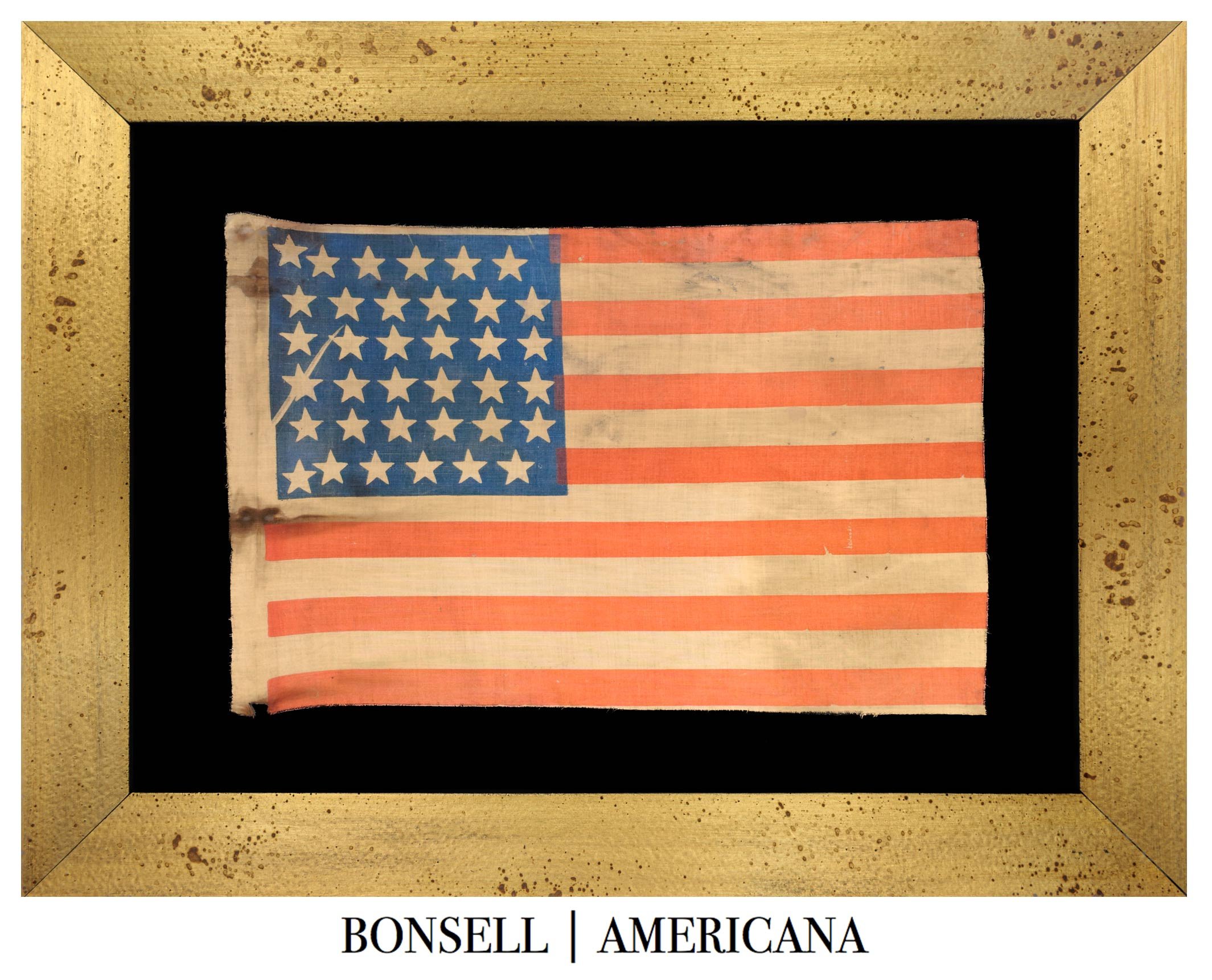
Civil War Patriotic Newspaper Broadside | Philadelphia Daily and Weekly Journal | 34 Star American Flag Format | Circa 1861–1862
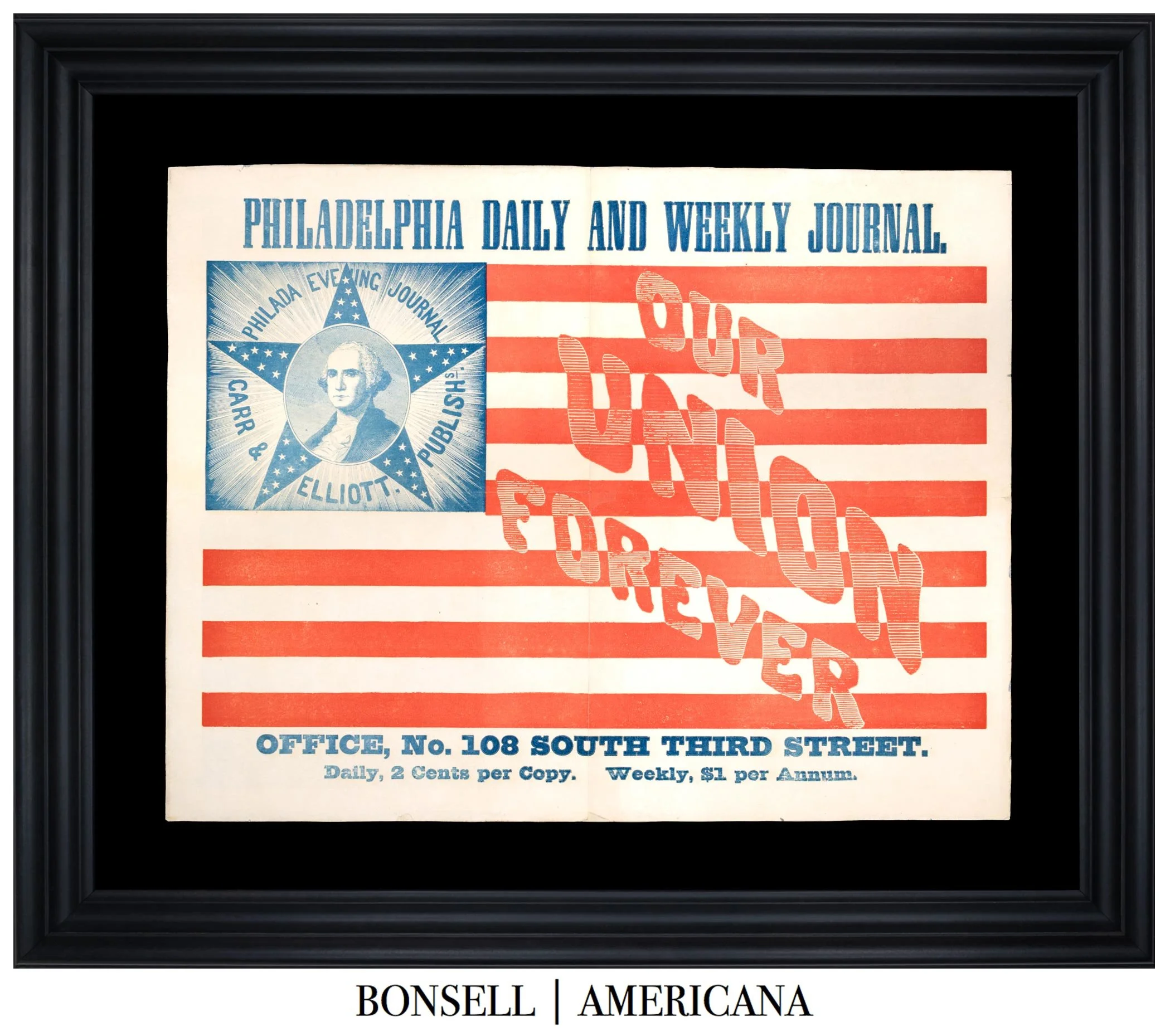
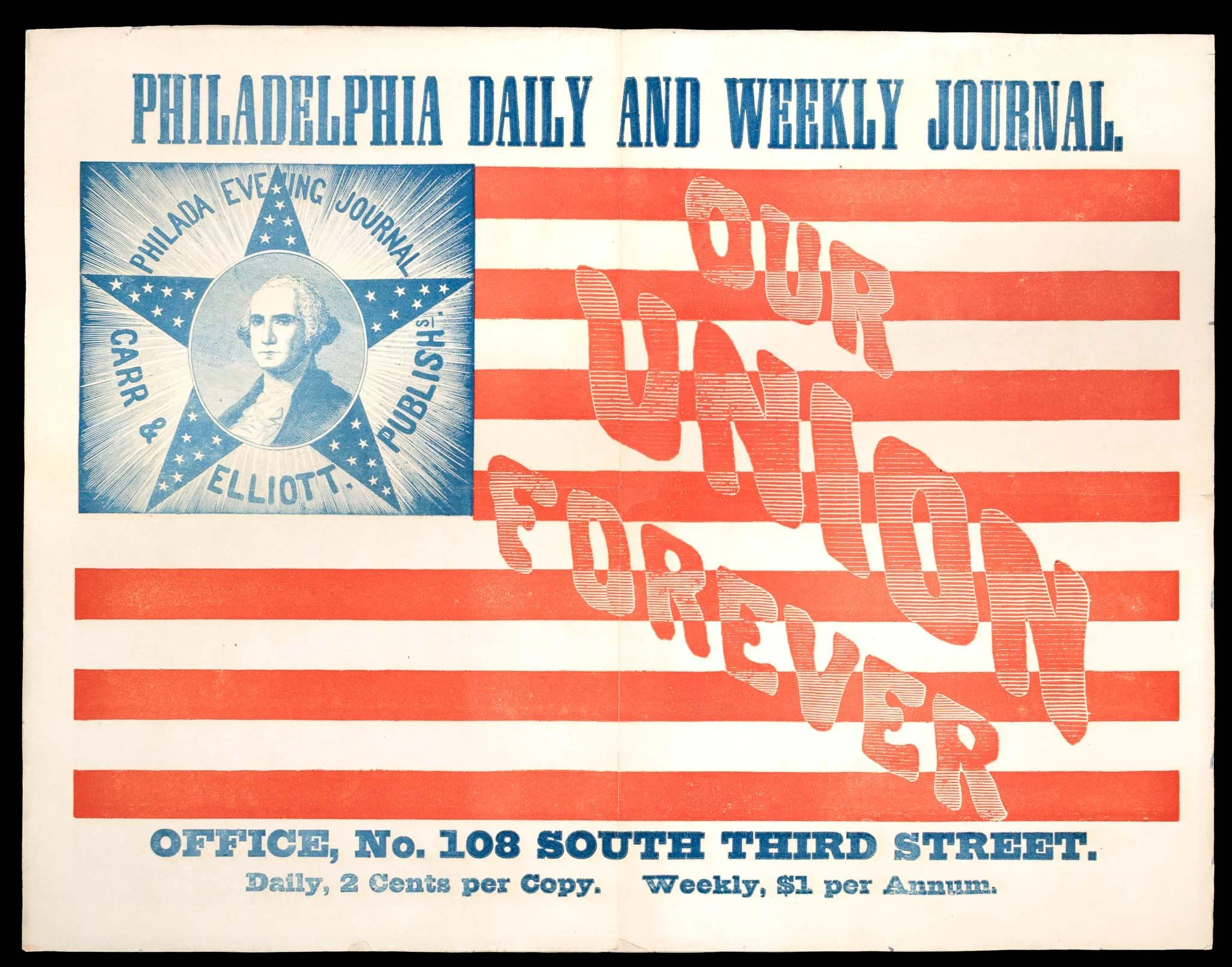



Civil War Patriotic Newspaper Broadside | Philadelphia Daily and Weekly Journal | 34 Star American Flag Format | Circa 1861–1862
Frame Size (H x L): 32” x 37.75”
Broadside Size (H x L): 21” x 26.75”
Offered is a Civil War–period advertising broadside for the Philadelphia Daily and Weekly Journal, printed in red and blue and designed in the form of an American flag. Produced in Philadelphia, Pennsylvania, circa 1861–1862, the sheet promotes the newspaper published by Carr & Elliott, whose office was located at No. 108 South Third Street. Combining patriotic imagery with commercial promotion, the broadside reflects the powerful role newspapers played in shaping public sentiment during the opening years of the American Civil War.
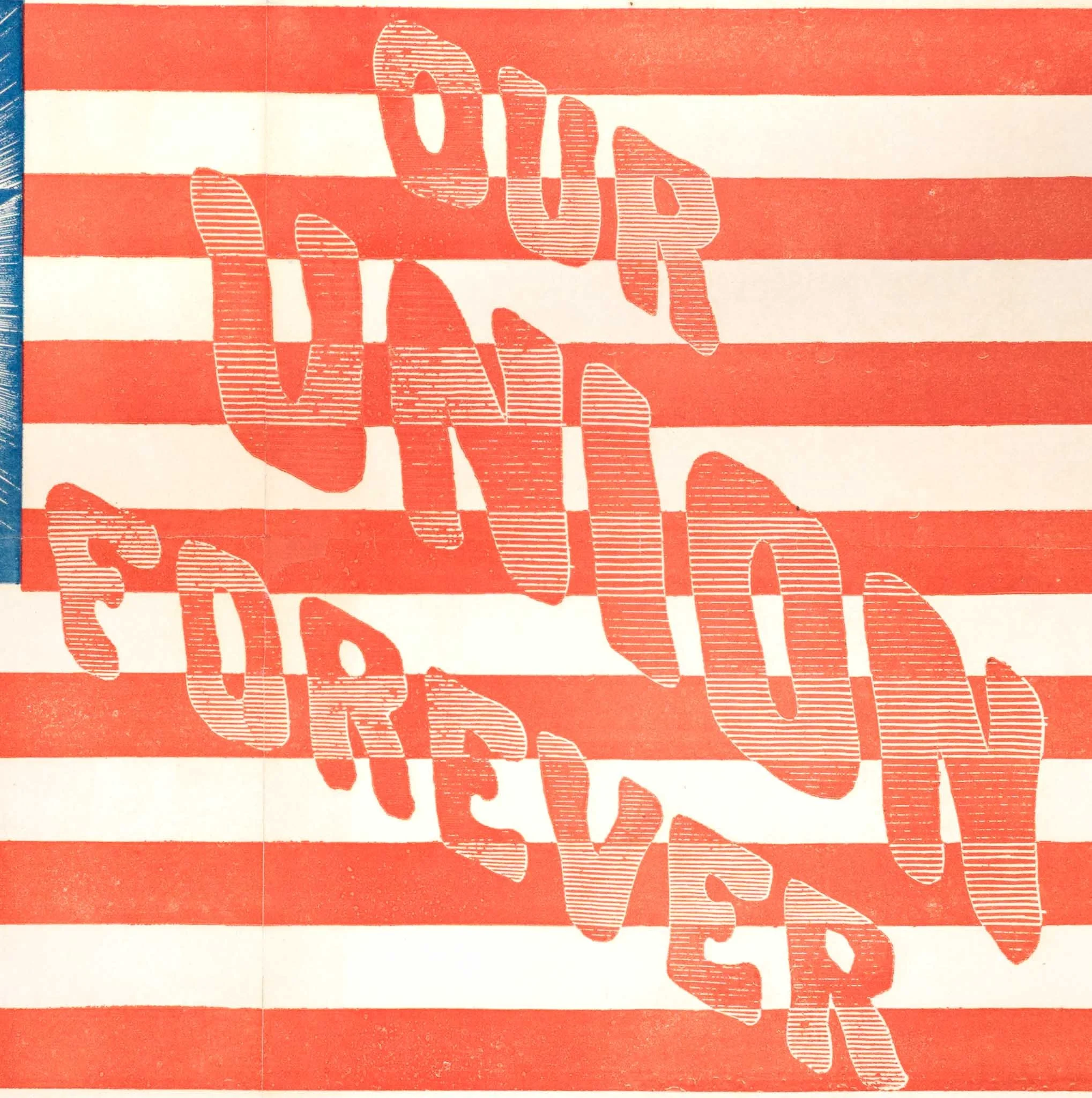
The broadside is printed on a single sheet and arranged as a stylized American flag. Across the upper portion appears the title “PHILADELPHIA DAILY AND WEEKLY JOURNAL.” Beneath this heading the design transitions into the striped field of the flag, printed in bold red bands. Running diagonally across the stripes in large block lettering is the emphatic slogan “OUR UNION FOREVER.” At the bottom of the sheet appears the imprint identifying the newspaper’s location and subscription terms: “OFFICE, No. 108 SOUTH THIRD STREET.” The cost of the publication is also clearly stated: “Daily, 2 Cents per Copy. Weekly, $1 per Annum.” These details underscore the dual purpose of the sheet as both patriotic display and newspaper advertisement.
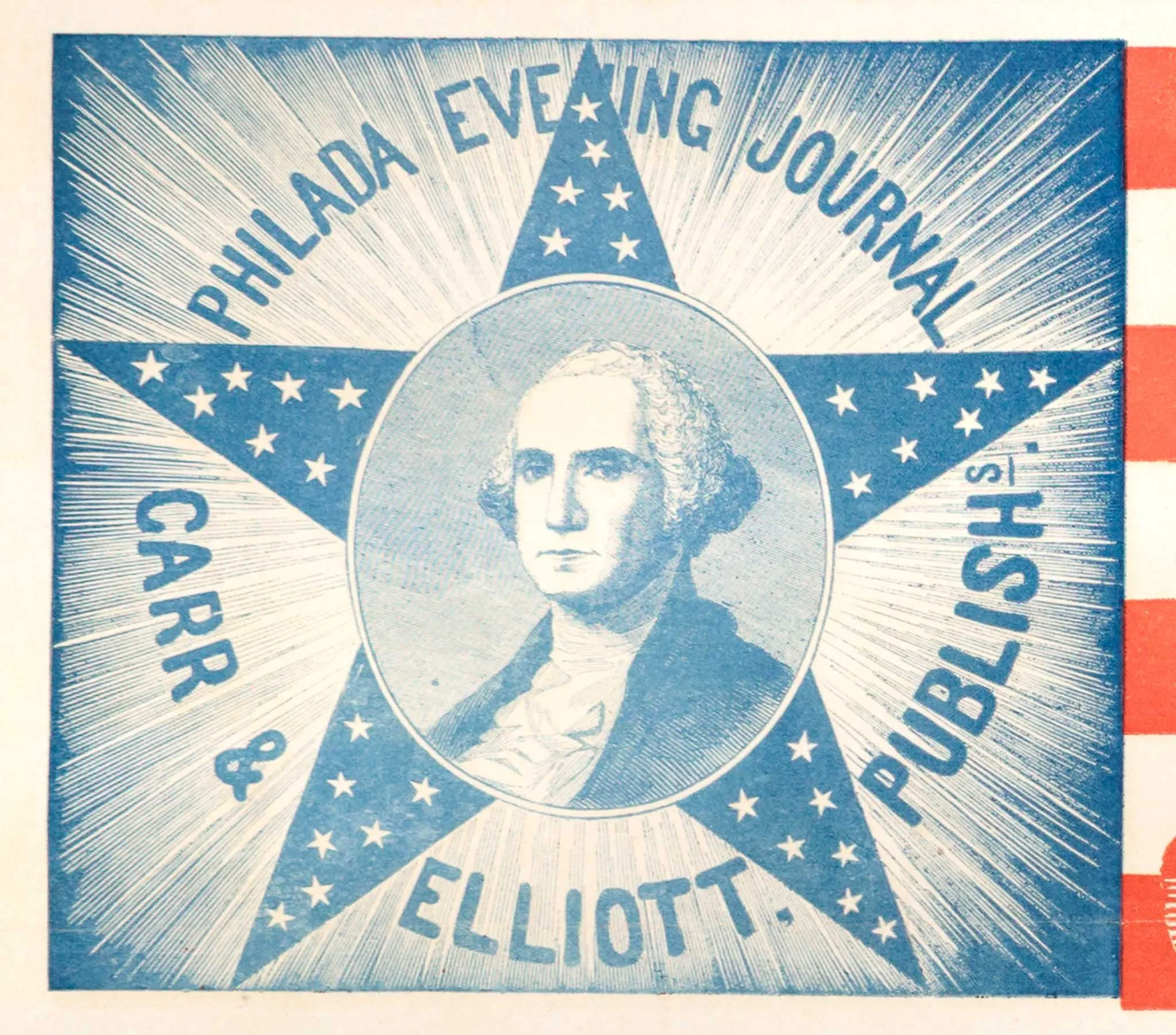
The canton occupies the upper left portion of the design and contains one of the most visually compelling elements of the broadside. Within the blue field appears a portrait of George Washington, framed within the outline of a large star. Washington’s likeness is rendered in a circular medallion at the center of the device, surrounded by radiating lines that draw attention to the image. Around the portrait appears the text “PHILADA EVENING JOURNAL” and “CARR & ELLIOTT PUBLISHES,” directly associating the revered figure of the nation’s founding with the newspaper being advertised. The use of Washington in this context is deliberate and symbolic. During the Civil War, Washington’s image served as a reminder of the founding of the United States and of the struggle to preserve the Union he helped create.
Within the large star that frames the portrait are 34 smaller stars, representing the official 34-star count of the United States flag. The 34-star flag corresponds to the admission of Kansas as the 34th state on January 29, 1861. This star count became the official national flag on July 4, 1861 and remained in effect until July 3, 1863. In this design, the smaller stars are arranged within the outline of the larger star, which functions as a decorative framing device rather than an additional star in the count. The arrangement creates a visually striking canton while preserving the historically accurate star count associated with the early war period.
The newspaper promoted by the broadside was published by Carr & Elliott, a Philadelphia partnership active during the early years of the Civil War. Their paper, the Philadelphia Evening Journal, was part of a vibrant and competitive newspaper culture in the city. Philadelphia was one of the most important publishing centers in the United States during the nineteenth century, and its newspapers played a central role in shaping public opinion. Papers such as the Philadelphia Evening Journal provided daily coverage of the war while simultaneously promoting strong Unionist sentiment among readers.
The address listed on the broadside—108 South Third Street—places the newspaper within the historic commercial district of Philadelphia, only a short distance from Independence Hall and other landmarks associated with the founding of the United States. During the mid-nineteenth century this area was home to numerous printers, publishers, and booksellers. The location situates Carr & Elliott within the long-standing printing and publishing tradition of the city.
The slogan “OUR UNION FOREVER” is one of the most significant elements of the design. Appearing boldly across the stripes of the flag, the phrase encapsulates the central political and emotional message of the Union cause during the American Civil War. In the months following the outbreak of hostilities in 1861, Northern printers, publishers, and artists produced a wide range of patriotic imagery emphasizing the preservation of the United States. Slogans invoking the permanence of the Union were especially common, serving both as expressions of loyalty and as tools for rallying public support for the war effort. By integrating this phrase directly into the flag design, the broadside transforms the newspaper advertisement into a statement of national unity and resolve.
The visual strategy employed here reflects a broader pattern in Civil War graphic culture. Printers frequently combined patriotic imagery with commercial or informational content, creating designs that were both decorative and persuasive. In this example, the American flag serves as the organizing structure for the entire composition, while the slogan, portrait, and newspaper information are integrated seamlessly into the design. The result is a piece that would have functioned effectively both as an advertisement and as a patriotic display suitable for posting in a public space.
Institutional records place the broadside within the broader category of Civil War printed ephemera. An example is documented in the collection of the Library Company of Philadelphia, one of the nation’s most important repositories for early American printing and Civil War graphics. The recorded example was originally preserved in a Civil War scrapbook compiled by John A. McAllister, whose extensive collection of wartime prints and ephemera forms an important historical archive of the period.
Broadsides of this type occupy an important place in the history of American printing. Unlike bound publications, broadsides were typically produced for immediate display or distribution and were often discarded once their immediate purpose had passed. Surviving examples therefore provide valuable insight into the visual and political culture of their time. This example is especially notable for its strong graphic design, its integration of patriotic symbolism with newspaper advertising, and its clear association with the early years of the Civil War.
Taken together, the elements of the design—the American flag format, the 34-star canton, the portrait of Washington, and the bold proclamation “OUR UNION FOREVER”—create a powerful visual statement reflecting the atmosphere of the Union states during the opening phase of the Civil War. At the same time, the inclusion of the newspaper’s name, address, and subscription terms reminds us that this striking patriotic image also served a practical purpose: promoting the circulation of a Philadelphia newspaper during one of the most consequential periods in American history.
Frame: The frame is a deep-profile moulding with a simple, classical profile, finished in a dark cocoa-brown tone.
Condition: The broadside has been professionally conserved by a paper conservator and presents well overall. The sheet shows a vertical center fold, with additional light handling creases consistent with age and original distribution. There is minor scattered toning and a few small areas of edge wear, along with subtle surface irregularities typical of nineteenth-century paper broadsides. Overall, the colors remain strong and the piece displays attractively.
Collectability Level: The Best – Perfect for Advanced Collectors
Date of Origin: 1861-1862