Mid-Century 13-Star Yacht Flag | Made by Valley Forge Flag Co., Spring City, PA | Circa 1935–1955
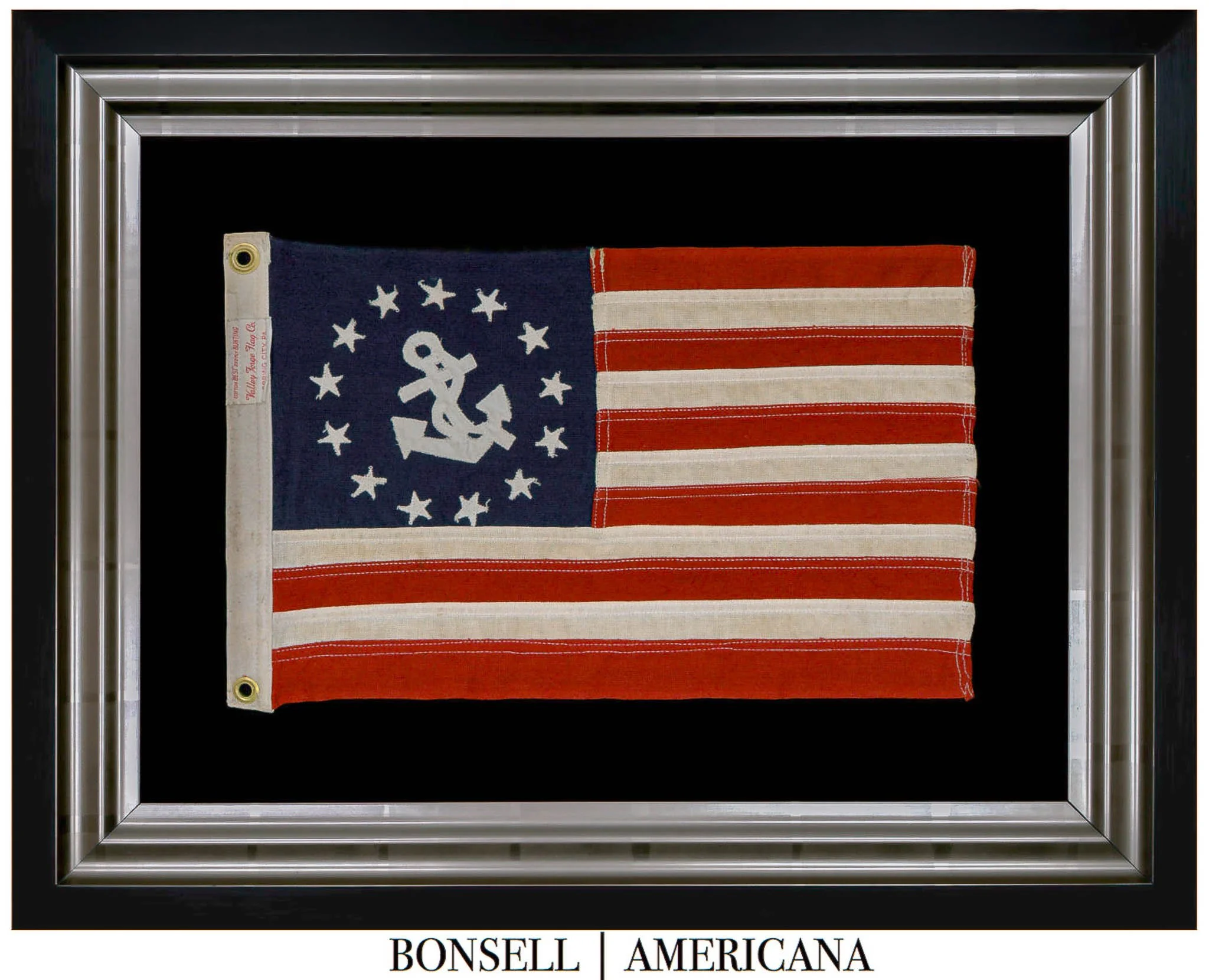


Mid-Century 13-Star Yacht Flag | Made by Valley Forge Flag Co., Spring City, PA | Circa 1935–1955
Frame Size (H x L): 19.5” x 25”
Flag Size (H x L): 23” x 35”
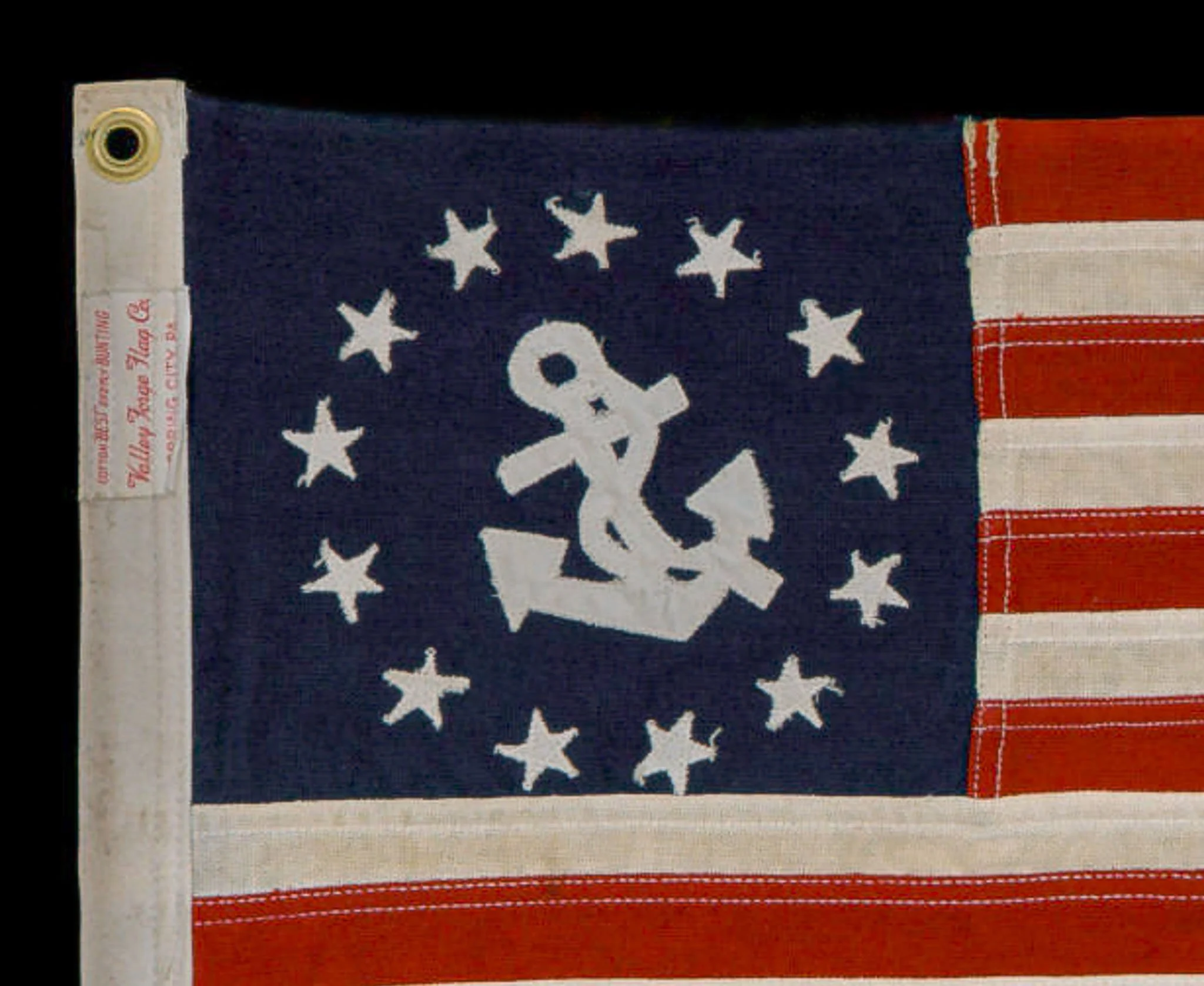
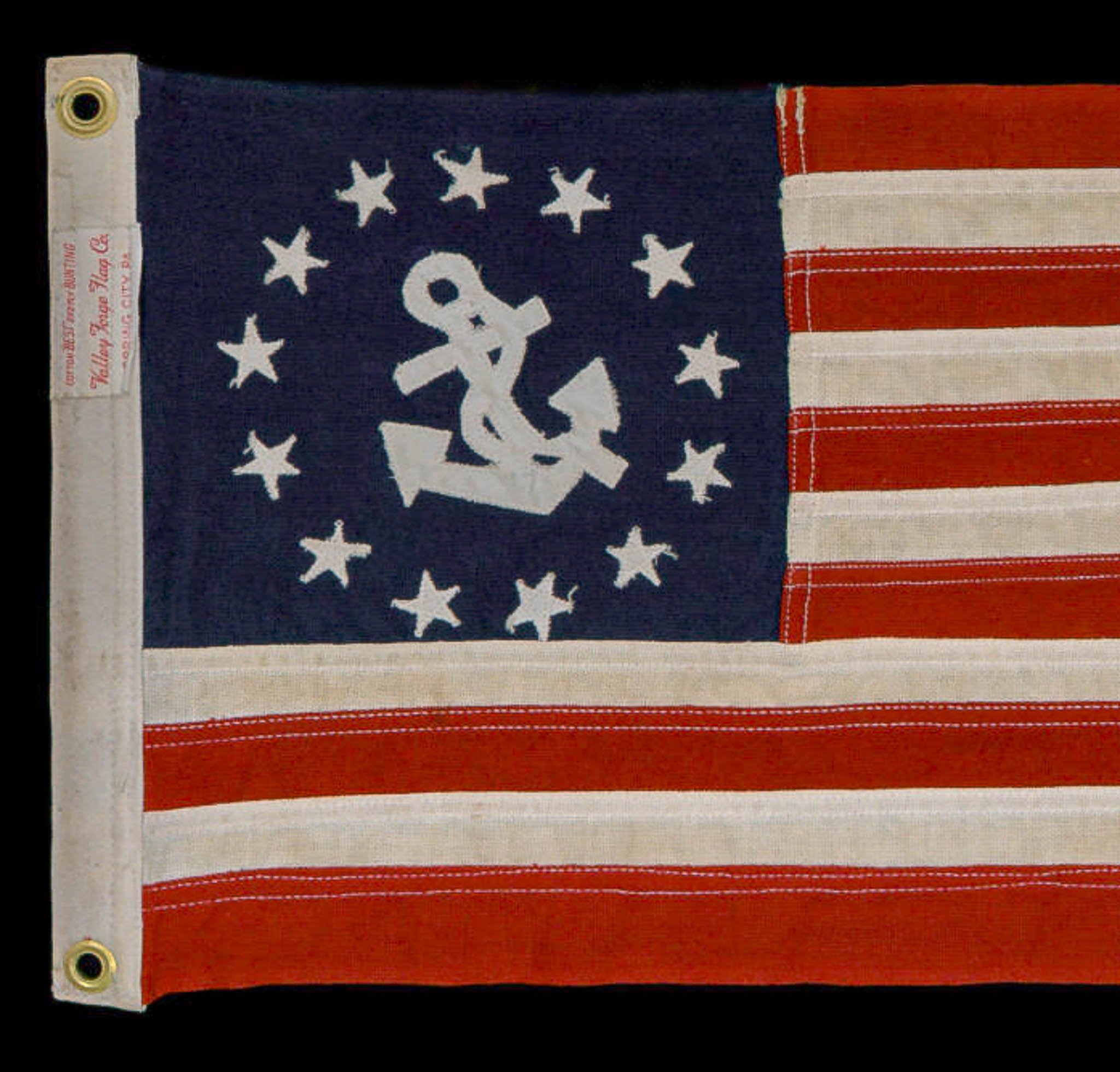
Offered is a mid-20th-century American yacht ensign, manufactured by the Valley Forge Flag Company of Spring City, Pennsylvania. These flags were traditionally flown in place of the standard U.S. national flag on private pleasure craft operating in U.S. waters. Distinctive in design, they feature a canted white anchor encircled by 13 white stars—representing the original 13 colonies—set within a blue canton. This emblem, unique to yacht ensigns, has long symbolized both American patriotism and nautical tradition.
The use of a dedicated U.S. yacht ensign arose in the 19th century, when customs officials frequently inspected all incoming vessels, including private yachts rarely involved in commerce. To address this, Congress passed legislation in 1848 authorizing a separate ensign for registered yachts. Vessels flying the yacht ensign were exempt from routine customs inspections, allowing owners uninterrupted leisure sailing while still maintaining official identification on the water.
While never intended to replace the national ensign, the yacht flag was typically flown from the masthead, with the national flag flown from the stern or gaff. Over time, however, many yachts flew the yacht ensign exclusively—an unofficial yet widespread practice driven by the flag’s aesthetic appeal and practicality. Though the law authorizing its use was repealed in 1980, the tradition endures, and the design remains a beloved emblem of American yachting culture.
CONSTRUCTION
This example was produced by the Valley Forge Flag Company, a prominent American maker active in flag production since 1918. A machine-sewn tag along the hoist reads:
“COTTON BEST 2X2 FLY BUNTING / Valley Forge Flag Co. / Spring City, PA.”
The tag’s wording, lack of zip code, and overall style—combined with the use of cotton bunting—indicate a date of manufacture between circa 1935 and 1955.
The flag is constructed from cotton bunting, which was widely used for ceremonial and recreational flags before synthetic materials became the standard in the 1960s. The red and white stripes are machine-pieced with straight seams, while the navy canton is appliquéd with a white anchor surrounded by 13 stars. All design elements in the canton are made from cotton and double-appliquéd to both sides using a zig-zag stitch.
A reinforced white twill hoist bears the manufacturer’s tag and is fitted with two metal grommets, likely nickel-plated brass—a corrosion-resistant alloy preferred for maritime use. The overall construction reflects the evolution of American flag-making in the postwar era: mass-produced, yet still rooted in traditional craftsmanship and patriotic symbolism.
THIRTEEN-STAR FLAGS GENERALLY
The 13-star flag originated with the Continental Congress’s resolution of June 14, 1777, establishing the first official national flag of the United States. While its official tenure lasted until 1795, the design remained symbolically powerful well into the 19th and 20th centuries.
From 1795 to 1916, the 13-star flag served as the standard ensign on small U.S. Navy boats. It was also flown during moments of national mourning and celebration, including George Washington’s death in 1799, the 50th anniversary of American independence, and General Lafayette’s 1824 return tour. Its Revolutionary War associations made it a fitting choice for commemorative and patriotic events throughout American history.
The design saw renewed prominence during the Mexican-American War and Civil War, when its ties to the founding era made it a potent symbol of national unity. By the centennial celebrations of 1876, the 13-star flag had become an enduring emblem of American resilience, often appearing at public events and historical commemorations.
Steeped in symbolic meaning and patriotic heritage, the 13-star flag continues to serve as a visual reminder of the nation’s founding ideals—unity, independence, and perseverance.
Conservation Process: This flag was hand sewn to cotton fabric, and both were hand sewn to a mounting board. To prevent the black dye in the cotton fabric from seeping into the flag, it was first washed in a standard wash and then in a dye setting wash. The flag is positioned behind Optium Museum Acrylic.
Frame: The flag is housed in a modern, shadowbox-style frame featuring a bold, stepped profile. The frame has a black outer edge with a metallic silver inner liner, providing a clean, high-contrast presentation that complements the flag.
Condition Report: The flag is in sound condition, with strong color retention in both the stripes and the canton. There is minor toning and light soiling, primarily along the hoist and edges. The fabric remains stable, with no significant fraying or loss.
Collectability Level: The Good – Perfect for Beginning Collectors and Gifts
Date of Origin: 1935-1955
Number of Stars: 13
Associated War: World War II (1941-1945)
Associated State: Original 13 Colonies