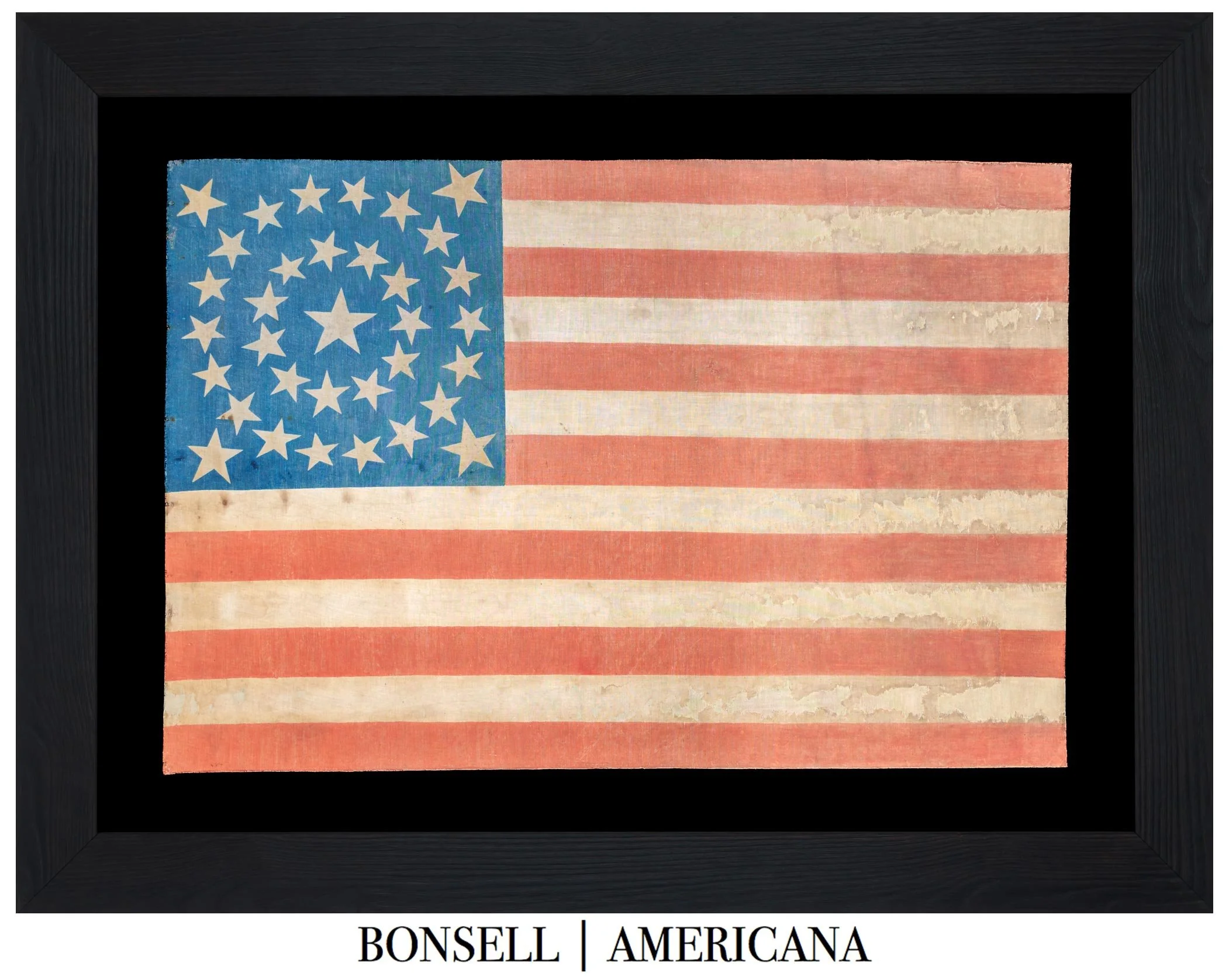
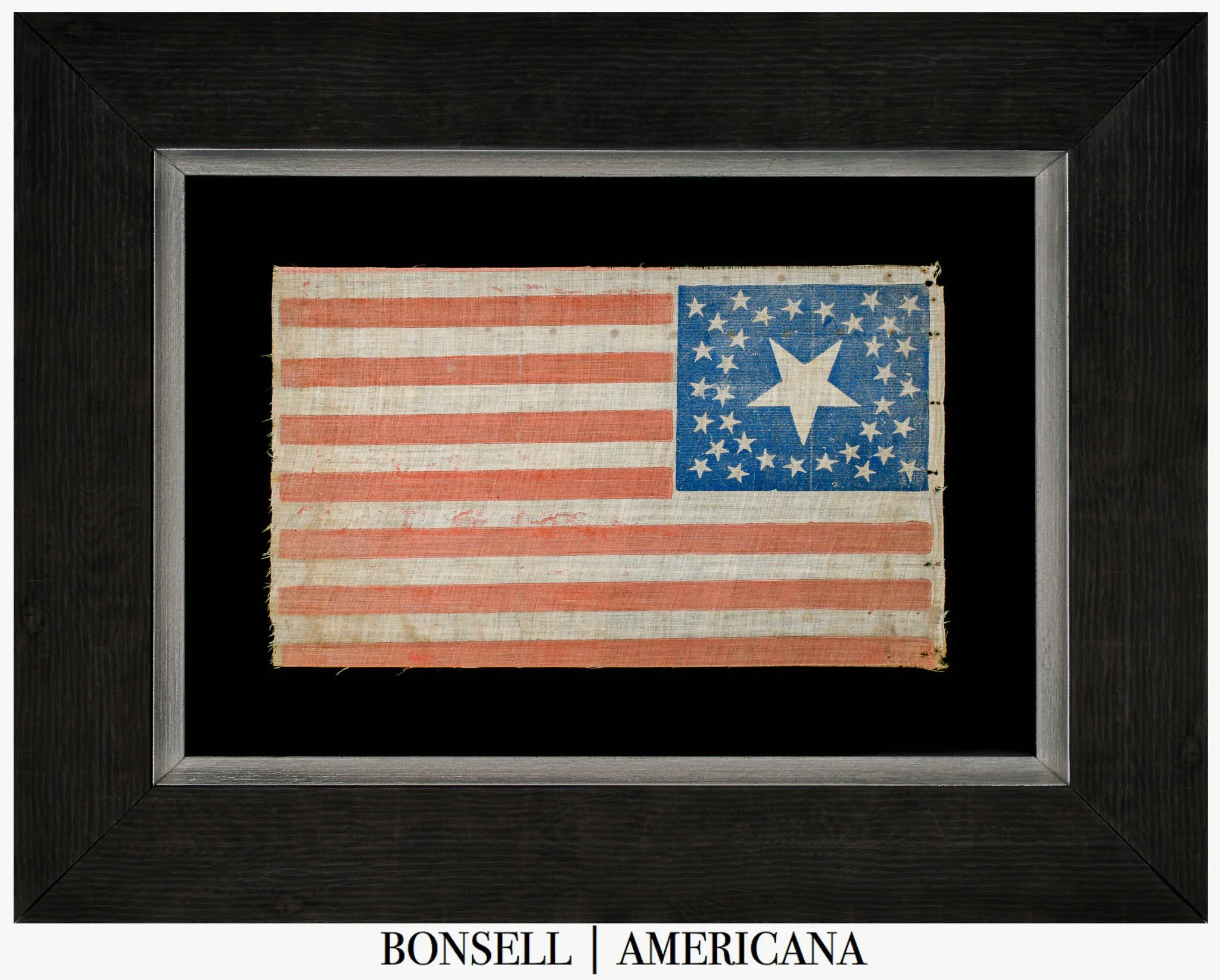
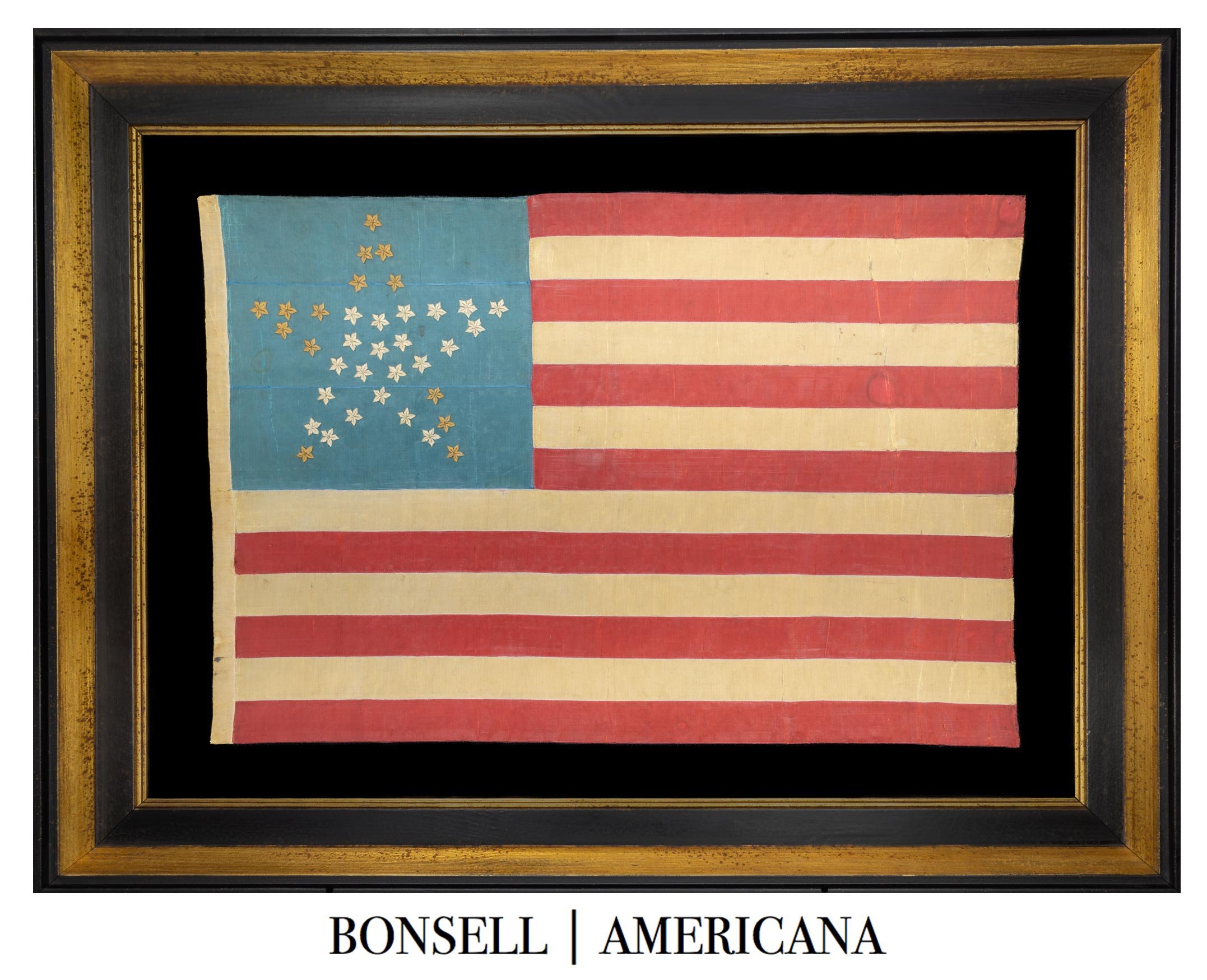
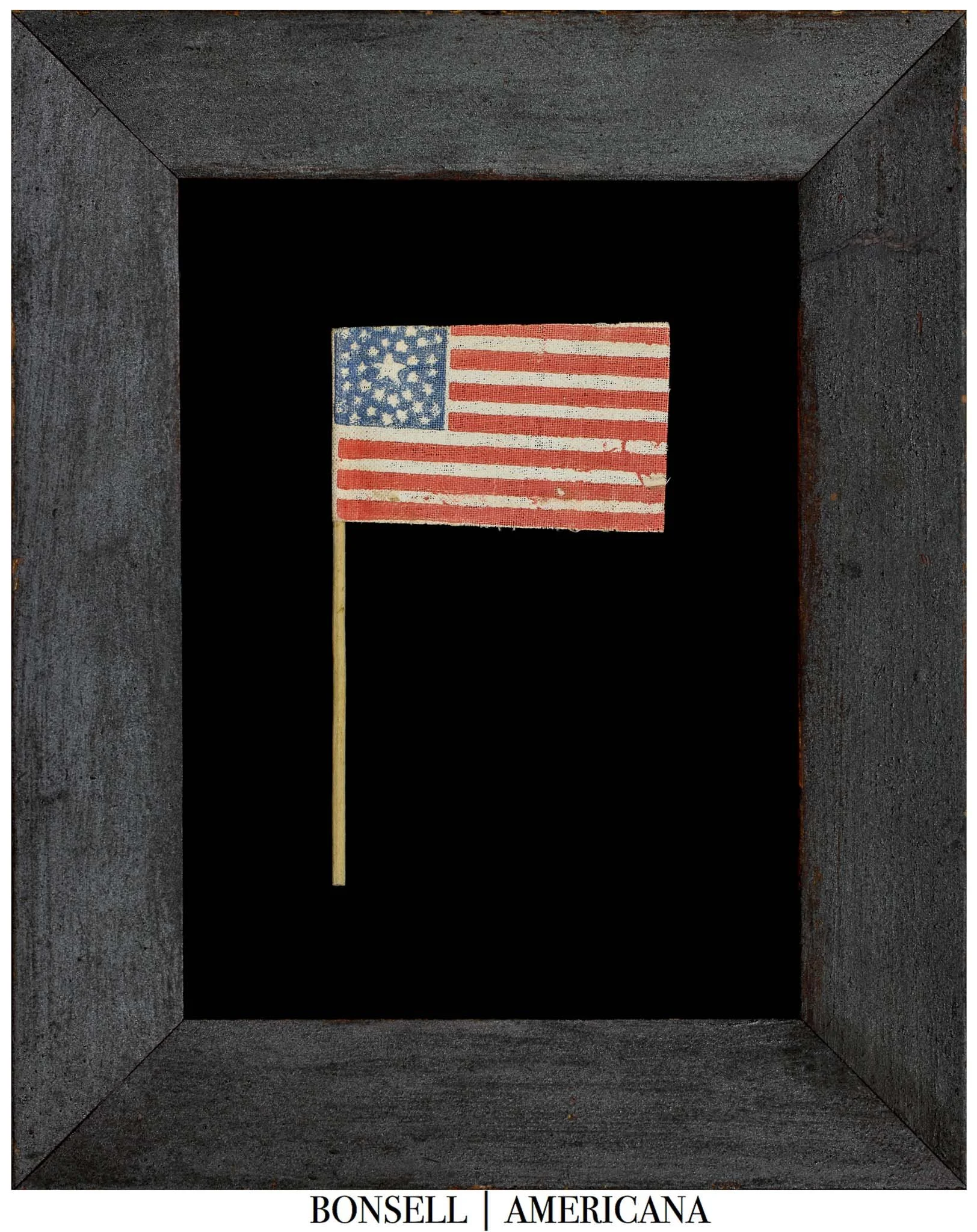
34 Star “UNION” Patriotic Flag Cover with Great Star Pattern | Kansas Statehood | Circa 1861–1890


34 Star “UNION” Patriotic Flag Cover with Great Star Pattern | Kansas Statehood | Circa 1861–1890
Frame Size (H x L): 6.5” x 8”
Flag Size (H x L): 3” x 5.5”
Offered is a 34-star patriotic flag cover bearing a bold “UNION” printed across the canton within a Great Star arrangement. The placement of text on the canton—rather than along the stripes—is notably desirable and especially associated with the early Civil War period, when patriotic envelopes served as both stationery and expressions of political loyalty. Although this style of cover continued to appear into the 1880s, examples combining a Civil War star count, an uncommon star pattern, and an added slogan remain among the most sought-after varieties.
These patriotic envelopes were typically produced through relief printing in multiple stages, with different elements of the flag design printed from separate blocks or plates. Printers often applied the colors and any accompanying text in successive impressions, each requiring its own inking, alignment, and drying time. Because this work was done quickly and by hand in mid-19th-century job shops, period examples frequently show subtle variations in registration, ink density, and pressure.
The stars are arranged in the Great Star or Grand Luminary pattern, in which smaller stars form the outline of a single large star. This configuration is one of the most visually compelling designs encountered in 19th-century flags. Before President Taft’s 1912 Executive Order introduced the first formal regulations on star placement, American flag makers and patriotic printers enjoyed complete freedom in arranging the stars. Among the diverse patterns that emerged, the Great Star stands out both for its geometric harmony and for its early pedigree.
The pattern is traditionally credited to Captain Samuel Chester Reid, a naval hero of the War of 1812 whose defense of the privateer General Armstrong at the Battle of Fayal delayed a British naval squadron bound for New Orleans. Reid’s actions contributed materially to General Andrew Jackson’s ability to fortify the city, and he was celebrated as a national hero. In 1818, Reid participated in the discussions that produced the Flag Act of 1818, which restored the number of stripes to thirteen and established the practice of adding one star for each new state. Reid recommended the Great Star pattern as a standardized, easily recognizable arrangement, particularly useful for naval identification at long distances. Although no specific pattern was mandated by Congress, Reid’s design achieved considerable influence and enjoyed intermittent commercial popularity from the 1820s through the Civil War and into the Centennial era.
The 34-star flag reflects the admission of Kansas to the Union on January 29, 1861, a moment that carried significance well beyond the addition of a single state. Kansas’s entry concluded nearly a decade of sectional conflict—popularly known as “Bleeding Kansas”—in which pro-slavery and free-state factions violently contested the territory’s political future. Its ultimate admission as a free state on the eve of Lincoln’s inauguration underscored the deepening national divide and served as an early signal of the constitutional crisis that would erupt into civil war within weeks.
This star count became official on July 4, 1861, and remained so until July 4, 1863, when the wartime creation of West Virginia increased the count to 35. Because flag makers typically adopted new star counts immediately upon a state’s admission—rather than waiting for the formal July 4 effective date—many 34-star flags predate the opening shots at Fort Sumter. As a result, this configuration is strongly associated with the transitional period between political fracture and open conflict, and it is widely regarded by collectors as one of the most evocative star counts of the 19th century.
Both 34-star and 35-star flags were used throughout the Civil War and together encompass the official star counts of Lincoln’s presidency, though other star counts appeared in limited or anticipatory forms. They appeared on recruitment broadsides, volunteer militia banners, camp gear, and patriotic ephemera of all kinds, becoming central visual markers of Union identity during the conflict. For this reason, the 34-star configuration—situated at the threshold of war—remains especially prized for its association with the earliest mobilization of Northern sentiment and the preservation of the Union.
This example, combining a Civil War-era star count, a rare Great Star medallion, and a bold UNION slogan printed directly on the canton, represents a compelling intersection of patriotic imagery and wartime sentiment.
Conservation Process: The flag is sandwiched between cotton rag board and a UV resistant acrylic.
Frame: The flag cover is housed in an older wooden frame with a dark, timeworn surface and an applied gilded inner lip.
Condition Report: The cover remains in very good condition with strong color retention and only light scattered surface wear typical of mid-19th-century patriotic envelopes. Minor toning and small handling marks are present but do not detract from the clarity or overall presentation of the piece.
Collectability Level: The Great – Perfect for Rising Collectors
Date of Origin: 1861-1890
Number of Stars: 34
Associated War: The Civil War (1861-1865)
Associated State: Kansas