Outstanding and Scarce 30 Star American Flag | Inscribed “C.V.B.H. at Dr. Brown’s” | Wisconsin Statehood | Circa 1848–1851
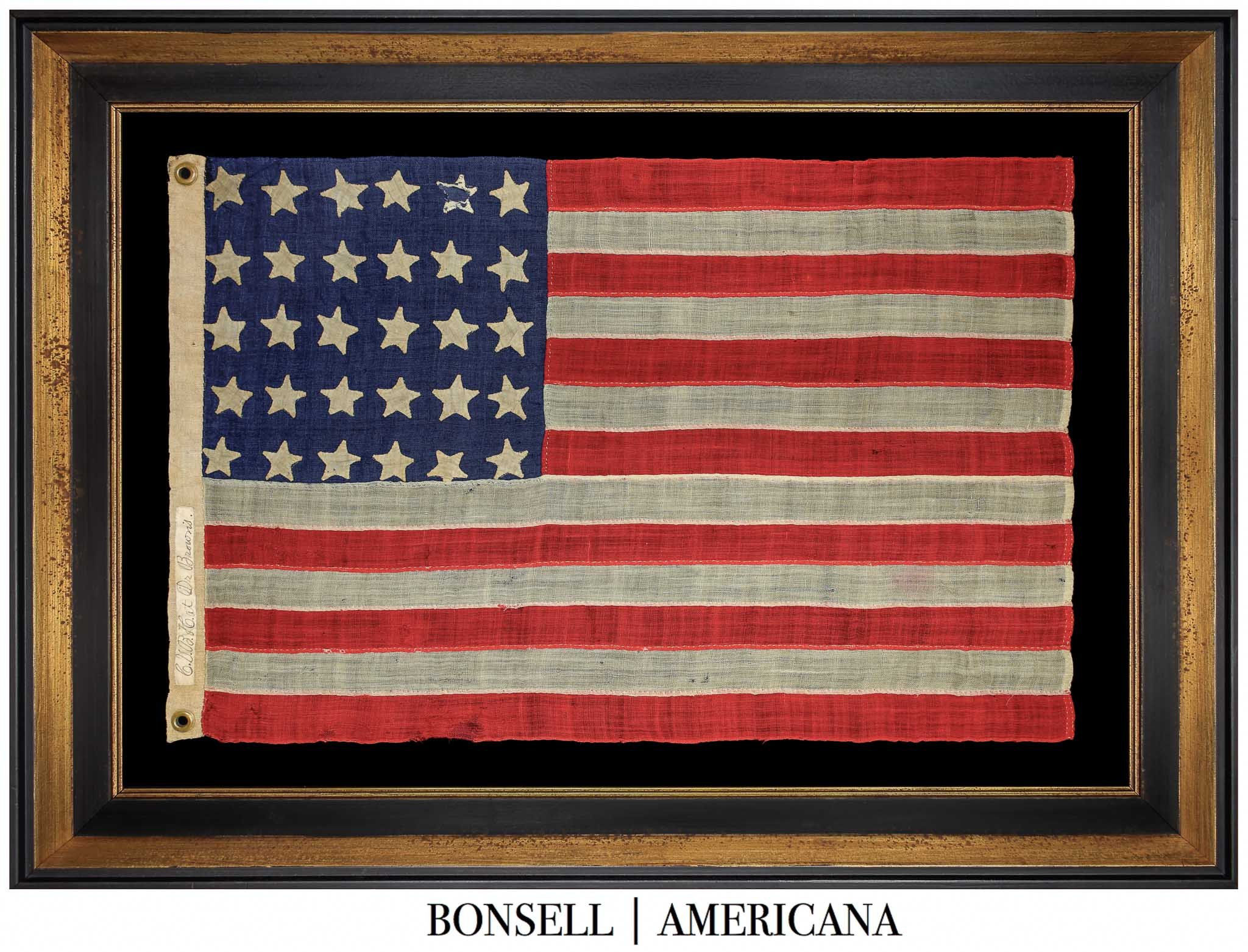
Outstanding and Scarce 30 Star American Flag | Inscribed “C.V.B.H. at Dr. Brown’s” | Wisconsin Statehood | Circa 1848–1851
Price: Call 618-553-2291, or email info@bonsellamericana.com
Frame Size (H x L): 32” x 44.5”
Flag Size (H x L): 22” x 34.5”
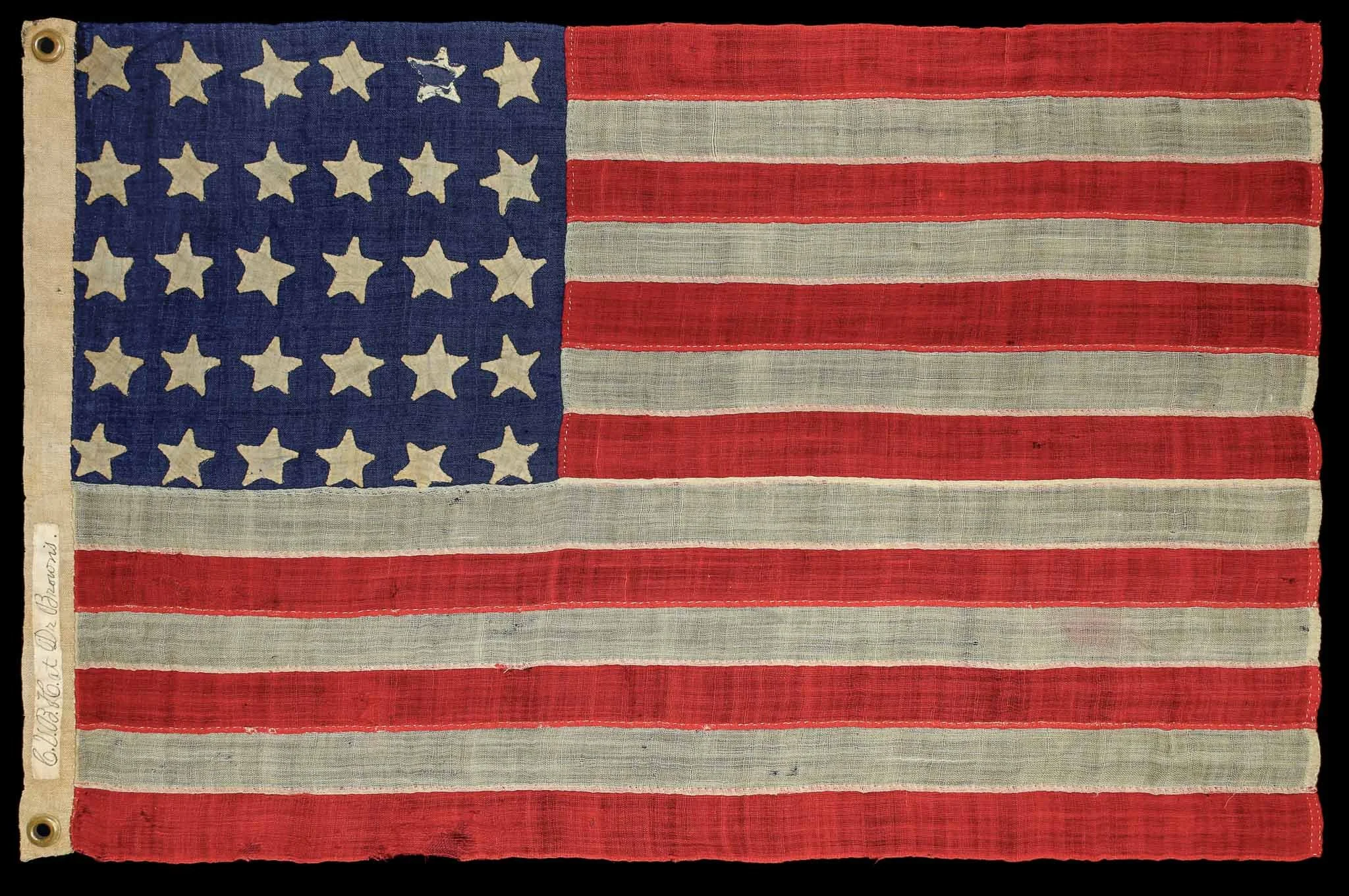
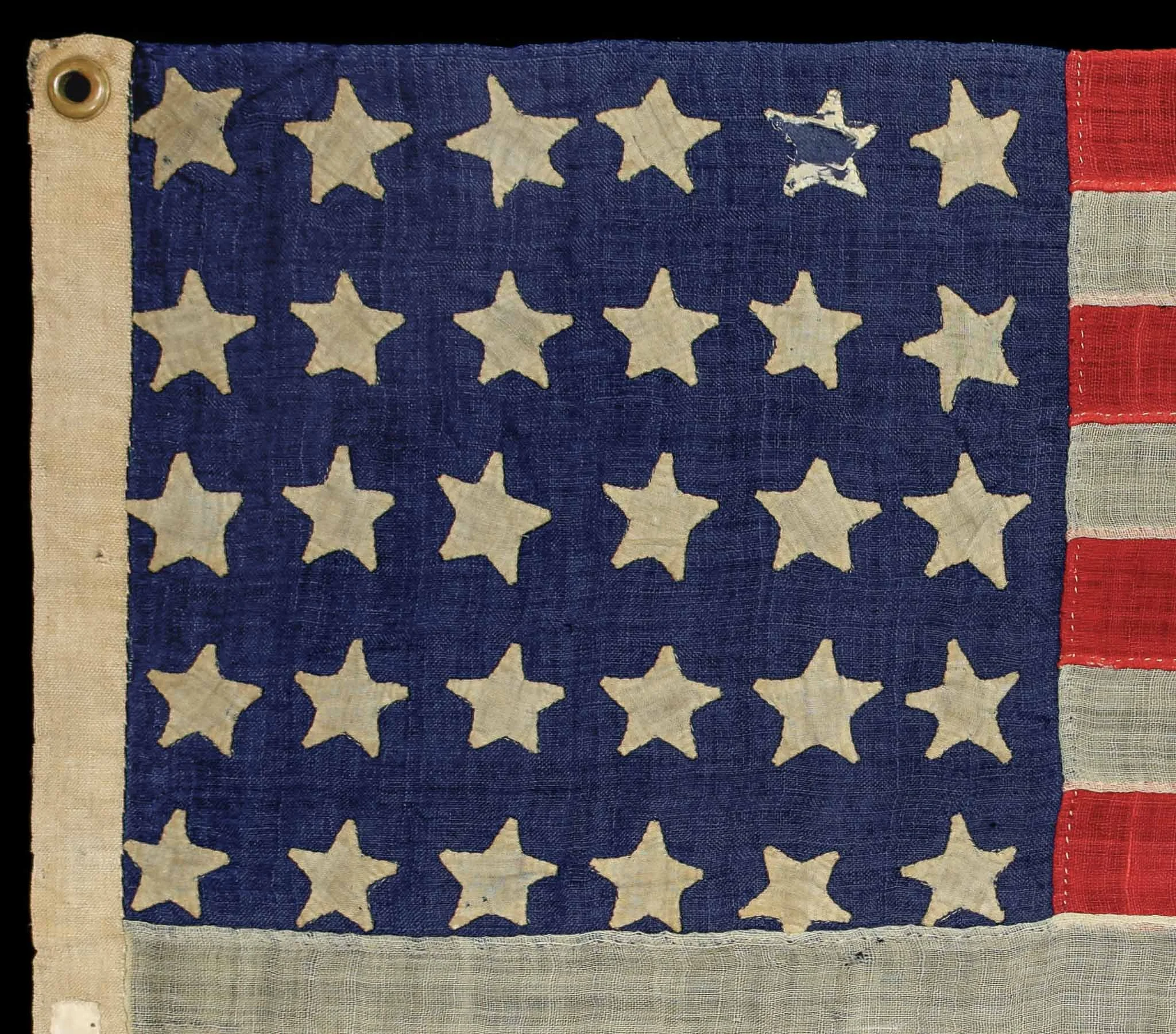
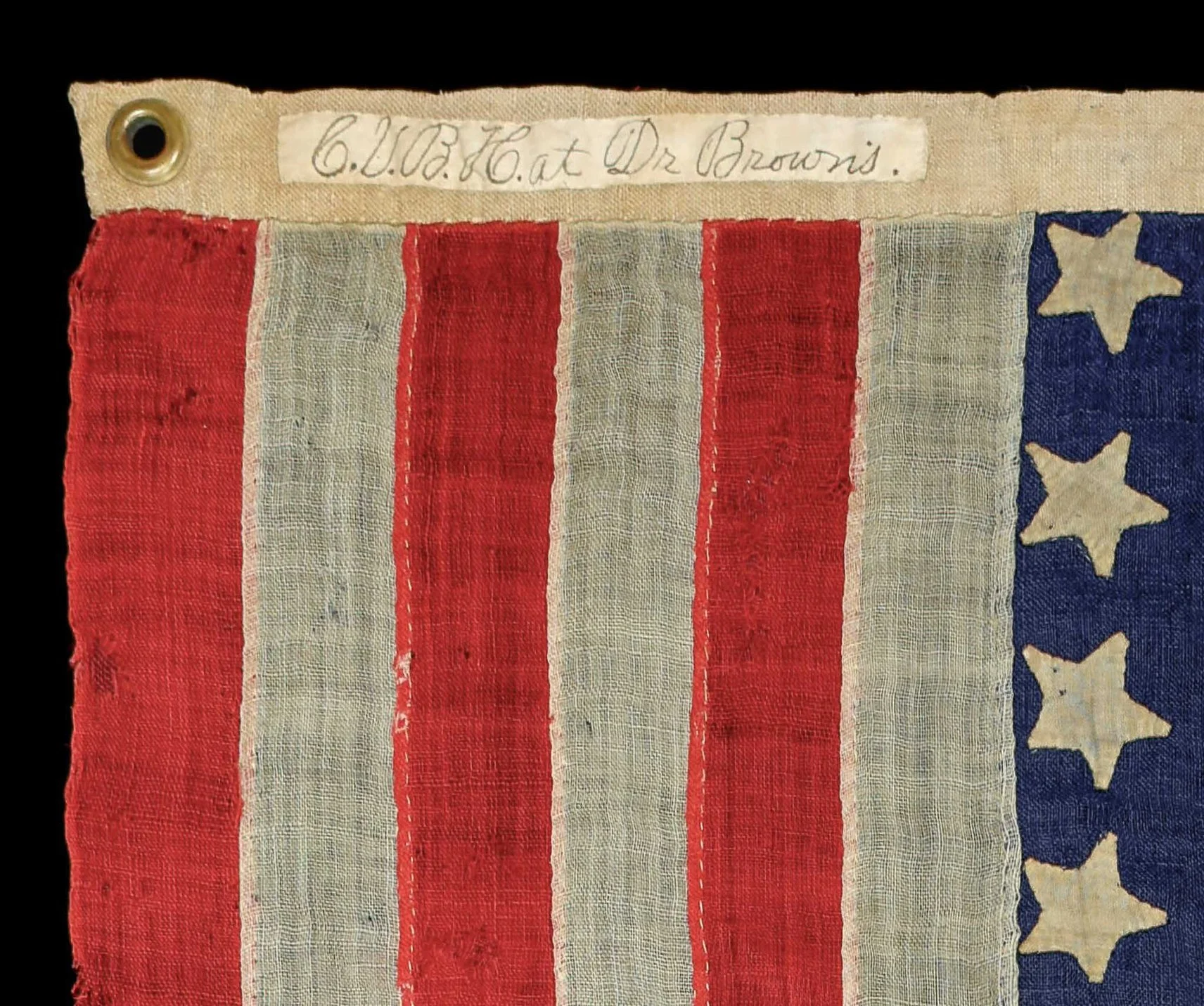
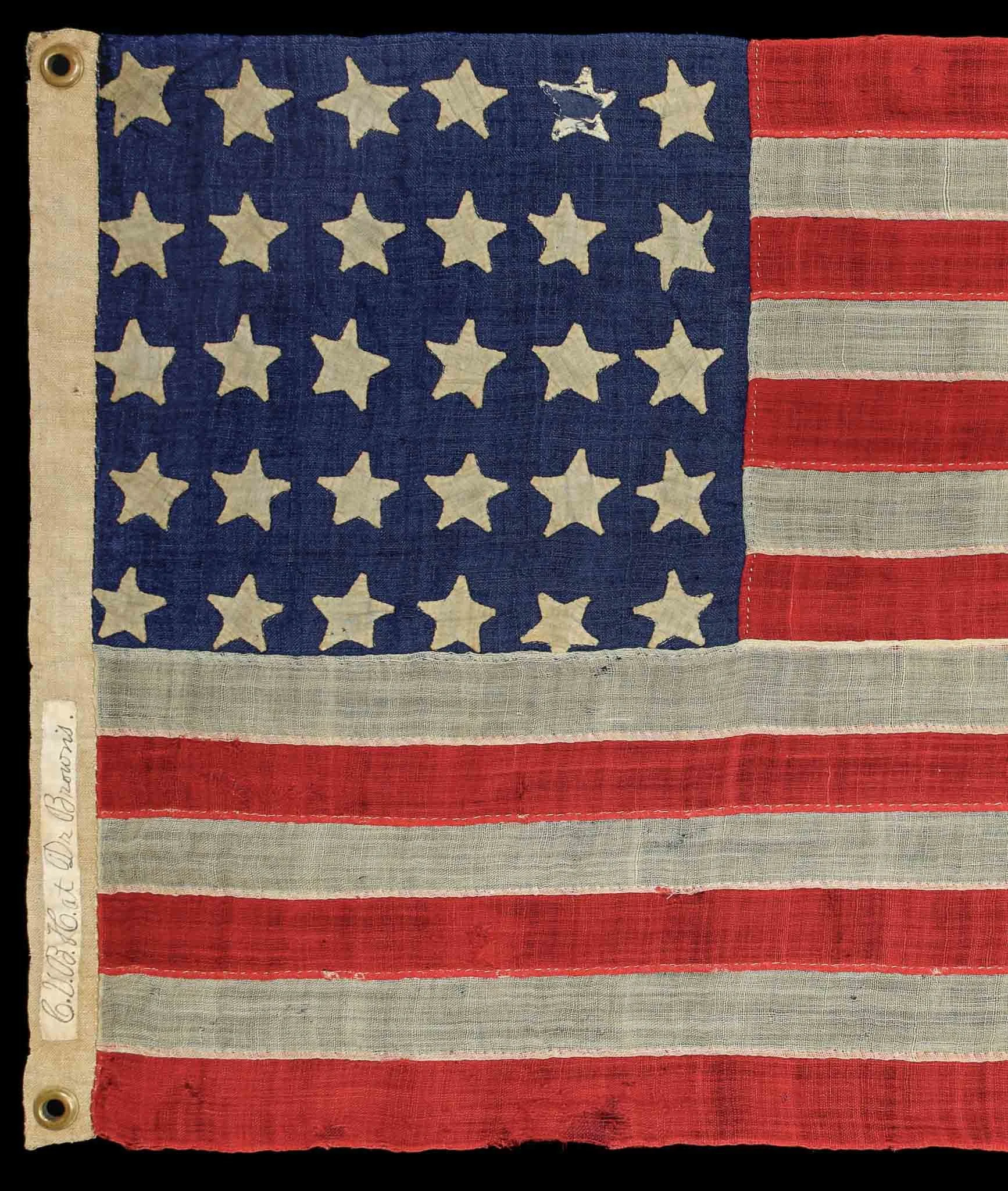
Offered is an exceptionally rare 30-star American national flag, representing Wisconsin’s admission as the 30th state to the Union. Made entirely by hand between 1848 and 1851, this example predates the Civil War by more than a decade and survives as a remarkably well-preserved specimen from one of the most elusive periods in American flagmaking. Its materials—fine wool bunting with cotton stars, hand-sewn with linen thread—reflect the craftsmanship of an era before industrial flag production, when each flag was the work of an individual or small workshop. A hand-inked label on the hoist reads “C.V.B.H. at Dr. Brown’s,” an inscription that likely roots the flag in a specific but as-yet-unidentified institutional or medical context.
The 30-star flag’s period of official use lasted only three years, from July 4, 1848, to July 4, 1851, and few examples have survived. Its compact size, refined construction, and exceptional state of preservation combine to make it both a study piece of early American textile craft and a rare artifact of national symbolism in the years preceding the Civil War.
CONSTRUCTION
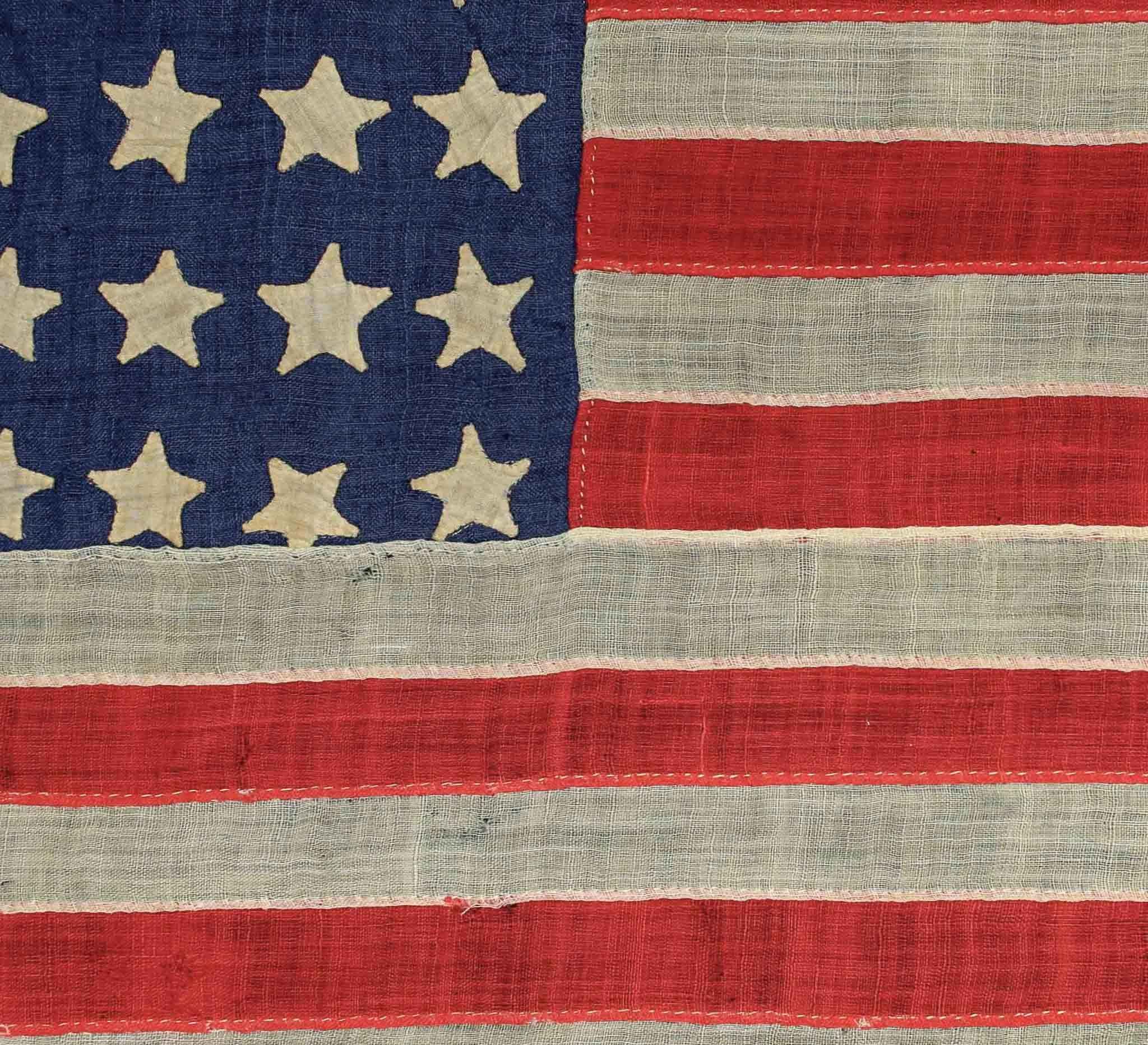
The flag is entirely hand-sewn of fine worsted-spun wool bunting, a lightweight, open-weave fabric developed specifically for flags and maritime signals. The thirteen stripes are joined with hand-stitched running seams, the length and tension of each stitch varying subtly from stripe to stripe—a telltale sign of human workmanship. The blue canton—also wool bunting—is attached with fine linen thread.
Each of the thirty stars is cut from plain-weave cotton muslin and appliquéd with a small, evenly spaced linen whipstitch. Under magnification, the fibers clearly reveal the distinction between the materials: the rounded, lustrous filaments and faint halo of wool versus the flat, ribbon-like fibers of cotton. This pairing was deliberate—cotton provided crisp, stable stars, while wool accepted dye beautifully and endured weather better than linen or silk.
HOIST AND GROMMETS
The hoist is made of densely woven, undyed wool bunting, folded for strength. Its weave is slightly tighter than that of the field, a purposeful reinforcement to bear the strain of display.
Attached near the canton is a hand-sewn cotton muslin label, inscribed in iron-gall ink with the words “C.V.B.H. at Dr. Brown’s.” The script is mid-19th century, the ink oxidized to a soft brown with subtle feathering into the cotton fibers. The label is hand-stitched with fine linen thread, consistent with the flag’s overall workmanship.
The hoist includes a pair of brass grommets, each manually set with a die and punch. Its smooth, flared rim and lack of serration identify it as a two-piece rolled eyelet. This early grommet type predates the spurred or pressed forms of the later century.
THE INSCRIPTION AND “DR. BROWN”
Affixed to the hoist is a small cotton muslin label inscribed “C.V.B.H. at Dr. Brown’s.” The inscription appears original to the flag’s period and written in a 19th-century hand. The abbreviation “C.V.B.H.” likely denotes an organizational or institutional reference, while the phrase “at Dr. Brown’s” implies a specific location or facility under the supervision of a physician.
The label’s survival offers a glimpse into the flag’s early use and ownership and underscores its authenticity as a working object, rather than a purely decorative piece.
CONTEXT AND RARITY
Flags predating the Civil War (1861–1865) are among the rarest and most desirable of all American flags. Prior to that period, the Stars and Stripes was not a household symbol but a formal standard—flown primarily on naval vessels, forts, and official buildings. Even within the military, the national flag was not widely used until 1834, when it was approved for the artillery, and 1841, when regiments began carrying it into the field. Consequently, pre-war examples represent perhaps one in a hundred of all 19th-century flags that survive.
The 30-star flag reflects Wisconsin’s admission to the Union on May 29, 1848, and became official on July 4th of that year, remaining in service until July 4, 1851, when California’s entry added the thirty-first star. The brevity of that period, combined with limited flag use nationwide, makes 30-star examples exceptionally scarce.
The rarity of early American flags also reflects a different relationship to national identity. Before the 1860s, flag display was reserved for significant public occasions; the flag had not yet become a symbol of daily patriotism. To encounter a pre–Civil War flag of this scale and quality—hand-sewn, labeled, and intact—is to see the nation’s evolving relationship to its most enduring emblem.
SIGNIFICANCE
This 30-star flag captures a formative chapter in the American story—the brief and optimistic period between the close of the Mexican War and the oncoming sectional divide that would soon lead to conflict. Hand-sewn and personalized, it reflects a time when the American flag was not yet ubiquitous, when its making required skill, and its display carried meaning.
For collectors and historians alike, flags of this early period stand among the most sought after of all surviving examples. Each represents a rare physical link to the decades when the nation’s identity—and its symbols—were still taking form. This 30-star flag, complete with its original inscription, remains one of the finest of its kind to surface in private hands.
Conservation Process: The flag was hand sewn to cotton fabric, and both were hand sewn to a mounting board. To prevent the black dye in the cotton fabric from seeping into the flag, it was first washed in a standard wash and then in a dye setting wash. The flag is positioned behind Optium Museum Acrylic.
Frame: The flag is in our Large Distressed Black and Gold Frame.
Condition Report: The flag remains in outstanding condition for its age. The colors are vibrant, with a deep and stable blue canton, rich red stripes, and cotton stars that have aged to a soft ivory hue. Minor mothing is present along portions of the lower red stripes, and a small section of one star is missing, consistent with natural wear.
Collectability Level: The Extraordinary – Museum Quality Offerings
Date of Origin: 1848-1851
Number of Stars: 30
Associated State: Wisconsin