35 Star Antique Flag with Medallion Double-Wreath Pattern | Bearing Battle Honors of the 71st New York Volunteer Infantry | Circa 1880–1913


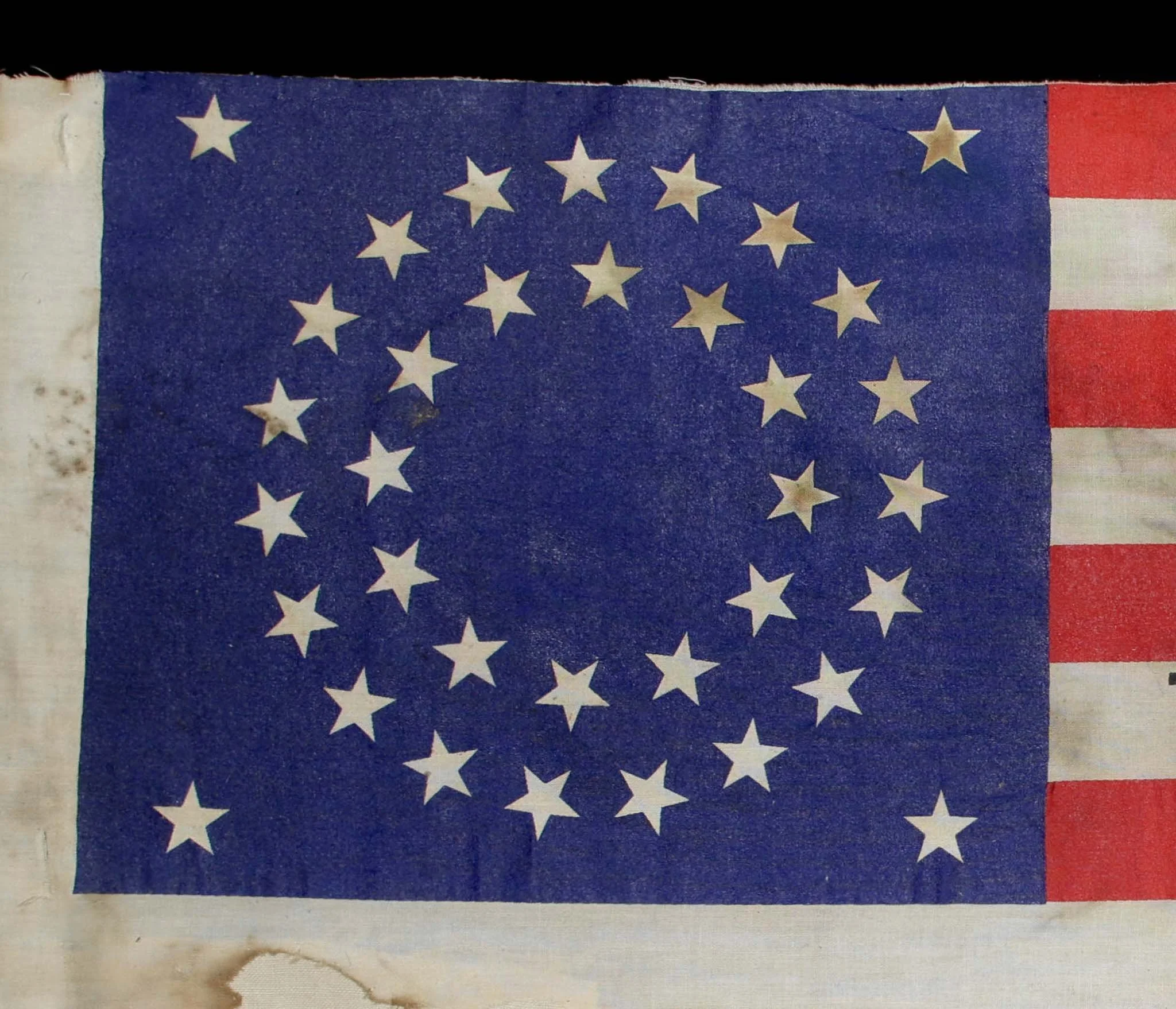

35 Star Antique Flag with Medallion Double-Wreath Pattern | Bearing Battle Honors of the 71st New York Volunteer Infantry | Circa 1880–1913
Frame Size (H x L): 27” x 35”
Flag Size (H x L): 15.5” x 25”
Offered is a 35-star American flag printed on plain weave cotton, commemorating the 71st New York Volunteer Infantry with overprinted battle honors. This exceedingly rare type is one of just a handful of known varieties of printed parade flags with regimental battle honors, making it an exceptional survivor from the postwar era of remembrance.
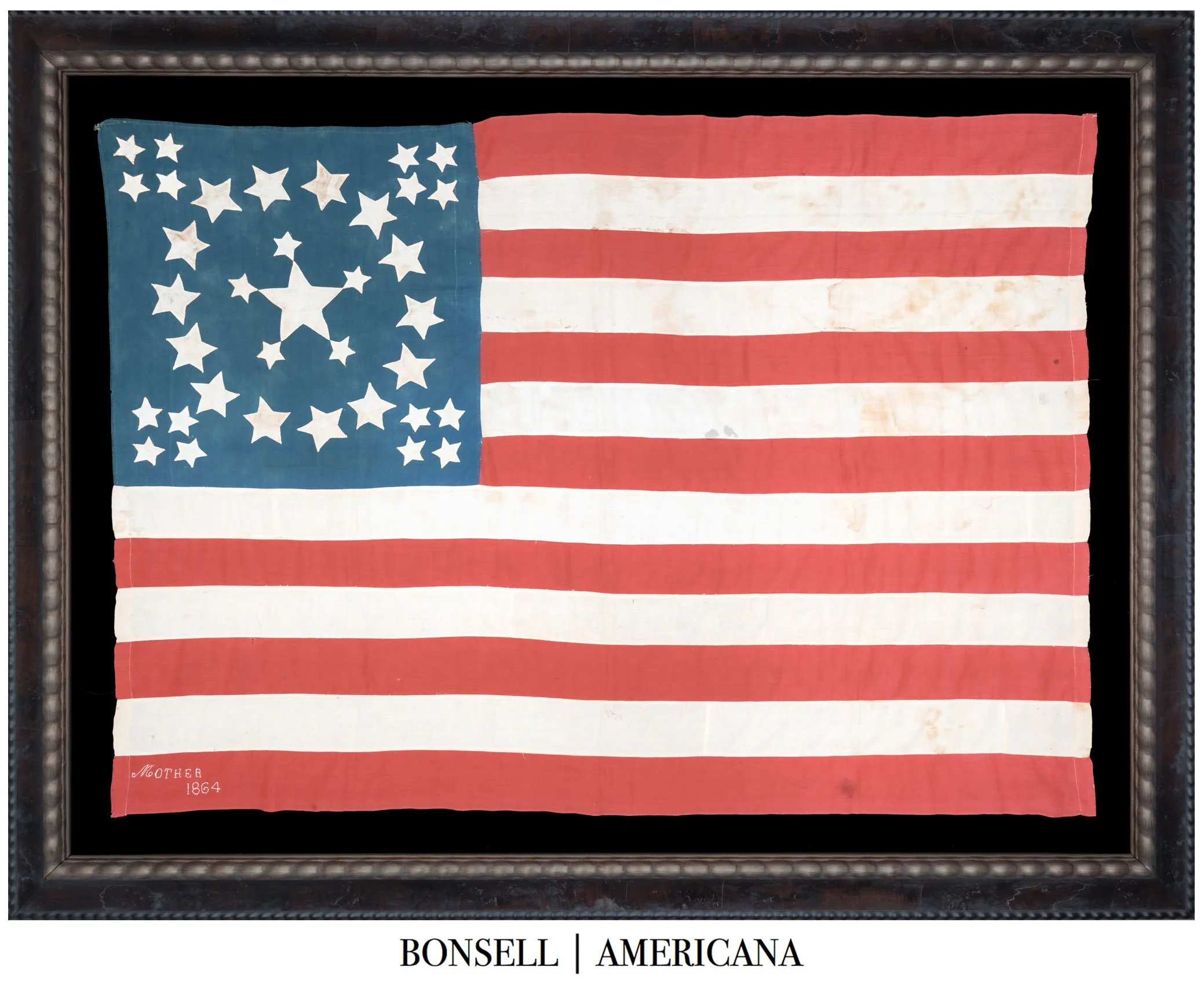
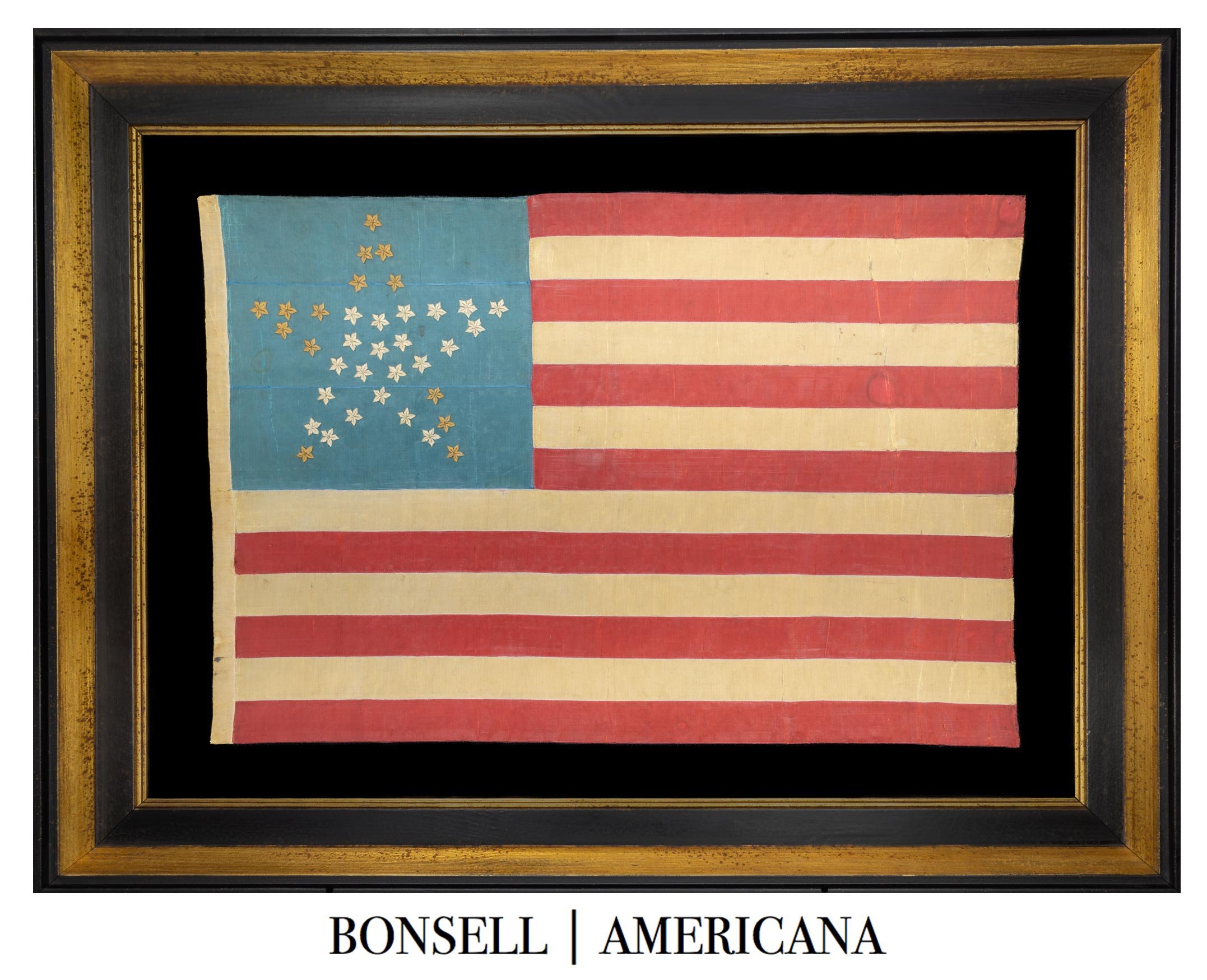
The stars are arranged in a medallion configuration: two concentric wreaths with a large center star and four flanking stars in the corners of the canton. This design recalls the pattern used on Civil War flank markers (guidons). While the medallion is a recognized arrangement, it is rarely encountered in printed parade flags, lending this example a striking visual distinction.
The regiment’s designation, “71ST NEW YORK VOL. INFT”, is boldly printed across the fourth white stripe. Above appears BULL RUN, while FREDERICKSBURG and CHANCELLORSVILLE appear below, side by side. Anchoring the design is GETTYSBURG. The presence of these inscriptions ties the flag directly to the service of the regiment in a way that is almost never seen in printed flags.
THE 71ST NEW YORK VOLUNTEER INFANTRY & ITS BATTLE HONORS
The 71st New York Volunteer Infantry, part of Daniel Sickles’ Excelsior Brigade, mustered into service in the summer of 1861 with recruits from Cattaraugus, Delaware, and Ulster counties. Its baptism of fire came at Bull Run in July 1861, where the regiment fought in the Union Army’s first major engagement. The battle ended in Confederate victory, but the experience marked the beginning of the 71st’s service.
The regiment next saw heavy action at Fredericksburg in December 1862, one of the Union’s most severe defeats. The 71st participated in the bloody assaults on fortified Confederate positions at Marye’s Heights, contributing to the staggering Federal casualties.
At Chancellorsville in May 1863, the 71st endured the shock of Stonewall Jackson’s flank attack. Though the larger battle was another Union defeat, the regiment managed to withdraw under intense pressure, sustaining heavy losses in the process.
Their defining service came at Gettysburg in July 1863, where they fought on the second day in the Wheatfield and Peach Orchard. The ground shifted hands repeatedly in brutal, close-quarter fighting, and the regiment’s defense helped blunt the Confederate advance on the Union left. Though it suffered heavily, the 71st’s stand at Gettysburg linked its name permanently with the battle that became the turning point of the war.
After Gettysburg, the regiment continued in the Eastern Theater until July 1864, when the original term of enlistment expired. While many men were discharged, others responded to President Lincoln’s personal appeal to extend their service. The regiment’s reputation for endurance and sacrifice was honored in the postwar years, when veterans gathered at reunions where flags such as this were displayed.
PRODUCTION & DATING
The materials and printing technique of this flag are highly unusual. Unlike the coarse, glazed cotton and vegetable-based dyes typically used on 19th-century parade flags, this flag is made from a plain weave cotton of atypical weight and bears a pigment that has a paint-like quality. The method suggests production outside the ordinary flag trade — possibly by a skilled printer who had never before made flags, working under deadline to produce commemorative pieces for a reunion.
Scholars have debated the precise dating. Some have speculated as early as 1864, though the absence of coarse cotton and orange-faded dyes suggests manufacture after 1880. On the other hand, the 50th anniversary of Gettysburg in 1913 provides a logical “no-later-than” date. The most likely range is 1880–1913, coinciding with the height of veterans’ reunions.
A small cache of these flags was discovered decades ago by a Civil War enthusiast at a Pennsylvania flea market, rolled up under a table. Though dispersed, examples occasionally resurface, each reaffirming the unusual character and limited production of this type.
THE 35-STAR FLAG
The 35-star flag represents the admission of West Virginia to the Union on June 20, 1863, a moment of political and symbolic importance. West Virginia was formed during the Civil War when the northwestern counties of Virginia, loyal to the Union, broke away in opposition to secession. President Abraham Lincoln signed the statehood bill in December 1862, and after a period of debate over its constitutionality, the new state was formally admitted the following summer.
The flag with 35 stars became official on July 4, 1863, one day after the conclusion of the Battle of Gettysburg and at nearly the same time as the Union victory at Vicksburg. These twin triumphs, coupled with the addition of a new loyal state, represented a turning point in the war when Union confidence was restored.
The 35-star flag is unique in being the only star count both added and recognized during the Civil War itself. It remained official until July 4, 1865, when a 36th star was added for Nevada. In practice, many flag makers continued to produce 34-star flags throughout 1863, partly because of existing stock and partly because updates were slow to spread. This makes true period 35-star flags comparatively rare.
Because of this scarcity, and because of their association with the turning point of the war, the 35-star count is regarded as one of the most evocative of the Civil War era. Reunion-period examples like the present flag, especially those that directly tie to regiments and their battle honors, embody both the symbolism of Union expansion and the lived memory of the men who fought to preserve it.
SIGNIFICANCE
This flag brings together an uncommon star configuration, regimental designation, and printed battle honors in a form seldom encountered. Its unusual materials, compelling design, and layered historical context—touching on West Virginia statehood, Union battlefield service, and the culture of postwar remembrance—place it among the most historically resonant printed flags of the late 19th and early 20th century.
Conservation Process: This flag was hand sewn to cotton fabric, and both were hand sewn to a mounting board. To prevent the black dye in the cotton fabric from seeping into the flag, it was first washed in a standard wash and then in a dye setting wash. The flag is positioned behind Optium Museum Acrylic.
Frame: This offering is in our Large Distressed Black and Gold Frame.
Condition Report: The flag shows expected age-related wear consistent with its period. There is soiling and staining scattered across the stripes, most notable in the white fields around the regimental designation and battle honors. Small holes and fabric losses are present, particularly along the fly end and in the area of the overprint text, though these have been masked with matching fabric to stabilize the presentation. Despite these imperfections, the colors remain strong, and the inscriptions are clear and legible.
Collectability Level: The Extraordinary – Museum Quality Offerings
Date of Origin: 1880-1913
Number of Stars: 35
Associated War: Civil War (1861-1865)
Associated State: West Virginia