Outstanding “FINE GROCERIES” Advertising Banner | Made from Five Connected 42 Star American Parade Flags | Circa 1889-1890
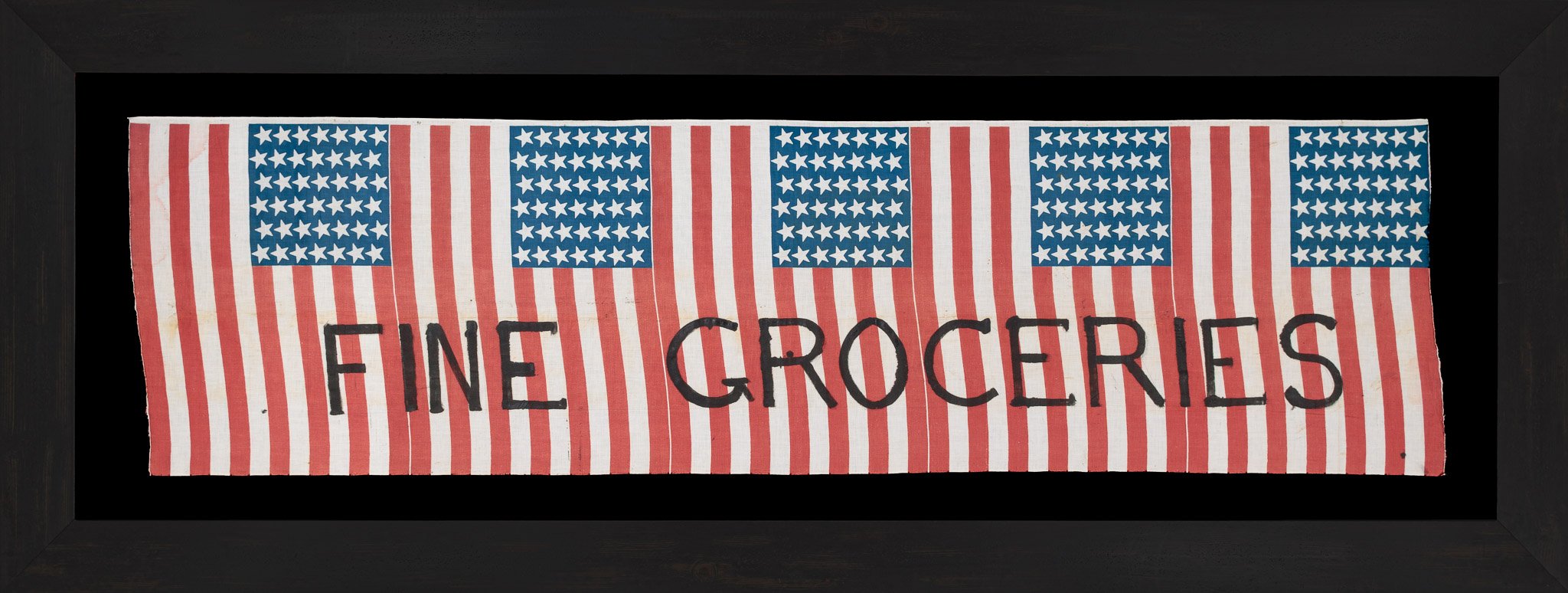


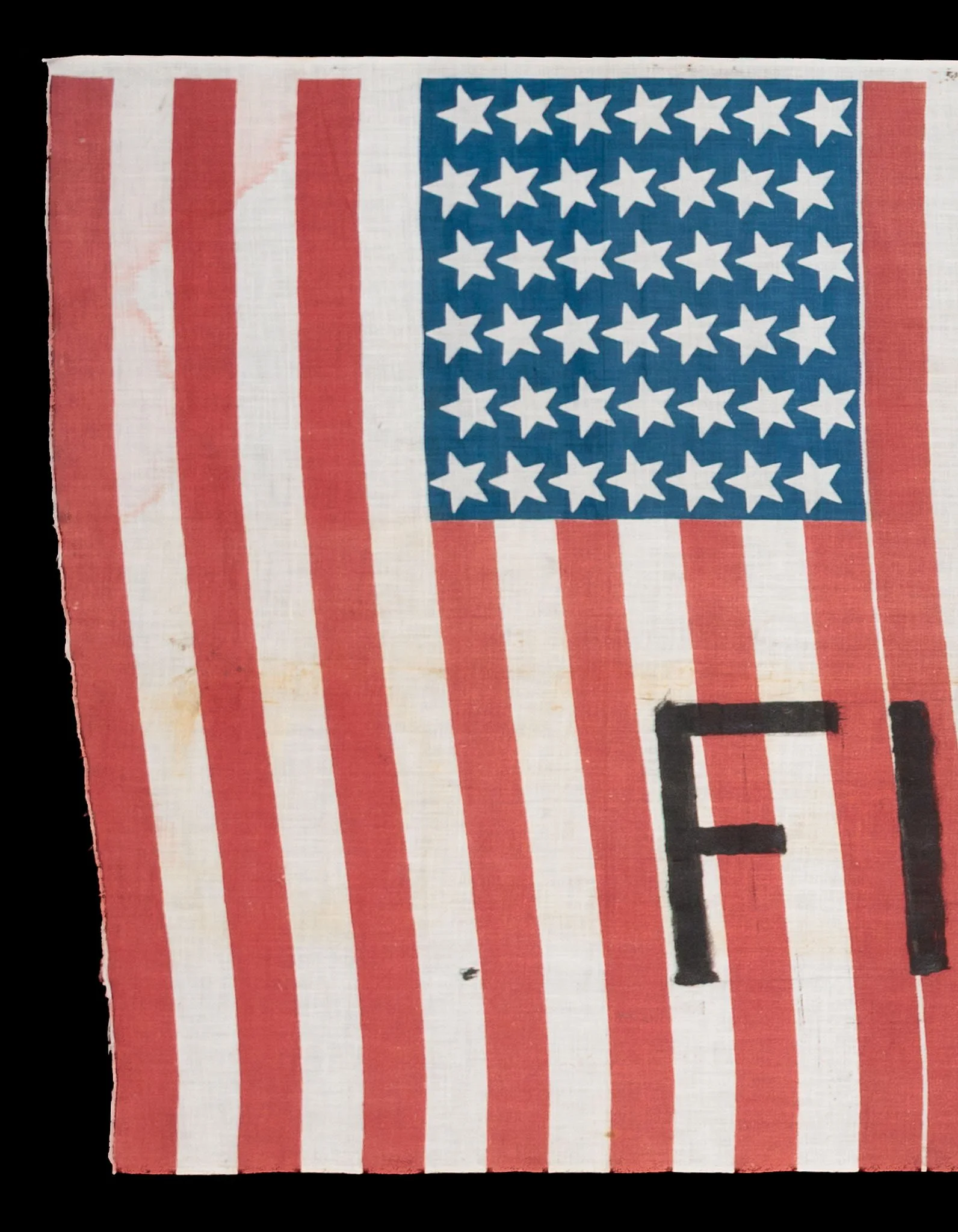
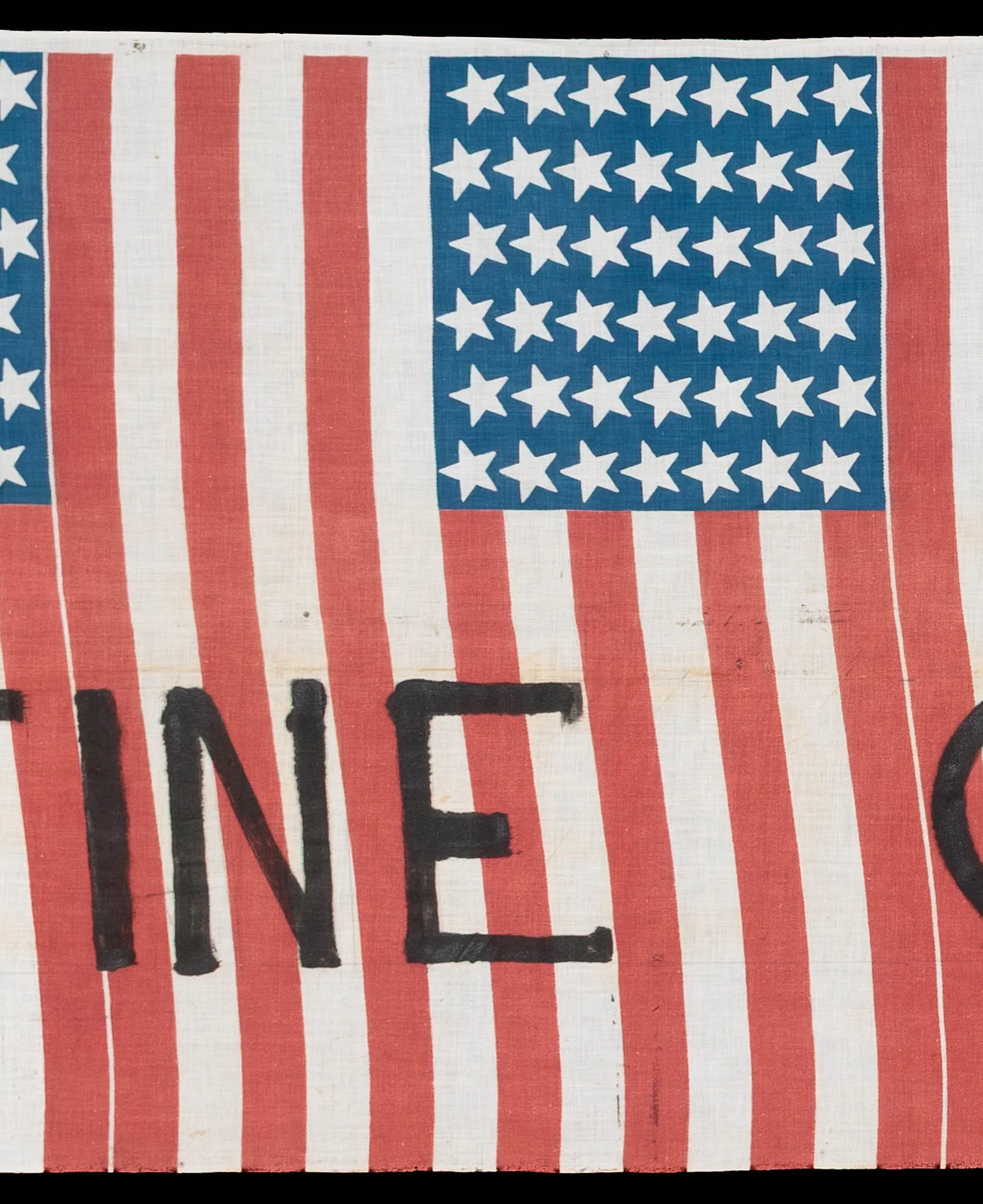
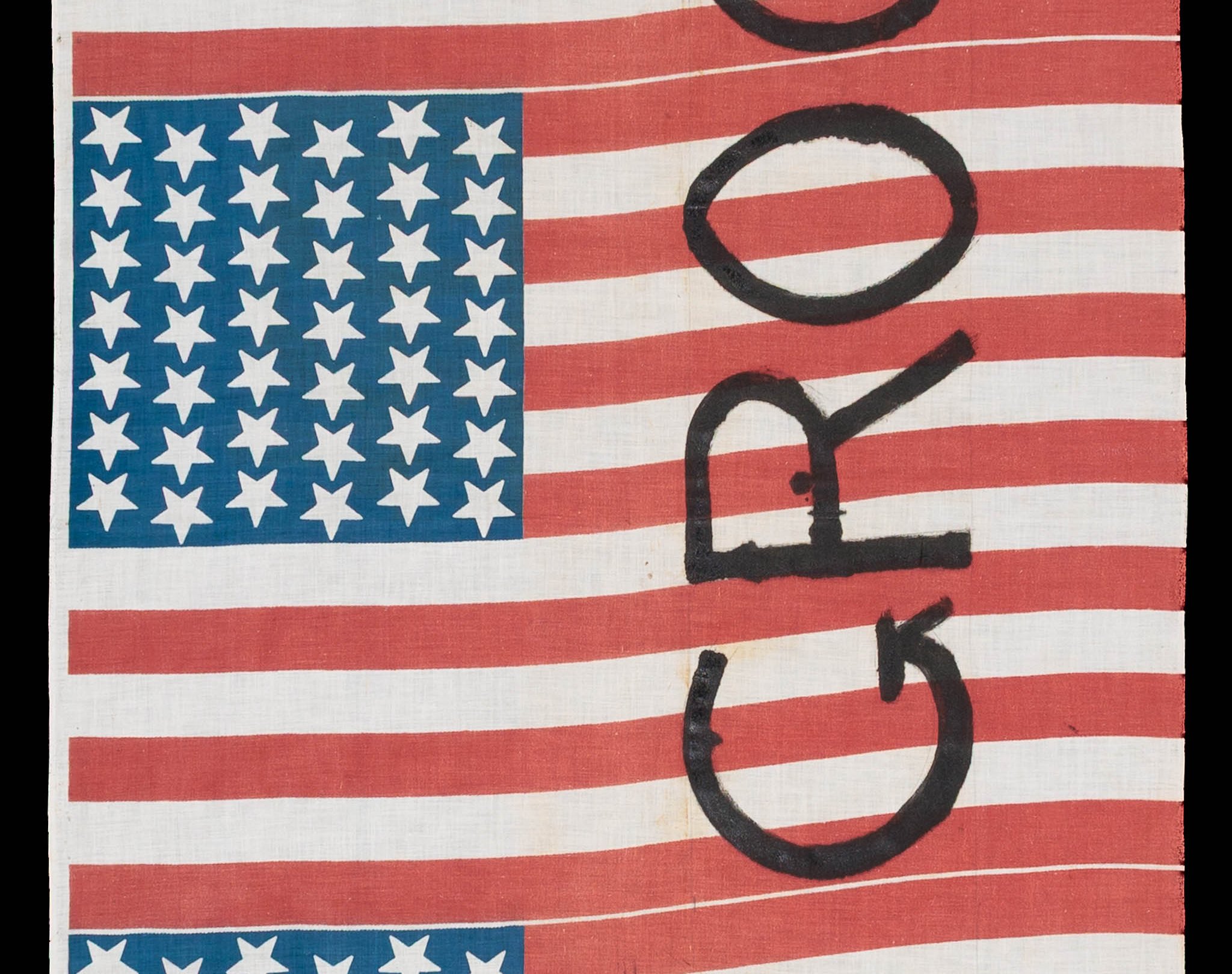
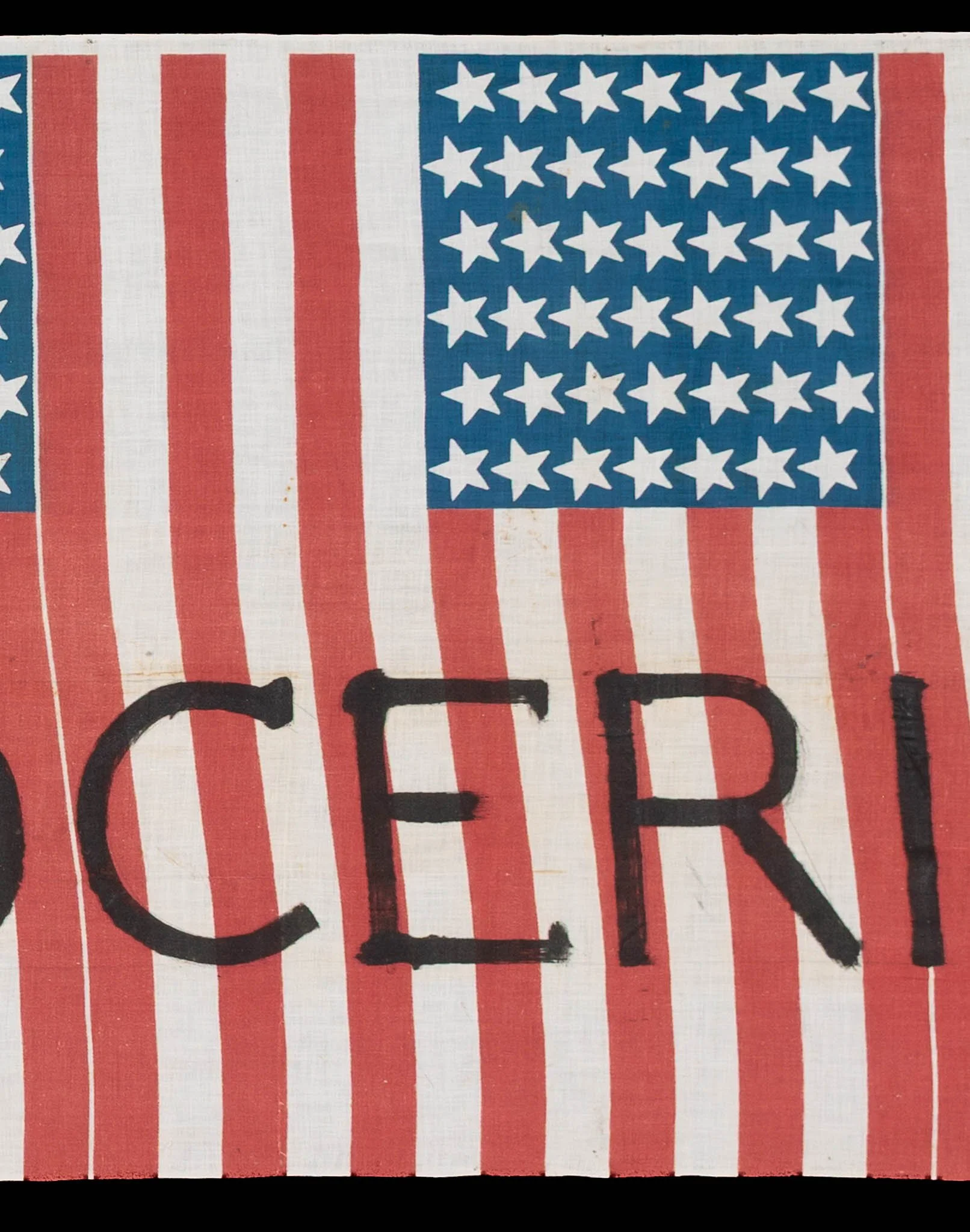
Outstanding “FINE GROCERIES” Advertising Banner | Made from Five Connected 42 Star American Parade Flags | Circa 1889-1890
Price: Call 618-553-2291, or email info@bonsellamericana.com
Frame Size (H x L): 40” x 105”
Flag Size (H x L): 24 ½” x 88 ½”
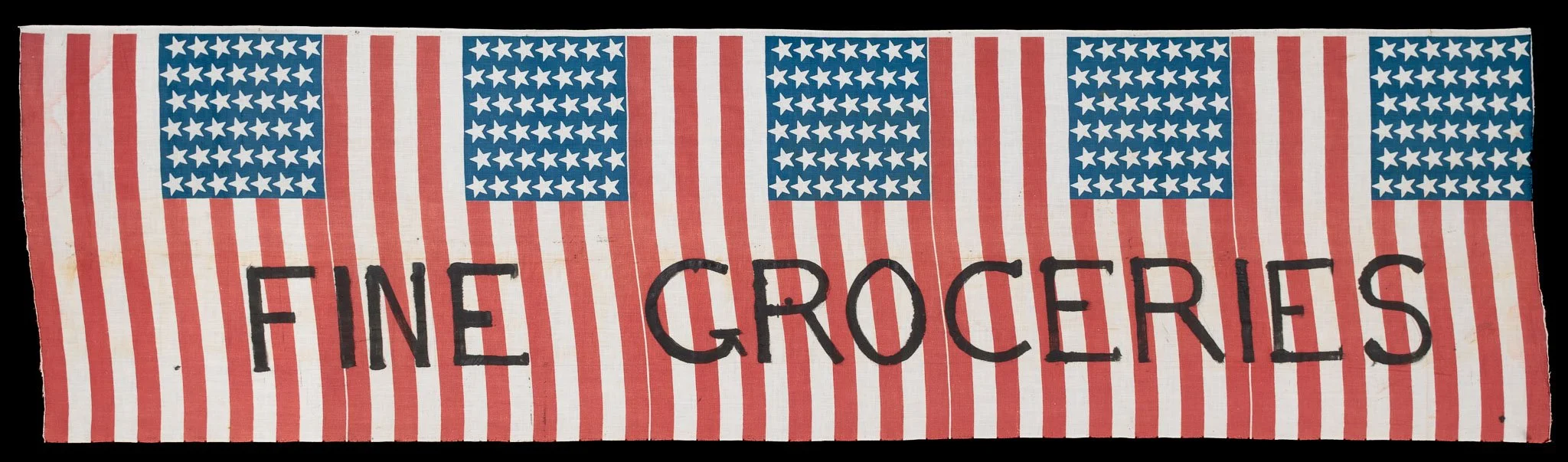
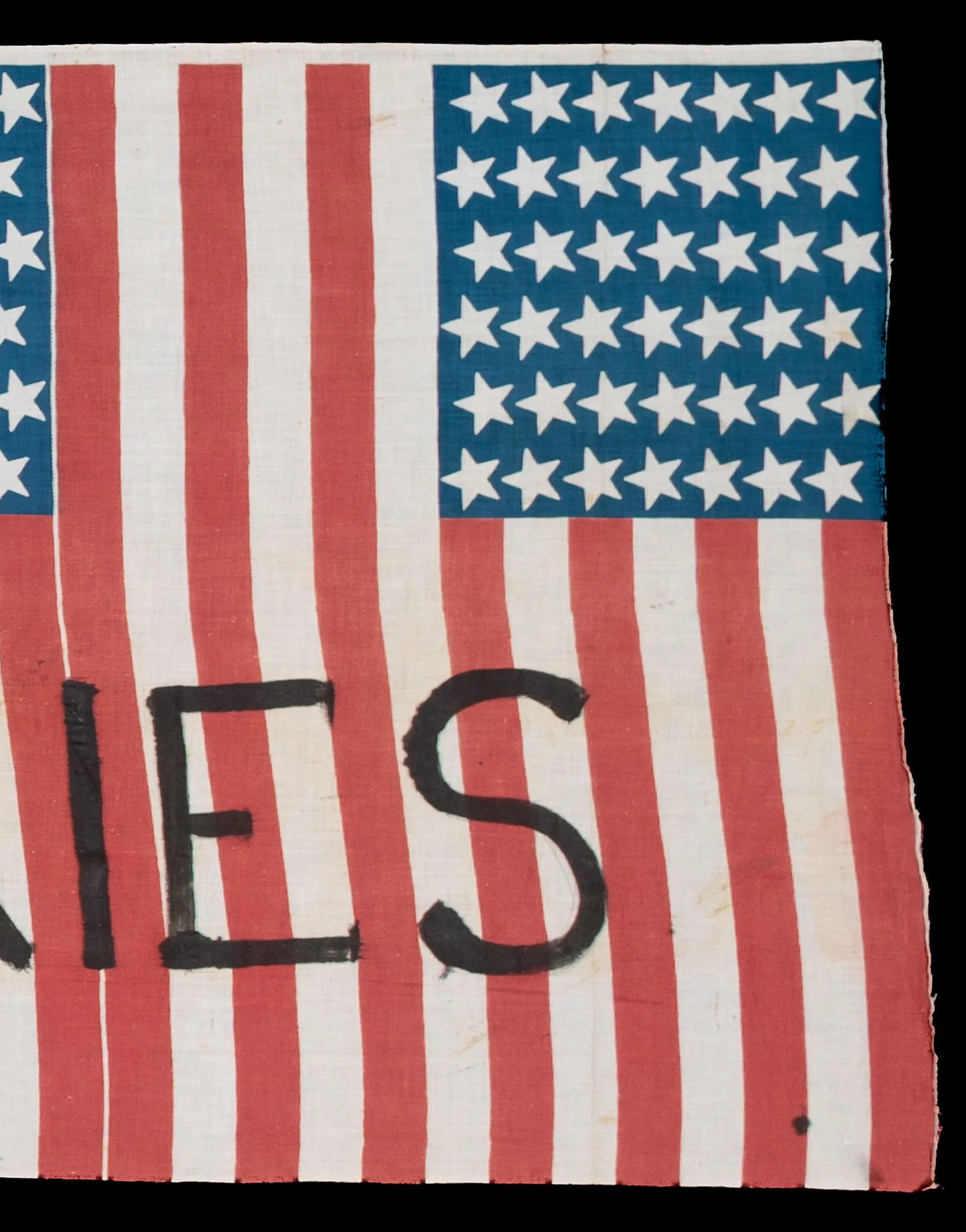
Offered is an unusual late 19th century advertising banner constructed from five connected 42-star American parade flags, printed on cotton and boldly hand-painted with the words “FINE GROCERIES.” The piece is notable on several levels: the flags themselves represent one of the more interesting unofficial star counts of the period, they remain joined in a continuous strip of five, and the group was later adapted for commercial use.
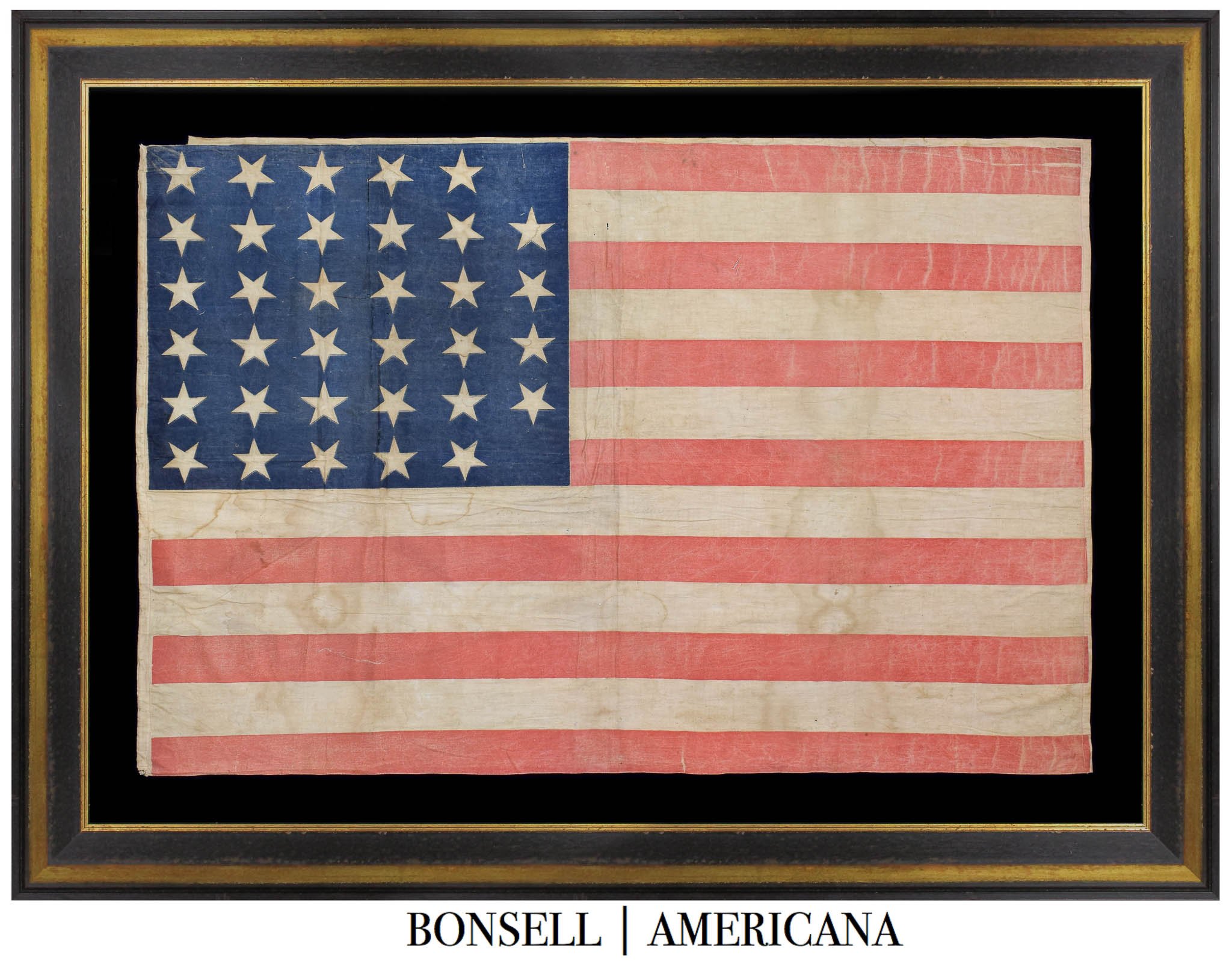
Each of the five flags contains 42 white stars on a blue canton. The stars are arranged in six vertical columns of seven, with alternating columns positioned at slightly different heights to create a subtle wave-like configuration. All of the stars are oriented with two points upward rather than the more familiar single point. There is no known significance to this orientation. During the 19th century, star arrangement and orientation were largely left to the discretion of flag makers, and the present configuration appears to have been simply a distinctive design choice.
The 42-star count corresponds to a particularly interesting moment in American expansion. North Dakota and South Dakota entered the Union on November 2nd, 1889, followed by Montana on November 8th and Washington on November 11th. Washington therefore became the 42nd state.
Flag manufacturers often responded to statehood more quickly than federal law did. Under the Flag Act of 1818, stars representing newly admitted states were formally added to the national flag on the following July 4th. In practice, commercial flag makers frequently introduced new star counts immediately after states were admitted, both to reflect the actual number of states and to keep pace with competing manufacturers.
That practice explains the appearance of the 42-star flag. Following Washington’s admission in November 1889, manufacturers began producing flags with 42 stars even though the official national flag still contained 38. Even though the 42-star count was expected to become official on July 4th, 1890, it never did.
Idaho was admitted as the 43rd state on July 3rd, 1890, just one day before the anticipated 42-star flag would have taken effect. Wyoming followed on July 10th as the 44th state. As a result, 42 stars never constituted an official United States flag count. Surviving 42-star flags therefore represent the relatively brief interval between Washington’s admission and Idaho’s entry into the Union, when manufacturers were anticipating the next official flag.
The present banner is especially interesting because the five flags were never separated. Small printed parade flags of this type were commonly manufactured in multiples on continuous lengths of cloth. Individual flags could then be cut apart for sale, distribution, or use at political rallies, patriotic celebrations, and other public events. Here, five examples remain joined together, preserving the manner in which they were originally printed rather than the individual format in which these flags are usually encountered.
The repeating design gives the banner a strong visual rhythm. Five blue cantons appear in sequence across the upper portion, while the red and white stripes continue below. The survival of this many connected examples also provides a useful illustration of how inexpensive printed parade flags were manufactured and distributed in the late 19th century.
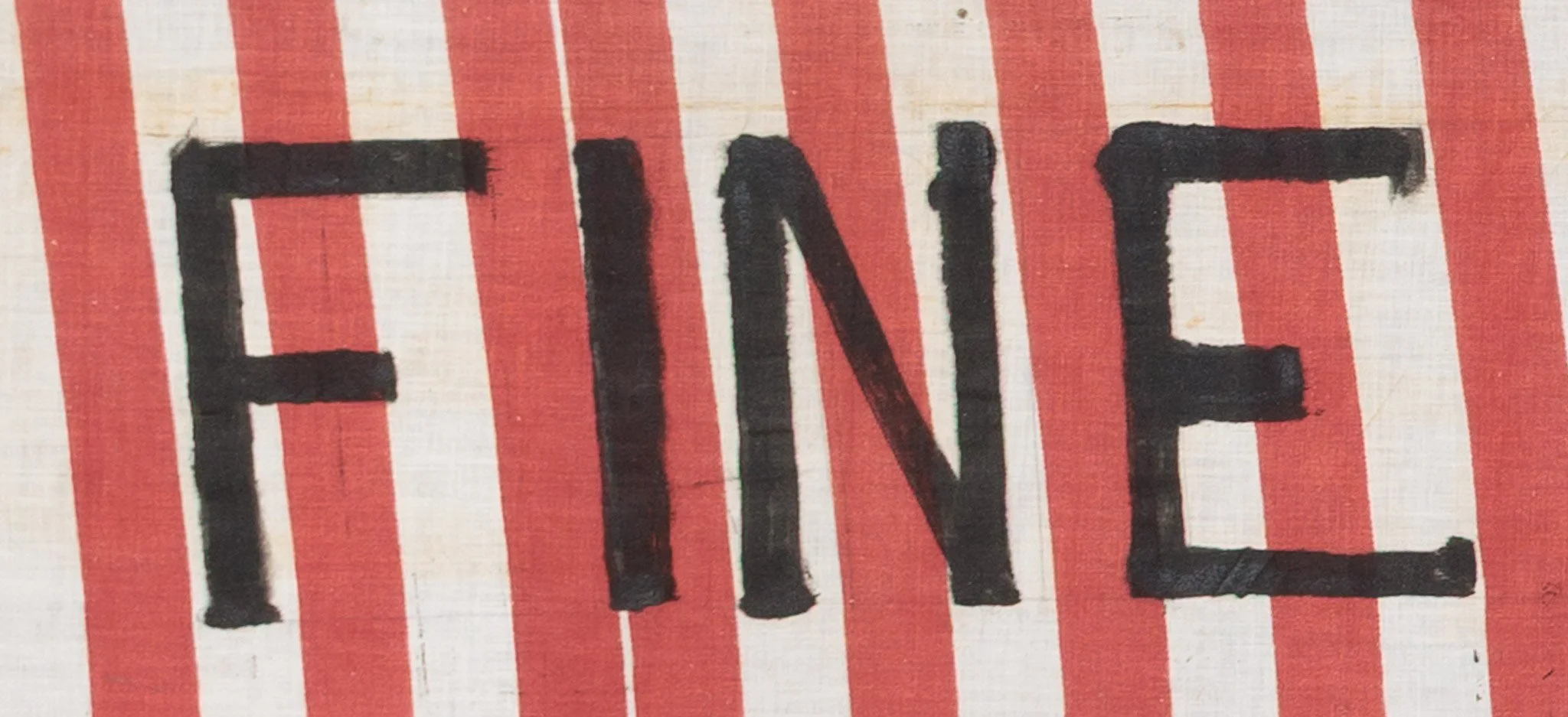
At some point, the connected strip was repurposed as a commercial sign. Across the center, in large black letters, someone painted: FINE GROCERIES
Fine pencil guidelines remain visible around portions of the lettering, showing that the inscription was carefully laid out before the paint was applied. The irregularities in the letter forms and the surviving pencil marks make clear that the wording was applied by hand rather than mechanically printed.
The phrase itself points toward the banner’s likely use. “Fine Groceries” was a familiar period description used by grocers, general merchants, and food dealers to advertise better-quality provisions and specialty goods. Although the specific business associated with the banner is unknown, it was presumably displayed in a grocery store, market, general store, or similar commercial setting.
Its reuse in this fashion is an important part of the object’s history. Rather than being separated into individual flags, the strip was retained intact and turned into functional advertising. The existing patriotic imagery provided a highly visible background, while the painted inscription allowed the merchant to adapt an already decorative textile for practical use.
American flags and other patriotic devices were widely incorporated into commercial displays during the late 19th and early 20th centuries. Bunting, shields, eagles, and national colors appeared in shop windows, storefronts, exhibitions, and advertising displays. This banner belongs to that broader tradition while retaining a particularly direct connection to the flag trade itself.
The date at which the lettering was added cannot be established with certainty. The flags themselves were produced in connection with the 42-state period beginning in late 1889 and extending into 1890. The advertising inscription may have been applied at approximately the same time, although it is also possible that an unused strip remained in stock and was adapted somewhat later. Without documentation linking the banner to a specific business, a narrower date for its commercial use would be speculative.
Taken as a whole, the piece brings together two distinct areas of late 19th century material culture. The flags document the rapid changes in the national star count during the admission of the western states, while the painted inscription reflects the practical reuse of patriotic textiles in everyday American commerce.
The survival of five connected 42-star flags is unusual in itself. Their conversion into a hand-painted “FINE GROCERIES” banner makes the piece considerably more distinctive. It functions simultaneously as a statehood-era flag textile and as a surviving example of vernacular commercial signage, with strong relevance to collectors of American flags, advertising, store displays, and food-related material culture.
Conservation Process: The banner was hand sewn to cotton fabric, and both were hand sewn to a mounting board. To prevent the black dye in the cotton fabric from seeping into the banner, it was first washed in a standard wash and then in a dye setting wash. The banner is positioned behind Optium Museum Acrylic.
Frame: The banner is housed in a substantial flat-profile wooden frame with a distressed black finish and subtle natural undertones visible along the surface and edges. The wide, restrained molding gives the piece a strong architectural presence while remaining visually secondary to the textile.
Condition Report: The banner remains in very good overall condition, with strong red and blue coloration and the painted lettering remaining bold and legible. There is scattered light soiling, minor staining, and small marks consistent with age and use, along with slight irregularity and wear at the outer edges.
Collectability Level: The Best – Perfect for Advanced Collectors
Date of Origin: 1889-1890
Number of Stars: 42
Associated State: Washington