Rare 38 Star Civil War Veteran Flag with Great Star Pattern and 12th New Hampshire Infantry Reunion Overprint | Colorado Statehood | Circa 1885
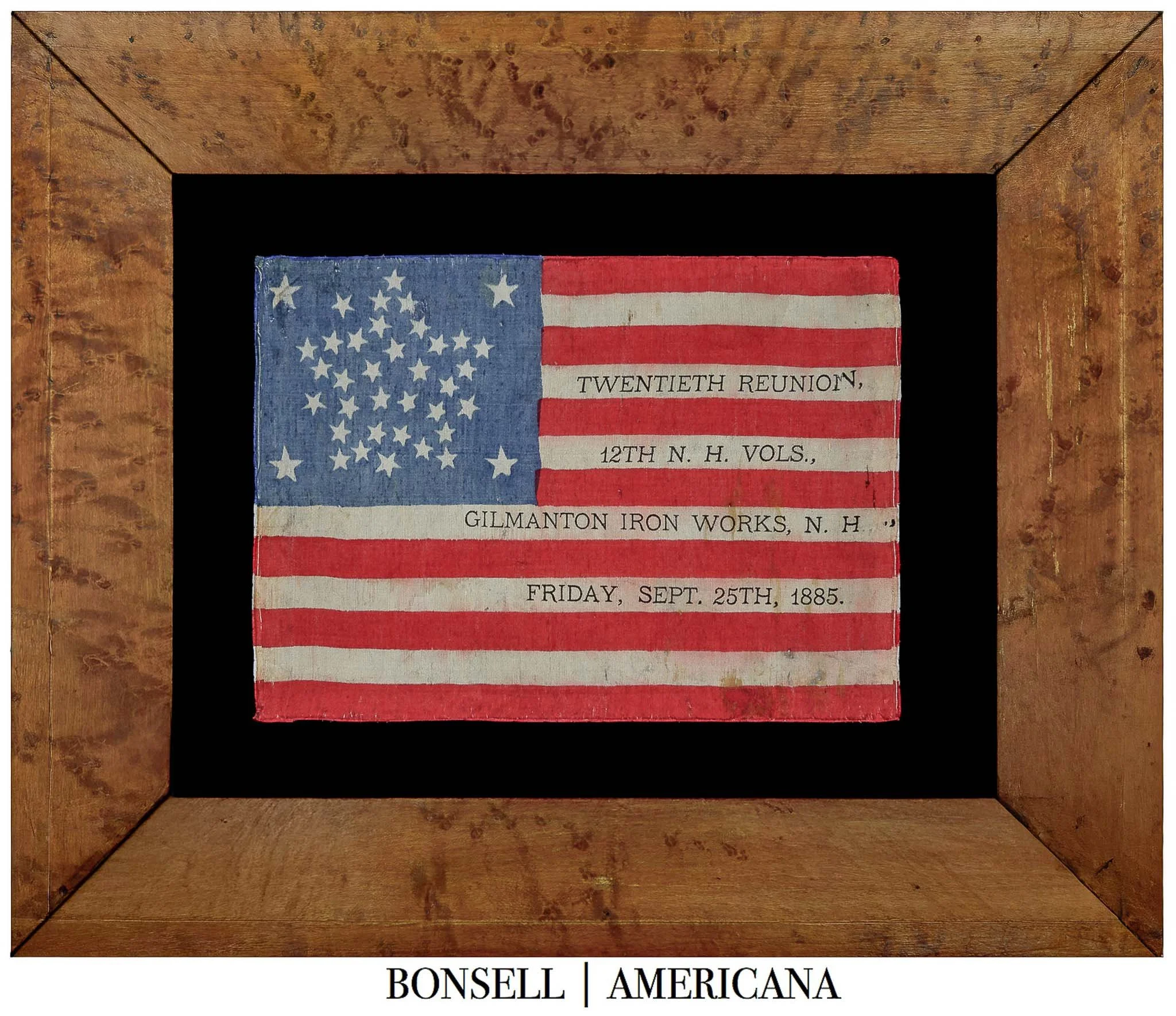
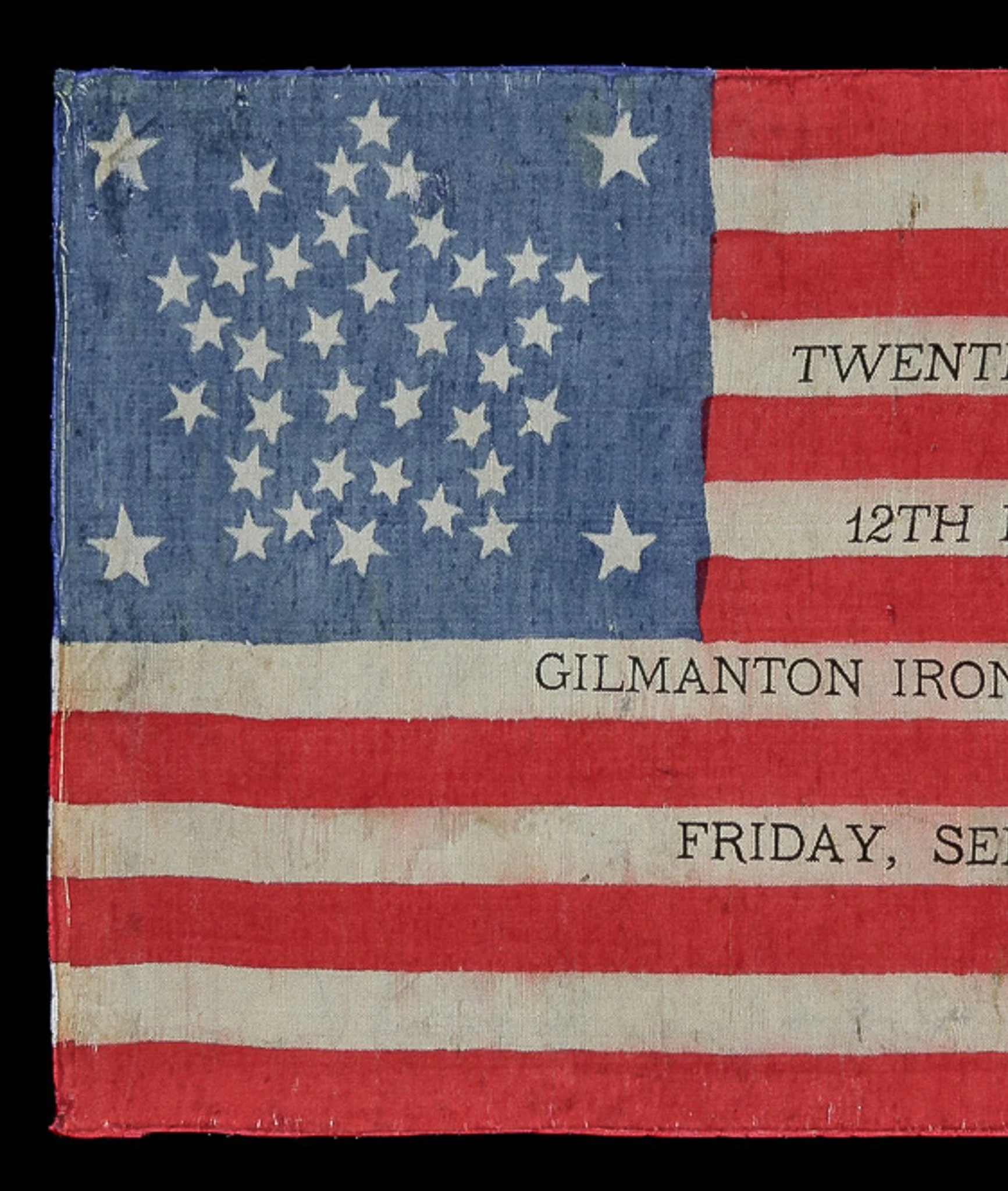
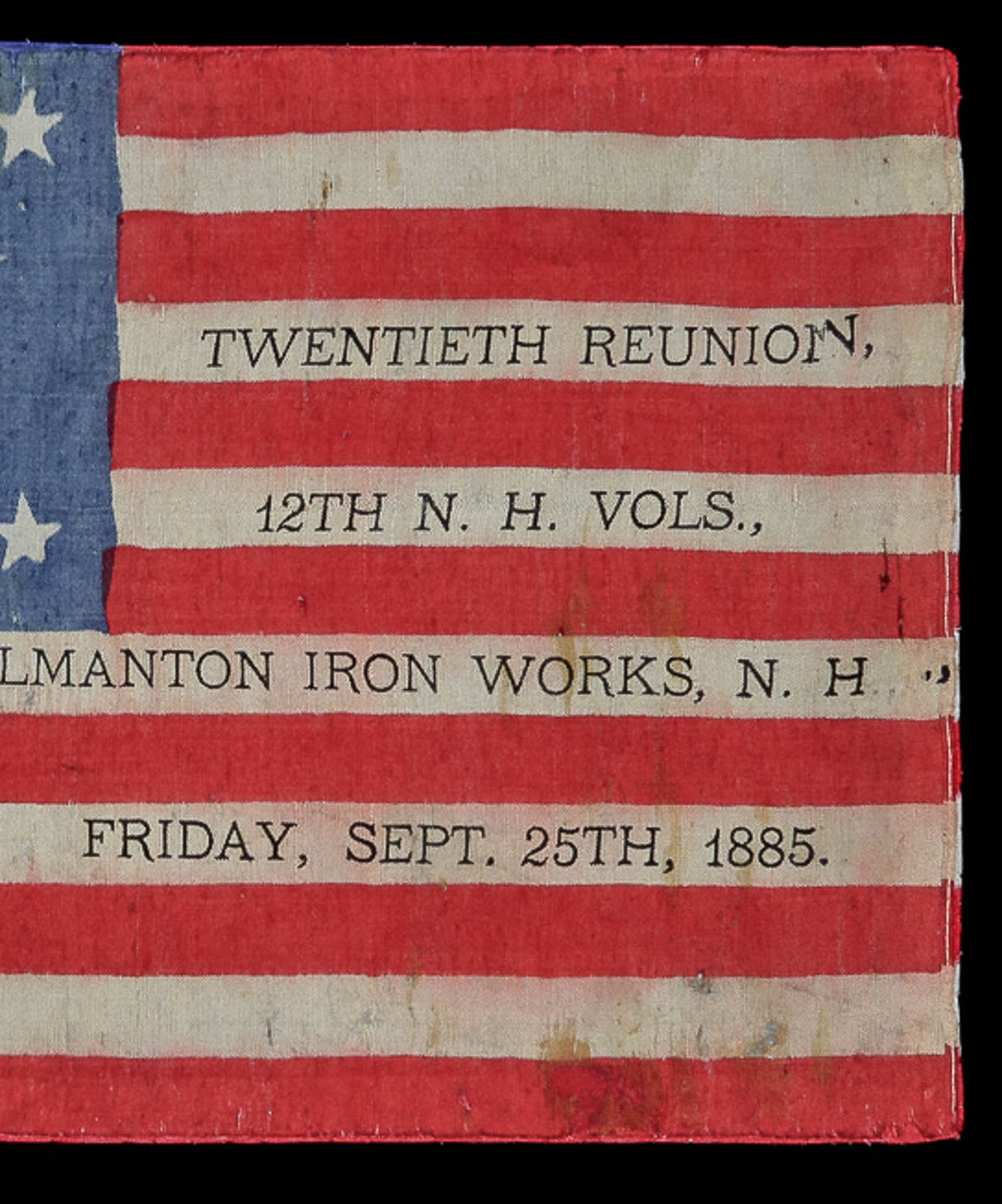
Rare 38 Star Civil War Veteran Flag with Great Star Pattern and 12th New Hampshire Infantry Reunion Overprint | Colorado Statehood | Circa 1885
Frame Size (H x L): 14” x 17”
Flag Size (H x L): 6.5” x 9.25”
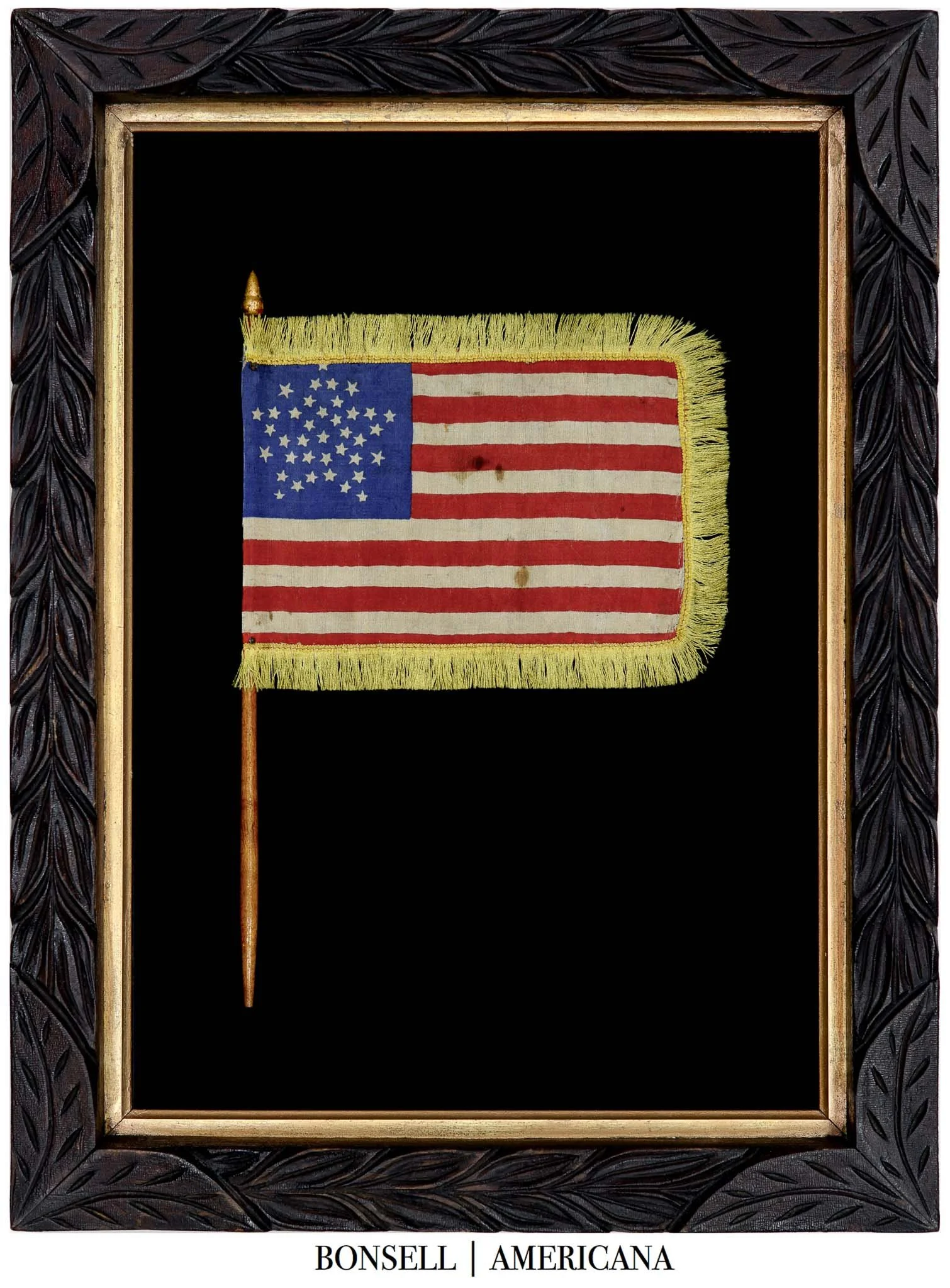
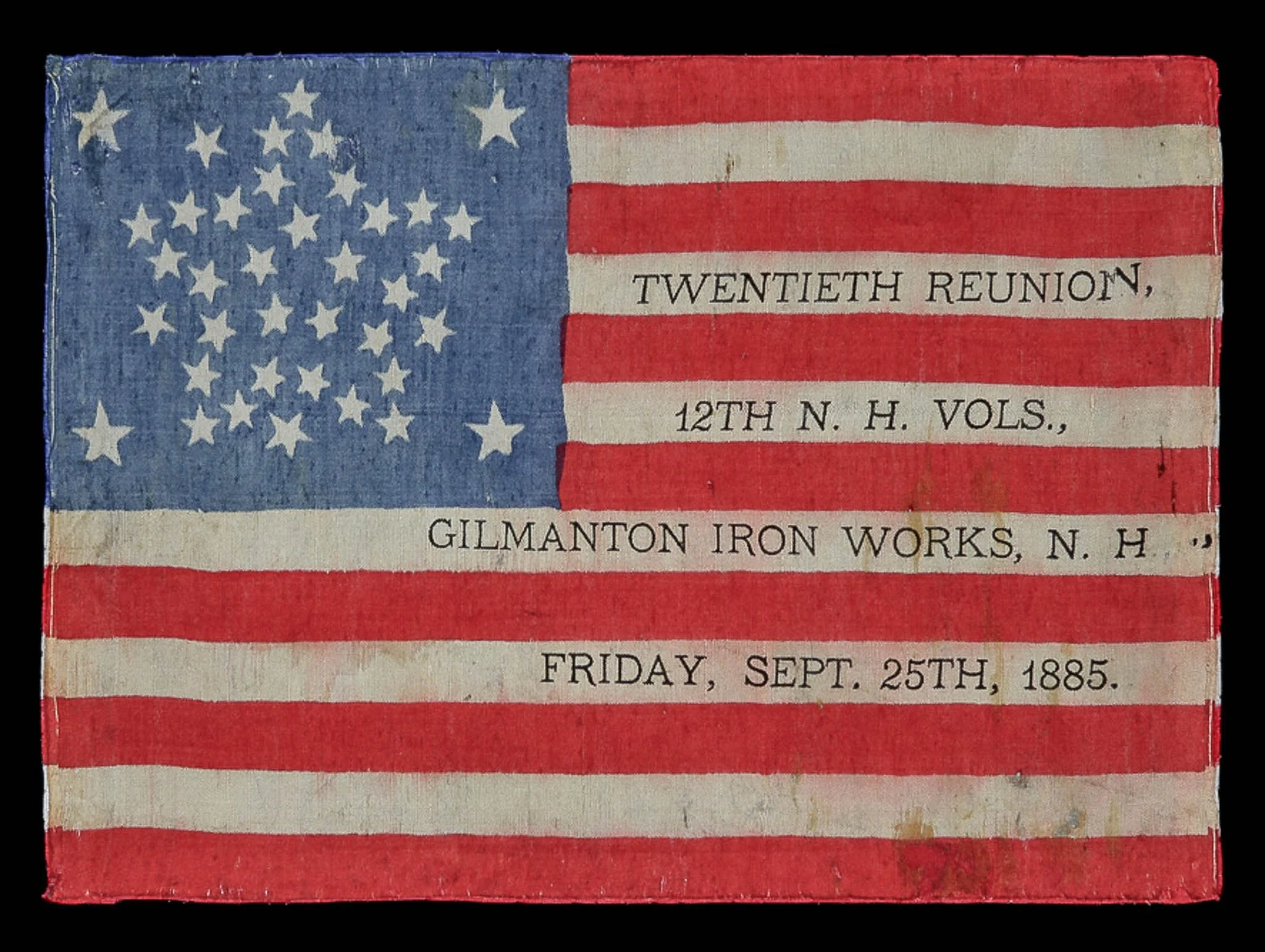
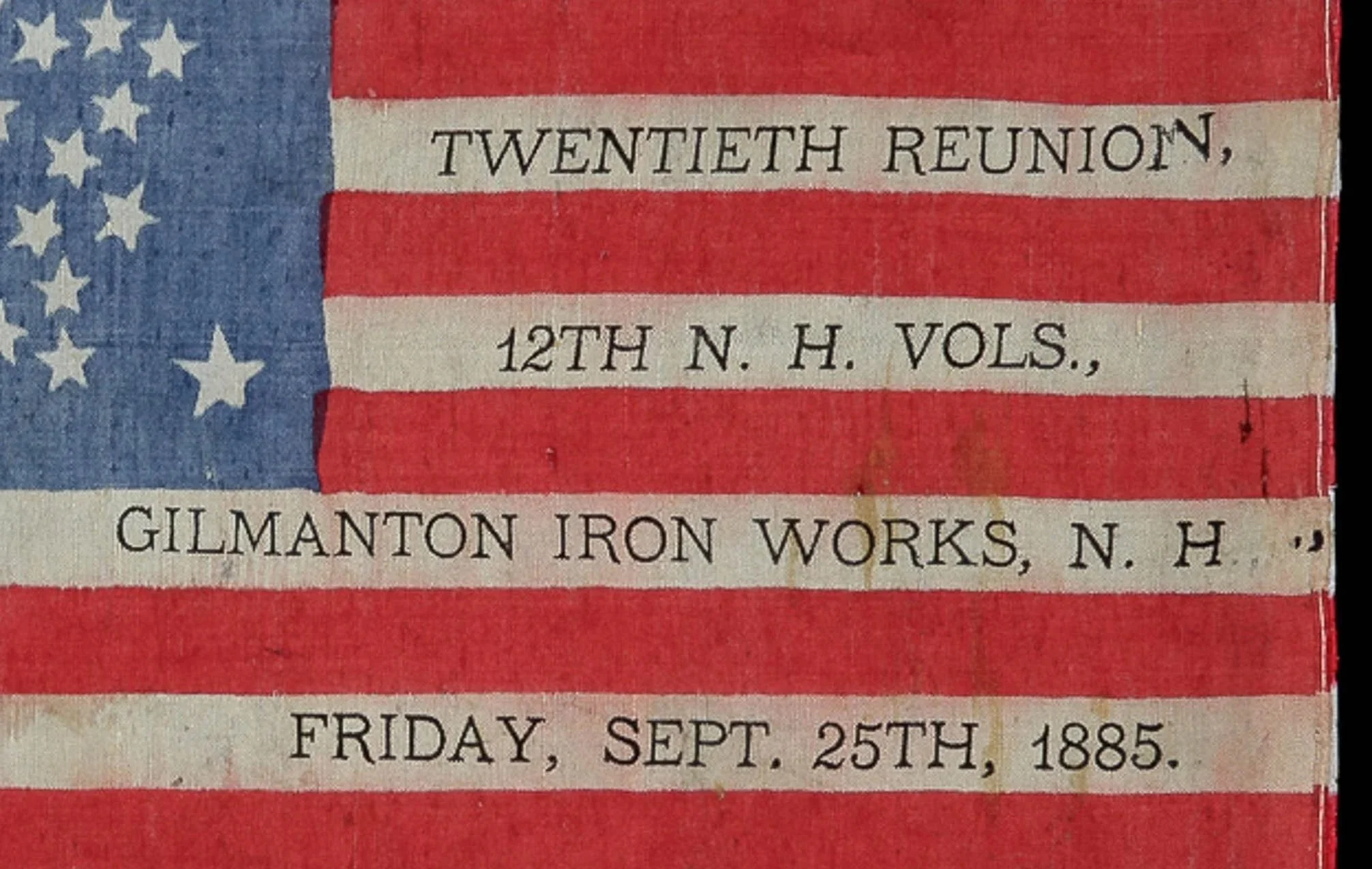
Offered is a remarkable 38-star printed silk parade flag commemorating the Twentieth Reunion of the 12th New Hampshire Volunteer Infantry, held at Gilmanton Iron Works, New Hampshire, on Friday, September 25th, 1885. It is overprinted with the following inscription:
TWENTIETH REUNION,
12TH N. H. VOLS.,
GILMANTON IRON WORKS, N. H.,
FRIDAY, SEPT. 25TH, 1885.
The “12TH N. H. VOLS.” refers to the 12th New Hampshire Infantry Regiment, a Union Army unit mustered in at Concord in September 1862 and mustered out in June 1865. The regiment saw heavy combat in several major engagements, including Fredericksburg, Chancellorsville, and Gettysburg. At Chancellorsville, it was the last unit under General Sickles’ command to withdraw from the field—suffering 69 killed and 250 wounded out of 580 men engaged. At Gettysburg, the 12th held ground north of the Klingel Farm under fierce attack by the Alabama Brigade, with 26 killed, 73 wounded, and 6 additional deaths from wounds among its 224 participants.
The reference to a “Twentieth Reunion” suggests the regiment began annual gatherings in 1866, immediately following the war. While most Civil War veteran flags feature overprints from the Grand Army of the Republic (GAR), this example is unusual in that it references a specific regimental reunion. Moreover, it predates the more commonly encountered GAR reunion flags, most of which date to the early 20th century.
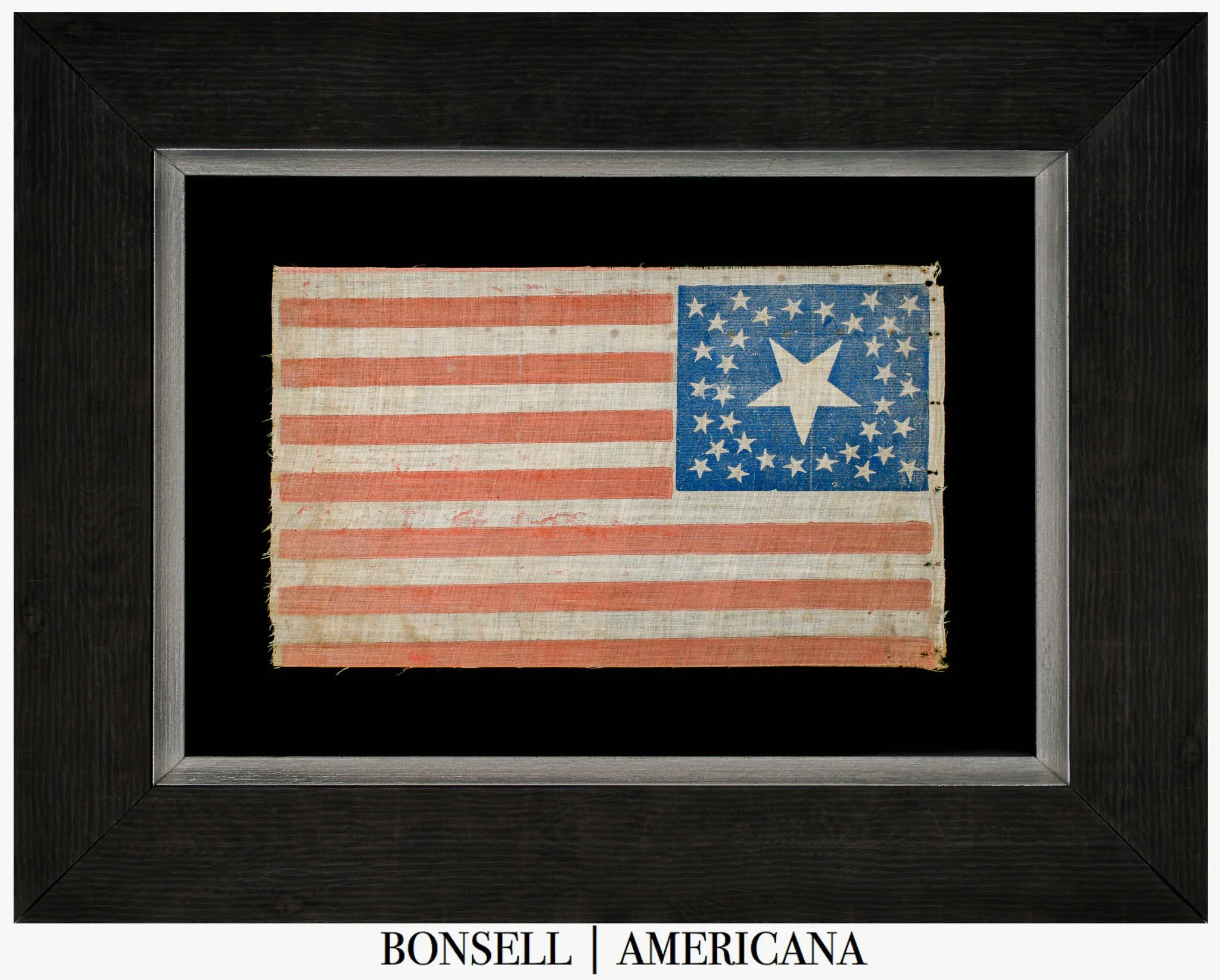
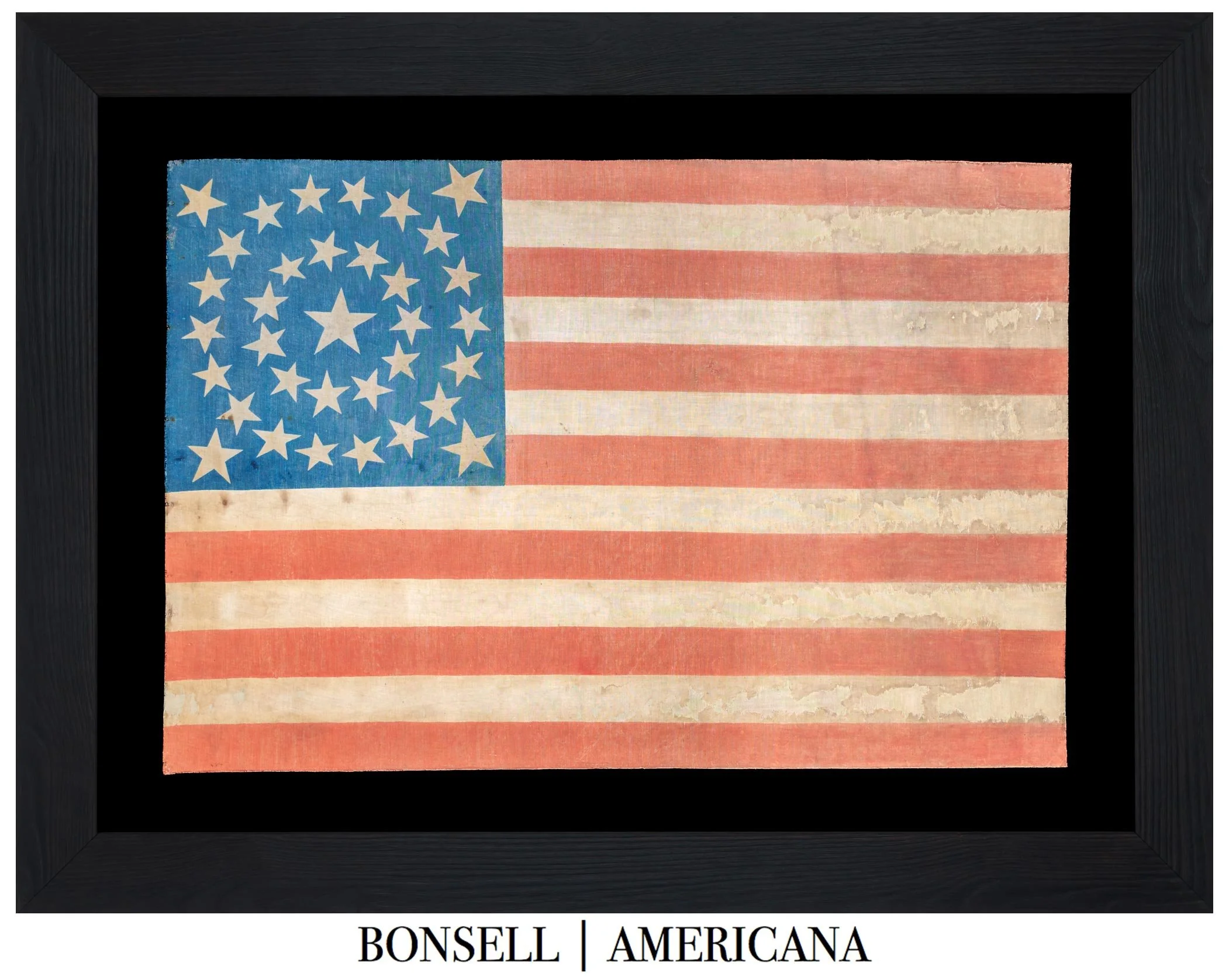
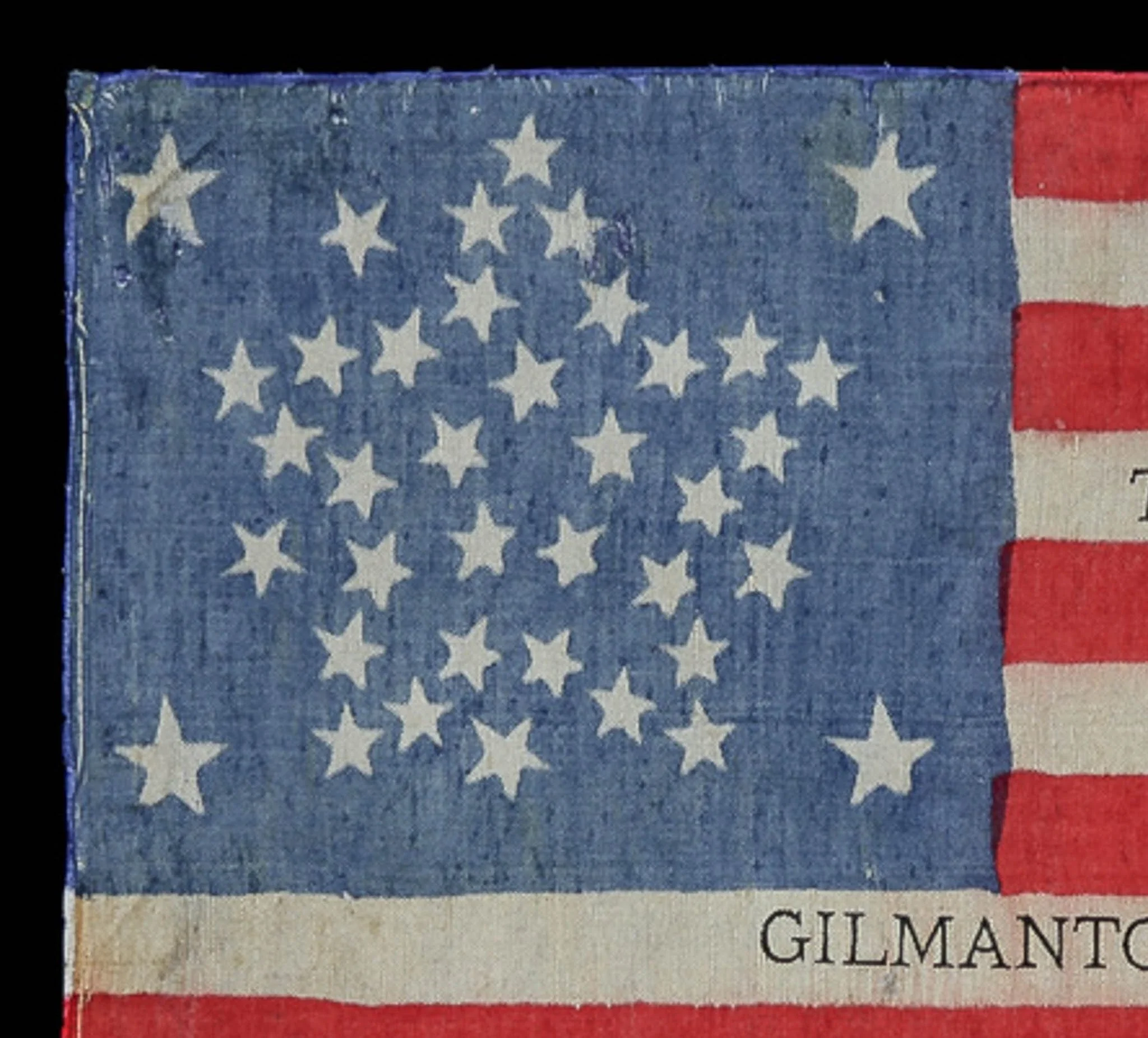
The flag’s canton features a rare and desirable “Great Star” pattern—an arrangement where smaller stars form the outline of a larger five-pointed star. This example includes 25 stars forming the outer shape, 5 within its interior, 4 interstitial stars surrounding the main form, and 4 canted corner stars. The slight asymmetry and open gaps likely allowed space for a future star, symbolizing the evolving Union.
The Great Star configuration is credited to U.S. Navy Captain Samuel Chester Reid, who proposed the design in 1818 while advising Congress on flag standardization. Reid's ideas helped shape the Flag Act of 1818, which fixed the number of stripes at thirteen and mandated that a new star be added for each new state on the July 4th following its admission. While his favored star pattern was not codified in law, the Great Star design became popular for its visual impact, especially when flown at sea. Though it saw greatest use in the 1840s, it remained in occasional production through the Centennial era. The last known commercial use of the pattern appeared on 38-star flags.
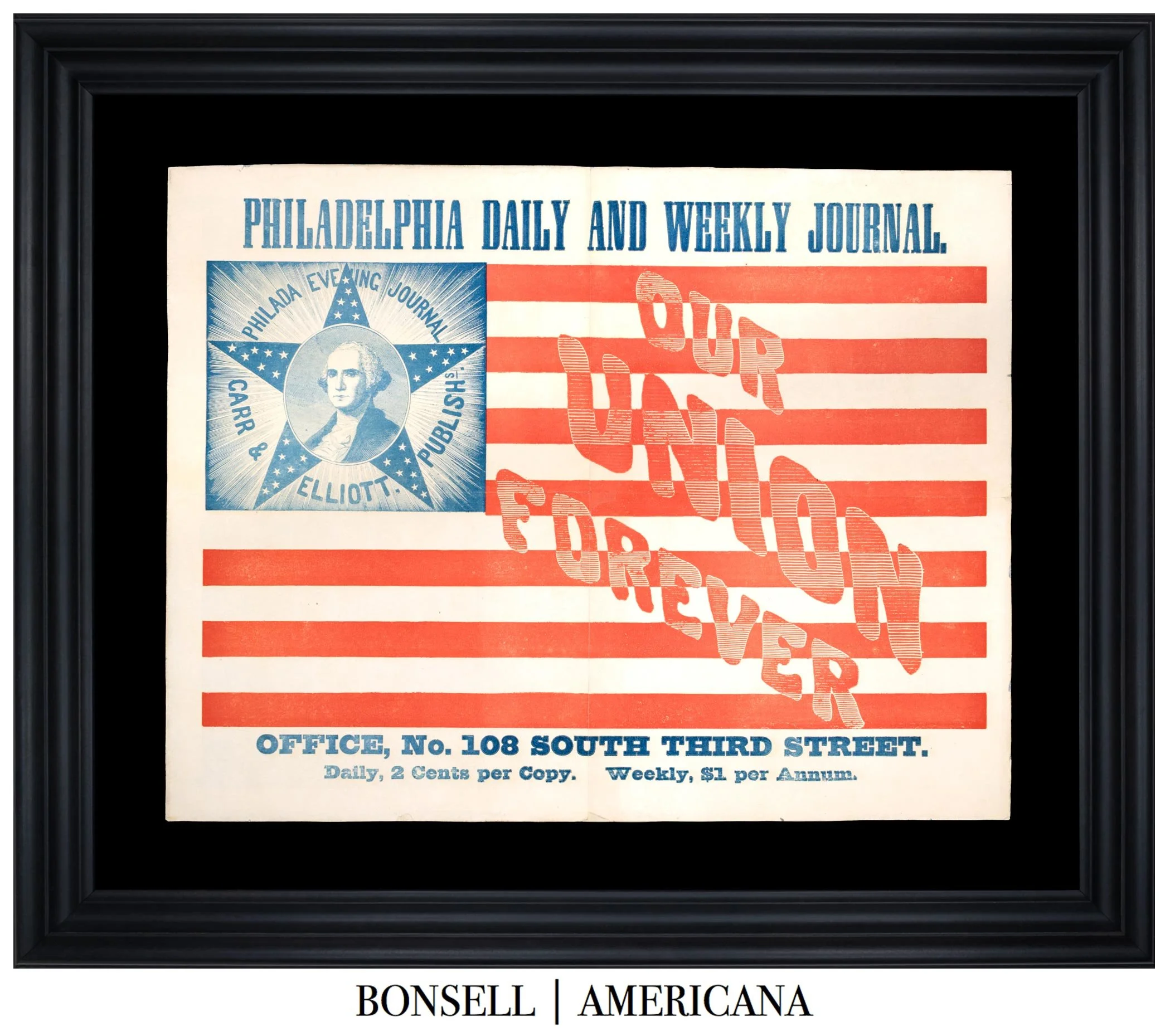
A matching example to the flag offered here was discovered in its original shipping tube bearing a two-cent stamp and the printed return address:
From
R.W. MUSGROVE,
Book and Job Printer.
R.W. Musgrove, a Civil War veteran and editor of the Bristol Enterprise, is confirmed to have produced these flags. To attribute a 19th-century printed flag to a specific maker is exceedingly rare and adds significant historical value.
The 38-star count represents the admission of Colorado to the Union on August 1, 1876, with the flag becoming official on July 4, 1877. The 38-star flag remained official through 1889 and into mid-1890, covering the administrations of Presidents Hayes, Garfield, Arthur, Cleveland, and Harrison. Though the 37-star flag was official during the nation’s Centennial in 1876, both the 13-star and 38-star flags were widely used to commemorate the event, especially by manufacturers eager to anticipate Colorado’s statehood.
The Centennial celebrations of 1876 ignited a renewed national pride. Cities hosted parades, homes were decorated in patriotic colors, and flags became a central symbol of unity and identity. The most prominent celebration was the Centennial International Exposition in Philadelphia, which attracted nearly 10 million visitors and introduced marvels such as the Corliss Steam Engine and Alexander Graham Bell’s telephone.
This flag, dating to 1885, stands apart as an early and regimental-specific veteran reunion artifact—bearing direct connection to one of the war’s hard-fought Union regiments, with a star pattern rooted in early 19th-century naval heritage. It is a compelling piece of Civil War memory.
Conservation Process: This flag was professionally conserved. "It is mounted to silk backing and positioned behind Optium Museum Acrylic.
Frame: The flag is mounted in a birdseye maple frame, likely dating to the mid-to-late 19th century, with a distinctive swirling grain and warm amber tone.
Condition Report: The flag is in good overall condition, with solid color retention and a clearly legible overprint. The silk exhibits typical age-related wear, including light creasing, a few small splits, and scattered staining—most notably some faint gold-toned discoloration.
Collectability Level: The Extraordinary – Museum Quality Offerings
Date of Origin: 1885
Number of Stars: 38
Associated War: The Indian Wars (1860-1890)
Associated State: Colorado