Rare 38 Star Silk Flag Bandanna | Unusual and Attractive Medallion Star Pattern | Documented in Threads of History | Colorado Statehood | Circa 1888
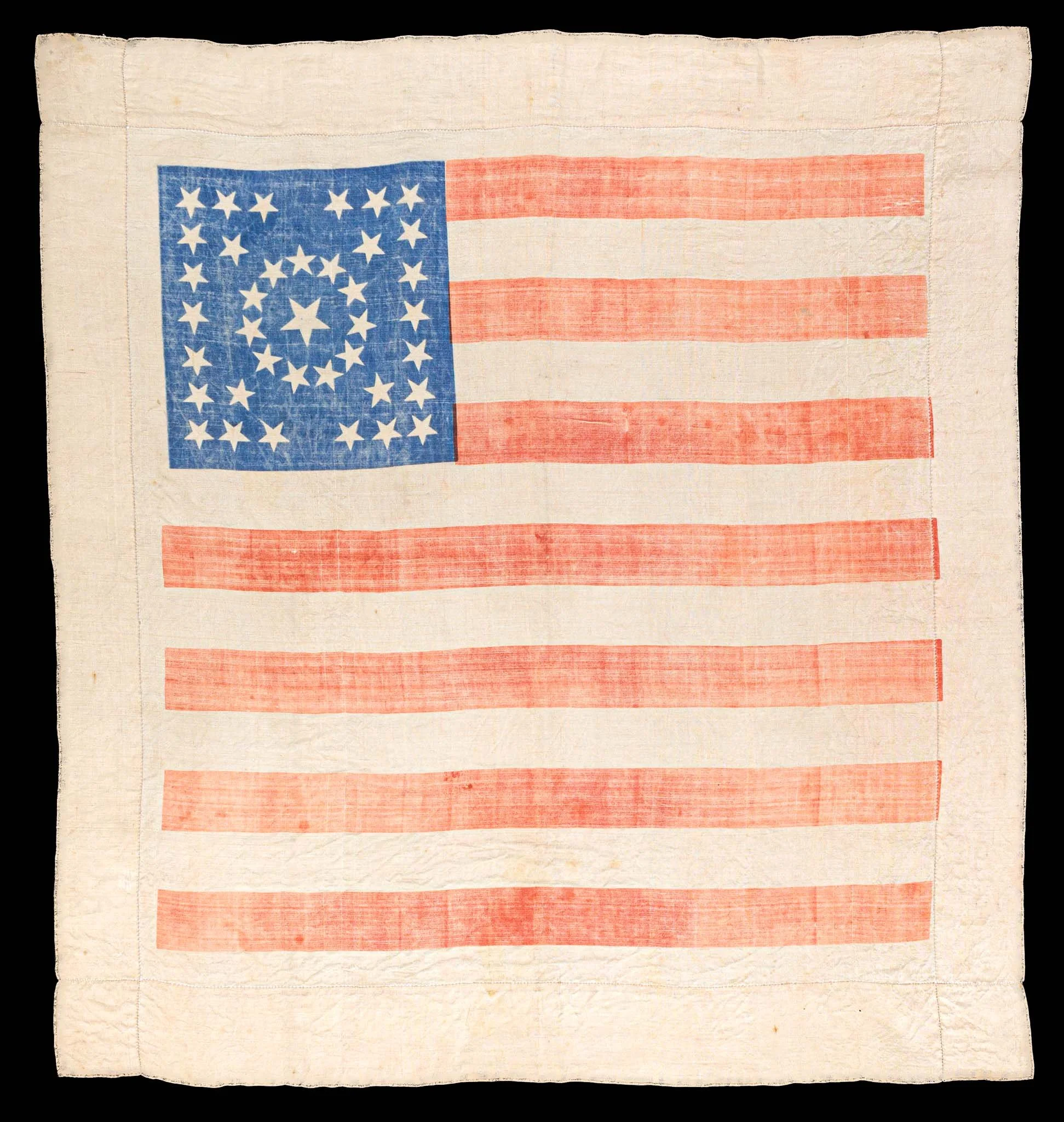
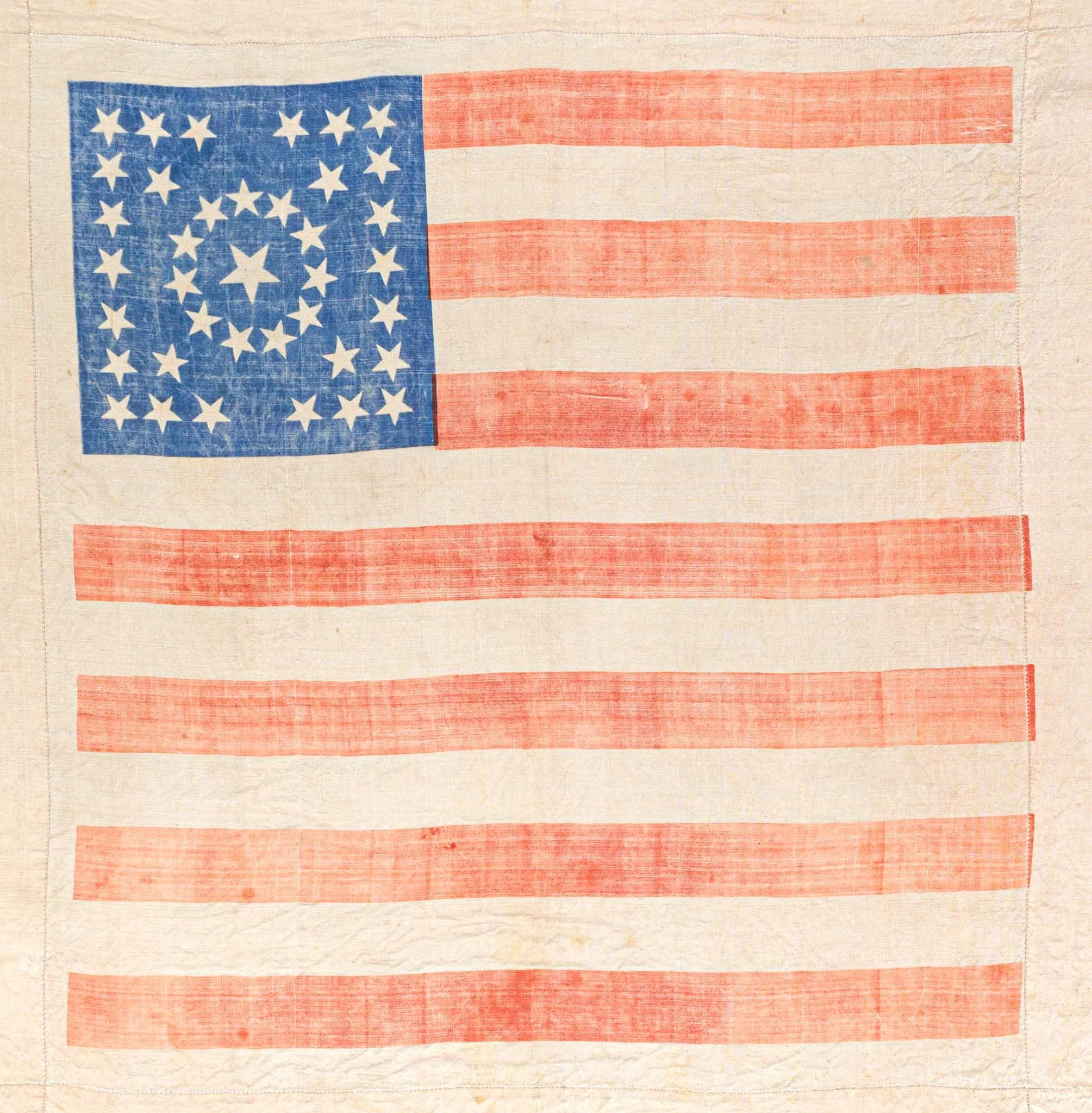
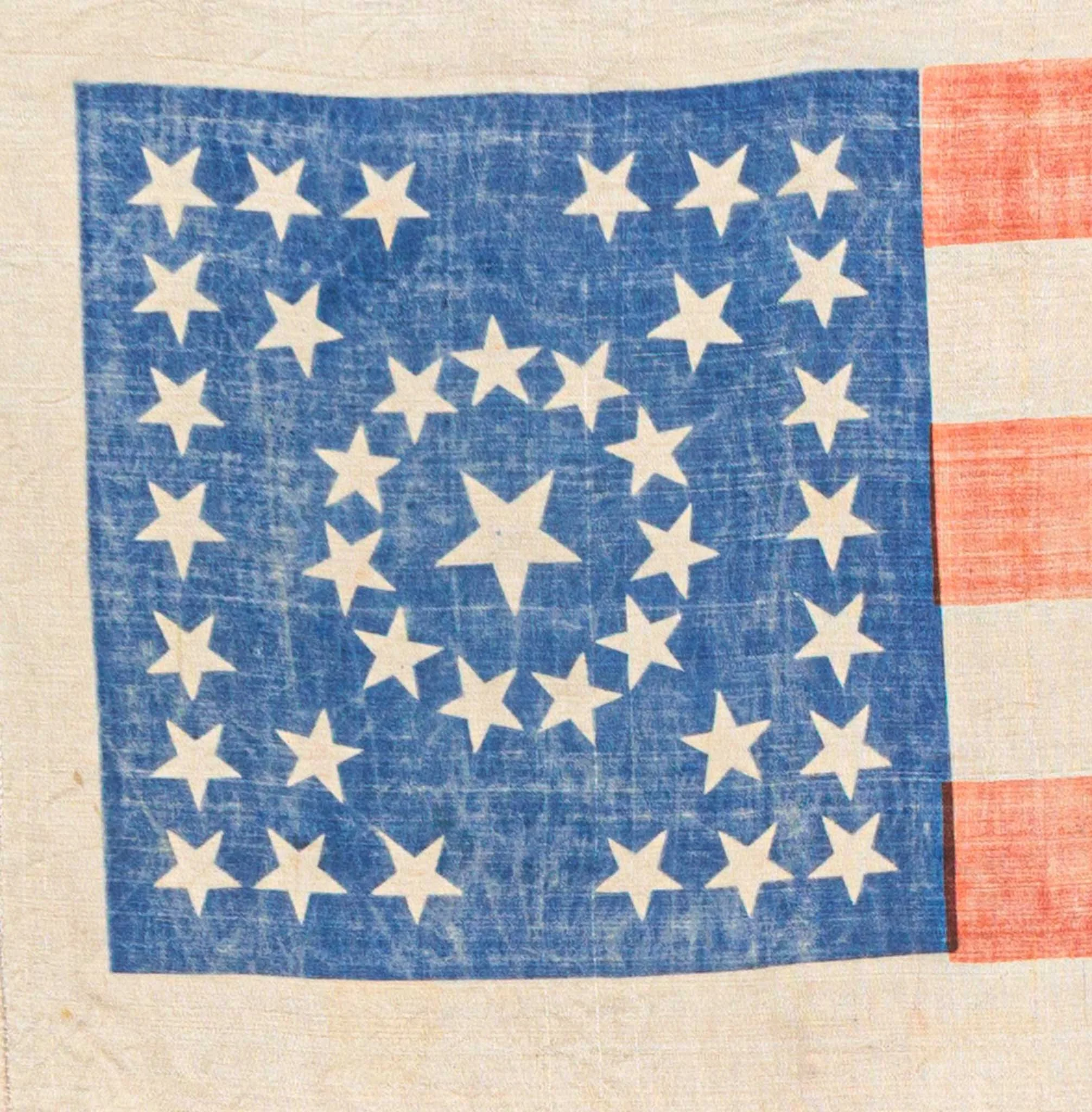
Rare 38 Star Silk Flag Bandanna | Unusual and Attractive Medallion Star Pattern | Documented in Threads of History | Colorado Statehood | Circa 1888
Frame Size (H x L): 33” x 32”
Flag Size (H x L): 22.5” x 21”
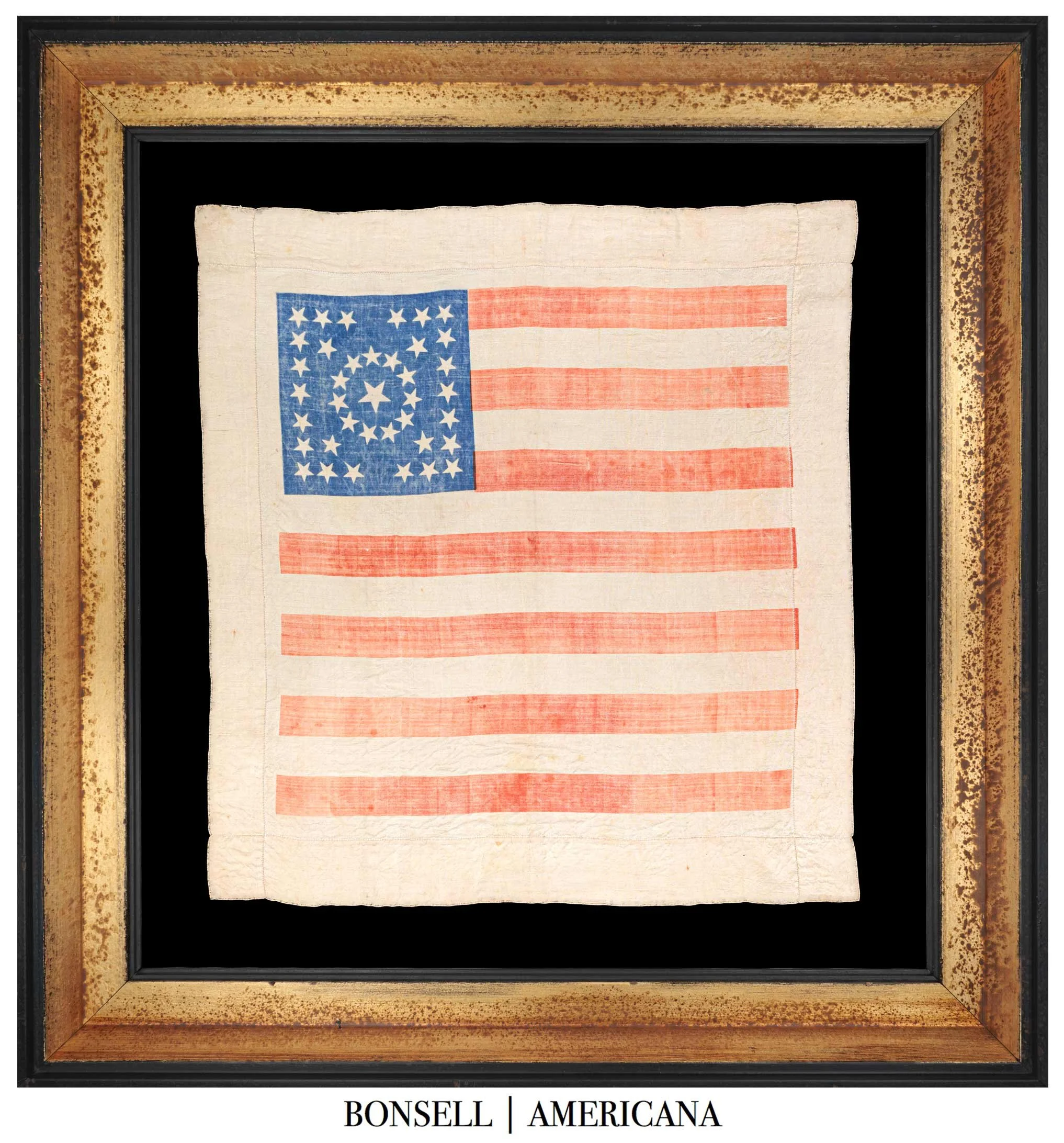
Offered is a rare and visually compelling 38-star American flag bandanna, produced in silk and rendered in the form of the Stars & Stripes, with the printed flag itself inset within a larger square field. The format possesses exceptional visual balance, with broad margins surrounding the printed design that reinforce its presentation as both a textile and a patriotic object. Two horizontal seams and two vertical seams, all machine-sewn, join the silk panels together, lending the piece a distinctly period method of construction and underscoring its manufacture during the late 19th century.
The star configuration is among the bandanna’s most memorable and attractive features. At its center is a large, canted star representing Colorado, the newest state admitted to the Union at the time the design originated. This oversized center star is encircled by a wreath of eleven smaller stars, creating a medallion-like presentation. Flanking this central device are four additional stars, while linear groupings of stars to the left and right create the impression of enclosing brackets or a squared framework around the central medallion. The arrangement is highly unusual and visually dynamic, balancing formal structure with folk-like irregularity. The stars are canted in various directions rather than mechanically aligned, and their forms vary subtly in proportion and execution, adding both movement and charm. Such variation is highly desirable among collectors, as it reflects the more artistic and less standardized production methods of the period.
The canton is paired with bold red stripes that have mellowed beautifully over time, taking on the warm orange-red cast often encountered in 19th century textiles. This transformation is especially attractive here, contrasting wonderfully against the soft blue canton and creamy silk ground. The resulting palette is considerably more nuanced than the stark primary coloration associated with later printed flags and contributes substantially to the textile’s visual appeal.
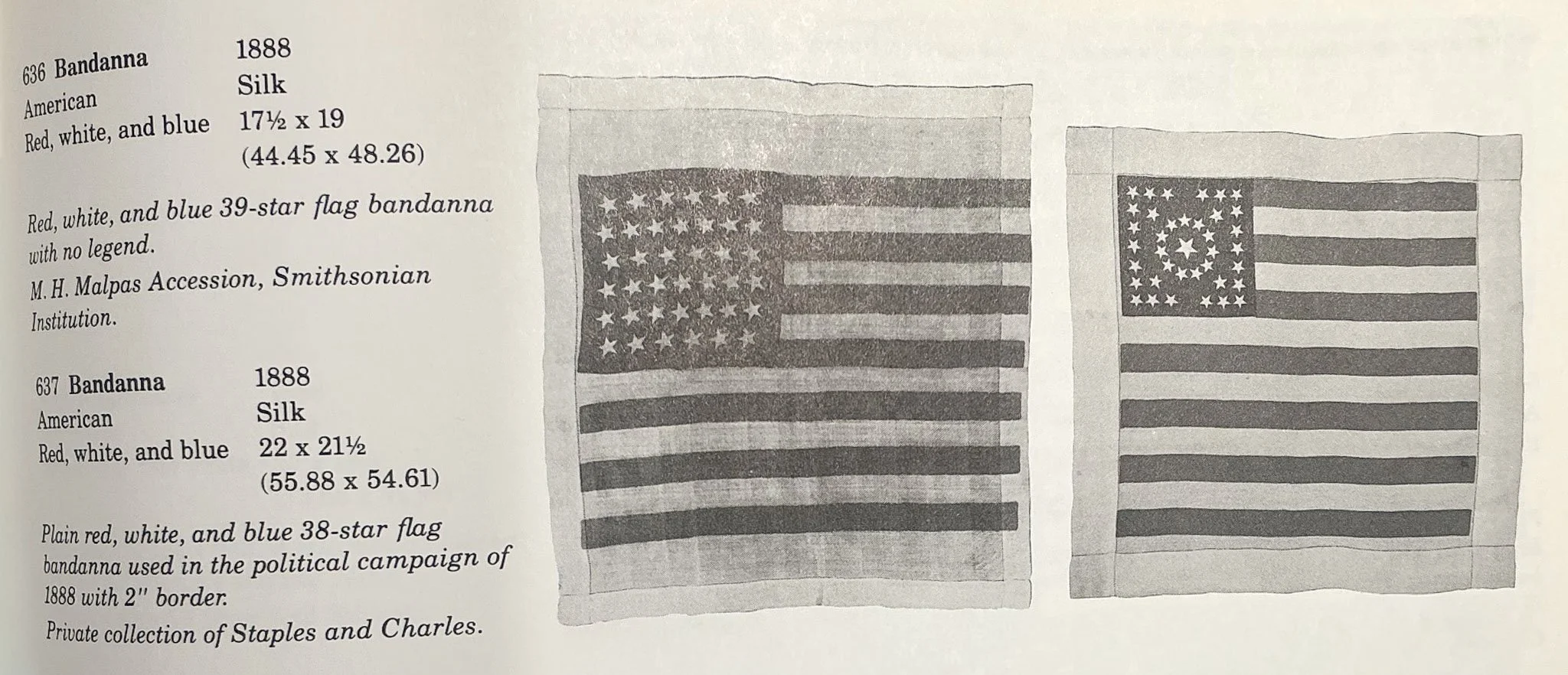
This exact variety is illustrated as item number 637 in Threads of History: Americana Recorded on Cloth, 1775 to the Present, the landmark exhibition catalogue produced in association with the Smithsonian Institution. For collectors unfamiliar with the publication, Threads of History is widely regarded as one of the most important references ever produced on American political textiles, parade flags, kerchiefs, and related patriotic cloth objects. Compiled by Herbert Ridgeway Collins and published in conjunction with the Smithsonian’s major bicentennial-era exhibition, the work documented some of the finest and most historically significant textiles known at the time. Inclusion within its pages represents an important point of scholarly recognition.
The catalogue notes that this bandanna was “used in the political campaign of 1888,” and another closely related example is illustrated nearby as item number 636. That counterpart employs a different flag and star configuration, yet shares the same general format, dimensions, and construction, suggesting that the two likely originated from the same manufacturer or workshop. The relationship between the two textiles provides an especially interesting glimpse into the diversity of patriotic printed goods produced during the period. Rather than relying upon a single standardized design, makers experimented with varying star arrangements and visual compositions while maintaining the same overall concept and scale.
The proposed 1888 campaign association places this textile within one of the more contentious presidential elections of the late 19th century. The election pitted incumbent President Grover Cleveland, the Democrat, against Republican challenger Benjamin Harrison. Tariff policy emerged as the defining issue of the campaign, with Cleveland advocating lower tariffs and Harrison supporting protective measures intended to bolster American industry. Although Cleveland won the national popular vote, Harrison secured victory in the Electoral College. The campaign unfolded during a period of rapid industrialization, expanding rail networks, and growing national identity, conditions that fueled demand for patriotic imagery and political textiles alike. Objects such as this bandanna occupied a unique space between political memorabilia and decorative Americana, serving both as expressions of patriotism and as tangible artifacts of campaign culture.
Its square proportions are particularly appealing. Unlike many parade flags and kerchiefs that feel visually elongated, this example possesses a balanced, almost architectural presentation that allows the star configuration to command attention without overwhelming the striped field. The inset format further heightens this effect, creating a framed composition within the textile itself. Combined with the medallion-style arrangement of stars, the result is exceptionally graphic and immediately recognizable from across a room.
The 38-star count on this flag reflects Colorado’s admission to the Union on August 1st, 1876. Known as the “Centennial State,” Colorado earned its nickname for achieving statehood just twenty-eight days after the nation’s centennial celebrations. Colorado’s path to statehood began with the establishment of the Colorado Territory in 1861, spurred by the Pike’s Peak Gold Rush, which brought a dramatic influx of settlers to the region. Early efforts toward statehood met setbacks, including a veto by President Andrew Johnson in the 1860s, but renewed momentum in the mid-1870s ultimately culminated in Colorado’s official admission as the nation’s 38th state.
Although the 38-star flag did not become official until July 4th, 1877, flag makers frequently produced anticipatory examples ahead of official adoption. These flags played a major role during the Centennial celebrations of 1876, alongside revival designs featuring 13 stars in homage to the original colonies. The Centennial year proved to be a defining moment in American visual culture, fostering renewed patriotism and unity following the divisions of the Civil War. Homes, businesses, parade grounds, and public buildings were adorned with red, white, and blue decoration, and flags became the centerpiece of this widespread national expression.
The Centennial International Exposition in Philadelphia served as the focal point of these celebrations, attracting nearly ten million visitors between May and November of 1876. The exposition showcased American innovation on a grand scale, introducing many visitors to technological marvels such as Alexander Graham Bell’s telephone and the enormous Corliss Steam Engine. Within this atmosphere of patriotic enthusiasm and industrial optimism, the production of decorative flag textiles flourished.
The 38-star flag officially served from July 4th, 1877, until July 4th, 1890, spanning the administrations of Presidents Rutherford B. Hayes, James A. Garfield, Chester A. Arthur, Grover Cleveland, and Benjamin Harrison. It represented a nation undergoing dramatic transformation through westward expansion, mining booms, railroad construction, and accelerating industrial growth. In 1890, the admission of North Dakota, South Dakota, Montana, Washington, and Idaho necessitated adoption of the 43-star flag, bringing the 38-star era to a close. Today, surviving textiles from this period remain especially prized among collectors for their inventive medallion configurations, strong folk qualities, and close association with the Centennial era, one of the most visually dynamic and patriotic periods in American flag history.
Conservation Process: This bandanna was hand sewn to cotton fabric, and both were hand sewn to a mounting board. To prevent the black dye in the cotton fabric from seeping into the bandanna, it was first washed in a standard wash and then in a dye setting wash. The bandanna is positioned behind Optium Museum Acrylic.
Frame: This offering is in our Large Distressed Gold Frame.
Condition Report: The silk exhibits modest to moderate age-related wear, accompanied by minor soiling, scattered pigment loss, and areas of thinning consistent with the textile’s age and delicate nature. There is gentle creasing throughout, accompanied by minor irregularities along the edges and at the seams. The printed coloration has softened beautifully over time, with the red pigments mellowing to an especially attractive orange-red tone. Overall, the bandanna presents exceptionally well, with strong visual impact and remarkable survivability for a late 19th century silk textile.
Collectability Level: The Great – Perfect for Rising Collectors
Date of Origin: 1888
Number of Stars: 38
Associated War: The Indian Wars (1860-1890)
Associated State: Colorado