Rare and Important 13 Star Antique US Flag | Handsewn by the Granddaughter of Betsy Ross, Rachel Albright | Circa 1904


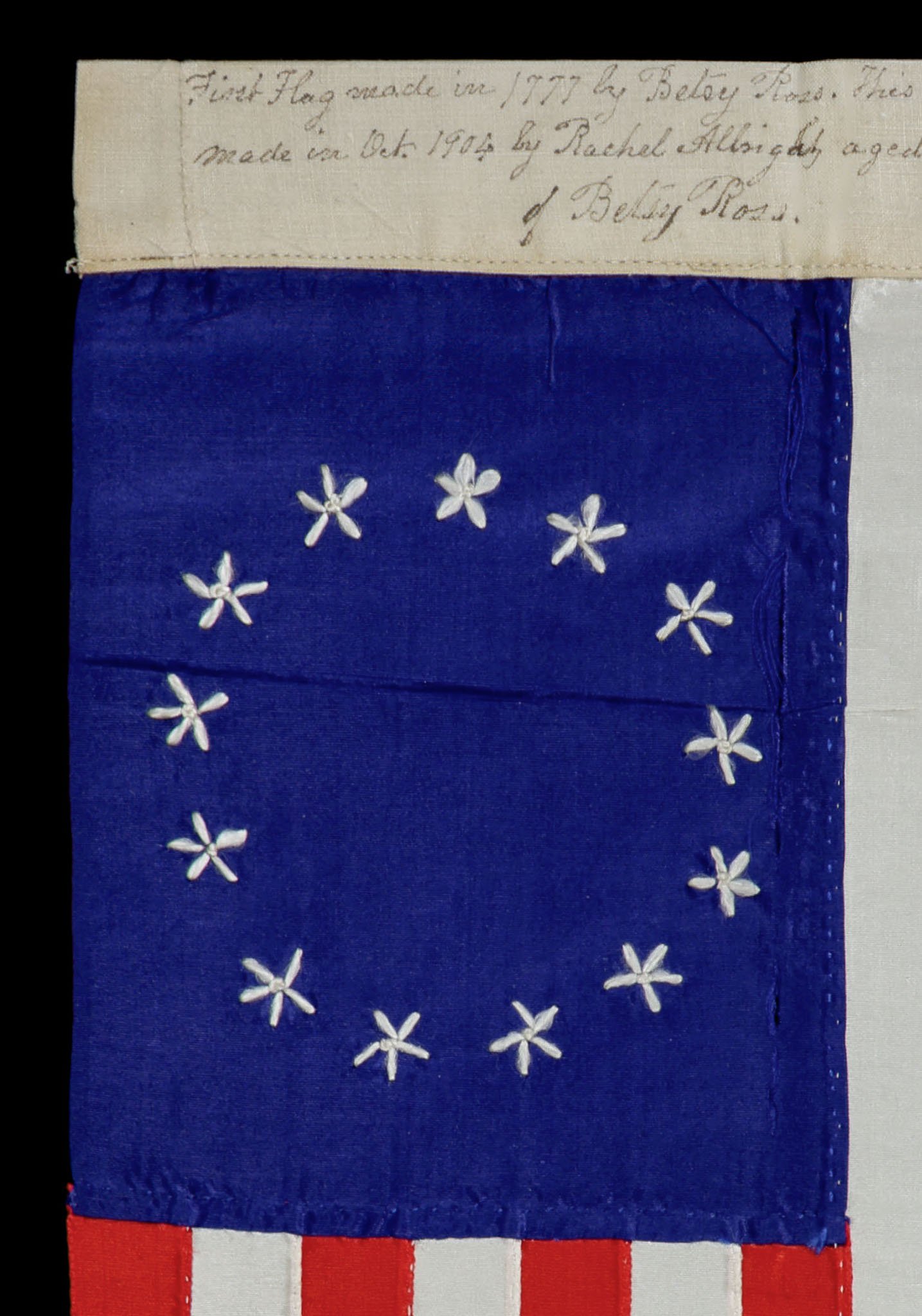

Rare and Important 13 Star Antique US Flag | Handsewn by the Granddaughter of Betsy Ross, Rachel Albright | Circa 1904
Price: Call 618-553-2291, or email info@bonsellamericana.com
Frame Size (H x L): 19.25” x 14.5”
Flag Size (H x L): 12.75” x 7.5”
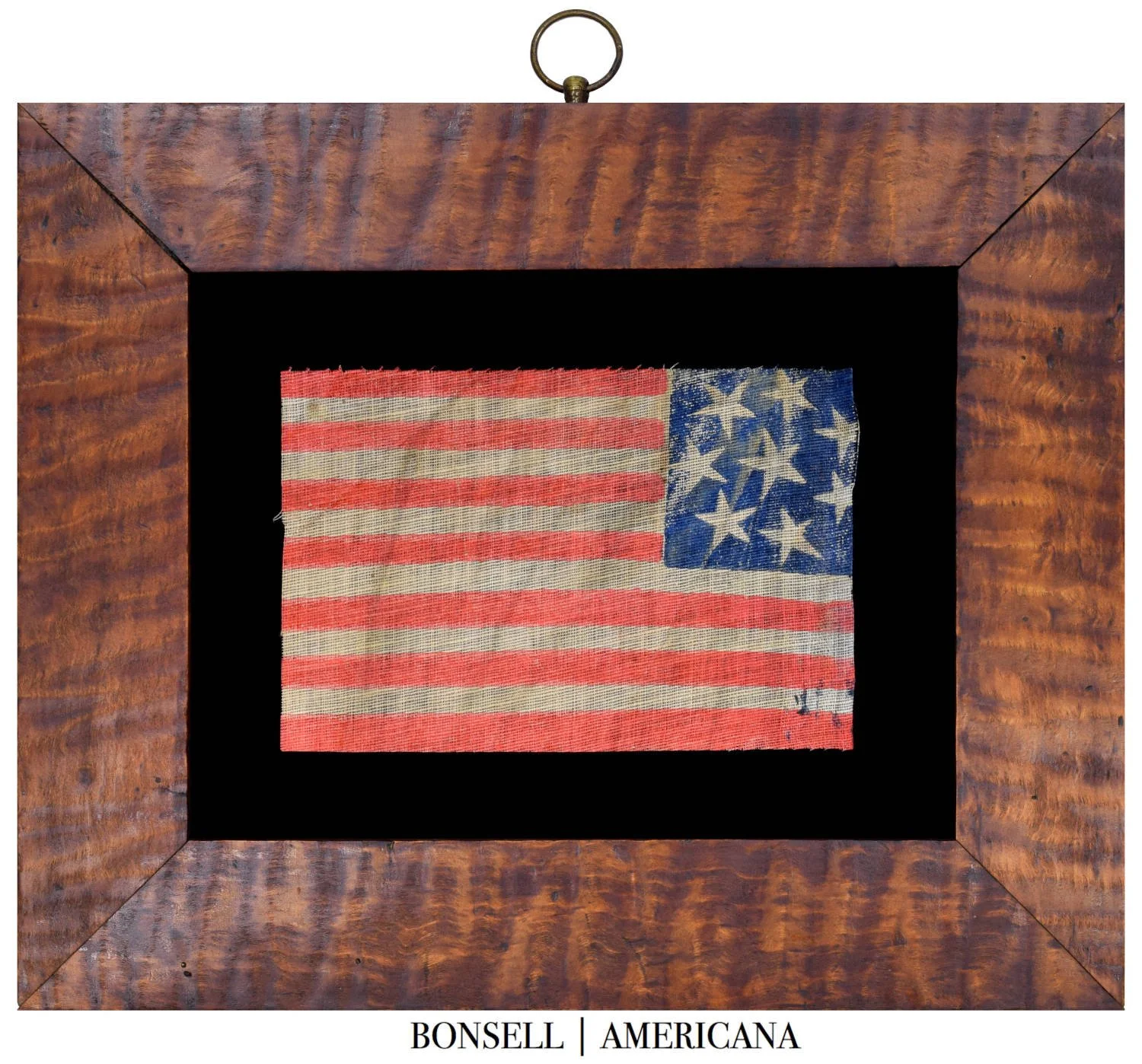
Offered is a handsewn thirteen-star flag. Rachel Albright, granddaughter of Betsy Ross, made it in 1904. As such, its stars are arranged in what is typically referred to as the Betsy Ross pattern, a circular pattern of thirteen stars. Betsy Ross is often mistakenly credited with making the first flag, most notably in grade school classrooms and in pop cultural references. And without doubt, she does deserve credit for making early flags, some of which date to the 1770’s. But it is an error to credit her with making the very first flag. Simply put, there is no substantive evidence to say as much in the form of letters, articles, journals, or other reliable sources.
As such, historians do not accept that Ross made or designed the first flag. Rather, they believe that Francis Hopkinson was the first to design it in 1777. Hopkinson was a member of the Continental Congress, a signer of the Declaration of Independence, and a lawyer. The evidence supporting Hopkinson’s role includes his claim to Congress for payment for having furnished the design of “the flag of the United States of America.” In 1780, Hopkinson asked to be paid in “a Quarter Cask of public wine”—to avoid risks associated with rampant inflation—and later asked to be paid in $1,440 in Continental paper. From this, there is firm evidence associating Hopkinson with the first flag versus no substantive evidence associating Betsy Ross with it.
WILLIAM CANBY
It was not until 1870—nearly a century after the flag was designed—that the myth of Betsy Ross took hold. At that time, William Canby, the grandson of Betsy Ross, told the Historical Society of Pennsylvania that she designed and made the first flag at George Washington’s request. One of the earliest—if not the earliest—media accounts perpetuating the myth was in Harper’s New Monthly Magazine in 1873. Its account was as follows:
The construction of the first national standard of the United States, as a design, from which the “Stars and Stripes” was afterword adopted, took place under the personal direction of General Washington, aided by a committee of Congress “authorized to design a suitable flag for the nation,” at Philadelphia, June, 1777.
This took place at the residence of Mrs. Ross, a relative of Colonel Ross, in Arch Street, between Second and Third, where General Washington and the committee completed the design, and employed Mrs. Ross to execute the work. The house is still standing (No. 239). Mrs. Ross was afterward Mrs. Claypoole. Her maiden name was Griscom, and, according to the fashion of the times, she was called “Betsy.”
Betsy Griscom had, before the Revolution, acquired some knowledge of the “upholder” trade, as it was then called—an occupation synonymous with that of the modern upholsterer—at the time mentioned was carrying on business on her own account in her little shop. One day, probably between the 23rd of May and the 7th of June, 1777, during which period Washington was in Philadelphia, there came to her the commander-in-chief, the Hon. George Ross, and other gentlemen, members of Congress, who desired to know whether she could make them a flag according to a design which they would produce. She intimated her willingness to try. The design was for a flag of thirteen red and white stripes, alternate, with a union, blue in the field, spangled with thirteen six-pointed stars. Mrs. Ross expressed her willingness to make the flag, but suggested that the stars would be more symmetrical and pleasing to the eye if made with five points, and she showed them how such a star could be made, by folding a sheet of paper and producing the pattern by a single cut. Her plan was approved, and she at once proceeded to make the flag, which was finished the next day. Mrs. Ross was given the position of manufacturer of flags for the government, and for some years she was engaged in that occupation. The business descended to her children, and was carried on by her daughter, Clarissa Claypoole, who voluntarily relinquished it on becoming a member of the Society of Friends, lest her handiwork should be used in time of war.
CANBY’S SUPPORT (OR LACK THEREOF)
Canby did not have any reliable evidence supporting his claim. Rather, his only support was in the form of family affidavits, which were based on unreliable word of mouth accounts, not to mention that they were self-serving. Regarding the former point, we can personally attest to the unreliability of family accounts, as we have examined numerous flags, in which the family history does not match the construction of the flag. As just one example, we corresponded with a family that believed its flag dated to the 18th century, even though a cursory examination of the stitching thereof indicated that it could date to no earlier than the middle of the 19th century.
RACHEL ALBRIGHT AND SARAH WILSON
While Canby was the catalyst of the Betsy Ross myth, it is Rachel Albright and Sarah Wilson—Ross’s granddaughter and great-granddaughter, respectively—who took the story mainstream by selling “Betsy Ross flags” in Independence Hall in Philadelphia. They made flags therein between approximately 1895 and 1913, and they sold them for a few dollars apiece. Many of the Albright and Wilson flags are marked directly on their hoists. For example, the flag offered herein includes the following inscription: First Flag made in 1777 by Betsy Ross. This copy of the original flag made in Oct. 1904 by Rachel Albright aged 92 years. Grand-daughter of Betsy Ross.
For at least four reasons, Albright and Wilson flags are distinctive in their appearance and construction, beyond the fact that many, but not all, are inscribed. First, they always use red and white silk ribbons for the stripes. Second, they always use blue silk for the canton. Third, they always use silk floss to form the stars, and the stars are always akin to spokes. And fourth, they are always made by hand and with precision, a level of which is generally on its own plane relative to other flags of the era. The flag offered herein illustrates all of these same features.
Albright’s flags tend to be noticeably larger and more visually assertive than those made by her niece, Sarah M. Wilson. Albright’s examples generally hover around 7½" × 12", sometimes slightly larger or smaller, and display a bolder presence well suited to framing. Wilson’s flags, by contrast, are typically more diminutive—usually 5½" × 9" to 6" × 10", with a few especially small outliers around 4¼" × 8½"—and their compact scale is one of their defining characteristics. Both women used similar materials and construction methods, but the size distinction is consistent enough that collectors and scholars often use it as a helpful diagnostic tool when attributing unsigned pieces within the Ross-descendant tradition.
RARITY
Antique flags in the Betsy Ross pattern—thirteen stars in a single wreath—are among the most famous, but most rare, of all antique thirteen-star flags. Antique Betsy Ross pattern flags are very difficult to find, even after the myth that was perpetuated by Canby, Albright, and Wilson. In our experience, of the thirteen-star antique flags that come to market, around 75% are the 3-2-3-2-3 pattern, around 20% are the medallion pattern, and the remaining 5% are various different patterns, only some of which are the Betsy Ross pattern.
The Albright and Wilson flags are particularly rare and do not surface often. When they do, they make their way into the leading collections. As one example, the Mastai Collection included an Albright flag. The Mastai’s featured it in their landmark text, the Stars and Stripes, and they later sold it via Sotheby’s in October of 2002.
THIRTEEN-STAR FLAGS GENERALLY
The original use of the thirteen-star flag dates to June 14th, 1777, the time at which the Continental Congress adopted a resolution creating the first official flag. The resolution stated, “Resolved, that the flag of the United States be made of thirteen stripes, alternate red and white, that the union be thirteen stars, white on a blue field, representing a new constellation.” Thirteen-star flags were official from 1777-1795, but have been in use ever since.
Small US Navy boats used it as the ensign from 1795 until 1916. Thirteen-star flags were also flown at the time of George Washington’s death in 1799 and to celebrate the nation’s 50th anniversary in 1824. They were also flown in 1824 in honor of General Lafayette’s return to the US for his nationwide tour. Celebrations for his Revolutionary War service were held in New York, Boston, and Philadelphia, along with many locations in the southern and western states.
Further, thirteen-star flags were also common during the Mexican War in 1846-1848 and the Civil War in 1861-1865. They were both relatively close in time to the revolution, and were very patriotic times, particularly during the Civil War time period when flag use became much more common than had ever previously been the case. Thirteen-star flags were also flown during the centennial celebrations, which were held across the country and, most notably, in Philadelphia at the Centennial International Exhibition.
Conservation Process: The flag was hand sewn to cotton fabric, and both were hand sewn to a mounting board. To prevent the black dye in the cotton fabric from seeping into the flag, it was first washed in a standard wash and then in a dye setting wash. The flag is positioned behind Optium Museum Acrylic.
Frame: The flag is housed in an early American frame dating to approximately 1830–1860, retaining its original lampblack or ‘dry black’ surface. The hand-cut joinery and oxidized hardwood construction are all consistent with antebellum rural framing practices.
Condition Report: The flag survives in remarkably strong condition, especially given its 1904 date and the delicacy of its silk construction. The colors remain vibrant, and the hand-sewn stripes and embroidered stars are stable with only light, expected handling wear. There is a small vertical tear in the canton. Minor, scattered surface creasing and tiny age specks are present but do not detract from the flag’s overall presentation.
Collectability Level: The Best – Perfect for Advanced Collectors
Date of Origin: 1904
Number of Stars: 13
Associated State: Original 13 Colonies
Rachel Albright Obituary | The Fort Madison Weekly Democrat, April 19, 1905:
Albright – At the family residence, 718 Third Street, Fort Madison, Iowa, on Tuesday, April 18, 1905, at 6:05 o'clock a.m., Mrs. Rachel J. (Wilson) Albright, aged 92 years, 10 months, and 2 days.
Rachel J. Wilson was born in Philadelphia, Penn., on June 16, 1819; married by Bishop Onderdonk of the Episcopal Church to Jacob W. Albright, in Philadelphia, on July 22, 1840. With her husband she came to Fort Madison in the spring of 1841 and has resided here since that time. There survive her three children: Mrs. M.C. Robison and J.W. Albright of Fort Madison and D.K. Albright of St. Louis.
Mrs. Albright was a member of the Episcopal Church of this city since 1847, at that time it being a mission parish under Bishop Kemper.
Mrs. Albright's last illness dates from last December, when she had a severe attack of grip, which was followed by dropsical conditions that resulted in her death. Since last Thanksgiving Day, when she was taken to church in her wheeled chair, she has been out of doors but once, when she was wheeled to Mrs. M. Case's on March 16, Mrs. Case's birthday anniversary. She suffered much during her sickness.
The funeral was held at the residence on Thursday morning at 10 o'clock, with services by Rev. Dr. Edward H. Rudd, rector of St. Luke's. Interment in the family lot in the City Cemetery.
The death of Mrs. Albright is an event of sorrow to her countless old friends. Blessed by nature with a strong constitution, her life was a long one – over a score of years more than the allotted life of man; but she lived none too long. She retained her mental faculties up to death. She was an historic character, a grand-daughter of Betsey Ross, the maker of the first U.S. Flag. During the last several years of her life she was engaged the greater part of her time in making small silk flags, doing all the delicate stitching upon each one herself, and suitably inscribing each one in her own handwriting as being the handiwork of the granddaughter of Betsey Ross. There are hundreds of these flags now all throughout our broad land. One of the last ones she made was one of about four feet in length, which she made for St. Luke's church; she inscribed it on April 7, her last writing. In making these flags she used small needles, number ten, which she threaded more deftly and quickly with 200 thread than most needlewomen do those much coarser sizes. She used spectacles for many years; her hearing was good.
But it was not her physical characteristics that endeared her to her friends, but her strong and lovable character: she was a brave Christian woman of large intelligence, wide information, knowledge and true culture – a tender and loving mother – a true friend – no better companion – bright and cheery even in her time of sickness and physical distress. Her great heart was ever warm with joy at the pleasure of her friends, warm with sympathy in their troubles and warm with consolation in their bereavements. Her life was a benison. She is at well earned rest.