13 Star American Flag | Handsewn by Fourth-Grade Student Harvey F. Sandford at South Orange Public School | Early Betsy Ross Pattern | Circa 1907–1910
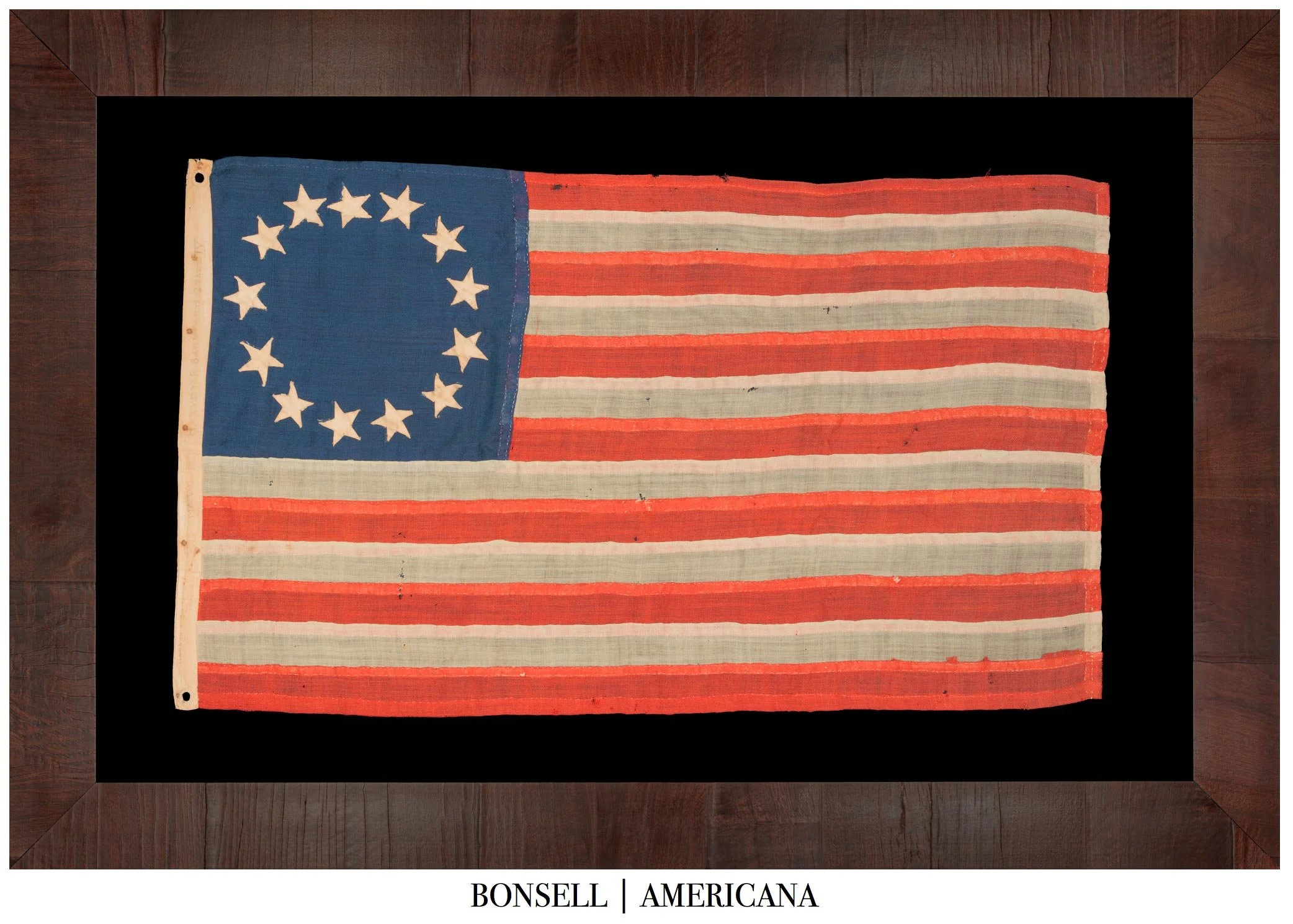
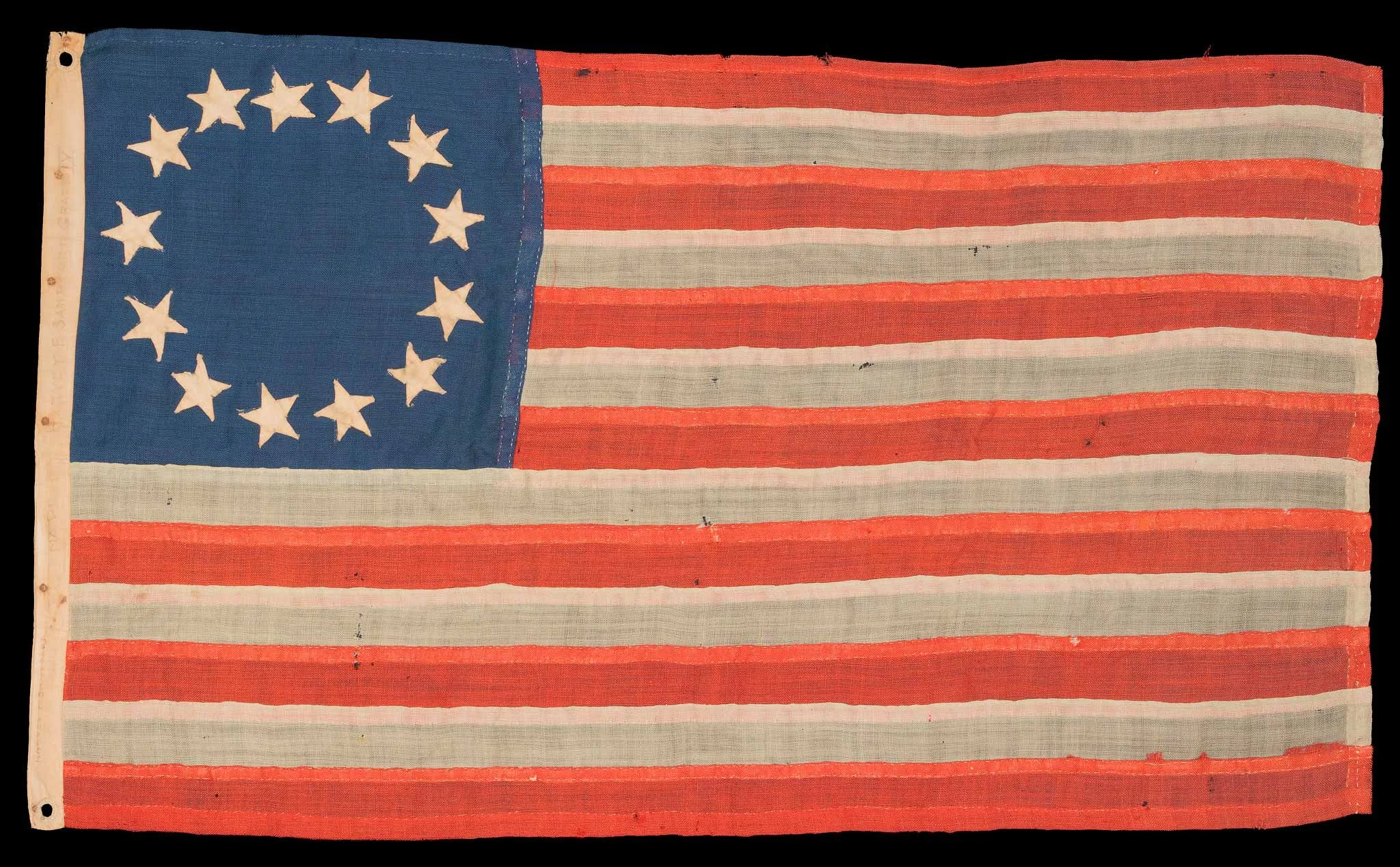

13 Star American Flag | Handsewn by Fourth-Grade Student Harvey F. Sandford at South Orange Public School | Early Betsy Ross Pattern | Circa 1907–1910
Price: Call 618-553-2291, or email info@bonsellamericana.com
Frame Size (H x L): 31” x 46”
Flag Size (H x L): 20” x 35”
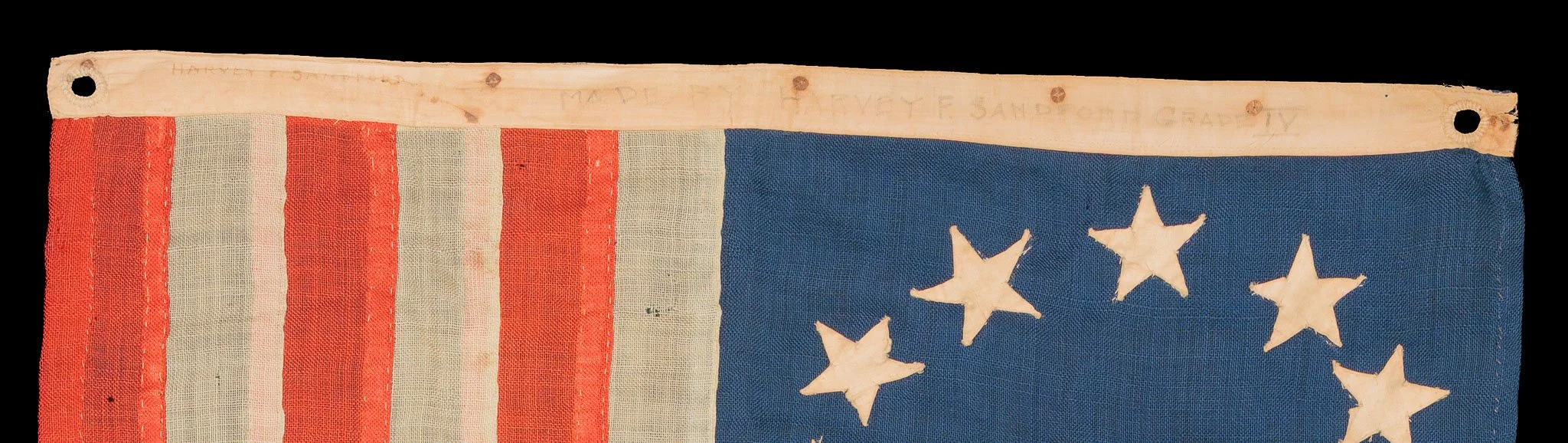
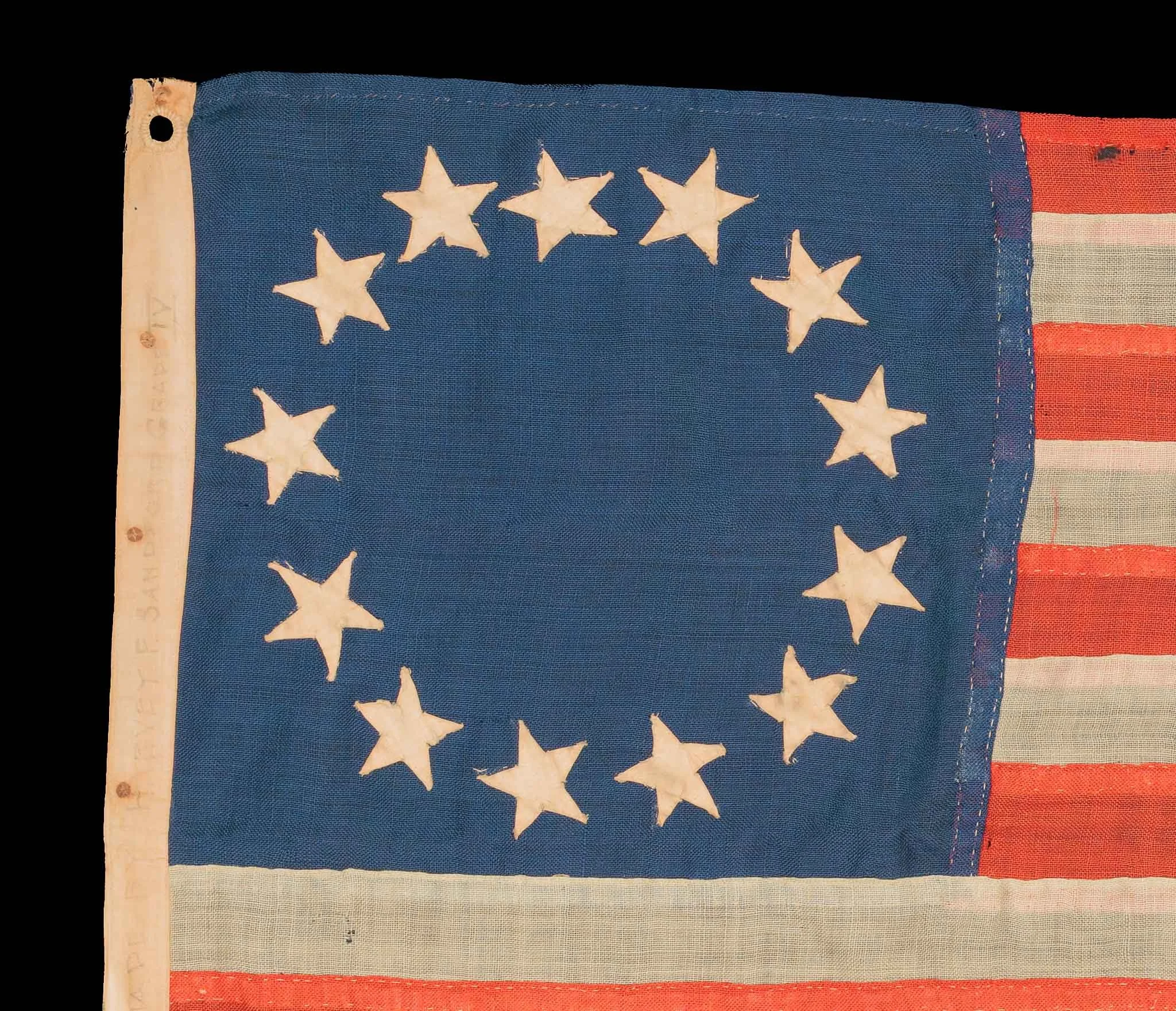
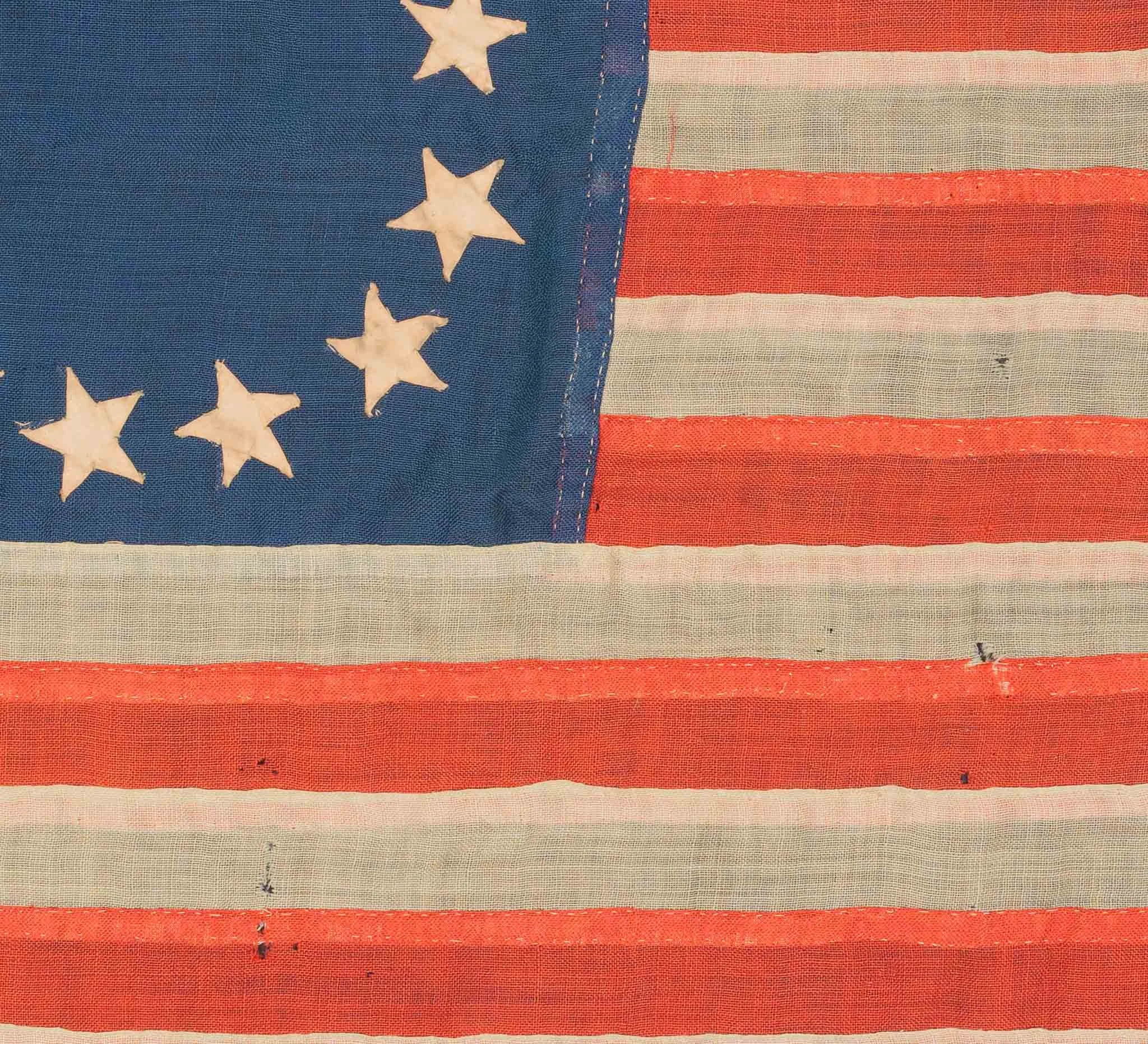
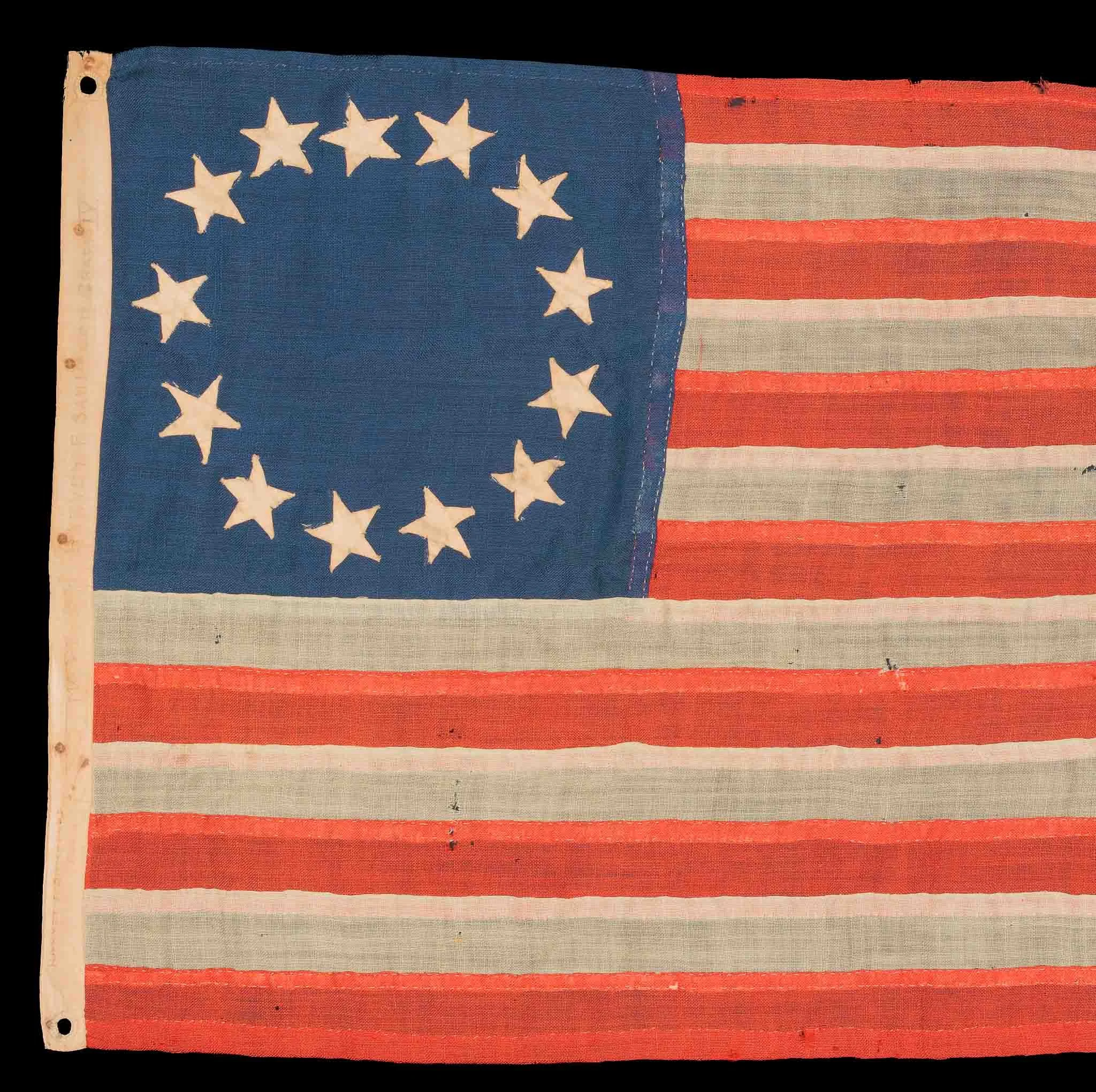
Offered is an exceptional 13-star American flag, handmade circa 1907–1910 by Harvey F. Sandford, a fourth-grade student at South Orange Public School in South Orange, New Jersey. The flag features 13 white stars arranged in a single circular wreath, the configuration popularly associated with Betsy Ross and the first American flag. Entirely handsewn, the flag is constructed of wool bunting with individually appliquéd cotton stars, a cotton hoist, and two hand-worked grommets. Of particular significance are the period handwritten inscriptions identifying its young maker, his grade, and the school at which it was produced. The flag represents an extraordinarily early surviving example of the handmade Betsy Ross pattern, produced during the formative years of the legend's widespread acceptance in American popular culture.
THE BETSY ROSS LEGEND
Although the circular arrangement of 13 stars is today among the most recognizable designs in American flag history, its association with the nation's first flag is rooted largely in a story that emerged nearly a century after the American Revolution. In March 1870, William J. Canby, a grandson of Elizabeth Griscom Ross, commonly known as Betsy Ross, presented a paper before the Historical Society of Pennsylvania. Canby claimed that his grandmother had been approached in 1776 by George Washington, Robert Morris, and George Ross, who requested that she manufacture a flag for the emerging nation. According to the family account, Ross suggested replacing the proposed six-pointed stars with five-pointed stars, demonstrating how they could be cut from folded fabric with a single movement of her scissors.
Canby's account was based on family recollections rather than contemporary Revolutionary War documentation. Although Ross was unquestionably a professional flagmaker who supplied flags during the Revolutionary period, historians have found no reliable contemporary evidence establishing that she designed or manufactured the first American flag. The precise star arrangement of the earliest national flag also remains unknown. Indeed, the familiar circular wreath of 13 stars was not specified in Canby's original account and became firmly associated with Ross through later illustrations, commemorative objects, and patriotic literature. Nevertheless, the story became an enduring part of American history, and Betsy Ross remains one of the nation's most recognizable patriotic figures.
The legend gained considerable attention following Canby's presentation, particularly as the nation approached its 1876 Centennial. Its popularity grew further during the closing decades of the 19th century, when the story began appearing in schoolbooks and other patriotic publications. An especially influential illustration was Charles H. Weisgerber's painting Birth of Our Nation's Flag, exhibited at the 1893 World's Columbian Exposition in Chicago. The painting depicted Ross presenting a flag bearing a circular arrangement of stars to Washington and his associates, reinforcing the design that would eventually become synonymous with her name. The American Flag House and Betsy Ross Memorial Association, established during the 1890s, further promoted the story, including through fundraising efforts involving American schoolchildren.
During approximately 1895–1912, Ross's granddaughter, Rachel Wilson Albright, and great-granddaughter, Sarah Markley Wilson, produced handmade examples of the circular 13-star flag in the east wing of Independence Hall in Philadelphia. These small, carefully constructed silk flags were sold as souvenirs and helped perpetuate the family's account. Outside of examples produced by Ross's descendants, however, surviving handmade flags displaying this configuration from the late 19th and earliest years of the 20th century are exceptionally scarce. The traditional 3-2-3-2-3 arrangement and various medallion configurations were far more prevalent among period 13-star flags. Dating to circa 1907–1910, the flag offered herein belongs to the earliest known generation of handmade Betsy Ross-pattern flags, with the additional distinction of an identifiable young maker and an associated educational institution.
HARVEY F. SANDFORD AND SOUTH ORANGE PUBLIC SCHOOL
Perhaps the most remarkable feature of this flag is its documented maker. Handwritten directly along the cotton hoist is the inscription identifying “Made by Harvey F. Sandford,” together with “Grade IV,” indicating that Sandford was a fourth-grade student when he completed the flag. The opposite side of the hoist bears the inscription “South Orange Public School,” identifying the institution associated with its manufacture. Together, these inscriptions provide an unusually specific record of the flag's origins, identifying not merely a previous owner or geographical location, but the individual responsible for its construction and the educational setting in which it was made.
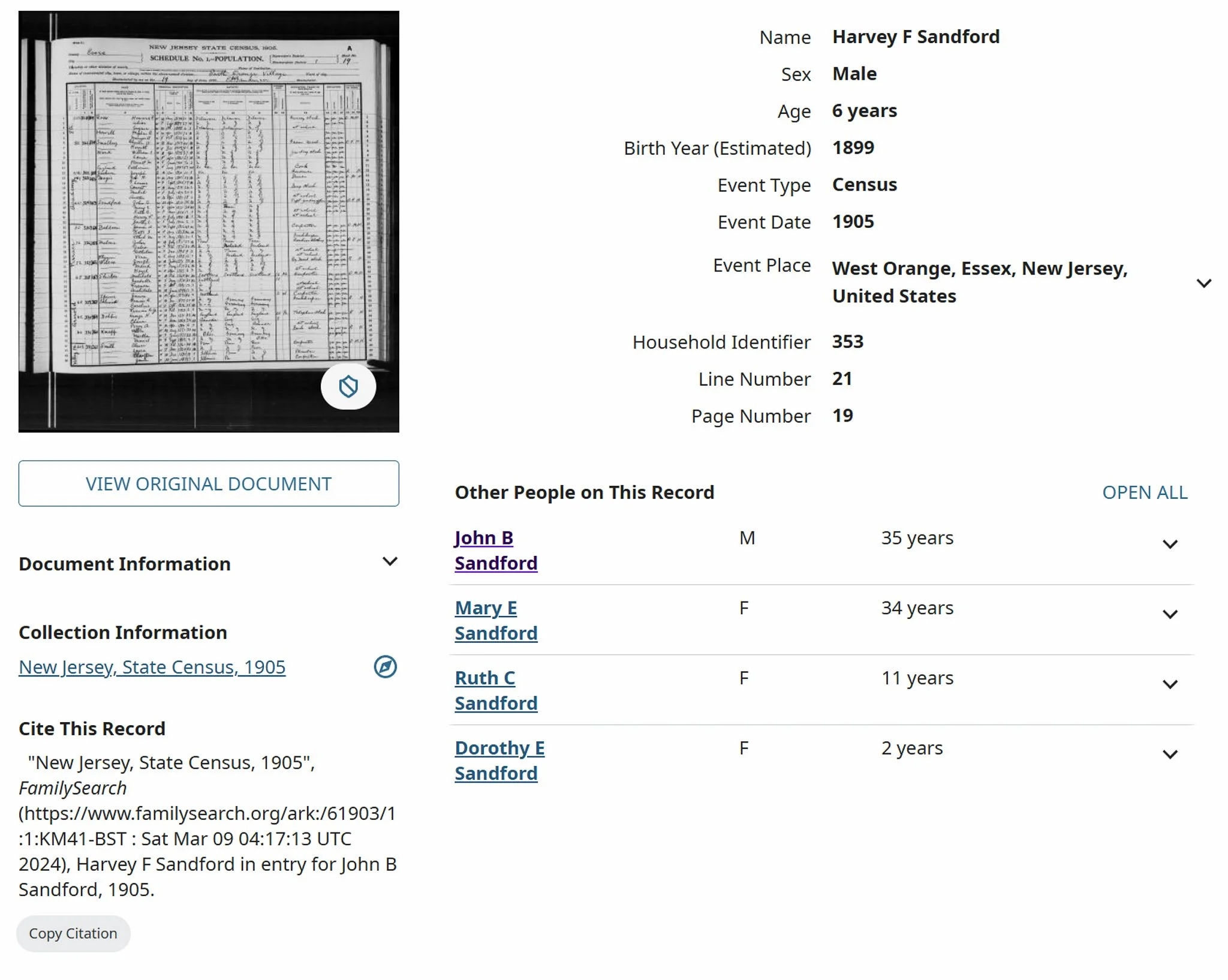
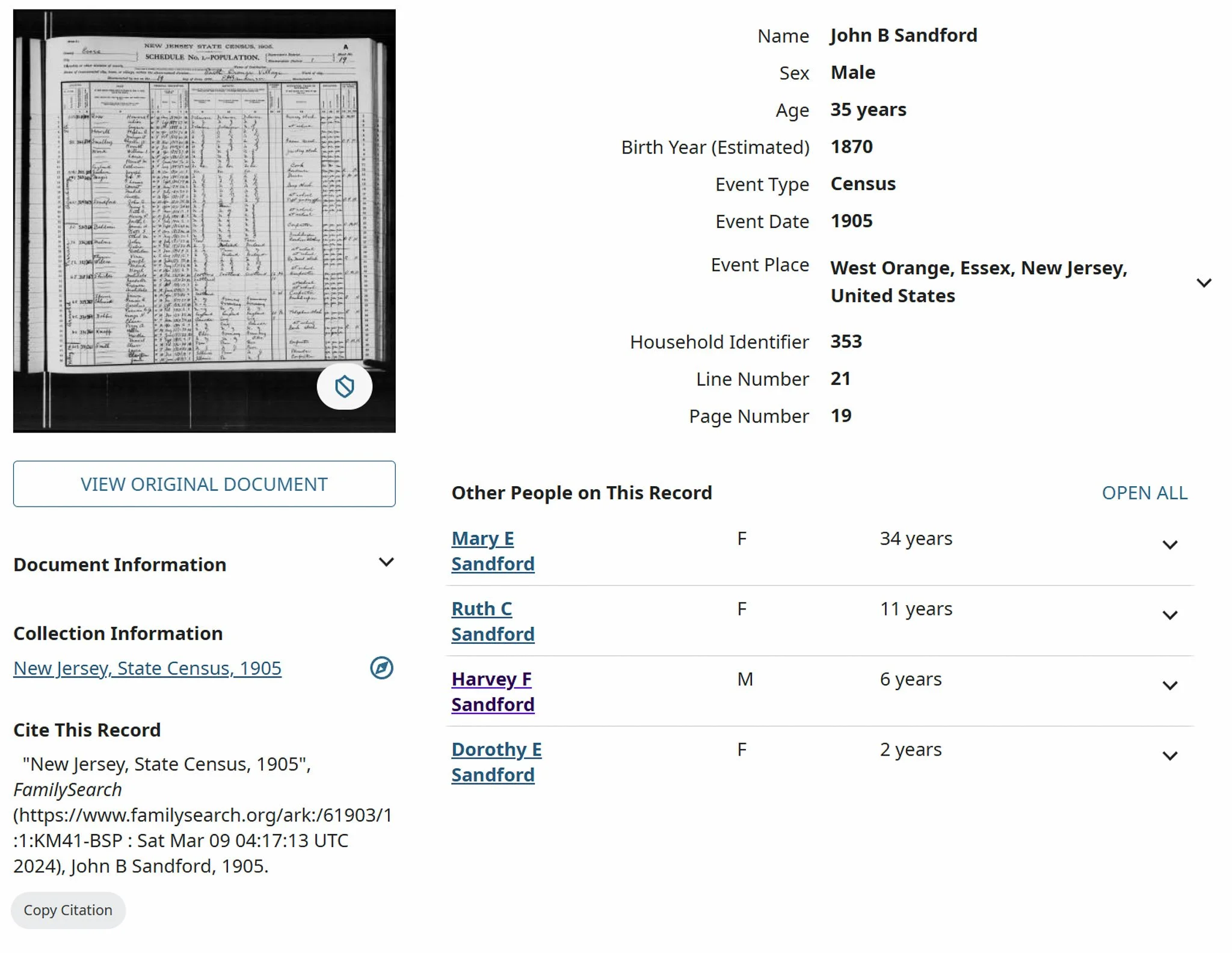
Historical research has identified Harvey F. Sandford, born circa 1898 in Newark, New Jersey, as the flag's maker. Sandford's family maintained longstanding connections to the South Orange and Maplewood communities. His father, John B. Sandford, is documented in local directories residing at 451 Academy Street in South Orange by 1916. Later records place father and son at the same residence, 7 Midland Boulevard in Maplewood, in 1929. Harvey subsequently resided in South Orange and Summit, New Jersey, and died in October 1964 at the age of sixty-six. His approximate birth year places his fourth-grade education around 1907–1910, providing the principal basis for dating the flag to this narrow period.
South Orange Public School traces its origins to the Columbian School of South Orange, formally established in 1814, with a schoolhouse completed the following year. The institution developed throughout the 19th century, adopting graded instruction in 1867 and occupying a new brick school building in 1880. Of particular relevance to this flag, manual training was formally introduced into the South Orange educational system in 1890. A New Jersey educational report from 1891 specifically commended South Orange for its progress in form study, drawing, and industrial work. Such instruction emphasized practical skills and the development of manual dexterity, incorporating activities that complemented traditional academic subjects. Sewing and needlework were important components of manual education in American schools during this period.
The flag is best understood within this educational setting. Its manufacture likely formed part of a classroom exercise combining practical needlework with instruction in American history and patriotism. By the time Sandford attended fourth grade, the Betsy Ross legend had become familiar to American schoolchildren, and the circular arrangement of 13 stars was widely presented as the design of the nation's original flag. Sandford's decision to reproduce this particular configuration is especially significant because it illustrates how the legend, first publicly advanced by Canby in 1870, had entered the education of American children within approximately four decades. The flag is thus both a surviving example of student craftsmanship and a tangible reflection of the development of American patriotic tradition.
CONSTRUCTION AND MATERIALS
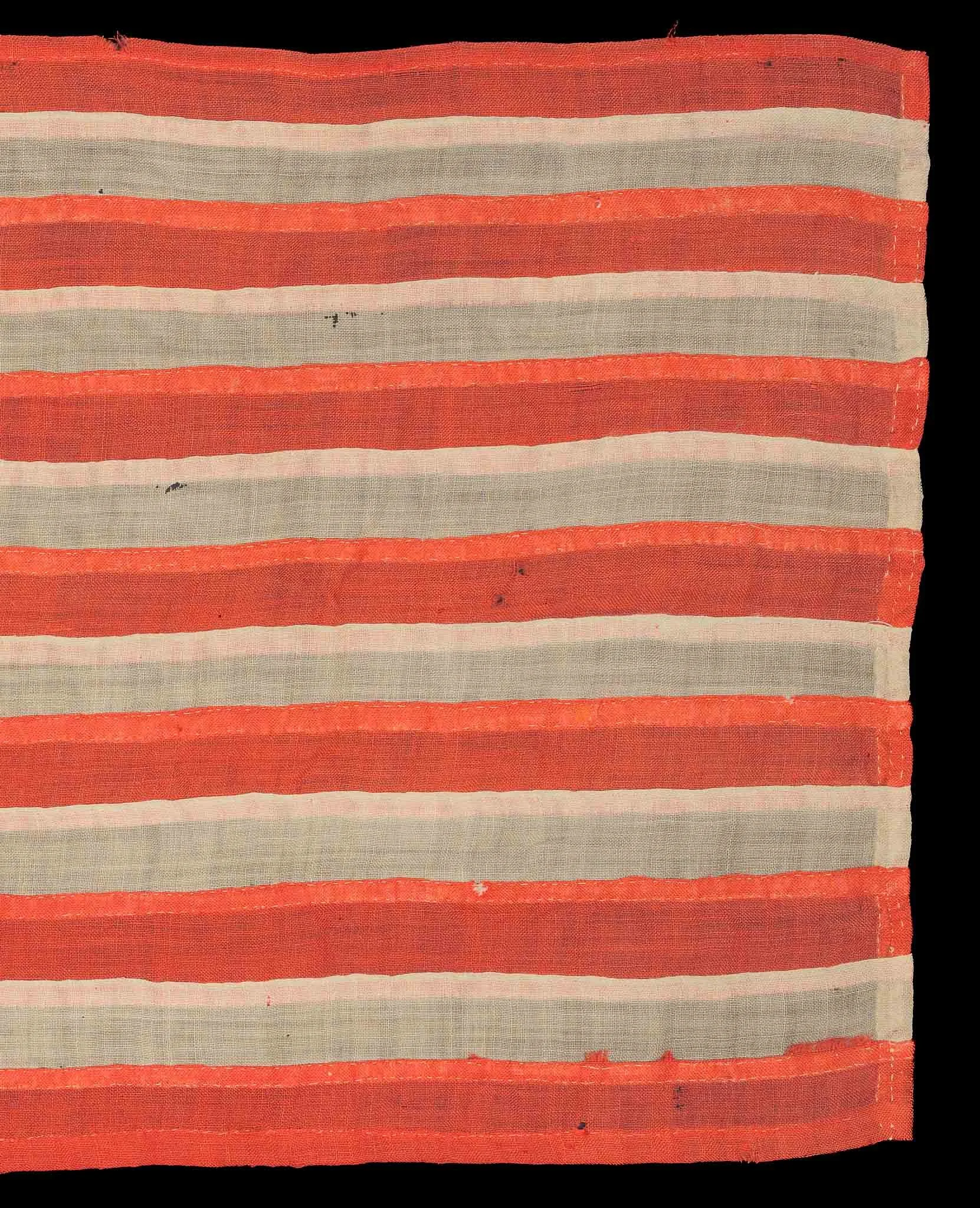
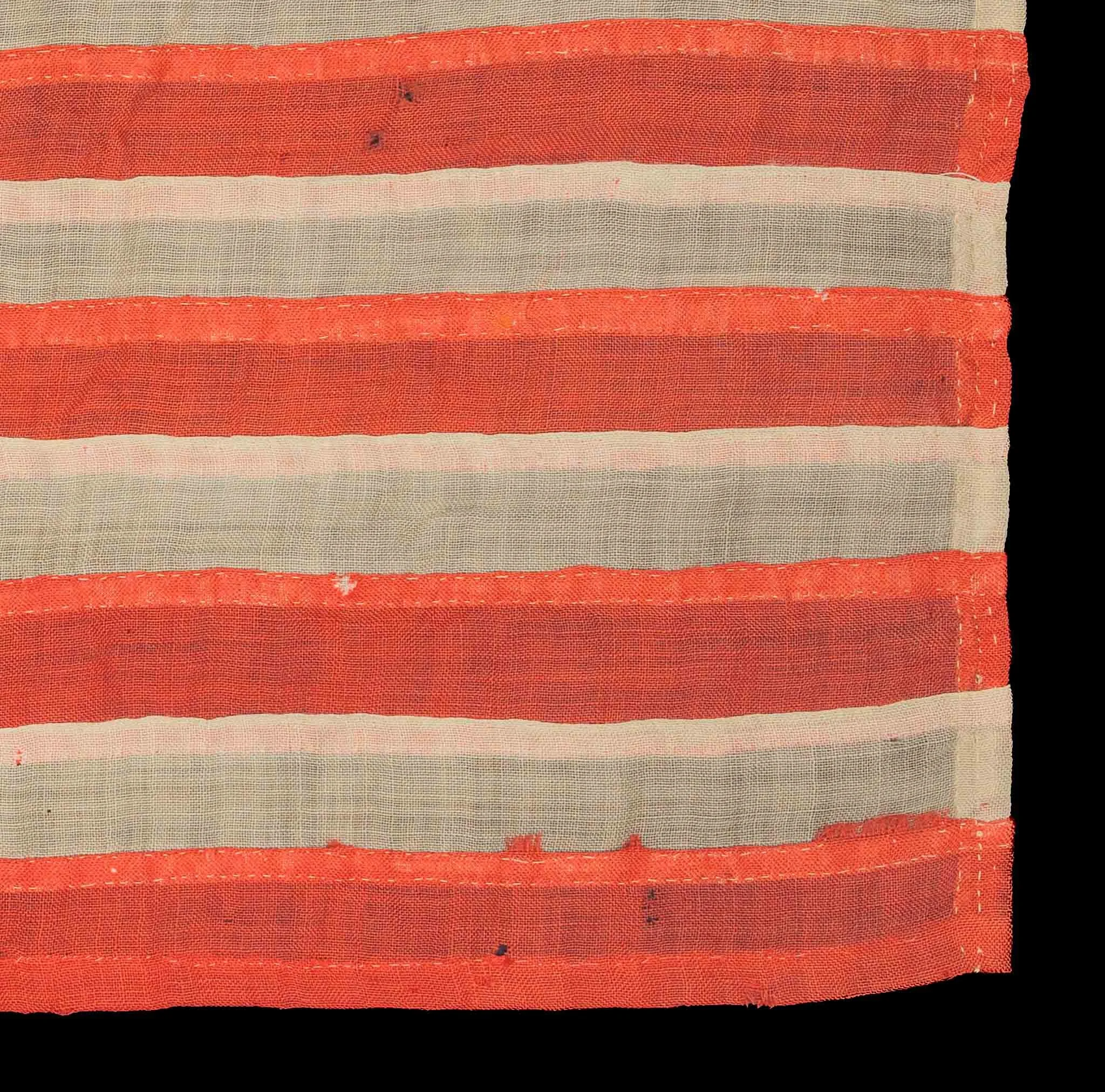
The flag is entirely handsewn, with 13 individual stripes of red and white wool bunting joined by hand stitching. The blue canton is likewise constructed of wool bunting and bears 13 white cotton stars arranged in a single circular wreath. Each star was individually cut and hand-appliquéd to the canton. The stars vary somewhat in their proportions, placement, and orientation, creating a distinctive handmade appearance. A cotton heading is sewn along the hoist, with two reinforced openings serving as grommets. Rather than employing metal hardware, the maker fashioned the grommets by hand, working thread around each opening to reinforce the fabric.
The stitching throughout the flag is notably irregular, with visible variations in stitch length, spacing, and alignment. The stripes exhibit uneven seams, and the stars display the same relatively inexperienced needlework. These characteristics are entirely consistent with the abilities of a young student learning to sew. Importantly, the irregular construction is not a detriment to the flag's significance; rather, it is a defining feature of its history, providing physical evidence of the workmanship of its fourth-grade maker. The flag was clearly constructed with considerable effort, despite the limited experience of the individual responsible for its manufacture.
The combination of its early circular star configuration, all-handsewn construction, handwritten maker and school inscriptions, and surviving family history distinguishes this flag from the overwhelming majority of antique 13-star examples. Its striking presentation, irregular handmade qualities, and substantial historical associations make it particularly appealing. More importantly, it represents a rare surviving connection between the popularization of the Betsy Ross legend and its incorporation into American elementary education. As one of the earliest known handmade examples of the Ross configuration outside those associated with Ross's descendants, this flag is an important surviving artifact of American flag history, patriotic instruction, and the craftsmanship of an identifiable young student.
Conservation Process: This flag was hand sewn to cotton fabric, and both were hand sewn to a mounting board. To prevent the black dye in the cotton fabric from seeping into the flag, it was first washed in a standard wash and then in a dye setting wash. The flag is positioned behind Optium Museum Acrylic.
Frame: The frame is a dark-stained hardwood molding with a clean square profile and subtle variations in grain and tone that lend warmth and visual depth.
Condition Report: The flag exhibits age-appropriate wear, including scattered staining, minor discoloration, and small areas of fabric loss throughout. The wool bunting retains strong coloration, while the cotton stars exhibit light toning and occasional fraying along their edges. The cotton hoist shows age-related discoloration and wear, particularly around the handsewn grommets. Overall, the flag remains in very good condition, with its original handmade character well preserved.
Collectability Level: The Extraordinary – Museum Quality Offerings
Date of Origin: 1907-1910
Number of Stars: 13
Associated State: Original 13 Colonies