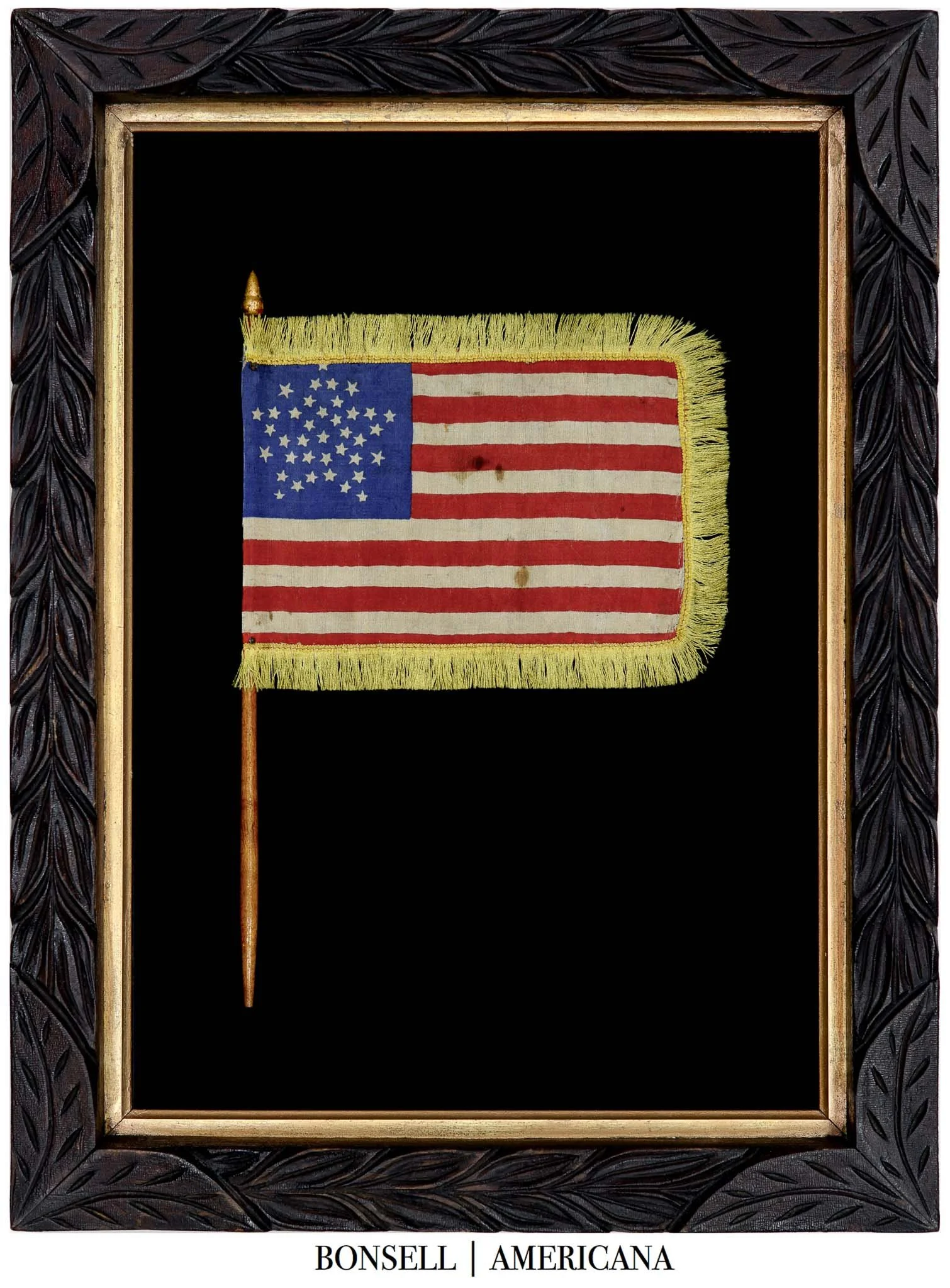
13 Star Antique American Flag with a Medallion Star Configuration | Centennial Era Parade Flag | Circa 1876
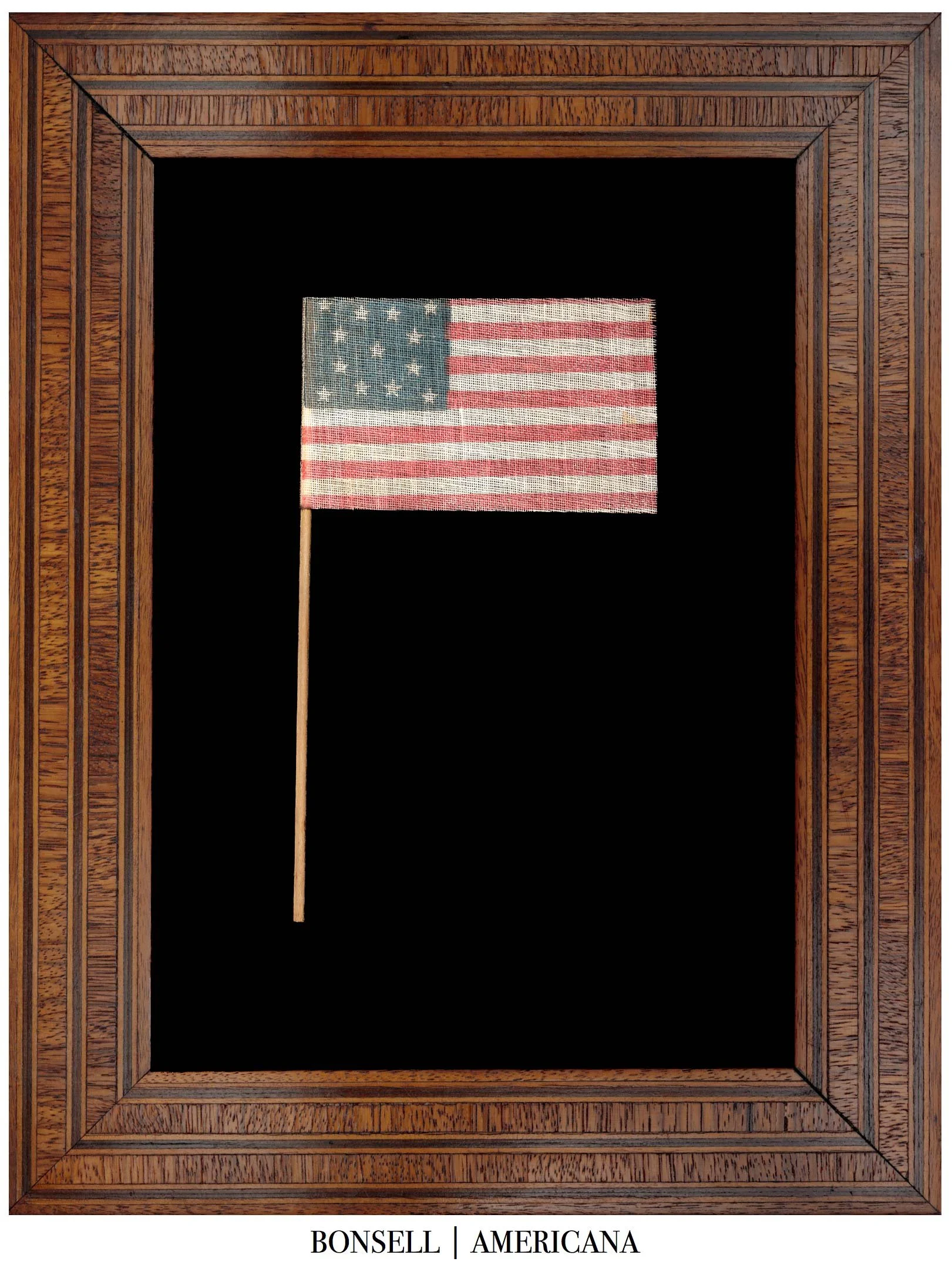
13 Star Antique American Flag with a Medallion Star Configuration | Centennial Era Parade Flag | Circa 1876
Frame Size (H x L): 13.5” x 10.5”
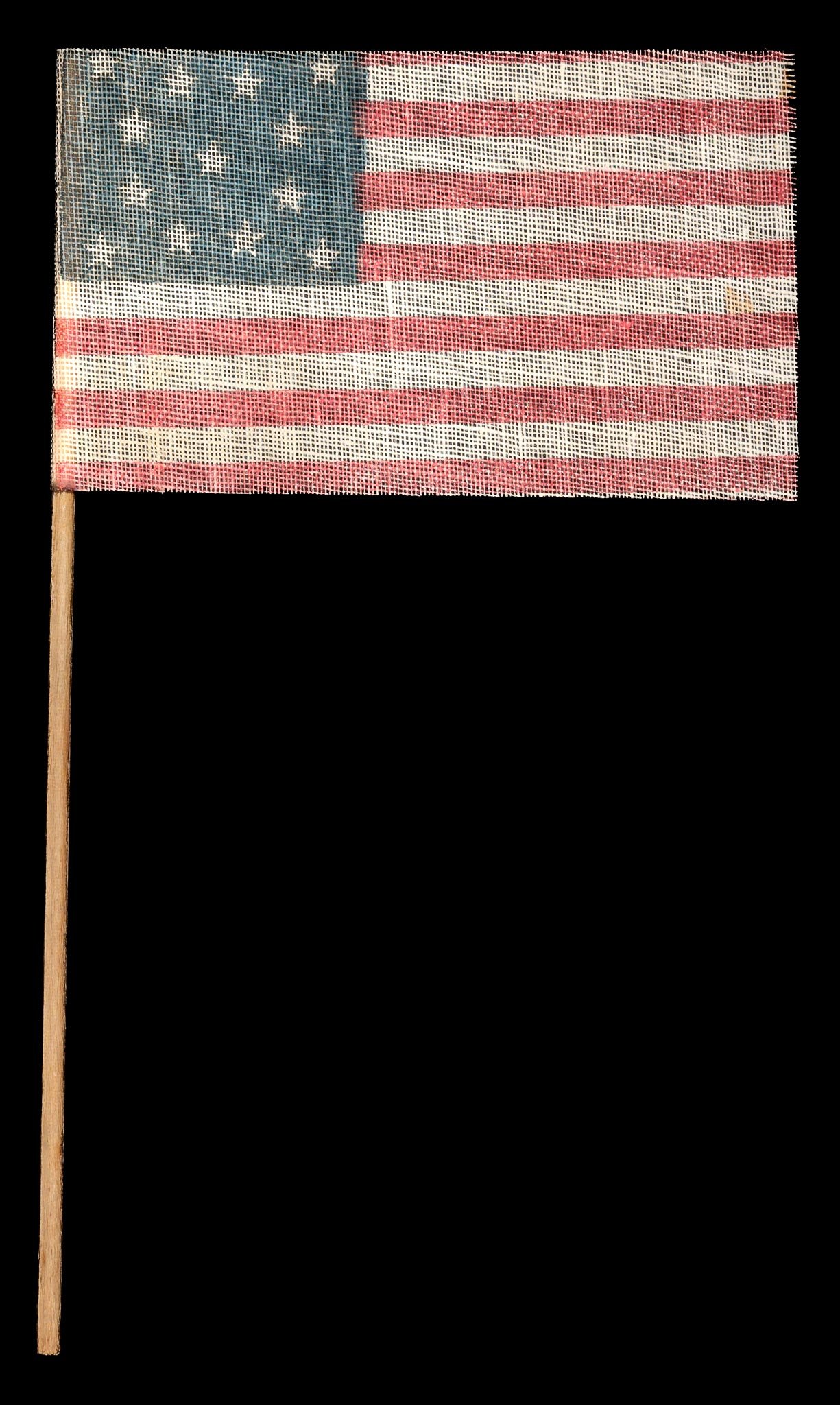
Flag Size (H x L): 2.5” x 4 and Affixed to a 7” Staff
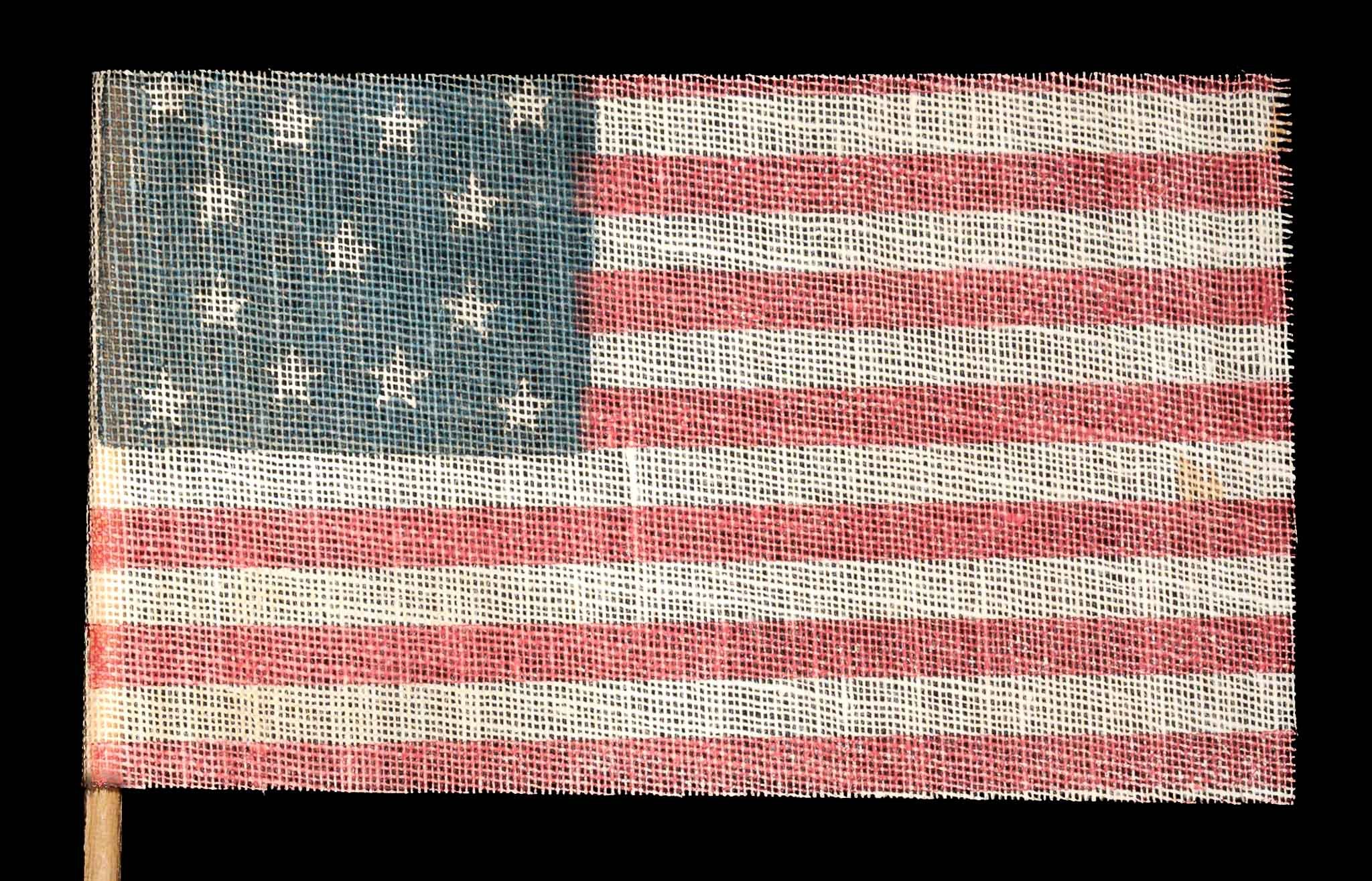
Offered is a 13-star American parade flag, made for the patriotic celebrations surrounding the United States Centennial of 1876. Printed on plain weave cotton and mounted to its original wooden staff, the flag is characteristic of the small hand-waving flags carried in parades, political gatherings, public ceremonies, and other patriotic events during the latter nineteenth century.
The Centennial represented an extraordinary moment in American history. Just eleven years after the conclusion of the Civil War, the nation celebrated the 100th anniversary of the Declaration of Independence amid an enormous revival of patriotic imagery. Cities and towns throughout the country organized parades, speeches, military demonstrations, fireworks, and public gatherings, while homes, businesses, and civic buildings were decorated extensively in red, white, and blue. American flags—particularly small parade flags such as this example—were among the most visible symbols of the celebration.
The centerpiece of the Centennial year was the Centennial International Exhibition in Philadelphia, the first official world's fair held in the United States. Open from May through November 1876, the exhibition attracted nearly ten million visitors and showcased American industry, technology, art, agriculture, and manufacturing to an international audience. Among its celebrated attractions were the enormous Corliss steam engine that powered much of Machinery Hall and Alexander Graham Bell's recently developed telephone, which was famously demonstrated before exhibition judges.
Although the official flag of the United States during most of the Centennial year contained 37 stars, flag makers were rarely constrained by official star counts. Colorado was admitted to the Union on August 1, 1876, becoming the 38th state and earning its enduring nickname, the “Centennial State.” Anticipating Colorado's admission, manufacturers produced large numbers of 38-star flags before that count formally became official on July 4, 1877.
Alongside the 37- and 38-star flags, however, 13-star flags enjoyed renewed popularity during the Centennial because of their direct association with the nation's founding. Rather than representing the contemporary number of states, the 13 stars recalled the 13 original colonies and the American Revolution. For a country celebrating its first hundred years, the symbolism was especially appropriate, and manufacturers produced 13-star flags in numerous arrangements and sizes for Centennial displays and festivities.
The origins of the 13-star American flag extend to June 14, 1777, when the Continental Congress adopted the first national flag resolution:
“Resolved, That the flag of the thirteen United States be thirteen stripes, alternate red and white; that the union be thirteen stars, white in a blue field, representing a new constellation.”
The precise arrangement of those 13 stars was not specified, resulting in an extraordinary variety of patterns during the early national period. Thirteen remained the official number of stars until Vermont and Kentucky entered the Union and the 15-star flag was adopted in 1795.
Importantly, the 13-star configuration did not disappear as additional states joined the nation. It continued to be employed for practical, naval, commemorative, and patriotic purposes throughout the nineteenth century. Its visual connection to the Revolution made it especially attractive whenever Americans sought to evoke the country's founding generation. Thirteen-star flags consequently appeared during periods of heightened patriotism, including the Mexican War, the Civil War, and celebrations honoring Revolutionary War history.
The return of the Marquis de Lafayette to the United States in 1824 provides an early example of this revival of Revolutionary symbolism. Lafayette, the celebrated French officer who had fought alongside the Americans during the Revolution, was welcomed during an extensive national tour with elaborate parades, banquets, speeches, and public ceremonies. Similar appeals to the imagery of the founding era became increasingly common as the nineteenth century progressed.
That tradition reached its greatest expression with the Centennial in 1876. Few flags could have conveyed the meaning of the occasion more directly than a flag bearing 13 stars: a visual reference to the original states displayed exactly one hundred years after American independence.
Small parade flags from the Centennial period are particularly evocative artifacts because they were intended to be held and waved rather than simply displayed from buildings. Their modest scale, lightweight construction, and wooden staffs allowed thousands of participants and spectators to carry the national colors personally through the parades and celebrations that defined America's 100th anniversary.
This example survives as a wonderful artifact of that period—a miniature American flag whose 13 stars deliberately look backward to the nation's founding while celebrating its first century.
Conservation Process: This flag was hand sewn to cotton fabric, and both were hand sewn to a mounting board. To prevent the black dye in the cotton fabric from seeping into the flag, it was first washed in a standard wash and then in a dye setting wash. The flag is positioned behind Optium Museum Acrylic.
Frame: The flag is presented in an antique marquetry frame with richly figured wood veneers arranged in geometric bands. The layered construction, warm patina, and dark inner molding provide an especially handsome period presentation for the flag.
Condition Report: The flag is in very good condition for its age, retaining strong red and blue coloration with attractive overall fading and toning. There is minor fraying and thread loss along the outer edges, along with scattered small stains and areas of discoloration consistent with age and use.
Collectability Level: The Good – Perfect for Beginning Collectors and Gifts
Date of Origin: 1876
Number of Stars: 13
Associated War: The Indian Wars (1860-1890)
Associated State: Original 13 Colonies