Scarce 29 Star Flag with a Medallion Configuration | An Early American Parade Flag Celebrating Iowa Statehood | Circa 1846–1848
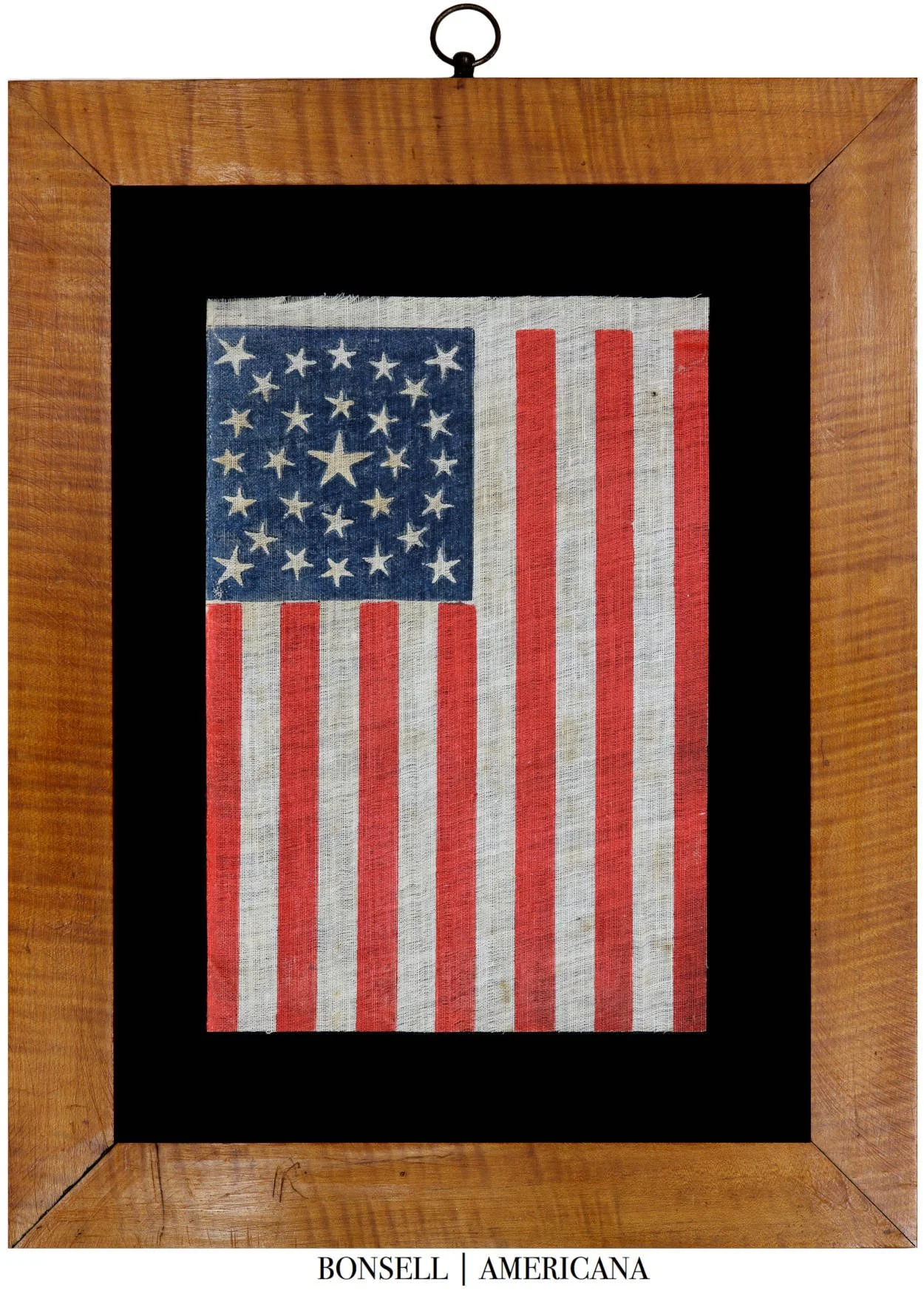

Scarce 29 Star Flag with a Medallion Configuration | An Early American Parade Flag Celebrating Iowa Statehood | Circa 1846–1848
Frame Size (H x L): 16” x 12.5”
Flag Size (H x L): 10” x 6.75”
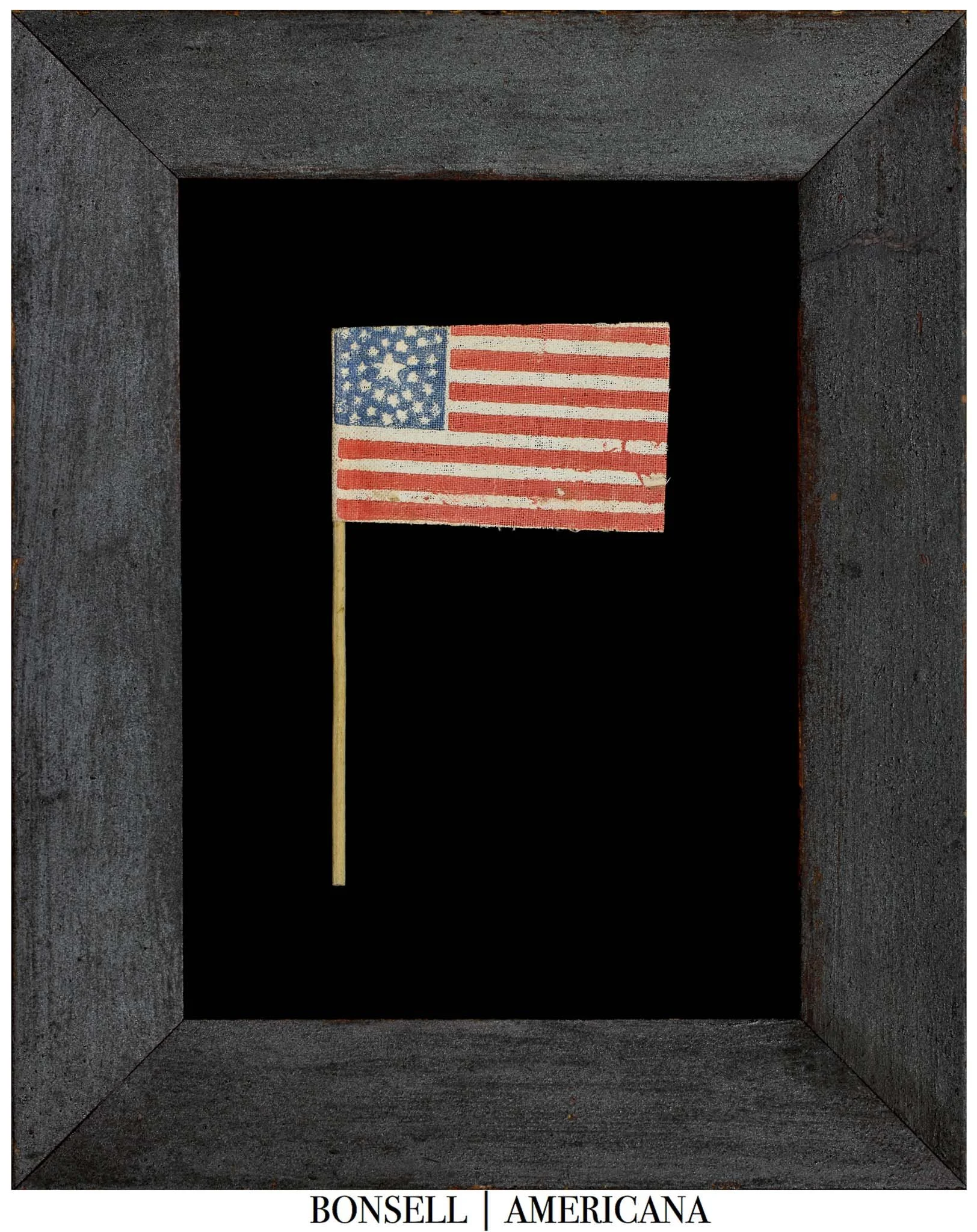
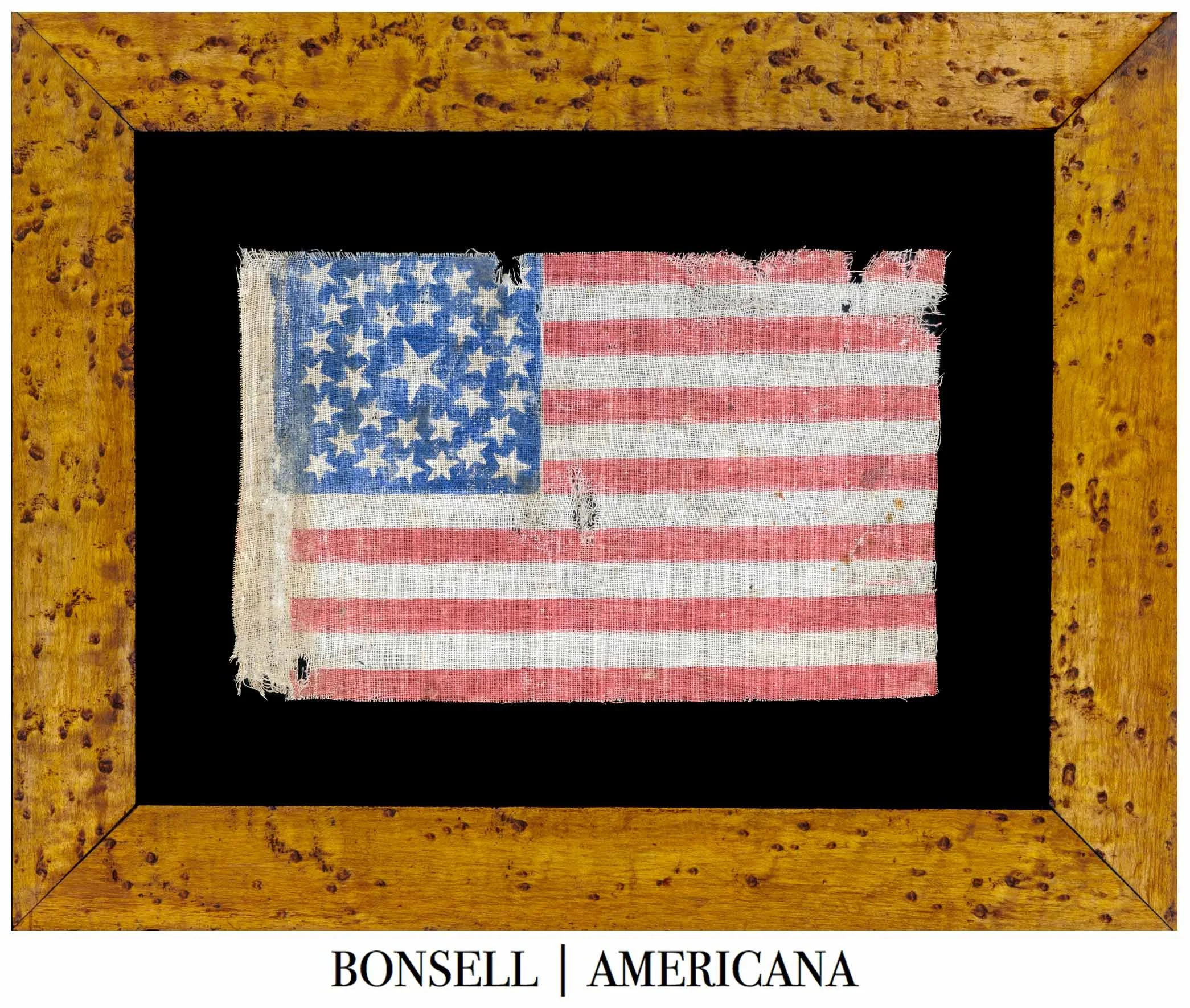
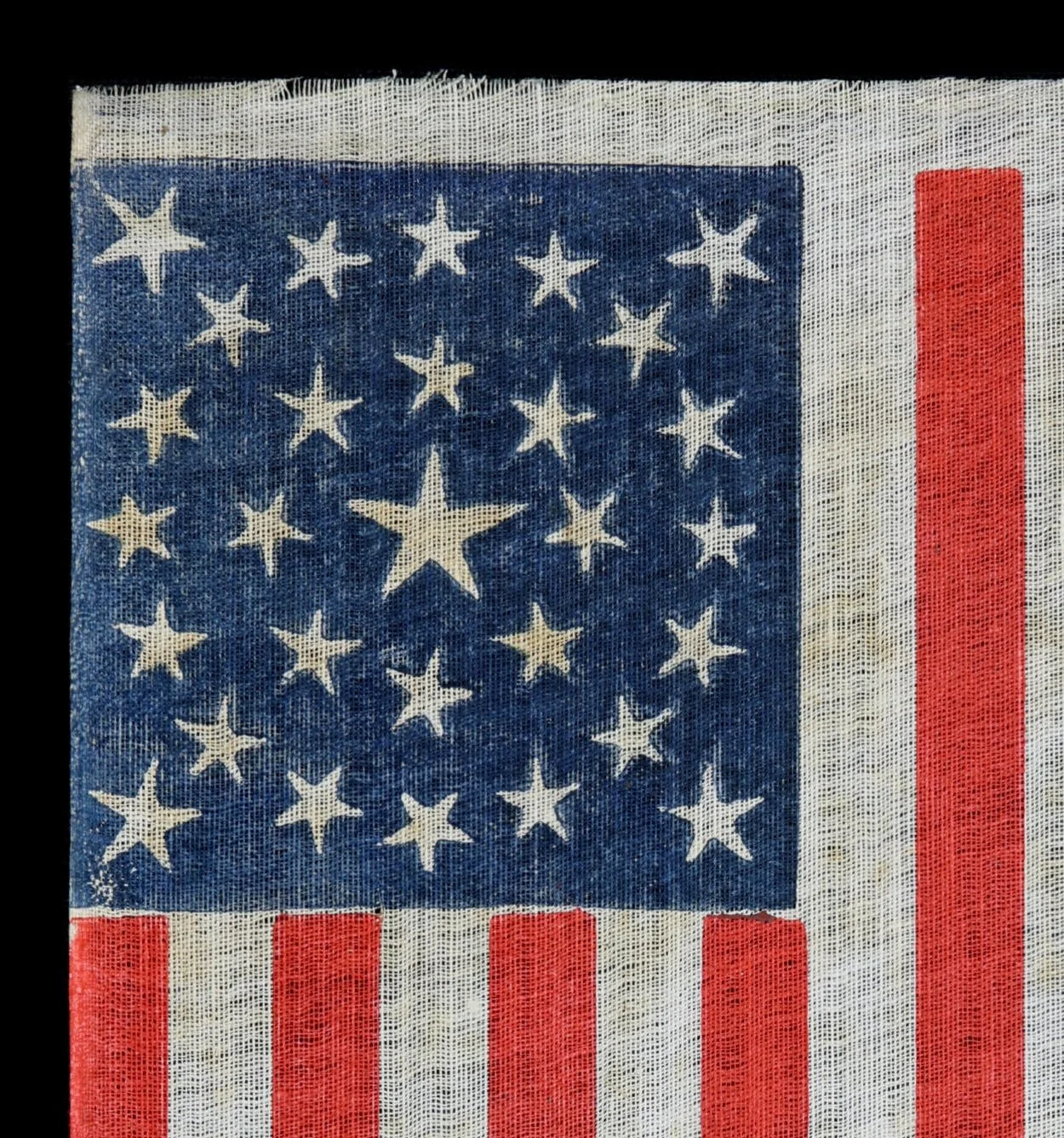
Offered is a 29-star American flag printed on glazed cotton, with its stars arranged in a striking and highly desirable medallion configuration. At the center of the canton is a large star, known as a “center star,” symbolizing the most recently admitted state to the Union—Iowa. This central star is surrounded by two concentric rings of smaller stars, with four additional flanking stars placed in each corner of the canton, creating a bold and balanced aesthetic.
The stars themselves are notably pointy and whimsical in design, tightly packed within the canton in a way that is both charming and visually distinctive. Though the specific maker is unknown, these stars match a recognizable style attributed to a small group of flags believed to originate from the same workshop. Flags from this group have been documented in only six known star counts: 7, 13, 15, 29, 33, and 35. Each of these counts carried symbolic meaning—celebrating early secession, the original thirteen colonies, Kentucky’s centennial, or the most recent state admissions to the Union. Among this group, the 29-star variant is the earliest and among the rarest.
This flag is mounted vertically, which repositions the canton to the upper left, in accordance with modern U.S. flag display customs. If it were mounted horizontally, the canton would appear in the upper right—a configuration known as a reverse (or backwards) mount. While that orientation conflicts with today’s flag code, such standards did not exist in the 19th century, and reverse displays were both common and acceptable. In some cases, flags were printed on only one side (e.g., the one offered herein) or appeared more vibrant on the reverse, making backwards mounting both practical and historically appropriate to collectors.
The 29-star flag commemorates Iowa’s admission to the Union on December 28, 1846. Iowa’s path to statehood began decades earlier, when the land was acquired as part of the Louisiana Purchase in 1803. For years, it remained sparsely populated by settlers and occupied largely by Native American tribes.
In the 1830s, following a series of treaties and the Black Hawk War of 1832, the U.S. government opened the territory to white settlement. Iowa became an official U.S. territory in 1838, carved from the Wisconsin Territory, and experienced rapid population growth due to its fertile land and strategic location along the Mississippi River.
As its population expanded, Iowa petitioned for statehood in the 1840s. Congress initially rejected Iowa’s proposed constitution due to boundary disputes, but a revised constitution was approved in 1846. On December 28 of that year, President James K. Polk signed the act admitting Iowa as the 29th state.
The admission marked a continued westward expansion of the Union and helped establish Iowa as a key agricultural state in the growing republic.
This flag officially became representative of the United States on July 4, 1847, and retained that status for just one year—until July 4, 1848, when a 30th star was added for Wisconsin. Due to this extremely brief period of official use, 29-star flags were produced in very limited numbers.
Compounding their rarity is the broader historical context: flags made before the Civil War (1861–1865) are exceptionally scarce. During this era, flag use was far more restrained. Americans did not commonly display flags for patriotic reasons, and military use was also limited. U.S. Army artillery units weren’t authorized to carry the national flag until 1834, and infantry regiments not until 1841. As a result, flags made before the outbreak of the Civil War account for roughly only 1% of 19th-century U.S. flags that survive today.
This example, with its early date, rare star count, and medallion design, represents an important artifact from the antebellum period. Flags from this era are difficult to find, and 29-star examples are especially scarce due to their short period of official use. This flag offers historical value both as a physical object and as a reflection of the nation's growth during the mid-19th century.
Conservation Process: This flag was hand sewn to cotton fabric, and both were hand sewn to a mounting board. To prevent the black dye in the cotton fabric from seeping into the flag, it was first washed in a standard wash and then in a dye setting wash. The flag is positioned behind Optium Museum Acrylic.
Frame: This offering is in an attractive tiger maple frame. Tiger maple frames are cherished for their striking, wavy grain patterns that shimmer with a unique iridescence, reminiscent of a tiger's coat.
Condition Report: The flag remains in remarkably clean and well-preserved condition. There is some discoloration, along with a few tiny holes, but these are minimal and do not detract from the flag’s overall appearance. Compared to others from the era, this example ranks among the very best in terms of condition.
Collectability Level: The Best – Perfect for Advanced Collectors
Date of Origin: 1846-1848
Number of Stars: 29
Associated State: Iowa