Exceptional 36 Star Parade Flag with Union Symbolism and Beehive Lineage | Nevada Statehood | Circa 1864–1867
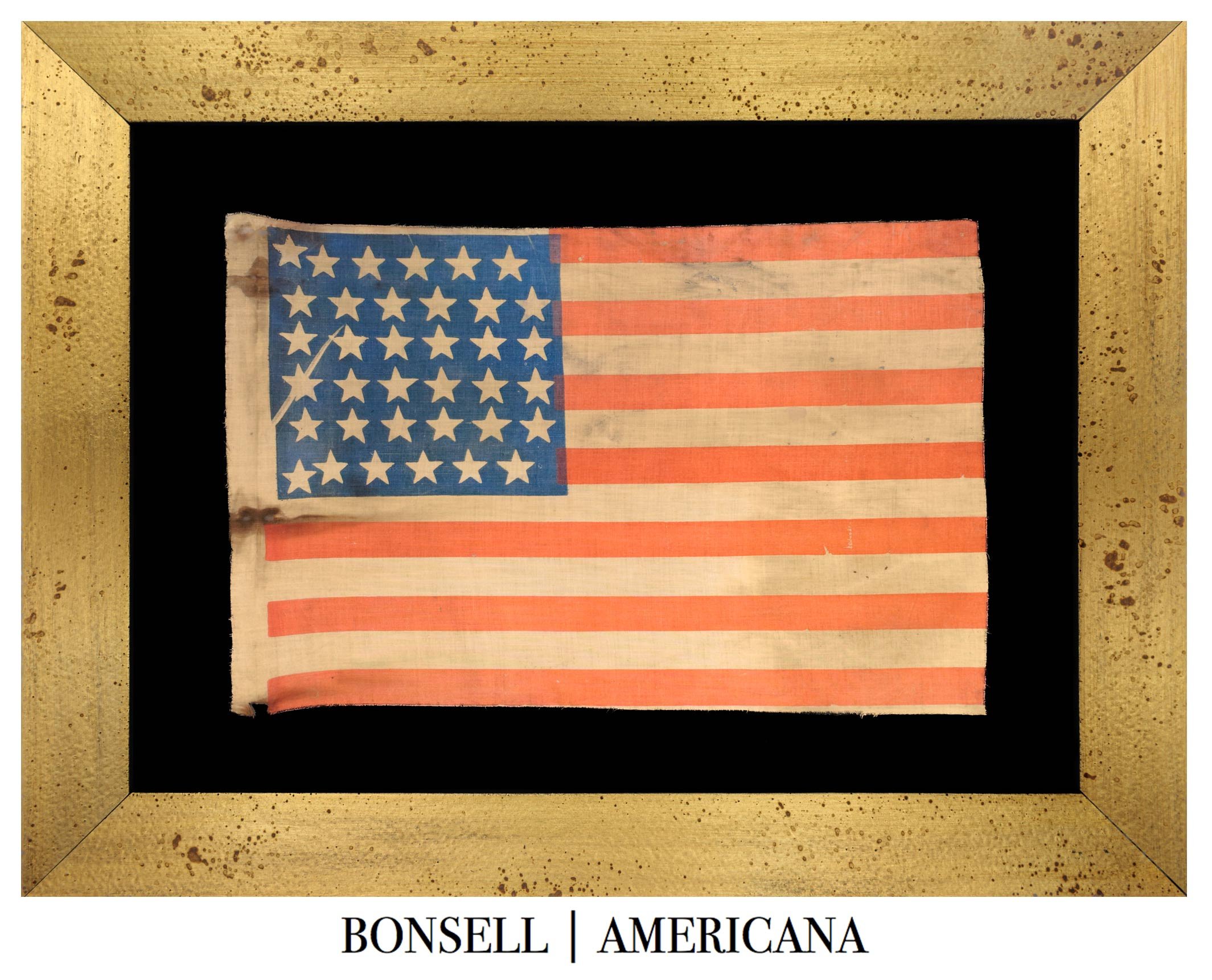
Exceptional 36 Star Parade Flag with Union Symbolism and Beehive Lineage | Nevada Statehood | Circa 1864–1867
Price: Call 618-553-2291, or email info@bonsellamericana.com
Frame Size (H x L): 20.5” x 26.5”
Flag Size (H x L): 11.5” x 17.5”
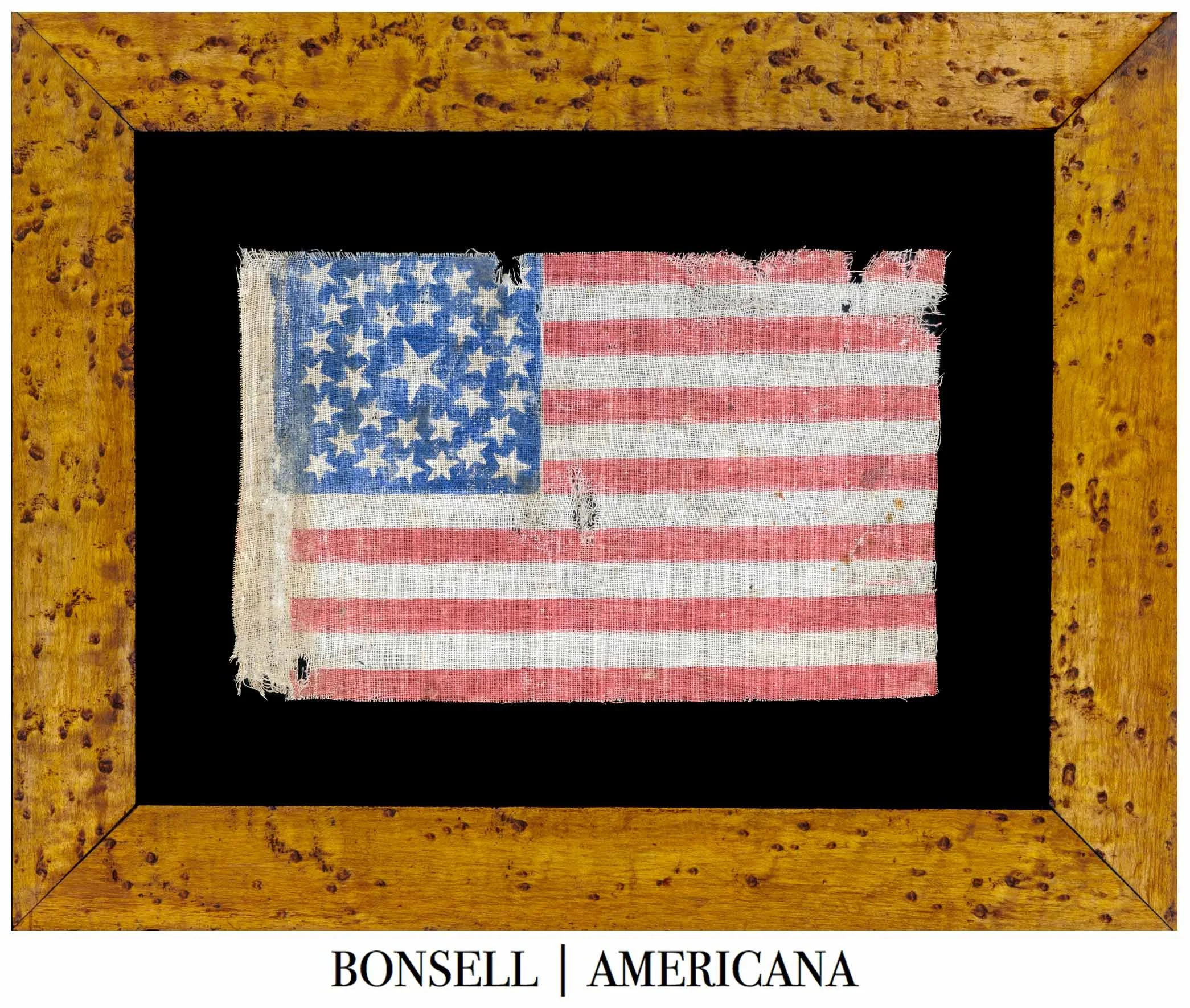
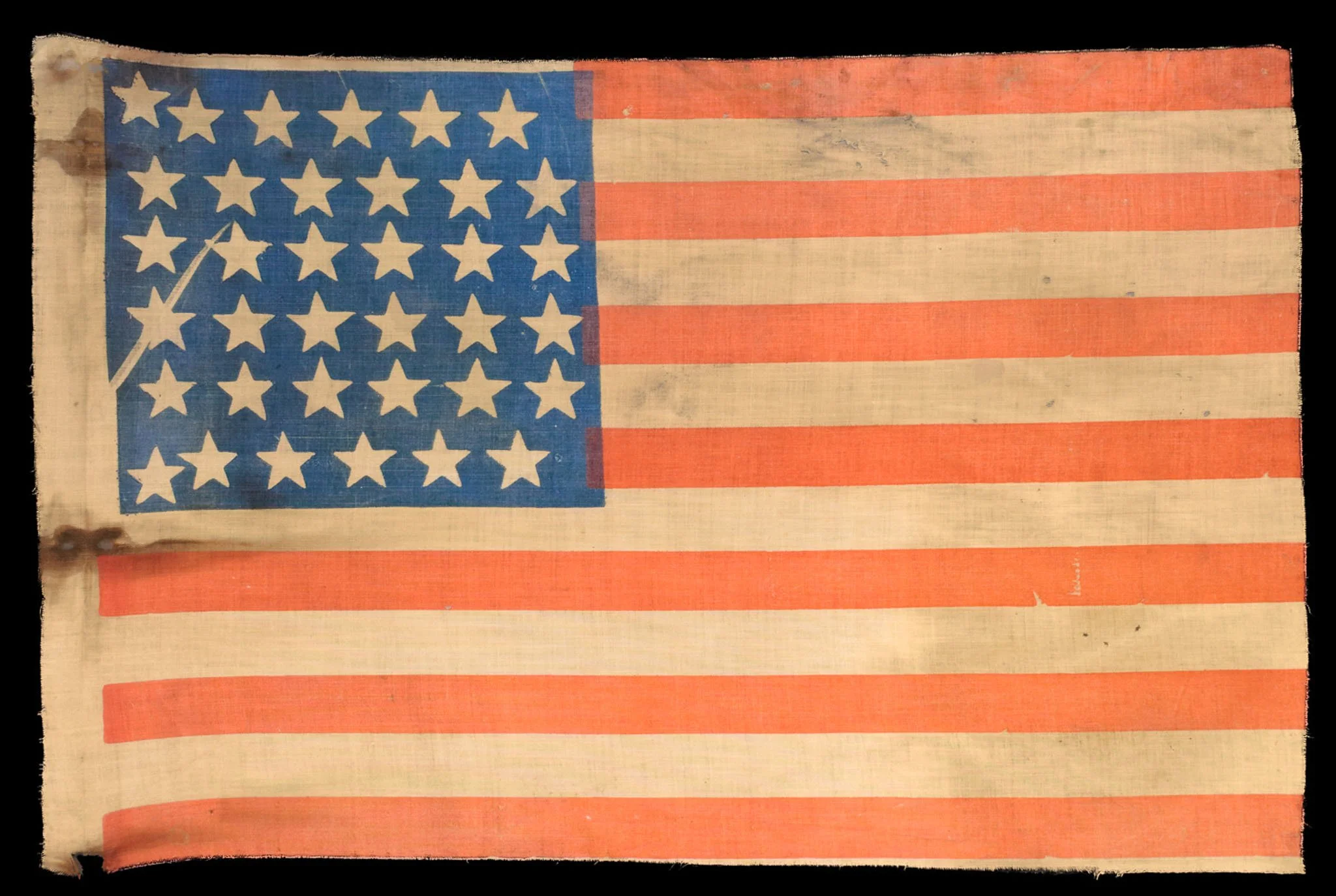
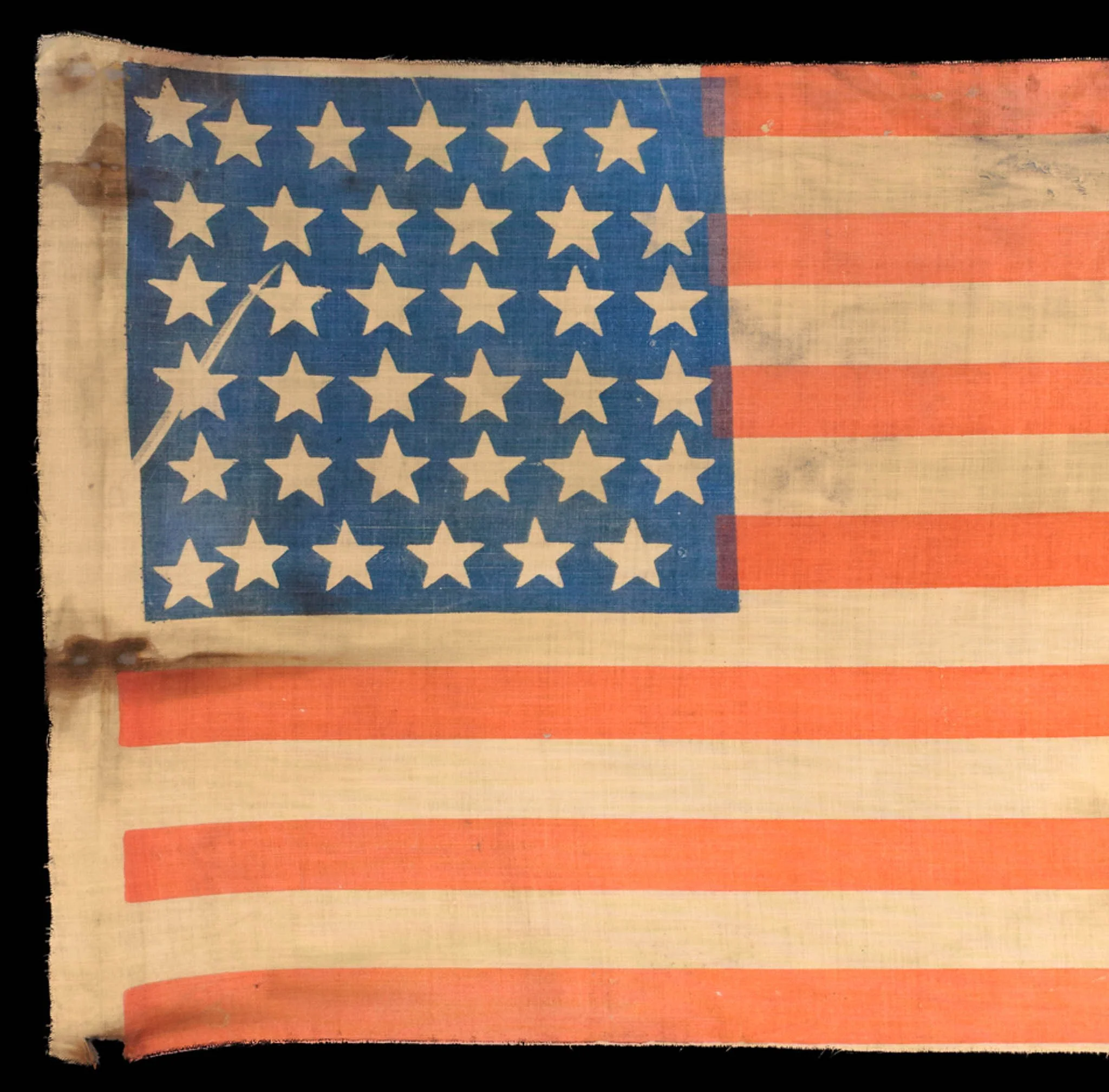
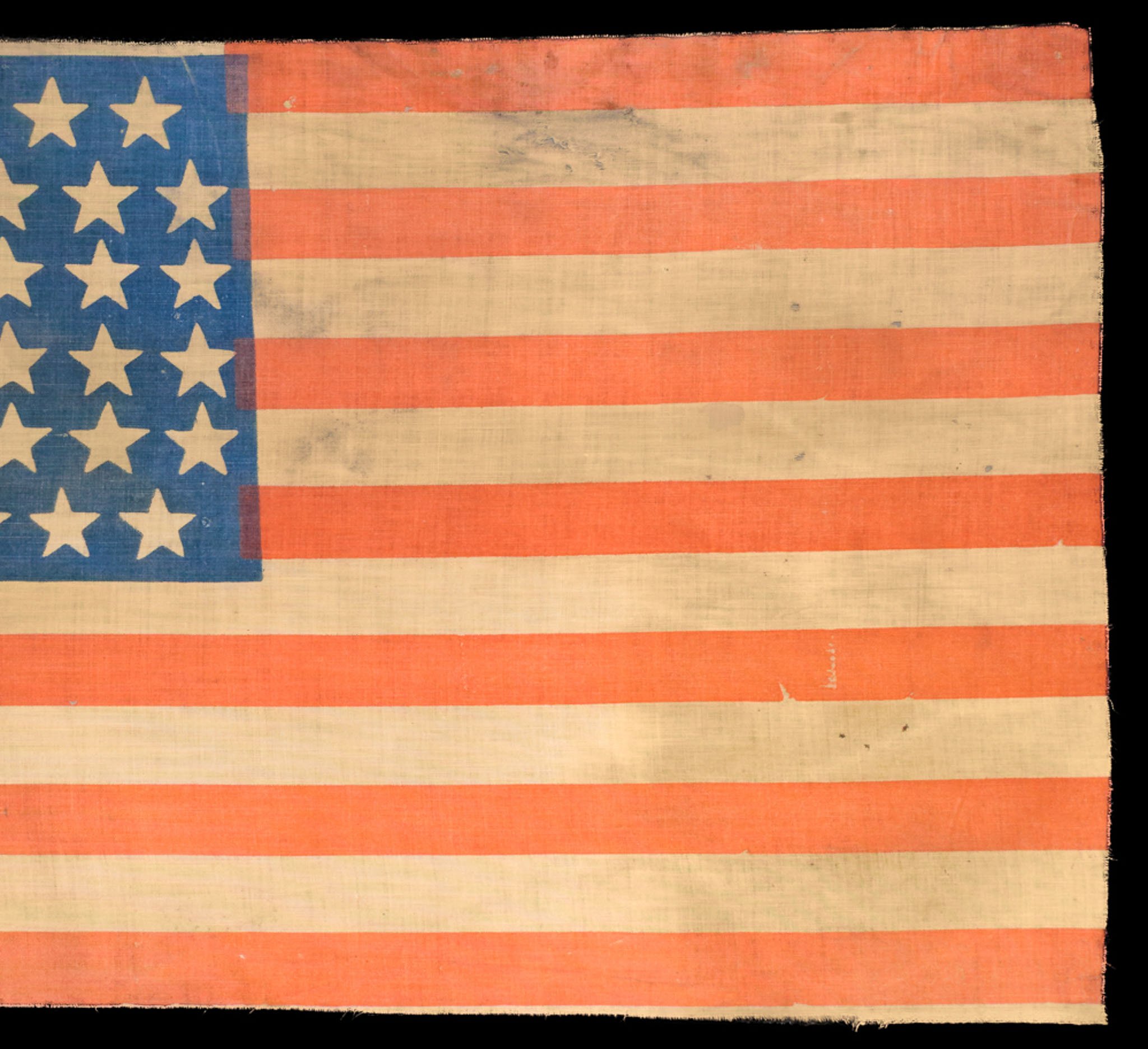
Offered is a scarce and historically resonant 36-star American parade flag, dating to the final years of the Civil War and the opening phase of Reconstruction, circa 1864–1867. Printed on cotton for public display, this flag reflects both the urgency of wartime patriotism and the latitude that 19th-century Americans exercised in interpreting and reshaping national symbols.
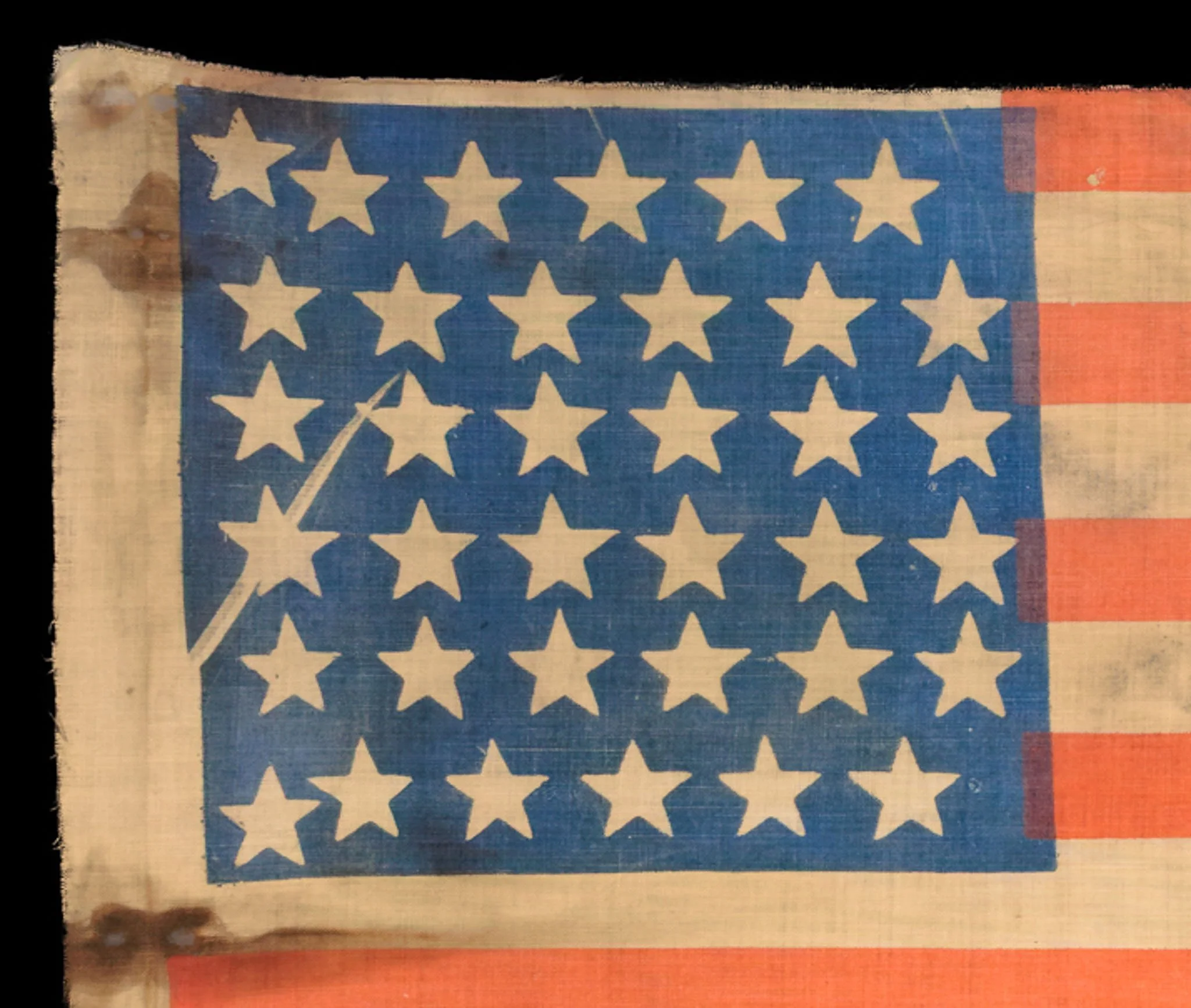
The canton bears a linear arrangement of stars framing three sides, creating a pronounced open-sided form that can reasonably be read as a visual reference to the Union itself. During the Civil War, the concept of Union was not merely political but existential, and visual shorthand for unity appears across a wide range of patriotic objects—from banners and badges to textiles and printed ephemera. Flags such as this one demonstrate how star placement, rather than being strictly ornamental, could be used to convey allegiance and resolve at a glance.
This configuration also places the flag within a small but documented family of beehive-related star patterns. When rotated ninety degrees, the linear stacking of stars closely resembles a beehive arrangement, aligning it conceptually with known 38-star and 42-star beehive flags produced later in the 19th century. In those examples, the beehive form is more explicit, but the underlying visual logic—organized, collective structure built from individual units—is consistent. The beehive was a long-established symbol in American civic and fraternal culture, representing industry, cooperation, and collective strength, themes that carried particular relevance during the war and the nation’s subsequent rebuilding.
From a manufacturing perspective, the flag illustrates the adaptive practices of mid-19th-century commercial flag-makers. Small parade flags were typically block-printed, using carved wooden forms designed for repeated use. As new states were admitted to the Union in quick succession, it was common for makers to modify existing blocks rather than commission entirely new carvings. In this case, the layout strongly suggests derivation from a 34-star pattern, with two stars added at the upper and lower corners of the hoist end to bring the count to thirty-six. The resulting design balances expediency with intentionality, combining practical production decisions with visually meaningful outcomes.
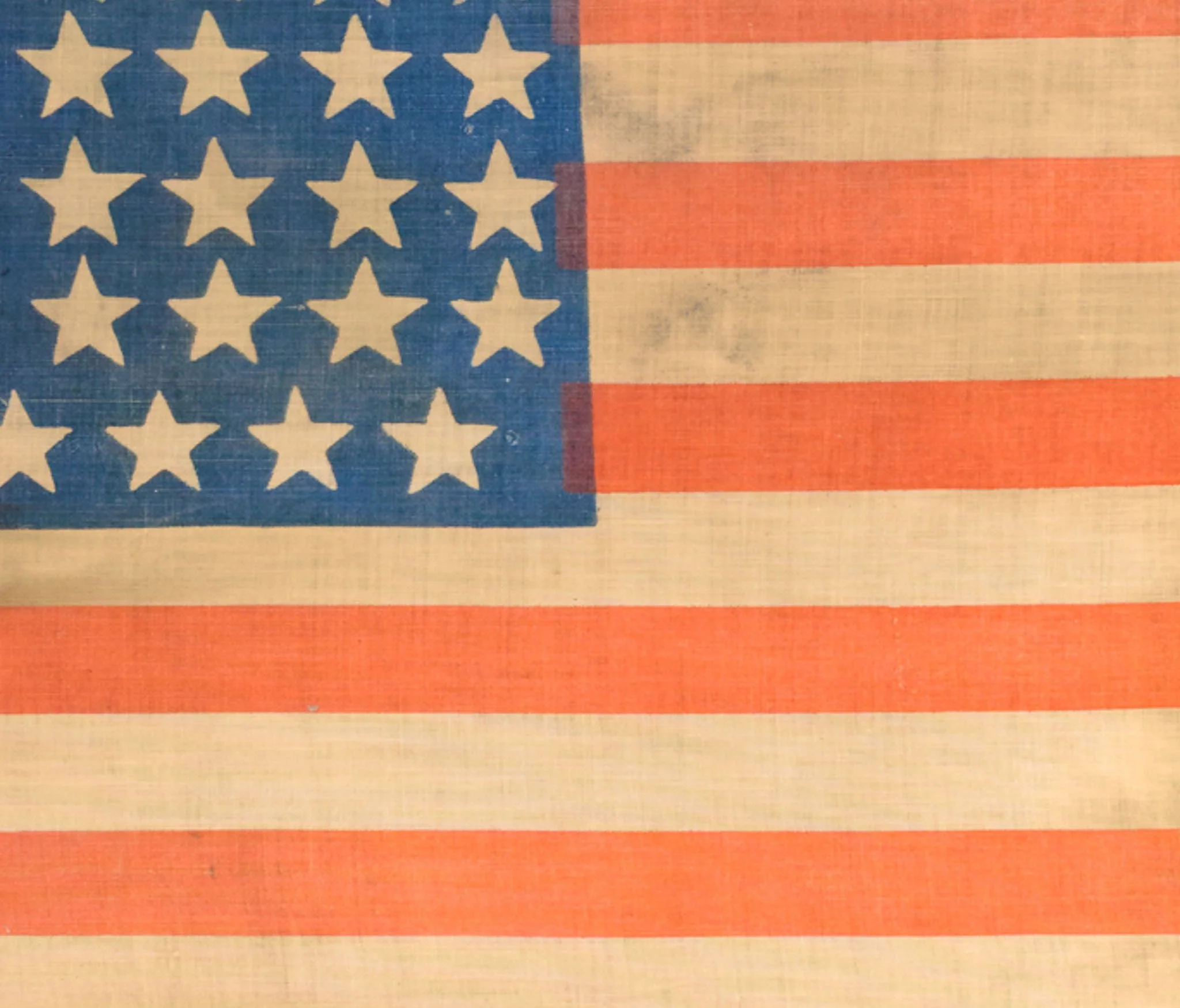
Several technical characteristics further distinguish the flag. The white ground appears to have been printed with white pigment prior to the application of color, a step that would have brightened the fabric and improved color adhesion. Additionally, the flag was printed on both sides, an uncommon feature among parade flags, which were more often printed on one side only, relying on pigment bleed-through to create a usable reverse. This added effort suggests an intent to produce a more visually finished object for display.
The thirty-six stars commemorate the admission of Nevada to the Union on October 31, 1864. Nevada’s statehood was driven by wartime necessity as much as geography. Its rapid admission was designed to reinforce support for President Abraham Lincoln during the 1864 election and to strengthen Republican influence in Congress. Equally significant were Nevada’s vast silver deposits, which were viewed as essential to sustaining Union finances during the war and addressing the immense fiscal demands that followed.
Although Nevada entered the Union in 1864, the 36-star flag did not become official until July 4, 1865, in accordance with federal flag protocol that delayed star additions until the first Independence Day following a state’s admission. As a result, the 36-star flag flew during the immediate postwar moment, when the nation was grappling with reunification, demobilization, and the early stages of Reconstruction. It remained the official flag of the United States until July 3, 1867, when it was superseded by the 37-star flag following Nebraska’s statehood. During this brief but consequential period, the 36-star flag served as a national emblem of a Union preserved at extraordinary cost.
In total, this flag stands as a rare convergence of symbolic design, adaptive manufacture, and historical timing. Its distinctive star arrangement, relationship to known beehive-pattern flags, and close association with the Civil War and its aftermath distinguish it as an intellectually engaging and historically significant example of American patriotic textiles.
Conservation Process: The flag was hand sewn to cotton fabric, and both were hand sewn to a mounting board. To prevent the black dye in the cotton fabric from seeping into the flag, it was first washed in a standard wash and then in a dye setting wash. The flag is positioned behind Optium Museum Acrylic.
Frame: The flag is housed in a wide, sloped molding with an aged gold surface, intentionally distressed to evoke the appearance of early gilded frames. The profile is substantial without being heavy, providing visual weight that complements the period character of the flag while maintaining a clean, restrained presentation.
Condition Report: The flag presents in sound, stable condition for its age, with expected wear consistent with mid-19th-century parade flags. There is moderate staining and discoloration along the hoist end, accompanied by scattered areas of minor pigment loss and surface abrasion throughout, most notably within the canton and along the stripes. The fabric remains intact overall, with light fraying at the edges and no major structural losses, allowing the flag to display well while retaining clear evidence of period use and age.
Collectability Level: The Best – Perfect for Advanced Collectors
Date of Origin: 1864-1867
Number of Stars: 36
Associated War: Civil War (1861-1865)
Associated State: Nevada