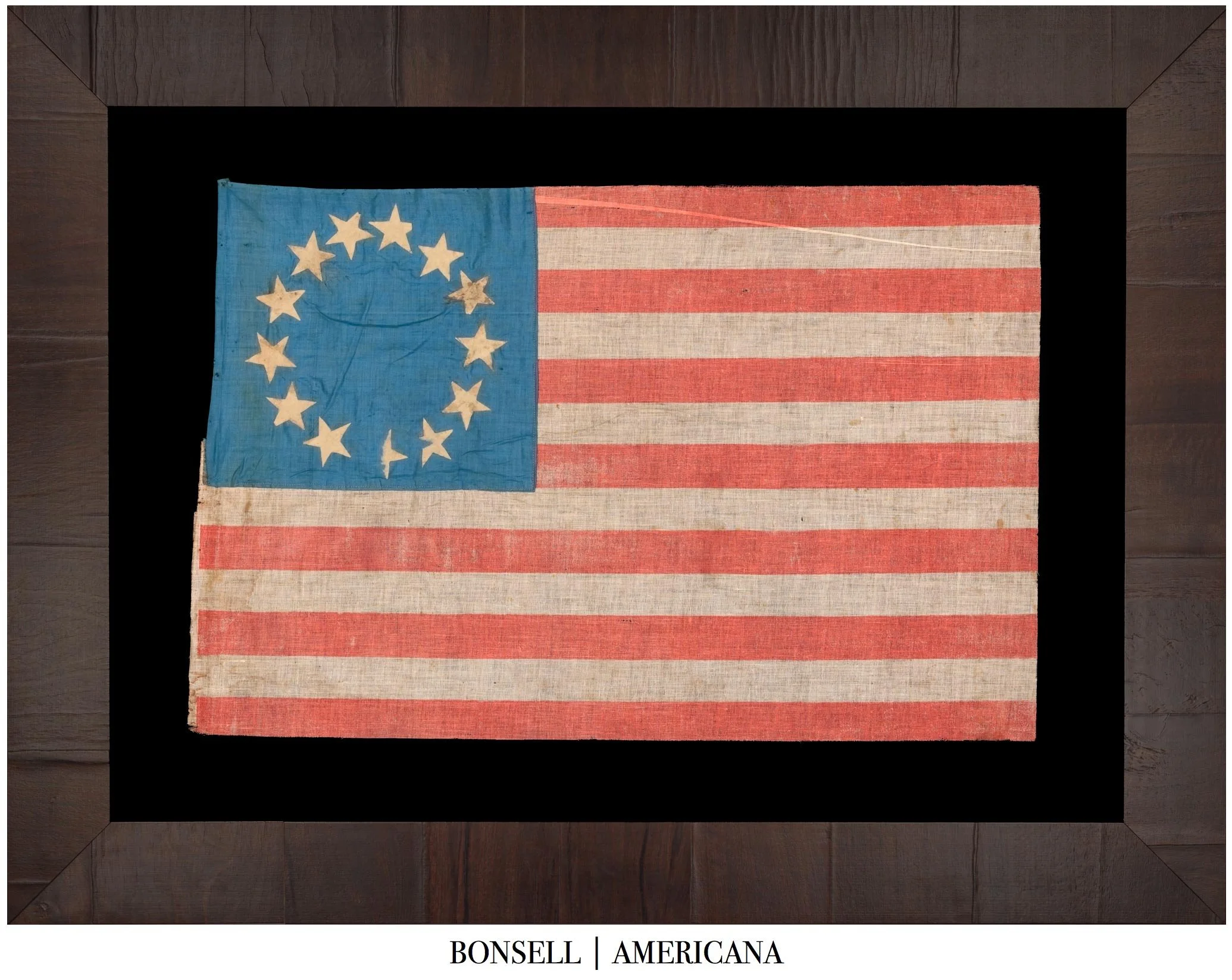
36 Star Antique American Flag with a Massive Center Star and Distinct Parenthesis Pattern | One of Three Known Examples | Circa 1864–1867
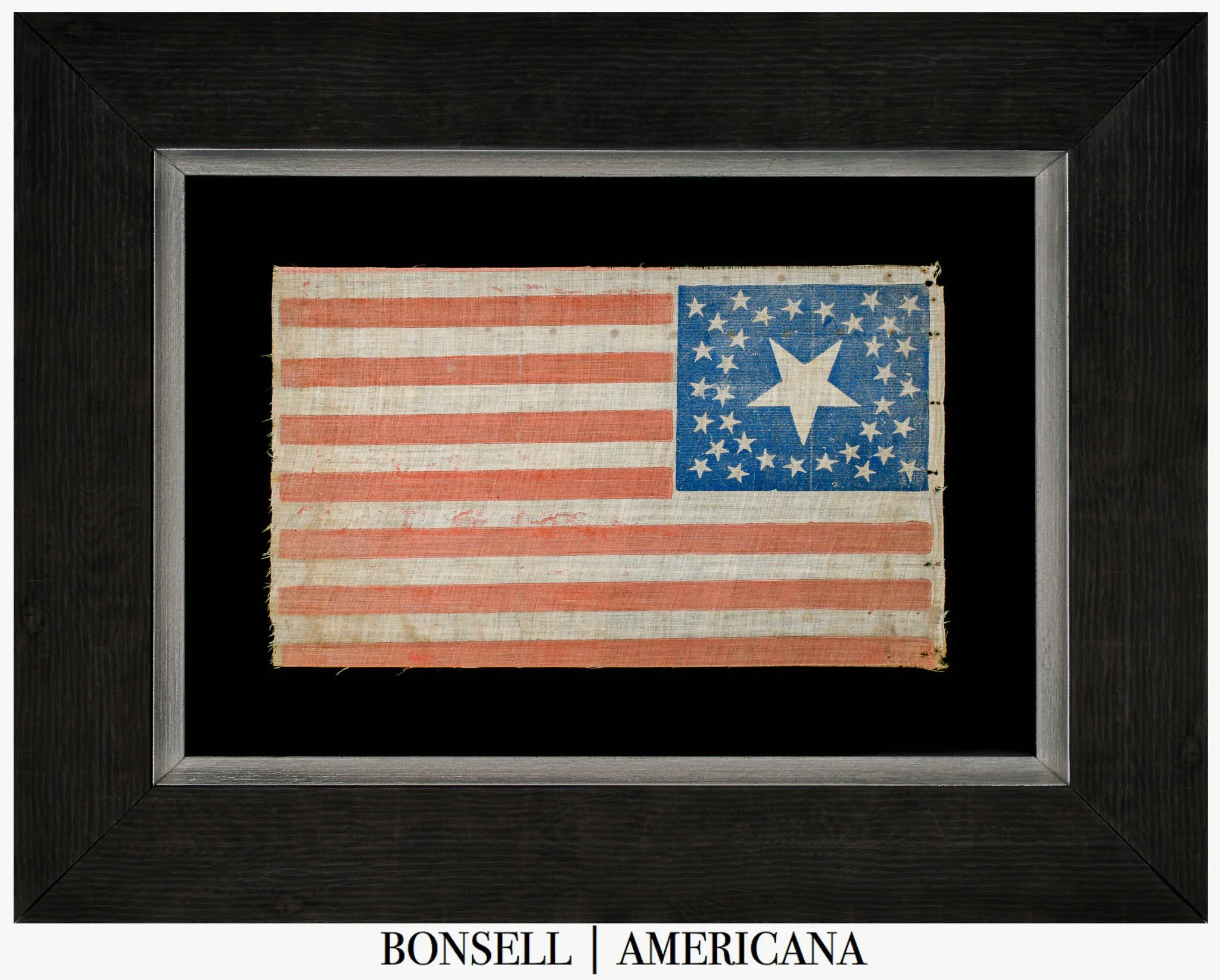
36 Star Antique American Flag with a Massive Center Star and Distinct Parenthesis Pattern | One of Three Known Examples | Circa 1864–1867
Frame Size (H x L): 18.5” x 24”
Flag Size (H x L): 8.5” x 14”
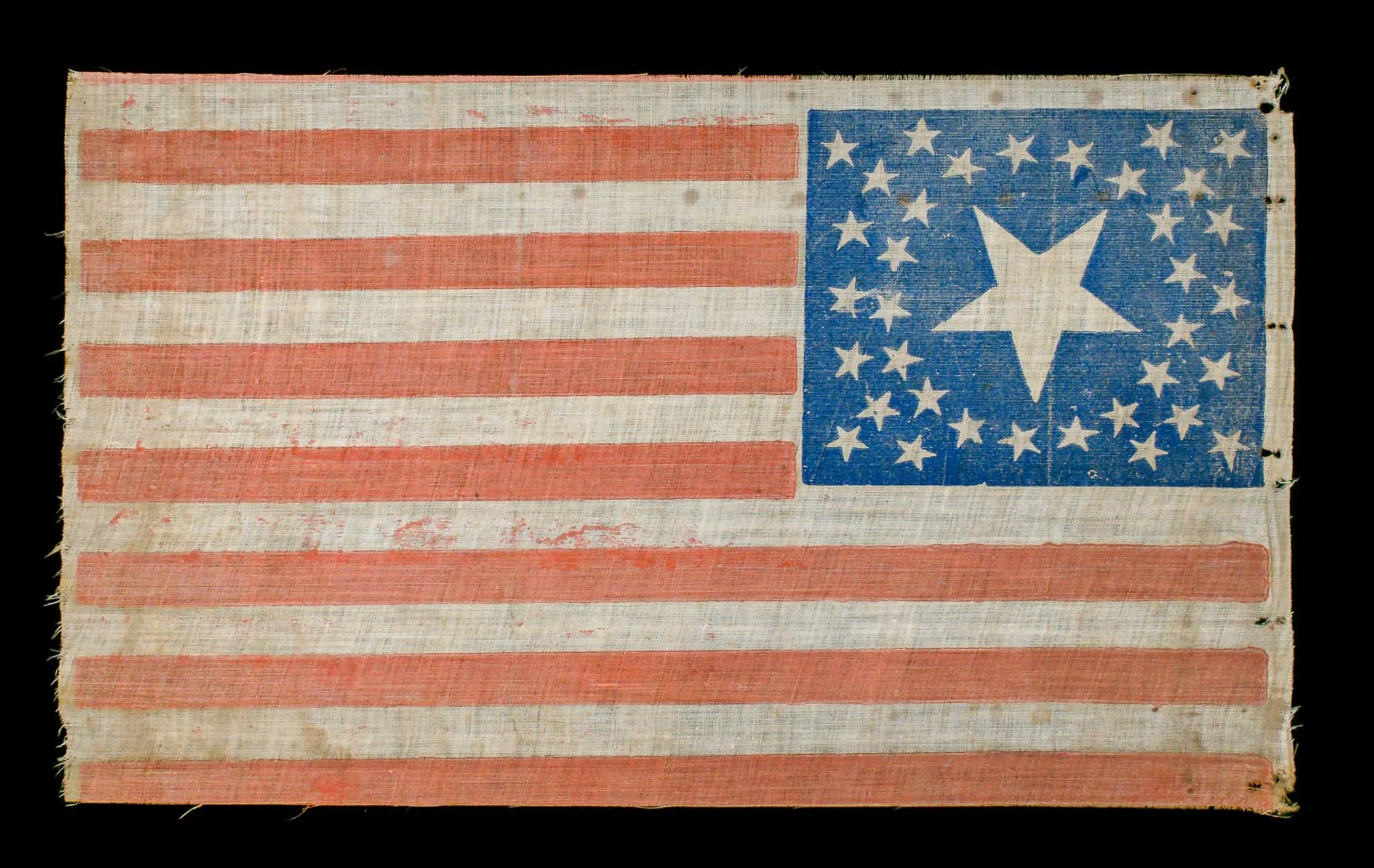
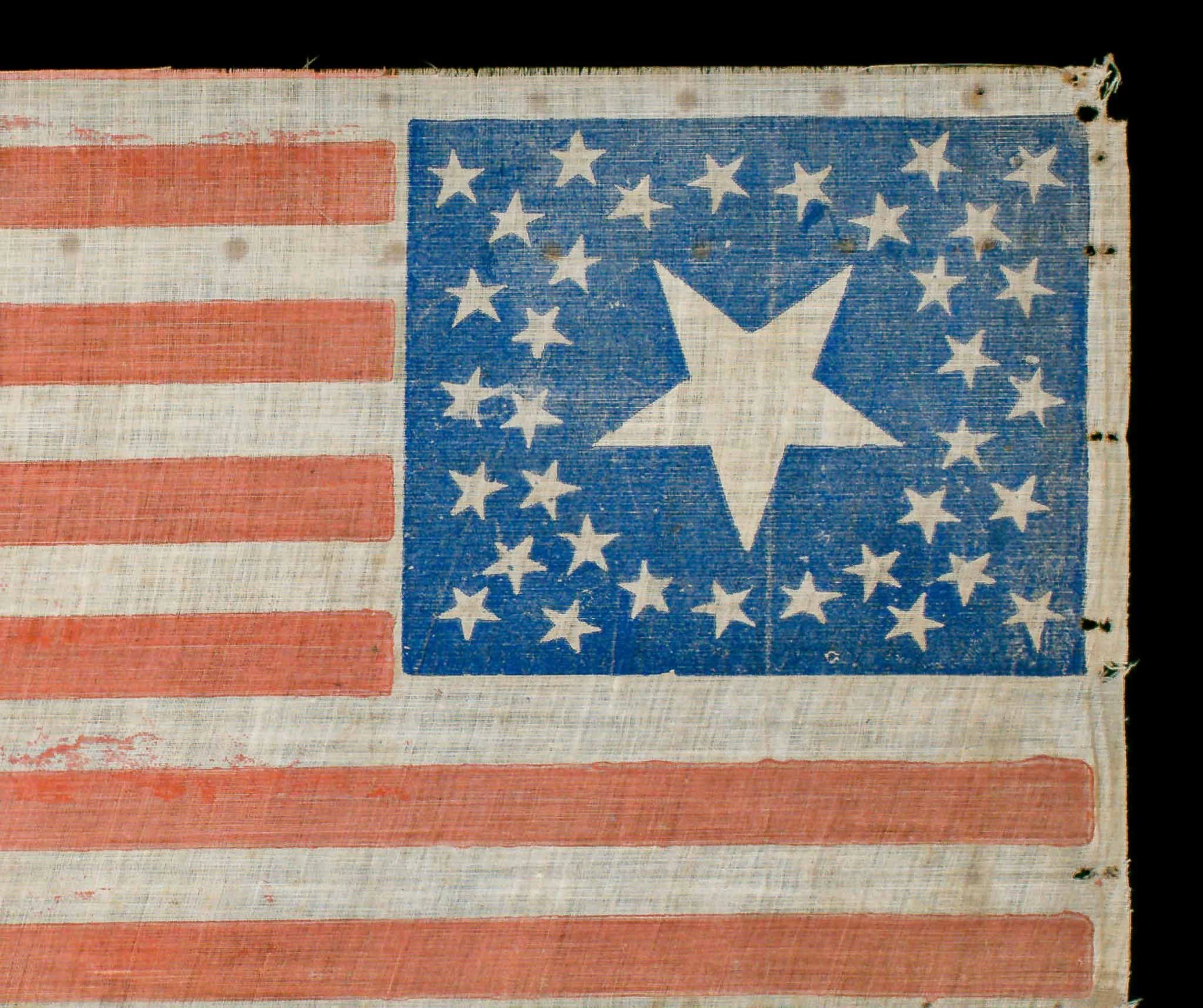
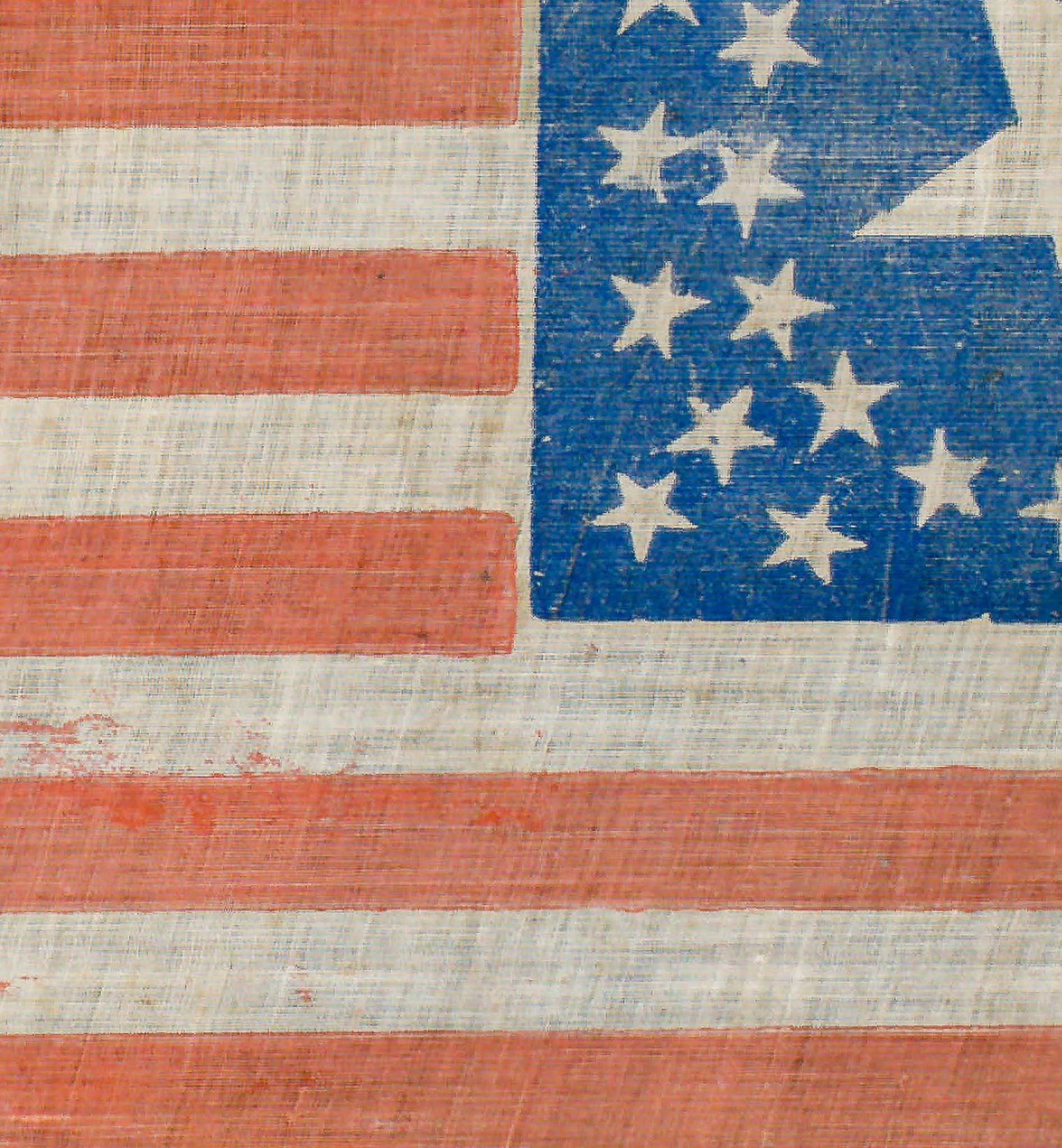
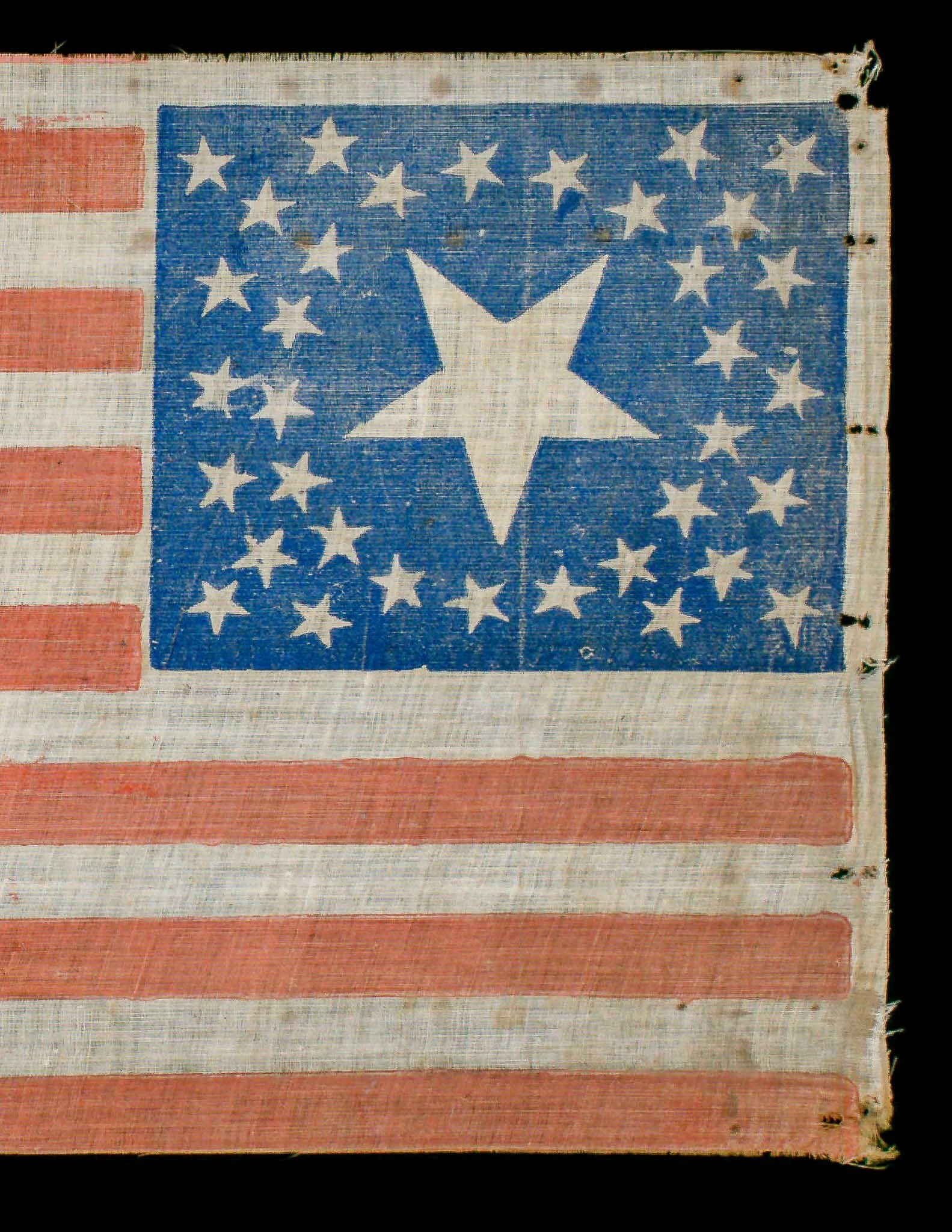
Offered is a thirty-six star antique flag, printed on coarse glazed cotton and bearing one of the most unusual and distinctive star configurations known in 19th-century American flags. The design features a massive central star set in the middle of the canton. Encircling it is a wreath of seventeen stars, followed by a larger parenthesis of fourteen stars—seven to the left and seven to the right. Four additional stars, one in each corner of the canton, frame the entire composition. Together, these elements form a clear and deliberate arrangement that is highly structured and visually balanced.
The use of a parenthesis formation in a star pattern is exceptionally rare. While 19th-century flag makers employed a wide range of designs—including medallions, wreaths, great stars, and snowflakes—very few surviving examples include a true left-right arc that resembles a bracketed enclosure. In the few that do, the arcs are typically subtle and easily lost within a field of other stars. In contrast, the parenthesis on this flag is plainly visible and integral to the design. We are aware of only three examples of this exact configuration, and no other known pattern presents the parenthesis in this prominent a way.
The massive center star is a form sometimes referred to as a “center star,” a feature occasionally used to represent the newest state admitted to the Union. In this case, that state is Nevada. Center stars are usually only modestly larger than surrounding stars. Here, however, the center star is dramatically oversized and dominates the canton. It is also inverted, with one point facing downward. The reasons for this orientation are unclear. In many cases, 19th-century makers did not follow a standard orientation and may not have viewed any one direction as “up.”
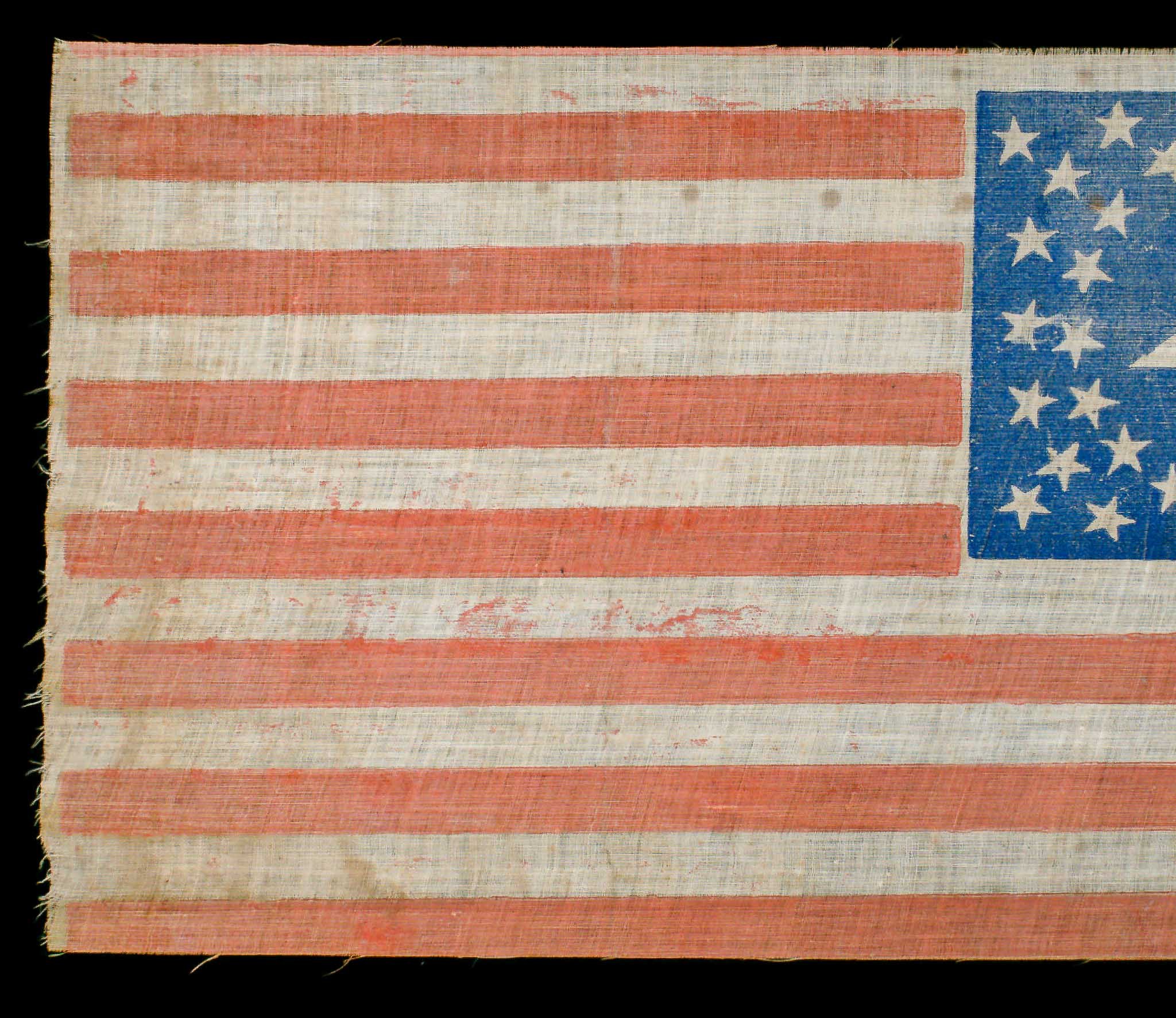
The remaining stars are irregular in shape and size. The stripes have faded to a salmon or orange hue, which aligns with the use of madder or cochineal dyes—commonly used between 1850 and 1880—and known to fade in this way over time.
This flag includes an extra white stripe along the top, an unusual but not symbolic feature. It likely results from how the flag was cut from a larger bolt of glazed cotton that included multiple printed flags. Depending on the cut, individual examples could include one or more additional stripes. In this case, the extra stripe adds visual interest.
This is the third known example of this flag type. One is held in the Pierce Collection of American Parade Flags and is published on page 18 of The Stars and Stripes: Fabric of the American Spirit. A second example previously passed through our hands.
Thirty-six star flags represent the admission of Nevada to the Union. Although Nevada became a state on October 31, 1864, the thirty-six star flag became official on July 4, 1865. That date came shortly after the end of the Civil War, and the flag is often associated with Union victory and the early years of Reconstruction. The thirty-six star flag remained official until July 4, 1867, when the thirty-seven star flag was adopted to include Nebraska.
Nevada’s admission was driven by both political and economic motives. It occurred just eight days before President Lincoln’s re-election, bolstering Republican electoral strength. Economically, Nevada’s silver mining industry was seen as important to financing the Union’s war debt. The state’s borders were later expanded in 1866 and again in 1867, adding land from the Utah and Arizona territories.
This flag stands out for its oversized center star, visible parenthesis arrangement, and added stripe—features that place it among the most distinctive and scarce known designs from the Civil War era.
Conservation Process: This flag was hand sewn to cotton fabric, and both were hand sewn to a mounting board. To prevent the black dye in the cotton fabric from seeping into the flag, it was first washed in a standard wash and then in a dye setting wash. The flag is positioned behind Optium Museum Acrylic.
Frame: The flag is presented in a custom two-part frame. The outer frame is a dark wood with a subtle grain texture, while the inner liner is a metallic silver, offering a clean contrast that highlights the colors and form of the flag.
Condition Report: The flag is in sound condition, with moderate wear consistent with age and use. Toning and soiling are present throughout, and there is some minor fraying along the edges. The colors have faded, particularly the red stripes, which now appear as a muted orange—typical of madder-based dyes used during the period. A line of old nail holes runs vertically along the right edge, evidence of the flag’s original attachment to a wooden staff.
Collectability Level: The Best – Perfect for Advanced Collectors
Date of Origin: 1864-1867
Number of Stars: 36
Associated War: Civil War (1861-1865)
Associated State: Nevada