37 Star American Flag Advertising Trade Card | J. Jay Gould’s Picture Store | Unusual Medallion of Stars, Overprint in Red Stripes | Nebraska Statehood | Circa 1867–1876
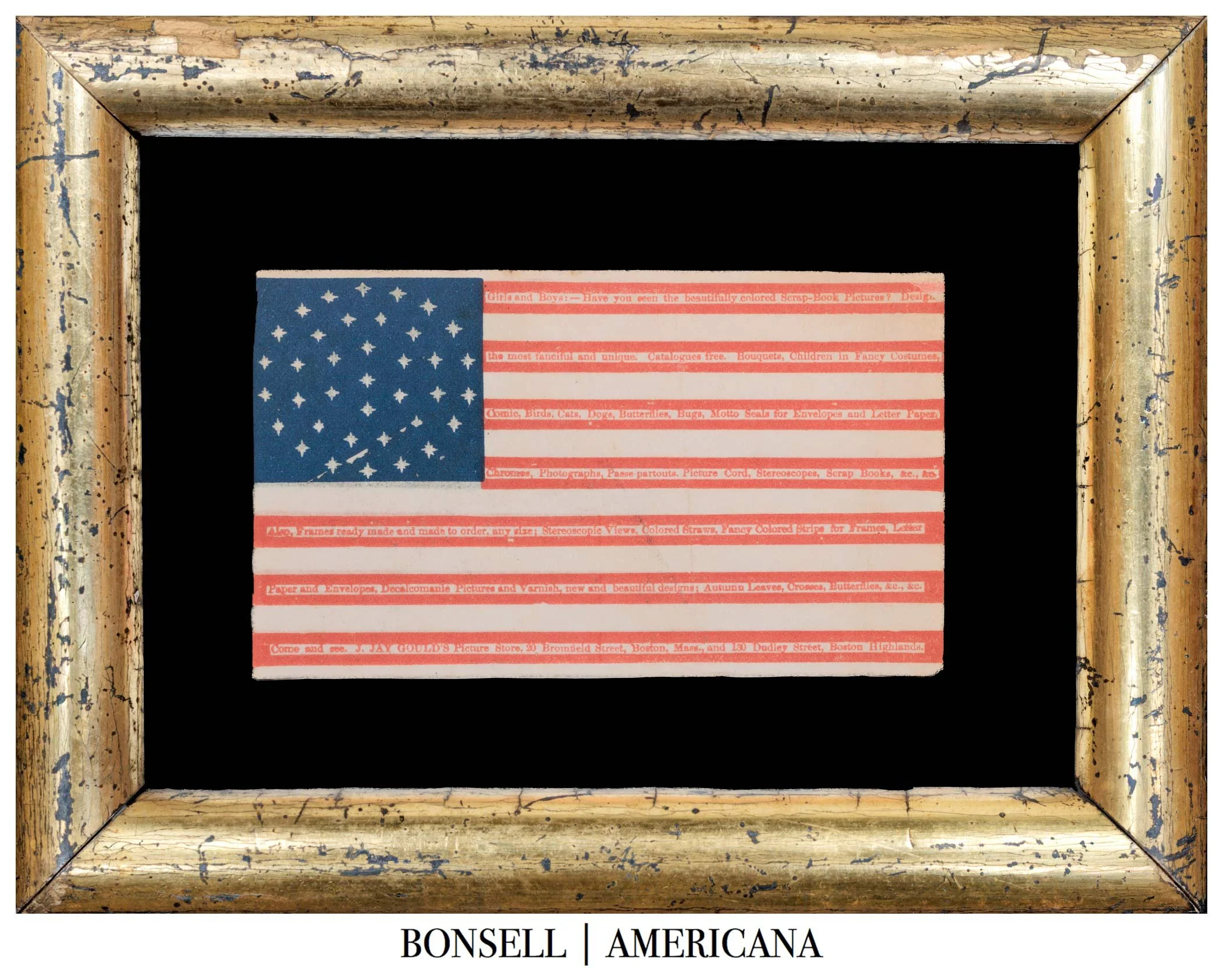
37 Star American Flag Advertising Trade Card | J. Jay Gould’s Picture Store | Unusual Medallion of Stars, Overprint in Red Stripes | Nebraska Statehood | Circa 1867–1876
Frame Size (H x L): 6.5” x 8.5”
Flag Size (H x L): 2.75” x 5”
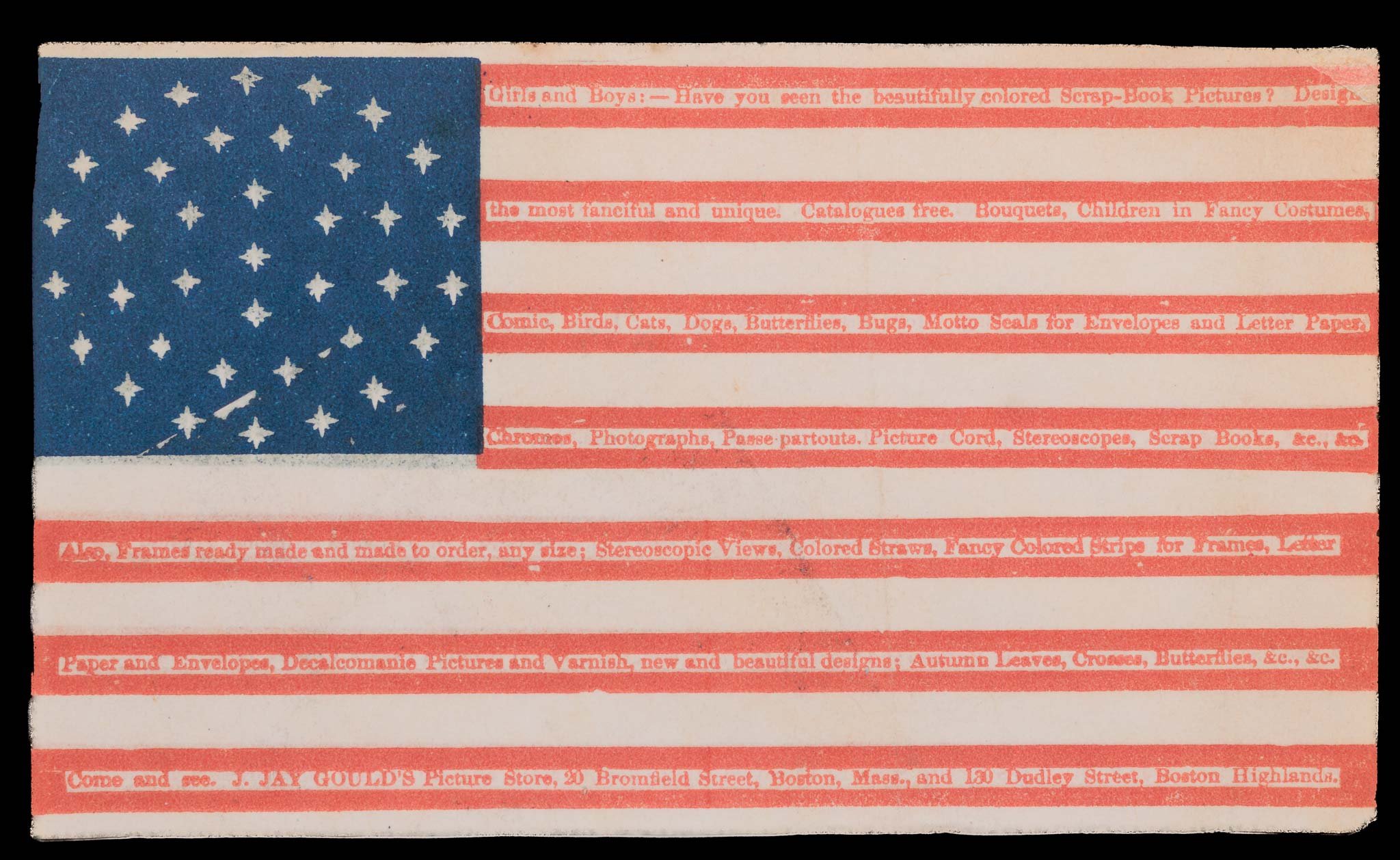
Offered is a 37-star American flag trade card, printed on paper and featuring an advertising overprint for J. Jay Gould’s Picture Store of Boston. Patriotic trade cards were widely produced in the late 19th century, but examples that combine an early star count with unusual graphic treatment and integrated advertising are less often encountered.
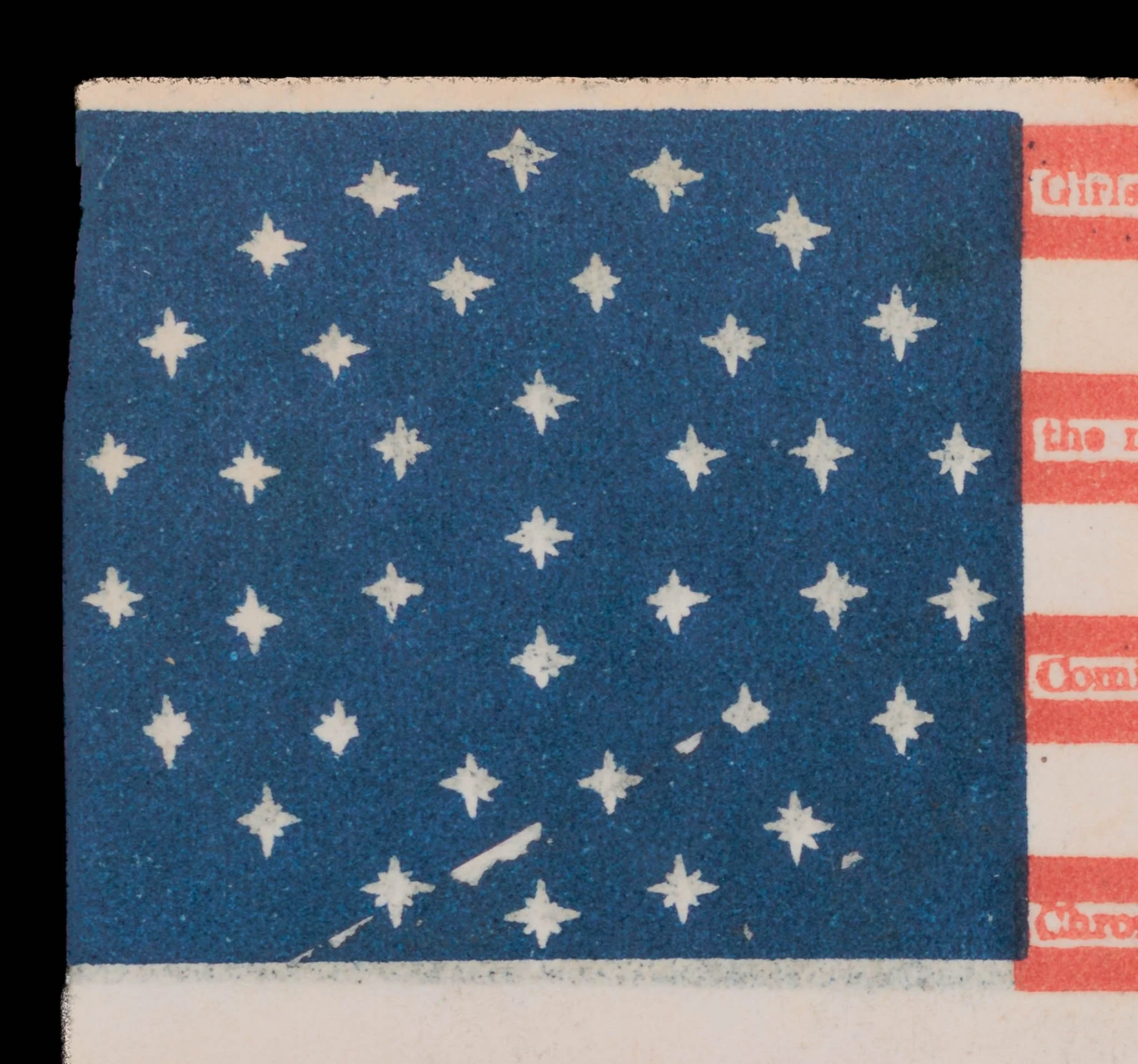
The star pattern is one of the more distinctive features. Arranged in a medallion formation with no outlying corner stars, the design departs from more typical linear or grid-based configurations. The stars themselves are also unusual. Rather than rounded or conventionally pointed forms, they have sharp, irregular points that give them an almost bursting appearance. The result is a more animated and expressive design than is usually seen in small printed flags of the period.
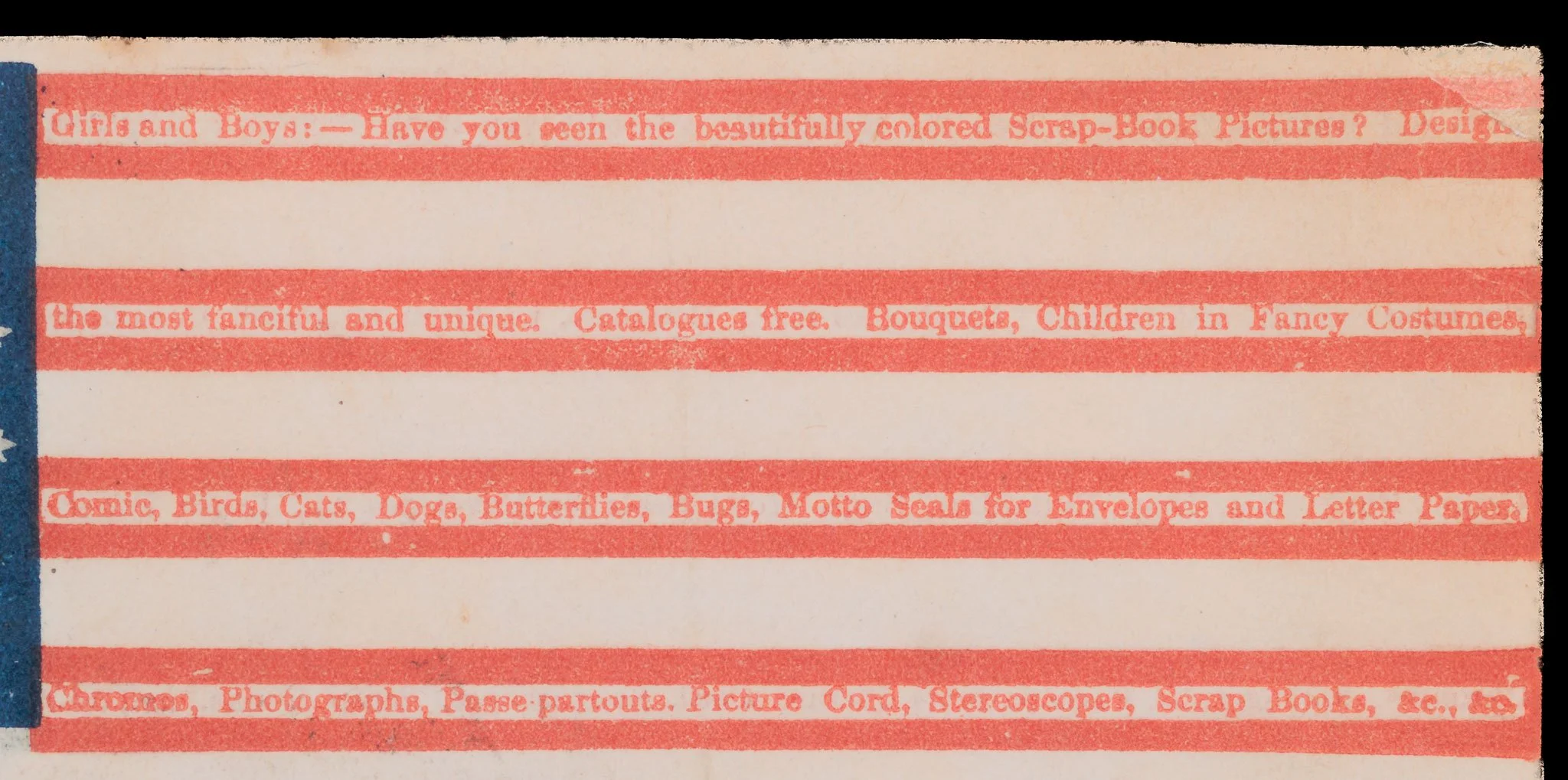
The placement of the advertising text is equally noteworthy. The overprint appears within the red stripes, executed in white lettering. In most known examples of overprinted patriotic paper items, text is placed in the white stripes for clarity and contrast. Here, the choice to print within the red required more careful registration and produced a more integrated effect, with the advertising functioning as part of the overall flag design rather than as a separate layer added afterward. This is an uncommon feature and one of the card’s most interesting visual characteristics.
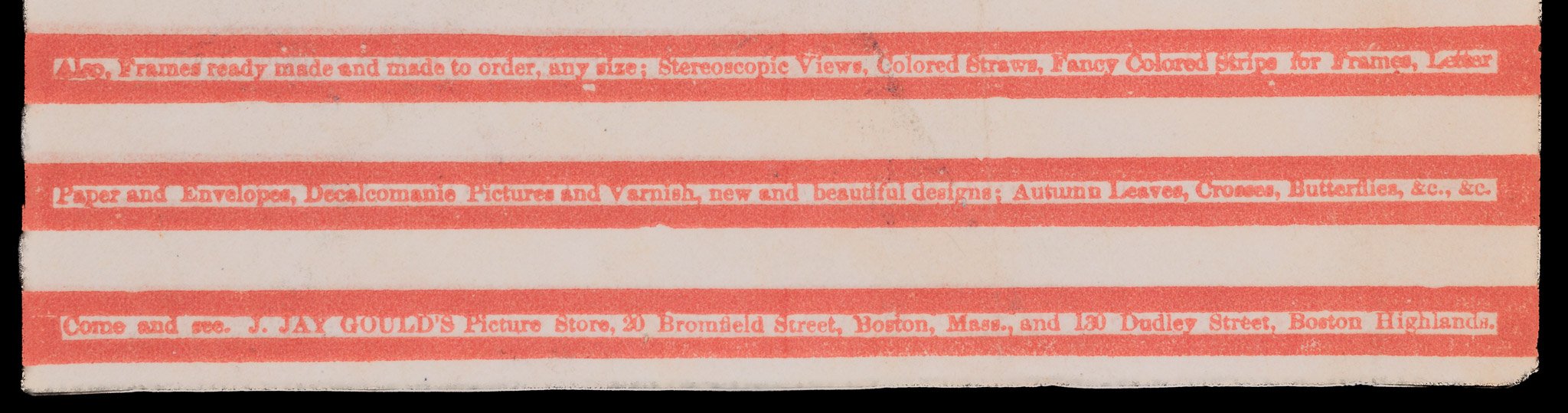
The contents of the overprint offer insight into both the business itself and the consumer culture of the period. The text advertises “beautifully colored scrap-book pictures,” with catalogues offered free, and promotes a broad assortment of decorative and novelty goods. Among the subjects mentioned are bouquets, children in fancy costumes, comic scenes, animals, butterflies, and motto subjects for scrapbooks and letter paper. References to stereoscopic views and colored engravings reflect the strong demand for affordable visual material in the years after the Civil War, while the mention of frames made to order and “fancy colored mats” suggests that the shop also served customers interested in the display of images in the home. Other items, including albums, photographs, passe-partouts, picture cords, and ornamental paper goods, further indicate a business centered on the sale of inexpensive, attractive, mass-produced imagery and related decorative materials. Taken together, the overprint reads almost like a condensed catalogue of popular visual culture in the period.
The advertisement identifies J. Jay Gould’s Picture Store at 20 Bromfield Street and 120 Dudley Street in Boston. The presence of two addresses suggests an established retail operation serving different parts of the city, and the specificity of the imprint is useful both historically and for dating purposes. Trade cards such as this were intended to advertise, but they were also meant to be kept. Their small format, colorful presentation, and novelty value made them ideal for retention in albums and scrapbooks, which helps explain why surviving examples remain of interest today.
From a collecting standpoint, the piece sits at the intersection of early American flags and 19th-century advertising ephemera. The unusual star shapes, medallion configuration, and red-stripe overprint distinguish it from more standard examples, while its small format reflects its original purpose as a portable promotional item.
The 37-star count corresponds to Nebraska’s admission as the 37th state on March 1, 1867. The official 37-star flag remained in use from July 4, 1867 through July 3, 1877, placing this card within the Reconstruction era and into the years leading up to the 1876 Centennial, when patriotic imagery was widely employed in both civic and commercial settings. The star count therefore provides a clear historical framework for the piece.
Overall, this is a strong example of late 19th-century patriotic advertising, made more interesting by several features not commonly encountered in combination. The unusual medallion star pattern, the sharply stylized stars, the placement of the overprint in the red stripes, and the specific connection to a Boston picture store all contribute to its appeal. It is a compact but layered object that brings together graphic interest, historical context, and crossover value for collectors of both flags and advertising ephemera.
Frame: The card is housed in an antique frame with a lemon gold finish, characterized by a soft, pale gilt tone with a gentle luster. The finish is consistent with mid- to late-19th century gilt frames, circa 1850–1880, and presents a refined, understated appearance typical of the period.
Condition Report: The trade card has been professionally conserved by a paper conservator. There is expected light toning and minor wear consistent with age and handling, but the surface remains stable and well-preserved. Any prior issues have been addressed through conservation, allowing the piece to present cleanly while retaining appropriate signs of age.
Collectability Level: The Great – Perfect for Rising Collectors
Date of Origin: 1867-1876
Number of Stars: 37
Associated War: The Indian Wars (1860-1890)
Associated State: Nebraska