British Schoolboy Rowing Flags | Group of Four Documenting Student D. Cole’s Progression | A Classic Gentleman’s Sporting Relic | Circa 1948–1951
British Schoolboy Rowing Flags | Group of Four Documenting Student D. Cole’s Progression | A Classic Gentleman’s Sporting Relic | Circa 1948–1951
Frame Size (H x L): 28.5” x 13”
Flag Size (H x L): 4” x 5.75”
Offered is a rare and engaging group of four mid-20th century rowing pennants, produced for competition at Eton College and dating from 1948 through 1951. Hand-lettered on fabric and originally mounted to small staffs, these flags document the progress of a single oarsman—identified throughout as “D. Cole”—within one of the most tradition-rich athletic systems in the world.
Founded in 1440 by King Henry VI, Eton College stands among the most storied educational institutions globally. Though termed a “public school” in England, it is in fact an elite, all-boys boarding school, long associated with Britain’s political and cultural leadership. For American audiences, it may be best understood as a hybrid of a top preparatory academy and a historic institution of national identity. Its traditions are both preserved and performed—uniforms, ceremonies, and hierarchies remaining largely intact across centuries. Its alumni include numerous British prime ministers, among them Boris Johnson and David Cameron, as well as literary figures such as George Orwell.
Rowing occupies a central place within this culture. Situated along the River Thames, Eton developed one of the most competitive and structured schoolboy rowing programs in existence. Under the auspices of the Eton College Boat Club, students are organized into multiple crews by age, experience, and ability, competing both internally and in prestigious external events such as the Henley Royal Regatta. Advancement through these crews is a defining aspect of student life, reflecting discipline, endurance, and status within the school.
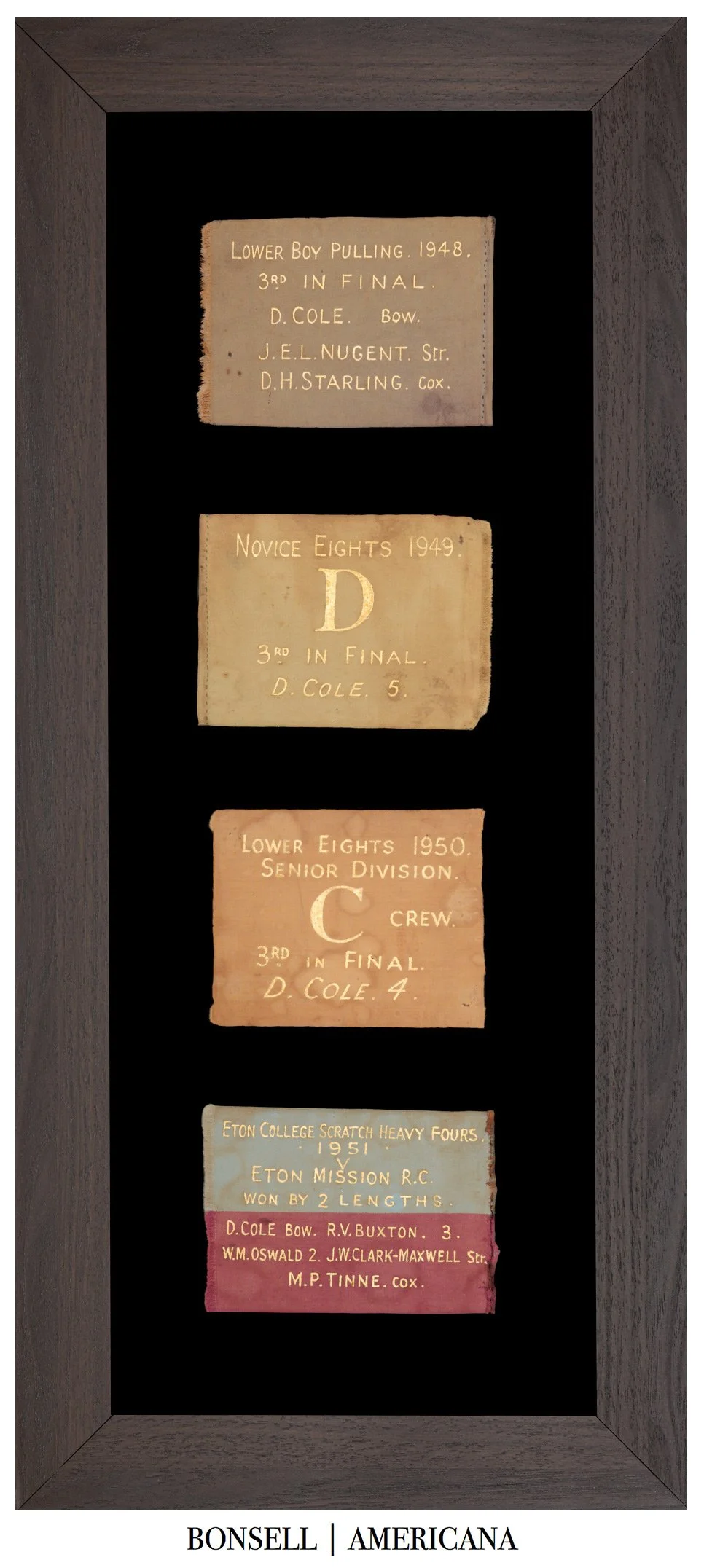
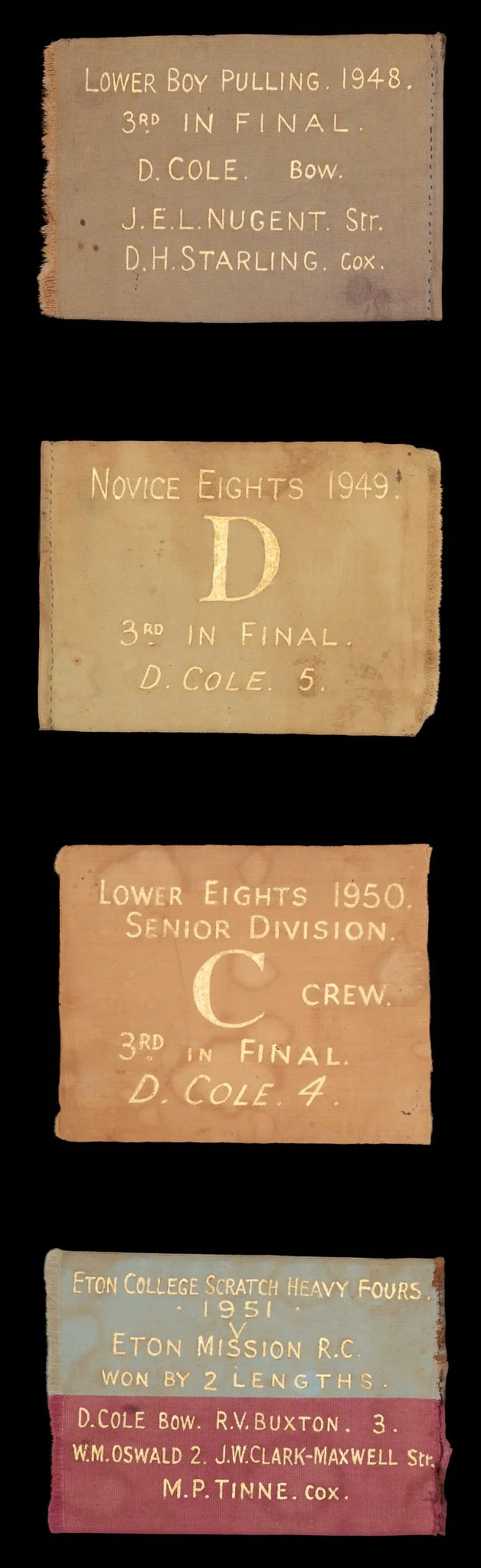
The present group captures this progression in tangible form. Each flag records a specific race, division, and outcome, offering a concise but remarkably vivid record of participation:
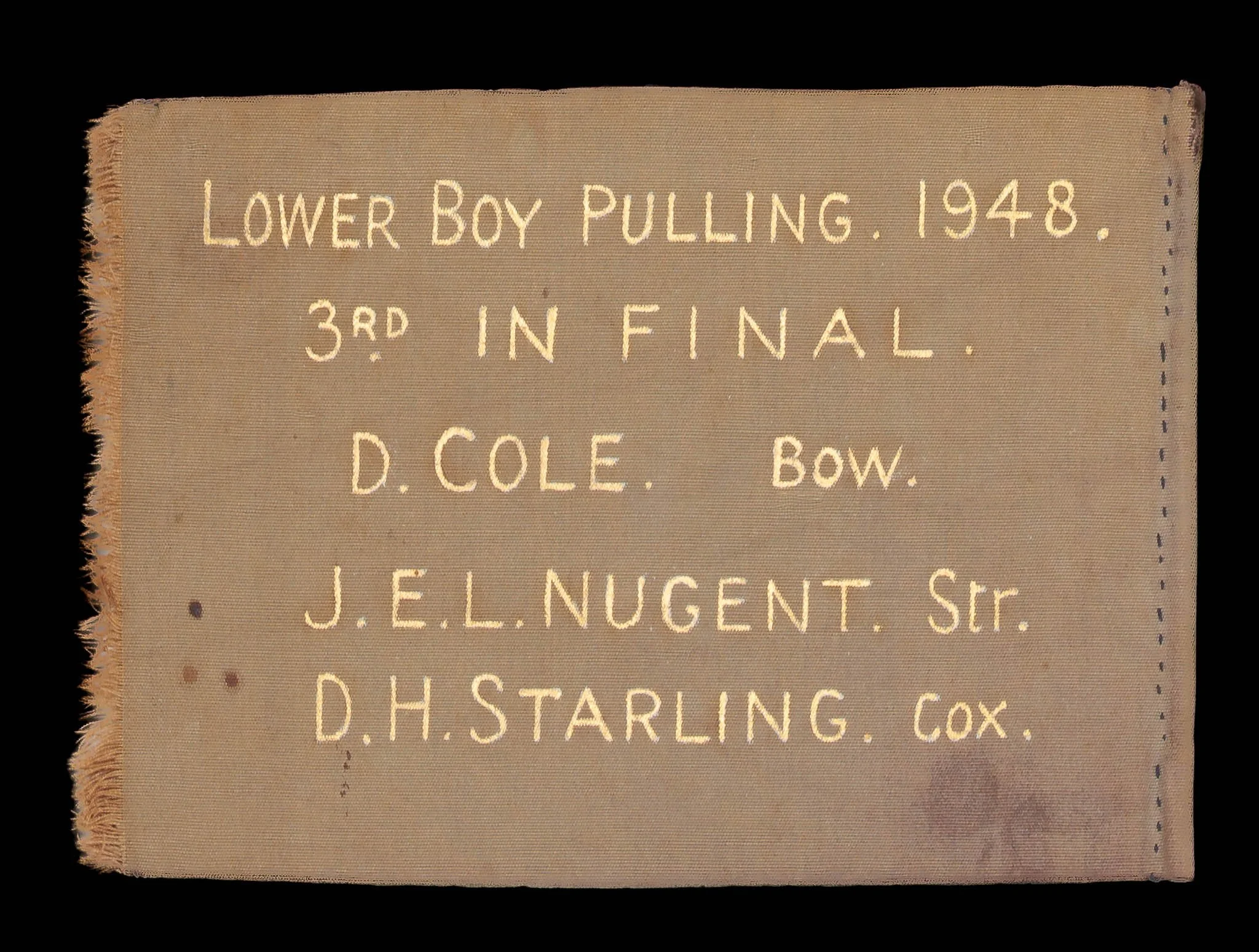
The earliest example, dated 1948, is inscribed “Lower Boy Pulling, 3rd in Final,” and lists the full crew by position, including bow, stroke, and coxswain. In rowing terms, “Lower Boy” denotes a younger division, indicating early participation. The fabric is a natural, undyed tone, with hand-painted lettering in a pale gold or cream pigment, and a roughly finished edge that suggests utilitarian production.
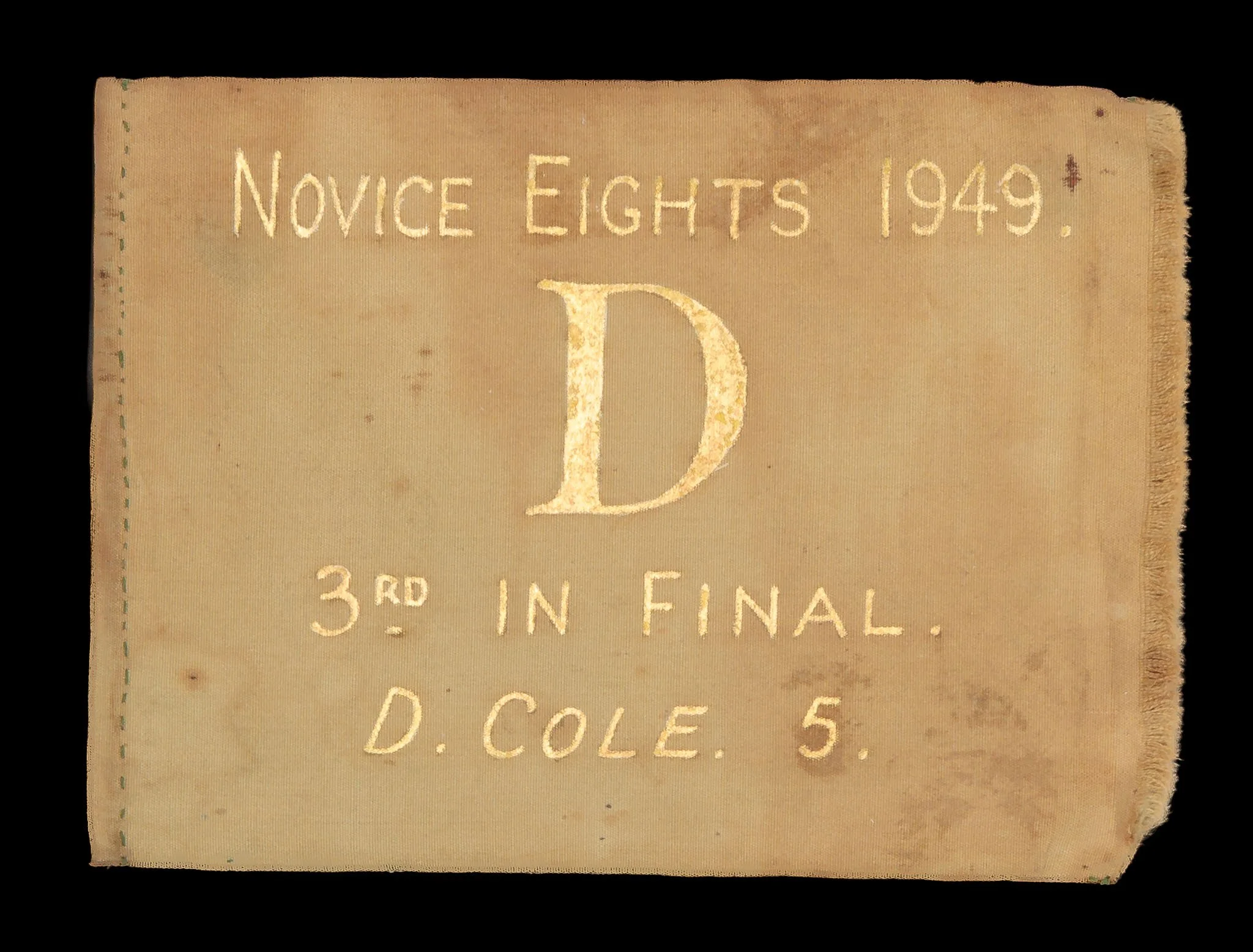
The 1949 flag, labeled “Novice Eights,” reflects the next stage. An “eight” refers to a boat crewed by eight rowers plus a coxswain, and “novice” indicates limited prior experience. The large letter “D” identifies the specific crew within the broader field—Eton commonly designates its multiple boats alphabetically. Again, the crew placed third in the final, and D. Cole appears in seat five, a central rowing position.
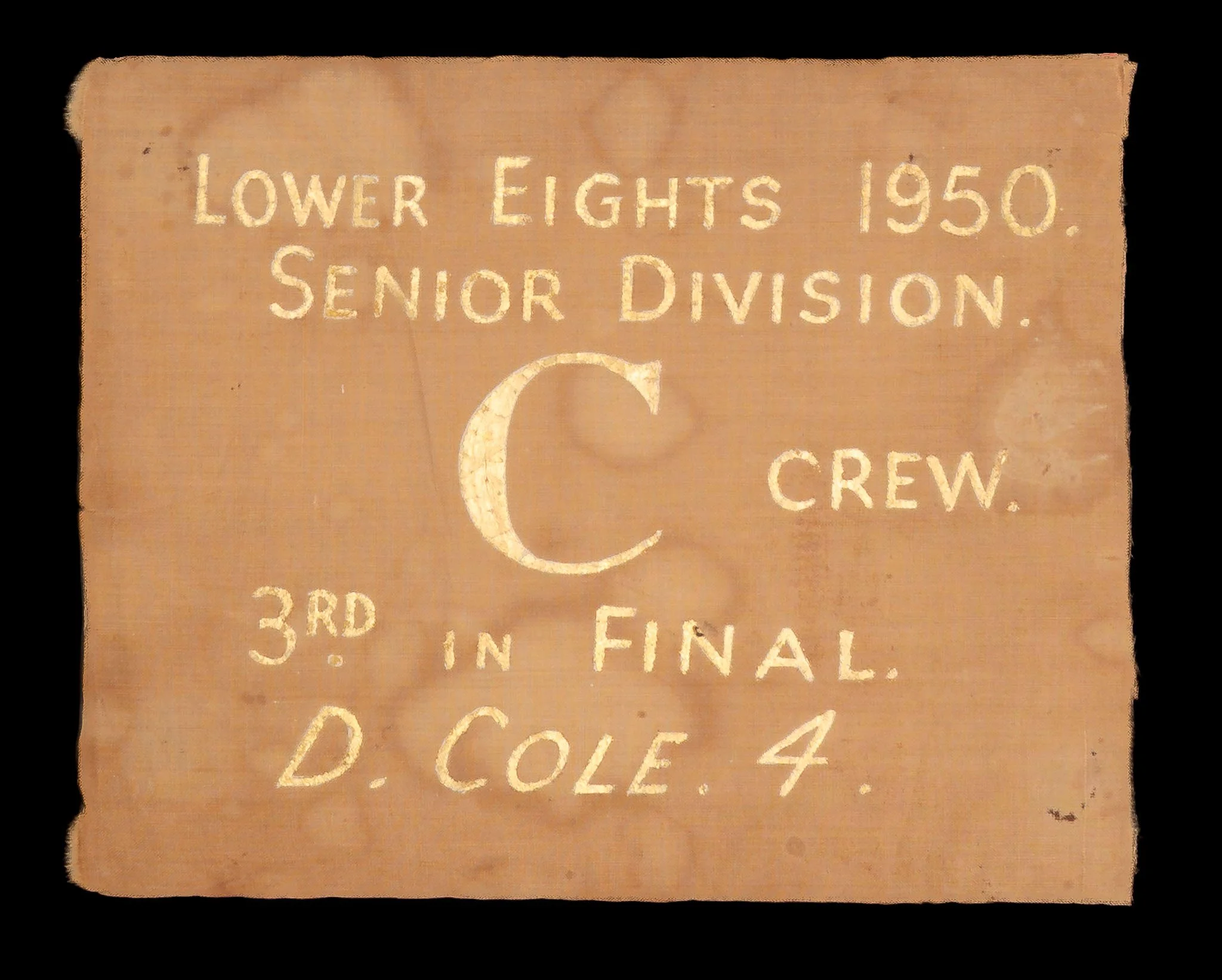
By 1950, the inscription reads “Lower Eights, Senior Division, C Crew.” This indicates advancement into a more competitive grouping, with “Senior Division” suggesting increased experience and performance level. The flag retains the same general format—hand-lettered text on a plain fabric ground—but shows slightly deeper coloration, likely from age or variation in material.
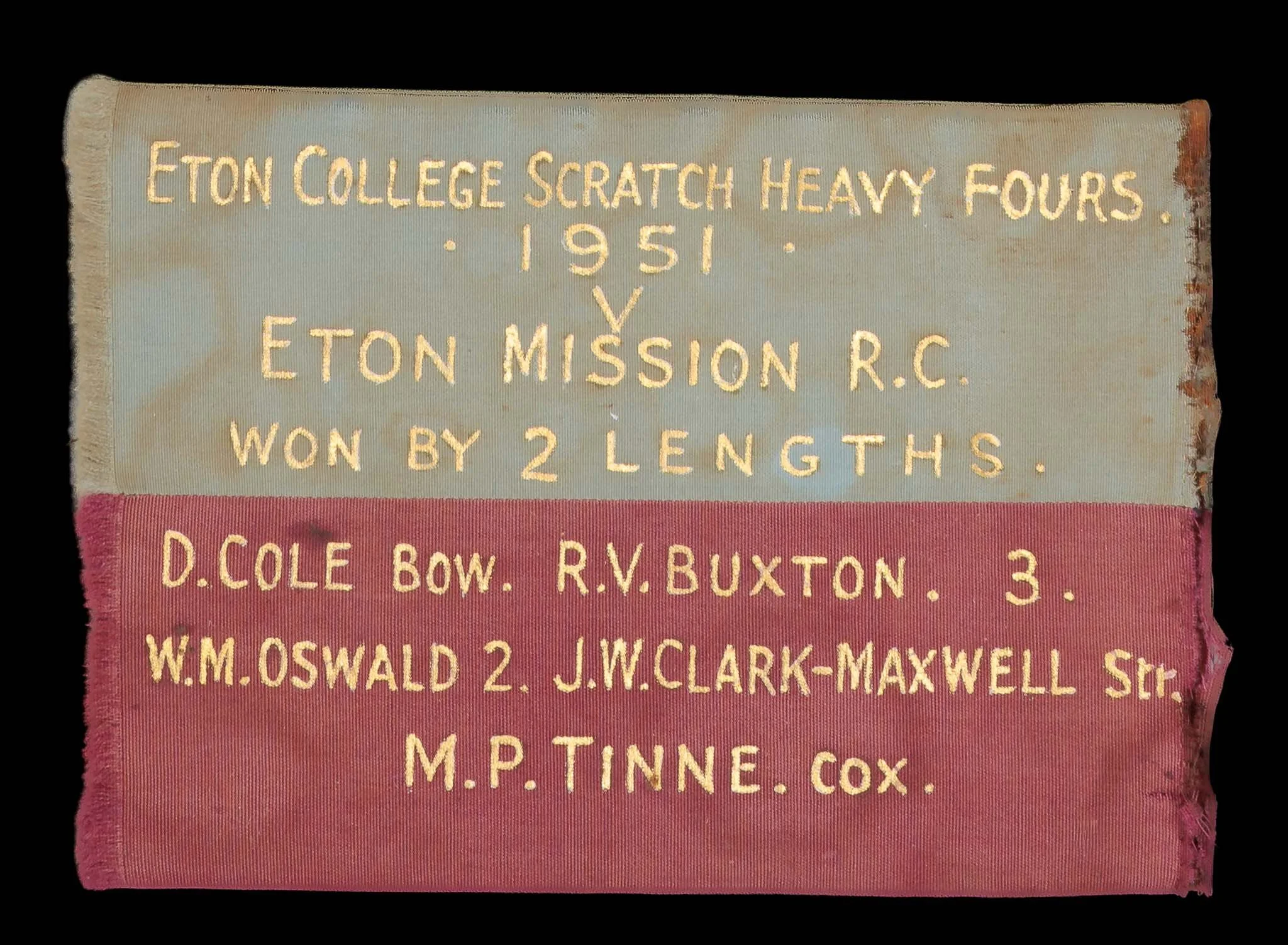
The final example, dated 1951, is the most visually distinctive. Titled “Eton College Scratch Heavy Fours,” it refers to a four-man boat assembled for a specific event (“scratch” meaning not a fixed crew). The two-tone coloration—light above and a reddish lower field—may relate to crew or event designation. Unlike the others, this flag records a victory: “Won by 2 Lengths.” It also references “Eton Mission R.C.,” a charitable rowing initiative associated with the school’s outreach efforts in London. The full crew is again listed, with D. Cole returning to the bow position.
Across all four examples, the consistent presence of D. Cole allows the group to be understood not merely as isolated artifacts, but as a cohesive record of athletic development over time—moving from junior to more advanced divisions within a highly structured system.
Taken together, these pennants offer a compelling intersection of sport, education, and social history. They speak to the traditions of Eton College, the discipline of competitive rowing, and the personal narrative of a student progressing through both. At once modest in scale and rich in context, they represent the sort of “gentleman’s antique” that resonates through association—where institution, tradition, and lived experience converge in a quietly meaningful way.
Conservation Process: The flag was hand sewn to cotton fabric, and both were hand sewn to a mounting board. To prevent the black dye in the cotton fabric from seeping into the flag, it was first washed in a standard wash and then in a dye setting wash. The flag is positioned behind Optium Museum Acrylic.
Frame: The frame features a broad, flat face with a clean, squared profile and a gently stepped inner rabbet, finished in a deep walnut tone.
Condition Report: The 1948 example shows moderate fraying along the hoist edge, with minor scattered staining and light surface soiling, consistent with use. The 1949 flag exhibits similar edge wear, along with areas of discoloration and toning to the fabric, particularly toward the right side. The 1950 example presents with more pronounced overall toning and light surface wear, though the lettering remains clear and legible. The 1951 pennant, the most visually distinctive, shows expected wear at the edges and some color variation and minor staining, particularly along the upper right, consistent with age and handling.
Collectability Level: The Great – Perfect for Rising Collectors
Date of Origin: 1948-1951