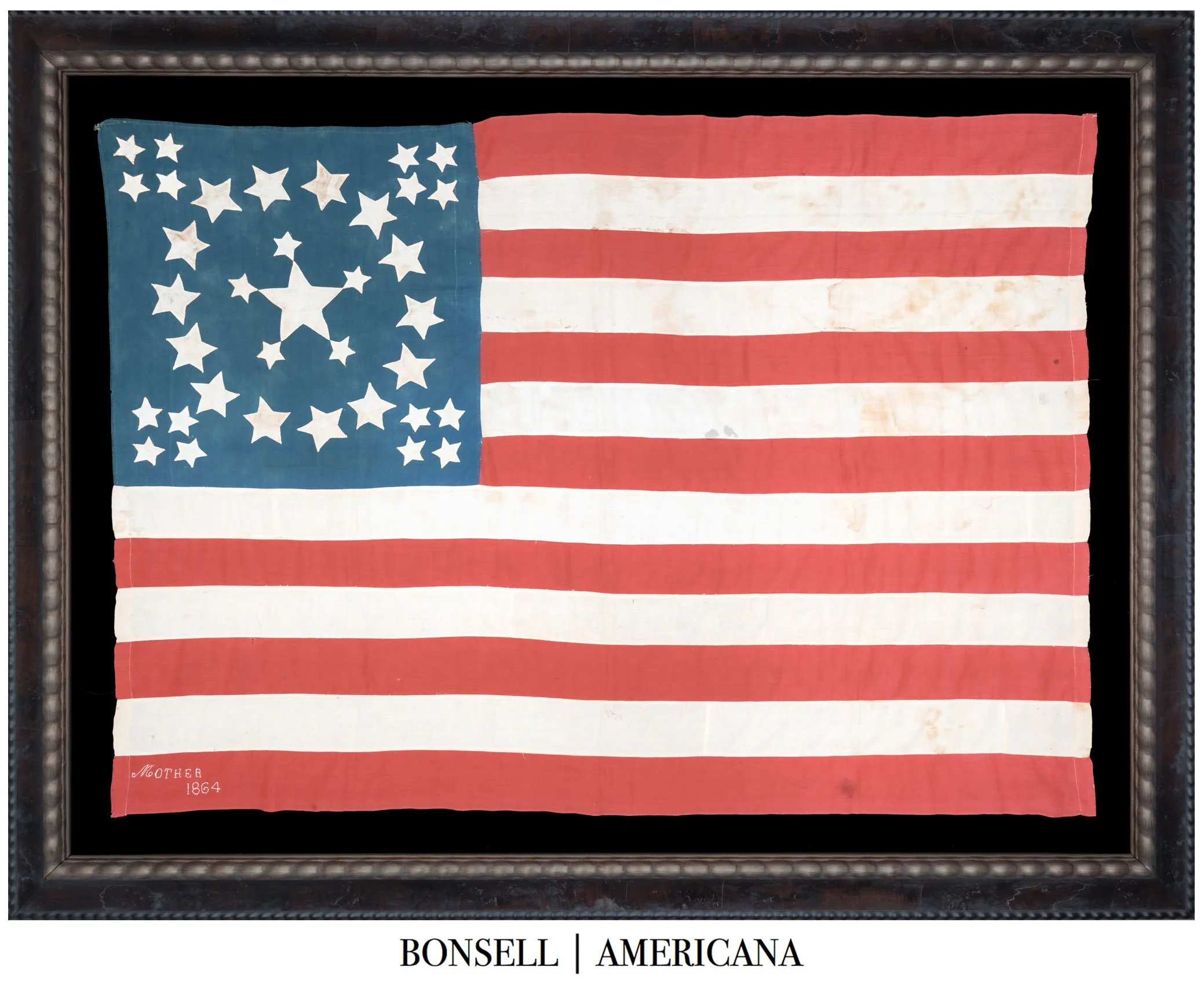
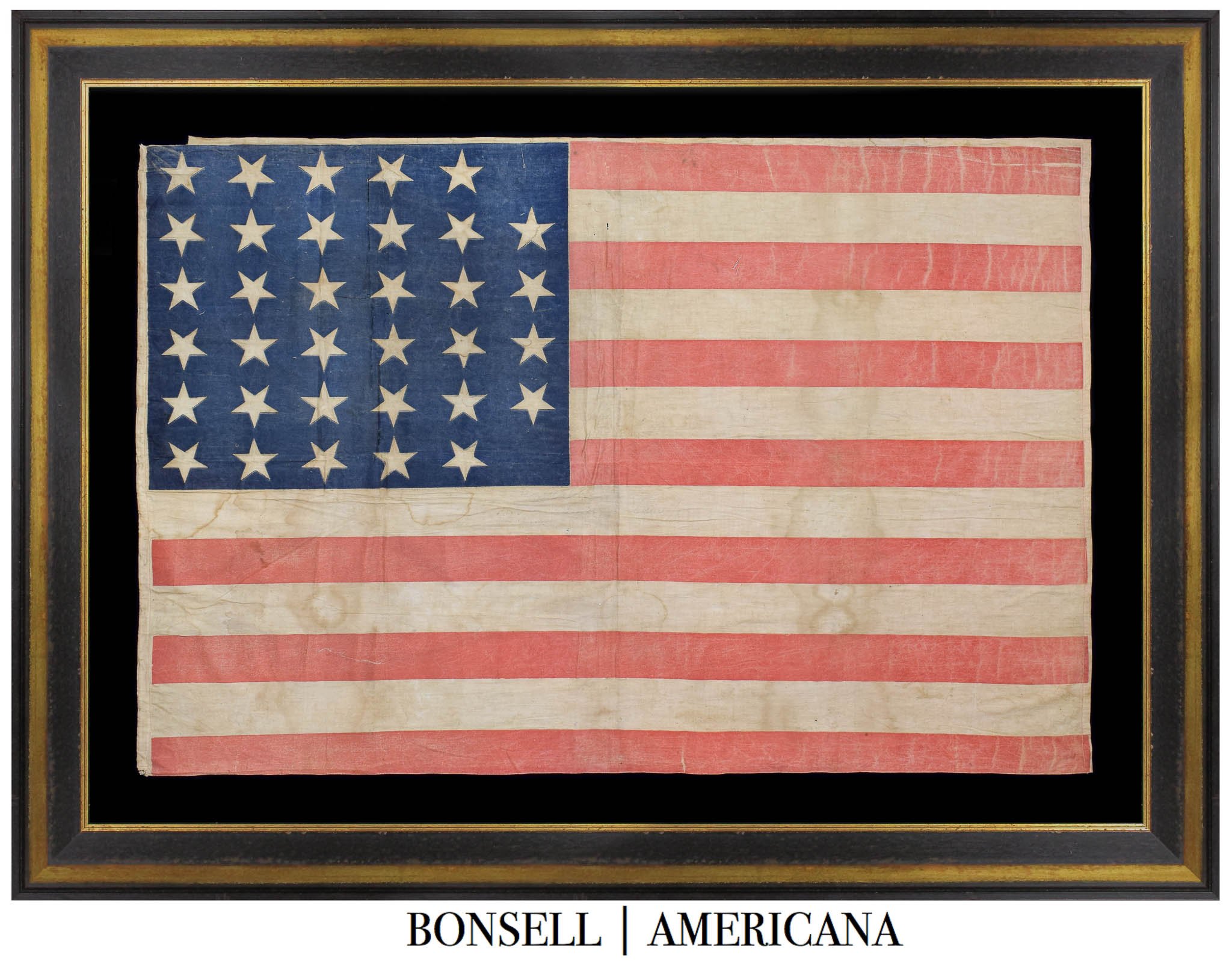
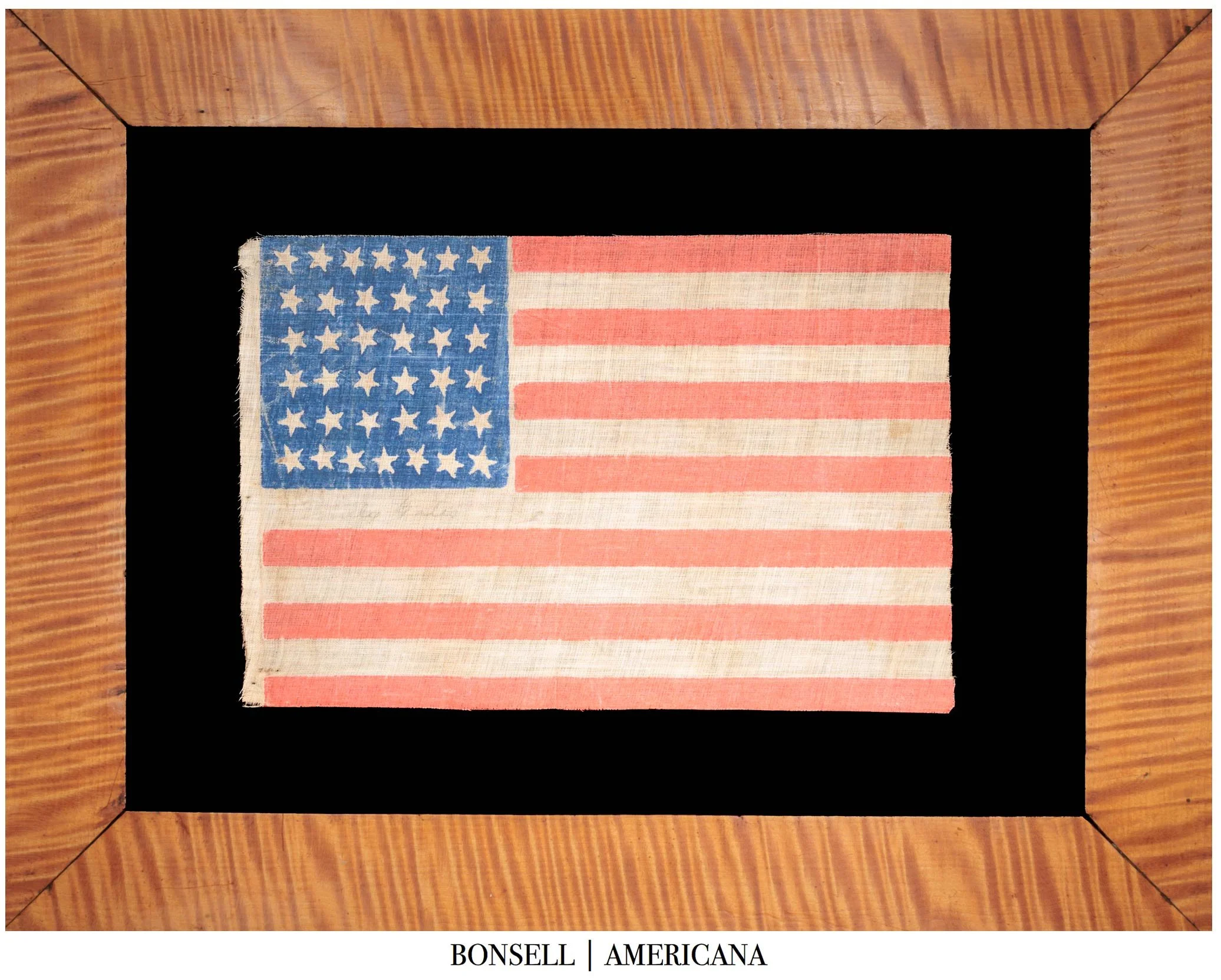
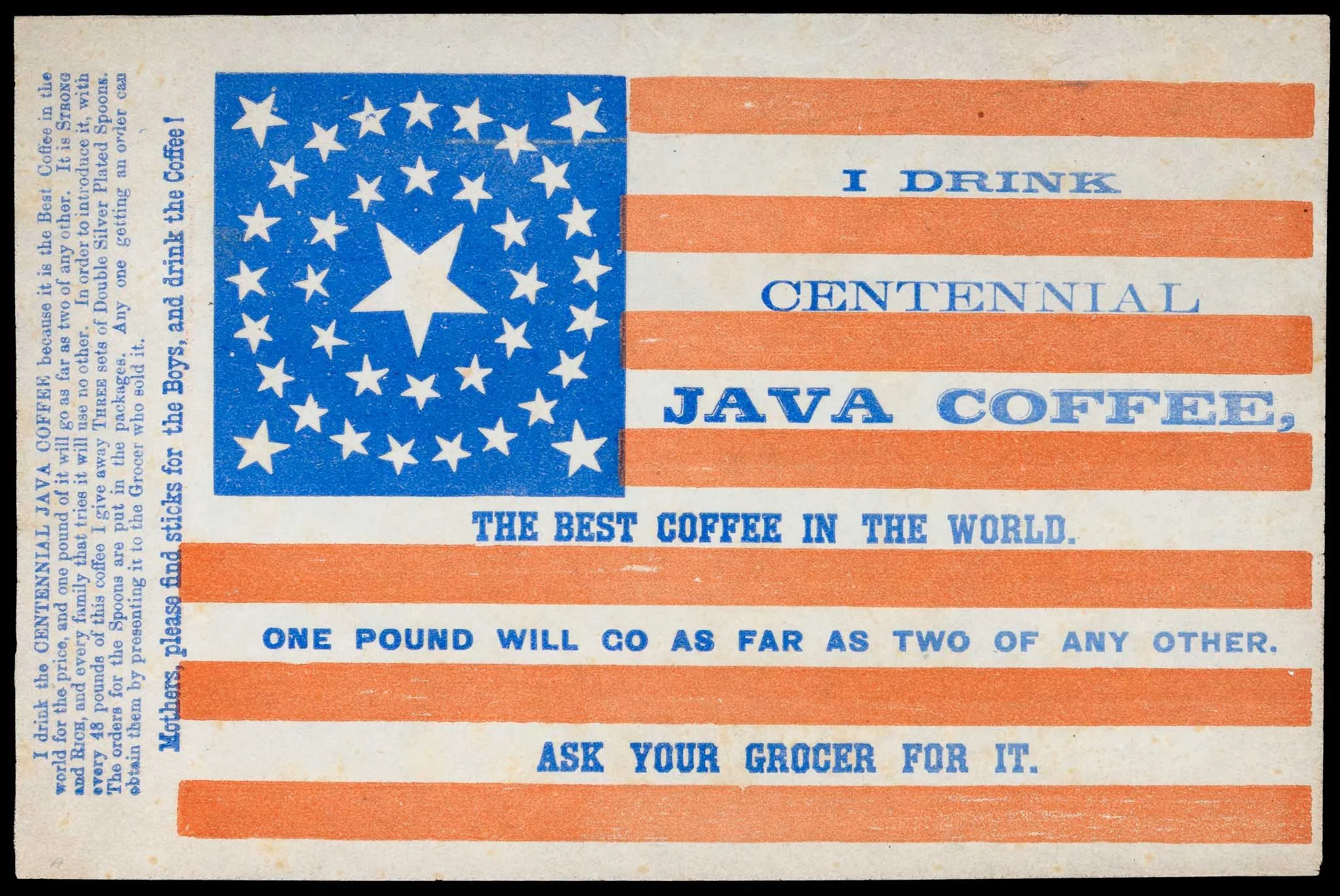
Exceptional 38 Star American Flag Trade Card | Centennial Java Coffee | Oversized Format | Medallion with Large Center Star | Colorado Statehood | Circa 1876–1890
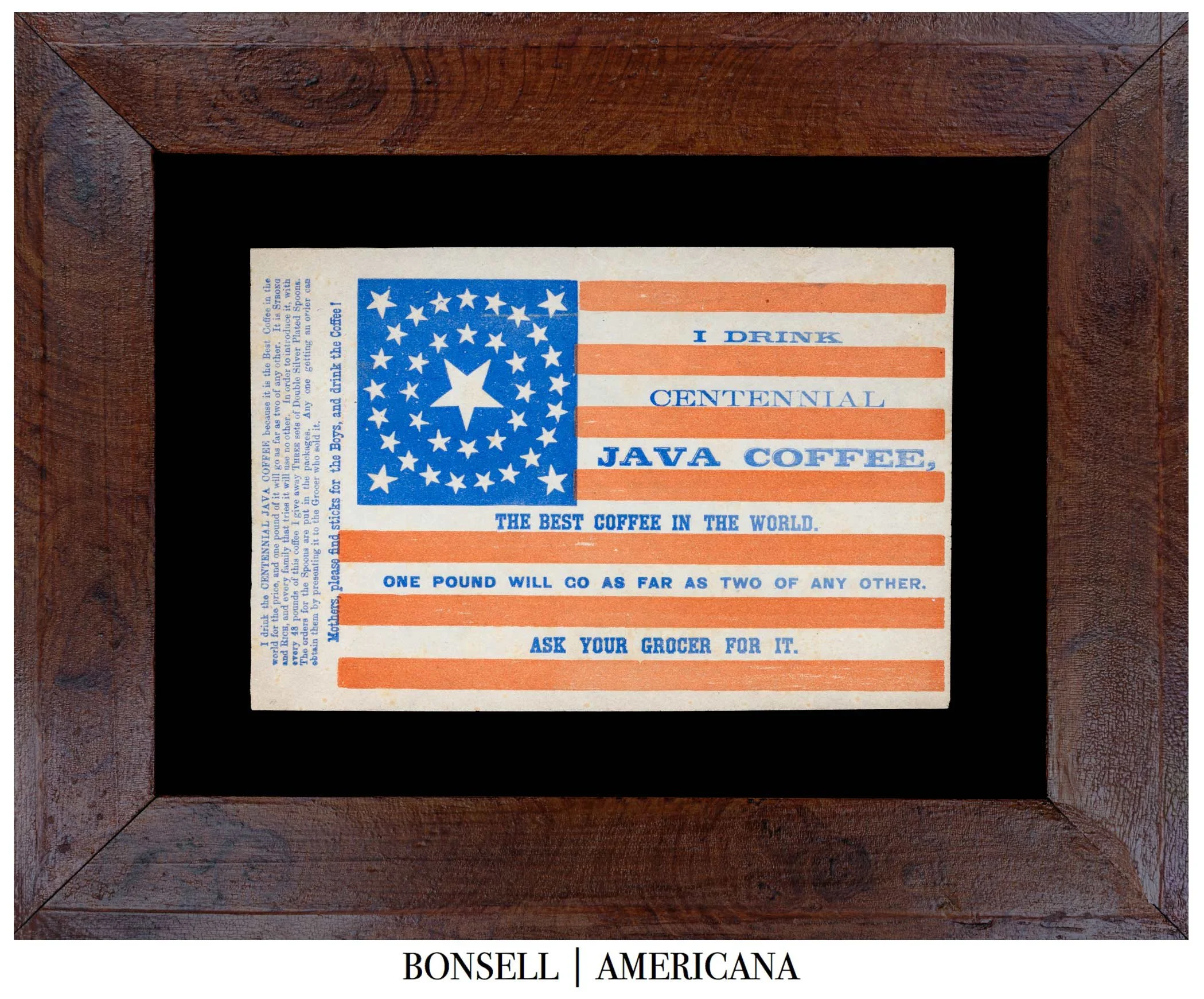
Exceptional 38 Star American Flag Trade Card | Centennial Java Coffee | Oversized Format | Medallion with Large Center Star | Colorado Statehood | Circa 1876–1890
Price: Call 618-553-2291, or email info@bonsellamericana.com
Frame Size (H x L): 13” x 16.5”
Flag Size (H x L): 6.5” x 10”
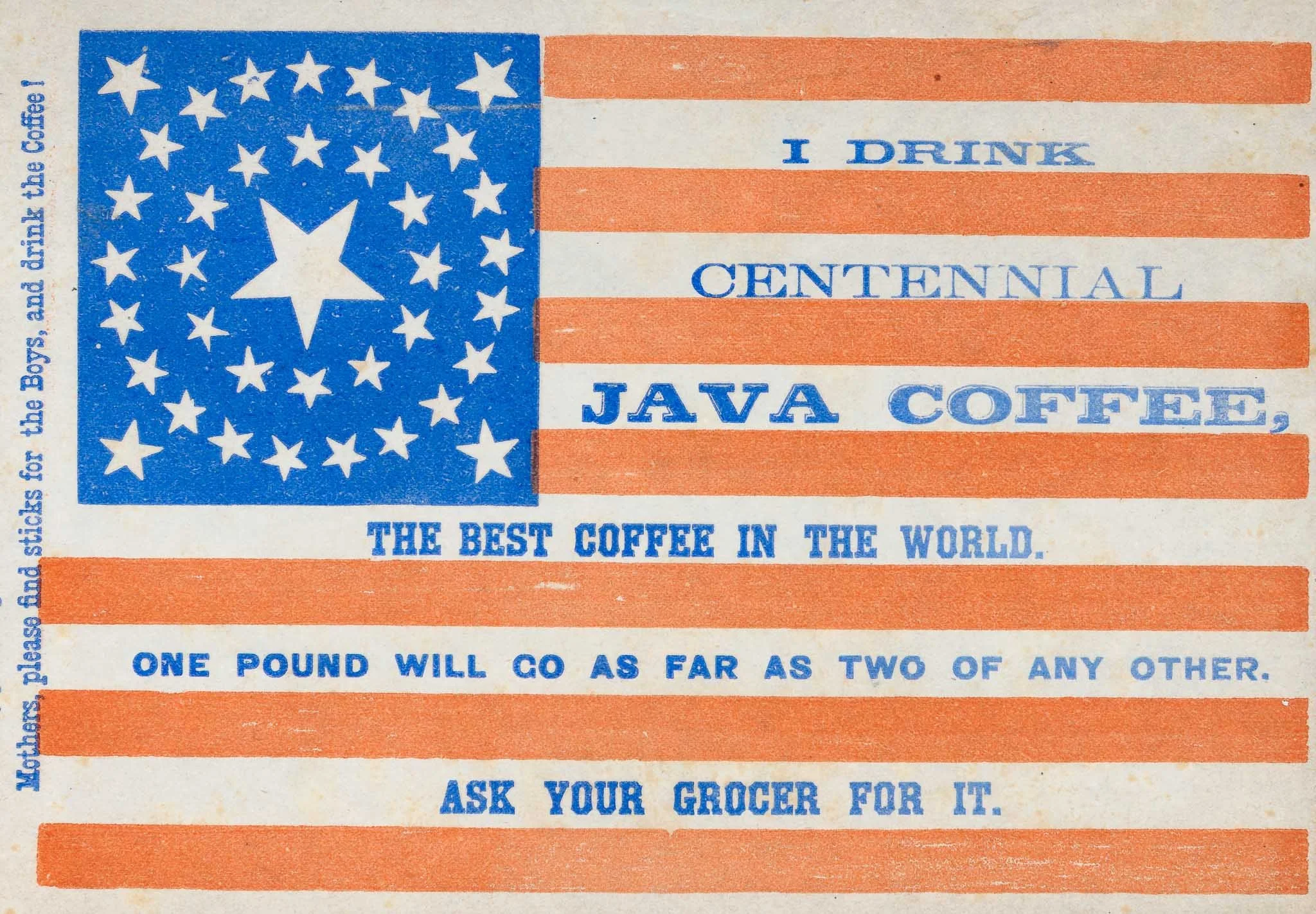
Offered is a rare and visually striking 38-star American flag trade flag, produced in the Centennial era and featuring an extensive advertising overprint for “CENTENNIAL JAVA COFFEE.” Printed on paper in an unusually large format measuring approximately 6.5 by 10 inches—roughly double the size of most surviving trade cards—this example occupies a compelling space between traditional advertising ephemera and a hand-held parade flag.
The canton displays a highly graphic and well-balanced medallion configuration, composed of a single, oversized center star surrounded by two concentric rings of smaller stars, with four additional flanking stars completing the count of thirty-eight. The inner ring contains 12 stars, while the outer ring presents 21, forming a bold and symmetrical arrangement that is both visually dynamic and carefully structured. The large center star serves as a strong focal point within the design and may be interpreted as an intentional visual emphasis on Colorado, the 38th state.
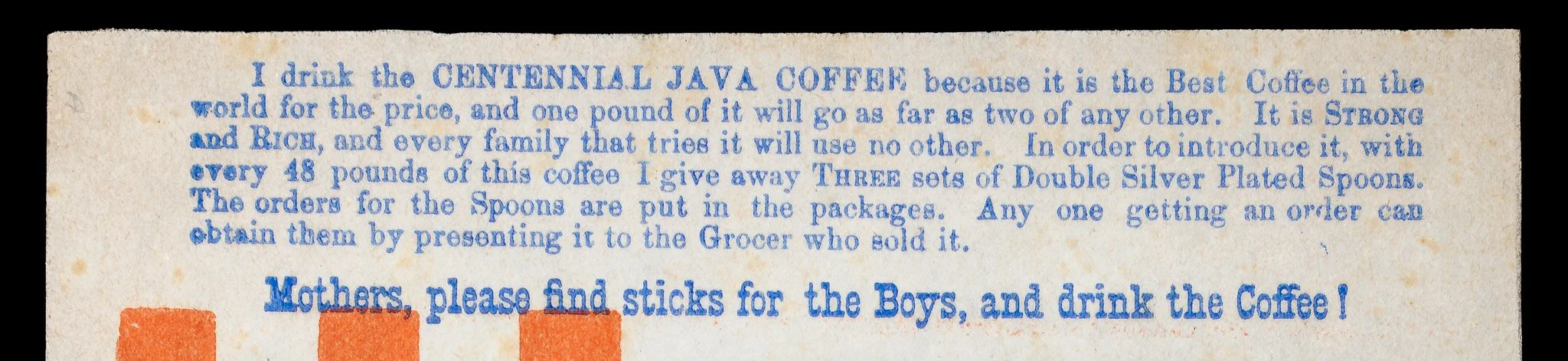
The overprint is exceptional in both scale and execution. Spanning the stripes in varying typefaces, it reads: “I DRINK CENTENNIAL JAVA COFFEE, THE BEST COFFEE IN THE WORLD. ONE POUND WILL GO AS FAR AS TWO OF ANY OTHER. ASK YOUR GROCER FOR IT.” The typography shifts from line to line, creating a layered and energetic visual rhythm that enhances the overall composition. Along the hoist, a vertical block of text further promotes the quality of the product, while an additional vertical instruction—directed to mothers—encourages the mounting of the flag on a stick for children to wave. This directive provides clear evidence that the piece was intended for active use as a hand-held display, rather than passive advertising alone.
The coloration is equally noteworthy. The red stripes, rendered in a distinctly orange-red tone, provide vivid contrast against the blue canton and contribute to the flag’s strong visual presence. Combined with the bold overprint and varied typography, the result is an unusually lively and engaging piece of printed Americana.
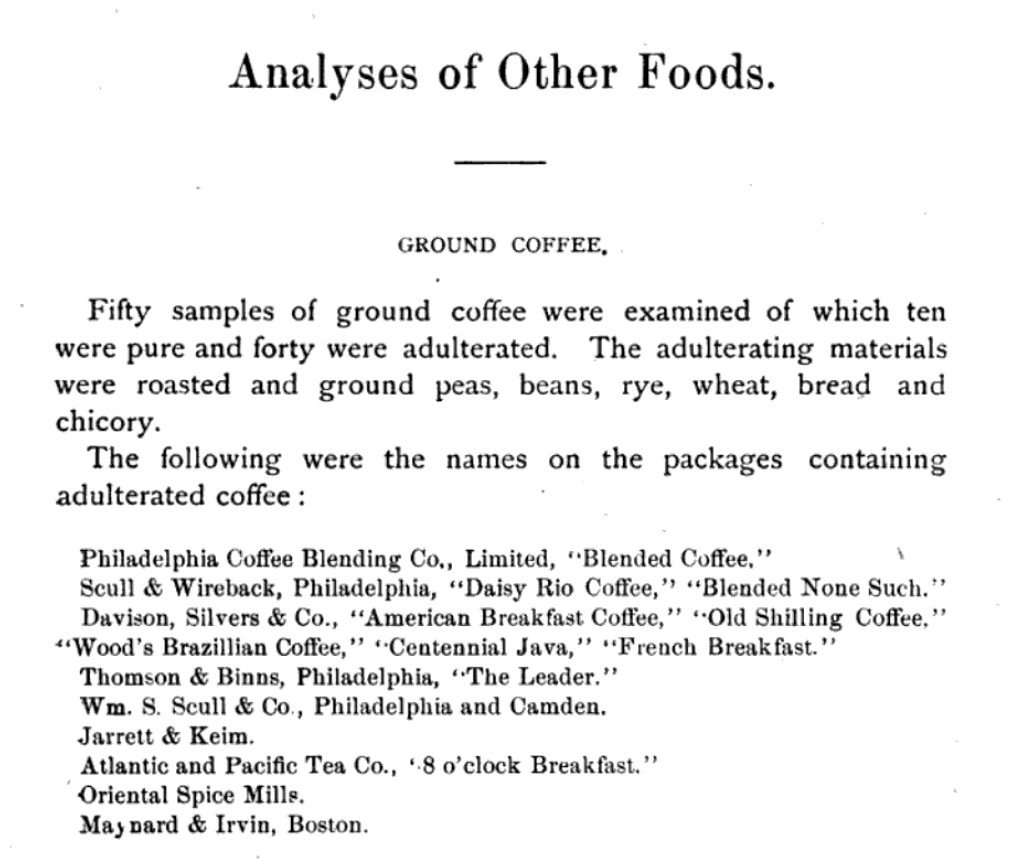
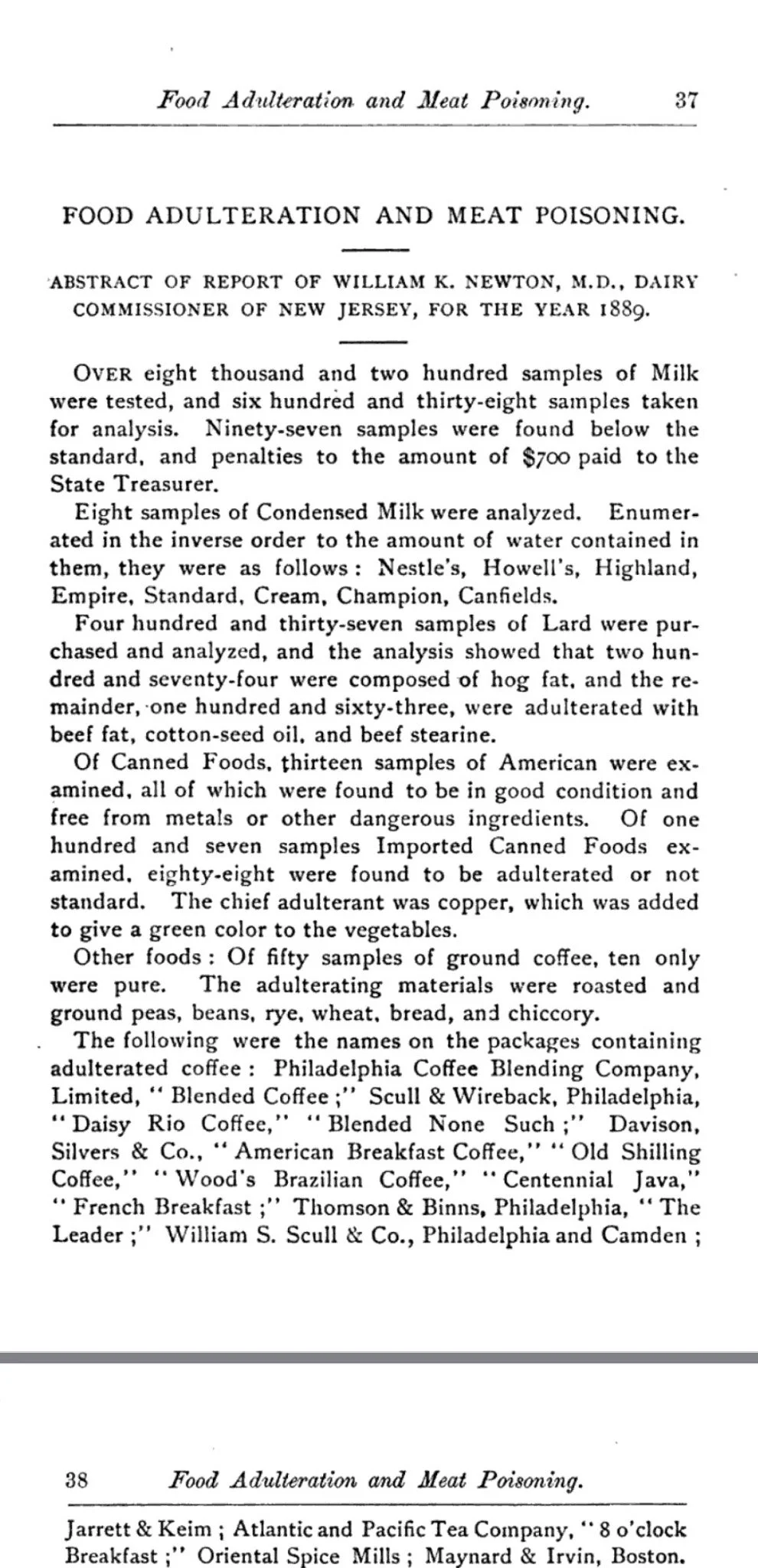
The broader context of this object is further enriched by period concerns surrounding the quality and purity of coffee. Late 19th-century reports on food adulteration reveal that a significant portion of commercially available ground coffee was diluted with roasted grains, legumes, and chicory. Within this environment, claims such as “ONE POUND WILL GO AS FAR AS TWO OF ANY OTHER” take on added meaning, functioning not merely as advertising rhetoric but as a direct appeal to consumers wary of inferior or adulterated products. Contemporary documentation even records “CENTENNIAL JAVA” among branded coffees in circulation, reinforcing the authenticity of the marketing language employed here.
The convergence of Centennial-era patriotism with commercial promotion is executed at an unusually high level in this 38-star example, both graphically and conceptually. Its large format, dynamic medallion star configuration, extensive overprint, and clear evidence of intended use as a parade flag combine to set it apart from more typical trade cards. Examples of this scale and visual impact are seldom encountered, and this is the first of this specific design that we have handled. Simply put, it ranks among the most compelling and visually engaging 19th-century American flag trade flags to surface.
The 38 stars on this flag represent Colorado’s admission to the Union on August 1st, 1876. Known as the “Centennial State,” Colorado earned its nickname for achieving statehood just 28 days after the nation’s centennial celebrations. Colorado’s journey to statehood began with the establishment of the Colorado Territory in 1861, spurred by the Pike’s Peak Gold Rush, which brought a wave of settlers to the region. Early statehood efforts faced setbacks, including a veto by President Andrew Johnson in the 1860s, but a renewed push in the mid-1870s culminated in Colorado’s official entry as the 38th state following Congress’s passage of an enabling act.
Although the 38-star flag did not become official until July 4th, 1877, flag makers frequently produced anticipatory examples ahead of such changes. These flags played a prominent role during the centennial celebrations of 1876, alongside revival designs featuring thirteen stars to commemorate the original colonies. The Centennial year was a watershed moment for the United States, fostering a renewed sense of patriotism and unity after the divisions of the Civil War. Communities across the nation adorned homes, businesses, and public spaces with red, white, and blue decorations, and flags became the centerpiece of this outpouring of national pride.
The Centennial International Exposition in Philadelphia was the highlight of these celebrations, attracting nearly ten million visitors between May and November of 1876. This world’s fair showcased American ingenuity on a grand scale, with notable exhibits including the Corliss Steam Engine and Alexander Graham Bell’s telephone, which would go on to revolutionize communication.
The 38-star flag officially served from July 4th, 1877, to July 4th, 1890, during which it flew over the administrations of Presidents Rutherford B. Hayes, James A. Garfield, Chester A. Arthur, Grover Cleveland, and Benjamin Harrison. This flag represented a nation growing both geographically and industrially. Colorado’s statehood symbolized the United States’ expansion westward, driven by mining booms, railroad construction, and the development of new settlements.
In 1890, the addition of five new states—North Dakota, South Dakota, Montana, Washington, and Idaho—necessitated a redesign, and the 43- star flag replaced the 38-star version. Despite its relatively short tenure, the 38-star flag remains a prized artifact, celebrated for its vibrant medallion designs and its connection to the Centennial year—a defining moment in American history when the nation reflected on its first century and welcomed Colorado as a symbol of progress and unity.
Frame: Housed in a beautiful American frame dating to circa 1840, crafted in hand-painted faux bois to simulate richly grained, knotty light mahogany. The surface displays exceptional graining with a warm, nuanced finish that complements the flag without overpowering it. The profile and early construction lend an appropriate sense of age and authenticity, enhancing the overall presentation.
Condition Report: The flag has been professionally conserved by a paper conservator, resulting in stable overall condition. There is moderate, even toning to the paper, accompanied by scattered foxing and minor surface soiling consistent with age. Evidence of prior handling is present in the form of minor edge wear, none of which detracts from the strong visual presentation. The printed imagery and overprint remain bold and highly legible throughout.
Collectability Level: The Extraordinary – Museum Quality Offerings
Date of Origin: 1860-1890
Associated War: The Indian Wars (1860-1890)