Extraordinary South Carolina Secession Flag | Carried by Florence May Turner at Age 12 During a Missouri Rally Calling for Secession | An Exceptional Piece of American History | Circa 1861
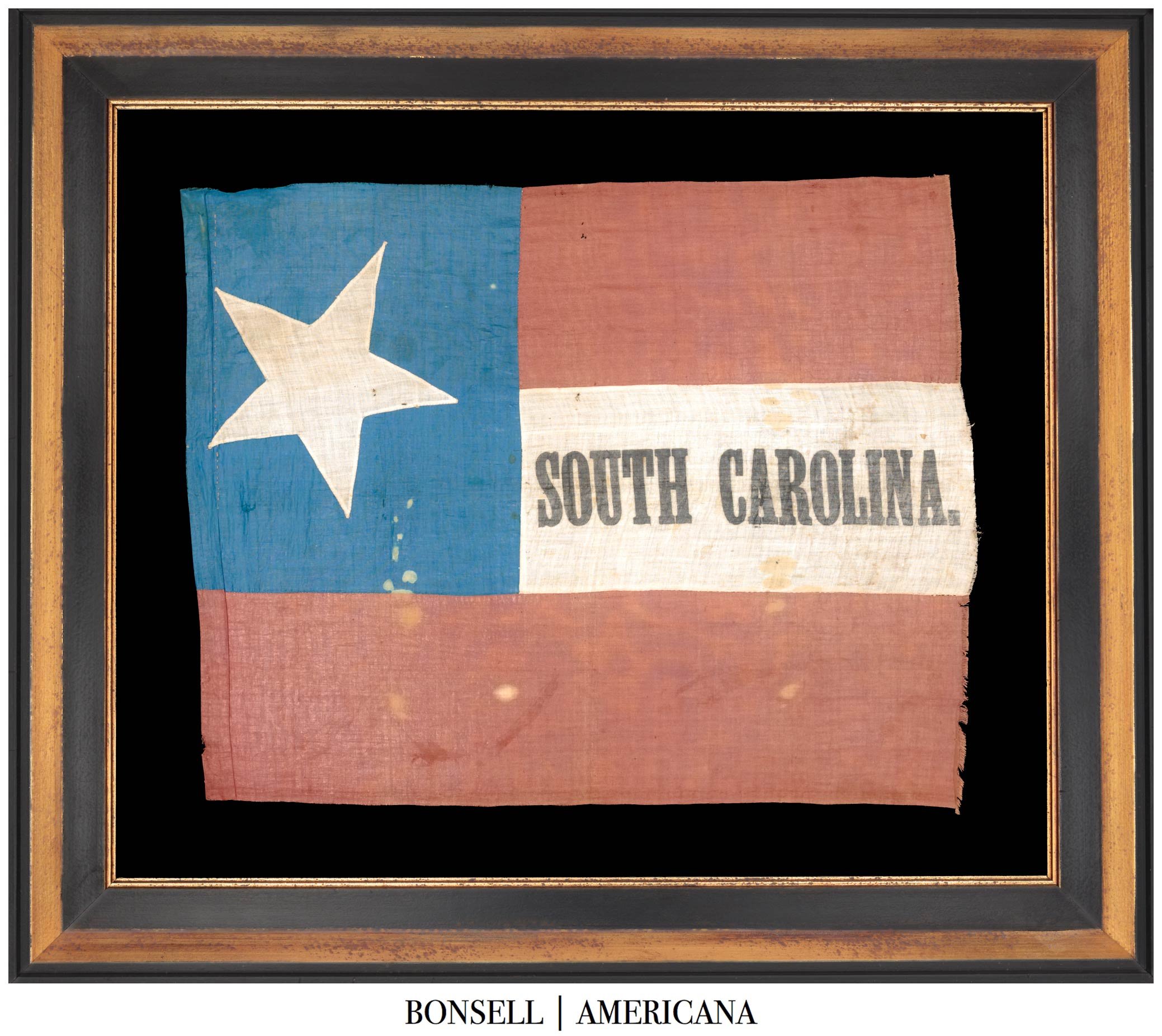
Extraordinary South Carolina Secession Flag | Carried by Florence May Turner at Age 12 During a Missouri Rally Calling for Secession | An Exceptional Piece of American History | Circa 1861
Frame Size (H x L): 32” x 37”
Flag Size (H x L): 21” x 26”
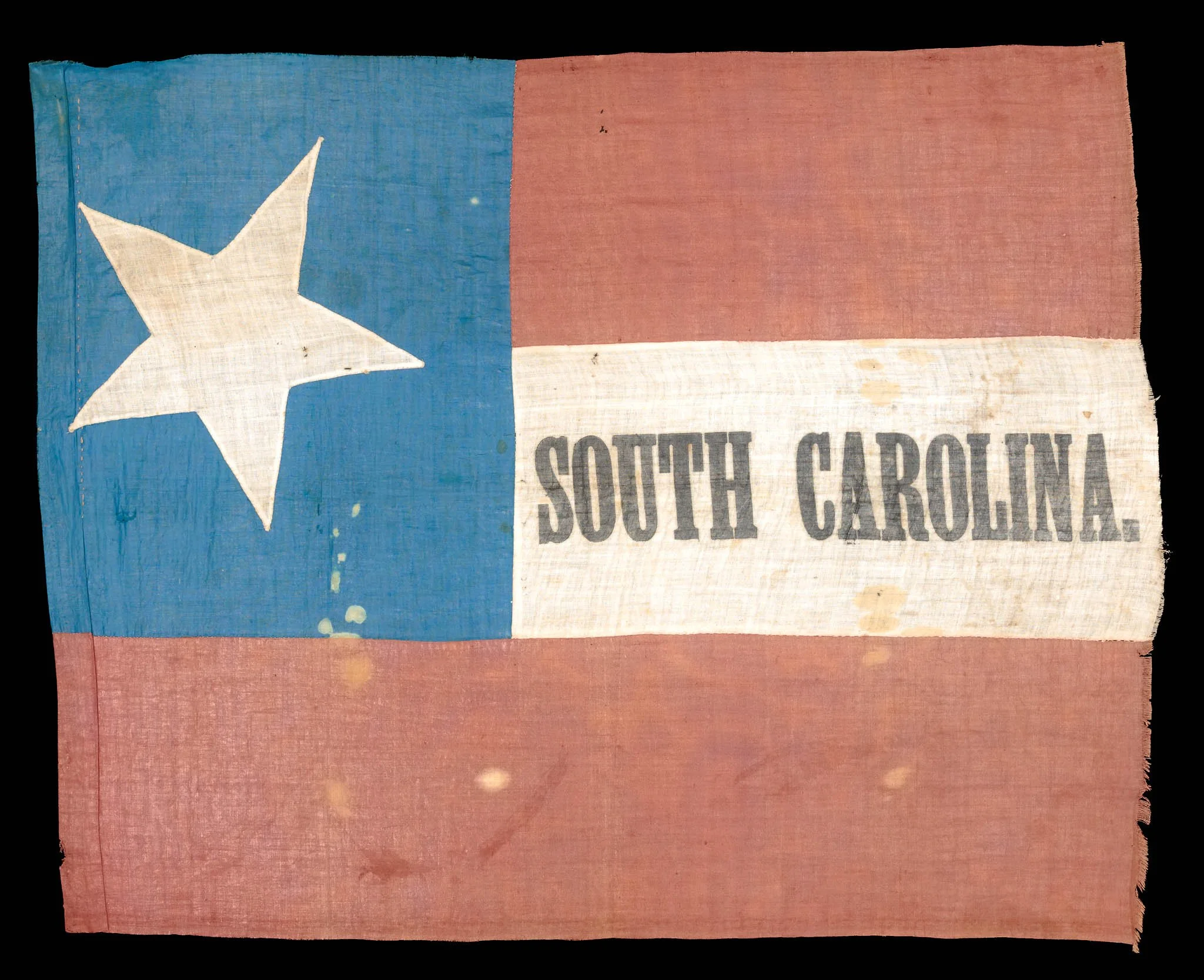
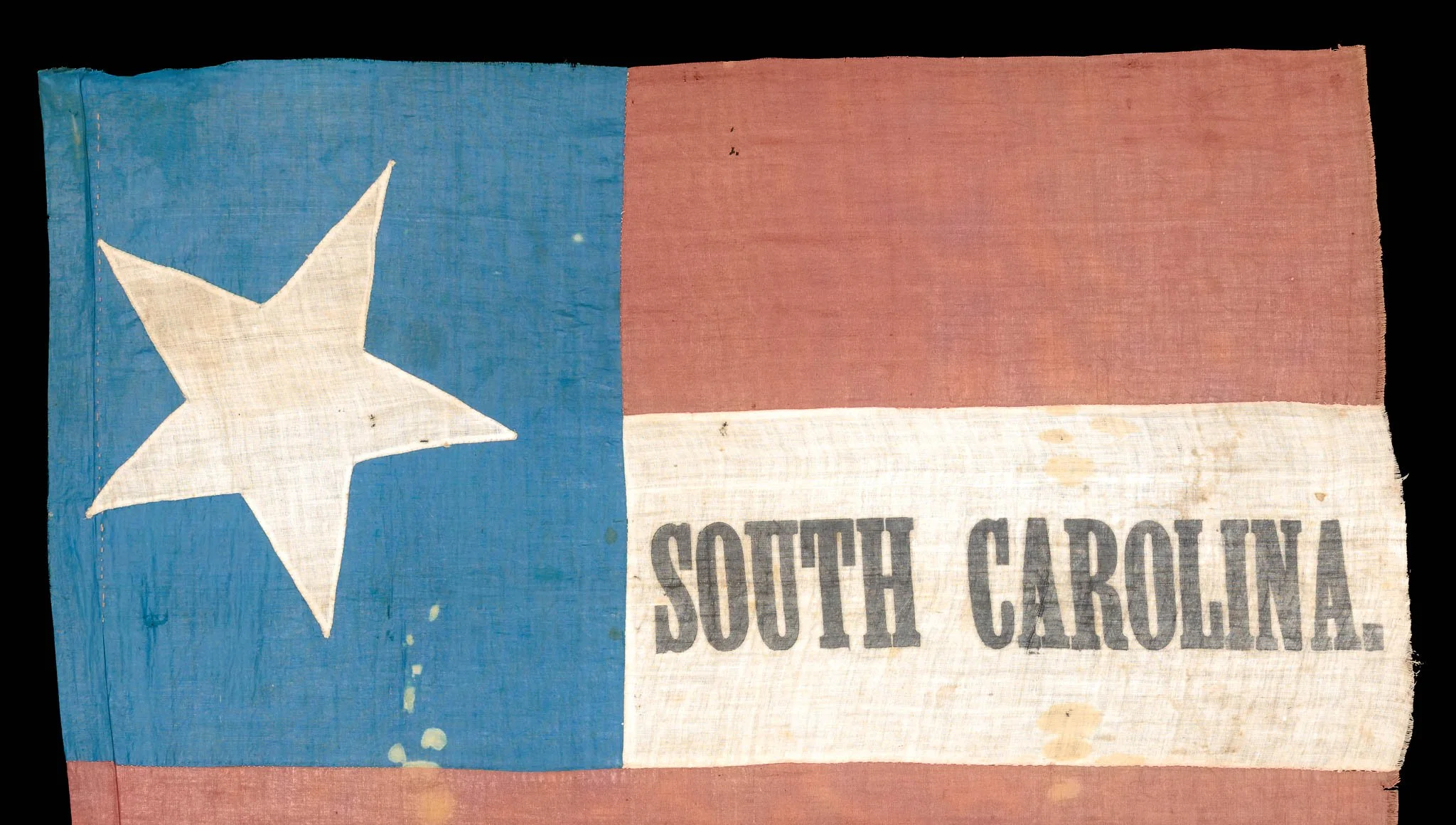
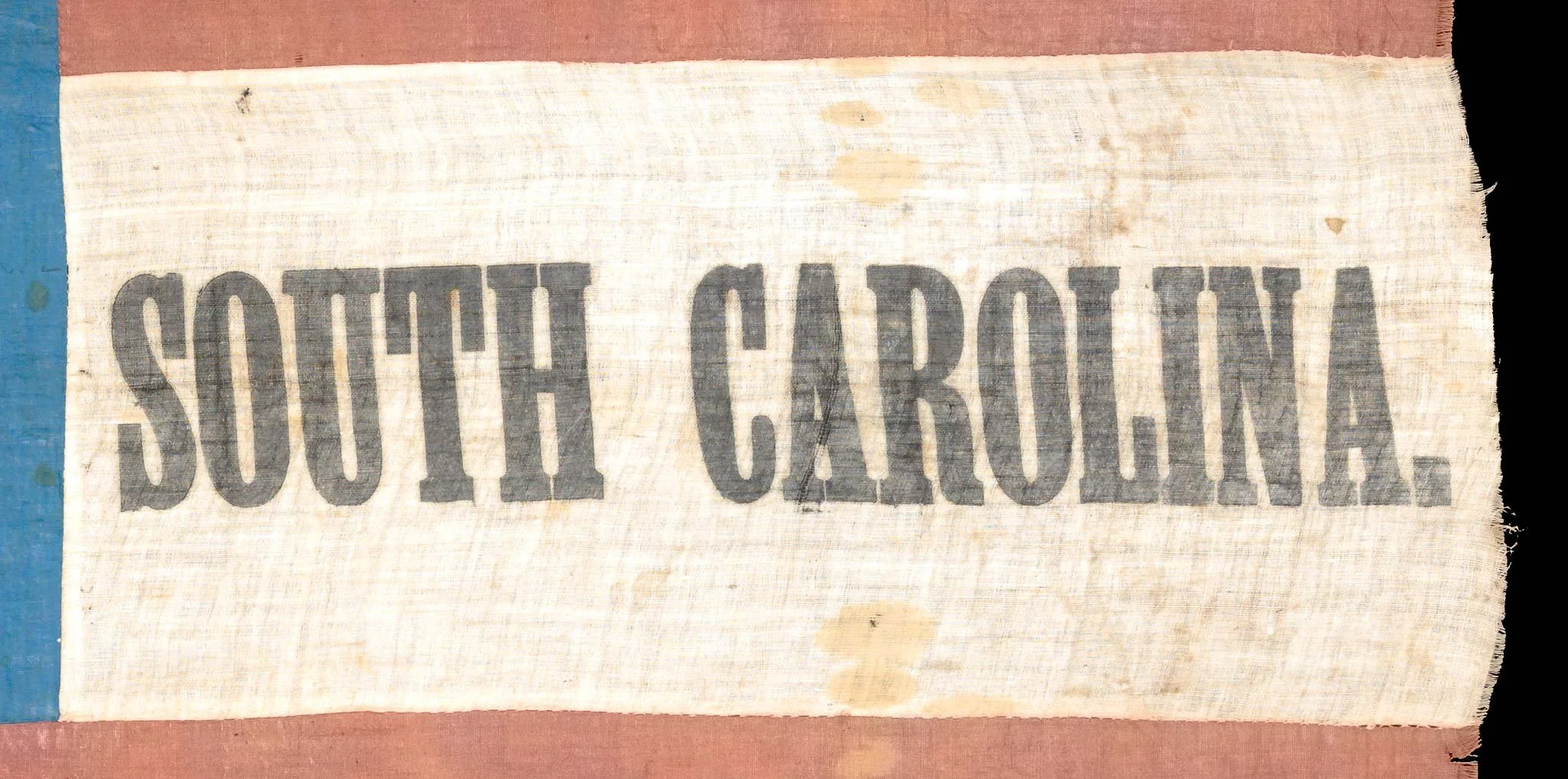
Offered is an exceptional Civil War-era South Carolina flag, entirely hand-sewn of glazed cotton and made in the configuration of the Confederate First National flag, popularly known as the “Stars and Bars.” Unlike a conventional example, however, its blue canton contains a single large white star, while SOUTH CAROLINA is boldly overprinted across the white center bar. The flag was made for a Confederate flag-presentation ceremony and secession pageant held in Plattsburg, Missouri, in the spring of 1861, where it was carried by 12-year-old Florence May Turner, later Florence May Turner Porter, as she personified South Carolina among seven young girls representing the seven original seceded states.
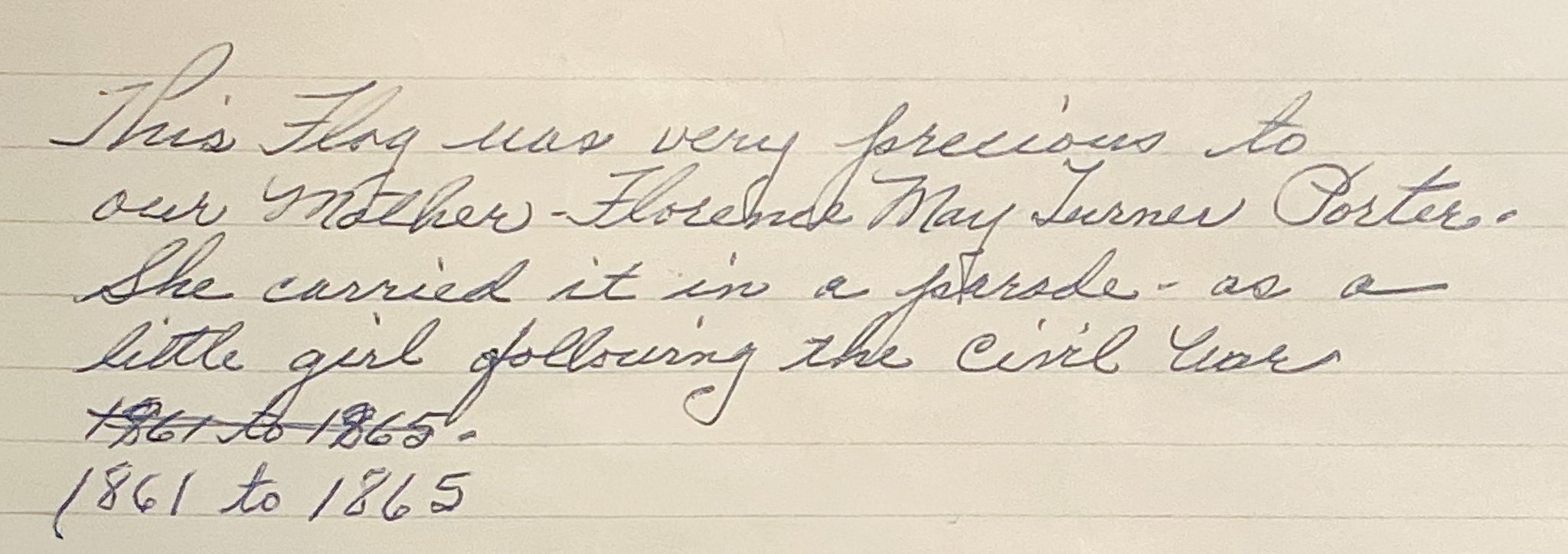
Remarkably, the flag survives with a handwritten family note identifying both its original bearer and the circumstances of its use. The note records that the flag was especially precious to “our Mother—Florence May Turner Porter,” and that she had carried it as a little girl in a parade associated with the Civil War. Although the writer placed the episode after the war, Florence herself left a far more detailed account that establishes exactly when and where it occurred.
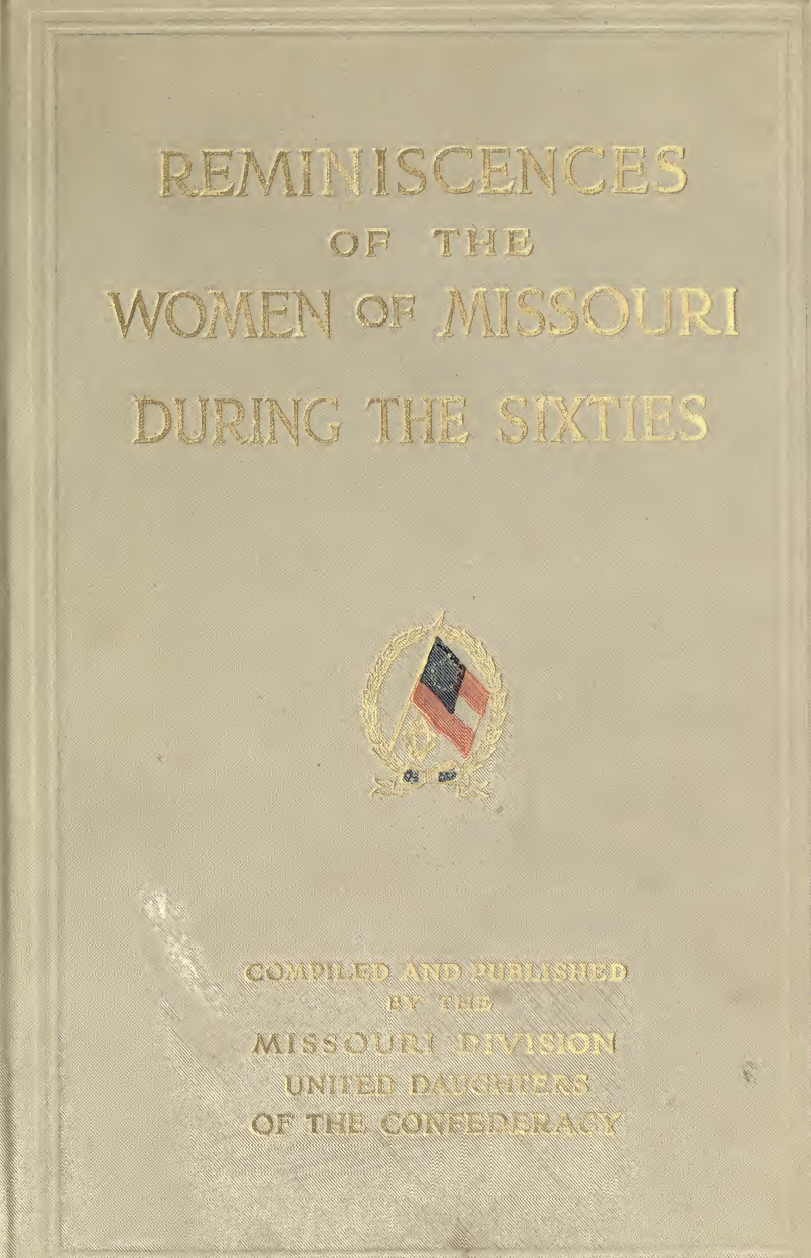
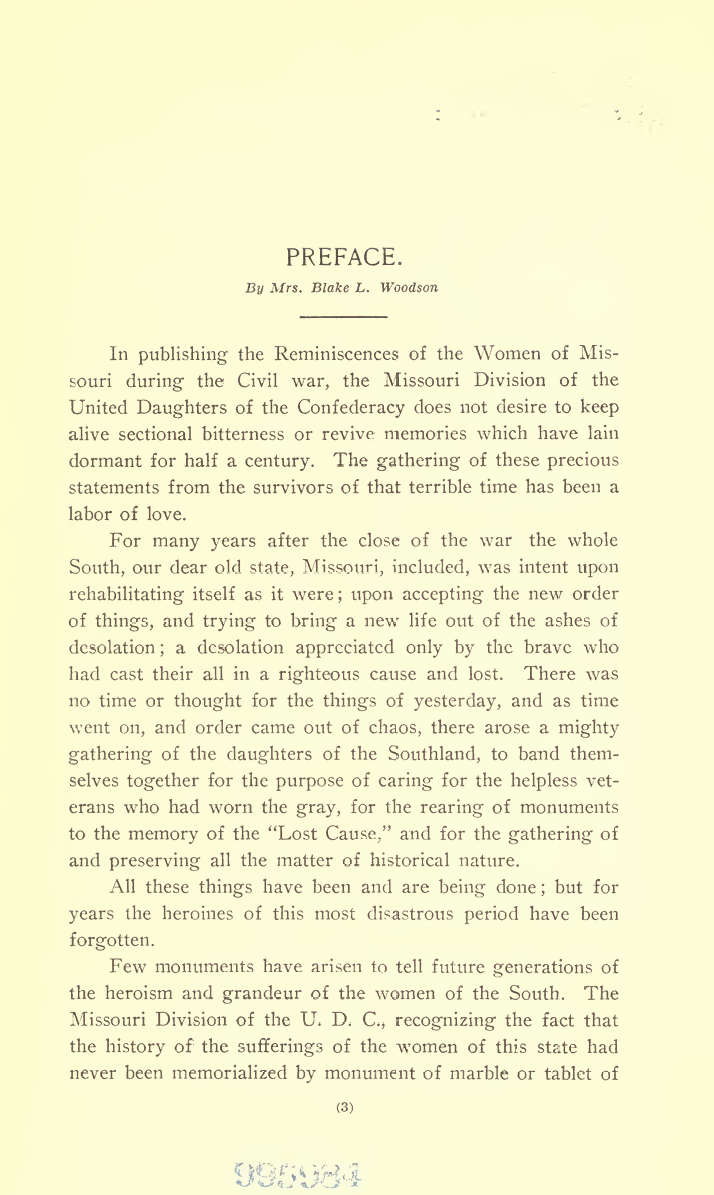
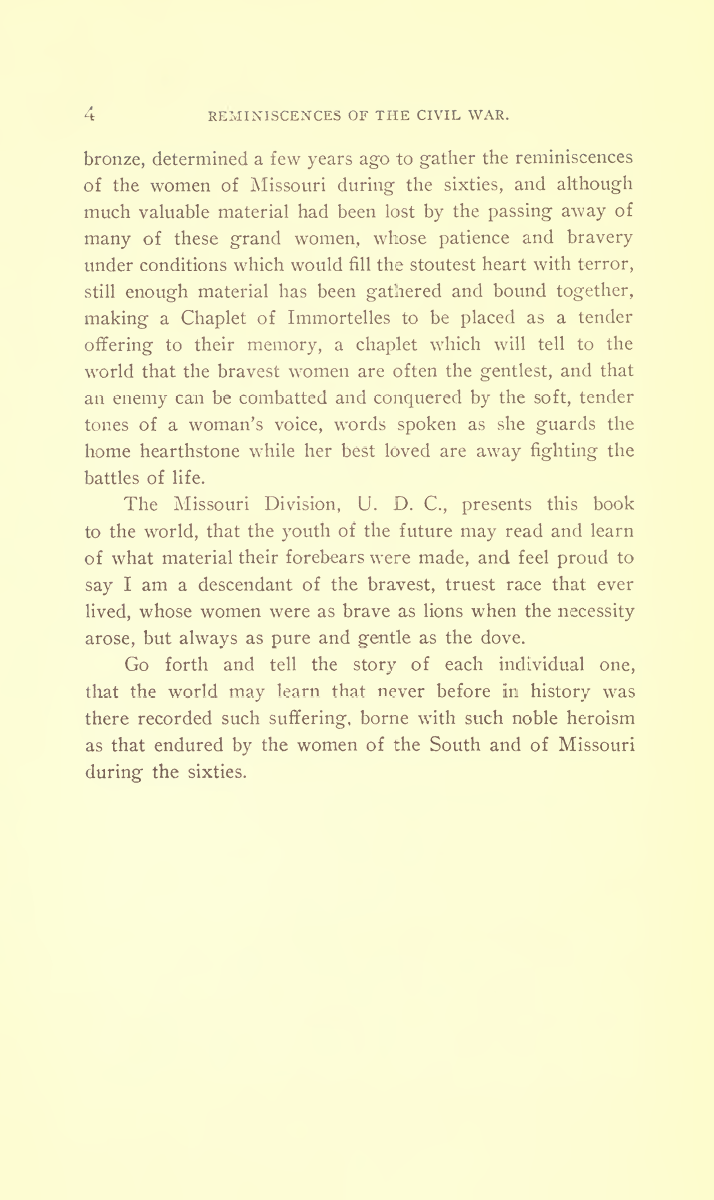
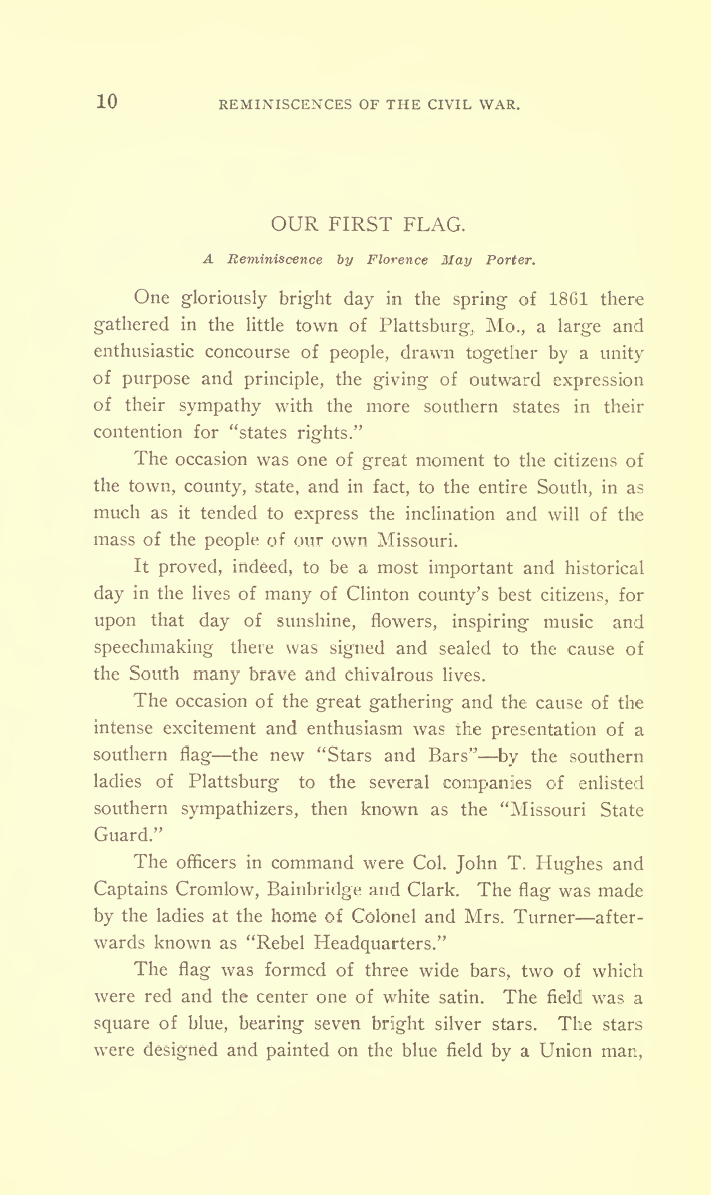
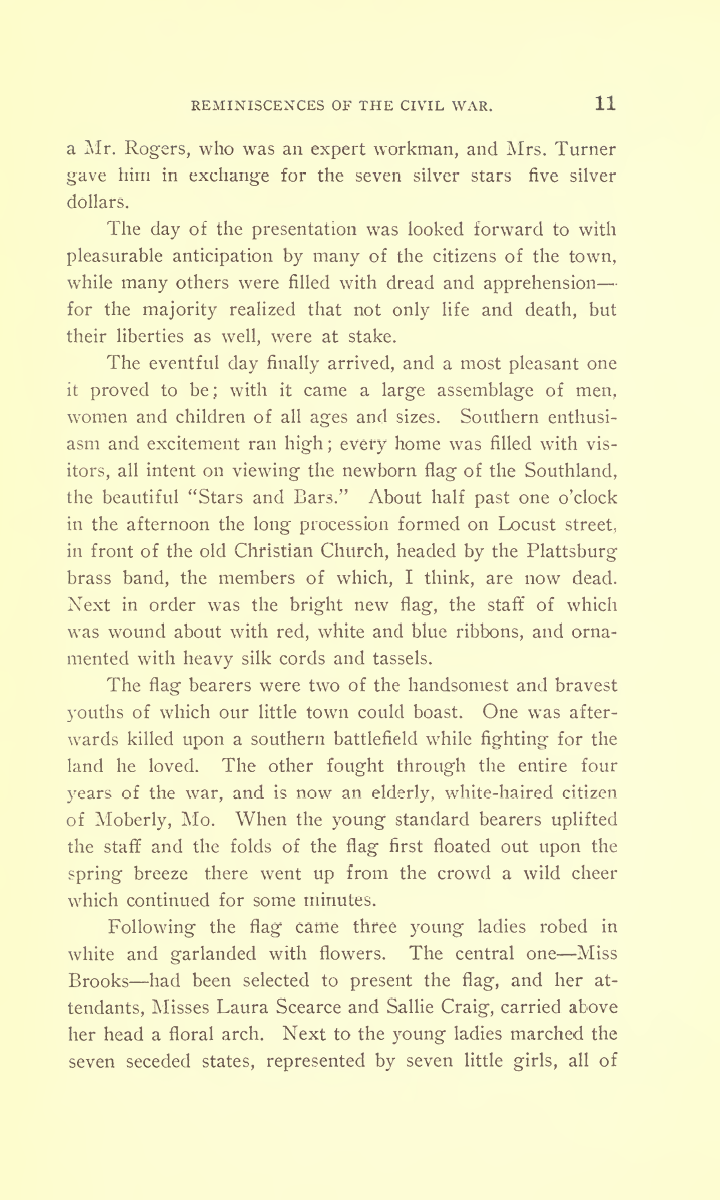
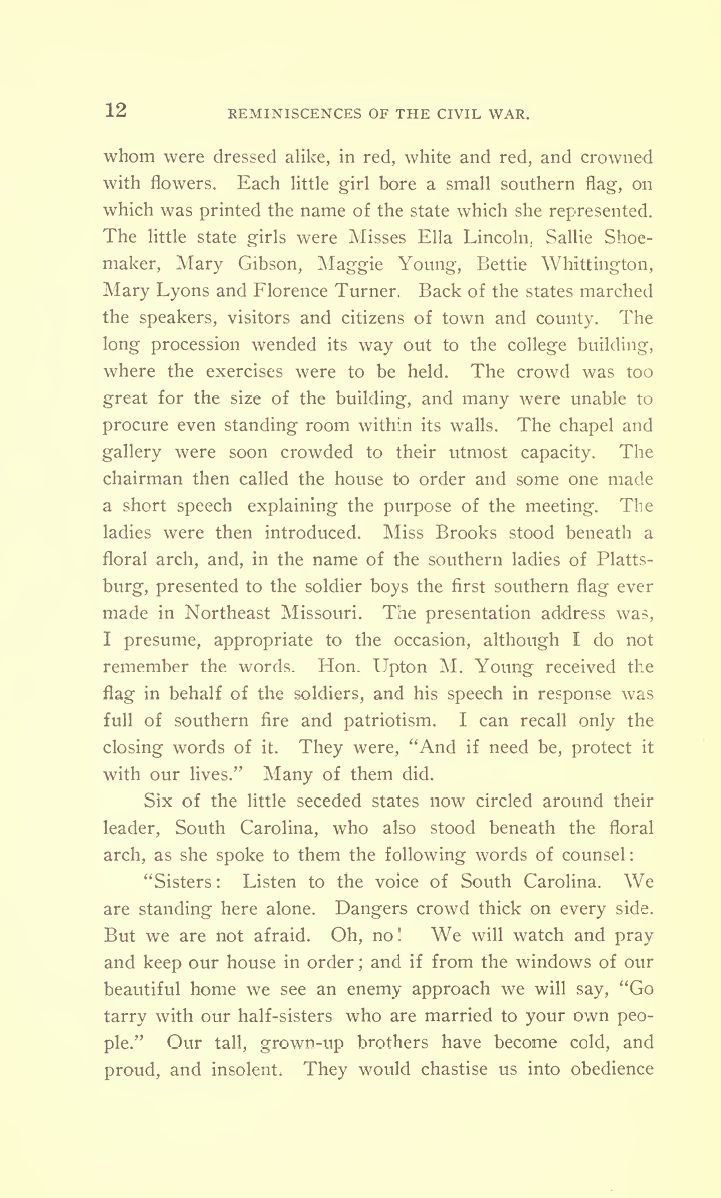
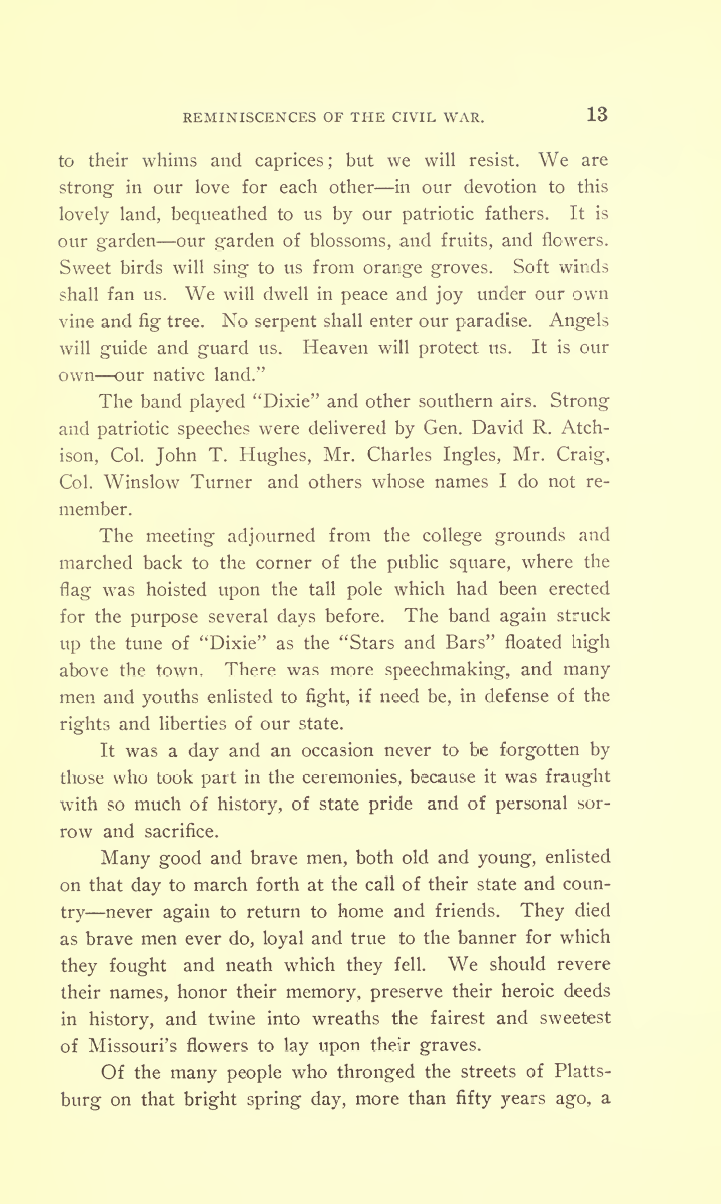
More than half a century later, Florence published a firsthand recollection entitled “Our First Flag” in Reminiscences of the Women of Missouri During the Sixties. Her account describes a large Confederate flag-presentation ceremony held at Plattsburg in the spring of 1861 and identifies herself as one of seven little girls selected to personify the seven states that had already seceded from the Union. Each girl, she explained, carried a small Southern flag on which was printed the name of the state she represented. South Carolina occupied the leading position in the tableau. Florence preserved the South Carolina address in unusual detail and, most significantly, specifically recorded that “the little flag carried by South Carolina is still in existence.” The present flag, preserved by Florence's family with the note identifying it as the flag she carried, is that surviving South Carolina flag.
The combination of the physical flag, its family provenance, and Florence's own published account allows its history to be reconstructed with unusual precision. Its single star, SOUTH CAROLINA overprint, Stars-and-Bars configuration, date, place of use, and original bearer are not simply interpretations based upon the appearance of the textile. They correspond directly with Florence's description of the flags made for the 1861 Plattsburg ceremony.
The Confederate First National flag was adopted at Montgomery, Alabama, on March 4, 1861, less than a month after the Confederate States of America had been organized. Its design consisted of three broad horizontal bars—red, white, and red—with a blue canton containing white stars corresponding to the states of the new Confederacy. The earliest version displayed seven stars for South Carolina, Mississippi, Florida, Alabama, Georgia, Louisiana, and Texas, the seven states that had seceded before Abraham Lincoln took office. The design was remarkably new when the present flag was made. The Plattsburg ceremony has been dated to May 1861, meaning this flag was fashioned only about two months after the Stars and Bars was adopted.
Ordinary examples of the Confederate First National carried the full complement of stars appropriate to the date of manufacture. The number increased as additional states joined the Confederacy, eventually producing 11-star examples and, through Confederate claims to Missouri and Kentucky, flags displaying 12 or 13 stars. Early seven-star examples belong to the Confederacy's formative period and are immediately recognizable by their blue canton, three broad bars, and seven white stars. The present flag deliberately departs from this convention. Its single star does not purport to represent the Confederacy as a whole. Rather, it isolates one of those original seven stars to represent South Carolina alone.
This symbolism was especially appropriate to South Carolina. On December 20, 1860, delegates to the state's secession convention voted unanimously to withdraw from the Union, making South Carolina the first state to do so. Six additional Deep South states followed before Lincoln's inauguration. South Carolina consequently occupied a distinctive position in the secession movement, and it was in Charleston Harbor that the sectional crisis developed into open warfare with the bombardment of Fort Sumter on April 12, 1861.
The single star also had established meaning in South Carolina's secession-era visual vocabulary. Although South Carolina adopted the familiar blue state flag with its white palmetto and crescent in January 1861, other flags employed during the secession crisis incorporated a single star as an emblem of the state's sovereignty and independence. On the present flag, that symbolism was adapted to the newly created Stars and Bars: the Confederate national pattern is retained, but the usual complement of stars is reduced to one and the identity of that individual state is made explicit by the large SOUTH CAROLINA overprint.
The circumstances surrounding the flag's manufacture and use are particularly well documented through Florence's account. Florence grew up in Plattsburg, Missouri, the only daughter of Colonel Winslow Turner. Her family was closely involved with the pro-Southern movement in Clinton County during the opening months of the Civil War, and her recollection places the Turner household at the center of preparations for the ceremony.
According to Florence, local women gathered at the home of Colonel and Mrs. Turner to make a large Confederate flag for presentation to local military companies. She remembered the flag in considerable detail: three broad bars of red, white, and red, a blue canton, and seven silver stars. The stars were designed and painted by a local Union man named Rogers, whom Mrs. Turner paid five silver dollars for the work. The Turner residence subsequently acquired the local sobriquet “Rebel Headquarters.” The flag was intended for public presentation to pro-Southern military forces in Plattsburg at a moment when Missouri's allegiance remained fiercely contested.
Missouri provides important context for understanding the event. Unlike South Carolina, the state did not simply leave the Union at the beginning of 1861. Unionists and secessionists competed for political and military control, and the state soon descended into a particularly complicated form of civil conflict. Pro-Southern military companies organized while supporters of both sides openly demonstrated their allegiance. In this setting, the Plattsburg gathering was more than a festive parade. It was a conspicuous public declaration of sympathy with the newly formed Confederacy and an effort to encourage the Southern cause in northwestern Missouri.
Florence described “one gloriously bright day in the spring of 1861,” when a large and enthusiastic crowd assembled at Plattsburg to demonstrate sympathy with the Southern states and the principle of states' rights. The immediate purpose was the presentation of the newly adopted Stars and Bars, made by the Southern ladies of Plattsburg, to companies of enlisted Southern sympathizers. Among the military participants were Colonel John T. Hughes and companies commanded by Captains Cromlow, Bainbridge, and Clark.
A procession formed and proceeded to the college building, where the principal exercises were held before a crowd sufficiently large to fill the chapel and gallery. A Miss Brooks formally presented the large Confederate flag on behalf of the Southern ladies of Plattsburg. The gathering also included prominent pro-Southern political figures. Most notable was former United States Senator David Rice Atchison, one of Missouri's best-known advocates of the Southern cause. Florence also remembered addresses by John T. Hughes, Charles Ingles, a Mr. Craig, and her father, Winslow Turner.
Within this larger ceremony was an elaborate allegorical pageant centered upon the seven states that had already seceded. Three young women dressed in white participated with the principal flag. They were followed by seven younger girls, whom Florence recalled as being dressed alike in red, white, and red and crowned with flowers. She identified the seven as Ella Lincoln, Sallie Shoemaker, Mary Gibson, Maggie Young, Bettie Whittington, Mary Lyons, and Florence Turner. Collectively, the girls personified South Carolina, Mississippi, Florida, Alabama, Georgia, Louisiana, and Texas—the seven original states of the Confederacy.
Most importantly for the present flag, Florence explained that each girl carried a small Southern flag bearing the name of the state she represented. The surviving flag conforms precisely to that description. Its red-white-red field reproduces the essential arrangement of the newly adopted Confederate First National, while the single white star reduces the seven-star national device to the individual state represented by its bearer. The large SOUTH CAROLINA inscription leaves no ambiguity regarding which of the seven states this particular flag personified.
South Carolina occupied the leading position in the children's tableau, an appropriate choice given that it had initiated the secession movement. Florence described the six other personified states gathering around “their leader, South Carolina,” after which South Carolina addressed her “sisters.” The speech began with an appeal to the other states to “Listen to the voice of South Carolina,” and continued as an allegorical address from the first seceded state to the six that had followed it.
There is a particularly intriguing aspect of Florence's recollection. Although she identifies the adult speakers and recalls the substance and circumstances of the day's proceedings, she does not preserve their addresses word for word. Her treatment of the South Carolina presentation is markedly different. She records the South Carolina speech at considerable length, preserving language that would have been exceedingly difficult to reproduce from childhood memory alone more than half a century later. This strongly suggests that she retained access to a written version of the address, perhaps the original script prepared for her role.
That circumstance takes on considerably greater significance when considered alongside the flag's family provenance. The handwritten note accompanying the textile identifies it specifically as the flag Florence carried. Florence's own account establishes that she was one of the seven girls, that each girl carried the flag of the state she represented, and that one of those flags was South Carolina. Her unusual preservation of the South Carolina speech provides further evidence that this was her particular role.
Most compelling of all is Florence's explicit statement concerning the survival of the flags. Looking back more than half a century after the event, she wrote that “the little flag carried by South Carolina is still in existence,” while the fate of the large Confederate flag presented that day was unknown. Her statement is remarkably specific. Florence knew that the South Carolina flag had survived. The present South Carolina flag subsequently descended through her family accompanied by a note identifying it as the flag their mother had carried.
Taken together, these facts provide an unusually strong identification. Florence Turner was one of the seven girls. Each represented one state and carried its corresponding flag. The surviving flag is explicitly marked SOUTH CAROLINA. Florence preserved the South Carolina address in exceptional detail. She later specifically documented the continued existence of the South Carolina flag. Finally, her family preserved that same flag with the written history that Florence had carried it as a child. The evidence collectively identifies Florence May Turner as the girl who personified South Carolina and the present textile as the flag she carried.
Florence was approximately 12 years old at the time of the ceremony. She later married Virgil Roe Porter and became Florence May Turner Porter, remaining closely associated with the Plattsburg community in which the episode occurred. Her published recollection is particularly valuable because it does considerably more than establish provenance. It explains why the flag looks the way it does. Without her testimony, the textile might reasonably be interpreted simply as an unusual homemade South Carolina variation of the Stars and Bars. With her account, the single-star canton, state overprint, red-white-red arrangement, small scale, and domestic construction can instead be understood as components of a coordinated group of seven state flags made for a specific political pageant.
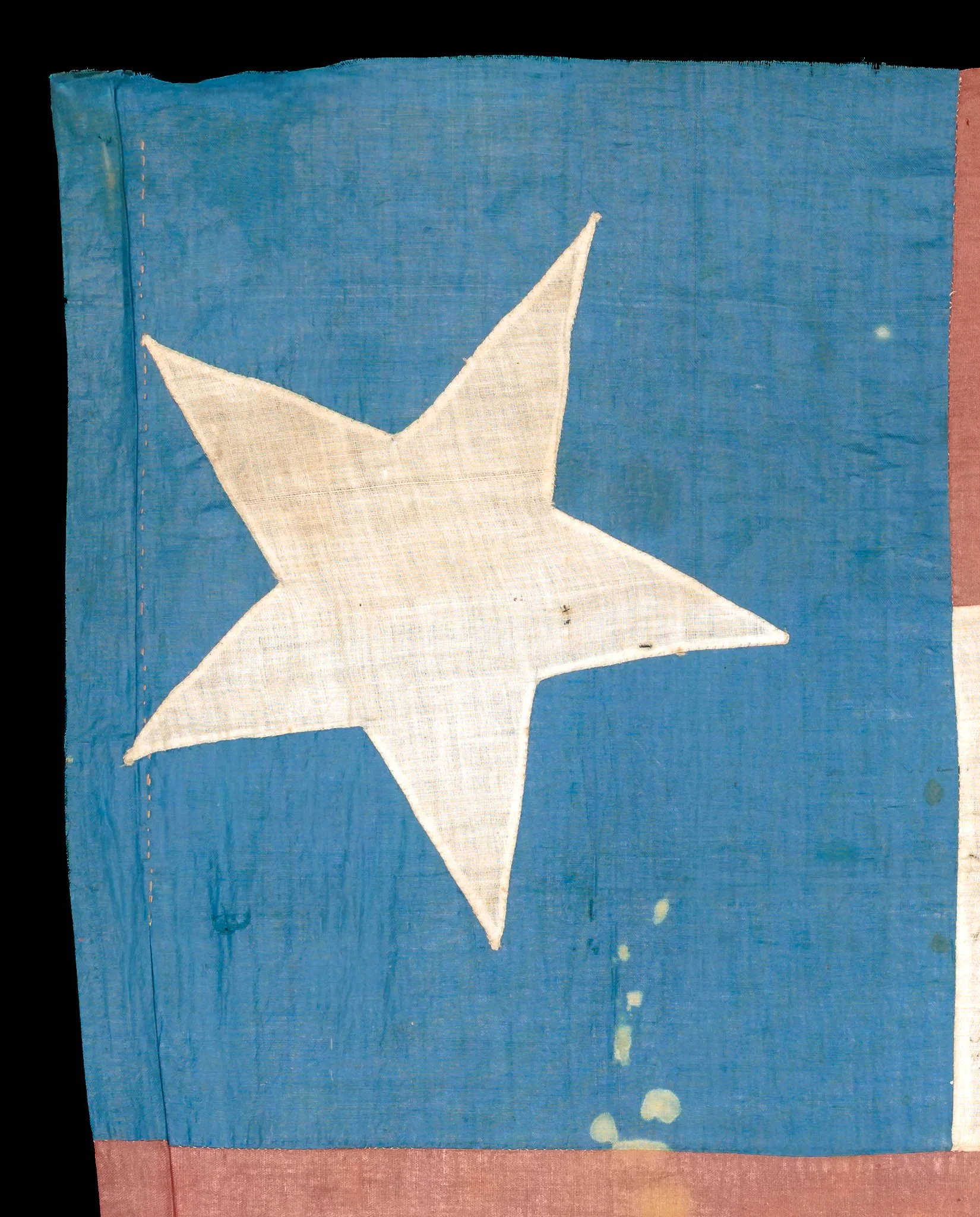
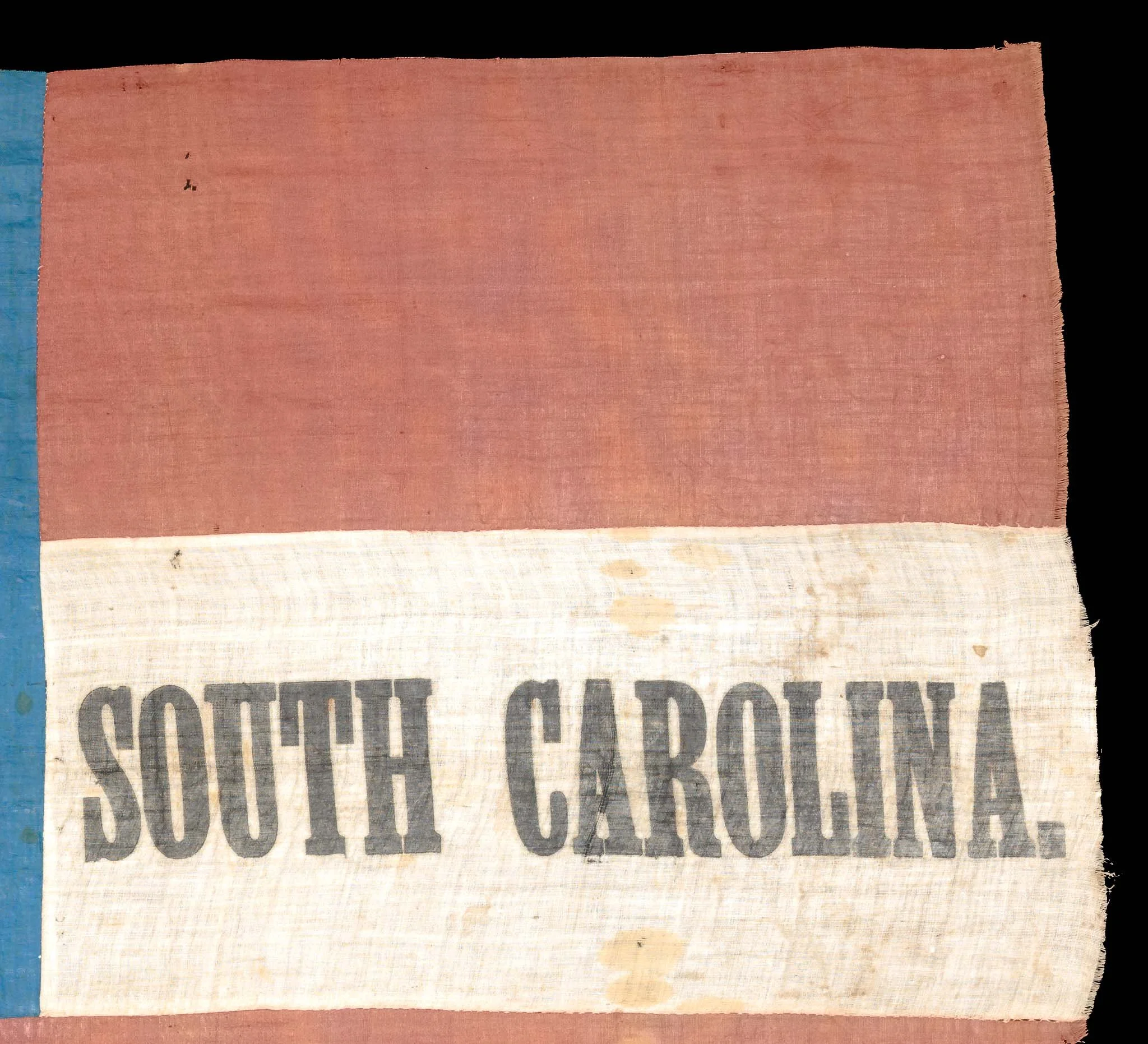
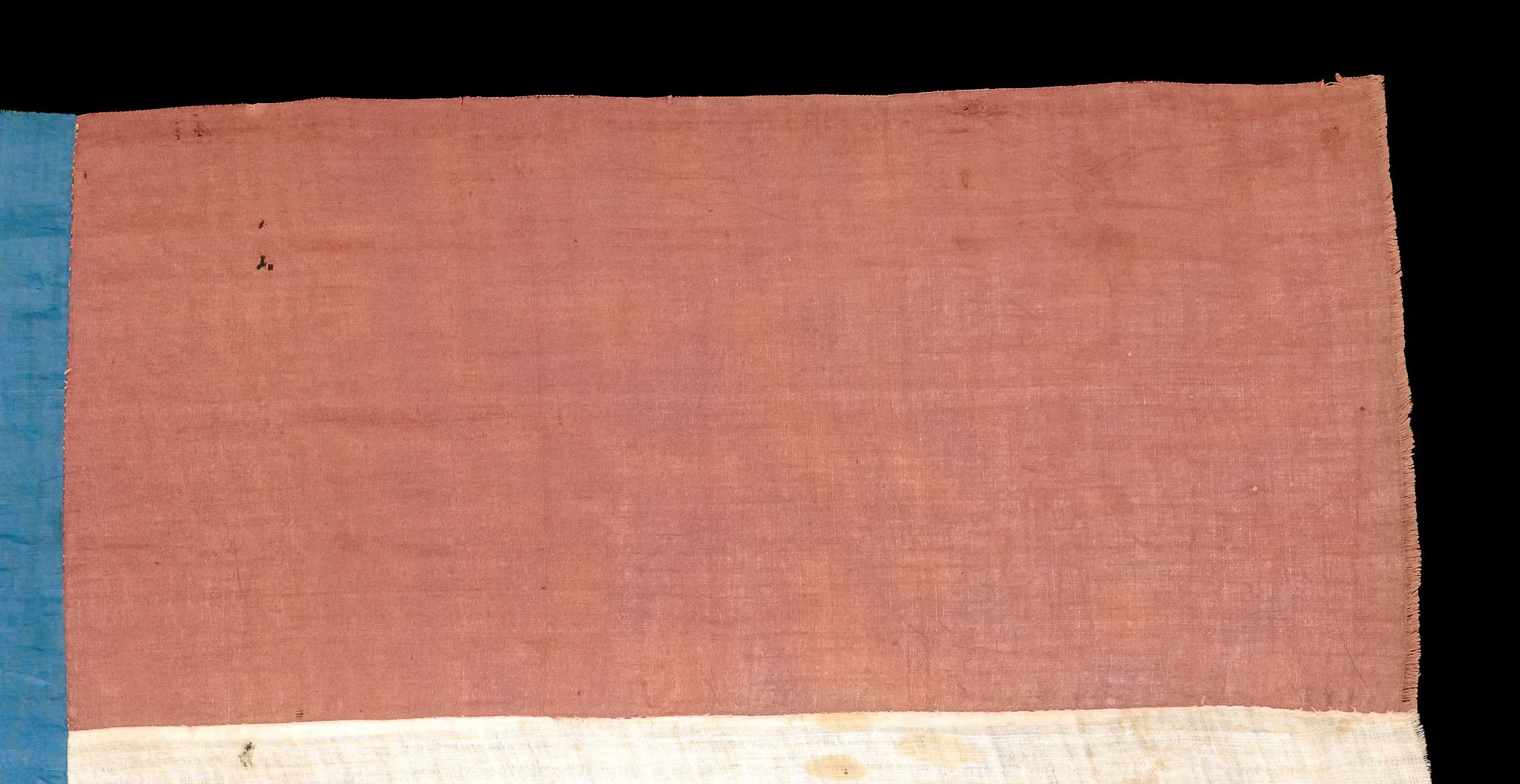
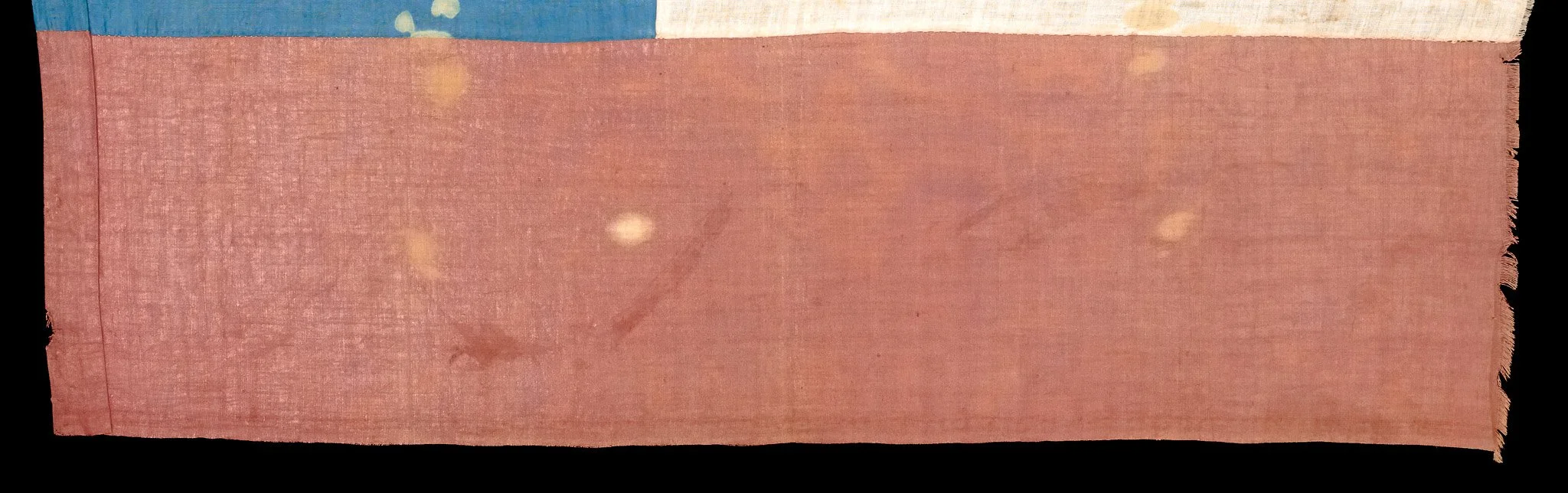
The flag itself is entirely hand-sewn and constructed of glazed cotton. Its three broad horizontal bars follow the red-white-red arrangement of the First National flag. A blue canton extends through the upper two bars and contains a single large, hand-cut white cotton star, appliquéd by hand. The star is characteristically irregular, with individually shaped points and none of the mechanical uniformity encountered on later commercially manufactured flags. SOUTH CAROLINA is printed in large black letters across the exposed portion of the white center bar. The combination of domestic hand-sewn construction with printed lettering is particularly appropriate to its intended function: the flag was individually made, while its state identity was rendered boldly enough to be immediately understood by spectators during the pageant.
Its construction also reflects the circumstances of the opening months of the war. In early 1861 there was no long-established commercial tradition for Confederate national flags. The Stars and Bars had only just been selected, and examples were being produced locally by women, military companies, civic organizations, and individual makers working from descriptions of the new design. These early flags consequently display considerable variation in their proportions, star arrangements, materials, and methods of construction. The women of Plattsburg were operating in this same environment, adapting an essentially brand-new national symbol for immediate local use.
Typically, however, a Stars and Bars displayed the full complement of stars representing the Confederate states, whether seven on the earliest examples or a greater number as additional states joined the Confederacy. The Plattsburg pageant flags were fundamentally different in purpose. Rather than representing the Confederacy collectively, each represented one of its original constituent states. The single star on Florence's flag was therefore intentional and integral to the pageant's symbolism. It represented South Carolina, and South Carolina alone.
The timing of the flag is consequently significant. The Confederate First National flag was adopted on March 4, 1861. Fort Sumter was bombarded on April 12. The Plattsburg ceremony followed in the spring and has been dated to May. The present flag was therefore made approximately two months after the Stars and Bars was adopted and within weeks of the opening shots of the Civil War. It is difficult to place a flag more squarely within the formative period of Confederate flag design.
The seven-star Stars and Bars represented the new Confederacy collectively. The present flag takes the same visual vocabulary and extracts its first member: South Carolina, represented by a single star. In the pageant, that symbolism became literal. Seven girls together represented the seven stars of the new Confederate nation, while each girl individually personified one state. The flag carried by Florence Turner was simultaneously a derivative of the Confederate First National and a South Carolina banner created for an event dramatizing the relationship between individual state sovereignty and the newly established Confederacy.
Following the exercises at the college, the procession returned to the public square in Plattsburg, where a tall flagpole had been erected. As the band played “Dixie,” the large Stars and Bars was raised over the town. Speeches followed and men and boys were encouraged to enlist. The ceremony thus concluded not simply as a symbolic demonstration but as a recruiting event for the Southern cause.
Florence's small South Carolina flag returned with her. Unlike the large presentation flag, whose eventual fate she did not know, it remained preserved. More than half a century later, Florence could still state that the South Carolina flag existed. At some point the flag passed through her family, where its association with her was sufficiently important that her descendants recorded its history in writing. That note remained with the flag.
The survival of any homemade Confederate flag from the opening weeks of the Civil War is notable. The survival of one whose original purpose, location, bearer, and circumstances of use can be reconstructed this precisely is considerably more unusual. In this instance, the object is accompanied not merely by a traditional family attribution, but by the published testimony of the woman who carried it. Florence May Turner Porter's account establishes the place, period, ceremony, design concept, participants, and survival of the South Carolina flag, while the accompanying family note reconnects that published history directly to the physical textile.
The flag consequently possesses intertwined histories in both South Carolina and Missouri. Its South Carolina symbolism reflects the state's position at the forefront of secession and the contemporary association of the single star with state sovereignty. Its Missouri history illustrates the intense sectional division that existed even in a state whose relationship with the Confederacy was far more complicated. Its association with Florence May Turner Porter preserves the experience of a particular 12-year-old girl who participated in a carefully staged political ceremony during the opening weeks of the Civil War and later left her own written account of the event.
Few surviving flags of the period can be connected this closely to the circumstances of their creation and first use. Here, the unusual features that might otherwise present questions—the single star, the SOUTH CAROLINA overprint, and the modified Stars-and-Bars design—are explained by the remarkable survival of Florence's history. One star represented one state, and one young bearer represented South Carolina in a seven-state tableau in the spring of 1861. Florence May Turner Porter's published recollection, together with the family's preservation of the flag and its accompanying note, allows that history to be recovered with exceptional specificity.
Conservation Process: The flag was hand sewn to a cotton fabric backing, which was then hand sewn to a mounting board. To prevent dye migration from the black cotton, the fabric was pre-washed and treated with a dye-setting wash prior to mounting. The flag is displayed behind Optium Museum Acrylic.
Frame: This offering is in our Large Distressed Black and Gold Frame.
Condition Report: The flag exhibits moderate fading and scattered staining and discoloration, with more pronounced spotting in the lower red bar and white center bar. There is minor fraying and small areas of loss along the fly end, together with scattered small marks and minor wear throughout. The hand-sewn construction remains intact, and the single appliquéd star and SOUTH CAROLINA overprint remain strong and readily legible.
Collectability Level: The Extraordinary – Museum Quality Offerings
Date of Origin: 1861
Associated War: Civil War (1861-1865)
Associated State: South Carolina