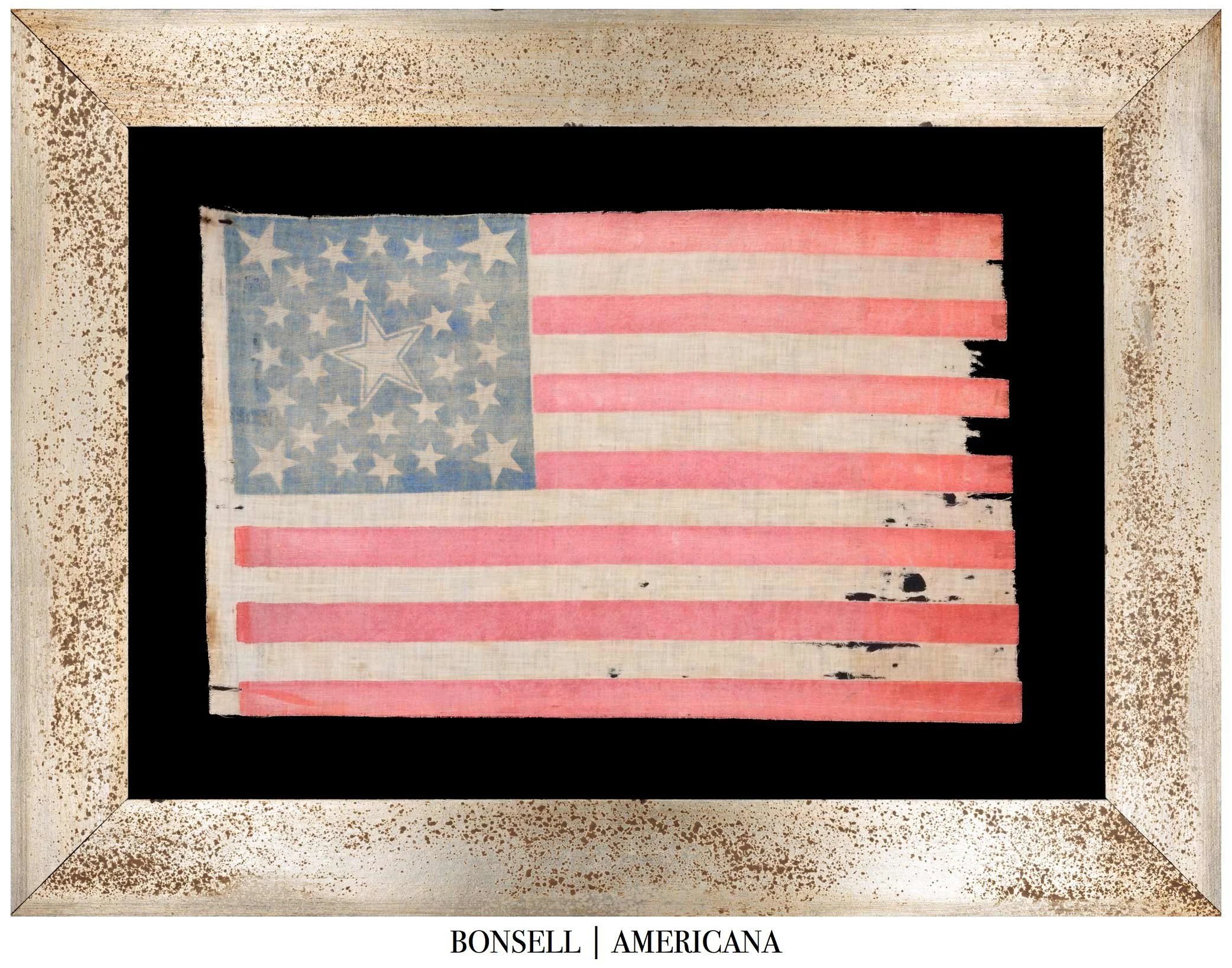
26 Star Antique American Campaign Flag | Henry Clay & Theodore Frelinghuysen | Markle & Protective Tariff Variant | Circa 1844
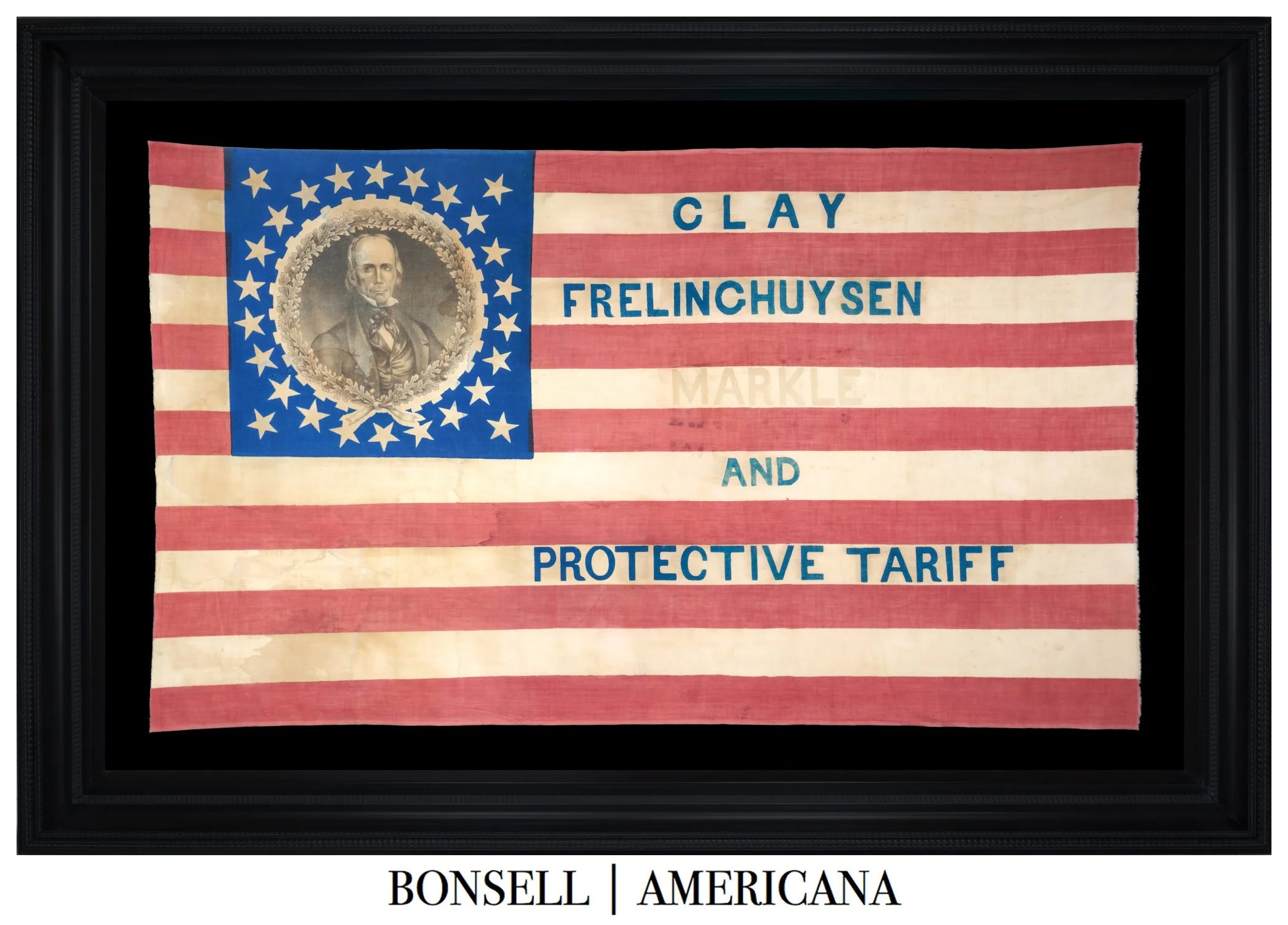
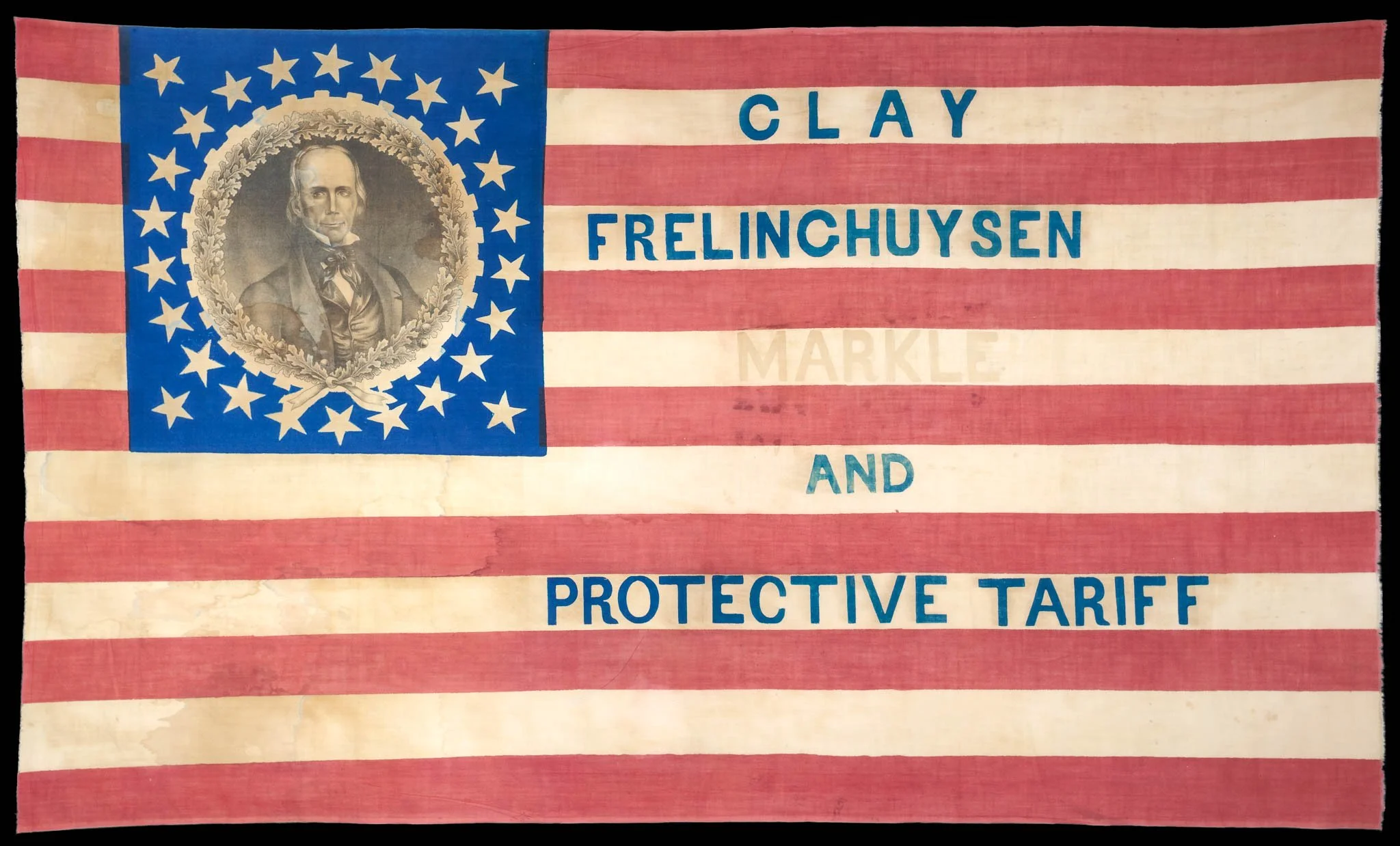


26 Star Antique American Campaign Flag | Henry Clay & Theodore Frelinghuysen | Markle & Protective Tariff Variant | Circa 1844
Frame Size (H x L): 41.5” x 64”
Flag Size (H x L): 30.75” x 52”
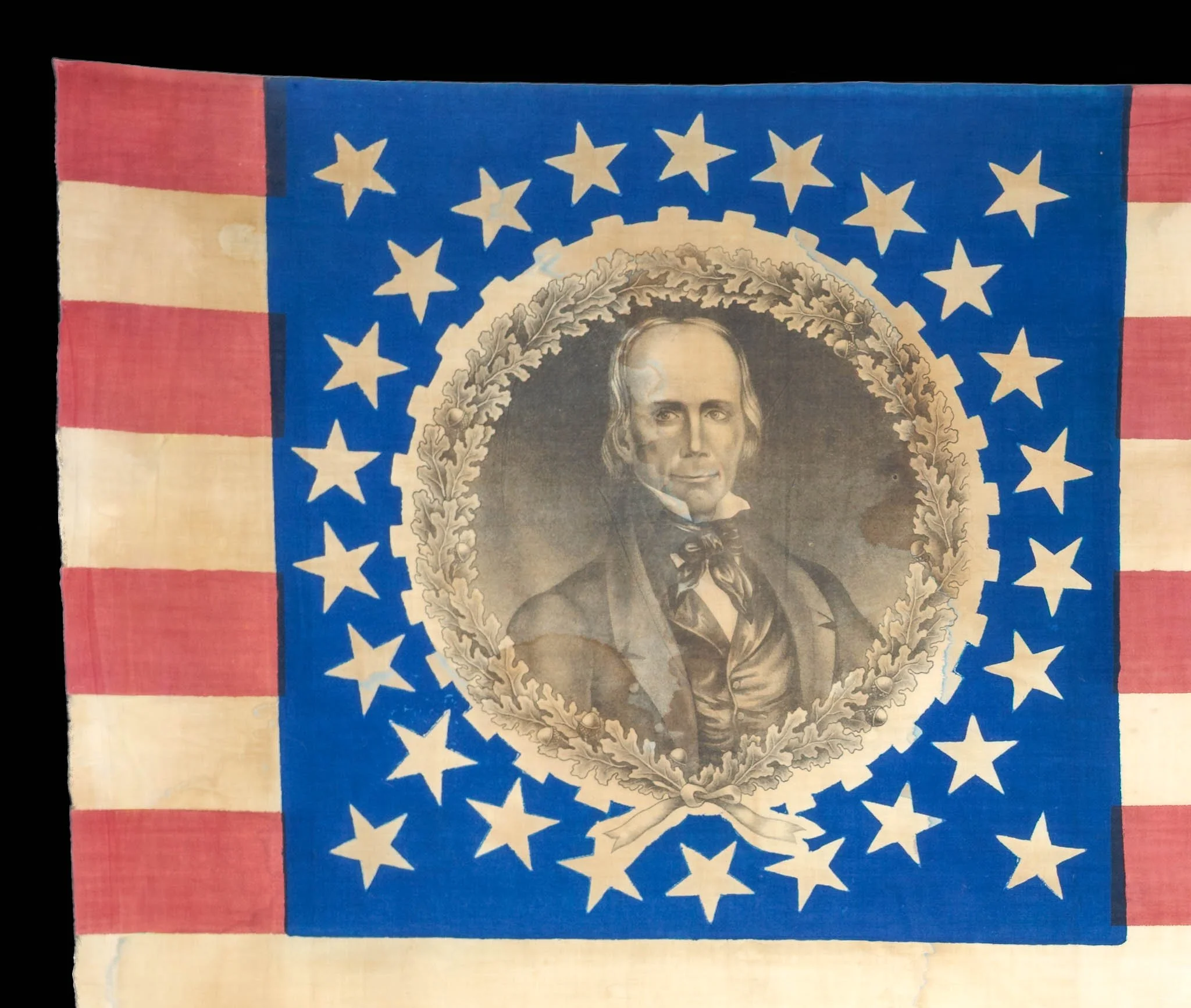
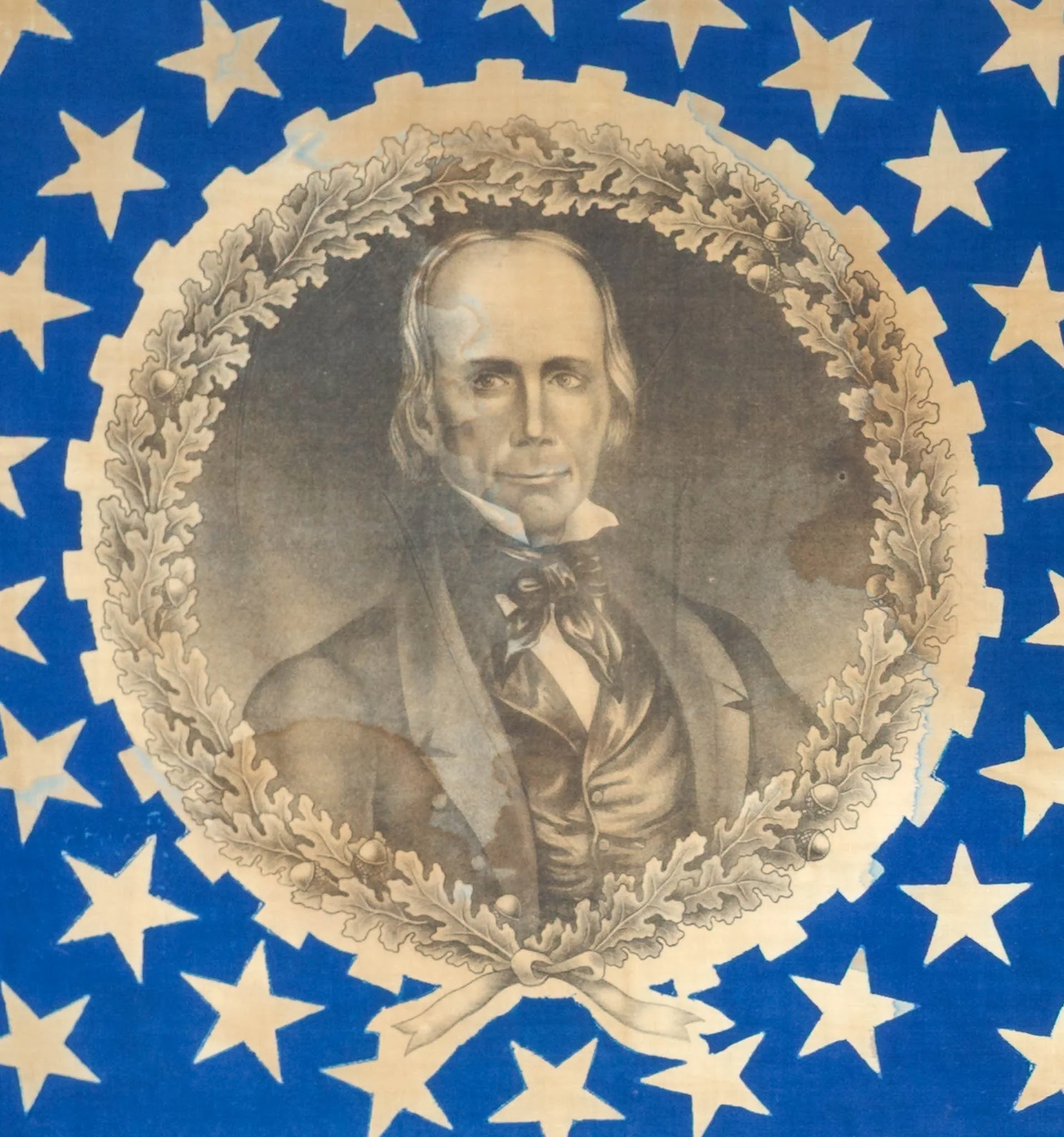
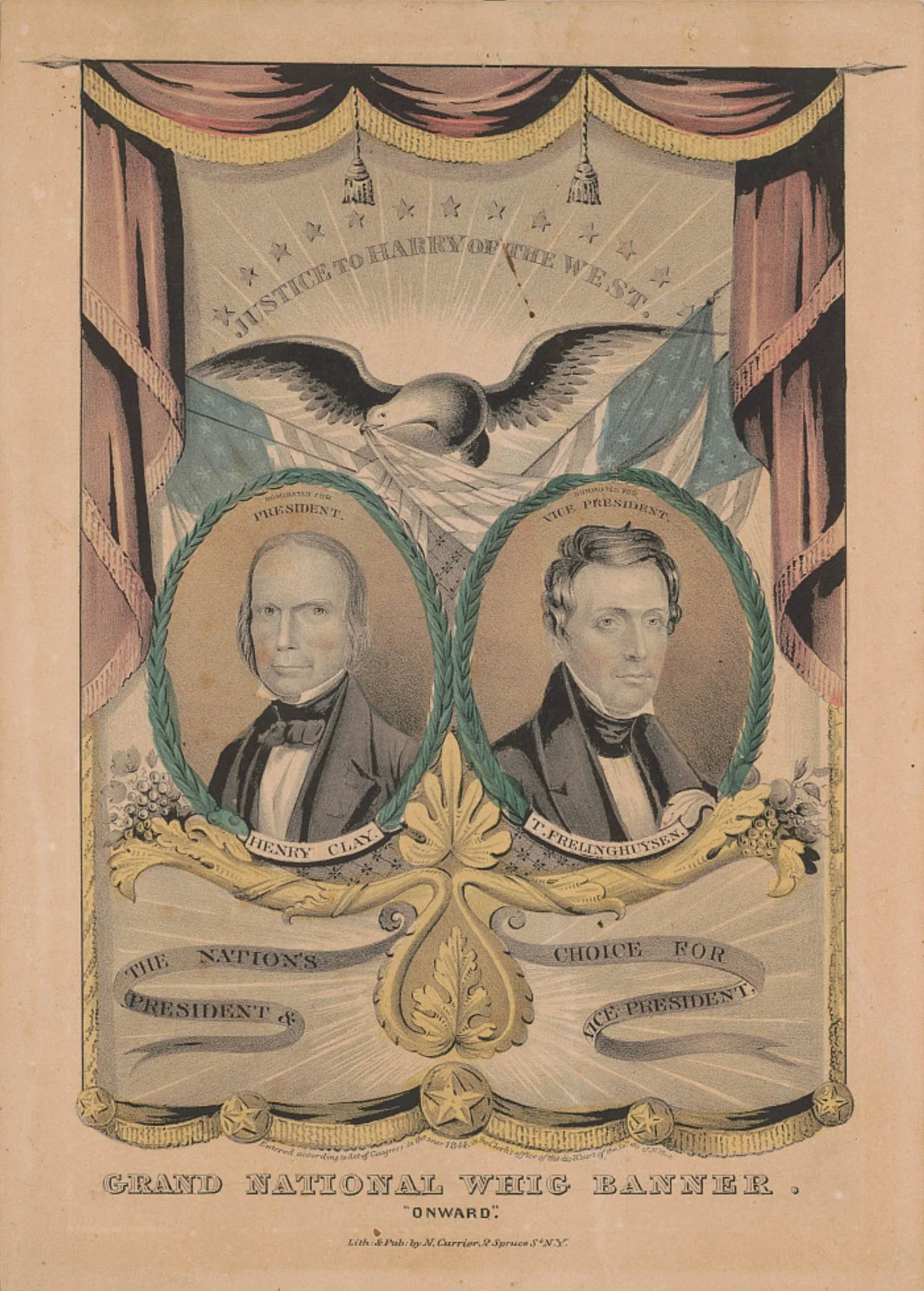
Offered is a 26-star American parade flag, printed on cotton for the 1844 presidential campaign of Whig candidate Henry Clay and his running mate Theodore Frelinghuysen. The design centers on a portrait of Clay within a medallion of 26 stars, framed by an oak-leaf wreath and gear-form border, with campaign text boldly overprinted across the striped field. Produced during the official 26-star period of the American national flag, this textile belongs to the earliest generation of printed political parade flags and represents one of the most ambitious campaign formats of the antebellum era.
The 26-star count corresponds to Michigan’s admission to the Union on January 26, 1837. The 26-star count became official on July 4 of that year and remained in effect until July 3, 1845. Flags bearing this count were contemporary to both the 1840 Harrison campaign and the pivotal 1844 contest between Clay and James K. Polk. Within this narrowly defined eight-year window, printed parade flags emerged as instruments of organized political expression, marking a transition from sewn national banners to graphic campaign textiles designed for rallies and public demonstration.
The 26-star configuration represents a precise historical moment in the evolution of the Union. It bridged the late Jacksonian period and the escalating sectional debates of the 1840s. While 13-star flags continued to be produced for commemorative purposes, the 26-star count reflected the contemporary nation and carried political significance. In campaign contexts, it reinforced legitimacy, unity, and constitutional continuity.
Equally significant is the relationship between the 26-star period and the rise of printed cotton flags. Prior to the late 1830s, most American flags were pieced and sewn from wool bunting. The development of printed cotton formats allowed for elaborate graphic programs, including portrait medallions and large-scale typography. Because such textiles were intended for outdoor political use, survival rates are inherently low. Large portrait campaign flags from this formative era therefore occupy an early and foundational position in American political material culture.
DESIGN, ICONOGRAPHY, AND PRODUCTION
The strength of this flag lies in the integration of portraiture, national symbolism, and political messaging into a unified composition.
At the center of the blue canton appears a finely rendered portrait of Henry Clay, executed in engraved copperplate style. The likeness presents Clay as composed and deliberate, emphasizing statesmanship over theatricality. The precision of the facial modeling and attire reflects a printing process of notable sophistication for a mid-nineteenth-century campaign textile.
The portrait is enclosed within a wreath of oak leaves and acorns, tied at the base with a ribbon. Surrounding this device is a medallion of 26-stars arranged in even radial spacing. Encircling the wreath is a gear-form border, visually reinforcing Clay’s economic program and advocacy of industrial development under the American System.
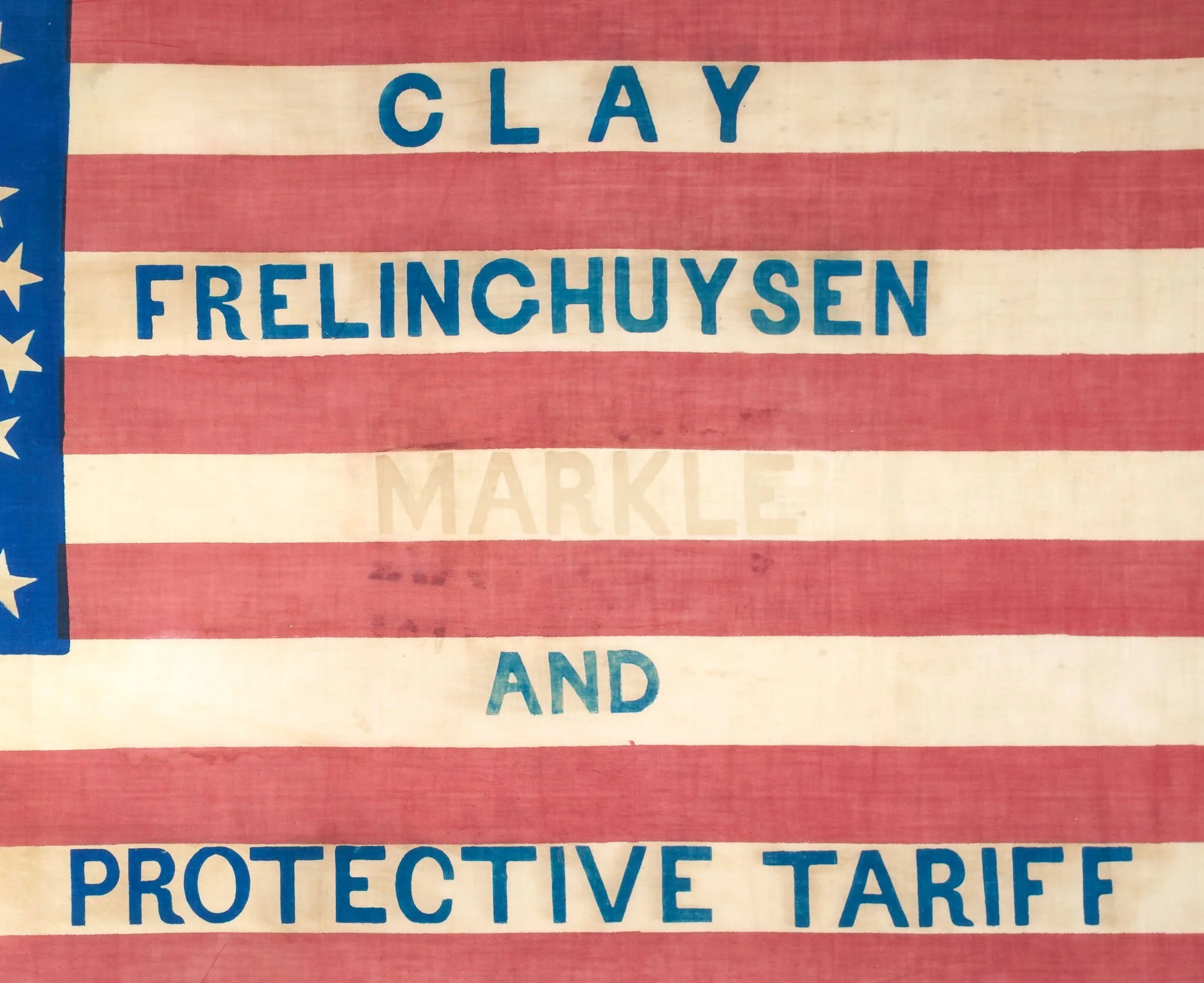
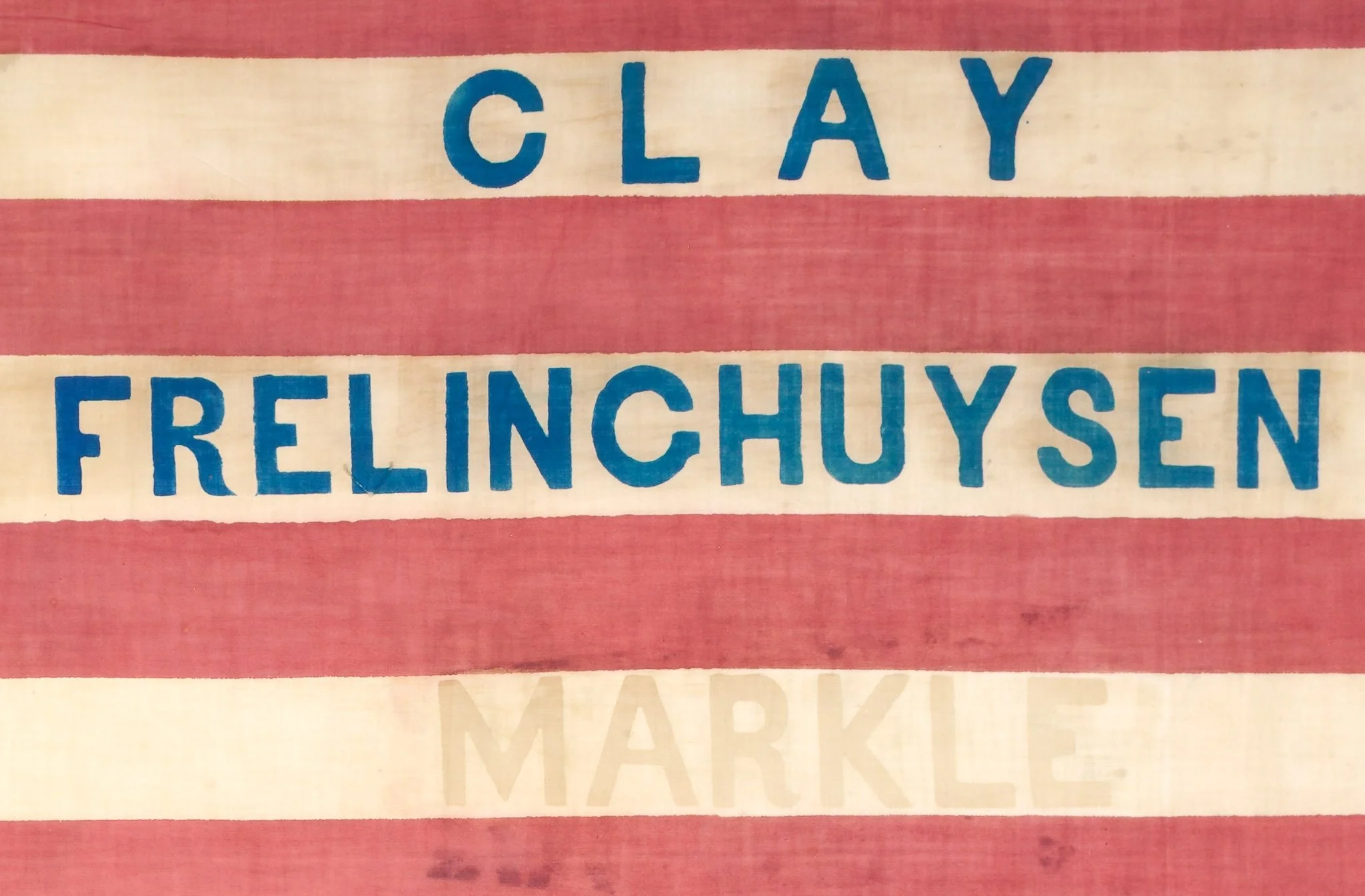
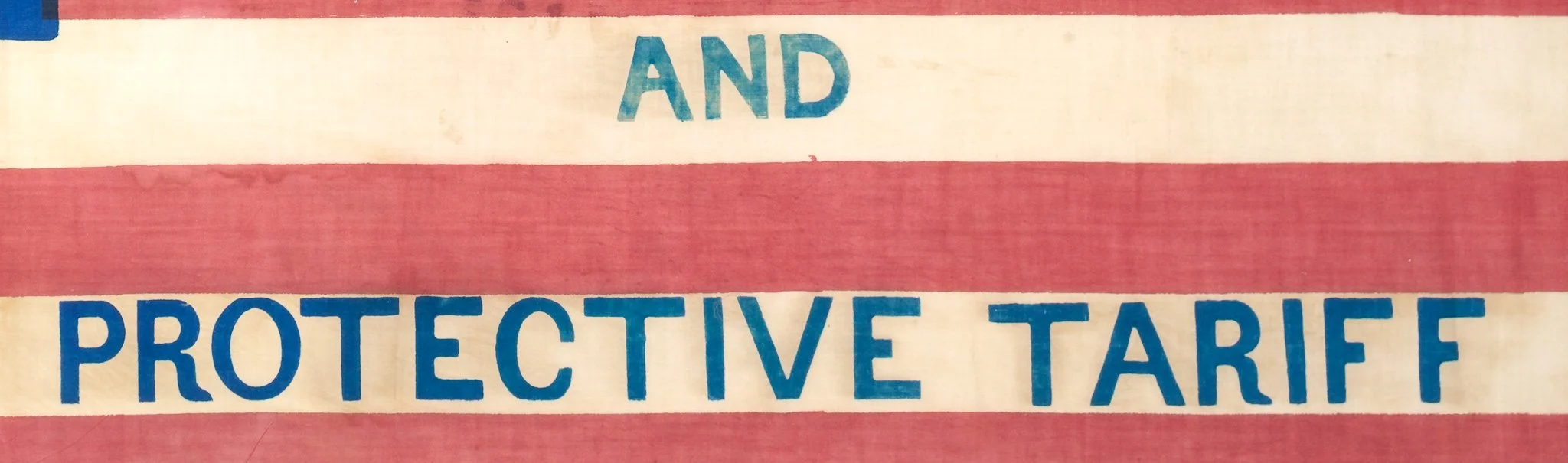
Across the striped field appear the overprinted words:
CLAY
FRELINGHUYSEN
MARKLE
AND
PROTECTIVE TARIFF
The inclusion of “MARKLE” identifies this example as the Pennsylvania variant of the design. Joseph Markle was the Whig candidate for governor of Pennsylvania in 1844, and his addition to the flag reflects coordinated state and national campaigning within a crucial electoral state.
The “MARKLE” overprint appears faint relative to the surrounding text. This likely reflects the mechanics of mid-nineteenth-century textile printing. The base design may have been produced first, with regional candidates added in a subsequent phase. Variations in ink density, plate wear, or printing pressure could result in lighter impressions. The existence of multiple overprint configurations within this production family supports such a modular printing strategy.
Importantly, this design and its related variants are documented in Threads of History: Americana Recorded by the Smithsonian Institution, the seminal 1979 study by Herbert Ridgeway Collins. Examples of the Clay portrait medallion format, including both name-only and tariff variants, are illustrated therein and are held in institutional collections such as the Smithsonian and West Point Museum. The documentation of this format within that reference confirms both its historical authenticity and its recognized place within the corpus of early American political textiles.
Surviving examples reveal that the core portrait medallion design remained consistent, while textual elements were adapted for differing political and geographic contexts. Known variants include name-only versions, examples incorporating “Protective Tariff,” Pennsylvania forms adding “Markle,” Delaware versions including “Stockton” and “Houston,” and related Polk and Dallas adaptations. The present configuration—combining presidential, vice-presidential, gubernatorial, and policy messaging—represents one of the most textually comprehensive forms within the group.
THE 1844 ELECTION AND THE AMERICAN SYSTEM
The presidential election of 1844 was among the most consequential of the antebellum era. Henry Clay (1777–1852), often referred to as the “Great Compromiser,” was one of the most influential American statesmen of his generation. Born in Virginia and later associated with Kentucky, Clay served as Speaker of the House, United States Senator, and Secretary of State. He played central roles in the Missouri Compromise of 1820 and the Compromise of 1850. By 1844, he was widely regarded as a figure of national stature and institutional continuity.
Theodore Frelinghuysen (1787–1862), Clay’s running mate, was a New Jersey senator known for his opposition to Andrew Jackson’s Indian removal policies and for his alignment with reform constituencies. His presence on the ticket balanced Clay geographically and ideologically.
Central to Clay’s platform was the protective tariff. Designed to shield American manufacturers from foreign competition, the tariff imposed duties on imported goods to encourage domestic production. Clay believed that a diversified industrial economy would strengthen national independence and foster internal development. The protective tariff formed a cornerstone of his American System, which also included federal support for infrastructure and a stable national banking framework.
In industrial states such as Pennsylvania, tariff protection was politically potent. The explicit inclusion of “Protective Tariff” on this flag underscores its electoral importance. While tariffs did stimulate industrial growth in certain regions, they were controversial and contributed to sectional tension. By 1844, the tariff debate symbolized broader disagreements about the nation’s economic direction.
Clay’s opponent, James K. Polk, campaigned on territorial expansion. Expansionist sentiment ultimately proved decisive, and Polk’s victory accelerated territorial enlargement while intensifying sectional divisions. Within this political climate, campaign textiles such as this flag functioned as instruments of persuasion and spectacle. Large portrait banners were designed to unify supporters visually and project allegiance unmistakably in public demonstrations.
SCALE, SURVIVAL, AND HISTORICAL SIGNIFICANCE
Large-format printed political flags from the 1840s are inherently uncommon. Their size, cotton construction, and exposure to outdoor conditions significantly reduced survival rates.
Printed pigments were susceptible to fading, and white cotton grounds readily absorbed staining and moisture. As a result, well-preserved examples of early portrait campaign flags are scarce. Moreover, the 26-star portrait format predates the mass patriotic textile production of the Civil War by nearly two decades, placing it within an early stage of American political graphic design.
Few nineteenth-century political textiles combine a contemporary national star count, engraved presidential portrait, explicit economic messaging, and coordinated state-level overprint within a single integrated composition. Documented in Threads of History and represented in institutional collections, this format occupies a recognized position within early American political material culture.
It stands as both a visually compelling banner and a primary artifact of organized political communication in the antebellum United States.
Conservation Process: The flag was hand sewn to a cotton fabric backing, which was then hand sewn to a mounting board. To prevent dye migration from the black cotton, the fabric was pre-washed and treated with a dye-setting wash prior to mounting. The flag is displayed behind Optium Museum Acrylic.
Frame: The frame features a dramatic scoop profile in a deep Dutch black finish, with a curved inner cove that creates pronounced shadow and depth. A subtle ripple detail along the inner edge adds texture and refinement, while the stepped outer molding lends architectural structure.
Condition Report: The flag retains strong color throughout, with a vivid blue canton and bold red striping. There is moderate, even toning to the white cotton ground, accompanied by scattered areas of light staining, most noticeable in the lower stripes and within portions of the portrait field. The “MARKLE” overprint appears faint relative to the surrounding text, consistent with the printing characteristics discussed above. Minor surface creasing and age-related wear are present, but the textile remains structurally sound and displays with excellent clarity and impact. Compared with examples that have surfaced through major dealers and auction houses, this is a notably strong and comparatively clean survivor within the known group.
Collectability Level: The Extraordinary – Museum Quality Offerings
Date of Origin: 1844
Number of Stars: 26
Associated State: Michigan