Rare 35 Star Parade Flag | Folksy Medallion Configuration | Civil War Period | West Virginia Statehood | Circa 1863–1865
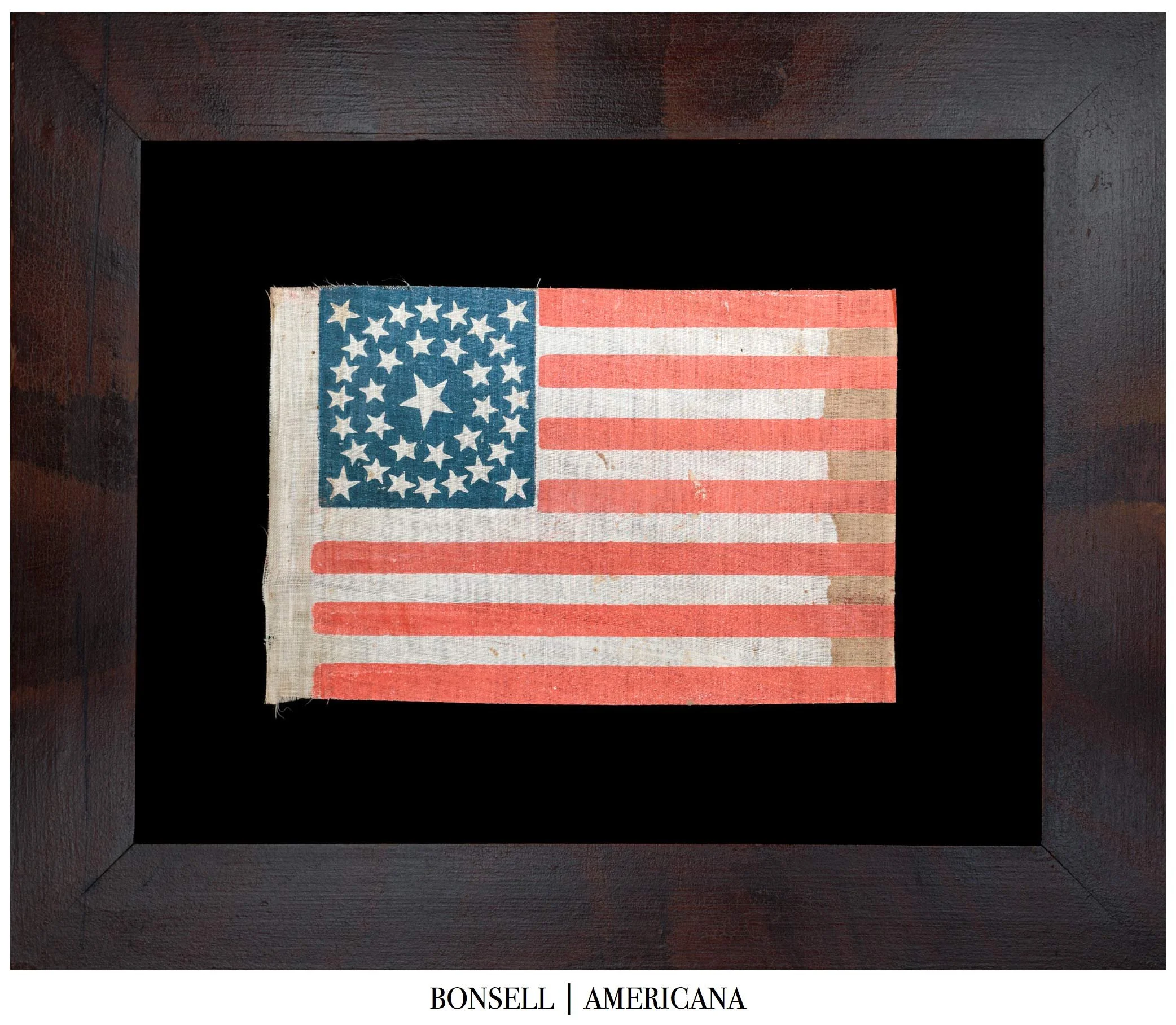
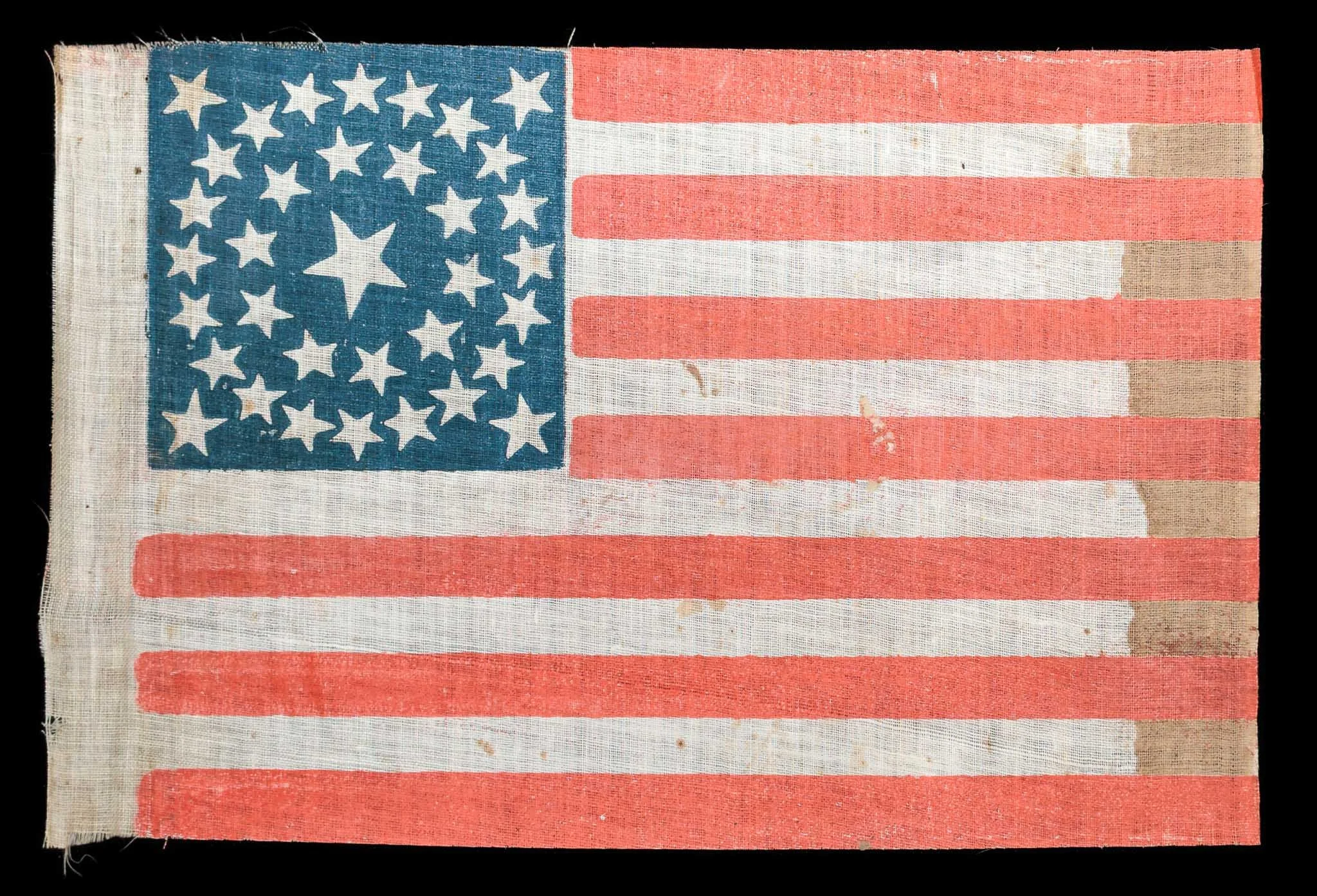
Rare 35 Star Parade Flag | Folksy Medallion Configuration | Civil War Period | West Virginia Statehood | Circa 1863–1865
Frame Size (H x L): 14.5” x 17.5”
Flag Size (H x L): 6.5” x 9.75”
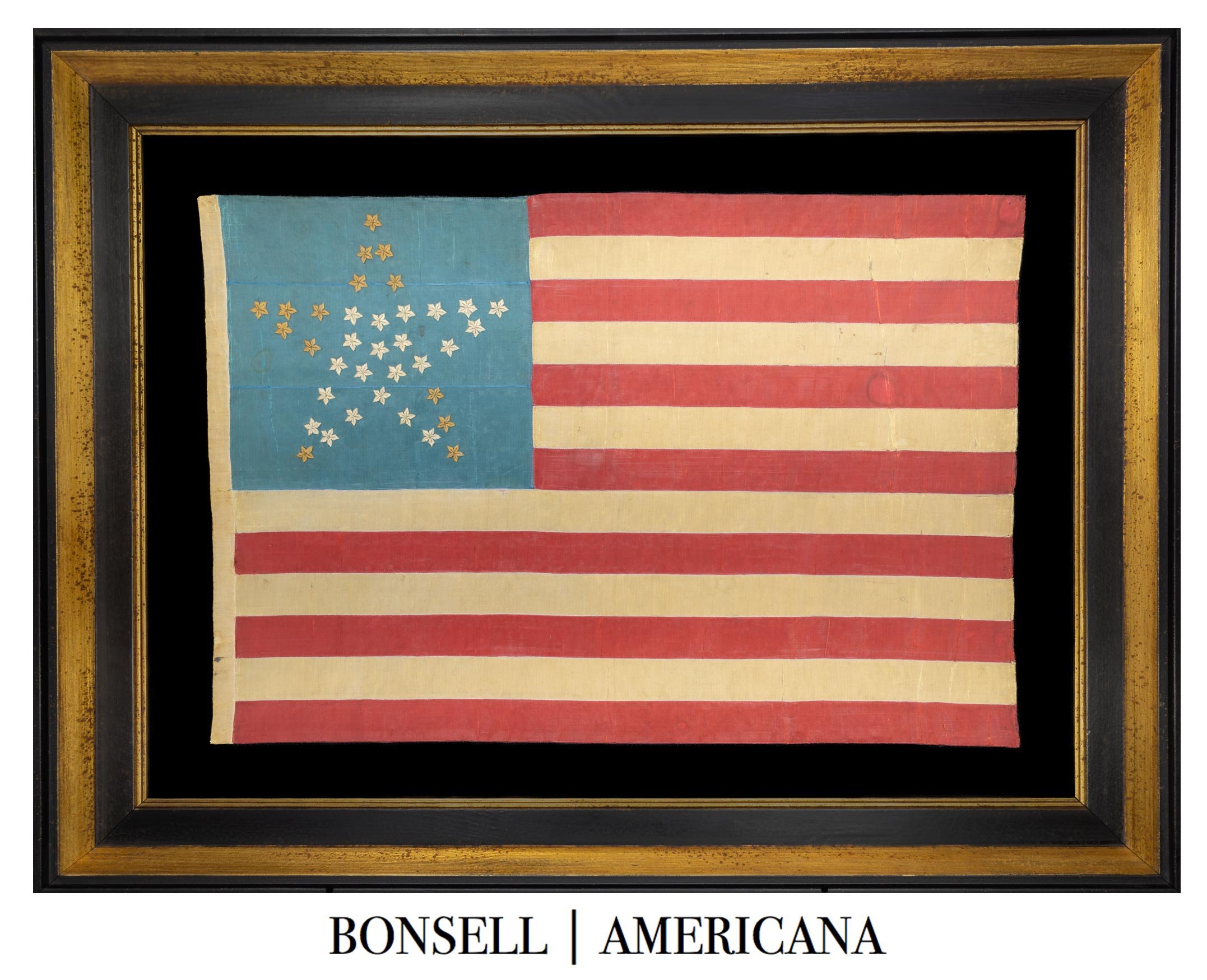
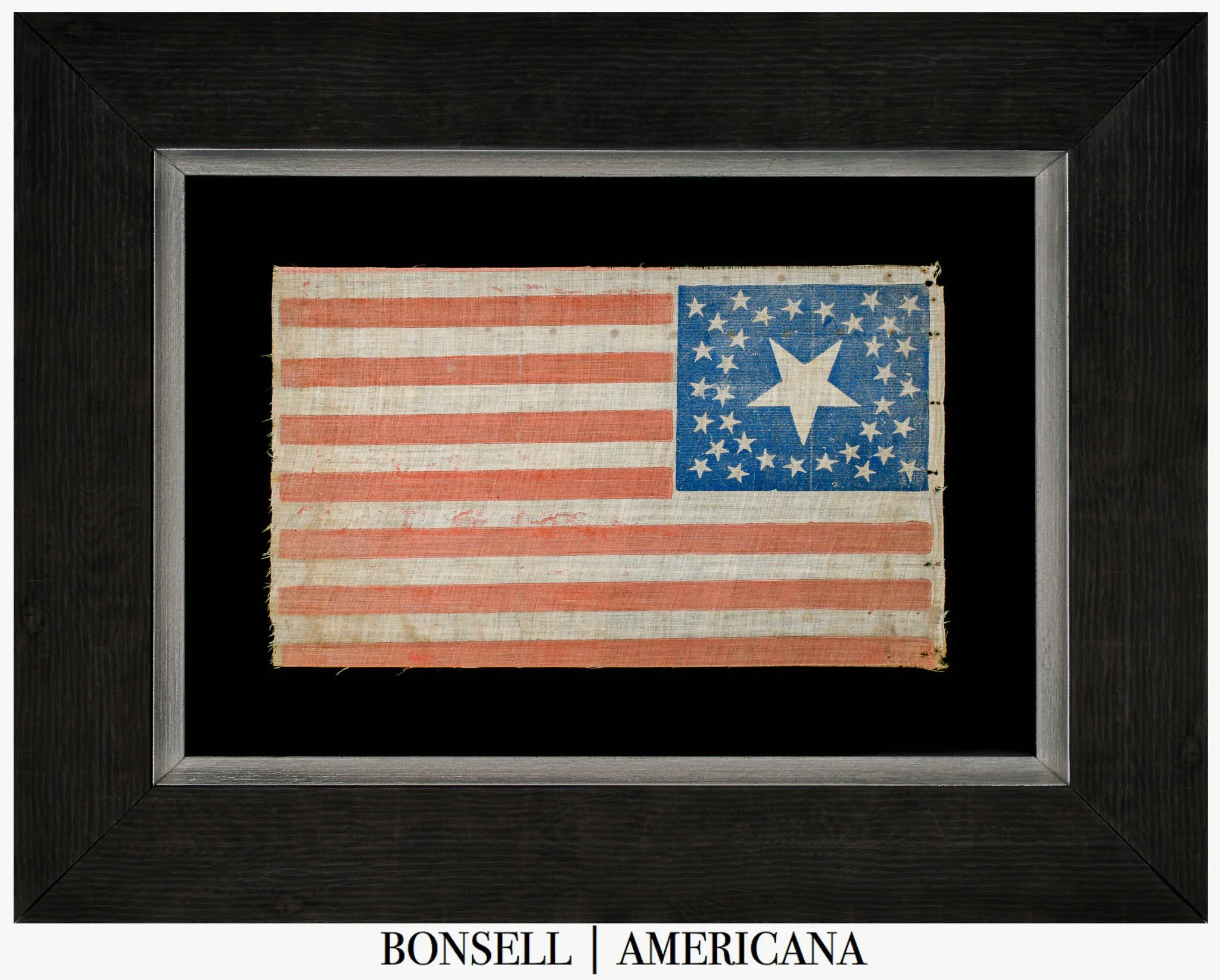
Offered is a 35-star American national flag, printed on glazed cotton and dating to the height of the Civil War. The stars are arranged in a striking medallion configuration that is among the most visually compelling of all 19th century parade flag designs. At the center of the canton is a large “center star,” canted toward the 11:00 position, representing the newest state admitted to the Union: West Virginia. Encircling the center star are two concentric wreaths of smaller stars, while four additional stars occupy the corners of the canton, framing the design in balanced and highly decorative fashion.
The stars themselves possess an especially memorable appearance. Sharp, elongated points and irregular, hand-drawn geometry lend them a distinctly folksy character, while their tight arrangement within the canton creates a sense of movement and energy uncommon among printed parade flags of the period. Though the maker of this particular example remains unidentified, the unusual star shapes and overall presentation are associated with a very small and recognizable family of flags believed to have originated from the same workshop. Flags of this style are known in just six star counts: 7-star, 13-star, 15-star, 29-star, 33-star, and 35-star varieties.
Each appears to have been produced to commemorate a specific historical milestone or patriotic theme. The 7-star examples celebrated the first seven Southern states to secede from the Union. The 13-star versions paid homage to the original colonies. The 15-star flags were likely produced in conjunction with the centennial celebration of Kentucky statehood. The 29-star, 33-star, and 35-star examples marked the admission of Iowa, Oregon, and West Virginia, respectively, with the oversized center star serving as a visual tribute to the newest state represented on the flag. Among all known examples from this maker, the 35-star variety is by far the rarest. Surviving examples are exceptionally limited, with perhaps fewer than ten presently known.
The 35-star flag officially represents the admission of West Virginia to the Union on June 20th, 1863. In one of the most extraordinary episodes in American political history, West Virginia was formed amid the turmoil of the Civil War itself. Following Virginia’s decision to secede from the Union in 1861, delegates from the northwestern counties opposed the move and established a separate pro-Union government. After a complicated legal and political process, the new state of West Virginia was admitted to the Union under President Abraham Lincoln, becoming the only state created directly out of a Confederate state during the war.
Under the Flag Act of 1818, newly admitted states were officially recognized on the national flag on the July 4th following admission. As a result, the 35-star flag became official on July 4th, 1863, less than two weeks after West Virginia entered the Union. It remained official until July 3rd, 1865, when the 36-star flag succeeded it following Nevada statehood. Because of this narrow official window—approximately two years—and because massive quantities of patriotic textiles had already been produced in 1861 and 1862 at the outbreak of the war, comparatively few 35-star flags were made.
The 35-star count occupies a singular place in American vexillological history. It is the only official star count both added and used entirely during the Civil War itself. As such, 35-star flags hold a special fascination for collectors, combining direct wartime association with great rarity and one of the most attractive medallion configurations encountered in 19th century American flag-making.
Conservation Process: This flag was hand sewn to cotton fabric, and both were hand sewn to a mounting board. To prevent the black dye in the cotton fabric from seeping into the flag, it was first washed in a standard wash and then in a dye setting wash. The flag is positioned behind Optium Museum Acrylic.
Frame: The flag has been placed in an American flame grain painted frame, dating to 1840. The surface displays strong faux-grained decoration with rich tonal variation and a warm, aged patina that pairs well with the Civil War-era textile.
Condition Report: The flag shows moderate to significant wear consistent with its Civil War period origin and use. Most notable is a band of brown discoloration along the fly end, concentrated primarily within the white stripes, likely the result of long-term storage while rolled, where the exposed outer surface absorbed environmental staining over time. There is minor scattered foxing and soiling throughout, accompanied by modest fabric breakdown and edge fraying, all of which contribute to the flag’s authentic early appearance and character.
Collectability Level: The Best – Perfect for Advanced Collectors
Date of Origin: 1863-1865
Number of Stars: 35
Associated War: Civil War (1861-1865)
Associated State: West Virginia